Spandidos Publications Logo
  • About
    • About Spandidos
    • Aims and Scopes
    • Abstracting and Indexing
    • Editorial Policies
    • Reprints and Permissions
    • Job Opportunities
    • Terms and Conditions
    • Contact
  • Journals
    • All Journals
    • Oncology Letters
      • Oncology Letters
      • Information for Authors
      • Editorial Policies
      • Editorial Board
      • Aims and Scope
      • Abstracting and Indexing
      • Bibliographic Information
      • Archive
    • International Journal of Oncology
      • International Journal of Oncology
      • Information for Authors
      • Editorial Policies
      • Editorial Board
      • Aims and Scope
      • Abstracting and Indexing
      • Bibliographic Information
      • Archive
    • Molecular and Clinical Oncology
      • Molecular and Clinical Oncology
      • Information for Authors
      • Editorial Policies
      • Editorial Board
      • Aims and Scope
      • Abstracting and Indexing
      • Bibliographic Information
      • Archive
    • Experimental and Therapeutic Medicine
      • Experimental and Therapeutic Medicine
      • Information for Authors
      • Editorial Policies
      • Editorial Board
      • Aims and Scope
      • Abstracting and Indexing
      • Bibliographic Information
      • Archive
    • International Journal of Molecular Medicine
      • International Journal of Molecular Medicine
      • Information for Authors
      • Editorial Policies
      • Editorial Board
      • Aims and Scope
      • Abstracting and Indexing
      • Bibliographic Information
      • Archive
    • Biomedical Reports
      • Biomedical Reports
      • Information for Authors
      • Editorial Policies
      • Editorial Board
      • Aims and Scope
      • Abstracting and Indexing
      • Bibliographic Information
      • Archive
    • Oncology Reports
      • Oncology Reports
      • Information for Authors
      • Editorial Policies
      • Editorial Board
      • Aims and Scope
      • Abstracting and Indexing
      • Bibliographic Information
      • Archive
    • Molecular Medicine Reports
      • Molecular Medicine Reports
      • Information for Authors
      • Editorial Policies
      • Editorial Board
      • Aims and Scope
      • Abstracting and Indexing
      • Bibliographic Information
      • Archive
    • World Academy of Sciences Journal
      • World Academy of Sciences Journal
      • Information for Authors
      • Editorial Policies
      • Editorial Board
      • Aims and Scope
      • Abstracting and Indexing
      • Bibliographic Information
      • Archive
    • International Journal of Functional Nutrition
      • International Journal of Functional Nutrition
      • Information for Authors
      • Editorial Policies
      • Editorial Board
      • Aims and Scope
      • Abstracting and Indexing
      • Bibliographic Information
      • Archive
    • International Journal of Epigenetics
      • International Journal of Epigenetics
      • Information for Authors
      • Editorial Policies
      • Editorial Board
      • Aims and Scope
      • Abstracting and Indexing
      • Bibliographic Information
      • Archive
    • Medicine International
      • Medicine International
      • Information for Authors
      • Editorial Policies
      • Editorial Board
      • Aims and Scope
      • Abstracting and Indexing
      • Bibliographic Information
      • Archive
  • Articles
  • Information
    • Information for Authors
    • Information for Reviewers
    • Information for Librarians
    • Information for Advertisers
    • Conferences
  • Language Editing
Spandidos Publications Logo
  • About
    • About Spandidos
    • Aims and Scopes
    • Abstracting and Indexing
    • Editorial Policies
    • Reprints and Permissions
    • Job Opportunities
    • Terms and Conditions
    • Contact
  • Journals
    • All Journals
    • Biomedical Reports
      • Information for Authors
      • Editorial Policies
      • Editorial Board
      • Aims and Scope
      • Abstracting and Indexing
      • Bibliographic Information
      • Archive
    • Experimental and Therapeutic Medicine
      • Information for Authors
      • Editorial Policies
      • Editorial Board
      • Aims and Scope
      • Abstracting and Indexing
      • Bibliographic Information
      • Archive
    • International Journal of Epigenetics
      • Information for Authors
      • Editorial Policies
      • Editorial Board
      • Aims and Scope
      • Abstracting and Indexing
      • Bibliographic Information
      • Archive
    • International Journal of Functional Nutrition
      • Information for Authors
      • Editorial Policies
      • Editorial Board
      • Aims and Scope
      • Abstracting and Indexing
      • Bibliographic Information
      • Archive
    • International Journal of Molecular Medicine
      • Information for Authors
      • Editorial Policies
      • Editorial Board
      • Aims and Scope
      • Abstracting and Indexing
      • Bibliographic Information
      • Archive
    • International Journal of Oncology
      • Information for Authors
      • Editorial Policies
      • Editorial Board
      • Aims and Scope
      • Abstracting and Indexing
      • Bibliographic Information
      • Archive
    • Medicine International
      • Information for Authors
      • Editorial Policies
      • Editorial Board
      • Aims and Scope
      • Abstracting and Indexing
      • Bibliographic Information
      • Archive
    • Molecular and Clinical Oncology
      • Information for Authors
      • Editorial Policies
      • Editorial Board
      • Aims and Scope
      • Abstracting and Indexing
      • Bibliographic Information
      • Archive
    • Molecular Medicine Reports
      • Information for Authors
      • Editorial Policies
      • Editorial Board
      • Aims and Scope
      • Abstracting and Indexing
      • Bibliographic Information
      • Archive
    • Oncology Letters
      • Information for Authors
      • Editorial Policies
      • Editorial Board
      • Aims and Scope
      • Abstracting and Indexing
      • Bibliographic Information
      • Archive
    • Oncology Reports
      • Information for Authors
      • Editorial Policies
      • Editorial Board
      • Aims and Scope
      • Abstracting and Indexing
      • Bibliographic Information
      • Archive
    • World Academy of Sciences Journal
      • Information for Authors
      • Editorial Policies
      • Editorial Board
      • Aims and Scope
      • Abstracting and Indexing
      • Bibliographic Information
      • Archive
  • Articles
  • Information
    • For Authors
    • For Reviewers
    • For Librarians
    • For Advertisers
    • Conferences
  • Language Editing
Login Register Submit
  • This site uses cookies
  • You can change your cookie settings at any time by following the instructions in our Cookie Policy. To find out more, you may read our Privacy Policy.

    I agree
Search articles by DOI, keyword, author or affiliation
Search
Advanced Search
presentation
Molecular and Clinical Oncology
Join Editorial Board Propose a Special Issue
Print ISSN: 2049-9450 Online ISSN: 2049-9469
Journal Cover
June-2021 Volume 14 Issue 6

Full Size Image

Sign up for eToc alerts
Recommend to Library

Journals

International Journal of Molecular Medicine

International Journal of Molecular Medicine

International Journal of Molecular Medicine is an international journal devoted to molecular mechanisms of human disease.

International Journal of Oncology

International Journal of Oncology

International Journal of Oncology is an international journal devoted to oncology research and cancer treatment.

Molecular Medicine Reports

Molecular Medicine Reports

Covers molecular medicine topics such as pharmacology, pathology, genetics, neuroscience, infectious diseases, molecular cardiology, and molecular surgery.

Oncology Reports

Oncology Reports

Oncology Reports is an international journal devoted to fundamental and applied research in Oncology.

Experimental and Therapeutic Medicine

Experimental and Therapeutic Medicine

Experimental and Therapeutic Medicine is an international journal devoted to laboratory and clinical medicine.

Oncology Letters

Oncology Letters

Oncology Letters is an international journal devoted to Experimental and Clinical Oncology.

Biomedical Reports

Biomedical Reports

Explores a wide range of biological and medical fields, including pharmacology, genetics, microbiology, neuroscience, and molecular cardiology.

Molecular and Clinical Oncology

Molecular and Clinical Oncology

International journal addressing all aspects of oncology research, from tumorigenesis and oncogenes to chemotherapy and metastasis.

World Academy of Sciences Journal

World Academy of Sciences Journal

Multidisciplinary open-access journal spanning biochemistry, genetics, neuroscience, environmental health, and synthetic biology.

International Journal of Functional Nutrition

International Journal of Functional Nutrition

Open-access journal combining biochemistry, pharmacology, immunology, and genetics to advance health through functional nutrition.

International Journal of Epigenetics

International Journal of Epigenetics

Publishes open-access research on using epigenetics to advance understanding and treatment of human disease.

Medicine International

Medicine International

An International Open Access Journal Devoted to General Medicine.

Journal Cover
June-2021 Volume 14 Issue 6

Full Size Image

Sign up for eToc alerts
Recommend to Library

  • Article
  • Citations
    • Cite This Article
    • Download Citation
    • Create Citation Alert
    • Remove Citation Alert
    • Cited By
  • Similar Articles
    • Related Articles (in Spandidos Publications)
    • Similar Articles (Google Scholar)
    • Similar Articles (PubMed)
  • Download PDF
  • Download XML
  • View XML
Case Report Open Access

COVID‑19 in a patient receiving adjuvant breast cancer chemotherapy with granulocyte olony‑stimulating factor (G‑CSF) support: A case report

  • Authors:
    • Rinat Yerushalmi
    • Moshe Sagi
    • Hadar Goldvaser
    • Jonathan Daliot
    • Raz Mutai
    • Ilan Krause
  • View Affiliations / Copyright

    Affiliations: Institute of Oncology, Davidoff Cancer Center, Beilinson Hospital, Petach Tikva 49100, Israel, Department of Internal Medicine F, Rabin Medical Center‑Beilinson Hospital, Petach Tikva 49100, Israel, Sackler Faculty of Medicine, Tel Aviv University, Tel Aviv 69978, Israel
    Copyright: © Yerushalmi et al. This is an open access article distributed under the terms of Creative Commons Attribution License.
  • Article Number: 117
    |
    Published online on: April 8, 2021
       https://doi.org/10.3892/mco.2021.2279
  • Expand metrics +
Metrics: Total Views: 0 (Spandidos Publications: | PMC Statistics: )
Metrics: Total PDF Downloads: 0 (Spandidos Publications: | PMC Statistics: )
Cited By (CrossRef): 0 citations Loading Articles...

This article is mentioned in:


Abstract

Patients receiving chemotherapy are at high risk for severe infections and complications such as acute respiratory syndrome. The most commonly used adjuvant chemotherapy protocols (docetaxel‑cyclophosphamide every 3 weeks or the dose‑dense regimen, doxorubicin‑cyclophosphamide every 2 weeks followed by paclitaxel) incorporate granulocyte‑colony stimulating factor (G‑CSF). G‑CSF is routinely administered to prevent chemotherapy‑associated neutropenia but often results in significant neutrophilia. The present case describes a patient with breast cancer who was successfully treated for severe COVID‑19 respiratory syndrome while under adjuvant chemotherapy (docetaxel‑cyclophosphamide) treatment and long‑term G‑CSF support. In addition, the potential effect of G‑CSF on the respiratory deterioration of the patient given its cardinal role in innate inflammation and, accordingly, the cytokine storm associated with COVID‑19 was described. The case described in the present study indicated how solutions to the immunity challenges faced when treating a patient with chemotherapy may be the source of a larger problem within the coronavirus COVID‑19 pandemic.

Introduction

Patients receiving chemotherapy are at high risk for severe infections and complications such as acute respiratory syndrome. The most commonly used adjuvant chemotherapy protocols (docetaxel-cyclophosphamide every 3 weeks or the dose-dense regimen, doxorubicin-cyclophosphamide every 2 weeks followed by paclitaxel) incorporate granulocyte-colony stimulating factor (G-CSF) (1-3). G-CSF is routinely administered to prevent chemotherapy-associated neutropenia but often results in significant neutrophilia.

We describe a patient with breast cancer who was successfully treated for severe COVID-19 respiratory syndrome while under treatment with adjuvant chemotherapy (docetaxel-cyclophosphamide) and long-term G-CSF support. In addition, we discuss the potential effect of G-CSF on the respiratory deterioration of the patient given its cardinal role in innate inflammation and, accordingly, the cytokine storm associated with COVID-19. Our case shows how solutions to the immunity challenge faced when treating a patient with chemotherapy may be the source of a bigger problem in the coronavirus COVID-19 pandemic.

Case report

A 58-year-old woman with a history of obesity, hypertension, and dyslipidemia was diagnosed with grade 2 Estrogen/Progesteron-positive, HER2-negative invasive ductal breast carcinoma (7 mm) with axillary lymph node involvement (N=1/6) and extracapsular invasion. The patient underwent right lumpectomy and sentinel node biopsy. Systemic staging was negative for distant metastases. The 21-gene Recurrence Score (Oncotype-DX™) was 19. She was started on a regimen of intravenous (i.v.) docetaxel 75 mg/m2 and i.v. cyclophosphamide 600 mg/m2 every 3 weeks and subcutaneous (s.c.) pegfilgrastim (pegylated G-CSF) 6 mg on day 3 of each cycle. On day 7 of cycle 2, the patient presented with fever (38.2˚C) and neutropenia [absolute neutrophil count (ANC) 700 cells/µl] and tested positive for COVID-19. Two tests were performed. The first in the emergency room, using geneXpert Xpress by Cepheid. The second test was Allplex TM 2019-nCoV assay by Seegene. The second test was performed while she was already in the department.

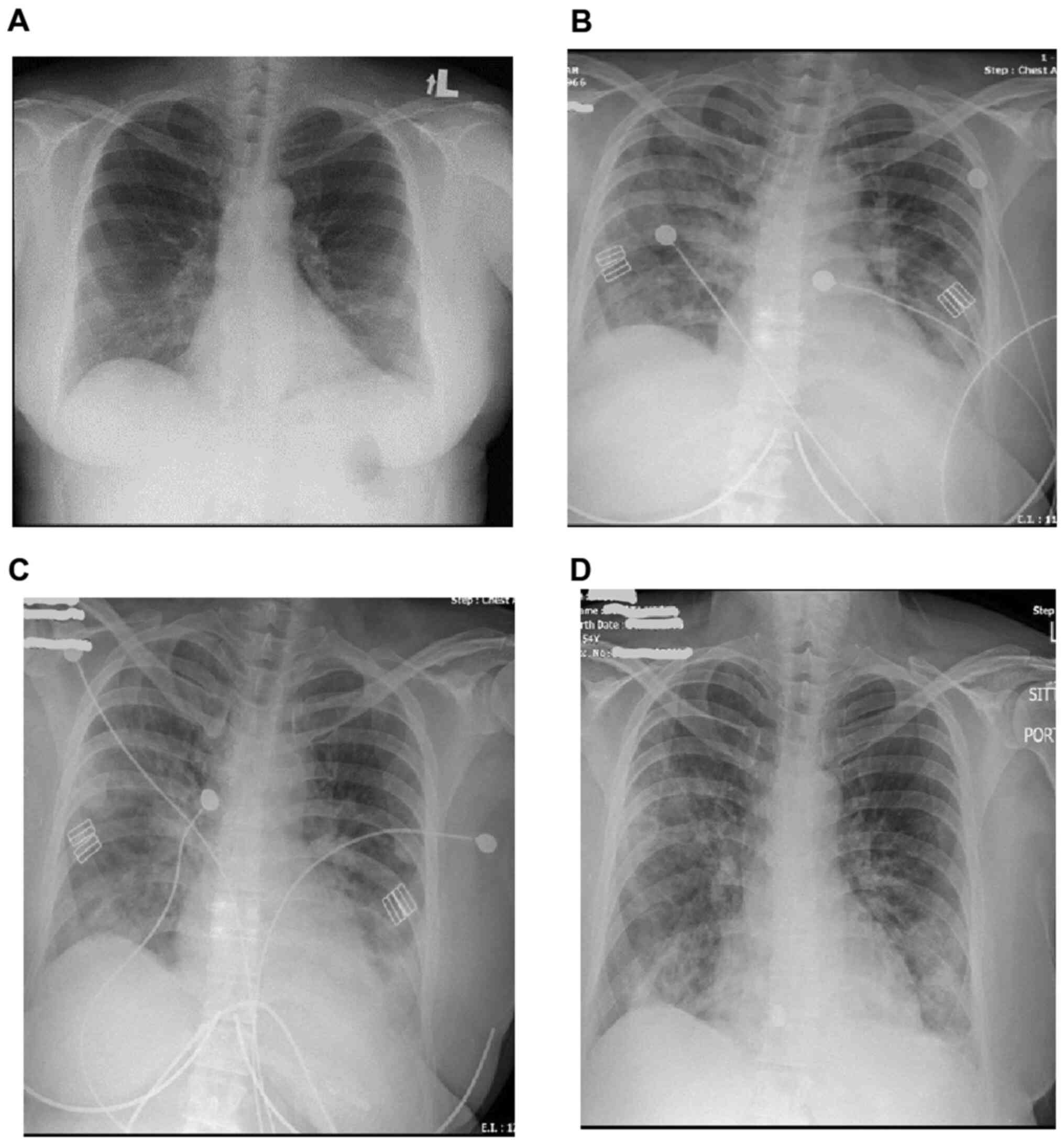
She reported a history of fatigue followed by fever of 4 days' duration. She was hemodynamically stable, with oxygen saturation 95% in room air with mild tachypnea (20 breaths/min). There was no cough, chest pain, or shortness of breath. Chest X-ray showed mild bilateral infiltrates (Fig. 1). The patient also reported diarrhea grade 1.

Figure 1

Chest X-ray findings during hospitalization course. (A) Day 1. Bilateral, mostly basilar, mild infiltrates. (B) Day 4. Bilateral diffuse infiltrates; worsening in line with the clinical deterioration. (C) Day 7. No significant change from day 4 despite clinical improvement on day 6. (D) Day 10. Mild improvement from day 7, with less opacity around left lower lung fields, in line with clinical improvement (high-flow nasal cannula no longer required).

After treatment with i.v. piperacillin/tazobactam (4.5 g every 8 h), the neutropenic fever resolved. However, the patient was increasingly tachypneic (respiratory rate 30 breaths/min, 88% desaturation) and was placed on 4L oxygen by nasal cannula. Blood and stool cultures were negative; Clostridium toxins were not detected. She also received s.c. enoxaparin sodium (1 mg/kg bid), i.v. dexamethasone (6 mg qd for 10 days), and i.v. remdesivir (loading dose 200 mg followed by 100 mg bid for 3 days).

The next day, the dyspnea and desaturation worsened. Work-up revealed ANC 4,700 cells/µl sterile blood cultures, and bilateral multifocal opacities on chest X-ray (Fig. 1). The patient was placed on a high-flow nasal cannula (HFNC) therapy (flow 40 l/min, FiO2 0.4%). On day 4, the ANC/absolute leukocyte count (ALC) ratio peaked at 18.5, and HFNC parameters were increased (flow 60 l/min, FiO2 0.8%). Acute atrial fibrillation developed and was treated with amiodarone with conversion to sinus rhythm.

On day 6 of hospitalization (day 10 of COVID-19 symptoms), gradual clinical improvement was noted along with a decrease in ANC/ALC ratio. On day 14, the patient was discharged home with no significant respiratory symptoms (Fig. 1).

Discussion

During the COVID-19 epidemic, to minimize the risk of febrile neutropenia in patients receiving adjuvant chemotherapy and to avoid overwhelming emergency rooms and hospitals, the NCCN extended the prophylactic use of G-CSF from high-risk-only patients (>20%) to intermediate-to-high-risk patients (10-20%). A cautionary note was added that cases of respiratory infection, respiratory symptoms, or confirmed or suspected COVID-19, G-CSF posed a risk of increased pulmonary inflammation or an increase in levels of inflammatory cytokines associated with an adverse outcome (4).

Our patient had pre-existing comorbidities known to be associated with respiratory and other systemic complications (5-7) in addition to two life-threatening conditions of febrile neutropenia and active COVID-19. Although per-protocol G-CSF administration may have prevented severe bacterial infection, it could also have caused further deterioration in her COVID-19-related lung status. Yang et al found that in patients with COVID-19, a high ratio of neutrophil count to lymphocyte count, high ratio was associated with a high rate of rapid development of severe disease (8).

Neutrophils are short-lived closely controlled cells that form an essential part of the host defense and inflammatory response. G-CSF regulates neutrophil production by inducing the proliferation and maturation of myeloid progenitors and promoting neutrophil release from bone marrow (9). Like G-CSF, granulocyte-macrophage CSF (GM-CSF) belongs to the hematopoietin/cytokine receptor superfamily and increases neutrophil chemotaxis and migration. However, its response kinetics differ and it is considered more pro-inflammatory (10). It also contributes to the development and maintenance of alveolar macrophages (11,12). Cumulative data suggest that both factors may play a cardinal role in innate inflammation and are potential mediators of the cytokine storm (13-15) as part of a positive feedback loop with inflammatory cytokines/chemokines, T-helper cells, and neighbouring cell populations (16).

Most of the reports on the involvement of stimulating factors in COVID-19 have focused on GM-CSF (13,14) and the incorporation of anti GM-CSF receptor to mitigate the COVID-19 cytokine storm (15,17,18). Using a prospective design, De Luca et al showed that administration of mavrilimumab, an anti-GSF monoclonal antibody, led to better clinical outcomes than standard treatment in mechanically ventilated patients with severe COVID-19 pneumonia, hypoxia, and systemic hyperinflammation (17).

There are no standardized treatments available for COVID-19. It is clear that one protocol does not fit all, and researchers are seeking accurate predictive markers to aid in the selection and manner of incorporation of the available drugs, including steroids (19). Dexamethasone is part of the standard of care for respiratory distress or severe pneumonia, and it seems that it may be of benefit in modulating G-CSF associated respiratory syndrome. In our patient, in view of the expected G-CSF-induced neutrophil activation the clinical course, and the developing cytokine storm, it was reasonable to add steroids.

We do not know which specific part(s) of the treatment (antivirals, steroids, supportive care, or their combination) had the greatest impact on the patient's outcome. Nevertheless, it is encouraging that an immune-suppressed patient with comorbidities and an apparently looming cytokine storm could recover in a short time with current treatment protocols. Given the potential involvement of cytokines in exacerbation of COVID-19, the new risk/benefit balance of active treatments, especially those including G-CSF injections, needs to be carefully considered (20).

Acknowledgements

Not applicable.

Funding

No funding was received.

Availability of data and materials

The datasets used and/or analyzed during the present study are available from the corresponding author on reasonable request.

Authors' contributions

RY is the primary care-give in the Oncology institute, conceptualized and co-wrote the manuscript and performed the literature search. HG is part of the breast-unit multidisciplinary group in the oncology instute which advised regarding the patient's treatment, and in addition co-wrote to the manuscript. MS was the main care-giver during her hospitalization, in addition he co-wrote the manuscript. JD and RM treated the patient at her initial Covid-19 diagnosis. IK acted as medical supervisor during the patient's hospitalization with COVID-19 infection and co-wrote the manuscript. All authors had access to the data and a role in writing the manuscript. All authors read and approved the final manuscript.

Ethics approval and consent to participate

The Helsinki Committee of Rabin Medical Center provided exemption for this case report since it does not contain any studies with human participants performed by any of the authors.

Patient consent for publication

The Helsinki Committee of Rabin Medical Center provided exemption for this case report since it does not contain any studies with human participants performed by any of the authors.

Competing interests

The authors declare that they have no competing interests.

References

1 

Citron ML, Berry DA, Cirrincione C, Hudis C, Winer EP, Gradishar WJ, Davidson NE, Martino S, Livingston R, Ingle JN, et al: Randomized trial of dose-dense versus conventionally scheduled and sequential versus concurrent combination chemotherapy as postoperative adjuvant treatment of node-positive primary breast cancer: First report of intergroup trial C9741/cancer and leukemia group B trial 9741. J Clin Oncol. 21:1431–1439. 2003.PubMed/NCBI View Article : Google Scholar

2 

Jones SE, Savin MA, Holmes FA, O'Shaughnessy JA, Blum JL, Vukelja S, McIntyre KJ, Pippen JE, Bordelon JH, Kirby R, et al: Phase III trial comparing doxorubicin plus cyclophosphamide with docetaxel plus cyclophosphamide as adjuvant therapy for operable breast cancer. J Clin Oncol. 24:5381–5387. 2006.PubMed/NCBI View Article : Google Scholar

3 

Early Breast Cancer Trialists' Collaborative Group (EBCTCG). Increasing the dose intensity of chemotherapy by more frequent administration or sequential scheduling: A patient-level meta-analysis of 37 298 women with early breast cancer in 26 randomised trials. Lancet. 393:1440–1452. 2019.PubMed/NCBI View Article : Google Scholar

4 

NCCN Hematopoietic Growth Factors: Short-term recommendations specific to issues with COVID-19 (SARS-CoV-2). https://www.nccn.org/covid-19/pdf/HGF_COVID-19.pdf. Accessed June 12, 2020.

5 

Long L, Zeng X, Zhang X, Xiao W, Guo E, Zhan W, Yang X, Li C, Wu C, Xu T, et al: Short-term outcomes of COVID-19 and risk factors for progression. Eur Respir J. 55(2000990)2020.PubMed/NCBI View Article : Google Scholar

6 

Wu C, Chen X, Cai Y, Xia J, Zhou X, Xu S, Huang H, Zhang L, Zhou X, Du C, et al: Risk factors associated with acute respiratory distress syndrome and death in patients with coronavirus disease 2019 pneumonia in Wuhan, China. JAMA Intern Med. 180:934–943. 2020.PubMed/NCBI View Article : Google Scholar

7 

Yang J, Zheng Y, Gou X, Pu K, Chen Z, Guo Q, Ji R, Wang H, Wang Y and Zhou Y: Prevalence of comorbidities and its effects in patients infected with SARS-CoV-2: A systematic review and meta-analysis. Int J Infect Dis. 94:91–95. 2020.PubMed/NCBI View Article : Google Scholar

8 

Yang AP, Liu JP, Tao WQ and Li HM: The diagnostic and predictive role of NLR, d-NLR and PLR in COVID-19 patients. Int Immunopharmacol. 84(106504)2020.PubMed/NCBI View Article : Google Scholar

9 

Eyles JL, Hickey MJ, Norman MU, Croker BA, Roberts AW, Drake SF, James WG, Metcalf D, Campben IK and Wicks IP: A key role for G-CSF-induced neutrophil production and trafficking during inflammatory arthritis. Blood. 112:5193–5201. 2008.PubMed/NCBI View Article : Google Scholar

10 

Hamilton JA and Achuthan A: Colony stimulating factors and myeloid cell biology in health and disease. Trends Immunol. 34:81–89. 2013.PubMed/NCBI View Article : Google Scholar

11 

Guilliams M, De Kleer I, Henri S, Post S, Vanhoutte C, De Prijck S, Deswarte K, Malissen B, Hammad H and Lambrecht BN: Alveolar macrophages develop from fetal monocytes that differentiate into long-lived cells in the first week of life via GM-CSF. J Exp Med. 210:1977–1992. 2013.PubMed/NCBI View Article : Google Scholar

12 

Trapnell BC, Nakata K, Bonella F, Campo I, Griese M, Hamilton J, Wang T, Morgan C, Cottin V and McCarthy C: Pulmonary alveolar proteinosis. Nat Rev Dis Primers. 5(16)2019.PubMed/NCBI View Article : Google Scholar

13 

Favalli EG and Caporali R: GM-CSF in the treatment of COVID-19: A new conductor in the pathogenesis of cytokine storm? Lancet Rheumatol. 2(e448)2020.PubMed/NCBI View Article : Google Scholar

14 

Nawar T, Morjaria S, Kaltsas A, Patel D, Perez-Johnston R, Daniyan AF, Mailankody S and Parameswaran R: Granulocyte-colony stimulating factor in COVID-19: Is it stimulating more than just the bone marrow? Am J Hematol. 95:E210–E213. 2020.PubMed/NCBI View Article : Google Scholar

15 

Lang FM, Lee KM, Teijaro JR, Becher B and Hamilton JA: GM-CSF-based treatments in COVID-19: Reconciling opposing therapeutic approaches. Nat Rev Immunol. 20:507–514. 2020.PubMed/NCBI View Article : Google Scholar

16 

Komuczki J, Tuzlak S, Friebel E, Hartwig T, Spath S, Rosenstiel P, Waisman A, Opitz L, Oukka M, Schreiner B, et al: Fate-mapping of GM-CSF expression identifies a discrete subset of inflammation-driving T helper cells regulated by cytokines IL-23 and IL-1β. Immunity. 50:1289–1304.e6. 2019.PubMed/NCBI View Article : Google Scholar

17 

De Luca G, Cavalli G, Campochiaro C, Della-Torre E, Angelillo P, Tomelleri A, Boffini N, Tentori S, Mette F, Farina N, et al: GM-CSF blockade with mavrilimumab in severe COVID-19 pneumonia and systemic hyperinflammation: A single-centre, prospective cohort study. Lancet Rheumatol. 2:e465–e473. 2020.PubMed/NCBI View Article : Google Scholar

18 

Mehta P, Porter JC, Manson JJ, Isaacs JD, Openshaw PJM, McInnes IB, Summers C and Chambers RC: Therapeutic blockade of granulocyte macrophage colony-stimulating factor in COVID-19-associated hyperinflammation: Challenges and opportunities. Lancet Respir Med. 8:822–830. 2020.PubMed/NCBI View Article : Google Scholar

19 

Lev S, Gottesman T, Sahaf Levin G, Lederfein D, Berkov E, Diker D, Zaidman A, Nutman A, Ber TI, Angel A, et al: Real-time IP-10 measurements as a new tool for inflammation regulation within a clinical decision support protocol for managing severe COVID-19 patients. medRxiv: 2020.07.21.20158782, 2020. doi: https://doi.org/10.1101/2020.07.21.20158782.

20 

Brunetti O, Derakhshani A, Baradaran B, Galvano A, Russo A and Silvestris N: COVID-19 infection in cancer patients: How can oncologists deal with these patients? Front Oncol. 10(734)2020.PubMed/NCBI View Article : Google Scholar

Related Articles

  • Abstract
  • View
  • Download
  • Twitter
Copy and paste a formatted citation
Spandidos Publications style
Yerushalmi R, Sagi M, Goldvaser H, Daliot J, Mutai R and Krause I: COVID‑19 in a patient receiving adjuvant breast cancer chemotherapy with granulocyte olony‑stimulating factor (G‑CSF) support: A case report. Mol Clin Oncol 14: 117, 2021.
APA
Yerushalmi, R., Sagi, M., Goldvaser, H., Daliot, J., Mutai, R., & Krause, I. (2021). COVID‑19 in a patient receiving adjuvant breast cancer chemotherapy with granulocyte olony‑stimulating factor (G‑CSF) support: A case report. Molecular and Clinical Oncology, 14, 117. https://doi.org/10.3892/mco.2021.2279
MLA
Yerushalmi, R., Sagi, M., Goldvaser, H., Daliot, J., Mutai, R., Krause, I."COVID‑19 in a patient receiving adjuvant breast cancer chemotherapy with granulocyte olony‑stimulating factor (G‑CSF) support: A case report". Molecular and Clinical Oncology 14.6 (2021): 117.
Chicago
Yerushalmi, R., Sagi, M., Goldvaser, H., Daliot, J., Mutai, R., Krause, I."COVID‑19 in a patient receiving adjuvant breast cancer chemotherapy with granulocyte olony‑stimulating factor (G‑CSF) support: A case report". Molecular and Clinical Oncology 14, no. 6 (2021): 117. https://doi.org/10.3892/mco.2021.2279
Copy and paste a formatted citation
x
Spandidos Publications style
Yerushalmi R, Sagi M, Goldvaser H, Daliot J, Mutai R and Krause I: COVID‑19 in a patient receiving adjuvant breast cancer chemotherapy with granulocyte olony‑stimulating factor (G‑CSF) support: A case report. Mol Clin Oncol 14: 117, 2021.
APA
Yerushalmi, R., Sagi, M., Goldvaser, H., Daliot, J., Mutai, R., & Krause, I. (2021). COVID‑19 in a patient receiving adjuvant breast cancer chemotherapy with granulocyte olony‑stimulating factor (G‑CSF) support: A case report. Molecular and Clinical Oncology, 14, 117. https://doi.org/10.3892/mco.2021.2279
MLA
Yerushalmi, R., Sagi, M., Goldvaser, H., Daliot, J., Mutai, R., Krause, I."COVID‑19 in a patient receiving adjuvant breast cancer chemotherapy with granulocyte olony‑stimulating factor (G‑CSF) support: A case report". Molecular and Clinical Oncology 14.6 (2021): 117.
Chicago
Yerushalmi, R., Sagi, M., Goldvaser, H., Daliot, J., Mutai, R., Krause, I."COVID‑19 in a patient receiving adjuvant breast cancer chemotherapy with granulocyte olony‑stimulating factor (G‑CSF) support: A case report". Molecular and Clinical Oncology 14, no. 6 (2021): 117. https://doi.org/10.3892/mco.2021.2279
Follow us
  • Twitter
  • LinkedIn
  • Facebook
About
  • Spandidos Publications
  • Careers
  • Cookie Policy
  • Privacy Policy
How can we help?
  • Help
  • Live Chat
  • Contact
  • Email to our Support Team