Spandidos Publications Logo
  • About
    • About Spandidos
    • Aims and Scopes
    • Abstracting and Indexing
    • Editorial Policies
    • Reprints and Permissions
    • Job Opportunities
    • Terms and Conditions
    • Contact
  • Journals
    • All Journals
    • Oncology Letters
      • Oncology Letters
      • Information for Authors
      • Editorial Policies
      • Editorial Board
      • Aims and Scope
      • Abstracting and Indexing
      • Bibliographic Information
      • Archive
    • International Journal of Oncology
      • International Journal of Oncology
      • Information for Authors
      • Editorial Policies
      • Editorial Board
      • Aims and Scope
      • Abstracting and Indexing
      • Bibliographic Information
      • Archive
    • Molecular and Clinical Oncology
      • Molecular and Clinical Oncology
      • Information for Authors
      • Editorial Policies
      • Editorial Board
      • Aims and Scope
      • Abstracting and Indexing
      • Bibliographic Information
      • Archive
    • Experimental and Therapeutic Medicine
      • Experimental and Therapeutic Medicine
      • Information for Authors
      • Editorial Policies
      • Editorial Board
      • Aims and Scope
      • Abstracting and Indexing
      • Bibliographic Information
      • Archive
    • International Journal of Molecular Medicine
      • International Journal of Molecular Medicine
      • Information for Authors
      • Editorial Policies
      • Editorial Board
      • Aims and Scope
      • Abstracting and Indexing
      • Bibliographic Information
      • Archive
    • Biomedical Reports
      • Biomedical Reports
      • Information for Authors
      • Editorial Policies
      • Editorial Board
      • Aims and Scope
      • Abstracting and Indexing
      • Bibliographic Information
      • Archive
    • Oncology Reports
      • Oncology Reports
      • Information for Authors
      • Editorial Policies
      • Editorial Board
      • Aims and Scope
      • Abstracting and Indexing
      • Bibliographic Information
      • Archive
    • Molecular Medicine Reports
      • Molecular Medicine Reports
      • Information for Authors
      • Editorial Policies
      • Editorial Board
      • Aims and Scope
      • Abstracting and Indexing
      • Bibliographic Information
      • Archive
    • World Academy of Sciences Journal
      • World Academy of Sciences Journal
      • Information for Authors
      • Editorial Policies
      • Editorial Board
      • Aims and Scope
      • Abstracting and Indexing
      • Bibliographic Information
      • Archive
    • International Journal of Functional Nutrition
      • International Journal of Functional Nutrition
      • Information for Authors
      • Editorial Policies
      • Editorial Board
      • Aims and Scope
      • Abstracting and Indexing
      • Bibliographic Information
      • Archive
    • International Journal of Epigenetics
      • International Journal of Epigenetics
      • Information for Authors
      • Editorial Policies
      • Editorial Board
      • Aims and Scope
      • Abstracting and Indexing
      • Bibliographic Information
      • Archive
    • Medicine International
      • Medicine International
      • Information for Authors
      • Editorial Policies
      • Editorial Board
      • Aims and Scope
      • Abstracting and Indexing
      • Bibliographic Information
      • Archive
  • Articles
  • Information
    • Information for Authors
    • Information for Reviewers
    • Information for Librarians
    • Information for Advertisers
    • Conferences
  • Language Editing
Spandidos Publications Logo
  • About
    • About Spandidos
    • Aims and Scopes
    • Abstracting and Indexing
    • Editorial Policies
    • Reprints and Permissions
    • Job Opportunities
    • Terms and Conditions
    • Contact
  • Journals
    • All Journals
    • Biomedical Reports
      • Information for Authors
      • Editorial Policies
      • Editorial Board
      • Aims and Scope
      • Abstracting and Indexing
      • Bibliographic Information
      • Archive
    • Experimental and Therapeutic Medicine
      • Information for Authors
      • Editorial Policies
      • Editorial Board
      • Aims and Scope
      • Abstracting and Indexing
      • Bibliographic Information
      • Archive
    • International Journal of Epigenetics
      • Information for Authors
      • Editorial Policies
      • Editorial Board
      • Aims and Scope
      • Abstracting and Indexing
      • Bibliographic Information
      • Archive
    • International Journal of Functional Nutrition
      • Information for Authors
      • Editorial Policies
      • Editorial Board
      • Aims and Scope
      • Abstracting and Indexing
      • Bibliographic Information
      • Archive
    • International Journal of Molecular Medicine
      • Information for Authors
      • Editorial Policies
      • Editorial Board
      • Aims and Scope
      • Abstracting and Indexing
      • Bibliographic Information
      • Archive
    • International Journal of Oncology
      • Information for Authors
      • Editorial Policies
      • Editorial Board
      • Aims and Scope
      • Abstracting and Indexing
      • Bibliographic Information
      • Archive
    • Medicine International
      • Information for Authors
      • Editorial Policies
      • Editorial Board
      • Aims and Scope
      • Abstracting and Indexing
      • Bibliographic Information
      • Archive
    • Molecular and Clinical Oncology
      • Information for Authors
      • Editorial Policies
      • Editorial Board
      • Aims and Scope
      • Abstracting and Indexing
      • Bibliographic Information
      • Archive
    • Molecular Medicine Reports
      • Information for Authors
      • Editorial Policies
      • Editorial Board
      • Aims and Scope
      • Abstracting and Indexing
      • Bibliographic Information
      • Archive
    • Oncology Letters
      • Information for Authors
      • Editorial Policies
      • Editorial Board
      • Aims and Scope
      • Abstracting and Indexing
      • Bibliographic Information
      • Archive
    • Oncology Reports
      • Information for Authors
      • Editorial Policies
      • Editorial Board
      • Aims and Scope
      • Abstracting and Indexing
      • Bibliographic Information
      • Archive
    • World Academy of Sciences Journal
      • Information for Authors
      • Editorial Policies
      • Editorial Board
      • Aims and Scope
      • Abstracting and Indexing
      • Bibliographic Information
      • Archive
  • Articles
  • Information
    • For Authors
    • For Reviewers
    • For Librarians
    • For Advertisers
    • Conferences
  • Language Editing
Login Register Submit
  • This site uses cookies
  • You can change your cookie settings at any time by following the instructions in our Cookie Policy. To find out more, you may read our Privacy Policy.

    I agree
Search articles by DOI, keyword, author or affiliation
Search
Advanced Search
presentation
Molecular and Clinical Oncology
Join Editorial Board Propose a Special Issue
Print ISSN: 2049-9450 Online ISSN: 2049-9469
Journal Cover
April-2022 Volume 16 Issue 4

Full Size Image

Sign up for eToc alerts
Recommend to Library

Journals

International Journal of Molecular Medicine

International Journal of Molecular Medicine

International Journal of Molecular Medicine is an international journal devoted to molecular mechanisms of human disease.

International Journal of Oncology

International Journal of Oncology

International Journal of Oncology is an international journal devoted to oncology research and cancer treatment.

Molecular Medicine Reports

Molecular Medicine Reports

Covers molecular medicine topics such as pharmacology, pathology, genetics, neuroscience, infectious diseases, molecular cardiology, and molecular surgery.

Oncology Reports

Oncology Reports

Oncology Reports is an international journal devoted to fundamental and applied research in Oncology.

Experimental and Therapeutic Medicine

Experimental and Therapeutic Medicine

Experimental and Therapeutic Medicine is an international journal devoted to laboratory and clinical medicine.

Oncology Letters

Oncology Letters

Oncology Letters is an international journal devoted to Experimental and Clinical Oncology.

Biomedical Reports

Biomedical Reports

Explores a wide range of biological and medical fields, including pharmacology, genetics, microbiology, neuroscience, and molecular cardiology.

Molecular and Clinical Oncology

Molecular and Clinical Oncology

International journal addressing all aspects of oncology research, from tumorigenesis and oncogenes to chemotherapy and metastasis.

World Academy of Sciences Journal

World Academy of Sciences Journal

Multidisciplinary open-access journal spanning biochemistry, genetics, neuroscience, environmental health, and synthetic biology.

International Journal of Functional Nutrition

International Journal of Functional Nutrition

Open-access journal combining biochemistry, pharmacology, immunology, and genetics to advance health through functional nutrition.

International Journal of Epigenetics

International Journal of Epigenetics

Publishes open-access research on using epigenetics to advance understanding and treatment of human disease.

Medicine International

Medicine International

An International Open Access Journal Devoted to General Medicine.

Journal Cover
April-2022 Volume 16 Issue 4

Full Size Image

Sign up for eToc alerts
Recommend to Library

  • Article
  • Citations
    • Cite This Article
    • Download Citation
    • Create Citation Alert
    • Remove Citation Alert
    • Cited By
  • Similar Articles
    • Related Articles (in Spandidos Publications)
    • Similar Articles (Google Scholar)
    • Similar Articles (PubMed)
  • Download PDF
  • Download XML
  • View XML
Case Report Open Access

A rare case of recurrent ovarian cancer with TPM3‑NTRK1 gene rearrangement: A case report

  • Authors:
    • Yuta Endo
    • Takafumi Watanabe
    • Motonobu Saito
    • Katsuharu Saito
    • Rei Suzuki
    • Hideki Sano
    • Yutaka Natori
    • Eisaku Sasaki
    • Makiko Ueda
    • Norihito Kamo
    • Shigenori Furukawa
    • Shu Soeda
    • Koji Kono
    • Shigehira Saji
    • Keiya Fujimori
  • View Affiliations / Copyright

    Affiliations: Department of Obstetrics and Gynecology, Fukushima Medical University School of Medicine, Fukushima 960‑1295, Japan, Department of Gastrointestinal Tract Surgery, Fukushima Medical University School of Medicine, Fukushima 960‑1295, Japan, Department of Gastroenterology, Fukushima Medical University School of Medicine, Fukushima 960‑1295, Japan, Department of Pediatric Oncology, Fukushima Medical University School of Medicine, Fukushima 960‑1295, Japan, Department of Medical Oncology, Fukushima Medical University School of Medicine, Fukushima 960‑1295, Japan
    Copyright: © Endo et al. This is an open access article distributed under the terms of Creative Commons Attribution License.
  • Article Number: 90
    |
    Published online on: February 23, 2022
       https://doi.org/10.3892/mco.2022.2523
  • Expand metrics +
Metrics: Total Views: 0 (Spandidos Publications: | PMC Statistics: )
Metrics: Total PDF Downloads: 0 (Spandidos Publications: | PMC Statistics: )
Cited By (CrossRef): 0 citations Loading Articles...

This article is mentioned in:


Abstract

NTRK gene fusion is rare in gynecological cancer. Entrectinib is a novel targeted drug, which is a potent inhibitor of TRK A, B and C. The present case report described a case of recurrent ovarian cancer with TPM3‑NTRK1 rearrangement, which was detected by next‑generation sequencing (NGS) and treated with entrectinib. A 56‑year‑old woman was diagnosed as having stage IV ovarian cancer with positive pleural fluid cytology. Neoadjuvant chemotherapy and interval debulking surgery, followed by chemotherapy, were performed. A total of 10 months after completion of chemotherapy, the disease recurred and the patient was treated with multimodal therapy for recurrence. DNA‑based NGS detected TPM3‑NTRK1 rearrangement and entrectinib therapy was initiated; however, the disease progressed despite 6 weeks of entrectinib administration, and 1 month after discontinuation of entrectinib, the patient died. After their death, immunohistochemistry with a pan‑Trk monoclonal antibody was performed to determine the expression levels of TRK; however, immunohistochemistry was negative for TRK. In conclusion, the present case report described a rare case of recurrent ovarian cancer with TPM3‑NTRK1 gene fusion, in which entrectinib was not effective. While NTRK gene fusion was detected by DNA‑based NGS, immunohistochemistry was negative for TRK. These findings indicated that immunohistochemistry may be required for confirmation of TRK protein expression prior to entrectinib administration.

Introduction

NTRK gene fusions are consistently detected in rare types of cancers (secretory breast carcinoma, mammary analogue secretary carcinoma, congenital infantile fibrosarcoma, and congenital mesoblastic nephroma) and they are novel therapeutic targets across multiple tumor types (1-3). On the other hand, these gene fusions are rare in common adult cancers (1,2). In gynecologic oncology, NTRK gene fusion is also rare, although there are several reports of uterine sarcoma with this fusion gene (4-7). A previous cohort study showed that TPM3-NTRK1 is most frequent in NTRK1 fusions across multiple histologies (2). Immunohistochemistry (IHC) staining, fluorescence in situ hybridization, reverse transcriptase polymerase chain reaction, DNA-based next-generation sequencing (NGS) and RNA-based NGS are used to identify patients with NTRK gene fusion cancer. Each method to detect NTRK gene fusion has its own characteristics (3).

NTRK1, NTRK2 and NTRK3 encode TRKA, TRKB, and TRKC, respectively (1). Entrectinib is a potent inhibitor of TRKA, TRKB, TRKC, ROS1, and ALK, and is specifically designed to have systemic activity. In gynecologic oncology, treatment using entrectinib is rare because of the low frequency of NTRK fusions (1). Here, we report a case of recurrent ovarian cancer (OC) with TPM3-NTRK1 gene fusion, which was treated with entrectinib.

Case report

In September 2013, a 56-year-old woman was referred to Fukushima Medical University Hospital (Fukushima, Japan) with bilateral ovarian tumors, multiple disseminations in the peritoneum, bilateral pleural effusion, and multiple swellings of the pelvic and paraaortic lymph nodes. Her serum level of cancer antigen 125 (CA125) was elevated to 1,740 U/ml. She was diagnosed as having stage IV OC according to the International Federation of Gynecology and Obstetrics (FIGO) 1988 because pleural effusion cytology was positive. Paclitaxel (175 mg/m2) and carboplatin (area under the curve 6), TC therapy, were started as neoadjuvant chemotherapy. After four courses of chemotherapy, computed tomography (CT) revealed a reduction in tumor size. Interval debulking surgery including abdominal hysterectomy, bilateral salpingo-oophorectomy, omentectomy, and pelvic and paraaortic lymphadenectomy, was performed. Histopathological diagnosis was high-grade serous carcinoma. Following this surgery, another three courses of the same regimen were administered, and the patient achieved clinical complete response.

A total of 10 months after the last therapy, CT showed multiple disseminations around the liver. TC therapy was administered again. At the time of the third course, carboplatin-related hypersensitivity reaction occurred. After the third course, stable disease (SD) was shown. Thus, TC therapy was converted to TP therapy (135 mg/m2 paclitaxel and 75 mg/m2 cisplatin). After three courses of TP therapy, SD was maintained. As the disseminations were located only around the liver, partial hepatectomy was performed. At that time, postoperative chemotherapy was not administered as there was no detectable disease in the abdominal cavity.

A total of 5 months after the surgery, CT showed multiple lesions in the peritoneum. Therefore, TP therapy with 15 mg/m2 bevacizumab (BV) was started. At the ninth course of this chemotherapy, cisplatin-related hypersensitivity reaction occurred. After the ninth course, CT showed progressive disease (PD). Subsequently, chemotherapy with pegylated liposomal doxorubicin with BV, gemcitabine with BV, and nogitecan with BV was administered. However, the tumors remained; mesentery dissemination resection was performed.

A total of 8 months after mesentery dissemination resection, CT showed multiple peritoneal lesions. Subsequently, weekly paclitaxel, oral etoposide, weekly nedaplatin and gemcitabine were administered in this order, however, none of the regimens were effective. Microsatellite stability was detected in specimens from the mesentery dissemination resection.

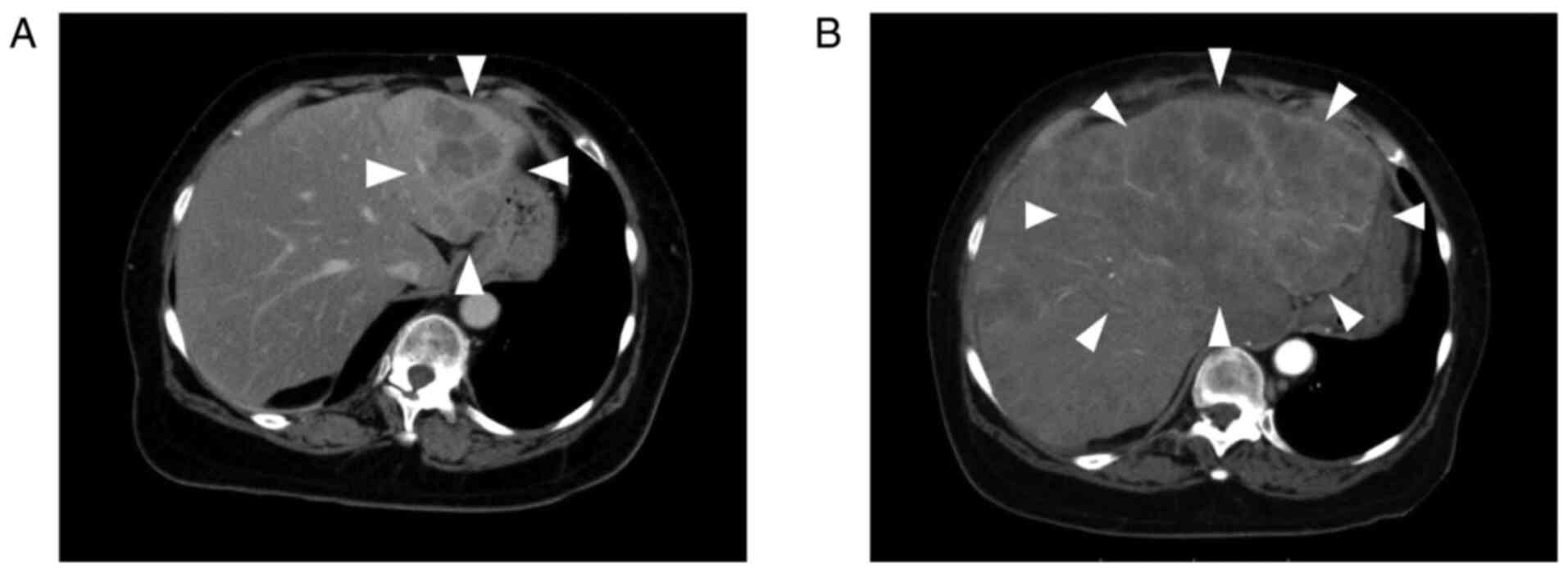
In August 2019, because there was no more standard therapy, FoundationOne® CDx (Foundation Medicine, Cambridge, MA), which is DNA based NGS and covers 324 genes, was performed based on the patient's archival tumor tissue from the mesentery dissemination resection. This revealed a missense variant of TP53 (c.731G>A) and TPM3-NTRK1 rearrangement between somewhere around exon 2-3 of TPM3 (pos1=‘chr1:156844554-156844771’, pos2=’chr1:154155588-154155822’) and exon 11 of NTRK1 (NM_002529). Oral entrectinib (600 mg/day) was started after discussing with experts. A total of 6 weeks after initiation of entrectinib, the patient's serum CA125 level elevated to 4,360 U/ml, which was 1,712 U/ml before initiation of entrectinib, and CT revealed progression of liver metastasis (Fig. 1). Adverse events during entrectinib administration comprised grade 2 dysgeusia. A total of 1 month after discontinuation of entrectinib, the patient died from disease progression (Fig. 2).
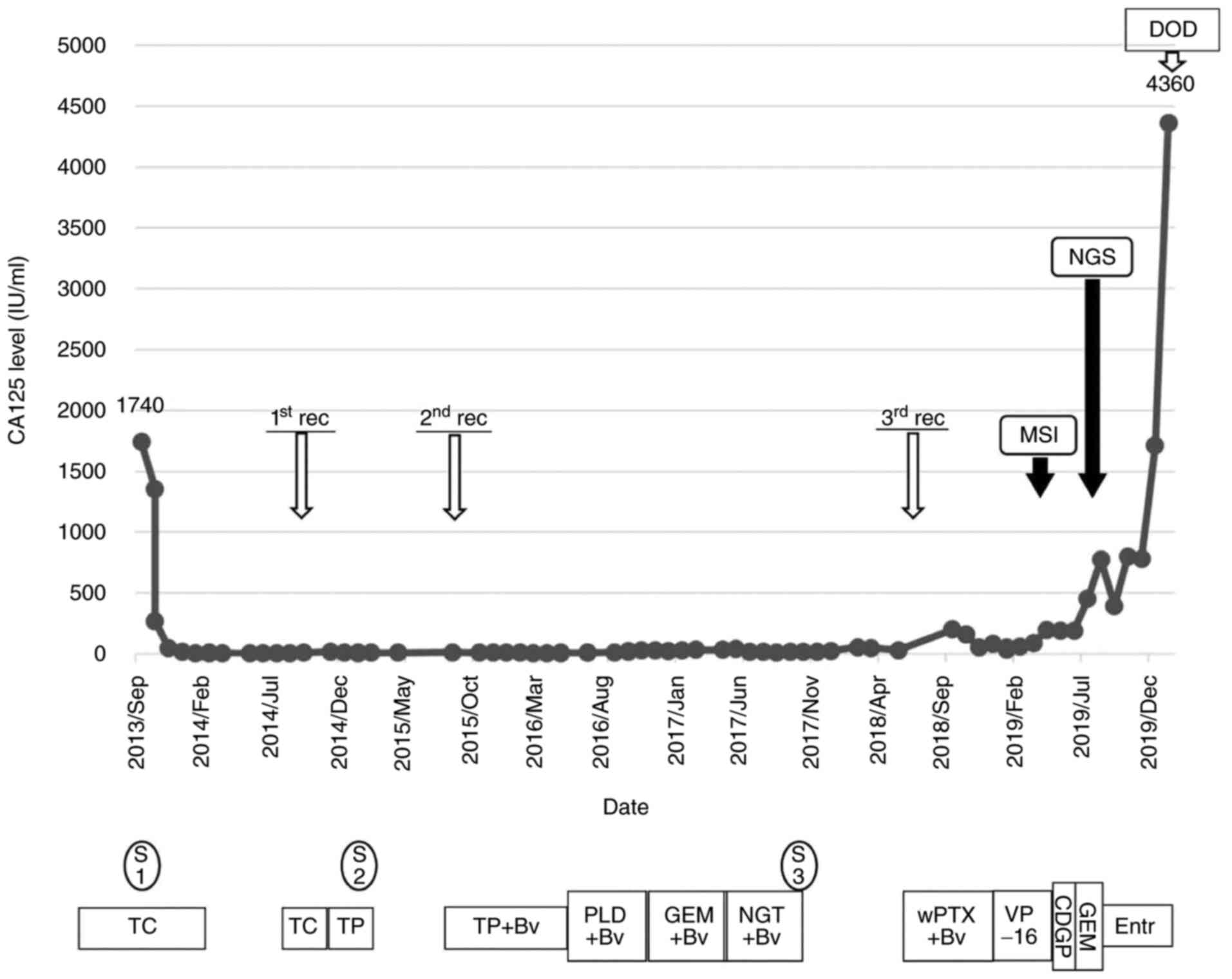
Figure 1

Computed tomography of liver metastasis; arrow heads show the liver metastasis lesion. (A) Before administration of entrectinib. (B) A total of 6 weeks after beginning administration of entrectinib.

Figure 2

Clinical flowchart of the patient. CA125, cancer antigen-125; MSI, microsatellite instability test; NGS, next-generation sequencing; DOD, dead of disease; rec, recurrence; S, surgery; S1, abdominal hysterectomy, bilateral salpingo-oophorectomy, omentectomy, and pelvic and paraaortic lymphadenectomy; S2, partial hepatectomy; S3, mesentery dissemination resection; TC, paclitaxel and carboplatin; TP, paclitaxel and cisplatin; BV, bevacizumab; PLD, pegylated liposomal doxorubicin; GEM, gemcitabine; NGT, nogitecan; wPTX, weekly paclitaxel; VP-16, etopocide; CDGP, nedaplatin; Entr, entrectinib.

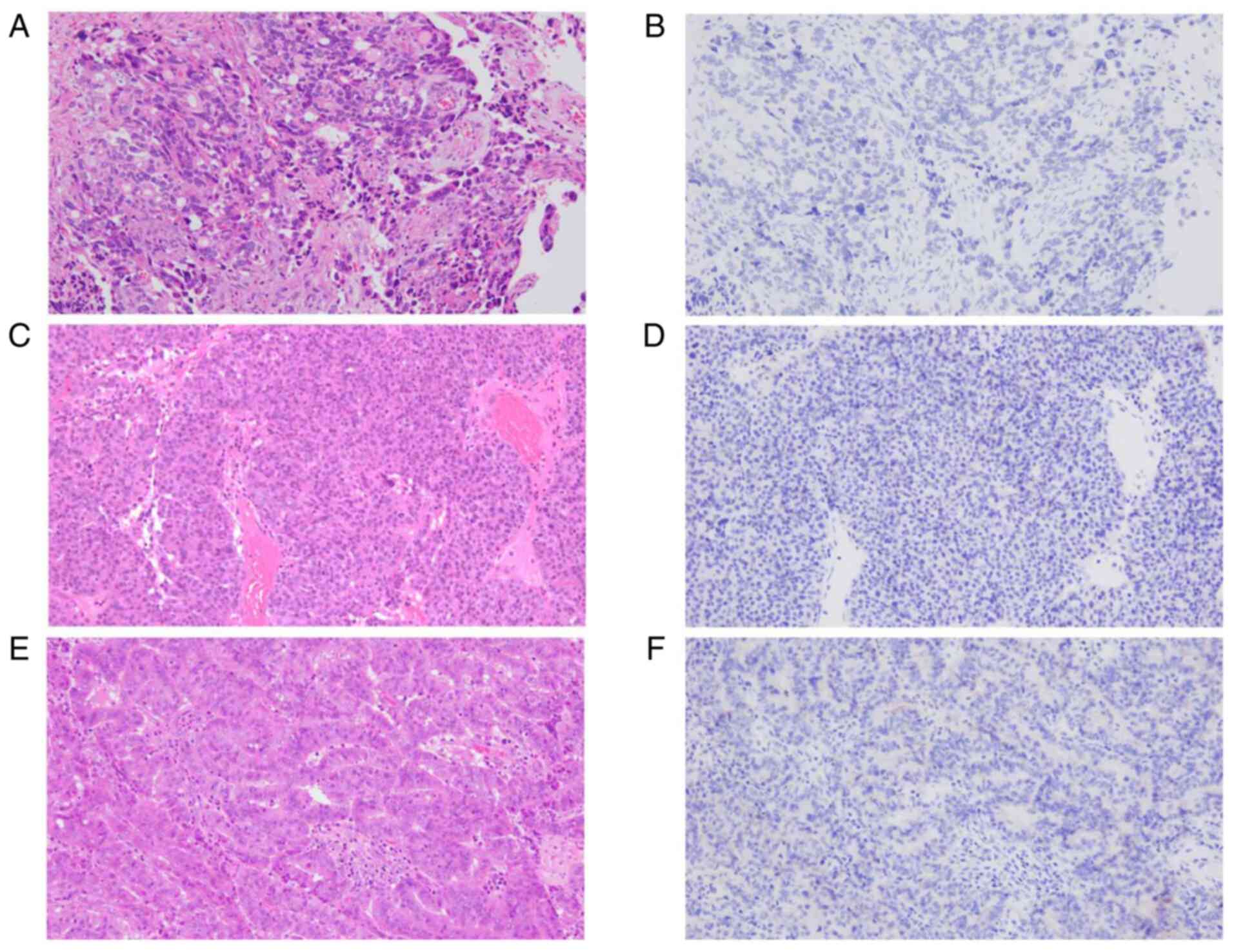
After the patient's death, IHC staining with a pan-Trk monoclonal antibody (mAB) clone EPR17341 (Abcam, Cambridge, MA) was performed to assess TRKA, TRKB, and TRKC expression as previously described (8). This mAB clone is most commonly used and has been investigated thoroughly. In addition, this mAB clone reacts with a conserved proprietary peptide from the C-terminus of TRKA, TRKB and TRKC, and is therefore reactive to any oncogenic NTRK fusion (3). IHC was negative for all specimens from the primary site, as well as the first and second recurrent sites (Fig. 3).

Figure 3

Histopathological and immunohistochemical features (magnification, x100). Immunohistochemistry was negative for pan-TRK in all specimens. (A and B) Interval debulking surgery specimen (tumor resection following neoadjuvant chemotherapy). (C and D) Liver dissemination specimen (resection for the first recurrence). (E and F) Mesentery dissemination specimen (recurrence for the second recurrence). (A, C and E) Hematoxilin and eosin staining. (B, D and F) Immunohistochemical stain for pan-Trk.

Discussion

Here we presented a case of recurrent OC with TPM3-NTRK1 rearrangement. Additionally, the present case demonstrates the discrepancy between gene rearrangement detected by NGS and protein expression. This discrepancy may be an indicator for predicting the ineffectiveness of entrectinib for cancers with NTRK rearrangement detected by NGS.

In the current case, NGS revealed TPM3-NTRK1 rearrangement and a missense variant of TP53. There are few approved therapies for TP53 variants, although almost all cases of ovarian high-grade serous carcinoma (95%) have somatic TP53 variants (9). On the other hand, NTRK fusions are oncogenic drivers and novel targets. Doebele et al (1) reported the safety and activity of entrectinib in adult patients with advanced or metastatic NTRK fusion-positive cancers across three clinical trials (ALKA-372-001, STARTRK-1 and STARTRK-2). In these trials, only one ovarian cancer patient was included. They showed that the objective response rate, which included complete response and partial response, was 57% (95% CI 43.2-70.8). The median duration of response was 10 months (95% CI 7.1 to not estimable) and the percentage of PD was only 7%. However, the characteristics of cases with PD remained unclear in their report (1).

In the present case, entrectinib was administered because NGS revealed TPM3-NTRK1 rearrangement and entrectinib was recommended after a discussion among experts. However, this novel target drug was ineffective. TRK protein was not expressed as a result of IHC testing with a pan-Trk mAB clone (EPR17341). A previous study reported that gene fusions involving NTRK1, 2, and 3 and their partner genes result in a constitutive activation or overexpression of TRK receptors, potentially leading to oncogenesis (10). Additionally, other reports have shown that pan-Trk IHC yielded a sensitivity of 75-95.2%, and a specificity of 92-100% and that the sensitivity of pan-Trk IHC for TRKA was 96.2% (3,8,11,12). Pan-Trk IHC is a reliable screening method for the detection of NTRK gene fusions based on these data. Moreover, pan-Trk IHC is used to assess rapidly assess malignancies which may harbor possible NTRK gene fusions in order to determine eligibility of patients for targeted therapy with TRK inhibitors (8). However, it should be considered that there are NTRK rearrangements which are found to be negative by IHC, and can only be detected by NGS, such as in the present case.

Drilon et al (13) reported the efficacy of larotrectinib, which is a selective inhibitor of TRKA, TRKB and TRKC. In their study, six of an initial 55 patients showed primary resistance to larotrectinib. Three of the six patients had tumor material available for pan-Trk IHC, by which TRK protein expression was not detected in all three. This indicated that the rearrangements detected by NGS were false positives or that the identified fusion genes were not expressed at the protein level (13). It is considered that entrectinib has the same characteristics as larotrectinib with regard to discrepancy between gene fusion and protein expression, as observed in the current case, and that this finding may be a key to predict the ineffectiveness of entrectinib for cancers with NTRK rearrangement detected by NGS.

To the best of our knowledge, this is the first case report of OC with NTRK rearrangement. It is known that a small percentage of common adult cancers carry fusions of NTRK genes (2). Large cohort studies revealed that the frequency of NTRK gene fusions was 0.25% of general cancers (2,12). Therefore, physicians have few chances to experience this molecular characteristic; however, they should be aware of the pitfall that TRK protein may not express even if NGS shows NTRK rearrangement.

In conclusion, we here presented a rare case of recurrent OC with TPM3-NTRK1 fusion. Physicians may need to be aware of the discrepancy of DNA rearrangement and protein expression, and IHC may be required for confirmation of TRK protein expression before entrectinib administration.

Acknowledgements

Not applicable.

Funding

Funding: No funding was received.

Availability of data and materials

The datasets used and/or analyzed during the current study are available from the corresponding author on reasonable request.

Authors' contributions

YE, TW and MS drafted the manuscript. YE, TW, RS, HS, YN, ES, MU, NK, SF, SSo, SSa and KF contributed to the patient management and manuscript editing. MS, KS and KK performed immunohistochemical staining. YE and TW confirm the authenticity of all the raw data. All authors have read and approved the final manuscript.

Ethics approval and consent to participate

Not applicable.

Patient consent for publication

Written informed consent was obtained from the patient for publication of this case report and the accompanying images.

Competing interests

The authors declare that they have no competing interests.

References

1 

Doebele RC, Drilon A, Paz-Ares L, Siena S, Shaw AT, Farago AF, Blakely CM, Seto T, Chow BC, Tosi D, et al: Entrectinib in patients with advanced or metastatic NTRK fusion-positive solid tumours: Integrated analysis of three phase 1-2 trials. Lancet Oncol. 21:271–282. 2020.PubMed/NCBI View Article : Google Scholar

2 

Getalica Z, Xiu J, Swensen J and Vranic S: Molecular characterization of cancers with NTRK gene fusions. Mod Pathol. 32:147–153. 2019.PubMed/NCBI View Article : Google Scholar

3 

Solomon JP, Benayed R, Hechtman JF and Ladanyi M: Identifying patients with NTRK fusion cancer. Ann Oncol. 30 (Suppl 8):viii16–viii22. 2019.PubMed/NCBI View Article : Google Scholar

4 

Chiang S, Cotzia P, Hyman DM, Drilon A, Tap WD, Zhang L, Hechtman JF, Frosina D, Jungbluth AA, Murali R, et al: NTRK fusions define a novel uterine sarcoma subtype with features of fibrosarcoma. Am J Surg Pathol. 42:791–798. 2018.PubMed/NCBI View Article : Google Scholar

5 

Rabban JT, Devine WP, Sangoi AR, Poder L, Alvarez E, Davis J, Rudzinski E, Garg K and Bean GR: NTRK fusion cervical sarcoma: A report of three cases, emphasising morphological and immunohistochemical distinction from other uterine sarcomas, including adenosarcoma. Histopathology. 77:100–111. 2020.PubMed/NCBI View Article : Google Scholar

6 

Hodgson A, Pun C, Djordjevic B and Turashvili G: NTRK-rearranged cervical sarcoma: Expanding the clinicopathologic spectrum. Int J Gynecol Pathol. 40:73–77. 2021.PubMed/NCBI View Article : Google Scholar

7 

Croce S, Hostein I and McCluggage WG: NTRK and other recently described kinase fusion positive uterine sarcomas: A review of a group of rare neoplasms. Genes Chromosomes Cancer. 60:147–159. 2021.PubMed/NCBI View Article : Google Scholar

8 

Hechtman JF, Benayed R, Hyman DM, Drilon A, Zehir A, Frosina D, Arcila ME, Dogan S, Klimstra DS, Ladanyi M and Jungbluth AA: Pan-Trk immunohistochemistry is an efficient and reliable screen for the detection of NTRK fusions. Am J Surg Pathol. 41:1547–1551. 2017.PubMed/NCBI View Article : Google Scholar

9 

Boyarskikh UA, Gulyaeva LF, Avdalyan AM, Kechin AA, Khrapov EA, Lazareva DG, Kushlinskii NE, Melkonyan A, Arakelyan A and Filipenko ML: Spectrum of TP53 mutations in BRCA1/2 associated high-grade serous ovarian cancer. Front Oncol. 10(1103)2020.PubMed/NCBI View Article : Google Scholar

10 

Khotskaya YB, Holla VR, Farago AF, Mills Shaw KR, Meric-Bernstam F and Hong DS: Targeting TRK family proteins in cancer. Pharmacol Ther. 173:58–66. 2017.PubMed/NCBI View Article : Google Scholar

11 

Rudzinski ER, Lockwood CM, Stohr BA, Vargas SO, Sheridan R, Black JO, Rajaram V, Laetsch TW and Davis JL: Pan-Trk immunohistochemistry identifies NTRK rearrangements in pediatric mesenchymal tumors. Am J Surg Pathol. 42:927–935. 2018.PubMed/NCBI View Article : Google Scholar

12 

Solomon JP, Linkov I, Rosado A, Mullaney K, Rosen EY, Frosina D, Jungbluth AA, Zehir A, Benayed R, Drilon A, et al: NTRK fusion detection across multiple assays and 33,997 cases: Diagnostic implications and pitfalls. Mod Pathol. 33:38–46. 2020.PubMed/NCBI View Article : Google Scholar

13 

Drilon A, Leatsch TW, Kummar S, DuBois SG, Lassen UN, Demetri GD, Nathenson M, Doebele R, Farago AF, Pappo AS, et al: Efficacy of larotrectinib in TRK fusion-positive cancers in adults and children. N Engl J Med. 378:731–739. 2018.PubMed/NCBI View Article : Google Scholar

Related Articles

  • Abstract
  • View
  • Download
  • Twitter
Copy and paste a formatted citation
Spandidos Publications style
Endo Y, Watanabe T, Saito M, Saito K, Suzuki R, Sano H, Natori Y, Sasaki E, Ueda M, Kamo N, Kamo N, et al: A rare case of recurrent ovarian cancer with <em>TPM3‑NTRK1</em> gene rearrangement: A case report. Mol Clin Oncol 16: 90, 2022.
APA
Endo, Y., Watanabe, T., Saito, M., Saito, K., Suzuki, R., Sano, H. ... Fujimori, K. (2022). A rare case of recurrent ovarian cancer with <em>TPM3‑NTRK1</em> gene rearrangement: A case report. Molecular and Clinical Oncology, 16, 90. https://doi.org/10.3892/mco.2022.2523
MLA
Endo, Y., Watanabe, T., Saito, M., Saito, K., Suzuki, R., Sano, H., Natori, Y., Sasaki, E., Ueda, M., Kamo, N., Furukawa, S., Soeda, S., Kono, K., Saji, S., Fujimori, K."A rare case of recurrent ovarian cancer with <em>TPM3‑NTRK1</em> gene rearrangement: A case report". Molecular and Clinical Oncology 16.4 (2022): 90.
Chicago
Endo, Y., Watanabe, T., Saito, M., Saito, K., Suzuki, R., Sano, H., Natori, Y., Sasaki, E., Ueda, M., Kamo, N., Furukawa, S., Soeda, S., Kono, K., Saji, S., Fujimori, K."A rare case of recurrent ovarian cancer with <em>TPM3‑NTRK1</em> gene rearrangement: A case report". Molecular and Clinical Oncology 16, no. 4 (2022): 90. https://doi.org/10.3892/mco.2022.2523
Copy and paste a formatted citation
x
Spandidos Publications style
Endo Y, Watanabe T, Saito M, Saito K, Suzuki R, Sano H, Natori Y, Sasaki E, Ueda M, Kamo N, Kamo N, et al: A rare case of recurrent ovarian cancer with <em>TPM3‑NTRK1</em> gene rearrangement: A case report. Mol Clin Oncol 16: 90, 2022.
APA
Endo, Y., Watanabe, T., Saito, M., Saito, K., Suzuki, R., Sano, H. ... Fujimori, K. (2022). A rare case of recurrent ovarian cancer with <em>TPM3‑NTRK1</em> gene rearrangement: A case report. Molecular and Clinical Oncology, 16, 90. https://doi.org/10.3892/mco.2022.2523
MLA
Endo, Y., Watanabe, T., Saito, M., Saito, K., Suzuki, R., Sano, H., Natori, Y., Sasaki, E., Ueda, M., Kamo, N., Furukawa, S., Soeda, S., Kono, K., Saji, S., Fujimori, K."A rare case of recurrent ovarian cancer with <em>TPM3‑NTRK1</em> gene rearrangement: A case report". Molecular and Clinical Oncology 16.4 (2022): 90.
Chicago
Endo, Y., Watanabe, T., Saito, M., Saito, K., Suzuki, R., Sano, H., Natori, Y., Sasaki, E., Ueda, M., Kamo, N., Furukawa, S., Soeda, S., Kono, K., Saji, S., Fujimori, K."A rare case of recurrent ovarian cancer with <em>TPM3‑NTRK1</em> gene rearrangement: A case report". Molecular and Clinical Oncology 16, no. 4 (2022): 90. https://doi.org/10.3892/mco.2022.2523
Follow us
  • Twitter
  • LinkedIn
  • Facebook
About
  • Spandidos Publications
  • Careers
  • Cookie Policy
  • Privacy Policy
How can we help?
  • Help
  • Live Chat
  • Contact
  • Email to our Support Team