Spandidos Publications Logo
  • About
    • About Spandidos
    • Aims and Scopes
    • Abstracting and Indexing
    • Editorial Policies
    • Reprints and Permissions
    • Job Opportunities
    • Terms and Conditions
    • Contact
  • Journals
    • All Journals
    • Oncology Letters
      • Oncology Letters
      • Information for Authors
      • Editorial Policies
      • Editorial Board
      • Aims and Scope
      • Abstracting and Indexing
      • Bibliographic Information
      • Archive
    • International Journal of Oncology
      • International Journal of Oncology
      • Information for Authors
      • Editorial Policies
      • Editorial Board
      • Aims and Scope
      • Abstracting and Indexing
      • Bibliographic Information
      • Archive
    • Molecular and Clinical Oncology
      • Molecular and Clinical Oncology
      • Information for Authors
      • Editorial Policies
      • Editorial Board
      • Aims and Scope
      • Abstracting and Indexing
      • Bibliographic Information
      • Archive
    • Experimental and Therapeutic Medicine
      • Experimental and Therapeutic Medicine
      • Information for Authors
      • Editorial Policies
      • Editorial Board
      • Aims and Scope
      • Abstracting and Indexing
      • Bibliographic Information
      • Archive
    • International Journal of Molecular Medicine
      • International Journal of Molecular Medicine
      • Information for Authors
      • Editorial Policies
      • Editorial Board
      • Aims and Scope
      • Abstracting and Indexing
      • Bibliographic Information
      • Archive
    • Biomedical Reports
      • Biomedical Reports
      • Information for Authors
      • Editorial Policies
      • Editorial Board
      • Aims and Scope
      • Abstracting and Indexing
      • Bibliographic Information
      • Archive
    • Oncology Reports
      • Oncology Reports
      • Information for Authors
      • Editorial Policies
      • Editorial Board
      • Aims and Scope
      • Abstracting and Indexing
      • Bibliographic Information
      • Archive
    • Molecular Medicine Reports
      • Molecular Medicine Reports
      • Information for Authors
      • Editorial Policies
      • Editorial Board
      • Aims and Scope
      • Abstracting and Indexing
      • Bibliographic Information
      • Archive
    • World Academy of Sciences Journal
      • World Academy of Sciences Journal
      • Information for Authors
      • Editorial Policies
      • Editorial Board
      • Aims and Scope
      • Abstracting and Indexing
      • Bibliographic Information
      • Archive
    • International Journal of Functional Nutrition
      • International Journal of Functional Nutrition
      • Information for Authors
      • Editorial Policies
      • Editorial Board
      • Aims and Scope
      • Abstracting and Indexing
      • Bibliographic Information
      • Archive
    • International Journal of Epigenetics
      • International Journal of Epigenetics
      • Information for Authors
      • Editorial Policies
      • Editorial Board
      • Aims and Scope
      • Abstracting and Indexing
      • Bibliographic Information
      • Archive
    • Medicine International
      • Medicine International
      • Information for Authors
      • Editorial Policies
      • Editorial Board
      • Aims and Scope
      • Abstracting and Indexing
      • Bibliographic Information
      • Archive
  • Articles
  • Information
    • Information for Authors
    • Information for Reviewers
    • Information for Librarians
    • Information for Advertisers
    • Conferences
  • Language Editing
Spandidos Publications Logo
  • About
    • About Spandidos
    • Aims and Scopes
    • Abstracting and Indexing
    • Editorial Policies
    • Reprints and Permissions
    • Job Opportunities
    • Terms and Conditions
    • Contact
  • Journals
    • All Journals
    • Biomedical Reports
      • Information for Authors
      • Editorial Policies
      • Editorial Board
      • Aims and Scope
      • Abstracting and Indexing
      • Bibliographic Information
      • Archive
    • Experimental and Therapeutic Medicine
      • Information for Authors
      • Editorial Policies
      • Editorial Board
      • Aims and Scope
      • Abstracting and Indexing
      • Bibliographic Information
      • Archive
    • International Journal of Epigenetics
      • Information for Authors
      • Editorial Policies
      • Editorial Board
      • Aims and Scope
      • Abstracting and Indexing
      • Bibliographic Information
      • Archive
    • International Journal of Functional Nutrition
      • Information for Authors
      • Editorial Policies
      • Editorial Board
      • Aims and Scope
      • Abstracting and Indexing
      • Bibliographic Information
      • Archive
    • International Journal of Molecular Medicine
      • Information for Authors
      • Editorial Policies
      • Editorial Board
      • Aims and Scope
      • Abstracting and Indexing
      • Bibliographic Information
      • Archive
    • International Journal of Oncology
      • Information for Authors
      • Editorial Policies
      • Editorial Board
      • Aims and Scope
      • Abstracting and Indexing
      • Bibliographic Information
      • Archive
    • Medicine International
      • Information for Authors
      • Editorial Policies
      • Editorial Board
      • Aims and Scope
      • Abstracting and Indexing
      • Bibliographic Information
      • Archive
    • Molecular and Clinical Oncology
      • Information for Authors
      • Editorial Policies
      • Editorial Board
      • Aims and Scope
      • Abstracting and Indexing
      • Bibliographic Information
      • Archive
    • Molecular Medicine Reports
      • Information for Authors
      • Editorial Policies
      • Editorial Board
      • Aims and Scope
      • Abstracting and Indexing
      • Bibliographic Information
      • Archive
    • Oncology Letters
      • Information for Authors
      • Editorial Policies
      • Editorial Board
      • Aims and Scope
      • Abstracting and Indexing
      • Bibliographic Information
      • Archive
    • Oncology Reports
      • Information for Authors
      • Editorial Policies
      • Editorial Board
      • Aims and Scope
      • Abstracting and Indexing
      • Bibliographic Information
      • Archive
    • World Academy of Sciences Journal
      • Information for Authors
      • Editorial Policies
      • Editorial Board
      • Aims and Scope
      • Abstracting and Indexing
      • Bibliographic Information
      • Archive
  • Articles
  • Information
    • For Authors
    • For Reviewers
    • For Librarians
    • For Advertisers
    • Conferences
  • Language Editing
Login Register Submit
  • This site uses cookies
  • You can change your cookie settings at any time by following the instructions in our Cookie Policy. To find out more, you may read our Privacy Policy.

    I agree
Search articles by DOI, keyword, author or affiliation
Search
Advanced Search
presentation
Molecular and Clinical Oncology
Join Editorial Board Propose a Special Issue
Print ISSN: 2049-9450 Online ISSN: 2049-9469
Journal Cover
May-2023 Volume 18 Issue 5

Full Size Image

Sign up for eToc alerts
Recommend to Library

Journals

International Journal of Molecular Medicine

International Journal of Molecular Medicine

International Journal of Molecular Medicine is an international journal devoted to molecular mechanisms of human disease.

International Journal of Oncology

International Journal of Oncology

International Journal of Oncology is an international journal devoted to oncology research and cancer treatment.

Molecular Medicine Reports

Molecular Medicine Reports

Covers molecular medicine topics such as pharmacology, pathology, genetics, neuroscience, infectious diseases, molecular cardiology, and molecular surgery.

Oncology Reports

Oncology Reports

Oncology Reports is an international journal devoted to fundamental and applied research in Oncology.

Experimental and Therapeutic Medicine

Experimental and Therapeutic Medicine

Experimental and Therapeutic Medicine is an international journal devoted to laboratory and clinical medicine.

Oncology Letters

Oncology Letters

Oncology Letters is an international journal devoted to Experimental and Clinical Oncology.

Biomedical Reports

Biomedical Reports

Explores a wide range of biological and medical fields, including pharmacology, genetics, microbiology, neuroscience, and molecular cardiology.

Molecular and Clinical Oncology

Molecular and Clinical Oncology

International journal addressing all aspects of oncology research, from tumorigenesis and oncogenes to chemotherapy and metastasis.

World Academy of Sciences Journal

World Academy of Sciences Journal

Multidisciplinary open-access journal spanning biochemistry, genetics, neuroscience, environmental health, and synthetic biology.

International Journal of Functional Nutrition

International Journal of Functional Nutrition

Open-access journal combining biochemistry, pharmacology, immunology, and genetics to advance health through functional nutrition.

International Journal of Epigenetics

International Journal of Epigenetics

Publishes open-access research on using epigenetics to advance understanding and treatment of human disease.

Medicine International

Medicine International

An International Open Access Journal Devoted to General Medicine.

Journal Cover
May-2023 Volume 18 Issue 5

Full Size Image

Sign up for eToc alerts
Recommend to Library

  • Article
  • Citations
    • Cite This Article
    • Download Citation
    • Create Citation Alert
    • Remove Citation Alert
    • Cited By
  • Similar Articles
    • Related Articles (in Spandidos Publications)
    • Similar Articles (Google Scholar)
    • Similar Articles (PubMed)
  • Download PDF
  • Download XML
  • View XML
Article Open Access

Soluble PD‑L1 reflects cachexia status in patients with gastric cancer and is an independent prognostic marker for relapse‑free survival after radical surgery

  • Authors:
    • Yasunori Matsumoto
    • Takuma Sasaki
    • Masayuki Kano
    • Tadashi Shiraishi
    • Hiroshi Suito
    • Kentaro Murakami
    • Takeshi Toyozumi
    • Ryota Otsuka
    • Kazuya Kinoshita
    • Shinichiro Iida
    • Hiroki Morishita
    • Yuri Nishioka
    • Koichi Hayano
    • Yoshihiro Kurata
    • Hideki Hayashi
    • Hisahiro Matsubara
  • View Affiliations / Copyright

    Affiliations: Department of Frontier Surgery, Chiba University Graduate School of Medicine, Chiba 2608670, Japan
    Copyright: © Matsumoto et al. This is an open access article distributed under the terms of Creative Commons Attribution License.
  • Article Number: 39
    |
    Published online on: March 20, 2023
       https://doi.org/10.3892/mco.2023.2635
  • Expand metrics +
Metrics: Total Views: 0 (Spandidos Publications: | PMC Statistics: )
Metrics: Total PDF Downloads: 0 (Spandidos Publications: | PMC Statistics: )
Cited By (CrossRef): 0 citations Loading Articles...

This article is mentioned in:


Abstract

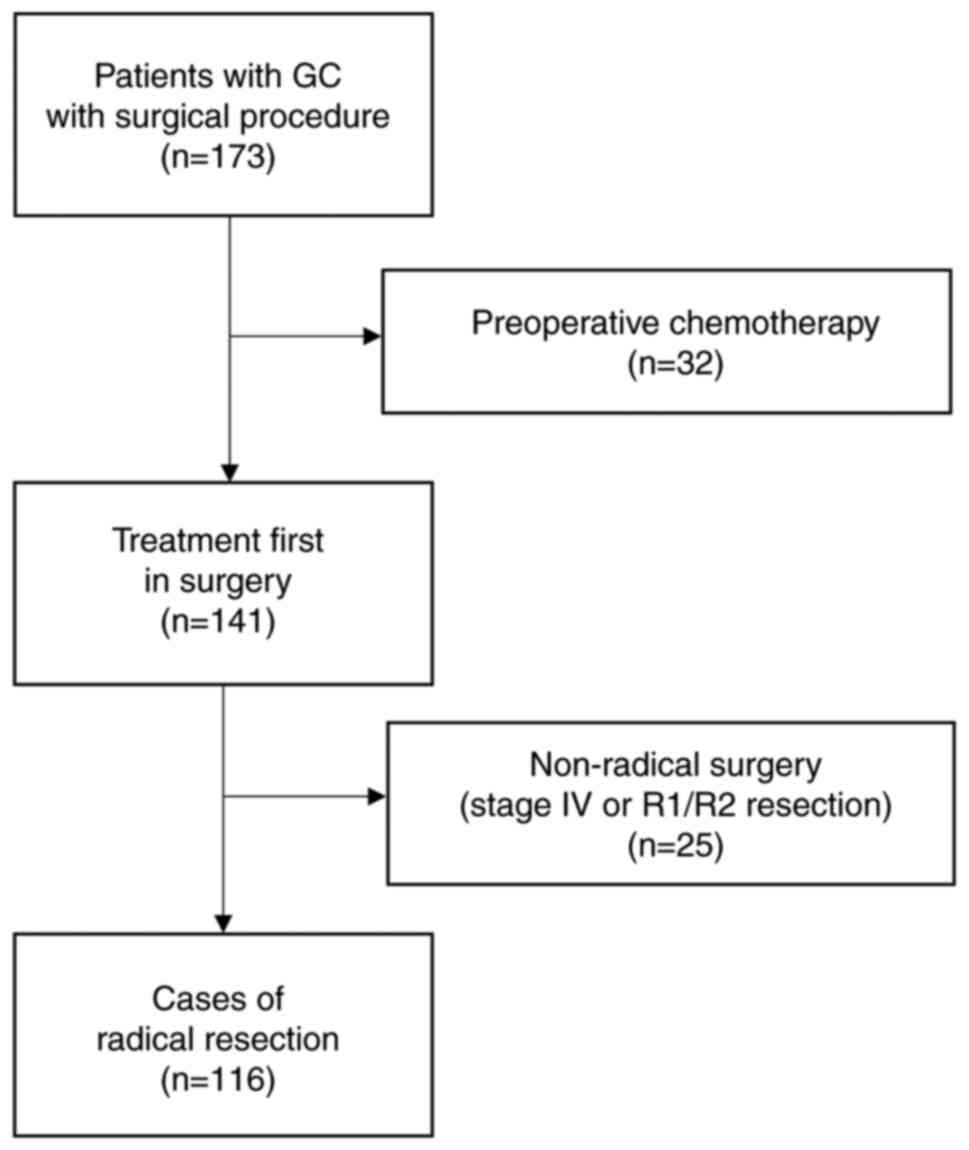
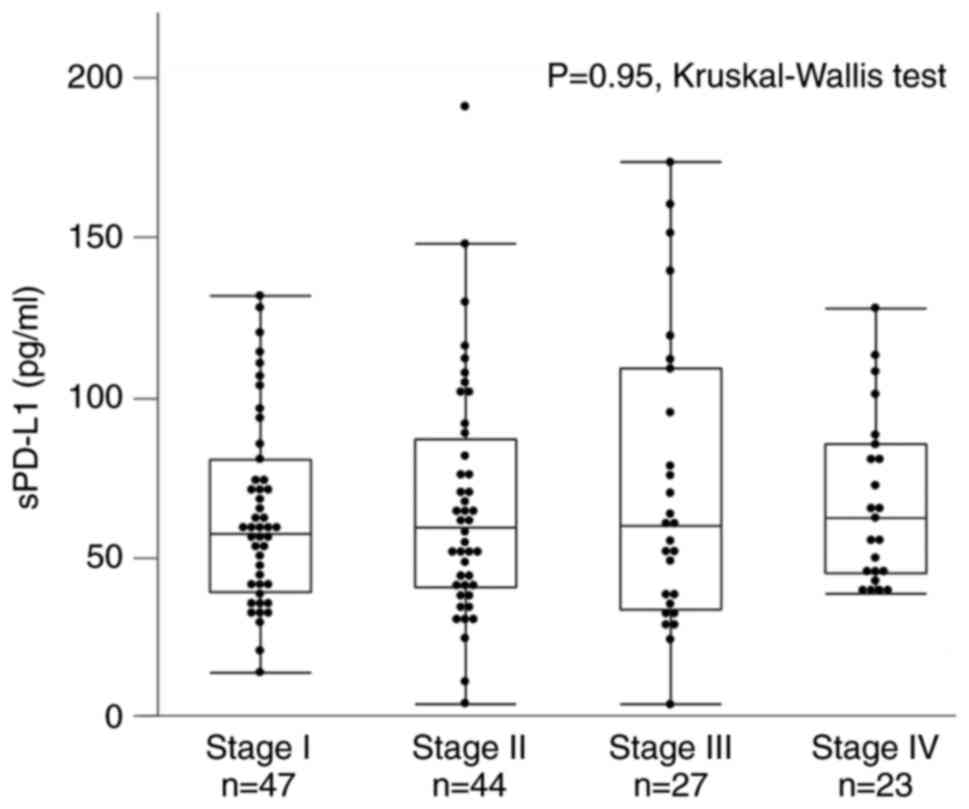
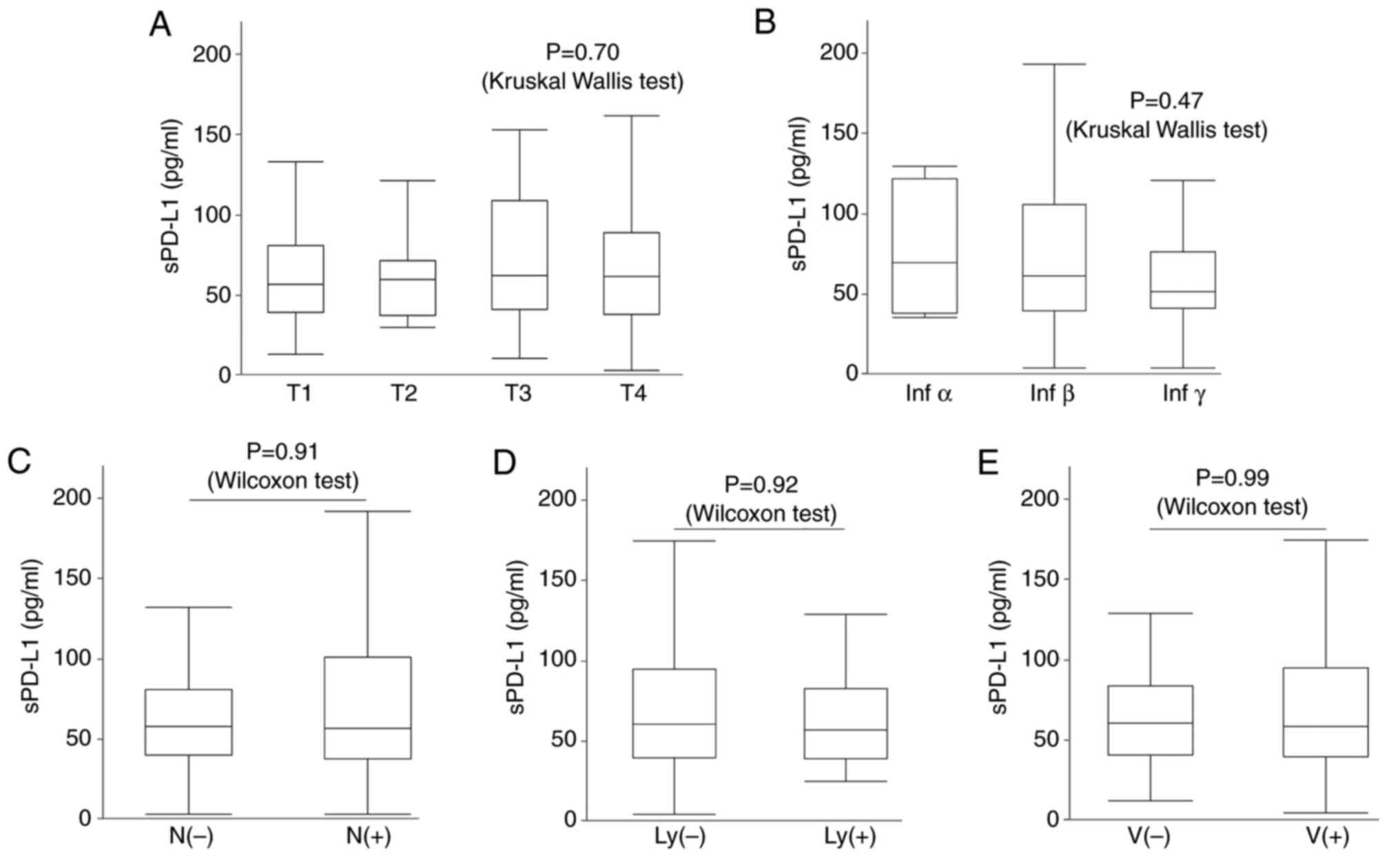
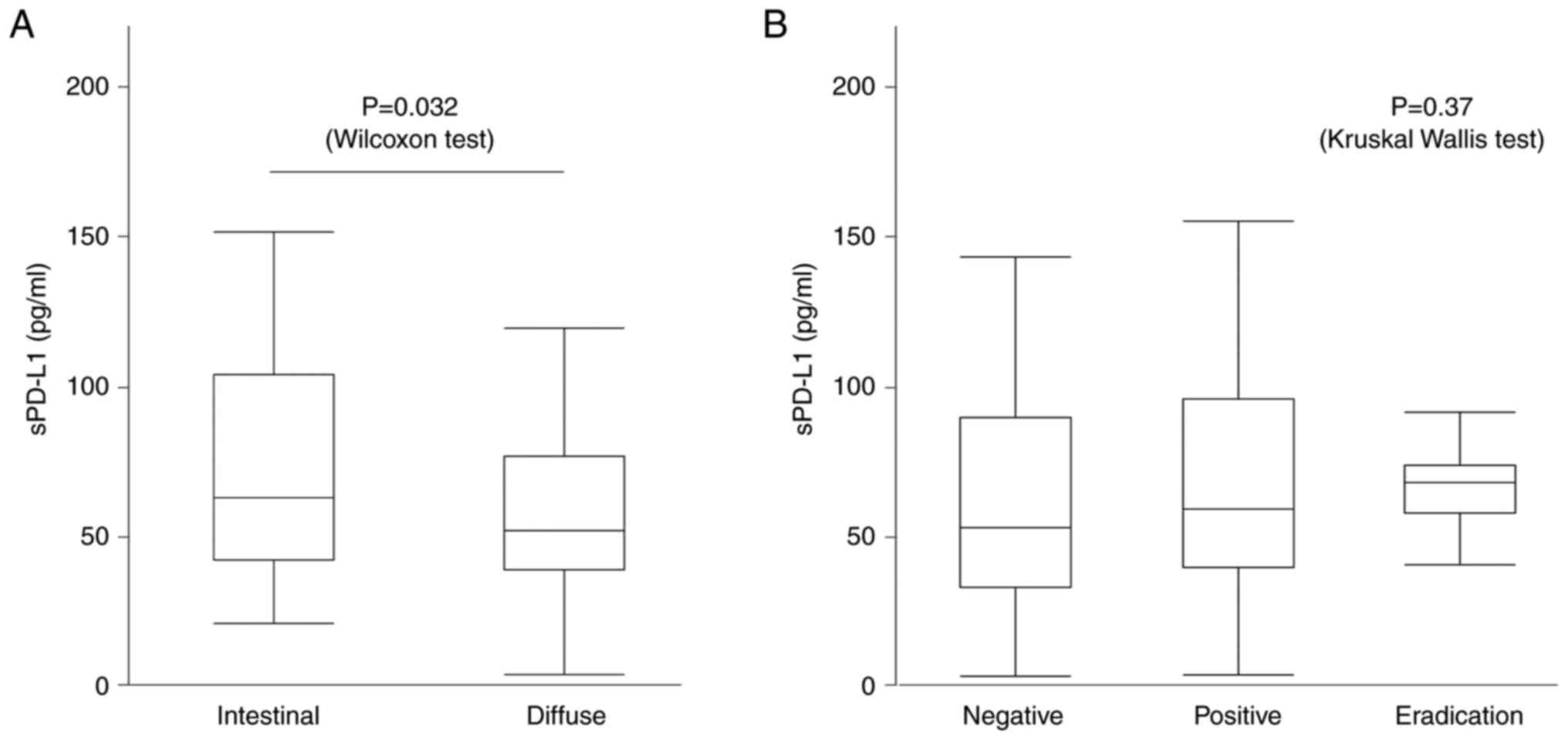
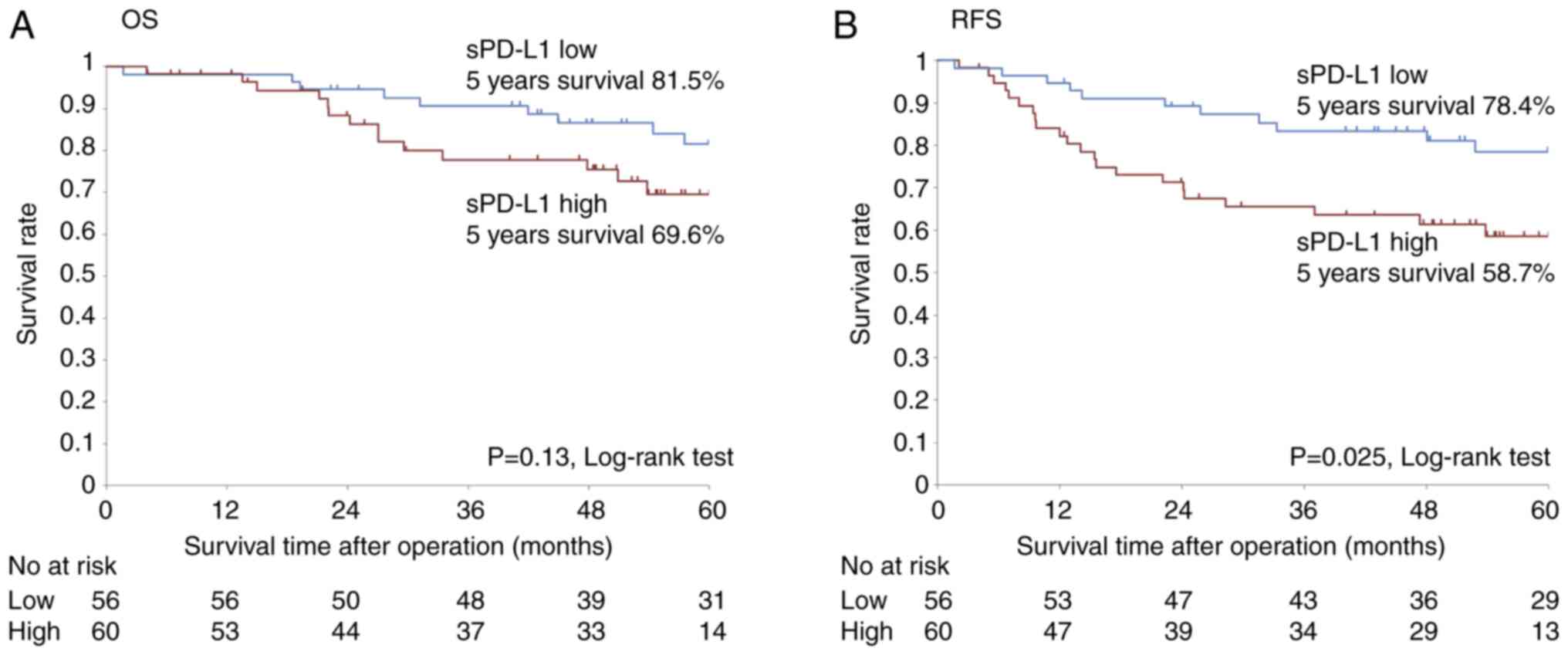
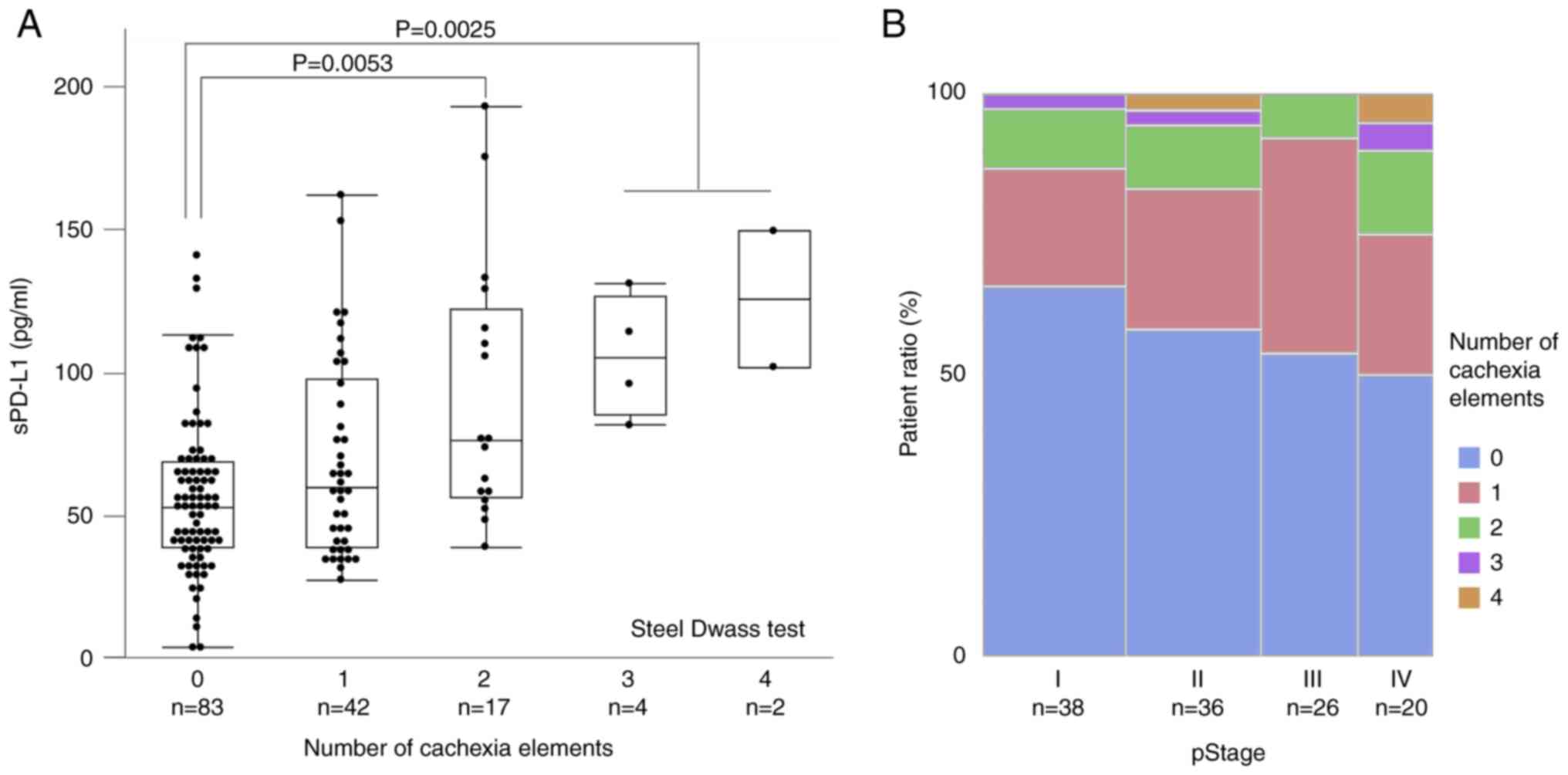
Soluble programmed death‑ligand 1 (sPD‑L1) levels can be used as a biomarker for gastric cancer (GC). However, comprehensive information regarding the sPD‑L1 expression profiles and their association with cachexia in GC is lacking. Therefore, the present study evaluated the association between clinicopathological findings and sPD‑L1 levels in patients with GC. Serum samples were collected from patients with GC during their first visit to Department of Esophageal‑Gastro‑Intestinal Surgery, Chiba University Hospital, Chiba, Japan (January 2012‑December 2017; n=173), and sPD‑L1 levels were measured using an enzyme‑linked immunosorbent assay. Survival rates among 116 patients, excluding cases with preoperative chemotherapy or no radical procedures, were analyzed. sPD‑L1 levels were associated with factors such as neutrophil‑to‑lymphocyte ratio, hemoglobin (Hb) and albumin (Alb) levels, total cholesterol and C‑reactive protein (CRP) levels, and related to inflammation and nutrition in patients. Notably, the higher the number of applicable indicators related to cachexia (Hb <12 g/dl, Alb <3.2 g/dl, CRP >0.5 mg/dl and low body mass index) was, the higher the sPD‑L1 value was. However, the pathological stage did not significantly differ between the groups. Clinicopathologically, there was no association with tumor depth, lymph node metastasis or vascular invasion; however, patients with the intestinal type had significantly higher sPD‑L1 levels than patients with the diffuse type (P=0.032; Wilcoxon test). The overall survival did not significantly differ between the groups with low and high sPD‑L1 levels; however, among patients who received radical treatment, the relapse‑free survival was significantly worse in the high‑sPD‑L1‑level group than in the low‑sPD‑L1‑level group (P=0.025; log‑rank test). Multivariate Cox regression analysis revealed that a high sPD‑L1 concentration was a sign of poor prognosis, independent of pathological stage and cancer antigen CA19‑9 (P=0.0029). Therefore, the present findings suggest that sPD‑L1 can reflect cachexia status in patients with GC and may serve as a prognostic marker for relapse‑free survival after radical GC surgery.
View Figures

Figure 1

Figure 2

Figure 3

Figure 4

Figure 5

Figure 6

View References

1 

Sung H, Ferlay J, Siegel RL, Laversanne M, Soerjomataram I, Jemal A and Bray F: Global Cancer Statistics 2020: GLOBOCAN estimates of incidence and mortality worldwide for 36 cancers in 185 countries. CA Cancer J Clin. 71:209–249. 2021.PubMed/NCBI View Article : Google Scholar

2 

Baazim H, Antonio-Herrera L and Bergthaler A: The interplay of immunology and cachexia in infection and cancer. Nat Rev Immunol. 22:309–321. 2022.PubMed/NCBI View Article : Google Scholar

3 

Fearon K, Strasser F, Anker SD, Bosaeus I, Bruera E, Fainsinger RL, Jatoi A, Loprinzi C, MacDonald N, Mantovani G, et al: Definition and classification of cancer cachexia: An international consensus. Lancet Oncol. 12:489–495. 2011.PubMed/NCBI View Article : Google Scholar

4 

Fukahori M, Shibata M, Hamauchi S, Kasamatsu E and Machii K: A retrospective cohort study to investigate the incidence of cancer-related weight loss during chemotherapy in gastric cancer patients. Support Care Cancer. 29:341–348. 2021.PubMed/NCBI View Article : Google Scholar

5 

Namikawa T, Marui A, Yokota K, Fujieda Y, Munekage M, Uemura S, Maeda H, Kitagawa H, Kobayashi M and Hanazaki K: Frequency and prognostic impact of cachexia during drug treatment for unresectable advanced gastric cancer patients. Surg Today. 52:1560–1567. 2022.PubMed/NCBI View Article : Google Scholar

6 

Morimoto K, Uchino J, Yokoi T, Kijima T, Goto Y, Nakao A, Hibino M, Takeda T, Yamaguchi H, Takumi C, et al: Impact of cancer cachexia on the therapeutic outcome of combined chemoimmunotherapy in patients with non-small cell lung cancer: A retrospective study. OncoImmunology. 10(1950411)2021.PubMed/NCBI View Article : Google Scholar

7 

Nielsen C, Ohm-Laursen L, Barington T, Husby S and Lillevang ST: Alternative splice variants of the human PD-1 gene. Cell Immunol. 235:109–116. 2005.PubMed/NCBI View Article : Google Scholar

8 

Finkelmeier F, Canli Ö, Tal A, Pleli T, Trojan J, Schmidt M, Kronenberger B, Zeuzem S, Piiper A, Greten FR and Waidmann O: High levels of the soluble programmed death-ligand (sPD-L1) identify hepatocellular carcinoma patients with a poor prognosis. Eur J Cancer. 59:152–159. 2016.PubMed/NCBI View Article : Google Scholar

9 

Chang B, Huang T, Wei H, Shen L, Zhu D, He W, Chen Q, Zhang H, Li Y, Huang R, et al: The correlation and prognostic value of serum levels of soluble programmed death protein 1 (sPD-1) and soluble programmed death-ligand 1 (sPD-L1) in patients with hepatocellular carcinoma. Cancer Immunol Immunother. 68:353–363. 2019.PubMed/NCBI View Article : Google Scholar

10 

Okuma Y, Hosomi Y, Nakahara Y, Watanabe K, Sagawa Y and Homma S: High plasma levels of soluble programmed cell death ligand 1 are prognostic for reduced survival in advanced lung cancer. Lung Cancer. 104:1–6. 2017.PubMed/NCBI View Article : Google Scholar

11 

Shigemori T, Toiyama Y, Okugawa Y, Yamamoto A, Yin C, Narumi A, Ichikawa T, Ide S, Shimura T, Fujikawa H, et al: Soluble PD-L1 expression in circulation as a predictive marker for recurrence and prognosis in gastric cancer: Direct comparison of the clinical burden between tissue and serum PD-L1 expression. Ann Surg Oncol. 26:876–883. 2019.PubMed/NCBI View Article : Google Scholar

12 

Ito M, Oshima Y, Yajima S, Suzuki T, Nanami T, Shiratori F, Funahashi K, Nemoto T and Shimada H: Is high serum programmed death ligand 1 level a risk factor for poor survival in patients with gastric cancer? Ann Gastroenterol Surg. 2:313–318. 2018.PubMed/NCBI View Article : Google Scholar

13 

Takahashi N, Iwasa S, Sasaki Y, Shoji H, Honma Y, Takashima A, Okita NT, Kato K, Hamaguchi T and Yamada Y: Serum levels of soluble programmed cell death ligand 1 as a prognostic factor on the first-line treatment of metastatic or recurrent gastric cancer. J Cancer Res Clin Oncol. 142:1727–1738. 2016.PubMed/NCBI View Article : Google Scholar

14 

Park W, Bang JH, Nam AR, Jin MH, Seo H, Kim JM, Oh KS, Kim TY and Oh DY: Prognostic value of serum soluble programmed death-ligand 1 and dynamics during chemotherapy in advanced gastric cancer patients. Cancer Res Treat. 53:199–206. 2021.PubMed/NCBI View Article : Google Scholar

15 

Frigola X, Inman BA, Lohse CM, Krco CJ, Cheville JC, Thompson RH, Leibovich B, Blute ML, Dong H and Kwon ED: Identification of a soluble form of B7-H1 that retains immunosuppressive activity and is associated with aggressive renal cell carcinoma. Clin Cancer Res. 17:1915–1923. 2011.PubMed/NCBI View Article : Google Scholar

16 

Tanaka H, Yoshii M, Imai T, Tamura T, Toyokawa T, Muguruma K, Hirakawa K and Ohira M: Clinical significance of coexisting histological diffuse type in stage II/III gastric cancer. Mol Clin Oncol. 15(234)2021.PubMed/NCBI View Article : Google Scholar

17 

Shiraishi T, Toyozumi T, Sakata H, Murakami K, Kano M, Matsumoto Y, Yokoyama M, Okada K, Kamata T, Ryuzaki T, et al: Soluble PD-L1 concentration is proportional to the expression of PD-L1 in tissue and is associated with a poor prognosis in esophageal squamous cell carcinoma. Oncology. 100:39–47. 2022.PubMed/NCBI View Article : Google Scholar

18 

Park JC, Lee YC, Kim JH, Kim YJ, Lee SK, Hyung WJ, Noh SH and Kim CB: Clinicopathological aspects and prognostic value with respect to age: An analysis of 3,362 consecutive gastric cancer patients. J Surg Oncol. 99:395–401. 2009.PubMed/NCBI View Article : Google Scholar

19 

Song P, Wu L, Jiang B, Liu Z, Cao K and Guan W: Age-specific effects on the prognosis after surgery for gastric cancer: A SEER population-based analysis. Oncotarget. 7:48614–48624. 2016.PubMed/NCBI View Article : Google Scholar

20 

Alshehri A, Alanezi H and Kim BS: Prognosis factors of advanced gastric cancer according to sex and age. World J Clin Cases. 8:1608–1619. 2020.PubMed/NCBI View Article : Google Scholar

21 

Imai Y, Chiba T, Kondo T, Kanzaki H, Kanayama K, Ao J, Kojima R, Kusakabe Y, Nakamura M, Saito T, et al: Interferon-γ induced PD-L1 expression and soluble PD-L1 production in gastric cancer. Oncol Lett. 20:2161–2168. 2020.PubMed/NCBI View Article : Google Scholar

22 

Freeman GJ, Long AJ, Iwai Y, Bourque K, Chernova T, Nishimura H, Fitz LJ, Malenkovich N, Okazaki T, Byrne MC, et al: Engagement of the PD-1 immunoinhibitory receptor by a novel B7 family member leads to negative regulation of lymphocyte activation. J Exp Med. 192:1027–1034. 2000.PubMed/NCBI View Article : Google Scholar

23 

Iwai Y, Ishida M, Tanaka Y, Okazaki T, Honjo T and Minato N: Involvement of PD-L1 on tumor cells in the escape from host immune system and tumor immunotherapy by PD-L1 blockade. Proc Natl Acad Sci USA. 99:12293–12297. 2002.PubMed/NCBI View Article : Google Scholar

24 

Iwai Y, Terawaki S and Honjo T: PD-1 blockade inhibits hematogenous spread of poorly immunogenic tumor cells by enhanced recruitment of effector T cells. Int Immunol. 17:133–144. 2005.PubMed/NCBI View Article : Google Scholar

25 

Akutsu Y, Murakami K, Kano M, Toyozumi T, Matsumoto Y, Takahashi M, Otsuka R, Sekino N, Yokoyama M, Shiraishi T and Matsubara H: The concentration of programmed cell death-ligand 1 in the peripheral blood is a useful biomarker for esophageal squamous cell carcinoma. Esophagus. 15:103–108. 2018.PubMed/NCBI View Article : Google Scholar

26 

Zhu Y, Zhu F, Ba H, Chen J and Bian X: Helicobacter pylori infection and PD-L1 expression in gastric cancer: A meta-analysis. Eur J Clin Invest. 53(e13880)2023.PubMed/NCBI View Article : Google Scholar

27 

Oh SY, Kim S, Keam B, Kim TM, Kim DW and Heo DS: Soluble PD-L1 is a predictive and prognostic biomarker in advanced cancer patients who receive immune checkpoint blockade treatment. Sci Rep. 11(19712)2021.PubMed/NCBI View Article : Google Scholar

28 

Chen G, Huang AC, Zhang W, Zhang G, Wu M, Xu W, Yu Z, Yang J, Wang B, Sun H, et al: Exosomal PD-L1 contributes to immunosuppression and is associated with anti-PD-1 response. Nature. 560:382–386. 2018.PubMed/NCBI View Article : Google Scholar

29 

Wei H, Wu F, Mao Y, Zhang Y, Leng G, Wang J, Zhang W and Wang T: Measurement of soluble PD-1 and soluble PD-L1 as well as PD-L1 and PD-1 from perioperative patients with gastric carcinoma. Jpn J Clin Oncol. 52:331–345. 2022.PubMed/NCBI View Article : Google Scholar

30 

Naito T, Uchino J, Kojima T, Matano Y, Minato K, Tanaka K, Mizukami T, Atagi S, Higashiguchi T, Muro K, et al: A multicenter, open-label, single-arm study of anamorelin (ONO-7643) in patients with cancer cachexia and low body mass index. Cancer. 128:2025–2035. 2022.PubMed/NCBI View Article : Google Scholar

Related Articles

  • Abstract
  • View
  • Download
  • Twitter
Copy and paste a formatted citation
Spandidos Publications style
Matsumoto Y, Sasaki T, Kano M, Shiraishi T, Suito H, Murakami K, Toyozumi T, Otsuka R, Kinoshita K, Iida S, Iida S, et al: Soluble PD‑L1 reflects cachexia status in patients with gastric cancer and is an independent prognostic marker for relapse‑free survival after radical surgery. Mol Clin Oncol 18: 39, 2023.
APA
Matsumoto, Y., Sasaki, T., Kano, M., Shiraishi, T., Suito, H., Murakami, K. ... Matsubara, H. (2023). Soluble PD‑L1 reflects cachexia status in patients with gastric cancer and is an independent prognostic marker for relapse‑free survival after radical surgery. Molecular and Clinical Oncology, 18, 39. https://doi.org/10.3892/mco.2023.2635
MLA
Matsumoto, Y., Sasaki, T., Kano, M., Shiraishi, T., Suito, H., Murakami, K., Toyozumi, T., Otsuka, R., Kinoshita, K., Iida, S., Morishita, H., Nishioka, Y., Hayano, K., Kurata, Y., Hayashi, H., Matsubara, H."Soluble PD‑L1 reflects cachexia status in patients with gastric cancer and is an independent prognostic marker for relapse‑free survival after radical surgery". Molecular and Clinical Oncology 18.5 (2023): 39.
Chicago
Matsumoto, Y., Sasaki, T., Kano, M., Shiraishi, T., Suito, H., Murakami, K., Toyozumi, T., Otsuka, R., Kinoshita, K., Iida, S., Morishita, H., Nishioka, Y., Hayano, K., Kurata, Y., Hayashi, H., Matsubara, H."Soluble PD‑L1 reflects cachexia status in patients with gastric cancer and is an independent prognostic marker for relapse‑free survival after radical surgery". Molecular and Clinical Oncology 18, no. 5 (2023): 39. https://doi.org/10.3892/mco.2023.2635
Copy and paste a formatted citation
x
Spandidos Publications style
Matsumoto Y, Sasaki T, Kano M, Shiraishi T, Suito H, Murakami K, Toyozumi T, Otsuka R, Kinoshita K, Iida S, Iida S, et al: Soluble PD‑L1 reflects cachexia status in patients with gastric cancer and is an independent prognostic marker for relapse‑free survival after radical surgery. Mol Clin Oncol 18: 39, 2023.
APA
Matsumoto, Y., Sasaki, T., Kano, M., Shiraishi, T., Suito, H., Murakami, K. ... Matsubara, H. (2023). Soluble PD‑L1 reflects cachexia status in patients with gastric cancer and is an independent prognostic marker for relapse‑free survival after radical surgery. Molecular and Clinical Oncology, 18, 39. https://doi.org/10.3892/mco.2023.2635
MLA
Matsumoto, Y., Sasaki, T., Kano, M., Shiraishi, T., Suito, H., Murakami, K., Toyozumi, T., Otsuka, R., Kinoshita, K., Iida, S., Morishita, H., Nishioka, Y., Hayano, K., Kurata, Y., Hayashi, H., Matsubara, H."Soluble PD‑L1 reflects cachexia status in patients with gastric cancer and is an independent prognostic marker for relapse‑free survival after radical surgery". Molecular and Clinical Oncology 18.5 (2023): 39.
Chicago
Matsumoto, Y., Sasaki, T., Kano, M., Shiraishi, T., Suito, H., Murakami, K., Toyozumi, T., Otsuka, R., Kinoshita, K., Iida, S., Morishita, H., Nishioka, Y., Hayano, K., Kurata, Y., Hayashi, H., Matsubara, H."Soluble PD‑L1 reflects cachexia status in patients with gastric cancer and is an independent prognostic marker for relapse‑free survival after radical surgery". Molecular and Clinical Oncology 18, no. 5 (2023): 39. https://doi.org/10.3892/mco.2023.2635
Follow us
  • Twitter
  • LinkedIn
  • Facebook
About
  • Spandidos Publications
  • Careers
  • Cookie Policy
  • Privacy Policy
How can we help?
  • Help
  • Live Chat
  • Contact
  • Email to our Support Team