Introduction
Malignant glioma including glioblastoma has poor
prognosis, despite recent advances in molecular diagnostics and in
modern individual treatment (1).
The current standard of care comprises surgical resection followed
by adjuvant radiotherapy and chemotherapy (2). Glioblastoma is characterized by
overexpression of vascular endothelial growth factor (VEGF), a
crucial factor of tumor-associated angiogenesis, and these tumors
are composed of highly disorganized vessels (3). A promising alternative therapeutic
approach for glioblastoma is the inhibition of angiogenesis through
VEGF, which may slow down tumor growth and enhance the effects of
radiotherapy and chemotherapy (4).
Bevacizumab is a recombinant humanized monoclonal antibody
targeting VEGF, which suppresses tumor angiogenesis and growth
(5). In the AVAglio study,
bevacizumab combined with standard treatment for patients with
newly-diagnosed glioblastoma was associated with a 4.4-month
increase in median progression-free survival (6). In the RTOG 0825 trial, first-line use
of bevacizumab did not improve overall survival in patients with
newly diagnosed glioblastoma, however, progression-free survival
was longer in the bevacizumab group than in the placebo group (10.7
months vs. 7.3 months) (7).
Bevacizumab has some specific adverse effects,
however, including proteinuria, hypertension, severe bleeding,
protracted wound healing, and gastrointestinal perforation
(5). In the RTOG 0825 trial, some
adverse events were more prevalent in the bevacizumab group than in
the placebo group, including hypertension (4.2% vs. 0.9%),
thromboembolic disease (7.7% vs. 4.7%), and wound dehiscence (1.5%
vs. 0.9%) (7). Administration of
bevacizumab in patients with glioblastoma has been associated with
an increased risk of intracerebral hemorrhage (ICH) (8). However, risk factors for the
occurrence of ICH as a result of bevacizumab treatment are unclear.
In this study, we therefore analyzed patients treated with
bevacizumab for malignant glioma and investigated the
characteristics of the patients in the cohort that developed
ICH.
Materials and methods
Patients
We retrospectively identified 118 patients with
malignant glioma (newly diagnosed or recurrent) that were treated
at Wakayama Medical University Hospital between January 2015 and
December 2022. Among them, 64 had been treated with bevacizumab, of
which 61 were men (51.7%) and 57 were women (48.3%), with a median
age of 66 years (range: 18-91 years). We extracted their clinical
and molecular biological information, treatment details, and the
presence of ICH after bevacizumab administration from the hospital
database. We retrospectively analyzed potential risk factors
involved in ICH. This study was carried out in accordance with the
principles of the Declaration of Helsinki. Approval was obtained
from the Wakayama Medical University Institutional Review Board
(approval no. 98). As this is a retrospective chart review
involving de-identified patient data, patient consent was not
required for this study.
Statistical analyses
Statistical analysis was performed using the SAS
package and JMP Pro version 16 (SAS Institute, Cary, NC, USA). The
overall survival was measured from date of diagnosis until death
and the overall survival curves were obtained by the Kaplan-Meier
method and compared with log-rank test. Categorized data were
compared between subgroups using the Fisher's exact test.
Continuous variables were compared using unpaired Student's
t-tests. Multivariate analyses were performed using logistic
regression analysis. P<0.05 was considered to indicate a
statistically significant difference. All incidences of ICH were
graded according to the common terminology criteria for adverse
events version 5.0(9).
Results
Patient characteristics
Within the study cohort were 64 patients that had
been treated with bevacizumab; their demographic and clinical
characteristics are summarized in Table I. There were 38 men (59.4%) and 26
women (40.6%) with a mean (standard deviation) age of 69 (14.6)
years. Based on integrated diagnosis by 2021 WHO Classification, 54
patients (84.4%) had glioblastoma, IDH-wildtype, four patients
(6.3%) had astrocytoma, IDH-mutant, and two patients (3.1%) had
oligodendroglioma, IDH-mutant, and 1p/19q-codeleted. Of the 64
patients, seven (10.9%) developed ICH while on bevacizumab.
 | Table IPatient demographic and clinical
characteristics (n=64). |
Table I
Patient demographic and clinical
characteristics (n=64).
| Characteristic | Value |
|---|
| Mean age at
diagnosis, years (SD) | 69 (14.6) |
| Sex, n (%) | |
|
Female | 26 (40.6) |
|
Male | 38 (59.4) |
| Main anatomical
location, n (%) | |
|
Frontal
lobe | 20 (31.3) |
|
Temporal
lobe | 11 (17.2) |
|
Parietal
lobe | 12 (18.8) |
|
Occipital
lobe | 3 (4.7) |
|
Basal
ganglia | 10 (15.6) |
|
Insula | 1 (1.6) |
|
Corpus
callosum | 4 (6.3) |
|
Cerebellum | 3 (4.7) |
| Laterality, n
(%) | |
|
Left | 23 (35.9) |
|
Right | 38 (59.4) |
|
Midline | 3 (4.7) |
| Corpus callosum
infiltration, n (%) | 17 (26.6) |
| Diabetes mellitus, n
(%) | 8 (12.5) |
| Hypertension, n
(%) | 30 (46.9) |
| Use of antithrombotic
drugs, n (%) | 8 (12.5) |
| Proteinuria, n
(%) | 33 (51.6) |
| Extent of resection,
n (%) | |
|
Gross total
resection | 6 (9.4) |
|
Partial
resection | 21 (32.8) |
|
Biopsy | 37 (57.8) |
| CNS WHO grade, n
(%) | |
|
3 | 6 (9.4) |
|
4 | 58 (90.6) |
| Molecular diagnosis,
n (%) | |
|
Astrocytoma,
IDH-mutant | 4 (6.3) |
|
Oligodendroglioma,
IDH-mutant, and | 2 (3.1) |
|
1p/19q-codeleted | |
|
Glioblastoma,
IDH-wildtype | 54 (84.4) |
|
Diffuse
midline glioma, H3K27-altered | 2 (3.1) |
|
Diffuse
glioma. NOS | 2 (3.1) |
| Molecular
alterations, n (%) | |
|
IDH
mutation | 6 (9.4) |
|
TERT
promoter mutation | 39 (60.9) |
|
H3K27M | 2 (3.1) |
|
MGMT
promoter methylation | 20 (31.3) |
| Radiation therapy, n
(%) | 42 (65.6) |
| Chemotherapy, n
(%) | |
|
Temozolomide | 60 (93.8) |
|
Bevacizumab | 64 (100.0) |
| Hemorrhage, n
(%) | 7 (10.9) |
Univariate and multivariate analyses
for the determination the factor of ICH
The clinical and molecular characteristics of
patients who developed ICH after bevacizumab administration are
summarized in Table II. ICH
occurred in four men and three women, with a mean age (standard
deviation) of 64.4 (11.6) years. Regarding the extent of resection,
six patients had a needle biopsy and one patient had a subtotal
resection. Based on the 2021 WHO Classification, six patients had
glioblastoma, IDH-wildtype, and the other patient had
oligodendroglioma, IDH-mutant, and 1p/19q-codeleted. Five patients
received radiation treatment and seven patients received
temozolomide. Two patients (28.6%) had grade ≥3 hemorrhage
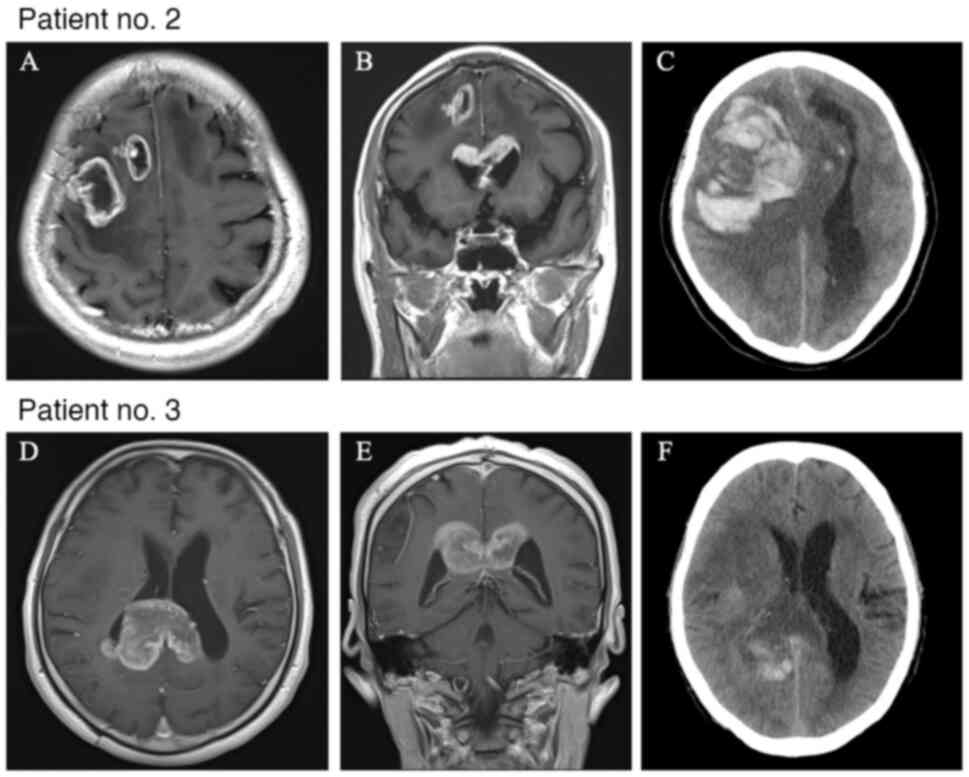
(Table II). At the time of ICH,
computed tomography showed peritumoral hemorrhage rather than
intra-tumor hemorrhage (Fig. 1).
The median number of administrations of bevacizumab before the
onset of ICH was seven times (range: 1-32), and the median duration
from first administration to ICH was 4 months (range: 1-22). One
patient (14.2%) was taking anti-thrombotic medication. ICH itself
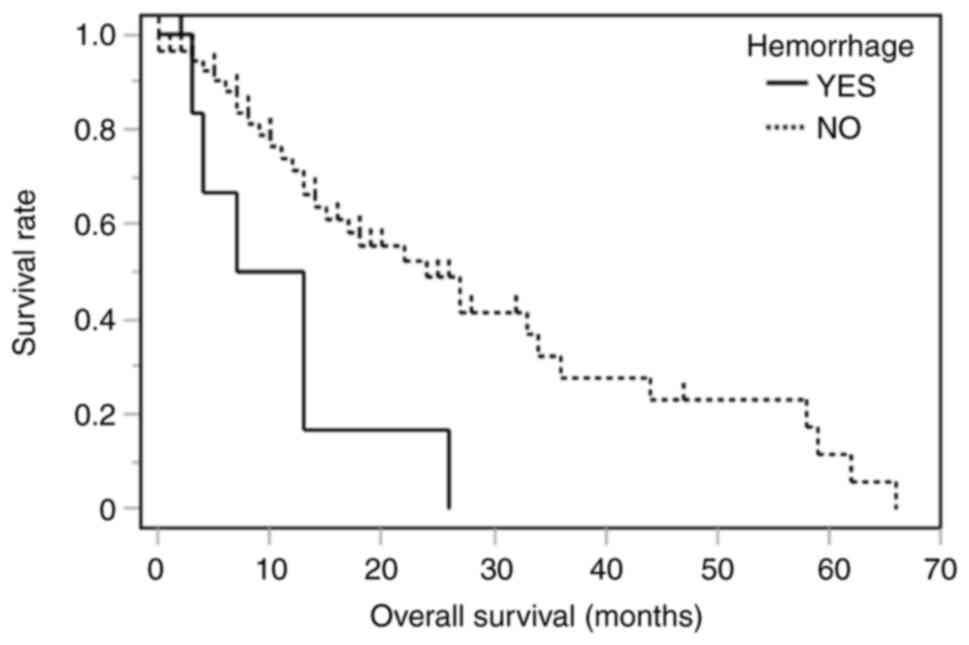
was associated with shorter overall survival (Fig. 2, log-rank, P=0.008). Tumor invasion
into the corpus callosum on contrast-enhanced magnetic resonance
imaging before administration of bevacizumab was associated with
ICH in both univariate analysis (Table III, odds ratio, 9.38; 95%
confidence interval, 1.61-54.4; P=0.01) and multivariate analysis
(Table IV, odds ratio, 9.76; 95%
confidence interval, 1.44-65.8; P=0.02).
| Table IISummary of patients in our cohort with
intracerebral hemorrhage after bevacizumab administration
(n=7). |
Table II
Summary of patients in our cohort with
intracerebral hemorrhage after bevacizumab administration
(n=7).
| No. | Sex | Age, years | Administration times
of BEV | Duration from first
administration to hemorrhage, months | Hemorrhagic grade on
CTCAE version 5.0 | Outcome after
ICH |
|---|
| 1 | Female | 59 | 32 | 22 | 2 | BSC |
| 2 | Male | 79 | 8 | 4 | 4 | Death |
| 3 | Male | 66 | 1 | 5 | 2 | BEV rechallenge |
| 4 | Female | 58 | 8 | 3 | 4 | Death |
| 5 | Male | 68 | 2 | 1 | 1 | BSC |
| 6 | Male | 45 | 7 | 7 | 1 | Reoperation |
| 7 | Female | 76 | 4 | 2 | 2 | BSC |
| Table IIIUnivariate analysis of risk factors
for intracerebral hemorrhage (n=64). |
Table III
Univariate analysis of risk factors
for intracerebral hemorrhage (n=64).
| | Hemorrhage |
|---|
| Characteristic | Yes N=7 | No N=57 | P-value |
|---|
| Mean age, years
(SD) | 64.4 (11.6) | 68.1 (15.0) | 0.36 |
| Female, n (%) | 3 (42.9) | 23 (40.3) | 0.89 |
| Laterality, n
(%) | | | 0.36 |
|
Left | 3 (42.9) | 20 (35.1) | |
|
Right | 3 (42.9) | 35 (61.4) | |
|
Midline | 1 (14.3) | 2 (3.5) | |
| Corpus callosum
infiltration, n (%) | 5 (71.4) | 12 (21.1) | 0.01a |
| Diabetes mellitus,
n (%) | 1 (14.3) | 7 (12.3) | 0.88 |
| Hypertension, n
(%) | 3 (42.9) | 26 (45.6) | 0.89 |
| Use of
antithrombotic drugs, n (%) | 1 (14.3) | 7 (12.3) | 0.87 |
| Proteinuria, n
(%) | 4 (57.1) | 29 (50.9) | 0.75 |
| Extent of
resection, n (%) | | | 0.27 |
|
Gross total
resection | 0 (0) | 6 (10.5) | |
|
Partial
resection | 1 (14.2) | 20 (35.1) | |
|
Biopsy | 6 (85.7) | 31 (54.4) | |
| CNS WHO grading, n
(%) | | | 0.51 |
|
3 | 1 (14.3) | 5 (8.8) | |
|
4 | 6 (85.7) | 52 (91.2) | |
| Molecular
diagnosis, n (%) | | | 0.49 |
|
Astrocytoma,
IDH-mutant | 0 (0) | 4 (7.0) | |
|
Oligodendroglioma,
IDH-mutant, and 1p/19q-co-deleted | 1 (14.3) | 1 (1.8) | |
|
Glioblastoma,
IDH-wildtype | 6 (85.7) | 48 (84.2) | |
|
Diffuse
midline glioma, H3K27-altered | 0 (0) | 2 (3.5) | |
|
Diffuse
glioma. NOS | 0 (0) | 2 (3.5) | |
| IDH1/2 mutation, n
(%) | 1 (14.3) | 5 (8.8) | 0.51 |
| TERT promoter
mutation, n (%) | 5 (71.4) | 34 (59.7) | 0.69 |
| H3K27M, n (%) | 0 (0) | 2 (3.5) | 0.61 |
| MGMT promoter
methylation, n (%) | 2 (28.6) | 18 (31.6) | 0.87 |
| Radiation therapy,
n (%) | 5 (71.4) | 37 (64.9) | 0.73 |
| Temozolomide, n
(%) | 7(100) | 53 (93.0) | 0.47 |
| Table IVMultivariate analysis of risk factors
for intracerebral hemorrhage (n=64). |
Table IV
Multivariate analysis of risk factors
for intracerebral hemorrhage (n=64).
|
Characteristics | Odds Ratio | 95% CI | P-value |
|---|
| Laterality | | | |
|
Left | 1.67 | (0.25-11.1) | 0.59 |
| Corpus callosum
infiltration | 9.76 | (1.44-65.8) | 0.02a |
| Extent of
resection | | | |
|
Biopsy | 5.67 | (0.53-61.1) | 0.15 |
Discussion
Bevacizumab has a specific toxicity profile related
to its anti-angiogenic effect, and some bevacizumab-associated
adverse events can be life-threatening (8). We investigated the overall incidence
and risk of ICH among patients with high-grade glioma that
underwent bevacizumab therapy. We found ICH to be associated with
shorter overall survival. Also, tumor invasion into the corpus
callosum before administration of bevacizumab was associated with
an increased risk of developing ICH.
Among brain tumors, gliomas and metastasis tend to
bleed most frequently (10). ICH
occurs in 3.7-7.2% of gliomas, mainly in glioblastoma and
oligodendroglioma (10). The most
important etiopathogenesis of ICH in glioblastoma is considered to
be the abnormalities of tumor vascularization (10). Glioblastomas are highly angiogenic
and infiltrative tumors. Tumor cells invade along blood vessels to
increase tumor growth, and glioblastomas displace the endfeet of
astrocytes and affect pericyte stability, leading to perivascular
niches and cell evasion (11).
Microvascular proliferation with hyperplasia of endothelial cells
following obliteration and the presence of numerous thin-walled,
poorly formed, or dilated vessels may induce hemorrhages (10,11).
In the AVAglio study, the incidence of ICH was 2.5%
in the placebo group and 4.3% in the bevacizumab group, suggesting
that bevacizumab may contribute to development of ICH (6). A post-marketing surveillance study of
bevacizumab for patients with newly diagnosed or recurrent
malignant glioma in Japan reported an ICH incidence of 5.4%
(12). In the current study, the
hemorrhage rates were higher than in these reports. The AVAglio
study reported that just 13% of patients in the bevacizumab-treated
group underwent a biopsy (6), as
compared with 58% in this study. We suggest the high hemorrhagic
rate may be related to the patient population in this study, which
includes a large portion of patients who underwent biopsy rather
than tumor removal due to old age, poor preoperative performance
status, and dissemination.
The pathophysiology underlying ICH in high-grade
glioma with bevacizumab still requires elucidation. VEGF is thought
to be important for endothelial cells to maintain the architecture
and integrity of the microvasculature (5). In metastatic brain tumors,
overexpression of VEGF and metalloproteinase, which degrade the
extracellular matrix, may play a role in causing hemorrhages
through rapid growth and breakdown of vessels around the tumor
(13). Bevacizumab may cause
hemorrhage by reducing the regenerative capacity of endothelial
cells (14). However, dysfunction
of endothelial cells alone cannot explain the ICH in patients that
have received bevacizumab (13,14).
In our cohort, tumor invasion into the corpus
callosum before administration of bevacizumab was associated with
an increased risk of ICH. Gliomas invading the corpus callosum
reportedly account for approximately 14% of gliomas (15,16).
Tumor invasion into the corpus callosum has been said to be a more
aggressive subtype of an already aggressive and incurable disease
(16). In a recent retrospective
cohort study, it was significantly associated with glioma WHO grade
and PDGFRA mutation (17).
Endocan, an endothelial-secreted proteoglycan reportedly activates
PDGFRA and promotes a hypervascular phenotype of glioblastoma
(18). The aggressive biological
behavior and hypervascularization of the tumor might affect ICH
after bevacizumab administration.
In relation to tumor-related ICH, a number of
reports have discussed feeding arteries (11,19),
but there has been little mention of the draining veins. Brain
arteriovenous malformations with deep venous drainage have shown
higher rates of hemorrhage, suggesting arteriovenous malformation
pressurization due to draining veins (20). Inhibition of VEGF signaling
suppresses the endothelial cell activation, predisposing to
thromboembolic events (14). Even
in malignant gliomas, the lesions invading the corpus callosum are
associated with deep venous drainage, and we suggest that
thrombosis of deep cerebral veins due to the use of bevacizumab may
contribute to ICH.
This study has several limitations. Unlike a
randomized study, there is a possibility of selection bias in the
decision-making on treatment strategy. Second, the limited number
of patients could be responsible for the absence of statistical
power to detect differences between groups. The sample size of this
study is insufficient to establish an association between invasion
of corpus callosum and ICH after bevacizumab administration.
Perhaps due to the small sample size, no risk factors other than
corpus callosum invasion could be observed in this study. Further
investigation in a larger population is required to examine other
factors, such as antithrombotic medications, angiographical
features, and microbleeds in the magnetic resonance imaging, which
would contribute to a better understanding of
bevacizumab-associated ICH in patients with malignant glioma.
In conclusion, in our cohort of patients with
malignant glioma treated with bevacizumab, ICH was associated with
shorter overall survival. It was suggested that invasion of the
corpus callosum shown on magnetic resonance imaging might be a
predictor of development of ICH in some patients that receive
bevacizumab. Further studies in larger cohorts are required to
confirm these results. Meticulous management, such as frequent
follow-up and treatment of hypertension, may be necessary in
patients at high risk for ICH after administration of
bevacizumab.
Acknowledgements
The authors would like to thank Mr. Benjamin Phillis
(Clinical Study Support Center at Wakayama Medical University) for
proofreading and editing the manuscript.
Funding
Funding: No funding was received.
Availability of data and materials
The data generated in the present study may be
requested from the corresponding author.
Authors' contributions
All authors (YH, TS, JF and NN) contributed to the
study conception and design. YH and TS wrote the final manuscript
and acquired all data. YH and TS confirm the authenticity of all
the raw data. All authors read and approved the final version of
the manuscript.
Ethics approval and consent to
participate
Approval was obtained from the Wakayama Medical
University Institutional Review Board (approval no. 98). This was a
retrospective chart review involving de-identified patient data, so
patient consent was not required for this study.
Patient consent for publication
Not applicable.
Competing interests
The authors declare that they have no competing
interests.
References
|
1
|
Wen PY, Weller M, Lee EQ, Alexander BM,
Barnholtz-Sloan JS, Barthel FP, Batchelor TT, Bindra RS, Chang SM,
Chiocca EA, et al: Glioblastoma in adults: A society for
neuro-oncology (SNO) and European society of neuro-oncology (EANO)
consensus review on current management and future directions. Neuro
Oncol. 22:1073–1113. 2020.PubMed/NCBI View Article : Google Scholar
|
|
2
|
Stupp R, Mason WP, van den Bent MJ, Weller
M, Fisher B, Taphoorn MJ, Belanger K, Brandes AA, Marosi C, Bogdahn
U, et al: Radiotherapy plus concomitant and adjuvant temozolomide
for glioblastoma. N Engl J Med. 352:987–996. 2005.PubMed/NCBI View Article : Google Scholar
|
|
3
|
Das S and Marsden PA: Angiogenesis in
glioblastoma. N Engl J Med. 369:1561–1563. 2013.PubMed/NCBI View Article : Google Scholar
|
|
4
|
Yang SB, Gao KD, Jiang T, Cheng SJ and Li
WB: . Bevacizumab combined with chemotherapy for glioblastoma: A
meta-analysis of randomized controlled trials. Oncotarget.
8:57337–57344. 2017.PubMed/NCBI View Article : Google Scholar
|
|
5
|
Liu ZL, Chen HH, Zheng LL, Sun LP and Shi
L: Angiogenic signaling pathways and anti-angiogenic therapy for
cancer. Signal Transduct Target Ther. 8(198)2023.PubMed/NCBI View Article : Google Scholar
|
|
6
|
Chinot OL, Wick W, Mason W, Henriksson R,
Saran F, Nishikawa R, Carpentier AF, Hoang-Xuan K, Kavan P, Cernea
D, et al: Bevacizumab plus radiotherapy-temozolomide for newly
diagnosed glioblastoma. N Engl J Med. 370:709–722. 2014.PubMed/NCBI View Article : Google Scholar
|
|
7
|
Gilbert MR, Dignam JJ, Armstrong TS, Wefel
JS, Blumenthal DT, Vogelbaum MA, Colman H, Chakravarti A, Pugh S,
Won M, et al: A randomized trial of bevacizumab for newly diagnosed
glioblastoma. N Engl J Med. 370:699–708. 2014.PubMed/NCBI View Article : Google Scholar
|
|
8
|
Brandes AA, Bartolotti M, Tosoni A, Poggi
R and Franceschi E: Practical management of bevacizumab-related
toxicities in glioblastoma. Oncologist. 20:166–175. 2015.PubMed/NCBI View Article : Google Scholar
|
|
9
|
Common Terminology Criteria for Adverse
Events (CTCAE) v5.0. Available at https://ctep.cancer.gov/protocolDevelopment/electronic_applications/ctc.htm#ctc_50.
Accessed on May 20, 2024.
|
|
10
|
Ostrowski RP, He Z, Pucko EB and Matyja E:
Hemorrhage in brain tumor-an unresolved issue. Brain Hemorrhages.
3:98–102. 2022.
|
|
11
|
Guyon J, Chapouly C, Andrique L, Bikfalvi
A and Daubon T: The normal and brain tumor vasculature:
Morphological and functional characteristics and therapeutic
targeting. Front Physiol. 12(622615)2021.PubMed/NCBI View Article : Google Scholar
|
|
12
|
Motoo N, Hayashi Y, Shimizu A, Ura M and
Nishikawa R: Safety and effectiveness of bevacizumab in Japanese
patients with malignant glioma: A post-marketing surveillance
study. Jpn J Clin Oncol. 49:1016–1023. 2019.PubMed/NCBI View Article : Google Scholar
|
|
13
|
Kubo H, Fujiwara T, Jussila L, Hashi H,
Ogawa M, Shimizu K, Awane M, Sakai Y, Takabayashi A, Alitalo K, et
al: Involvement of vascular endothelial growth factor receptor-3 in
maintenance of integrity of endothelial cell lining during tumor
angiogenesis. Blood. 96:546–553. 2000.PubMed/NCBI
|
|
14
|
Kamba T and McDonald DM: Mechanisms of
adverse effects of anti-VEGF therapy for cancer. Br J Cancer.
96:1788–1795. 2007.PubMed/NCBI View Article : Google Scholar
|
|
15
|
Chen KT, Wu TW, Chuang CC, Hsu YH, Hsu PW,
Huang YC, Lin TK, Chang CN, Lee ST, Wu CT, et al: Corpus callosum
involvement and postoperative outcomes of patients with gliomas. J
Neurooncol. 124:207–214. 2015.PubMed/NCBI View Article : Google Scholar
|
|
16
|
Dayani F, Young JS, Bonte A, Chang EF,
Theodosopoulos P, McDermott MW, Berger MS and Aghi MK: Safety and
outcomes of resection of butterfly glioblastoma. Neurosurg Focus.
44(E4)2018.PubMed/NCBI View Article : Google Scholar
|
|
17
|
Shen S, Feng S, Liu H, Jiang J and Yu X:
Associations of histological and molecular alterations with
invasion of the corpus callosum in gliomas. Acta Neurochir (Wien).
162:1691–1699. 2020.PubMed/NCBI View Article : Google Scholar
|
|
18
|
Bastola S, Pavlyukov MS, Sharma N,
Ghochani Y, Nakano MA, Muthukrishnan SD, Yu SY, Kim MS, Sohrabi A,
Biscola NP, et al: Endothelial-secreted Endocan activates PDGFRA
and regulates vascularity and spatial phenotype in glioblastoma.
Nat Commun. 16(471)2025.PubMed/NCBI View Article : Google Scholar
|
|
19
|
Liebelt B, Boghani Z, Takei H, Fung S and
Britz G: Epithelioid glioblastoma presenting as massive
intracerebral hemorrhage: Case report and review of the literature.
Surg Neurol Int. 6 (Suppl 2):S97–S100. 2015.PubMed/NCBI View Article : Google Scholar
|
|
20
|
Alexander MD, Cooke DL, Nelson J, Guo DE,
Dowd CF, Higashida RT, Halbach VV, Lawton MT, Kim H and Hetts SW:
Association between venous angioarchitectural features of sporadic
brain arteriovenous malformations and intracranial hemorrhage. Am J
Neuroradiol. 36:949–952. 2015.PubMed/NCBI View Article : Google Scholar
|