1. Introduction
Prostate cancer (PC) is the second most common
cancer diagnosed in men worldwide, with nearly 1.4 million new
cases reported in 2022(1).
National Cancer Registry Program in India found that PC ranks
second among men over 65 years of age and third among all cancers
(2). Metastatic
castration-sensitive PC (mCSPC) may be either a de novo
condition or as a recurrence following local treatment for PC that
has spread locally. Prostate-specific antigen (PSA) is a biomarker
used for prognosis and to determine oncological outcomes in
patients with PC. A decline in PSA is a well-established indicator
of disease control in both early and advanced stages of PC
(3). Combining androgen
deprivation therapy (ADT) with androgen receptor (AR) signaling
inhibitors (ARSIs) has been shown to significantly improve
oncological outcomes in patients and influence PSA dynamics with
mCSPC. In the last several years, there have been significant
advancements in the management of mCSPC, with studies showing that
when compared with ADT alone, new ARSIs significantly improve
overall survival (OS) (4). A total
of four hormonal therapies including abiraterone, apalutamide,
darolutamide and enzalutamide have been given approval for
management of mCSPC when paired along with ADT.
According to 2025 National Comprehensive Cancer
Network guidelines, apalutamide, darolutamide, enzalutamide or
abiraterone is recommended along with ADT for low and high volume
synchronous and metachronous metastases CSPC (5). Similarly, the American Urology
Association guidelines strongly recommend that ‘for patients with
mCSPC, ADT should be offered by clinicians in combination with
either androgen pathway-directed therapy (abiraterone, apalutamide,
enzalutamide) or chemotherapy (docetaxel) (6). Japanese guidelines also align on
combining ADT with ARSIs (abiraterone, apalutamide, enzalutamide,
or darolutamide) in mCSPC, favoring them over chemotherapy for
their superior efficacy and safety profile (7). The 2025 Canadian guidelines recommend
combining ADT with ARSIs (abiraterone, apalutamide, enzalutamide,
or darolutamide) in mCSPC, with apalutamide recommended regardless
of disease volume based on strong evidence of efficacy in both
high- and low-volume settings (8).
The present review focuses on apalutamide because,
among the approved ARSIs, it offers a distinct clinical profile and
robust evidence of PSA suppression in mCSPC yet remains relatively
underexplored in terms of detailed PSA response correlations with
long-term outcomes. Through the present review, it was aimed to
provide a comprehensive overview of the implications of PSA
dynamics in the context of apalutamide therapy.
2. Methodology
The present article is a narrative review that
synthesizes evidence on PSA dynamics and clinical outcomes in
patients with mCSPC treated with apalutamide plus ADT. A literature
search was conducted in PubMed (https://pubmed.ncbi.nlm.nih.gov/), Scopus (https://www.sciencedirect.com) and Google Scholar
(https://scholar.google.com/) from
database inception to February 2025 using combinations of the
following terms: ‘apalutamide’, ‘metastatic castration-sensitive
PC’, ‘mCSPC’, ‘PSA response’, ‘PSA50’, ‘PSA90’, ‘PSA ≤0.2 ng/ml’,
‘ultralow PSA’, ‘PSA kinetics’, and ‘real-world’. Randomized
controlled trials (RCTs) and post-hoc analyses, as well as
observational cohort and real-world database studies were included,
that evaluated apalutamide plus ADT in adult patients with mCSPC
and quantitative PSA outcomes (for example PSA50, PSA90, PSA ≤0.2
ng/ml or ultralow PSA) and/or clinical endpoints such as
radiographic progression-free survival (PFS), OS, or time to
castration resistance were reported. Case reports, small series
(fewer than ~20 patients), non-English articles, conference
abstracts without sufficient numerical data, and studies not
reporting PSA outcomes of interest were excluded. Because this was
a narrative rather than a formal systematic review, a structured
risk-of-bias assessment was not performed; instead, post-hoc
analyses of phase III randomized trials and larger multicenter
real-world studies were prioritized when summarizing the
evidence.
3. PSA decline as a prognostic
indicator
PC is accompanied by the release of various
biomarkers into the bloodstream, with PSA and PSA-phosphatase
(PSAP) being most clinically relevant. These markers are used for
screening, monitoring treatment response, and providing diagnostic
insight. The free form of PSA is particularly helpful for detecting
PC for males whose total PSA levels fall between 4 and 10 µg/l
(9). PSA90 response, characterized
by a decrease of 90% PSA or more is an early predictor of better or
extended rPFS and OS among patients with mCSPC undergoing
next-generation ARSI therapy (10). Achieving a PSA50 (≥50% decline in
PSA) early in treatment is strongly associated with improved OS in
mCSPC. A deep and rapid PSA response, a decline >90% from
baseline, improves survival in mCSPC and also positively influences
prognosis in subsequent CRPC therapy (11).
Decline in PSA is a powerful prognostic marker in
mCSPC. A total of five RCTs were recently the subject of a
systematic review and Bayesian meta-analysis. PEACE-1, ARASENS,
CHAARTED, LATITUDE and TITAN, including 2,533 patients,
demonstrated that deep PSA response following intensified therapy
(either doublet or triplet regimens) was achieved in ~49.45% of
patients (95% CI: 37.75-61.18). Importantly, patients who achieved
a deep PSA response experienced notably superior OS with a pooled
hazard ratio (HR) of 0.39 (95% CI: 0.30-0.50) in comparison to
individuals who were not affected. These findings, consistent
across sensitivity analyses, suggest that early deep PSA decline
may serve not only as a surrogate for improved survival but also as
a potential biomarker to inform future treatment de-escalation
strategies in selected patients with mCSPC (12).
4. Apalutamide
Mechanism of action
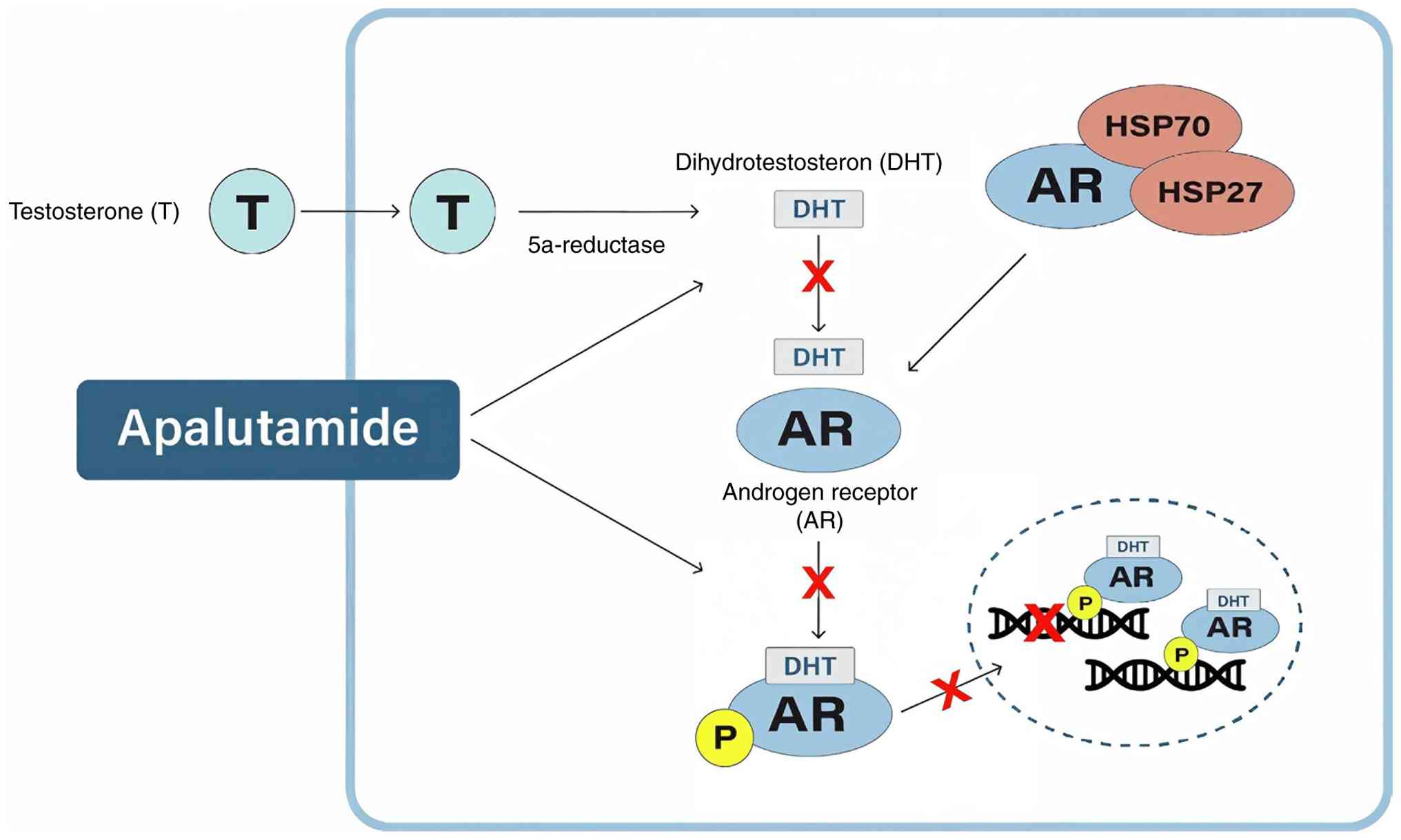
Apalutamide is a nonsteroidal AR inhibitor that
binds directly to the androgen ligand binding-domain of the AR.
This action inhibits AR nuclear translocation, DNA binding and
AR-mediated transcription (13)
(Fig. 1).
Key clinical trials and real-world
evidence with apalutamide
Table I summarizes
evidence from randomized clinical trials, post hoc analyses, and
real-world studies evaluating PSA response outcomes with
apalutamide-based therapy in patients with mCSPC. Comparative
real-world analyses further suggest that apalutamide may achieve
faster and deeper PSA responses than enzalutamide or abiraterone in
mCSPC populations (Table I).
 | Table ISummary of clinical trial and
real-world evidence on PSA90 and deep PSA responses with
apalutamide in mCSPC. |
Table I
Summary of clinical trial and
real-world evidence on PSA90 and deep PSA responses with
apalutamide in mCSPC.
| First author/s,
year | Study type | Population/N | Treatment | PSA90 Response | PSA ≤0.2 ng/ml
Response | Timepoint | Key clinical
outcomes | (Refs.) |
|---|
| Chi et al,
2019 | Clinical Trial (Phase
III RCT) | 1052 (APA + ADT-525;
Placebo + ADT-527) | APA 240 mg or placebo
(1:1), orally once daily, in addition to continuous ADT. | - | 68.4% vs. 28.7% | Median follow up 22.7
months | Improved OS (HR
0.67), improved rPFS, delayed PSA progression and CRPC
progression | (14) |
| Chowdhury et
al, 2023 | Clinical Trial (Post
Hoc TITAN) | mCSPC; n=525 vs.
527 | Apalutamide + ADT vs.
Placebo + ADT | PSA90 achieved in 73%
vs. 29% | PSA ≤0.2 ng/ml in 68%
vs. 32% | 44 months | Deep PSA decline
associated with superior OS, rPFS, delayed PSA progression and
delayed CRPC | (15) |
| Merseburger et
al, 2023 | Clinical Trial
(Post Hoc TITAN) | mCSPC; n=525 vs.
527 | Apalutamide + ADT
vs. Placebo + ADT | - | UL1: 38% vs. 15%;
UL2: 23% vs. 5% | 3 months | UL PSA responses
associated with improved OS, rPFS and delayed CRPC | (16) |
| Lopez-Abad et
al, 2024 | Real-World
Study | mCSPC; n=193 | Apalutamide +
ADT | 88% | 82.4% | 12 months | OS: 98.7% vs.
65.3%; rPFS: 97.4% vs. 53.7% in PSA ≤0.2 group | (17) |
| Tohi et al,
2024 | Real-World
Study | mCSPC; n=108 | Apalutamide +
ADT | 84.3% | 65.7% | 16 months | PSA ≤0.2 ng/ml
associated with significantly longer time to CRPC | (18) |
| Santoni et
al, 2024 | Real-World
Study | mCSPC; n=531 | Apalutamide +
ADT | 87% | 69% | 18 months | 2-year OS: 93% vs.
70% for PSA90 achievers; 95% vs. 80% for PSA ≤0.2 achievers | (19) |
| Encarnación Navarro
et al, 2025 | Real-World
Study | mCSPC; n=432 | Apalutamide +
ADT | 88.2% | 81.7% | 12 months | rPFS: 95.1% vs. 62%
in PSA ≤0.2 ng/ml responders | (20) |
| Lopez-Abad et
al, 2024 | Real-World
Study | mCSPC; n=193 | Apalutamide +
ADT | - | PSA <0.02 ng/ml:
58.2% | 6 months | 18-month OS: 100%
vs. 67.7%; rPFS: 100% vs. 50.7% | (21) |
| Lowentritt et
al, 2023 | Comparative
Real-World Study | mCSPC | Apalutamide vs.
Enzalutamide | 72.3% vs.
61.6% | 81% vs. 63% | 12 months | Faster median time
to PSA90 with apalutamide (3.1 vs. 5.2 months) | (22) |
| | Comparative
Real-World Study | mCSPC | Apalutamide vs.
Abiraterone | 72.3% vs.
54.7% | 81% vs. 58% | 12 months | Greater probability
and earlier achievement of PSA90 with apalutamide | |
| Maughan et
al, 2024 | Comparative
Real-World Study | mCSPC | Apalutamide vs.
Enzalutamide vs. Abiraterone | 66% vs. 61% vs.
57% | 74% vs. 61% vs.
58% | 12 months | Lower progression
to CRPC and improved OS with apalutamide | (23) |
PSA decline with apalutamide and its
correlation with clinical outcomes
The combination of apalutamide with ADT has been
extensively evaluated for its impact on PSA responses in patients
with mCSPC. Clinical trials and retrospective studies have
consistently demonstrated that this therapeutic regimen leads to
significant reductions in PSA levels, including deep (≥90% decline
from baseline) and ultra-low (≤0.02 ng/ml) PSA responses. These
findings underscore the efficacy of apalutamide plus ADT in
achieving substantial PSA declines in the mCSPC patient
population.
PSA kinetics are validated early prognostic
biomarkers in mCSPC. In the phase III TITAN trial, treatment with
apalutamide plus ADT resulted in higher rates of deep PSA declines,
including PSA50, PSA90 and PSA reduction to ≤0.2 ng/ml, compared
with ADT alone, supporting PSA decline as a marker of treatment
response (24).
Post-hoc analyses of TITAN further demonstrated that
early achievement of PSA90 and lower PSA nadir levels were
independently associated with improved OS, radiographic PFS (rPFS),
delayed time to castration resistance, and delayed PSA progression,
establishing the prognostic value of both depth and timing of PSA
decline (15,24). Consistent with randomized trial
data, real-world evidence shows that patients with mCSPC treated
with apalutamide plus ADT achieve PSA90 more frequently and with a
shorter median time to PSA90 compared with other AR pathway
inhibitors, reinforcing the clinical utility of PSA kinetics as
dynamic prognostic markers in routine practice (10).
Although PSA decline represents a validated early
prognostic marker in mCSPC, its clinical relevance is best
interpreted alongside radiographic and clinical outcomes. In post
hoc analyses of the phase III TITAN trial, deep and early PSA
declines with apalutamide plus ADT, including achievement of PSA90
and low PSA nadir levels, were associated with improved rPFS,
delayed time to castration resistance, and delayed PSA progression
(24).
These analyses further demonstrated that patients
achieving early PSA90 or very low PSA nadir experienced superior OS
compared with patients without deep PSA declines, supporting a link
between PSA kinetics and long term clinical outcomes in mCSPC
(15). However, PSA kinetics
should be interpreted in conjunction with imaging findings and
clinical assessment, particularly in patients with discordant
biochemical and radiographic responses. This multimodal approach is
especially relevant in low PSA-producing tumors or atypical disease
biology, where PSA decline alone may not fully reflect disease
burden (25).
In a combined analysis of the TITAN and SPARTAN
trials, adding APA to ADT led to a deep and rapid decline in PSA
levels at 3 and 6 months, defined as PSA ≤0.2 ng/ml or ≥90%
reduction from baseline. Patients who attained this early PSA
response had a longer time to worsening of patient-reported
outcomes, including physical well-being, overall HRQoL, pain and
fatigue. These benefits highlight the value of early and deep PSA
decline with apalutamide (16).
In a real-world study, 94.4% of patients with mCSPC
treated with ADT achieved a PSA50 response. These patients had
significantly longer OS compared with those who did not achieve
PSA50 (56.0 vs. 14.8 months; P<0.001). Additionally, 47.9% of
patients achieved a deep and rapid PSA response (PSA50 in 4
months), which correlated with longer median OS (101.0 vs. 41.9
months) and PFS (23.4 vs. 11.0 months) compared with those without
PSA >50% reduction within 4 months (P<0.001).
In a retrospective multicenter study by Lopez-Abad
et al (17) involving 193
patients with mCSPC treated with ADT plus apalutamide, patients
with PSA ≤0.2 ng/ml had significantly improved OS (98.7% vs. 65.3%)
and rPFS (97.4% vs. 53.7%) than those with PSA >0.2 ng/ml, at 18
months, suggesting PSA suppression as a strong prognostic marker
(17).
In another analysis by the same author, 58.2%
achieved PSA <0.02 ng/ml, 20.6% for PSA 0.02 and 0.2 ng/ml and
21.2% of PSA levels >0.2 ng/ml. Most patients reached PSA
<0.02 ng/ml within 6 months. 18-month OS in patients with mCSPC
was 100% for the ultralow PSA group (<0.02 ng/ml), 94.4% for PSA
0.02-0.2 ng/ml, and 67.7% for PSA >0.2 ng/ml. Similarly, rPFS at
18 months was 100, 93.5 and 50.7%, respectively. Cox regression
confirmed ultralow PSA as a strong predictor of OS (HR=8.256) and
rPFS (HR=0.085), reinforcing the prognostic significance of deep
PSA suppression (21). PSA <0.2
ng/ml and a full initial dose of apalutamide were significantly
associated with a longer time to CRPC according to Tohi et
al (18). Median OS was
significantly longer for patients with PSA90 response or PSA
<0.2 ng/ml than for subjects lacking these responses in ARON 3
study (19).
PSA response metrics have been proposed as early
indicators of treatment activity in mCSPC, as changes in PSA often
precede radiographic or clinical progression (26,27).
However, PSA responses do not consistently reflect disease burden
or progression at the individual-patient level. Discordance between
biochemical response and radiographic progression has been well
described, particularly under modern systemic therapies (27-29).
Therefore, current evidence and expert opinion support interpreting
PSA kinetics in conjunction with serial imaging and clinical
evaluation, rather than relying on PSA alone as a surrogate
endpoint to guide treatment decisions (30,31).
Comparing PSA response and clinical
outcomes with apalutamide vs. enzalutamide and abiraterone
For numerous years, ADT was the sole systemic
treatment for mCSPC. However, clinicians now have access to several
life-prolonging therapies that can be used alongside ADT, including
docetaxel, abiraterone acetate, enzalutamide, apalutamide and
darolutamide. All these offer significant survival benefits
compared with ADT alone. A retrospective observational cohort study
using real-world data comparing apalutamide and abiraterone acetate
in patients with mCSPC found that by 6 months, patients were 53%
more likely to achieve PSA (PSA90) reduction of ≥90% compared with
those on abiraterone acetate (P=0.016). At 9, and 12 months,
similar findings have been noted (P<0.019). For the apalutamide
group, the median time to reach PSA90 was 3.5 months. In contrast
to the abiraterone acetate group, where the median was not achieved
(32).
A real-world study comparing apalutamide and
enzalutamide found that by the sixth month, patients starting
apalutamide received a 56% greater probability of achieving a ≥90%
decrease in PSA in contrast to those starting enzalutamide
(P=0.014). For apalutamide, the median duration to reach PSA90 was
3.1 months, while for enzalutamide, it was 5.2 months. Apalutamide
was associated with greater probability of obtaining deep PSA
responses and these responses occurred earlier than with
enzalutamide (10). Apalutamide
and abiraterone acetate were compared in a real-world trial
conducted in 2025 by Lowentritt et al (33) in ARSI-naïve patients with mCSPC.
Utilizing linked clinical and claims data from U.S. community
urology practices, the study included 1,879 patients on apalutamide
and 2,073 on abiraterone. At 24 months, the apalutamide group
exhibited a 26% decreased risk of mortality (HR: 0.74; 95% CI:
0.59-0.93; P=0.010), a benefit that persisted with extended
follow-up (HR: 0.72; 95% CI: 0.59-0.88; P<0.001). The percentage
of patients for the various PSA levels, for apalutamide vs.
abiraterone acetate respectively, were 15.3% vs. 14.4% (≤0.2
ng/ml), 15.2% vs. 14.3% (>0.2 to ≤2 ng/ml) and 9.9% vs. 9.3%
(>2 to <5 ng/ml) in the adjusted weighted population. These
results suggest that in real-world situations apalutamide may
provide greater survival benefits than abiraterone (33). The comparative PSA response between
apalutamide and darolutamide when used alongside ADT in real-world
settings has not yet been investigated.
Real-world studies comparing apalutamide with
enzalutamide or abiraterone used weighting or propensity-score
methods to balance observable characteristics and consistently
reported a higher likelihood and shorter median time to PSA90 with
apalutamide overall (34).
However, these analyses did not provide harmonized, drug-to-drug
PSA90 data stratified by standard high-vs. low-volume definitions,
therefore it remains uncertain whether the magnitude of
apalutamide's advantage compared with enzalutamide or abiraterone
is identical across all metastatic-burden subgroups. Within
apalutamide-treated populations, post-hoc TITAN analyses and
real-world multicenter series show that deep and ultralow PSA
responses occur in both high- and low-volume mCSPC, suggesting that
apalutamide is active across the spectrum of metastatic burden even
though formal volume-stratified comparative data vs. other ARSIs
are still limited (10,21,35).
PSA response and clinical outcomes across
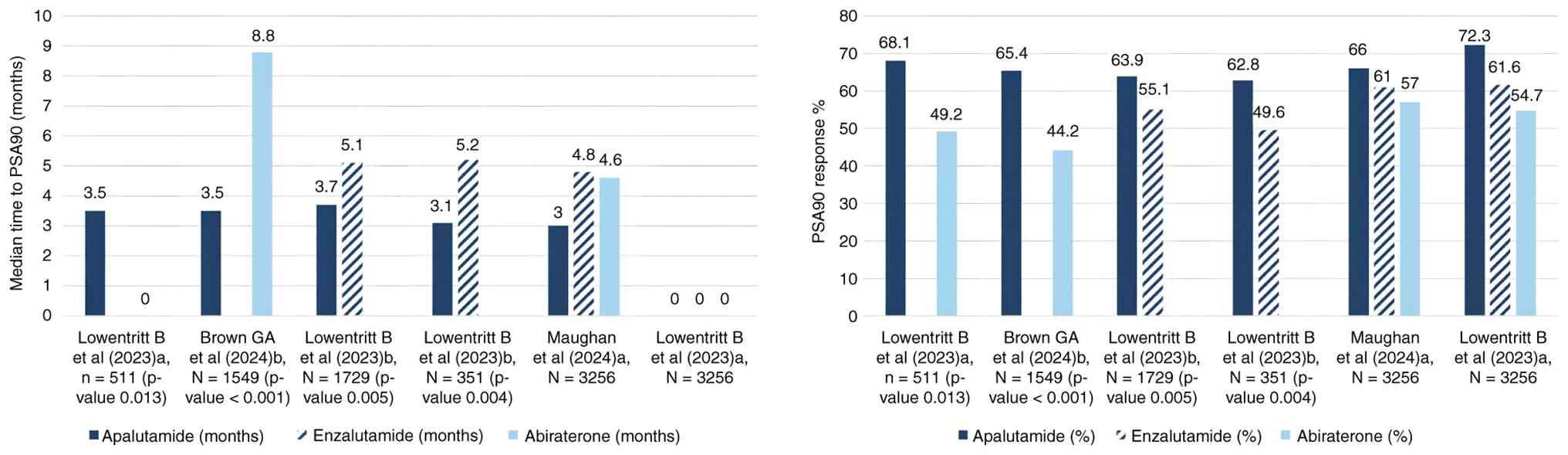
apalutamide, enzalutamide and abiraterone are compared in Fig. 2. A greater PSA90 response was
associated with Apalutamide. Median time to PSA90 was shortest with
apalutamide as compared with enzalutamide and abiraterone.
Recent research on lipid and carbon metabolism has
also clarified how metabolic reprogramming contributes to hormone
therapy resistance and disease progression in PC. Gao et al
(36) demonstrated that acetate
utilization via acyl-CoA synthetase short-chain family member 2
promotes neuroendocrine differentiation and castration-resistant
growth, and that targeting this pathway can resensitize models to
androgen-directed therapy. In parallel, Wenes et al
(37) showed that mitochondrial
pyruvate carrier activity shapes CD8+ T-cell memory
differentiation and antitumor function, highlighting how systemic
metabolic cues influence immune control of tumors. These
mechanistic insights suggest that PSA dynamics observed with ARSIs
such as apalutamide reflect not only androgen-receptor blockade but
also broader alterations in tumor and immune cell metabolism,
supporting future evaluation of rational combinations of
AR-directed and metabolism-targeted therapies in mCSPC. A
comparative summary of PSA90 response rates and median time to
PSA90 for apalutamide, enzalutamide and abiraterone across
available real-world studies is provided in Fig. 2.
In Table II, it is
shown that apalutamide achieved faster PSA90 (median 3 months) at
12 months. This was higher than enzalutamide and abiraterone. PSA
<0.2 ng/ml at 12 months was also highest with apalutamide,
correlating with lower 24-month CRPC rates and better survival
outcomes (22,23).
| Table IIPSA response and clinical outcomes
with apalutamide, enzalutamide and abiraterone. |
Table II
PSA response and clinical outcomes
with apalutamide, enzalutamide and abiraterone.
| | Maughan et
al (2024) (23) |
|---|
| Parameters
Arms | Apalutamide
(n=315) | Enzalutamide
(n=1181) | Abiraterone
(n=1760) |
|---|
| Proportion of
patients (%) with PSA90 response | | | |
| At 3 months | 49% | 38% | 37% |
| At 12 months | 66% | 61% | 57% |
| Median time
(months) to achieve PSA90 response | | | |
| | 3 months | 4.82 months | 4.62 months |
| Proportion of
patients (%) with PSA <0.2 ng/ml | | | |
| At 12 months | 74% | 61% | 58% |
| Clinical Outcomes
[proportion (%) of patients] | | | |
| Progressed to CR at
24 months | 23% | 37% | 33% |
| OS rate at 24
months | 66% | 55% | 59% |
| Lowentritt et
al (2023) (22) | | | |
| Arms | Apalutamide
(n=589) | Enzalutamide
(n=597) | Abiraterone
(n=553) |
| Proportion of
patients (%) with PSA90 response | | | |
| At 3 months | 48% | 35.1% | 36.7% |
| At 12 months | 72.3% | 61.6% | 54.7% |
| Proportion of
patients (%) with PSA <0.2 ng/ml | | | |
| At 12 months | 81% | 63% | 58% |
| Clinical outcomes
[proportion (%) of patients] | | | |
| Progressed to CR at
24 months | 33.5% | 38.6% | 44.5% |
| OS rate at 24
months | NA | NA | NA |
5. Implications for future clinical
research
Role of PSA reduction as a surrogate
endpoint in CT and monitoring PSA in real-world clinical
practice
PSA reduction has emerged as a valuable surrogate
endpoint in both clinical trials and real-world practice for
patients with advanced PC. Multiple studies have shown that early
and deep declines in PSA, particularly PSA50 (≥50% decline), PSA90
(≥90% decline), and PSA levels ≤0.2 ng/ml, are strongly correlated
with improved clinical outcomes, including OS, rPFS, time to CRPC,
and quality of life. The TITAN and SPARTAN trials demonstrated that
patients achieving early PSA90 or PSA ≤0.2 ng/ml had significantly
prolonged OS and rPFS. Patients achieving PSA90 or ultra-low PSA
levels early in therapy have improved long-term outcomes. PSA
dynamics, such as PSA velocity, defined as any decrease in PSA
levels over time and PSA50, can inform decisions regarding
treatment intensification, de-escalation, or switching to
alternative therapies. While PSA reduction is a useful surrogate,
it should be interpreted alongside imaging and clinical context,
especially in non-secretory variants or atypical disease
biology.
Limitations
Overall, the main limitation is that PSA response
with ARSIs, while strongly prognostic, is not a fully validated
surrogate for individual survival outcomes and can be discordant
with radiographic and clinical progression. PSA decline is an
imperfect surrogate endpoint in mCSPC. Although early and deep PSA
responses with apalutamide plus ADT are consistently associated
with improved clinical outcomes, PSA kinetics do not always fully
reflect tumor burden or survival benefit, particularly in
non-secretory or neuroendocrine variants where radiographic
progression may occur despite low or declining PSA levels.
Furthermore, the comparative evidence favoring apalutamide over
enzalutamide or abiraterone is indirect and derived primarily from
retrospective real-world cohorts rather than head-to-head RCTs. As
these studies were conducted across different healthcare settings
and time periods, residual confounding from unmeasured factors such
as performance status, metastatic burden, visceral involvement,
comorbidities and treatment sequencing may have influenced the
observed differences in PSA kinetics and clinical outcomes.
Therefore, PSA responses should be interpreted as supportive early
indicators of treatment activity rather than definitive surrogates
for OS, and current comparative findings should be considered
hypothesis-generating rather than conclusive evidence of
superiority.
Although PSA response is a valuable prognostic
biomarker and an early indicator of treatment activity in mCSPC,
PSA changes alone should not be considered sufficient grounds for
treatment switching in the absence of radiographic or clinical
evidence of progression. Treatment decisions should integrate PSA
kinetics with imaging findings, clinical assessment, symptom
burden, and overall disease status to ensure an accurate evaluation
of therapeutic benefit and disease progression.
In addition, while emerging real-world analyses in
mCSPC and nmCRPC have begun to compare apalutamide and
darolutamide, these data are observational and heterogeneous; they
suggest at least comparable, and in some cases more favorable,
survival and PSA outcomes with apalutamide, whereas darolutamide
may offer advantages in tolerability and treatment persistence in
other disease settings.
Recommendations for future
studies
Future studies should consider monitoring PSA
dynamics as one of the study end points. It could be useful as a
predictive biomarker in mCSPC as a key indicator to identify the
transition to mCRPC (disease progression). Investigating the
predictive utility of early PSA dynamics, in forecasting long-term
survival and PFS is essential and requires longitudinal research.
The present review is limited by its reliance on retrospective and
real-world studies, which may introduce selection bias and lack
standardized outcome measures. Additionally, heterogeneity in study
designs, endpoints, and follow-up durations limits direct
comparison across treatment regimens.
6. Conclusion
Achieving a rapid and deep PSA response is a key
prognostic marker in mCSPC. Evidence from retrospective real-world
studies consistently demonstrates that apalutamide plus ADT leads
to higher proportion of patients achieving PSA responses and faster
PSA decline compared with enzalutamide plus ADT or abiraterone
acetate plus ADT. Patients achieving PSA90 (≥90% decline) and PSA
≤0.2 ng/ml within the first 6-12 months demonstrated significantly
improved rPFS, OS, and delayed progression to CRPC. Additionally,
time to PSA suppression correlates with long-term survival
benefits, reinforcing its role as an early surrogate endpoint for
treatment efficacy. The data supports early PSA monitoring to
optimize treatment strategies in mCSPC, with deep PSA suppression
emerging as a critical parameter for improved clinical outcomes.
Further studies are warranted to refine biomarker-driven treatment
approaches.
Acknowledgements
Not applicable.
Funding
Funding: The present study was supported by Sun Pharma
Laboratories Limited (Mumbai, India).
Availability of data and materials
The data generated in the present study may be
requested from the corresponding author.
Authors' contributions
SN, CMV, AU, AM and SM wrote, reviewed and edited
the manuscript. PS, SD, GP and CK wrote the original draft. All
authors read and approved the final version of the manuscript. Data
authentication is not applicable.
Ethics approval and consent to
participate
Not applicable.
Patient consent for publication
Not applicable.
Competing interests
Dr Pankaj Sonone, Shruti Dharmadhikari, Dr Gaurav
Puppalwar, Dr Chintan Khandhedia, Dr Amey Mane and Dr Suyog Mehta
are employees of Sun Pharma Laboratories Ltd. SN, CMV and AU
declare that they have no competing interests.
References
|
1
|
Prostate cancer statistics. World Cancer
Research Fund, London, 2026.
|
|
2
|
Sathishkumar K, Chaturvedi M, Das P,
Stephen S and Mathur P: Cancer incidence estimates for 2022 &
projection for 2025: Result from National Cancer Registry
Programme, India. Indian J Med Res. 156:598–607. 2022.PubMed/NCBI View Article : Google Scholar
|
|
3
|
Urabe F, Hatakeyama S, Yanagisawa T,
Narita S, Muramoto K, Katsumi K, Takahashi H, Fukuokaya W, Mori K,
Tashiro K, et al: Clinical significance of PSA dynamics in
castration-sensitive prostate cancer treated with ARSI doublet
therapy: A multicenter study. Urol Oncol. 43:e9–e271.e18.
2025.PubMed/NCBI View Article : Google Scholar
|
|
4
|
Fiorica F, Buttigliero C, Grigolato D,
Muraro M, Turco F, Munoz F and Tucci M: Addition of new androgen
receptor pathway inhibitors to docetaxel and androgen deprivation
therapy in metastatic Hormone-sensitive prostate cancer: A
systematic review and metanalysis. Curr Oncol. 29:9511–9524.
2022.PubMed/NCBI View Article : Google Scholar
|
|
5
|
Schaeffer EM, Srinivas S, Adra N, An Y,
Bitting R, Chapin B, Cheng HH, D'Amico AV, Desai N, et al: NCCN
Guidelines® Insights: Prostate Cancer, Version 3.2024. JNCCN 22:
April 6, 2024.
|
|
6
|
Advanced Prostate Cancer: AUA/SUO
Guideline-American Urological Association, 2026.
|
|
7
|
Kohjimoto Y, Uemura H, Yoshida M, Hinotsu
S, Takahashi S, Takeuchi T, Suzuki K, Shinmoto H, Tamada T, Inoue
T, et al: Japanese clinical practice guidelines for prostate cancer
2023. Int J Urol. 31:1180–1222. 2024.PubMed/NCBI View Article : Google Scholar
|
|
8
|
So AI, Chi K, Danielson B, Fleshner N,
Kinnaird A, Niazi T, Pouliot F, Rendon RA, Shayegan B, Sridhar SS,
et al: 2025 canadian urological Association-canadian Uro-oncology
Group Guideline: Metastatic castration-naive and
castration-sensitive prostate cancer (Update). Can Urol Assoc J.
19:E142–E152. 2025.PubMed/NCBI View Article : Google Scholar
|
|
9
|
Buhmeida A, Pyrhönen S, Laato M and Collan
Y: Prognostic factors in prostate cancer. Diagn Pathol.
1(4)2006.PubMed/NCBI View Article : Google Scholar
|
|
10
|
Lowentritt B, Pilon D, Khilfeh I, Rossi C,
Muser E, Kinkead F, Waters D, Ellis L, Lefebvre P and Brown G:
Attainment of early, deep prostate-specific antigen response in
metastatic castration-sensitive prostate cancer: A comparison of
patients initiated on apalutamide or enzalutamide. Urol Oncol.
41:e1–e253.e9. 2023.PubMed/NCBI View Article : Google Scholar
|
|
11
|
Iacovelli R, Ciccarese C, Caffo O, De
Giorgi U, Basso U, Tucci M, Mosillo C, Maruzzo M, Maines F, Casadei
C, et al: The role of fast and deep PSA response in
castration-sensitive prostate cancer. Anticancer Res. 42:165–172.
2022.PubMed/NCBI View Article : Google Scholar
|
|
12
|
Naqvi SAA, Riaz IB, Imran M, Bin Zafar MD,
Faisal KS, Bin Riaz Z, Singh P and Bryce AH: Deep prostate-specific
antigen response and overall survival in patients with metastatic
castration-sensitive prostate cancer: A systematic review and
meta-analysis. J Clin Oncol. 41 (6_suppl)(s195)2023.
|
|
13
|
Patel UJ and Caulfield S: Apalutamide for
the treatment of nonmetastatic Castration-resistant prostate
cancer. J Adv Pract Oncol. 10:501–507. 2019.PubMed/NCBI View Article : Google Scholar
|
|
14
|
Chi KN, Agarwal N and Bjartell A:
Apalutamide for metastatic, Castration-sensitive prostate cancer. N
Engl J Med. 381:13–24. 2019.PubMed/NCBI View Article : Google Scholar
|
|
15
|
Chowdhury S, Bjartell A, Agarwal N, Chung
BH, Given RW, Pereira de Santana Gomes AJ, Merseburger AS,
Özgüroğlu M, Soto ÁJ, Uemura H, et al: Prostate-specific antigen
(PSA) decline with apalutamide therapy is associated with longer
survival and improved outcomes in individuals with metastatic
prostate cancer: A plain language summary of the TITAN study.
Future Oncol. 20:563–578. 2024.PubMed/NCBI View Article : Google Scholar
|
|
16
|
Merseburger AS, Agarwal N, Bhaumik A,
Lefresne F, Karsh LI, Pereira de Santana Gomes AJ, Soto ÁJ, Given
RW, Brookman-May SD, Mundle SD, et al: Apalutamide plus androgen
deprivation therapy in clinical subgroups of patients with
metastatic castration-sensitive prostate cancer: A subgroup
analysis of the randomised clinical TITAN study. Eur J Cancer.
193(113290)2023.PubMed/NCBI View Article : Google Scholar
|
|
17
|
López-Abad A, Ramírez Backhaus M, Server
Gómez G, Cao Avellaneda E, Moreno Alarcón C, López Cubillana P,
Yago Giménez P, de Pablos Rodríguez P, Juan Fita MJ, Climent Durán
MÁ, et al: Real-world prostate-specific antigen reduction and
survival outcomes of metastatic hormone-sensitive prostate cancer
patients treated with apalutamide: An observational, retrospective,
and multicentre study. Prostate Int. 12:20–26. 2024.PubMed/NCBI View Article : Google Scholar
|
|
18
|
Tohi Y, Kato T, Kobayashi K, Daizumoto K,
Fukuhara H, Ohira S, Katayama S, Shimizu R, Takamoto A, Nishimura
K, et al: Real-world prostate-specific antigen response and
progression to castration-resistant prostate cancer among men with
metastatic castration-sensitive prostate cancer treated with
apalutamide: A multi-institutional study in the Chu-shikoku Japan
Urological Consortium. Jap J Clin Oncol. 54:167–174.
2024.PubMed/NCBI View Article : Google Scholar
|
|
19
|
Santoni M, Büttner T, Rescigno P, Fiala O,
Cavasin N, Basso U, Taha T, Massari F, Myint ZW, Formisano L, et
al: Apalutamide in metastatic Castration-sensitive prostate cancer:
Results from the multicenter Real-world ARON-3 study. Eur Urol
Oncol. 8:444–451. 2025.PubMed/NCBI View Article : Google Scholar
|
|
20
|
Encarnación Navarro JA, Morillo Macías V,
Borrás Calbo M, De la Fuente Muñoz I, Lozano Martínez A, García
Martínez V, Fernández Fornos L, Guijarro Roche M, Amr Rey O and
García Gómez R: Multicenter real-world study: 432 patients with
apalutamide in metastatic Hormone-sensitive prostate cancer. Curr
Oncol. 32(119)2025.PubMed/NCBI View Article : Google Scholar
|
|
21
|
López-Abad A, Belmonte M, Ramírez Backhaus
M, Server Gómez G, Cao Avellaneda E, Moreno Alarcón C, López
Cubillana P, Yago Giménez P, de Pablos Rodríguez P, Juan Fita MJ,
et al: Ultralow Prostate-specific antigen (PSA) levels and improved
oncological outcomes in metastatic Hormone-sensitive prostate
cancer (mHSPC) patients treated with apalutamide: A Real-world
multicentre study. J Clin Med. 13(6221)2024.PubMed/NCBI View Article : Google Scholar
|
|
22
|
Lowentritt B, Du S, Rossi C, Kinkead F,
Waters D, Moore B, Lefebvre P, Pilon D and Muser EJ: MP29-14
Prostate-specific antigen response and time-to-castration
resistance among patients with metastatic castration sensitive
prostate cancer initiated on apalutamide, enzalutamide, or
abiraterone acetate. J Urol. 209 (Suppl 4)(E387)2023.
|
|
23
|
Maughan BL, Mundle S, Nematian-Samani M,
Wang S, Du S, Liu Y and Ivan Karsh L: Survival Outcomes of APA as a
Starting treatment: Impact in real-world patients with mCSPC
(OASIS). J Clin Oncol. 42 (Suppl 4)(S65)2024.PubMed/NCBI View Article : Google Scholar
|
|
24
|
Chowdhury S, Bjartell A, Agarwal N, Chung
BH, Given RW, Pereira de Santana Gomes AJ, Merseburger AS,
Özgüroğlu M, Juárez Soto Á, Uemura H, et al: Deep, rapid, and
durable prostate-specific antigen decline with apalutamide plus
androgen deprivation therapy is associated with longer survival and
improved clinical outcomes in TITAN patients with metastatic
castration-sensitive prostate cancer. Ann Oncol. 34:477–485.
2023.PubMed/NCBI View Article : Google Scholar
|
|
25
|
Scher HI, Morris MJ, Stadler WM, Higano C,
Basch E, Fizazi K, Antonarakis ES, Beer TM, Carducci MA, Chi KN, et
al: Trial design and objectives for Castration-resistant prostate
cancer: Updated recommendations from the prostate cancer clinical
trials working group 3. J Clin Oncol. 34:1402–1418. 2016.PubMed/NCBI View Article : Google Scholar
|
|
26
|
Hiroshige T, Suekane H, Tokunaga T, Uegaki
M, Iwashita M, Taura H, Hirano T, Mitani T, Matsuo M and Igawa T:
Prognostic stratification using early Prostate-specific antigen
kinetics in men with metastatic Hormone-sensitive prostate cancer.
Anticancer Res. 45:751–759. 2025.PubMed/NCBI View Article : Google Scholar
|
|
27
|
Bryce AH, Chen YH, Liu G, Carducci MA,
Jarrard DM, Garcia JA, Dreicer R, Hussain M, Eisenberger MA,
Plimack ER, et al: Patterns of cancer progression of metastatic
Hormone-sensitive prostate cancer in the ECOG3805 CHAARTED trial.
Eur Urol Oncol. 3:717–724. 2020.PubMed/NCBI View Article : Google Scholar
|
|
28
|
Armstrong AJ, Mottet N, Iguchi T,
Szmulewitz RZ, Holzbeierlein J, Villers A, Alcaraz A, Alekseev B,
Shore ND, Gomez-Veiga F, et al: Radiographic progression in the
absence of prostate-specific antigen (PSA) progression in patients
with metastatic hormone-sensitive prostate cancer (mHSPC): Post hoc
analysis of ARCHES. J Clin Oncol. 40 (16_suppl)(s5072)2022.
|
|
29
|
Bryce AH, Alumkal JJ, Armstrong A, Higano
CS, Iversen P, Sternberg CN, Rathkopf D, Loriot Y, de Bono J,
Tombal B, et al: Radiographic progression with nonrising PSA in
metastatic castration-resistant prostate cancer: Post hoc analysis
of PREVAIL. Prostate Cancer Prostatic Dis. 20:221–227.
2017.PubMed/NCBI View Article : Google Scholar
|
|
30
|
Collette L, Burzykowski T, Carroll KJ,
Newling D, Morris T and Schröder FH: European Organisation for
Research and Treatment of Cancer; Limburgs Universitair Centrum;
AstraZeneca Pharmaceuticals. Is prostate-specific antigen a valid
surrogate end point for survival in hormonally treated patients
with metastatic prostate cancer? Joint research of the European
Organisation for Research and Treatment of Cancer, the Limburgs
Universitair Centrum, and AstraZeneca Pharmaceuticals. J Clin
Oncol. 23:6139–6148. 2005.PubMed/NCBI View Article : Google Scholar
|
|
31
|
Maeda H, Takeda K, Urushihara H and
Kurokawa T: Searching for potential surrogate endpoints of overall
survival in clinical trials for patients with prostate cancer.
Cancer Rep (Hoboken). 4(e1334)2021.PubMed/NCBI View Article : Google Scholar
|
|
32
|
Lowentritt B, Pilon D, Waters D, Rossi C,
Muser E, Kurteva S, Shah A, Khilfeh I, Du S, Ellis L, et al:
Comparison of prostate-specific antigen response in patients with
metastatic castration-sensitive prostate cancer initiated on
apalutamide or abiraterone acetate: A retrospective cohort study.
Urol Oncol. 41:252.e19–e252.e27. 2023.PubMed/NCBI View Article : Google Scholar
|
|
33
|
Lowentritt B, Bilen MA, Khilfeh I, Rossi
C, Du S, Kinkead F, Diaz L, Pilon D, Ellis L and Shore ND: Overall
survival in patients with metastatic castration-sensitive prostate
cancer treated with apalutamide versus abiraterone acetate: A
head-to-head analysis of real-world patients in the USA. J Comp Eff
Res. 14(e250023)2025.PubMed/NCBI View Article : Google Scholar
|
|
34
|
Bilen MA, Lowentritt BH, Burbage S, Joshi
K, Patel C, Rossi C, Kinkead F, Wong G, Pilon D, Shore ND, et al:
Real-world comparison of prostate-specific antigen (PSA) response
among patients with metastatic castration-sensitive prostate cancer
(mCSPC) treated with apalutamide (APA) or enzalutamide (ENZ). JCO
Oncol Pract. 21 (10_suppl)(s570)2025.
|
|
35
|
Lu Y, Jiang J, Yang G, Ding H, Zheng Q, Ji
L, Wang Y, Dong Z, Zhai Z, Tian J, et al: Comparative effectiveness
of multiple androgen receptor signaling inhibitor medicines with
androgen deprivation therapy for metastatic hormone-sensitive
prostate cancer: A study in the real world. Front Oncol.
14(1324181)2024.PubMed/NCBI View Article : Google Scholar
|
|
36
|
Gao D, Shen Y, Xu L, Sun Y, Hu H, Xu B,
Wang Z and Xu H: Acetate utilization promotes hormone therapy
resistance in prostate cancer through neuroendocrine
differentiation. Drug Resist Updat. 77(101158)2024.PubMed/NCBI View Article : Google Scholar
|
|
37
|
Wenes M, Jaccard A, Wyss T,
Maldonado-Pérez N, Teoh ST, Lepez A, Renaud F, Franco F, Waridel P,
Yacoub Maroun C, et al: The mitochondrial pyruvate carrier
regulates memory T cell differentiation and antitumor function.
Cell Metab. 34:731–746.e9. 2022.PubMed/NCBI View Article : Google Scholar
|