Non-small cell lung cancer (NSCLC) is a global
health challenge; in 2022, lung cancer accounted for ~2.48 million
new cases and 1.82 million deaths worldwide (1-3).
Global burden statistics, including incidence and mortality
estimates, describe the worldwide disease burden, whereas
stage-specific survival statistics, including the poor prognosis
associated with metastatic disease, are commonly derived from
population-based registries such as the Surveillance, Epidemiology,
and End Results (SEER) Program (4). Therefore, these metrics are
complementary indicators rather than as estimates originating from
a single dataset.
Platinum-based chemotherapy and targeted therapy
against oncogenic drivers, including epidermal growth factor
receptor (EGFR), anaplastic lymphoma kinase (ALK) and ROS
proto-oncogene 1 receptor tyrosine kinase (ROS1), have improved the
management of NSCLC (5). Although
these therapeutic modalities primarily inhibit tumor cell
proliferation and survival, emerging evidence has suggested that
they also regulate antitumor immunity. For example, activation of
EGFR signaling and the development of resistance to EGFR-tyrosine
kinase inhibitors (TKIs) affects programmed death-ligand 1 (PD-L1)
expression and facilitates immune escape. Therefore,
tumor-cell-directed treatment and tumor-host immune interactions
should be considered to be biologically interconnected rather than
mutually exclusive (5-7).
Programmed cell death protein 1, PD-L1 and cytotoxic
T lymphocyte-associated protein 4 (CTLA-4) are well-established
immune checkpoint targets (8-14).
In metastatic NSCLC, objective response and clinical benefit from
immune checkpoint inhibitors (ICIs) vary significantly based on
PD-L1 tumor proportion score, oncogenic driver status, disease
stage, treatment regimen and patient population. These broad
response ranges should be interpreted within their clinical
context. For example, ICI monotherapy is used for selected patients
with high PD-L1 expression; chemo-immunotherapy is used for
metastatic NSCLC without actionable drivers; durvalumab following
concurrent chemoradiotherapy is used for unresectable stage III
NSCLC; and neoadjuvant nivolumab plus chemotherapy is used for
selected patients with resectable NSCLC (8-14).
The present review aimed to summarize tumor
microenvironment (TME)-mediated ICI resistance in NSCLC, including
the effects of immunosuppressive cells, stromal-triggered immune
exclusion, abnormal angiogenesis, hypoxia, metabolic stress,
impaired antigen-presentation and oncogenic alterations in the
context of immune-inflamed (immune cell infiltration with
functional exhaustion), immune-excluded (immune cells retained
largely outside tumor nests) and immune-desert (minimal immune-cell
infiltration) tumor phenotypes. The present study aimed to
distinguish clinically established and investigational combination
therapeutic approaches and identify biomarkers that could help
guide patient selection.
The present narrative review prioritized
English-language publications indexed in PubMed (https://pubmed.ncbi.nlm.nih.gov/), major oncology
guidelines, pivotal phase II/III clinical trials, meta-analyses and
mechanistic studies published from January 1946 to June 2026.
Search terms included ‘NSCLC’, ‘immune checkpoint inhibitor’,
‘tumor microenvironment’, ‘resistance’, ‘TAM’, ‘MDSC’, ‘Treg’,
‘CAF’, ‘VEGF’, ‘TGF-β’, ‘hypoxia’, ‘STK11’, ‘KEAP1’, ‘antigen
presentation’, ‘biomarker’, ‘ctDNA’, ‘spatial omics’, ‘microbiome’
and ‘combination therapy’. Clinical evidence was weighted according
to trial phase, population relevance, maturity of clinical
endpoints and regulatory or guideline significance, whereas
preclinical and hypothesis-generating studies were primarily used
to support mechanistic concepts rather than as established clinical
standards.
The TME is a complex system composed of tumor,
immune and stromal cells, including fibroblasts, the extracellular
matrix (ECM) and various soluble factors. Interactions among the
aforementioned components serve an essential role in regulating
tumor initiation, progression and immune evasion (13). Overall, the interaction between
these components through intercellular molecular pathways
facilitates the establishment of an immunosuppressive
microenvironment that directly influences the efficacy of
immunotherapy (14).
Consistently, myeloid-derived suppressor cells
(MDSCs) warrant subtype-specific interpretation. Monocytic MDSCs
predominantly suppress immunity through the expression of arginase
1 (ARG1), inducible nitric oxide synthase (iNOS), IL-10 and TGF-β,
whereas polymorphonuclear MDSCs are more closely associated with
reactive oxygen species (ROS) production and oxidative stress.
These mechanisms deplete L-arginine, impair T cell receptor
signaling, inhibit natural killer and CD8+ T cell
function and promote the expansion of Tregs (21,22).
This suppresses antitumor immunity through several mechanisms,
including the secretion of IL-10 and TGF-β, CD25
expression-mediated IL-2 consumption and CTLA-4-mediated
competition for CD80/CD86 on antigen-presenting cells (23-25).
Cancer-associated fibroblasts and ECM remodeling promote immune
evasion by increasing stromal stiffness and secreting TGF-β, thus
attenuating lymphocyte infiltration and promoting the development
of immune-excluded tumors (26-30).
Within the TME, lymphocyte activation gene 3 (LAG-3)
serves as an inhibitor of T cell activation and proliferation while
enhancing the immunosuppressive activity of Tregs through
high-affinity binding to major histocompatibility complex (MHC)
class II molecules (31). T cell
immunoglobulin and mucin-domain-containing protein 3 (TIM-3) is
another inhibitory immune checkpoint receptor that restrains T-cell
activation and effector function and is predominantly expressed on
T helper (Th)1 and type 1 cytotoxic (Tc1) cells. After binding
ligands such as galectin-9, TIM-3 suppresses Th1/Tc1-mediated
responses and promotes T cell exhaustion (32). T cell immunoreceptor with Ig and
ITIM domains (TIGIT), which is predominantly expressed on the
surface of CD8+ T cells, mediates immunosuppression in
the TME by binding to receptors on antigen-presenting cells,
including CD155(33). TIGIT is
also present on Tregs, where it enhances suppressive capacity and
inhibits the activation, proliferation and effector activity of
immune cells (34).
The TME is typically characterized by hypoxia, which
activates hypoxia-inducible factor-1α, induces VEGF expression and
directly or indirectly upregulates PD-L1(35). Hypoxia also serves a key role in
promoting lactate accumulation, nutrient competition and acidic
stress through distinct but interconnected mechanisms. Lactic acid
preferentially supports the metabolism of Tregs (36). By contrast, extracellular acidosis
and glucose deprivation impair CD8+ effector T cell
function by inhibiting cytokine production, proliferation and
cytotoxic activity (37). In
parallel, hypoxia, impaired perfusion, high interstitial pressure
and metabolic restriction attenuate immune infiltration and
activity, eventually resulting in a non-inflamed or dysfunctional
immune phenotype.
The TME represents a dynamic and highly
heterogeneous ecosystem in which cell factors, molecular pathways
and physicochemical characteristics can collectively determine the
efficacy of immunotherapy. Consequently, targeting key regulatory
mechanisms within the TME and reshaping the immune milieu through
focused intervention represent promising strategies for improving
clinical responses to immunotherapy in NSCLC.
The TME serves a key role in mediating resistance to
ICIs, thereby severely limiting the clinical benefits of
immunotherapy. The mechanisms underlying TME-mediated resistance
are complex and can be categorized into three primary domains:
Tumor-intrinsic, tumor-extrinsic and systemic factors.
Tumor-intrinsic resistance is primarily
characterized by the loss or impairment of antigen presentation.
Mutations or deletions in β2 microglobulin disrupt the assembly and
transport of MHC class I, while human leukocyte antigen class I
downregulation decreases recognition by CD8+ T cells
(38,39). Alterations in serine/threonine
kinase 11 (STK11), also known as liver kinase B1 (LKB1) and KEAP1
define a clinically important immune-resistant state. Loss of STK11
suppresses stimulator of interferon genes-dependent type I
interferon signaling, thereby attenuating innate immune activation
and dendritic cell priming. These alterations are commonly
associated with low PD-L1 expression and decreased CD8+
T cell infiltration. Concurrent loss of KEAP1 results in activation
of nuclear factor erythroid 2-related factor 2-dependent
antioxidant and metabolic programs, promoting immune evasion and
resistance to ICIs (40,41). EGFR- and ALK-driven NSCLC is
commonly characterized by lower tumor mutational burden (TMB),
decreased neoantigenicity and a less inflamed immune contexture
(the composition, density, functional state and spatial
distribution of immune cells within the tumor) (6). In EGFR-mutant NSCLC, resistance to
EGFR-TKIs promotes immune escape through increased PD-L1 expression
(7), whereas Ras homolog family
member B (RHOB)-dependent AKT signaling represents a distinct
tumor-intrinsic mechanism of EGFR-TKI resistance (42).
The marked expansion of immunosuppressive cell
populations within the TME, including Tregs, MDSCs and TAMs,
substantially contributes to immune evasion and tumor progression
through several mechanisms. For example, Tregs display greater
infiltration, abundance and suppressive capacity in tumor tissue
than in peripheral blood and non-tumor tissue, thus impairing
effector T cell function by secreting inhibitory cytokines such as
IL-10 and TGF-β and by expressing CTLA-4, which competes for
co-stimulatory signals for T cell activation (43). MDSCs accumulate in the peripheral
blood and tumor tissue of patients with NSCLC and suppress T-cell
proliferation and function through ARG1, iNOS, ROS and TGF-β
(21). TAMs, including M2-like
macrophages, promote angiogenesis and recruit Tregs by secreting
VEGF, IL-10 and CCL17/22, while also driving T cell exhaustion
through the production of tryptophan metabolites (17).
Systemic factors affect the response to ICIs but
require disease-specific interpretation. In NSCLC, exposure to
antibiotics and specific features of the gut microbiome are
associated with ICI efficacy, while taxa such as Akkermansia
muciniphila, Bifidobacterium spp. and
Ruminococcus have been involved in promoting a favorable
immune milieu in certain NSCLC cohorts (44-48).
Associations involving Fusobacterium are stronger in
colorectal cancer compared with NSCLC and should be considered
extrapolative unless supported by NSCLC-specific datasets. Host
nutrition, sarcopenia, hypoalbuminemia, elevated C-reactive protein
levels and a high neutrophil-to-lymphocyte ratio reflect systemic
inflammation and impaired immune competence (49).
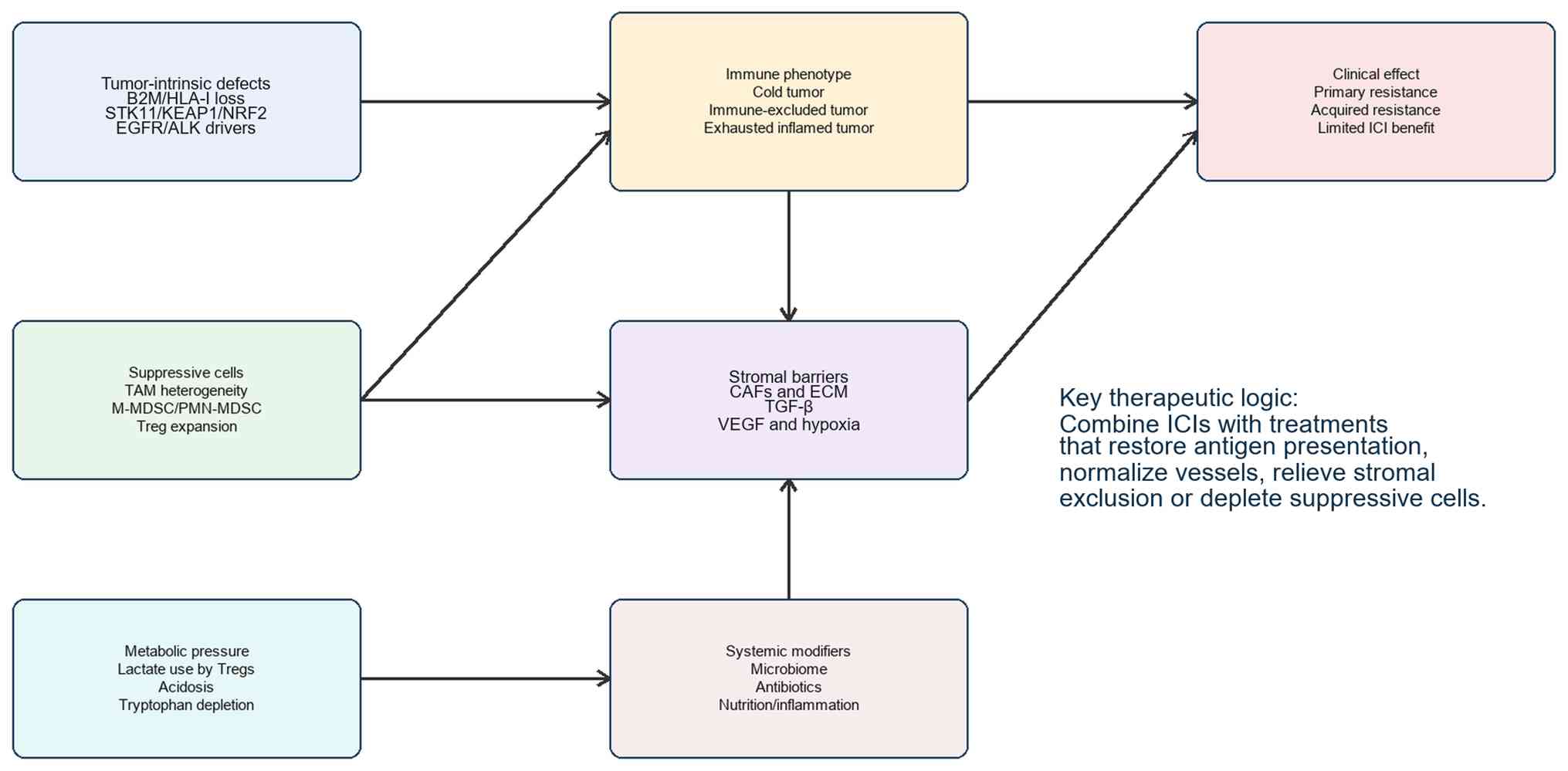
Collectively, the TME-mediated resistance to ICIs in
patients with NSCLC arises from the interplay between tumor
genotype, antigen presentation, the local immunosuppressive cell
ecosystem, stromal architecture, metabolic stress and the host
systemic state. Fig. 1 summarizes
the aforementioned integrated framework, including immune-desert
and -excluded and exhausted inflamed phenotypes, and links each
resistance domain to its corresponding therapeutic rationale.
To overcome the limitations imposed by the
immunosuppressive TME, combination therapies tailored to its
characteristics have become a central strategy in tumor
immunotherapy (50). These
approaches aim to reverse TME-mediated immunosuppression, promote
immune cell infiltration and activation and achieve durable
antitumor responses by targeting multiple mechanisms, thereby
improving clinical outcomes.
Combination therapies should be evaluated according
to the evidence level, patient selection and toxicity profile
rather than biological plausibility alone. Dual immune checkpoint
blockade with nivolumab + ipilimumab has shown notable efficacy in
phase III clinical trials in selected patients with advanced NSCLC,
including the CheckMate 227 trial. However, the interpretation of
these results depends on PD-L1 expression, TMB-defined analyses,
study endpoints and the comparator arm (50-52).
By contrast, emerging immune checkpoint combinations require
caution (53). Although the
CITYSCAPE trial suggested clinical efficacy of tiragolumab +
atezolizumab in patients with PD-L1-positive NSCLC, the subsequent
phase III SKYSCRAPER-01 trial failed to meet the overall survival
endpoint (54,55). Similarly, although LAG-3 and TIM-3
remain biologically promising, their clinical adoption in NSCLC
requires confirmation through mature clinical trials (56-59).
Anti-angiogenic therapy has a strong mechanistic
rationale because VEGF promotes abnormal vasculature, hypoxia,
Treg/MDSC accumulation and impaired lymphocyte trafficking. The
IMpower150 trial supported the use of atezolizumab + bevacizumab,
carboplatin and paclitaxel in patients with metastatic non-squamous
NSCLC and is clinically notable for demonstrating efficacy in
subgroups such as patients with baseline liver metastases and those
with EGFR-mutant disease after TKI failure (60-66).
This regimen is therefore more clinically actionable compared with
investigational combinations such as ICIs with anti-angiogenic
TKIs, TGF-β-targeted agents or myeloid-cell-targeted agents,
although its use is affected by regional approvals, histology,
prior therapy and the risk of bleeding or vascular
complications.
The combination of ICIs with chemotherapy or
radiotherapy is currently considered a standard treatment approach
in unresectable stage III NSCLC after concurrent chemoradiotherapy
and metastatic driver-negative NSCLC treated with
chemo-immunotherapy. Chemotherapy induces immunogenic cell death,
decreases suppressive myeloid cell populations and increases
antigen release, whereas radiotherapy predominantly serves as an
in situ vaccine by releasing tumor antigens, increasing
antigen presentation and promoting interferon-mediated immune
activation (67-70).
The PACIFIC regimen (durvalumab after concurrent chemoradiotherapy
[CRT]) is an established treatment strategy following concurrent
chemoradiotherapy for patients with unresectable stage III NSCLC
and chemo-immunotherapy regimens such as KEYNOTE-189 represent the
standard first-line option for patients with metastatic
non-squamous NSCLC without actionable drivers (67-70).
However, these clinical benefits should be balanced against
treatment-related adverse events, including pneumonitis and bone
marrow toxicity; baseline comorbidities should be assessed
separately because they may increase treatment risk.
In EGFR- or ALK-driven NSCLC, ICI monotherapy
typically shows limited efficacy, and combinations with TKIs can
result in notable toxicity, including pneumonitis and
hepatotoxicity (71,72). The KEYNOTE-789 trial did not
demonstrate a clear clinical advantage of pembrolizumab +
chemotherapy after EGFR-TKI failure (73). In the post-osimertinib setting,
CHRYSALIS-2 evaluated amivantamab + lazertinib without the addition
of an ICI. Therefore, this regimen should be interpreted as a
targeted therapy regimen rather than an ICI-based combination
therapy (74,75). In patients with oncogene-driven
NSCLC, clinical decision-making should prioritize targeted therapy,
chemotherapy-based treatment options and carefully selected
anti-VEGF/ICI/chemotherapy combinations rather than the
indiscriminate use of TKI-ICI combinations.
Microbiome- and metabolism-associated interventions
remain promising but are largely investigational. Fecal microbiota
transplantation, probiotics, dietary fiber manipulation,
indoleamine 2,3-dioxygenase (IDO) inhibition, lactate metabolism
targeting and related approaches have a strong mechanistic appeal
but require prospective clinical validation, standardized
assessment approaches and safety monitoring before their clinical
implementation in patients with NSCLC (46-48,76-78).
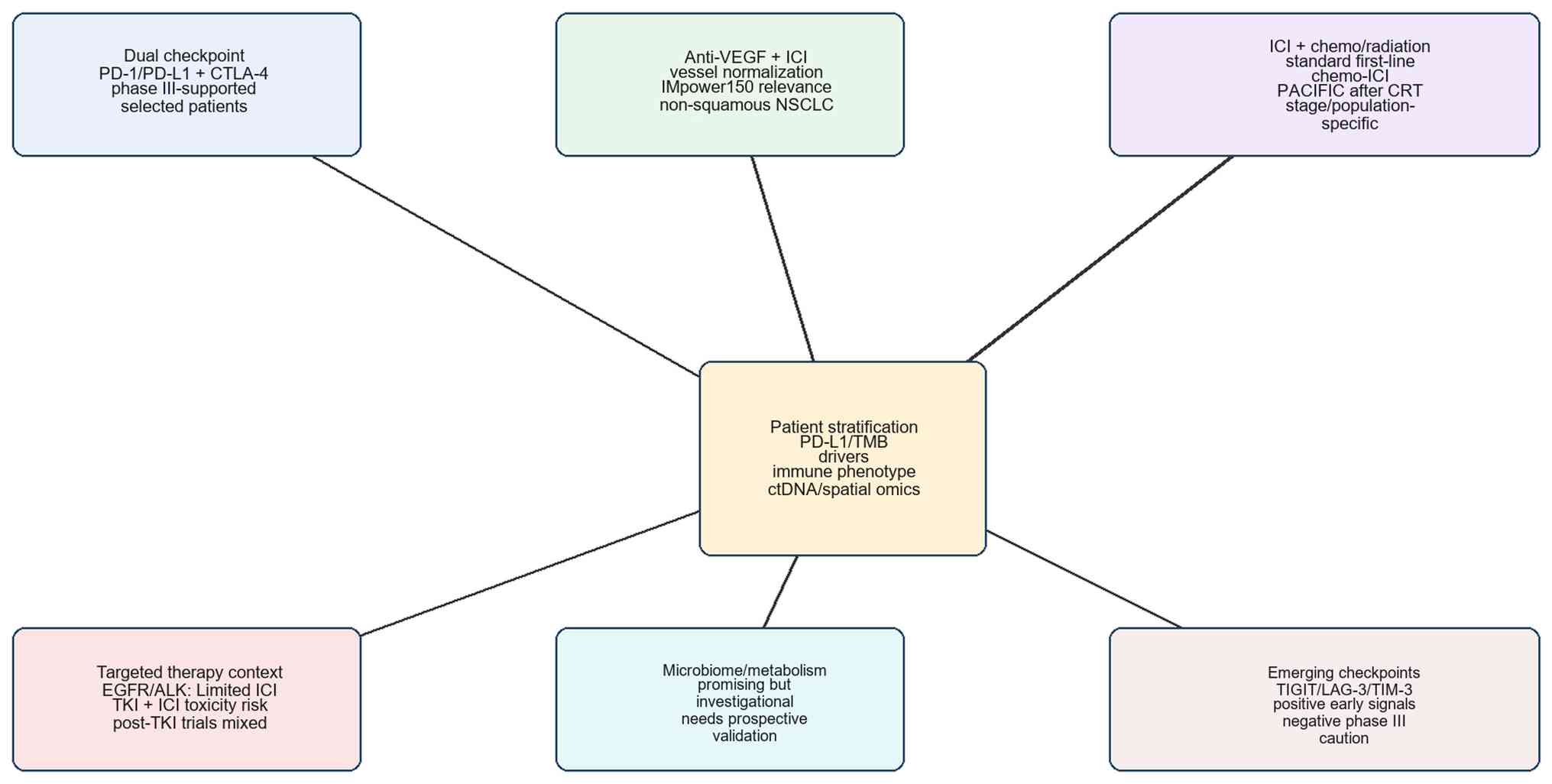
The main therapeutic categories of combination
treatment strategies, their biological rationale, level of clinical
evidence and their key limitations are summarized in Table I, and an evidence-stratified
overview is shown in Fig. 2.
Biomarker-guided patient stratification should be
operational rather than descriptive. Although PD-L1 is a clinically
useful biomarker, its limitations include spatial heterogeneity,
temporal changes following therapy, assay-specific PD-L1 tumor
proportion score cutoffs used to select patients for ICI-containing
regimens and imperfect predictive value. PD-L1 assay comparability
has been evaluated by the Blueprint PD-L1 IHC Comparability
Project, which indicated substantial concordance among several
validated, regulatory-approved antibody-platform combinations,
although assay interchangeability remains incomplete and the
Ventana PD-L1 SP142 immunohistochemistry assay may show lower tumor
cell staining in the same lung cancer specimens compared with the
22C3, 28-8 and SP263 assays (79).
In selected NSCLC cohorts, high TMB has been associated with
increased immune infiltration and improved outcomes with PD-1/PD-L1
blockade, but its predictive potential is affected by the
sequencing platform, cutoff value and tumor purity and type, and
high TMB is not universally predictive across cancer types
(80,81). IFN-γ-related signatures and
CD8+ T cell infiltration reflect immune activation,
while spatial transcriptomics distinguishes inflamed, excluded and
desert phenotypes (82-84).
Microbiome features are also being investigated as response markers
(47). Liquid biopsy, circulating
tumor DNA dynamics and exosomal markers represent promising
approaches for monitoring tumor burden and treatment resistance,
although prospectively validated thresholds are needed to inform
treatment decisions (85,86). These biomarkers and assessment
approaches are summarized in Table
II (87). Recent studies using
multi-omics, network analysis, artificial intelligence and immune
microenvironment modeling further illustrate how biomarker
discovery is evolving beyond single markers (88-92).
Toxicity management is a key component of
combination therapy. Immune-related adverse events arise not only
from enhanced T cell activation and autoantibody production but
also from molecular mimicry, bystander T cell activation, epitope
spreading, cytokine dysregulation and disruption of peripheral
immune tolerance (93,94). Dual immune checkpoint blockade and
ICI-based combination therapies increase the incidence and severity
of immune-mediated toxicity compared with single-agent therapy,
although the risks vary according to the treatment regimen and
patient population (95,96). Management should follow
guideline-based toxicity grading and include the prompt exclusion
of infection or disease progression, temporary interruption of ICI
therapy for clinically notable toxicities, therapy with
corticosteroids or organ-specific immunosuppressive agents when
indicated and consideration of treatment rechallenge after recovery
(97-99).
For patients with EGFR/ALK-driven NSCLC and those treated with
thoracic radiotherapy, vigilance is warranted due to the increased
risk of pneumonitis.
One of the principal challenges to immunotherapy in
NSCLC is immune resistance, with the TME serving as a notable
mediator of this process. Resistance generally reflects an
integrated phenotype rather than a single molecular alteration.
Defects in antigen-presentation, STK11/KEAP1 biology, suppressive
myeloid and regulatory immune cell networks, stromal exclusion,
abnormal vasculature, hypoxia and metabolic stress collectively
contribute to the development of immune-desert, immune-excluded and
exhausted immune-inflamed tumor phenotypes.
Several significant issues remain unresolved.
Establishing which TME features are causal drivers of ICI failure
rather than associated findings remains a priority. Practical
treatment algorithms must define how to integrate spatial immune
phenotypes, ctDNA dynamics and conventional biomarkers. Prospective
studies are needed to identify patients who benefit from
intensified immune checkpoint blockade or anti-VEGF-based
combinations and those who are primarily exposed to additional
toxicity. Oncogene-driven NSCLC also requires validated
stratification after targeted therapy failure. Finally, microbiome-
and metabolism-based interventions require standardized methods and
prospective validation.
Future research should focus on prospective
biomarker-defined clinical trials, harmonized PD-L1, TMB and
spatial omics assays, longitudinal liquid biopsy monitoring, and
mechanism-based studies including patients with STK11/KEAP1- and
EGFR/ALK-altered NSCLC, as well as clinical trials with
toxicity-conscious designs. In this context, recent methodological
advances in immune microenvironment analysis, network toxicology,
artificial intelligence-based multimodal modeling and integrative
translational frameworks may provide useful analytical directions
(88-92).
However, disease-specific validation in NSCLC immunotherapy remains
essential.
Not applicable.
Funding: No funding was received.
Not applicable.
JM conceived and designed the study, performed the
literature review and wrote and edited the manuscript. QX edited
the manuscript. Data authentication is not applicable. All authors
have read and approved the final manuscript.
Not applicable.
Not applicable.
The authors declare that they have no competing
interests.
During the preparation of this work, artificial
intelligence tools were used to improve the readability and
language of the manuscript, and subsequently, the authors revised
and edited the content produced by the artificial intelligence
tools as necessary, taking full responsibility for the ultimate
content of the present manuscript.
|
1
|
Bray F, Laversanne M, Sung H, Ferlay J,
Siegel RL, Soerjomataram I and Jemal A: Global cancer statistics
2022: GLOBOCAN estimates of incidence and mortality worldwide for
36 cancers in 185 countries. CA Cancer J Clin. 74:229–263.
2024.PubMed/NCBI View Article : Google Scholar
|
|
2
|
Duma N, Santana-Davila R and Molina JR:
Non-small cell lung cancer: Epidemiology, screening, diagnosis, and
treatment. Mayo Clin Proc. 94:1623–1640. 2019.PubMed/NCBI View Article : Google Scholar
|
|
3
|
Siegel RL, Kratzer TB, Giaquinto AN, Sung
H and Jemal A: Cancer statistics, 2025. CA Cancer J Clin. 75:10–45.
2025.PubMed/NCBI View Article : Google Scholar
|
|
4
|
National Cancer Institute: Cancer Stat
Facts: Lung and Bronchus Cancer. Surveillance, Epidemiology, and
End Results Program, 2025. National Cancer Institute, Bethesda, MD,
2025. Accessed on May 10, 2026. https://seer.cancer.gov/statfacts/html/lungb.html.
|
|
5
|
Garg P, Htay ZW, Shah M, Bhatti S, Pedroza
J, Crotty R and Aggarwal C: Advances in non-small cell lung cancer:
Current insights and future directions. J Clin Med.
13(4189)2024.PubMed/NCBI View Article : Google Scholar
|
|
6
|
Lisberg A, Cummings A, Goldman JW,
Bornazyan K, Reese N, Wang T, Coluzzi P, Ledezma C, Mendenhall M,
Hunt J, et al: A phase II study of Pembrolizumab in EGFR-mutant,
PD-L1+, tyrosine kinase inhibitor Naïve patients with advanced
NSCLC. J Thorac Oncol. 13:1138–1145. 2018.PubMed/NCBI View Article : Google Scholar
|
|
7
|
Peng S, Wang R, Zhang X, Ma Y, Zhong L, Li
K, Nishiyama A, Arai S, Yano S and Wang W: EGFR-TKI resistance
promotes immune escape in lung cancer via increased PD-L1
expression. Mol Cancer. 18(165)2019.PubMed/NCBI View Article : Google Scholar
|
|
8
|
Forde PM, Spicer J, Lu S, Provencio M,
Mitsudomi T, Awad MM, Felip E, Broderick SR, Brahmer JR, Swanson
SJ, et al: Neoadjuvant nivolumab plus chemotherapy in resectable
lung cancer. N Engl J Med. 386:1973–1985. 2022.PubMed/NCBI View Article : Google Scholar
|
|
9
|
Reck M, Rodríguez-Abreu D, Robinson AG,
Hui R, Csoszi T, Fülöp A, Gottfried M, Peled N, Tafreshi A, Cuffe
S, et al: Five-year outcomes with pembrolizumab versus chemotherapy
for metastatic Non-small-cell lung cancer With PD-L1 tumor
proportion score ≥ 50. J Clin Oncol. 39:2339–2349. 2021.PubMed/NCBI View Article : Google Scholar
|
|
10
|
Garon EB, Rizvi NA, Hui R, Leighl N,
Balmanoukian AS, Eder JP, Patnaik A, Aggarwal C, Gubens M, Horn L,
et al: Pembrolizumab for the treatment of non-small-cell lung
cancer. N Engl J Med. 372:2018–2028. 2015.PubMed/NCBI View Article : Google Scholar
|
|
11
|
Schoenfeld AJ and Hellmann MD: Acquired
resistance to immune checkpoint inhibitors. Cancer Cell.
37:443–455. 2020.PubMed/NCBI View Article : Google Scholar
|
|
12
|
Dai Y, Wu Z, Lin X, Hu T and Zhou H: Role
of the TME in immune checkpoint blockade resistance of non-small
cell lung cancer. Cancer Drug Resist. 7(52)2024.PubMed/NCBI View Article : Google Scholar
|
|
13
|
Binnewies M, Roberts EW, Kersten K, Chan
V, Fearon DF, Merad M, Coussens LM, Gabrilovich DI,
Ostrand-Rosenberg S, Hedrick CC, et al: Understanding the tumor
immune microenvironment (TIME) for effective therapy. Nat Med.
24:541–550. 2018.PubMed/NCBI View Article : Google Scholar
|
|
14
|
Konen JM, Wu H and Gibbons DL: Immune
checkpoint blockade resistance in lung cancer: emerging mechanisms
and therapeutic opportunities. Trends Pharmacol Sci. 45:520–536.
2024.PubMed/NCBI View Article : Google Scholar
|
|
15
|
de Visser KE and Joyce JA: The evolving
tumor microenvironment: From cancer initiation to metastatic
outgrowth. Cancer Cell. 41:374–403. 2023.PubMed/NCBI View Article : Google Scholar
|
|
16
|
Zhang Q and Sioud M: Tumor-associated
macrophage subsets: Shaping polarization and targeting. Int J Mol
Sci. 24(7493)2023.PubMed/NCBI View Article : Google Scholar
|
|
17
|
Mantovani A, Allavena P, Marchesi F and
Garlanda C: Macrophages as tools and targets in cancer therapy. Nat
Rev Drug Discov. 21:799–820. 2022.PubMed/NCBI View Article : Google Scholar
|
|
18
|
Shabo I and Svanvik J: Expression of
macrophage antigens by tumor cells. Adv Exp Med Biol. 714:141–150.
2011.PubMed/NCBI View Article : Google Scholar
|
|
19
|
Cheng S, Li Z, Gao R, Xing B, Gao Y, Yang
Y, Qin S, Zhang L, Ouyang H, Du P, et al: A pan-cancer single-cell
transcriptional atlas of tumor infiltrating myeloid cells. Cell.
184:792–809.e23. 2021.PubMed/NCBI View Article : Google Scholar
|
|
20
|
He Z and Zhang S: Tumor-Associated
macrophages and their functional transformation in the hypoxic
tumor microenvironment. Front Immunol. 12(741305)2021.PubMed/NCBI View Article : Google Scholar
|
|
21
|
Veglia F, Sanseviero E and Gabrilovich DI:
Myeloid-derived suppressor cells in the era of increasing myeloid
cell diversity. Nat Rev Immunol. 21:485–498. 2021.PubMed/NCBI View Article : Google Scholar
|
|
22
|
Li K, Shi H, Zhang B, Ou X, Ma Q, Chen Y,
Shu P, Li D, Wang Y and Wang X: Myeloid-derived suppressor cells as
immunosuppressive regulators and therapeutic targets in cancer.
Signal Transduct Target Ther. 6(362)2021.PubMed/NCBI View Article : Google Scholar
|
|
23
|
Togashi Y, Shitara K and Nishikawa H:
Regulatory T cells in cancer immunosuppression-implications for
anticancer therapy. Nat Rev Clin Oncol. 16:356–371. 2019.PubMed/NCBI View Article : Google Scholar
|
|
24
|
Hsieh CS and Bautista JL: Sliding
set-points of immune responses for therapy of autoimmunity. J Exp
Med. 207:1819–1823. 2010.PubMed/NCBI View Article : Google Scholar
|
|
25
|
Gu D, Ao X, Yang Y, Chen Z and Xu X:
Soluble immune checkpoints in cancer: Production, function and
biological significance. J Immunother Cancer. 6(132)2018.PubMed/NCBI View Article : Google Scholar
|
|
26
|
Bergers G, Brekken R, McMahon G, Vu TH,
Itoh T, Tamaki K, Tanzawa K, Thorpe P, Itohara S, Werb Z and
Hanahan D: Matrix metalloproteinase-9 triggers the angiogenic
switch during carcinogenesis. Nat Cell Biol. 2:737–744.
2000.PubMed/NCBI View
Article : Google Scholar
|
|
27
|
Masson V, de la Ballina LR, Munaut C,
Wielockx B, Jost M, Maillard C, Blacher S, Bajou K, Itoh T, Itohara
S, et al: Contribution of host MMP-2 and MMP-9 to promote tumor
vascularization and invasion of malignant keratinocytes. FASEB J.
19:234–236. 2005.PubMed/NCBI View Article : Google Scholar
|
|
28
|
Wen J, Yu JZ, Liu C, Ould Ismail AAO and
Ma W: Exploring the molecular tumor microenvironment and
translational biomarkers in brain metastases of Non-small-cell lung
cancer. Int J Mol Sci. 25(2044)2024.PubMed/NCBI View Article : Google Scholar
|
|
29
|
Bruni D, Angell HK and Galon J: The immune
contexture and Immunoscore in cancer prognosis and therapeutic
efficacy. Nat Rev Cancer. 20:662–680. 2020.PubMed/NCBI View Article : Google Scholar
|
|
30
|
Galon J and Bruni D: Approaches to treat
immune hot, altered and cold tumours with combination
immunotherapies. Nat Rev Drug Discov. 18:197–218. 2019.PubMed/NCBI View Article : Google Scholar
|
|
31
|
Andrews LP, Marciscano AE, Drake CG and
Vignali DAA: LAG3 (CD223) as a cancer immunotherapy target. Immunol
Rev. 276:80–96. 2017.PubMed/NCBI View Article : Google Scholar
|
|
32
|
Freeman GJ, Casasnovas JM, Umetsu DT and
DeKruyff RH: TIM genes: A family of cell surface phosphatidylserine
receptors that regulate innate and adaptive immunity. Immunol Rev.
235:172–189. 2010.PubMed/NCBI View Article : Google Scholar
|
|
33
|
Chauvin JM and Zarour HM: TIGIT in cancer
immunotherapy. J Immunother Cancer. 8(e000957)2020.PubMed/NCBI View Article : Google Scholar
|
|
34
|
Ge Z, Peppelenbosch MP, Sprengers D and
Kwekkeboom J: TIGIT, the next step towards successful combination
immune checkpoint therapy in cancer. Front Immunol.
12(699895)2021.PubMed/NCBI View Article : Google Scholar
|
|
35
|
Noman MZ, Desantis G, Janji B, Hasmim M,
Karray S, Dessen P, Bronte V and Chouaib S: PD-L1 is a novel direct
target of HIF-1α, and its blockade under hypoxia enhanced
MDSC-mediated T cell activation. J Exp Med. 211:781–790.
2014.PubMed/NCBI View Article : Google Scholar
|
|
36
|
Watson MJ, Vignali PDA, Mullett SJ,
Overacre-Delgoffe AE, Peralta RM, Grebinoski S, Menk AV,
Rittenhouse NL, DePeaux K, Whetstone RD, et al: Metabolic support
of tumour-infiltrating regulatory T cells by lactic acid. Nature.
591:645–651. 2021.PubMed/NCBI View Article : Google Scholar
|
|
37
|
Munn LL and Jain RK: Vascular regulation
of antitumor immunity. Science. 365:544–545. 2019.PubMed/NCBI View Article : Google Scholar
|
|
38
|
Torrejon DY, Galvez M, Abril-Rodriguez G,
Campbell KM, Medina E, Vega-Crespo A, Kalbasi A, Comin-Anduix B and
Ribas A: Antitumor immune responses in B2M-deficient cancers.
Cancer Immunol Res. 11:1642–1655. 2023.PubMed/NCBI View Article : Google Scholar
|
|
39
|
Dhatchinamoorthy K, Colbert JD and Rock
KL: Cancer immune evasion through loss of MHC class I antigen
presentation. Front Immunol. 12(636568)2021.PubMed/NCBI View Article : Google Scholar
|
|
40
|
Zheng J, Deng Y, Huang B and Chen X:
Prognostic implications of STK11 with different mutation status and
its relationship with tumor-infiltrating immune cells in non-small
cell lung cancer. Front Immunol. 15(1387896)2024.PubMed/NCBI View Article : Google Scholar
|
|
41
|
Zhou F, Qiao M and Zhou C: The
cutting-edge progress of immune-checkpoint blockade in lung cancer.
Cell Mol Immunol. 18:279–293. 2021.PubMed/NCBI View Article : Google Scholar
|
|
42
|
Calvayrac O, Mazières J, Figarol S,
Marty-Detraves C, Raymond-Letron I, Bousquet E, Farella M,
Clermont-Taranchon E, Milia J, Rouquette I, et al: The RAS-related
GTPase RHOB confers resistance to EGFR-tyrosine kinase inhibitors
in non-small-cell lung cancer via an AKT-dependent mechanism. EMBO
Mol Med. 9:238–250. 2017.PubMed/NCBI View Article : Google Scholar
|
|
43
|
Kumagai S, Togashi Y, Kamada T, Sugiyama
E, Nishinakamura H, Takeuchi Y, Vitaly K, Itahashi K, Maeda Y,
Matsui S, et al: The PD-1 expression balance between effector and
regulatory T cells predicts the clinical efficacy of PD-1 blockade
therapies. Nat Immunol. 21:1346–1358. 2020.PubMed/NCBI View Article : Google Scholar
|
|
44
|
Hakozaki T, Richard C, Elkrief A, Hosomi
Y, Benlaïfaoui M, Mimpen I, Terrisse S, Derosa L, Zitvogel L, Routy
B and Okuma Y: The Gut Microbiome Associates with Immune Checkpoint
Inhibition Outcomes in Patients with Advanced Non-Small Cell Lung
Cancer. Cancer Immunol Res. 8:1243–1250. 2020.PubMed/NCBI View Article : Google Scholar
|
|
45
|
Li H, Zhang L, Yang F, Zhao R, Li X and Li
H: Impact of concomitant medications on the efficacy of immune
checkpoint inhibitors: An umbrella review. Front Immunol.
14(1218386)2023.PubMed/NCBI View Article : Google Scholar
|
|
46
|
Routy B, Le Chatelier E, Derosa L, Duong
CPM, Alou MT, Daillere R, Fluckiger A, Messaoudene M, Rauber C,
Roberti MP, et al: Gut microbiome influences efficacy of PD-1-based
immunotherapy against epithelial tumors. Science. 359:91–97.
2018.PubMed/NCBI View Article : Google Scholar
|
|
47
|
Duttagupta S, Hakozaki T, Routy B and
Messaoudene M: The gut microbiome from a biomarker to a novel
therapeutic strategy for immunotherapy response in patients with
lung cancer. Curr Oncol. 30:9406–9427. 2023.PubMed/NCBI View Article : Google Scholar
|
|
48
|
Spencer CN, McQuade JL, Gopalakrishnan V,
McCulloch JA, Vetizou M, Cogdill AP, Khan MAW, Zhang X, White MG,
Peterson CB, et al: Dietary fiber and probiotics influence the gut
microbiome and melanoma immunotherapy response. Science.
374:1632–1640. 2021.PubMed/NCBI View Article : Google Scholar
|
|
49
|
Kasprzak A: The role of tumor
microenvironment cells in colorectal cancer (CRC) cachexia. Int J
Mol Sci. 22(1565)2021.PubMed/NCBI View Article : Google Scholar
|
|
50
|
Ribas A and Wolchok JD: Cancer
immunotherapy using checkpoint blockade. Science. 359:1350–1355.
2018.PubMed/NCBI View Article : Google Scholar
|
|
51
|
Wei SC, Duffy CR and Allison JP:
Fundamental mechanisms of immune checkpoint blockade therapy.
Cancer Discov. 8:1069–1086. 2018.PubMed/NCBI View Article : Google Scholar
|
|
52
|
Hellmann MD, Paz-Ares L, Bernabe Caro R,
Zurawski B, Kim SW, Carcereny Costa E, Park K, Alexandru A,
Lupinacci L, de la Mora Jimenez E, et al: Nivolumab plus ipilimumab
in advanced non-small-cell lung cancer. N Engl J Med.
381:2020–2031. 2019.PubMed/NCBI View Article : Google Scholar
|
|
53
|
Cheng L, Chen L, Shi Y, Gu W, Ding W,
Zheng X, Liu Y, Jiang J and Zheng Z: Efficacy and safety of
bispecific antibodies vs. immune checkpoint blockade combination
therapy in cancer: A real-world comparison. Mol Cancer.
23(77)2024.PubMed/NCBI View Article : Google Scholar
|
|
54
|
Rodriguez-Abreu D, Johnson ML, Hussein MA,
Cobo M, Patel AJ, Secen NM, Lee KH, Massuti B, Hiret S, Yang JC, et
al: Primary analysis of a randomized, double-blind, phase II study
of the anti-TIGIT antibody tiragolumab (tira) plus atezolizumab
(atezo) versus placebo plus atezo as first-line (1L) treatment in
patients with PD-L1-selected NSCLC (CITYSCAPE). J Clin Oncol.
38:9503. 2020.
|
|
55
|
Roche: Roche reports update on Phase III
SKYSCRAPER-01 study results, 2024. Accessed June on 24, 2026.
https://www.roche.com/media/releases/med-cor-2024-11-26.
|
|
56
|
Tawbi HA, Schadendorf D, Lipson EJ,
Ascierto PA, Matamala L, Castillo Gutierrez E, Rutkowski P, Gogas
HJ, Lao CD, De Menezes JJ, et al: Relatlimab and nivolumab versus
nivolumab in untreated advanced melanoma. N Engl J Med. 386:24–34.
2022.PubMed/NCBI View Article : Google Scholar
|
|
57
|
Schöffski P, Tan DSW, Martín M,
Ochoa-de-Olza M, Sarantopoulos J, Carvajal RD, Kyi C, Esaki T,
Prawira A, Akerley W, et al: Phase I/II study of the LAG-3
inhibitor ieramilimab (LAG525) ± anti-PD-1 spartalizumab (PDR001)
in patients with advanced malignancies. J Immunother Cancer.
10(e003776)2022.PubMed/NCBI View Article : Google Scholar
|
|
58
|
Villaruz LC, Blumenschein GR Jr, Otterson
GA and Leal TA: Emerging therapeutic strategies for enhancing
sensitivity and countering resistance to programmed cell death
protein 1 or programmed death-ligand 1 inhibitors in non-small cell
lung cancer. Cancer. 129:1319–1350. 2023.PubMed/NCBI View Article : Google Scholar
|
|
59
|
Koyama S, Akbay EA, Li YY, Herter-Sprie
GS, Buczkowski KA, Richards WG, Gandhi L, Redig AJ, Rodig SJ,
Asahina H, et al: Adaptive resistance to therapeutic PD-1 blockade
is associated with upregulation of alternative immune checkpoints.
Nat Commun. 7(10501)2016.PubMed/NCBI View Article : Google Scholar
|
|
60
|
Fukumura D, Kloepper J, Amoozgar Z, Duda
DG and Jain RK: Enhancing cancer immunotherapy using
antiangiogenics: Opportunities and challenges. Nat Rev Clin Oncol.
15:325–340. 2018.PubMed/NCBI View Article : Google Scholar
|
|
61
|
Jain RK: Antiangiogenesis strategies
revisited: From starving tumors to alleviating hypoxia. Cancer
Cell. 26:605–622. 2014.PubMed/NCBI View Article : Google Scholar
|
|
62
|
Socinski MA, Jotte RM, Cappuzzo F, Orlandi
F, Stroyakovskiy D, Nogami N, Rodríguez-Abreu D, Moro-Sibilot D,
Thomas CA, Barlesi F, et al: Atezolizumab for first-line treatment
of metastatic nonsquamous NSCLC. N Engl J Med. 378:2288–2301.
2018.PubMed/NCBI View Article : Google Scholar
|
|
63
|
Reck M, Mok TSK, Nishio M, Jotte RM,
Cappuzzo F, Orlandi F, Stroyakovskiy D, Nogami N, Rodríguez-Abreu
D, Moro-Sibilot D, et al: Atezolizumab plus bevacizumab and
chemotherapy in non-small-cell lung cancer (IMpower150): Key
subgroup analyses of patients with EGFR mutations or baseline liver
metastases in a randomised, open-label phase 3 trial. Lancet Respir
Med. 7:387–401. 2019.PubMed/NCBI View Article : Google Scholar
|
|
64
|
Wallin JJ, Bendell JC, Funke R, Sznol M,
Korski K, Jones S, Hernandez G, Mier J, He X, Hodi FS, et al:
Atezolizumab in combination with bevacizumab enhances
antigen-specific T-cell migration in metastatic renal cell
carcinoma. Nat Commun. 7(12624)2016.PubMed/NCBI View Article : Google Scholar
|
|
65
|
Yi M, Jiao D, Qin S, Chu Q, Wu K and Li A:
Synergistic effect of immune checkpoint blockade and
anti-angiogenesis in cancer treatment. Mol Cancer.
18(60)2019.PubMed/NCBI View Article : Google Scholar
|
|
66
|
Han B, Li K, Wang Q, Zhang L, Shi J, Wang
Z, Cheng Y, He J, Shi Y, Zhao Y, et al: Effect of anlotinib as a
third-line or further treatment on overall survival of patients
with advanced non-small cell lung cancer: The ALTER 0303 phase 3
randomized clinical trial. JAMA Oncol. 4:1569–1575. 2018.PubMed/NCBI View Article : Google Scholar
|
|
67
|
Demaria S, Golden EB and Formenti SC: Role
of local radiation therapy in cancer immunotherapy. JAMA Oncol.
1:1325–1332. 2015.PubMed/NCBI View Article : Google Scholar
|
|
68
|
Paz-Ares L, Spira A, Raben D, Planchard D,
Cho BC, Özgüroğlu M, Daniel D, Villegas A, Vicente D, Hui R, et al:
Outcomes with durvalumab by tumour PD-L1 expression in
unresectable, stage III non-small-cell lung cancer in the PACIFIC
trial. Ann Oncol. 31:798–806. 2020.PubMed/NCBI View Article : Google Scholar
|
|
69
|
Zhang L, Zhou C, Zhang S, Chen X, Liu J,
Xu F and Liang W: Chemotherapy reinforces anti-tumor immune
response and enhances clinical efficacy of immune checkpoint
inhibitors. Front Oncol. 12(939249)2022.PubMed/NCBI View Article : Google Scholar
|
|
70
|
Joshi S and Sharabi A: Targeting
myeloid-derived suppressor cells to enhance natural killer
cell-based immunotherapy. Pharmacol Ther.
235(108114)2022.PubMed/NCBI View Article : Google Scholar
|
|
71
|
Gainor JF, Shaw AT, Sequist LV, Fu X,
Azzoli CG, Piotrowska Z, Huynh TG, Zhao L, Fulton L, Schultz KR, et
al: EGFR mutations and ALK rearrangements are associated with low
response rates to PD-1 pathway blockade in Non-Small cell lung
cancer: A retrospective analysis. Clin Cancer Res. 22:4585–4593.
2016.PubMed/NCBI View Article : Google Scholar
|
|
72
|
Ahn MJ, Yang J, Yu H, Saka H, Ramalingam
S, Goto K, Kim SW, Yang L, Walding A, Oxnard GR, et al: 136O:
Osimertinib combined with durvalumab in EGFR-mutant non-small cell
lung cancer: Results from the TATTON phase Ib trial. J Thorac
Oncol. 11(S115)2016.
|
|
73
|
Yang JC, Lee DH, Lee JS, Fan Y, De Marinis
F, Iwama E, Inoue T, Rodríguez-Cid J, Zhang L, Yang C-T, et al:
Phase III KEYNOTE-789 study of pemetrexed and platinum with or
without pembrolizumab for tyrosine kinase inhibitor-resistant,
EGFR-mutant, metastatic nonsquamous non-small cell lung cancer. J
Clin Oncol. 42:4029–4039. 2024.PubMed/NCBI View Article : Google Scholar
|
|
74
|
Meador CB, Sequist LV and Piotrowska Z:
Targeting EGFR Exon 20 insertions in Non-small cell lung cancer:
Recent advances and clinical updates. Cancer Discov. 11:2145–2157.
2021.PubMed/NCBI View Article : Google Scholar
|
|
75
|
Felip E, Cho BC, Gutiérrez V, Alip A,
Besse B, Lu S, Spira AI, Girard N, Califano R, Gadgeel SM, et al:
Amivantamab plus lazertinib versus osimertinib in first-line
EGFR-mutant advanced non-small-cell lung cancer with biomarkers of
high-risk disease: A secondary analysis from MARIPOSA. Ann Oncol.
35:805–816. 2024.PubMed/NCBI View Article : Google Scholar
|
|
76
|
Zhang F, Liu H, Duan M, Wang G, Zhang Z,
Wang Y, Qian Y, Yang Z and Jiang X: Crosstalk among m6A RNA
methylation, hypoxia and metabolic reprogramming in TME: From
immunosuppressive microenvironment to clinical application. J
Hematol Oncol. 15(84)2022.PubMed/NCBI View Article : Google Scholar
|
|
77
|
Villanueva N and Bazhenova L: New
strategies in immunotherapy for lung cancer: Beyond PD-1/PD-L1.
Ther Adv Respir Dis. 12(1753466618794133)2018.PubMed/NCBI View Article : Google Scholar
|
|
78
|
Hay N: Reprogramming glucose metabolism in
cancer: Can it be exploited for cancer therapy? Nat Rev Cancer.
16:635–649. 2016.PubMed/NCBI View Article : Google Scholar
|
|
79
|
Doroshow DB, Bhalla S, Beasley MB, Sholl
LM, Kerr KM, Gnjatic S, Wistuba II, Rimm DL, Tsao MS and Hirsch FR:
PD-L1 as a biomarker of response to immune-checkpoint inhibitors.
Nat Rev Clin Oncol. 18:345–362. 2021.PubMed/NCBI View Article : Google Scholar
|
|
80
|
Ricciuti B, Wang X, Alessi JV, Rizvi H,
Mahadevan NR, Li YY, Polio A, Lindsay J, Umeton R, Sinha R, et al:
Association of high tumor mutation burden in non-small cell lung
cancers with increased immune infiltration and improved clinical
outcomes of PD-L1 blockade across PD-L1 expression levels. JAMA
Oncol. 8:1160–1168. 2022.PubMed/NCBI View Article : Google Scholar
|
|
81
|
McGrail DJ, Pilie PG, Rashid NU, Voorwerk
L, Slagter M, Kok M, Jonasch E, Khasraw M, Heimberger AB, Lim B, et
al: High tumor mutation burden fails to predict immune checkpoint
blockade response across all cancer types. Ann Oncol. 32:661–672.
2021.PubMed/NCBI View Article : Google Scholar
|
|
82
|
Ayers M, Lunceford J, Nebozhyn M, Murphy
E, Loboda A, Kaufman DR, Albright A, Cheng JD, Kang SP, Shankaran
V, et al: IFN-γ-related mRNA profile predicts clinical response to
PD-1 blockade. J Clin Invest. 127:2930–2940. 2017.PubMed/NCBI View Article : Google Scholar
|
|
83
|
Hu J, Coleman K, Zhang D, Lee EB, Kadara
H, Wang L and Li M: Deciphering tumor ecosystems at super
resolution from spatial transcriptomics with TESLA. Cell Syst.
14:404–417.e4. 2023.PubMed/NCBI View Article : Google Scholar
|
|
84
|
Liu SY, Dong ZY, Wu SP, Xie Z, Yan LX, Li
YF, Yan HH, Su J, Yang JJ, Zhong WZ, et al: Clinical relevance of
PD-L1 expression and CD8+ T cells infiltration in patients with
EGFR-mutated and ALK-rearranged lung cancer. Lung Cancer.
125:86–92. 2018.PubMed/NCBI View Article : Google Scholar
|
|
85
|
Rolfo C, Mack PC, Scagliotti GV, Baas P,
Barlesi F, Bivona TG, Herbst RS, Mok TS, Peled N, Pirker R, et al:
Liquid biopsy for advanced NSCLC: A consensus statement from the
international association for the study of lung cancer. J Thorac
Oncol. 16:1647–1662. 2021.PubMed/NCBI View Article : Google Scholar
|
|
86
|
Kalluri R and LeBleu VS: The biology,
function, and biomedical applications of exosomes. Science.
367(eaau6977)2020.PubMed/NCBI View Article : Google Scholar
|
|
87
|
Mino-Kenudson M, Schalper K, Cooper W,
Dacic S, Hirsch FR, Jain D, Lopez-Rios F, Tsao MS, Yatabe Y,
Beasley MB, et al: IASLC Pathology Committee. Predictive Biomarkers
for Immunotherapy in Lung Cancer: Perspective from the
International Association for the Study of Lung Cancer Pathology
Committee. J Thorac Oncol. 17:1335–1354. 2022.PubMed/NCBI View Article : Google Scholar
|
|
88
|
Chen H, Jiang T, Yang Y, Cai G, Jiang Y
and Ouyang W: Exploring the carcinogenic potential of bisphenol A
in lung adenocarcinoma: Molecular mechanisms, key gene insights,
and immune microenvironment impacts. Front Immunol.
16(1647807)2025.PubMed/NCBI View Article : Google Scholar
|
|
89
|
Ouyang W, Zhu C, Li Y, Huang H, Li F and
Ling L: Assessing the neurotoxic risks of triethyl citrate in daily
environmental exposure using network toxicology and molecular
docking. Ecotoxicol Environ Saf. 297(118225)2025.PubMed/NCBI View Article : Google Scholar
|
|
90
|
Ouyang W, Peng Q, Lai Z, Huang H, Huang Z,
Xie X, Lin R, Wang Z, Yao H and Yu Y: Synergistic role of activated
CD4+ memory T cells and CXCL13 in augmenting cancer immunotherapy
efficacy. Heliyon. 10(e27151)2024.PubMed/NCBI View Article : Google Scholar
|
|
91
|
Yu Y, Ouyang W, Huang Y, Huang H, Wang Z,
Jia X, Huang Z, Lin R, Zhu Y, Yalikun Y, et al: Artificial
intelligence-based multi-modal multi-tasks analysis reveals tumor
molecular heterogeneity, predicts preoperative lymph node
metastasis and prognosis in papillary thyroid carcinoma: A
retrospective study. Int J Surg. 111:839–856. 2025.PubMed/NCBI View Article : Google Scholar
|
|
92
|
Ouyang W, Deng Z, Li Y, Chi W, Huang Z,
Zhan C, Li M, Wang D, Li F, Liu Y and Ling L: Traditional Chinese
medicine in cerebral infarction: Integrative strategies and future
directions. Phytomedicine. 143(156841)2025.PubMed/NCBI View Article : Google Scholar
|
|
93
|
O'Leary CL, Pierce N, Patel SP and Naidoo
J: Immune-related toxicity in non-small cell lung cancer: Current
state-of-the-art and future directions. J Thorac Oncol. 19:395–408.
2024.PubMed/NCBI View Article : Google Scholar
|
|
94
|
Postow MA, Sidlow R and Hellmann MD:
Immune-related adverse events associated with immune checkpoint
blockade. N Engl J Med. 378:158–168. 2018.PubMed/NCBI View Article : Google Scholar
|
|
95
|
Pasello G, Pavan A, De Nuzzo M, Frega S,
Ferro A, Dal Maso A, Bonanno L, Guarneri V and Girardi F:
Immune-related adverse events in patients treated with
immunotherapy for locally advanced or metastatic NSCLC in
real-world settings: a systematic review and meta-analysis. Front
Oncol. 14(1415470)2024.PubMed/NCBI View Article : Google Scholar : doi:
10.3389/fonc.2024.1415470.
|
|
96
|
Zhang W, Gu J, Bian C and Huang G:
Immune-related adverse events associated with immune checkpoint
inhibitors for advanced non-small cell lung cancer: A network
meta-analysis of randomized clinical trials. Front Pharmacol.
12(686876)2021.PubMed/NCBI View Article : Google Scholar
|
|
97
|
Schneider BJ, Naidoo J, Santomasso BD,
Lacchetti C, Adkins S, Anadkat M, Atkins MB, Brassil KJ, Caterino
JM, Chau I, et al: Management of immune-related adverse events in
patients treated with immune checkpoint inhibitor therapy: ASCO
guideline update. J Clin Oncol. 39:4073–4126. 2021.PubMed/NCBI View Article : Google Scholar
|
|
98
|
Lacouture ME, Sibaud V, Gerber PA, van den
Hurk CJ, Fernandez-Penas P, Santini D, Rueda A, Larocca C, Peris K,
Lacouture ME, et al: Prevention and management of dermatological
toxicities related to anticancer agents: ESMO Clinical Practice
Guidelines. Ann Oncol. 32:157–170. 2021.PubMed/NCBI View Article : Google Scholar
|
|
99
|
Thompson JA, Schneider BJ, Brahmer J, Zaid
MA, Achufusi A, Armand P, Berkenstock MK, Bermas Braaten T, Budde
LE, Chokshi S, et al: NCCN Guidelines Insights: Management of
immunotherapy-related toxicities, Version 2.2024. J Natl Compr Canc
Netw. 22:582–592. 2024.PubMed/NCBI View Article : Google Scholar
|