Introduction
Prospective randomized trials of poly(ADP-ribose)
polymerase (PARP) inhibitors as maintenance therapy for advanced
ovarian cancer, particularly high-grade serous carcinoma, have
yielded inconsistent results regarding overall survival; although
some studies reported a survival benefit, others did not report
such benefits (1-3).
Several studies have suggested that overall survival outcomes may
differ depending on the homologous recombination deficiency status
(2,3). In addition, survival advantages have
not been consistent for recurrent ovarian cancer.
In Japan, following the Study 19 trial, PARP
inhibitors were approved as maintenance therapy for patients with
platinum-sensitive recurrent ovarian cancer, irrespective of the
homologous recombination deficiency status (4-13).
In the recurrent setting, olaparib has also been evaluated as an
oral targeted treatment option, rather than cyclic intravenous
cytotoxic chemotherapy, in comparison with conventional
non-platinum chemotherapy for patients with platinum-sensitive
relapsed ovarian cancer and a germline BRCA1/2 mutation
(5). In routine practice, PARP
inhibitor maintenance therapy may impose a different type of
treatment burden from repeated intravenous cytotoxic chemotherapy
and may reduce patients' cumulative exposure to conventional
cytotoxic agents. Moreover, the SOLO2 trial demonstrated improved
progression-free survival and preserved health-related quality of
life among patients treated with olaparib maintenance therapy
(6).
The total burden of cytotoxic chemotherapy is
clinically relevant because patients with advanced ovarian cancer
often receive multiple lines of treatment over the course of their
disease. A reduction in the cumulative number of cytotoxic
chemotherapy cycles may represent a measurable change in treatment
burden, although it does not directly capture quality of life,
toxicity, or patient-reported outcomes. Therefore, real-world
analyses describing the number of chemotherapy regimens and
cumulative cytotoxic chemotherapy exposure may provide
complementary information to survival-focused clinical trials.
Several randomized trials allowed subsequent PARP
inhibitor administration after progression in patients who were
initially assigned to placebo or comparator arms, which could
complicate the interpretation of overall survival differences
(14,15). A historical cohort may describe
treatment patterns before and after the clinical introduction of
PARP inhibitors, but such a design is inherently non-randomized and
is susceptible to treatment-selection bias, era effects, and
baseline imbalances. In the present study, we aimed to describe
real-world treatment patterns, the number of chemotherapy regimens
received, cumulative exposure to cytotoxic chemotherapy, and
exploratory survival outcomes in patients with stage III-IV
high-grade serous ovarian, fallopian tube, or primary peritoneal
carcinoma treated before and after the introduction of PARP
inhibitors at a single institution. This study was not designed to
establish a causal survival benefit of PARP inhibitors.
Materials and methods
Patient selection
This study was approved by the Institutional Review
Board of Jichi Medical University, Saitama Medical Center (approval
number: S25-062), and conducted according to the Declaration of
Helsinki (2024). Because the present study was a retrospective
review of existing records, the requirement for informed consent
was waived by the institutional review board. The current study was
reported according to the Strengthening the Reporting of
Observational Studies in Epidemiology (https://www.equator-network.org/reporting-guidelines/strobe/)
guidelines. We retrospectively reviewed the medical records of
patients with stage III-IV high-grade serous ovarian, fallopian
tube, or primary peritoneal carcinoma who received chemotherapy
between January 2009 and August 2023 at our institution. Patients
were excluded if they had a history of other malignancies,
borderline ovarian tumors, or non-epithelial ovarian cancer, had
non-high-grade serous histology, or were younger than 20 years at
diagnosis.
Data retrieval
The following variables were extracted: age at
diagnosis, International Federation of Gynecology and Obstetrics
(FIGO) stage, receipt of neoadjuvant chemotherapy, completeness of
cytoreduction, bevacizumab use, PARP inhibitor use, timing of PARP
inhibitor initiation, duration of PARP inhibitor therapy, number of
chemotherapy regimens received, and cumulative number of cytotoxic
chemotherapy cycles. Patients who received a PARP inhibitor at any
time during their treatment course were classified into the PARP
inhibitor-treated group, whereas those who never received a PARP
inhibitor were classified into the PARP inhibitor-untreated group.
The timing of PARP inhibitor initiation was categorized as
frontline maintenance or later-line maintenance. The best
documented response to first-line platinum-based treatment was
assessed after the completion of first-line chemotherapy or
immediately before maintenance therapy, based on medical records
and imaging reports, and categorized as complete response, partial
response, stable disease, or progressive disease. In the PARP
inhibitor-treated group, the best documented response immediately
before PARP inhibitor initiation was recorded separately for
frontline and recurrent maintenance settings based on the medical
records and imaging reports. Completeness of cytoreduction was
categorized as complete cytoreduction when no macroscopic residual
disease remained, optimal cytoreduction when residual disease was
≤1 cm, and suboptimal cytoreduction when residual disease was >1
cm. The number of chemotherapy regimens received was defined as the
number of distinct cytotoxic chemotherapy regimens administered
during the disease course. The cumulative number of cytotoxic
chemotherapy cycles was defined as the total number of cycles of
cytotoxic agents administered, regardless of changes in regimen.
PARP inhibitor maintenance therapy was not considered a cytotoxic
chemotherapy regimen or cycle. For patients who experienced
recurrence after PARP inhibitor therapy, platinum sensitivity after
progression was also recorded. Platinum sensitivity was defined as
recurrence or progression occurring ≥6 months after the last dose
of platinum-based chemotherapy, whereas platinum resistance was
defined as recurrence or progression occurring <6 months after
the last dose of platinum-based chemotherapy.
Treatment strategy
First-line treatment generally consisted of
paclitaxel plus carboplatin, with either primary debulking surgery
or neoadjuvant chemotherapy followed by interval debulking surgery
selected according to disease extent, resectability, and patient
condition. Bevacizumab was used according to its approval and
reimbursement status in Japan and the treating physician's
judgment. At recurrence, platinum-based chemotherapy was generally
selected for platinum-sensitive disease, whereas non-platinum
chemotherapy was selected for platinum-resistant disease. PARP
inhibitors were administered as maintenance therapy after response
to platinum-based chemotherapy in eligible patients according to
approval and reimbursement criteria in Japan.
Primary and secondary outcomes
The primary outcomes were the number of chemotherapy
regimens received and the cumulative number of cytotoxic
chemotherapy cycles. Overall survival was evaluated as an
exploratory secondary outcome and was defined as the time from the
initiation of first-line treatment to death from any cause.
Survivors at the time of the last follow-up were censored at the
most recent evaluation. Among patients who experienced recurrence
after PARP inhibitor therapy, post-progression overall survival was
defined as the time from recurrence or progression after PARP
inhibitor therapy to death from any cause.
Statistical analysis
All statistical analyses were performed using IBM
SPSS Statistics for Windows version 26.0 (IBM Corp., Armonk, NY,
USA). Follow-up duration was defined as the time from the
initiation of first-line treatment to death or last follow-up.
Continuous variables are presented as mean ± standard deviation or
median (range), as appropriate. Normality of continuous variables
was assessed using the Shapiro-Wilk test and by visual inspection
of histograms and Q-Q plots. Normally distributed variables were
compared using the unpaired Student's t-test, whereas non-normally
distributed variables were compared using the Wilcoxon rank-sum
test. Associations between categorical variables were assessed
using Fisher's exact test. Overall survival was estimated using the
Kaplan-Meier method. An unrestricted Kaplan-Meier analysis was
initially inspected to assess the overall curve pattern; however,
because late crossover of the survival curves was observed, this
unrestricted analysis was not presented as a separate result. The
between-group comparison presented in the Results section and
Fig. 2 was based on a
time-restricted log-rank analysis with administrative censoring at
110 months, before the observed late crossover. For this analysis,
patients who were alive or who died after 110 months were censored
at 110 months. To adjust for potential prognostic factors in the
main cohort, multivariable Cox regression analysis for overall
survival was performed using the same 110-month administrative
censoring as the time-restricted log-rank analysis. The
proportional hazards assumption for this model was assessed by
testing time-dependent interactions between each covariate and
log-transformed analysis time using the internal time variable in
SPSS. The initial model included clinically relevant variables,
including PARP inhibitor use, FIGO stage (stage IV vs. stage III),
receipt of neoadjuvant chemotherapy, suboptimal cytoreduction, and
bevacizumab use. Because bevacizumab use showed a significant
time-dependent interaction with log-transformed analysis time, the
final multivariable Cox regression model was stratified by
bevacizumab use and included PARP inhibitor use, FIGO stage,
receipt of neoadjuvant chemotherapy, and suboptimal cytoreduction
as covariates. For the subgroup of patients who experienced
recurrence or progression after PARP inhibitor therapy,
post-progression overall survival was analyzed using Kaplan-Meier
analysis and univariable Cox regression. Owing to the small number
of patients in this subgroup, univariable Cox regression was used
as the primary Cox regression approach to reduce the risk of
overfitting. Exploratory multivariable Cox regression analysis was
additionally performed. Because of the retrospective historical
design and baseline imbalances between groups, survival analyses
were considered exploratory and were not intended to establish
causal effects of PARP inhibitors. All variables included in the
primary analysis were available for all patients; therefore, no
imputation was performed. Comprehensive BRCA mutation and
homologous recombination deficiency data were not available for the
full cohort and were therefore not included in the statistical
models. Statistical significance was defined as a two-sided P-value
of <0.05.
Results
Patient characteristics
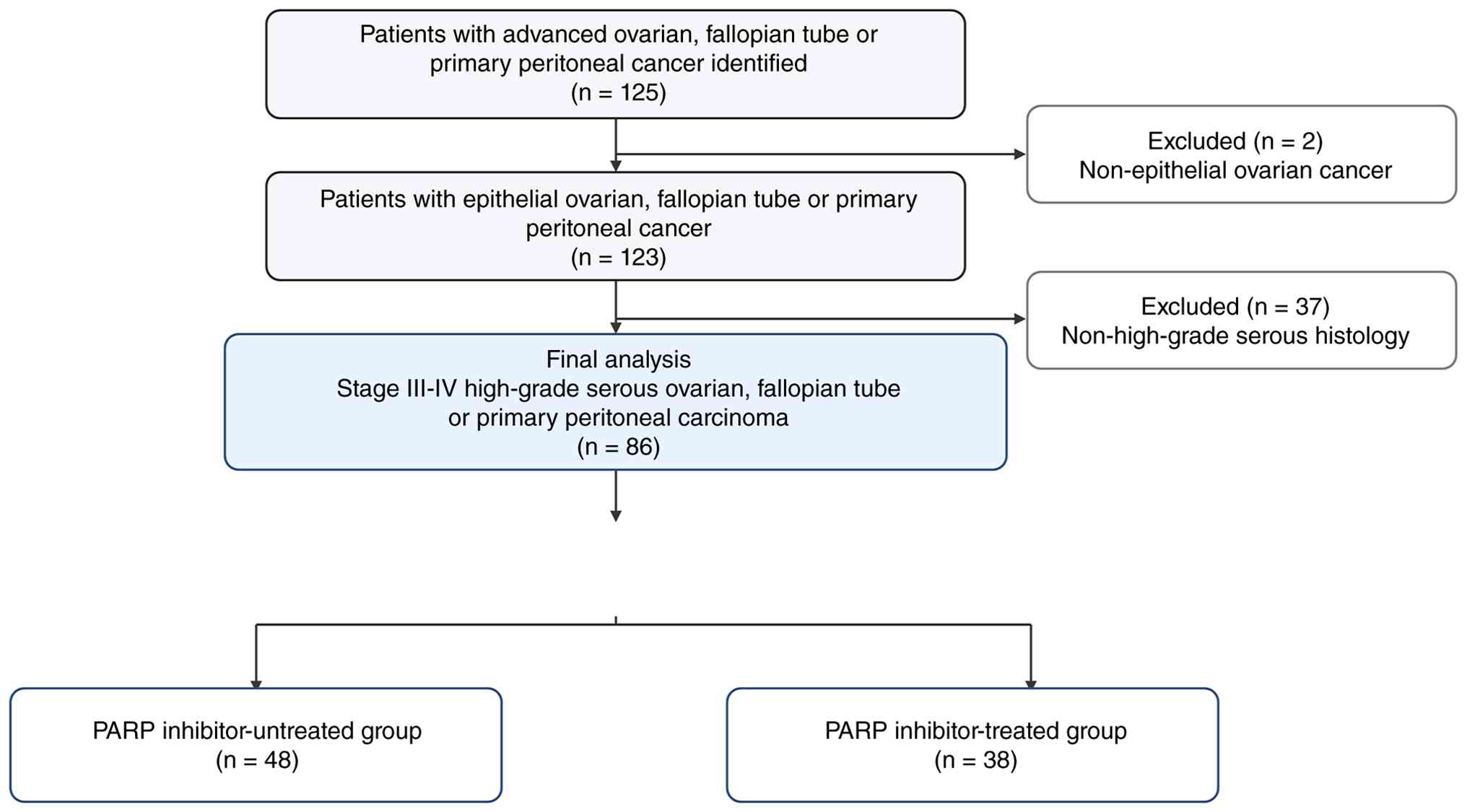
During the study period, 125 patients with advanced
ovarian, fallopian tube, or primary peritoneal cancer were
identified. After excluding two patients with non-epithelial
ovarian cancer and 37 patients with non-high-grade serous
histology, 86 patients with stage III-IV high-grade serous
carcinoma were included in the final analysis (Fig. 1). Of these, 48 patients were
classified into the PARP inhibitor-untreated group and 38 into the
PARP inhibitor-treated group.
Patient baseline characteristics are summarized in
Table I. Age was similar between
the two groups. However, baseline imbalances remained in the FIGO
stage, receipt of neoadjuvant chemotherapy, and cytoreduction
status. Follow-up duration was 45 months (range, 14-156 months) in
the PARP inhibitor-untreated group and 50.5 months (range, 22-144
months) in the PARP inhibitor-treated group. Neoadjuvant
chemotherapy was more frequently used in the PARP inhibitor-treated
group than in the PARP inhibitor-untreated group (52.6% vs. 29.2%,
P=0.045). Suboptimal cytoreduction was more common in the PARP
inhibitor-untreated group than in the PARP inhibitor-treated group
(70.8% vs. 28.9%, P<0.001). The distribution of best documented
response to first-line platinum-based treatment did not differ
significantly between the groups (P=0.212). Complete and partial
responses were observed in 31 (64.6%) and 10 (20.8%) patients,
respectively, in the PARP inhibitor-untreated group, and in 27
(71.1%) and 10 (26.3%) patients, respectively, in the PARP
inhibitor-treated group. Bevacizumab use was numerically more
frequent in the PARP inhibitor-treated group, although the
difference was not significant (76.3% vs. 56.3%, P=0.069). Among
the 38 patients in the PARP inhibitor-treated group, 25 (65.8%)
received olaparib and 13 (34.2%) received niraparib. PARP
inhibitors were initiated as frontline maintenance therapy in 20
patients (52.6%) and as maintenance therapy in the recurrent
setting in 18 patients (47.4%). The median duration of PARP
inhibitor therapy was similar between the frontline (24 months,
range: 10-55 months) and recurrent (23 months, range: 2-73 months)
maintenance settings. Among patients who received PARP inhibitors
as frontline maintenance therapy, the best documented response
before PARP inhibitor initiation was a complete response in 13
patients (65.0%) and partial response in seven patients (35.0%).
Among those who received PARP inhibitors as maintenance therapy in
the recurrent setting, the best documented response before PARP
inhibitor initiation was a complete response in four patients
(22.2%), partial response in 13 patients (72.2%), and stable
disease in one patient (5.6%).
 | Table IPatient characteristics. |
Table I
Patient characteristics.
| Variables | PARP
inhibitor-untreated (n=48) | PARP
inhibitor-treated (n=38) | P-value |
|---|
| Mean age ± SD,
years | 58.8±10.1 | 59.3±10.7 | 0.834 |
| Stage, n (%) | | | 0.012a |
|
IIIA | 0 (0.0) | 3 (7.9) | |
|
IIIB | 1 (2.1) | 7 (18.4) | |
|
IIIC | 38 (79.2) | 22 (57.9) | |
|
IVA | 6 (12.5) | 2 (5.3) | |
|
IVB | 3 (6.3) | 4 (10.5) | |
| Neoadjuvant
chemotherapy, n (%) | 14 (29.2) | 20 (52.6) | 0.045a |
| Cytoreduction, n
(%) | | |
<0.001a |
|
Complete | 5 (10.4) | 9 (23.7) | |
|
Optimal | 9 (18.8) | 18 (47.4) | |
|
Suboptimal | 34 (70.8) | 11 (28.9) | |
| Response to
first-line platinum-based treatment, n (%) | | | 0.212 |
|
Complete
response | 31 (64.6) | 27 (71.1) | |
|
Partial
response | 10 (20.8) | 10 (26.3) | |
|
Stable
disease | 2 (4.2) | 1 (2.6) | |
|
Progressive
disease | 5 (10.4) | 0 (0.0) | |
| Bevacizumab use, n
(%) | 27 (56.3) | 29 (76.3) | 0.069 |
| PARP inhibitor for
frontline treatment, n (%) | - | 20 (52.6) | |
| PARP inhibitor type,
n (%) | | | |
|
Olaparib | - | 25 (65.8) | |
|
Niraparib | - | 13 (34.2) | |
| Median total number
of regimens (range) | 3 (1-7) | 2 (1-8) | 0.081 |
| Median total cycles
of cytotoxic chemotherapy (range) | 18.5 (6-49) | 12.0 (5-45) | 0.020a |
Cytotoxic chemotherapy exposure
The cumulative number of cytotoxic chemotherapy
cycles was significantly greater in the PARP inhibitor-untreated
group than in the PARP inhibitor-treated group (median 18.5 (range,
6-49) vs. 12.0 (range, 5-45), P=0.020). In contrast, the number of
chemotherapy regimens did not differ significantly between the
groups (3 (1-7) vs. 2 (1-8), P=0.081).
Overall survival
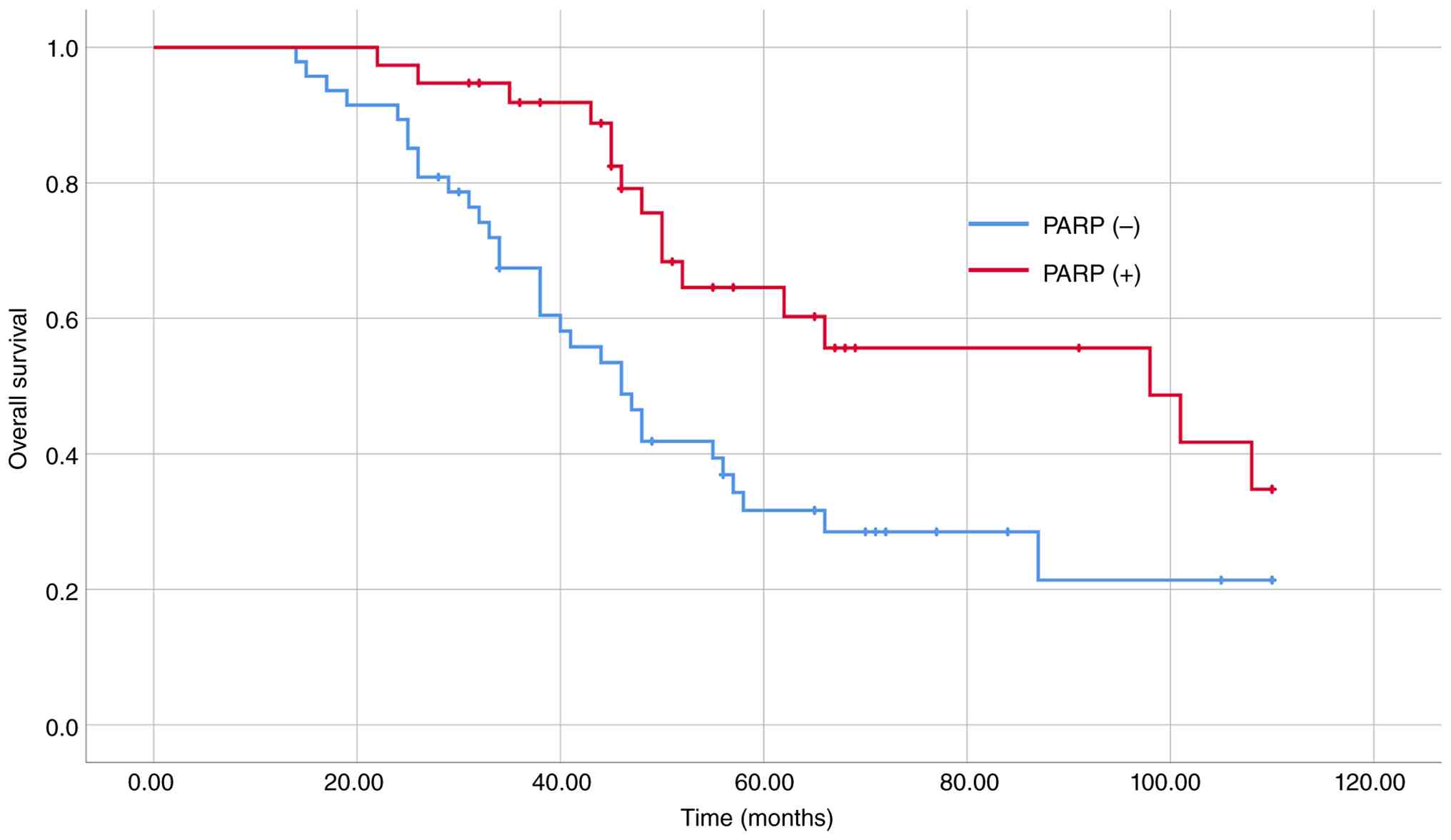
Overall survival outcomes are shown in Fig. 2. Because late crossover of the
Kaplan-Meier curves was observed in the overall survival analysis,
a time-restricted log-rank analysis was additionally performed by
administratively censoring observations at 110 months, before the
observed late crossover of the survival curves. In this restricted
analysis, the 5-year overall survival rate and median overall
survival time in the PARP inhibitor-untreated group were 31.7% and
46 months, respectively, compared with 64.6% and 98 months,
respectively, in the PARP inhibitor-treated group (P=0.011). The
proportional hazards assumption was assessed for the
time-restricted Cox regression model. No significant time-dependent
interaction was observed for PARP inhibitor use, FIGO stage IV
disease, suboptimal cytoreduction, or receipt of neoadjuvant
chemotherapy. However, bevacizumab use showed a significant
time-dependent interaction with log-transformed analysis time.
Therefore, the final multivariable Cox regression model was
stratified by bevacizumab use. In this stratified Cox regression
analysis restricted to 110 months, PARP inhibitor use was
associated with overall survival (HR, 0.400; 95% CI, 0.208-0.771;
P=0.006). Receipt of neoadjuvant chemotherapy was also associated
with overall survival (HR, 2.374; 95% CI, 1.246-4.523; P=0.009),
whereas FIGO stage IV disease and suboptimal cytoreduction were not
significantly associated with overall survival (Table II). These survival analyses were
exploratory because of the retrospective historical design and
baseline imbalances between the groups.
| Table IIMultivariate Cox regression analysis
for overall survival. |
Table II
Multivariate Cox regression analysis
for overall survival.
| Variables | HR | 95% CI | P-value |
|---|
| PARP inhibitor
use | 0.400 | 0.208-0.771 | 0.006a |
| FIGO stage IV
(reference: Stage III) | 1.540 | 0.783-3.031 | 0.211 |
| Suboptimal
cytoreduction | 1.429 | 0.892-2.291 | 0.138 |
| Neoadjuvant
chemotherapy | 2.374 | 1.246-4.523 | 0.009a |
| Bevacizumab use | Stratification
variable | | |
In the PARP inhibitor-treated group, multivariable
Cox regression analysis revealed no significant prognostic factors
for overall survival, including late-line PARP inhibitor
initiation, bevacizumab use, FIGO stage IV disease, suboptimal
cytoreduction, and receipt of neoadjuvant chemotherapy (Table III).
| Table IIIMultivariate Cox regression analysis
for the overall survival of patients treated with PARP
inhibitors. |
Table III
Multivariate Cox regression analysis
for the overall survival of patients treated with PARP
inhibitors.
| Variables | HR | 95% CI | P-value |
|---|
| PARP inhibitor as a
late-line treatment | 0.445 | 0.128-1.542 | 0.202 |
| Bevacizumab use | 1.641 | 0.396-6.807 | 0.495 |
| FIGO stage IV
(reference: Stage III) | 1.945 | 0.539-7.022 | 0.310 |
| Suboptimal
cytoreduction | 0.813 | 0.382-1.729 | 0.591 |
| Neoadjuvant
chemotherapy | 1.880 | 0.519-6.811 | 0.337 |
Post-progression overall survival
after PARP inhibitor therapy
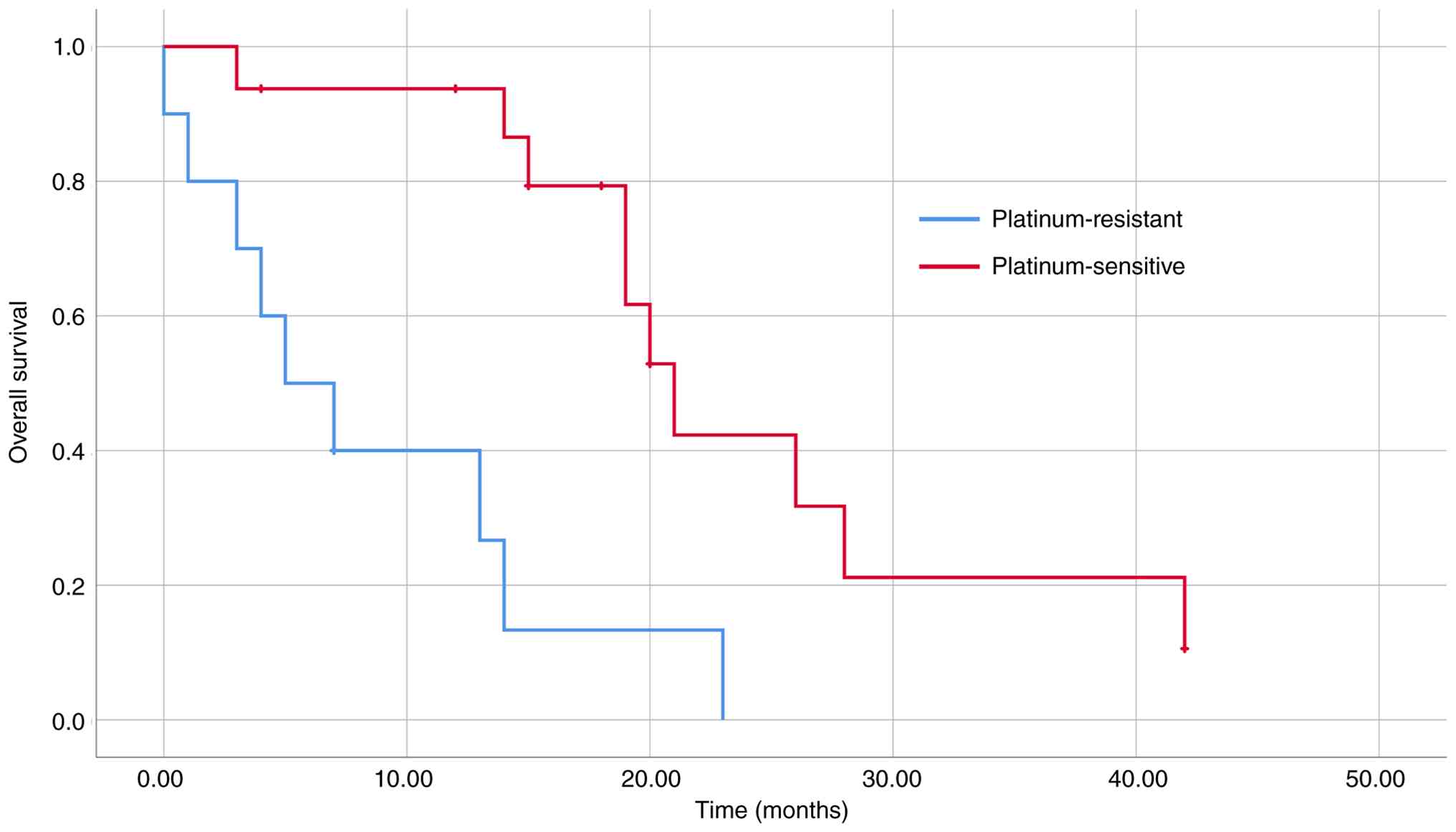
Recurrence or progression after PARP inhibitor
therapy occurred in 26 patients, of whom 16 (61.5%) were classified
as having platinum-sensitive disease. Patients with
platinum-sensitive disease after progression had significantly
longer post-progression overall survival than those with
platinum-resistant disease (median, 21 vs. 5 months; P<0.001;
Fig. 3). Because of the small
number of patients in this subgroup, the primary analysis for
post-progression overall survival was limited to univariable Cox
regression to reduce the risk of overfitting. In the univariable
Cox regression analysis, platinum sensitivity after progression was
associated with longer post-progression overall survival (HR,
0.191; 95% CI, 0.068-0.538; P=0.002; Table IV). The results of the exploratory
multivariable Cox regression analysis are shown in Table SI.
| Table IVUnivariate Cox regression analysis
for post-progression overall survival among patients experiencing
recurrence or progression after PARP inhibitor therapy. |
Table IV
Univariate Cox regression analysis
for post-progression overall survival among patients experiencing
recurrence or progression after PARP inhibitor therapy.
| Variables | HR | 95% CI | P-value |
|---|
| Platinum
sensitivity after progression following PARP inhibitor use | 0.191 | 0.068-0.538 | 0.002a |
| Bevacizumab use
after progression | 0.754 | 0.293-1.942 | 0.559 |
| FIGO stage IV
(reference: Stage III) | 2.229 | 0.820-6.063 | 0.116 |
| Suboptimal
cytoreduction | 0.589 | 0.336-1.034 | 0.065 |
| Neoadjuvant
chemotherapy | 1.524 | 0.594-3.912 | 0.381 |
Discussion
In this descriptive single-center historical cohort
restricted to patients with stage III-IV high-grade serous ovarian,
fallopian tube, or primary peritoneal carcinoma, the clinical
introduction of PARP inhibitors was associated with lower
cumulative exposure to cytotoxic chemotherapy. The cumulative
number of cytotoxic chemotherapy cycles was significantly lower in
the PARP inhibitor-treated group than in the PARP
inhibitor-untreated group, whereas the number of chemotherapy
regimens did not differ significantly between the groups. Overall
survival appeared longer in the PARP inhibitor-treated group;
however, this finding should be interpreted as exploratory because
of the retrospective historical design, treatment-selection bias,
era effects, and baseline imbalances between the groups.
This endpoint was selected as an objective measure
of cytotoxic treatment exposure that could be consistently
retrieved from medical records. Patients with advanced high-grade
serous ovarian carcinoma often receive multiple lines of systemic
treatment over the course of their disease, and repeated exposure
to cytotoxic agents may contribute to treatment burden. PARP
inhibitor maintenance therapy has been shown to prolong
progression-free survival in pivotal trials, and health-related
quality of life analyses have suggested that maintenance therapy
can delay disease progression without a major deterioration in
patient-reported outcomes (1-3,6).
In this context, the lower cumulative number of cytotoxic
chemotherapy cycles observed in the PARP inhibitor-treated group
may represent a measurable change in real-world treatment patterns
after the introduction of PARP inhibitor maintenance therapy.
However, this finding should not be interpreted as direct evidence
of improved quality of life or reduced toxicity, because
patient-reported outcomes and treatment-related adverse events were
not systematically evaluated in this retrospective analysis.
Instead, cumulative cytotoxic chemotherapy cycles should be
regarded as a surrogate measure of treatment exposure rather than a
validated measure of patient burden. The number of chemotherapy
regimens did not differ significantly between the two groups,
suggesting that PARP inhibitor introduction may alter cumulative
cytotoxic exposure without necessarily reducing the number of
treatment lines.
Pivotal trials have demonstrated progression-free
survival benefits of PARP inhibitor maintenance therapy, whereas
overall survival benefits have been inconsistent and appear to vary
according to BRCA mutation status, homologous recombination
deficiency status, treatment line, and subsequent therapies
(1-3).
In the recurrent setting, the ENGOT-OV16/NOVA, ARIEL3, ARIEL4,
SOLO3, QUADRA, and OReO trials highlighted the complexity of
evaluating survival outcomes and subsequent treatment strategies
after PARP inhibitor exposure (7-10,14,15).
Unlike randomized trials, however, the present historical cohort
study could not control for treatment indication, supportive care,
surgical strategy, or era-related factors.
Although the analysis was restricted to high-grade
serous carcinoma to reduce histologic heterogeneity, important
baseline imbalances remained. The FIGO stage, use of neoadjuvant
chemotherapy, and cytoreduction status differed between the groups.
Suboptimal cytoreduction was more frequent in the PARP
inhibitor-untreated group, whereas neoadjuvant chemotherapy was
more frequent in the PARP inhibitor-treated group. These
differences likely reflect changes in treatment strategy over time
and differences in patient selection. Therefore, the observed
survival association in the stratified multivariable Cox model
should not be interpreted as causal evidence that PARP inhibitors
improve overall survival in this cohort. It should be regarded as
hypothesis-generating rather than confirmatory. Although
multivariable Cox regression analysis was performed using
clinically relevant prognostic factors, statistical adjustment
could not fully account for residual confounding,
treatment-selection bias, or unmeasured factors in this historical
cohort.
The association between neoadjuvant chemotherapy and
poorer overall survival should be interpreted as confounding by
indication, because neoadjuvant chemotherapy is generally selected
for patients with greater tumor burden, more extensive disease,
poorer resectability, or reduced suitability for primary debulking
surgery. Similarly, bevacizumab use was more frequent in the PARP
inhibitor-treated group, likely influenced by disease extent,
reimbursement status, and physician judgment.
In the exploratory analysis of patients who
experienced recurrence or progression after PARP inhibitor therapy,
platinum sensitivity after progression was associated with longer
post-progression overall survival. However, because this subgroup
included only 26 patients, the analysis was underpowered and
vulnerable to statistical instability. Therefore, this finding
should be interpreted as descriptive and hypothesis-generating.
Previous studies have reported that prior PARP inhibitor exposure
may influence response to subsequent chemotherapy, supporting the
clinical importance of treatment sequencing after PARP inhibitor
therapy (11,12). As new agents such as antibody-drug
conjugates are being incorporated into the treatment landscape for
platinum-resistant ovarian cancer, understanding post-PARP
treatment sensitivity, sequencing, and biomarker-guided treatment
selection remains clinically important (16).
This study has some limitations. First, this was a
retrospective single-center historical cohort study with
substantial treatment-selection bias and era effects; therefore,
causal inference regarding the effect of PARP inhibitors on overall
survival could not be made. Second, although the cohort was
restricted to high-grade serous carcinoma, baseline imbalances
remained, particularly in FIGO stage, neoadjuvant chemotherapy, and
cytoreduction status. In addition, immortal time bias may have
affected the survival analysis, as patients in the PARP
inhibitor-treated group had to survive and achieve disease control
after platinum-based chemotherapy before receiving PARP inhibitor
maintenance therapy. Although we added the response to first-line
platinum-based treatment and the response immediately before PARP
inhibitor initiation, this bias could not be eliminated in the
retrospective design. Third, comprehensive BRCA mutation
status and homologous recombination deficiency data were
unavailable for the full cohort. Many patients had been treated
before routine BRCA/HRD testing became available, and some
had died by the time of this retrospective analysis; therefore,
comprehensive post hoc biomarker testing was not feasible. Because
BRCA and HRD status are closely associated with PARP
inhibitor benefit, residual confounding by unmeasured biological
factors cannot be excluded (1-3).
Fourth, approximately half of the patients in the PARP
inhibitor-treated group received PARP inhibitors as later-line
maintenance therapy, which complicated the interpretation of
survival outcomes and treatment exposure. Fifth, quality of life,
adverse events, dose reductions, treatment interruptions, and
hospitalization were not systematically evaluated in this
retrospective analysis. These variables were not evaluated because
patient-reported outcomes were not routinely collected, and
treatment-related adverse events were not consistently recorded
using standardized grading criteria throughout the long study
period. In addition, the reasons for dose reductions and treatment
interruptions were heterogeneous and could not be reliably
classified retrospectively. Hospitalizations were also difficult to
interpret as a surrogate for treatment burden or toxicity, because
planned admissions for chemotherapy administration, admissions
based on patient preference or social factors, disease-related
admissions, and adverse-event-related admissions could not be
consistently distinguished from medical records. Including these
incompletely and inconsistently documented variables could have
introduced substantial missing data and misclassification bias.
Therefore, the lower cumulative number of cytotoxic chemotherapy
cycles should not be interpreted as direct evidence of reduced
toxicity or improved quality of life. Sixth, the subgroup analysis
of post-progression overall survival after PARP inhibitor therapy
included only 26 patients. To reduce the risk of overfitting, the
main Cox regression analysis in this subgroup was limited to
univariable analysis, and the multivariable model was presented
only as an exploratory supplementary analysis. Therefore, the
association between platinum sensitivity after progression and
post-progression overall survival should be interpreted as
descriptive and hypothesis-generating. Finally, differences in
follow-up duration may have influenced cumulative cytotoxic
chemotherapy exposure and exploratory survival outcomes, and may
partly reflect differences in survival because follow-up duration
was defined as the time from first-line treatment initiation to
death or last follow-up.
In conclusion, this descriptive single-center cohort
study restricted to advanced high-grade serous carcinoma suggests
that the clinical introduction of PARP inhibitors was associated
with lower cumulative exposure to cytotoxic chemotherapy. However,
the number of chemotherapy regimens did not differ significantly
between the groups, and no causal inference regarding a survival
benefit could be made. Platinum sensitivity after recurrence or
progression following PARP inhibitor therapy remained associated
with post-progression survival in the exploratory analysis. Larger
multicenter studies with biomarker data, toxicity data, and
patient-reported outcomes are needed to clarify how PARP inhibitors
influence long-term treatment burden and subsequent treatment
sequencing in real-world practice.
Supplementary Material
Exploratory multivariate Cox
regression analysis for post-progression overall survival among
patients experiencing recurrence or progression after PARP
inhibitor therapy.
Acknowledgements
Not applicable.
Funding
Funding: No funding was received.
Availability of data and materials
The data generated in the present study may be
requested from the corresponding author.
Authors' contributions
NO acquired clinical data from the medical records,
performed the statistical analyses, investigated the treatment
courses, and reviewed, edited and revised the manuscript. KC
conceived and designed the study, developed the analytical
approach, interpreted the data, wrote the original draft, and was
involved in correspondence. KI acquired clinical data from the
medical records and checked the extracted data against the source
medical records. AS acquired clinical data and reviewed key
clinical variables for accuracy. HK acquired clinical data and
reviewed key clinical variables for accuracy. TK contributed to the
interpretation of the clinical findings, supervised the study, and
critically revised the manuscript for important intellectual
content. NO and KC confirm the authenticity of all the raw data.
All authors have read and approved the final version of the
manuscript.
Ethics approval and consent to
participate
The present study was approved by the Institutional
Review Board of Jichi Medical University, Saitama Medical Center
(approval no. S25-062; Saitama, Japan). As this was a retrospective
review of existing records, the requirement for informed consent
was waived by this institutional review board.
Patient consent for publication
Not applicable.
Competing interests
The authors declare that they have no competing
interests.
References
|
1
|
DiSilvestro P, Banerjee S, Colombo N,
Scambia G, Kim BG, Oaknin A, Friedlander M, Lisyanskaya A, Floquet
A, Leary A, et al: Overall survival with maintenance olaparib at a
7-year follow-up in patients with newly diagnosed advanced ovarian
cancer and a BRCA mutation: the SOLO1/GOG 3004 trial. J Clin Oncol.
41:609–617. 2023.PubMed/NCBI View Article : Google Scholar
|
|
2
|
Lorusso D, Mouret-Reynier MA, Harter P,
Cropet C, Caballero C, Wolfrum-Ristau P, Satoh T, Vergote I, Parma
G, Nøttrup TJ, et al: Updated progression-free survival and final
overall survival with maintenance olaparib plus bevacizumab
according to clinical risk in patients with newly diagnosed
advanced ovarian cancer in the phase III PAOLA-1/ENGOT-ov25 trial.
Int J Gynecol Cancer. 34:550–558. 2024.PubMed/NCBI View Article : Google Scholar
|
|
3
|
Monk BJ, Barretina-Ginesta MP, Pothuri B,
Vergote I, Graybill W, Mirza MR, McCormick CC, Lorusso D, Moore RG,
Freyer G, et al: Niraparib first-line maintenance therapy in
patients with newly diagnosed advanced ovarian cancer: Final
overall survival results from the PRIMA/ENGOT-OV26/GOG-3012 trial.
Ann Oncol. 35:981–992. 2024.PubMed/NCBI View Article : Google Scholar
|
|
4
|
Ledermann J, Harter P, Gourley C,
Friedlander M, Vergote I, Rustin G, Scott C, Meier W,
Shapira-Frommer R, Safra T, et al: Olaparib maintenance therapy in
platinum-sensitive relapsed ovarian cancer. N Engl J Med.
366:1382–1392. 2012.PubMed/NCBI View Article : Google Scholar
|
|
5
|
Penson RT, Valencia RV, Cibula D, Colombo
N, Leath CA III, Bidziński M, Kim JW, Nam JH, Madry R, Hernández C,
et al: Olaparib versus nonplatinum chemotherapy in patients with
platinum-sensitive relapsed ovarian cancer and a germline BRCA1/2
mutation (SOLO3): A randomized phase III trial. J Clin Oncol.
38:1164–1174. 2020.PubMed/NCBI View Article : Google Scholar
|
|
6
|
Friedlander M, Gebski V, Gibbs E, Davies
L, Bloomfield R, Hilpert F, Wenzel LB, Eek D, Rodrigues M, Clamp A,
et al: Health-related quality of life and patient-centred outcomes
with olaparib maintenance after chemotherapy in patients with
platinum-sensitive, relapsed ovarian cancer and a BRCA1/2 mutation
(SOLO2/ENGOT Ov-21): A placebo-controlled, phase 3 randomised
trial. Lancet Oncol. 19:1126–1134. 2018.PubMed/NCBI View Article : Google Scholar
|
|
7
|
Oza AM, Lisyanskaya A, Fedenko A, de Melo
AC, Shparyk Y, Rakhmatullina I, Bondarenko I, Colombo N,
Svintsitskiy V, Biela L, et al: Rucaparib versus chemotherapy for
treatment of relapsed ovarian cancer with deleterious BRCA1 or
BRCA2 mutation (ARIEL4): final results of an international,
open-label, randomised, phase 3 trial. Lancet Oncol. 26:249–264.
2025.PubMed/NCBI View Article : Google Scholar
|
|
8
|
Scambia G, Villalobos Valencia R, Colombo
N, Cibula D, Leath CA III, Bidziński M, Kim JW, Nam JH, Madry R,
Hernández C, et al: Olaparib as treatment versus nonplatinum
chemotherapy in patients with platinum-sensitive relapsed ovarian
cancer: Phase III SOLO3 study final overall survival results. J
Clin Oncol. 43:1408–1416. 2025.PubMed/NCBI View Article : Google Scholar
|
|
9
|
Moore KN, Secord AA, Geller MA, Miller DS,
Cloven N, Fleming GF, Wahner Hendrickson AE, Azodi M, DiSilvestro
P, Oza AM, et al: Niraparib monotherapy for late-line treatment of
ovarian cancer (QUADRA): A multicentre, open-label, single-arm,
phase 2 trial. Lancet Oncol. 20:636–648. 2019.PubMed/NCBI View Article : Google Scholar
|
|
10
|
Pujade-Lauraine E, Selle F, Scambia G,
Asselain B, Marmé F, Lindemann K, Colombo N, Mądry R, Glasspool R,
Vergote I, et al: Maintenance olaparib rechallenge in patients with
platinum-sensitive relapsed ovarian cancer previously treated with
a PARP inhibitor (OReO/ENGOT-ov38): A phase IIIb trial. Ann Oncol.
34:1152–1164. 2023.PubMed/NCBI View Article : Google Scholar
|
|
11
|
Frenel JS, Kim JW, Aryal N, Asher R,
Berton D, Vidal L, Pautier P, Ledermann JA, Penson RT, Oza AM, et
al: Efficacy of subsequent chemotherapy for patients with
BRCA1/2-mutated recurrent epithelial ovarian cancer progressing on
olaparib versus placebo maintenance: Post-hoc analyses of the
SOLO2/ENGOT Ov-21 trial. Ann Oncol. 33:1021–1028. 2022.PubMed/NCBI View Article : Google Scholar
|
|
12
|
Park J, Kim SI, Jeong SY, Kim Y, Bookman
MA, Kim JW, Kim BG and Lee JY: Second-line olaparib maintenance
therapy is associated with poor response to subsequent chemotherapy
in BRCA1/2-mutated epithelial ovarian cancer: A multicentre
retrospective study. Gynecol Oncol. 165:97–104. 2022.PubMed/NCBI View Article : Google Scholar
|
|
13
|
Tokunaga H, Mikami M, Nagase S, Kobayashi
Y, Tabata T, Kaneuchi M, Satoh T, Hirashima Y, Matsumura N,
Yokoyama Y, et al: The 2020 Japan society of gynecologic oncology
guidelines for the treatment of ovarian cancer, fallopian tube
cancer, and primary peritoneal cancer. J Gynecol Oncol.
32(e49)2021.PubMed/NCBI View Article : Google Scholar
|
|
14
|
Matulonis UA, Herrstedt J, Oza A, Mahner
S, Redondo A, Berton D, Berek JS, Haslund CA, Marmé F,
González-Martín A, et al: ENGOT-OV16/NOVA trial of niraparib in
recurrent ovarian cancer: Survival and long-term safety. Gynecol
Oncol. 195:192–199. 2025.PubMed/NCBI View Article : Google Scholar
|
|
15
|
Ledermann JA, Oza AM, Lorusso D,
Aghajanian C, Oaknin A, Dean A, Colombo N, Weberpals JI, Clamp AR,
Scambia G, et al: Rucaparib for maintenance treatment of
platinum-sensitive, recurrent ovarian carcinoma: Final results of
the phase 3, randomized, placebo-controlled ARIEL3 trial. Eur J
Cancer. 225(115584)2025.PubMed/NCBI View Article : Google Scholar
|
|
16
|
Moore KN, Angelergues A, Konecny GE,
García Y, Banerjee S, Lorusso D, Lee JY, Moroney JW, Colombo N,
Roszak A, et al: Mirvetuximab soravtansine in FRα-positive,
platinum-resistant ovarian cancer. N Engl J Med. 389:2162–2174.
2023.PubMed/NCBI View Article : Google Scholar
|