1. Introduction
Glioblastoma (GBM), a WHO grade 4 diffuse glioma
defined in the 2021 WHO Classification of Tumors of the Central
Nervous System (1), is the most
common and most aggressive primary malignant brain tumor in adults,
accounting for ~57% of all gliomas and more than 50% of adult
intracranial malignant tumors (2).
The global annual incidence is ~3.2 per 100,000 population, with a
predilection for adults aged 45-70 years, and the incidence is
~1.6-fold higher in men than in women (3). Despite advances in neurosurgery,
radiotherapy and chemotherapy, prognosis remains poor: Maximal safe
resection plus concurrent temozolomide (TMZ) chemoradiotherapy
followed by adjuvant TMZ yields a median overall survival (mOS) of
only 14-16 months and a 5-year survival rate below 5% (4).
The poor prognosis reflects two core biological
features: Diffuse invasive growth and extreme molecular
heterogeneity. GBM cells secrete matrix metalloproteinases (MMP2
and MMP9) that degrade the extracellular matrix, allowing tumor
cells to infiltrate surrounding brain parenchyma and even cross the
midline, so that complete resection is rarely possible and
scattered residual micro-infiltration drives recurrence (recurrence
exceeds 90%, with a median time of 7-9 months) (5). GBM also shows marked spatiotemporal
heterogeneity: Distinct regions of the same tumor harbor different
genomic and transcriptomic profiles, and the molecular phenotype
evolves dynamically under chemoradiotherapy pressure through
epigenetic reprogramming (6). A
single lesion may contain both IDH-mutant and IDH-wildtype cell
populations, or both MGMT promoter-methylated and unmethylated
clones, thus no single agent can cover all tumor cells (5).
In parallel, advances in single-cell sequencing and
liquid biopsy have shifted the field from histology-based subtyping
toward molecularly guided precision therapy (7,8). The
2021 WHO classification incorporated molecular biomarkers (IDH
mutation, MGMT promoter methylation, TERT promoter mutation, EGFR
amplification, chromosome 7 gain/10 loss, H3 K27M mutation) into
the diagnostic framework (1,9). It
is important, however, to distinguish three biomarker classes that
are frequently conflated: Diagnostic markers (for example, IDH
mutation, TERT promoter mutation, EGFR amplification, chromosome 7
gain/10 loss), which establish the tumor type; prognostic markers
(for example, IDH status, CDKN2A/B homozygous deletion), which
predict outcome independent of treatment; and predictive markers
(for example, MGMT promoter methylation), which predict response to
a specific therapy (9). This
distinction is emphasized throughout the present review.
Several reviews published between 2023 and 2025 have
summarized individual aspects of GBM therapy, such as
immunotherapy, targeted agents or specific resistance pathways. The
present review differs in three respects. First, it integrates
molecular classification, optimization of conventional therapy,
emerging therapies and resistance mechanisms within a single
framework. Second, it explicitly grades the level of evidence
behind each therapeutic claim, distinguishing randomized trials
from early-phase and preclinical studies. Third, it emphasizes the
interconnected, network-like nature of GBM resistance rather than
treating resistance pathways in isolation. The aim is to provide
clinicians and researchers with a critical, balanced and
translational overview of the 2020-2025 literature, and to identify
the barriers that must be overcome before emerging therapies can
enter routine practice.
2. Molecular pathological characteristics
and subtyping advances
Clinical translation of molecular
subtyping
The 2021 WHO (CNS5) classification defines
adult-type diffuse gliomas primarily by IDH status. IDH-wildtype
GBM (~90% of cases) is diagnosed when a diffuse astrocytic glioma
harbors TERT promoter mutation, EGFR amplification, or combined
chromosome 7 gain and chromosome 10 loss, even in the absence of
microvascular proliferation or necrosis (1,10).
IDH-mutant astrocytoma is graded as CNS WHO grade 4 in the presence
of CDKN2A/B homozygous deletion, necrosis, or microvascular
proliferation (1,10). H3 K27M-mutant diffuse midline
glioma is a distinct, highly aggressive entity occurring mainly in
children and adolescents (10).
These criteria illustrate that molecular classification is no
longer determined solely by IDH mutation and MGMT methylation, but
by a combination of diagnostic, prognostic and predictive markers
(10).
MGMT promoter methylation is a predictive biomarker
rather than a diagnostic one: It identifies patients most likely to
benefit from TMZ, and methylated patients show a mOS ~4-6 months
longer than unmethylated patients (11,12).
IDH mutation is both diagnostic and prognostic: IDH-mutant tumors
carry a mOS 6-8 months longer than IDH-wildtype GBM and may respond
to IDH1/2 inhibitors (13,14). A 2023 multicenter cohort study
reported that patients with IDH-wildtype GBM with MGMT promoter
methylation treated with TMZ plus immunotherapy achieved a mOS of
18.5 months vs. 14.3 months in unmethylated patients (11). In addition, circ-SETDB1 was
recently identified as an independent prognostic factor in
IDH-wildtype GBM (12).
Molecular mechanisms of tumor
heterogeneity
Single-cell RNA sequencing has revealed that GBM is
composed of transcriptionally plastic cellular states rather than
fixed subtypes. The landmark integrative analysis identified four
recurrent states, neural progenitor cell-like, oligodendrocyte
progenitor cell-like, astrocyte (AC)-like and mesenchymal
(MES)-like, that coexist within individual tumors and interconvert
dynamically (7,15). The MES-like state is enriched in
hypoxic and necrotic regions, upregulates TGF-β pathway genes,
suppresses CD8+ T-cell activation, enhances invasion and
reduces chemo-radiosensitivity (15). Recent spatial transcriptomics and
single-cell multi-omics studies further show that lineage
plasticity and cellular-state transitions are key drivers of
treatment resistance and represent one of the most active areas of
GBM research (16,17).
Temporal heterogeneity is equally important. A 2025
longitudinal study showed that GBM cells undergo epigenetic
reprogramming under TMZ pressure, leading to MGMT promoter
demethylation and upregulation of MGMT expression, converting
TMZ-sensitive cells into TMZ-resistant cells and driving early
progression after an initially effective response (16,18).
3. Optimization of traditional treatment
strategies
Maximal safe resection combined with TMZ-based
chemoradiotherapy remains the first-line standard of care. Recent
optimization has focused on precision surgery, individualized
chemoradiotherapy, and the addition of tumor treating fields
(TTFields).
Precision surgical technology
5-aminolevulinic acid (5-ALA) fluorescence-guided
surgery is the most mature precision technique. A 2023
meta-analysis of 12 randomized controlled trials reported that
5-ALA increased the gross total resection rate by 32% and extended
mOS by 2.1 months compared with conventional surgery (19-21).
Nevertheless, the benefit is limited to patients in whom complete
resection of the enhancing tumor is achievable, and
fluorescence-guided surgery does not address the diffuse
infiltrative component. Intraoperative rapid molecular testing has
also advanced: A 2024 study described an intraoperative MGMT
promoter methylation assay completed within 30 min that can guide
postoperative chemoradiotherapy planning (22).
Individualized chemoradiotherapy
Whether to extend adjuvant TMZ beyond six cycles
remains controversial. A 2022 phase III trial reported that
extending adjuvant TMZ from 6 to 12 cycles in MGMT-methylated GBM
prolonged median progression-free survival (PFS) from 6.4 to 10.2
months (23); however, this
finding has not been consistently reproduced, and prolonged TMZ
increases toxicity and cost without a universal overall survival
benefit. Extended adjuvant TMZ should therefore be regarded as an
individualized option rather than a new standard. Hyperbaric oxygen
therapy combined with chemoradiotherapy has been reported to
improve the objective response rate (ORR) by 15% by increasing
tumor oxygenation and TMZ cytotoxicity (24), but the supporting evidence is
limited and preliminary, and this approach should be interpreted
cautiously.
TTFields
TTFields deliver low-intensity,
intermediate-frequency alternating electric fields that disrupt
mitosis. In the pivotal EF-14 randomized trial, adding TTFields to
maintenance TMZ in newly diagnosed GBM extended mOS from 16.0 to
20.9 months (25), and TTFields
are now incorporated into major management guidelines for eligible
patients. Real-world data from 2020-2025 generally support the
feasibility of TTFields in routine practice, although adherence,
scalp toxicity and cost remain practical limitations (25).
4. Emerging therapeutic strategies
Emerging approaches, immunotherapy, targeted therapy
and oncolytic viruses, have generated substantial interest, but
most supporting evidence derives from phase I/II trials or
preclinical models, and these findings should be regarded as
preliminary rather than definitive. The main clinical trial results
are summarized in Table I.
 | Table IClinical trial results of emerging
therapies for GBM (2020-2025). |
Table I
Clinical trial results of emerging
therapies for GBM (2020-2025).
| First author(s),
year | Therapy/Drug |
Target/Mechanism | Phase | Population | Efficacy | (Refs.) |
|---|
| Kreatsoulas et
al, 2022 | Nivolumab +
bevacizumab | PD-1 + VEGF
inhibition | II | Recurrent GBM | ORR 22%, mOS 9.8
months | (29) |
| Zhang et al,
2026 | EGFRvIII-targeted
CAR-T | EGFRvIII-specific
elimination | I | Recurrent GBM | PR 4/12, mPFS 5.3
months | (30) |
| Mitchell et
al, 2015 | DC vaccine +
standard therapy | Induction of
antitumor immunity | III | Newly diagnosed
IDH-wildtype GBM | mOS 19.3
months | (33) |
| Van Den Bent et
al, 2018 | Depatuxizumab
mafodotin + TMZ | EGFRvIII ADC +
chemotherapy | II | EGFRvIII-positive
GBM | ORR 18% | (36) |
| Singh et al,
2025 | OMO-103 + TMZ | HK2 inhibition +
chemotherapy | I | MGMT-unmethylated
GBM | mPFS extended by
2.9 months | (23) |
| Todo et al,
2022 | Oncolytic HSV-1 +
radiotherapy | Tumor lysis +
immune induction | II | Newly diagnosed
GBM | mOS 17.6
months | (41) |
| Nassiri et
al, 2023 | Oncolytic
adenovirus (PD-L1 inhibitor) | Tumor lysis + PD-L1
inhibition | I | Recurrent GBM | ORR 25% | (42) |
Immunotherapy: Rationale and remaining
barriers
Immune checkpoint inhibitors have transformed
several solid tumors but have largely failed in GBM. The randomized
CheckMate 143 trial found no survival benefit of nivolumab over
bevacizumab in recurrent GBM (26), and this negative result is now
understood to reflect profound immune suppression, T-cell
exhaustion, antigen heterogeneity, corticosteroid-induced
immunosuppression and poor T-cell infiltration in the GBM
microenvironment (27,28). Combination strategies aim to
overcome these barriers: A 2024 phase II trial reported that
nivolumab plus bevacizumab achieved an ORR of 22% and a mOS of 9.8
months in recurrent GBM [vs. 6.2 months for monotherapy (29)], but confirmatory phase III data are
still lacking.
CAR-T cell therapy: Intracranial delivery is used to
bypass the BBB. A 2025 phase I trial of intracranial
EGFRvIII-directed CAR-T cells in 12 patients with recurrent GBM
reported partial responses in 4 patients and a median PFS of 5.3
months (30). Dual-target
(EGFRvIII + IL13Rα2) CAR-T cells may reduce antigen-escape
resistance (31,32). However, CAR-T therapy in GBM faces
major challenges, including antigen escape, limited T-cell
persistence, neurotoxicity and delivery limitations, and efficacy
remains unproven in randomized trials.
Tumor vaccines: A 2023 phase III trial reported that
a dendritic cell vaccine added to standard therapy extended mOS to
19.3 months in IDH-wildtype GBM (33), and a 2025 phase I trial of an mRNA
vaccine targeting GBM-specific mutations reported induction of
tumor-specific immune responses with acceptable safety (34,35).
These results are encouraging but require independent
confirmation.
Targeted therapy: New targets,
persistent barriers
Targeted therapy has shifted from conventional
signal-pathway inhibition toward metabolic inhibition and
antibody-drug conjugates (ADCs). Depatuxizumab mafodotin, an
EGFRvIII-directed ADC, achieved an ORR of 18% in EGFRvIII-positive
GBM in a phase II trial (36,37).
However, EGFR-targeted therapies have generally been disappointing
in GBM despite frequent EGFR alterations, largely because of
inadequate BBB penetration, pharmacokinetic limitations and
redundant signaling pathways (38-40).
A 2025 phase I trial of the hexokinase 2 (HK2) inhibitor OMO-103
plus TMZ in MGMT-unmethylated GBM extended median PFS by 2.9 months
(23); again, this is an
early-phase signal requiring confirmation.
Oncolytic virus therapy
Oncolytic viruses both lyse tumor cells and
stimulate antitumor immunity and are increasingly combined with
radiotherapy or immunotherapy. A 2024 phase II trial of oncolytic
HSV-1 (T-VEC) plus radiotherapy in newly diagnosed GBM reported a
mOS of 17.6 months (41), and a
2025 phase I trial of an oncolytic adenovirus expressing a PD-L1
inhibitor achieved an ORR of 25% in recurrent GBM (42,43).
These agents remain investigational.
5. Mechanisms of treatment resistance and
intervention strategies
GBM treatment resistance results from multiple
interacting mechanisms. Importantly, these mechanisms do not
operate in isolation; hypoxia, DNA repair, metabolic reprogramming,
TME immunosuppression and glioblastoma stem cell (GSC) stemness
form an interconnected network (Fig.
1). Throughout this section, preclinical findings are
distinguished from observations validated in human clinical
studies.
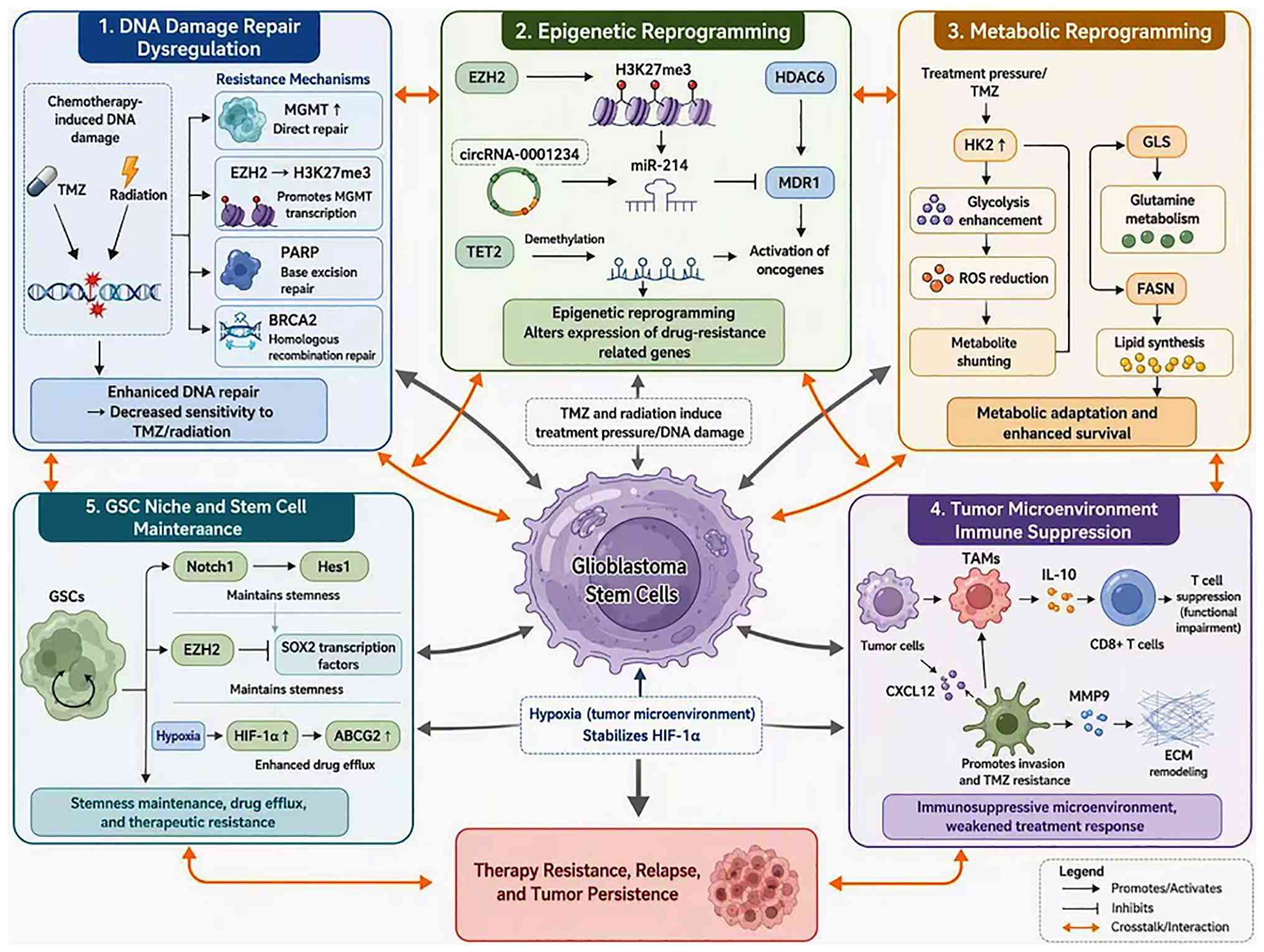 | Figure 1Interconnected network of
glioblastoma therapy resistance mechanisms. DNA repair, epigenetic
reprogramming, metabolic reprogramming, tumor microenvironment
immunosuppression and GSC stemness are mutually reinforcing; orange
arrows indicate crosstalk. miR, microRNA; HIF-1α, hypoxia-inducible
factor 1α; TMZ, temozolomide; ECM, extracellular matrix; GLS,
glutaminase; FASN, fatty acid synthase; miR, microRNA; TAMs,
tumor-associated macrophages; MMP9, matrix metalloproteinase 9;
ROS, reactive oxygen species; GSCs, glioblastoma stem cell. |
Abnormal DNA damage repair
TMZ cytotoxicity depends on DNA alkylation, and
enhanced DNA repair is a major resistance mechanism. MGMT-mediated
direct repair: IDH-wildtype GBM upregulates MGMT transcription
through EZH2-mediated H3K27me3 modification after TMZ exposure
(44); the EZH2 inhibitor
tazemetostat plus TMZ increased apoptosis of MGMT-high GBM cells by
42% in preclinical models (44,45).
PARP-mediated base excision repair: a 2025 phase I trial reported
that the PARP inhibitor olaparib plus TMZ extended median PFS to
7.1 months (vs. 4.2 months in controls) in MGMT-unmethylated GBM
(46). ~30% of recurrent GBM
harbor BRCA2 mutations, which activate homologous recombination and
may predict response to PARP inhibitors (46).
Epigenetic regulation
Histone modification, non-coding RNA regulation and
DNA methylation dynamics all contribute to acquired resistance. GBM
upregulates HDAC6 after radiotherapy, stabilizing DNA repair
proteins; the HDAC6 inhibitor ricolinostat plus radiotherapy
extended survival in tumor-bearing mice (47). The circular RNA circRNA-0001234
upregulates MDR1 by sponging miR-214 in drug-resistant GBM
(18). In IDH-mutant GBM, TET2
silencing induces global hypomethylation and activates
invasion-related genes (18).
These are predominantly preclinical observations.
Metabolic reprogramming
GBM cells adapt metabolically to therapeutic
pressure. TMZ upregulates HK2 by 2.3-fold, enhancing glycolysis and
reducing reactive oxygen species to evade apoptosis; the HK2
inhibitor 2-DG plus TMZ reduced GBM cell survival by 60% in
vitro (48,50). Recurrent GBM overexpresses
glutaminase (GLS), which maintains GSC stemness; the GLS inhibitor
CB-839 plus CAR-T cells increased GSC clearance in preclinical
models (51). Radiotherapy
activates fatty acid synthase (FASN); the FASN inhibitor orlistat
plus radiotherapy reduced tumor volume in animal models (49).
TME immunosuppression
Tumor-associated macrophages dominate the GBM TME
and secrete IL-10, inducing CD8+ T-cell exhaustion;
anti-IL-10 plus anti-PD-1 increased the ORR to 28% in a phase I
study of recurrent GBM (52,53).
GBM-induced ACs secrete CXCL12, promoting invasion and TMZ
resistance; the CXCR4 inhibitor plerixafor plus TMZ extended
survival in mice (54).
GBM-secreted MMP9 remodels the extracellular matrix; the MMP9
inhibitor marimastat may enhance oncolytic virus penetration
(55,56).
GSC stemness maintenance
GSCs are self-renewing, multidrug-resistant cells
central to recurrence. Notch1 signaling maintains stemness through
Hes1; the Notch inhibitor DAPT plus radiotherapy reduced GSC
proportion by 80% in preclinical models (57). EZH2 maintains stemness by
repressing SOX2 negative regulators; tazemetostat plus CD133-ADC
eliminated 90% of GSCs in vitro and in vivo (44). Hypoxia-inducible factor 1α (HIF-1α)
upregulates ABCG2 in hypoxic GSCs, enhancing drug efflux; the
HIF-1α inhibitor belzutifan plus TMZ increased GSC drug sensitivity
in preclinical studies (58,59).
An interconnected resistance
network
A key emerging concept is that these mechanisms are
mutually reinforcing. Hypoxia stabilizes HIF-1α, which
simultaneously drives metabolic reprogramming (glycolysis), GSC
stemness (ABCG2 upregulation) and TME immunosuppression (TGF-β,
IL-10), while DNA damage from TMZ and radiotherapy feeds back to
activate epigenetic and metabolic adaptations (23,60).
A schematic summary is provided in Fig. 1. Targeting single nodes of this
network is therefore unlikely to be curative, and rational
combination strategies that simultaneously address DNA repair,
metabolism, immunosuppression and stemness are more likely to
succeed.
6. Conclusions and perspectives
Over the past five years, GBM research has
progressed from empirical multimodal therapy toward molecularly
guided precision therapy. The 2021 WHO classification has
established the clinical value of molecular biomarkers, enabling
stratified treatment: MGMT-methylated patients may benefit from
extended TMZ, and IDH-mutant patients may respond to
metabolic-pathway inhibitors. Precision surgery (5-ALA,
intraoperative molecular testing) has improved resection and
decision-making, and TTFields have added a meaningful,
guideline-endorsed survival benefit (4,19,25).
Emerging therapies, including dual-target CAR-T cells, mRNA
vaccines and metabolic inhibitors, have produced preliminary
signals of activity in recurrent GBM.
However, substantial translational barriers remain.
The BBB severely limits drug penetration; spatiotemporal
heterogeneity leads to failure of single-agent therapy; the
interconnected resistance network is difficult to reverse; and the
immunosuppressive TME reduces the efficiency of immunotherapy
(23). At present, most emerging
therapies have not been validated in adequately powered randomized
trials, and none can yet be described as curative. The most
realistic path forward is multimodal, molecularly stratified
therapy that combines refined single-cell and liquid-biopsy-based
classification, BBB-penetrant delivery systems, and rationally
designed combinations targeting the interconnected resistance
network, all tested in rigorous, controlled clinical trials.
Significant additional work is required before these strategies can
become standard practice, and any expectation of cure for a broad
GBM population remains premature (6,23).
7. Literature search methods
Databases and search strategy
PubMed, Embase and Web of Science were searched on
15 December 2025 for records published between 1 January 2020 and
15 December 2025. The following search string was adapted for each
database: (‘glioblastoma’ OR ‘GBM’) AND (‘molecular classification’
OR ‘molecular subtyping’ OR ‘IDH’ OR ‘MGMT’) AND (‘targeted
therapy’ OR ‘immunotherapy’ OR ‘tumor treating fields’ OR ‘drug
resistance’ OR ‘tumor microenvironment’). No language restriction
was applied at retrieval; non-English records were excluded after
screening because of data-integrity concerns.
Study selection. After duplicate removal, two
reviewers (L.S. and S.S.) independently screened titles and
abstracts, and then full texts, against predefined inclusion and
exclusion criteria. Disagreements were resolved by discussion or by
a third reviewer (Y.G.). Inclusion criteria were: i) Original
research, clinical trials or high-quality reviews published in
authoritative oncology/neuro-oncology journals; ii) studies with
clear experimental or clinical data on GBM molecular pathology,
therapy or resistance; and iii) trials reporting phase, population
and efficacy endpoints. Exclusion criteria were: i) case reports,
conference abstracts and unpublished gray literature; ii) studies
with incomplete data, unclear conclusions or low methodological
quality; and iii) studies focused on non-GBM glioma subtypes.
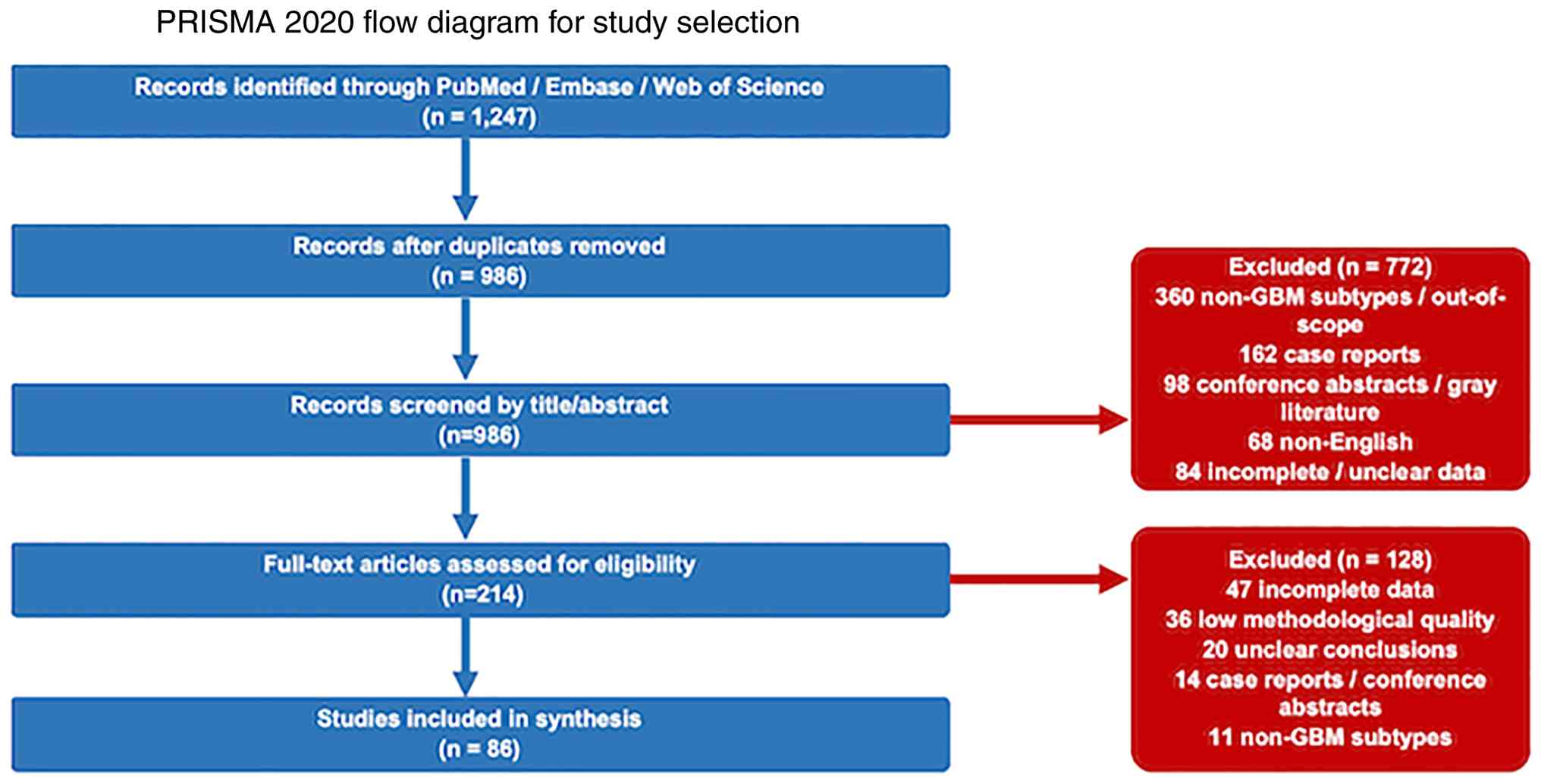
Screening results and quality assessment. The
search identified 1,247 records, of which 261 duplicates were
removed, leaving 986 records for screening. Of these, 68
non-English records were excluded after title/abstract screening
because of data-integrity concerns. The 772 records excluded at the
title/abstract stage comprised 360 records on non-GBM glioma
subtypes or out-of-scope topics, 162 case reports, 98 conference
abstracts or gray-literature items, and 84 records with incomplete
or unclear data. A further 128 records were excluded at the
full-text stage, comprising 47 with incomplete data, 36 with low
methodological quality, 20 with unclear conclusions, 14 case
reports/conference abstracts confirmed on full text, and 11 non-GBM
glioma subtypes. The remaining 86 studies were synthesized
(Fig. 2). Inter-reviewer agreement
was substantial (Cohen's κ=0.82). Methodological quality was
assessed by study design, sample size and endpoint definition;
findings from randomized trials were weighted above single-arm
early-phase trials, which were in turn weighted above preclinical
studies. The main clinical and pre-clinical studies included in
this review are summarized in Table
II.
| Table IISummary of included studies
(2020-2025). |
Table II
Summary of included studies
(2020-2025).
| First author/s,
year | Study (topic) | Study type | Population | Main finding | (Refs.) |
|---|
| A. Molecular
classification and heterogeneity |
|---|
| Neftel et
al, 2019 | Cellular states and
plasticity | Single-cell
RNA-seq | Human GBM | Four plastic
cellular states (NPC-, OPC-, AC-, MES-like) | (7) |
| McMahon et
al, 2022 | ctDNA in
glioma | Systematic
review/meta-analysis | Glioma | ctDNA biomarker
performance | (8) |
| LeBlanc et
al, 2022 | Single-cell
landscapes | Single-cell | Primary GBM | Variable
inter-/intratumor heterogeneity retention | (16) |
| Migliozzi et
al, 2025 | Spatial plasticity
restraint |
Single-cell/spatial | GBM | Homotypic
clustering restrains plasticity | (17) |
| Hamed et al,
2025 | Gliomagenesis
injury response | Single-cell | Glioma | Neural crest-like
cells orchestrate gliomagenesis | (18) |
| B. Standard therapy
and optimization |
| Qazi et al,
2017 | TMZ +
radiotherapy | Phase III RCT | Newly diagnosed
GBM | Established TMZ
chemoradiotherapy standard | (5) |
| Hegi et al,
2005 | MGMT methylation
and TMZ | RCT (biomarker
analysis) | GBM | MGMT methylation
predicts TMZ benefit | (11) |
| Barault et
al, 2015 | MGMT digital
PCR | Cohort | GBM/CRC | Digital PCR refines
MGMT-based prediction | (12) |
| Stummer et
al, 2006 | 5-ALA fluorescence
surgery | Phase III RCT | Malignant
glioma | Improved complete
resection rate | (19) |
| Coty-Fattal et
al, 2025 | Intraoperative MGMT
assay |
Proof-of-concept | GBM | 30-min
intraoperative MGMT assay | (22) |
| Arienti et
al, 2021 | Hyperbaric
oxygen |
Preclinical/translational | GBM cells | HBO rewires glucose
metabolism | (24) |
| Stupp et al,
2017 | TTFields EF-14 | Phase III RCT | Newly diagnosed
GBM | mOS 20.9 vs. 16.0
months | (25) |
| Mellinghoff et
al, 2023 | Vorasidenib | Phase III RCT | IDH-mutant
low-grade glioma | Vorasidenib
efficacy in IDH-mutant glioma | (14) |
| C.
Immunotherapy |
| Reardon et
al, 2020 | CheckMate 143 | Phase III RCT | Recurrent GBM | No survival benefit
of nivolumab | (26) |
| Schalper et
al, 2019 | Neoadjuvant
nivolumab | Phase II | Resectable GBM | Nivolumab modifies
TME | (27) |
| Zhao et al,
2019 | Anti-PD-1
correlates | Cohort | GBM | Immune/genomic
correlates of response | (28) |
| Zhang et al,
2026 | B7-H3 CAR-T | Phase I | Recurrent GBM | Intracranial B7-H3
CAR-T delivery | (30) |
| Clubb et al,
2026 | Armored CAR-T | Preclinical | GBM | Targets
antigen-heterogeneous glioma | (31) |
| Kong et al,
2012 | IL13R CAR-T | Preclinical | Glioma
xenografts | IL13Rα2 CAR-T
suppression | (32) |
| Mitchell et
al, 2015 | DC vaccine | Clinical trial | GBM | DC vaccine +
tetanus/CCL3 improves survival | (33) |
| Berneman et
al, 2025 | WT1 mRNA DC
vaccine | Phase I | GBM/solid
tumors | WT1-mRNA DC
vaccination responses | (34) |
| Garfinkle et
al, 2026 | Neoantigen DNA
vaccine | Phase I | MGMT-unmethylated
GBM | Personalized
multivalent vaccination | (35) |
| D. Targeted
therapy/ADC |
| Van Den Bent et
al, 2018 | Depatux-M
(INTELLANCE 2) | Phase II RCT | Recurrent
EGFR-amplified GBM | Depatux-M + TMZ
results | (36) |
| Padovan et
al, 2020 | Depatux-M
real-world | Cohort | Recurrent GBM | Real-world
Depatux-M + TMZ experience | (37) |
| E. Oncolytic
viruses |
| Todo et al,
2022 | G47∆ HSV-1 | Phase II | Residual/recurrent
GBM | Intratumoral G47∆
survival | (41) |
| Nassiri et
al, 2023 | DNX-2401 +
pembro | Phase I/II | Recurrent GBM | Oncolytic
adenovirus + pembrolizumab | (42) |
| Desjardins et
al, 2018 | Recombinant
poliovirus | Phase I | Recurrent GBM | PVSRIPO
survival | (43) |
| F. Resistance
mechanisms |
| Suvà et al,
2009 | EZH2 in GSC | Preclinical | GBM stem cells | EZH2 essential for
GSC maintenance | (44) |
| Jin et al,
2017 | BMI1/EZH2
inhibition | Preclinical | GBM stem cells | Combined BMI1 +
EZH2 targeting | (45) |
| Stefan et
al, 2025 | Olaparib + TMZ | Phase I | GBM | PARP inhibitor +
TMZ safety/activity | (46) |
| Natsume et
al, 2013 | PRC2
plasticity | Preclinical | GBM | PRC2 regulates
epigenetic plasticity | (47) |
| Minami et
al, 2023 | CDKN2A lipid | Preclinical | GBM | CDKN2A deletion
primes ferroptosis | (48) |
| Duman et al,
2019 | ACBP FAO | Preclinical | GBM | ACBP sustains fatty
acid oxidation | (49) |
| Masui et al,
2013 | mTORC2
glycolysis | Preclinical | GBM | mTORC2-FoxO-c-Myc
glycolysis | (50) |
| Ye et al,
2023 | Microglial
rewiring | Preclinical | GBM | Microglial
metabolic rewiring + ICB | (51) |
| Polania et
al, 2025 | TAM exhaustion | Preclinical | GBM | TAM antigen
presentation drives exhaustion | (52) |
| Wang et al,
2024 | Hypoxic
macrophages | Preclinical | GBM | Hypoxic macrophage
vascular normalization | (53) |
| Sattiraju et
al, 2023 | Hypoxic niche | Preclinical | GBM | Hypoxic niches
reprogram TAM/T-cells | (54) |
| Jeon et al,
2023 | Tissue factor
RT | Preclinical | GBM | Tissue factor
regulates RT remodeling | (55) |
| Hoogstrate et
al, 2023 | TME
transcriptome | Preclinical | GBM | TME transcriptomic
changes | (56) |
| Man et al,
2018 | Notch1 GSC | Preclinical | GSC | Hypoxic Notch1
turnover maintains GSC | (57) |
| Li et al,
2009 | Hypoxia-inducible
factor GSC | Preclinical | GSC | Hypoxia-inducible
factor regulates GSC tumorigenic capacity | (58) |
| Bao et al,
2006 | GSC
radioresistance | Preclinical | GSC | GSC preferential
DNA damage response | (59) |
| G. Background
reviews and consensus papers |
| Louis et al,
2021 | WHO CNS5
classification |
Consensus/classification | CNS tumors | Molecular
diagnostic framework | (1) |
| van den Bent et
al, 2023 | Primary brain
tumors | Review | Adult brain
tumors | Diagnostic and
therapeutic overview | (2) |
| Tan et al,
2020 | GBM management | Review | GBM | State-of-the-art
management | (3) |
| Qazi et al,
2017 | Intratumoral
heterogeneity | Review | GBM | Heterogeneity
drives resistance | (5) |
| Weller et
al, 2024 | Glioma
(Primers) | Review | Glioma | Comprehensive
overview | (6) |
| Horbinski et
al, 2024 | Molecular
testing | Review | CNS tumors | Molecular testing
framework | (9) |
| Wen et al,
2021 | WHO 2021
implications | Review | Adult gliomas | Clinical
translation | (10) |
| Reardon et
al, 2023 | IDH-mutant
therapy | Review | IDH-mutant
glioma | Targeting mutant
IDH | (13) |
| Mukherjee et
al, 2024 | Transcriptional
plasticity | Review | GBM | Phenotypic
plasticity mechanisms | (15) |
| Moiyadi et
al, 2014 | Fluorescence
surgery review | Review | Malignant
glioma | 5-ALA paradigm | (20) |
| McCracken et
al, 2022 | 5-ALA story | Review | Brain tumor | 5-ALA
evolution | (21) |
| Singh et al,
2025 | GBM crossroads | Review | GBM | Therapeutic
horizons | (23) |
| Kreatsoulas et
al, 2022 | Immunotherapy
landscape | Review | GBM | Translational
immunotherapy | (29) |
| Mair et al,
2023 | ADC brain
tumors | Review | Brain tumors | ADC activity | (38) |
| Gan et al,
2017 | ADC GBM | Review | GBM | ADC design | (39) |
| Furnari et
al, 2015 | EGFR
heterogeneity | Review | GBM | EGFR signaling
heterogeneity | (40) |
| Wu et al,
2023 | Radiotherapy
resistance | Review | Tumors | Molecular
resistance mechanisms | (60) |
Acknowledgements
Not applicable.
Funding
Funding: No funding was received.
Availability of data and materials
The data generated in the present study are included
in the figures and/or tables of this article.
Authors' contributions
LS and YG conceptualized and designed the study. LS,
SS and LY conducted literature acquisition and analysis. LS drafted
the manuscript. JY and JY critically revised the manuscript. All
authors read and approved the final version of the manuscript. Data
authentication is not applicable.
Ethics approval and consent to
participate
Not applicable.
Patient consent for publication
Not applicable.
Competing interests
The authors declare that they have no competing
interests.
References
|
1
|
Louis DN, Perry A, Wesseling P, Brat DJ,
Cree IA, Figarella-Branger D, Hawkins C, Ng HK, Pfister SM,
Reifenberger G, et al: The 2021 WHO classification of tumors of the
central nervous system: A summary. Neuro Oncol. 23:1231–1251.
2021.PubMed/NCBI View Article : Google Scholar
|
|
2
|
van den Bent MJ, Geurts M, French PJ,
Smits M, Capper D, Bromberg JEC and Chang SM: Primary brain tumours
in adults. Lancet. 402:1564–1579. 2023.PubMed/NCBI View Article : Google Scholar
|
|
3
|
Tan AC, Ashley DM, López GY, Malinzak M,
Friedman HS and Khasraw M: Management of glioblastoma: State of the
art and future directions. CA Cancer J Clin. 70:299–312.
2020.PubMed/NCBI View Article : Google Scholar
|
|
4
|
Stupp R, Mason WP, van den Bent MJ, Weller
M, Fisher B, Taphoorn MJ, Belanger K, Brandes AA, Marosi C, Bogdahn
U, et al: Radiotherapy plus concomitant and adjuvant temozolomide
for glioblastoma. N Engl J Med. 352:987–996. 2005.PubMed/NCBI View Article : Google Scholar
|
|
5
|
Qazi MA, Vora P, Venugopal C, Sidhu SS,
Moffat J, Swanton C and Singh SK: Intratumoral heterogeneity:
Pathways to treatment resistance and relapse in human glioblastoma.
Ann Oncol. 28:1448–1456. 2017.PubMed/NCBI View Article : Google Scholar
|
|
6
|
Weller M, Wen PY, Chang SM, Dirven L, Lim
M, Monje M and Reifenberger G: Glioma. Nat Rev Dis Primers.
10(33)2024.PubMed/NCBI View Article : Google Scholar
|
|
7
|
Neftel C, Laffy J, Filbin MG, Hara T,
Shore ME, Rahme GJ, Richman AR, Silverbush D, Shaw ML, Hebert CM,
et al: An integrative model of cellular states, plasticity, and
genetics for glioblastoma. Cell. 178(849.e21)2019.PubMed/NCBI View Article : Google Scholar
|
|
8
|
McMahon JT, Studer M, Ulrich B, Revuelta
Barbero JM, Pradilla I, Palacios-Ariza MA and Pradilla G:
Circulating tumor DNA in adults with glioma: A systematic review
and Meta-analysis of biomarker performance. Neurosurgery.
91:231–238. 2022.PubMed/NCBI View Article : Google Scholar
|
|
9
|
Horbinski C, Solomon DA, Lukas RV, Packer
RJ, Brastianos P, Wen PY, Snuderl M, Berger MS, Chang S, Fouladi M,
et al: Molecular testing for the world health organization
classification of central nervous system tumors: A review. JAMA
Oncol. 11:317–328. 2025.PubMed/NCBI View Article : Google Scholar
|
|
10
|
Wen PY and Packer RJ: The 2021 WHO
classification of tumors of the central nervous system: Clinical
implications. Neuro Oncol. 23:1215–1217. 2021.PubMed/NCBI View Article : Google Scholar
|
|
11
|
Hegi ME, Diserens AC, Gorlia T, Hamou MF,
de Tribolet N, Weller M, Kros JM, Hainfellner JA, Mason W, Mariani
L, et al: MGMT gene silencing and benefit from temozolomide in
glioblastoma. N Engl J Med. 352:997–1003. 2005.PubMed/NCBI View Article : Google Scholar
|
|
12
|
Barault L, Amatu A, Bleeker FE, Moutinho
C, Falcomatà C, Fiano V, Cassingena A, Siravegna G, Milione M,
Cassoni P, et al: Digital PCR quantification of MGMT methylation
refines prediction of clinical benefit from alkylating agents in
glioblastoma and metastatic colorectal cancer. Ann Oncol.
26:1994–1999. 2015.PubMed/NCBI View Article : Google Scholar
|
|
13
|
Reardon DA and Cahill DP: A new era for
glioma therapy-targeting mutant IDH. Nat Rev Clin Oncol.
20:737–738. 2023.PubMed/NCBI View Article : Google Scholar
|
|
14
|
Mellinghoff IK, van den Bent MJ,
Blumenthal DT, Touat M, Peters KB, Clarke J, Mendez J, Yust-Katz S,
Welsh L, Mason WP, et al: Vorasidenib in IDH1- or IDH2-mutant
low-grade glioma. N Engl J Med. 389:589–601. 2023.PubMed/NCBI View Article : Google Scholar
|
|
15
|
Mukherjee I, Park J, Patel AP and Baliga
NS: Transcriptional mechanisms of phenotypic plasticity in
glioblastoma. J Clin Oncol. 42 (16_suppl)(e14027)2024.
|
|
16
|
LeBlanc VG, Trinh DL, Aslanpour S, Hughes
M, Livingstone D, Jin D, Ahn BY, Blough MD, Cairncross JG, Chan JA,
et al: Single-cell landscapes of primary glioblastomas and matched
explants and cell lines show variable retention of inter- and
intratumor heterogeneity. Cancer Cell. 40:79–392.e9.
2022.PubMed/NCBI View Article : Google Scholar
|
|
17
|
Migliozzi S, Adabbo B, Garofano L, Wu F,
Davila P, Komotar RJ, Ivan ME, Shah AH, Currall BB, Williams S, et
al: Restraint of cancer cell plasticity by spatial homotypic
clustering. Cancer Cell. 43:2206–2223.e10. 2025.PubMed/NCBI View Article : Google Scholar
|
|
18
|
Hamed AA, Hua K, Trinh QM, Simons BD,
Marioni JC, Stein LD and Dirks PB: Gliomagenesis mimics an injury
response orchestrated by neural crest-like cells. Nature.
638:499–509. 2025.PubMed/NCBI View Article : Google Scholar
|
|
19
|
Stummer W, Pichlmeier U, Meinel T,
Wiestler OD, Zanella F and Reulen HJ: ALA-Glioma Study Group.
Fluorescence-guided surgery with 5-aminolevulinic acid for
resection of malignant glioma: A randomised controlled multicentre
phase III trial. Lancet Oncol. 7:392–401. 2006.PubMed/NCBI View Article : Google Scholar
|
|
20
|
Moiyadi A, Syed P and Srivastava S:
Fluorescence-guided surgery of malignant gliomas based on
5-aminolevulinic acid: Paradigm shifts but not a panacea. Nat Rev
Cancer. 14(146)2014.PubMed/NCBI View Article : Google Scholar
|
|
21
|
McCracken DJ, Schupper AJ, Lakomkin N,
Malcolm J, Painton Bray D and Hadjipanayis CG: Turning on the light
for brain tumor surgery: A 5-aminolevulinic acid story. Neuro
Oncol. 24 (Suppl 6):S52–S61. 2022.PubMed/NCBI View Article : Google Scholar
|
|
22
|
Coty-Fattal Z, Smith H, McCord M,
Mejia-Bautista M, Dittman D, Primdahl D, Conway K, Becker N,
Ahrendsen JT, Santana-Santos L, et al: Rapid assessment of MGMT
promoter methylation status by droplet digital polymerase chain
reaction on intraoperative smear preparation: A proof-of-concept
study. J Neuropathol Exp Neurol. 85:280–284. 2025.PubMed/NCBI View Article : Google Scholar
|
|
23
|
Singh S, Dey D, Barik D, Mohapatra I, Kim
S, Sharma M, Prasad S, Wang P, Singh A and Singh G: Glioblastoma at
the crossroads: Current understanding and future therapeutic
horizons. Signal Transduct Target Ther. 10(213)2025.PubMed/NCBI View Article : Google Scholar
|
|
24
|
Arienti C, Pignatta S, Zanoni M, Zamagni
A, Cortesi M, Sarnelli A, Romeo A, Arpa D, Longobardi P, Bartolini
D, et al: High-pressure oxygen rewires glucose metabolism of
patient-derived glioblastoma cells and fuels inflammasome response.
Cancer Lett. 506:152–166. 2021.PubMed/NCBI View Article : Google Scholar
|
|
25
|
Stupp R, Taillibert S, Kanner A, Read W,
Steinberg D, Lhermitte B, Toms S, Idbaih A, Ahluwalia MS, Fink K,
et al: Effect of tumor-treating fields plus maintenance
temozolomide vs maintenance temozolomide alone on survival in
patients with glioblastoma: A randomized clinical trial. JAMA.
318:2306–2316. 2017.PubMed/NCBI View Article : Google Scholar
|
|
26
|
Reardon DA, Brandes AA, Omuro A,
Mulholland P, Lim M, Wick A, Baehring J, Ahluwalia MS, Roth P, Bähr
O, et al: Effect of Nivolumab vs bevacizumab in patients with
recurrent glioblastoma: The CheckMate 143 phase 3 randomized
clinical trial. JAMA Oncol. 6:1003–1010. 2020.PubMed/NCBI View Article : Google Scholar
|
|
27
|
Schalper KA, Rodriguez-Ruiz ME, Diez-Valle
R, López-Janeiro A, Porciuncula A, Idoate MA, Inogés S, de Andrea
C, López-Diaz de Cerio A, Tejada S, et al: Neoadjuvant nivolumab
modifies the tumor immune microenvironment in resectable
glioblastoma. Nat Med. 25:470–476. 2019.PubMed/NCBI View Article : Google Scholar
|
|
28
|
Zhao J, Chen AX, Gartrell RD, Silverman
AM, Aparicio L, Chu T, Bordbar D, Shan D, Samanamud J, Mahajan A,
et al: Immune and genomic correlates of response to anti-PD-1
immunotherapy in glioblastoma. Nat Med. 25:462–469. 2019.PubMed/NCBI View Article : Google Scholar
|
|
29
|
Kreatsoulas D, Bolyard C, Wu BX, Cam H,
Giglio P and Li Z: Translational landscape of glioblastoma
immunotherapy for physicians: Guiding clinical practice with basic
scientific evidence. J Hematol Oncol. 15(80)2022.PubMed/NCBI View Article : Google Scholar
|
|
30
|
Zhang Y, Chi X, Feng R, Xian N, Huang N,
Sun S, Zhao X, Zhang P, Liu K, Ma Y, et al: Intracranial delivery
of B7-H3-targeting CAR-T cells for recurrent glioblastoma: A phase
1 trial. Nat Med. 32:3268–3275. 2026.PubMed/NCBI View Article : Google Scholar
|
|
31
|
Clubb JD, Shih RM, Gao TA, Shafer A,
Vajragiri S, Lam K, Talluri S, Bouren A, Brown CE, Ruivo P, et al:
Armored chimeric antigen receptor T-cell therapy targets
antigen-heterogeneous glioma. Cancer Res. 86:3781–3800.
2026.PubMed/NCBI View Article : Google Scholar
|
|
32
|
Kong S, Sengupta S, Tyler B, Bais AJ, Ma
Q, Doucette S, Zhou J, Sahin A, Carter BS, Brem H, et al:
Suppression of human glioma xenografts with second-generation
IL13R-specific chimeric antigen receptor-modified T cells. Clin
Cancer Res. 18:5949–5960. 2012.PubMed/NCBI View Article : Google Scholar
|
|
33
|
Mitchell DA, Batich KA, Gunn MD, Huang MN,
Sanchez-Perez L, Nair SK, Congdon KL, Reap EA, Archer GE,
Desjardins A, et al: Tetanus toxoid and CCL3 improve dendritic cell
vaccines in mice and glioblastoma patients. Nature. 519:366–369.
2015.PubMed/NCBI View Article : Google Scholar
|
|
34
|
Berneman ZN, De Laere M, Germonpré P,
Huizing MT, Willemen Y, Lion E, De Reu H, Van den Bossche J, Van
den Brande J, Specenier P, et al: WT1-mRNA dendritic cell
vaccination of patients with glioblastoma multiforme, malignant
pleural mesothelioma, metastatic breast cancer, and other solid
tumors: Type 1 T-lymphocyte responses are associated with clinical
outcome. J Hematol Oncol. 18(9)2025.PubMed/NCBI View Article : Google Scholar
|
|
35
|
Garfinkle EAR, Perales-Linares R, Gimple
RC, Livingstone AJ, Roberts KF, Butt OH, Goedegebuure SP, McLellan
MD, Chang GS, Hundal J, et al: Adjuvant personalized multivalent
neoantigen DNA vaccination for MGMT unmethylated glioblastoma: A
phase 1 trial. Nature Cancer. 7:1064–1079. 2026.PubMed/NCBI View Article : Google Scholar
|
|
36
|
Van Den Bent MJ, French P, Eoli M,
Sepúlveda JM, Walenkamp AME, Frenel JS, Franceschi E, Clement PM,
Weller M, de Heer I, et al: Updated results of the INTELLANCE
2/EORTC trial 1410 randomized phase II study on Depatux-M alone,
Depatux-M in combination with temozolomide (TMZ) and either TMZ or
lomustine (LOM) in recurrent EGFR amplified glioblastoma
(NCT02343406). J Clin Oncol: Jun 1, 2018 (Epub ahead of print).
doi: 10.1200/JCO.2018.36.15_suppl.202.
|
|
37
|
Padovan M, Eoli M, Pellerino A, Rizzato S,
Caserta C, Simonelli M, Michiara M, Caccese M, Anghileri E,
Cerretti G, et al: Depatuxizumab mafodotin (Depatux-M) plus
temozolomide in recurrent glioblastoma patients: Real-world
experience from a multicenter study of italian association of
Neuro-oncology (AINO). Cancers (Basel). 13(2773)2020.PubMed/NCBI View Article : Google Scholar
|
|
38
|
Mair MJ, Bartsch R, Le Rhun E, Berghoff
AS, Brastianos PK, Cortes J, Gan HK, Lin NU, Lassman AB, Wen PY, et
al: Understanding the activity of antibody-drug conjugates in
primary and secondary brain tumours. Nat Rev Clin Oncol.
20:372–389. 2023.PubMed/NCBI View Article : Google Scholar
|
|
39
|
Gan HK, van den Bent M, Lassman AB,
Reardon DA and Scott AM: Antibody-drug conjugates in glioblastoma
therapy: The right drugs to the right cells. Nat Rev Clin Oncol.
14:695–707. 2017.PubMed/NCBI View Article : Google Scholar
|
|
40
|
Furnari FB, Cloughesy TF, Cavenee WK and
Mischel PS: Heterogeneity of epidermal growth factor receptor
signalling networks in glioblastoma. Nat Rev Cancer. 15:302–310.
2015.PubMed/NCBI View Article : Google Scholar
|
|
41
|
Todo T, Ito H, Ino Y, Ohtsu H, Ota Y,
Shibahara J and Tanaka M: Intratumoral oncolytic herpes virus G47∆
for residual or recurrent glioblastoma: A phase 2 trial. Nat Med.
28:1630–1639. 2022.PubMed/NCBI View Article : Google Scholar
|
|
42
|
Nassiri F, Patil V, Yefet LS, Singh O, Liu
J, Dang RMA, Yamaguchi TN, Daras M, Cloughesy TF, Colman H, et al:
Oncolytic DNX-2401 virotherapy plus pembrolizumab in recurrent
glioblastoma: A phase 1/2 trial. Nat Med. 29:1370–1378.
2023.PubMed/NCBI View Article : Google Scholar
|
|
43
|
Desjardins A, Gromeier M, Herndon JE II,
Beaubier N, Bolognesi DP, Friedman AH, Friedman HS, McSherry F,
Muscat AM, Nair S, et al: Recurrent Glioblastoma treated with
recombinant poliovirus. N Engl J Med. 379:150–161. 2018.PubMed/NCBI View Article : Google Scholar
|
|
44
|
Suvà ML, Riggi N, Janiszewska M,
Radovanovic I, Provero P, Stehle JC, Baumer K, Le Bitoux MA, Marino
D, Cironi L, et al: EZH2 is essential for glioblastoma cancer stem
cell maintenance. Cancer Res. 69:9211–9218. 2009.PubMed/NCBI View Article : Google Scholar
|
|
45
|
Jin X, Kim LJY, Wu Q, Wallace LC, Prager
BC, Sanvoranart T, Gimple RC, Wang X, Mack SC, Miller TE, et al:
Targeting glioma stem cells through combined BMI1 and EZH2
inhibition. Nat Med. 23:1352–1361. 2017.PubMed/NCBI View Article : Google Scholar
|
|
46
|
Stefan D, Lesueur P, Lequesne J, Feuvret
L, Bronnimann C, Castéra M, Brachet PE, Hrab I, Ducloie M, Lacroix
J, et al: Olaparib, temozolomide and concomitant radiotherapy for
partially or biopsy-only glioblastoma first-line treatment: Results
from the OLA-TMZ-RTE-01 phase 1 study. Clin Cancer Res.
31:1212–1222. 2025.PubMed/NCBI View Article : Google Scholar
|
|
47
|
Natsume A, Ito M, Katsushima K, Ohka F,
Hatanaka A, Shinjo K, Sato S, Takahashi S, Ishikawa Y, Takeuchi I,
et al: Chromatin regulator PRC2 is a key regulator of epigenetic
plasticity in glioblastoma. Cancer Res. 73:4559–4570.
2013.PubMed/NCBI View Article : Google Scholar
|
|
48
|
Minami JK, Morrow D, Bayley NA, Fernandez
EG, Salinas JJ, Tse C, Zhu H, Su B, Plawat R, Jones A, et al:
CDKN2A deletion remodels lipid metabolism to prime glioblastoma for
ferroptosis. Cancer Cell. 41:1048–1060.e9. 2023.PubMed/NCBI View Article : Google Scholar
|
|
49
|
Duman C, Yaqubi K, Hoffmann A, Acikgöz AA,
Korshunov A, Bendszus M, Herold-Mende C, Liu HK and Alfonso J:
Acyl-CoA-binding protein drives glioblastoma tumorigenesis by
sustaining fatty acid oxidation. Cell Metab. 30:274–289.e5.
2019.PubMed/NCBI View Article : Google Scholar
|
|
50
|
Masui K, Tanaka K, Akhavan D, Babic I,
Gini B, Matsutani T, Iwanami A, Liu F, Villa GR, Gu Y, et al: mTOR
complex 2 controls glycolytic metabolism in glioblastoma through
FoxO acetylation and upregulation of c-Myc. Cell Metab. 18:726–739.
2013.PubMed/NCBI View Article : Google Scholar
|
|
51
|
Ye Z, Ai X, Yang K, Yang Z, Fei F, Liao X,
Qiu Z, Gimple RC, Yuan H, Huang H, et al: Targeting microglial
metabolic rewiring synergizes with immune-checkpoint blockade
therapy for glioblastoma. Cancer Discov. 13:974–1001.
2023.PubMed/NCBI View Article : Google Scholar
|
|
52
|
Waibl Polania J, Hoyt-Miggelbrink A,
Tomaszewski WH, Wachsmuth LP, Lorrey SJ, Wilkinson DS, Lerner E,
Woroniecka K, Finlay JB, Ayasoufi K and Fecci PE: Antigen
presentation by tumor-associated macrophages drives T cells from a
progenitor exhaustion state to terminal exhaustion. Immunity.
58:232–246.e6. 2025.PubMed/NCBI View Article : Google Scholar
|
|
53
|
Wang W, Li T, Cheng Y, Li F, Qi S, Mao M,
Wu J, Liu Q, Zhang X, Li X, et al: Identification of hypoxic
macrophages in glioblastoma with therapeutic potential for
vasculature normalization. Cancer Cell. 42:815–832.e12.
2024.PubMed/NCBI View Article : Google Scholar
|
|
54
|
Sattiraju A, Kang S, Giotti B, Chen Z,
Marallano VJ, Brusco C, Ramakrishnan A, Shen L, Tsankov AM,
Hambardzumyan D, et al: Hypoxic niches attract and sequester
tumor-associated macrophages and cytotoxic T cells and reprogram
them for immunosuppression. Immunity. 56:1825–1843.e6.
2023.PubMed/NCBI View Article : Google Scholar
|
|
55
|
Jeon HM, Kim JY, Cho HJ, Lee WJ, Nguyen D,
Kim SS, Oh YT, Kim HJ, Jung CW, Pinero G, et al: Tissue factor is a
critical regulator of radiation therapy-induced glioblastoma
remodeling. Cancer Cell. 41:1480–1497.e9. 2023.PubMed/NCBI View Article : Google Scholar
|
|
56
|
Hoogstrate Y, Draaisma K, Ghisai SA, van
Hijfte L, Barin N, de Heer I, Coppieters W, van den Bosch TPP,
Bolleboom A, Gao Z, et al: Transcriptome analysis reveals tumor
microenvironment changes in glioblastoma. Cancer Cell.
41:678–692.e7. 2023.PubMed/NCBI View Article : Google Scholar
|
|
57
|
Man J, Yu X, Huang H, Zhou W, Xiang C,
Huang H, Miele L, Liu Z, Bebek G, Bao S and Yu JS: Hypoxic
induction of vasorin regulates Notch1 turnover to maintain glioma
Stem-like cells. Cell Stem Cell. 22:104–118.e6. 2018.PubMed/NCBI View Article : Google Scholar
|
|
58
|
Li Z, Bao S, Wu Q, Wang H, Eyler C,
Sathornsumetee S, Shi Q, Cao Y, Lathia J, McLendon RE, et al:
Hypoxia-inducible factors regulate tumorigenic capacity of glioma
stem cells. Cancer Cell. 15:501–513. 2009.PubMed/NCBI View Article : Google Scholar
|
|
59
|
Bao S, Wu Q, McLendon RE, Hao Y, Shi Q,
Hjelmeland AB, Dewhirst MW, Bigner DD and Rich JN: Glioma stem
cells promote radioresistance by preferential activation of the DNA
damage response. Nature. 444:756–760. 2006.PubMed/NCBI View Article : Google Scholar
|
|
60
|
Wu Y, Song Y, Wang R and Wang T: Molecular
mechanisms of tumor resistance to radiotherapy. Mol Cancer.
22(96)2023.PubMed/NCBI View Article : Google Scholar
|