Introduction
Anemia is common in patients with end-stage kidney
disease (ESKD) who receive maintenance hemodialysis (HD). Although
reduced endogenous erythropoietin production is the central
mechanism, the observed anemia is usually multifactorial. Absolute
or functional iron deficiency, inflammation, blood loss, shortened
red-cell survival, nutritional deficiencies and marrow
hyporesponsiveness may all contribute to its development (1,2). The
majority of patients, therefore, require erythropoiesis-stimulating
agent (ESA) therapy, often in conjunction with iron
supplementation. When the hemoglobin level decreases despite
adequate or increased ESA treatment, the differential diagnosis
should remain broad and include iron deficiency, inflammation or
infection, occult bleeding, hemolysis, vitamin B12 or folate
deficiency, hypothyroidism, inadequate dialysis,
hyperparathyroidism, malignancy, marrow disease,
anti-erythropoietin antibody-mediated pure red cell aplasia (PRCA),
and infections that directly suppress erythropoiesis (1,2).
Human parvovirus B19 has a strong tropism for
erythroid progenitor cells and may abruptly interrupt red-cell
production (3). In immunocompetent
individuals, infection is usually self-limited. However, in
patients with limited erythropoietic reserve, it may cause a
clinically significant transient aplastic crisis. In
immunocompromised patients, persistent infection can lead to
chronic PRCA (3). Overt parvovirus
B19-associated erythroid suppression has rarely been reported in
patients undergoing dialysis (4-6).
The present case report describes the case of a
patient on maintenance HD with prolonged fever, culture-negative
mitral-valve endocarditis and parvovirus B19 infection confirmed by
serology and polymerase chain reaction (PCR). The patient developed
a disproportionate, ESA-resistant hypoproliferative anemia,
followed by severe iron deficiency during hematological
recovery.
Case report
A 79-year-old man on maintenance HD was admitted to
the University Hospital of Larissa (Larissa, Greece) for the
evaluation of recurrent fever. His medical history included ESKD,
right nephrectomy for urothelial carcinoma 8 years prior, a bladder
tumor treated with transurethral resection and intravesical
mitomycin C 5 years prior, arterial hypertension, abdominal aortic
aneurysm repair and hypothyroidism. Preceding the episode described
herein, he was receiving recombinant human erythropoietin (rHuEPO)
at 10,000 IU three times weekly (30,000 IU/week).
The first hospitalization period followed ~1 week of
fever. Blood and urine cultures had already been obtained in the HD
unit, and empirical antibiotics (ceftazidime IV, 1 g after each HD
session) had been commenced for suspected urinary infection due to
a recent episode of urinary retention and catheterization. During
hospitalization, blood and urine cultures remained sterile.
Transthoracic echocardiography revealed no vegetation, and chest
imaging did not reveal an infectious focus. He received meropenem
(1 g/day) and teicoplanin (400 mg after each HD session) and
gradually became afebrile. Upon admission, the hemoglobin level was
10.1 g/dl, and the C-reactive protein (CRP) level was 0.27 mg/dl.
At discharge on day 6, the hemoglobin level was 9.3 g/dl and the
CRP level was 0.29 mg/dl. The rHuEPO dose remained at 30,000
IU/week, and he was discharged afebrile with instructions to
continue intravenous antimicrobial treatment during HD.
Fever recurred soon after discharge despite ongoing
antimicrobial therapy, and amikacin (initially at 3 mg/kg IV after
each HD session, targeting trough levels of 5 mg/l) was added prior
to readmission. At the second hospitalization, new blood and urine
cultures were obtained, and empirical treatment was changed to
daptomycin (500 mg IV after each HD session),
piperacillin/tazobactam (2.25 g IV every 8 h) and metronidazole
(500 mg IV every 8 h); doxycycline (100 mg/day PO) was added after
5 days. This antibiotic treatment continued until the end of
treatment for endocarditis, i.e., for 8 weeks. Repeated blood
cultures remained negative, most likely as the patient had been
continuously exposed to antibiotics before and during the
admission. Testing for Clostridioides difficile yielded
negative results and urine culture was sterile, Legionella
urinary antigen was negative, and the assessment of the
arteriovenous fistula did not suggest access infection.
Immunological testing did not support systemic autoimmune
disease.
As the fever persisted, transesophageal
echocardiography was performed, which revealed findings consistent
with mitral valve endocarditis. The patient was therefore managed
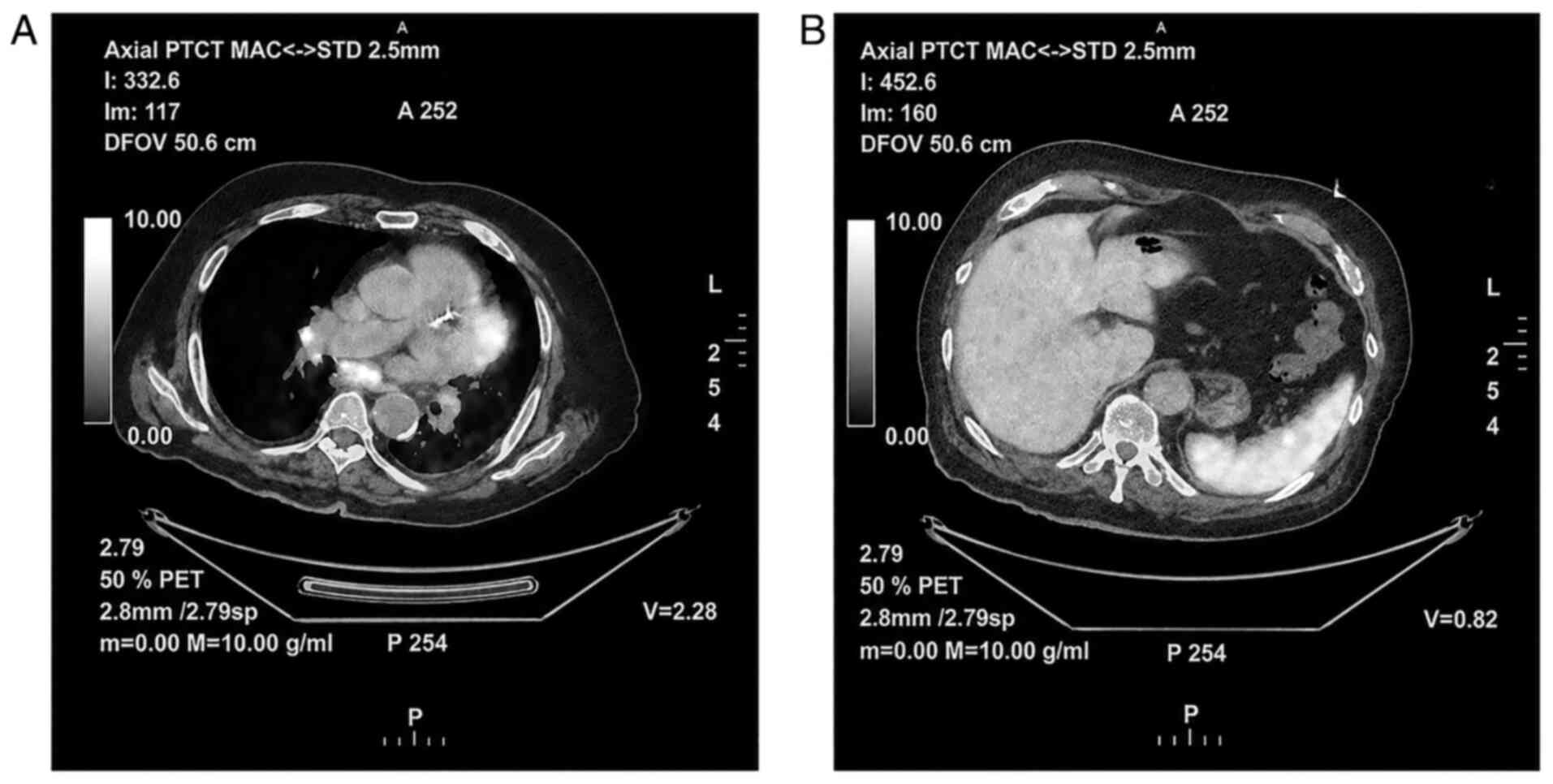
as having culture-negative endocarditis. Positron emission
tomography/computed tomography (PET/CT) was performed due to the
history of urothelial malignancy, persistent fever and concern for
occult infectious, inflammatory, malignant, or aortic-graft
involvement. PET/CT revealed hypermetabolic lymph nodes, diffuse
pulmonary infiltrative-type uptake and splenic uptake (Fig. 1). These findings were interpreted as
inflammatory or infectious in origin. Thoracic and lumbar spine
magnetic resonance imaging, requested for low back pain and
tenderness, did not reveal any evidence of spondylodiscitis.
During the second period of hospitalization, the
fever resolved and inflammatory activity decreased; however, anemia
continued to worsen despite ESA therapy. On day 1, the hemoglobin
level was 8.8 g/dl, the CRP level was 3.46 mg/dl, and rHuEPO was
30,000 IU/week. On day 6, the hemoglobin level was 8.2 g/dl,
reticulocytes were 2.07%, the reticulocyte index was 1.13, the
reticulocyte production index was 0.57, the CRP level was 3.17
mg/dl, the ferritin level was 207 ng/ml, and transferrin saturation
(TSAT) was 13.14%. Due to the ongoing decrease in the hemoglobin
level, rHuEPO was increased to 20,000 IU three times weekly (60,000
IU/week). On day 19, the hemoglobin level was 7.7 g/dl,
reticulocytes had decreased to 0.95%, the reticulocyte index was
0.49, the reticulocyte production index was 0.24, the CRP level was
0.99 mg/dl and transfusion was required. Iron was not administered
due to active infection.
The decrease in reticulocytes from 2.07% on day 6 to
0.95% at the hemoglobin nadir was considered inappropriately low
for the degree of anemia and the level of ESA exposure, prompting
testing for Parvovirus B19. Parvovirus B19 serology was positive,
with elevated immunoglobulin M (IgM) antibodies (28.58 U/ml;
positive cut-off, >15 U/ml) and immunoglobulin G (IgG)
antibodies (8.9 IU/ml; positive cut-off, >5 IU/ml), as measured
using enzyme-linked immunosorbent assay (ELISA) with the SERION
ELISA classic Parvovirus B19 IgM and IgG assays (Institut
Virion/Serion GmbH; cat. nos. ESR122M and ESR122G, respectively).
Subsequently, parvovirus B19 deoxyribonucleic acid (DNA) was
detected in plasma by the qualitative interpretation of a real-time
PCR assay using the commercially available kit, Parvovirus B19
Real-TM Quant (Sacace Biotechnologies, Como, Italy; Cat. No.
V49-50FRT), confirming active infection.
Other common causes of ESA hyporesponsiveness were
evaluated. There was no active bleeding or positive fecal occult
blood test. Hemolysis was not supported as the direct antiglobulin
test was negative, and haptoglobin was normal. Vitamin B12 and
folic acid levels were normal. The hypothyroidism of the patient
was under control with levothyroxine, since the level of serum
thyroid-stimulating hormone (TSH) was within the laboratory
reference range (0.27-4.20 mIU/l). The negative PET-CT along with
normal serum alkaline phosphatase (ALP) and lactate dehydrogenase
(LDH) levels and the absence of leukoerythroblastic features on
peripheral blood smear examination rendered malignant cell bone
marrow infiltration unlikely. Dialysis adequacy was acceptable,
with a urea reduction ratio of ~68%. The low TSAT suggested
iron-restricted erythropoiesis as a possible contributor, but
intravenous iron was not given during active infection and
endocarditis treatment.
Intravenous immunoglobulin (IVIG) was administered
at 0.4 g/kg/day for 5 days. At the time of discharge, on day 30 of
the second period of hospitalization, the hemoglobin level was 9.4
g/dl, reticulocytes had increased to 2.7%, the reticulocyte index
was 1.69, the reticulocyte production index was 1.13, the CRP level
had decreased to 0.15 mg/dl and rHuEPO was continued at 60,000
IU/week. He remained afebrile and was discharged with instructions
to complete antimicrobial therapy for culture-negative
endocarditis.
During the post-discharge antibiotic period, rHuEPO
was maintained at 60,000 IU/week, and intravenous iron was deferred
due to recent endocarditis and ongoing antibiotic therapy. At
follow-up at 20 days following discharge, the hemoglobin level was
10.5 g/dl, reticulocytes were 1.8%, the reticulocyte index was
1.26, the reticulocyte production index was 0.84, the CRP level was
0.4 mg/dl, the ferritin level was 32.9 ng/ml and TSAT was 9.07%,
indicating a marked iron deficiency. Repeat parvovirus B19 PCR was
negative.
At 6 days after this follow-up, on day 56 of the
second hospitalization period, the patient completed an 8-week
course of antimicrobial therapy. On the same day, he received 1 g
of intravenous ferric carboxymaltose. At 14 days thereafter, the
ferritin level had increased to 350 ng/ml, TSAT increased to 27%,
the hemoglobin level increased to 12.1 g/dl, reticulocytes
increased to 3.9%, the reticulocyte index increased to 3.15, the
reticulocyte production index increased to 3.15, and the CRP was
0.5 mg/dl. The rHuEPO dose was then reduced to 8,000 IU three times
weekly (24,000 IU/week). The simplified clinical course of the
patient is presented in Fig. 2.
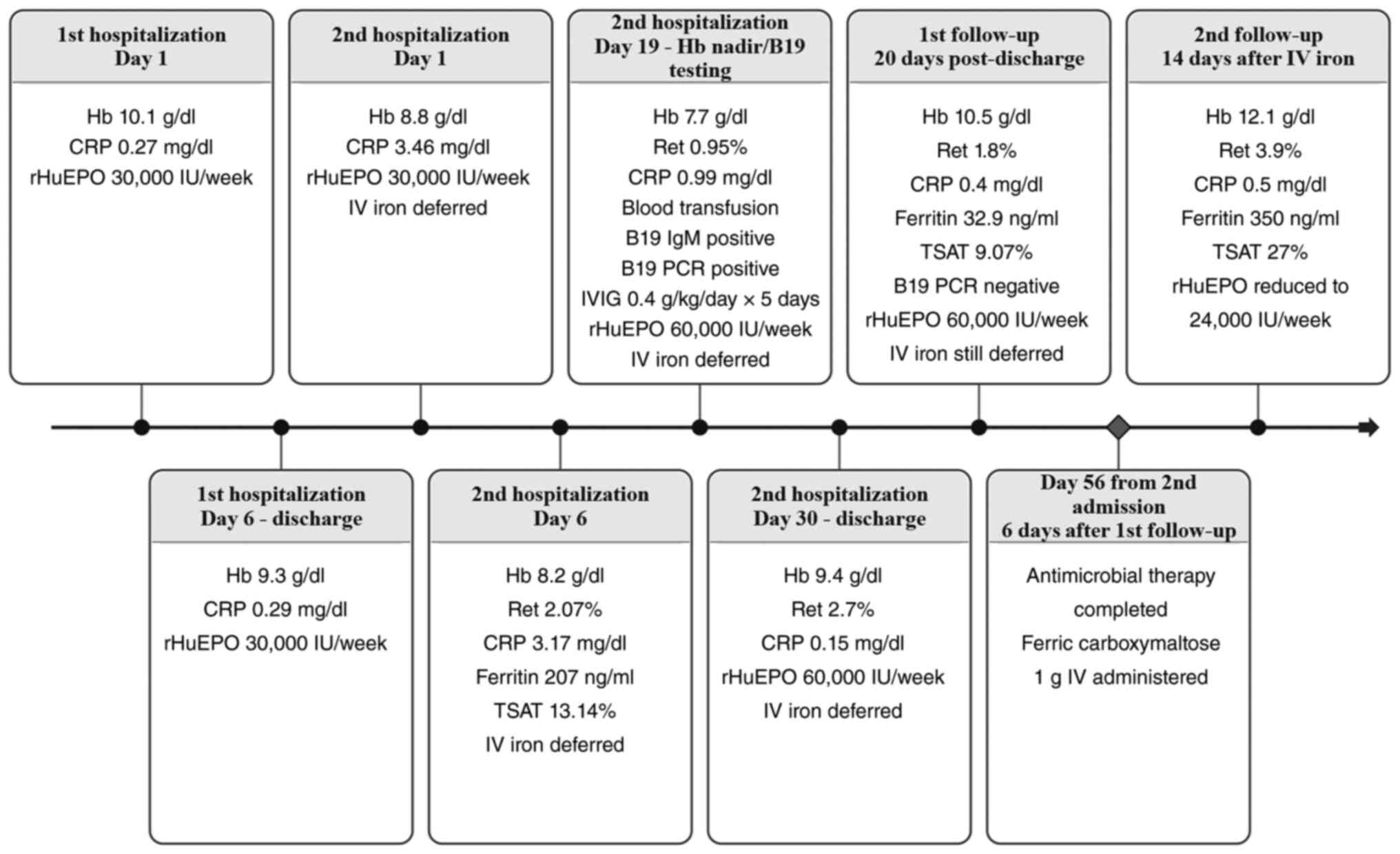 | Figure 2Simplified clinical course of
Parvovirus B19-associated anemia in a patient on maintenance
hemodialysis. Boxes summarize Hb (g/dl), Ret (%), CRP (mg/dl),
ferritin (ng/ml), TSAT (%), Parvovirus B19 serology and PCR
results, rHuEPO dose, IVIG administration, blood transfusion and
follow-up findings. Hb, hemoglobin; Ret, reticulocytes; CRP,
C-reactive protein; TSAT, transferrin saturation; PCR, polymerase
chain reaction; rHuEPO, recombinant human erythropoietin; IVIG,
intravenous immunoglobulin.` |
Discussion
The present case report describes a diagnostically
difficult episode of ESA-resistant anemia in a patient undergoing
HD. The patient had a prolonged fever and was treated for
culture-negative mitral valve endocarditis. In this setting, a
decrease in the hemoglobin level can easily be attributed to
infection, inflammation and reduced iron availability. In this
patient, however, the sequence of events suggested that
inflammation and iron restriction were not the only
explanations.
The hemoglobin level decreased despite the doubling
of the rHuEPO dose from 30,000 to 60,000 IU/week. The reticulocyte
response was inadequate, decreasing from 2.07% on day 6 to 0.95% at
the hemoglobin nadir. Parvovirus B19 infection was supported by IgM
and IgG serology and confirmed by PCR. Other major non-iron causes
were not identified. There was no overt or occult bleeding, the
direct antiglobulin test was negative, haptoglobin was normal,
vitamin B12 and folic acid levels were normal, TSH was within the
laboratory reference range, and dialysis adequacy was acceptable.
In addition, PET-CT did not detect malignancy. Although PET-CT
cannot completely rule out bone marrow infiltration, it has good
diagnostic discriminatory ability in this setting (7,8). Serum
ALP and LDH were within the normal range, and the peripheral blood
smear revealed no leukoerythroblastic features, further supporting
the absence of marrow infiltration by malignant cells. Following
IVIG, reticulocytes increased to 2.7%, and repeat PCR 20 days after
discharge yielded negative results.
The observed decrease in reticulocytes is consistent
with the known erythroid tropism of Parvovirus B19. The virus
infects erythroid progenitor cells and can cause transient aplastic
crisis (3,9). Persistent infection may lead to chronic
PRCA in immunocompromised patients (3,10).
Reports on patients undergoing non-transplant HD are limited.
Duranay et al (4) described a
patient undergoing HD with fever, arthralgia, severe anemia, very
low reticulocytes, positive Parvovirus B19 IgM, and worsening
anemia despite an increased erythropoietin dose. Ozeki et al
(5) reported a patient on HD with
rapidly progressive anemia and severe reticulocytopenia, with
positive Parvovirus B19 IgM and PCR. Shi et al (6) described an adult patient on peritoneal
dialysis with chronic PRCA, erythroid hypoplasia in the marrow,
positive IgM, high viral load and improvement following IVIG. A
heart-transplant recipient on chronic HD has also been reported,
although transplant-related immunosuppression makes that case
clinically distinct (10).
The present case report resembled previous dialysis
reports in several respects, including ESA dependence, worsening
anemia, inadequate reticulocytosis, exclusion of bleeding and
hemolysis and subsequent hematologic recovery. There were also
differences from the earlier dialysis cases. The patient described
herein was elderly, and his ESKD state was complicated by
endocarditis. Adaptive immunity is impaired in patients undergoing
HD (11). Although the patient was
not receiving immunosuppressive medications, the addition of a
severe infection to his advanced age and HD state is likely to
further suppress his immune system, rendering him vulnerable to
Parvovirus B19 infection. In addition, he had an iron deficiency.
Iron was not administered due to the infection, and following IVIG
treatment, the iron deficiency became severe, likely due to
increased iron utilization during hematologic recovery. As
expected, hemoglobin levels and ESA responsiveness improved only
partially following IVIG, whereas a more complete hematologic
response was observed only following iron administration and the
completion of antibiotic treatment for endocarditis.
As regards Parvovirus B19 serology, IgM typically
appears in the 2nd week following infection and may persist for
several months, while IgG appears shortly thereafter and usually
persists lifelong (12,13). In immunocompetent individuals,
false-negative IgM results are uncommon, although false-positive
IgM results from commercial assays have been reported (14). Therefore, when available, PCR is
useful for a definitive diagnosis. This is particularly critical in
immunocompromised patients, such as solid-organ transplant
recipients (15), in whom
false-negative IgM results can reach 25% (16). In the present case reprot, positive
PCR supported the serological diagnosis, and subsequent PCR
negativity supported virological resolution.
The main difficulty in interpreting the case
described herein was the coexistence of multiple causes of anemia.
During hospitalization, the decline in reticulocytes, a positive
parvovirus B19 PCR, the need for transfusion, and an early
reticulocyte rise following IVIG all support a diagnosis of acute
viral erythroid suppression. The patient was iron-deficient, and
after discharge, the deficiency became severe, possibly due to its
utilization for erythropoiesis following treatment for Parvovirus
B19. The ferritin level was 32.9 ng/ml and TSAT was 9.07% while the
patient was still receiving high-dose rHuEPO. Intravenous iron was
deferred during the active systemic infection, in accordance with
current guidelines for anemia management in chronic kidney disease
(17). It was administered on day 56
after the start of the second hospitalization, once the infection
had clinically resolved and the eight-week antimicrobial course was
completed. At 14 days following the administration of ferric
carboxymaltose, iron indices improved, hemoglobin increased to 12.1
g/dl, reticulocytes increased to 3.9%, and the rHuEPO dose could be
reduced. Taken together, the clinical course suggests that several
factors were contributing at the same time. Parvovirus B19 appears
to have played a role in the acute suppression of erythropoiesis,
while iron deficiency became a key contributor to the persistent
ESA hyporesponsiveness during recovery.
In addition to iron deficiency, infection likely
contributes to the observed anemia. In a patient with endocarditis,
the initial decrease in hemoglobin could reasonably be explained by
inflammation, restricted iron availability and reduced
responsiveness to ESA therapy. It is also recognized that the
suppressive effects of inflammation on erythropoiesis may continue
even after fever has resolved and CRP has begun to decline
(18). However, as the condition of
the patient evolved, inflammation alone no longer appeared to
explain the progressive hypoproliferative anemia. Between days 6
and 19 of the second hospitalization, the patient became afebrile,
and the CRP level decreased from 3.17 to 0.99 mg/dl. During the
same period, the hemoglobin level continued to decrease from 8.2 to
7.7 g/dl, while the reticulocyte percentage declined from 2.07 to
0.95% and the reticulocyte production index from 0.57 to 0.24. This
worsening of erythropoiesis occurred despite doubling the rHuEPO
dose from 30,000 to 60,000 IU/week, prompting the investigation of
other possible causes. Positive parvovirus B19 IgM serology,
together with detectable viral DNA in plasma, indicated a recent
active infection. Following the administration of IVIG, the
reticulocyte percentage increased to 2.7% and the reticulocyte
production index to 1.13. Parvovirus B19 PCR later yielded negative
results. This sequence does not prove a direct causal association.
However, the worsening reticulocytopenia in the presence of
parvovirus B19 DNAemia, followed by reticulocyte recovery following
IVIG and subsequent PCR negativity, suggests that parvovirus B19
contributed to the suppression of erythropoiesis. The anemia was
therefore most likely multifactorial. Inflammation related to
endocarditis and impaired iron availability contributed to ESA
hyporesponsiveness, while Parvovirus B19 appears to have
contributed to an additional acute suppression of red-cell
production. The further improvement in hemoglobin following
intravenous iron administration also highlights the critical role
of iron deficiency during the recovery period.
IVIG has been used for parvovirus B19-related
erythroid suppression, particularly when viral clearance is
impaired (19). In the patient
described herein, reticulocytes recovered following IVIG and
follow-up PCR became negative, whereas a more complete hemoglobin
response occurred only after iron deficiency was corrected.
Clinically, this sequence is critical. IVIG was followed by
reticulocyte recovery and PCR negativity, although the correction
of iron deficiency was still required for a fuller hemoglobin
response.
The present case report has certain limitations. One
such limitation is that neutralizing anti-EPO antibodies were not
measured; thus, antibody-mediated PRCA cannot be completely ruled
out. However, the clinical course of the patient rendered this
diagnosis less likely. In suspected ESA-related PRCA, the Kidney
Disease: Improving Global Outcomes (KDIGO) Anemia Work Group
recommends discontinuing ESA therapy, providing transfusion support
when needed, and considering immunosuppressive treatment. IVIG is
not specifically recommended (17).
Similarly, in a retrospective study of 47 patients with
epoetin-induced PRCA, only 11% of those treated with IVIG achieved
hematological recovery, while recovery was considerably more common
with immunosuppressive therapy (20). Although improvement following IVIG
does not exclude antibody-mediated PRCA, the overall pattern in the
patient described herein was more suggestive of parvovirus
B19-associated erythroid suppression. Parvovirus B19 DNA was
detected, the reticulocyte percentage increased from 0.95 to 2.7%
after the 5-day course of IVIG, and repeat PCR subsequently became
negative. Moreover, rHuEPO treatment was continued, which would
prevent hematological recovery in epoetin-induced PRCA. The dose
was eventually reduced after correction of iron deficiency. The
authors therefore considered neutralizing anti-EPO
antibody-mediated PRCA less likely. Another limitation is that bone
marrow examination was not performed. Quantitative parvovirus B19
viral-load measurements were also not available. Therefore,
although the combination of PCR positivity, reticulocytopenia,
subsequent reticulocyte recovery and PCR negativity supports a
clinically relevant role for Parvovirus B19, its contribution
cannot be separated with certainty from that of inflammation and
iron restriction. Parvovirus B19 infection should be considered in
patients undergoing HD with an unexpected decrease in hemoglobin
levels and ESA hyporesponsiveness, particularly when the
reticulocyte response is inappropriately low, or the severity of
anemia seems disproportionate to the inflammatory state. Rather
than relying on a specific reticulocyte or hemoglobin threshold,
testing may be particularly useful when progressive anemia and
marked reticulocytopenia persist despite increasing ESA exposure
and appear disproportionate to the course of inflammation, after
more common causes of ESA hyporesponsiveness have been evaluated.
The impaired immunity associated with HD may increase vulnerability
to Parvovirus B19 infection, while the multifactorial nature of
anemia in this population can delay diagnosis. Early recognition is
critical as IVIG may be followed by the recovery of
erythropoiesis.
Acknowledgements
Not applicable.
Funding
Funding: No funding was received.
Availability of data and materials
The data generated in the present study may be
requested from the corresponding author.
Authors' contributions
TE managed the patient, contributed to data
collection and clinical interpretation. TE also conceived the case
report and drafted the manuscript.. MD, MAPK, EL, CP, AB, and IS
contributed to data collection, clinical interpretation and
manuscript revision. TE and IS confirm the authenticity of all the
raw data. All authors have read and approved the manuscript.
Ethics approval and consent to
participate
All procedures involving human participants were
performed in accordance with the ethical standards of the
Declaration of Helsinki, 1964, and its later amendments. For single
anonymized case reports, approval was not required by the ethics
committee of the University of Thessaly, Faculty of Medicine.
Written informed consent was obtained from the patient described in
the present case report.
Patient consent for publication
Written informed consent was obtained from the
patient for the publication of the present case report and
accompanying de-identified clinical data.
Competing interests
The authors declare that they have no competing
interests.
References
|
1
|
Mikhail A, Brown C, Williams JA, Mathrani
V, Shrivastava R, Evans J, Isaac H and Bhandari S: Renal
association clinical practice guideline on Anaemia of chronic
kidney disease. BMC Nephrol. 18(345)2017.PubMed/NCBI View Article : Google Scholar
|
|
2
|
Babitt JL, Eisenga MF, Haase VH,
Kshirsagar AV, Levin A, Locatelli F, Małyszko J, Swinkels DW, Tarng
DC, Cheung M, et al: Controversies in optimal anemia management:
conclusions from a kidney disease: Improving global outcomes
(KDIGO) conference. Kidney Int. 99:1280–1295. 2021.PubMed/NCBI View Article : Google Scholar
|
|
3
|
Young NS and Brown KE: Parvovirus B19. N
Engl J Med. 350:586–597. 2004.PubMed/NCBI View Article : Google Scholar
|
|
4
|
Duranay M, Bali M, Sahin M, Yakinci G,
Vurgun N and Dilmen U: Parvovirus B19 infection and
unresponsiveness to erythropoietin therapy in Haemodialysis
patients. Nephrol Dial Transplant. 13:779–780. 1998.PubMed/NCBI View Article : Google Scholar
|
|
5
|
Ozeki M, Fukushima T, Ohzeki M, Sasaki T
and Kashihara N: A nosocomial parvovirus B19 infection-induced
transient aplastic crisis in a patient with chronic renal failure.
Clin Nephrol. 65:141–143. 2006.PubMed/NCBI View
Article : Google Scholar
|
|
6
|
Shi Y, Shi X, Wang H, Zhou Z, Zhang L and
Chen L: Pure red cell aplasia secondary to parvovirus B19 infection
as a rare cause of anemia in a dialysis patient. Intern Med.
63:2647–2650. 2024.PubMed/NCBI View Article : Google Scholar
|
|
7
|
Evangelista L, Panunzio A, Polverosi R,
Ferretti A, Chondrogiannis S, Pomerri F, Rubello D and Muzzio PC:
Early bone marrow metastasis detection: The additional value of
FDG-PET/CT vs. CT imaging. Biomed Pharmacother. 66:448–453.
2012.PubMed/NCBI View Article : Google Scholar
|
|
8
|
Kitajima K, Yamamoto S, Fukushima K,
Yamakado K, Katsuura T, Igarashi Y, Kawanaka Y, Mouri M and Hirota
S: FDG-PET/CT as a post-treatment restaging tool in urothelial
carcinoma: Comparison with contrast-enhanced CT. Eur J Radiol.
85:593–598. 2016.PubMed/NCBI View Article : Google Scholar
|
|
9
|
Guillen E, Hermida E, Rodas L, Broseta JJ
and Cases A: Aplastic crisis secondary to parvovirus B19
primoinfection as an infrequent cause of anemia in an
immunocompetent, non-dialysis chronic kidney disease patient. Clin
Nephrol. 95:224–226. 2021.PubMed/NCBI View
Article : Google Scholar
|
|
10
|
Schröder C, Roeles J, Schwarzer A, Heuser
M, Retzlaff J and Hiß M: Treatment-refractory anaemia in a
35-year-old heart transplant recipient on chronic hemodialysis.
Internist (Berl). 62:768–771. 2021.PubMed/NCBI View Article : Google Scholar
|
|
11
|
Eleftheriadis T, Antoniadi G, Liakopoulos
V, Kartsios C and Stefanidis I: Basic science and dialysis:
Disturbances of acquired immunity in hemodialysis patients. Semin
Dial. 20:440–451. 2007.PubMed/NCBI View Article : Google Scholar
|
|
12
|
Broliden K, Tolfvenstam T and Norbeck O:
Clinical aspects of parvovirus B19 infection. J Intern Med.
260:285–304. 2006.PubMed/NCBI View Article : Google Scholar
|
|
13
|
Landry ML: Parvovirus B19. Microbiol
Spectr. 4(DMIH2-0008-2015)2016.PubMed/NCBI View Article : Google Scholar
|
|
14
|
Maple PAC, Hedman L, Dhanilall P, Kantola
K, Nurmi V, Söderlund-Venermo M, Brown KE and Hedman K:
Identification of past and recent parvovirus B19 infection in
immunocompetent individuals by quantitative PCR and enzyme
immunoassays: A dual-laboratory study. J Clin Microbiol.
52:947–956. 2014.PubMed/NCBI View Article : Google Scholar
|
|
15
|
Eleftheriadis T, Divani M, Leontaridis T,
Poulianiti C, Polyzou-Konsta MA, Lykotsetas E and Stefanidis I:
Parvovirus B19-induced pure red cell aplasia several years after
kidney transplantation and following a transition from everolimus
to tacrolimus. Exp Clin Transplant. 23:67–71. 2025.PubMed/NCBI View Article : Google Scholar
|
|
16
|
Eid AJ and Ardura MI: AST Infectious
Diseases Community of Practice. Human parvovirus B19 in solid organ
transplantation: Guidelines from the American society of
transplantation infectious diseases community of practice. Clin
Transplant. 33(e13535)2019.PubMed/NCBI View Article : Google Scholar
|
|
17
|
Kidney Disease; Improving Global Outcomes
(KDIGO) Anemia Work Group. KDIGO 2026 clinical practice guideline
for the management of anemia in chronic kidney disease (CKD).
Kidney Int. 109:S1–S99. 2026.PubMed/NCBI View Article : Google Scholar
|
|
18
|
Karaboyas A, Morgenstern H, Fleischer NL,
Vanholder RC, Dhalwani NN, Schaeffner E, Schaubel DE, Akizawa T,
James G, Sinsakul MV, et al: Inflammation and
erythropoiesis-stimulating agent response in hemodialysis patients:
A self-matched longitudinal study of anemia management in the
dialysis outcomes and practice patterns study (DOPPS). Kidney Med.
2:286–296. 2020.PubMed/NCBI View Article : Google Scholar
|
|
19
|
Crabol Y, Terrier B, Rozenberg F, Pestre
V, Legendre C, Hermine O, Montagnier-Petrissans C, Guillevin L and
Mouthon L: Groupe d'experts de l'Assistance Publique-Hôpitaux de
Paris. Intravenous immunoglobulin therapy for pure red cell aplasia
related to human parvovirus B19 infection: A retrospective study of
10 patients and review of the literature. Clin Infect Dis.
56:968–977. 2013.PubMed/NCBI View Article : Google Scholar
|
|
20
|
Verhelst D, Rossert J, Casadevall N,
Krüger A, Eckardt KU and Macdougall IC: Treatment of
erythropoietin-induced pure red cell aplasia: A retrospective
study. Lancet. 363:1768–1771. 2004.PubMed/NCBI View Article : Google Scholar
|