Infections, Candidozyma auris and the P6 model
Healthcare-associated infections (HAIs) remain among the most frequent and costly adverse events worldwide, contributing substantially to preventable morbidity, mortality and health-system strain. Although tens of millions of patients are estimated to acquire infections annually through healthcare exposure, the true magnitude remains uncertain owing to heterogeneous surveillance systems, variable diagnostic capacity and inconsistent reporting standards (1). These limitations disproportionately affect pathogens that rely on specialized laboratory identification and antifungal susceptibility testing, allowing critical threats to remain under-recognized until outbreaks occur.
Within this under-characterized landscape, fungal infections are persistently under-recognized despite their disproportionate contribution to global mortality. Invasive fungal diseases are estimated to affect 6 million individuals annually, resulting in ~3-4 million deaths, either directly or in the context of severe underlying illness. These figures, although constrained by methodological uncertainty, underscore an escalating public health challenge exacerbated by delayed diagnosis, limited resistance surveillance and the insufficient integration of fungal pathogens into routine HAI monitoring frameworks (2).
In 2022, the World Health Organization (WHO) included Candidozyma auris (formerly known as Candida auris, henceforth referred to C. auris) in its first Global Priority List of Fungal Pathogens of critical concern. This designation reflects a convergence of high-risk characteristics: Multidrug resistance, environmental persistence, healthcare-associated transmission and a marked capacity to cause sustained outbreaks across diverse clinical settings (3-5). Notably, C. auris has emerged at the interface of clinical microbiology, antifungal stewardship, and infection prevention and control (IPC), exposing gaps created by fragmented, discipline-specific responses.
The clinical challenge posed by C. auris is rooted in its complex and evolving resistome. Resistance to azoles is commonly associated with mutations in ERG11 and the overexpression of efflux pumps, while echinocandin resistance is primarily mediated by hotspot mutations in FKS1 (6,7). Although resistance to polyenes appears less frequent, reduced susceptibility has been documented and remains incompletely understood. These mechanisms significantly constrain therapeutic options, particularly in critically ill patients. They also underscore the need for timely species identification, antifungal susceptibility testing, and resistance surveillance to inform clinical management and stewardship strategies (4,8).
Beyond genetic resistance, C. auris exhibits marked environmental resilience. It tolerates heat, osmotic stress and several commonly used disinfectants, and readily forms biofilms on medical devices and hospital surfaces. These properties facilitate prolonged environmental persistence and recurrent transmission, particularly in intensive care units and long-term care facilities. Genomic analyses have identified at least five major clades with distinct geographic distributions and resistance profiles, supporting the hypothesis of multiple, near-simultaneous emergences rather than dissemination from a single source (7-10). From an operational perspective, these findings highlight the importance of linking genomic epidemiology with local laboratory surveillance and IPC interventions. Despite growing recognition, the management of C. auris infections remains largely reactive. Current approaches emphasize case detection, patient isolation, cohorting and intensified environmental cleaning after colonization or infection has occurred. While essential, these measures are often implemented at a late stage, are resource-intensive, and may fail to prevent recurrent transmission when laboratory detection, resistance data and IPC decision-making are insufficiently integrated (11,12).
More fundamentally, the emergence of C. auris exposes structural limitations in healthcare systems that prioritize individual-level treatment over anticipatory, system-wide prevention (13).
Surveillance programs frequently focus on bacterial pathogens, with fungal organisms underrepresented in routine reporting (14). Data sharing between institutions may be inconsistent, and laboratory capacity for advanced diagnostics or genomic sequencing remains uneven across regions. These gaps undermine early detection, delay coordinated responses, and allow outbreaks to expand before comprehensive containment measures are deployed.
Addressing these limitations requires more than incremental improvements in diagnostics or environmental cleaning. It demands a framework capable of linking molecular insight, clinical decision-making, behavioral engagement and public-health coordination. The predictive, preventive, personalized, participatory, psycho-cognitive and public (P6) model of medicine provides such an integrative approach. Extending beyond traditional precision medicine, which often centers primarily on individualized therapy, P6 explicitly incorporates population health, behavioral science and governance into a unified model. In doing so, it positions clinical microbiology, not merely as a diagnostic service, but as a sentinel discipline within healthcare systems (15).
Applied to C. auris, the P6 model enables predictive and personalized care using clinical, microbiological and genomic data to identify high-risk patients and wards before transmission escalates. The preventive component emphasizes proactive laboratory screening policies, environmental monitoring and early IPC engagement, rather than reliance on post hoc containment. Personalized care integrates antifungal susceptibility data and patient-specific risk factors to optimize therapy, while limiting unnecessary antifungal exposure (Fig. 1).
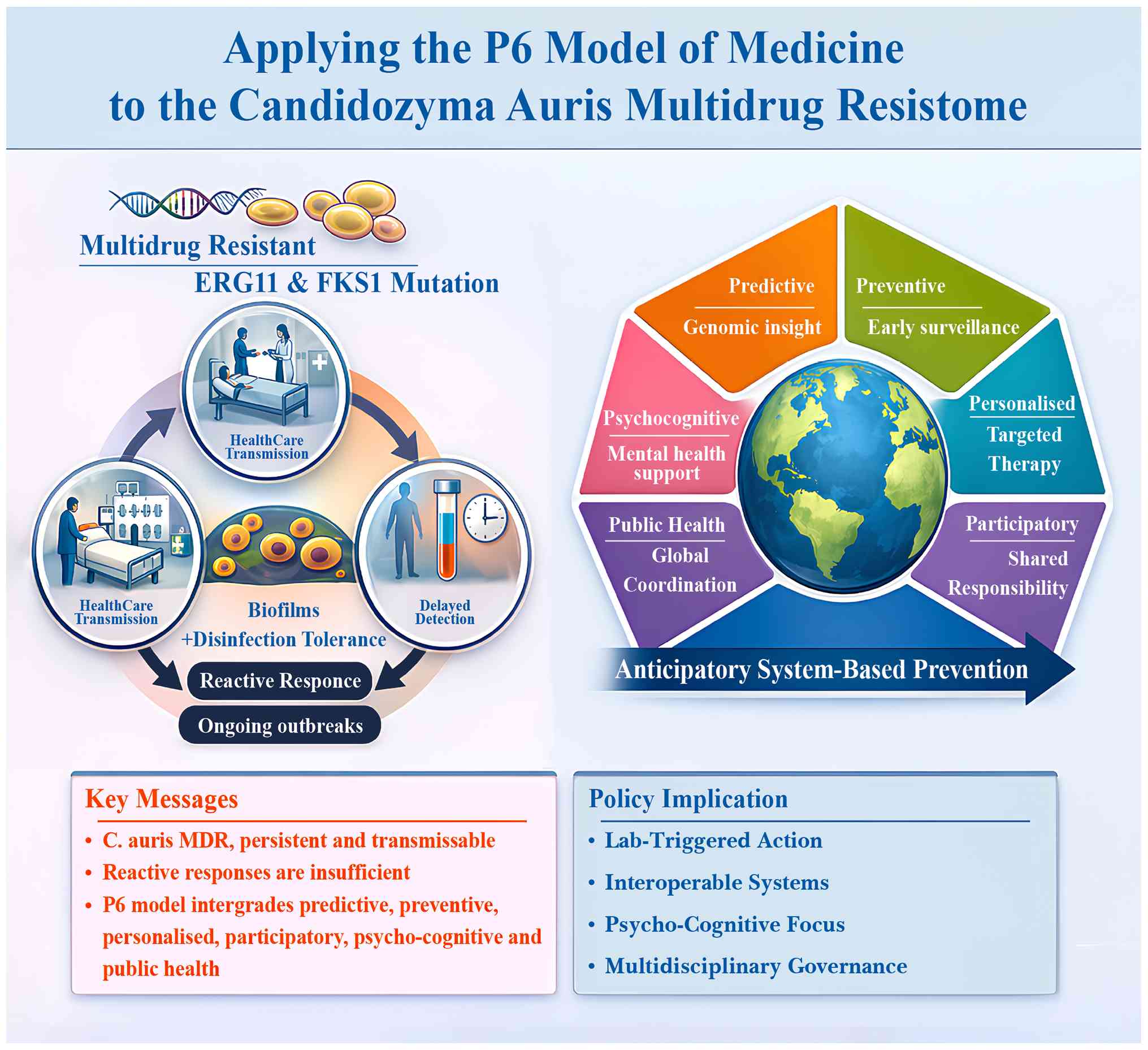 |
Figure 1
Applying the P6 medicine framework to the prevention and control of multidrug-resistant Candidozyma (Candida) auris. The left panel illustrates the limitations of conventional reactive approaches, in which antifungal resistance associated with ERG11 and FKS1 mutations, biofilm formation, disinfectant tolerance, healthcare transmission, and delayed detection contribute to persistent outbreaks. The right panel presents the P6 medicine framework, integrating predictive (genomic insight), preventive (early surveillance), personalized (targeted therapy), participatory (shared responsibility), psycho-cognitive (mental health and behavioral support), and public health (global coordination) principles to enable anticipatory, systems-based prevention. Together, these complementary strategies support genomic surveillance, precision diagnosis and treatment, infection prevention and control, stakeholder engagement, and multidisciplinary public health governance. Specifically, policy implementation relies on lab-triggered system action, interoperable genomic and electronic health record data sharing, psycho-cognitive support to address staff alert fatigue and patient isolation stigma, and coordinated oversight uniting public health authorities, inspectors, and infection control teams to reduce transmission and improve preparedness against multidrug-resistant C. auris. MDR, multidrug-resistant; IPC, infection prevention and control; EHR, electronic health record.
|
The participatory dimension recognizes that effective containment depends on the engagement of healthcare workers, patients and caregivers. Education on transmission dynamics, adherence to IPC protocols, and transparent communication during outbreaks are critical for sustaining compliance. The psycho-cognitive element addresses often-overlooked factors, such as stigma associated with isolation, alert fatigue among staff and psychological stress during prolonged outbreaks, factors that can erode adherence and compromise IPC effectiveness. Finally, the public dimension situates C. auris within broader surveillance and governance systems, promoting harmonized reporting standards, cross-institutional data sharing, and alignment between antifungal resistance surveillance and IPC programs at regional and national levels (Fig. 1). The core conceptual shifts required to move from these traditional, reactive approaches to a P6-integrated paradigm are summarized in Table I.
 |
Table I
Key conceptual shifts introduced by the P6 framework for C. auris surveillance, prevention and control.
|
Table I
Key conceptual shifts introduced by the P6 framework for C. auris surveillance, prevention and control.
| Domain |
Reactive approach |
P6-integrated approach |
| Trigger for action |
Detection of clinical infection or outbreak |
Early microbiological intelligence, predictive risk assessment, surveillance signals, and genomic detection before widespread transmission |
| Role of microbiology |
Diagnostic service provider |
Triggering source of actionable microbiological intelligence that initiates multidisciplinary surveillance, clinical decision-making, and IPC interventions |
| Surveillance model |
Fragmented laboratory, clinical, and public health activities |
Integrated surveillance linking clinical microbiology, epidemiology, IPC, public health inspection, stewardship, and governance |
| Data utilization |
Separate laboratory and clinical datasets |
Integrated microbiological, genomic, epidemiological, environmental, behavioral and clinical intelligence |
| Primary focus |
Containment and treatment after detection |
Prevention, prediction, personalized management and coordinated multidisciplinary response |
| Psycho-cognitive dimension |
Emphasis on protocol compliance |
Inclusion of behavioral, psychological, and organizational considerations-alert fatigue, isolation-related stigma, and communication- to improve adherence, communication, resilience, and sustained IPC performance |
| Participatory and public dimension |
Limited stakeholder engagement and institution-specific response |
Active participation of healthcare workers, patients, caregivers, and coordinated action through surveillance, public health inspection and governance |
Artificial intelligence and advanced analytics can strengthen the P6 framework by integrating electronic health records, laboratory information systems and genomic databases to identify high-risk patients and anticipate outbreak hotspots, transmission clusters or resistance trends. However, implementation remains uneven and requires careful governance-accompanied by robust governance, interoperability standards and safeguards to ensure responsible data use and equitable access to advanced diagnostics (16). Notably, adopting an integrative framework does not diminish the importance of established IPC measures. Rather, it strengthens them by embedding these measures within a predictive and system-oriented structure. Clinical microbiology laboratories, with their access to diagnostic, susceptibility and genomic data, are uniquely positioned to generate the microbiological intelligence that triggers integrated responses. By rapidly communicating laboratory findings to clinicians, epidemiologists, infection prevention and control teams, antifungal stewardship programs, public health inspectors and public health authorities, laboratories transform diagnostic data into actionable intelligence that supports coordinated surveillance, investigation and control.
Finally, the public dimension situates C. auris within broader surveillance and governance systems, promoting harmonized reporting standards, cross-institutional data sharing, and alignment between antifungal resistance surveillance and IPC programs at regional and national levels (3,11). This dimension also recognizes the complementary responsibilities of clinical microbiologists, epidemiologists, public health inspectors, IPC professionals and public health authorities (12). Clinical microbiology provides the microbiological intelligence that initiates surveillance and response activities, epidemiologists investigate transmission dynamics and analyze surveillance data, public health inspectors evaluate environmental and regulatory compliance within healthcare facilities (17), while public health authorities coordinate surveillance systems, policy implementation, and population-level responses (3,11,12).
Operationalizing the P6 framework for the prevention and control of C. auris
Although the P6 framework is conceptual in nature, its principles can be translated into practical health-system actions. An integrated response can be organized across three complementary phases: Pre-emptive prevention, targeted clinical management and coordinated systems-level governance.
Phase 1: Predictive and preventive response. The predictive and preventive dimensions aim to shift the management of C. auris from outbreak response to early risk identification. Hospitals may implement targeted screening strategies for high-risk populations, including patients transferred from healthcare facilities with known transmission, individuals requiring intensive care, and those with prolonged healthcare exposure. During outbreaks or in high-risk settings, targeted environmental assessment may complement patient screening, particularly given the ability of C. auris to persist on surfaces and medical equipment (18).
Where infrastructure permits, the integration of electronic health records, laboratory information systems, and genomic surveillance platforms may support identification of transmission patterns and emerging outbreak clusters. However, these approaches should complement, rather than replace, foundational requirements such as diagnostic capacity, surveillance infrastructure, and effective IPC programs.
Phase 2: Personalized and psycho-cognitive response
Once C. auris is detected, management should integrate biological characteristics of the organism with patient-specific and organizational factors. Rapid species identification, antifungal susceptibility testing and genomic analysis where available can support personalized therapeutic decisions and identification of resistance-associated mechanisms, including alterations involving ERG11 and FKS1. Within this phase, antifungal stewardship programs provide the clinical governance mechanism to translate microbiological findings into appropriate treatment decisions, including the optimization of antifungal selection, dosing, duration, and the avoidance of unnecessary exposure that may contribute to resistance (19).
The psycho-cognitive dimension recognizes that successful outbreak control depends not only on microbiological interventions, but also on human behavior. Prolonged isolation precautions may contribute to patient distress and stigma, while repeated alerts and changing IPC requirements may contribute to staff fatigue. Addressing these factors through communication strategies and staff support is essential for maintaining adherence (20).
Phase 3
The participatory and public dimensions extend management beyond individual institutions and emphasize multidisciplinary collaboration across clinical, laboratory and public health systems (21). Clinical microbiology laboratories function as the triggering hub by providing timely organism identification, antifungal susceptibility testing, and genomic intelligence that initiate surveillance and response activities. Effective responses require structured communication pathways through which laboratory findings are rapidly shared with clinicians, infection prevention and control teams, epidemiologists, antifungal stewardship programs, public health inspectors and public health authorities.
Epidemiologists analyze surveillance data, investigate transmission dynamics, identify outbreak clusters, and perform risk assessments that guide evidence-based public health interventions (17). Public health inspectors contribute through healthcare facility inspections, environmental investigations, assessment of infection prevention and control compliance, and implementation of regulatory measures where appropriate (17). Public health authorities coordinate surveillance systems, harmonize reporting standards, facilitate cross-institutional data sharing, and oversee policy implementation and outbreak response. Together, these complementary functions strengthen early detection, coordinated containment, and health-system resilience against multidrug-resistant fungal pathogens.
The contribution of the present study is the adaptation of the P6 model from an individual-centered precision medicine paradigm toward a health-system framework for managing multidrug-resistant fungal threats, with clinical microbiology positioned as the triggering source of microbiological intelligence that informs clinical decision-making, epidemiological surveillance, infection prevention and control, and public health action within an integrated health-system framework.
The continued spread of HAIs reflects the failures of integration across microbiological diagnostics, antifungal resistance surveillance, clinical management, and infection prevention and control. C. auris represents more than an emerging multidrug-resistant pathogen; it is a stress test for siloed approaches of modern healthcare systems, exemplified by the diagnostic lags and unintegrated electronic health records that allow undetected colonization to spread during inter-facility patient transfers. Positioning clinical microbiology as the triggering node for microbiological intelligence within an integrative framework enables the earlier recognition of emerging threats and provides the evidence base for coordinated action by clinicians, infection prevention and control teams, epidemiologists, public health inspectors and public health authorities. Such an approach strengthens preparedness not only for C. auris, but also for future healthcare-associated fungal threats.
Acknowledgements
Not applicable.
Funding
Funding: No funding was received.
Availability of data and materials
Not applicable.
Authors' contributions
SG was involved in the conceptualization of the study, as well as in the literature investigation and curation of theoretical resources. SG and GPC contributed equally to all other aspects of the article process, and have read and approved the final manuscript. Data authentication is not applicable.
Ethics approval and consent to participate
Not applicable.
Patient consent for publication
Not applicable.
Competing interests
The authors declare that they have no competing interests.
References
|
1
|
Magill SS, Edwards JR, Bamberg W, Beldavs ZG, Dumyati G, Kainer MA, Lynfield R, Maloney M, McAllister-Hollod L, Nadle J, et al: Multistate point-prevalence survey of health care-associated infections. N Engl J Med. 370:1198–1208. 2014.PubMed/NCBI View Article : Google Scholar
|
|
2
|
Fisher MC, Alastruey-Izquierdo A, Berman J, Bicanic T, Bignell EM, Bowyer P, Bromley M, Brüggemann R, Garber G, Cornely OA, et al: Tackling the emerging threat of antifungal resistance to human health. Nat Rev Microbiol. 20:557–571. 2022.PubMed/NCBI View Article : Google Scholar
|
|
3
|
World Health Organization (WHO): WHO fungal priority pathogens list to guide research, development and public health action. WHO, Geneva, 2022.
|
|
4
|
Chowdhary A, Sharma C and Meis JF: Candida auris: A rapidly emerging cause of hospital-acquired multidrug-resistant fungal infections globally. PLoS Pathog. 13(e1006290)2017.PubMed/NCBI View Article : Google Scholar
|
|
5
|
Patel J, Moghaddam SS, Ranganathan S, Vezeau N, O'Neill E, Harant A, Stolpe M, Wieler LH, Eckmanns T and Sridhar D: Global policy responses to antimicrobial resistance, 2021-22: A systematic governance analysis of 161 countries and territories. Lancet Infect Dis. 26:55–66. 2026.PubMed/NCBI View Article : Google Scholar
|
|
6
|
Flowers SA, Colón B, Whaley SG, Schuler MA and Rogers PD: Contribution of clinically derived mutations in ERG11 to azole resistance in Candida albicans. Antimicrob Agents Chemother. 59:450–560. 2015.PubMed/NCBI View Article : Google Scholar
|
|
7
|
Centers for Disease Control and Prevention (CDC): Infection control guidance: Candida auris; CDC, Atlanta, GA, 2024. https://www.cdc.gov/candida-auris/hcp/infection-control/index.html. Accessed June 21, 2026.
|
|
8
|
Lockhart SR, Berkow EL, Chow N and Welsh RM: Candida auris for the clinical microbiology laboratory: Not your grandfather's Candida species. Clin Microbiol Newsl. 39:99–103. 2017.PubMed/NCBI View Article : Google Scholar
|
|
9
|
Rhodes J and Fisher MC: Global epidemiology of emerging Candida auris. Curr Opin Microbiol. 52:84–89. 2019.PubMed/NCBI View Article : Google Scholar
|
|
10
|
Kim HY, Nguyen TA, Kidd S, Chambers J, Alastruey-Izquierdo A, Shin JH, Dao A, Forastiero A, Wahyuningsih R, Chakrabarti A, et al: Candida auris-a systematic review to inform the World Health Organization fungal priority pathogens list. Med Mycol. 62(myae042)2024.PubMed/NCBI View Article : Google Scholar
|
|
11
|
European Centre for Disease Prevention and Control (ECDC): Point prevalence survey of healthcare associated infections and antimicrobial use in European acute care hospitals. Stockholm: ECDC, 2024. https://www.google.com/url?sa=t&source=web&rct=j&opi=89978449&url=https://www.ecdc.europa.eu/sites/default/files/documents/healthcare-associated-point-prevalence-survey-acute-care-hospitals-2022-2023.pdf&ved=2ahUKEwjGvZ6E0oyXAxVWQfEDHfVSDowQFnoECA8QAQ&usg=AOvVaw1vcwvoYcHIOpoNxMe-2FFZ Accessed September 2, 2026.
|
|
12
|
Centers for Disease Control and Prevention. 2007 Guideline for Isolation Precautions: Preventing Transmission of Infectious Agents in Healthcare Settings. Last update May, 2022. Available at: https://www.cdc.gov/infectioncontrol/pdf/guidelines/isolation-guidelines-H.pdf. Accessed March 14, 2024.
|
|
13
|
Rux CE, Johnson MD, Grant VC, Katipunan SG, Chahine EB, Smith DJ, Lockhart SR, Drwiega E and Gubbins PO: SIDP as a corporate author. Comprehensive review of candidozyma (Candida) auris management: Insights from the society of infectious diseases pharmacists. Pharmacotherapy. 46(e70122)2026.PubMed/NCBI View Article : Google Scholar
|
|
14
|
Alanio A, White PL, Arendrup MC, Fe Talento A, Andersen CT, Johnson E, Lanternier F, Meletiadis J, Aastvad KMT, Cuypers L, et al: Antifungal resistance surveillance: Insights from national mycology reference centers and expert mycology laboratories. Open Forum Infect Dis. 13(ofaf747)2025.PubMed/NCBI View Article : Google Scholar
|
|
15
|
Bragazzi NL: From P0 to P6 medicine, a model of highly participatory, narrative, interactive, and ‘augmented’ medicine: Some considerations on Salvatore Iaconesi's clinical story. Patient Prefer Adherence. 7:353–359. 2013.PubMed/NCBI View Article : Google Scholar
|
|
16
|
Barbati C, Viviani L, Vecchio R, Arzilli G, De Angelis L, Baglivo F, Sacchi L, Bellazzi R, Rizzo C and Odone A: Artificial intelligence use and performance in detecting and predicting healthcare-associated infections: A systematic review. Artif Intell Med. 172(103321)2026.PubMed/NCBI View Article : Google Scholar
|
|
17
|
Pan American Health Organization (PAHO): Recommendations on Public Environmental Health in Health Care Facilities, 11 May 2020 (Procedures, manuals, guidelines). PAHO, Washington, DC, 2020. https://iris.paho.org/handle/10665.2/52208. Accessed August 31, 2026.
|
|
18
|
Alves M, Ricardo E and Costa de Oliveira S: Active screening for C. auris colonisation: A preventive step or an excessive measure? A systematic review. J Fungi (Basel). 12(603)2026.PubMed/NCBI View Article : Google Scholar
|
|
19
|
Albahar F, Alhamad H, Abu Assab M, Abu-Farha R, Alawi L and Khaleel S: The impact of antifungal stewardship on clinical and performance measures: A global systematic review. Trop Med Infect Dis. 9(8)2023.PubMed/NCBI View Article : Google Scholar
|
|
20
|
Abad C, Fearday A and Safdar N: Adverse effects of isolation in hospitalised patients: A systematic review. J Hosp Infect. 76:97–102. 2010.PubMed/NCBI View Article : Google Scholar
|
|
21
|
Bates SM, Lin J, Allen LN, Wright M and Kidd M: Can multidisciplinary teams improve the quality of primary care? A scoping review. EClinicalMedicine. 88(103497)2025.PubMed/NCBI View Article : Google Scholar
|