Spandidos Publications Logo
  • About
    • About Spandidos
    • Aims and Scopes
    • Abstracting and Indexing
    • Editorial Policies
    • Reprints and Permissions
    • Job Opportunities
    • Terms and Conditions
    • Contact
  • Journals
    • All Journals
    • Oncology Letters
      • Oncology Letters
      • Information for Authors
      • Editorial Policies
      • Editorial Board
      • Aims and Scope
      • Abstracting and Indexing
      • Bibliographic Information
      • Archive
    • International Journal of Oncology
      • International Journal of Oncology
      • Information for Authors
      • Editorial Policies
      • Editorial Board
      • Aims and Scope
      • Abstracting and Indexing
      • Bibliographic Information
      • Archive
    • Molecular and Clinical Oncology
      • Molecular and Clinical Oncology
      • Information for Authors
      • Editorial Policies
      • Editorial Board
      • Aims and Scope
      • Abstracting and Indexing
      • Bibliographic Information
      • Archive
    • Experimental and Therapeutic Medicine
      • Experimental and Therapeutic Medicine
      • Information for Authors
      • Editorial Policies
      • Editorial Board
      • Aims and Scope
      • Abstracting and Indexing
      • Bibliographic Information
      • Archive
    • International Journal of Molecular Medicine
      • International Journal of Molecular Medicine
      • Information for Authors
      • Editorial Policies
      • Editorial Board
      • Aims and Scope
      • Abstracting and Indexing
      • Bibliographic Information
      • Archive
    • Biomedical Reports
      • Biomedical Reports
      • Information for Authors
      • Editorial Policies
      • Editorial Board
      • Aims and Scope
      • Abstracting and Indexing
      • Bibliographic Information
      • Archive
    • Oncology Reports
      • Oncology Reports
      • Information for Authors
      • Editorial Policies
      • Editorial Board
      • Aims and Scope
      • Abstracting and Indexing
      • Bibliographic Information
      • Archive
    • Molecular Medicine Reports
      • Molecular Medicine Reports
      • Information for Authors
      • Editorial Policies
      • Editorial Board
      • Aims and Scope
      • Abstracting and Indexing
      • Bibliographic Information
      • Archive
    • World Academy of Sciences Journal
      • World Academy of Sciences Journal
      • Information for Authors
      • Editorial Policies
      • Editorial Board
      • Aims and Scope
      • Abstracting and Indexing
      • Bibliographic Information
      • Archive
    • International Journal of Functional Nutrition
      • International Journal of Functional Nutrition
      • Information for Authors
      • Editorial Policies
      • Editorial Board
      • Aims and Scope
      • Abstracting and Indexing
      • Bibliographic Information
      • Archive
    • International Journal of Epigenetics
      • International Journal of Epigenetics
      • Information for Authors
      • Editorial Policies
      • Editorial Board
      • Aims and Scope
      • Abstracting and Indexing
      • Bibliographic Information
      • Archive
    • Medicine International
      • Medicine International
      • Information for Authors
      • Editorial Policies
      • Editorial Board
      • Aims and Scope
      • Abstracting and Indexing
      • Bibliographic Information
      • Archive
  • Articles
  • Information
    • Information for Authors
    • Information for Reviewers
    • Information for Librarians
    • Information for Advertisers
    • Conferences
  • Language Editing
Spandidos Publications Logo
  • About
    • About Spandidos
    • Aims and Scopes
    • Abstracting and Indexing
    • Editorial Policies
    • Reprints and Permissions
    • Job Opportunities
    • Terms and Conditions
    • Contact
  • Journals
    • All Journals
    • Biomedical Reports
      • Information for Authors
      • Editorial Policies
      • Editorial Board
      • Aims and Scope
      • Abstracting and Indexing
      • Bibliographic Information
      • Archive
    • Experimental and Therapeutic Medicine
      • Information for Authors
      • Editorial Policies
      • Editorial Board
      • Aims and Scope
      • Abstracting and Indexing
      • Bibliographic Information
      • Archive
    • International Journal of Epigenetics
      • Information for Authors
      • Editorial Policies
      • Editorial Board
      • Aims and Scope
      • Abstracting and Indexing
      • Bibliographic Information
      • Archive
    • International Journal of Functional Nutrition
      • Information for Authors
      • Editorial Policies
      • Editorial Board
      • Aims and Scope
      • Abstracting and Indexing
      • Bibliographic Information
      • Archive
    • International Journal of Molecular Medicine
      • Information for Authors
      • Editorial Policies
      • Editorial Board
      • Aims and Scope
      • Abstracting and Indexing
      • Bibliographic Information
      • Archive
    • International Journal of Oncology
      • Information for Authors
      • Editorial Policies
      • Editorial Board
      • Aims and Scope
      • Abstracting and Indexing
      • Bibliographic Information
      • Archive
    • Medicine International
      • Information for Authors
      • Editorial Policies
      • Editorial Board
      • Aims and Scope
      • Abstracting and Indexing
      • Bibliographic Information
      • Archive
    • Molecular and Clinical Oncology
      • Information for Authors
      • Editorial Policies
      • Editorial Board
      • Aims and Scope
      • Abstracting and Indexing
      • Bibliographic Information
      • Archive
    • Molecular Medicine Reports
      • Information for Authors
      • Editorial Policies
      • Editorial Board
      • Aims and Scope
      • Abstracting and Indexing
      • Bibliographic Information
      • Archive
    • Oncology Letters
      • Information for Authors
      • Editorial Policies
      • Editorial Board
      • Aims and Scope
      • Abstracting and Indexing
      • Bibliographic Information
      • Archive
    • Oncology Reports
      • Information for Authors
      • Editorial Policies
      • Editorial Board
      • Aims and Scope
      • Abstracting and Indexing
      • Bibliographic Information
      • Archive
    • World Academy of Sciences Journal
      • Information for Authors
      • Editorial Policies
      • Editorial Board
      • Aims and Scope
      • Abstracting and Indexing
      • Bibliographic Information
      • Archive
  • Articles
  • Information
    • For Authors
    • For Reviewers
    • For Librarians
    • For Advertisers
    • Conferences
  • Language Editing
Login Register Submit
  • This site uses cookies
  • You can change your cookie settings at any time by following the instructions in our Cookie Policy. To find out more, you may read our Privacy Policy.

    I agree
Search articles by DOI, keyword, author or affiliation
Search
Advanced Search
presentation
Molecular Medicine Reports
Join Editorial Board Propose a Special Issue
Print ISSN: 1791-2997 Online ISSN: 1791-3004
Journal Cover
August 2012 Volume 6 Issue 2

Full Size Image

Sign up for eToc alerts
Recommend to Library

Journals

International Journal of Molecular Medicine

International Journal of Molecular Medicine

International Journal of Molecular Medicine is an international journal devoted to molecular mechanisms of human disease.

International Journal of Oncology

International Journal of Oncology

International Journal of Oncology is an international journal devoted to oncology research and cancer treatment.

Molecular Medicine Reports

Molecular Medicine Reports

Covers molecular medicine topics such as pharmacology, pathology, genetics, neuroscience, infectious diseases, molecular cardiology, and molecular surgery.

Oncology Reports

Oncology Reports

Oncology Reports is an international journal devoted to fundamental and applied research in Oncology.

Experimental and Therapeutic Medicine

Experimental and Therapeutic Medicine

Experimental and Therapeutic Medicine is an international journal devoted to laboratory and clinical medicine.

Oncology Letters

Oncology Letters

Oncology Letters is an international journal devoted to Experimental and Clinical Oncology.

Biomedical Reports

Biomedical Reports

Explores a wide range of biological and medical fields, including pharmacology, genetics, microbiology, neuroscience, and molecular cardiology.

Molecular and Clinical Oncology

Molecular and Clinical Oncology

International journal addressing all aspects of oncology research, from tumorigenesis and oncogenes to chemotherapy and metastasis.

World Academy of Sciences Journal

World Academy of Sciences Journal

Multidisciplinary open-access journal spanning biochemistry, genetics, neuroscience, environmental health, and synthetic biology.

International Journal of Functional Nutrition

International Journal of Functional Nutrition

Open-access journal combining biochemistry, pharmacology, immunology, and genetics to advance health through functional nutrition.

International Journal of Epigenetics

International Journal of Epigenetics

Publishes open-access research on using epigenetics to advance understanding and treatment of human disease.

Medicine International

Medicine International

An International Open Access Journal Devoted to General Medicine.

Journal Cover
August 2012 Volume 6 Issue 2

Full Size Image

Sign up for eToc alerts
Recommend to Library

  • Article
  • Citations
    • Cite This Article
    • Download Citation
    • Create Citation Alert
    • Remove Citation Alert
    • Cited By
  • Similar Articles
    • Related Articles (in Spandidos Publications)
    • Similar Articles (Google Scholar)
    • Similar Articles (PubMed)
  • Download PDF
  • Download XML
  • View XML
Article

Correlation between serum H2S and pulmonary function in children with bronchial asthma

  • Authors:
    • Man Tian
    • Yu Wang
    • Yue-Qing Lu
    • Ming Yan
    • Yan-He Jiang
    • De-Yu Zhao
  • View Affiliations / Copyright

    Affiliations: Department of Respiratory Medicine, Nanjing Children's Hospital Affiliated with Nanjing Medical University, Nanjing, Jiangsu 210008, P.R. China
  • Pages: 335-338
    |
    Published online on: May 4, 2012
       https://doi.org/10.3892/mmr.2012.904
  • Expand metrics +
Metrics: Total Views: 0 (Spandidos Publications: | PMC Statistics: )
Metrics: Total PDF Downloads: 0 (Spandidos Publications: | PMC Statistics: )
Cited By (CrossRef): 0 citations Loading Articles...

This article is mentioned in:


Abstract

Endogenous hydrogen sulfide (H2S) has generated recent research interest because of its potential function as an inflammatory mediator. Despite its apparent functions in vascular smooth muscle, an important player in airway remodeling in asthma, little research has been done to assess the role of H2S in the pathogenesis of asthma. To determine whether serum H2S concentration is correlated with pulmonary function in children with asthma, we measured serum H2S concentration and pulmonary function indices (FVC, FEV1, PEF, FEF25-75, MEF50 and MEF25) in 64 children with asthma and 60 healthy children. Pearson's correlation was used to determine the relationship between serum H2S concentration and lung function parameters. Compared to healthy children, both serum H2S concentration and all lung function parameters were significantly decreased in children with asthma (P<0.05). Furthermore, serum H2S concentration was positively correlated with lung function indices (P<0.05). Thus, decreasing levels of H2S in the serum may be used to indicate decreasing lung function. Further investigation into the causality behind these findings is required.

Introduction

Recent studies have shown that endogenous hydrogen sulfide (H2S) is produced in the human body. Together with nitric oxide (NO) and carbon monoxide (CO), H2S is a gaseous signaling molecule with regulatory functions (1). Indeed, H2S relaxes vascular smooth muscle, inhibits vascular smooth muscle cell proliferation and reduces oxidative stress to play an important role in the structure and function of pulmonary circulation (2,3). Notably, endogenous H2S may be involved in the pathogenesis of airflow obstruction in chronic obstructive pulmonary disease (COPD) (4). In addition, epidemiological studies have shown that exogenous H2S exposure increases the incidence of asthma (5). However, whether endogenous H2S is involved in the pathogenesis of asthma and the precise effects of H2S on pulmonary function remain unclear. While a previous study indicated that serum H2S levels are lower in patients with asthma (6), serum H2S has yet to be correlated with pulmonary function in these individuals. In the present study, we analyzed H2S concentration in the serum in comparison to lung function parameters in 64 children with bronchial asthma and 60 healthy children to determine the effects of H2S on pulmonary function in children with bronchial asthma.

Materials and methods

Study population

Between June 2009 and June 2011, 64 children admitted to the Affiliated Nanjing Children’s Hospital, Nanjing Medical University (China), with acute bronchial asthma were recruited to the study. The study population included 36 males and 28 females between 6 and 12 years of age (mean 9.03±1.84). Acute disease lasted between 6 and 25 days. Eighteen individuals (28.1%) experienced fever, with body temperatures between 37.5 and 38.4°C. Asthma diagnosis followed the WHO criteria (7): all children had cough, asthma, obvious wheeze, rhonchus and moist rale in the lung, and other clinical manifestations; X-ray examination also showed increased lung markings or lung hyperinflation and infection. None of the children used asthma-related drugs prior to diagnosis. Children with combined respiratory and heart failure or other complications, or with congenital heart disease, tuberculosis infection and foreign body in the bronchus, were excluded. Sixty healthy children who had received physical examinations in our hospital during the same period were selected as controls. Control population included 31 males and 29 females between 6 and 12 years of age (mean 9.22±1.80). Mean age and gender distribution between the two groups of children were not statistically different. The study was approved by the Nanjing Health Bureau.

Detection of H2S concentration in the serum

Venous blood (3 ml) was collected from children in the morning following a minimum 10-h fast. Samples were centrifuged at 3,000 rpm for 10 min to separate sera and were stored at −70°C until testing for H2S. H2S was measured as described by Geng et al (8). A sensitive sulfur electrode [PXS-270 ion meter (Leici Company, Shanghai, China)] was used to determine H2S content in the plasma. Briefly, standard sulfion and antioxidant solutions were prepared. The electrode was activated for at least 2 h in deionized water prior to use. The ion meter was adjusted to mV and rake ratio to 100. Sensitive sulfur electrode and reference electrode were immersed together in the sample until the reading stabilized. Standard curves were determined with standard sulfion solution before each test.

Detection of pulmonary function

MINAT (Japan) AS-407 pulmonary function instrument was used by specialized technicians to determine pulmonary function in all participants. Main indicators included forced vital capacity (FVC), forced expiratory volume in 1 sec (FEV1), peak expiratory flow (PEF), forced midexpiratory flow rate (FEF25–75), midexpiratory flow rate at 50% vital capacity (MEF50) and midexpiratory flow rate at 75% vital capacity (MEF25). All indicators are expressed as the percentage of the normal predicted value (based on the actual age, height and weight of children at sample collection).

Statistical analysis

SPSS13.0 statistical software was used for analyses. Data are expressed as the means ± standard deviation (χ̄ ± SD). Independent samples t-test was used to compare H2S concentrations in the serum as well as differences in pulmonary function parameters between groups. Pearson’s correlation was used to detect and analyze the correlation between H2S concentration and each pulmonary function parameter in children with bronchial asthma. Analyses were performed with two-sided tests at α level 0.05. p<0.05 denoted statistically significant differences.

Results

H2S serum concentration and pulmonary function differ in children with asthma

In children with bronchial asthma, H2S concentration in the serum and indicators of pulmonary function (FVC, FEV1, PEF, FEF25–75, MEF50 and MEF25) were all decreased in comparison to the healthy children. Each of these decreases were statistically significant between groups (p<0.05; Tables I and II).

Table I

Mean measures of H2S, FVC, FEV1 and PEF in children with or without asthma (χ̄ ± s).

Table I

Mean measures of H2S, FVC, FEV1 and PEF in children with or without asthma (χ̄ ± s).

Study populationnH2S (μM)FVC (%)FEV1 (%)PEF (%)
Healthy control6052.60±5.56104.51±8.2099.02±7.81100.59±7.66
Bronchial asthma6444.17±10.9578.79±11.9869.79±11.4160.48±12.63
t5.35313.86516.53721.201
p-value0.0010.0010.0050.001

[i] H2S, hydrogen sulfide; FVC, forced vital capacity; FEV1, forced expiratory volume in 1 sec; PEF, peak expiratory flow.

Table II

Mean measures of FEF25–75, MEF50 and MEF25 in children with or without asthma (χ̄ ± s).

Table II

Mean measures of FEF25–75, MEF50 and MEF25 in children with or without asthma (χ̄ ± s).

Study groupnFEF25–75 (%)MEF50 (%)MEF25 (%)
Healthy control6092.30±7.0895.93±8.2486.39±7.56
Bronchial asthma6454.78±12.1957.84±12.2250.67±11.70
t20.77920.21220.049
p-value0.0010.0020.001

[i] FEF25–75, forced midexpiratory flow rate; MEF50, midexpiratory flow rate at 50% vital capacity; MEF25, midexpiratory flow rate at 75% vital capacity.

Correlation between H2S concentration in the serum and lung function in bronchial asthma

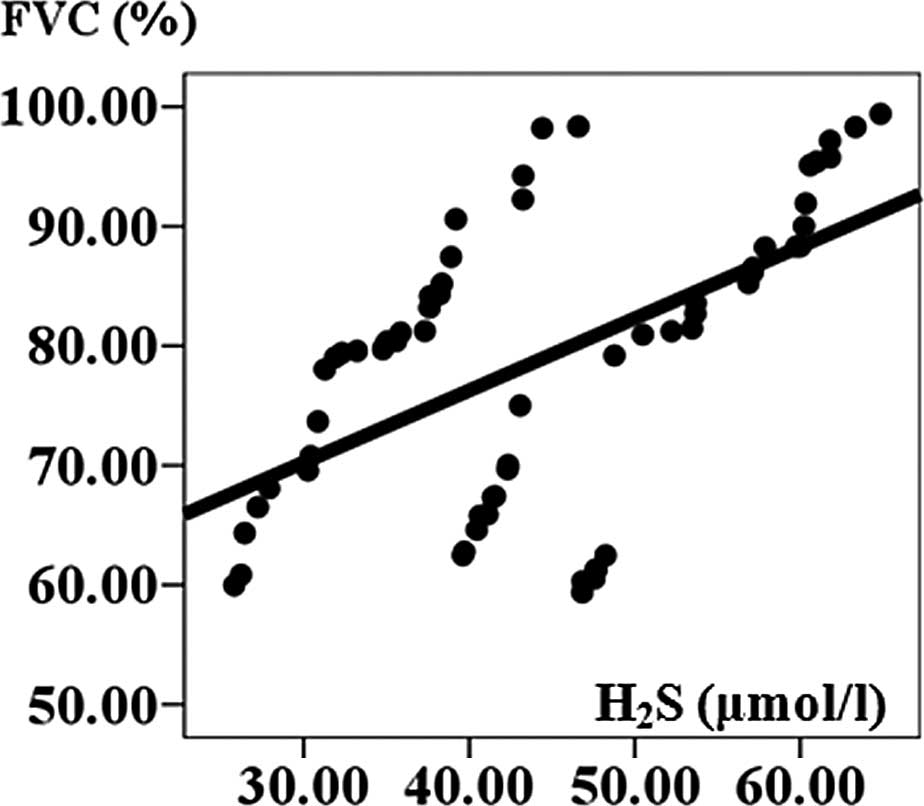
To establish a connection between the decreases in endogenous H2S and the altered lung function in asthma patients, we assessed these results with Pearson’s correlation. The H2S concentration in the serum of children with bronchial asthma was positively correlated with each of the lung function parameters (FVC, FEV1, PEF, FEF25–75, MEF50 and MEF25) (p<0.05; Table III); i.e., for increasing H2S concentrations, lung function (FVC, FEV1, PEF, FEF25–75, MEF50 and MEF25) also significantly increased (Fig. 1).

Figure 1

Relationship between serum H2S concentration and pulmonary function parameters in children with asthma. FVC, forced vital capacity; FEV1, forced expiratory volume in 1 sec; PEF, peak expiratory flow; FEF25–75, forced midexpiratory flow rate; MEF50, midexpiratory flow rate at 50% vital capacity; MEF25, midexpiratory flow rate at 75% vital capacity.

Table III

Correlation between H2S concentration and pulmonary function parameters in children with asthma.

Table III

Correlation between H2S concentration and pulmonary function parameters in children with asthma.

StatisticsFVCFEV1PEF FEF25–75MEF50MEF25
r0.5500.5540.5550.5430.5400.567
p-value0.0010.0010.0010.0010.0010.001

[i] FVC, forced vital capacity; FEV1, forced expiratory volume in 1 sec; PEF, peak expiratory flow; FEF25–75, forced midexpiratory flow rate; MEF50, midexpiratory flow rate at 50% vital capacity; MEF25, midexpiratory flow rate at 75% vital capacity.

Discussion

H2S exists in the human blood in two forms: gas and an ion, accounting for 18.5 and 81.5% of H2S, respectively, constituting a dynamic balance (9). Metabolism of H2S in the body is not fully understood. Two main metabolic pathways have been proposed (10): i) H2S is rapidly oxidized into trisulfide in mitochondria and is further converted to sulfite and sulfate, as occurs in the colon; ii) H2S is methylated in the cytoplasm by sulfo-S-methyltransferase and combined with metahemoglobin to form sulfhemoglobin. Despite such uncertainties, the functions of H2S as a signaling molecule within the body are becoming increasingly evident. For example, H2S relaxes vascular smooth muscle, which, as reported by Zhao et al (11), occurs via direct regulation on vascular smooth muscle tone. H2S also inhibits proliferation of vascular smooth muscle cells (12,13). Additionally, conflicting evidence suggests both anti- and pro-inflammatory properties of this compound (14,15), making it of increasing interest for its potential involvement in promoting or preventing disease.

One disease in which H2S may play a preventative role is bronchial asthma. A chronic inflammatory disease of the airway, bronchial asthma involves changes in various cell types, eosinophils, mastocytes, T lymphocytes, neutrophils and airway epithelial cells, and cellular components (15). Of note, vascular smooth muscle changes are involved in the airway remodeling noted in asthma and may suggest a role of H2S in this disease (16,17). In the past 20 years, the incidence of asthma has significantly increased and it has become one of the most common chronic diseases worldwide (18). The pathogenesis of asthma is very complex and has not yet been fully elucidated. Uncovering a role of H2S in asthma pathogenesis may lead to new therapeutic or preventative approaches. Here, we confirmed that H2S concentration in the serum is lower in children with bronchial asthma than in healthy children, which indicates that endogenous H2S may play an anti-inflammatory role in the lung. Endogenous H2S may therefore be useful as a non-invasive indicator for monitoring bronchial asthma.

Pulmonary function is impaired in individuals with bronchial asthma (15,16). Lung function testing is commonly employed in the diagnosis and prognosis of this disease. Our findings of reduced lung function in children with bronchial asthma are not surprising. However, this is the first report of a correlation between indicators of lung function and concentration of endogenous H2S in the serum of patients with bronchial asthma. Increasing serum H2S concentrations corresponded to improved lung function. This result indicates that H2S concentration may predict disease severity. It is possible that endogenous H2S causes bronchoconstriction via effects on smooth muscle of bronchi to influence pulmonary function of both large and small airways. Indeed, a study in a rat model of asthma indicated that endogenous H2S reduced airway remodeling (19). Taken together, these findings suggest that further investigation of endogenous H2S in the context of asthma is warranted.

In conclusion, few studies have focused on the biological effects of endogenous H2S on airway and function in respiratory diseases. Our findings of a correlation between endogenous H2S and lung function indicate that further investigation of this compound in the context of airway disease is required, possibly leading to improvements in the diagnosis and treatment of such diseases.

Acknowledgements

This study was supported by the Nanjing Health Bureau (no. YKK10050).

References

1 

Wang R: Two’s company, three’s a crowd: can H2S be the third endogenous gaseous transmitter? FASEB J. 16:1792–1798. 2002.

2 

Li XH, Du JB and Tang CS: Impact of hydrogen sulfide donor on pulmonary vascular structure and vasoactive peptides in rats with pulmonary hypertension induced by high pulmonary blood flow. Zhongguo Yi Xue Ke Xue Yuan Xue Bao. 28:159–163. 2006.(In Chinese).

3 

Kimura Y and Kimura H: Hydrogen sulfide protects neurons from oxidative stress. FASEB J. 18:1165–1167. 2004.PubMed/NCBI

4 

Chen YH, Yao WZ, Geng B, et al: Endogenous hydrogen sulfide in patients with COPD. Chest. 128:3205–3211. 2005. View Article : Google Scholar : PubMed/NCBI

5 

Campagna D, Kathman SJ, Pierson R, et al: Ambient hydrogen sulfide, total reduced sulfur, and hospital visits for respiratory diseases in northeast Nebraska, 1998–2000. J Expo Anal Environ Epidemiol. 14:180–187. 2004.PubMed/NCBI

6 

Wu R, Yao WZ, Chen YH, et al: Plasma level of endogenous hydrogen sulfide in patients with acute asthma. Beijing Daxue Xuebao. 40:505–508. 2008.(In Chinese).

7 

Nicklas RA: National and international guidelines for the diagnosis and treatment of asthma. Curr Opin Pulm Med. 3:51–55. 1997. View Article : Google Scholar : PubMed/NCBI

8 

Geng B, Chang L, Pan C, et al: Endogenous hydrogen sulfide regulation of myocardial injury induced by isoproterenol. Biochem Biophys Res Commun. 318:756–763. 2004. View Article : Google Scholar : PubMed/NCBI

9 

Dombkowski RA, Russell MJ and Olson KR: Hydrogen sulfide as an endogenous regulator of vascular smooth muscle tone in trout. Am J Physiol Regul Integr Comp Physiol. 286:678–685. 2004. View Article : Google Scholar : PubMed/NCBI

10 

Furne J, Springfield J, Koenig T, et al: Oxidation of hydrogen sulfide and methanethiol to thiosulfate by rat tissues: a specialized function of the colonic mucosa. Biochem Pharmacol. 62:255–259. 2001. View Article : Google Scholar : PubMed/NCBI

11 

Zhao W, Zhang J, Lu Y, et al: The vasorelaxant effect of H2S as a novel endogenous gaseous K(ATP) channel opener. EMBO J. 20:6008–6016. 2001.PubMed/NCBI

12 

Hongfang J, Cong B, Zhao B, et al: Effects of hydrogen sulfide on hypoxic pulmonary vascular structural remodeling. Life Sci. 78:1299–1309. 2006. View Article : Google Scholar : PubMed/NCBI

13 

Du J, Hui Y, Cheung Y, et al: The possible role of hydrogen sulfide as a smooth muscle cell proliferation inhibitor in rat cultured cells. Heart Vessels. 19:75–80. 2004. View Article : Google Scholar : PubMed/NCBI

14 

Zanardo RC, Brancaleone V, Distrutti E, et al: Hydrogen sulfide is an endogenous modulator of leukocyte-mediated inflammation. FASEB J. 20:2118–2120. 2006. View Article : Google Scholar : PubMed/NCBI

15 

Siddiqui S and Martin JG: Structural aspects of airway remodeling in asthma. Curr Allergy Asthma Rep. 8:540–547. 2008. View Article : Google Scholar : PubMed/NCBI

16 

Al-Muhsen S, Johnson JR and Hamid Q: Remodeling in asthma. J Allergy Clin Immunol. 128:451–462. 2011. View Article : Google Scholar

17 

Wang P, Zhang G, Wondimu T, et al: Hydrogen sulfide and asthma. Exp Physiol. 96:847–852. 2011. View Article : Google Scholar : PubMed/NCBI

18 

Alavaikko S, Jaakkola MS, Tjaderhane L and Jaakkola JJ: Asthma and caries: a systematic review and meta-analysis. Am J Epidemiol. 174:631–641. 2011. View Article : Google Scholar : PubMed/NCBI

19 

Chen Y, Wu R, Geng B, et al: Endogenous hydrogen sulfide reduces airway inflammation and remodeling in a rat model of asthma. Cytokine. 45:117–123. 2009. View Article : Google Scholar : PubMed/NCBI

Related Articles

  • Abstract
  • View
  • Download
  • Twitter
Copy and paste a formatted citation
Spandidos Publications style
Tian M, Wang Y, Lu Y, Yan M, Jiang Y and Zhao D: Correlation between serum H2S and pulmonary function in children with bronchial asthma. Mol Med Rep 6: 335-338, 2012.
APA
Tian, M., Wang, Y., Lu, Y., Yan, M., Jiang, Y., & Zhao, D. (2012). Correlation between serum H2S and pulmonary function in children with bronchial asthma. Molecular Medicine Reports, 6, 335-338. https://doi.org/10.3892/mmr.2012.904
MLA
Tian, M., Wang, Y., Lu, Y., Yan, M., Jiang, Y., Zhao, D."Correlation between serum H2S and pulmonary function in children with bronchial asthma". Molecular Medicine Reports 6.2 (2012): 335-338.
Chicago
Tian, M., Wang, Y., Lu, Y., Yan, M., Jiang, Y., Zhao, D."Correlation between serum H2S and pulmonary function in children with bronchial asthma". Molecular Medicine Reports 6, no. 2 (2012): 335-338. https://doi.org/10.3892/mmr.2012.904
Copy and paste a formatted citation
x
Spandidos Publications style
Tian M, Wang Y, Lu Y, Yan M, Jiang Y and Zhao D: Correlation between serum H2S and pulmonary function in children with bronchial asthma. Mol Med Rep 6: 335-338, 2012.
APA
Tian, M., Wang, Y., Lu, Y., Yan, M., Jiang, Y., & Zhao, D. (2012). Correlation between serum H2S and pulmonary function in children with bronchial asthma. Molecular Medicine Reports, 6, 335-338. https://doi.org/10.3892/mmr.2012.904
MLA
Tian, M., Wang, Y., Lu, Y., Yan, M., Jiang, Y., Zhao, D."Correlation between serum H2S and pulmonary function in children with bronchial asthma". Molecular Medicine Reports 6.2 (2012): 335-338.
Chicago
Tian, M., Wang, Y., Lu, Y., Yan, M., Jiang, Y., Zhao, D."Correlation between serum H2S and pulmonary function in children with bronchial asthma". Molecular Medicine Reports 6, no. 2 (2012): 335-338. https://doi.org/10.3892/mmr.2012.904
Follow us
  • Twitter
  • LinkedIn
  • Facebook
About
  • Spandidos Publications
  • Careers
  • Cookie Policy
  • Privacy Policy
How can we help?
  • Help
  • Live Chat
  • Contact
  • Email to our Support Team