Introduction
The primary tumor or nasopharyngeal carcinoma (NPC)
is a complicated malignant disease, originating from the epithelial
cells located in the nasopharynx. There is markedly higher
incidence of NPC in East Asia and Africa, compared with other
regions of the world (1). The
disease is attributed to multiple causative factors. One of the key
risk factors identified is the Epstein-Barr (EB) viral infection
(2,3). In addition, environmental effects and
hereditary susceptibility contribute to the disease (4). The poor outcome of NPC treatment is
attributed to the deficiency of effective therapeutic approaches
and medicines, the complex structure of the nasopharynx,
nonspecific clinical features, the difficulty of early diagnosis
and variations in tumor histological types and differentiation
(5,6). Therefore, there is an urgent
requirement to identify specific molecular biomarkers for the early
diagnosis of NPC.
It has been previously reported in Central and
Southern China, that the miRNA-146a gene polymorphism is associated
with the incidence of NPC (7).
Additionally, EB virus-encoded microRNA has been reported to have
an active role in NPC via modulating E-cadherin (8). It has been established that
biological activities are performed by numerous interactions among
proteins, DNA, RNA and other small molecules (9). Biological functions are achieved by a
complex interaction network constructed by several functional units
(10). Therefore, bioinformatics
approaches have been widely used to investigate the associations
among biological molecules, thus elucidating the complex mechanisms
of disease (11). In addition,
increasing studies have revealed that the roles of node proteins in
the biological network topology are closely associated with their
importance in cellular function, and networks with distinct
topological features exhibit varying degrees of robustness in
response to external environmental effects and internal conflicts
(12,13). Consequently, the aims of
topology-based investigations of biological networks are to
investigate the association of critical nodes in the network, thus
assisting in the understanding of the interactive topology and
complex functions in cells. This provides valuable information for
the diagnosis and treatment of disease, and designing novel drugs
(14).
The present study aimed to investigate the molecular
mechanism underlying NPC, by screening for the differentially
expressed genes (DEGs) between NPC primary tumor and control
samples, followed by hierarchical clustering analysis. The
subsequent construction of a protein-protein interaction (PPI)
network aimed to select hub proteins and perform network module
analysis. The present study contributed to an enhanced
understanding of the molecular mechanism of NPC and provided a
basis for treating the disease.
Materials and methods
Microarray data preprocessing and DEG
screening
The GSE53819 microarray dataset was downloaded from
the Gene Expression Omnibus database (http://www.ncbi.nlm.nih.gov/geo/), which is the
largest open database of gene expression data (15). The data set used in the present
study consisted of 18 samples of NPC primary tumor tissue and 18
control samples of normal nasopharyngeal tissue, based on the
GPL6480 Agilent-014850 Whole Human Genome Microarray 4×44 K G4112F
platform (Agilent Technologies, Inc., Santa Clara, CA, USA).
According to the platform, all probe numbers in the
microarray data were mapped to their corresponding gene names.
Regarding the genes corresponding to several probes, the average
expression values of these probes were calculated to determine the
expression value of the gene. Subsequently, the skewed distribution
of data was converted into a normal distribution using a log 2
transformation, followed by normalization using the Median method
(16). The Linear Models for
Microarray Analysis package (http://www.bioconductor.org/packages/release/bioc/html/limma.html)
(17) in R language was used to
screen for the DEGs between the NPC and control tissue samples.
Multiple testing correction (18)
was also performed using the Benjamini-Hochberg method (19). |Log fold change|>1 and false
discovery rate <0.05 were set as the strict cutoffs for DEG
identification.
Hierarchical clustering analysis
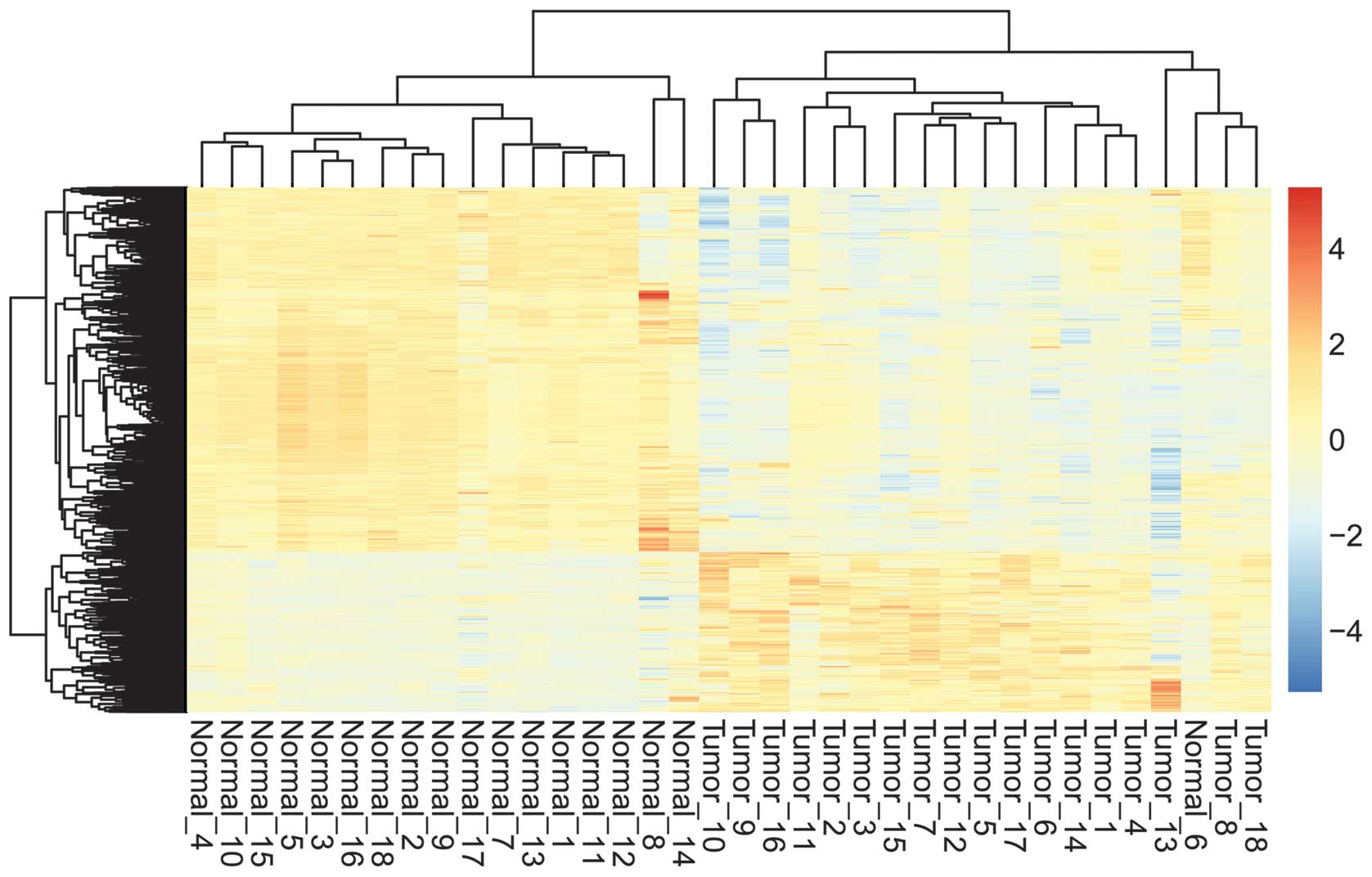
Two-way hierarchical clustering analysis was
performed for the identified DEGs using the pheatmap package in R
language (http://cran.fhcrc.org/web/packages/pheatmap/index.html)
(20). The clustering analysis
grouped together genes with similarities in expression patterns,
evaluating whether these DEGs were sample-specific. The clustering
result of the DEGs enabled assessment of the sample type. The
result was displayed as a heatmap.
PPI network construction and hub protein
analysis
It has been established that the majority of
biological networks are scale-free networks, in which only a
minority of nodes possess a large number of links, while the
majority of nodes have few links (21). Nodes which are connected to most of
the proteins are defined as hub proteins and are the key in the
network. To identify the hub proteins in the present study, the
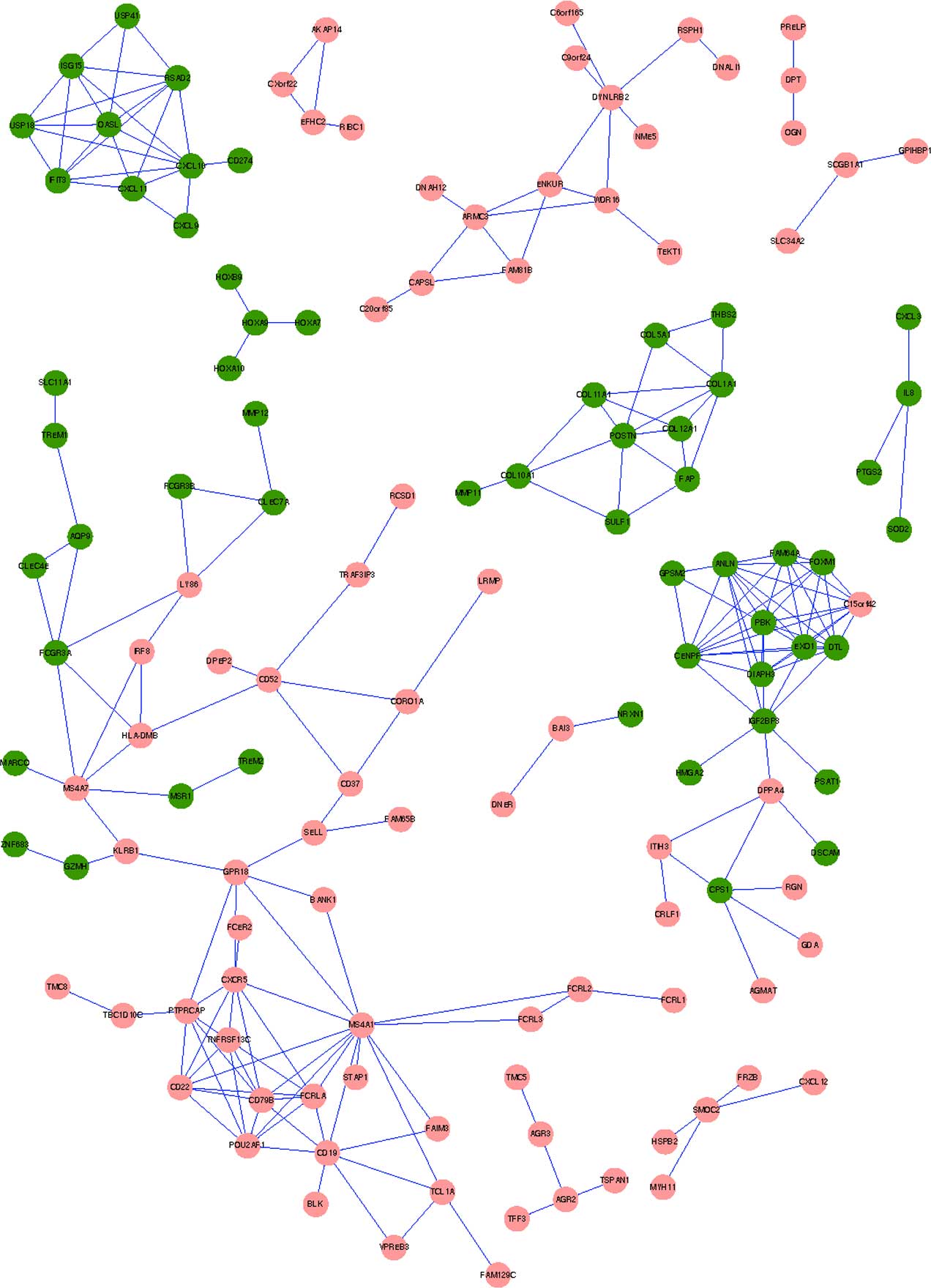
Search Tool for the Retrieval of Interacting Genes (22) online database (http://string-db.org/) was used to construct a PPI
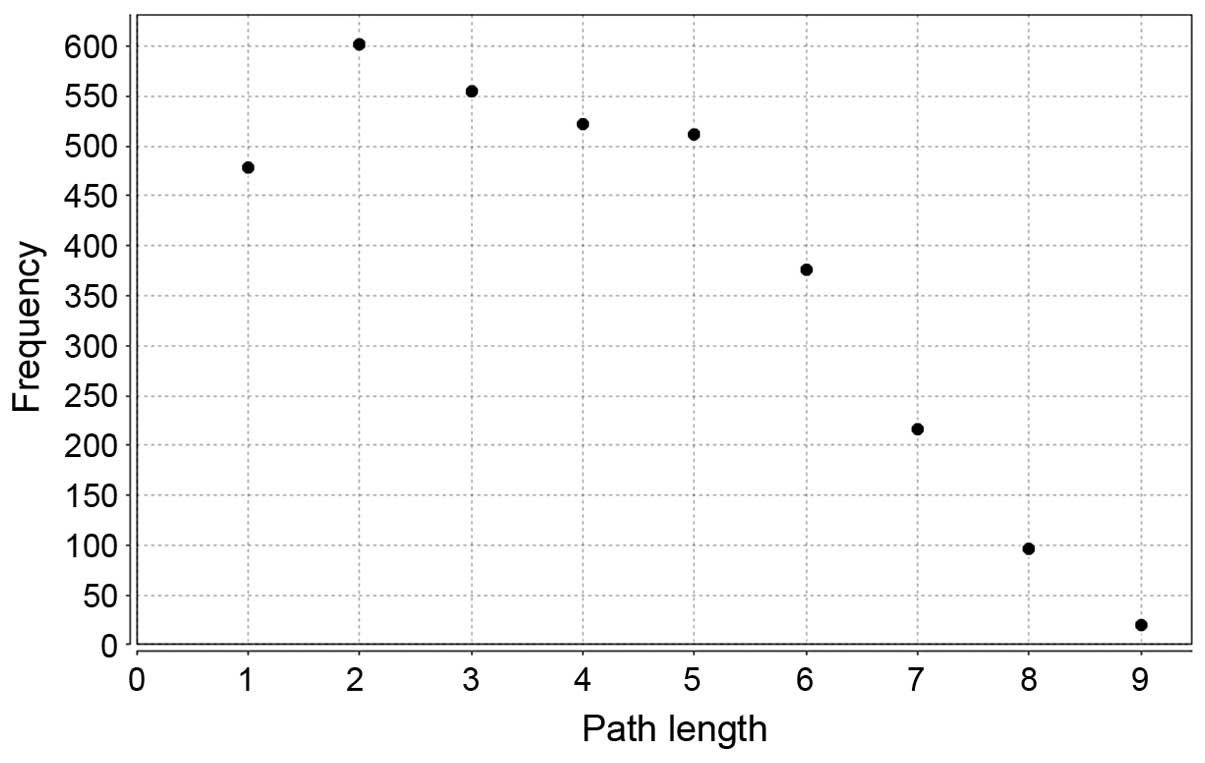
network using the proteins encoded by the DEGs. The path lengths of
the nodes in the network were calculated to determine that the
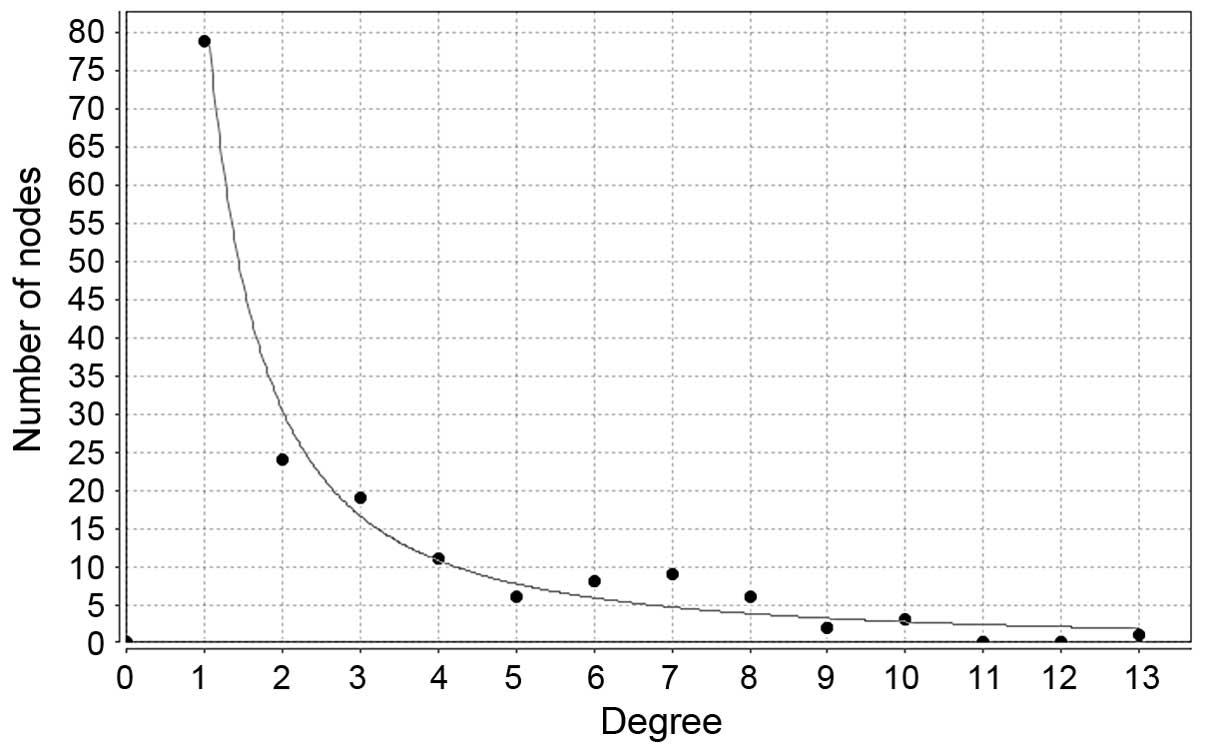
constructed network was scale-free. Subsequently, the degrees of
the nodes corresponding to the links of the node protein were
calculated, in order to screen for the hub proteins with the
highest degrees.
Network modules analysis
Single proteins usually function via interactions
with other proteins, rather than acting alone (23). Given that proteins in the same
module are likely to perform similar functions, network modules
with a degree ≥2 and K-core ≥2 were obtained using the Mcode plugin
(24) from Cytoscape (www.cytoscape.org/) (25), which is software for network
visualization and analysis. Gene ontology (GO) (26) functional enrichment analysis was
performed for these obtained modules using the Bingo plugin
(27) of Cytoscape. An adjusted
P-value <0.05 was set as the threshold.
Results
DEG screening and hierarchical clustering
analysis
A total of 1,067 DEGs were screened between the NPC
and control samples, including 326 upregulated genes and 741
down-regulated genes. The heatmap demonstrated that 95% of the DEGs
were sample-specific (Fig. 1).
Analysis of hub proteins in the PPI
network
In the PPI network (Fig. 2), 239 pairs of interactions among
proteins were identified, in which 168 DEGs were involved. As shown
in Fig. 3, the path lengths of the
nodes in the network varied, ranging between one and nine, with the
highest frequency at two, revealing that the network was
scale-free. The degrees of the nodes are shown in Fig. 4. The top 10 node genes were sorted
by degree in descending order (Table
I). Among these 10 genes, membrane-spanning 4-domains,
subfamily A, member 1 had the highest degree, with a degree of
13.
 | Table ITop 10 node genes sorted in descending
order of degree. |
Table I
Top 10 node genes sorted in descending
order of degree.
| Gene | Path length | Degree |
|---|
| MS4A1 | 3.16 | 13 |
| PBK | 2.05 | 10 |
| CENPF | 2.05 | 10 |
| ANLN | 2.05 | 10 |
| DTL | 2.10 | 9 |
| EXO1 | 2.10 | 9 |
| CD79B | 3.82 | 8 |
| C15ORF42 | 2.65 | 8 |
| IGF2BP3 | 1.80 | 8 |
Network module analysis
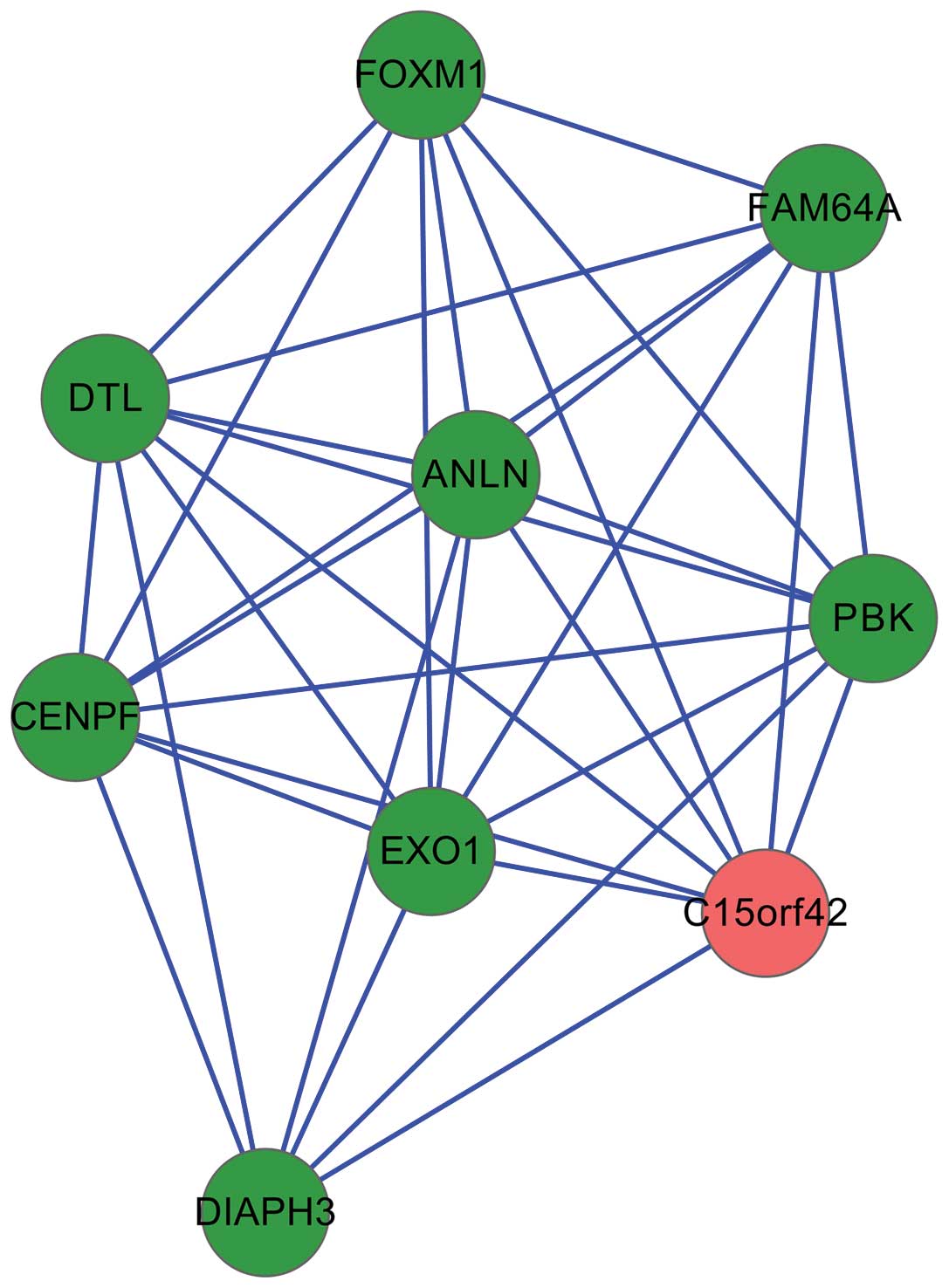
As shown in Fig. 5,
a network module including six genes exhibiting high degrees was
obtained. The six genes involved were PDZ binding kinase (PBK),
centromere protein F (CENPF), anillin (ANLN), denticleless protein
homolog (DTL), exonuclease 1 (EXO1) and chromosome 15 open reading
frame 42 (C15ORF42). The results of the GO functional analysis
revealed that the network module was closely associated with the
cell cycle and nucleic acid metabolic process (Table II), which were enriched in five of
the genes exhibiting high degrees: EXO1, CENPF, ANLN, åPBK and
C15ORF42. Of these five genes, PBK exhibited the highest degree
(10).
| Table IIGO functional enrichment analysis of
network modules. |
Table II
GO functional enrichment analysis of
network modules.
| GO ID | P-value | Adjusted P-value | Description |
|---|
| 7049 |
7.30×10⁻⁷ |
2.38×10⁻⁴ | Cell cycle |
| 51726 |
1.49×10⁻⁶ |
2.43×10⁻⁴ | Regulation of cell
cycle |
| 90304 |
4.73×10⁻⁴ |
6.75×10⁻³ | Nucleic acid
metabolic process |
| 6139 |
1.22×10⁻³ |
1.17×10⁻² | Nucleobase,
nucleoside, nucleotide and nucleic acid metabolic process |
| 34641 |
2.46×10⁻³ |
1.82×10⁻² | Cellular nitrogen
compound metabolic process |
| 6807 |
3.16×10⁻³ |
2.15×10⁻² | Nitrogen compound
metabolic process |
| 44260 |
3.79×10⁻³ |
2.32×10⁻² | Cellular
macromolecule metabolic process |
| 16043 |
6.37×10⁻³ |
2.91×10⁻² | Cellular component
organization |
| 43170 |
7.92×10⁻³ |
3.31×10⁻² | Macromolecule
metabolic process |
Discussion
NPC is an endemic malignant tumor in Southern China.
The present study identified 1,067 DEGs between NPC and control
samples. These DEGs were revealed to be sample-specific by
hierarchical clustering analysis. The constructed PPI network was
confirmed to be scale-free and its hub proteins were analyzed. The
results of network module analysis demonstrated that the obtained
network module was associated with the cell cycle and nucleic acid
metabolic process, in which EXO1, CENPF, ANLN, PBK and C15ORF42
were enriched DEGs with high degrees. These DEGs were
downregulated, with the exception of C15ORF42. In agreement with
the results of the present study, increasing studies have reported
that cell cycle function is closely associated with the initiation
and progression of NPC (28,29).
EXO1, one of the five DEGs identified, is an enzyme
encoded by the EXO1 gene, which is involved in DNA repair and
homologous recombination (30). It
has been reported that genes associated with DNA repair are
involved in the molecular mechanism underlying NPC (31). Similarly, the present study found
that EXO1, the critical node protein in PPI network, was associated
with the nucleic acid metabolic process, suggesting that EXO1 may
be critically involved in the mechanism of NPC via regulating the
nucleic acid metabolic process.
CENPF, a member of the centromere protein family, is
involved in the formation of the nuclear matrix during the
G2 phase of the cell cycle and is involved in mitosis
(32). Significant upregulation of
CENPF has been previously reported in NPC cells, relative to normal
nasopharyngeal cells, thus CENPF may be a molecular biomarker for
the progression of NPC (33).
Centromere protein H is also considered as a prognostic marker for
the progression of NPC (34). In
agreement with these reports, the present study demonstrated that
CENPF was a critical node protein, exhibiting a high degree in the
network module, indicating its importance in the mechanism of
NPC.
Anillin, encoded by the ANLN gene, is a scaffolding
actin-binding protein, which is involved in cytokinesis via
connecting RhoA, actin and myosin (35). It has been demonstrated that
anillin is upregulated in lung carcinogenesis, which may serve as a
prognostic indicator for this disease (36). By contrast, the results of the
present study suggested an undetermined role of anillin, which was
downregulated in NPC. In addition, lymphokine-activated killer
T-cell-originated protein kinase (TOPK), which is encoded by the
PBK gene, is a serine/threonine kinase associated with
mitogen-activated protein kinase kinase (37). TOPK has been previously identified
to promote proliferation of breast tumor cells via p38 mitogen
activated protein kinase activity (38). In addition, high expression levels
of TOPK have been observed in melanoma cells (39). However, PBK was downregulated in
the present study. These conflicting results may be a result of
discrepancies between the experimental models and the samples.
The function of the C15ORF42 gene remains to be
fully elucidated. It has been reported that another member of the
same family, C16ORF13, is overexpressed in gastric cancer tissues,
although the precise function of C15ORF42 remains elusive. In the
present study, C15ORF42 was identified to be an upregulated node
protein with a high degree in NPC, indicating a potentially
critical role of C15ORF42 in the tumorigenesis of NPC for the first
time, to the best of our knowledge.
In conclusion, the present study identified critical
node proteins exhibiting close interactions with other proteins in
the network module, including EXO1, CENPF, ANLN, PBK and C15ORF42.
These proteins may be involved in the tumori-genesis of NPC via
modulating the cell cycle and nucleic acid metabolic process, and
may be used as molecular biomarkers for the early diagnosis of NPC.
The results of the present study assist in further understanding of
the tumorigenesis of NPC, and provide potential targets for
developing effective therapeutic treatment strategies for this
disease.
References
|
1
|
Chang ET and Adami HO: The enigmatic
epidemiology of nasopharyngeal carcinoma. Cancer Epidemiol
Biomarkers Prev. 15:1765–1777. 2006. View Article : Google Scholar : PubMed/NCBI
|
|
2
|
Wong AM, Kong KL, Tsang JW, Kwong DL and
Guan XY: Profiling of Epstein, Barr virus, encoded microRNAs in
nasopharyngeal carcinoma reveals potential biomarkers and oncomirs.
Cancer. 118:698–710. 2012. View Article : Google Scholar
|
|
3
|
Dawson CW, Port RJ and Young LS: The role
of the EBV-encoded latent membrane proteins LMP1 and LMP2 in the
pathogenesis of nasopharyngeal carcinoma (NPC). Semin Cancer Biol.
22:144–153. 2012. View Article : Google Scholar : PubMed/NCBI
|
|
4
|
Fachiroh J, Sangrajrang S, Johansson M,
Renard H, Gaborieau V, Chabrier A, Chindavijak S, Brennan P and
McKay JD: Tobacco consumption and genetic susceptibility to
nasopharyngeal carcinoma (NPC) in Thailand. Cancer Causes Control.
23:1995–2002. 2012. View Article : Google Scholar : PubMed/NCBI
|
|
5
|
Wei WI and Sham JS: Nasopharyngeal
carcinoma. Lancet. 365:2041–2054. 2005. View Article : Google Scholar : PubMed/NCBI
|
|
6
|
Siddique MA, Sabur MA, Kundu SC, Mostafa
MG, Khan JA, Ahmed S, Karim MA and Hanif MA: Difficulty in
diagnosis of nasopharyngeal carcinoma. Mymensingh Med J.
21:158–161. 2012.PubMed/NCBI
|
|
7
|
Huang GL, Chen ML, Li YZ, Lu Y, Pu XX, He
YX, Tang SY, Chen H, Ding C and He Z: Association of miR-146a gene
polymorphism with risk of nasopharyngeal carcinoma in the
central-southern Chinese population. J Hum Genet. 59:141–144. 2014.
View Article : Google Scholar : PubMed/NCBI
|
|
8
|
Hsu CY, Yi YH, Chang KP, Chang YS, Chen SJ
and Chen HC: The Epstein-Barr virus-encoded microRNA MiR-BART9
promotes tumor metastasis by targeting E-cadherin in nasopharyngeal
carcinoma. Plos Pathog. 10:e10039742014. View Article : Google Scholar : PubMed/NCBI
|
|
9
|
Segal E, Wang H and Koller D: Discovering
molecular pathways from protein interaction and gene expression
data. Bioinformatics. 19:i264–i271. 2003. View Article : Google Scholar : PubMed/NCBI
|
|
10
|
Ideker T, Ozier O, Schwikowski B and
Siegel AF: Discovering regulatory and signalling circuits in
molecular interaction networks. Bioinformatics. 18(Suppl 1):
S233–S240. 2002. View Article : Google Scholar : PubMed/NCBI
|
|
11
|
Moore JH, Asselbergs FW and Williams SM:
Bioinformatics challenges for genome-wide association studies.
Bioinformatics. 26:445–455. 2010. View Article : Google Scholar : PubMed/NCBI
|
|
12
|
Albert R, Jeong H and Barabási AL: Error
and attack tolerance of complex networks. Nature. 406:378–382.
2000. View
Article : Google Scholar : PubMed/NCBI
|
|
13
|
Jeong H, Mason SP, Barabási AL and Oltvai
ZN: Lethality and centrality in protein networks. Nature.
411:41–42. 2001. View
Article : Google Scholar : PubMed/NCBI
|
|
14
|
Csermely P, Agoston V and Pongor S: The
efficiency of multi-target drugs: The network approach might help
drug design. Trends Pharmacol Sci. 26:178–182. 2005. View Article : Google Scholar : PubMed/NCBI
|
|
15
|
Barrett T, Troup DB, Wilhite SE, Ledoux P,
Rudnev D, Evangelista C, Kim IF, Soboleva A, Tomashevsky M and
Edgar R: NCBI GEO: Mining tens of millions of expression
profiles–database and tools update. Nucleic Acids Res. 35(Database
Issue): D760–D765. 2007. View Article : Google Scholar
|
|
16
|
Fujita A, Sato JR, Rodrigues Lde O,
Ferreira CE and Sogayar MC: Evaluating different methods of
microarray data normalization. BMC Bioinformatics. 7:4692006.
View Article : Google Scholar : PubMed/NCBI
|
|
17
|
Smyth GK: Limma: Linear models for
microarray data. Bioinformatics and Computational Biology Solutions
Using R and Bioconductor. Gentleman R, Carey V, Dudoit S, Irizarry
R and Huber W: Springer; New York: pp. 397–420. 2005, View Article : Google Scholar
|
|
18
|
Noble WS: How does multiple testing
correction work? Nat Biotechnol. 27:1135–1137. 2009. View Article : Google Scholar : PubMed/NCBI
|
|
19
|
He L and Sarkar SK: On improving some
adaptive BH procedures controlling the FDR under dependence.
Electron J Statist. 7:2683–2701. 2013. View Article : Google Scholar
|
|
20
|
Szekely GJ and Rizzo ML: Hierarchical
clustering via joint between-within distances: Extending Ward's
minimum variance method. J Classif. 22:151–183. 2005. View Article : Google Scholar
|
|
21
|
Albert R: Scale-free networks in cell
biology. J Cell Sci. 118:4947–4957. 2005. View Article : Google Scholar : PubMed/NCBI
|
|
22
|
Franceschini A, Szklarczyk D, Frankild S,
Kuhn M, Simonovic M, Roth A, Lin J, Minguez P, Bork P, von Mering
C, et al: STRING v9.1: protein-protein interaction networks, with
increased coverage and integration. Nucleic Acids Res. 41(Database
Issue): D808–D815. 2013. View Article : Google Scholar :
|
|
23
|
Przulj N, Wigle NA and Jurisica I:
Functional topology in a network of protein interactions.
Bioinformatics. 20:340–348. 2004. View Article : Google Scholar : PubMed/NCBI
|
|
24
|
Bader GD and Hogue CW: An automated method
for finding molecular complexes in large protein interaction
networks. BMC Bioinformatics. 4:22003. View Article : Google Scholar : PubMed/NCBI
|
|
25
|
Smoot ME, Ono K, Ruscheinski J, Wang PL
and Ideker T: Cytoscape 2.8: New features for data integration and
network visualization. Bioinformatics. 27:431–432. 2011. View Article : Google Scholar :
|
|
26
|
Ashburner M, Ball CA, Blake JA, Botstein
D, Butler H, Cherry JM, Davis AP, Dolinski K, Dwight SS, Eppig JT,
et al: Gene Ontology: Tool for the unification of biology. The Gene
Ontology Consortium. Nat Genet. 25:25–29. 2000. View Article : Google Scholar : PubMed/NCBI
|
|
27
|
Maere S, Heymans K and Kuiper M: BiNGO: A
Cytoscape plugin to assess overrepresentation of gene ontology
categories in biological networks. Bioinformatics. 21:3448–3449.
2005. View Article : Google Scholar : PubMed/NCBI
|
|
28
|
Zhu XF, Liu ZC, Xie BF, Li ZM, Feng GK,
Yang D and Zeng YX: EGFR tyrosine kinase inhibitor AG1478 inhibits
cell proliferation and arrests cell cycle in nasopharyngeal
carcinoma cells. Cancer Lett. 169:27–32. 2001. View Article : Google Scholar : PubMed/NCBI
|
|
29
|
Guo L, Tang M, Yang L, Xiao L, Bode AM, Li
L, Dong Z and Cao Y: Epstein-Barr virus oncoprotein LMP1 mediates
survivin upregulation by p53 contributing to G1/S cell cycle
progression in nasopharyngeal carcinoma. Int J Mol Med.
29:5742012.PubMed/NCBI
|
|
30
|
Desai A, Qing Y and Gerson SL: Exonuclease
1 is a critical mediator of survival during DNA double strand break
repair in nonquiescent hematopoietic stem and progenitor cells.
Stem Cells. 32:582–593. 2014. View Article : Google Scholar : PubMed/NCBI
|
|
31
|
Zhou X, Tian D, Wang S, Ruan Y, Qiu B,
Zhang L and Lu B: Expressions of genes related to genome stability
and DNA repair in nasopharyngeal carcinoma clustering families.
Chin Ger J Clin Oncol. 8:713–718. 2009. View Article : Google Scholar
|
|
32
|
Liao H, Winkfein R, Mack G, Rattner JB and
Yen TJ: CENP-F is a protein of the nuclear matrix that assembles
onto kinetochores at late G2 and is rapidly degraded after mitosis.
J Cell Biol. 130:507–518. 1995. View Article : Google Scholar : PubMed/NCBI
|
|
33
|
Cao JY, Liu L, Chen SP, Zhang X, Mi YJ,
Liu ZG, Li MZ, Zhang H, Qian CN, Shao JY, et al: Prognostic
significance and therapeutic implications of centromere protein F
expression in human nasopharyngeal carcinoma. Mol Cancer.
9:2372010. View Article : Google Scholar : PubMed/NCBI
|
|
34
|
Liao WT, Song LB, Zhang HZ, Zhang X, Zhang
L, Liu WL, Feng Y, Guo BH, Mai HQ, Cao SM, et al: Centromere
protein H is a novel prognostic marker for nasopharyngeal carcinoma
progression and overall patient survival. Clin Cancer Res.
13:508–514. 2007. View Article : Google Scholar : PubMed/NCBI
|
|
35
|
Piekny AJ and Glotzer M: Anillin is a
scaffold protein that links RhoA, actin and myosin during
cytokinesis. Curr Biol. 18:30–36. 2008. View Article : Google Scholar
|
|
36
|
Suzuki C, Daigo Y, Ishikawa N, Kato T,
Hayama S, Ito T, Tsuchiya E and Nakamura Y: ANLN plays a critical
role in human lung carcinogenesis through the activation of RHOA
and by involvement in the phosphoinositide 3-kinase/AKT pathway.
Cancer Res. 65:11314–11325. 2005. View Article : Google Scholar : PubMed/NCBI
|
|
37
|
Abe Y, Matsumoto S, Kito K and Ueda N:
Cloning and expression of a novel MAPKK-like protein kinase,
lymphokine-activated killer T-cell-originated protein kinase,
specifically expressed in the testis and activated lymphoid cells.
J Biol Chem. 275:21525–21531. 2000. View Article : Google Scholar : PubMed/NCBI
|
|
38
|
Ayllon V and O'connor R: PBK/TOPK promotes
tumour cell proliferation through p38 MAPK activity and regulation
of the DNA damage response. Oncogene. 26:3451–3461. 2007.
View Article : Google Scholar
|
|
39
|
Zykova TA, Zhu F, Lu C, Higgins L, Tatsumi
Y, Abe Y, Bode AM and Dong Z: Lymphokine-activated killer
T-cell-originated protein kinase phosphorylation of histone H2AX
prevents arsenite-induced apoptosis in RPMI7951 melanoma cells.
Clin Cancer Res. 12:6884–6893. 2006. View Article : Google Scholar : PubMed/NCBI
|