Introduction
Osteosarcoma (OS) is a high-grade malignant bone
neoplasm, which has become one of the most common primary malignant
bone tumors in children and young adults (1). The majority of failures of
osteosarcoma treatment are due to resistance to chemotherapy
(2,3). Thus, there is an urgent need to
elucidate the underlying molecular mechanisms of OS and to
determine an appropriate gene therapy strategy in OS treatment
(4).
Recent studies have demonstrated that microRNAs
(miRNAs), are small non-coding RNAs of 18–25 nt. They have the
ability to regulate cellular processes, such as cell proliferation,
apoptosis, invasion and differentiation, suggesting that they could
be involved in cancer (5–7). Previous studies have found that
miR-20a is upregulated in several types of cancer, suggesting that
it may be pivotal in tumorigenesis and tumor progression (8–10).
In the present study, the biological effects and the potential
mechanisms of miR-20a in OS were investigated. The role of miR-20a
in OS development was investigated by MTT and cell cycle assays. In
addition, the present study explored the regulatory role of miR-20a
on EGR2 in OS cells, and investigated its function in cell
proliferation.
Materials and methods
Clinical specimens
Eight human osteosarcoma (OS) tissues and matched
adjacent normal tissues (ANT) were obtained from patients with OS
(age, ~49–63 years; 4 females, 4 males) at the Institute of
Orthopedics and Traumatology, Xijing Hospital, The Fourth Military
Medical University (Xi'an, China). This study was approved by the
ethics committee of Xijing Hospital. Written informed consent was
obtained from all patients. Tissue samples were collected during
surgery, immediately frozen in liquid nitrogen and stored until
total RNA or protein was extracted.
Cell culture
MG-63, Saos-2 and SW1353 human osteosarcoma cell
lines and h-FOB human osteoblast cell lines were purchased from the
Cell Bank of Chinese Academy of Sciences (Shanghai, China) and
grown in Dulbecco's modified Eagle's medium (DMEM, Gibco-BRL,
Carlsbad, CA, USA) supplemented with 10% fetal bovine serum (FBS,
Sigma-Aldrich, St. Louis, MO, USA) and 100 U/ml
penicillin-streptomycin (Invitrogen Life Technologies, Carlsbad,
CA, USA). Cell lines were cultured in a humidified incubator at
37°C in an atmosphere of 5% CO2 and 95% air.
Plasmids, small interfering (si)RNA and
transfection
For ectopic expression of EGR2, EGR2 open reading
frames with 3′-UTRs were amplified using polymerase chain reaction
(PCR) and subcloned into pEGFP-N1 using the following primers:
Sense: 5′-CCCTCGAGATCCCAGGCTCAGTCCAACC-3′ and antisense:
5′-CCAAGCTTAGGTGTCCGGGTCCG AGA-3′ (Invitrogen Life Technologies).
miR-20a mimic, miR-20a inhibitor and negative control (NC) were
purchased from GeneCopoeia (Guangzhou, China) and transfected into
OS cells using Lipofectamine® 2000 reagent (Invitrogen
Life Technologies) according to the manufacturer's
instructions.
For EGR2 depletion, EGR2-siRNA (SI04948762) and
negative control siRNA were purchased from Qiagen China (Shanghai)
Co. Ltd. (Shanghai, China). Transfection of siRNAs was performed
using Lipofectamine 2000, according to the manufacturer's
instructions.
RNA extraction and reverse
transcription-quantitative (RT-q)PCR
For miRNA quantification, total RNA including
microRNAs was extracted from culture cells and patient samples
using the mirVana miRNA Isolation kit (Ambion, Austin, TX, USA)
according to the manufacturer's instructions, and then cDNA was
synthesized from 5 ng of total RNA using the Taqman®
miRNA Reverse Transcription kit (Applied Biosystems, Foster City,
CA, USA). The expression levels of miR-20a were quantified using
the miRNA-specific TaqMan® MiRNA Assay kit (Applied
Biosystems) by the 7500 Sequence Detection system (Applied
Biosystems). The relative miR-20a expression levels after
normalization to U6 small nuclear RNA were calculated using 2-[(Ct
of miR-20a) - (Ct of U6)]. qPCR was performed using an SYBR kit
[Qiagen China (Shanghai) Co., Ltd.]. The PCR reaction conditions
for all assays were as follows: 95°C for 30 sec, followed by 40
cycles of amplification (95°C for 5 sec, 59°C for 30 sec and 72°C
for 30 sec). The primers which were synthesized by a
TaqMan® Gene Expression Assay (Invitrogen Life
Technologues) were used as follows: Cyclin D1 (Hs00765553/m1) and
p21 (Hs00159357/m1). Expression data were normalized to the
geometric mean of GAPDH (Hs02758991/g1) to control the variability
in expression levels and calculated as 2-[(Ct of cyclin D1 and p21)
- (Ct of GAPDH)].
MTT assays and colony formation
For MTT assays, Saos-2 cells were seeded into
96-well plates in medium containing 10% FBS at ~3,000 cells/well.
In brief, 20 μl of 5 mg/ml MTT solution (Sigma-Aldrich) was
added to each well and incubated at 37°C for 4 h. After the
incubation period, the medium was removed from each well and the
resulting MTT formazan was solubilized in 150 μl dimethyl
sulfoxide (Sigma-Aldrich). The absorbance at 490 nm was measured in
a Thermo Scientific Multiskan (Thermo Fisher Scientific, Rockford,
IL, USA).
For the colony formation assay, Saos-2 cells were
plated into three 6-cm cell culture dishes (1×10³
cells/well) and incubated for 10 days in medium containing 10% FBS.
The colonies were washed with phosphate-buffered saline (PBS) and
stained with 1.0% crystal violet (Beyotime Institute of
Biotechnology, Haimen, China) for 30 sec after fixation with 10%
formaldehyde (Beyotime Institute of Biotechnology) for 15 min. The
number of colonies, defined as >50 cells/colony were counted
under an inverted fluorescent microscope (MoticAE30; Microscope
Systems, Ltd., Glasgow, UK). Three independent experiments were
performed and the data was calculated using a paired t-test.
Cell cycle assay
Cells were harvested, washed twice with cold PBS,
fixed in 70% ice-cold ethanol, and incubated with propidium iodide
(PI) (Beyotime Institute of Biotechnology) and RNase A (Beyotime
Institute of Biotechnology), then analyzed by
fluorescence-activated cell sorting (FACScan; BD Biosciences, San
Jose, CA, USA). Each sample was run in triplicate.
Luciferase assays
To construct a luciferase reporter vector, the EGR2
3′-UTR fragment containing putative binding sites for miR-20a was
amplified using PCR and cloned in the psiCHECK-2 vector (Promega
Corporation, Madison, WI, USA). These constructs (1 μg) were
co-transfected with 1 μg control or miR-20a precursor into
Saos-2 cells. Dual-luciferase activity assays (cat. no. RG027;
Beyotime Institute of Biotechnology) were assayed 48 h
post-transfection according to the manufacturer's instructions.
Western blotting
Protein lysates were prepared, the equivalent
aliquots of proteins were electrophoresed on a 10%
SDS/polyacrylamide gel (Beyotime Institute of Biotechnology) and
transferred to nitrocellulose membranes (Invitrogen Life
Technologies). The membrane was blocked in Tris-buffered
saline-Tween 20 (Institute of Biotechnology) supplemented with 5%
milk (Institute of Biotechnology) for 2 h at room temperature, and
then incubated overnight at 4°C with anti-EGR2 (1:1,000; cat. no.
ab108399; Abcam, Cambridge, MA, USA), anti-cyclin D1 (1:1,000; cat.
no. ab16663; Abcam) and anti-p21 (1:1,000; cat. no. 2947; Cell
Signaling Technology, Inc., Beverly, MA, USA). α-tubulin (1:500;
cat. no. T9026; Sigma-Aldrich) acted as a protein loading control.
Following incubation with secondary antibody (horseradish
peroxidase-conjugated) for 2 h at room temperature, immunocomplexes
were visualized using the Enhanced Chemiluminesence Advanced
Western Blotting Detection kit (GE Healthcare Bio-Sciences,
Pittsburgh, PA, USA) according to the manufacturer's
instructions.
Statistical analysis
Statistical analysis was performed using SPSS 15.0
(SPSS, Inc., Chicago, IL, USA). Statistical analyses were conducted
by Student's t-test. P<0.05 was considered to indicate a
statistically significant difference.
Results
miR-20a expression is upregulated in OS
tissues and OS cell lines
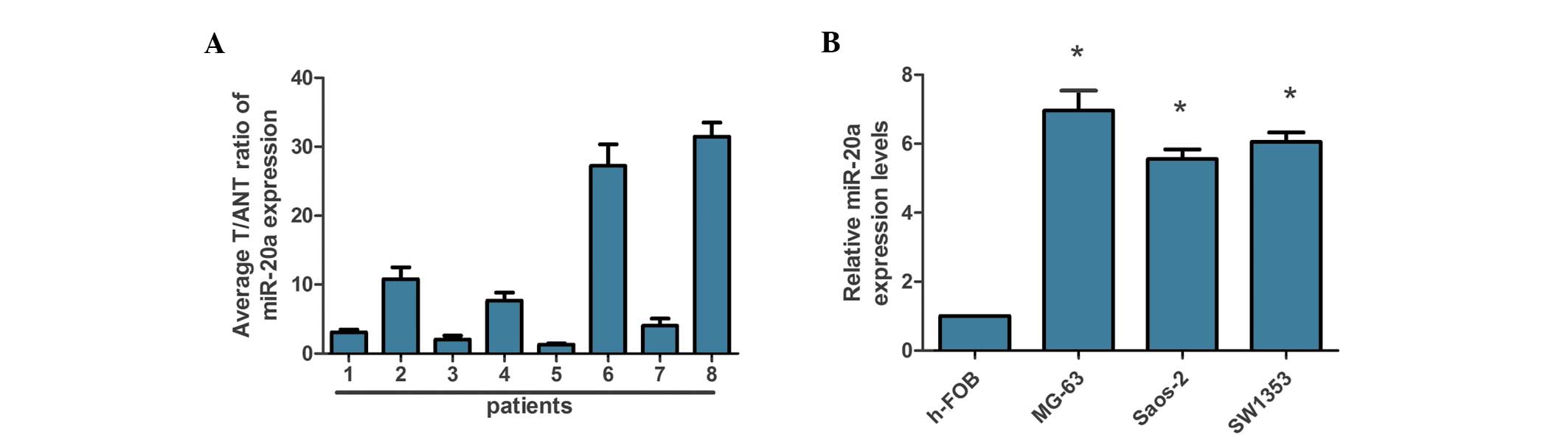
To investigate the role of miR-20a in OS
development, the expression levels of miR-20a in OS tissues and OS
cells were first evaluated by RT-qPCR (Fig. 1A). The results showed that the
expression levels of miR-20a were upregulated in the OS tissues
compared with in the matched ANTs, and all three tested OS cell
lines had significantly upregulated miR-20a levels compared with
the h-FOB human osteoblast cell lines (Fig. 1B). These results showed that
miR-20a exhibited a crucial role in OS and suggest that miR-20a is
significantly increased in OS and may serve as a prognostic marker
for patients with OS.
miR-20a promotes OS cell proliferation
and cell cycle progression
As miR-20a was significantly upregulated in OS
tissues and OS cell lines, it was investigated whether miR-20a
promotes cell proliferation and the cell cycle of OS cells
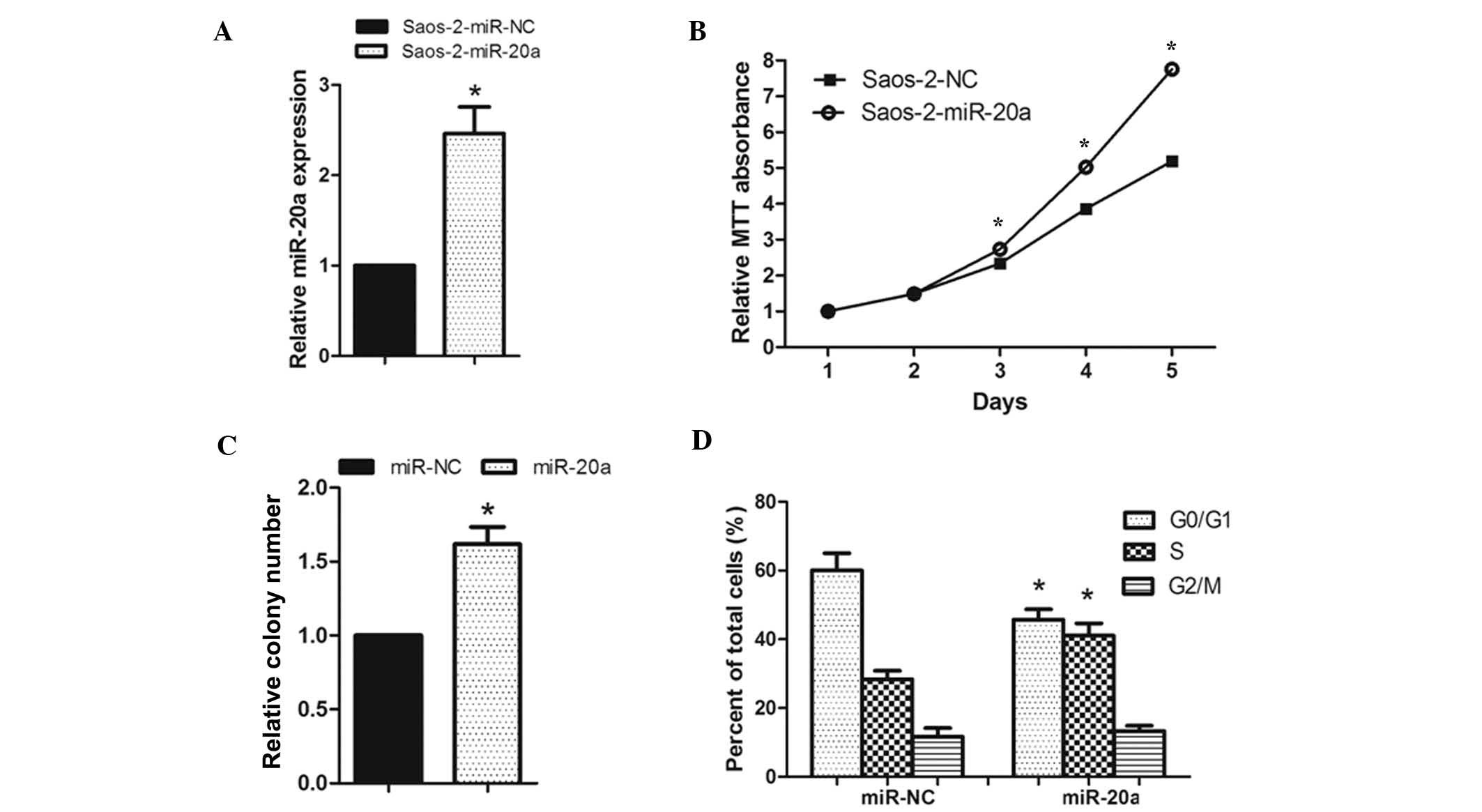
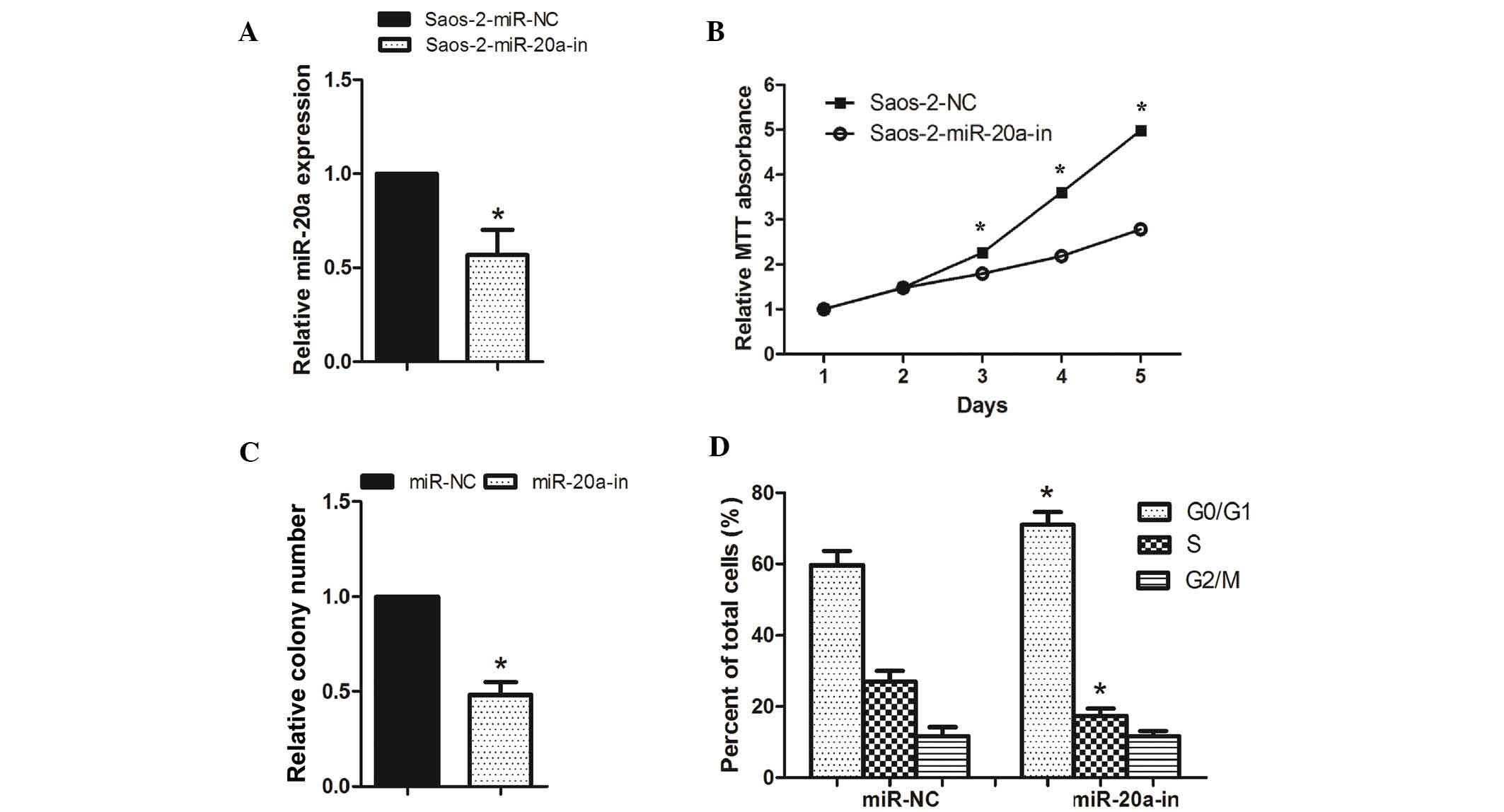
(Figs. 2 and 3). Saos-2 cells were transfected with
miR-20a mimics, miR-20a inhibitor or the respective controls, both
of them showed great transfection efficiency (Figs. 2A and 3A). The MTT assay showed that the cell
growth rate was significantly higher in miR-20a-transduced Saos-2
cells than in miR-NC-transfected cells (Fig. 2B). Colony formation assays
consistently showed that enforced expression of miR-20a
significantly enhanced the number of Saos-2 cell colonies after 14
days of culture compared with the controls (Fig. 2C). By contrast, the cell growth
rates and colony numbers of Saos-2 cells transfected with
miR-20a-in were significantly lower than those transfected with NC
(Fig. 3B and C). To determine
whether modulating cell viability was a result of the cell cycle,
flow cytometry was used. After 48 h transfection, miR-20a mimics
decreased the proportion of Saos-2 cells in the G0/G1-phase and
increased the proportion of Saos-2 cells in the S-phase compared
with those transfected with NC (Fig.
2D). However, miR-20a-in increased the proportion of Saos-2
cells in the G0/G1-phase and decreased the proportion of Saos-2
cells in S-phase compared with those transfected with NC (Fig. 3D). These results showed that
miR-20a promoted OS cell tumorigenicity in vitro.
miR-20a directly targets EGR2 by binding
to its 3′-UTR in OS
It is generally accepted that miRNAs regulate the
expression of mRNAs by targeting the mRNA 3′UTR. Bioinformatics
analysis revealed that EGR2, is a member of a multi-gene family
encoding zinc finger proteins and is crucial in the regulation of
cellular proliferation and the cell cycle, as a putative target of
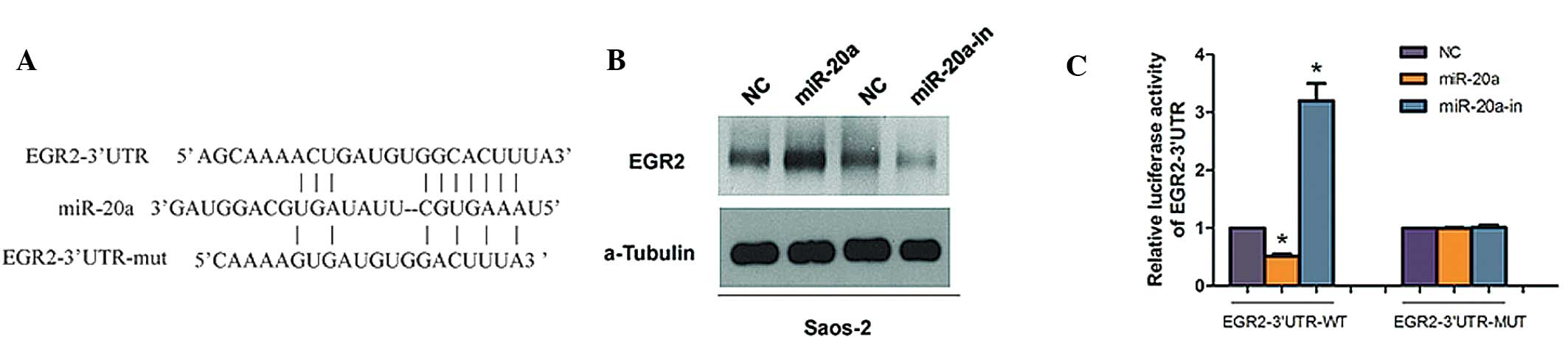
miR-20a (11–13). Therefore, EGR2 was selected as a
target for further analysis (Fig.
4A).
To determine whether miR-20a affects EGR2
expression, expression of EGR2 was detected in the Saos-2 cells,
which were transfected with miR-20a mimics, miR-20a-in or the
respective controls. Western blot analysis showed that miR-20a
mimics markedly suppressed EGR2 protein levels in Saos-2 cells
(Fig. 4B), while miR-20a-in
clearly promoted EGR2 protein expression. To verify the effect of
miR-20a on the inhibition of EGR2 expression, it was examined
whether EGR2 is regulated by miR-20a through direct binding to its
3′UTR. EGR2 3′-UTR (wild or mut type) vector was cotransfected in
Saos-2 cells with miR-20a mimic or miR-20a-in and then luciferase
activity was measured. As shown in Fig. 4C, significant repression of
luciferase activity was observed in Saos-2 cells cotransfected with
pGL-3-EGR2 3′-UTR vector and miR-20a mimic, whereas miR-20a-in
increased luciferase activity. These results, demonstrated that
EGR2 is a target of miR-20a.
miR-20a alters the levels of proteins
associated with proliferation and the cell cycle in OS cells
To investigate the mechanism underlying cell
proliferation and the cell cycle, the effect of miR-20a on critical
cell-proliferation and cell cycle related regulators cyclin D1 and
p21 were analyzed. The cyclin-dependent kinase inhibitor p21 and
cyclin D1 are two miR-20a targeted proteins that negatively (p21)
and positively (cyclin D1) regulate control cell cycle progression
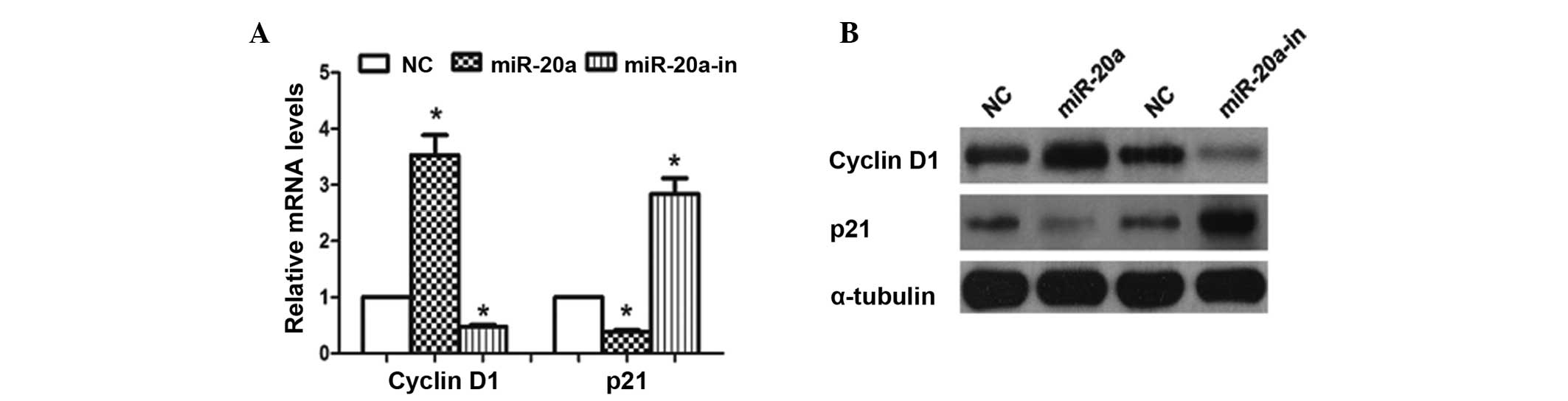
and proliferation (14,15). As shown in Fig. 5, cyclin D1 mRNA and protein were
upregulated in Saos-2 cells transfected with miR-20a mimic, but the
levels were decreased in the cells transfected with miR-20a-in,
relative to control cells. In addition, overexpression of miR-20a
caused the downregulation of p21 (mRNA and protein), but
upregulation in the cells tranfected with miR-20a-in. Thus
providing further evidence that miR-20a is important in OS cell
proliferation and the cell cycle.
EGR2 upregulation is required for
miR-20a-in-induced proliferation of OS cells
To further investigate the role of EGR2 promotion in
miR-20a-in-induced OS proliferation, the effects of EGR2
downregulation on OS cell proliferation were first examined. As
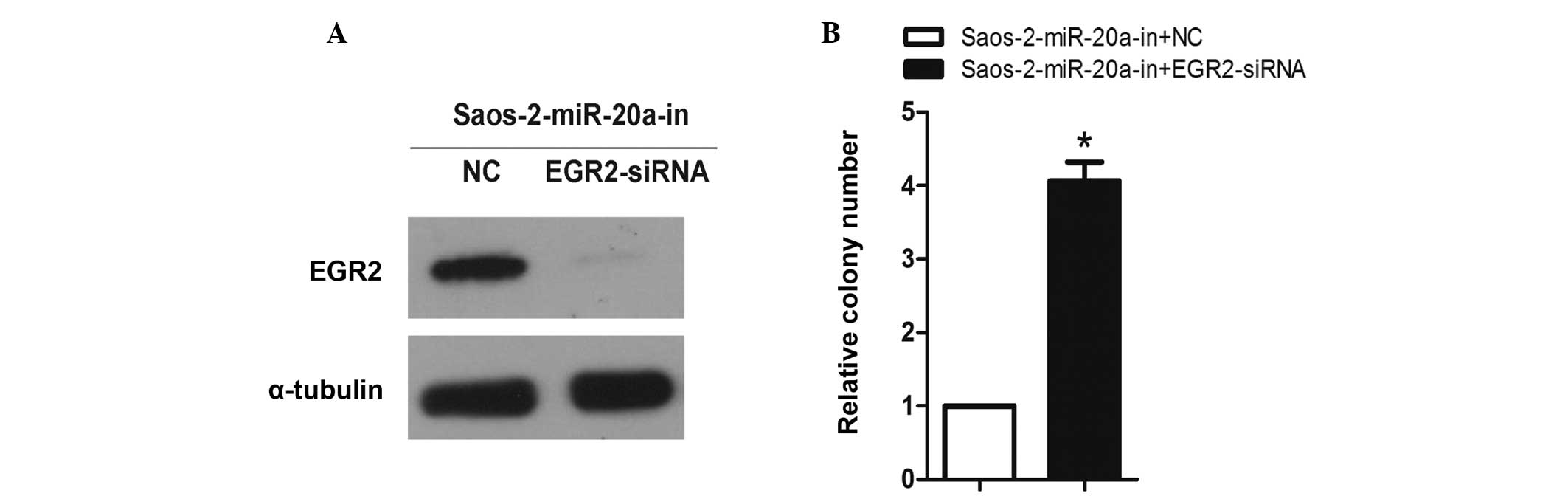
predicted, western blot analysis verified that EGR2-siRNA
effectively decreased the expression of EGR2 in
miR-20a-in-transfected Saos-2 cells (Fig. 6A). Colony formation assays showed
that EGR2-silencing and miR-20a-in-transfection in Saos-2 cells
exhibited an additive effect on cell proliferation (Fig. 6B). These results demonstrate that
direct EGR2 downregulation is required for miR-20a-induced OS cell
proliferation.
Discussion
Growing evidence suggests that microRNAs exhibit
crucial roles in development and in the progression of human
cancers, such as OS (16–20). miRNAs are a large family of gene
regulators that negatively regulate their target mRNAs in a
sequence-specific manner (6,21).
The effects of miR-20a have been described in numerous types of
cancer cells (8,10). However, it was uncertain whether
dysregulation of miR-20a was associated with the progression of OS.
In the present study, miR-20a expression was examined in human OS
tissues, the matched adjacent normal tissues, OS cell lines (MG-63,
Saos-2, and SW1353) and h-FOB human osteoblast cell lines. It was
demonstrated that miR-20a expression was markedly upregulated in OS
tissues and OS cells, suggesting that miR-20a is important in
malignant processes in OS.
Bioinformatic analysis revealed that EGR2, a novel
member of the Egr family of genes encoding immediate-early
transcription factors, is a target gene of miR-20a. Furthermore,
direct binding of miR-20a to the 3′-UTR of EGR2 mRNA was observed
and it was demonstrated that miR-20a overexpression suppresses EGR2
expression in OS cells, while inhibition of miR-20a increases its
expression.
Given that EGR2 is key in the regulation of cell
proliferation and the cell cycle (12,22)
the effect of miR-20a on these processes in OS cells was
investigated. Saos-2 cells were transfected with miR-20a or
miR-20a-in to upregulate or downregulate miR-20a expression. It was
demonstrated that ectopic expression of miR-20a enhanced the cell
proliferation of Saos-2 cells. Conversely, inhibition of miR-20a
inhibited cell proliferation. Using flow cytometric analysis, it
was observed that miR-20a-transfected Saos-2 cells entered the S
phase earlier and inhibition of miR-20a arrested cell cycle
progression at the G0/G1 boundary. More specifically, to determine
the potential underlying mechanism, the expression of cell
proliferation and cycle-associated molecules cyclin D1 and p21 was
investigated, the results showed that the molecular mechanism by
which miR-20a promotes OS cancer cell proliferation was due to
acceleration of the G1/S phase transition, upregulation of cyclin
D1 and down-regulation of p21 in cells overexpressing miR-20a
(23–25). Furthermore, EGR2-silencing in
miR-20a-in-transfected Saos-2 cells exhibited a positive effect to
promote cell proliferation, suggesting that direct EGR2
downregulation is required for miR-20a-in duced OS cell
proliferation.
In conclusion, the current study revealed that
upregulation of miR-20a is a common event underlying OS.
Furthermore, miR-20a functions as an oncogene by directly targeting
EGR2. These findings collectively suggest that miR-20a may serve as
a promising prognostic and therapeutic target for OS.
Acknowledgments
This study was supported by the Institute of
Orthopedics and Traumatology, Xijing Hospital.
References
|
1
|
Ottaviani G and Jaffe N: The epidemiology
of osteosarcoma. Cancer Treat Res. 152:3–13. 2009. View Article : Google Scholar
|
|
2
|
Ahmed AA, Zia H and Wagner L: Therapy
resistance mechanisms in Ewing's sarcoma family tumors. Cancer
Chemother Pharmacol. 73:657–663. 2014. View Article : Google Scholar : PubMed/NCBI
|
|
3
|
Constantinidou A, Pollack S, Loggers E,
Rodler E and Jones RL: The evolution of systemic therapy in
sarcoma. Expert Rev Anticancer Ther. 13:211–223. 2013. View Article : Google Scholar : PubMed/NCBI
|
|
4
|
Miao J, Wu S, Peng Z, Tania M and Zhang C:
MicroRNAs in osteosarcoma: Diagnostic and therapeutic aspects.
Tumour Biol. 34:2093–2098. 2013. View Article : Google Scholar : PubMed/NCBI
|
|
5
|
Esquela-Kerscher A and Slack FJ: Oncomirs
- microRNAs with a role in cancer. Nat Rev Cancer. 6:259–269. 2006.
View Article : Google Scholar : PubMed/NCBI
|
|
6
|
Calin GA and Croce CM: MicroRNA signatures
in human cancers. Nat Rev Cancer. 6:857–866. 2006. View Article : Google Scholar : PubMed/NCBI
|
|
7
|
Sun K and Lai EC: Adult-specific functions
of animal microRNAs. Nat Rev Genet. 14:535–548. 2013. View Article : Google Scholar : PubMed/NCBI
|
|
8
|
Xiong Y, Zhang L and Kebebew E: MiR-20a is
upregulated in anaplastic thyroid cancer and targets LIMK1. PLoS
One. 9:e961032014. View Article : Google Scholar : PubMed/NCBI
|
|
9
|
Zhao S, Yao D, Chen J and Ding N:
Circulating miRNA-20a and miRNA-203 for screening lymph node
metastasis in early stage cervical cancer. Genet Test Mol
Biomarkers. 17:631–636. 2013. View Article : Google Scholar : PubMed/NCBI
|
|
10
|
Chang Y, Liu C, Yang J, Liu G, Feng F,
Tang J, Hu L, Li L, Jiang F, Chen C, et al: MiR-20a triggers
metastasis of gallbladder carcinoma. J Hepatol. 59:518–527. 2013.
View Article : Google Scholar : PubMed/NCBI
|
|
11
|
Joseph LJ, Le Beau MM, Jamieson GA Jr,
Acharya S, Shows TB, Rowley JD and Sukhatme VP: Molecular cloning,
sequencing, and mapping of EGR2, a human early growth response gene
encoding a protein with “zinc-binding finger” structure. Proc Natl
Acad Sci USA. 85:7164–7168. 1988. View Article : Google Scholar
|
|
12
|
Li X, Zhang Z, Yu M, Li L, Du G, Xiao W
and Yang H: Involvement of miR-20a in promoting gastric cancer
progression by targeting early growth response 2 (EGR2). Int J Mol
Sci. 14:16226–16239. 2013. View Article : Google Scholar : PubMed/NCBI
|
|
13
|
Sumitomo S, Fujio K, Okamura T and
Yamamoto K: Egr2 and Egr3 are the unique regulators for systemic
autoimmunity. JAK-STAT. 2:e239522013. View Article : Google Scholar : PubMed/NCBI
|
|
14
|
Yu Z, Wang C, Wang M, Li Z, Casimiro MC,
Liu M, Wu K, Whittle J, Ju X, Hyslop T, et al: A cyclin D1/microRNA
17/20 regulatory feedback loop in control of breast cancer cell
proliferation. J Cell Biol. 182:509–517. 2008. View Article : Google Scholar : PubMed/NCBI
|
|
15
|
Wang Z, Liu M, Zhu H, Zhang W, He S, Hu C,
Quan L, Bai J and Xu N: Suppression of p21 by c-Myc through members
of miR-17 family at the post-transcriptional level. Int J Oncol.
37:1315–1321. 2010.PubMed/NCBI
|
|
16
|
Arabi L, Gsponer JR, Smida J, Nathrath M,
Perrina V, Jundt G, Ruiz C, Quagliata L and Baumhoer D:
Upregulation of the miR-17-92 cluster and its two paraloga in
osteosarcoma - reasons and consequences. Genes Cancer. 5:56–63.
2014.PubMed/NCBI
|
|
17
|
Tian Q, Jia J, Ling S, Liu Y, Yang S and
Shao Z: A causal role for circulating miR-34b in osteosarcoma. Eur
J Surg Oncol. 40:67–72. 2014. View Article : Google Scholar
|
|
18
|
Xu JQ, Liu P, Si MJ and Ding XY:
MicroRNA-126 inhibits osteosarcoma cells proliferation by targeting
Sirt1. Tumour Biol. 34:3871–3877. 2013. View Article : Google Scholar : PubMed/NCBI
|
|
19
|
Cao ZQ, Shen Z and Huang WY: MicroRNA-802
promotes osteosarcoma cell proliferation by targeting p27. Asian
Pac J Cancer Prev. 14:7081–7084. 2013. View Article : Google Scholar
|
|
20
|
Tang M, Lin L, Cai H, Tang J and Zhou Z:
MicroRNA-145 downregulation associates with advanced tumor
progression and poor prognosis in patients suffering osteosarcoma.
Onco Targets Ther. 6:833–838. 2013.PubMed/NCBI
|
|
21
|
van Kouwenhove M, Kedde M and Agami R:
MicroRNA regulation by RNA-binding proteins and its implications
for cancer. Nat Rev Cancer. 11:644–656. 2011. View Article : Google Scholar : PubMed/NCBI
|
|
22
|
Unoki M and Nakamura Y: Growth-suppressive
effects of BPOZ and EGR2, two genes involved in the PTEN signaling
pathway. Oncogene. 20:4457–4465. 2001. View Article : Google Scholar : PubMed/NCBI
|
|
23
|
Baldin V, Lukas J, Marcote MJ, Pagano M
and Draetta G: Cyclin D1 is a nuclear protein required for cell
cycle progression in G1. Genes Dev. 7:812–821. 1993. View Article : Google Scholar : PubMed/NCBI
|
|
24
|
Masamha CP and Benbrook DM: Cyclin D1
degradation is sufficient to induce G1 cell cycle arrest despite
constitutive expression of cyclin E2 in ovarian cancer cells.
Cancer Res. 69:6565–6572. 2009. View Article : Google Scholar : PubMed/NCBI
|
|
25
|
Yang M, Zhong J, Zhao M, Wang J, Gu Y,
Yuan X, Sang J and Huang C: Overexpression of nuclear
apoptosis-inducing factor 1 altered the proteomic profile of human
gastric cancer cell MKN45 and induced cell cycle arrest at G1/S
phase. PLoS One. 9:e1002162014. View Article : Google Scholar : PubMed/NCBI
|