Spandidos Publications Logo
  • About
    • About Spandidos
    • Aims and Scopes
    • Abstracting and Indexing
    • Editorial Policies
    • Reprints and Permissions
    • Job Opportunities
    • Terms and Conditions
    • Contact
  • Journals
    • All Journals
    • Oncology Letters
      • Oncology Letters
      • Information for Authors
      • Editorial Policies
      • Editorial Board
      • Aims and Scope
      • Abstracting and Indexing
      • Bibliographic Information
      • Archive
    • International Journal of Oncology
      • International Journal of Oncology
      • Information for Authors
      • Editorial Policies
      • Editorial Board
      • Aims and Scope
      • Abstracting and Indexing
      • Bibliographic Information
      • Archive
    • Molecular and Clinical Oncology
      • Molecular and Clinical Oncology
      • Information for Authors
      • Editorial Policies
      • Editorial Board
      • Aims and Scope
      • Abstracting and Indexing
      • Bibliographic Information
      • Archive
    • Experimental and Therapeutic Medicine
      • Experimental and Therapeutic Medicine
      • Information for Authors
      • Editorial Policies
      • Editorial Board
      • Aims and Scope
      • Abstracting and Indexing
      • Bibliographic Information
      • Archive
    • International Journal of Molecular Medicine
      • International Journal of Molecular Medicine
      • Information for Authors
      • Editorial Policies
      • Editorial Board
      • Aims and Scope
      • Abstracting and Indexing
      • Bibliographic Information
      • Archive
    • Biomedical Reports
      • Biomedical Reports
      • Information for Authors
      • Editorial Policies
      • Editorial Board
      • Aims and Scope
      • Abstracting and Indexing
      • Bibliographic Information
      • Archive
    • Oncology Reports
      • Oncology Reports
      • Information for Authors
      • Editorial Policies
      • Editorial Board
      • Aims and Scope
      • Abstracting and Indexing
      • Bibliographic Information
      • Archive
    • Molecular Medicine Reports
      • Molecular Medicine Reports
      • Information for Authors
      • Editorial Policies
      • Editorial Board
      • Aims and Scope
      • Abstracting and Indexing
      • Bibliographic Information
      • Archive
    • World Academy of Sciences Journal
      • World Academy of Sciences Journal
      • Information for Authors
      • Editorial Policies
      • Editorial Board
      • Aims and Scope
      • Abstracting and Indexing
      • Bibliographic Information
      • Archive
    • International Journal of Functional Nutrition
      • International Journal of Functional Nutrition
      • Information for Authors
      • Editorial Policies
      • Editorial Board
      • Aims and Scope
      • Abstracting and Indexing
      • Bibliographic Information
      • Archive
    • International Journal of Epigenetics
      • International Journal of Epigenetics
      • Information for Authors
      • Editorial Policies
      • Editorial Board
      • Aims and Scope
      • Abstracting and Indexing
      • Bibliographic Information
      • Archive
    • Medicine International
      • Medicine International
      • Information for Authors
      • Editorial Policies
      • Editorial Board
      • Aims and Scope
      • Abstracting and Indexing
      • Bibliographic Information
      • Archive
  • Articles
  • Information
    • Information for Authors
    • Information for Reviewers
    • Information for Librarians
    • Information for Advertisers
    • Conferences
  • Language Editing
Spandidos Publications Logo
  • About
    • About Spandidos
    • Aims and Scopes
    • Abstracting and Indexing
    • Editorial Policies
    • Reprints and Permissions
    • Job Opportunities
    • Terms and Conditions
    • Contact
  • Journals
    • All Journals
    • Biomedical Reports
      • Information for Authors
      • Editorial Policies
      • Editorial Board
      • Aims and Scope
      • Abstracting and Indexing
      • Bibliographic Information
      • Archive
    • Experimental and Therapeutic Medicine
      • Information for Authors
      • Editorial Policies
      • Editorial Board
      • Aims and Scope
      • Abstracting and Indexing
      • Bibliographic Information
      • Archive
    • International Journal of Epigenetics
      • Information for Authors
      • Editorial Policies
      • Editorial Board
      • Aims and Scope
      • Abstracting and Indexing
      • Bibliographic Information
      • Archive
    • International Journal of Functional Nutrition
      • Information for Authors
      • Editorial Policies
      • Editorial Board
      • Aims and Scope
      • Abstracting and Indexing
      • Bibliographic Information
      • Archive
    • International Journal of Molecular Medicine
      • Information for Authors
      • Editorial Policies
      • Editorial Board
      • Aims and Scope
      • Abstracting and Indexing
      • Bibliographic Information
      • Archive
    • International Journal of Oncology
      • Information for Authors
      • Editorial Policies
      • Editorial Board
      • Aims and Scope
      • Abstracting and Indexing
      • Bibliographic Information
      • Archive
    • Medicine International
      • Information for Authors
      • Editorial Policies
      • Editorial Board
      • Aims and Scope
      • Abstracting and Indexing
      • Bibliographic Information
      • Archive
    • Molecular and Clinical Oncology
      • Information for Authors
      • Editorial Policies
      • Editorial Board
      • Aims and Scope
      • Abstracting and Indexing
      • Bibliographic Information
      • Archive
    • Molecular Medicine Reports
      • Information for Authors
      • Editorial Policies
      • Editorial Board
      • Aims and Scope
      • Abstracting and Indexing
      • Bibliographic Information
      • Archive
    • Oncology Letters
      • Information for Authors
      • Editorial Policies
      • Editorial Board
      • Aims and Scope
      • Abstracting and Indexing
      • Bibliographic Information
      • Archive
    • Oncology Reports
      • Information for Authors
      • Editorial Policies
      • Editorial Board
      • Aims and Scope
      • Abstracting and Indexing
      • Bibliographic Information
      • Archive
    • World Academy of Sciences Journal
      • Information for Authors
      • Editorial Policies
      • Editorial Board
      • Aims and Scope
      • Abstracting and Indexing
      • Bibliographic Information
      • Archive
  • Articles
  • Information
    • For Authors
    • For Reviewers
    • For Librarians
    • For Advertisers
    • Conferences
  • Language Editing
Login Register Submit
  • This site uses cookies
  • You can change your cookie settings at any time by following the instructions in our Cookie Policy. To find out more, you may read our Privacy Policy.

    I agree
Search articles by DOI, keyword, author or affiliation
Search
Advanced Search
presentation
Molecular Medicine Reports
Join Editorial Board Propose a Special Issue
Print ISSN: 1791-2997 Online ISSN: 1791-3004
Journal Cover
June-2017 Volume 15 Issue 6

Full Size Image

Sign up for eToc alerts
Recommend to Library

Journals

International Journal of Molecular Medicine

International Journal of Molecular Medicine

International Journal of Molecular Medicine is an international journal devoted to molecular mechanisms of human disease.

International Journal of Oncology

International Journal of Oncology

International Journal of Oncology is an international journal devoted to oncology research and cancer treatment.

Molecular Medicine Reports

Molecular Medicine Reports

Covers molecular medicine topics such as pharmacology, pathology, genetics, neuroscience, infectious diseases, molecular cardiology, and molecular surgery.

Oncology Reports

Oncology Reports

Oncology Reports is an international journal devoted to fundamental and applied research in Oncology.

Experimental and Therapeutic Medicine

Experimental and Therapeutic Medicine

Experimental and Therapeutic Medicine is an international journal devoted to laboratory and clinical medicine.

Oncology Letters

Oncology Letters

Oncology Letters is an international journal devoted to Experimental and Clinical Oncology.

Biomedical Reports

Biomedical Reports

Explores a wide range of biological and medical fields, including pharmacology, genetics, microbiology, neuroscience, and molecular cardiology.

Molecular and Clinical Oncology

Molecular and Clinical Oncology

International journal addressing all aspects of oncology research, from tumorigenesis and oncogenes to chemotherapy and metastasis.

World Academy of Sciences Journal

World Academy of Sciences Journal

Multidisciplinary open-access journal spanning biochemistry, genetics, neuroscience, environmental health, and synthetic biology.

International Journal of Functional Nutrition

International Journal of Functional Nutrition

Open-access journal combining biochemistry, pharmacology, immunology, and genetics to advance health through functional nutrition.

International Journal of Epigenetics

International Journal of Epigenetics

Publishes open-access research on using epigenetics to advance understanding and treatment of human disease.

Medicine International

Medicine International

An International Open Access Journal Devoted to General Medicine.

Journal Cover
June-2017 Volume 15 Issue 6

Full Size Image

Sign up for eToc alerts
Recommend to Library

  • Article
  • Citations
    • Cite This Article
    • Download Citation
    • Create Citation Alert
    • Remove Citation Alert
    • Cited By
  • Similar Articles
    • Related Articles (in Spandidos Publications)
    • Similar Articles (Google Scholar)
    • Similar Articles (PubMed)
  • Download PDF
  • Download XML
  • View XML
Article

Two novel ADAR1 gene mutations in two patients with dyschromatosis symmetrical hereditaria from birth

  • Authors:
    • Qian Zhou
    • Linglin Zhang
    • Yunfeng Zhang
    • Hao Luo
    • Lude Zhu
    • Peiru Wang
    • Guolong Zhang
    • Xiuli Wang
  • View Affiliations / Copyright

    Affiliations: Institute of Photomedicine, Shanghai Skin Disease Hospital, Tongji University School of Medicine, Shanghai 200443, P.R. China
  • Pages: 3715-3718
    |
    Published online on: April 3, 2017
       https://doi.org/10.3892/mmr.2017.6427
  • Expand metrics +
Metrics: Total Views: 0 (Spandidos Publications: | PMC Statistics: )
Metrics: Total PDF Downloads: 0 (Spandidos Publications: | PMC Statistics: )
Cited By (CrossRef): 0 citations Loading Articles...

This article is mentioned in:


Abstract

Dyschromatosis symmetrica hereditaria (DSH) is a rare type of pigmentary genodermatosis, which is autosomal dominantly inherited with high penetrance. The onset of DSH is typically during infancy or childhood. Cases of patients born with skin lesions have rarely been reported. Additionally, there have been few significant non‑cutaneous complications reported with DSH. The present study reported two sporadic cases of patients born with DSH, confirmed by the identification of ADAR1 mutations. Additionally, comorbidity of DSH, congenital heart disease (CHD) and hemangioma disease were first reported. In the patient with isolated DSH from birth, a nonsense mutation (p.Y1192X) was identified, whereas in the second patient with DSH, CHD and hemangioma from birth, a frameshift mutation (p.Glu673ValfsX652) in ADAR1 was identified. To the best of the authors' knowledge, >120 mutations in ADAR1 have been reported to cause DSH; however, no previous studies have reported mutations in ADAR1 in DSH at birth, with CHD and hemangioma. The novel variants described in the current study add to the current knowledge of ADAR1 mutations in DSH.

Introduction

Dyschromatosis symmetrica hereditaria (DSH; OMIM no. 127400) is a rare type of autosomal dominant genodermatosis that is characterized by hyper- and hypo-pigmented macules on the dorsal aspects of the extremities (1). The causative gene for DSH was identified as adenosine deaminase acting on RNA 1 (ADAR1 or DSRAD) (2). Disease onset typically occurs during infancy or childhood, and 73% of patients develop skin lesions <6 years of age (3). Case reports of patients presenting with skin lesions at birth are rarely reported; only one case was reported by Hemmati and Lam in 2009 (4). Moreover, there have been limited significant non-cutaneous associations previously reported with DSH. Notably, although there have been numerous reports of associated dystonia, patients with comorbid congenital heart disease (CHD) and DSH have not been reported before.

The present study examined two sporadic cases of DSH, with confirmation of the diagnosis by identification of two novel mutations in the ADAR1 gene. Notably, one of the affected patients additionally presented with CHD and succumbed to heart failure at the age of 2 years.

Materials and methods

Ethical approval

The study protocol was approved by the Shanghai Skin Disease Hospital (Shanghai, China). All patients and 120 ethnically matched control individuals were informed about the purpose of the study and written consent was obtained prior to recruitment and sampling. Informed written consent of minors was obtained from their guardians.

Clinical report

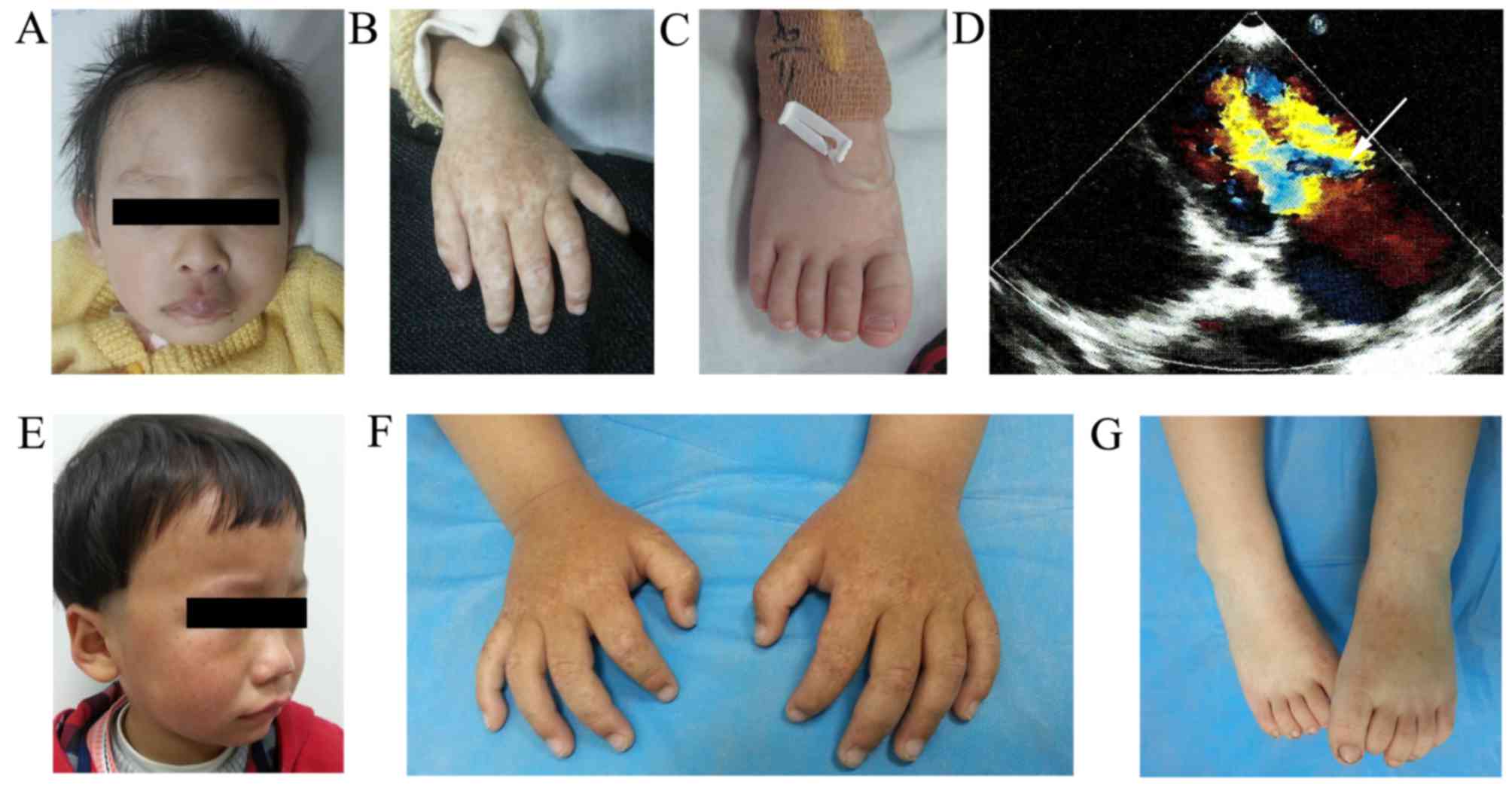
The first patient, an 8-month-old girl, was delivered at 34 weeks by cesarean section due to fetal distress with a birth weight of 1.750 kg. She presented with CHD and hyper- and hypo-pigmented macules on the dorsal aspects of her extremities from birth. On examination at the age of 3 months, an ultrasound revealed a hemangioma and patent foramen ovale. A physical examination revealed a hyperplastic plaque with a healthy skin color (diameter, 2–3 cm) on the central segment of the upper lip (Fig. 1A), and hyper- and hypo-pigmented macules were distributed on the back of her hands (Fig. 1B) and feet (Fig. 1C). Cardiac auscultation revealed a diastolic murmur at the apex, and a diastolic thrill. Levels of creatine kinase isoenzyme-MB were typical; however, the N-terminal pro-brain natriuretic peptide level was 5,140 ng/ml. An echocardiogram disclosed severe mitral valve stenosis and regurgitation (Fig. 1D), mild to moderate aortic regurgitation and left atrium and left ventricle dilation. An electrocardiogram revealed sinus tachycardia and a right bundle branch block. A chest computed tomography scan demonstrated an enlarged cardiac shadow and bilateral large pleural effusions. Ultrasonography revealed a small pleural effusion and fluid in the peritoneal cavity. Based on the clinical features and investigation findings, the diagnoses of CHD, DSH and hemangioma were confirmed.

Figure 1.

Clinical manifestations of the patients. (A) A hemangioma on the central segment of the upper lip in Patient 1. Hyper- and hypo-pigmented macules on (B) the back of the left hand and (C) the right foot in Patient 1. (D) Doppler echocardiogram with a four-chamber view, demonstrating an image suggestive of severe stenosis and regurgitation (white arrow) of the mitral valve in Patient 1. (E) Freckle-like pigmented macules over the face in Patient 2. Hyper- and hypo-pigmented macules over the (F) hands (G) and feet in Patient 2.

At the age of 6 months, mitral valve surgery was undertaken. An echocardiogram following mitral valve surgery revealed moderate to severe mitral valve stenosis and regurgitation with anterior mitral leaflet prolapse, mild to moderate aortic valve regurgitation and left ventricular and left atrium dilation. At 4 days afterwards, similar results were observed in a second echocardiogram, with the exception of rupture of the chordae tendinae. These findings placed the patient at high risk of acute heart failure, which was the cause of death at age 2.

The second patient was a 2-year-old Chinese boy, born following a full-term pregnancy by healthy delivery. He presented with asymptomatic hyper- and hypo-pigmented macules over the dorsum of the hands and feet from birth, and developed freckle-like macules on his face at 1-year-old. Gradually, these lesions progressed. Physical examination revealed that the patient had small freckle-like pigmented macules on his face (Fig. 1E), and hypo- and hyper-pigmented macules on the back of the knees (Fig. 1F) and extremities (Fig. 1G) of irregular shape and size. The rest of the physical examination presented no abnormalities.

ADAR1 mutation analysis

Following informed consent, genomic DNA was extracted from the patients' peripheral blood lymphocytes according to the standard protocol. The present study designed primers flanking all 15 coding exons and intron-exon boundaries of the ADAR1 gene using the web-based version of the Primer 3.0 program (www.genome.wi.mit.edu/cgi-bin/primer/primer3_www.cgi). A polymerase chain reaction (PCR) was performed in a 15 µl reaction volume containing 20 ng genomic DNA, 0.3 mM deoxunucleotides, 0.3 µM each primer, 3.0 mM MgCl2 and 0.1 U Taq DNA polymerase (Roche Diagnostics, Basel, Switzerland). The PCR conditions were as follows: Taq activation at 95°C for 15 min, followed by 40 cycles of denaturation at 94°C for 40 sec, annealing at 58°C for 60 sec and extension at 72°C for 55 sec, except that in the first 10 cycles when annealing temperature decreased from 63 to 58°C by 0.5°C per cycle. The final extension was 72°C for 10 min. Following amplification, the products were purified using a QIAquick PCR Purification kit (Qiagen GmbH, Hilden, Germany). ADAR1 was sequenced using an ABI PRISM® 3730 automated sequencer (Applied Biosystems; Thermo Fisher Scientific, Inc., Waltham, MA, USA). Sequence comparisons and analysis were performed using Phred-Phrap-Consed software version 12.0 (http://www.phrap.org/phredphrapconsed.html). In addition, samples from 120 unrelated population-matched controls were sequenced to exclude the possibility that any discovered mutations were polymorphisms in ADAR1. Mutations were identified by comparing these results with the reported cDNA reference sequence (GenBank accession no. NM_001111).

Results

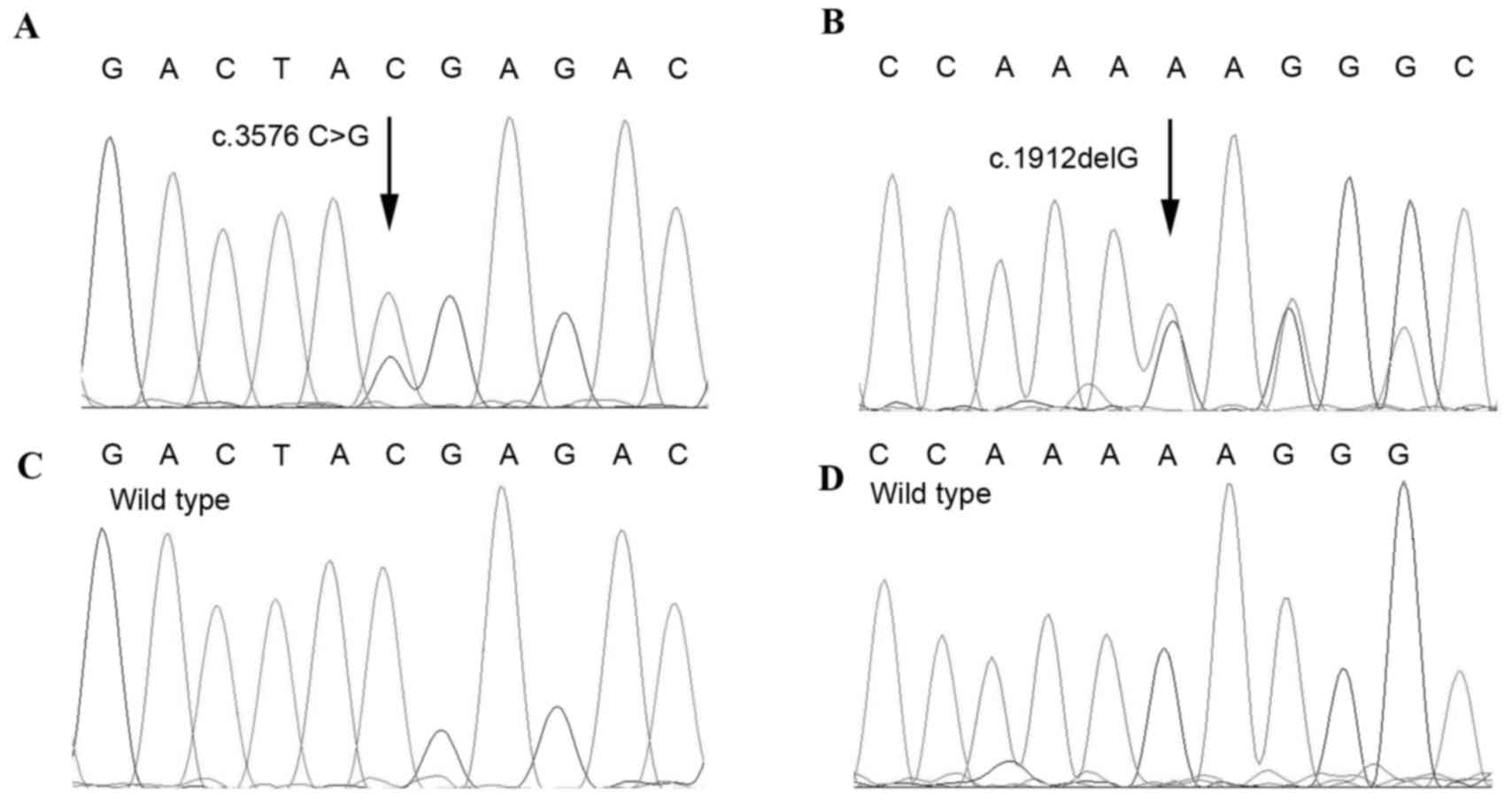
Sequencing analysis of the ADAR1 gene from the two DSH patients was performed. A nonsense mutation at c.3576 C>G (p.Y1192X) in exon 15 of the ADAR1 gene was identified in Patient 1 (Fig. 2A). The resulting truncated protein was predicted to lack 105 amino acids. A single-base frameshift deletion, c.1912delG, was identified within exon 4 in Patient 2, which generated a pre-terminating codon 15 codons downstream of the deletion site (Fig. 2B). These two mutations, which have not been described in previous studies, were not detected in the 120-unrelated healthy Chinese individuals (Fig. 2C and D), suggesting that they are not common polymorphisms.

Figure 2.

Mutations of the adenosine deaminase acting on RNA1 (ADAR1) gene in the two investigated patients. (A) A nonsense mutation of c.3576 C>G (p.Y1192X) mutation in exon 15 of the ADAR1 gene in Patient 1. (B) A frameshift mutation of c.1912delG (p.Glu673ValfsX652) in exon 4 of the ADAR1 gene in Patient 2. (C) The sequence of this region of exon 15 of the ADAR1 gene in healthy subjects. (D) The sequence of the corresponding region of exon 4 of the ADAR1 gene in healthy subjects. Arrowheads indicate the location of the mutations.

Discussion

DSH is an autosomal-dominant skin disorder, characterized by the presence of hyper- and hypo-pigmented macules primarily on the dorsal aspects of the extremities that appear in infancy or early childhood (5,6). Mutations in the ADAR1 gene have been identified as the molecular basis of DSH (2). To date, >120 mutations, distributed primarily in the deaminase domain of ADAR1 (~62.3%), have been reported (7–9). Although the lesions in DSH are common in infancy and early childhood, and typically stop spreading prior adolescence and then remain unaltered for the rest of life, only one patient with DSH since birth has been reported previously (4). In 2009, Hemmati and Lam (4) first reported a 4-year-old Chinese girl who presented at the authors' pediatric dermatology clinic with reticulate hyper- and hypo-pigmentation of the dorsum of the hands and feet that were present since birth; however, gene analysis was not performed. The two patients examined in the present study developed DSH at birth. Sequencing of the overall coding sequence of ADAR1 revealed a nonsense mutation at c.3576C>G (p.Y1192X) in Patient 1 and a single-base deletion c.1912delG (p.Glu673ValfsX652) in Patient 2. To the best of the authors' knowledge, these are novel mutations in the ADAR1 gene. The present study raises the question of whether these two novel ADAR1 mutations are associated with the earlier emergence of DSH. Further investigations of ADAR1 mutations are necessary to confirm this possibility.

Although the comorbidity of DSH and other diseases is uncommon, various complications, including dystonia (10–13), acral hypertrophy (14), psoriasis (15,16) and depression (15) have been reported in patients with DSH. However, a patient with DSH complicated by CHD has not previously been reported. The etiology of CHD is complex and is associated with environmental and genetic causes. Studies in human genetics have led to the identification of >50 human genes (17) involved in isolated CHD or in genetic syndromes where CHD is part of the phenotype. However, none of these genes were primarily associated with malfunctions of the mitral valve; therefore, the present study did not perform mutation analyses on them. Patient 1, who had concurrent CHD, succumbed to congestive heart failure and was identified as having a p.Y1192X mutation in ADAR1. CHD and DSH are hypothesized to be different entities. There is no conclusive evidence that the mutation in ADAR1 causes CHD. Therefore, the coexistence of these two diseases may be a simple coincidence rather than an intrinsic underlying mechanism.

In conclusion, the present study performed a mutation analysis of the ADAR1 gene in two sporadic patients with typical DSH from birth, and identified two novel mutations. To the best of the authors' knowledge, only one case of the existence of DSH since birth has previously been reported. Additionally, the coexistence of DSH and CHD diseases was first reported, and the affected patient succumbed to heart failure. The identification of additional ADAR1 mutations may facilitate understanding of the association between genotype and phenotype in DSH.

Acknowledgements

The authors would like to thank all the subjects for their ongoing participation in the present study. The present study was supported by grants from National Natural Science Foundation of China (grant nos. 81201222 and 81272990).

References

1 

Zhang G, Shao M, Li Z, Gu Y, Du X, Wang X and Li M: Genetic spectrum of dyschromatosis symmetrica hereditaria in Chinese patients including a novel nonstop mutation in ADAR1 gene. BMC Med Genet. 17:142016. View Article : Google Scholar : PubMed/NCBI

2 

Miyamura Y, Suzuki T, Kono M, Inagaki K, Ito S, Suzuki N and Tomita Y: Mutations of the RNA-specific adenosine deaminase gene (DSRAD) are involved in dyschromatosis symmetrica hereditaria. Am J Hum Genet. 73:693–699. 2003. View Article : Google Scholar : PubMed/NCBI

3 

Tomita Y and Suzuki T: Genetics of pigmentary disorders. Am J Med Genet C Semin Med Genet. 131C:75–81. 2004. View Article : Google Scholar : PubMed/NCBI

4 

Hemmati I and Lam J: Hyper-and hypopigmented macules over palms and soles since birth-a case of dyschromatosis symmetrica hereditaria. Dermatol Online J. 15:52009.PubMed/NCBI

5 

Toyama I: Dyschromatosis symmetrica hereditaria. Jpn J Dermatol. 29:95–96. 1929.

6 

Ostlere LS, Ratnavel RC, Lawlor F, Black MM and Griffiths WA: Reticulate acropigmentation of Dohi. Clin Exp Dermatol. 20:477–479. 1995. View Article : Google Scholar : PubMed/NCBI

7 

Li M, Yang L, Li C, Jin C, Lai M, Zhang G, Hu Y, Ji J and Yao Z: Mutational spectrum of the ADAR1 gene in dyschromatosis symmetrica hereditaria. Arch Dermatol Res. 302:469–476. 2010. View Article : Google Scholar : PubMed/NCBI

8 

Stenson PD, Mort M, Ball EV, Howells K, Phillips AD, Thomas NS and Cooper DN: The human gene mutation database: 2008 update. Genome Med. 1:132009. View Article : Google Scholar : PubMed/NCBI

9 

Lai ML, Yang LJ, Zhu XH and Li M: A novel mutation of the DSRAD gene in a Chinese family with dyschromatosis symmetrica hereditaria. Genet Mol Res. 11:1731–1737. 2012. View Article : Google Scholar : PubMed/NCBI

10 

Kondo T, Suzuki T, Ito S, Kono M, Negoro T and Tomita Y: Dyschromatosis symmetrica hereditaria associated with neurological disorders. J Dermatol. 35:662–666. 2008. View Article : Google Scholar : PubMed/NCBI

11 

Tojo K, Sekijima Y, Suzuki T, Suzuki N, Tomita Y, Yoshida K, Hashimoto T and Ikeda S: Dystonia, mental deterioration, and dyschromatosis symmetrica hereditaria in a family with ADAR1 mutation. Mov Disord. 21:1510–1513. 2006. View Article : Google Scholar : PubMed/NCBI

12 

Patrizi A, Manneschi V, Pini A, Baioni E and Ghetti P: Dyschromatosis symmetrica hereditaria associated with idiopathic torsion dystonia. A case report. Acta Derm Venereol. 74:135–137. 1994.PubMed/NCBI

13 

Kaliyadan F, Vinayan KP, Fernandes B and Jayasree MG: Acral dyschromatosis with developmental regression and dystonia in a seven-year-old child: Dyschromatosis symmetrica hereditaria variant or a new syndrome? Indian J Dermatol Venereol Leprol. 75:412–414. 2009. View Article : Google Scholar : PubMed/NCBI

14 

Murata T, Yagi Y, Tanioka M, Suzuki T, Miyachi Y, Morita K and Utani A: Dyschromatosis symmetrica hereditaria with acral hypertrophy. Eur J Dermatol. 21:649–650. 2011.PubMed/NCBI

15 

Luo S, Zheng Y, Ni H, Liu Y, Liu Y, Li X and Liu Q: Novel clinical and molecular findings in Chinese families with dyschromatosis symmetrica hereditaria. J Dermatol. 39:556–558. 2012. View Article : Google Scholar : PubMed/NCBI

16 

Shi BJ, Xue M, Liu Y, Jiang Y and Diao QC: First report of the coexistence of dyschromatosis symmetrica hereditaria and psoriasis: One novel TCT to A mutation in the double-RNA-specific adenosine deaminase gene. J Eur Acad Dermatol Venereol. 26:657–658. 2012. View Article : Google Scholar : PubMed/NCBI

17 

Andersen TA, Kde L Troelsen and Larsen LA: Of mice and men: Molecular genetics of congenital heart disease. Cell Mol Life Sci. 71:1327–1352. 2014. View Article : Google Scholar : PubMed/NCBI

Related Articles

  • Abstract
  • View
  • Download
  • Twitter
Copy and paste a formatted citation
Spandidos Publications style
Zhou Q, Zhang L, Zhang Y, Luo H, Zhu L, Wang P, Zhang G and Wang X: Two novel ADAR1 gene mutations in two patients with dyschromatosis symmetrical hereditaria from birth. Mol Med Rep 15: 3715-3718, 2017.
APA
Zhou, Q., Zhang, L., Zhang, Y., Luo, H., Zhu, L., Wang, P. ... Wang, X. (2017). Two novel ADAR1 gene mutations in two patients with dyschromatosis symmetrical hereditaria from birth. Molecular Medicine Reports, 15, 3715-3718. https://doi.org/10.3892/mmr.2017.6427
MLA
Zhou, Q., Zhang, L., Zhang, Y., Luo, H., Zhu, L., Wang, P., Zhang, G., Wang, X."Two novel ADAR1 gene mutations in two patients with dyschromatosis symmetrical hereditaria from birth". Molecular Medicine Reports 15.6 (2017): 3715-3718.
Chicago
Zhou, Q., Zhang, L., Zhang, Y., Luo, H., Zhu, L., Wang, P., Zhang, G., Wang, X."Two novel ADAR1 gene mutations in two patients with dyschromatosis symmetrical hereditaria from birth". Molecular Medicine Reports 15, no. 6 (2017): 3715-3718. https://doi.org/10.3892/mmr.2017.6427
Copy and paste a formatted citation
x
Spandidos Publications style
Zhou Q, Zhang L, Zhang Y, Luo H, Zhu L, Wang P, Zhang G and Wang X: Two novel ADAR1 gene mutations in two patients with dyschromatosis symmetrical hereditaria from birth. Mol Med Rep 15: 3715-3718, 2017.
APA
Zhou, Q., Zhang, L., Zhang, Y., Luo, H., Zhu, L., Wang, P. ... Wang, X. (2017). Two novel ADAR1 gene mutations in two patients with dyschromatosis symmetrical hereditaria from birth. Molecular Medicine Reports, 15, 3715-3718. https://doi.org/10.3892/mmr.2017.6427
MLA
Zhou, Q., Zhang, L., Zhang, Y., Luo, H., Zhu, L., Wang, P., Zhang, G., Wang, X."Two novel ADAR1 gene mutations in two patients with dyschromatosis symmetrical hereditaria from birth". Molecular Medicine Reports 15.6 (2017): 3715-3718.
Chicago
Zhou, Q., Zhang, L., Zhang, Y., Luo, H., Zhu, L., Wang, P., Zhang, G., Wang, X."Two novel ADAR1 gene mutations in two patients with dyschromatosis symmetrical hereditaria from birth". Molecular Medicine Reports 15, no. 6 (2017): 3715-3718. https://doi.org/10.3892/mmr.2017.6427
Follow us
  • Twitter
  • LinkedIn
  • Facebook
About
  • Spandidos Publications
  • Careers
  • Cookie Policy
  • Privacy Policy
How can we help?
  • Help
  • Live Chat
  • Contact
  • Email to our Support Team