Spandidos Publications Logo
  • About
    • About Spandidos
    • Aims and Scopes
    • Abstracting and Indexing
    • Editorial Policies
    • Reprints and Permissions
    • Job Opportunities
    • Terms and Conditions
    • Contact
  • Journals
    • All Journals
    • Oncology Letters
      • Oncology Letters
      • Information for Authors
      • Editorial Policies
      • Editorial Board
      • Aims and Scope
      • Abstracting and Indexing
      • Bibliographic Information
      • Archive
    • International Journal of Oncology
      • International Journal of Oncology
      • Information for Authors
      • Editorial Policies
      • Editorial Board
      • Aims and Scope
      • Abstracting and Indexing
      • Bibliographic Information
      • Archive
    • Molecular and Clinical Oncology
      • Molecular and Clinical Oncology
      • Information for Authors
      • Editorial Policies
      • Editorial Board
      • Aims and Scope
      • Abstracting and Indexing
      • Bibliographic Information
      • Archive
    • Experimental and Therapeutic Medicine
      • Experimental and Therapeutic Medicine
      • Information for Authors
      • Editorial Policies
      • Editorial Board
      • Aims and Scope
      • Abstracting and Indexing
      • Bibliographic Information
      • Archive
    • International Journal of Molecular Medicine
      • International Journal of Molecular Medicine
      • Information for Authors
      • Editorial Policies
      • Editorial Board
      • Aims and Scope
      • Abstracting and Indexing
      • Bibliographic Information
      • Archive
    • Biomedical Reports
      • Biomedical Reports
      • Information for Authors
      • Editorial Policies
      • Editorial Board
      • Aims and Scope
      • Abstracting and Indexing
      • Bibliographic Information
      • Archive
    • Oncology Reports
      • Oncology Reports
      • Information for Authors
      • Editorial Policies
      • Editorial Board
      • Aims and Scope
      • Abstracting and Indexing
      • Bibliographic Information
      • Archive
    • Molecular Medicine Reports
      • Molecular Medicine Reports
      • Information for Authors
      • Editorial Policies
      • Editorial Board
      • Aims and Scope
      • Abstracting and Indexing
      • Bibliographic Information
      • Archive
    • World Academy of Sciences Journal
      • World Academy of Sciences Journal
      • Information for Authors
      • Editorial Policies
      • Editorial Board
      • Aims and Scope
      • Abstracting and Indexing
      • Bibliographic Information
      • Archive
    • International Journal of Functional Nutrition
      • International Journal of Functional Nutrition
      • Information for Authors
      • Editorial Policies
      • Editorial Board
      • Aims and Scope
      • Abstracting and Indexing
      • Bibliographic Information
      • Archive
    • International Journal of Epigenetics
      • International Journal of Epigenetics
      • Information for Authors
      • Editorial Policies
      • Editorial Board
      • Aims and Scope
      • Abstracting and Indexing
      • Bibliographic Information
      • Archive
    • Medicine International
      • Medicine International
      • Information for Authors
      • Editorial Policies
      • Editorial Board
      • Aims and Scope
      • Abstracting and Indexing
      • Bibliographic Information
      • Archive
  • Articles
  • Information
    • Information for Authors
    • Information for Reviewers
    • Information for Librarians
    • Information for Advertisers
    • Conferences
  • Language Editing
Spandidos Publications Logo
  • About
    • About Spandidos
    • Aims and Scopes
    • Abstracting and Indexing
    • Editorial Policies
    • Reprints and Permissions
    • Job Opportunities
    • Terms and Conditions
    • Contact
  • Journals
    • All Journals
    • Biomedical Reports
      • Information for Authors
      • Editorial Policies
      • Editorial Board
      • Aims and Scope
      • Abstracting and Indexing
      • Bibliographic Information
      • Archive
    • Experimental and Therapeutic Medicine
      • Information for Authors
      • Editorial Policies
      • Editorial Board
      • Aims and Scope
      • Abstracting and Indexing
      • Bibliographic Information
      • Archive
    • International Journal of Epigenetics
      • Information for Authors
      • Editorial Policies
      • Editorial Board
      • Aims and Scope
      • Abstracting and Indexing
      • Bibliographic Information
      • Archive
    • International Journal of Functional Nutrition
      • Information for Authors
      • Editorial Policies
      • Editorial Board
      • Aims and Scope
      • Abstracting and Indexing
      • Bibliographic Information
      • Archive
    • International Journal of Molecular Medicine
      • Information for Authors
      • Editorial Policies
      • Editorial Board
      • Aims and Scope
      • Abstracting and Indexing
      • Bibliographic Information
      • Archive
    • International Journal of Oncology
      • Information for Authors
      • Editorial Policies
      • Editorial Board
      • Aims and Scope
      • Abstracting and Indexing
      • Bibliographic Information
      • Archive
    • Medicine International
      • Information for Authors
      • Editorial Policies
      • Editorial Board
      • Aims and Scope
      • Abstracting and Indexing
      • Bibliographic Information
      • Archive
    • Molecular and Clinical Oncology
      • Information for Authors
      • Editorial Policies
      • Editorial Board
      • Aims and Scope
      • Abstracting and Indexing
      • Bibliographic Information
      • Archive
    • Molecular Medicine Reports
      • Information for Authors
      • Editorial Policies
      • Editorial Board
      • Aims and Scope
      • Abstracting and Indexing
      • Bibliographic Information
      • Archive
    • Oncology Letters
      • Information for Authors
      • Editorial Policies
      • Editorial Board
      • Aims and Scope
      • Abstracting and Indexing
      • Bibliographic Information
      • Archive
    • Oncology Reports
      • Information for Authors
      • Editorial Policies
      • Editorial Board
      • Aims and Scope
      • Abstracting and Indexing
      • Bibliographic Information
      • Archive
    • World Academy of Sciences Journal
      • Information for Authors
      • Editorial Policies
      • Editorial Board
      • Aims and Scope
      • Abstracting and Indexing
      • Bibliographic Information
      • Archive
  • Articles
  • Information
    • For Authors
    • For Reviewers
    • For Librarians
    • For Advertisers
    • Conferences
  • Language Editing
Login Register Submit
  • This site uses cookies
  • You can change your cookie settings at any time by following the instructions in our Cookie Policy. To find out more, you may read our Privacy Policy.

    I agree
Search articles by DOI, keyword, author or affiliation
Search
Advanced Search
presentation
Molecular Medicine Reports
Join Editorial Board Propose a Special Issue
Print ISSN: 1791-2997 Online ISSN: 1791-3004
Journal Cover
December-2017 Volume 16 Issue 6

Full Size Image

Sign up for eToc alerts
Recommend to Library

Journals

International Journal of Molecular Medicine

International Journal of Molecular Medicine

International Journal of Molecular Medicine is an international journal devoted to molecular mechanisms of human disease.

International Journal of Oncology

International Journal of Oncology

International Journal of Oncology is an international journal devoted to oncology research and cancer treatment.

Molecular Medicine Reports

Molecular Medicine Reports

Covers molecular medicine topics such as pharmacology, pathology, genetics, neuroscience, infectious diseases, molecular cardiology, and molecular surgery.

Oncology Reports

Oncology Reports

Oncology Reports is an international journal devoted to fundamental and applied research in Oncology.

Experimental and Therapeutic Medicine

Experimental and Therapeutic Medicine

Experimental and Therapeutic Medicine is an international journal devoted to laboratory and clinical medicine.

Oncology Letters

Oncology Letters

Oncology Letters is an international journal devoted to Experimental and Clinical Oncology.

Biomedical Reports

Biomedical Reports

Explores a wide range of biological and medical fields, including pharmacology, genetics, microbiology, neuroscience, and molecular cardiology.

Molecular and Clinical Oncology

Molecular and Clinical Oncology

International journal addressing all aspects of oncology research, from tumorigenesis and oncogenes to chemotherapy and metastasis.

World Academy of Sciences Journal

World Academy of Sciences Journal

Multidisciplinary open-access journal spanning biochemistry, genetics, neuroscience, environmental health, and synthetic biology.

International Journal of Functional Nutrition

International Journal of Functional Nutrition

Open-access journal combining biochemistry, pharmacology, immunology, and genetics to advance health through functional nutrition.

International Journal of Epigenetics

International Journal of Epigenetics

Publishes open-access research on using epigenetics to advance understanding and treatment of human disease.

Medicine International

Medicine International

An International Open Access Journal Devoted to General Medicine.

Journal Cover
December-2017 Volume 16 Issue 6

Full Size Image

Sign up for eToc alerts
Recommend to Library

  • Article
  • Citations
    • Cite This Article
    • Download Citation
    • Create Citation Alert
    • Remove Citation Alert
    • Cited By
  • Similar Articles
    • Related Articles (in Spandidos Publications)
    • Similar Articles (Google Scholar)
    • Similar Articles (PubMed)
  • Download PDF
  • Download XML
  • View XML
Article

SIRT1 activation by resveratrol reduces brain edema and neuronal apoptosis in an experimental rat subarachnoid hemorrhage model

Retraction in: /10.3892/mmr.2025.13603
  • Authors:
    • Cong Qian
    • Jianxiang Jin
    • Jingyin Chen
    • Jianru Li
    • Xiaobo Yu
    • Hangbo Mo
    • Gao Chen
  • View Affiliations / Copyright

    Affiliations: Department of Neurological Surgery, The Second Affiliated Hospital, Zhejiang University School of Medicine, Hangzhou, Zhejiang 310009, P.R. China
  • Pages: 9627-9635
    |
    Published online on: October 12, 2017
       https://doi.org/10.3892/mmr.2017.7773
  • Expand metrics +
Metrics: Total Views: 0 (Spandidos Publications: | PMC Statistics: )
Metrics: Total PDF Downloads: 0 (Spandidos Publications: | PMC Statistics: )
Cited By (CrossRef): 0 citations Loading Articles...

This article is mentioned in:


Abstract


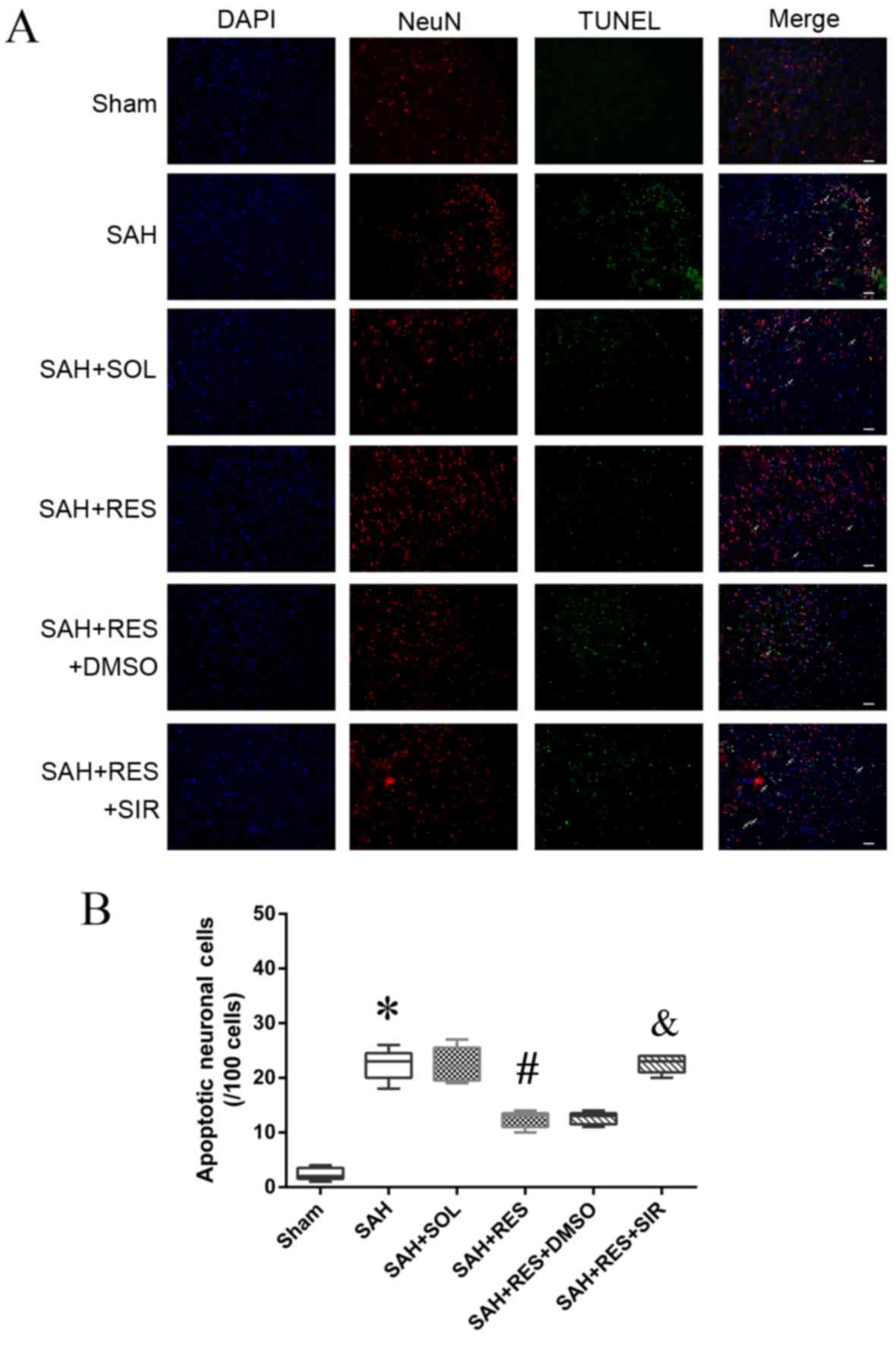
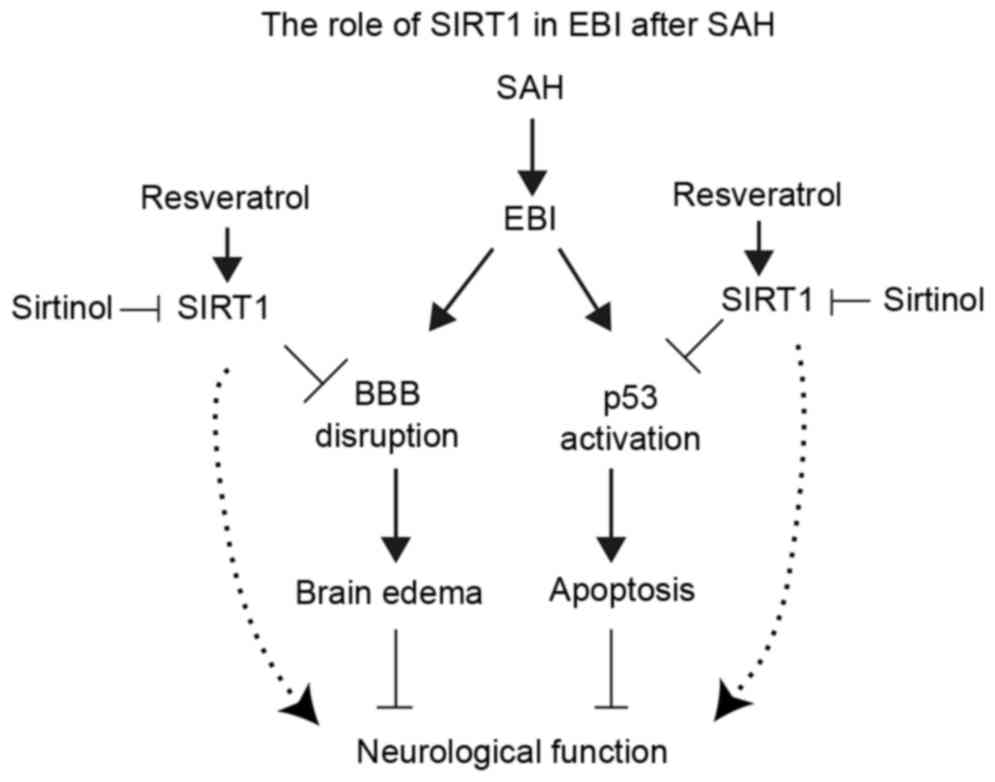
Early brain injury is considered to be a major risk that is related to the prognosis of subarachnoid hemorrhage (SAH). In SAH model rats, brain edema and apoptosis have been closely related with death rate and neurological function. Sirtuin 1 (SIRT1) was reported to be involved in apoptosis in cerebral ischemia and brain tumor formation through p53 deacetylation. The present study aimed to evaluate the role of SIRT1 in a rat endovascular perforation model of SAH. The SIRT1 activator resveratrol (RES) was administered 48 h prior to SAH induction and the SIRT1 inhibitor Sirtinol (SIR) was used to reverse the effects of RES on SIRT1 expression. Mortality rate, neurological function and brain water content were measured 24 h post‑SAH induction. Proteins associated with the blood brain barrier (BBB), apoptosis and SIRT1 in the cortex, such as zona occludens 1 (ZO‑1), occludin, claudin‑5, SIRT1, p53 and cleaved caspase3 were investigated. mRNA expression of the p53 downstream molecules including Bcl‑associated X protein, P53 upregulated modulator of apoptosis, Noxa and BH3 interacting‑domain death agonist were also investigated. Neuronal apoptosis was also investigated by immunofluorescence. RES pretreatment reduced the mortality rate and improved neurological function, which was consistent with reduced brain water content and neuronal apoptosis; these effects were partially reversed by co‑treatment with SIR. SIRT1 may reduce the brain water content by improvement of dysfunctional BBB permeability, and protein analysis revealed that both ZO‑1, occludin and claudin‑5 may be involved, and these effects were reversed by SIRT1 inhibition. SIRT1 may also affect apoptosis post‑SAH through p53 deacetylation, and the analysis of p53 related downstream pro‑apoptotic molecules supported this hypothesis. Localization of neuron specific apoptosis revealed that SIRT1 may regulate neuronal apoptosis following SAH. SIRT1 may also ease brain edema and neuronal protection through BBB improvement and p53 deacetylation. SIRT1 activators such as RES may have the potential to improve the prognosis of patients with SAH and clinical research should be investigated further.
View Figures

Figure 1

Figure 2

Figure 3

Figure 4

Figure 5

Figure 6

Figure 7

View References

1 

Bederson JB, Connolly ES Jr, Batjer HH, Dacey RG, Dion JE, Diringer MN, Duldner JE Jr, Harbaugh RE, Patel AB and Rosenwasser RH; American Heart Association, : Guidelines for the management of aneurysmal subarachnoid hemorrhage: A statement for healthcare professionals from a special writing group of the Stroke Council, American Heart Association. Stroke. 40:994–1025. 2009. View Article : Google Scholar : PubMed/NCBI

2 

Kaptain GJ, Lanzino G and Kassell NF: Subarachnoid haemorrhage: Epidemiology, risk factors, and treatment options. Drugs Aging. 17:183–199. 2000. View Article : Google Scholar : PubMed/NCBI

3 

Weir B, Macdonald RL and Stoodley M: Etiology of cerebral vasospasm. Acta Neurochir Suppl. 72:27–46. 1999.PubMed/NCBI

4 

King JT Jr: Epidemiology of aneurysmal subarachnoid hemorrhage. Neuroimaging Clin N Am. 7:659–668. 1997.PubMed/NCBI

5 

Becker KJ: Epidemiology and clinical presentation of aneurysmal subarachnoid hemorrhage. Neurosurg Clin N Am. 9:435–444. 1998.PubMed/NCBI

6 

Fujii M, Yan J, Rolland WB, Soejima Y, Caner B and Zhang JH: Early brain injury, an evolving frontier in subarachnoid hemorrhage research. Transl Stroke Res. 4:432–446. 2013. View Article : Google Scholar : PubMed/NCBI

7 

Sehba FA, Hou J, Pluta RM and Zhang JH: The importance of early brain injury after subarachnoid hemorrhage. Prog Neurobiol. 97:14–37. 2012. View Article : Google Scholar : PubMed/NCBI

8 

Matz PG, Fujimura M and Chan PH: Subarachnoid hemolysate produces DNA fragmentation in a pattern similar to apoptosis in mouse brain. Brain Res. 858:312–319. 2000. View Article : Google Scholar : PubMed/NCBI

9 

Matz PG, Fujimura M, Lewen A, Morita-Fujimura Y and Chan PH: Increased cytochrome c-mediated DNA fragmentation and cell death in manganese-superoxide dismutase-deficient mice after exposure to subarachnoid hemolysate. Stroke. 32:506–515. 2001. View Article : Google Scholar : PubMed/NCBI

10 

Nau R, Haase S, Bunkowski S and Brück W: Neuronal apoptosis in the dentate gyrus in humans with subarachnoid hemorrhage and cerebral hypoxia. Brain Pathol. 12:329–336. 2002.PubMed/NCBI

11 

Endo H, Nito C, Kamada H, Yu F and Chan PH: Akt/GSK3beta survival signaling is involved in acute brain injury after subarachnoid hemorrhage in rats. Stroke. 37:2140–2146. 2006. View Article : Google Scholar : PubMed/NCBI

12 

Kusaka G, Ishikawa M, Nanda A, Granger DN and Zhang JH: Signaling pathways for early brain injury after subarachnoid hemorrhage. J Cereb Blood Flow Metab. 24:916–925. 2004. View Article : Google Scholar : PubMed/NCBI

13 

Yan J, Chen C, Hu Q, Yang X, Lei J, Yang L, Wang K, Qin L, Huang H and Zhou C: The role of p53 in brain edema after 24 h of experimental subarachnoid hemorrhage in a rat model. Exp Neurol. 214:37–46. 2008. View Article : Google Scholar : PubMed/NCBI

14 

Chen X, Ghribi O and Geiger JD: Caffeine protects against disruptions of the blood-brain barrier in animal models of Alzheimer's and Parkinson's diseases. J Alzheimers Dis. 20 Suppl 1:S127–S141. 2010. View Article : Google Scholar : PubMed/NCBI

15 

Engelhardt B and Sorokin L: The blood-brain and the blood-cerebrospinal fluid barriers: Function and dysfunction. Semin Immunopathol. 31:497–511. 2009. View Article : Google Scholar : PubMed/NCBI

16 

Sugawara T, Jadhav V, Ayer R, Chen W, Suzuki H and Zhang JH: Thrombin inhibition by argatroban ameliorates early brain injury and improves neurological outcomes after experimental subarachnoid hemorrhage in rats. Stroke. 40:1530–1532. 2009. View Article : Google Scholar : PubMed/NCBI

17 

Kim WJ, Rivera MN, Coffman EJ and Haber DA: The WTX tumor suppressor enhances p53 acetylation by CBP/p300. Mol Cell. 45:587–597. 2012. View Article : Google Scholar : PubMed/NCBI

18 

Sykes SM, Mellert HS, Holbert MA, Li K, Marmorstein R, Lane WS and McMahon SB: Acetylation of the p53 DNA-binding domain regulates apoptosis induction. Mol Cell. 24:841–851. 2006. View Article : Google Scholar : PubMed/NCBI

19 

Tang Y, Luo J, Zhang W and Gu W: Tip60-dependent acetylation of p53 modulates the decision between cell-cycle arrest and apoptosis. Mol Cell. 24:827–839. 2006. View Article : Google Scholar : PubMed/NCBI

20 

Gu W and Roeder RG: Activation of p53 sequence-specific DNA binding by acetylation of the p53 C-terminal domain. Cell. 90:595–606. 1997. View Article : Google Scholar : PubMed/NCBI

21 

Cahill J, Calvert JW, Marcantonio S and Zhang JH: p53 may play an orchestrating role in apoptotic cell death after experimental subarachnoid hemorrhage. Neurosurgery. 60:531–545. 2007. View Article : Google Scholar : PubMed/NCBI

22 

Miyashita T, Krajewski S, Krajewska M, Wang HG, Lin HK, Liebermann DA, Hoffman B and Reed JC: Tumor suppressor p53 is a regulator of bcl-2 and bax gene expression in vitro and in vivo. Oncogene. 9:1799–1805. 1994.PubMed/NCBI

23 

Nakano K and Vousden KH: A novel proapoptotic gene, is induced by p53. Mol Cell. 7:683–694. 2001. View Article : Google Scholar : PubMed/NCBI

24 

Oda E, Ohki R, Murasawa H, Nemoto J, Shibue T, Yamashita T, Tokino T, Taniguchi T and Tanaka N: Noxa, a BH3-only member of the Bcl-2 family and candidate mediator of p53-induced apoptosis. Science. 288:1053–1058. 2000. View Article : Google Scholar : PubMed/NCBI

25 

Becatti M, Taddei N, Cecchi C, Nassi N, Nassi PA and Fiorillo C: SIRT1 modulates MAPK pathways in ischemic-reperfused cardiomyocytes. Cell Mol Life Sci. 69:2245–2260. 2012. View Article : Google Scholar : PubMed/NCBI

26 

Wang P, Xu TY, Guan YF, Tian WW, Viollet B, Rui YC, Zhai QW, Su DF and Miao CY: Nicotinamide phosphoribosyltransferase protects against ischemic stroke through SIRT1-dependent adenosine monophosphate-activated kinase pathway. Ann Neurol. 69:360–374. 2011. View Article : Google Scholar : PubMed/NCBI

27 

Yan W, Fang Z, Yang Q, Dong H, Lu Y, Lei C and Xiong L: SirT1 mediates hyperbaric oxygen preconditioning-induced ischemic tolerance in rat brain. J Cereb Blood Flow Metab. 33:396–406. 2013. View Article : Google Scholar : PubMed/NCBI

28 

Zhou XM, Zhang X, Zhang XS, Zhuang Z, Li W, Sun Q, Li T, Wang CX, Zhu L, Shi JX and Zhou ML: SIRT1 inhibition by sirtinol aggravates brain edema after experimental subarachnoid hemorrhage. J Neurosci Res. 92:714–722. 2014. View Article : Google Scholar : PubMed/NCBI

29 

Della-Morte D, Dave KR, DeFazio RA, Bao YC, Raval AP and Perez-Pinzon MA: Resveratrol pretreatment protects rat brain from cerebral ischemic damage via a sirtuin 1-uncoupling protein 2 pathway. Neuroscience. 159:993–1002. 2009. View Article : Google Scholar : PubMed/NCBI

30 

Sugawara T, Ayer R, Jadhav V and Zhang JH: A new grading system evaluating bleeding scale in filament perforation subarachnoid hemorrhage rat model. J Neurosci Methods. 167:327–334. 2008. View Article : Google Scholar : PubMed/NCBI

31 

Chen S, Ma Q, Krafft PR, Chen Y, Tang J, Zhang J and Zhang JH: P2X7 receptor antagonism inhibits p38 mitogen-activated protein kinase activation and ameliorates neuronal apoptosis after subarachnoid hemorrhage in rats. Crit Care Med. 41:e466–e474. 2013. View Article : Google Scholar : PubMed/NCBI

32 

Garcia JH, Wagner S, Liu KF and Hu XJ: Neurological deficit and extent of neuronal necrosis attributable to middle cerebral artery occlusion in rats. Statistical validation. 26:627–635. 1995.

33 

Livak KJ and Schmittgen TD: Analysis of relative gene expression data using real-time quantitative PCR and the 2(-Delta Delta C(T)) method. Methods. 25:402–408. 2001. View Article : Google Scholar : PubMed/NCBI

34 

Broderick JP, Brott TG, Duldner JE, Tomsick T and Leach A: Initial and recurrent bleeding are the major causes of death following subarachnoid hemorrhage. Stroke. 25:1342–1347. 1994. View Article : Google Scholar : PubMed/NCBI

35 

Shao AW, Wu HJ, Chen S, Ammar AB, Zhang JM and Hong Y: Resveratrol attenuates early brain injury after subarachnoid hemorrhage through inhibition of NF-κB-dependent inflammatory/MMP-9 pathway. CNS Neurosci Ther. 20:182–185. 2014. View Article : Google Scholar : PubMed/NCBI

36 

Zhang XS, Li W, Wu Q, Wu LY, Ye ZN, Liu JP, Zhuang Z, Zhou ML, Zhang X and Hang CH: Resveratrol attenuates acute inflammatory injury in experimental subarachnoid hemorrhage in rats via inhibition of TLR4 pathway. Int J Mol Sci. 17:pii: E13312016. View Article : Google Scholar

37 

Claassen J, Carhuapoma JR, Kreiter KT, Du EY, Connolly ES and Mayer SA: Global cerebral edema after subarachnoid hemorrhage: Frequency, predictors, and impact on outcome. Stroke. 33:1225–1232. 2002. View Article : Google Scholar : PubMed/NCBI

38 

Unterberg AW, Stover J, Kress B and Kiening KL: Edema and brain trauma. Neuroscience. 129:1021–1029. 2004. View Article : Google Scholar : PubMed/NCBI

39 

Suzuki H, Hasegawa Y, Kanamaru K and Zhang JH: Mechanisms of osteopontin-induced stabilization of blood-brain barrier disruption after subarachnoid hemorrhage in rats. Stroke. 41:1783–1790. 2010. View Article : Google Scholar : PubMed/NCBI

40 

Kniesel U and Wolburg H: Tight junctions of the blood-brain barrier. Cell Mol Neurobiol. 20:57–76. 2000. View Article : Google Scholar : PubMed/NCBI

41 

Fang S, Jensen JP, Ludwig RL, Vousden KH and Weissman AM: Mdm2 is a RING finger-dependent ubiquitin protein ligase for itself and p53. J Biol Chem. 275:8945–8951. 2000. View Article : Google Scholar : PubMed/NCBI

42 

Liebner S, Kniesel U, Kalbacher H and Wolburg H: Correlation of tight junction morphology with the expression of tight junction proteins in blood-brain barrier endothelial cells. Eur J Cell Biol. 79:707–717. 2000. View Article : Google Scholar : PubMed/NCBI

43 

Zhao L, Liu H, Yue L, Zhang J, Li X, Wang B, Lin Y and Qu Y: Melatonin attenuates early brain injury via the melatonin receptor/Sirt1/NF-κB signaling pathway following subarachnoid hemorrhage in mice. Mol Neurobiol. 54:1612–1621. 2017. View Article : Google Scholar : PubMed/NCBI

44 

Asahi M, Wang X, Mori T, Sumii T, Jung JC, Moskowitz MA, Fini ME and Lo EH: Effects of matrix metalloproteinase-9 gene knock-out on the proteolysis of blood-brain barrier and white matter components after cerebral ischemia. J Neurosci. 21:7724–7732. 2001.PubMed/NCBI

45 

Bauer AT, Bürgers HF, Rabie T and Marti HH: Matrix metalloproteinase-9 mediates hypoxia-induced vascular leakage in the brain via tight junction rearrangement. J Cereb Blood Flow Metab. 30:837–848. 2010. View Article : Google Scholar : PubMed/NCBI

46 

Cunnea P, McMahon J, O'Connell E, Mashayekhi K, Fitzgerald U and McQuaid S: Gene expression analysis of the microvascular compartment in multiple sclerosis using laser microdissected blood vessels. Acta Neuropathol. 119:601–615. 2010. View Article : Google Scholar : PubMed/NCBI

47 

Yang Y, Estrada EY, Thompson JF, Liu W and Rosenberg GA: Matrix metalloproteinase-mediated disruption of tight junction proteins in cerebral vessels is reversed by synthetic matrix metalloproteinase inhibitor in focal ischemia in rat. J Cereb Blood Flow Metab. 27:697–709. 2007. View Article : Google Scholar : PubMed/NCBI

48 

Wei H, Wang S, Zhen L, Yang Q, Wu Z, Lei X, Lv J, Xiong L and Xue R: Resveratrol attenuates the blood-brain barrier dysfunction by regulation of the MMP-9/TIMP-1 balance after cerebral ischemia reperfusion in rats. J Mol Neurosci. 55:872–879. 2015. View Article : Google Scholar : PubMed/NCBI

49 

Cohen M, Wuillemin C, Irion O and Bischof P: Regulation of MMP-9 by p53 in first trimester cytotrophoblastic cells. Hum Reprod. 23:2273–2281. 2008. View Article : Google Scholar : PubMed/NCBI

50 

Vaziri H, Dessain SK, Ng Eaton E, Imai SI, Frye RA, Pandita TK, Guarente L and Weinberg RA: hSIR2(SIRT1) functions as an NAD-dependent p53 deacetylase. Cell. 107:149–159. 2001. View Article : Google Scholar : PubMed/NCBI

51 

Li M, Luo J, Brooks CL and Gu W: Acetylation of p53 inhibits its ubiquitination by Mdm2. J Biol Chem. 277:50607–50611. 2002. View Article : Google Scholar : PubMed/NCBI

Related Articles

  • Abstract
  • View
  • Download
  • Twitter
Copy and paste a formatted citation
Spandidos Publications style
Qian C, Jin J, Chen J, Li J, Yu X, Mo H and Chen G: SIRT1 activation by resveratrol reduces brain edema and neuronal apoptosis in an experimental rat subarachnoid hemorrhage model Retraction in /10.3892/mmr.2025.13603. Mol Med Rep 16: 9627-9635, 2017.
APA
Qian, C., Jin, J., Chen, J., Li, J., Yu, X., Mo, H., & Chen, G. (2017). SIRT1 activation by resveratrol reduces brain edema and neuronal apoptosis in an experimental rat subarachnoid hemorrhage model Retraction in /10.3892/mmr.2025.13603. Molecular Medicine Reports, 16, 9627-9635. https://doi.org/10.3892/mmr.2017.7773
MLA
Qian, C., Jin, J., Chen, J., Li, J., Yu, X., Mo, H., Chen, G."SIRT1 activation by resveratrol reduces brain edema and neuronal apoptosis in an experimental rat subarachnoid hemorrhage model Retraction in /10.3892/mmr.2025.13603". Molecular Medicine Reports 16.6 (2017): 9627-9635.
Chicago
Qian, C., Jin, J., Chen, J., Li, J., Yu, X., Mo, H., Chen, G."SIRT1 activation by resveratrol reduces brain edema and neuronal apoptosis in an experimental rat subarachnoid hemorrhage model Retraction in /10.3892/mmr.2025.13603". Molecular Medicine Reports 16, no. 6 (2017): 9627-9635. https://doi.org/10.3892/mmr.2017.7773
Copy and paste a formatted citation
x
Spandidos Publications style
Qian C, Jin J, Chen J, Li J, Yu X, Mo H and Chen G: SIRT1 activation by resveratrol reduces brain edema and neuronal apoptosis in an experimental rat subarachnoid hemorrhage model Retraction in /10.3892/mmr.2025.13603. Mol Med Rep 16: 9627-9635, 2017.
APA
Qian, C., Jin, J., Chen, J., Li, J., Yu, X., Mo, H., & Chen, G. (2017). SIRT1 activation by resveratrol reduces brain edema and neuronal apoptosis in an experimental rat subarachnoid hemorrhage model Retraction in /10.3892/mmr.2025.13603. Molecular Medicine Reports, 16, 9627-9635. https://doi.org/10.3892/mmr.2017.7773
MLA
Qian, C., Jin, J., Chen, J., Li, J., Yu, X., Mo, H., Chen, G."SIRT1 activation by resveratrol reduces brain edema and neuronal apoptosis in an experimental rat subarachnoid hemorrhage model Retraction in /10.3892/mmr.2025.13603". Molecular Medicine Reports 16.6 (2017): 9627-9635.
Chicago
Qian, C., Jin, J., Chen, J., Li, J., Yu, X., Mo, H., Chen, G."SIRT1 activation by resveratrol reduces brain edema and neuronal apoptosis in an experimental rat subarachnoid hemorrhage model Retraction in /10.3892/mmr.2025.13603". Molecular Medicine Reports 16, no. 6 (2017): 9627-9635. https://doi.org/10.3892/mmr.2017.7773
Follow us
  • Twitter
  • LinkedIn
  • Facebook
About
  • Spandidos Publications
  • Careers
  • Cookie Policy
  • Privacy Policy
How can we help?
  • Help
  • Live Chat
  • Contact
  • Email to our Support Team