Spandidos Publications Logo
  • About
    • About Spandidos
    • Aims and Scopes
    • Abstracting and Indexing
    • Editorial Policies
    • Reprints and Permissions
    • Job Opportunities
    • Terms and Conditions
    • Contact
  • Journals
    • All Journals
    • Oncology Letters
      • Oncology Letters
      • Information for Authors
      • Editorial Policies
      • Editorial Board
      • Aims and Scope
      • Abstracting and Indexing
      • Bibliographic Information
      • Archive
    • International Journal of Oncology
      • International Journal of Oncology
      • Information for Authors
      • Editorial Policies
      • Editorial Board
      • Aims and Scope
      • Abstracting and Indexing
      • Bibliographic Information
      • Archive
    • Molecular and Clinical Oncology
      • Molecular and Clinical Oncology
      • Information for Authors
      • Editorial Policies
      • Editorial Board
      • Aims and Scope
      • Abstracting and Indexing
      • Bibliographic Information
      • Archive
    • Experimental and Therapeutic Medicine
      • Experimental and Therapeutic Medicine
      • Information for Authors
      • Editorial Policies
      • Editorial Board
      • Aims and Scope
      • Abstracting and Indexing
      • Bibliographic Information
      • Archive
    • International Journal of Molecular Medicine
      • International Journal of Molecular Medicine
      • Information for Authors
      • Editorial Policies
      • Editorial Board
      • Aims and Scope
      • Abstracting and Indexing
      • Bibliographic Information
      • Archive
    • Biomedical Reports
      • Biomedical Reports
      • Information for Authors
      • Editorial Policies
      • Editorial Board
      • Aims and Scope
      • Abstracting and Indexing
      • Bibliographic Information
      • Archive
    • Oncology Reports
      • Oncology Reports
      • Information for Authors
      • Editorial Policies
      • Editorial Board
      • Aims and Scope
      • Abstracting and Indexing
      • Bibliographic Information
      • Archive
    • Molecular Medicine Reports
      • Molecular Medicine Reports
      • Information for Authors
      • Editorial Policies
      • Editorial Board
      • Aims and Scope
      • Abstracting and Indexing
      • Bibliographic Information
      • Archive
    • World Academy of Sciences Journal
      • World Academy of Sciences Journal
      • Information for Authors
      • Editorial Policies
      • Editorial Board
      • Aims and Scope
      • Abstracting and Indexing
      • Bibliographic Information
      • Archive
    • International Journal of Functional Nutrition
      • International Journal of Functional Nutrition
      • Information for Authors
      • Editorial Policies
      • Editorial Board
      • Aims and Scope
      • Abstracting and Indexing
      • Bibliographic Information
      • Archive
    • International Journal of Epigenetics
      • International Journal of Epigenetics
      • Information for Authors
      • Editorial Policies
      • Editorial Board
      • Aims and Scope
      • Abstracting and Indexing
      • Bibliographic Information
      • Archive
    • Medicine International
      • Medicine International
      • Information for Authors
      • Editorial Policies
      • Editorial Board
      • Aims and Scope
      • Abstracting and Indexing
      • Bibliographic Information
      • Archive
  • Articles
  • Information
    • Information for Authors
    • Information for Reviewers
    • Information for Librarians
    • Information for Advertisers
    • Conferences
  • Language Editing
Spandidos Publications Logo
  • About
    • About Spandidos
    • Aims and Scopes
    • Abstracting and Indexing
    • Editorial Policies
    • Reprints and Permissions
    • Job Opportunities
    • Terms and Conditions
    • Contact
  • Journals
    • All Journals
    • Biomedical Reports
      • Information for Authors
      • Editorial Policies
      • Editorial Board
      • Aims and Scope
      • Abstracting and Indexing
      • Bibliographic Information
      • Archive
    • Experimental and Therapeutic Medicine
      • Information for Authors
      • Editorial Policies
      • Editorial Board
      • Aims and Scope
      • Abstracting and Indexing
      • Bibliographic Information
      • Archive
    • International Journal of Epigenetics
      • Information for Authors
      • Editorial Policies
      • Editorial Board
      • Aims and Scope
      • Abstracting and Indexing
      • Bibliographic Information
      • Archive
    • International Journal of Functional Nutrition
      • Information for Authors
      • Editorial Policies
      • Editorial Board
      • Aims and Scope
      • Abstracting and Indexing
      • Bibliographic Information
      • Archive
    • International Journal of Molecular Medicine
      • Information for Authors
      • Editorial Policies
      • Editorial Board
      • Aims and Scope
      • Abstracting and Indexing
      • Bibliographic Information
      • Archive
    • International Journal of Oncology
      • Information for Authors
      • Editorial Policies
      • Editorial Board
      • Aims and Scope
      • Abstracting and Indexing
      • Bibliographic Information
      • Archive
    • Medicine International
      • Information for Authors
      • Editorial Policies
      • Editorial Board
      • Aims and Scope
      • Abstracting and Indexing
      • Bibliographic Information
      • Archive
    • Molecular and Clinical Oncology
      • Information for Authors
      • Editorial Policies
      • Editorial Board
      • Aims and Scope
      • Abstracting and Indexing
      • Bibliographic Information
      • Archive
    • Molecular Medicine Reports
      • Information for Authors
      • Editorial Policies
      • Editorial Board
      • Aims and Scope
      • Abstracting and Indexing
      • Bibliographic Information
      • Archive
    • Oncology Letters
      • Information for Authors
      • Editorial Policies
      • Editorial Board
      • Aims and Scope
      • Abstracting and Indexing
      • Bibliographic Information
      • Archive
    • Oncology Reports
      • Information for Authors
      • Editorial Policies
      • Editorial Board
      • Aims and Scope
      • Abstracting and Indexing
      • Bibliographic Information
      • Archive
    • World Academy of Sciences Journal
      • Information for Authors
      • Editorial Policies
      • Editorial Board
      • Aims and Scope
      • Abstracting and Indexing
      • Bibliographic Information
      • Archive
  • Articles
  • Information
    • For Authors
    • For Reviewers
    • For Librarians
    • For Advertisers
    • Conferences
  • Language Editing
Login Register Submit
  • This site uses cookies
  • You can change your cookie settings at any time by following the instructions in our Cookie Policy. To find out more, you may read our Privacy Policy.

    I agree
Search articles by DOI, keyword, author or affiliation
Search
Advanced Search
presentation
Molecular Medicine Reports
Join Editorial Board Propose a Special Issue
Print ISSN: 1791-2997 Online ISSN: 1791-3004
Journal Cover
April-2019 Volume 19 Issue 4

Full Size Image

Sign up for eToc alerts
Recommend to Library

Journals

International Journal of Molecular Medicine

International Journal of Molecular Medicine

International Journal of Molecular Medicine is an international journal devoted to molecular mechanisms of human disease.

International Journal of Oncology

International Journal of Oncology

International Journal of Oncology is an international journal devoted to oncology research and cancer treatment.

Molecular Medicine Reports

Molecular Medicine Reports

Covers molecular medicine topics such as pharmacology, pathology, genetics, neuroscience, infectious diseases, molecular cardiology, and molecular surgery.

Oncology Reports

Oncology Reports

Oncology Reports is an international journal devoted to fundamental and applied research in Oncology.

Experimental and Therapeutic Medicine

Experimental and Therapeutic Medicine

Experimental and Therapeutic Medicine is an international journal devoted to laboratory and clinical medicine.

Oncology Letters

Oncology Letters

Oncology Letters is an international journal devoted to Experimental and Clinical Oncology.

Biomedical Reports

Biomedical Reports

Explores a wide range of biological and medical fields, including pharmacology, genetics, microbiology, neuroscience, and molecular cardiology.

Molecular and Clinical Oncology

Molecular and Clinical Oncology

International journal addressing all aspects of oncology research, from tumorigenesis and oncogenes to chemotherapy and metastasis.

World Academy of Sciences Journal

World Academy of Sciences Journal

Multidisciplinary open-access journal spanning biochemistry, genetics, neuroscience, environmental health, and synthetic biology.

International Journal of Functional Nutrition

International Journal of Functional Nutrition

Open-access journal combining biochemistry, pharmacology, immunology, and genetics to advance health through functional nutrition.

International Journal of Epigenetics

International Journal of Epigenetics

Publishes open-access research on using epigenetics to advance understanding and treatment of human disease.

Medicine International

Medicine International

An International Open Access Journal Devoted to General Medicine.

Journal Cover
April-2019 Volume 19 Issue 4

Full Size Image

Sign up for eToc alerts
Recommend to Library

  • Article
  • Citations
    • Cite This Article
    • Download Citation
    • Create Citation Alert
    • Remove Citation Alert
    • Cited By
  • Similar Articles
    • Related Articles (in Spandidos Publications)
    • Similar Articles (Google Scholar)
    • Similar Articles (PubMed)
  • Download PDF
  • Download XML
  • View XML
Article Open Access

PITX3 mutations associated with autosomal dominant congenital cataract in the Chinese population

  • Authors:
    • Zehua Wu
    • Delong Meng
    • Chengbo Fang
    • Jian Li
    • Xiujie Zheng
    • Jiansuo Lin
    • Haijiang Zeng
    • Sihan Lv
    • Zhenning Zhang
    • Bing Luan
    • Zilin Zhong
    • Jianjun Chen
  • View Affiliations / Copyright

    Affiliations: Department of Ophthalmology, Shanghai Tenth People's Hospital and Tongji Eye Institute, Tongji University School of Medicine, Shanghai 200092, P.R. China, Department of Ophthalmology, The First Affiliated Hospital of Anhui Medical University, Hefei, Anhui 230032, P.R. China, Department of Endocrinology, Shanghai Tenth People's Hospital and Tongji Eye Institute, Tongji University School of Medicine, Shanghai 200092, P.R. China, Department of Pediatrics, Ganzhou People's Hospital, Ganzhou, Jiangxi 341000, P.R. China, Translational Medical Center for Stem Cell Therapy and Institute for Regenerative Medicine, Shanghai East Hospital, Shanghai Key Laboratory of Signaling and Disease Research, School of Life Science and Technology, Tongji University, Shanghai 200092, P.R. China
    Copyright: © Wu et al. This is an open access article distributed under the terms of Creative Commons Attribution License.
  • Pages: 3123-3131
    |
    Published online on: February 26, 2019
       https://doi.org/10.3892/mmr.2019.9989
  • Expand metrics +
Metrics: Total Views: 0 (Spandidos Publications: | PMC Statistics: )
Metrics: Total PDF Downloads: 0 (Spandidos Publications: | PMC Statistics: )
Cited By (CrossRef): 0 citations Loading Articles...

This article is mentioned in:


Abstract

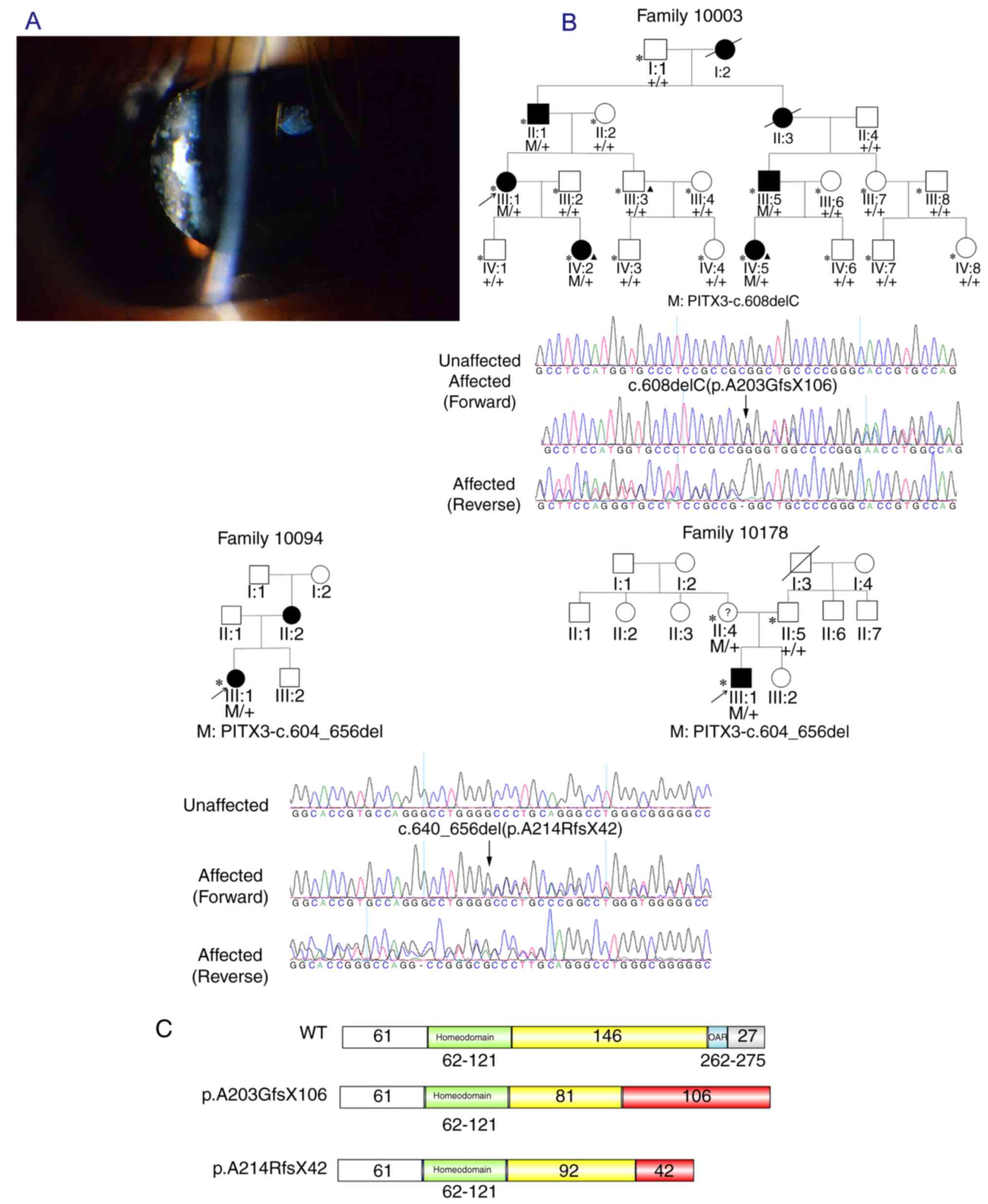
The present study aimed to identify the disease‑causing gene of a four‑generation Chinese family affected with congenital posterior subcapsular cataracts (CPSC), to additionally investigate the frequency of paired like homeodomain 3 (PITX3) mutations in Chinese patients with autosomal dominant congenital cataract (ADCC) and to analyze the pathogenesis of the mutations identified in the present study. Whole exome sequencing (WES) was utilized to identify the genetic cause of CPSC in the four‑generation family. Sanger sequencing was performed to verify the WES results and to screen for mutations of the PITX3 gene in probands of an additional 194 Chinese ADCC families. Co‑segregation analysis was performed in the family members with available DNA. Subcellular localization analyses and transactivation assays were performed for the PITX3 mutations identified. From the WES data, the c.608delC (p.A203GfsX106) mutation of PITX3 was identified in the four‑generation family with CPSC. A second PITX3 mutation c.640_656del (p.A214RfsX42) was detected in two of the additional 194 ADCC families and one of these two families exhibited incomplete penetrance. Functional studies indicated that these 2 PITX3 mutant proteins retained a nuclear localization pattern, but resulted in decreased transactivation activity, similar to other previously identified PITX3 mutations. In the present study, 2 different mutations (p.A203GfsX106 and p.A214RfsX42) in PITX3 were identified as the causative defect in a four‑generation family with CPSC and two ADCC families, respectively. The prevalence of PITX3 gene‑associated cataract was 1.54% (3/195) in the Chinese congenital cataract (CC) family cohort. In vitro functional analyses of these 2 PITX3 mutations were performed, in order to enhance understanding of the pathogenesis of CC caused by PITX3 mutations.
View Figures

Figure 1

Figure 2

View References

1 

WHO. Visual impairment and blindness, . 2014.http://www.who.int/mediacentre/factsheets/fs282/en/May 14–2016

2 

Liu YC, Wilkins M, Kim T, Malyugin B and Mehta JS: Cataracts. Lancet. 390:6002017. View Article : Google Scholar : PubMed/NCBI

3 

Li FF, Zhu SQ, Wang SZ, Gao C, Huang SZ, Zhang M and Ma X: Nonsense mutation in the CRYBB2 gene causing autosomal dominant progressive polymorphic congenital coronary cataracts. Mol Vis. 14:750–755. 2008.PubMed/NCBI

4 

Zhong Z, Wu Z, Han L and Chen J: Novel mutations in CRYGC are associated with congenital cataracts in Chinese families. Sci Rep. 7:1892017. View Article : Google Scholar : PubMed/NCBI

5 

Shiels A and Hejtmancik JF: Molecular genetics of cataract. John Wiley & Sons, Ltd. 37:672014.

6 

Brémond-Gignac D, Bitoun P, Reis LM, Copin H, Murray JC and Semina EV: Identification of dominant FOXE3 and PAX6 mutations in patients with congenital cataract and aniridia. Mol Vis. 16:1705–1711. 2010.PubMed/NCBI

7 

Aldahmesh MA, Khan AO, Mohamed J and Alkuraya FS: Novel recessive BFSP2 and PITX3 mutations: Insights into mutational mechanisms from consanguineous populations. Genet Med. 13:978–981. 2011. View Article : Google Scholar : PubMed/NCBI

8 

Kent WJ, Sugnet CW, Furey TS, Roskin KM, Pringle TH, Zahler AM and Haussler D: The human genome browser at UCSC. Genome Res. 12:996–1006. 2002. View Article : Google Scholar : PubMed/NCBI

9 

Robinson JT, Thorvaldsdóttir H, Winckler W, Guttman M, Lander ES, Getz G and Mesirov JP: Integrative genomics viewer. Nat Biotechnol. 29:24–26. 2011. View Article : Google Scholar : PubMed/NCBI

10 

Sorokina EA, Muheisen S, Mlodik N and Semina EV: MIP/Aquaporin 0 represents a direct transcriptional target of PITX3 in the developing lens. PLoS One. 6:e211222011. View Article : Google Scholar : PubMed/NCBI

11 

Deng H and Yuan L: Molecular genetics of congenital nuclear cataract. Eur J Med Genet. 57:113–122. 2014. View Article : Google Scholar : PubMed/NCBI

12 

Adamsons I, Muñoz B, Enger C and Taylor HR: Prevalence of lens opacities in surgical and general populations. Arch Ophthalmol. 109:993–997. 1991. View Article : Google Scholar : PubMed/NCBI

13 

Shiels A, Bennett TM and Hejtmancik JF: Cat-Map: Putting cataract on the map. Mol Vis. 16:2007–2015. 2010.PubMed/NCBI

14 

Verdin H, Sorokina EA, Meire F, Casteels I, de Ravel T, Semina EV and De Baere E: Novel and recurrent PITX3 mutations in Belgian families with autosomal dominant congenital cataract and anterior segment dysgenesis have similar phenotypic and functional characteristics. Orphanet J Rare Dis. 9:262014. View Article : Google Scholar : PubMed/NCBI

15 

Semina EV, Ferrell RE, Mintz-Hittner HA, Bitoun P, Alward WL, Reiter RS, Funkhauser C, Daack-Hirsch S and Murray JC: A novel homeobox gene PITX3 is mutated in families with autosomal-dominant cataracts and ASMD. Nat Genet. 19:167–170. 1998. View Article : Google Scholar : PubMed/NCBI

16 

Berry V, Francis PJ, Prescott Q, Waseem NH, Moore AT and Bhattacharya SS: A novel 1-bp deletion in PITX3 causing congenital posterior polar cataract. Mol Vis. 17:1249–1253. 2011.PubMed/NCBI

17 

Liu H, Liu H, Tang J, Lin Q, Sun Y, Wang C, Yang H, Khan MR, Peerbux MW, Ahmad S, et al: Whole exome sequencing identifies a novel mutation in the PITX3 gene, causing autosomal dominant congenital cataracts in a Chinese family. Ann Clin Lab Sci. 47:92–95. 2017.PubMed/NCBI

18 

Berry V, Yang Z, Addison PK, Francis PJ, Ionides A, Karan G, Jiang L, Lin W, Hu J, Yang R, et al: Recurrent 17 bp duplication in PITX3 is primarily associated with posterior polar cataract (CPP4). J Med Genet. 41:e1092004. View Article : Google Scholar : PubMed/NCBI

19 

Finzi S, Li Y, Mitchell TN, Farr A, Maumenee IH, Sallum JM and Sundin O: Posterior polar cataract: Genetic analysis of a large family. Ophthalmic Genet. 26:125–130. 2005. View Article : Google Scholar : PubMed/NCBI

20 

Burdon KP, McKay JD, Wirth MG, Russell-Eggit IM, Bhatti S, Ruddle JB, Dimasi D, Mackey DA and Craig JE: The PITX3 gene in posterior polar congenital cataract in Australia. Mol Vis. 12:367–371. 2006.PubMed/NCBI

21 

Summers KM, Withers SJ, Gole GA, Piras S and Taylor PJ: Anterior segment mesenchymal dysgenesis in a large Australian family is associated with the recurrent 17 bp duplication in PITX3. Mol Vis. 14:2010–2015. 2008.PubMed/NCBI

22 

Bidinost C, Matsumoto M, Chung D, Salem N, Zhang K, Stockton DW, Khoury A, Megarbane A, Bejjani BA and Traboulsi EI: Heterozygous and homozygous mutations in PITX3 in a large Lebanese family with posterior polar cataracts and neurodevelopmental abnormalities. Invest Ophthalmol Vis Sci. 47:1274–1280. 2006. View Article : Google Scholar : PubMed/NCBI

23 

Zazo Seco C, Plaisancié J, Lupasco T, Michot C, Pechmeja J, Delanne J, Cottereau E, Ayuso C, Corton M, Calvas P, et al: Identification of PITX3 mutations in individuals with various ocular developmental defects. Ophthalmic Genet. 39:314–320. 2018. View Article : Google Scholar : PubMed/NCBI

24 

Sakazume S, Sorokina E, Iwamoto Y and Semina EV: Functional analysis of human mutations in homeodomain transcription factor PITX3. BMC Mol Biol. 8:842007. View Article : Google Scholar : PubMed/NCBI

25 

Takata K, Matsuzaki T and Tajika Y: Aquaporins: Water channel proteins of the cell membrane. Prog Histochem Cytochem. 39:1–83. 2004. View Article : Google Scholar : PubMed/NCBI

26 

Gorin MB, Yancey SB, Cline J, Revel JP and Horwitz J: The major intrinsic protein (MIP) of the bovine lens fiber membrane: Characterization and structure based on cDNA cloning. Cell. 39:49–59. 1984. View Article : Google Scholar : PubMed/NCBI

27 

Ahmad N, Aslam M, Muenster D, Horsch M, Khan MA, Carlsson P, Beckers J and Graw J: Pitx3 directly regulates Foxe3 during early lens development. Int J Dev Biol. 57:741–751. 2013. View Article : Google Scholar : PubMed/NCBI

28 

Boone PM, Yuan B, Gu S, Ma Z, Gambin T, Gonzaga-Jauregui C, Jain M, Murdock TJ, White JJ, Jhangiani SN, et al: Hutterite-type cataract maps to chromosome 6p21.32-p21.31, cosegregates with a homozygous mutation in LEMD2 and is associated with sudden cardiac death. Mol Genet Genomic Med. 4:77–94. 2015. View Article : Google Scholar : PubMed/NCBI

29 

Huber MD, Guan T and Gerace L: Overlapping functions of nuclear envelope proteins NET25 (Lem2) and emerin in regulation of extracellular signal-regulated kinase signaling in myoblast differentiation. Mol Cell Biol. 29:5718–5728. 2009. View Article : Google Scholar : PubMed/NCBI

30 

Tapia O, Fong LG, Huber MD, Young SG and Gerace L: Nuclear envelope protein Lem2 is required for mouse development and regulates MAP and AKT kinases. PLoS One. 10:e01161962015. View Article : Google Scholar : PubMed/NCBI

31 

Golestaneh N, Fan J, Fariss RN, Lo WK, Zelenka PS and Chepelinsky AB: Lens major intrinsic protein (MIP)/aquaporin 0 expression in rat lens epithelia explants requires fibroblast growth factor-induced ERK and JNK signaling. J Biol Chem. 279:31813–31822. 2004. View Article : Google Scholar : PubMed/NCBI

32 

Saadi I, Kuburas A, Engle JJ and Russo AF: Dominant negative dimerization of a mutant homeodomain protein in Axenfeld-Rieger syndrome. Mol Cell Biol. 23:1968–1982. 2003. View Article : Google Scholar : PubMed/NCBI

33 

Moede T, Leibiger B, Pour HG, Berggren P and Leibiger IB: Identification of a nuclear localization signal, RRMKWKK, in the homeodomain transcription factor PDX-1. FEBS Lett. 461:229–234. 1999. View Article : Google Scholar : PubMed/NCBI

34 

Hessabi B, Ziegler P, Schmidt I, Hessabi C and Walther R: The nuclear localization signal (NLS) of PDX-1 is part of the homeodomain and represents a novel type of NLS. Eur J Biochem. 263:170–177. 1999. View Article : Google Scholar : PubMed/NCBI

35 

Kozlowski K and Walter MA: Variation in residual PITX2 activity underlies the phenotypic spectrum of anterior segment developmental disorders. Hum Mol Genet. 9:2131–2139. 2000. View Article : Google Scholar : PubMed/NCBI

36 

Sabherwal N, Schneider KU, Blaschke RJ, Marchini A and Rappold G: Impairment of SHOX nuclear localization as a cause for Léri-Weill syndrome. J Cell Sci. 117:3041–3048. 2004. View Article : Google Scholar : PubMed/NCBI

37 

Sabherwal N, Blaschke RJ, Marchini A, Heine-Suner D, Rosell J, Ferragut J, Blum WF and Rappold G: A novel point mutation A170P in the SHOX gene defines impaired nuclear translocation as a molecular cause for Léri-Weill dyschondrosteosis and Langer dysplasia. J Med Genet. 41:e832004. View Article : Google Scholar : PubMed/NCBI

Related Articles

  • Abstract
  • View
  • Download
  • Twitter
Copy and paste a formatted citation
Spandidos Publications style
Wu Z, Meng D, Fang C, Li J, Zheng X, Lin J, Zeng H, Lv S, Zhang Z, Luan B, Luan B, et al: PITX3 mutations associated with autosomal dominant congenital cataract in the Chinese population. Mol Med Rep 19: 3123-3131, 2019.
APA
Wu, Z., Meng, D., Fang, C., Li, J., Zheng, X., Lin, J. ... Chen, J. (2019). PITX3 mutations associated with autosomal dominant congenital cataract in the Chinese population. Molecular Medicine Reports, 19, 3123-3131. https://doi.org/10.3892/mmr.2019.9989
MLA
Wu, Z., Meng, D., Fang, C., Li, J., Zheng, X., Lin, J., Zeng, H., Lv, S., Zhang, Z., Luan, B., Zhong, Z., Chen, J."PITX3 mutations associated with autosomal dominant congenital cataract in the Chinese population". Molecular Medicine Reports 19.4 (2019): 3123-3131.
Chicago
Wu, Z., Meng, D., Fang, C., Li, J., Zheng, X., Lin, J., Zeng, H., Lv, S., Zhang, Z., Luan, B., Zhong, Z., Chen, J."PITX3 mutations associated with autosomal dominant congenital cataract in the Chinese population". Molecular Medicine Reports 19, no. 4 (2019): 3123-3131. https://doi.org/10.3892/mmr.2019.9989
Copy and paste a formatted citation
x
Spandidos Publications style
Wu Z, Meng D, Fang C, Li J, Zheng X, Lin J, Zeng H, Lv S, Zhang Z, Luan B, Luan B, et al: PITX3 mutations associated with autosomal dominant congenital cataract in the Chinese population. Mol Med Rep 19: 3123-3131, 2019.
APA
Wu, Z., Meng, D., Fang, C., Li, J., Zheng, X., Lin, J. ... Chen, J. (2019). PITX3 mutations associated with autosomal dominant congenital cataract in the Chinese population. Molecular Medicine Reports, 19, 3123-3131. https://doi.org/10.3892/mmr.2019.9989
MLA
Wu, Z., Meng, D., Fang, C., Li, J., Zheng, X., Lin, J., Zeng, H., Lv, S., Zhang, Z., Luan, B., Zhong, Z., Chen, J."PITX3 mutations associated with autosomal dominant congenital cataract in the Chinese population". Molecular Medicine Reports 19.4 (2019): 3123-3131.
Chicago
Wu, Z., Meng, D., Fang, C., Li, J., Zheng, X., Lin, J., Zeng, H., Lv, S., Zhang, Z., Luan, B., Zhong, Z., Chen, J."PITX3 mutations associated with autosomal dominant congenital cataract in the Chinese population". Molecular Medicine Reports 19, no. 4 (2019): 3123-3131. https://doi.org/10.3892/mmr.2019.9989
Follow us
  • Twitter
  • LinkedIn
  • Facebook
About
  • Spandidos Publications
  • Careers
  • Cookie Policy
  • Privacy Policy
How can we help?
  • Help
  • Live Chat
  • Contact
  • Email to our Support Team