Spandidos Publications Logo
  • About
    • About Spandidos
    • Aims and Scopes
    • Abstracting and Indexing
    • Editorial Policies
    • Reprints and Permissions
    • Job Opportunities
    • Terms and Conditions
    • Contact
  • Journals
    • All Journals
    • Oncology Letters
      • Oncology Letters
      • Information for Authors
      • Editorial Policies
      • Editorial Board
      • Aims and Scope
      • Abstracting and Indexing
      • Bibliographic Information
      • Archive
    • International Journal of Oncology
      • International Journal of Oncology
      • Information for Authors
      • Editorial Policies
      • Editorial Board
      • Aims and Scope
      • Abstracting and Indexing
      • Bibliographic Information
      • Archive
    • Molecular and Clinical Oncology
      • Molecular and Clinical Oncology
      • Information for Authors
      • Editorial Policies
      • Editorial Board
      • Aims and Scope
      • Abstracting and Indexing
      • Bibliographic Information
      • Archive
    • Experimental and Therapeutic Medicine
      • Experimental and Therapeutic Medicine
      • Information for Authors
      • Editorial Policies
      • Editorial Board
      • Aims and Scope
      • Abstracting and Indexing
      • Bibliographic Information
      • Archive
    • International Journal of Molecular Medicine
      • International Journal of Molecular Medicine
      • Information for Authors
      • Editorial Policies
      • Editorial Board
      • Aims and Scope
      • Abstracting and Indexing
      • Bibliographic Information
      • Archive
    • Biomedical Reports
      • Biomedical Reports
      • Information for Authors
      • Editorial Policies
      • Editorial Board
      • Aims and Scope
      • Abstracting and Indexing
      • Bibliographic Information
      • Archive
    • Oncology Reports
      • Oncology Reports
      • Information for Authors
      • Editorial Policies
      • Editorial Board
      • Aims and Scope
      • Abstracting and Indexing
      • Bibliographic Information
      • Archive
    • Molecular Medicine Reports
      • Molecular Medicine Reports
      • Information for Authors
      • Editorial Policies
      • Editorial Board
      • Aims and Scope
      • Abstracting and Indexing
      • Bibliographic Information
      • Archive
    • World Academy of Sciences Journal
      • World Academy of Sciences Journal
      • Information for Authors
      • Editorial Policies
      • Editorial Board
      • Aims and Scope
      • Abstracting and Indexing
      • Bibliographic Information
      • Archive
    • International Journal of Functional Nutrition
      • International Journal of Functional Nutrition
      • Information for Authors
      • Editorial Policies
      • Editorial Board
      • Aims and Scope
      • Abstracting and Indexing
      • Bibliographic Information
      • Archive
    • International Journal of Epigenetics
      • International Journal of Epigenetics
      • Information for Authors
      • Editorial Policies
      • Editorial Board
      • Aims and Scope
      • Abstracting and Indexing
      • Bibliographic Information
      • Archive
    • Medicine International
      • Medicine International
      • Information for Authors
      • Editorial Policies
      • Editorial Board
      • Aims and Scope
      • Abstracting and Indexing
      • Bibliographic Information
      • Archive
  • Articles
  • Information
    • Information for Authors
    • Information for Reviewers
    • Information for Librarians
    • Information for Advertisers
    • Conferences
  • Language Editing
Spandidos Publications Logo
  • About
    • About Spandidos
    • Aims and Scopes
    • Abstracting and Indexing
    • Editorial Policies
    • Reprints and Permissions
    • Job Opportunities
    • Terms and Conditions
    • Contact
  • Journals
    • All Journals
    • Biomedical Reports
      • Information for Authors
      • Editorial Policies
      • Editorial Board
      • Aims and Scope
      • Abstracting and Indexing
      • Bibliographic Information
      • Archive
    • Experimental and Therapeutic Medicine
      • Information for Authors
      • Editorial Policies
      • Editorial Board
      • Aims and Scope
      • Abstracting and Indexing
      • Bibliographic Information
      • Archive
    • International Journal of Epigenetics
      • Information for Authors
      • Editorial Policies
      • Editorial Board
      • Aims and Scope
      • Abstracting and Indexing
      • Bibliographic Information
      • Archive
    • International Journal of Functional Nutrition
      • Information for Authors
      • Editorial Policies
      • Editorial Board
      • Aims and Scope
      • Abstracting and Indexing
      • Bibliographic Information
      • Archive
    • International Journal of Molecular Medicine
      • Information for Authors
      • Editorial Policies
      • Editorial Board
      • Aims and Scope
      • Abstracting and Indexing
      • Bibliographic Information
      • Archive
    • International Journal of Oncology
      • Information for Authors
      • Editorial Policies
      • Editorial Board
      • Aims and Scope
      • Abstracting and Indexing
      • Bibliographic Information
      • Archive
    • Medicine International
      • Information for Authors
      • Editorial Policies
      • Editorial Board
      • Aims and Scope
      • Abstracting and Indexing
      • Bibliographic Information
      • Archive
    • Molecular and Clinical Oncology
      • Information for Authors
      • Editorial Policies
      • Editorial Board
      • Aims and Scope
      • Abstracting and Indexing
      • Bibliographic Information
      • Archive
    • Molecular Medicine Reports
      • Information for Authors
      • Editorial Policies
      • Editorial Board
      • Aims and Scope
      • Abstracting and Indexing
      • Bibliographic Information
      • Archive
    • Oncology Letters
      • Information for Authors
      • Editorial Policies
      • Editorial Board
      • Aims and Scope
      • Abstracting and Indexing
      • Bibliographic Information
      • Archive
    • Oncology Reports
      • Information for Authors
      • Editorial Policies
      • Editorial Board
      • Aims and Scope
      • Abstracting and Indexing
      • Bibliographic Information
      • Archive
    • World Academy of Sciences Journal
      • Information for Authors
      • Editorial Policies
      • Editorial Board
      • Aims and Scope
      • Abstracting and Indexing
      • Bibliographic Information
      • Archive
  • Articles
  • Information
    • For Authors
    • For Reviewers
    • For Librarians
    • For Advertisers
    • Conferences
  • Language Editing
Login Register Submit
  • This site uses cookies
  • You can change your cookie settings at any time by following the instructions in our Cookie Policy. To find out more, you may read our Privacy Policy.

    I agree
Search articles by DOI, keyword, author or affiliation
Search
Advanced Search
presentation
Molecular Medicine Reports
Join Editorial Board Propose a Special Issue
Print ISSN: 1791-2997 Online ISSN: 1791-3004
Journal Cover
June-2022 Volume 25 Issue 6

Full Size Image

Sign up for eToc alerts
Recommend to Library

Journals

International Journal of Molecular Medicine

International Journal of Molecular Medicine

International Journal of Molecular Medicine is an international journal devoted to molecular mechanisms of human disease.

International Journal of Oncology

International Journal of Oncology

International Journal of Oncology is an international journal devoted to oncology research and cancer treatment.

Molecular Medicine Reports

Molecular Medicine Reports

Covers molecular medicine topics such as pharmacology, pathology, genetics, neuroscience, infectious diseases, molecular cardiology, and molecular surgery.

Oncology Reports

Oncology Reports

Oncology Reports is an international journal devoted to fundamental and applied research in Oncology.

Experimental and Therapeutic Medicine

Experimental and Therapeutic Medicine

Experimental and Therapeutic Medicine is an international journal devoted to laboratory and clinical medicine.

Oncology Letters

Oncology Letters

Oncology Letters is an international journal devoted to Experimental and Clinical Oncology.

Biomedical Reports

Biomedical Reports

Explores a wide range of biological and medical fields, including pharmacology, genetics, microbiology, neuroscience, and molecular cardiology.

Molecular and Clinical Oncology

Molecular and Clinical Oncology

International journal addressing all aspects of oncology research, from tumorigenesis and oncogenes to chemotherapy and metastasis.

World Academy of Sciences Journal

World Academy of Sciences Journal

Multidisciplinary open-access journal spanning biochemistry, genetics, neuroscience, environmental health, and synthetic biology.

International Journal of Functional Nutrition

International Journal of Functional Nutrition

Open-access journal combining biochemistry, pharmacology, immunology, and genetics to advance health through functional nutrition.

International Journal of Epigenetics

International Journal of Epigenetics

Publishes open-access research on using epigenetics to advance understanding and treatment of human disease.

Medicine International

Medicine International

An International Open Access Journal Devoted to General Medicine.

Journal Cover
June-2022 Volume 25 Issue 6

Full Size Image

Sign up for eToc alerts
Recommend to Library

  • Article
  • Citations
    • Cite This Article
    • Download Citation
    • Create Citation Alert
    • Remove Citation Alert
    • Cited By
  • Similar Articles
    • Related Articles (in Spandidos Publications)
    • Similar Articles (Google Scholar)
    • Similar Articles (PubMed)
  • Download PDF
  • Download XML
  • View XML
Article Open Access

A combined antitumor strategy of separately transduced mesenchymal stem cells with soluble TRAIL and IFNβ produces a synergistic activity in the reduction of lymphoma and mice survival enlargement

  • Authors:
    • Adriana G. Quiroz-Reyes
    • Carlos A. González-Villarreal
    • Herminia Martínez-Rodriguez
    • Salvador Said-Fernández
    • Mario César Salinas-Carmona
    • Alberto Y. Limón-Flores
    • Adolfo Soto-Domínguez
    • Gerardo Padilla-Rivas
    • Roberto Montes De Oca-Luna
    • Jose F. Islas
    • Elsa N. Garza-Treviño
  • View Affiliations / Copyright

    Affiliations: Department of Biochemistry and Molecular Medicine, Faculty of Medicine, Autonomous University of Nuevo Leon, Monterrey, Nuevo León 64460, Mexico, Laboratory of Molecular Genetics, Department of Basic Sciences, University of Monterrey, Monterrey, Nuevo León 66238, Mexico, Department of Immunology, Faculty of Medicine, Autonomous University of Nuevo Leon, Monterrey, Nuevo León 64460, Mexico, Department of Histology, Faculty of Medicine, Autonomous University of Nuevo Leon, Monterrey, Nuevo León 64460, Mexico
    Copyright: © Quiroz-Reyes et al. This is an open access article distributed under the terms of Creative Commons Attribution License.
  • Article Number: 206
    |
    Published online on: April 29, 2022
       https://doi.org/10.3892/mmr.2022.12722
  • Expand metrics +
Metrics: Total Views: 0 (Spandidos Publications: | PMC Statistics: )
Metrics: Total PDF Downloads: 0 (Spandidos Publications: | PMC Statistics: )
Cited By (CrossRef): 0 citations Loading Articles...

This article is mentioned in:


Abstract

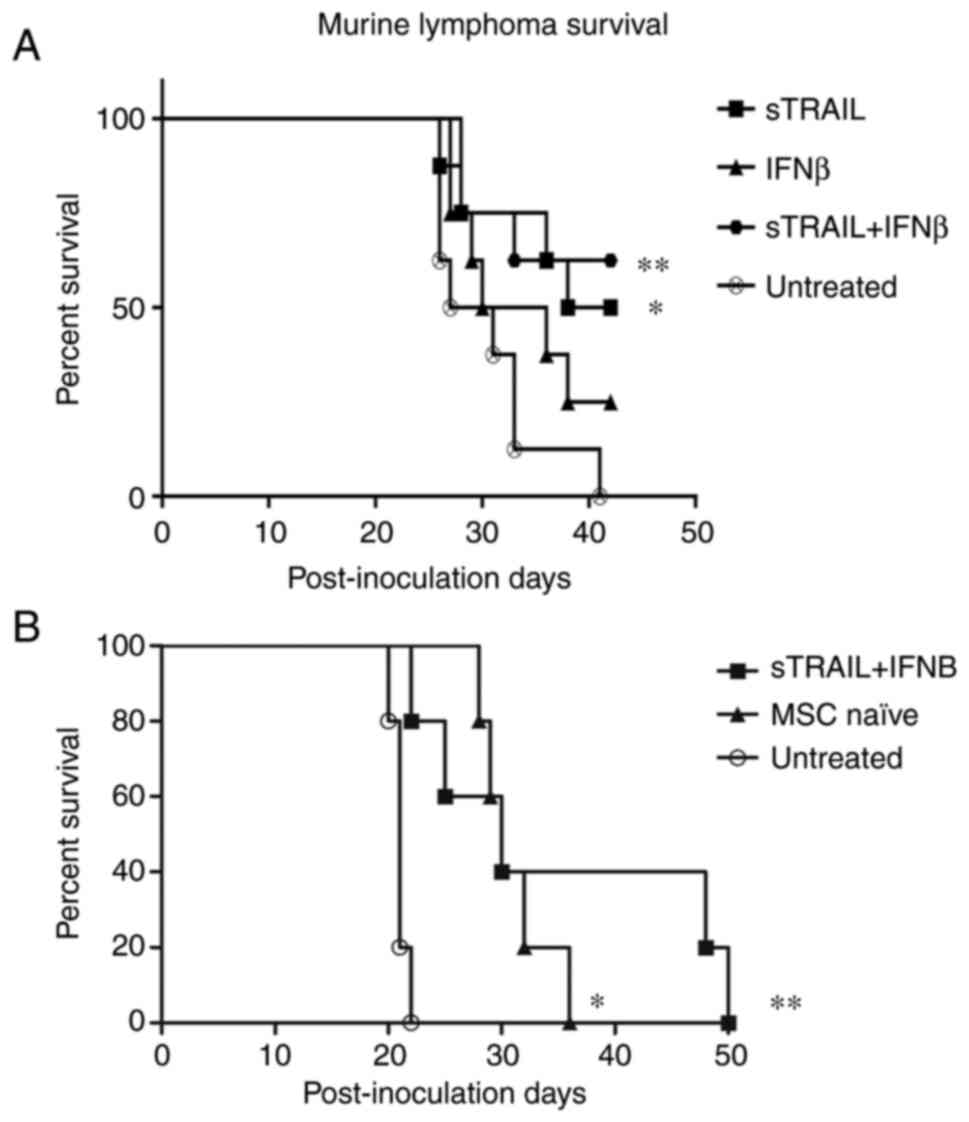
As the understanding of cancer grows, new therapies have been proposed to improve the well-known limitations of current therapies, whose efficiency relies mostly on early detection, surgery and chemotherapy. Mesenchymal stem cells (MSCs) have been introduced as a promissory and effective therapy. This fact is due to several useful features of MSCs, such as their accessibility and easy culture and expansion in vitro, and their remarkable ability for ‘homing’ towards tumors, allowing MSCs to exert their anticancer effects directly into tumors. Additionally, MSCs offer the practicability of being genetically engineered to carry anticancer genes, increasing their specificity and efficacy for fighting tumors. In the present study, the antitumoral efficacy and post-implant survival of mice bearing lymphomas implanted intratumorally were determined using mouse bone marrow-derived (BM)-MSCs transduced with soluble TRAIL (sTRAIL), full length TRAIL (flTRAIL), or interferon β (IFNβ), naïve BM-MSCs, or combinations of these. The percentage of surviving mice was determined once all not-implanted mice succumbed. It was found that the percentage of surviving mice implanted with the combination of MSCs-sTRAIL and MSCs-IFN-β was 62.5%. Lymphoma model achieved 100% fatality in the non-treated group by day 41. On the other hand, the percentage of surviving mice implanted with MSCs-sTRAIL was 50% and with MSCs-INFβ 25%. All the aforementioned differences were statistically significant (P<0.05). In conclusion, all implants exhibited tumor size reduction, growth delay, or apparent tumor clearance. MSCs proved to be effective anti-lymphoma agents; additionally, the combination of soluble TRAIL and IFN-β resulted in the most effective antitumor and life enlarging treatment, showing an additive antitumoral effect compared with individual treatments.
View Figures

Figure 1

Figure 2

Figure 3

Figure 4

Figure 5

Figure 6

View References

1 

Urrutiocoechea A, Alemany R, Balart J, Villanueva A, Viñals F and Capellá G: Recent advances in cancer: An Overview. Curr Pharm Des. 16:3–10. 2010. View Article : Google Scholar : PubMed/NCBI

2 

Herskovic A, Martz K, Al-Sarraf M, Leichman L, Brindle J, Vaitkevicius V, Cooper J, Byhardt R, Davis L and Emami B: Combined chemotherapy and radiotherapy compared with radiotherapy alone in patients with cancer of the esophagus. N Engl J Med. 326:1593–1598. 1992. View Article : Google Scholar : PubMed/NCBI

3 

Singh P, Pandit S, Mokkapati VRSS, Garg A, Ravikumar V and Mijakovic I: Gold nanoparticles in diagnostics and therapeutics for human cancer. Int J Mol Sci. 19:19792018. View Article : Google Scholar

4 

Baetke SC, Lammers T and Kiessling F: Applications of nanoparticles for diagnosis and therapy of cancer. Br J Radiol. 88:201502072015. View Article : Google Scholar

5 

Rupaimoole R and Slack FJ: MicroRNA therapeutics: Towards a new era for the management of cancer and other diseases. Nat Rev Drug Discov. 16:203–221. 2017. View Article : Google Scholar : PubMed/NCBI

6 

Iorio MV and Croce CM: MicroRNA dysregulation in cancer: Diagnostics, monitoring and therapeutics. A comprehensive review. EMBO Mol Med. 4:143–159. 2012. View Article : Google Scholar : PubMed/NCBI

7 

Ling H, Fabbri M and Calin GA: MicroRNAs and other non-coding RNAs as targets for anticancer drug development. Nat Rev Drug Discov. 176:139–148. 2013.

8 

Loebinger M, Sage E, Davies D and Janes S: TRAIL-expressing mesenchymal stem cells kill the putative cancer stem cell population. Br J Cancer. 103:1692–1697. 2010. View Article : Google Scholar : PubMed/NCBI

9 

Liu X, Hu J, Li Y, Cao W, Wang Y, Ma Z and Li F: Mesenchymal stem cells expressing interleukin-18 inhibit breast cancer in a mouse model. Oncol Lett. 15:6265–6274. 2018.

10 

Matosevic S: Viral and nonviral engineering of natural killer cells as emerging adoptive cancer immunotherapies. J Immunol Res. 2018:40548152018. View Article : Google Scholar : PubMed/NCBI

11 

Friedenstein AJ, Gorskaja JF and Kulagina NN: Fibroblast precursors in normal and irradiated mouse hematopoietic organs. Exp Hematol. 4:267–274. 1976.

12 

Pittenger MF, Mackay AM, Beck SC, Jaiswal RK, Douglas R, Mosca JD, Moorman MA, Simonetti DW, Craig S and Marshak DR: Multilineage potential of adult human mesenchymal stem cells. Science. 284:143–147. 1999. View Article : Google Scholar : PubMed/NCBI

13 

Igura K, Zhang X, Takahashi K, Mitsuru A, Yamaguchi S and Takahashi TA: Isolation and characterization of mesenchymal progenitor cells from chorionic villi of human placenta. Cytotherapy. 6:543–553. 2004. View Article : Google Scholar : PubMed/NCBI

14 

Karp JM and Leng Teo GS: Mesenchymal stem cell homing: The devil is in the details. Cell Stem Cell. 4:206–216. 2009. View Article : Google Scholar

15 

Karnoub AE, Dash AB, Vo AP, Sullivan A, Brooks MW, Bell GW, Richardson AL, Polyak K, Tubo R and Weinberg RA: Mesenchymal stem cells within tumour stroma promote breast cancer metastasis. Nature. 449:557–563. 2007. View Article : Google Scholar : PubMed/NCBI

16 

Shinagawa K, Kitadai Y, Tanaka M, Sumida T, Kodama M, Higashi Y, Tanaka S, Yasui W and Chayama K: Mesenchymal stem cells enhance growth and metastasis of colon cancer. Int J Cancer. 127:2323–2333. 2010. View Article : Google Scholar : PubMed/NCBI

17 

Yu JM, Jun ES, Bae YC and Jung JS: Mesenchymal stem cells derived from human adipose tissues favor tumor cell growth in vivo. Stem Cells Dev. 17:463–473. 2008. View Article : Google Scholar : PubMed/NCBI

18 

Pan G, O'Rourke K, Chinnaiyan A, Gentz R, Ebner R, Ni J and Dixit V: The receptor for the cytotoxic ligand TRAIL. Science. 276:111–113. 1997. View Article : Google Scholar : PubMed/NCBI

19 

Wong SHM, Kong WY, Fang CM, Loh HS, Chuah LH, Abdullah S and Ngai SC: The TRAIL to cancer therapy: Hindrances and potential solutions. Crit Rev Oncol Hematol. 143:81–94. 2019. View Article : Google Scholar

20 

Nicolini A, Carpi A and Rossi G: Cytokines in breast cancer. Cytokine Growth Factor Rev. 17:325–337. 2006. View Article : Google Scholar : PubMed/NCBI

21 

Studeny M, Marini FC, Champlin RE, Zompetta C, Fidler IJ and Andreeff M: Bone marrow-derived mesenchymal stem cells as vehicles for interferon-β delivery into tumors. Cancer Res. 62:3603–3608. 2002.PubMed/NCBI

22 

Gonzalez-Villarreal C, Rodriguez M and Said-Fernández S: How desirable and undesirable features of naïve or genetically reengineered mesenchymal stem cells are being considered in preclinical or clinical assays. J BUON. 22:812–830. 2017.PubMed/NCBI

23 

Qin JY, Zhang L, Clift KL, Hulur I, Xiang AP, Ren BZ and Lahn BT: Systematic comparison of constitutive promoters and the doxycycline-inducible promoter. PLoS One. 5:3–6. 2010. View Article : Google Scholar

24 

Kim MH, Billiar TR and Seol DW: The secretable form of trimeric TRAIL, a potent inducer of apoptosis. Biochem Biophys Res Commun. 321:930–935. 2004. View Article : Google Scholar : PubMed/NCBI

25 

Yan C, Li S, Li Z, Peng H, Yuan X, Jiang L, Zhang Y, Fan D, Hu X, Yang M and Xiong D: Human umbilical cord mesenchymal stem cells as vehicles of CD20-specific TRAIL fusion protein delivery: A double-target therapy against non-Hodgkin's lymphoma. Mol Pharm. 10:142–151. 2013. View Article : Google Scholar : PubMed/NCBI

26 

Stern B, Olsen LC, Tröße C, Ravneberg H and Pryme IF: Improving mammalian cell factories: The selection of signal peptide has a major impact on recombinant protein synthesis and secretion in mammalian cells. Trends Cell Mol Biol. 10:19–24. 2007.

27 

Yuan Z, Kolluri KK, Sage EK, Gowers KH and Janes SM: Mesenchymal stromal cell delivery of full-length tumor necrosis factor-related apoptosis-inducing ligand is superior to soluble type for cancer therapy. Cytotherapy. 17:885–896. 2015. View Article : Google Scholar : PubMed/NCBI

28 

Langford DJ, Bailey AL, Chanda ML, Clarke SE, Drummond TE, Echols S, Glick S, Ingrao J, Klassen-Ross T, Lacroix-Fralish ML, et al: Coding of facial expressions of pain in the laboratory mouse. Nat Methods. 7:447–449. 2010. View Article : Google Scholar : PubMed/NCBI

29 

Committee on Rodents, Institute of Laboratory Animal Resources, Commission on Life Sciences and the National Research Council, . Laboratory Animal Managent Rodents. National Academies Press; Washington, D.C., USA: pp. 991996

30 

Bankert RB, Egilmez NK and Hess SD: Human-SCID mouse chimeric models for the evaluation of anti-cancer therapies. Trends Immunol. 22:386–393. 2001. View Article : Google Scholar

31 

Haouzi P: Murine models in critical care research. Crit Care Med. 39:2290–2293. 2011. View Article : Google Scholar : PubMed/NCBI

32 

Frese K and Tuveson D: Maximizing mouse cancer models. Nat Rev Cancer. 7:654–658. 2007. View Article : Google Scholar

33 

Boxall SA and Jones E: Markers for characterization of bone marrow multipotential stromal cells. Stem Cells Int. 2012:9758712012. View Article : Google Scholar

34 

Darzi S, Werkmeister JA, Deane JA and Gargett CE: Identification and characterization of human endometrial mesenchymal stem/stromal cells and their potential for cellular therapy. Stem Cells Transl Med. 5:1127–1132. 2016. View Article : Google Scholar : PubMed/NCBI

35 

Li Q, Hou H, Li M, Yu X, Zuo H, Gao J, Zhang M, Li Z and Guo Z: CD73+ Mesenchymal stem cells ameliorate myocardial infarction by promoting angiogenesis. Front Cell Dev Biol. 9:6372392021. View Article : Google Scholar

36 

Song N, Gao L, Qiu H, Huang C, Cheng H, Zhou H, Lv S, Chen L and Wang J: Mouse bone marrow-derived mesenchymal stem cells inhibit leukemia/lymphoma cell proliferation in vitro and in a mouse model of allogeneic bone marrow transplant. Int J Mol Med. 36:139–149. 2015. View Article : Google Scholar : PubMed/NCBI

37 

Secchiero P, Zorzet S, Tripodo C, Corallini F, Melloni E, Caruso L, Bosco R, Ingrao S, Zavan B and Zauli G: Human bone marrow mesenchymal stem cells display anti-cancer activity in SCID mice bearing disseminated non-hodgkin's lymphoma xenografts. PLoS One. 5:e111402010. View Article : Google Scholar : PubMed/NCBI

38 

Tu E, Chia PZC and Chen W: TGFβ in T cell biology and tumor immunity: Angel or devil? Cytokine Growth Factor Rev. 25:423–435. 2014. View Article : Google Scholar : PubMed/NCBI

39 

Yuen GJ, Demissie E, Pillai S and Burnet M: B lymphocytes and cancer: A love-hate relationship. Trends Cancer. 2:747–757. 2017. View Article : Google Scholar

40 

Soussi T: p53 Antibodies in the sera of patients with various types of cancer: A review. Cancer Res. 60:1777–1788. 2000.PubMed/NCBI

41 

Sharonov GV, Serebrovskaya EO, Yuzhakova DV, Britanova OV and Chudakov DM: B cells, plasma cells and antibody repertoires in the tumour microenvironment. Nat Rev Immunol. 20:294–307. 2020. View Article : Google Scholar

42 

Lei H, Furlong PJ, Jin HR, Mullins D, Cantor R, Fraker DL and Spitz FR: AKT activation and response to interferon-β in human cancer cells. Cancer Biol Ther. 4:709–715. 2005. View Article : Google Scholar : PubMed/NCBI

43 

Ren C, Kumar S, Chanda D, Kallman L, Chen J, Mountz JD and Ponnazhagan S: Cancer gene therapy using mesenchymal stem cells expressing interferon-β in a mouse prostate cancer lung metastasis model. Gene Ther. 15:1446–1453. 2008. View Article : Google Scholar : PubMed/NCBI

44 

Dong Z, Greene G, Pettaway C, Dinney CP, Eue I, Lu W, Bucana CD, Balbay MD, Bielenberg D and Fidler IJ: Suppression of angiogenesis, tumorigenicity, and metastasis by human prostate cancer cells engineered to produce interferon-beta. Cancer Res. 59:872–879. 1999.PubMed/NCBI

45 

Pestka S and Langer JA: Interferons and their actions. Ann Rev Biochem. 56:727–777. 1987. View Article : Google Scholar : PubMed/NCBI

46 

Qin X, Runkel L, Deck C, Dedios C and Barsoum J: Interferon-beta induces S phase accumulation selectively in human transformed cells. J Interf Cytokine Res. 17:355–367. 1997. View Article : Google Scholar

47 

Kavrochorianou N, Markogiannaki M and Haralambous S: IFN-β differentially regulates the function of T cell subsets in MS and EAE. Cytokine Growth Factor Rev. 30:47–54. 2016. View Article : Google Scholar : PubMed/NCBI

48 

Teige I, Liu Y and Issazadeh-Navikas S: IFN-β Inhibits T cell activation capacity of central nervous system APCs. J Immunol. 177:3542–3553. 2006. View Article : Google Scholar

49 

Makowska A, Wahab L, Braunschweig T, Kapetanakis NI, Vokuhl C, Denecke B, Shen L, Busson P and Kontny U: Interferon beta induces apoptosis in nasopharyngeal carcinoma cells via the TRAIL-signaling pathway. Oncotarget. 9:14228–14250. 2018. View Article : Google Scholar

50 

Vannucchi S, Chiantore MV, Fiorucci G, Percario ZA, Leone S, Affabris E and Romeo G: TRAIL is a key target in S-phase slowing-dependent apoptosis induced by interferon-β in cervical carcinoma cells. Oncogene. 24:2536–2546. 2005. View Article : Google Scholar : PubMed/NCBI

51 

Yang J, LeBlanc FR, Dighe SA, Hamele CE, Olson TL, Feith DJ and Loughran TP: TRAIL mediates and sustains constitutive NF-kB activation in LGL leukemia. Blood. 131:2803–2815. 2018. View Article : Google Scholar : PubMed/NCBI

52 

Mühlenbeck F, Schneider P, Bodmer JL, Schwenzer R, Hauser A, Schubert G, Scheurich P, Moosmayer D, Tschopp J and Wajant H: The tumor necrosis factor-related apoptosis-inducing ligand receptors TRAIL-R1 and TRAIL-R2 have distinct cross-linking requirements for initiation of apoptosis and are non-redundant in JNK activation. J Biol Chem. 275:32208–32213. 2000. View Article : Google Scholar

53 

Wang CY, Guttridge DC, Mayo MW and Baldwin AS: NF-κB induces expression of the Bcl-2 homologue A1/Bfl-1 to preferentially suppress chemotherapy-induced apoptosis. Mol Cell Biol. 19:5923–5929. 1999. View Article : Google Scholar

54 

Baetu TM, Kwon H, Sharma S, Grandvaux N and Hiscott J: Disruption of NF-kappaB signaling reveals a novel role for NF-kappaB in the regulation of TNF-related apoptosis-inducing ligand expression. J Immunol. 167:3164–3173. 2001. View Article : Google Scholar

55 

Shetty S, Brown Gladden J, Henson ES, Hu X, Villanueva J, Haney N and Gibson SB: Tumor necrosis factor-related apoptosis inducing ligand (TRAIL) up-regulates death receptor 5 (DR5) mediated by NFkappaB activation in epithelial derived cell lines. Apoptosis. 7:413–420. 2002. View Article : Google Scholar : PubMed/NCBI

56 

Sedger LM, Shows DM, Blanton RA, Peschon JJ, Goodwin RG, Cosman D and Wiley SR: IFN-gamma mediates a novel antiviral activity through dynamic modulation of TRAIL and TRAIL receptor expression. J Immunol. 163:920–926. 1999.

57 

Meng RD and El-Deiry WS: P53-independent upregulation of KILLER/DR5 TRAIL receptor expression by glucocorticoids and interferon-gamma. Exp Cell Res. 262:154–169. 2001. View Article : Google Scholar : PubMed/NCBI

58 

Shigeno M, Nakao K, Ichikawa T, Suzuki K, Kawakami A, Abiru S, Miyazoe S, Nakagawa Y, Ishikawa H, Hamasaki K, et al: Interferon-alpha sensitizes human hepatoma cells to TRAIL-induced apoptosis through DR5 upregulation and NF-kappa B inactivation. Oncogene. 22:1653–1662. 2003. View Article : Google Scholar : PubMed/NCBI

59 

Choi EA, Lei H, Maron DJ, Wilson JM, Barsoum J, Fraker DL, El-Deiry WS and Spitz FR: Stat1-dependent induction of tumor necrosis factor-related apoptosis-inducing ligand and the cell-surface death signaling pathway by interferon beta in human cancer cells. Cancer Res. 63:5299–5307. 2003.PubMed/NCBI

60 

Bao Q, Zhao Y, Niess H, Conrad C, Schwarz B, Jauch KW, Huss R, Nelson PJ and Bruns CJ: Mesenchymal stem cell-based tumor-targeted gene therapy in gastrointestinal cancer. Stem Cells Dev. 21:2355–2363. 2012. View Article : Google Scholar : PubMed/NCBI

61 

Taraballi F, Pasto A, Bauza G and Varner C: Immunomodulatory potential of mesenchymal stem cell role in diseases and therapies: A bioengineering prospective. J Immunol Regen Med. 4:1000172019.

62 

Monteran L and Erez N: The Dark side of fibroblasts: Cancer-Associated fibroblasts as mediators of immunosuppression in the tumor microenvironment. Front Immunol. 10:18352019. View Article : Google Scholar

63 

Yu P and Fu YX: Tumor-infiltrating T lymphocytes: Friends or foes? Lab Investig. 86:231–245. 2006. View Article : Google Scholar : PubMed/NCBI

64 

Badalamenti G, Fanale D, Incorvaia L, Barraco N, Listì A, Maragliano R, Vincenzi B, Calò V, Iovanna JL, Bazan V and Russo A: Role of tumor-infiltrating lymphocytes in patients with solid tumors: Can a drop dig a stone? Cell Immunol. 343:1037532019. View Article : Google Scholar

Related Articles

  • Abstract
  • View
  • Download
  • Twitter
Copy and paste a formatted citation
Spandidos Publications style
Quiroz-Reyes AG, González-Villarreal CA, Martínez-Rodriguez H, Said-Fernández S, Salinas-Carmona MC, Limón-Flores AY, Soto-Domínguez A, Padilla-Rivas G, Montes De Oca-Luna R, Islas JF, Islas JF, et al: A combined antitumor strategy of separately transduced mesenchymal stem cells with soluble TRAIL and IFNβ produces a synergistic activity in the reduction of lymphoma and mice survival enlargement. Mol Med Rep 25: 206, 2022.
APA
Quiroz-Reyes, A.G., González-Villarreal, C.A., Martínez-Rodriguez, H., Said-Fernández, S., Salinas-Carmona, M.C., Limón-Flores, A.Y. ... Garza-Treviño, E.N. (2022). A combined antitumor strategy of separately transduced mesenchymal stem cells with soluble TRAIL and IFNβ produces a synergistic activity in the reduction of lymphoma and mice survival enlargement. Molecular Medicine Reports, 25, 206. https://doi.org/10.3892/mmr.2022.12722
MLA
Quiroz-Reyes, A. G., González-Villarreal, C. A., Martínez-Rodriguez, H., Said-Fernández, S., Salinas-Carmona, M. C., Limón-Flores, A. Y., Soto-Domínguez, A., Padilla-Rivas, G., Montes De Oca-Luna, R., Islas, J. F., Garza-Treviño, E. N."A combined antitumor strategy of separately transduced mesenchymal stem cells with soluble TRAIL and IFNβ produces a synergistic activity in the reduction of lymphoma and mice survival enlargement". Molecular Medicine Reports 25.6 (2022): 206.
Chicago
Quiroz-Reyes, A. G., González-Villarreal, C. A., Martínez-Rodriguez, H., Said-Fernández, S., Salinas-Carmona, M. C., Limón-Flores, A. Y., Soto-Domínguez, A., Padilla-Rivas, G., Montes De Oca-Luna, R., Islas, J. F., Garza-Treviño, E. N."A combined antitumor strategy of separately transduced mesenchymal stem cells with soluble TRAIL and IFNβ produces a synergistic activity in the reduction of lymphoma and mice survival enlargement". Molecular Medicine Reports 25, no. 6 (2022): 206. https://doi.org/10.3892/mmr.2022.12722
Copy and paste a formatted citation
x
Spandidos Publications style
Quiroz-Reyes AG, González-Villarreal CA, Martínez-Rodriguez H, Said-Fernández S, Salinas-Carmona MC, Limón-Flores AY, Soto-Domínguez A, Padilla-Rivas G, Montes De Oca-Luna R, Islas JF, Islas JF, et al: A combined antitumor strategy of separately transduced mesenchymal stem cells with soluble TRAIL and IFNβ produces a synergistic activity in the reduction of lymphoma and mice survival enlargement. Mol Med Rep 25: 206, 2022.
APA
Quiroz-Reyes, A.G., González-Villarreal, C.A., Martínez-Rodriguez, H., Said-Fernández, S., Salinas-Carmona, M.C., Limón-Flores, A.Y. ... Garza-Treviño, E.N. (2022). A combined antitumor strategy of separately transduced mesenchymal stem cells with soluble TRAIL and IFNβ produces a synergistic activity in the reduction of lymphoma and mice survival enlargement. Molecular Medicine Reports, 25, 206. https://doi.org/10.3892/mmr.2022.12722
MLA
Quiroz-Reyes, A. G., González-Villarreal, C. A., Martínez-Rodriguez, H., Said-Fernández, S., Salinas-Carmona, M. C., Limón-Flores, A. Y., Soto-Domínguez, A., Padilla-Rivas, G., Montes De Oca-Luna, R., Islas, J. F., Garza-Treviño, E. N."A combined antitumor strategy of separately transduced mesenchymal stem cells with soluble TRAIL and IFNβ produces a synergistic activity in the reduction of lymphoma and mice survival enlargement". Molecular Medicine Reports 25.6 (2022): 206.
Chicago
Quiroz-Reyes, A. G., González-Villarreal, C. A., Martínez-Rodriguez, H., Said-Fernández, S., Salinas-Carmona, M. C., Limón-Flores, A. Y., Soto-Domínguez, A., Padilla-Rivas, G., Montes De Oca-Luna, R., Islas, J. F., Garza-Treviño, E. N."A combined antitumor strategy of separately transduced mesenchymal stem cells with soluble TRAIL and IFNβ produces a synergistic activity in the reduction of lymphoma and mice survival enlargement". Molecular Medicine Reports 25, no. 6 (2022): 206. https://doi.org/10.3892/mmr.2022.12722
Follow us
  • Twitter
  • LinkedIn
  • Facebook
About
  • Spandidos Publications
  • Careers
  • Cookie Policy
  • Privacy Policy
How can we help?
  • Help
  • Live Chat
  • Contact
  • Email to our Support Team