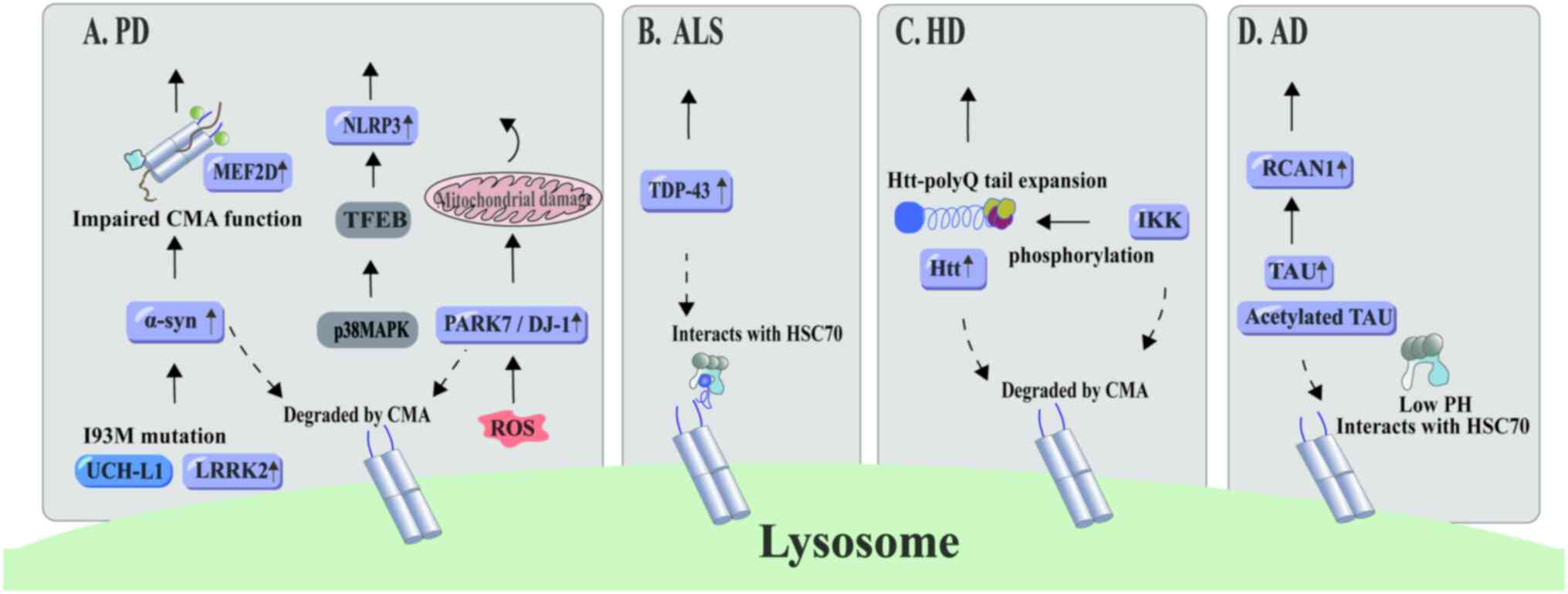
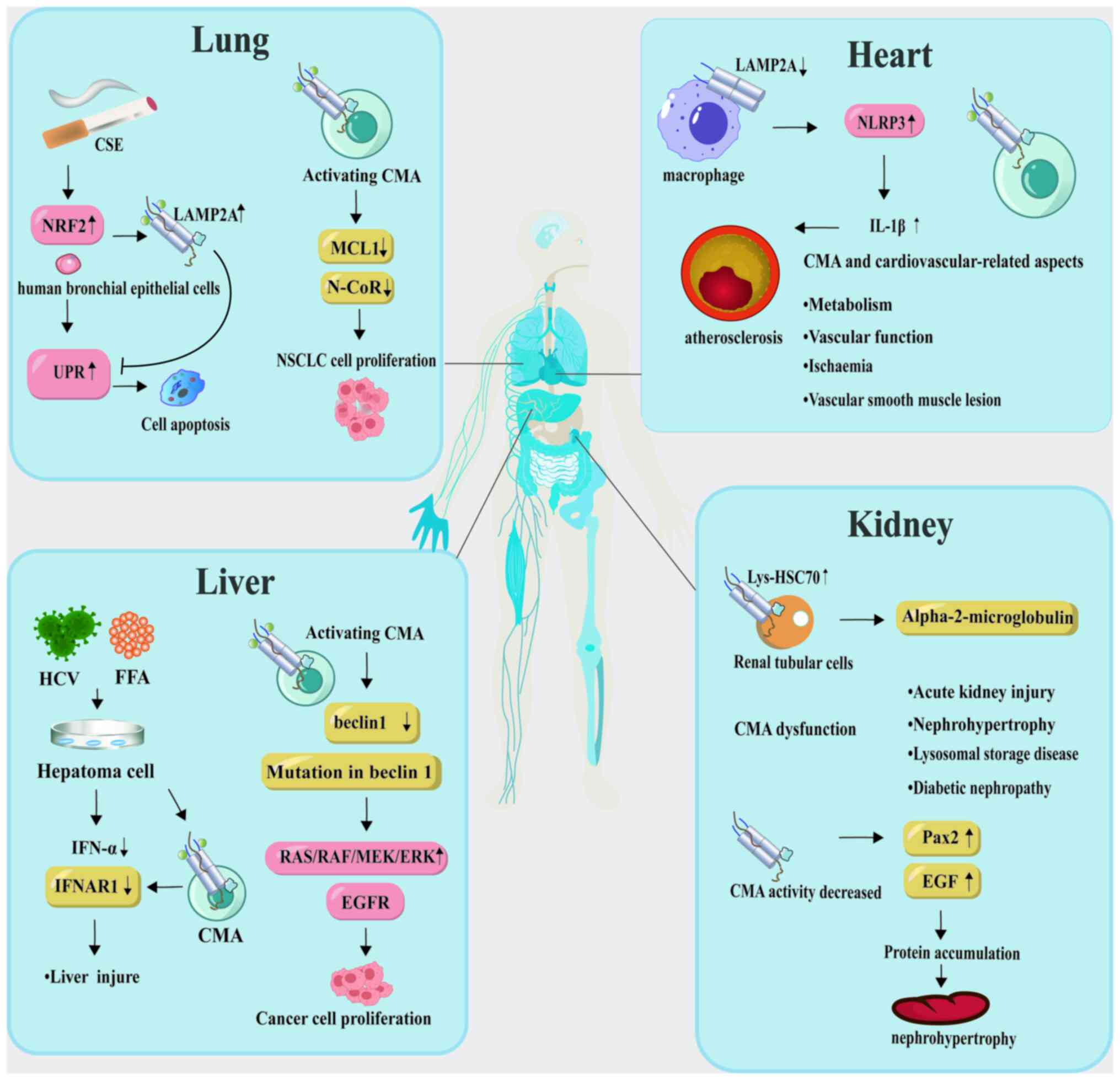
|
1
|
De Duve C and Wattiaux R: Functions of
lysosomes. Annu Rev Physiol. 28:435–492. 1966. View Article : Google Scholar : PubMed/NCBI
|
|
2
|
Etlinger JD and Goldberg AL: A soluble
ATP-dependent proteolytic system responsible for the degradation of
abnormal proteins in reticulocytes. Proc Natl Acad Sci USA.
74:54–58. 1977. View Article : Google Scholar : PubMed/NCBI
|
|
3
|
Bright NA, Davis LJ and Luzio JP:
Endolysosomes are the principal intracellular sites of acid
hydrolase activity. Curr Biol. 26:2233–2245. 2016. View Article : Google Scholar : PubMed/NCBI
|
|
4
|
Mizushima N: Autophagy: Process and
function. Genes Dev. 21:2861–2873. 2007. View Article : Google Scholar : PubMed/NCBI
|
|
5
|
Levine B and Kroemer G: Biological
functions of autophagy genes: A disease perspective. Cell.
176:11–42. 2019. View Article : Google Scholar : PubMed/NCBI
|
|
6
|
Mizushima N and Komatsu M: Autophagy:
Renovation of cells and tissues. Cell. 147:728–741. 2011.
View Article : Google Scholar : PubMed/NCBI
|
|
7
|
Klionsky DJ: Autophagy: From phenomenology
to molecular understanding in less than a decade. Nat Rev Mol Cell
Biol. 8:931–937. 2007. View Article : Google Scholar : PubMed/NCBI
|
|
8
|
Nakatogawa H: Mechanisms governing
autophagosome biogenesis. Nat Rev Mol Cell Biol. 21:439–458. 2020.
View Article : Google Scholar : PubMed/NCBI
|
|
9
|
Tsukada M and Ohsumi Y: Isolation and
characterization of autophagy-defective mutants of Saccharomyces
cerevisiae. FEBS Lett. 333:169–174. 1993. View Article : Google Scholar : PubMed/NCBI
|
|
10
|
Klionsky DJ, Cregg JM, Dunn WA Jr, Emr SD,
Sakai Y, Sandoval IV, Sibirny A, Subramani S, Thumm M, Veenhuis M
and Ohsumi Y: A unified nomenclature for yeast autophagy-related
genes. Dev Cell. 5:539–545. 2003. View Article : Google Scholar : PubMed/NCBI
|
|
11
|
Feng Y, He D, Yao Z and Klionsky DJ: The
machinery of macroautophagy. Cell Res. 24:24–41. 2014. View Article : Google Scholar : PubMed/NCBI
|
|
12
|
Chan EYW, Longatti A, McKnight NC and
Tooze SA: Kinase-inactivated ULK proteins inhibit autophagy via
their conserved C-terminal domains using an Atg13-independent
mechanism. Mol Cell Biol. 29:157–171. 2009. View Article : Google Scholar : PubMed/NCBI
|
|
13
|
Suzuki K, Kirisako T, Kamada Y, Mizushima
N, Noda T and Ohsumi Y: The pre-autophagosomal structure organized
by concerted functions of APG genes is essential for autophagosome
formation. EMBO J. 20:5971–5981. 2001. View Article : Google Scholar : PubMed/NCBI
|
|
14
|
Griffey CJ and Yamamoto A: Macroautophagy
in CNS health and disease. Nat Rev Neurosci. 23:411–427. 2022.
View Article : Google Scholar : PubMed/NCBI
|
|
15
|
Mari M, Griffith J, Rieter E, Krishnappa
L, Klionsky DJ and Reggiori F: An Atg9-containing compartment that
functions in the early steps of autophagosome biogenesis. J Cell
Biol. 190:1005–1022. 2010. View Article : Google Scholar : PubMed/NCBI
|
|
16
|
Hara T, Takamura A, Kishi C, Iemura S,
Natsume T, Guan JL and Mizushima N: FIP200, a ULK-interacting
protein, is required for autophagosome formation in mammalian
cells. J Cell Biol. 181:497–510. 2008. View Article : Google Scholar : PubMed/NCBI
|
|
17
|
Hosokawa N, Hara T, Kaizuka T, Kishi C,
Takamura A, Miura Y, Iemura S, Natsume T, Takehana K, Yamada N, et
al: Nutrient-dependent mTORC1 association with the
ULK1-Atg13-FIP200 complex required for autophagy. Mol Biol Cell.
20:1981–1991. 2009. View Article : Google Scholar : PubMed/NCBI
|
|
18
|
Weidberg H, Shvets E and Elazar Z:
Biogenesis and cargo selectivity of autophagosomes. Annu Rev
Biochem. 80:125–156. 2011. View Article : Google Scholar : PubMed/NCBI
|
|
19
|
Yokota S and Dariush Fahimi H: Degradation
of excess peroxisomes in mammalian liver cells by autophagy and
other mechanisms. Histochem Cell Biol. 131:455–458. 2009.
View Article : Google Scholar : PubMed/NCBI
|
|
20
|
Kundu M, Lindsten T, Yang CY, Wu J, Zhao
F, Zhang J, Selak MA, Ney PA and Thompson CB: Ulk1 plays a critical
role in the autophagic clearance of mitochondria and ribosomes
during reticulocyte maturation. Blood. 112:1493–1502. 2008.
View Article : Google Scholar : PubMed/NCBI
|
|
21
|
Oku M and Sakai Y: Three distinct types of
microautophagy based on membrane dynamics and molecular
machineries. Bioessays. 40:e18000082018. View Article : Google Scholar : PubMed/NCBI
|
|
22
|
Uttenweiler A, Schwarz H, Neumann H and
Mayer A: The vacuolar transporter chaperone (VTC) complex is
required for microautophagy. Mol Biol Cell. 18:166–175. 2007.
View Article : Google Scholar : PubMed/NCBI
|
|
23
|
Uttenweiler A, Schwarz H and Mayer A:
Microautophagic vacuole invagination requires calmodulin in a
Ca2+-independent function. J Biol Chem. 280:33289–33297. 2005.
View Article : Google Scholar : PubMed/NCBI
|
|
24
|
Müller O, Sattler T, Flötenmeyer M,
Schwarz H, Plattner H and Mayer A: Autophagic tubes: Vacuolar
invaginations involved in lateral membrane sorting and inverse
vesicle budding. J Cell Biol. 151:519–528. 2000. View Article : Google Scholar : PubMed/NCBI
|
|
25
|
Epple UD, Suriapranata I, Eskelinen EL and
Thumm M: Aut5/Cvt17p, a putative lipase essential for
disintegration of autophagic bodies inside the vacuole. J
Bacteriol. 183:5942–5955. 2001. View Article : Google Scholar : PubMed/NCBI
|
|
26
|
Yang Z and Klionsky DJ: Permeases recycle
amino acids resulting from autophagy. Autophagy. 3:149–150. 2007.
View Article : Google Scholar : PubMed/NCBI
|
|
27
|
Roberts P, Moshitch-Moshkovitz S, Kvam E,
O'Toole E, Winey M and Goldfarb DS: Piecemeal microautophagy of
nucleus in Saccharomyces cerevisiae. Mol Biol Cell. 14:129–141.
2003. View Article : Google Scholar : PubMed/NCBI
|
|
28
|
Kawamura N, Sun-Wada GH, Aoyama M, Harada
A, Takasuga S, Sasaki T and Wada Y: Delivery of endosomes to
lysosomes via microautophagy in the visceral endoderm of mouse
embryos. Nat Commun. 3:10712012. View Article : Google Scholar : PubMed/NCBI
|
|
29
|
Kaushik S and Cuervo AM:
Chaperone-mediated autophagy: A unique way to enter the lysosome
world. Trends Cell Biol. 22:407–417. 2012. View Article : Google Scholar : PubMed/NCBI
|
|
30
|
Dice JF, Walker CD, Byrne B and Cardiel A:
General characteristics of protein degradation in diabetes and
starvation. Proc Natl Acad Sci USA. 75:2093–2097. 1978. View Article : Google Scholar : PubMed/NCBI
|
|
31
|
Backer JM and Dice JF: Covalent linkage of
ribonuclease S-peptide to microinjected proteins causes their
intracellular degradation to be enhanced during serum withdrawal.
Proc Natl Acad Sci USA. 83:5830–5834. 1986. View Article : Google Scholar : PubMed/NCBI
|
|
32
|
Chiang HL and Dice JF: Peptide sequences
that target proteins for enhanced degradation during serum
withdrawal. J Biol Chem. 263:6797–6805. 1988. View Article : Google Scholar : PubMed/NCBI
|
|
33
|
Chiang HL, Terlecky SR, Plant CP and Dice
JF: A role for a 70-kilodalton heat shock protein in lysosomal
degradation of intracellular proteins. Science. 246:382–385. 1989.
View Article : Google Scholar : PubMed/NCBI
|
|
34
|
Cuervo AM and Dice JF: A receptor for the
selective uptake and degradation of proteins by lysosomes. Science.
273:501–503. 1996. View Article : Google Scholar : PubMed/NCBI
|
|
35
|
Cuervo AM and Dice JF: Age-related decline
in chaperone-mediated autophagy. J Biol Chem. 275:31505–31513.
2000. View Article : Google Scholar : PubMed/NCBI
|
|
36
|
Dice JF, Chiang HL, Spencer EP and Backer
JM: Regulation of catabolism of microinjected ribonuclease A.
Identification of residues 7–11 as the essential pentapeptide. J
Biol Chem. 261:6853–6859. 1986. View Article : Google Scholar : PubMed/NCBI
|
|
37
|
Koga H, Martinez-Vicente M, Macian F,
Verkhusha VV and Cuervo AM: A photoconvertible fluorescent reporter
to track chaperone-mediated autophagy. Nat Commun. 2:3862011.
View Article : Google Scholar : PubMed/NCBI
|
|
38
|
Dice JF: Peptide sequences that target
cytosolic proteins for lysosomal proteolysis. Trends Biochem Sci.
15:305–309. 1990. View Article : Google Scholar : PubMed/NCBI
|
|
39
|
Kirchner P, Bourdenx M, Madrigal-Matute J,
Tiano S, Diaz A, Bartholdy BA, Will B and Cuervo AM: Proteome-wide
analysis of chaperone-mediated autophagy targeting motifs. PLoS
Biol. 17:e30003012019. View Article : Google Scholar : PubMed/NCBI
|
|
40
|
Glick BS: Can Hsp70 proteins act as
force-generating motors? Cell. 80:11–14. 1995. View Article : Google Scholar : PubMed/NCBI
|
|
41
|
Bandyopadhyay U, Kaushik S, Varticovski L
and Cuervo AM: The chaperone-mediated autophagy receptor organizes
in dynamic protein complexes at the lysosomal membrane. Mol Cell
Biol. 28:5747–5763. 2008. View Article : Google Scholar : PubMed/NCBI
|
|
42
|
Gong Z, Tasset I, Diaz A, Anguiano J, Tas
E, Cui L, Kuliawat R, Liu H, Kühn B, Cuervo AM and Muzumdar R:
Humanin is an endogenous activator of chaperone-mediated autophagy.
J Cell Biol. 217:635–647. 2018. View Article : Google Scholar : PubMed/NCBI
|
|
43
|
Massey AC, Kaushik S, Sovak G, Kiffin R
and Cuervo AM: Consequences of the selective blockage of
chaperone-mediated autophagy. Proc Natl Acad Sci USA.
103:5805–5810. 2006. View Article : Google Scholar : PubMed/NCBI
|
|
44
|
Majeski AE and Dice JF: Mechanisms of
chaperone-mediated autophagy. Int J Biochem Cell Biol.
36:2435–2444. 2004. View Article : Google Scholar : PubMed/NCBI
|
|
45
|
Bimston D, Song J, Winchester D, Takayama
S, Reed JC and Morimoto RI: BAG-1, a negative regulator of Hsp70
chaperone activity, uncouples nucleotide hydrolysis from substrate
release. EMBO J. 17:6871–6878. 1998. View Article : Google Scholar : PubMed/NCBI
|
|
46
|
Gough NR, Hatem CL and Fambrough DM: The
family of LAMP-2 proteins arises by alternative splicing from a
single gene: Characterization of the avian LAMP-2 gene and
identification of mammalian homologs of LAMP-2b and LAMP-2c. DNA
Cell Biol. 14:863–867. 1995. View Article : Google Scholar : PubMed/NCBI
|
|
47
|
Chi C, Leonard A, Knight WE, Beussman KM,
Zhao Y, Cao Y, Londono P, Aune E, Trembley MA, Small EM, et al:
LAMP-2B regulates human cardiomyocyte function by mediating
autophagosome-lysosome fusion. Proc Natl Acad Sci USA. 116:556–565.
2019. View Article : Google Scholar : PubMed/NCBI
|
|
48
|
Fujiwara Y, Furuta A, Kikuchi H, Aizawa S,
Hatanaka Y, Konya C, Uchida K, Yoshimura A, Tamai Y, Wada K and
Kabuta T: Discovery of a novel type of autophagy targeting RNA.
Autophagy. 9:403–409. 2013. View Article : Google Scholar : PubMed/NCBI
|
|
49
|
Schnebert S, Goguet M, Vélez EJ, Depincé
A, Beaumatin F, Herpin A and Seiliez I: Diving into the
evolutionary history of HSC70-linked selective autophagy pathways:
Endosomal microautophagy and chaperone-mediated autophagy. Cells.
11:19452022. View Article : Google Scholar : PubMed/NCBI
|
|
50
|
Cuervo AM and Dice JF: Regulation of
lamp2a levels in the lysosomal membrane. Traffic. 1:570–583. 2000.
View Article : Google Scholar : PubMed/NCBI
|
|
51
|
Cuervo AM, Mann L, Bonten EJ, d'Azzo A and
Dice JF: Cathepsin A regulates chaperone-mediated autophagy through
cleavage of the lysosomal receptor. EMBO J. 22:47–59. 2003.
View Article : Google Scholar : PubMed/NCBI
|
|
52
|
Tanaka Y, Guhde G, Suter A, Eskelinen EL,
Hartmann D, Lüllmann-Rauch R, Janssen PM, Blanz J, von Figura K and
Saftig P: Accumulation of autophagic vacuoles and cardiomyopathy in
LAMP-2-deficient mice. Nature. 406:902–906. 2000. View Article : Google Scholar : PubMed/NCBI
|
|
53
|
Ferreira JV, da Rosa Soares A, Ramalho J,
Máximo Carvalho C, Cardoso MH, Pintado P, Carvalho AS, Beck HC,
Matthiesen R, Zuzarte M, et al: LAMP2A regulates the loading of
proteins into exosomes. Sci Adv. 8:eabm11402022. View Article : Google Scholar : PubMed/NCBI
|
|
54
|
Kaushik S, Massey AC and Cuervo AM:
Lysosome membrane lipid microdomains: Novel regulators of
chaperone-mediated autophagy. EMBO J. 25:3921–3933. 2006.
View Article : Google Scholar : PubMed/NCBI
|
|
55
|
Kaushik S and Cuervo AM: The coming of age
of chaperone-mediated autophagy. Nat Rev Mol Cell Biol. 19:365–381.
2018. View Article : Google Scholar : PubMed/NCBI
|
|
56
|
Duong V and Rochette-Egly C: The molecular
physiology of nuclear retinoic acid receptors. From health to
disease. Biochim Biophys Acta. 1812:1023–1031. 2011. View Article : Google Scholar : PubMed/NCBI
|
|
57
|
Anguiano J, Garner TP, Mahalingam M, Das
BC, Gavathiotis E and Cuervo AM: Chemical modulation of
chaperone-mediated autophagy by retinoic acid derivatives. Nat Chem
Biol. 9:374–382. 2013. View Article : Google Scholar : PubMed/NCBI
|
|
58
|
Gomez-Sintes R, Xin Q, Jimenez-Loygorri
JI, McCabe M, Diaz A, Garner TP, Cotto-Rios XM, Wu Y, Dong S,
Reynolds CA, et al: Targeting retinoic acid receptor
alpha-corepressor interaction activates chaperone-mediated
autophagy and protects against retinal degeneration. Nat Commun.
13:42202022. View Article : Google Scholar : PubMed/NCBI
|
|
59
|
Tian Y, Liu B, Li Y, Zhang Y, Shao J, Wu
P, Xu C, Chen G and Shi H: Activation of RARα receptor attenuates
neuroinflammation after SAH via promoting M1-to-M2 phenotypic
polarization of microglia and regulating Mafb/Msr1/PI3K-Akt/NF-κB
pathway. Front Immunol. 13:8397962022. View Article : Google Scholar : PubMed/NCBI
|
|
60
|
Alers S, Löffler AS, Wesselborg S and
Stork B: Role of AMPK-mTOR-Ulk1/2 in the regulation of autophagy:
Cross talk, shortcuts, and feedbacks. Mol Cell Biol. 32:2–11. 2012.
View Article : Google Scholar : PubMed/NCBI
|
|
61
|
Carling D: AMPK signalling in health and
disease. Curr Opin Cell Biol. 45:31–37. 2017. View Article : Google Scholar : PubMed/NCBI
|
|
62
|
Zhang K, Zhu S, Li J, Jiang T, Feng L, Pei
J, Wang G, Ouyang L and Liu B: Targeting autophagy using
small-molecule compounds to improve potential therapy of
Parkinson's disease. Acta Pharm Sin B. 11:3015–3034. 2021.
View Article : Google Scholar : PubMed/NCBI
|
|
63
|
Kaushik S and Cuervo AM: Degradation of
lipid droplet-associated proteins by chaperone-mediated autophagy
facilitates lipolysis. Nat Cell Biol. 17:759–770. 2015. View Article : Google Scholar : PubMed/NCBI
|
|
64
|
Schweiger M and Zechner R: Breaking the
barrier-chaperone-mediated autophagy of perilipins regulates the
lipolytic degradation of fat. Cell Metab. 22:60–61. 2015.
View Article : Google Scholar : PubMed/NCBI
|
|
65
|
Zhang T, Liu J, Shen S, Tong Q, Ma X and
Lin L: SIRT3 promotes lipophagy and chaperon-mediated autophagy to
protect hepatocytes against lipotoxicity. Cell Death Differ.
27:329–344. 2020. View Article : Google Scholar : PubMed/NCBI
|
|
66
|
Zhang T, Liu J, Tong Q and Lin L: SIRT3
Acts as a positive autophagy regulator to promote lipid
mobilization in adipocytes via activating AMPK. Int J Mol Sci.
21:3722020. View Article : Google Scholar : PubMed/NCBI
|
|
67
|
Li W, Zhu J, Dou J, She H, Tao K, Xu H,
Yang Q and Mao Z: Phosphorylation of LAMP2A by p38 MAPK couples ER
stress to chaperone-mediated autophagy. Nat Commun. 8:17632017.
View Article : Google Scholar : PubMed/NCBI
|
|
68
|
Wang L, Cai J, Zhao X, Ma L, Zeng P, Zhou
L, Liu Y, Yang S, Cai Z, Zhang S, et al: Palmitoylation prevents
sustained inflammation by limiting NLRP3 inflammasome activation
through chaperone-mediated autophagy. Mol Cell. 83:281–297.e10.
2023. View Article : Google Scholar : PubMed/NCBI
|
|
69
|
Chen J, Mao K, Yu H, Wen Y, She H, Zhang
H, Liu L, Li M, Li W and Zou F: p38-TFEB pathways promote microglia
activation through inhibiting CMA-mediated NLRP3 degradation in
Parkinson's disease. J Neuroinflammation. 18:2952021. View Article : Google Scholar : PubMed/NCBI
|
|
70
|
Song JX, Liu J, Jiang Y, Wang ZY and Li M:
Transcription factor EB: An emerging drug target for
neurodegenerative disorders. Drug Discov Today. 26:164–172. 2021.
View Article : Google Scholar : PubMed/NCBI
|
|
71
|
Valdor R, Mocholi E, Botbol Y,
Guerrero-Ros I, Chandra D, Koga H, Gravekamp C, Cuervo AM and
Macian F: Chaperone-mediated autophagy regulates T cell responses
through targeted degradation of negative regulators of T cell
activation. Nat Immunol. 15:1046–1054. 2014. View Article : Google Scholar : PubMed/NCBI
|
|
72
|
Bader AG, Kang S, Zhao L and Vogt PK:
Oncogenic PI3K deregulates transcription and translation. Nat Rev
Cancer. 5:921–929. 2005. View Article : Google Scholar : PubMed/NCBI
|
|
73
|
Sarbassov DD, Guertin DA, Ali SM and
Sabatini DM: Phosphorylation and regulation of Akt/PKB by the
rictor-mTOR complex. Science. 307:1098–1101. 2005. View Article : Google Scholar : PubMed/NCBI
|
|
74
|
Li Y, Lu L, Luo N, Wang YQ and Gao HM:
Inhibition of PI3K/AKt/mTOR signaling pathway protects against
d-galactosamine/lipopolysaccharide-induced acute liver failure by
chaperone-mediated autophagy in rats. Biomed Pharmacother.
92:544–553. 2017. View Article : Google Scholar : PubMed/NCBI
|
|
75
|
Endicott SJ, Ziemba ZJ, Beckmann LJ,
Boynton DN and Miller RA: Inhibition of class I PI3K enhances
chaperone-mediated autophagy. J Cell Biol. 219:e2020010312020.
View Article : Google Scholar : PubMed/NCBI
|
|
76
|
He Q, Qin R, Glowacki J, Zhou S, Shi J,
Wang S, Gao Y and Cheng L: Synergistic stimulation of osteoblast
differentiation of rat mesenchymal stem cells by leptin and
25(OH)D3 is mediated by inhibition of chaperone-mediated
autophagy. Stem Cell Res Ther. 12:5572021. View Article : Google Scholar : PubMed/NCBI
|
|
77
|
Bourdenx M, Gavathiotis E and Cuervo AM:
Chaperone-mediated autophagy: A gatekeeper of neuronal
proteostasis. Autophagy. 17:2040–2042. 2021. View Article : Google Scholar : PubMed/NCBI
|
|
78
|
Andrade-Tomaz M, de Souza I, Rocha CRR and
Gomes LR: The role of chaperone-mediated autophagy in cell cycle
control and its implications in cancer. Cells. 9:21402020.
View Article : Google Scholar : PubMed/NCBI
|
|
79
|
Arias E and Cuervo AM: Chaperone-mediated
autophagy in protein quality control. Curr Opin Cell Biol.
23:184–189. 2011. View Article : Google Scholar : PubMed/NCBI
|
|
80
|
Li W, Nie T, Xu H, Yang J, Yang Q and Mao
Z: Chaperone-mediated autophagy: Advances from bench to bedside.
Neurobiol Dis. 122:41–48. 2019. View Article : Google Scholar : PubMed/NCBI
|
|
81
|
Li J, Cao F, Yin HL, Huang ZJ, Lin ZT, Mao
N, Sun B and Wang G: Ferroptosis: Past, present and future. Cell
Death Dis. 11:882020. View Article : Google Scholar : PubMed/NCBI
|
|
82
|
Wu Z, Geng Y, Lu X, Shi Y, Wu G, Zhang M,
Shan B, Pan H and Yuan J: Chaperone-mediated autophagy is involved
in the execution of ferroptosis. Proc Natl Acad Sci USA.
116:2996–3005. 2019. View Article : Google Scholar : PubMed/NCBI
|
|
83
|
Wu K, Yan M, Liu T, Wang Z, Duan Y, Xia Y,
Ji G, Shen Y, Wang L, Li L, et al: Creatine kinase B suppresses
ferroptosis by phosphorylating GPX4 through a moonlighting
function. Nat Cell Biol. 25:714–725. 2023. View Article : Google Scholar : PubMed/NCBI
|
|
84
|
Yu S, Li Z, Zhang Q, Wang R, Zhao Z, Ding
W, Wang F, Sun C, Tang J, Wang X, et al: GPX4 degradation via
chaperone-mediated autophagy contributes to antimony-triggered
neuronal ferroptosis. Ecotoxicol Environ Saf. 234:1134132022.
View Article : Google Scholar : PubMed/NCBI
|
|
85
|
Chen C, Wang D, Yu Y, Zhao T, Min N, Wu Y,
Kang L, Zhao Y, Du L, Zhang M, et al: Legumain promotes tubular
ferroptosis by facilitating chaperone-mediated autophagy of GPX4 in
AKI. Cell Death Dis. 12:652021. View Article : Google Scholar : PubMed/NCBI
|
|
86
|
Liu C, Sun W, Zhu T, Shi S, Zhang J, Wang
J, Gao F, Ou Q, Jin C, Li J, et al: Glia maturation factor-β
induces ferroptosis by impairing chaperone-mediated autophagic
degradation of ACSL4 in early diabetic retinopathy. Redox Biol.
52:1022922022. View Article : Google Scholar : PubMed/NCBI
|
|
87
|
Xie W, Zhang L, Jiao H, Guan L, Zha J, Li
X, Wu M, Wang Z, Han J and You H: Chaperone-mediated autophagy
prevents apoptosis by degrading BBC3/PUMA. Autophagy. 11:1623–1635.
2015. View Article : Google Scholar : PubMed/NCBI
|
|
88
|
Kiffin R, Christian C, Knecht E and Cuervo
AM: Activation of chaperone-mediated autophagy during oxidative
stress. Mol Biol Cell. 15:4829–4840. 2004. View Article : Google Scholar : PubMed/NCBI
|
|
89
|
Cuervo AM, Hildebrand H, Bomhard EM and
Dice JF: Direct lysosomal uptake of alpha 2-microglobulin
contributes to chemically induced nephropathy. Kidney Int.
55:529–545. 1999. View Article : Google Scholar : PubMed/NCBI
|
|
90
|
Schneider JL, Villarroya J, Diaz-Carretero
A, Patel B, Urbanska AM, Thi MM, Villarroya F, Santambrogio L and
Cuervo AM: Loss of hepatic chaperone-mediated autophagy accelerates
proteostasis failure in aging. Aging Cell. 14:249–264. 2015.
View Article : Google Scholar : PubMed/NCBI
|
|
91
|
Kaushik S, Juste YR and Cuervo AM:
Circadian remodeling of the proteome by chaperone-mediated
autophagy. Autophagy. 18:1205–1207. 2022. View Article : Google Scholar : PubMed/NCBI
|
|
92
|
Hao Y, Kacal M, Ouchida AT, Zhang B,
Norberg E and Vakifahmetoglu-Norberg H: Targetome analysis of
chaperone-mediated autophagy in cancer cells. Autophagy.
15:1558–1571. 2019. View Article : Google Scholar : PubMed/NCBI
|
|
93
|
Dong S, Wang Q, Kao YR, Diaz A, Tasset I,
Kaushik S, Thiruthuvanathan V, Zintiridou A, Nieves E,
Dzieciatkowska M, et al: Chaperone-mediated autophagy sustains
haematopoietic stem-cell function. Nature. 591:117–123. 2021.
View Article : Google Scholar : PubMed/NCBI
|
|
94
|
Lv L, Li D, Zhao D, Lin R, Chu Y, Zhang H,
Zha Z, Liu Y, Li Z, Xu Y, et al: Acetylation targets the M2 isoform
of pyruvate kinase for degradation through chaperone-mediated
autophagy and promotes tumor growth. Mol Cell. 42:719–730. 2011.
View Article : Google Scholar : PubMed/NCBI
|
|
95
|
Susan PP and Dunn WA Jr:
Starvation-induced lysosomal degradation of aldolase B requires
glutamine 111 in a signal sequence for chaperone-mediated
transport. J Cell Physiol. 187:48–58. 2001. View Article : Google Scholar : PubMed/NCBI
|
|
96
|
Schneider JL, Suh Y and Cuervo AM:
Deficient chaperone-mediated autophagy in liver leads to metabolic
dysregulation. Cell Metab. 20:417–432. 2014. View Article : Google Scholar : PubMed/NCBI
|
|
97
|
Xu Y, Zhang Y, García-Cañaveras JC, Guo L,
Kan M, Yu S, Blair IA, Rabinowitz JD and Yang X: Chaperone-mediated
autophagy regulates the pluripotency of embryonic stem cells.
Science. 369:397–403. 2020. View Article : Google Scholar : PubMed/NCBI
|
|
98
|
TeSlaa T, Chaikovsky AC, Lipchina I,
Escobar SL, Hochedlinger K, Huang J, Graeber TG, Braas D and
Teitell MA: α-Ketoglutarate accelerates the initial differentiation
of primed human pluripotent stem cells. Cell Metab. 24:485–493.
2016. View Article : Google Scholar : PubMed/NCBI
|
|
99
|
Carey BW, Finley LW, Cross JR, Allis CD
and Thompson CB: Intracellular α-ketoglutarate maintains the
pluripotency of embryonic stem cells. Nature. 518:413–416. 2015.
View Article : Google Scholar : PubMed/NCBI
|
|
100
|
Tasset I and Cuervo AM: Role of
chaperone-mediated autophagy in metabolism. FEBS J. 283:2403–2413.
2016. View Article : Google Scholar : PubMed/NCBI
|
|
101
|
Kaushik S, Juste YR, Lindenau K, Dong S,
Macho-González A, Santiago-Fernández O, McCabe M, Singh R,
Gavathiotis E and Cuervo AM: Chaperone-mediated autophagy regulates
adipocyte differentiation. Sci Adv. 8:eabq27332022. View Article : Google Scholar : PubMed/NCBI
|
|
102
|
Schroeder B, Schulze RJ, Weller SG,
Sletten AC, Casey CA and McNiven MA: The small GTPase Rab7 as a
central regulator of hepatocellular lipophagy. Hepatology.
61:1896–1907. 2015. View Article : Google Scholar : PubMed/NCBI
|
|
103
|
Rodriguez-Navarro JA, Kaushik S, Koga H,
Dall'Armi C, Shui G, Wenk MR, Di Paolo G and Cuervo AM: Inhibitory
effect of dietary lipids on chaperone-mediated autophagy. Proc Natl
Acad Sci USA. 109:E705–E714. 2012. View Article : Google Scholar : PubMed/NCBI
|
|
104
|
García-Gutiérrez L, Delgado MD and León J:
MYC oncogene contributions to release of cell cycle brakes. Genes
(Basel). 10:2442019. View Article : Google Scholar : PubMed/NCBI
|
|
105
|
Gomes LR, Menck CFM and Cuervo AM:
Chaperone-mediated autophagy prevents cellular transformation by
regulating MYC proteasomal degradation. Autophagy. 13:928–940.
2017. View Article : Google Scholar : PubMed/NCBI
|
|
106
|
Zhou J, Yang J, Fan X, Hu S, Zhou F, Dong
J, Zhang S, Shang Y, Jiang X, Guo H, et al: Chaperone-mediated
autophagy regulates proliferation by targeting RND3 in gastric
cancer. Autophagy. 12:515–528. 2016. View Article : Google Scholar : PubMed/NCBI
|
|
107
|
Patil M, Pabla N and Dong Z: Checkpoint
kinase 1 in DNA damage response and cell cycle regulation. Cell Mol
Life Sci. 70:4009–4021. 2013. View Article : Google Scholar : PubMed/NCBI
|
|
108
|
Park C, Suh Y and Cuervo AM: Regulated
degradation of Chk1 by chaperone-mediated autophagy in response to
DNA damage. Nat Commun. 6:68232015. View Article : Google Scholar : PubMed/NCBI
|
|
109
|
Hubbi ME, Gilkes DM, Hu H, Kshitiz Ahmed I
and Semenza GL: Cyclin-dependent kinases regulate lysosomal
degradation of hypoxia-inducible factor 1α to promote cell-cycle
progression. Proc Natl Acad Sci USA. 111:E3325–E3334. 2014.
View Article : Google Scholar : PubMed/NCBI
|
|
110
|
Spence J, Sadis S, Haas AL and Finley D: A
ubiquitin mutant with specific defects in DNA repair and
multiubiquitination. Mol Cell Biol. 15:1265–1273. 1995. View Article : Google Scholar : PubMed/NCBI
|
|
111
|
Ferreira JV, Soares AR, Ramalho JS,
Pereira P and Girao H: K63 linked ubiquitin chain formation is a
signal for HIF1A degradation by chaperone-mediated autophagy. Sci
Rep. 5:102102015. View Article : Google Scholar : PubMed/NCBI
|
|
112
|
Ferreira JV, Fôfo H, Bejarano E, Bento CF,
Ramalho JS, Girão H and Pereira P: STUB1/CHIP is required for HIF1A
degradation by chaperone-mediated autophagy. Autophagy.
9:1349–1366. 2013. View Article : Google Scholar : PubMed/NCBI
|
|
113
|
Jin C, Ou Q, Chen J, Wang T, Zhang J, Wang
Z, Wang Y, Tian H, Xu JY, Gao F, et al: Chaperone-mediated
autophagy plays an important role in regulating retinal progenitor
cell homeostasis. Stem Cell Res Ther. 13:1362022. View Article : Google Scholar : PubMed/NCBI
|
|
114
|
Tan J, Wang W, Liu X, Xu J, Che Y, Liu Y,
Hu J, Hu L, Li J and Zhou Q: C11orf54 promotes DNA repair via
blocking CMA-mediated degradation of HIF1A. Commun Biol. 6:6062023.
View Article : Google Scholar : PubMed/NCBI
|
|
115
|
Gong Y, Li Z, Zou S, Deng D, Lai P, Hu H,
Yao Y, Hu L, Zhang S, Li K, et al: Vangl2 limits chaperone-mediated
autophagy to balance osteogenic differentiation in mesenchymal stem
cells. Dev Cell. 56:2103–2120.e9. 2021. View Article : Google Scholar : PubMed/NCBI
|
|
116
|
Zhu L, He S, Huang L, Ren D, Nie T, Tao K,
Xia L, Lu F, Mao Z and Yang Q: Chaperone-mediated autophagy
degrades Keap1 and promotes Nrf2-mediated antioxidative response.
Aging Cell. 21:e136162022. View Article : Google Scholar : PubMed/NCBI
|
|
117
|
Zhang L, Sun Y, Fei M, Tan C, Wu J, Zheng
J, Tang J, Sun W, Lv Z, Bao J, et al: Disruption of
chaperone-mediated autophagy-dependent degradation of MEF2A by
oxidative stress-induced lysosome destabilization. Autophagy.
10:1015–1035. 2014. View Article : Google Scholar : PubMed/NCBI
|
|
118
|
Kahle PJ, Waak J and Gasser T: DJ-1 and
prevention of oxidative stress in Parkinson's disease and other
age-related disorders. Free Radic Biol Med. 47:1354–1361. 2009.
View Article : Google Scholar : PubMed/NCBI
|
|
119
|
Wang B, Cai Z, Tao K, Zeng W, Lu F, Yang
R, Feng D, Gao G and Yang Q: Essential control of mitochondrial
morphology and function by chaperone-mediated autophagy through
degradation of PARK7. Autophagy. 12:1215–1228. 2016. View Article : Google Scholar : PubMed/NCBI
|
|
120
|
Nie T, Tao K, Zhu L, Huang L, Hu S, Yang
R, Xu P, Mao Z and Yang Q: Chaperone-mediated autophagy controls
the turnover of E3 ubiquitin ligase MARCHF5 and regulates
mitochondrial dynamics. Autophagy. 17:2923–2938. 2021. View Article : Google Scholar : PubMed/NCBI
|
|
121
|
Kiffin R, Kaushik S, Zeng M, Bandyopadhyay
U, Zhang C, Massey AC, Martinez-Vicente M and Cuervo AM: Altered
dynamics of the lysosomal receptor for chaperone-mediated autophagy
with age. J Cell Sci. 120:782–791. 2007. View Article : Google Scholar : PubMed/NCBI
|
|
122
|
Zhang C and Cuervo AM: Restoration of
chaperone-mediated autophagy in aging liver improves cellular
maintenance and hepatic function. Nat Med. 14:959–965. 2008.
View Article : Google Scholar : PubMed/NCBI
|
|
123
|
Unno K, Asakura H, Shibuya Y, Kaiho M,
Okada S and Oku N: Increase in basal level of Hsp70, consisting
chiefly of constitutively expressed Hsp70 (Hsc70) in aged rat
brain. J Gerontol A Biol Sci Med Sci. 55:B329–B335. 2000.
View Article : Google Scholar : PubMed/NCBI
|
|
124
|
Calabrese V, Scapagnini G, Ravagna A,
Colombrita C, Spadaro F, Butterfield DA and Giuffrida Stella AM:
Increased expression of heat shock proteins in rat brain during
aging: Relationship with mitochondrial function and glutathione
redox state. Mech Ageing Dev. 125:325–335. 2004. View Article : Google Scholar : PubMed/NCBI
|
|
125
|
Gleixner AM, Pulugulla SH, Pant DB, Posimo
JM, Crum TS and Leak RK: Impact of aging on heat shock protein
expression in the substantia nigra and striatum of the female rat.
Cell Tissue Res. 357:43–54. 2014. View Article : Google Scholar : PubMed/NCBI
|
|
126
|
Loeffler DA: Influence of normal aging on
brain autophagy: A complex scenario. Front Aging Neurosci.
11:492019. View Article : Google Scholar : PubMed/NCBI
|
|
127
|
Huang J, Xu J, Pang S, Bai B and Yan B:
Age-related decrease of the LAMP-2 gene expression in human
leukocytes. Clin Biochem. 45:1229–1232. 2012. View Article : Google Scholar : PubMed/NCBI
|
|
128
|
Zhou J, Chong SY, Lim A, Singh BK, Sinha
RA, Salmon AB and Yen PM: Changes in macroautophagy,
chaperone-mediated autophagy, and mitochondrial metabolism in
murine skeletal and cardiac muscle during aging. Aging (Albany NY).
9:583–599. 2017. View Article : Google Scholar : PubMed/NCBI
|
|
129
|
Muñoz-Espín D and Serrano M: Cellular
senescence: From physiology to pathology. Nat Rev Mol Cell Biol.
15:482–496. 2014. View Article : Google Scholar : PubMed/NCBI
|
|
130
|
Rovira M, Sereda R, Pladevall-Morera D,
Ramponi V, Marin I, Maus M, Madrigal-Matute J, Díaz A, García F,
Muñoz J, et al: The lysosomal proteome of senescent cells
contributes to the senescence secretome. Aging Cell. 21:e137072022.
View Article : Google Scholar : PubMed/NCBI
|
|
131
|
Ye W, Xu K, Huang D, Liang A, Peng Y, Zhu
W and Li C: Age-related increases of macroautophagy and
chaperone-mediated autophagy in rat nucleus pulposus. Connect
Tissue Res. 52:472–478. 2011. View Article : Google Scholar : PubMed/NCBI
|
|
132
|
Kang HT, Lee KB, Kim SY, Choi HR and Park
SC: Autophagy impairment induces premature senescence in primary
human fibroblasts. PLoS One. 6:e233672011. View Article : Google Scholar : PubMed/NCBI
|
|
133
|
Hubbi ME and Semenza GL: An essential role
for chaperone-mediated autophagy in cell cycle progression.
Autophagy. 11:850–851. 2015. View Article : Google Scholar : PubMed/NCBI
|
|
134
|
Koshiji M, Kageyama Y, Pete EA, Horikawa
I, Barrett JC and Huang LE: HIF-1alpha induces cell cycle arrest by
functionally counteracting Myc. EMBO J. 23:1949–1956. 2004.
View Article : Google Scholar : PubMed/NCBI
|
|
135
|
Liu J, Wang L, He H, Liu Y, Jiang Y and
Yang J: The complex role of chaperone-mediated autophagy in cancer
diseases. Biomedicines. 11:20502023. View Article : Google Scholar : PubMed/NCBI
|
|
136
|
Koga H and Cuervo AM: Chaperone-mediated
autophagy dysfunction in the pathogenesis of neurodegeneration.
Neurobiol Dis. 43:29–37. 2011. View Article : Google Scholar : PubMed/NCBI
|
|
137
|
Hosaka Y, Araya J, Fujita Y and Kuwano K:
Role of chaperone-mediated autophagy in the pathophysiology
including pulmonary disorders. Inflamm Regen. 41:292021. View Article : Google Scholar : PubMed/NCBI
|
|
138
|
Qiao L, Ma J, Zhang Z, Sui W, Zhai C, Xu
D, Wang Z, Lu H, Zhang M, Zhang C, et al: Deficient
chaperone-mediated autophagy promotes inflammation and
atherosclerosis. Circ Res. 129:1141–1157. 2021. View Article : Google Scholar : PubMed/NCBI
|
|
139
|
Mastoridou EM, Goussia AC, Kanavaros P and
Charchanti AV: Involvement of lipophagy and chaperone-mediated
autophagy in the pathogenesis of non-alcoholic fatty liver disease
by regulation of lipid droplets. Int J Mol Sci. 24:158912023.
View Article : Google Scholar : PubMed/NCBI
|
|
140
|
Franch HA: Chaperone-mediated autophagy in
the kidney: The road more traveled. Semin Nephrol. 34:72–83. 2014.
View Article : Google Scholar : PubMed/NCBI
|
|
141
|
Kon M, Kiffin R, Koga H, Chapochnick J,
Macian F, Varticovski L and Cuervo AM: Chaperone-mediated autophagy
is required for tumor growth. Sci Transl Med. 3:109ra1172011.
View Article : Google Scholar : PubMed/NCBI
|
|
142
|
Nguyen D, Yang K, Chiao L, Deng Y, Zhou X,
Zhang Z, Zeng SX and Lu H: Inhibition of tumor suppressor p73 by
nerve growth factor receptor via chaperone-mediated autophagy. J
Mol Cell Biol. 12:700–712. 2020. View Article : Google Scholar : PubMed/NCBI
|
|
143
|
Wang R, Liu Y, Liu L, Chen M, Wang X, Yang
J, Gong Y, Ding BS, Wei Y and Wei X: Tumor cells induce LAMP2a
expression in tumor-associated macrophage for cancer progression.
EBioMedicine. 40:118–134. 2019. View Article : Google Scholar : PubMed/NCBI
|
|
144
|
Ding ZB, Fu XT, Shi YH, Zhou J, Peng YF,
Liu WR, Shi GM, Gao Q, Wang XY, Song K, et al: Lamp2a is required
for tumor growth and promotes tumor recurrence of hepatocellular
carcinoma. Int J Oncol. 49:2367–2376. 2016. View Article : Google Scholar : PubMed/NCBI
|
|
145
|
Desideri E, Castelli S, Dorard C, Toifl S,
Grazi GL, Ciriolo MR and Baccarini M: Impaired degradation of YAP1
and IL6ST by chaperone-mediated autophagy promotes proliferation
and migration of normal and hepatocellular carcinoma cells.
Autophagy. 19:152–162. 2023. View Article : Google Scholar : PubMed/NCBI
|
|
146
|
Shi YH, Ding ZB, Zhou J, Qiu SJ and Fan J:
Prognostic significance of beclin 1-dependent apoptotic activity in
hepatocellular carcinoma. Autophagy. 5:380–382. 2009. View Article : Google Scholar : PubMed/NCBI
|
|
147
|
Al-Shenawy HAS: Expression of beclin-1, an
autophagy-related marker, in chronic hepatitis and hepatocellular
carcinoma and its relation with apoptotic markers. APMIS.
124:229–237. 2016. View Article : Google Scholar : PubMed/NCBI
|
|
148
|
Qu X, Yu J, Bhagat G, Furuya N, Hibshoosh
H, Troxel A, Rosen J, Eskelinen EL, Mizushima N, Ohsumi Y, et al:
Promotion of tumorigenesis by heterozygous disruption of the beclin
1 autophagy gene. J Clin Invest. 112:1809–1820. 2003. View Article : Google Scholar : PubMed/NCBI
|
|
149
|
Aydin Y, Stephens CM, Chava S, Heidari Z,
Panigrahi R, Williams DD, Wiltz K, Bell A, Wilson W, Reiss K and
Dash S: Chaperone-mediated autophagy promotes beclin1 degradation
in persistently infected hepatitis C virus cell culture. Am J
Pathol. 188:2339–2355. 2018. View Article : Google Scholar : PubMed/NCBI
|
|
150
|
Ichikawa A, Fujita Y, Hosaka Y, Kadota T,
Ito A, Yagishita S, Watanabe N, Fujimoto S, Kawamoto H, Saito N, et
al: Chaperone-mediated autophagy receptor modulates tumor growth
and chemoresistance in non-small cell lung cancer. Cancer Sci.
111:4154–4165. 2020. View Article : Google Scholar : PubMed/NCBI
|
|
151
|
Suzuki J, Nakajima W, Suzuki H, Asano Y
and Tanaka N: Chaperone-mediated autophagy promotes lung cancer
cell survival through selective stabilization of the pro-survival
protein, MCL1. Biochem Biophys Res Commun. 482:1334–1340. 2017.
View Article : Google Scholar : PubMed/NCBI
|
|
152
|
Ali AB, Nin DS, Tam J and Khan M: Role of
chaperone mediated autophagy (CMA) in the degradation of misfolded
N-CoR protein in non-small cell lung cancer (NSCLC) cells. PLoS
One. 6:e252682011. View Article : Google Scholar : PubMed/NCBI
|
|
153
|
Du C, Huang D, Peng Y, Yao Y, Zhao Y, Yang
Y, Wang H, Cao L, Zhu WG and Gu J: 5-Fluorouracil targets histone
acetyltransferases p300/CBP in the treatment of colorectal cancer.
Cancer Lett. 400:183–193. 2017. View Article : Google Scholar : PubMed/NCBI
|
|
154
|
Li P, Ji M, Lu F, Zhang J, Li H, Cui T, Li
Wang X, Tang D and Ji C: Degradation of AF1Q by chaperone-mediated
autophagy. Exp Cell Res. 327:48–56. 2014. View Article : Google Scholar : PubMed/NCBI
|
|
155
|
Fan Y, Hou T, Gao Y, Dan W, Liu T, Liu B,
Chen Y, Xie H, Yang Z, Chen J, et al: Acetylation-dependent
regulation of TPD52 isoform 1 modulates chaperone-mediated
autophagy in prostate cancer. Autophagy. 17:4386–4400. 2021.
View Article : Google Scholar : PubMed/NCBI
|
|
156
|
Losmanova T, Zens P, Scherz A, Schmid RA,
Tschan MP and Berezowska S: Chaperone-mediated autophagy markers
LAMP2A and HSPA8 in advanced non-small cell lung cancer after
neoadjuvant therapy. Cells. 10:27312021. View Article : Google Scholar : PubMed/NCBI
|
|
157
|
Hubbi ME, Hu H, Kshitiz Ahmed I, Levchenko
A and Semenza GL: Chaperone-mediated autophagy targets
hypoxia-inducible factor-1α (HIF-1α) for lysosomal degradation. J
Biol Chem. 288:10703–10714. 2013. View Article : Google Scholar : PubMed/NCBI
|
|
158
|
Dice JF: Altered degradation of proteins
microinjected into senescent human fibroblasts. J Biol Chem.
257:14624–14627. 1982. View Article : Google Scholar : PubMed/NCBI
|
|
159
|
Valdor R, García-Bernal D, Riquelme D,
Martinez CM, Moraleda JM, Cuervo AM, Macian F and Martinez S:
Glioblastoma ablates pericytes antitumor immune function through
aberrant up-regulation of chaperone-mediated autophagy. Proc Natl
Acad Sci USA. 116:20655–20665. 2019. View Article : Google Scholar : PubMed/NCBI
|
|
160
|
Arias E and Cuervo AM: Pros and cons of
chaperone-mediated autophagy in cancer biology. Trends Endocrinol
Metab. 31:53–66. 2020. View Article : Google Scholar : PubMed/NCBI
|
|
161
|
Lu TL, Huang GJ, Wang HJ, Chen JL, Hsu HP
and Lu TJ: Hispolon promotes MDM2 downregulation through
chaperone-mediated autophagy. Biochem Biophys Res Commun.
398:26–31. 2010. View Article : Google Scholar : PubMed/NCBI
|
|
162
|
Bonhoure A, Vallentin A, Martin M,
Senff-Ribeiro A, Amson R, Telerman A and Vidal M: Acetylation of
translationally controlled tumor protein promotes its degradation
through chaperone-mediated autophagy. Eur J Cell Biol. 96:83–98.
2017. View Article : Google Scholar : PubMed/NCBI
|
|
163
|
Yang F, Xie HY, Yang LF, Zhang L, Zhang
FL, Liu HY, Li DQ and Shao ZM: Stabilization of MORC2 by estrogen
and antiestrogens through GPER1-PRKACA-CMA pathway contributes to
estrogen-induced proliferation and endocrine resistance of breast
cancer cells. Autophagy. 16:1061–1076. 2020. View Article : Google Scholar : PubMed/NCBI
|
|
164
|
Sohn EJ, Kim JH, Oh SO and Kim JY:
Regulation of self-renewal in ovarian cancer stem cells by fructose
via chaperone-mediated autophagy. Biochim Biophys Acta Mol Basis
Dis. 1869:1667232023. View Article : Google Scholar : PubMed/NCBI
|
|
165
|
Tang J, Zhan MN, Yin QQ, Zhou CX, Wang CL,
Wo LL, He M, Chen GQ and Zhao Q: Impaired p65 degradation by
decreased chaperone-mediated autophagy activity facilitates
epithelial-to-mesenchymal transition. Oncogenesis. 6:e3872017.
View Article : Google Scholar : PubMed/NCBI
|
|
166
|
Cuervo AM and Wong E: Chaperone-mediated
autophagy: Roles in disease and aging. Cell Res. 24:92–104. 2014.
View Article : Google Scholar : PubMed/NCBI
|
|
167
|
Orenstein SJ, Kuo SH, Tasset I, Arias E,
Koga H, Fernandez-Carasa I, Cortes E, Honig LS, Dauer W, Consiglio
A, et al: Interplay of LRRK2 with chaperone-mediated autophagy. Nat
Neurosci. 16:394–406. 2013. View Article : Google Scholar : PubMed/NCBI
|
|
168
|
Andersson FI, Werrell EF, McMorran L,
Crone WJ, Das C, Hsu ST and Jackson SE: The effect of
Parkinson's-disease-associated mutations on the deubiquitinating
enzyme UCH-L1. J Mol Biol. 407:261–272. 2011. View Article : Google Scholar : PubMed/NCBI
|
|
169
|
Wang YT and Lu JH: Chaperone-mediated
autophagy in neurodegenerative diseases: Molecular mechanisms and
pharmacological opportunities. Cells. 11:22502022. View Article : Google Scholar : PubMed/NCBI
|
|
170
|
Martinez-Vicente M, Talloczy Z, Kaushik S,
Massey AC, Mazzulli J, Mosharov EV, Hodara R, Fredenburg R, Wu DC,
Follenzi A, et al: Dopamine-modified alpha-synuclein blocks
chaperone-mediated autophagy. J Clin Invest. 118:777–788.
2008.PubMed/NCBI
|
|
171
|
Tang FL, Erion JR, Tian Y, Liu W, Yin DM,
Ye J, Tang B, Mei L and Xiong WC: VPS35 in dopamine neurons is
required for endosome-to-golgi retrieval of Lamp2a, a receptor of
chaperone-mediated autophagy that is critical for α-synuclein
degradation and prevention of pathogenesis of Parkinson's disease.
J Neurosci. 35:10613–10628. 2015. View Article : Google Scholar : PubMed/NCBI
|
|
172
|
Scrivo A, Bourdenx M, Pampliega O and
Cuervo AM: Selective autophagy as a potential therapeutic target
for neurodegenerative disorders. Lancet Neurol. 17:802–815. 2018.
View Article : Google Scholar : PubMed/NCBI
|
|
173
|
Scheltens P, De Strooper B, Kivipelto M,
Holstege H, Chételat G, Teunissen CE, Cummings J and van der Flier
WM: Alzheimer's disease. Lancet. 397:1577–1590. 2021. View Article : Google Scholar : PubMed/NCBI
|
|
174
|
Yang Y, Nishimura I, Imai Y, Takahashi R
and Lu B: Parkin suppresses dopaminergic neuron-selective
neurotoxicity induced by Pael-R in Drosophila. Neuron.
37:911–924. 2003. View Article : Google Scholar : PubMed/NCBI
|
|
175
|
Dou F, Netzer WJ, Tanemura K, Li F, Hartl
FU, Takashima A, Gouras GK, Greengard P and Xu H: Chaperones
increase association of tau protein with microtubules. Proc Natl
Acad Sci USA. 100:721–726. 2003. View Article : Google Scholar : PubMed/NCBI
|
|
176
|
Auluck PK, Chan HYE, Trojanowski JQ, Lee
VMY and Bonini NM: Chaperone suppression of alpha-synuclein
toxicity in a Drosophila model for Parkinson's disease.
Science. 295:865–868. 2002. View Article : Google Scholar : PubMed/NCBI
|
|
177
|
Caballero B, Wang Y, Diaz A, Tasset I,
Juste YR, Stiller B, Mandelkow EM, Mandelkow E and Cuervo AM:
Interplay of pathogenic forms of human tau with different
autophagic pathways. Aging Cell. 17:e126922018. View Article : Google Scholar : PubMed/NCBI
|
|
178
|
Caballero B, Bourdenx M, Luengo E, Diaz A,
Sohn PD, Chen X, Wang C, Juste YR, Wegmann S, Patel B, et al:
Acetylated tau inhibits chaperone-mediated autophagy and promotes
tau pathology propagation in mice. Nat Commun. 12:22382021.
View Article : Google Scholar : PubMed/NCBI
|
|
179
|
Wang Y, Martinez-Vicente M, Krüger U,
Kaushik S, Wong E, Mandelkow EM, Cuervo AM and Mandelkow E: Tau
fragmentation, aggregation and clearance: The dual role of
lysosomal processing. Hum Mol Genet. 18:4153–4170. 2009. View Article : Google Scholar : PubMed/NCBI
|
|
180
|
Liu H, Wang P, Song W and Sun X:
Degradation of regulator of calcineurin 1 (RCAN1) is mediated by
both chaperone-mediated autophagy and ubiquitin proteasome
pathways. FASEB J. 23:3383–3392. 2009. View Article : Google Scholar : PubMed/NCBI
|
|
181
|
Kalia LV and Lang AE: Parkinson's disease.
Lancet. 386:896–912. 2015. View Article : Google Scholar : PubMed/NCBI
|
|
182
|
Alvarez-Erviti L, Rodriguez-Oroz MC,
Cooper JM, Caballero C, Ferrer I, Obeso JA and Schapira AH:
Chaperone-mediated autophagy markers in Parkinson disease brains.
Arch Neurol. 67:1464–1472. 2010. View Article : Google Scholar : PubMed/NCBI
|
|
183
|
Cuervo AM, Stefanis L, Fredenburg R,
Lansbury PT and Sulzer D: Impaired degradation of mutant
alpha-synuclein by chaperone-mediated autophagy. Science.
305:1292–1295. 2004. View Article : Google Scholar : PubMed/NCBI
|
|
184
|
Yang Q, She H, Gearing M, Colla E, Lee M,
Shacka JJ and Mao Z: Regulation of neuronal survival factor MEF2D
by chaperone-mediated autophagy. Science. 323:124–127. 2009.
View Article : Google Scholar : PubMed/NCBI
|
|
185
|
Yang Q and Mao Z: The complexity in
regulation of MEF2D by chaperone-mediated autophagy. Autophagy.
5:1073–1074. 2009. View Article : Google Scholar : PubMed/NCBI
|
|
186
|
Setsuie R, Wang YL, Mochizuki H, Osaka H,
Hayakawa H, Ichihara N, Li H, Furuta A, Sano Y, Sun YJ, et al:
Dopaminergic neuronal loss in transgenic mice expressing the
Parkinson's disease-associated UCH-L1 I93M mutant. Neurochem Int.
50:119–129. 2007. View Article : Google Scholar : PubMed/NCBI
|
|
187
|
Kabuta T, Furuta A, Aoki S, Furuta K and
Wada K: Aberrant interaction between Parkinson disease-associated
mutant UCH-L1 and the lysosomal receptor for chaperone-mediated
autophagy. J Biol Chem. 283:23731–23738. 2008. View Article : Google Scholar : PubMed/NCBI
|
|
188
|
Freibaum BD, Chitta RK, High AA and Taylor
JP: Global analysis of TDP-43 interacting proteins reveals strong
association with RNA splicing and translation machinery. J Proteome
Res. 9:1104–1120. 2010. View Article : Google Scholar : PubMed/NCBI
|
|
189
|
Coyne AN, Lorenzini I, Chou CC, Torvund M,
Rogers RS, Starr A, Zaepfel BL, Levy J, Johannesmeyer J, Schwartz
JC, et al: Post-transcriptional inhibition of Hsc70-4/HSPA8
expression leads to synaptic vesicle cycling defects in multiple
models of ALS. Cell Rep. 21:110–125. 2017. View Article : Google Scholar : PubMed/NCBI
|
|
190
|
Huang CC, Bose JK, Majumder P, Lee KH,
Huang JT, Huang JK and Shen CK: Metabolism and mis-metabolism of
the neuropathological signature protein TDP-43. J Cell Sci.
127:3024–3038. 2014.PubMed/NCBI
|
|
191
|
Ormeño F, Hormazabal J, Moreno J, Riquelme
F, Rios J, Criollo A, Albornoz A, Alfaro IE and Budini M: Chaperone
mediated autophagy degrades TDP-43 protein and is affected by
TDP-43 aggregation. Front Mol Neurosci. 13:192020. View Article : Google Scholar : PubMed/NCBI
|
|
192
|
Arosio A, Cristofani R, Pansarasa O,
Crippa V, Riva C, Sirtori R, Rodriguez-Menendez V, Riva N, Gerardi
F, Lunetta C, et al: HSC70 expression is reduced in lymphomonocytes
of sporadic ALS patients and contributes to TDP-43 accumulation.
Amyotroph Lateral Scler Frontotemporal Degener. 21:51–62. 2020.
View Article : Google Scholar : PubMed/NCBI
|
|
193
|
Thompson LM, Aiken CT, Kaltenbach LS,
Agrawal N, Illes K, Khoshnan A, Martinez-Vincente M, Arrasate M,
O'Rourke JG, Khashwji H, et al: IKK phosphorylates huntingtin and
targets it for degradation by the proteasome and lysosome. J Cell
Biol. 187:1083–1099. 2009. View Article : Google Scholar : PubMed/NCBI
|
|
194
|
Jana NR, Tanaka M, Wang G and Nukina N:
Polyglutamine length-dependent interaction of Hsp40 and Hsp70
family chaperones with truncated N-terminal huntingtin: Their role
in suppression of aggregation and cellular toxicity. Hum Mol Genet.
9:2009–2018. 2000. View Article : Google Scholar : PubMed/NCBI
|
|
195
|
Adachi H, Katsuno M, Minamiyama M, Sang C,
Pagoulatos G, Angelidis C, Kusakabe M, Yoshiki A, Kobayashi Y, Doyu
M and Sobue G: Heat shock protein 70 chaperone overexpression
ameliorates phenotypes of the spinal and bulbar muscular atrophy
transgenic mouse model by reducing nuclear-localized mutant
androgen receptor protein. J Neurosci. 23:2203–2211. 2003.
View Article : Google Scholar : PubMed/NCBI
|
|
196
|
Hay DG, Sathasivam K, Tobaben S, Stahl B,
Marber M, Mestril R, Mahal A, Smith DL, Woodman B and Bates GP:
Progressive decrease in chaperone protein levels in a mouse model
of Huntington's disease and induction of stress proteins as a
therapeutic approach. Hum Mol Genet. 13:1389–1405. 2004. View Article : Google Scholar : PubMed/NCBI
|
|
197
|
Qi L and Zhang XD: Role of
chaperone-mediated autophagy in degrading Huntington's
disease-associated huntingtin protein. Acta Biochim Biophys Sin
(Shanghai). 46:83–91. 2014. View Article : Google Scholar : PubMed/NCBI
|
|
198
|
Virani SS, Alonso A, Aparicio HJ, Benjamin
EJ, Bittencourt MS, Callaway CW, Carson AP, Chamberlain AM, Cheng
S, Delling FN, et al: Heart disease and stroke statistics-2021
update: A report from the american heart association. Circulation.
143:e254–e743. 2021. View Article : Google Scholar : PubMed/NCBI
|
|
199
|
Madrigal-Matute J, de Bruijn J, van Kuijk
K, Riascos-Bernal DF, Diaz A, Tasset I, Martín-Segura A, Gijbels
MJJ, Sander B, Kaushik S, et al: Protective role of
chaperone-mediated autophagy against atherosclerosis. Proc Natl
Acad Sci USA. 119:e21211331192022. View Article : Google Scholar : PubMed/NCBI
|
|
200
|
Madrigal-Matute J, Cuervo AM and Sluimer
JC: Chaperone-mediated autophagy protects against atherosclerosis.
Autophagy. 18:2505–2507. 2022. View Article : Google Scholar : PubMed/NCBI
|
|
201
|
Subramani J, Kundumani-Sridharan V and Das
KC: Chaperone-mediated autophagy of eNOS in myocardial
ischemia-reperfusion injury. Circ Res. 129:930–945. 2021.
View Article : Google Scholar : PubMed/NCBI
|
|
202
|
Ghosh R, Gillaspie JJ, Campbell KS, Symons
JD, Boudina S and Pattison JS: Chaperone-mediated autophagy
protects cardiomyocytes against hypoxic-cell death. Am J Physiol
Cell Physiol. 323:C1555–C1575. 2022. View Article : Google Scholar : PubMed/NCBI
|
|
203
|
GBD 2017 Causes of Death Collaborators, .
Global, regional, and national age-sex-specific mortality for 282
causes of death in 195 countries and territories, 1980–2017: A
systematic analysis for the global burden of disease study 2017.
Lancet. 392:1736–1788. 2018. View Article : Google Scholar : PubMed/NCBI
|
|
204
|
Sebastiani G, Gkouvatsos K and Pantopoulos
K: Chronic hepatitis C and liver fibrosis. World J Gastroenterol.
20:11033–11053. 2014. View Article : Google Scholar : PubMed/NCBI
|
|
205
|
Blight KJ, Kolykhalov AA and Rice CM:
Efficient initiation of HCV RNA replication in cell culture.
Science. 290:1972–1974. 2000. View Article : Google Scholar : PubMed/NCBI
|
|
206
|
Lohmann V, Körner F, Koch J, Herian U,
Theilmann L and Bartenschlager R: Replication of subgenomic
hepatitis C virus RNAs in a hepatoma cell line. Science.
285:110–113. 1999. View Article : Google Scholar : PubMed/NCBI
|
|
207
|
Kurt R, Chandra PK, Aboulnasr F, Panigrahi
R, Ferraris P, Aydin Y, Reiss K, Wu T, Balart LA and Dash S:
Chaperone-mediated autophagy targets IFNAR1 for lysosomal
degradation in free fatty acid treated HCV cell culture. PLoS One.
10:e01259622015. View Article : Google Scholar : PubMed/NCBI
|
|
208
|
Matsui C, Deng L, Minami N, Abe T, Koike K
and Shoji I: Hepatitis C virus NS5A protein promotes the lysosomal
degradation of hepatocyte nuclear factor 1α via chaperone-mediated
autophagy. J Virol. 92:e00639–18. 2018. View Article : Google Scholar : PubMed/NCBI
|
|
209
|
Matsui C, Shoji I, Kaneda S, Sianipar IR,
Deng L and Hotta H: Hepatitis C virus infection suppresses GLUT2
gene expression via downregulation of hepatocyte nuclear factor 1α.
J Virol. 86:12903–12911. 2012. View Article : Google Scholar : PubMed/NCBI
|
|
210
|
You Y, Li WZ, Zhang S, Hu B, Li YX, Li HD,
Tang HH, Li QW, Guan YY, Liu LX, et al: SNX10 mediates
alcohol-induced liver injury and steatosis by regulating the
activation of chaperone-mediated autophagy. J Hepatol. 69:129–141.
2018. View Article : Google Scholar : PubMed/NCBI
|
|
211
|
Sooparb S, Price SR, Shaoguang J and
Franch HA: Suppression of chaperone-mediated autophagy in the renal
cortex during acute diabetes mellitus. Kidney Int. 65:2135–2144.
2004. View Article : Google Scholar : PubMed/NCBI
|
|
212
|
Wing SS, Chiang HL, Goldberg AL and Dice
JF: Proteins containing peptide sequences related to
Lys-Phe-Glu-Arg-Gln are selectively depleted in liver and heart,
but not skeletal muscle, of fasted rats. Biochem J. 275:165–169.
1991. View Article : Google Scholar : PubMed/NCBI
|
|
213
|
Napolitano G, Johnson JL, He J, Rocca CJ,
Monfregola J, Pestonjamasp K, Cherqui S and Catz SD: Impairment of
chaperone-mediated autophagy leads to selective lysosomal
degradation defects in the lysosomal storage disease cystinosis.
EMBO Mol Med. 7:158–174. 2015. View Article : Google Scholar : PubMed/NCBI
|
|
214
|
Lee CH, Lee KH, Jang AH and Yoo CG: The
impact of autophagy on the cigarette smoke extract-induced
apoptosis of bronchial epithelial cells. Tuberc Respir Dis (Seoul).
80:83–89. 2017. View Article : Google Scholar : PubMed/NCBI
|
|
215
|
Kelsen SG: The unfolded protein response
in chronic obstructive pulmonary disease. Ann Am Thorac Soc. 13
(Suppl 2):S138–S145. 2016.PubMed/NCBI
|
|
216
|
Hosaka Y, Araya J, Fujita Y, Kadota T,
Tsubouchi K, Yoshida M, Minagawa S, Hara H, Kawamoto H, Watanabe N,
et al: Chaperone-mediated autophagy suppresses apoptosis via
regulation of the unfolded protein response during chronic
obstructive pulmonary disease pathogenesis. J Immunol.
205:1256–1267. 2020. View Article : Google Scholar : PubMed/NCBI
|
|
217
|
Fujii S, Hara H, Araya J, Takasaka N,
Kojima J, Ito S, Minagawa S, Yumino Y, Ishikawa T, Numata T, et al:
Insufficient autophagy promotes bronchial epithelial cell
senescence in chronic obstructive pulmonary disease.
Oncoimmunology. 1:630–641. 2012. View Article : Google Scholar : PubMed/NCBI
|
|
218
|
Regitz C, Fitzenberger E, Mahn FL, Dußling
LM and Wenzel U: Resveratrol reduces amyloid-beta
(Aβ1-42)-induced paralysis through targeting
proteostasis in an Alzheimer model of Caenorhabditis
elegans. Eur J Nutr. 55:741–747. 2016. View Article : Google Scholar : PubMed/NCBI
|
|
219
|
Wu JZ, Ardah M, Haikal C, Svanbergsson A,
Diepenbroek M, Vaikath NN, Li W, Wang ZY, Outeiro TF, El-Agnaf OM
and Li JY: Dihydromyricetin and salvianolic acid B inhibit
alpha-synuclein aggregation and enhance chaperone-mediated
autophagy. Transl Neurodegener. 8:182019. View Article : Google Scholar : PubMed/NCBI
|
|
220
|
Luan Y, Ren X, Zheng W, Zeng Z, Guo Y, Hou
Z, Guo W, Chen X, Li F and Chen JF: Chronic caffeine treatment
protects against α-synucleinopathy by reestablishing autophagy
activity in the mouse striatum. Front Neurosci. 12:3012018.
View Article : Google Scholar : PubMed/NCBI
|
|
221
|
Sotelo J, Briceño E and López-González MA:
Adding chloroquine to conventional treatment for glioblastoma
multiforme: A randomized, double-blind, placebo-controlled trial.
Ann Intern Med. 144:337–343. 2006. View Article : Google Scholar : PubMed/NCBI
|
|
222
|
Galan-Acosta L, Xia H, Yuan J and
Vakifahmetoglu-Norberg H: Activation of chaperone-mediated
autophagy as a potential anticancer therapy. Autophagy.
11:2370–2371. 2015. View Article : Google Scholar : PubMed/NCBI
|
|
223
|
Wang F and Muller S: Manipulating
autophagic processes in autoimmune diseases: A special focus on
modulating chaperone-mediated autophagy, an emerging therapeutic
target. Front Immunol. 6:2522015. View Article : Google Scholar : PubMed/NCBI
|
|
224
|
Maueröder C, Schall N, Meyer F, Mahajan A,
Garnier B, Hahn J, Kienhöfer D, Hoffmann MH and Muller S:
Capability of neutrophils to form NETs is not directly influenced
by a CMA-targeting peptide. Front Immunol. 8:162017. View Article : Google Scholar : PubMed/NCBI
|
|
225
|
Rusmini P, Cortese K, Crippa V, Cristofani
R, Cicardi ME, Ferrari V, Vezzoli G, Tedesco B, Meroni M, Messi E,
et al: Trehalose induces autophagy via lysosomal-mediated TFEB
activation in models of motoneuron degeneration. Autophagy.
15:631–651. 2019. View Article : Google Scholar : PubMed/NCBI
|
|
226
|
Xu X, Sun Y, Cen X, Shan B, Zhao Q, Xie T,
Wang Z, Hou T, Xue Y, Zhang M, et al: Metformin activates
chaperone-mediated autophagy and improves disease pathologies in an
Alzheimer disease mouse model. Protein Cell. 12:769–787. 2021.
View Article : Google Scholar : PubMed/NCBI
|
|
227
|
Cuervo AM, Dice JF and Knecht E: A
population of rat liver lysosomes responsible for the selective
uptake and degradation of cytosolic proteins. J Biol Chem.
272:5606–5615. 1997. View Article : Google Scholar : PubMed/NCBI
|
|
228
|
Dong S, Aguirre-Hernandez C, Scrivo A,
Eliscovich C, Arias E, Bravo-Cordero JJ and Cuervo AM: Monitoring
spatiotemporal changes in chaperone-mediated autophagy in vivo. Nat
Commun. 11:6452020. View Article : Google Scholar : PubMed/NCBI
|