Spandidos Publications Logo
  • About
    • About Spandidos
    • Aims and Scopes
    • Abstracting and Indexing
    • Editorial Policies
    • Reprints and Permissions
    • Job Opportunities
    • Terms and Conditions
    • Contact
  • Journals
    • All Journals
    • Oncology Letters
      • Oncology Letters
      • Information for Authors
      • Editorial Policies
      • Editorial Board
      • Aims and Scope
      • Abstracting and Indexing
      • Bibliographic Information
      • Archive
    • International Journal of Oncology
      • International Journal of Oncology
      • Information for Authors
      • Editorial Policies
      • Editorial Board
      • Aims and Scope
      • Abstracting and Indexing
      • Bibliographic Information
      • Archive
    • Molecular and Clinical Oncology
      • Molecular and Clinical Oncology
      • Information for Authors
      • Editorial Policies
      • Editorial Board
      • Aims and Scope
      • Abstracting and Indexing
      • Bibliographic Information
      • Archive
    • Experimental and Therapeutic Medicine
      • Experimental and Therapeutic Medicine
      • Information for Authors
      • Editorial Policies
      • Editorial Board
      • Aims and Scope
      • Abstracting and Indexing
      • Bibliographic Information
      • Archive
    • International Journal of Molecular Medicine
      • International Journal of Molecular Medicine
      • Information for Authors
      • Editorial Policies
      • Editorial Board
      • Aims and Scope
      • Abstracting and Indexing
      • Bibliographic Information
      • Archive
    • Biomedical Reports
      • Biomedical Reports
      • Information for Authors
      • Editorial Policies
      • Editorial Board
      • Aims and Scope
      • Abstracting and Indexing
      • Bibliographic Information
      • Archive
    • Oncology Reports
      • Oncology Reports
      • Information for Authors
      • Editorial Policies
      • Editorial Board
      • Aims and Scope
      • Abstracting and Indexing
      • Bibliographic Information
      • Archive
    • Molecular Medicine Reports
      • Molecular Medicine Reports
      • Information for Authors
      • Editorial Policies
      • Editorial Board
      • Aims and Scope
      • Abstracting and Indexing
      • Bibliographic Information
      • Archive
    • World Academy of Sciences Journal
      • World Academy of Sciences Journal
      • Information for Authors
      • Editorial Policies
      • Editorial Board
      • Aims and Scope
      • Abstracting and Indexing
      • Bibliographic Information
      • Archive
    • International Journal of Functional Nutrition
      • International Journal of Functional Nutrition
      • Information for Authors
      • Editorial Policies
      • Editorial Board
      • Aims and Scope
      • Abstracting and Indexing
      • Bibliographic Information
      • Archive
    • International Journal of Epigenetics
      • International Journal of Epigenetics
      • Information for Authors
      • Editorial Policies
      • Editorial Board
      • Aims and Scope
      • Abstracting and Indexing
      • Bibliographic Information
      • Archive
    • Medicine International
      • Medicine International
      • Information for Authors
      • Editorial Policies
      • Editorial Board
      • Aims and Scope
      • Abstracting and Indexing
      • Bibliographic Information
      • Archive
  • Articles
  • Information
    • Information for Authors
    • Information for Reviewers
    • Information for Librarians
    • Information for Advertisers
    • Conferences
  • Language Editing
Spandidos Publications Logo
  • About
    • About Spandidos
    • Aims and Scopes
    • Abstracting and Indexing
    • Editorial Policies
    • Reprints and Permissions
    • Job Opportunities
    • Terms and Conditions
    • Contact
  • Journals
    • All Journals
    • Biomedical Reports
      • Information for Authors
      • Editorial Policies
      • Editorial Board
      • Aims and Scope
      • Abstracting and Indexing
      • Bibliographic Information
      • Archive
    • Experimental and Therapeutic Medicine
      • Information for Authors
      • Editorial Policies
      • Editorial Board
      • Aims and Scope
      • Abstracting and Indexing
      • Bibliographic Information
      • Archive
    • International Journal of Epigenetics
      • Information for Authors
      • Editorial Policies
      • Editorial Board
      • Aims and Scope
      • Abstracting and Indexing
      • Bibliographic Information
      • Archive
    • International Journal of Functional Nutrition
      • Information for Authors
      • Editorial Policies
      • Editorial Board
      • Aims and Scope
      • Abstracting and Indexing
      • Bibliographic Information
      • Archive
    • International Journal of Molecular Medicine
      • Information for Authors
      • Editorial Policies
      • Editorial Board
      • Aims and Scope
      • Abstracting and Indexing
      • Bibliographic Information
      • Archive
    • International Journal of Oncology
      • Information for Authors
      • Editorial Policies
      • Editorial Board
      • Aims and Scope
      • Abstracting and Indexing
      • Bibliographic Information
      • Archive
    • Medicine International
      • Information for Authors
      • Editorial Policies
      • Editorial Board
      • Aims and Scope
      • Abstracting and Indexing
      • Bibliographic Information
      • Archive
    • Molecular and Clinical Oncology
      • Information for Authors
      • Editorial Policies
      • Editorial Board
      • Aims and Scope
      • Abstracting and Indexing
      • Bibliographic Information
      • Archive
    • Molecular Medicine Reports
      • Information for Authors
      • Editorial Policies
      • Editorial Board
      • Aims and Scope
      • Abstracting and Indexing
      • Bibliographic Information
      • Archive
    • Oncology Letters
      • Information for Authors
      • Editorial Policies
      • Editorial Board
      • Aims and Scope
      • Abstracting and Indexing
      • Bibliographic Information
      • Archive
    • Oncology Reports
      • Information for Authors
      • Editorial Policies
      • Editorial Board
      • Aims and Scope
      • Abstracting and Indexing
      • Bibliographic Information
      • Archive
    • World Academy of Sciences Journal
      • Information for Authors
      • Editorial Policies
      • Editorial Board
      • Aims and Scope
      • Abstracting and Indexing
      • Bibliographic Information
      • Archive
  • Articles
  • Information
    • For Authors
    • For Reviewers
    • For Librarians
    • For Advertisers
    • Conferences
  • Language Editing
Login Register Submit
  • This site uses cookies
  • You can change your cookie settings at any time by following the instructions in our Cookie Policy. To find out more, you may read our Privacy Policy.

    I agree
Search articles by DOI, keyword, author or affiliation
Search
Advanced Search
presentation
Molecular Medicine Reports
Join Editorial Board Propose a Special Issue
Print ISSN: 1791-2997 Online ISSN: 1791-3004
Journal Cover
November-2025 Volume 32 Issue 5

Full Size Image

Sign up for eToc alerts
Recommend to Library

Journals

International Journal of Molecular Medicine

International Journal of Molecular Medicine

International Journal of Molecular Medicine is an international journal devoted to molecular mechanisms of human disease.

International Journal of Oncology

International Journal of Oncology

International Journal of Oncology is an international journal devoted to oncology research and cancer treatment.

Molecular Medicine Reports

Molecular Medicine Reports

Covers molecular medicine topics such as pharmacology, pathology, genetics, neuroscience, infectious diseases, molecular cardiology, and molecular surgery.

Oncology Reports

Oncology Reports

Oncology Reports is an international journal devoted to fundamental and applied research in Oncology.

Experimental and Therapeutic Medicine

Experimental and Therapeutic Medicine

Experimental and Therapeutic Medicine is an international journal devoted to laboratory and clinical medicine.

Oncology Letters

Oncology Letters

Oncology Letters is an international journal devoted to Experimental and Clinical Oncology.

Biomedical Reports

Biomedical Reports

Explores a wide range of biological and medical fields, including pharmacology, genetics, microbiology, neuroscience, and molecular cardiology.

Molecular and Clinical Oncology

Molecular and Clinical Oncology

International journal addressing all aspects of oncology research, from tumorigenesis and oncogenes to chemotherapy and metastasis.

World Academy of Sciences Journal

World Academy of Sciences Journal

Multidisciplinary open-access journal spanning biochemistry, genetics, neuroscience, environmental health, and synthetic biology.

International Journal of Functional Nutrition

International Journal of Functional Nutrition

Open-access journal combining biochemistry, pharmacology, immunology, and genetics to advance health through functional nutrition.

International Journal of Epigenetics

International Journal of Epigenetics

Publishes open-access research on using epigenetics to advance understanding and treatment of human disease.

Medicine International

Medicine International

An International Open Access Journal Devoted to General Medicine.

Journal Cover
November-2025 Volume 32 Issue 5

Full Size Image

Sign up for eToc alerts
Recommend to Library

  • Article
  • Citations
    • Cite This Article
    • Download Citation
    • Create Citation Alert
    • Remove Citation Alert
    • Cited By
  • Similar Articles
    • Related Articles (in Spandidos Publications)
    • Similar Articles (Google Scholar)
    • Similar Articles (PubMed)
  • Download PDF
  • Download XML
  • View XML
Article Open Access

Reg3β promotes chondrocyte proliferation and ECM metabolism during acetabular roof remodeling in a rat model of DDH‑induced residual dysplasia

  • Authors:
    • Peng Wang
    • Mengxia Li
    • Wenxuan Wang
    • Weiguo Sun
    • Wen Zhen
    • Qian Sun
    • Bo Ning
    • Guanghao Su
    • Xiaodong Wang
  • View Affiliations / Copyright

    Affiliations: Department of Pediatric Surgery, Jiaxing Women and Children's Hospital Affiliated with Wenzhou Medical University, Jiaxing, Zhejiang 314000, P.R. China, Pediatrics Research Institute, Children's Hospital of Soochow University, Suzhou, Jiangsu 215024, P.R. China, Department of Pediatric Orthopedics, National Children's Medical Center, Children's Hospital of Fudan University, Shanghai 201100, P.R. China
    Copyright: © Wang et al. This is an open access article distributed under the terms of Creative Commons Attribution License.
  • Article Number: 288
    |
    Published online on: August 14, 2025
       https://doi.org/10.3892/mmr.2025.13653
  • Expand metrics +
Metrics: Total Views: 0 (Spandidos Publications: | PMC Statistics: )
Metrics: Total PDF Downloads: 0 (Spandidos Publications: | PMC Statistics: )
Cited By (CrossRef): 0 citations Loading Articles...

This article is mentioned in:


Abstract

Residual acetabular dysplasia (RAD) is a common complication after the successful management of developmental dysplasia of the hip (DDH). RAD remodeling is important for predicting the outcome of the affected hip, and optimal treatment can be chosen accordingly. Regenerating islet‑derived protein 3‑β (Reg3β), a multifaceted cytokine, is a prognostic marker for inflammation and cardiac disease. Nevertheless, the roles of Reg3β in RAD remain unclear. Consequently, the aim of the present study was to assess the role of Reg3β in RAD and explore its related functions in chondrocytes in vitro. First, remodeling of the affected hip after fixation removal was observed in a neonatal rat DDH model, which simulated the process of RAD. Reg3β expression in RAD was upregulated at weeks 1, 2 and 4, as determined by western blot analysis. The serum concentration of Reg3β was greater than that of normal rats at 2 weeks and returned to normal levels at 4 weeks. Subsequently, it was found that Reg3β promoted cell proliferation and extracellular matrix (ECM) metabolism via the Jak2/Stat3/Socs3 signaling pathway through gene knockdown and addition of recombinant Reg3β protein. These findings suggest that Reg3β is a novel potent prognostic biomarker for the remodeling of RAD via regulation of chondrocyte proliferation and metabolism of the ECM.
View Figures

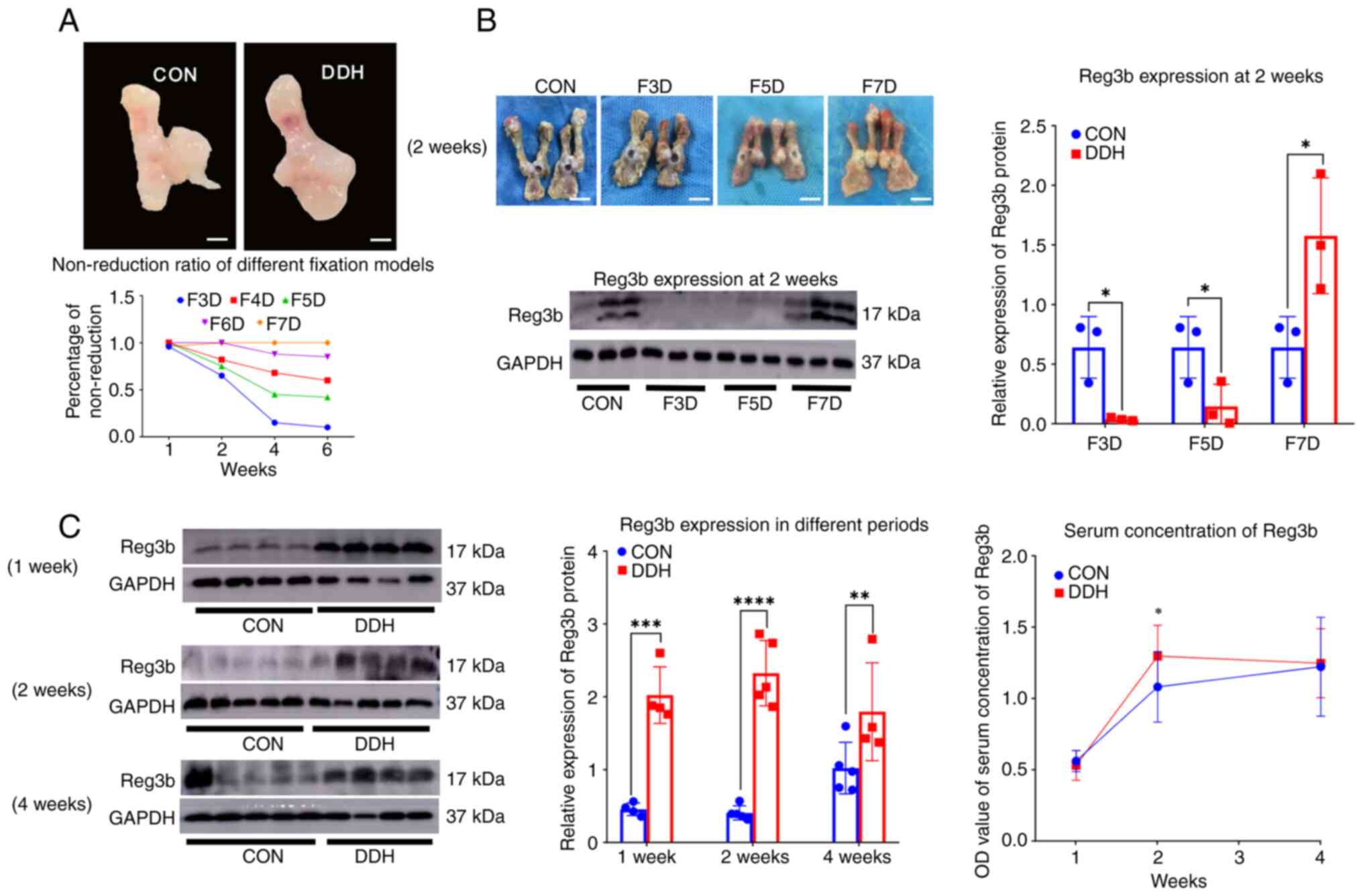
Figure 1

Morphology of a hip with residual
dysplasia and the expression of Reg3β. (A) Success of the DDH model
after 2 days of fixation (scale bar, 1 mm) and percentage of failed
reduction of the affected hip after removal of fixation (n=20 in
each group). (B) Dislocated hip was reduced at 2 weeks with F3D and
F5D fixation. By contrast, the affected hip was unreducible along
with the thickness of the acetabular roof after F7D, which is
consistent with the morphology of RAD (scale bar, 1 cm). In
addition, Reg3β in the acetabular roof was expressed at a higher
level in the 7-day fixation group than in the 3-day and 5-day
fixation groups and was expressed at lower levels in the 3-day and
5-day fixation groups than in the control group (n=3 in each
group). (C) Reg3β expression was greater in the 7-day fixation
group than in the normal group at weeks 1, 2 and 4, and Reg3β
expression was transiently upregulated in the serum at week 2 but
returned to the normal level at week 4. Student's t-tests were used
to compare the two groups between each time point. *P<0.05,
**P<0.01, ***P<0.001 and ****P<0.0001. Reg3β, regenerating
islet-derived protein 3-β; DDH, developmental dysplasia of the hip;
F3D, 3-day fixation; F5D, 5-day fixation; F7D, 7-day fixation; RAD,
residual acetabular dysplasia; CON, control.

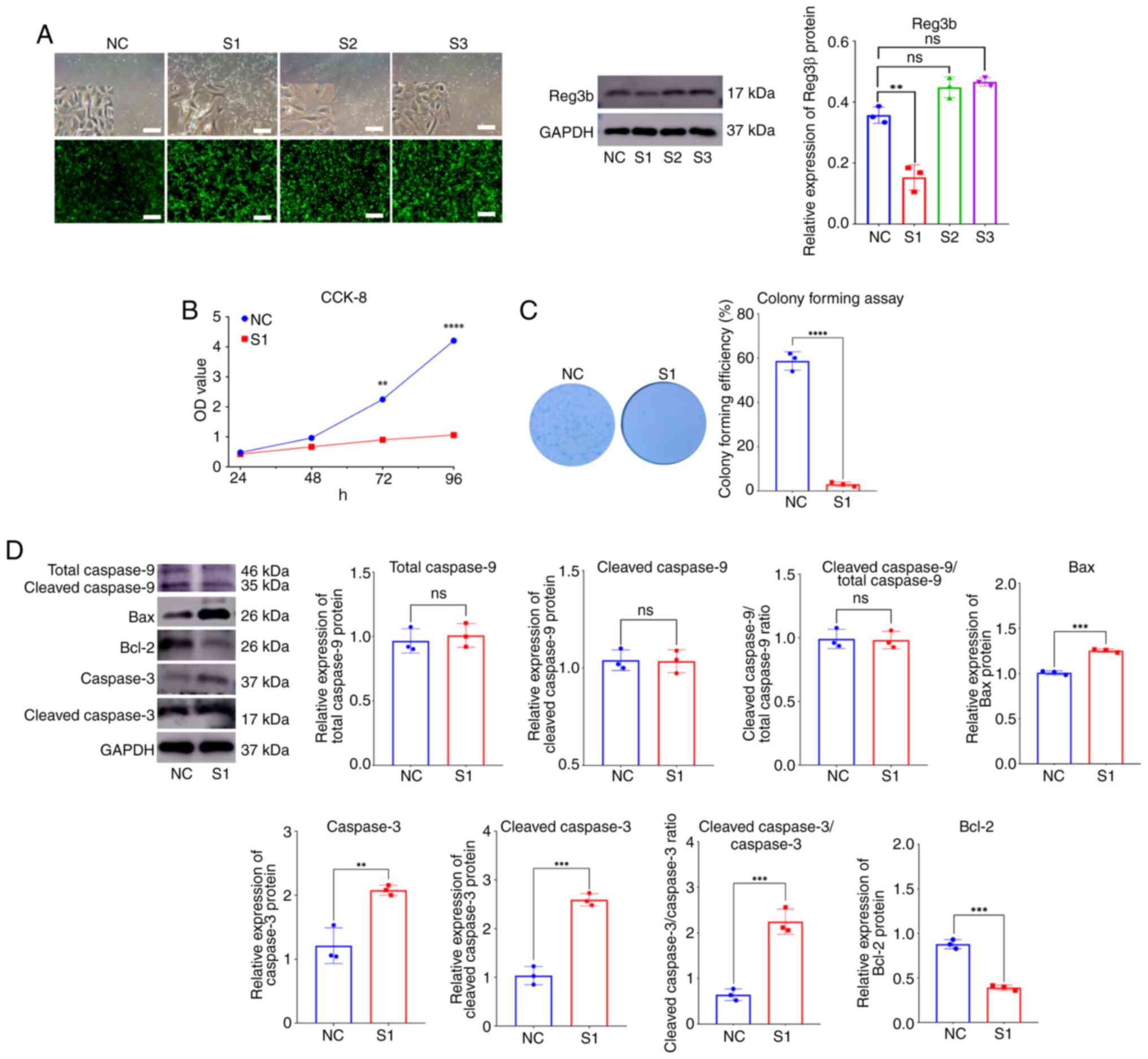
Figure 2

Western blot analysis of Reg3β
expression, proliferation and apoptosis after Reg3β knockdown. (A)
Clear cell death was observed with the S1 sequence, which exhibited
the most effective knockdown compared with the other two sequences.
One-way analysis of variance was used to compare these groups
followed by Dunnett's post hoc test. Scale bar, 100 µm. (B) CCK-8
assay revealed that the proliferation of chondrocytes was inhibited
after 72 h. (C) A colony formation assay with Alcian blue staining
revealed that few cells remained after 1 week of S1 infection. (D)
Cleaved caspase-3 and caspase-3, along with Bax, were increased
after Reg3β knockdown at 72 h, whereas the level of Bcl-2 was
significantly decreased, and the level of caspase-9 remained
essentially unchanged. Student's t-tests were conducted to assess
the statistical difference between the two groups in Fig. 2B-D. **P<0.01 and ***P<0.001.
Reg3β, regenerating islet-derived protein 3-β; CCK-8, Cell Counting
Kit-8; NC, negative control; OD, optical density.

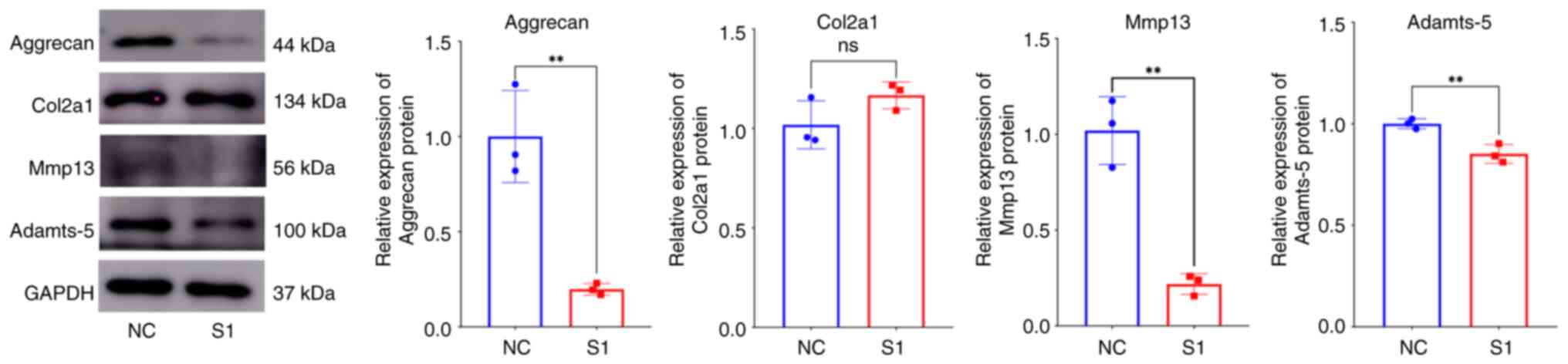
Figure 3

Anabolic and catabolic changes after
Reg3β knockdown. Aggrecan, Mmp13 and Adamts-5 were downregulated,
whereas Col2a1 exhibited no obvious change. Student's t-tests were
performed to evaluate the statistical difference between the two
groups. **P<0.01. Reg3β, regenerating islet-derived protein 3-β;
NC, negative control; ns, not significant; Mmp13, matrix
metallopeptidase 13; Col2a1, collagen type II alpha 1 chain;
Adamts-5, ADAM metallopeptidase with thrombospondin type 1 motif
5.

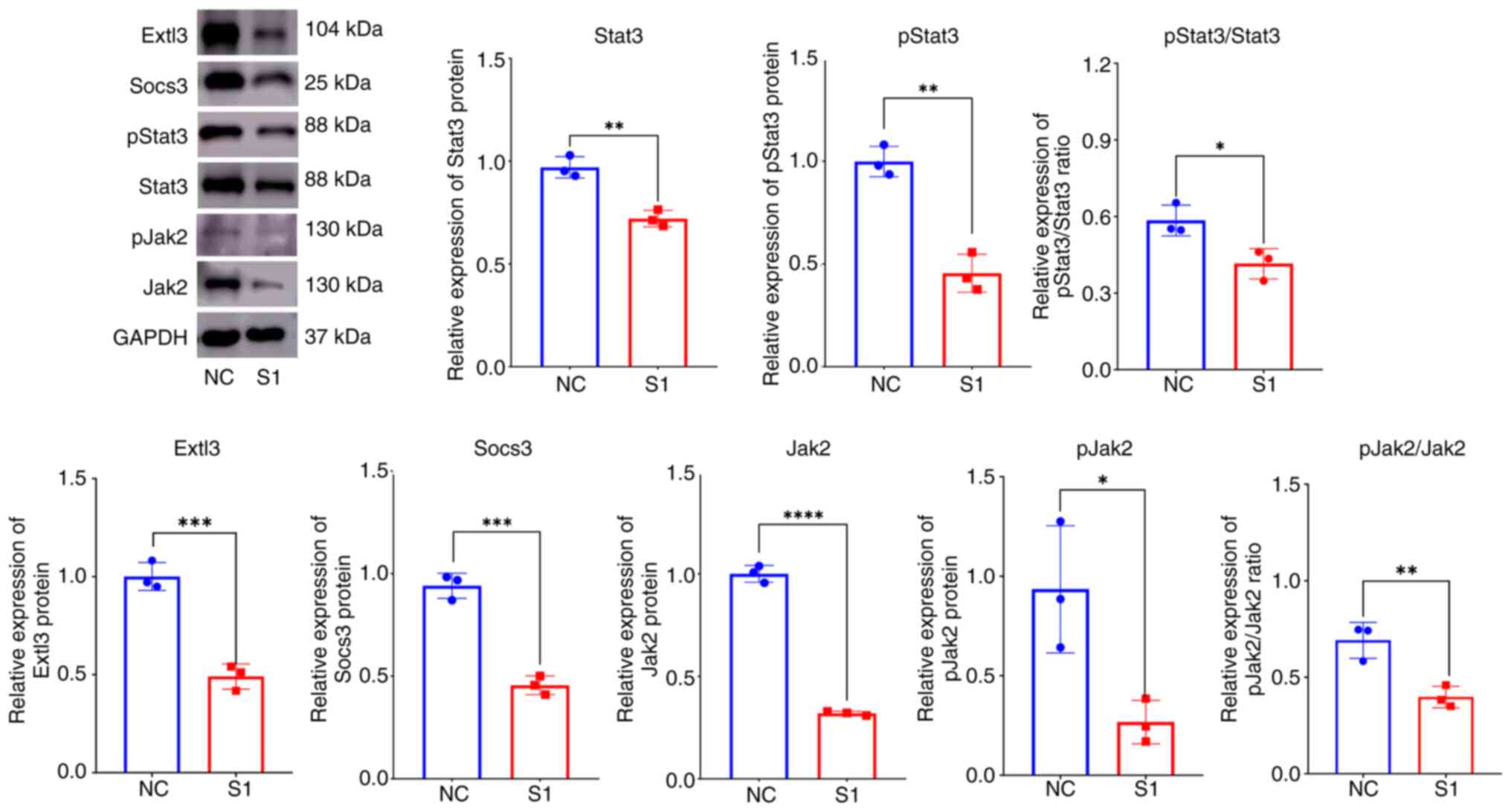
Figure 4

Jak2/Stat3/Socs3 signaling pathway is
inhibited after Reg3β knockdown. Jak2/Stat3 and the corresponding
phosphorylated proteins, as well as Extl3 and Socs3, were
downregulated. Student's t-tests were performed to evaluate the
statistical difference between the two groups. *P<0.05,
**P<0.01, ***P<0.001 and ****P<0.0001. Reg3β, regenerating
islet-derived protein 3-β; Extl3, exostosin like
glycosyltransferase 3; Socs3, suppressor of cytokine signaling 3;
NC, negative control.

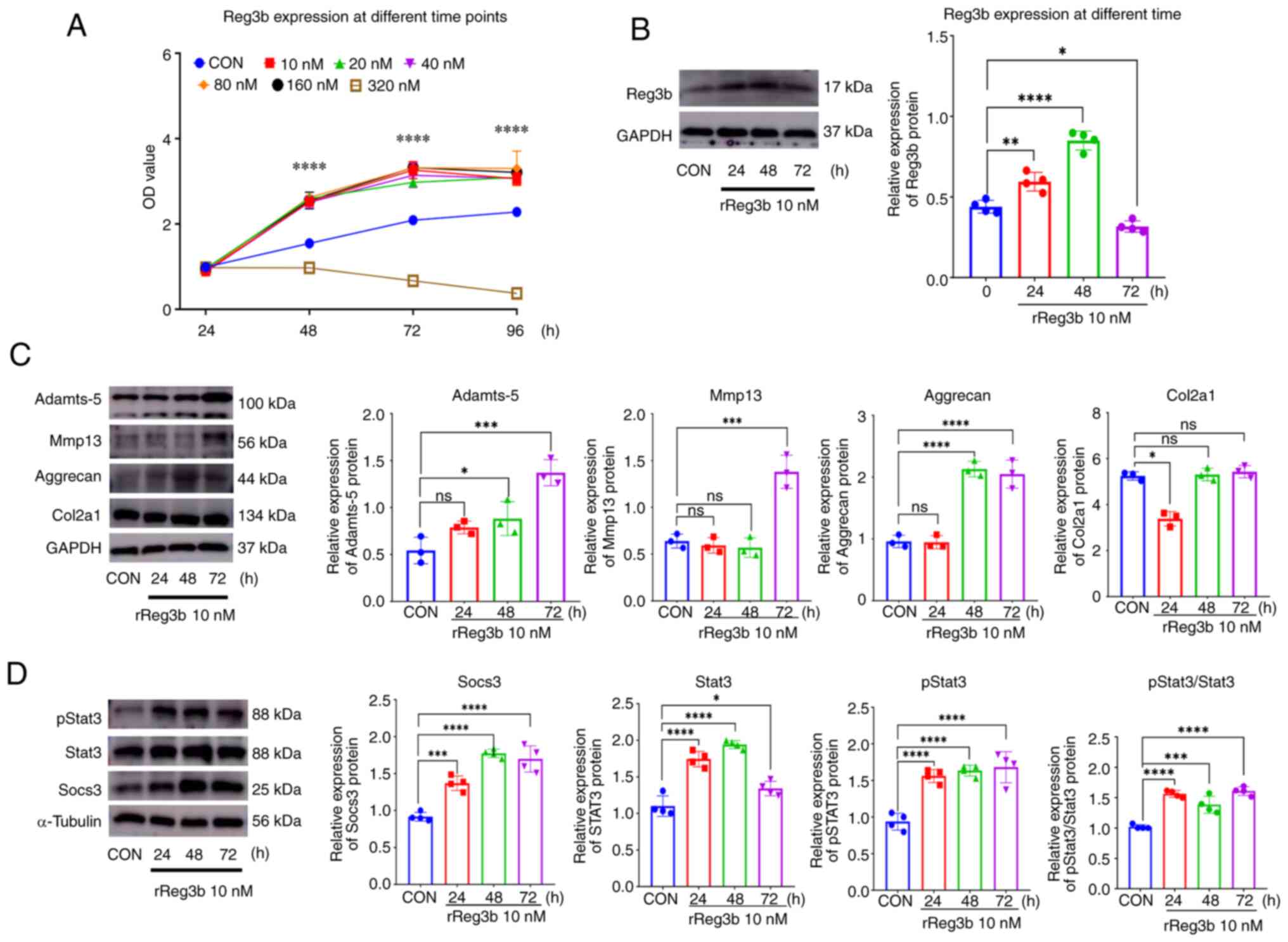
Figure 5

Recombinant Reg3β protein promotes
the activity of chondrocytes and the metabolism of the
extracellular matrix. (A) The optimum concentration of recombinant
Reg3β protein for subsequent experiments was determined. (B)
Changes in Reg3β expression over time after the addition of
recombinant Reg3β protein. (C) Aggrecan and corresponding
degradative enzymes, such as Adamts-5 and Mmp13, were upregulated
significantly after stimulation with the recombinant Reg3β protein,
whereas Col2a1 expression did not change following transient
downregulation at 24 h. (D) Stat3 and Socs3 were activated after
Reg3β protein stimulation. ANOVA with Dunnett's post hoc test were
performed. *P<0.05, **P<0.01, ***P<0.001 and
****P<0.0001. Reg3β, regenerating islet-derived protein 3-β;
CCK-8, Cell Counting Kit-8; OD, optical density; CON, control;
rReg3β, recombinant Reg3β; Mmp13, matrix metallopeptidase 13;
Col2a1, collagen type II alpha 1 chain; Adamts-5, ADAM
metallopeptidase with thrombospondin type 1 motif 5; Socs3,
suppressor of cytokine signaling 3.
View References

1 

Kiani SN, Gornitzky AL, Matheney TH, Schaeffer EK, Mulpuri K, Shah HH, Yihua G, Upasani V, Aroojis A, Krishnamoorthy V, et al: A prospective, multicenter study of developmental dysplasia of the hip: What can patients expect after open reduction? J Pediatr Orthop. 43:279–285. 2023. View Article : Google Scholar : PubMed/NCBI

2 

Håberg Ø, Bremnes T, Foss OA, Angenete O, Lian ØB and Holen KJ: Children treated for developmental dysplasia of the hip at birth and with normal acetabular index at 1 year: How many had residual dysplasia at 5 years? J Child Orthop. 16:183–190. 2022. View Article : Google Scholar : PubMed/NCBI

3 

Bakti K, Lankinen V, Helminen M, Välipakka J, Laivuori H and Hyvärinen A: Clinical and sonographic improvement of developmental dysplasia of the hip: Analysis of 948 patients. J Orthop Surg. 17:5382022. View Article : Google Scholar : PubMed/NCBI

4 

Dornacher D, Lutz B, Freitag T, Sgroi M, Taurman R and Reichel H: Residual dysplasia of the hip after successful ultrasound-monitored treatment: How does an infant's hip evolve? J Pediatr Orthop B. 31:524–531. 2022. View Article : Google Scholar : PubMed/NCBI

5 

de Courtivron B, Brulefert K, Portet A and Odent T: Residual acetabular dysplasia in congenital hip dysplasia. Orthop Traumatol Surg Res. 108:1031722022. View Article : Google Scholar : PubMed/NCBI

6 

Tuhanioğlu Ü, Cicek H, Ogur HU, Seyfettinoglu F and Kapukaya A: Evaluation of late redislocation in patients who underwent open reduction and pelvic osteotomy as treament for developmental dysplasia of the hip. HIP Int. 28:309–314. 2018. View Article : Google Scholar : PubMed/NCBI

7 

McClincy MP, Wylie JD, Yen YM and Novais EN: Mild or borderline hip dysplasia: Are we characterizing hips with a lateral center-edge angle between 18° and 25° appropriately? Am J Sports Med. 47:112–122. 2019. View Article : Google Scholar : PubMed/NCBI

8 

Barrera CA, Cohen SA, Sankar WN, Ho-Fung VM, Sze RW and Nguyen JC: Imaging of developmental dysplasia of the hip: Ultrasound, radiography and magnetic resonance imaging. Pediatr Radiol. 49:1652–1668. 2019. View Article : Google Scholar : PubMed/NCBI

9 

Shin CH, Yang E, Lim C, Yoo WJ, Choi IH and Cho TJ: Which Acetabular landmarks are the most useful for measuring the acetabular index and Center-edge angle in developmental dysplasia of the hip? A comparison of two methods. Clin Orthop. 478:2120–2131. 2020. View Article : Google Scholar : PubMed/NCBI

10 

Miyake T, Tetsunaga T, Endo H, Yamada K, Sanki T, Fujiwara K, Nakata E and Ozaki T: Predicting acetabular growth in developmental dysplasia of the hip following open reduction after walking age. J Orthop Sci. 24:326–331. 2019. View Article : Google Scholar : PubMed/NCBI

11 

Liu X, Deng X, Ding R, Cheng X and Jia J: Chondrocyte suppression is mediated by miR-129-5p via GDF11/SMAD3 signaling in developmental dysplasia of the hip. J Orthop Res. 38:2559–2572. 2020. View Article : Google Scholar : PubMed/NCBI

12 

Wakabayashi K, Wada I, Horiuchi O, Mizutani J, Tsuchiya D and Otsuka T: MRI Findings in Residual Hip Dysplasia. J Pediatr Orthop. 31:381–387. 2011. View Article : Google Scholar : PubMed/NCBI

13 

Kim HT, Kim IB and Lee JS: MR-based parameters as a supplement to radiographs in managing developmental hip dysplasia. Clin Orthop Surg. 3:2022011. View Article : Google Scholar : PubMed/NCBI

14 

Douira-Khomsi W, Smida M, Louati H, Hassine LB, Bouchoucha S, Saied W, Ladeb MF, Ghachem MB and Bellagha I: Magnetic resonance evaluation of acetabular residual dysplasia in developmental dysplasia of the hip: A preliminary study of 27 patients. J Pediatr Orthop. 30:37–43. 2010. View Article : Google Scholar : PubMed/NCBI

15 

Schmaranzer F, Justo P, Kallini JR, Ferrer MG, Miller PE, Matheney T, Bixby SD and Novais EN: MRI hip morphology is abnormal in unilateral DDH and increased lateral limbus thickness is associated with residual DDH at minimum 10-year follow-up. J Child Orthop. 17:86–96. 2023. View Article : Google Scholar : PubMed/NCBI

16 

Fu Z, Zhang Z, Deng S, Yang J, Li B, Zhang H and Liu J: MRI assessment of femoral head docking following closed reduction of developmental dysplasia of the hip. Bone Jt J. 105-B:140–147. 2023. View Article : Google Scholar

17 

Johnson MA, Gohel S, Nguyen JC and Sankar WN: MRI predictors of residual dysplasia in developmental dysplasia of the hip following open and closed reduction. J Pediatr Orthop. 42:179–185. 2022. View Article : Google Scholar : PubMed/NCBI

18 

Gather KS, Mavrev I, Gantz S, Dreher T, Hagmann S and Beckmann NA: Outcome prognostic factors in MRI during spica cast therapy treating developmental hip dysplasia with midterm follow-up. Children. 9:10102022. View Article : Google Scholar : PubMed/NCBI

19 

Tetsunaga T, Tetsunaga T, Akazawa H, Yamada K, Furumatsu T and Ozaki T: Evaluation of the labrum on postoperative magnetic resonance images: A predictor of acetabular development in developmental dysplasia of the hip. HIP Int. 32:800–806. 2022. View Article : Google Scholar : PubMed/NCBI

20 

Meng X, Yang J and Wang Z: Magnetic resonance imaging follow-up can screen for soft tissue changes and evaluate the short-term prognosis of patients with developmental dysplasia of the hip after closed reduction. BMC Pediatr. 21:1152021. View Article : Google Scholar : PubMed/NCBI

21 

Kawamura Y, Tetsunaga T, Akazawa H, Yamada K, Sanki T, Sato Y, Nakata E and Ozaki T: Acetabular depth, an early predictive factor of acetabular development: MRI in patients with developmental dysplasia of the hip after open reduction. J Pediatr Orthop B. 30:509–514. 2021. View Article : Google Scholar : PubMed/NCBI

22 

Ding R, Liu X, Zhang J, Yuan J, Zheng S, Cheng X and Jia J: Downregulation of miR-1-3p expression inhibits the hypertrophy and mineralization of chondrocytes in DDH. J Orthop Surg. 16:5122021. View Article : Google Scholar : PubMed/NCBI

23 

Ning B, Jin R, Wan L and Wang D: Cellular and molecular changes to chondrocytes in an in vitro model of developmental dysplasia of the hip-an experimental model of DDH with swaddling position. Mol Med Rep. 18:3873–3881. 2018.PubMed/NCBI

24 

Li TY and Ma RX: Increasing thickness and fibrosis of the cartilage in acetabular dysplasia: A rabbit model research. Chin Med J (Engl). 123:3061–3066. 2010.PubMed/NCBI

25 

Fischer J, Knoch N, Sims T, Rosshirt N and Richter W: Time-dependent contribution of BMP, FGF, IGF, and HH signaling to the proliferation of mesenchymal stroma cells during chondrogenesis. J Cell Physiol. 233:8962–8970. 2018. View Article : Google Scholar : PubMed/NCBI

26 

Ji X, Liu T, Zhao S, Li J, Li L and Wang E: WISP-2, an upregulated gene in hip cartilage from the DDH model rats, induces chondrocyte apoptosis through PPARγ in vitro. FASEB J. 34:4904–4917. 2020. View Article : Google Scholar : PubMed/NCBI

27 

Otsuka N, Yoshioka M, Abe Y, Nakagawa Y, Uchinami H and Yamamoto Y: Reg3α and Reg3β expressions followed by JAK2/STAT3 activation play a pivotal role in the acceleration of liver hypertrophy in a rat ALPPS model. Int J Mol Sci. 21:40772020. View Article : Google Scholar : PubMed/NCBI

28 

Namikawa K, Okamoto T, Suzuki A, Konishi H and Kiyama H: Pancreatitis-associated protein-III is a novel macrophage chemoattractant implicated in nerve regeneration. J Neurosci. 26:7460–7467. 2006. View Article : Google Scholar : PubMed/NCBI

29 

Cao Y, Tian Y, Liu Y and Su Z: Reg3β: A potential therapeutic target for tissue injury and inflammation-associated disorders. Int Rev Immunol. 41:160–170. 2022. View Article : Google Scholar : PubMed/NCBI

30 

Lindsey ML, Mouton AJ and Ma Y: Adding Reg3β to the acute coronary syndrome prognostic marker list. Int J Cardiol. 258:24–25. 2018. View Article : Google Scholar : PubMed/NCBI

31 

Chijimatsu R and Saito T: Mechanisms of synovial joint and articular cartilage development. Cell Mol Life Sci. 76:3939–3952. 2019. View Article : Google Scholar : PubMed/NCBI

32 

Zhang H, Corredor ALG, Messina-Pacheco J, Li Q, Zogopoulos G, Kaddour N, Wang Y, Shi BY, Gregorieff A, Liu JL and Gao ZH: REG3A/REG3B promotes acinar to ductal metaplasia through binding to EXTL3 and activating the RAS-RAF-MEK-ERK signaling pathway. Commun Biol. 4:6882021. View Article : Google Scholar : PubMed/NCBI

33 

Raab P, Löhr J and Krauspe R: Remodellierung des Azetabulum nach experimenteller Hüftgelenksdislokation-eine tierexperimentelle Studie an Kaninchen. Z Für Orthop Ihre Grenzgeb. 136:519–524. 2008. View Article : Google Scholar : PubMed/NCBI

34 

Yamamoto N: Changes of the acetabular cartilage following experimental subluxation of the hip joint in rabbits. Nihon Seikeigeka Gakkai Zasshi. 57:1741–1753. 1983.(In Japanese). PubMed/NCBI

35 

Ning B, Sun J, Yuan Y, Yao J, Wang P and Ma R: Early articular cartilage degeneration in a developmental dislocation of the hip model results from activation of β-catenin. Int J Clin Exp Pathol. 7:1369–1378. 2014.PubMed/NCBI

36 

Brougham D, Broughton N, Cole W and Menelaus M: The predictability of acetabular development after closed reduction for congenital dislocation of the hip. J Bone Joint Surg Br. 70-B:733–736. 1988. View Article : Google Scholar : PubMed/NCBI

37 

Bos CF, Bloem JL and Verbout AJ: Magnetic resonance imaging in acetabular residual dysplasia. Clin Orthop. 207–217. 1991. View Article : Google Scholar : PubMed/NCBI

38 

Harris NH: Acetabular growth potential in congenital dislocation of the hip and some factors upon which it may depend. Clin Orthop. 99–106. 1976.PubMed/NCBI

39 

Albinana J, Dolan LA, Spratt KF, Morcuende J, Meyer MD and Weinstein SL: Acetabular dysplasia after treatment for developmental dysplasia of the hip: Implications for secondary procedures. J Bone Joint Surg Br. 86:876–886. 2004. View Article : Google Scholar : PubMed/NCBI

40 

Fu M, Liu J, Huang G, Huang Z, Zhang Z, Wu P, Wang B, Yang Z and Liao W: Impaired ossification coupled with accelerated cartilage degeneration in developmental dysplasia of the hip: Evidences from µCT arthrography in a rat model. BMC Musculoskelet Disord. 15:3392014. View Article : Google Scholar : PubMed/NCBI

41 

Mansour E, Eid R, Romanos E and Ghanem I: The management of residual acetabular dysplasia: Updates and controversies. J Pediatr Orthop B. 26:344–349. 2017. View Article : Google Scholar : PubMed/NCBI

42 

Morris WZ, Hinds S, Worrall H, Jo CH and Kim HKW: Secondary surgery and residual dysplasia following late closed or open reduction of developmental dysplasia of the hip. J Bone Jt Surg. 103:235–242. 2021. View Article : Google Scholar : PubMed/NCBI

43 

Chen Z, Huang Z, Xue H, Lin X, Chen R, Chen M and Jin R: REG3A promotes the proliferation, migration, and invasion of gastric cancer cells. Onco Targets Ther. 10:2017–2023. 2017. View Article : Google Scholar : PubMed/NCBI

44 

Xu X, Fukui H, Ran Y, Wang X, Inoue Y, Ebisudani N, Nishimura H, Tomita T, Oshima T, Watari J, et al: The link between type III Reg and STAT3-associated cytokines in inflamed colonic tissues. Mediators Inflamm. 2019:78594602019. View Article : Google Scholar : PubMed/NCBI

45 

Wang L, Quan Y, Zhu Y, Xie X, Wang Z, Wang L, Wei X and Che F: The regenerating protein 3A: A crucial molecular with dual roles in cancer. Mol Biol Rep. 49:1491–1500. 2022. View Article : Google Scholar : PubMed/NCBI

46 

Guan M, Yu Q, Zhou G, Wang Y, Yu J, Yang W and Li Z: Mechanisms of chondrocyte cell death in osteoarthritis: Implications for disease progression and treatment. J Orthop Surg. 19:5502024. View Article : Google Scholar : PubMed/NCBI

47 

Blumer MJF: Bone tissue and histological and molecular events during development of the long bones. Ann Anat. 235:1517042021. View Article : Google Scholar : PubMed/NCBI

48 

Koosha E, Brenna CTA, Ashique AM, Jain N, Ovens K, Koike T, Kitagawa H and Eames BF: Proteoglycan inhibition of canonical BMP-dependent cartilage maturation delays endochondral ossification. Development. 151:dev2017162024. View Article : Google Scholar : PubMed/NCBI

49 

Noritake K, Yoshihashi Y, Hattori T and Miura T: Acetabular development after closed reduction of congenital dislocation of the hip. J Bone Joint Surg Br. 75:737–743. 1993. View Article : Google Scholar : PubMed/NCBI

50 

Sarkar A, Liu NQ, Magallanes J, Tassey J, Lee S, Shkhyan R, Lee Y, Lu J, Ouyang Y, Tang H, et al: STAT3 promotes a youthful epigenetic state in articular chondrocytes. Aging Cell. 22:e137732023. View Article : Google Scholar : PubMed/NCBI

51 

Liu NQ, Lin Y, Li L, Lu J, Geng D, Zhang J, Jashashvili T, Buser Z, Magallanes J, Tassey J, et al: gp130/STAT3 signaling is required for homeostatic proliferation and anabolism in postnatal growth plate and articular chondrocytes. Commun Biol. 5:642022. View Article : Google Scholar : PubMed/NCBI

52 

Liu X, D'Cruz AA, Hansen J, Croker BA, Lawlor KE, Sims NA and Wicks IP: Deleting suppressor of cytokine Signaling-3 in chondrocytes reduces bone growth by disrupting mitogen-activated protein kinase signaling. Osteoarthritis Cartilage. 27:1557–1563. 2019. View Article : Google Scholar : PubMed/NCBI

Related Articles

  • Abstract
  • View
  • Download
  • Twitter
Copy and paste a formatted citation
Spandidos Publications style
Wang P, Li M, Wang W, Sun W, Zhen W, Sun Q, Ning B, Su G and Wang X: Reg3&beta; promotes chondrocyte proliferation and ECM metabolism during acetabular roof remodeling in a rat model of DDH‑induced residual dysplasia. Mol Med Rep 32: 288, 2025.
APA
Wang, P., Li, M., Wang, W., Sun, W., Zhen, W., Sun, Q. ... Wang, X. (2025). Reg3&beta; promotes chondrocyte proliferation and ECM metabolism during acetabular roof remodeling in a rat model of DDH‑induced residual dysplasia. Molecular Medicine Reports, 32, 288. https://doi.org/10.3892/mmr.2025.13653
MLA
Wang, P., Li, M., Wang, W., Sun, W., Zhen, W., Sun, Q., Ning, B., Su, G., Wang, X."Reg3&beta; promotes chondrocyte proliferation and ECM metabolism during acetabular roof remodeling in a rat model of DDH‑induced residual dysplasia". Molecular Medicine Reports 32.5 (2025): 288.
Chicago
Wang, P., Li, M., Wang, W., Sun, W., Zhen, W., Sun, Q., Ning, B., Su, G., Wang, X."Reg3&beta; promotes chondrocyte proliferation and ECM metabolism during acetabular roof remodeling in a rat model of DDH‑induced residual dysplasia". Molecular Medicine Reports 32, no. 5 (2025): 288. https://doi.org/10.3892/mmr.2025.13653
Copy and paste a formatted citation
x
Spandidos Publications style
Wang P, Li M, Wang W, Sun W, Zhen W, Sun Q, Ning B, Su G and Wang X: Reg3&beta; promotes chondrocyte proliferation and ECM metabolism during acetabular roof remodeling in a rat model of DDH‑induced residual dysplasia. Mol Med Rep 32: 288, 2025.
APA
Wang, P., Li, M., Wang, W., Sun, W., Zhen, W., Sun, Q. ... Wang, X. (2025). Reg3&beta; promotes chondrocyte proliferation and ECM metabolism during acetabular roof remodeling in a rat model of DDH‑induced residual dysplasia. Molecular Medicine Reports, 32, 288. https://doi.org/10.3892/mmr.2025.13653
MLA
Wang, P., Li, M., Wang, W., Sun, W., Zhen, W., Sun, Q., Ning, B., Su, G., Wang, X."Reg3&beta; promotes chondrocyte proliferation and ECM metabolism during acetabular roof remodeling in a rat model of DDH‑induced residual dysplasia". Molecular Medicine Reports 32.5 (2025): 288.
Chicago
Wang, P., Li, M., Wang, W., Sun, W., Zhen, W., Sun, Q., Ning, B., Su, G., Wang, X."Reg3&beta; promotes chondrocyte proliferation and ECM metabolism during acetabular roof remodeling in a rat model of DDH‑induced residual dysplasia". Molecular Medicine Reports 32, no. 5 (2025): 288. https://doi.org/10.3892/mmr.2025.13653
Follow us
  • Twitter
  • LinkedIn
  • Facebook
About
  • Spandidos Publications
  • Careers
  • Cookie Policy
  • Privacy Policy
How can we help?
  • Help
  • Live Chat
  • Contact
  • Email to our Support Team