Introduction
Ovarian torsion is a rare but serious gynecological
emergency that can occur in women of all ages. The prevalence of
ovarian torsion is 2–15% among patients undergoing surgical
treatment for adnexal masses, and 10–22% of all ovarian torsion
cases occur in pregnant women (1).
Torsion typically involves both the ovary and fallopian tube, with
torsion affecting only one of these structures being less common
(2–4). Ovarian torsion involves the total or
partial rotation of the adnexa around its supporting structures.
Torsion of the ovarian vascular pedicle along its axis leads to
diminished arterial blood flow and obstructed venous and lymphatic
drainage, ultimately leading to ischemia (5), which has been widely recognized to
induce cellular damage (6).
Since the extent of ischemic injury is strongly
time-dependent, rapid intervention to reduce the duration of
hypoperfusion is critical for preventing cell damage. Rapid
diagnosis and prompt surgical intervention are therefore essential
for reducing the hypoperfusion period and preserving ovarian and
tubal function (7,8). Surgery is the main method of treating
ovarian torsion, involving either laparoscopy or laparotomy. After
surgery, medications are typically administered to reduce the risk
of recurrence (8). However, the
restoration of blood flow during reperfusion can trigger events
that worsen cellular damage (9).
The reperfusion of ischemic tissue triggers an influx of molecular
oxygen that activates xanthine oxidase and NADPH oxidase,
generating highly reactive oxygen species (ROS) (10). Excessive quantities of ROS induce
lipid peroxidation, leading to the synthesis and systemic release
of proinflammatory eicosanoids, which decrease membrane
permeability and ultimately lead to cell death through autophagy,
necroptosis or apoptosis (11). In
parallel, lactate dehydrogenase and other anaerobic metabolites
contribute to oxidative tissue damage and necrosis (12). Under physiological conditions, ROS
are neutralized by natural antioxidant mechanisms. However, under
conditions of ischemia-reperfusion (IR), the radical-scavenging
ability of these antioxidants is overwhelmed (13).
Tadalafil, a phosphodiesterase type 5 (PDE-5)
inhibitor, is commonly used for the treatment of erectile
dysfunction. PDE-5 inhibitors increase 3′,5′-cyclic guanosine
monophosphate (cGMP) levels by inhibiting the enzymatic degradation
of cGMP (14). The
tadalafil-induced elevation of cGMP levels has been shown to
diminish lipid peroxidation and suppress NADP oxidase activity,
which are the primary ROS-producing systems during oxidative stress
(15). Tadalafil exhibits a dual
role in tissues undergoing ischemia and reperfusion, exerting both
vasodilatory and antioxidant effects (16). Previous studies suggest that PDE-5
inhibitors may mitigate the negative consequences of IR injury on
the brain, kidneys and heart (17–19).
Hyperbaric oxygen therapy (HBOT) increases the
partial pressure of oxygen in the circulatory system and tissues by
administering 100% oxygen at pressures >1 atmosphere absolute
(ATA). HBOT can mitigate IR injury by reducing inflammation,
promoting microcirculation, preserving the metabolic function of
injured tissues, and limiting the generation of ROS and the
resulting oxidative tissue damage (20,21).
To the best of our knowledge, no information is
currently available regarding the combined effects of tadalafil and
HBOT on IR-induced ovarian damage. Therefore, the present study
aims to evaluate the protective efficacy of HBOT and tadalafil
treatment against IR injury in an experimental model of ovarian
torsion in rats.
Materials and methods
Animals
The study was conducted at the Experimental Research
Application and Research Center (DEKAM) of Erciyes University. The
rats were obtained from DEKAM. The Experimental Animal Ethics
Committee of Erciyes University (Kayseri, Turkey) approved the
study protocol (approval no. 21/124). A total of 40 female Wistar
albino rats (body weight, 250–300 g; age, 6–8 weeks) were used in
the study. The rats were divided into five groups (n=8/group) as
follows: Control group; IR group, subjected to 2 h ischemia; IR +
tadalafil group, subjected to 2 h ischemia followed by treatment
with 10 mg/kg tadalafil daily for 7 days; IR + HBOT group,
subjected to 2 h ischemia followed by treatment with 2.4 ATA/1 h
HBOT daily for 7 days; and IR + tadalafil + HBOT, subjected to 2 h
ischemia followed by treatment with 10 mg/kg tadalafil and 2.4
ATA/1 h HBOT daily for 7 days. The rats were housed away from
stressful situations in a well-ventilated environment under
controlled conditions (22–25°C, 40–70% relative humidity and a 12-h
light/dark cycle). Animals had free access to water and food, and
were fed a standard rodent diet.
Experimental design
Prior to surgery, the rats were anesthetized under
sterile conditions with xylazine hydrochloride (Rompun; 10 mg/kg;
Bayer AG) and ketamine hydrochloride (Ketalar; 80 mg/kg; Pfizer,
Inc.). A 2-cm midline incision was performed for laparotomy in the
lower abdomen of the rats, allowing for examination of the uterine
horns, adnexa and ovaries. The left adnexa was sutured with 4/0
Vicryl, rendering it ischemic for 2 h. The ischemia was terminated
by removal of the suture. Following the procedure, the surgical
site was closed in two layers using 4/0 silk sutures; the muscular
and subcutaneous connective tissues were closed first, followed by
the skin. In the control group (Sham), the left side of the
abdominal wall was opened and closed 1 min later with 4/0 silk
sutures.
For HBOT, the cages containing the rats of the IR +
HBOT and IR + tadalafil + HBOT groups were placed in a hyperbaric
chamber. The chamber was filled with 100% oxygen (GAZSAN Sanayi
Gazlari Ltd. Sti.) at a rate of 0.1 ATA/min for ~15 min until the
pressure reached 2.4 ATA. The rats then underwent HBOT for 1 h. The
HBOT was initially administered 4 h post-surgery, then performed
once daily and terminated after 7 days. In the tadalafil and IR +
tadalafil + HBOT groups, the rats received tadalafil (10 mg/kg;
Nuvomed Pharmaceuticals) via oral gavage (22) 4 h post-surgery and once daily for a
total of 7 days. At the end of the treatment period, ovarian tissue
was harvested from the rats under anesthesia Thereafter, the
thoracic cavity was accessed, intracardiac blood was extracted and
the rats were euthanized by cervical dislocation.
Serum anti-Müllerian hormone (AMH)
ELISA
AMH levels were analyzed in serum samples from the
rats using a commercially available ELISA kit (cat. no.
201-11-0457; Shanghai Sunred Biological Technology Co., Ltd.).
Briefly, micro-ELISA strip plates pre-coated with an AMH-specific
antibody were incubated with standards and serum samples. A
horseradish peroxidase-conjugated AMH-specific antibody was then
added to each well. Following incubation, a substrate solution was
added to induce a color change reaction (23). Optical density was measured using a
BioTek Synergy HT microplate reader (Agilent Technologies,
Inc.).
Immunohistochemistry
AMH immunoreactivity in primordial, primary,
preantral, secondary and tertiary ovarian follicles was evaluated
using a streptavidin-biotin immunoenzymatic antigen detection kit
(UltraVision Large Volume Detection System; Thermo Fisher
Scientific, Inc.) according to the manufacturer's protocol. The
ovarian tissues were fixed in 10% formaldehyde at 20°C for 72 h. In
brief, the 5-µm paraffin-embedded slices were deparaffinized at
67°C for 2 h and subsequently rehydrated. Xylene solutions were
employed in the purifying process of paraffin. Then, endogenous
peroxidase activity was blocked by incubation with 3% hydrogen
peroxide in methanol for 10 min at room temperature. The sections
were subsequently incubated with a serum-blocking reagent for 10
min at room temperature (10% goat serum; cat. no. ab138478; Abcam)
to prevent non-specific staining, and then treated overnight at 4°C
with goat polyclonal anti-AMH antibody (1:150; cat. no. sc-166752;
Santa Cruz Biotechnology, Inc.). After incubation with the primary
antibody, the section was washed and then incubated with the
secondary antibody at room temperature for 15 min. Finally, the
sections were treated with 3,3′-diaminobenzidine tetrahydrochloride
and counterstained with hematoxylin at room temperature for 5 min.
Images were acquired using an Olympus BX51 microscope (Olympus
Corporation). The images were evaluated using the ImageJ program
(version 1.54 k; National Institutes of Health).
Histopathological evaluation
Ovarian tissues were fixed in % 10 formalin at 20°C
for 72 h and dehydrated using graded alcohols, cleared with xylene,
and embedded in paraffin. Serial 5-µm sections were cut with a
microtome, and stained with either hematoxylin (5 min at room
temperature) and eosin (3 min at room temperature) (H&E) or
Masson's trichrome (MT; hematoxylin, 5 min; acid fuchsin, 30 sec;
aniline blue, 3 min; all at room temperature). The stained sections
were examined under an Olympus BX51 microscope. Primordial,
primary, preantral, secondary follicles were counted on the slides
to assess the follicular reserve.
TUNEL assay
Apoptosis was assessed using the ApopTag®
Fluorescein In Situ Apoptosis Detection Kit (MilliporeSigma)
according to the manufacturer's protocol. The nuclei were then
stained with DAPI for 15 min at 37°C. (Sigma-Aldrich), and
evaluated using an Olympus BX51 fluorescence microscope. Images
were acquired from ≥10 independent fields in each tissue section at
40× magnification, and the number of TUNEL-positive apoptotic cells
was quantified.
Statistical analysis
All statistical analyses were conducted using SPSS
for Windows, version 22.0 (IBM Corp.). Comparisons among the
control and experimental groups for normally distributed variables
were conducted using one-way analysis of variance (ANOVA), and
multiple comparisons were performed using Tukey's test when the
ANOVA indicated a significant difference. The Kruskal-Wallis test
was used for the comparison of non-normally distributed data, and
multiple comparisons were performed using Dunn's test when the
Kruskal-Wallis analysis indicated a significant difference. Results
are presented as the mean ± standard deviation, with P<0.05
considered to indicate a statistically significant difference.
Results
Serum AMH levels
AMH is a well-established marker of ovarian reserve
during the early follicular phase and is associated with natural
fertility (24). The rat ovarian
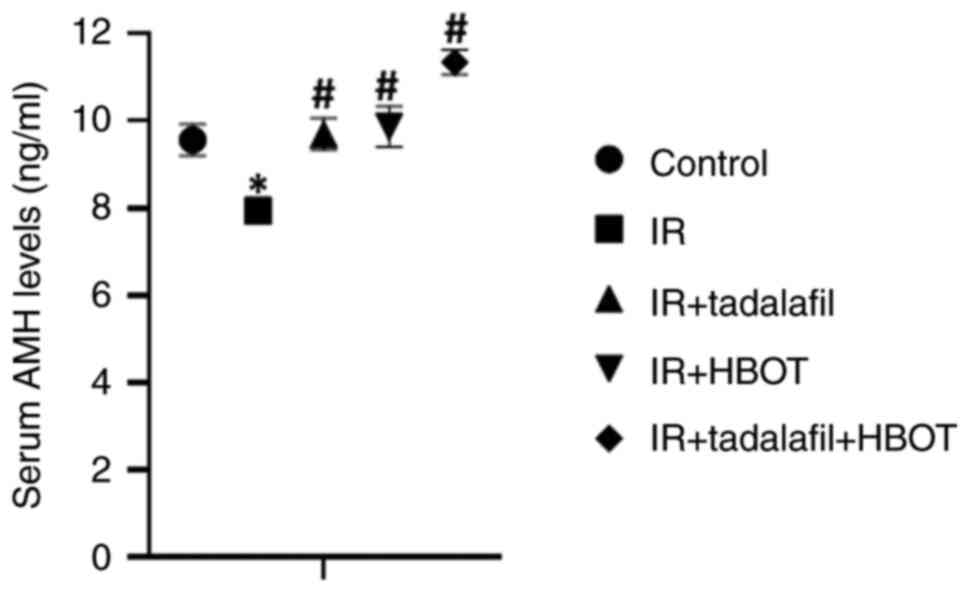
torsion model resulted in a significant reduction of serum AMH
levels in the IR group compared with those in the control group,
consistent with a reduction of ovarian reserve. Treatment with
either tadalafil or HBOT significantly elevated serum AMH levels in
the IR model rats. In addition, compared to the IR group, the
combined administration of tadalafil and HBOT resulted in a notable
elevation of the serum AMH levels (Fig. 1).
Ovarian follicular AMH
immunohistochemistry
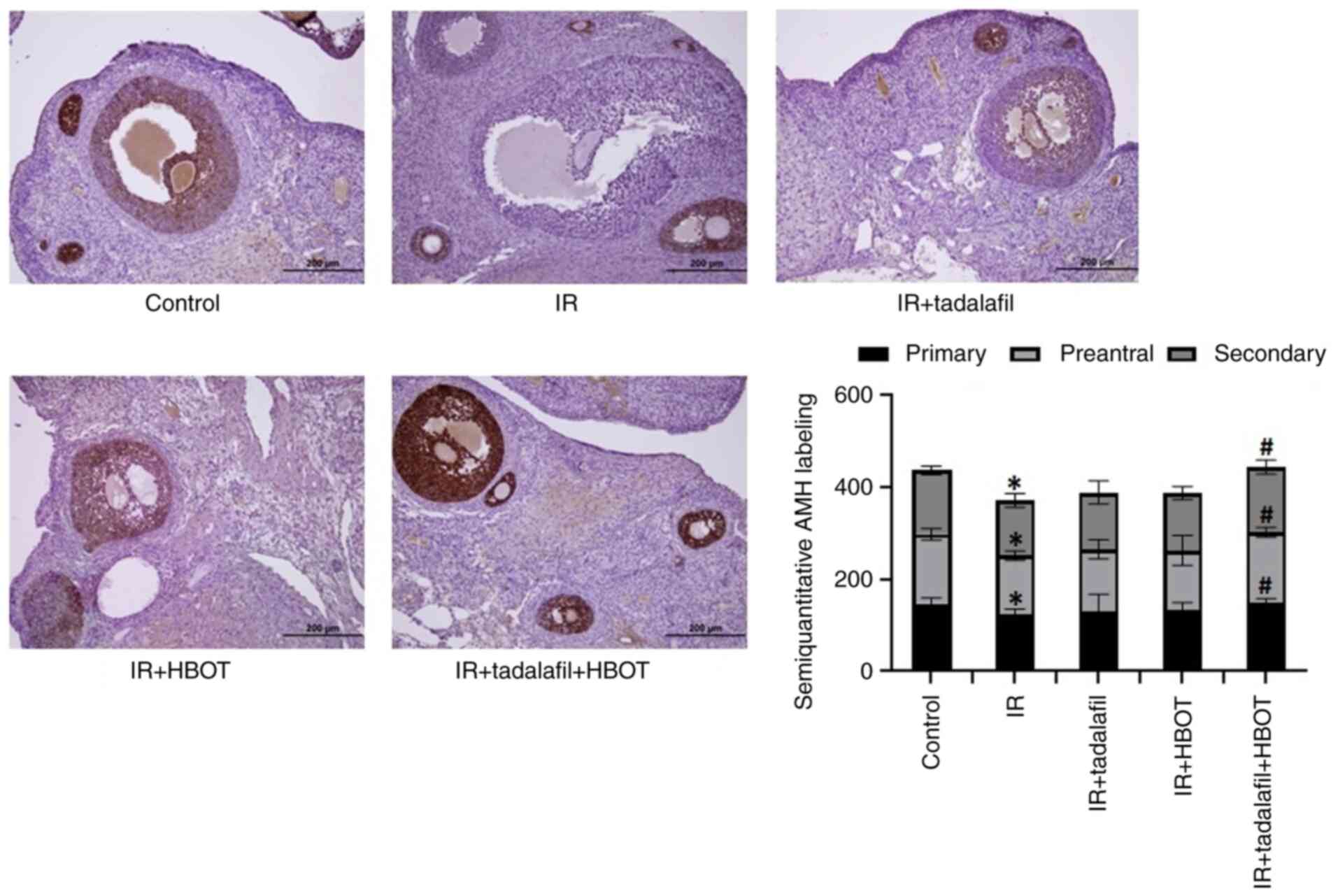
Semiquantitative immunohistochemistry was performed
to assess the expression of AMH in ovarian follicles (Fig. 2). AMH immunoreactivity was detected
in the cytoplasm of granulosa cells in the control and experimental
groups, whereas no nuclear staining was observed. No AMH expression
was detected in primordial follicles, whereas AMH labeling was
prominent in primary, preantral and secondary follicles but absent
from tertiary follicles. AMH labeling in the IR group was
significantly reduced compared with that in the control group. This
reduction was significantly attenuated by the combination of
tadalafil and HBOT, but not by tadalafil or HBOT alone (Fig. 2).
Histopathological evaluation
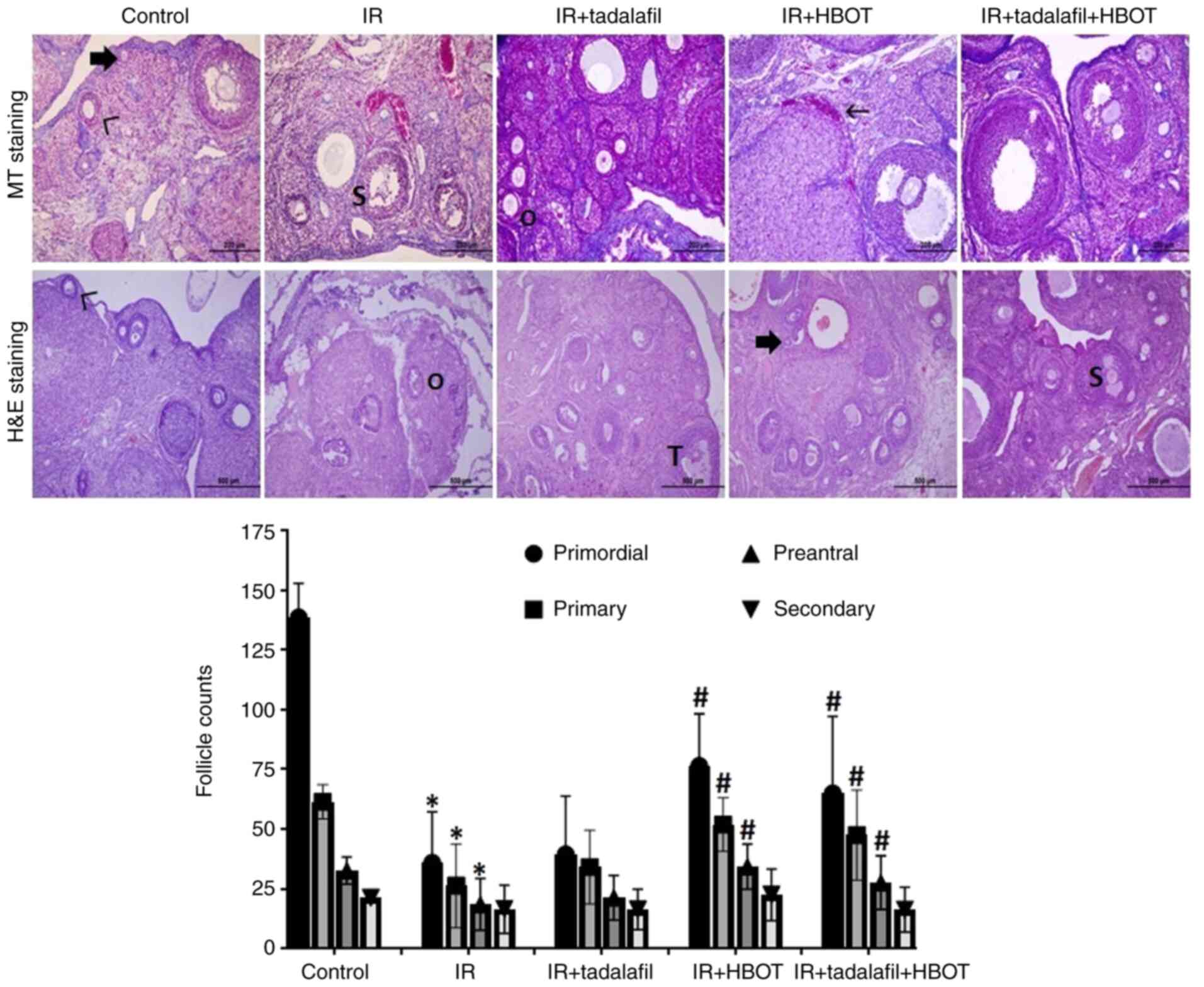
Ovarian tissues stained with H&E or MT were
examined under a light microscope. The ovarian tissues of the
control group exhibited a normal histological structure. The
surface of the ovary was covered by a single layer of flat or
cuboidal germinal epithelium, beneath which lay the tunica
albuginea, a dense connective tissue layer separating it from the
cortex. The cortical layer contained primordial, primary,
preantral, secondary, tertiary and atretic follicles from the
preceding cycle, exhibiting diverse sizes and morphologies. By
contrast, the ovarian histological architecture was disrupted in
the IR group (Fig. 3). The IR
group exhibited morphological abnormalities and a significant
reduction in primordial, primary and preantral follicle counts
compared with those in the control group. In addition, blood
vessels in the medulla were markedly dilated. Follicular
architecture in the IR + tadalafil and IR + HBOT groups was more
regular than that in the IR group. A significant increase in
primordial, primary and preantral follicle counts was observed in
the IR + HBOT group but not the IR + tadalafil group. In the IR
model rats treated with a combination of tadalafil and HBOT,
ovarian histology was nearly identical to that of the control
group, and a significant increase in primordial, primary and
preantral follicle counts compared with those in the IR group was
observed (Fig. 3).
TUNEL assay
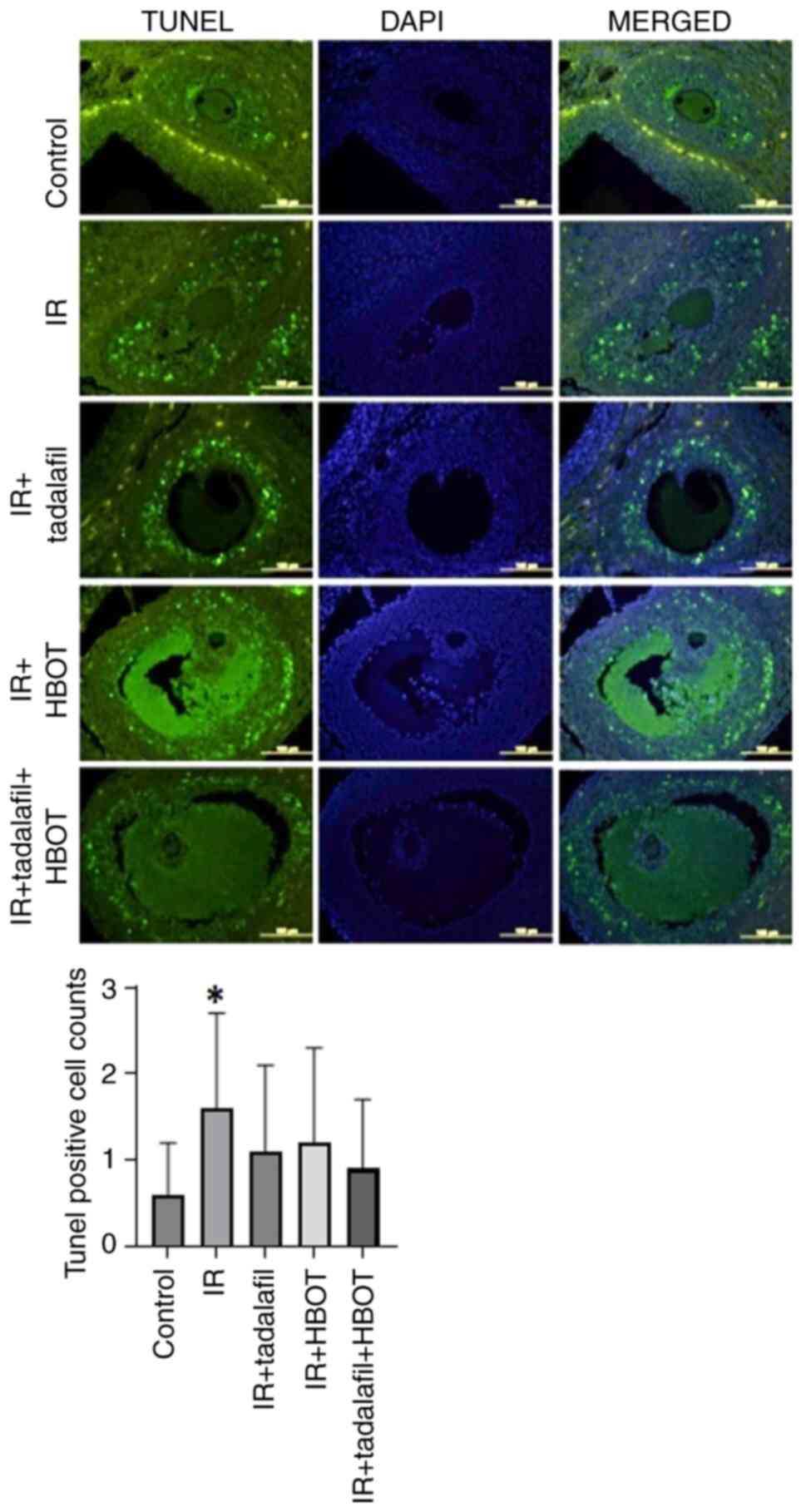
A TUNEL immunofluorescent staining assay was
performed on ovarian tissues from all groups (Fig. 4). The IR group exhibited the
greatest number of TUNEL-positive cells, which was significantly
higher than that in the control group (Fig. 4). Although the treatment groups
exhibited a reduction in the number of TUNEL-positive cells
compared with that in the IR group, these changes were not
statistically significant.
Discussion
In the present study, the histopathological and
biochemical effects of tadalafil, HBOT and their combination on a
rat model of ovarian IR injury were examined. The results
demonstrate that while damaged histological architecture was
observed in the IR group, the combined administration of tadalafil
and HBOT preserved ovarian histological architecture. In the IR +
tadalafil + HBOT group, IR injury was diminished, evidenced by
increased follicle counts. As well increasing follicle counts, the
combination therapy also elevated serum and follicular AMH levels,
indicating enhanced ovarian reserve compared with that in the IR
group. Although tadalafil and HBOT, individually and in
combination, decreased the number of apoptotic cells in the ovaries
compared with that in the IR group, these reductions were not
statistically significant. Overall, these findings suggest that a
combination of tadalafil and HBOT can mitigate some of the negative
consequences of IR, and may provide a greater protective effect
than either tadalafil or HBOT alone. This highlights the potential
benefit of combining tadalafil and HBOT in the ovarian IR
model.
Ovarian torsion obstructs arterial blood flow to the
ovaries, leading to ischemia and cellular damage. The surgical
reversal of ovarian torsion, an urgent gynecological procedure, is
the standard intervention to preserve fertility in young women
(25). The reperfusion of ischemic
tissue triggers a complex cascade of cellular and humoral
responses, including mitochondrial dysfunction in immune cells that
leads to elevated levels of ROS production, thereby exacerbating
tissue injury. During IR injury, oxidative stress is accompanied by
several critical pathological processes, including apoptosis,
ferroptosis, inflammatory responses and extracellular matrix
remodeling (6). In addition,
intracellular enzymes are released during cell necrosis or in
response to inflammatory mediators such as TNF (26). These elevated ROS levels and other
pathological alterations can impair oocyte quality and ovarian
reserve, thereby negatively impacting future fertility (27).
Supplementary treatments to mitigate surgical IR
damage in the ovary have long been explored. Natural products
(28,29), vitamins (30,31)
and antioxidants (32,33) have been used in experimental models
of ovarian IR injury to preserve ovarian function and enhance
ovarian reserve. However, no standardized therapy plan for the
conservative management of this condition exists in the literature.
In the current study, a combination of tadalafil and HBOT was
employed for the first time, to the best of our knowledge, in a rat
model of ovarian IR injury. Tadalafil is a more selective PDE-5
inhibitor than sildenafil with a longer half-life (34). It enhances nitric oxide (NO)
production by inhibiting the enzymatic degradation of cGMP
(35). NO acts as an efficient
antioxidant, inhibiting lipid oxidation by rapidly neutralizing
peroxyl radicals (36), and
protecting against cell death induced by hydrogen peroxide,
alkyl-hydroperoxides and xanthine oxidase (37).
The present study aimed to evaluate the combined
efficacy of the antioxidant tadalafil and HBOT in mitigating
oxidative tissue damage in a model of ovarian torsion. The results
revealed that 7 days of treatment with 10 mg/kg tadalafil and HBOT
at 2.4 ATA for 60 min exhibited a beneficial effect by preserving
ovarian reserves and ameliorating the histological architecture of
ovaries compromised by IR injury. Previous studies on PDE-5
inhibition in ovarian torsion have been limited to single-dose
experiments. For example, in one study, the administration of 20
mg/kg tadalafil to rats immediately before torsion diminished
vascular congestion and hemorrhage in the ovaries. In addition, the
tadalafil treatment restored the histological architecture
following reperfusion, and helped to preserve the ovarian reserve
(16). Other single-dose studies
have also demonstrated the protective effects of PDE-5 inhibitors
on ovarian torsion (38,39).
HBOT is a complementary therapy designed to mitigate
ischemic tissue damage. It has been reported to diminish IR injury
during the acute phase by modulating inflammation, enhancing the
microcirculation and preserving metabolic function in the affected
tissues (13,21,40).
HBOT may also alleviate IR-induced oxidative tissue damage by
reducing the production of ROS (13). Although HBOT has been shown to
provide preventive benefits against IR damage, further research is
needed to determine the optimal timing of HBOT initiation,
treatment pressure, duration and number of treatments required. In
a previous study, HBOT was administered to rats for 1 week, at a
pressure of 60 kPa three times daily. This treatment alleviated the
histopathological and biochemical alterations associated with IR.
It also reduced the levels of 8-hydroxy-2′-deoxyguanosine and
malondialdehyde, and exhibited a protective effect on the ovaries
by minimizing edema, vascular blockage, neutrophilic infiltration
and follicular cell damage (41).
Testicular torsion involves a similar type of rotation as ovarian
torsion, and both testicular and ovarian torsion involve IR damage
in their pathophysiology. Notably, rat testicular IR models
subjected to HBOT during ischemia or reperfusion have shown
markedly diminished testicular damage (42), supporting the protective effects of
HBOT against IR injury. Consequently, HBOT has emerged as a
potential supplementary treatment for male infertility, addressing
sperm defects at the molecular and membrane levels, and enhancing
reproductive outcomes (43).
A previous study investigating the impact of
progesterone on ovarian IR damage revealed that the number of
TUNEL-positive cells in the ovaries was higher in rats subjected to
IR than in those subjected to a sham procedure, indicating
increased apoptosis (44).
Consistent with this, the present study found that IR injury
resulted in an elevation in the number of TUNEL-positive cells in
the ovaries, reflecting cellular apoptosis following IR. In a
separate study, rats with spinal cord injury were treated with HBOT
at 2.0 ATA twice daily for 3 days and once daily thereafter, which
resulted in a substantial reduction in TUNEL-positive cells by day
7 (45). By contrast, the present
study did not find HBOT alone to be effective in reducing the
number of TUNEL-positive cells in the ovaries. However, the HBOT
treatment in the present study differs from that in the previous
study regarding pressure levels and duration. The pressure level,
duration of treatment and frequency of administration may influence
the efficacy of HBOT.
To the best of our knowledge, the present study
provided the first evidence that using tadalafil with HBOT was more
successful when compared with the use of the two treatments alone
in treating ovarian torsion. However, it has certain limitations.
These include the lack of evaluation of oxidative parameters and
apoptosis markers, including Bax, Bcl2 and caspase 3, the absence
of experimental groups to assess the effects of tadalafil and/or
HBOT without IR injury, and the small sample size. In addition to
addressing these factors, future studies should also explore
varying dosages, treatment durations and administration routes of
HBOT and tadalafil. Comprehensive clinical trials are also
necessary to clarify the findings further.
To the best of our knowledge, the combined effect of
tadalafil and HBOT on ovarian torsion has not been investigated
prior to the present study, despite the use of various medications
to protect the ovaries from IR damage. However, the present study
demonstrated that HBOT, an anti-ischemic therapy, has protective
effects against ovarian IR injury in rats, and these beneficial
effects are augmented when HBOT is combined with tadalafil.
Acknowledgements
The authors would like to thank Professor Eugene
Steele and M.A. Aysegul Ozaslan (Research Dean's Proofreading and
Editing Office, Erciyes University; Kayseri, Turkey) for
proofreading and editing this article.
Funding
This study was supported by Erciyes University Scientific
Research Projects unit (grant no. TSA-2022-11654).
Availability of data and materials
The data generated in the present study may be
requested from the corresponding author.
Authors' contributions
MAB was responsible for conceptualization and
methodology, particularly HBOT administration. ME and EK was
responsible for the methodology of the surgical procedure. EB, BY
and AC performed the formal analysis. MAB and AC wrote the original
draft of the manuscript. MAB and AC confirm the authenticity of all
the raw data. All authors read and approved the final version of
the manuscript.
Ethics approval and consent to
participate
Ethical approval was provided by the Ethics
Committee of Erciyes University (approval no. 21/124; Kayseri,
Turkey).
Patient consent for publication
Not applicable.
Competing interests
The authors declare that they have no competing
interests.
References
|
1
|
Huang C, Hong MK and Ding DC: A review of
ovary torsion. Tzu Chi Med J. 29:143–147. 2017. View Article : Google Scholar : PubMed/NCBI
|
|
2
|
Ding DC, Hsu S and Kao SP: Isolated
torsion of the hydrosalpinx in a postmenopausal woman. JSLS.
11:252–254. 2007.PubMed/NCBI
|
|
3
|
Antoniou N, Varras M, Akrivis C, Kitsiou
E, Stefanaki S and Salamalekis E: Isolated torsion of the fallopian
tube: A case report and review of the literature. Clin Exp Obstet
Gynecol. 31:235–238. 2004.PubMed/NCBI
|
|
4
|
van der Zanden M, Nap A and van Kints M:
Isolated torsion of the fallopian tube: A case report and review of
the literature. Eur J Pediatr. 170:1329–1332. 2011. View Article : Google Scholar : PubMed/NCBI
|
|
5
|
Abali R, Tasdemir N, Yuksel MA, Guzel S,
Oznur M, Nalbantoglu B and Tasdemir UG: Protective effect of
infliximab on ischemia/reperfusion injury in a rat ovary model:
Biochemical and histopathologic evaluation. Eur J Obstet Gynecol
Reprod Biol. 171:353–357. 2013. View Article : Google Scholar : PubMed/NCBI
|
|
6
|
Zhang M, Liu Q, Meng H, Duan H, Liu X, Wu
J, Gao F, Wang S, Tan R and Yuan J: Ischemia-reperfusion injury:
Molecular mechanisms and therapeutic targets. Signal Transduct
Target Ther. 9:122024. View Article : Google Scholar : PubMed/NCBI
|
|
7
|
Argenta PA, Yeagley TJ, Ott G and
Sondheimer SJ: Torsion of the uterine adnexa. Pathologic
correlations and current management trends. J Reprod Med.
45:831–836. 2000.PubMed/NCBI
|
|
8
|
Robertson JJ, Long B and Koyfman A: Myths
in the evaluation and management of ovarian torsion. J Emerg Med.
52:449–456. 2017. View Article : Google Scholar : PubMed/NCBI
|
|
9
|
Naito H, Nojima T, Fujisaki N, Tsukahara
K, Yamamoto H, Yamada T, Aokage T, Yumoto T, Osako T and Nakao A:
Therapeutic strategies for ischemia reperfusion injury in emergency
medicine. Acute Med Surg. 7:e5012020. View
Article : Google Scholar : PubMed/NCBI
|
|
10
|
Wu MY, Yiang GT, Liao WT, Tsai AP, Cheng
YL, Cheng PW, Li CY and Li CJ: Current mechanistic concepts in
ischemia and reperfusion injury. Cell Physiol Biochem.
46:1650–1667. 2018. View Article : Google Scholar : PubMed/NCBI
|
|
11
|
Li H, Xia Z, Chen Y, Qi D and Zheng H:
Mechanism and therapies of oxidative stress-mediated cell death in
ischemia reperfusion injury. Oxid Med Cell Longev.
2018:29106432018. View Article : Google Scholar : PubMed/NCBI
|
|
12
|
Jurisic V, Radenkovic S and Konjevic G:
The actual role of LDH as tumor marker, biochemical and clinical
aspects. Adv Exp Med Biol. 867:115–124. 2015. View Article : Google Scholar : PubMed/NCBI
|
|
13
|
Francis A and Baynosa R:
Ischaemia-reperfusion injury and hyperbaric oxygen pathways: A
review of cellular mechanisms. Diving Hyperb Med. 47:110–117. 2017.
View Article : Google Scholar : PubMed/NCBI
|
|
14
|
Rybalkin SD, Yan C, Bornfeldt KE and Beavo
JA: Cyclic GMP phosphodiesterases and regulation of smooth muscle
function. Circ Res. 93:280–291. 2003. View Article : Google Scholar : PubMed/NCBI
|
|
15
|
Koka S, Das A, Salloum FN and Kukreja RC:
Phosphodiesterase-5 inhibitor tadalafil attenuates oxidative stress
and protects against myocardial ischemia/reperfusion injury in type
2 diabetic mice. Free Radic Biol Med. 60:80–88. 2013. View Article : Google Scholar : PubMed/NCBI
|
|
16
|
Şahin Ç, Yıldırım N, Hortu İ, Akdemir A,
Özşener S, Yiğittürk G and Erbaş O: Tadalafil attenuates ischemic
damage as well as reperfusion injury in the rat ovary. J Turk Ger
Gynecol Assoc. 21:35–40. 2020. View Article : Google Scholar : PubMed/NCBI
|
|
17
|
Lux A, Pokreisz P, Swinnen M, Caluwe E,
Gillijns H, Szelid Z, Merkely B and Janssens SP: Concomitant
phosphodiesterase 5 inhibition enhances myocardial protection by
inhaled nitric oxide in ischemia-reperfusion injury. J Pharmacol
Exp Ther. 356:284–292. 2016. View Article : Google Scholar : PubMed/NCBI
|
|
18
|
Gulati P and Singh N: Neuroprotective
effect of tadalafil, a PDE-5 inhibitor, and its modulation by
L-NAME in mouse model of ischemia-reperfusion injury. J Surg Res.
186:475–483. 2014. View Article : Google Scholar : PubMed/NCBI
|
|
19
|
Küçük A, Yucel M, Erkasap N, Tosun M,
Koken T, Ozkurt M and Erkasap S: The effects of PDE5 inhibitory
drugs on renal ischemia/reperfusion injury in rats. Mol Biol Rep.
39:9775–9782. 2012. View Article : Google Scholar : PubMed/NCBI
|
|
20
|
Robins M, Falkson SR, Goldfarb J and Wyatt
HA: Hyperbaric Treatment of Ischemia Reperfusion Injury. StatPearls
[Internet]. StatPearls Publishing; Treasure Island, FL: 2025
|
|
21
|
De Wolde SD, Hulskes RH, Weenink RP,
Hollmann MW and Van Hulst RA: The effects of hyperbaric oxygenation
on oxidative stress, inflammation and angiogenesis. Biomolecules.
11:12102021. View Article : Google Scholar : PubMed/NCBI
|
|
22
|
Altıntaş Ural D, Altıntaş Aykan D,
Koçarslan S and Doğaner A: Effect of Tadalafil Treatment on Ovarian
Ischemia Injury in Rats. Cukurova Med J. 46:55–62. 2021.
|
|
23
|
Jurisic V: Multiomic analysis of cytokines
in immuno-oncology. Expert Rev Proteomics. 17:663–674. 2020.
View Article : Google Scholar : PubMed/NCBI
|
|
24
|
Moolhuijsen LME and Visser JA:
Anti-Müllerian hormone and ovarian reserve: Update on assessing
ovarian function. J Clin Endocrinol Metab. 105:3361–3373. 2020.
View Article : Google Scholar : PubMed/NCBI
|
|
25
|
Zhu TW and Li XL: Ovarian torsion: A
review of the evidence. Obstet Gynecol Surv. 79:484–492. 2024.
View Article : Google Scholar : PubMed/NCBI
|
|
26
|
Jurisic V, Bumbasirevic V, Konjevic G,
Djuricic B and Spuzic I: TNF-alpha induces changes in LDH isotype
profile following triggering of apoptosis in PBL of non-Hodgkin's
lymphomas. Ann Hematol. 83:84–91. 2004. View Article : Google Scholar : PubMed/NCBI
|
|
27
|
Laganà AS, Sofo V, Salmeri FM, Palmara VI,
Triolo O, Terzić MM, Patrelli TS, Lukanovic A, Bokal EV and Santoro
G: Oxidative stress during ovarian torsion in pediatric and
adolescent patients: changing the perspective of the disease. Int J
Fertil Steril. 9:416–423. 2016.PubMed/NCBI
|
|
28
|
Yilmaz F, Ilgen O, Mankan A, Yilmaz B and
Kurt S: The effects of berberine on ischemia-reperfusion injuries
in an experimental model of ovarian torsion. Clin Exp Reprod Med.
50:292–298. 2023. View Article : Google Scholar : PubMed/NCBI
|
|
29
|
Barghi B, Shokoohi M, Khaki AA, Khaki A,
Moghimian M and Soltani M: Eugenol improves tissue damage and
oxidative stress in adult female rats after ovarian
torsion/detorsion. J Obstet Gynaecol. 41:933–938. 2021. View Article : Google Scholar : PubMed/NCBI
|
|
30
|
Çandar T, Uzunlar Ö, Kiseli M and Özcan S:
The effect of folate on ischemia/reperfusion injury in a rat
adnexal torsion model. Arch Gynecol Obstet. 303:1495–1500. 2021.
View Article : Google Scholar : PubMed/NCBI
|
|
31
|
Deniz E, Topcu A, Ozturk A, Ozturk SD,
Arpa M and Atak M: The effects of vitamin B12 on the TLR-4/NF-κB
signaling pathway in ovarian ischemia-reperfusion injury-related
inflammation. Int Immunopharmacol. 107:1086762022. View Article : Google Scholar : PubMed/NCBI
|
|
32
|
Sarac M, Bakal U, Kuloglu T, Tartar T,
Aydin S, Yardim M, Artas G and Kazez A: Effects of carnosine and
vitamin E on Nucleobindin 2 (NUCB2)/nesfatin-1, ghrelin, adropin,
and irisin in experimentally induced ovarian torsion. Ann Clin Lab
Sci. 48:345–354. 2018.PubMed/NCBI
|
|
33
|
Dogan Ozcil M, Ozcan O, Hakverdi S,
Bayraktar HS, Dirican E and Kacmaz F: Impact of Enoxaparin +alpha
Lipoic acid combination on oxidative stress, follicle development
and apoptotic damage in ovarian ischemia reperfusion model. Eur Rev
Med Pharmacol Sci. 26:6583–6592. 2022.PubMed/NCBI
|
|
34
|
Porst H, Padma-Nathan H, Giuliano F,
Anglin G, Varanese L and Rosen R: Efficacy of tadalafil for the
treatment of erectile dysfunction at 24 and 36 hours after dosing:
A randomized controlled trial. Urology. 62:121–125; discussion
125–126. 2003. View Article : Google Scholar : PubMed/NCBI
|
|
35
|
McDonald LJ and Murad F: Nitric oxide and
cGMP signaling. Adv Pharmacol. 34:263–275. 1995. View Article : Google Scholar : PubMed/NCBI
|
|
36
|
Hummel SG, Fischer AJ, Martin SM, Schafer
FQ and Buettner GR: Nitric oxide as a cellular antioxidant: A
little goes a long way. Free Radic Biol Med. 40:501–506. 2006.
View Article : Google Scholar : PubMed/NCBI
|
|
37
|
Wink DA, Miranda KM, Espey MG, Pluta RM,
Hewett SJ, Colton C, Vitek M, Feelisch M and Grisham MB: Mechanisms
of the antioxidant effects of nitric oxide. Antioxid Redox Signal.
3:203–213. 2001. View Article : Google Scholar : PubMed/NCBI
|
|
38
|
Sakin O, Anğın AD, Akalın EE, Cikman MS,
Basak K and Kaptanagasi AO: Comparison of the protective effects of
sildenafil, vardenafil and tadalafil treatments in
ischemia-reperfusion injury in rat ovary. Ginekol Pol. 90:513–519.
2019. View Article : Google Scholar : PubMed/NCBI
|
|
39
|
Incebiyik A, Seker A, Camuzcuoglu H,
Kocaslan S, Camuzcuoglu A, Hilali NG, Vural M, Taskin A and Aksoy
N: Does sildenafil have protective effects against ovarian
ischemia-reperfusion injury in rats? Arch Gynecol Obstet.
291:1283–1288. 2015. View Article : Google Scholar : PubMed/NCBI
|
|
40
|
Qian H, Li Q and Shi W: Hyperbaric oxygen
alleviates the activation of NLRP-3-inflammasomes in traumatic
brain injury. Mol Med Rep. 16:3922–3928. 2017. View Article : Google Scholar : PubMed/NCBI
|
|
41
|
Bulutlar E, Yilmaz A, Uluutku Bulutlar GB,
Aslan Y, Bozdağ HN and Küçükodaci Z: Effect of hyperbaric oxygen
treatment on ischaemia-reperfusion injury in rats detorsioned after
experimental ovarian torsion. Diving Hyperb Med. 54:16–22. 2024.
View Article : Google Scholar : PubMed/NCBI
|
|
42
|
Kolski JM, Mazolewski PJ, Stephenson LL,
Texter J, Grigoriev VE and Zamboni WA: Effect of hyperbaric oxygen
therapy on testicular ischemia-reperfusion injury. J Urol.
160:601–604. 1998. View Article : Google Scholar : PubMed/NCBI
|
|
43
|
Liu B, Wang J, Liu L, Lv M, Zhou D and Li
M: Hyperbaric oxygen therapy for male infertility: A systematic
review and meta-analysis on improving sperm quality and fertility
outcomes. Med Gas Res. 15:529–534. 2025. View Article : Google Scholar : PubMed/NCBI
|
|
44
|
Güleç Başer B, İslimye Taşkın M, Adalı E,
Öztürk E, Hısmıoğulları AA and Yay A: Does progesterone have
protective effects on ovarian ischemia-reperfusion injury? J Turk
Ger Gynecol Assoc. 19:87–93. 2018. View Article : Google Scholar : PubMed/NCBI
|
|
45
|
Long Y, Liang F, Gao C, Li Z and Yang J:
Hyperbaric oxygen therapy reduces apoptosis after spinal cord
injury in rats. Int J Clin Exp Med. 7:4073–4081. 2014.PubMed/NCBI
|