Introduction
Hypertensive disorders of pregnancy (HDP), including
gestational hypertension, preeclampsia and eclampsia, are a leading
cause of maternal and perinatal morbidity and mortality worldwide,
affecting 5–10% of all pregnancies (1). Beyond the immediate adverse outcomes
(2), including preterm birth,
fetal growth restriction and perinatal mortality, affected women
face markedly elevated long-term risks of cardiovascular disease
(including ischemic heart disease, heart failure, stroke and
cardiomyopathy) (3), metabolic
syndrome (characterized by hypertension, obesity, dyslipidemia and
insulin resistance) (4) and
chronic kidney disease, whereas offspring exhibit increased
susceptibility to neurodevelopmental disorders such as autism
spectrum disorder, attention-deficit/hyperactivity disorder,
cerebral palsy and cognitive impairments (1,5), as
well as cardiometabolic disorders, including elevated blood
pressure and obesity in childhood and adolescence across the life
course (4). Despite decades of
research, the precise pathogenic mechanisms underlying HDPs remain
incompletely understood and current clinical management largely
focuses on blood pressure control and timely delivery rather than
on disease-modifying interventions. The recognition that HDP
pathogenesis involves complex interactions among maternal vascular
dysfunction, placental ischemia, systemic inflammation and immune
dysregulation has prompted growing interest in the role of the gut
microbiota as an upstream modulator of these processes (2).
The gut microbiota undergoes notable physiological
remodeling during pregnancy, with longitudinal studies
demonstrating gestational stage-specific shifts in microbial
composition, diversity and functional capacity that support
maternal metabolic adaptation and immune modulation (3,5).
Using bibliometric analysis of 1,268 publications, Chen et
al (3) mapped global research
trends and identified that the gut microbiota during pregnancy
shifts toward increased Proteobacteria and reduced
Faecalibacterium in the third trimester, supporting its role
in metabolic adaptation. These pregnancy-induced microbial changes
are characterized by increased inter-subject variability and
altered abundances of taxa involved in short-chain fatty acids
(SCFAs) production (5). Notably,
disruptions in this normal remodeling process have been documented
in women who develop HDP, with reduced α-diversity and distinct
taxonomic signatures reported in affected pregnancies (6,7). A
systematic review and meta-analysis by Colonetti et al
(7) pooled data from 11
case-control studies (total n=1,020) and reported that preeclamptic
women had notably lower gut microbial α-diversity (standardized
mean difference, −0.67; 95% CI, −1.02–0.32) and a higher
Firmicutes/Bacteroidetes ratio, confirming a consistent association
between dysbiosis and preeclampsia. Similarly, Jordan et al
(8) conducted a scoping review
concluding that microbiota dysbiosis is reproducibly associated
with increased preeclampsia risk, although the directionality of
this relationship remains a topic of debate, as multiple studies
have explicitly questioned whether microbial alterations represent
a causative factor or merely an epiphenomenon secondary to disease
pathophysiology (2,9). The importance of understanding
site-specific microbial changes during pregnancy has been
emphasized in the study by Flores Ventura et al (10), which highlighted opportunities for
targeted interventions based on distinct microbial signatures.
Specifically, distinct site-specific signatures in the gut, vaginal
and oral microbiotas are differentially associated with pregnancy
outcomes (for example, preterm birth, pre-eclampsia and gestational
diabetes), providing a rational basis for the development of
site-specific probiotic interventions tailored to each biological
niche.
Notably, the functional consequences of
microbiota-host interactions are primarily mediated through
microbial-derived metabolites rather than microbial composition
per se. Among these, SCFAs and tryptophan metabolites have
emerged as particularly notable signaling molecules at the
maternal-fetal interface (2,11,12).
SCFAs, generated through bacterial fermentation of dietary fiber,
exert pleiotropic effects on host physiology through activation of
G protein-coupled receptors and histone deacetylase (HDAC)
inhibition, thereby modulating vascular tone, inflammatory
responses and immune cell function (13,14).
A scoping review by Zhao et al (14) synthesized evidence from 11
case-control studies (total of 2,314 participants) and concluded
that reduced SCFAs concentrations, particularly butyrate (median
reduction, 37%; range, 22–54%), are consistently associated with
preeclampsia. The tryptophan pathway represents another major route
of host-microbiota metabolic interaction, with gut bacteria
metabolizing dietary tryptophan to generate indole derivatives,
while host enzymes process the majority through the kynurenine
pathway (9). A systematic review
by van Zundert et al (9)
examined 42 studies (18 human and 24 animal studies) and reported
that alterations in the kynurenine pathway [increased
kynurenine/tryptophan ratio and reduced kynurenic acid (KYNA)] are
consistently observed in HDP, although causal relationships remain
to be established. The placental enzyme indoleamine 2,3-dioxygenase
(IDO), which catalyzes the rate-limiting step in tryptophan
degradation, serves a key role in maintaining maternal-fetal immune
tolerance and its dysregulation has been implicated in preeclampsia
pathogenesis (15). A previous
review by Kudo and Sugimoto (15)
summarized data from 23 human placental studies and reported that
IDO activity is reduced by 40–60% in preeclamptic placentas
compared with normotensive controls, associating IDO deficiency
with impaired immune tolerance.
Emerging evidence has begun to elucidate the
mechanistic convergence of SCFAs and tryptophan metabolite
signaling pathways in HDP. Both metabolite classes influence shared
downstream effectors including immune cell polarization,
endothelial function and placental development, suggesting that
integrated analysis of these pathways may yield insights beyond
investigating each pathway in isolation (2,12).
The aryl hydrocarbon receptor (AhR) has been identified as a
central hub integrating signals from tryptophan-derived microbial
metabolites, with recent studies demonstrating that indole-3-lactic
acid alleviates preeclampsia-like phenotypes through AhR activation
(16–18). Concurrently, SCFAs modulate
macrophage polarization and trophoblast function via G
protein-coupled receptor 43 (GPR43)-mediated signaling,
highlighting the existence of parallel yet interconnected
regulatory networks at the maternal-fetal interface (11,13).
The concept of a gut-placenta axis has been proposed, wherein
microbial metabolites serve as key mediators associating maternal
gut ecology with placental function and fetal outcomes (12,19).
A comprehensive review by Ma et al (12) integrated data from 86 studies and
proposed that the gut-placenta axis operates through SCFAs,
tryptophan metabolites and trimethylamine N-oxide (TMAO), each
influencing placental autophagy, inflammation and angiogenesis.
Mechanistic insights from animal models have further supported this
framework, with previous studies revealing that microbial
metabolites regulate placental autophagy and ferroptosis, processes
notably involved in trophoblast survival and placental development
(13,20,21).
Despite key progress, notable knowledge gaps and
methodological challenges persist in the field. Majority of
clinical studies are cross-sectional, to the best of our knowledge,
precluding the determination of whether microbial alterations
precede or result from disease onset (2,8,22).
Mendelian randomization (MR) studies, including those by Li et
al (23), have provided
genetic evidence supporting causal relationships between the gut
microbiota and preeclampsia; however, these approaches cannot fully
exclude residual confounding or reverse causation. In a two-sample
MR study using summary statistics from 18,340 individuals for gut
microbiota and 5,976 preeclampsia cases, Li et al (23) identified that the genus
Ruminococcaceae (OR=1.28; 95% CI, 1.10–1.49) and order
Clostridiales (OR=0.81; 95% CI, 0.68–0.96) demonstrated causal
associations with preeclampsia, but horizontal pleiotropy could not
be fully excluded. Technical challenges associated with
distinguishing microbial-derived from host-derived metabolites, the
need for absolute quantification methods and the absence of
standardized analytical protocols across studies further complicate
interpretation and cross-study comparability (14,24).
Furthermore, the extent to which findings from preclinical animal
models translate to human pregnancy physiology remains to be
elucidated due to notable species differences in placental
structure, gestational timing and metabolic exchange (25). Unresolved questions regarding the
mechanisms of maternal-fetal metabolite transfer and the potential
in intergenerational programming of disease risk represent key
frontiers for future investigation (26). The present review aimed to
synthesize current evidence on the roles of SCFAs and tryptophan
microbial metabolites in HDP pathogenesis, with a particular focus
on the functional mechanisms underlying these associations, the
emerging crosstalk between these metabolite classes and the
clinical translation potential for biomarker development and
therapeutic intervention. The three novel contributions are as
follows: i) A comprehensive mechanistic synthesis; ii) a
hypothetical framework for SCFA-tryptophan crosstalk (presented in
the following section, with detailed mechanistic evidence for
synergistic amplification and competitive antagonism provided in
the corresponding subsections); and iii) a key appraisal of
clinical translation barriers, including biomarker specificity and
safety.
Overview of HDP and gut microbial
metabolites in pregnancy
HDP represent a spectrum of conditions characterized
by new-onset hypertension after 20 weeks of gestation, encompassing
gestational hypertension, preeclampsia and eclampsia. The
pathophysiological hallmarks include systemic vascular dysfunction,
placental ischemia, maternal systemic inflammation and disruption
of immune tolerance mechanisms. In parallel with advances in
understanding HDP pathogenesis, there has been increasing
recognition that the maternal gut microbiota undergoes notable
physiological remodeling during pregnancy (27–29),
with emerging evidence implicating alterations in this ecosystem in
HDP development. Of note, the functional consequences of
microbiota-host interactions are largely mediated through
microbial-derived metabolites, particularly SCFAs and tryptophan
metabolites, which serve as key signaling molecules at the
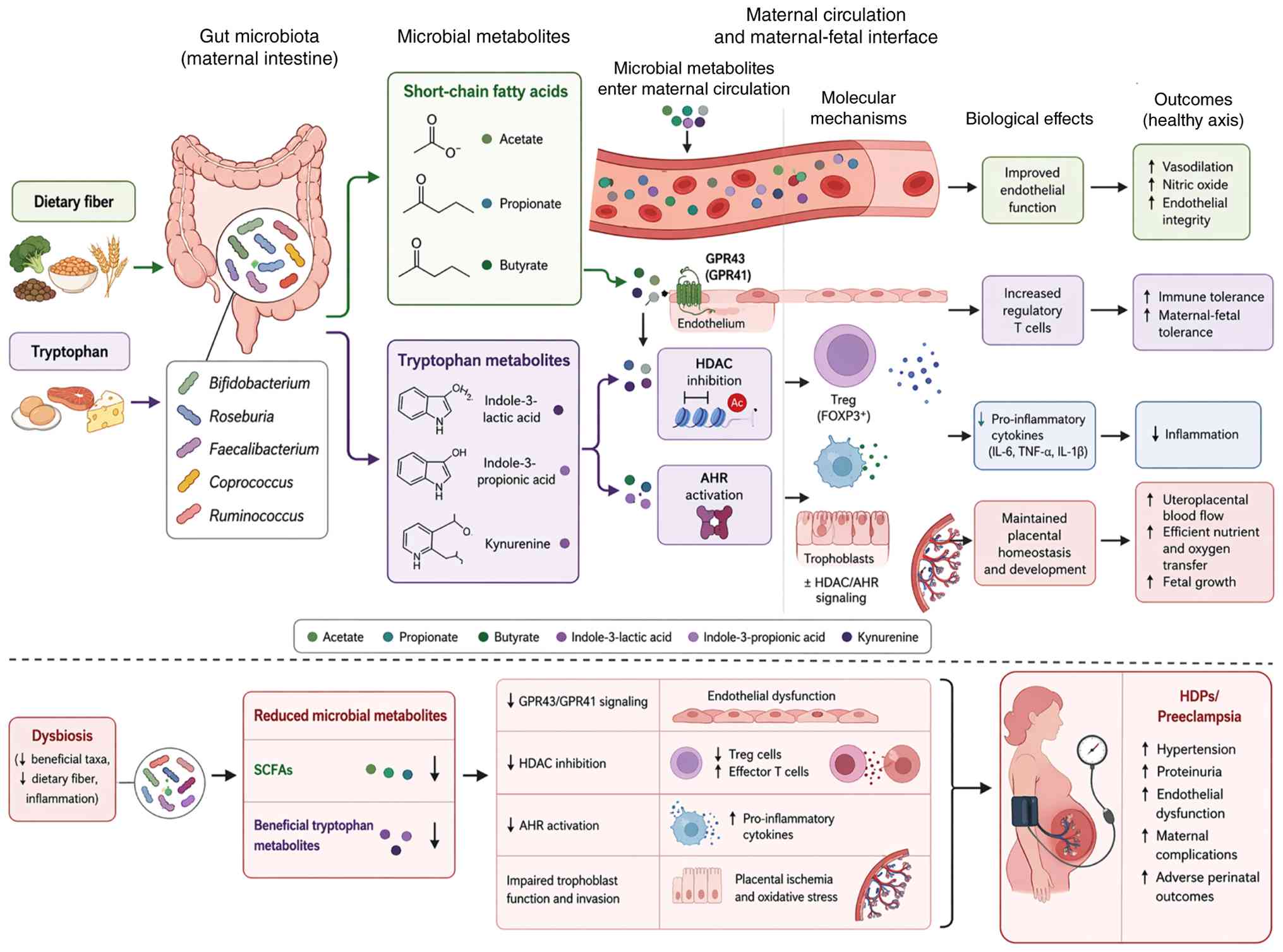
maternal-fetal interface. These metabolites act on the vasculature,
immune system and placenta through GPR41/43, HDAC inhibition and
AhR signaling, collectively influencing HDP pathogenesis (Fig. 1).
Clinical classification and
pathophysiological hallmarks of HDP
HDP encompass a heterogeneous group of conditions
with overlapping clinical features but distinct diagnostic criteria
and pathophysiological underpinnings. According to the American
College of Obstetricians and Gynecologists guidelines, these
include gestational hypertension (new-onset hypertension after 20
weeks without proteinuria) and preeclampsia (hypertension with
proteinuria or end-organ dysfunction) (30). Preeclampsia, the most extensively
studied disorder within this spectrum, is characterized by de
novo hypertension after 20 weeks of gestation accompanied by
proteinuria or maternal end-organ dysfunction. The core
pathophysiological hallmarks include impaired spiral artery
remodeling, placental ischemia-reperfusion injury, excessive
oxidative stress and a generalized maternal systemic inflammatory
response with endothelial dysfunction as a unifying feature
(31). In a nested case-control
study (124 preeclamptic women and 124 normotensive controls), Lin
et al (31) measured gut
microbial composition and reported that the genus
Bifidobacterium was significantly reduced in preeclampsia
(fold change, 0.52; P=0.008) and that this reduction correlated
positively with systolic blood pressure (r=−0.41; P=0.003),
supporting the association between gut dysbiosis and HDP severity.
Increasing evidence from MR studies have provided genetic support
for causal relationships between gut microbiota composition and HDP
susceptibility, suggesting that microbial factors may contribute
directly to disease pathogenesis rather than merely reflecting
epiphenomena. Wu et al (32) performed an MR analysis using
genome-wide association studies (GWAS) data for 211 microbial taxa
and 7,025 preeclampsia cases, identifying 12 taxa with notable
causal associations (for example, Pasteurellales, OR=1.19; 95% CI,
1.06–1.34), thereby reinforcing the biological plausibility of
microbiota-host interactions in HDP development. Of note, HDP
encompasses heterogeneous subtypes including gestational
hypertension, early-onset preeclampsia (delivery <34 weeks) and
late-onset preeclampsia (delivery ≥34 weeks), which have distinct
pathophysiological features (for example, placental ischemia vs.
maternal metabolic syndrome) and may exhibit different microbial
metabolite signatures; however, to the best of our knowledge,
majority of current studies do not stratify by these subtypes
(33,34). In a prospective cohort study, Lv
et al (33) analyzed fecal
samples from 60 women with early-onset preeclampsia and 40 healthy
pregnant women and reported that α-diversity (Shannon index) was
reduced by 28% (P<0.001) in the preeclampsia group, and these
alterations persisted into the postpartum period. This finding
suggests that HDP-associated dysbiosis is not merely a consequence
of acute disease. Notably, the majority of existing research,
including all studies cited in sections 3 and 4 on SCFAs and
tryptophan metabolites, has focused exclusively on preeclampsia, to
the best of our knowledge. Evidence specific to gestational
hypertension or eclampsia is virtually absent. Therefore, in the
present review, the term ‘HDP’ was used generically to refer to the
broader disorder category; however, the underlying data derive
almost entirely from preeclampsia cohorts unless stated
otherwise.
Physiological gut microbiota
remodeling in pregnancy and dysregulation in HDP
Normal pregnancy is associated with notable and
dynamic alterations in maternal gut microbiota composition,
structure and functional capacity across gestation. Using a
longitudinal design with samples collected at gestational weeks 12,
24 and 36, Crusell et al (35) sequenced the gut microbiota of 50
pregnant women and reported that the relative abundance of
Faecalibacterium significantly increased by 2.4-fold from
the first to third trimester (P=0.003), and that these changes were
more marked in women who later developed gestational diabetes
compared with those who remained normoglycaemic during pregnancy,
suggesting that pregnancy complications amplify physiological
microbial adaptations. The metabolic potential of the maternal gut
microbiota also undergoes gestational stage-specific reprogramming,
for example, Gosalbes et al (36) performed metagenomic sequencing on
40 pregnant women at three time points and demonstrated that genes
involved in SCFA production (for example, butyrate kinase)
significantly increased by 34% in the third trimester compared with
the first trimester (P=0.002), extending beyond taxonomic shifts to
encompass functional metabolic adaptation.
In the context of HDP, emerging evidence indicates
that the normal physiological remodeling of the maternal gut
microbiota is disrupted, with distinct compositional and functional
signatures observed in affected women. Lv et al (33) reported that in antepartum women
with early-onset preeclampsia, the abundance of the
butyrate-producing genus Roseburia was significantly reduced
by 76% compared with normotensive controls (P<0.001) and this
reduction persisted at 6-weeks postpartum, indicating long-lasting
dysbiosis. Similarly, Liu et al (37) conducted a cross-sectional study of
52 patients with severe preeclampsia and 52 matched controls, using
16S ribosomal RNA (rRNA) sequencing and targeted metabolomics. The
study reported that fecal butyrate levels correlated negatively
with systolic blood pressure (r=−0.58; P<0.001) and identified
18 microbial species that discriminated severe preeclampsia with an
area under the curve (AUC) of 0.92 (95% CI, 0.87–0.97). These
findings collectively support the concept that HDP-associated gut
dysbiosis extends beyond simple compositional changes to encompass
functional metabolic alterations that may contribute to disease
pathogenesis.
Key gut microbial metabolites in
maternal-fetal health
Among the diverse array of bioactive molecules
produced by the gut microbiota, SCFAs and tryptophan metabolites
have emerged as particularly key mediators of maternal-fetal health
due to their pleiotropic effects on host physiology and their
capacity to reach biologically relevant concentrations in the
maternal circulation and at the maternal-fetal interface (11,38).
SCFAs, primarily acetate, propionate and butyrate, are generated
through bacterial fermentation of dietary fiber and resistant
starch, with their production contingent upon substrate
availability and the metabolic capacity of specific microbial
communities (39). In a
cross-sectional study of 120 pregnant women (60 women in the third
trimester and 60 women in the first trimester), Ziętek et al
(39) measured serum SCFAs
concentrations and reported that acetate, propionate and butyrate
were significantly higher in the third trimester compared with
those in the first trimester (mean increases, 42, 38 and 55%,
respectively; all P<0.01), and that butyrate levels correlated
negatively with total cholesterol (r=−0.34; P=0.02), supporting the
relevance of SCFAs to maternal metabolic regulation. The tryptophan
pathway represents another major route of host-microbiota metabolic
interaction, with gut bacteria metabolizing dietary tryptophan
through multiple pathways to generate bioactive metabolites
including indole derivatives and kynurenine pathway intermediates
(40). In a prospective cohort
study of 1,057 women with first-trimester blood sampling, van
Zundert et al (41)
measured 12 tryptophan metabolites and reported that lower KYNA
levels (≤25th percentile) were associated with a 2.3-fold increased
risk of subsequent HDP (95% CI, 1.4–3.8), highlighting the
potential predictive value of these metabolites in early
gestation.
General biological mechanisms of
microbial metabolite action
Microbial metabolites act on maternal vascular
homeostasis, immune tolerance and placental function via multiple
convergent mechanisms that influence HDP pathogenesis (42). SCFAs signal through G
protein-coupled receptors, particularly G protein-coupled receptor
41 (GPR41) and GPR43, which are expressed on vascular endothelial
cells, immune cells and placental tissues, activating intracellular
signaling cascades that modulate inflammatory responses, vascular
tone and tissue perfusion. In addition to receptor-mediated
effects, SCFAs function as histone deacetylase inhibitors, thereby
influencing epigenetic regulation of gene expression in host cells
and modifying transcriptional programs relevant to inflammation,
oxidative stress and metabolic function (43). Tryptophan-derived microbial
metabolites, particularly those activating the AhR, represent a
parallel signaling axis with notable effects on maternal immune
tolerance and vascular function (40). Wei et al (17) treated pregnant mice with soluble
fms-like tyrosine kinase-1 (sFlt-1; to induce a preeclampsia-like
phenotype) and co-administered indole-3-lactic acid (50 mg/kg/day,
oral) or vehicle. The treated group demonstrated normalization of
blood pressure (from 158±9 to 131±6 mmHg; P<0.001), reduced
urinary protein (from 345±42 to 187±31 mg/dl; P<0.001) and
increased placental AhR target gene expression [cytochrome P450,
family 1, subfamily A, polypeptide 1 (CYP1A1) increased 3.2-fold],
providing mechanistic evidence for the protective effects of this
AhR pathway. The interplay between SCFAs and tryptophan metabolite
signaling pathways at the maternal-fetal interface represents an
emerging area of investigation with potential implications in
understanding the integrated effects of microbial metabolites on
pregnancy outcomes.
Methodological advances in microbial
metabolite research
Investigation of microbial metabolites in obstetric
disease has been advanced by methodological developments enabling
more precise detection, quantification and functional validation of
these molecules in relevant biological matrices (44). Mass spectrometry-based metabolomic
platforms have facilitated comprehensive profiling of microbial
metabolites in maternal serum, plasma, urine and fecal samples,
while emerging evidence suggests that microbial metabolites may
also be detectable in amniotic fluid and even in fetal tissues,
indicating transplacental transfer and potential direct effects on
fetal development (45). Wang
et al (45) analyzed 20
human fetal intestinal samples (gestational age, 10–20 weeks) using
mass spectrometry and detected 83 bacterial-derived metabolites,
including SCFAs, indole derivatives and secondary bile acids, in
the fetal gut lumen, providing direct evidence for transplacental
transfer and fetal exposure to maternal microbial metabolites.
However, the field faces notable technical challenges, including
the distinction between microbial- and host-derived metabolites,
the need for absolute quantification rather than relative abundance
measures and the complexities of establishing causal relationships
in observational human studies (46). Bihl et al (46) performed a key re-analysis of
putative fetal microbiome data and demonstrated that up to 80% of
bacterial sequences in certain studies could be attributed to
contamination, underscoring the need for strict negative controls
in microbiome research. The integration of multi-omics approaches,
including metagenomics, metabolomics and transcriptomics, together
with advanced bioinformatic and statistical methods, offers
opportunities to address these challenges and advance understanding
of the role of microbial metabolites in HDP pathogenesis (47). Huang et al (47) performed integrated multi-omics
analysis (16S rRNA sequencing, targeted metabolomics and cytokine
profiling) on 150 pregnant women and identified 49 metabolites and
12 cytokines that are associated with gut microbial shifts, with
butyrate and tryptophan metabolites accounting for 38% of the
variance in inflammatory markers, demonstrating the power of
integrative approaches.
To further interpret the strength of the evidence,
the following framework is used throughout: i) Prospective cohort
studies provide the strongest human evidence for temporality and
risk prediction; ii) case-control and cross-sectional studies can
identify associations but cannot establish causality due to risk of
reverse causation; and iii) preclinical studies (animal models and
cell lines) offer mechanistic insights but their translation to
human pregnancy warrants caution. As appropriate, the study design
of human studies cited in the present review is explicitly
noted.
Role of SCFAs in the pathogenesis of
HDP
The involvement of SCFAs in HDP pathogenesis is
supported by converging evidence from clinical observational
studies, mechanistic investigations and preclinical intervention
trials. SCFAs (acetate, propionate and butyrate) are produced by
gut bacterial fermentation of dietary fiber. In normal pregnancy,
SCFAs levels change dynamically across gestation; in HDP, butyrate
is consistently reduced. SCFAs signal via G protein-coupled
receptors (such as GPR43) and inhibit HDACs, leading to enhanced
regulatory T cell development, reduced inflammation and improved
vascular function (Fig. 2). The
figure provides a schematic overview of SCFAs biosynthesis, their
dynamic changes across gestation and the multi-level mechanisms
through which these metabolites influence maternal vascular
function, immune homeostasis and placental development.
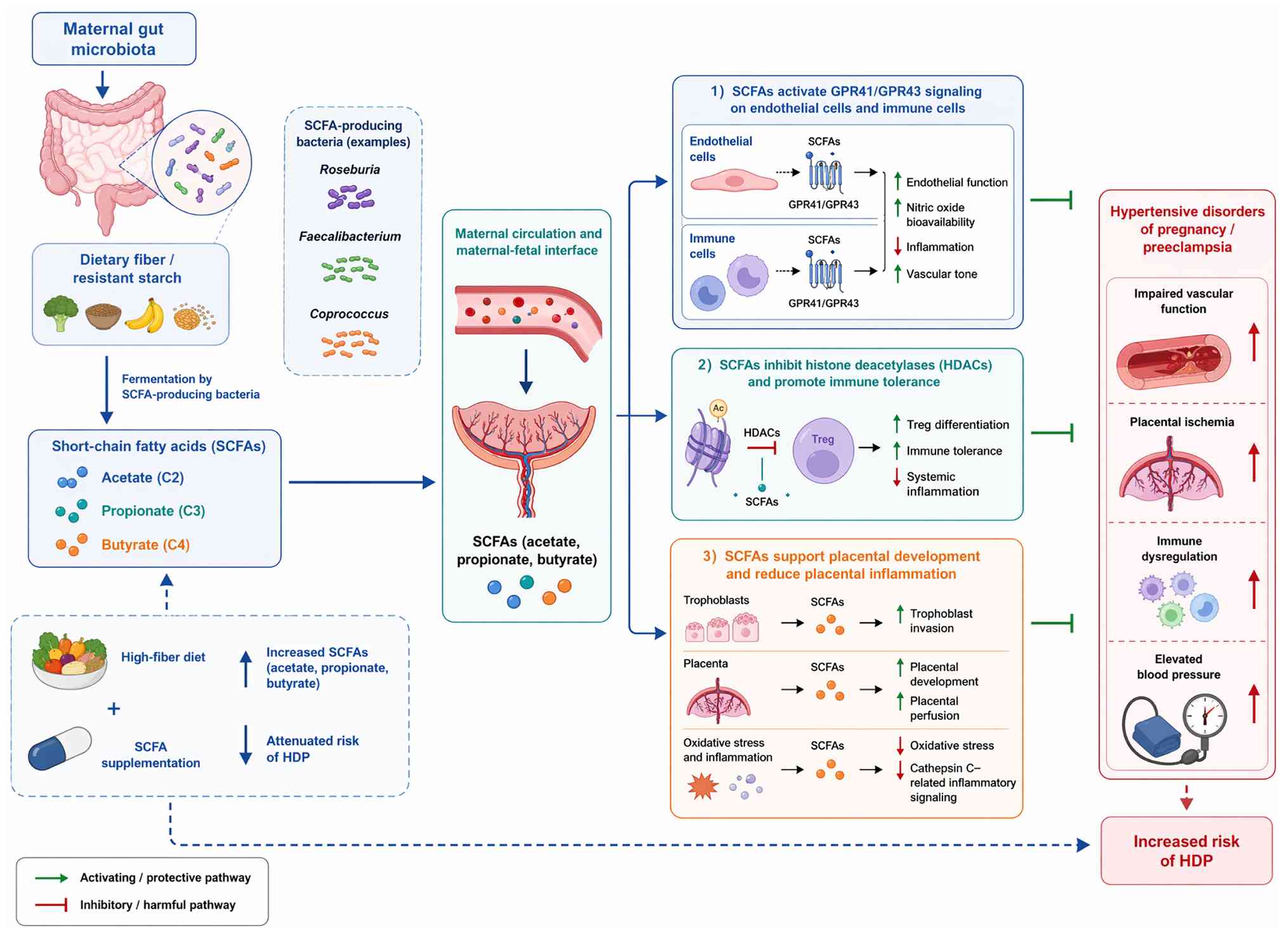 | Figure 2.Biosynthesis, gestational dynamics
and molecular mechanisms of SCFAs in HDP. SCFAs (acetate,
propionate and butyrate) are produced by gut bacterial fermentation
of dietary fiber. In normal pregnancy, SCFA levels change
dynamically across gestation; in HDP, butyrate is consistently
reduced. SCFAs signal via GPCRs (for example, GPR43) and inhibit
HDACs, leading to enhanced Treg development, reduced inflammation
and improved vascular function. GPCR, G protein-coupled receptor;
HDAC, histone deacetylase; HDP, hypertensive disorders of
pregnancy; NO, nitric oxide; SCFAs, short-chain fatty acids; Treg,
regulatory T cell; GPR41/43, GPCRs 41/43. |
Biosynthesis, microbial sources and
gestational dynamics of SCFAs
SCFAs, predominantly acetate, propionate and
butyrate, are generated through bacterial fermentation of dietary
fiber and resistant starch in the distal gut, with their production
contingent upon substrate availability and the metabolic capacity
of specific microbial communities (48). A comprehensive review by
Mukhopadhya and Louis (48)
summarized that 500–600 mmol of SCFAs are produced daily in the
human colon, with a typical acetate/propionate/butyrate ratio of
60:20:20 and that butyrate is the primary energy source for
colonocytes. During normal pregnancy, the maternal gut microbiota
undergoes physiological remodeling that includes functional
metabolic adaptation, with altered capacity for SCFAs production
across gestation (49). In a
cross-sectional study of 90 pregnant women (30 women each in the
first, second and third trimesters), Ziętek et al (49) reported that serum butyrate
concentrations significantly increased from 4.1±1.2 µM in the first
trimester to 7.3±2.1 µM in the third trimester (P<0.001) and
that these levels correlated positively with gestational age
(r=0.52; P<0.001), supporting a notable increase in SCFA
bioavailability across gestation. The biosynthesis of SCFAs is not
uniform but rather reflects the compositional dynamics of
SCFAs-producing bacterial populations, including genera such as
Coprococcus, Roseburia and Faecalibacterium, which
exhibit gestational stage-specific abundance patterns that
influence the availability of these metabolites at the
maternal-fetal interface.
Clinical evidence of SCFA alterations
in HDP
Multiple observational studies have consistently
demonstrated notable alterations in circulating, fecal and
placental SCFA profiles in women with preeclampsia compared with
normotensive pregnancies. In a case-control study of 35
preeclamptic and 35 normotensive pregnant women, Chang et al
(50) used gas chromatography-mass
spectrometry to quantify fecal SCFAs and reported that butyrate was
significantly reduced by 54% (36.2±8.4 vs. 78.9±12.5 µmol/g;
P<0.001) and propionate by 41% (23.1±5.2 vs. 39.3±7.8 µmol/g;
P<0.001) in the preeclampsia group, and these reductions
significantly correlated with increased systolic blood pressure
(r=−0.61 for butyrate; P<0.001), providing the first
comprehensive evidence associating reduced fecal SCFAs with
preeclampsia. These findings were corroborated in a previous study
by Altemani et al (51),
which performed 16S rRNA sequencing on fecal samples from 40 women
who developed preeclampsia and 50 normotensive controls, and
reported that the abundance of the butyrate-producing genus
Coprococcus was 67% lower in the preeclampsia group compared
with that in normotensive pregnant women (relative abundance, 0.8
vs. 2.4%; P=0.002), directly associating a taxonomic shift with a
functional metabolic consequence. Building on this clinical
evidence, Li et al (52)
conducted a diagnostic study of 95 preeclamptic and 98 healthy
pregnant women, measuring plasma SCFAs using liquid
chromatography-mass spectrometry (LC-MS), and reported that a panel
of acetate and butyrate levels distinguished preeclampsia from
healthy pregnancy with an AUC of 0.94 (95% CI, 0.89–0.98) and at a
cut-off value of butyrate ≤4.2 µM, the sensitivity was 86% and
specificity 91%. Chen et al (42) further extended these observations
by systematically examining SCFAs expression across multiple
pregnancy complications, confirming that altered SCFA profiles
represent a common feature of adverse pregnancy outcomes with
particular relevance to hypertensive disorders. In a
cross-sectional study of 200 pregnant women (50 women each with
preeclampsia, gestational diabetes mellitus, intrauterine growth
restriction and 50 healthy controls), Chen et al (42) reported that butyrate was
significantly lower only in the preeclampsia group (P<0.001 vs.
each of the other groups), suggesting that SCFA reduction is
relatively specific to hypertensive disorders rather than a general
marker of pregnancy complications. A recent scoping review by Zhao
et al (14) synthesized
evidence from 11 case-control studies and concluded that reduced
SCFA concentrations, particularly butyrate, are consistently
associated with preeclampsia, although notable heterogeneity exists
across studies in terms of sampling matrices, analytical methods
and population characteristics. All 11 human studies included in
the review were case-control or cross-sectional in design. No
prospective cohort study yet has examined SCFAs levels before HDP
onset, to the best of our knowledge. Therefore, while reduced
SCFAs, particularly butyrate, are consistently associated with
preeclampsia (7/7 studies reporting lower levels and 6 studies with
P<0.05), causality cannot be inferred from the current evidence.
Kaihara et al (53)
performed untargeted plasma metabolomic profiling on 160 women (40
women with gestational hypertension, 40 women with preeclampsia
without severe features, 40 women with preeclampsia with severe
features and 40 women normotensive controls) and identified
distinct metabolic signatures, with butyrate and its derivatives
indicating significant progressive reduction across increasing
disease severity (P<0.001 for trend), further supporting the
potential of SCFAs as components of multi-metabolite diagnostic
panels. Despite the consistency of these findings, key limitations
warrant consideration, including cross-sectional designs that
preclude determination of whether SCFA alterations precede or
follow disease onset, variable adjustment for confounders such as
dietary intake and medication use and the predominance of studies
from Asian populations limiting generalizability.
Molecular mechanisms of SCFAs action
in HDP pathophysiology
Hu et al (54) conducted a prospective cohort study
including 50 preeclamptic and 50 normotensive pregnant women,
measuring maternal serum acetate and analyzing fetal thymic tissue.
The study reported that serum acetate was significantly reduced by
48% in preeclampsia (median, 17.3 vs. 33.2 µM, P<0.001) and that
fetal thymic regulatory T cell (Treg) numbers were significantly
reduced by 62% (P<0.001) and correlated positively with maternal
acetate levels (r=0.71; P<0.001), establishing a direct
association between reduced SCFA availability and impaired immune
tolerance in HDP. This immunological perspective was markedly
advanced in a previous study by Jin et al (55), which used a gut dysbiosis mouse
model (antibiotic-treated) and macrophage-trophoblast co-cultures
to demonstrate that butyrate (1 mM) significantly increased the
proportion of M2 macrophages from 18 to 52% (P<0.001) and
significantly enhanced trophoblast invasion by 2.3-fold (P<0.01)
via GPR43-mediated signaling; in vivo, butyrate
supplementation (200 mg/kg/day) to pregnant mice with experimental
preeclampsia significantly lowered blood pressure by 28 mmHg
(P<0.001) and reduced fetal loss from 45 to 12%, providing
causal evidence for SCFA-mediated protection. Cui et al
(11) comprehensively reviewed the
multifaceted roles of SCFAs in preeclampsia regulation, emphasizing
that these metabolites simultaneously influence blood pressure
control, endothelial function, inflammatory responses and placental
development through integrated mechanisms. A recent study by Lu
et al (56) demonstrated
the gut microbiota-SCFAs-cathepsin C pathway as a novel therapeutic
target in preeclampsia. The study used a rat model (n=48) and
reported that butyrate supplementation (100 mg/kg/day)
significantly reduced serum cathepsin C levels by 52% (P<0.001),
decreased blood pressure from 152±8 to 122±6 mmHg and normalized
proteinuria, revealing that SCFAs regulate lysosomal enzyme
activity and subsequent inflammatory mediator release from immune
cells. Mackay and Marques (57)
provided an accompanying perspective emphasizing that dysbiosis in
preeclampsia is amenable to treatment with SCFAs, highlighting the
therapeutic potential of targeting the gut
microbiota-SCFAs-cathepsin C pathway.
Preclinical functional validation of
SCFAs in HDP
The functional consequences of SCFA alterations in
HDP have been investigated using in vitro cellular models
and in vivo animal studies, providing causal evidence
complementing observational human data. Yong et al (58) induced preeclampsia in pregnant rats
(n=60) using L-NG-nitro arginine methyl ester (50
mg/kg/day) and treated them with sodium butyrate (100 mg/kg/day) or
vehicle. Butyrate-treated rats had significantly lower systolic
blood pressure (128±6 vs. 167±9 mmHg in the untreated PE model
group, P<0.001), reduced urinary protein (118±21 vs. 342±45
mg/24 h in the untreated PE model group, P<0.001) and improved
gut microbiota composition (increased Bifidobacterium from
2.1 to 7.8%; P=0.003), suggesting a positive feedback loop between
exogenous SCFA supplementation and endogenous microbial metabolic
capacity. This intervention approach was further validated in
Ishimwe et al (59), which
supplemented Dahl salt-sensitive rats (n=32) with 1,3-butanediol
(2% in drinking water) for 2 weeks before mating and throughout
pregnancy. Treated rats had suppressed the superimposed
preeclampsia-like phenotype, with a significant 34 mmHg reduction
in blood pressure (P<0.001) and a 56% reduction in placental
oxidative stress markers, indicating that metabolic interventions
targeting SCFA-associated pathways may be effective even when
initiated prior to conception. The relevance of these findings to
human physiology is supported by Alhasan et al (60), which used a rat model of
superimposed preeclampsia (n=24) and performed fecal 16S rRNA
sequencing and SCFA profiling at disease onset. At gestation day
14, the fecal gut microbiome of diseased rats showed lower α
diversity and significant differences in β diversity compared with
controls, with depletion of bacteria from the families
Ruminococcaceae and Oscillospiraceae, as well as the genera
Blautia and Faecalibacterium, while acetate,
propionate and valerate were increased (60), closely recapitulating the metabolic
disturbances observed in affected women. Beckers et al
(61) extended these observations
to the blood pressure high/5 (BPH/5) mouse model of superimposed
preeclampsia, demonstrating that pregnant BPH/5 mice (n=12) had a
significant 45% reduction in fecal butyrate (P=0.004) compared with
normotensive C57BL/6 mice and that these changes were
pregnancy-specific, as non-pregnant BPH/5 mice had normal butyrate
levels, further confirming the translational relevance of these
animal models. Mechanistic insights from these preclinical studies
revealed that SCFAs supplementation exerts antihypertensive effects
through multiple pathways, including enhancement of endothelial
nitric oxide bioavailability, suppression of systemic inflammation,
improvement of placental blood flow and modulation of immune cell
populations toward tolerogenic phenotypes.
SCFAs as mediators associating
environmental factors with HDP susceptibility
Beyond their direct pathophysiological roles, SCFAs
function as key mechanistic mediators associating maternal
environmental factors with HDP susceptibility, providing a
biologically plausible explanation for how dietary, lifestyle and
other factors influence disease risk. Maternal dietary fiber intake
represents the primary determinant of SCFAs production, as these
metabolites are generated through bacterial fermentation of
indigestible carbohydrates. Schwartz et al (62) conducted a cross-sectional study of
158 third-trimester pregnant women, using food frequency
questionnaires and 16S rRNA sequencing, and reported that each 10
g/day increase in dietary fiber was associated with a significant
12% increase in gut microbial richness (P=0.01) and a 15% increase
in the abundance of SCFA-producing bacteria (Roseburia and
Faecalibacterium), establishing the nutritional foundation
for SCFA-mediated effects on maternal health. The causal
relationship between SCFAs-associated metabolic pathways and HDP
has been strengthened by MR studies, such as Wu et al
(32), which used GWAS data to
demonstrate that the genus Ruminococcaceae (OR=1.21; 95% CI,
1.08–1.36) and the butyrate production pathway (OR=0.78; 95% CI,
0.66–0.92) exhibited notable causal associations with HDP,
supporting a protective role for SCFA biosynthesis. Yang et
al (63) subsequently
performed two-sample MR analysis of 5,979 preeclampsia cases and
229,377 controls, identifying that genetically predicted higher
levels of the fatty acid butyrate (inverse-variance weighted
OR=0.85 per SD increase; 95% CI, 0.76–0.95) were causally
associated with reduced preeclampsia risk, providing genetic
evidence supporting the role of SCFA-associated metabolic pathways
in disease pathogenesis. The integration of environmental,
microbial and metabolic factors is exemplified in a previous study
by Fan et al (64), which
fed BPH/5 mice (n=30) either a control or a high-fiber diet (10%
inulin) from early pregnancy and reported that the high-fiber group
had a significant 2.8-fold increase in fecal butyrate (P<0.001),
a 24 mmHg lower blood pressure (P=0.002) and reduced placental
sFlt-1 expression by 51%, illustrating the potential for dietary
interventions to modify SCFA-associated pathways and influence
disease outcomes. A study by Lu et al (65) using a rat model (n=48) demonstrated
that probiotic-fermented buffalo milk (containing
propionate-producing bacteria; 5 ml/day) significantly increased
serum propionate by 3.1-fold (P<0.001) and reduced blood
pressure by 22 mmHg (P<0.001) via the phenylalanine metabolic
pathway, further supporting the feasibility of microbiome-targeted
interventions to enhance SCFA production and improve pregnancy
outcomes. Collectively, these findings position SCFAs as central
nodes in a complex network connecting maternal diet, gut microbial
ecology, metabolic function and HDP pathogenesis, with notable
implications for the development of preventive and therapeutic
strategies targeting these modifiable pathways in the future.
Gut microbial tryptophan metabolites in the
pathogenesis of HDP
Tryptophan metabolism represents a key interface
between maternal nutrition, gut microbial activity and host
physiology, with emerging evidence implicating this pathway in HDP
pathogenesis (66–71). Fig.
3 illustrates the dual routes of tryptophan metabolism (the
host enzymatic kynurenine pathway and the microbial indole pathway)
and their convergence on the AhR as a central regulatory hub.
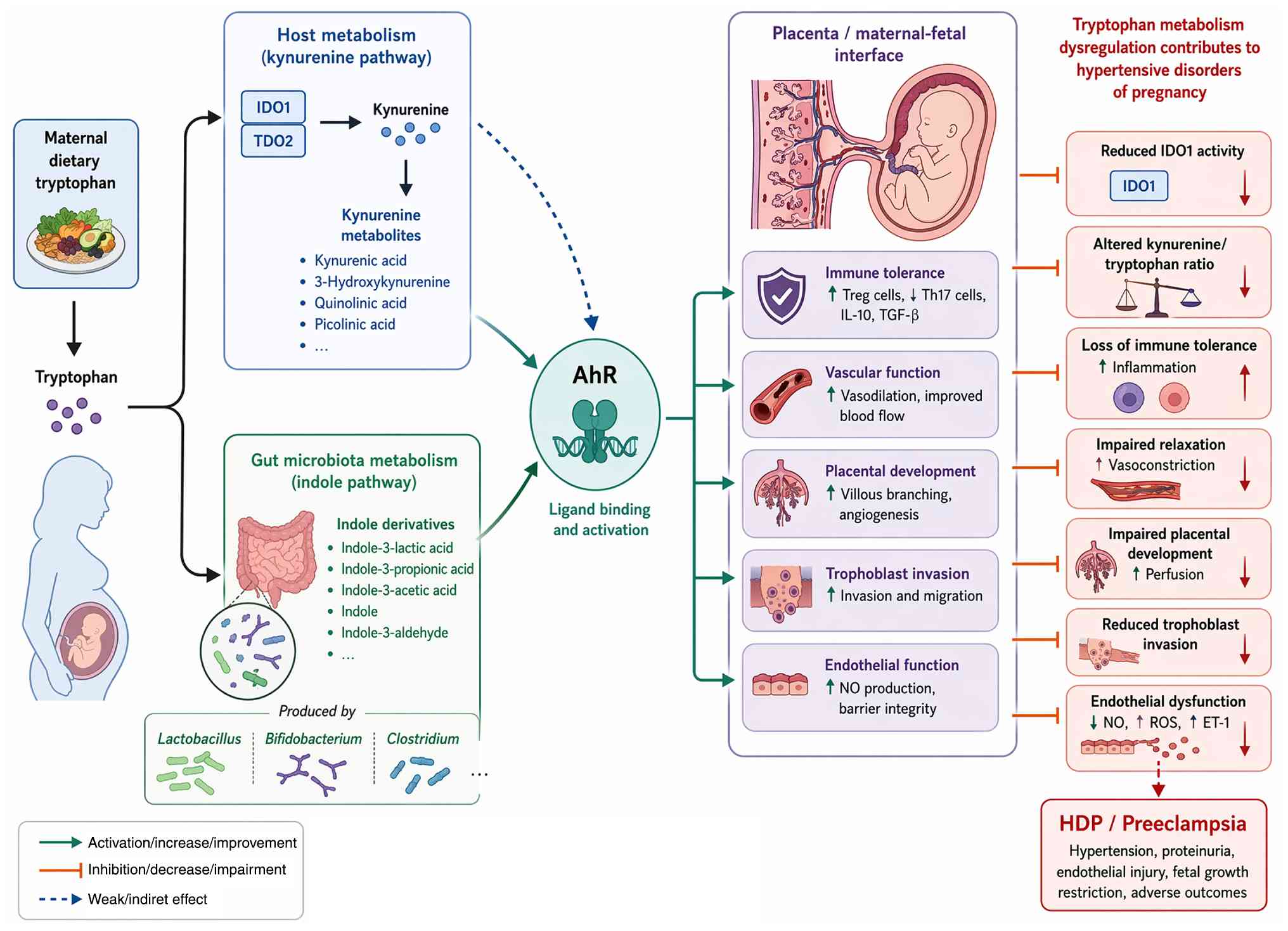 | Figure 3.Metabolic pathways of tryptophan and
AhR signaling in HDP. Tryptophan is metabolized via the host
kynurenine pathway (IDO-dependent) and the microbial indole pathway
(producing ILA and IPA). Both routes generate ligands that activate
the AhR, which regulates trophoblast migration, immune tolerance
and vascular homeostasis. Dysregulation of this pathway is
implicated in preeclampsia. HDP, hypertensive disorders of
pregnancy; AhR, aryl hydrocarbon receptor; IDO, indoleamine
2,3-dioxygenase; ILA, indole-3-lactic acid; IPA, indole-3-propionic
acid; NO, nitric oxide; Treg, regulatory T cell. |
Metabolic pathways and maternal-fetal
distribution of tryptophan metabolites
Tryptophan is metabolized through three principal
pathways: The kynurenine pathway catalyzed by IDO and tryptophan
2,3-dioxygenase, the serotonin pathway and the direct microbial
conversion to indole derivatives. The kynurenine pathway (producing
kynurenine, KYNA) is primarily host-derived, whereas indole
derivatives (for example, indole-3-lactic acid, and
indole-3-propionic acid) are exclusively of microbial origin. The
kynurenine pathway accounts for ~95% of dietary tryptophan
degradation and generates metabolites with diverse immunological
and vascular effects (66). In
pregnancy, the placental expression and activity of IDO are
dynamically regulated, with IDO serving a key role in maintaining
maternal-fetal immune tolerance by depleting tryptophan and
generating immunosuppressive kynurenines (66). These two metabolic routes converge
on the aryl hydrocarbon receptor (AhR), which serves as a central
regulatory hub integrating signals from tryptophan-derived
metabolites at the maternal-fetal interface (Fig. 3). Zardoya-Laguardia et al
(67) performed ex vivo
wire myography on placental arteries from normotensive (n=15),
preeclamptic (n=15) and intrauterine growth restriction (n=15)
pregnancies, and reported that endothelial IDO-1 expression was
significantly reduced by 67% in preeclampsia (P<0.001) and that
blood vessels in these patients exhibited significantly impaired
tryptophan-induced relaxation (maximum relaxation, 32±6% vs. 78±8%
in controls; P<0.001), establishing a direct association between
impaired tryptophan metabolism and placental vascular dysfunction.
The distribution of tryptophan metabolites across the
maternal-fetal interface exhibits compartment-specific patterns,
for example, Zhao et al (68) measured tryptophan and its
metabolites in paired maternal and fetal cord blood from 30
normotensive and 30 preeclamptic pregnancies, and reported that the
fetal-to-maternal ratio of kynurenine was 1.8-fold higher in
preeclamptic pregnancies compared with that in normotensive
controls (median, 1.32 vs. 0.73; P=0.004), indicating altered
transplacental handling of these metabolites. Keaton et al
(69) further characterized
altered tryptophan catabolism in placentas from women with
preeclampsia, using LC-MS to measure tryptophan metabolites in
placental tissue from 28 preeclamptic and 28 control women, and
reported that the kynurenine/tryptophan ratio (a marker of IDO
activity) was significantly increased by 42% in preeclampsia
(P=0.002), while serotonin was significantly reduced by 39%
(P=0.01), identifying specific disruptions in this metabolic
pathway that may contribute to disease pathogenesis. Broekhuizen
et al (70) subsequently
demonstrated that L-tryptophan (100 µM) induced vasodilation of
isolated placental arteries (n=20 per group), with a significant
maximal relaxation of 52±8% in the normotensive group but 78±6% in
the group with preeclamptic vessels (P=0.01), indicating adaptive
upregulation of tryptophan-mediated vasodilation in the diseased
state. A recent comprehensive review by Karahoda et al
(71) synthesized current
understanding of the placental tryptophan pathway across gestation,
emphasizing its implications for pregnancy outcomes and identifying
key knowledge gaps regarding the regulation of this system in
complicated pregnancies.
Clinical associations between
tryptophan metabolites and HDP
A prospective cohort study (n=1,057) reported that
first-trimester host-derived kynurenine pathway metabolites are
associated with subsequent preeclampsia risk, with an adjusted OR
of 2.3 (95% CI, 1.4–3.8) for KYNA ≤25th percentile, providing
notable evidence for temporality (41). By contrast, majority of indole
derivatives (microbial origin) have been studied only in
cross-sectional designs or preclinical models. A systematic review
by van Zundert et al (9)
concluded that while alterations in the kynurenine pathway are
consistently observed in HDP, causal relationships have not been
established yet due to the predominance of cross-sectional studies
and lack of longitudinal data. Multiple clinical studies have
established notable associations between circulating tryptophan
metabolite concentrations and HDP risk, severity and adverse
pregnancy outcomes. Jasim et al (40) performed a cross-sectional study of
80 preeclamptic and 80 normotensive pregnant women, measuring serum
tryptophan metabolites and insulin resistance markers, and reported
that kynurenine was significantly elevated by 34% in preeclampsia
(P<0.001) and correlated positively with Homeostatic Model
Assessment of Insulin Resistance (r=0.52; P<0.001) (72), suggesting that metabolic
dysfunction may associate altered tryptophan metabolism with
hypertensive complications. Jääskeläinen et al (73) employed non-targeted LC-MS profiling
to reveal elevated levels of carnitine precursors and trimethylated
compounds, including tryptophan-associated metabolites, in the cord
blood plasma of preeclamptic infants (n=25) compared with controls
(n=25), with a significant 2.4-fold increase in indole-3-acetic
acid (P=0.002), indicating that fetal exposure to altered
tryptophan metabolism occurs in utero. Ferranti et al
(74) conducted a pilot study
examining early pregnancy serum metabolite profiles associated with
HDP in African American women (n=40; 20 cases and 20 controls) and
identified tryptophan pathway metabolites (kynurenine and
indole-3-lactic acid) among the discriminating features (AUC=0.79
for the panel), suggesting that these metabolites may serve as
early risk markers for HDP. Recently, Broekhuizen et al
(75) analyzed umbilical cord
blood from 100 pregnancies (50 preeclamptic women and 50 controls)
and reported that kynurenine was significantly elevated by 28%
(P=0.01) and KYNA significantly reduced by 35% (P=0.003) in the
preeclampsia group, providing evidence for fetal programming
effects mediated through this metabolic axis. Despite the
consistency of these associations, notable limitations include the
predominance of cross-sectional designs, variable adjustment for
potential confounders such as dietary tryptophan intake and
medication use and heterogeneity in the specific metabolites
measured and analytical platforms employed.
AhR signaling as a mechanistic
hub
The AhR has emerged as the central regulatory hub
through which microbial indole derivatives exert their effects on
maternal vascular function, immune tolerance and placental
development. AhR is a ligand-activated transcription factor that
responds to diverse endogenous and exogenous ligands, including
several tryptophan metabolites generated by both host enzymes and
gut bacteria. Li et al (76) systematically reviewed 45 studies on
AhR in endothelial function and concluded that AhR activation by
tryptophan metabolites (for example, kynurenine and indole-3-lactic
acid) promotes angiogenesis through upregulation of VEGF and
hypoxia-inducible factor-1α, establishing a potential mechanistic
foundation in understanding how this receptor influences placental
vascular development. Zhao et al (77,78)
have made notable contributions to understanding AhR signaling in
HDP pathogenesis, demonstrating in a rat model (n=24) that
administration of the endogenous AhR ligand
2-(1′H-indole-3′-carbonyl)-thiazole-4-carboxylic acid methyl ester
(ITE) (2,3,7,8-tetrachlorodibenzo-p-dioxin analog; 200 µg/kg/day
from gestation day 7–18) induced preeclampsia-like phenotypes:
Systolic blood pressure significantly increased from 104±5 to 149±8
mmHg (P<0.001), proteinuria significantly increased 4.2-fold
(P<0.001) and placental transcriptomic analysis revealed 1,287
differentially expressed genes enriched in inflammatory and
angiogenic pathways, identifying AhR as a key mediator of disease.
Zhao et al (79) further
demonstrated that AhR activation in human umbilical vein
endothelial cells (n=6; independent donors) with ITE (1 µM; 24 h)
dysregulated endothelial functions: Tube formation was
significantly reduced by 48% (P=0.002) and the expression level of
endothelial nitric oxide synthase (eNOS) was significantly
decreased by 62% (P<0.001), providing mechanistic insights into
how this pathway may contribute to the generalized endothelial
dysfunction characteristic of preeclampsia. Wei et al
(17) provided key evidence that
indole-3-lactic acid, a tryptophan metabolite produced by gut
bacteria, alleviates sFlt-1-induced preeclampsia-like phenotypes
through activation of AhR signaling, as described in section 1. Wei
et al (18) subsequently
demonstrated that indole-3-lactic acid (10 µM; 24 h) significantly
increased trophoblast migration (scratch wound assay, 78% closure
vs. 34% in controls; P<0.001) and invasion (Transwell, 2.3-fold;
P<0.001) in HTR-8/SVneo cells via the AhR/versican (VCAN)
pathway, further elaborating the mechanistic basis for beneficial
effects on placental development. Xodo et al (80) examined the AhR network in placental
tissues from pregnancies complicated by preeclampsia (n=30)
compared with controls (n=30) and reported that AhR protein
expression significantly increased 2.1-fold (P=0.008) while its
downstream target CYP1A1 was significantly reduced by 54% (P=0.02),
indicating a dysfunctional signaling system in affected women. Kim
et al (81) investigated
the role of AhR in vascular factors associated with preeclampsia
using a smoking mouse model (n=20) and reported that cigarette
smoke extract (1 mg/kg/day) activated placental AhR (CYP1A1
significantly increased 4.5-fold; P<0.001) and significantly
increased sFlt-1 production by 67% (P=0.002), revealing complex
interactions between exogenous ligands and endogenous signaling
pathways. Jiang et al (82)
recently provided genetic evidence supporting the importance of
this pathway. The study performed genotyping of the AhR gene
(rs2066853) in 500 preeclamptic and 500 control women, and reported
that the G allele was significantly associated with a 1.4-fold
increased risk (P=0.02) and reduced AhR transcriptional activity by
34% in reporter assays, demonstrating functional implications of
AhR gene polymorphism in preeclampsia susceptibility. Marbrey et
al (83) proposed that
AhR-activated placental adrenomedullin may explain the paradoxical
protective effects of smoking against preeclampsia. The study
demonstrated that in placental explants (n=12), the AhR agonist
6-formylindolo(3,2-b)carbazole (10 nM) significantly increased
adrenomedullin secretion by 3.1-fold (P<0.001) and that
adrenomedullin, in turn, significantly reduced sFlt-1 release by
48% (P=0.005), further highlighting the complexity of AhR signaling
in pregnancy. Collectively, these studies established AhR as a
master regulator integrating diverse environmental and metabolic
signals into coordinated cellular responses relevant to HDP
pathogenesis.
Functional evidence in placental
dysfunction, vascular injury and immune imbalance
The functional consequences of altered tryptophan
metabolism in HDP have been investigated using in vitro
cellular models and in vivo animal studies, providing
mechanistic insights that complement observational human data.
Worton et al (84)
performed wire myography on isolated omental and placental arteries
from normotensive women (n=24) and women with preeclampsia (n=24).
The study reported that kynurenine (100 µM) induced relaxation of
78±8% in normotensive arteries and 82±6% in preeclamptic arteries
(P=0.45 for between-group comparison), identifying a direct
vasodilatory effect of this tryptophan metabolite that is preserved
in the diseased state. Worton et al (85) further explored the therapeutic
potential of targeting the kynurenine pathway in treating the
maternal features of preeclampsia. The study reviewed 32
preclinical and clinical studies and concluded that kynurenine
pathway modulators (for example, IDO inhibitors and kynurenine
aminotransferase activators) represent a novel target for
pharmacological intervention, although safety in pregnancy remains
to be investigated in the future. Broekhuizen et al
(86) comprehensively reviewed the
function of the kynurenine pathway in the placenta, synthesizing
evidence from 48 studies and proposing that KYNA, through GPR35
activation, may protect against placental ischemia; however,
elevated kynurenine in preeclampsia could be either adaptive or
maladaptive. Marsden (87)
provided an accompanying perspective emphasizing the importance of
tryptophan metabolism in pregnancy and the therapeutic implications
of targeting this pathway. Gumusoglu et al (88) investigated the serotonin-immune
axis in preeclampsia. The study measured serotonin and inflammatory
cytokine levels in serum from 50 preeclamptic and 50 control women
and reported that serotonin was significantly reduced by 45%
(P<0.001) and correlated negatively with IL-6 (r=−0.61;
P<0.001), revealing complex interactions between serotonergic
signaling and inflammatory processes. Gumusoglu et al
(89) also demonstrated that low
IDO activity (measured by serum kynurenine/tryptophan ratio ≤0.035)
was significantly associated with a 3.1-fold increased risk of both
preeclampsia and postpartum depression (P=0.004), linking
tryptophan metabolism with both psychiatric and obstetric outcomes.
Using the Rgs2 knockout model, Gumusoglu et al (90) reported that Rgs2−/− mice
(n=12) had a significant 52% reduction in placental serotonin
(P<0.001) and a significant 2.7-fold increase in sFlt-1
(P=0.002), identifying anti-angiogenic mechanisms and serotonergic
dysfunction relevant to psycho-obstetric risk, further elaborating
the mechanistic associations between tryptophan metabolites and
pregnancy complications. Prescott et al (91) conducted an integrative review
examining tryptophan as a biomarker of pregnancy-associated immune
expression and modulation. The review synthesized data from 38
studies and concluded that the kynurenine/tryptophan ratio is
elevated in preeclampsia, intrauterine growth restriction and
preterm birth, suggesting that tryptophan is a general marker of
inflammatory stress rather than a HDP-specific signature. Kudo and
Sugimoto (15) comprehensively
reviewed the role of the placental enzyme IDO in normal and
abnormal human pregnancy. The review summarized that IDO expression
in syncytiotrophoblasts increases with gestational age and is
reduced by 40–60% in preeclamptic placentas, emphasizing its key
functions in immune regulation and vascular homeostasis. A previous
study by Dupont et al (92)
used a combination of human samples (n=60) and a mouse model (n=24)
to reveal that impaired renal reserve (measured by creatinine
clearance) was associated with a significant 2.3-fold increase in
serum kynurenine (P=0.005) and a significant 2.1-fold increase in
sFlt-1 (P=0.003), identifying a novel mechanism associating renal
function, tryptophan metabolism and placental dysfunction. These
functional studies collectively demonstrated that tryptophan
metabolites influence multiple aspects of HDP pathophysiology,
including vascular tone regulation, immune cell function,
trophoblast biology and endothelial integrity, through mechanisms
that converge on AhR signaling and other downstream effectors.
Interplay with classic HDP pathogenic
pathways
Tryptophan metabolites do not function in isolation
but rather interact extensively with other classic HDP pathogenic
pathways, including the renin-angiotensin-aldosterone system,
oxidative stress, inflammatory cascades and angiogenic factor
balance. The interplay between tryptophan metabolism and oxidative
stress is particularly notable, as both pathways are markedly
altered in preeclampsia and exhibit bidirectional regulatory
relationships. Chiarello et al (93) comprehensively reviewed oxidative
stress in normal pregnancy vs. preeclampsia (n=212 studies). The
review concluded that reactive oxygen species are increased 2- to
3-fold in preeclampsia and that tryptophan metabolites,
particularly kynurenine, can both generate and scavenge free
radicals, suggesting bidirectional regulatory relationships. The
relationship between tryptophan metabolism and angiogenic balance
is exemplified in a previous study by Wei et al (17), which demonstrated that
indole-3-lactic acid alleviates sFlt-1-induced preeclampsia-like
phenotypes, as aforementioned. Hsu and Tain (94) recently reviewed melatonin as a
redox modulator in developmental programming, highlighting that
tryptophan-derived melatonin reduces oxidative stress markers by
40–60% in preclinical models of pregnancy hypertension and that
melatonin supplementation may have therapeutic potential for
hypertensive disorders of pregnancy. A comprehensive multi-omics
analysis by Marić et al (95) used machine learning on data from
2,200 pregnant women (800 preeclamptic women and 1,400 controls)
and reported that tryptophan metabolites contributed to 24% of the
predictive signal in the final model, with kynurenine and
indole-3-lactic acid identified among the top 15 features, enabling
early prediction of preeclampsia as early as gestational week 12
(AUC=0.92 in validation cohort). These interconnected pathways
create a complex regulatory network in which perturbations in
tryptophan metabolism can propagate through multiple systems to
influence overall pregnancy outcomes, suggesting that therapeutic
strategies targeting this pathway may have e effects on HDP
pathophysiology.
Synergistic and antagonistic crosstalk
between SCFAs and tryptophan microbial metabolites in HDP
pathogenesis
Based on available evidence, three potential modes
of interaction are proposed: i) Synergistic amplification: SCFAs
inhibit HDACs, increasing chromatin accessibility, while tryptophan
metabolites activate AhR and HDAC inhibition may potentiate
AhR-driven transcription; ii) competitive antagonism: SCFAs via
GPR43 promote anti-inflammatory M2 macrophage polarization, whereas
AhR signaling can be pro-inflammatory and high SCFA availability
may override AhR-mediated inflammation; and iii) sequential
signaling: AhR activation (by indole-3-lactic acid) primes
trophoblast migration, while SCFAs (butyrate) support metabolic
adaptation and immune evasion. These three modes collectively
constitute the specific biochemical crosstalk model proposed in the
present review. Direct experimental validation of these three
proposed modes of interaction is currently lacking, and the
framework thus remains hypothetical at present. The following
subsections provide the experimental and clinical evidence that
informs these three proposed modes. Specifically, the mechanistic
evidence for synergistic amplification is detailed below in the
subsection on synergistic protective effects and the evidence for
competitive antagonism is detailed in the subsection on
antagonistic interactions. Table
SI summarizes the key evidence for metabolic interactions
between SCFAs and tryptophan pathways in HDP. Direct evidence for
SCFAs-tryptophan crosstalk in HDP is hypothesis-generating rather
than definitive. No study has measured both metabolite classes in
the same cohort to formally test for statistical interactions, to
the best of our knowledge. The proposed crosstalk is supported by
separate lines of preclinical and observational research; however,
prospective studies are warranted in the future.
Shared core regulatory networks
Converging evidence from preclinical and clinical
studies indicated that SCFAs and tryptophan metabolites interface
through overlapping signaling pathways and shared downstream
effectors. These shared nodes provide the molecular basis for
potential synergistic or competitive interactions between the two
metabolite classes. Using the BPH/5 mouse model (n=10 per group),
Beckers et al (61)
performed integrated microbiome (16S rRNA) and metabolome (LC-MS)
analyses and reported that pregnancy-specific shifts in both
compartments were correlated [Procrustes analysis, M2 (a
goodness-of-fit statistic with lower values indicating greater
concordance between the two datasets)=0.34; P=0.02], with notable
alterations in SCFA profiles (butyrate reduced 45%) accompanied by
changes in tryptophan metabolites (indole-3-lactic acid reduced
38%), suggesting coordinated dysregulation of these pathways
through shared regulatory nodes. This coordinated dysregulation
suggests that perturbations in one metabolic pathway may propagate
to the other through shared regulatory nodes. Indeed, the AhR has
been established as a central hub integrating signals from
tryptopha-derived metabolites (17,18),
while SCFAs modulate immune cell polarization and trophoblast
function via GPR43-mediated signaling (55), collectively highlighting the
convergence of these two metabolite classes on shared regulatory
networks at the maternal-fetal interface. The convergence of SCFAs
and tryptophan metabolite signaling on common transcription factors
(for example, AhR and NF-κB) and immune cell populations (Tregs and
macrophages) supports the existence of integrated regulatory
networks at the maternal-fetal interface.
Synergistic protective effects on
vascular and immune homeostasis
Direct mechanistic evidence for synergistic
amplification derives from a previous study by Jin et al
(55), which demonstrated that
butyrate acts as a HDAC inhibitor, increasing chromatin
accessibility at AhR target gene promoters (for example, CYP1A1)
and enhancing AhR recruitment in the presence of tryptophan-derived
agonists. This effect is independent of GPR41/43 and was confirmed
in human intestinal explants. Xiong et al (96) further demonstrated that butyrate
upregulates gene expression via HDAC inhibition, providing a
mechanistic basis for SCFA-mediated potentiation of AhR-driven
transcription. These findings are consistent with the proposed
‘synergistic amplification’ mode, where SCFA-mediated HDAC
inhibition may enhance AhR-driven transcription. In a diagnostic
study of 95 preeclamptic and 98 healthy pregnant women, Li et
al (52) measured plasma SCFAs
and reported that a panel of acetate and butyrate levels
distinguished preeclampsia from healthy pregnancy with an AUC of
0.94 (95% CI, 0.89–0.98). This clinical association supports the
biological plausibility that SCFAs, via HDAC inhibition, may
enhance AhR-driven protective transcriptional programs.
Complementing these findings, Marić et al (95) used machine learning on multi-omics
data from 2,200 pregnant women and reported that tryptophan
metabolites accounted for 24% of the predictive signal for
preeclampsia, with kynurenine and indole-3-lactic acid among the
top 15 features. The convergence of SCFA- and tryptophan-based
predictive signatures suggests that these metabolite classes may
act through shared downstream pathways. The synergistic potential
of these metabolite classes is further supported by multi-omics
analyses in Cao et al (97), which prospectively profiled serum
metabolites in 800 patients with suspected preeclampsia and
identified a 12-metabolite panel (including butyrate,
indole-3-lactic acid and 10 other markers) that predicted
progression to preeclampsia with an AUC of 0.91 (95% CI, 0.87–0.95)
when measured at 20–24 weeks. While direct evidence for
SCFAs-tryptophan synergy in pregnancy remains limited, studies in
other systems demonstrated that microbial metabolites can
cooperatively enhance host defense mechanisms (98–100). The concept that combinations of
microbial metabolites may produce greater effects compared with the
sum of their individual contributions warrants systematic
investigation in the context of HDP in the future.
Antagonistic interactions and
compensatory metabolic regulation
Direct mechanistic evidence for competitive
antagonism is provided in the study by Zhao et al (78), which demonstrated that AhR
activation induces endothelial dysfunction and elevates blood
pressure in a rat model of preeclampsia-like phenotype. By
contrast, SCFAs, particularly butyrate, promote anti-inflammatory
M2 macrophage polarization via GPR43 activation and enhance Treg
development via HDAC inhibition (54,55).
These opposing functional outcomes on vascular and immune
homeostasis support the ‘competitive antagonism’ hypothesis,
wherein high SCFA availability may override AhR-mediated
pro-inflammatory signals. In a rat model of preeclampsia (n=24), Xu
et al (101) performed
metabolomic profiling on maternal brain, placenta and fetal tissues
and reported that pathways for SCFAs (butyrate) and tryptophan
metabolites (kynurenine) exhibited opposite directional changes:
Butyrate significantly decreased by 44% in maternal brain (P=0.002)
while kynurenine significantly increased by 67% (P<0.001),
suggesting a compensatory metabolic shift. Metabolomic profiling by
Yutao et al (102) in a
rat preeclampsia model (n=30) treated with aspirin (20 mg/kg/day)
reported that aspirin simultaneously and significantly increased
butyrate by 52% (P<0.001) and decreased kynurenine by 38%
(P=0.003), demonstrating that therapeutic interventions can
modulate multiple metabolic pathways in opposite directions.
Jääskeläinen et al (73)
identified elevated levels of carnitine precursors and
trimethylated compounds, alongside tryptophan-associated
metabolites, in the cord blood plasma of preeclamptic infants,
suggesting that fetal exposure to metabolic disturbances involves
coordinated shifts across multiple pathways, with certain
metabolites (butyrate) decreased and others (indole-3-acetate)
increased. Understanding these compensatory responses may provide
insights into why single-metabolite interventions often yield
inconsistent results and why combined approaches may be more
effective for preventing or treating HDP.
Modulation by maternal dietary and
genetic factors
The crosstalk between SCFAs and tryptophan
metabolism is dynamically modulated by maternal dietary intake and
genetic predisposition. This population-specific variation
highlights the importance of gene-environment interactions in
shaping metabolic phenotypes. Luo et al (103) demonstrated that human chorionic
gonadotropin (hCG; 100 IU/ml) stimulated IL-4-induced-1 (IL4I1)
expression in human endometrial stromal cells (n=6 donors) by
3.2-fold (P<0.001) and that IL4I1, through AhR, promoted
decidualization (prolactin secretion increased 2.8-fold;
P<0.001), revealing a hormonal association with tryptophan
metabolism that may interact with SCFA signaling. Dietary factors
represent the most readily modifiable determinants of microbial
metabolite production; however, the specific dietary patterns that
optimally support both SCFAs and tryptophan metabolism during
pregnancy remain poorly defined. Kuang et al (104) emphasized the importance of
understanding metabolic pathways and disease signatures in response
to environmental exposures. The study used a murine model to
demonstrate that exposure to tribromobisphenol A altered both SCFA
and tryptophan metabolic pathways, with a 34% significant reduction
in butyrate and a 41% significant reduction in indole-3-lactic acid
(both P<0.01), a principle that extends to dietary and
pharmacological interventions targeting the maternal gut
microbiota.
Combined predictive value for early
risk stratification
The integration of SCFAs and tryptophan metabolite
measurements may enhance early prediction and risk stratification
for HDP beyond what can be achieved with either class alone.
Escorcia Mora et al (105)
reviewed 86 studies on the gut microbiota in female reproductive
health and concluded that endometrial signaling pathways (for
example, AhR and GPR43) may be influenced by microbial metabolites
including SCFAs and tryptophan derivatives, suggesting that
combined measurement could improve prediction of implantation
success and pregnancy outcomes. Song et al (106) investigated the metabolic role of
the CD73/adenosine signaling pathway in trophoblast cells
(HTR-8/SVneo; n=6; independent experiments) and reported that
adenosine (10 µM) significantly increased trophoblast migration by
2.1-fold (P<0.001) and that this effect was augmented by
butyrate (1 mM) and indole-3-lactic acid (10 µM) in an additive
manner (3.4-fold increase; P<0.001), revealing complex
interactions that could serve as nodes for metabolite integration.
The multi-omics approach introduced by Marić et al (95) demonstrated that combining multiple
classes of metabolites with clinical variables markedly improves
predictive accuracy for preeclampsia (AUC increased from 0.76 with
clinical variables alone to 0.92 after including metabolite data;
P<0.001). As Cao et al (97) confirmed in a large-scale
prospective study (n=800), metabolite-based signatures offer
potential in identifying at-risk women before clinical
manifestation of disease, with the SCFA-tryptophan panel achieving
a negative predictive value of 96% at 20 weeks. Future efforts to
develop clinically useful biomarker panels should consider
including representatives from both SCFAs and tryptophan pathways
to capture the full spectrum of microbial metabolite contributions
to HDP pathogenesis.
Clinical translation potential of targeting
SCFAs and tryptophan microbial metabolism for HDP prevention and
management
The growing understanding of microbial metabolite
involvement in HDP has opened novel avenues for clinical
translation, ranging from early biomarker development to targeted
therapeutic interventions. However, it should be noted that the
majority of all translational studies discussed below have been
conducted in preeclampsia; data on gestational hypertension or
eclampsia are lacking and findings may not be directly
generalizable to these other HDP subtypes. SCFAs and
tryptophan-derived metabolites offer promising opportunities for
non-invasive risk stratification, dietary and probiotic-based
prevention strategies and novel pharmacological approaches.
However, the path from preclinical identification to clinical
implementation requires validation across diverse populations and
careful consideration of safety in pregnancy. Table SII summarizes the current clinical
translation landscape for SCFAs and tryptophan metabolite-based
approaches in HDP.
Microbial metabolites as non-invasive
early predictive biomarkers
Multiple clinical studies have demonstrated the
potential of SCFAs and tryptophan metabolites as early predictive
biomarkers for HDP. Chang et al (50) quantified fecal SCFAs in 35
preeclamptic and 35 normotensive women and reported that butyrate
was significantly reduced by 54% (P<0.001) and propionate by 41%
(P<0.001), with these reductions correlating with systolic blood
pressure (r=−0.61; P<0.001). This observation established a
potential foundation for the use of fecal SCFAs as non-invasive
biomarkers. Building on this evidence, Li et al (52) extended these findings to plasma.
The study demonstrated that a panel of acetate and butyrate
achieved an AUC of 0.94 in distinguishing preeclampsia from healthy
pregnancy, indicating that circulating SCFAs also have diagnostic
potential for HDP. Collectively, studies have further demonstrated
the utility of combining SCFA and tryptophan metabolite
measurements for early risk stratification, including prospective
profiling in at-risk pregnancies, multi-metabolite discrimination
in diverse populations and detection of fetal exposure to altered
tryptophan metabolism (73,74,97).
Powell et al (107)
further demonstrated the utility of metabolic profiling in
diagnosing pregnancy complications, in a case-control study (n=150)
that a panel of 16 metabolites (including butyrate and kynurenine)
discriminated preeclampsia from other complications with an AUC of
0.84 (95% CI, 0.77–0.91). Thus, heterogeneity in study populations,
sample matrices and analytical platforms warrants standardization
and validation in prospective cohorts before clinical use in the
future.
Key appraisal of biomarker specificity
and technical artifacts
Despite promising diagnostic accuracy in
case-control studies, two major challenges limit clinical
translation. First, circulating levels of SCFAs and kynurenine
pathway metabolites are not disease-specific; they are notably
influenced by diet, renal function, systemic inflammation and gut
permeability, all of which are altered in HDP (9,62).
Thus, observed differences between preeclamptic and normotensive
women may reflect secondary changes rather than a unique disease
signature. Second, measurement of plasma butyrate is technically
problematic: Butyrate can be generated ex vivo by residual
erythrocytes if blood samples are not processed with immediate
centrifugation and plasma separation, a condition rarely achievable
in routine clinical settings (108). This factor may have contributed
to the heterogeneity across studies (14). Therefore, while metabolite-based
signatures are promising, pre-analytical standardization and
validation for disease-specificity in prospective cohorts are
warranted before clinical implementation in the future.
Dietary intervention strategies for
primary prevention
Dietary modification represents the most accessible
approach in modulating microbial metabolite production and
potentially reducing HDP risk. Both human observational and
preclinical evidence support the potential of dietary fiber to
enhance SCFA production and improve HDP-related outcomes (62,64).
Gomez-Arango et al (109)
provided clinical evidence associating increased blood pressure
with altered gut microbiota composition and reduced butyrate
production in early pregnancy. The study demonstrated in a cohort
of 80 pregnant women that each 1 log reduction in fecal butyrate
was associated with a 4.2 mmHg increase in systolic blood pressure
(P=0.02), suggesting that dietary strategies to enhance butyrate
production may have preventive potential for HDP (109). The importance of nutritional
modulation extends to tryptophan metabolism, for example, Wu et
al (110) reviewed 78 studies
and concluded that dietary nutrients (tryptophan, fiber and
polyphenols) mediate intestinal host defense peptide expression, a
mechanism potentially relevant to HDP pathogenesis. Whitmore et
al (111) further explored
nutritional modulation of host defense peptide synthesis as a novel
host-directed antimicrobial therapeutic strategy, highlighting that
butyrate and tryptophan metabolites (indole) synergistically
increase defensin expression by 3- to 5-fold in intestinal
epithelial cell models, with implications for pregnancy-associated
inflammatory conditions. However, intervention trials specifically
targeting HDP prevention through dietary modulation of microbial
metabolites are urgently needed to translate these preclinical and
observational findings into clinical practice.
Probiotics, prebiotics and
microbiome-targeted approaches
Microbiome-targeted interventions, including
probiotics and prebiotics, offer the potential to restore
beneficial microbial metabolite production in at-risk women. Wang
et al (112) conducted a
randomized controlled crossover trial (n=40; healthy young adults)
comparing a vegetarian diet with and without lean red meat (100
g/day for 4 weeks). The study reported that red meat addition
significantly increased fecal butyrate by 28% (P=0.01) and
significantly decreased TMAO by 31% (P=0.02), providing
proof-of-concept that dietary interventions can reshape microbial
communities relevant to metabolite production. In the context of
host defense enhancement, Liu et al (113) treated IPEC-J2 cells and neonatal
piglets (n=12) with Lactobacillus reuteri I5007
(109 CFU/day) and reported that the probiotic increased
intestinal host defense peptide expression [porcine β-defensin
(pBD)-2 increased 4.3-fold; P<0.001], suggesting that probiotic
supplementation may influence immune-associated metabolite
pathways. Xiong et al (96)
demonstrated that butyrate (1 mM) upregulated endogenous host
defense peptides (pBD-1 and pBD-2) by 2.5- to 3.8-fold in porcine
intestinal epithelial cells via HDAC inhibition and that oral
butyrate (100 mg/kg) administered to piglets (n=24) reduced
bacterial translocation and significantly improved survival from 65
to 90% (P=0.04), providing mechanistic support for SCFA-based
interventions. The potential of microbiome-targeted approaches in
pregnancy is further supported by Zong et al (114), which comprehensively reviewed the
association between gut microbiota and preeclampsia (n=78 studies),
discussing microbiome changes, mechanisms and potential treatments.
Nevertheless, the safety and efficacy of probiotic interventions
during pregnancy require further evaluation, and only a limited
number of studies have specifically examined their impact on HDP
outcomes, including a few clinical trials (115) and preclinical investigations
(116).
Preclinical progress of targeted
therapeutic agents
Notable preclinical progress has been made in
developing targeted therapeutic agents that modulate SCFAs
signaling and tryptophan-AhR pathways. Yong et al (58) demonstrated that sodium butyrate
administration to pregnant rats with experimentally induced
preeclampsia alleviated hypertensive and proteinuric phenotypes
while simultaneously improving gut microbiota composition and
enhancing SCFAs metabolite production. Santillan et al
(117) provided genetic evidence
that pregnant mice lacking IDO (n=10) exhibited preeclampsia
phenotypes (systolic blood pressure, 148±6 vs. 112±5 mmHg in
wild-type; P<0.001; proteinuria, 245±38 vs. 78±12 mg/dl;
P<0.001), supporting the importance of tryptophan metabolism in
disease pathogenesis. Additional therapeutic candidates include: i)
Isorhynchophylline, which Wang et al (118) investigated in a rat preeclampsia
model (n=40) and reported that isorhynchophylline (20 mg/kg/day)
significantly reduced blood pressure by 28 mmHg (P<0.001) and
increased trophoblast migration by 2.2-fold via
PI3K/AKT/mTOR-mediated oxidative stress inhibition; and ii)
pravastatin, which Toghi et al (119) evaluated in a rat model of
gestational hypertension (n=30) and reported that pravastatin (5
mg/kg/day) significantly prevented the increase in MMP-2 activity
(reduction, 54%; P=0.01) and oxidative stress (malondialdehyde
reduced 38%; P=0.02), while significantly enhancing
endothelium-derived nitric oxide-dependent vasodilation by 62%
(P=0.005). Despite this promising preclinical landscape,
translation to human pregnancy warrants careful consideration of
fetal safety, optimal dosing and appropriate timing of intervention
in future.
Risk-benefit considerations for
AhR-targeted therapies in pregnancy
Although AhR activation by indole-3-lactic acid or
other ligands exhibits therapeutic potential in preclinical models,
the translational path faces notable safety concerns. AhR is a
pleiotropic transcription factor with key roles in embryonic
development, including organogenesis of the liver, immune system
and vasculature. Pharmacological AhR modulation during pregnancy
carries a notable risk of teratogenicity and developmental
disruption, as evidenced by dioxin-like compounds, such as
2,3,7,8-tetrachlorodibenzo-p-dioxin and dioxin-like polychlorinated
biphenyls, that cause birth defects via AhR overactivation
(120). Previous studies have
revealed that AhR activation in pregnancy can induce
preeclampsia-like phenotypes and dysregulate placental and
endothelial functions (78,83),
underscoring that AhR modulation is not without hazard. No specific
reproductive toxicology studies have been performed for
indole-3-lactic acid or other AhR-targeting agents, to the best of
our knowledge. Thus, any future therapeutic development would
require gestational stage-specific delivery (for example, targeting
only the maternal-fetal interface without systemic exposure) and
extensive preclinical safety evaluation, making clinical
application a distant prospect.
Registered and completed clinical
trials
The clinical translation of microbial
metabolite-based approaches for HDP management remains in its early
stages, with limited registered trials specifically targeting these
pathways (121–125). Several studies have examined
associated interventions, including the safety of various
medications during pregnancy. Fareed et al (121) conducted a systematic review and
meta-analysis of montelukast use in pregnancy (11 studies; 1,234
exposed pregnancies) and found that montelukast exposure during
pregnancy was not associated with a significantly increased risk of
major congenital malformations (pooled OR, 1.04; 95% CI, 0.85–1.27;
I2=0%), preterm birth or low birth weight compared with
unexposed pregnancies. Subgroup analyses by trimester of exposure
and by asthma severity yielded consistent null findings, and the
GRADE assessment indicated moderate certainty for the primary
outcome. These data provide a framework for evaluating medication
safety in pregnancy and support the general safety profile of
montelukast when used for asthma treatment during gestation,
although the small number of included studies and the observational
nature of the evidence preclude definitive conclusions. Petersen
et al (122)
comprehensively assessed the risks and benefits of psychotropic
medication in pregnancy using cohort studies based on UK electronic
primary care health records (n=45,000 pregnancies). The study
reported that antidepressant exposure was associated with a small
increase in preterm birth (OR=1.2; 95% CI, 1.1–1.3); however, no
increase in major malformations was observed, establishing notable
safety benchmarks. Sibiude et al (123) examined liver enzyme elevation in
pregnant women receiving antiretroviral therapy in the National
Agency for Research on AIDS and Viral Hepatitis-French Perinatal
Cohort (n=10,000). The study reported that 3% had grade 2 or higher
liver enzyme elevations according to the Division of AIDS Toxicity
Grading Scale (Grade 2: 2.51–5×ULN; Grade 3: 5.1–10×ULN; Grade 4:
>10×ULN) (126), highlighting
the importance of monitoring metabolic effects of medications
during pregnancy. Regan et al (124) investigated coronavirus disease
2019 (COVID-19) vaccination around the time of conception and risk
of placenta-mediated adverse pregnancy outcomes (n=120,000
pregnancies) and reported no increased risk (hazard ratio=0.96; 95%
CI, 0.89–1.04), providing safety data relevant to future
intervention trials. Vesco et al (125) evaluated obstetric complications
and birth outcomes after antenatal COVID-19 vaccination (n=80,000
vaccinated vs. 120,000 unvaccinated) and reported no differences in
preterm birth (7.2 vs. 7.4%; P=0.41) or small-for-gestational age
(8.1 vs. 8.3%; P=0.38), further contributing to the evidence base
for intervention safety in pregnancy. While these studies do not
directly target microbial metabolites, the aforementioned findings
established key frameworks in evaluating intervention safety in
pregnant populations. Specific clinical trials examining SCFAs or
tryptophan-based interventions for HDP prevention or management are
warranted to translate preclinical potential into clinical practice
in the future.
Current limitations, controversies and
unresolved scientific questions in the field
Current clinical evidence associating microbial
metabolites with HDP is predominantly derived from observational
studies with inherent methodological constraints (2,8,14).
Cross-sectional designs, which characterize majority of studies,
preclude determination of whether metabolite alterations precede or
follow disease onset, creating notable ambiguity for causal
inference (2,7,9). Wu
et al (127) employed a
nested case-control (300 cases and 300 controls) and MR approach to
address temporal relationships, demonstrating notable causal
associations between specific microbial taxa and HDP (for example,
genus Lactobacillus, OR=0.74; 95% CI, 0.62–0.89); however,
this design cannot fully exclude reverse causation because the
genetic instruments for microbiota were derived from non-pregnant
populations. Xiong et al (128) similarly applied MR to investigate
the causal role of the intestinal microbiome in preeclampsia
development, using GWAS data for 211 taxa and 5,976 preeclampsia
cases, and reported that the genus Bifidobacterium was
causally associated with reduced risk (OR=0.83; 95% CI, 0.73–0.94),
but acknowledged the limitations of instrument strength
(F-statistic, <10 for several instruments) and potential
horizontal pleiotropy. Yang et al (63) conducted two-sample MR analysis
revealing causal relationships between lipid and fatty acid
metabolism and preeclampsia; however, the study emphasized that
genetic instruments explained only 4–8% of variance in metabolite
levels and residual confounding remains possible. Dunlop et
al (129) markedly reviewed
the maternal microbiome and pregnancy outcomes, highlighting
notable heterogeneity in study populations (sample sizes, 20–500),
sampling protocols (stool vs. rectal swab and different storage
conditions) and analytical pipelines (16S vs. metagenomics,
different variable regions and different databases), which markedly
limit cross-study comparability and meta-analytic efforts.
A fundamental controversy that persists in the
field concerns the directionality of the relationship between
microbial metabolites and HDP pathophysiology. While observational
studies consistently reported altered SCFAs and tryptophan
metabolite profiles in affected women (40,50),
whether these changes represent causative factors or epiphenomena
secondary to disease-associated alterations in diet, intestinal
permeability or immune function remain to be elucidated. The
reverse causation scenario, whereby systemic endothelial
dysfunction, placental ischemia and the intense inflammatory state
of HDP drive gut dysbiosis and altered metabolite production, is
equally plausible and is supported by emerging experimental
evidence (9,50). Specifically, a case-control study
by Chang et al (50)
compared 35 preeclamptic women with 35 normotensive controls and
reported that reduced fecal SCFAs, particularly butyrate and
propionate, associated with elevated systolic blood pressure,
suggesting a bidirectional relationship between microbial
metabolites and disease pathology. These findings are consistent
with the broader recognition that systemic inflammation, a hallmark
of HDP pathophysiology, can itself drive gut dysbiosis, increased
intestinal permeability and subsequent metabolic alterations,
creating a self-reinforcing cycle rather than a unidirectional
causal chain (9).
Beckers and Sones (130) markedly examined the maternal
microbiome and preeclampsia (n=59 studies), noting that
cross-sectional associations cannot distinguish cause from
consequence and that intervention studies are warranted to
establish directionality in the future. Wang et al (131) investigated gut microbiota-derived
TMAO as a potential target for preeclampsia treatment,
demonstrating in a case-control study (n=100) that TMAO levels were
significantly elevated by 58% in preeclamptic women (P<0.001)
and that TMAO inhibition (using 3,3-dimethyl-1-butanol and 1% in
drinking water) attenuated disease phenotypes in a rat model (blood
pressure significantly reduced by 29 mmHg; P<0.001); however,
the translational relevance of these findings to human pregnancy
remains to be elucidated. The bidirectional nature of this
association is further complicated by the recognition that
pregnancy itself induces notable physiological remodeling of the
maternal gut microbiota, making it challenging to disentangle
disease-specific alterations from gestational stage-dependent
changes. Gare et al (132)
conducted a scoping review on periodontal conditions and
preeclampsia (n=32 studies), highlighting the complexity of
establishing causality in conditions where multiple interacting
factors converge and noted that intervention trials targeting
periodontal disease failed to reduce preeclampsia risk (pooled
OR=0.96; 95% CI, 0.81–1.14), cautioning against oversimplified
causal models.
Beyond diet and medication, other major unmeasured
confounders further limit causal inference. Gestational weight gain
trajectory independently alters gut microbiota composition and SCFA
production (39,49); excessive or inadequate weight gain
may confound associations between microbial metabolites and HDP.
Physical activity patterns modulate both SCFA levels (via enhanced
fermentation) and blood pressure (62); however, these patterns are rarely
quantified in HDP microbiome studies, to the best of our knowledge.
Similarly, sleep chronobiology and circadian disruption affect gut
microbial composition and metabolite profiles (10), and are known to influence
inflammatory and vascular pathways relevant to HDP (11). To the best of our knowledge, the
absence of these variables in the majority of all published studies
represents a key source of residual confounding that undermines the
interpretability of observed associations. To address the
confounding effect of diet, future observational studies should
prospectively collect detailed dietary intake data (for example,
24-h dietary recalls or validated food frequency questionnaires)
and explicitly adjust for dietary fiber and tryptophan consumption
in multivariable models. These adjustments would potentially help
distinguish metabolite alterations attributable to HDP
pathophysiology from those driven by dietary differences.
Notable technical challenges complicate the
accurate detection and quantification of microbial-derived
metabolites in pregnant populations. Distinguishing between
metabolites of microbial origin and those derived from host
metabolism represents a fundamental analytical hurdle, as several
metabolites can be generated through both routes. Wagner et
al (133) demonstrated that
prenatal complications are associated with postnatal airway host
responses and microbiota in preterm infants (n=150), highlighting
the complexity of distinguishing microbial contributions from host
responses in biological samples, as 31% of detected bacterial
genera were also present in environmental controls. The need for
absolute quantification rather than relative abundance measures is
increasingly recognized (44,46,47);
however, standardized protocols for metabolite extraction,
derivatization and calibration across different biological matrices
remain lacking. Saadaoui et al (134) reviewed the bidirectional
relationship between oral microbiome and pregnancy (78 studies),
emphasizing that sampling site, timing (gestational week) and
processing methods (DNA extraction kit and primer choice) notably
influence detection outcomes, with up to 50% variation in
α-diversity attributable to methodological choices. Moumne et
al (135) discussed
implications of the vaginal microbiome for maternal health, noting
that contamination during sample collection and processing remains
a persistent concern that can introduce both false-positive and
false-negative findings and that negative controls (blank swabs and
extraction blanks) are included in only 12% of studies.
Temporal and spatial heterogeneity of
metabolite actions
The present review considers the maternal-fetal
interface as a relatively uniform compartment, which represents a
major simplification. This simplification reflects the current
state of the literature, as majority of existing studies have
analyzed whole placental tissue, maternal serum or mixed cell
populations without cell-type or gestational-stage resolution
(9,50,54,55).
In reality, the cellular constituents of this interface, including
maternal vascular endothelial cells, decidual immune cells
(macrophages, T and NK cells), extravillous trophoblasts and
syncytiotrophoblasts, are likely to exhibit distinct and
cell-type-specific responses to SCFAs and tryptophan metabolites.
For example, butyrate modulates macrophage polarization via GPR43
(55) while also affecting Treg
development (54); however, direct
comparisons across cell types are lacking. Furthermore, the
functional roles of these metabolites are not static across
gestation. Placentation and spiral artery remodeling occur
predominantly in the first and early second trimester, whereas
fetal growth and immune tolerance maintenance dominate the third
trimester. Several studies examining SCFA or tryptophan metabolite
effects at different gestational stages are virtually absent
(9,14,71),
to the best of our knowledge. Thus, the current evidence cannot
distinguish whether metabolite alterations are drivers of early
placental dysfunction or consequences of late-gestation disease
pathology. Future research should adopt spatially resolved
(cell-type-specific) and temporally resolved (gestational
stage-specific) approaches to deconstruct host-microbiota
metabolite interactions at the maternal-fetal interface.
Limitations of MR studies in the
context of HDP and microbial metabolites
Several MR studies have been cited as providing
genetic evidence supporting causal relationships between gut
microbiota or metabolite pathways and HDP (23,32,63,127,128). However, a key and often
overlooked limitation is that the genetic instruments for
metabolites used in these MR analyses are derived from GWAS
conducted in non-pregnant populations, typically middle-aged or
elderly adults of European ethnicity. Their validity as proxies for
metabolite exposure during pregnancy, a state of notable
physiological and metabolic remodeling, is unverified. Pregnancy
induces major changes in gut microbiota composition, intestinal
permeability, immune function and hormonal milieu, all of which
could markedly alter the genetic regulation of metabolite levels
(9,71). Furthermore, MR studies assume that
genetic variants affect the outcome exclusively through the
exposure of interest (no pleiotropy), an assumption that is
difficult to satisfy when the exposure (for example, SCFAs) itself
is influenced by diet, medication and other environmental factors
that change markedly during pregnancy (7,10).
Specifically for gut microbiota-metabolite traits, horizontal
pleiotropy (where a genetic variant influences the outcome through
pathways independent of the exposure) and weak instrument bias
(when genetic variants explain only a small fraction of exposure
variance) are major concerns that can lead to false causal
inferences (7,10). Thus, while MR provides suggestive
evidence, it does not offer definitive causal inference in the
context of HDP and findings should be interpreted with caution.
GWAS of the maternal metabolome during pregnancy particularly are
warranted to generate pregnancy-specific genetic instruments in the
future.
Key translational barriers limit the extrapolation
of findings from preclinical animal models to human HDP
pathophysiology. While rodent models have provided notable
mechanistic insights into SCFAs and tryptophan metabolite actions
(13,67,70),
key differences in placental structure, gestational timing and
maternal-fetal metabolic exchange between rodents and humans
constrain the direct applicability of these findings. Mate et
al (136) reviewed the
relationships between lifestyle, maternal nutrition and healthy
pregnancy (n=112 studies), emphasizing that animal models cannot
fully recapitulate the complexity of human gene-environment
interactions and the multifactorial nature of HDP. Enninga and
Garovic (137) discussed a novel
mechanism of increased preeclampsia risk after kidney donation,
highlighting that animal models of pre-existing conditions may not
accurately reflect the metabolic adaptations of healthy human
pregnancy.
Key knowledge gaps persist regarding the
transmission of microbial metabolites from mother to fetus and the
potential intergenerational effects of HDP-associated metabolic
disturbances. Whether SCFAs and tryptophan metabolites cross the
placenta and reach biologically relevant concentrations in fetal
circulation remains incompletely characterized. As demonstrated by
Broekhuizen et al (75),
altered tryptophan metabolism in HDP leads to measurable changes in
fetal circulation, but the mechanisms governing trans-placental
transfer and the direct effects on fetal development remain poorly
understood. However, the mechanisms governing transplacental
transfer, the role of placental metabolism in modifying these
compounds and the direct effects on fetal development remain poorly
understood. Ma et al (12)
comprehensively reviewed the gut-placenta axis in preeclampsia,
identifying key knowledge gaps regarding the regulatory networks
associating maternal gut microbiota with placental function and
fetal outcomes. The potential in intergenerational programming
through microbial metabolite-mediated epigenetic modifications
represents an emerging frontier with notable implications in
understanding the developmental origins of health and disease.
Resolving these unanswered questions will require integrated
multi-omics approaches, longitudinal mother-offspring cohort
studies with extended follow-up and mechanistic investigations in
models that permit direct assessment of fetal programming effects
in the future. To improve study quality and cross-study
comparability, future studies should consider: i) Standardized
gestational age at sampling; ii) medication and dietary records;
iii) batch correction; and iv) absolute quantification and negative
controls for contamination.
Conclusions
Gut microbial metabolites, particularly SCFAs and
tryptophan derivatives, serve key roles in HDP by modulating
vascular function, immune tolerance and placental development
through convergent signaling pathways. Their synergistic and
antagonistic crosstalk underscores the integrated nature of
host-microbiota interactions. Advancing clinical translation
warrants standardized methodologies, prospective validation of
predictive biomarkers and further evaluation of targeted
interventions to potentially improve maternal and offspring
outcomes in the future.
Supplementary Material
Supporting Data
Acknowledgements
Not applicable.
Funding
The present review was funded by the Science and Technology
Project of Baiyin City (project name: ‘Correlation study of body
composition during mid-pregnancy and the incidence of pregnancy
hypertensive disorders’; grant no. 2024-2-33S).
Availability of data and materials
Not applicable.
Authors' contributions
FG, LW, GT and LS made notable contributions to the
conception and design of the present review. All authors performed
the literature search, data synthesis and interpretation. FG and LS
drafted the manuscript, and all authors notably revised the
manuscript for key intellectual content. All authors agreed to be
accountable for all aspects of the work. All authors read and
approved the final manuscript. Data authentication is not
applicable.
Ethics approval and consent to
participate
Not applicable.
Patient consent for publication
Not applicable.
Competing interests
The authors declare that they have no competing
interests.
Glossary
Abbreviations
Abbreviations:
|
AhR
|
aryl hydrocarbon receptor
|
|
BPH/5
|
blood pressure high/5
|
|
GPR41
|
G protein-coupled receptor 41
|
|
GPR43
|
G protein-coupled receptor 43
|
|
HDAC
|
histone deacetylase
|
|
HDP
|
hypertensive disorders of
pregnancy
|
|
IDO
|
indoleamine 2,3-dioxygenase
|
|
KYNA
|
kynurenic acid
|
|
LC-MS
|
liquid chromatography-mass
spectrometry
|
|
SCFAs
|
short-chain fatty acids
|
|
sFlt-1
|
soluble fms-like tyrosine
kinase-1
|
|
TMAO
|
trimethylamine N-oxide
|
|
Treg
|
regulatory T cell
|
|
VCAN
|
versican
|
References
|
1
|
Liu CH, Zhang HY, Wang F, Mu SS and Wen
FY: Anxiety and hypertensive disorders of pregnancy: Epidemiology,
mechanisms, and management strategies. World J Psychiatry.
15:1059442025. View Article : Google Scholar : PubMed/NCBI
|
|
2
|
Deady C, McCarthy FP, Barron A, McCarthy
CM, O'Keeffe GW and O'Mahony SM: An altered gut microbiome in
pre-eclampsia: Cause or consequence. Front Cell Infect Microbiol.
14:13522672024. View Article : Google Scholar : PubMed/NCBI
|
|
3
|
Chen A, Luo Z and Zhang J: Gut microbiota
during pregnancy: A bibliometric analysis of global research trends
and collaborative networks. Front Microbiol. 16:17083592025.
View Article : Google Scholar : PubMed/NCBI
|
|
4
|
Yang M, Wang M and Li N: Advances in
pathogenesis of preeclampsia. Arch Gynecol Obstet. 309:1815–1823.
2024. View Article : Google Scholar : PubMed/NCBI
|
|
5
|
Ma G, Chen Z, Xie Z, Liu J and Xiao X:
Mechanisms underlying changes in intestinal permeability during
pregnancy and their implications for maternal and infant health. J
Reprod Immunol. 168:1044232025. View Article : Google Scholar : PubMed/NCBI
|
|
6
|
Yang Y: Recent research on the effect of
preeclampsia on Maternal-infant intestinal flora interactions.
Zhongguo Dang Dai Er Ke Za Zhi. 24:102–107. 2022.(In English,
Chinese). PubMed/NCBI
|
|
7
|
Colonetti T, Limas Carmo Teixeira D,
Grande AJ, Rodrigues Uggioni ML, Generoso J, Harding S,
Rodriguez-Mateos A, Rech P, Rosa Silva F, Toreti I, et al: The role
of intestinal microbiota on pre-eclampsia: Systematic review and
Meta-analysis. Eur J Obstet Gynecol Reprod Biol. 291:49–58. 2023.
View Article : Google Scholar : PubMed/NCBI
|
|
8
|
Jordan MM, Amabebe E, Khanipov K and
Taylor BD: Scoping review of microbiota dysbiosis and risk of
preeclampsia. Am J Reprod Immunol. 92:e700032024. View Article : Google Scholar : PubMed/NCBI
|
|
9
|
van Zundert SK, Broekhuizen M, Smit AJ,
van Rossem L, Mirzaian M, Willemsen SP, Danser AJ, De Rijke YB,
Reiss IK, Merkus D and Steegers-Theunissen RP: The role of the
kynurenine pathway in the (Patho) physiology of maternal pregnancy
and fetal outcomes: A systematic review. Int J Tryptophan Res.
15:117864692211355452022. View Article : Google Scholar : PubMed/NCBI
|
|
10
|
Flores Ventura E, Lane JA, Turjeman S,
Vidra N, Weiss GA, Gross G, Chang CY and Koren O: ILSI Europe
perspective review: Site-specific microbiota changes during
pregnancy associated with biological consequences and clinical
outcomes: Opportunities for probiotic interventions. Gut Microbes.
17:25011862025. View Article : Google Scholar : PubMed/NCBI
|
|
11
|
Cui J, Wang J and Wang Y: The role of
short-chain fatty acids produced by gut microbiota in the
regulation of pre-eclampsia onset. Front Cell Infect Microbiol.
13:11777682023. View Article : Google Scholar : PubMed/NCBI
|
|
12
|
Ma N, Cao H, Ma Y, Yin J, Yan J, Pei J and
Zhang C: The gut-placenta axis in preeclampsia: Unraveling the
regulatory network and clinical prospects in pathogenesis. Front
Cell Infect Microbiol. 15:16977392025. View Article : Google Scholar : PubMed/NCBI
|
|
13
|
Du X, Elsabagh M, He F, Wu H, Zhang B, Fan
K, Wang M and Zhang H: Gut microbiota and its metabolites modulate
pregnancy outcomes by regulating placental autophagy and
ferroptosis. Antioxidants (Basel). 14:9702025. View Article : Google Scholar : PubMed/NCBI
|
|
14
|
Zhao HJ, Chen Y, Liu T, McArthur K and
Mueller NT: Short-Chain fatty acids and preeclampsia: A scoping
review. Nutr Rev. 83:e683–e693. 2025. View Article : Google Scholar : PubMed/NCBI
|
|
15
|
Kudo Y and Sugimoto J: The role of the
placental enzyme Indoleamine 2,3-dioxygenase in normal and abnormal
human pregnancy. Int J Mol Sci. 25:45772024. View Article : Google Scholar : PubMed/NCBI
|
|
16
|
Olaniyi KS, Moodley J, Mahabeer Y and
Mackraj I: Placental microbial colonization and its association
with Pre-eclampsia. Front Cell Infect Microbiol. 10:4132020.
View Article : Google Scholar : PubMed/NCBI
|
|
17
|
Wei Y, Tian H, Peng H, Wubulikasimu A, Wei
M, Li H, He Q, Duan T, Huang Y and Wang K: Indole-3-lactic acid
derived from tryptophan metabolism alleviates the sFlt-1-induced
preeclampsia-like phenotype via the activation of aryl hydrocarbon
receptor. Life Sci. 361:1233292025. View Article : Google Scholar : PubMed/NCBI
|
|
18
|
Wei Y, Wei M, Zhang L, Jia L, Huang X,
Duan T, He Q and Wang K: Indole-3-lactic acid derived from
tryptophan metabolism promotes trophoblast migration and invasion
by activating the AhR/VCAN pathway. Placenta. 165:4–15. 2025.
View Article : Google Scholar : PubMed/NCBI
|
|
19
|
Li B, Xiong Y, Guo D, Deng G and Wu H: The
gut-reproductive axis: Bridging microbiota balances to reproductive
health and fetal development. Int Immunopharmacol. 144:1136272025.
View Article : Google Scholar : PubMed/NCBI
|
|
20
|
Zhang W, Lai W, Peng M, Yu L, Nie Y and
Deng Y: Faecalibacterium prausnitzii: A microbial ally
against preeclampsia via extracellular vesicle-mediated ferroptosis
inhibition. Free Radic Biol Med. 248:333–349. 2026. View Article : Google Scholar : PubMed/NCBI
|
|
21
|
He F, Liu G, Wu H, Elsabagh M, Huang Y,
Wang J, Wang M and Zhang H: Maternal intestinal and placental
mitochondrial dysfunction, autophagy, and ferroptosis involving
intestinal microbiota by gut microbiota transplantation from sheep
to mice†. Biol Reprod. 114:1030–1044. 2026. View Article : Google Scholar : PubMed/NCBI
|
|
22
|
Ruschman GL, Bittor JA, Charnock-Jones DS
and Day-Walsh PE: Towards microbiome-informed strategies for
predicting and preventing pregnancy complications. Reprod Fertil.
7:AF2600092026. View Article : Google Scholar : PubMed/NCBI
|
|
23
|
Li P, Wang H, Guo L, Gou X, Chen G, Lin D,
Fan D, Guo X and Liu Z: Association between gut microbiota and
preeclampsia-eclampsia: A two-sample Mendelian randomization study.
BMC Med. 20:4432022. View Article : Google Scholar : PubMed/NCBI
|
|
24
|
Stupak A and Kwaśniewski W: Evaluating
current molecular techniques and evidence in assessing microbiome
in Placenta-Related health and disorders in pregnancy.
Biomolecules. 13:9112023. View Article : Google Scholar : PubMed/NCBI
|
|
25
|
Gupta S, Petras L, Tufail MU, Rodriguez
Salazar JD and Jim B: Hypertension in pregnancy: What we now know.
Curr Opin Nephrol Hypertens. 32:153–164. 2023. View Article : Google Scholar : PubMed/NCBI
|
|
26
|
Biagioli V, Matera M, Ramenghi LA,
Falsaperla R and Striano P: Microbiome and pregnancy dysbiosis: A
narrative review on offspring health. Nutrients. 17:10332025.
View Article : Google Scholar : PubMed/NCBI
|
|
27
|
Kennedy KM, Plagemann A, Sommer J, Hofmann
M, Henrich W, Barrett JFR, Surette MG, Atkinson S, Braun T and
Sloboda DM: Parity modulates impact of BMI and gestational weight
gain on gut microbiota in human pregnancy. Gut Microbes.
15:22593162013. View Article : Google Scholar : PubMed/NCBI
|
|
28
|
Li M, Zhang G, Cui L, Zhang L, Zhou Q, Mu
C, Chi R, Zhang N and Ma G: Dynamic changes in gut microbiota
during pregnancy among Chinese women and influencing factors: A
prospective cohort study. Front Microbiol. 14:11142282023.
View Article : Google Scholar : PubMed/NCBI
|
|
29
|
López-Agudelo VA, Falk-Paulsen M, Bharti
R, Rehman A, Sommer F, Wacker EM, Ellinghaus D, Luzius A, Sievers
LK, Liebeke M, et al: Defective Atg16l1 in intestinal epithelial
cells links to altered fecal microbiota and metabolic shifts during
pregnancy in mice. Gut Microbes. 16:24292672024. View Article : Google Scholar : PubMed/NCBI
|
|
30
|
Gestational hypertension preeclampsia:
ACOG practice bulletin, number 222. Obstet Gynecol. 135:e237–e260.
2020. View Article : Google Scholar : PubMed/NCBI
|
|
31
|
Lin H, Chen J, Ma S, An R, Li X and Tan H:
The association between gut microbiome and Pregnancy-induced
hypertension: A nested Case-control study. Nutrients. 14:45822022.
View Article : Google Scholar : PubMed/NCBI
|
|
32
|
Wu X, Li Q, Lin D, Cai J, Huang H and Tan
H: Gut microbiota and hypertensive disorders in pregnancy: Evidence
from the Mendelian randomization study. Aging (Albany NY).
15:9105–9127. 2023. View Article : Google Scholar : PubMed/NCBI
|
|
33
|
Lv LJ, Li SH, Li SC, Zhong ZC, Duan HL,
Tian C, Li H, He W, Chen MC, He TW, et al: Early-Onset preeclampsia
is associated with gut microbial alterations in antepartum and
postpartum women. Front Cell Infect Microbiol. 9:2242019.
View Article : Google Scholar : PubMed/NCBI
|
|
34
|
Meijer S, Hugerth LW, Nouri M, Erlandsson
L, Lavasani S and Hansson SR: Comparative analysis of gut
microbiome alterations in early- and late-onset preeclampsia: A
case control study. PLoS One. 21:e03489432026. View Article : Google Scholar : PubMed/NCBI
|
|
35
|
Crusell MKW, Hansen TH, Nielsen T, Allin
KH, Rühlemann MC, Damm P, Vestergaard H, Rørbye C, Jørgensen NR,
Christiansen OB, et al: Gestational diabetes is associated with
change in the gut microbiota composition in third trimester of
pregnancy and postpartum. Microbiome. 6:892018. View Article : Google Scholar : PubMed/NCBI
|
|
36
|
Gosalbes MJ, Compte J, Moriano-Gutierrez
S, Vallès Y, Jiménez-Hernández N, Pons X, Artacho A and Francino
MP: Metabolic adaptation in the human gut microbiota during
pregnancy and the first year of life. EBioMedicine. 39:497–509.
2019. View Article : Google Scholar : PubMed/NCBI
|
|
37
|
Liu X, Zeng X, Li X, Xin S, Zhang F, Liu
F, Zeng Y, Wu J, Zou Y and Xiong X: Landscapes of gut bacterial and
fecal metabolic signatures and their relationship in severe
preeclampsia. J Transl Med. 22:3602024. View Article : Google Scholar : PubMed/NCBI
|
|
38
|
Qin X, Zhang M, Chen S, Tang Y, Cui J and
Ding G: Short-chain fatty acids in fetal development and
metabolism. Trends Mol Med. 31:625–639. 2025. View Article : Google Scholar : PubMed/NCBI
|
|
39
|
Ziętek M, Celewicz Z, Kikut J and Szczuko
M: Implications of SCFAs on the parameters of the lipid and hepatic
profile in pregnant women. Nutrients. 13:17492021. View Article : Google Scholar : PubMed/NCBI
|
|
40
|
Jasim ZA, Al-Hakeim HK, Zolghadri S and
Stanek A: Maternal tryptophan catabolites and insulin resistance
parameters in preeclampsia. Biomolecules. 13:14472023. View Article : Google Scholar : PubMed/NCBI
|
|
41
|
van Zundert SKM, Broekhuizen M, Mirzaian
M, van Rossem L, Danser AHJ, Willemsen SP, Griffioen PH, Koning
AHJ, Mulders AGMGJ, van Schaik RHN and Steegers-Theunissen RPM:
First-trimester maternal tryptophan metabolites, utero-placental
(vascular) development and hypertensive disorders of pregnancy: The
Rotterdam periconceptional cohort. Placenta. 158:105–112. 2024.
View Article : Google Scholar : PubMed/NCBI
|
|
42
|
Chen S, Li J, Ren S, Gao Y, Zhou Y and
Xuan R: Expression and clinical significance of short-chain fatty
acids in pregnancy complications. Front Cell Infect Microbiol.
12:10710292023. View Article : Google Scholar : PubMed/NCBI
|
|
43
|
Hsu CN, Yu HR, Lin IC, Tiao MM, Huang LT,
Hou CY, Chang-Chien GP, Lin S and Tain YL: Sodium butyrate
modulates blood pressure and gut microbiota in maternal
tryptophan-free diet-induced hypertension rat offspring. J Nutr
Biochem. 108:1090902022. View Article : Google Scholar : PubMed/NCBI
|
|
44
|
Jasner Y, Belogolovski A, Ben-Itzhak M,
Koren O and Louzoun Y: Microbiome preprocessing machine learning
pipeline. Front Immunol. 12:6778702021. View Article : Google Scholar : PubMed/NCBI
|
|
45
|
Wang W, Gu W, Schweitzer R, Koren O,
Khatib S, Tseng G and Konnikova L: In utero human intestine
contains maternally derived bacterial metabolites. Microbiome.
13:1162025. View Article : Google Scholar : PubMed/NCBI
|
|
46
|
Bihl S, de Goffau M, Podlesny D, Segata N,
Shanahan F, Walter J and Fricke WF: When to suspect contamination
rather than colonization-lessons from a putative fetal sheep
microbiome. Gut Microbes. 14:20057512022. View Article : Google Scholar : PubMed/NCBI
|
|
47
|
Huang T, Liang X, Bao H, Ma G, Tang X, Luo
H and Xiao X: Multi-omics analysis reveals the associations between
altered gut microbiota, metabolites, and cytokines during
pregnancy. mSystems. 9:e01252232024. View Article : Google Scholar : PubMed/NCBI
|
|
48
|
Mukhopadhya I and Louis P: Gut
microbiota-derived short-chain fatty acids and their role in human
health and disease. Nat Rev Microbiol. 23:635–651. 2025. View Article : Google Scholar : PubMed/NCBI
|
|
49
|
Ziętek M, Celewicz Z and Szczuko M:
Short-Chain fatty acids, maternal microbiota and metabolism in
pregnancy. Nutrients. 13:12442021. View Article : Google Scholar : PubMed/NCBI
|
|
50
|
Chang Y, Chen Y, Zhou Q, Wang C, Chen L,
Di W and Zhang Y: Short-chain fatty acids accompanying changes in
the gut microbiome contribute to the development of hypertension in
patients with preeclampsia. Clin Sci (Lond). 134:289–302. 2020.
View Article : Google Scholar : PubMed/NCBI
|
|
51
|
Altemani F, Barrett HL, Gomez-Arango L,
Josh P, David McIntyre H, Callaway LK, Morrison M, Tyson GW and
Dekker Nitert M: Pregnant women who develop preeclampsia have lower
abundance of the butyrate-producer Coprococcus in their gut
microbiota. Pregnancy Hypertens. 23:211–219. 2021. View Article : Google Scholar : PubMed/NCBI
|
|
52
|
Li J, Wang L, Chen H, Yang Z, Chen S, Wang
J, Zhou Y and Xuan R: The diagnostic potential of gut
Microbiota-Derived Short-Chain fatty acids in preeclampsia. Front
Pediatr. 10:8789242022. View Article : Google Scholar : PubMed/NCBI
|
|
53
|
Kaihara JNS, de Moraes FR, Nunes PR, Alves
MG, Cavalli RC, Tasic L and Sandrim VC: Plasma metabolic profile
reveals signatures of maternal health during gestational
hypertension and preeclampsia without and with severe features.
PLoS One. 19:e03140532024. View Article : Google Scholar : PubMed/NCBI
|
|
54
|
Hu M, Eviston D, Hsu P, Mariño E, Chidgey
A, Santner-Nanan B, Wong K, Richards JL, Yap YA, Collier F, et al:
Decreased maternal serum acetate and impaired fetal thymic and
regulatory T cell development in preeclampsia. Nat Commun.
10:30312019. View Article : Google Scholar : PubMed/NCBI
|
|
55
|
Jin J, Gao L, Zou X, Zhang Y, Zheng Z,
Zhang X, Li J, Tian Z, Wang X, Gu J, et al: Gut dysbiosis promotes
preeclampsia by regulating macrophages and trophoblasts. Circ Res.
131:492–506. 2022. View Article : Google Scholar : PubMed/NCBI
|
|
56
|
Lu F, Lei H, Xiao X and Yu L: Unraveling
the gut microbiota-SCFAs-cathepsin C pathway in preeclampsia: A
novel therapeutic target. Front Immunol. 16:17007812025. View Article : Google Scholar : PubMed/NCBI
|
|
57
|
Mackay CR and Marques FZ: Dysbiosis in
preeclampsia and treatment with short chain fatty acids. Circ Res.
131:507–509. 2022. View Article : Google Scholar : PubMed/NCBI
|
|
58
|
Yong W, Zhao Y, Jiang X and Li P: Sodium
butyrate alleviates pre-eclampsia in pregnant rats by improving the
gut microbiota and short-chain fatty acid metabolites production. J
Appl Microbiol. 132:1370–1383. 2022. View Article : Google Scholar : PubMed/NCBI
|
|
59
|
Ishimwe JA, Baker MB, Garrett MR and
Sasser JM: Periconceptional 1,3-butanediol supplementation
suppresses the superimposed preeclampsia-like phenotype in the Dahl
salt-sensitive rat. Am J Physiol Heart Circ Physiol. 322:H285–H295.
2022. View Article : Google Scholar : PubMed/NCBI
|
|
60
|
Alhasan MM, Landa MS, García SI, Gerlach
RG, Harb H, Fahlbusch FB, Conrad ML and Barrientos G: Distinct gut
microbial signature and altered short chain fatty acid metabolism
at disease onset in a rat preclinical model of superimposed
preeclampsia. Sci Rep. 14:321372024. View Article : Google Scholar : PubMed/NCBI
|
|
61
|
Beckers KF, Schulz CJ, Flanagan JP, Blair
RV, Liu CC, Childers GW and Sones JL: Pregnancy-specific shifts in
the maternal microbiome and metabolome in the BPH/5 mouse model of
superimposed preeclampsia. Physiol Genomics. 57:115–124. 2025.
View Article : Google Scholar : PubMed/NCBI
|
|
62
|
Schwartz LT, Ladouceur JG, Russell MM, Xie
SYL, Bu S, Kerver JM and Comstock SS: The relationship between
fiber intake and gut bacterial diversity and composition during the
third trimester of pregnancy. Nutrients. 17:7732025. View Article : Google Scholar : PubMed/NCBI
|
|
63
|
Yang D, Chen J, Wang X, Zhuang L, Feng H,
Liao X and Mo T: Two-sample Mendelian randomization analysis of the
causal relationship between lipid metabolism/fatty acid metabolism
and pre-eclampsia. Ginekol Pol. 96:256–270. 2025. View Article : Google Scholar : PubMed/NCBI
|
|
64
|
Fan K, Liu CC, Beckers KF, Schulz CJ,
Childers GW and Sones JL: Monitored food intake in early pregnancy
modulates the maternal microbiome in the obese BPH/5 mouse model of
superimposed preeclampsia. Physiol Genomics. 58:144–151. 2026.
View Article : Google Scholar : PubMed/NCBI
|
|
65
|
Lu HZ, Jiang TM, Chen ST, Khoo HE, Dong
XH, Li HY and Li X: Modulation of blood pressure in pregnant rats
through probiotic-fermented buffalo milk, propionate-producing
bacteria, and the phenylalanine metabolic pathway. J Hypertens.
44:168–179. 2026. View Article : Google Scholar : PubMed/NCBI
|
|
66
|
Chang RQ, Li DJ and Li MQ: The role of
indoleamine-2,3-dioxygenase in normal and pathological pregnancies.
Am J Reprod Immunol. 79:e127862018. View Article : Google Scholar : PubMed/NCBI
|
|
67
|
Zardoya-Laguardia P, Blaschitz A,
Hirschmugl B, Lang I, Herzog SA, Nikitina L, Gauster M, Häusler M,
Cervar-Zivkovic M, Karpf E, et al: Endothelial indoleamine
2,3-dioxygenase-1 regulates the placental vascular tone and is
deficient in intrauterine growth restriction and pre-eclampsia. Sci
Rep. 8:54882018. View Article : Google Scholar : PubMed/NCBI
|
|
68
|
Zhao YJ, Zhou C, Wei YY, Li HH, Lei W,
Boeldt DS, Wang K and Zheng J: Differential distribution of
Tryptophan-metabolites in fetal and maternal circulations during
normotensive and preeclamptic pregnancies. Reprod Sci.
29:1278–1286. 2022. View Article : Google Scholar : PubMed/NCBI
|
|
69
|
Keaton SA, Heilman P, Bryleva EY, Madaj Z,
Krzyzanowski S, Grit J, Miller ES, Jälmby M, Kalapotharakos G,
Racicot K, et al: Altered tryptophan catabolism in placentas from
women with Pre-eclampsia. Int J Tryptophan Res.
12:11786469198403212019. View Article : Google Scholar : PubMed/NCBI
|
|
70
|
Broekhuizen M, Klein T, Hitzerd E, de
Rijke YB, Schoenmakers S, Sedlmayr P, Danser AHJ, Merkus D and
Reiss IKM: l-Tryptophan-Induced vasodilation is enhanced in
preeclampsia: Studies on its uptake and metabolism in the human
placenta. Hypertension. 76:184–194. 2020. View Article : Google Scholar : PubMed/NCBI
|
|
71
|
Karahoda R, Walker D, Abad C, Anandam KY,
Murthi P and Staud F: The placental tryptophan pathway across
gestation: Implications for pregnancy outcomes. Hum Reprod Update.
32:356–379. 2026. View Article : Google Scholar : PubMed/NCBI
|
|
72
|
Matthews DR, Hosker JP, Rudenski AS,
Naylor BA, Treacher DF and Turner RC: Homeostasis model assessment:
Insulin resistance and beta-cell function from fasting plasma
glucose and insulin concentrations in man. Diabetologia.
28:412–419. 1985. View Article : Google Scholar : PubMed/NCBI
|
|
73
|
Jääskeläinen T, Kärkkäinen O, Jokkala J,
Litonius K, Heinonen S, Auriola S, Lehtonen M, Hanhineva K and
Laivuori H; FINNPE: A Non-targeted LC-MS profiling reveals elevated
levels of carnitine precursors and trimethylated compounds in the
cord plasma of Pre-Eclamptic infants. Sci Rep. 8:146162018.
View Article : Google Scholar : PubMed/NCBI
|
|
74
|
Ferranti EP, Frediani JK, Mitchell R,
Fernandes J, Li S, Jones DP, Corwin E and Dunlop AL: Early
pregnancy serum metabolite profiles associated with hypertensive
disorders of pregnancy in African American Women: A pilot study. J
Pregnancy. 2020:15153212020. View Article : Google Scholar : PubMed/NCBI
|
|
75
|
Broekhuizen M, Allenberg H, van der Ley
CP, van Zundert SKM, Cai Z, van Faassen M, Merkus D, Danser AHJ,
Lange A, Reiss IKM and Heckmann M: Pregnancy complications affect
kynurenine pathway metabolite concentrations in umbilical cord
blood. Reprod Biol Endocrinol. 23:1052025. View Article : Google Scholar : PubMed/NCBI
|
|
76
|
Li Y, Zhou C, Lei W, Wang K and Zheng J:
Roles of aryl hydrocarbon receptor in endothelial angiogenic
responses†. Biol Reprod. 103:927–937. 2020. View Article : Google Scholar : PubMed/NCBI
|
|
77
|
Zhao YJ, Zhou C, Wei YY, Zhang SY, Mishra
JS, Li HH, Lei W, Wang K, Kumar S and Zheng J: An endogenous aryl
hydrocarbon receptor ligand induces Preeclampsia-like phenotypes:
Transcriptome, phosphoproteome, and cell functions. bioRxiv. Dec
26–2023.doi: 10.1101/2023.12.20.572271.
|
|
78
|
Zhao YJ, Zhou C, Zhang SY, Mishra JS, Li
HH, Lei W, Wang K, Kumar S and Zheng J: An endogenous aryl
hydrocarbon receptor ligand induces preeclampsia-like phenotypes in
rats. J Physiol. 603:579–594. 2025. View Article : Google Scholar : PubMed/NCBI
|
|
79
|
Zhao YJ, Zhang SY, Wei YY, Li HH, Lei W,
Wang K, Kumar S, Zhou C and Zheng J: An endogenous aryl hydrocarbon
receptor ligand dysregulates endothelial functions, transcriptome,
and phosphoproteome. Am J Physiol Cell Physiol. 328:C954–C966.
2025. View Article : Google Scholar : PubMed/NCBI
|
|
80
|
Xodo S, Londero AP, Orsaria M, Marzinotto
S, Colussi G, Cagnacci A, Mariuzzi L and Gri G: Examining the aryl
hydrocarbon receptor network in the placental tissues of
pregnancies complicated by Pre-Eclampsia: An explorative
Case-control analysis. Life (Basel). 13:21222023.PubMed/NCBI
|
|
81
|
Kim HY, Seok YS, Moon HY, Cho GJ, Ahn KH,
Hong SC, Oh MJ and Kim HJ: The role of the aryl hydrocarbon
receptor in vascular factors related to preeclampsia in a smoking
mouse model. Curr Issues Mol Biol. 46:741–752. 2024. View Article : Google Scholar : PubMed/NCBI
|
|
82
|
Jiang H, Meng H, Ma Y, Qian Y, Chen X, Luo
L and Yang Y: Genetic association and functional implications of
AhR gene polymorphism on preeclampsia. Front Cardiovasc Med.
12:15671272025. View Article : Google Scholar : PubMed/NCBI
|
|
83
|
Marbrey MW, Kistner B, Douglas ES and
Caron KM: AHR activated placental adrenomedullin: A plausible
factor in smoke-induced preeclampsia protection. Placenta.
167:175–180. 2025. View Article : Google Scholar : PubMed/NCBI
|
|
84
|
Worton SA, Pritchard HAT, Greenwood SL,
Alakrawi M, Heazell AEP, Wareing M, Greenstein A and Myers JE:
Kynurenine relaxes arteries of normotensive women and those with
preeclampsia. Circ Res. 128:1679–1693. 2021. View Article : Google Scholar : PubMed/NCBI
|
|
85
|
Worton SA, Greenwood SL, Wareing M,
Heazell AE and Myers J: The kynurenine pathway; A new target for
treating maternal features of preeclampsia? Placenta. 84:44–49.
2019. View Article : Google Scholar : PubMed/NCBI
|
|
86
|
Broekhuizen M, Danser AHJ, Reiss IKM and
Merkus D: The function of the kynurenine pathway in the placenta: A
novel pharmacotherapeutic target? Int J Environ Res Public Health.
18:115452021. View Article : Google Scholar : PubMed/NCBI
|
|
87
|
Marsden PA: The curious case of tryptophan
in pregnancy. J Clin Invest. 132:e1642192022. View Article : Google Scholar : PubMed/NCBI
|
|
88
|
Gumusoglu S, Scroggins S, Vignato J,
Santillan D and Santillan M: The Serotonin-Immune axis in
preeclampsia. Curr Hypertens Rep. 23:372021. View Article : Google Scholar : PubMed/NCBI
|
|
89
|
Gumusoglu S, Meincke CR, Kiel M, Betz A,
Nuckols V, DuBose L, Steidele J, Sweezer E, Santillan D, Stroud AK,
et al: Low indoleamine 2, 3 dioxygenase (IDO) activity is
associated with psycho-obstetric risk. Pregnancy Hypertens.
35:12–18. 2024. View Article : Google Scholar : PubMed/NCBI
|
|
90
|
Gumusoglu SB, Kiel MD, Gugel A, Schickling
BM, Weaver KR, Lauffer MC, Sullivan HR, Coulter KJ, Blaine BM,
Kamal M, et al: Anti-angiogenic mechanisms and serotonergic
dysfunction in the Rgs2 knockout model for the study of
psycho-obstetric risk. Neuropsychopharmacology. 49:864–875. 2024.
View Article : Google Scholar : PubMed/NCBI
|
|
91
|
Prescott S, Billeci N, Gotcher M, Patel S,
Almon A, Morgan H, Abukhalaf D and Groer M: Tryptophan as a
biomarker of pregnancy-related immune expression and modulation: An
integrative review. Front Reprod Health. 6:14537142024. View Article : Google Scholar : PubMed/NCBI
|
|
92
|
Dupont V, Berg AH, Yamashita M, Huang C,
Covarrubias AE, Ali S, Stotland A, Van Eyk JE, Jim B, Thadhani R
and Karumanchi SA: Impaired renal reserve contributes to
preeclampsia via the kynurenine and soluble fms-like tyrosine
kinase 1 pathway. J Clin Invest. 132:e1583462022. View Article : Google Scholar : PubMed/NCBI
|
|
93
|
Chiarello DI, Abad C, Rojas D, Toledo F,
Vázquez CM, Mate A, Sobrevia L and Marín R: Oxidative stress:
Normal pregnancy versus preeclampsia. Biochim Biophys Acta Mol
Basis Dis. 1866:1653542020. View Article : Google Scholar : PubMed/NCBI
|
|
94
|
Hsu CN and Tain YL: Melatonin as a redox
modulator in developmental programming: Implications for
Cardiovascular-Kidney-metabolic risk. Int J Mol Sci. 27:23902026.
View Article : Google Scholar : PubMed/NCBI
|
|
95
|
Marić I, Contrepois K, Moufarrej MN,
Stelzer IA, Feyaerts D, Han X, Tang A, Stanley N, Wong RJ, Traber
GM, et al: Early prediction and longitudinal modeling of
preeclampsia from multiomics. Patterns (N Y). 3:1006552022.
View Article : Google Scholar : PubMed/NCBI
|
|
96
|
Xiong H, Guo B, Gan Z, Song D, Lu Z, Yi H,
Wu Y, Wang Y and Du H: Butyrate upregulates endogenous host defense
peptides to enhance disease resistance in piglets via histone
deacetylase inhibition. Sci Rep. 6:270702016. View Article : Google Scholar : PubMed/NCBI
|
|
97
|
Cao Y, Meng L, Wang Y, Zhao S, Zheng Y,
Ran R, Du J, Wu H, Han J, Xu Z, et al: Large-scale prospective
serum metabolomic profiling reveals candidate predictive biomarkers
for suspected preeclampsia patients. Sci Rep. 15:48072025.
View Article : Google Scholar : PubMed/NCBI
|
|
98
|
Kim DM, Liu J, Whitmore MA, Tobin I, Zhao
Z and Zhang G: Two intestinal microbiota-derived metabolites,
deoxycholic acid and butyrate, synergize to enhance host defense
peptide synthesis and alleviate necrotic enteritis. J Anim Sci
Biotechnol. 15:292024. View Article : Google Scholar : PubMed/NCBI
|
|
99
|
Huang FC and Huang SC: The pivotal role of
aryl hydrocarbon Receptor-regulated tight junction proteins and
innate immunity on the synergistic effects of postbiotic butyrate
and active Vitamin D3 to defense against microbial invasion in
Salmonella colitis. Nutrients. 15:3052023. View Article : Google Scholar : PubMed/NCBI
|
|
100
|
Koren O, Collado MC, Chassaing B,
Silverman MA and Konnikova L: Microbial metabolites at the front
line: Orchestrating gastrointestinal and systemic barrier immunity
across the lifespan. Cell Rep. 45:1175562026. View Article : Google Scholar : PubMed/NCBI
|
|
101
|
Xu X, Chen H, Gao L, Sun C, Li X, Li Y,
Wang W and Zheng Y: Maternal-offspring brain and tissue cross-talk
in preeclampsia: Insights from a rat model. Metab Brain Dis.
40:1732025. View Article : Google Scholar : PubMed/NCBI
|
|
102
|
Yutao B, Xin L, Yun L, Jin H, Wenling S
and Xin H: Study on the pathogenesis of preeclampsia and the
mechanism of aspirin prevention by metabolomics. Biomed Chromatogr.
40:e702842026. View Article : Google Scholar : PubMed/NCBI
|
|
103
|
Luo JM, Zhang TT, He YY, Luo HN, Hong YQ
and Yang ZM: Human chorionic Gonadotropin-Stimulated
Interleukin-4-Induced-1 (IL4I1) promotes human decidualization via
aryl hydrocarbon receptor. Int J Mol Sci. 24:31632023. View Article : Google Scholar : PubMed/NCBI
|
|
104
|
Kuang HX, Dong CY, Yan L, Zhou Y, Xiang MD
and Yu YJ: Exposure to synthesized tribromobisphenol A and critical
effects: Metabolic pathways, disease signature, and benchmark dose
derivation. Sci Total Environ. 932:1731172024. View Article : Google Scholar : PubMed/NCBI
|
|
105
|
Escorcia Mora P, Valbuena D and Diez-Juan
A: The role of the gut microbiota in female reproductive and
gynecological health: Insights into endometrial signaling pathways.
Life (Basel). 15:7622025.PubMed/NCBI
|
|
106
|
Song G, Zhang D, Zhu J, Wang A, Zhou X,
Han TL and Zhang H: The metabolic role of the CD73/adenosine
signaling pathway in HTR-8/SVneo cells: A Double-edged sword?
Heliyon. 10:e252522024. View Article : Google Scholar : PubMed/NCBI
|
|
107
|
Powell KL, Carrozzi A, Stephens AS,
Tasevski V, Morris JM, Ashton AW and Dona AC: Utility of metabolic
profiling of serum in the diagnosis of pregnancy complications.
Placenta. 66:65–73. 2018. View Article : Google Scholar : PubMed/NCBI
|
|
108
|
Debik J, Isaksen SH, Strømmen M, Spraul M,
Schäfer H, Bathen TF and Giskeødegård GF: Effect of delayed
centrifugation on the levels of NMR-Measured lipoproteins and
metabolites in plasma and serum samples. Anal Chem. 94:17003–17010.
2022. View Article : Google Scholar : PubMed/NCBI
|
|
109
|
Gomez-Arango LF, Barrett HL, McIntyre HD,
Callaway LK, Morrison M and Dekker Nitert M; SPRING Trial Group, :
Increased systolic and diastolic blood pressure is associated with
altered gut microbiota composition and butyrate production in early
pregnancy. Hypertension. 68:974–981. 2016. View Article : Google Scholar : PubMed/NCBI
|
|
110
|
Wu J, Ma N, Johnston LJ and Ma X: Dietary
nutrients mediate intestinal host defense peptide expression. Adv
Nutr. 11:92–102. 2020. View Article : Google Scholar : PubMed/NCBI
|
|
111
|
Whitmore M, Tobin I, Burkardt A and Zhang
G: Nutritional modulation of host defense peptide synthesis: A
novel Host-directed antimicrobial therapeutic strategy? Adv Nutr.
15:1002772024. View Article : Google Scholar : PubMed/NCBI
|
|
112
|
Wang Y, Lindemann SR, Cross TL, Tang M,
Clark CM and Campbell WW: Effects of adding lean red meat to a
U.S.-Style healthy vegetarian dietary pattern on gut microbiota and
cardiovascular risk factors in young adults: A crossover randomized
controlled trial. J Nutr. 153:1439–1452. 2023. View Article : Google Scholar : PubMed/NCBI
|
|
113
|
Liu H, Hou C, Wang G, Jia H, Yu H, Zeng X,
Thacker PA, Zhang G and Qiao S: Lactobacillus reuteri I5007
modulates intestinal host defense peptide expression in the model
of IPEC-J2 cells and neonatal piglets. Nutrients. 9:5592017.
View Article : Google Scholar : PubMed/NCBI
|
|
114
|
Zong Y, Wang X and Wang J: Research
progress on the correlation between gut microbiota and
preeclampsia: Microbiome changes, mechanisms and treatments. Front
Cell Infect Microbiol. 13:12569402023. View Article : Google Scholar : PubMed/NCBI
|
|
115
|
Movaghar R, Abbasalizadeh S, Vazifekhah S,
Farshbaf-Khalili A and Shahnazi M: The effects of synbiotic
supplementation on blood pressure and other maternal outcomes in
pregnant mothers with mild preeclampsia: A triple-blinded
randomized controlled trial. BMC Womens Health. 24:802024.
View Article : Google Scholar : PubMed/NCBI
|
|
116
|
Li B, Shi Y, Qiu W, Lin Q, Zeng S, Hou Y,
Zhou H, Chen M and Zhang D: Limosilactobacillus reuteri
ameliorates preeclampsia in mice via improving gut dysbiosis and
endothelial dysfunction. Biomed Pharmacother. 161:1144292023.
View Article : Google Scholar : PubMed/NCBI
|
|
117
|
Santillan MK, Pelham CJ, Ketsawatsomkron
P, Santillan DA, Davis DR, Devor EJ, Gibson-Corley KN, Scroggins
SM, Grobe JL, Yang B, et al: Pregnant mice lacking indoleamine
2,3-dioxygenase exhibit preeclampsia phenotypes. Physiol Rep.
3:e122572015. View Article : Google Scholar : PubMed/NCBI
|
|
118
|
Wang J, Li X, Zhu Y, Zhang X, Ye C, Zhuang
Q, Wang Z, Liu D and Zhao G: Isorhynchophylline alleviates
preeclampsia via PI3K/AKT/mTOR-mediated trophoblast oxidative
stress inhibition. Eur J Pharmacol. 1005:1780762025. View Article : Google Scholar : PubMed/NCBI
|
|
119
|
Toghi CJ, Martins LZ, Pacheco LL, Caetano
ESP, Mattos BR, Rizzi E and Dias-Junior CA: Pravastatin prevents
increases in activity of Metalloproteinase-2 and oxidative stress,
and enhances Endothelium-Derived Nitric Oxide-Dependent
vasodilation in gestational hypertension. Antioxidants (Basel).
12:9392023. View Article : Google Scholar : PubMed/NCBI
|
|
120
|
Birnbaum LS and Tuomisto J:
Non-carcinogenic effects of TCDD in animals. Food Addit Contam.
17:275–288. 2000. View Article : Google Scholar : PubMed/NCBI
|
|
121
|
Fareed A, Siblini D, Vaid R, Farhat H,
Rida A, Moradeyo A and Khan MA: Montelukast use in pregnancy: A
systematic review and meta-analysis of maternal and fetal outcomes
in asthma treatment. Congenit Anom (Kyoto). 64:220–227. 2024.
View Article : Google Scholar : PubMed/NCBI
|
|
122
|
Petersen I, McCrea RL, Sammon CJ, Osborn
DP, Evans SJ, Cowen PJ, Freemantle N and Nazareth I: Risks and
benefits of psychotropic medication in pregnancy: Cohort studies
based on UK electronic primary care health records. Health Technol
Assess. 20:1–176. 2016. View Article : Google Scholar : PubMed/NCBI
|
|
123
|
Sibiude J, Warszawski J, Tubiana R, Le
Chenadec J, Meier F, Faye A, Blanche S and Mandelbrot L;
ANRS-French Perinatal Cohort Study Group, : Liver enzyme elevation
in pregnant women receiving antiretroviral therapy in the
ANRS-French perinatal cohort. J Acquir Immune Defic Syndr.
81:83–94. 2019. View Article : Google Scholar : PubMed/NCBI
|
|
124
|
Regan AK, Bruce L, Lavin Venegas C, Török
E, Platt RW, Gravel CA, Alton GD, Dimanlig-Cruz S, Shah PS, Barrett
J, et al: COVID-19 vaccination around the time of conception and
risk of placenta-mediated adverse pregnancy outcomes. Acta Obstet
Gynecol Scand. 104:1883–1896. 2025. View Article : Google Scholar : PubMed/NCBI
|
|
125
|
Vesco KK, Denoble AE, Lipkind HS,
Kharbanda EO, DeSilva MB, Daley MF, Getahun D, Zerbo O, Naleway AL,
Jackson L, et al: Obstetric complications and birth outcomes after
antenatal coronavirus disease 2019 (COVID-19) vaccination. Obstet
Gynecol. 143:794–802. 2024. View Article : Google Scholar : PubMed/NCBI
|
|
126
|
Wu PY, Cheng CY, Liu CE, Lee YC, Yang CJ,
Tsai MS, Cheng SH, Lin SP, Lin DY, Wang NC, et al: Multicenter
study of skin rashes and hepatotoxicity in antiretroviral-naïve
HIV-positive patients receiving non-nucleoside
reverse-transcriptase inhibitor plus nucleoside
reverse-transcriptase inhibitors in Taiwan. PLoS One.
12:e01715962017. View Article : Google Scholar : PubMed/NCBI
|
|
127
|
Wu X, Li Q, Cai J, Huang H, Ma S and Tan
H: Longitudinal change of gut microbiota in hypertensive disorders
in pregnancy: A nested case-control and Mendelian randomization
study. Sci Rep. 13:169862023. View Article : Google Scholar : PubMed/NCBI
|
|
128
|
Xiong Z, Wang Q, Pei S and Zhu Z: The
causal role of intestinal microbiome in development of
pre-eclampsia. Funct Integr Genomics. 23:1272023. View Article : Google Scholar : PubMed/NCBI
|
|
129
|
Dunlop AL, Mulle JG, Ferranti EP, Edwards
S, Dunn AB and Corwin EJ: Maternal microbiome and pregnancy
outcomes that impact infant health: A review. Adv Neonatal Care.
15:377–385. 2015. View Article : Google Scholar : PubMed/NCBI
|
|
130
|
Beckers KF and Sones JL: Maternal
microbiome and the hypertensive disorder of pregnancy,
preeclampsia. Am J Physiol Heart Circ Physiol. 318:H1–H10. 2020.
View Article : Google Scholar : PubMed/NCBI
|
|
131
|
Wang J, Gao Y, Ren S, Li J, Chen S, Feng
J, He B, Zhou Y and Xuan R: Gut microbiota-derived trimethylamine
N-Oxide: A novel target for the treatment of preeclampsia. Gut
Microbes. 16:23118882024. View Article : Google Scholar : PubMed/NCBI
|
|
132
|
Gare J, Kanoute A, Meda N, Viennot S,
Bourgeois D and Carrouel F: Periodontal conditions and pathogens
associated with Pre-Eclampsia: A scoping review. Int J Environ Res
Public Health. 18:71942021. View Article : Google Scholar : PubMed/NCBI
|
|
133
|
Wagner BD, Sontag MK, Harris JK, Miller
JI, Morrow L, Robertson CE, Stephens MJ, Poindexter BB, Abman SH
and Mourani PM: Prenatal complications are associated with the
postnatal airway host response and microbiota in intubated preterm
infants. J Matern Fetal Neonatal Med. 32:1499–1506. 2019.
View Article : Google Scholar : PubMed/NCBI
|
|
134
|
Saadaoui M, Singh P and Al Khodor S: Oral
microbiome and pregnancy: A bidirectional relationship. J Reprod
Immunol. 145:1032932021. View Article : Google Scholar : PubMed/NCBI
|
|
135
|
Moumne O, Hampe ME, Montoya-Williams D,
Carson TL, Neu J, Francois M, Rhoton-Vlasak A and Lemas DJ:
Implications of the vaginal microbiome and potential restorative
strategies on maternal health: A narrative review. J Perinat Med.
49:402–411. 2021. View Article : Google Scholar : PubMed/NCBI
|
|
136
|
Mate A, Reyes-Goya C, Santana-Garrido Á
and Vázquez CM: Maternal nutrition and healthy pregnancy. Curr Vasc
Pharmacol. 19:132–140. 2021. View Article : Google Scholar : PubMed/NCBI
|
|
137
|
Enninga EAL and Garovic VD: Novel
mechanism of increased preeclampsia risk after kidney donation.
Kidney Int. 103:653–655. 2023. View Article : Google Scholar : PubMed/NCBI
|