Introduction
Major depressive disorder (MDD) continues to impose
a substantial global health burden. According to the World Health
Organization, depression affects ~332 million people worldwide,
corresponding to 4.0% of the global population and 5.7% of adults.
Prevalence is higher among women (6.9%) than men (4.6%), and an
estimated 727,000 people died by suicide in 2021 (1). Despite the widespread availability of
pharmacological interventions, including selective serotonin
reuptake inhibitors (SSRIs) and serotonin-norepinephrine reuptake
inhibitors (SNRIs), a considerable proportion of patients exhibit
suboptimal treatment responses, with remission rates frequently
remaining <50% even after multiple therapeutic attempts
(2). This persistent therapeutic
gap highlights the inherent limitations of conventional
monoaminergic antidepressants, which primarily target
neurotransmitter systems but often fail to address the complex and
multifactorial pathophysiology present across individuals. The
characteristic delayed onset of these treatments, often extending
over weeks to months, combined with common adverse effects, further
highlights the urgent need for innovative strategies capable of
providing more rapid, sustained and comprehensive symptom relief
(3,4).
Over the past decade, restoration of impaired
hippocampal neurogenesis has emerged as a key mechanism in
depression research. Adult hippocampal neurogenesis (AHN), the
generation of new neurons from neural stem cells (NSCs) in the
subgranular zone (SGZ) of the dentate gyrus (DG), contributes to
hippocampus-dependent learning, memory, pattern separation and
affective regulation (5–7). Preclinical studies, alongside
selected human post-mortem analyses, link chronic stress and
depression with reductions in AHN (8–10).
Nevertheless, AHN should be considered within the context of a
broader neurobiological network that encompasses synaptic
plasticity, glial-immune signaling, stress circuitry and
network-level adaptations. Accordingly, the present review employs
neurogenesis as a focused organizing framework without assuming it
represents the sole causal mechanism or therapeutic target in
MDD.
The present narrative review summarizes research
published between 2015 and 2025 on natural medicines for
depression, with particular emphasis on neurogenesis-related
mechanisms and clinical translation. Priority was given to human
clinical trials, post-mortem human studies and human-derived in
vitro models, while animal and cellular studies were primarily
used to elucidate underlying mechanisms. Natural products are
discussed according to compound class, formulation strategy,
evidence level and pathway involvement, including brain-derived
neurotrophic factor (BDNF)/tropomyosin receptor kinase B (TrkB),
Wnt/β-catenin, NF-κB/NLR family pyrin domain containing 3 (NLRP3),
epigenetic regulation, mitochondrial bioenergetics, autophagy and
gut-brain communication. Comparisons with SSRIs, SNRIs, ketamine,
electroconvulsive therapy (ECT), psychotherapy and lifestyle
interventions are framed to identify complementary roles and
translational gaps rather than to imply overall superiority or
clinical replacement.
Review methodology and evidence
interpretation
The present article is a narrative review rather
than a systematic review or meta-analysis. To enhance transparency,
relevant literature was identified through targeted searches of
PubMed (https://pubmed.ncbi.nlm.nih.gov/), Web of Science
(https://www.webofscience.com/) and
Google Scholar (https://scholar.google.com/) for English-language
publications primarily from January 2015 to April 2025. Search
terms combined ‘depression’ or ‘major depressive disorder’ with
‘neurogenesis’, ‘adult hippocampal neurogenesis’, ‘BDNF’,
‘Wnt/β-catenin’, ‘neuroinflammation’, ‘autophagy’, ‘gut
microbiota’, ‘natural products’, ‘natural medicines’,
‘phytochemicals’, ‘traditional Chinese medicine’, ‘polyphenols’,
‘nanomedicine’, and related compound names.
Studies were included if they addressed depression
or depression-relevant models, natural products or natural
product-derived interventions, neurogenesis-related mechanisms,
clinical translation, safety or formulation considerations.
Priority was given to peer-reviewed clinical trials, human
post-mortem studies, human-derived in vitro models and
recent mechanistic animal studies. Publications that were not
directly relevant to depression or neurogenesis, duplicate reports,
non-peer-reviewed material or studies lacking interpretable
mechanistic or therapeutic information were excluded.
Evidence was interpreted hierarchically: Randomized
clinical trials and meta-analyses were weighted most strongly;
human observational studies, post-mortem analyses and human-derived
cellular studies were considered supportive; animal and cellular
studies were primarily used to clarify underlying mechanisms. As a
narrative review, a formal risk-of-bias assessment was not applied.
Instead, study design, sample size, control measures,
reproducibility, outcome metrics and the preclinical vs. clinical
nature of the evidence were qualitatively considered. Preclinical
efficacy was not regarded as equivalent to clinical efficacy.
Neurogenesis hypothesis of depression and
its impairment
The relationship between AHN and mood regulation has
evolved from a theoretical concept to a well-characterized
biological process implicated in the pathophysiology of MDD. AHN
refers to the ongoing generation of new neurons from NSCs in the
SGZ of the DG within the hippocampus, a region essential for
memory, learning and emotional processing (5–7).
Newly generated neurons undergo a complex maturation process,
integrating into pre-existing neural circuits and contributing to
hippocampal plasticity and functionality, including pattern
separation, spatial memory and regulation of affective states
(11). Environmental factors such
as exercise and enrichment have been shown to enhance AHN, whereas
chronic stress, a primary risk factor for depression, consistently
suppresses it (5,12).
Evidence for impaired neurogenesis in
depression
Preclinical studies demonstrate that multiple animal
models of depression, particularly chronic stress paradigms,
exhibit reductions in AHN. This impairment encompasses decreased
proliferation of NSCs, diminished survival of newly generated
neurons, and altered differentiation, collectively reducing the
pool of functional adult-born neurons. For instance, chronic
corticosterone administration in mice induces depressive-like
behaviors, decreases hippocampal BDNF expression and disrupts AHN.
Mechanistically, these effects have been linked to hyperactive
neuronal autophagy, increased autophagy protein 5 (ATG5)
expression, and lysosomal degradation of BDNF. Silencing Atg5
reverses these alterations, suggesting that neuronal autophagy may
mediate the connection between chronic stress, BDNF depletion and
AHN inhibition (9,13). Additionally, chronic unpredictable
stress and corticosterone exposure suppress adult neurogenesis and
reduce hippocampal astrocyte populations in murine models, further
supporting the association between stress exposure and neurogenic
deficits (14).
Beyond its direct effects on neurogenesis,
neuroinflammation, a dysregulated immune response within the brain,
has gained increasing recognition as a critical factor in MDD and a
potent disruptor of hippocampal neurogenesis (15). Inflammatory cells, including
microglia, astrocytes and oligodendrocytes, serve central roles in
shaping the neurogenic microenvironment. Dysregulated microglial
activity has been implicated in the disruption of neurogenesis and
constitutes a key component of depression pathophysiology,
involving mechanisms such as Toll-like receptor (TLR) signaling,
microglial polarization and the release of inflammatory cytokines
(15–18). Astrocytes also exhibit multifaceted
roles; for example, signaling from astrocyte-derived
chitinase-3-like protein 1 has been shown to impair neurogenesis
and cognitive function by attenuating β-catenin signaling in
hippocampal demyelination models (19). Collectively, these findings
indicate that impairments in AHN within the context of depression
are not merely secondary consequences but actively contribute to
disease manifestation, shaped by the intricate interplay among
stress hormones, neurotrophic factors and inflammatory
pathways.
Human adult hippocampal neurogenesis:
Recent developments and challenges
The existence and functional relevance of AHN in the
human brain have been subjects of extensive scientific
investigation. Early post-mortem studies provided evidence
supporting ongoing neurogenesis; however, subsequent reports
yielded conflicting results, with some suggesting that neurogenesis
ceases by early childhood (7,20).
Recent technological advances, particularly in single-cell
transcriptomics and refined immunohistochemical techniques, now
allow more precise characterization of AHN in humans. Current
research is exploring complex cell fate decisions within the
developing human neocortex, revealing substantial direct
neurogenesis that bypasses intermediate progenitors, a process
critical for cortical expansion in gyrencephalic species (21–24).
Despite these advancements, mapping human AHN via
single-cell transcriptomics continues to face methodological,
conceptual and biological challenges that require consistent
resolution across studies (25).
The relative scarcity of radial glial cells in humans compared with
other species further complicates understanding of macroglial
dynamics and the evolutionary aspects of adult neurogenesis
(26). Nevertheless, a growing
consensus recognizes the presence of AHN in humans, albeit with
potentially distinct dynamics and regulatory mechanisms relative to
rodent models. For example, glucocorticoids have been shown to
modulate human cortical neurogenesis by enhancing a specific
subtype of basal progenitors, providing a cellular and molecular
framework for understanding how glucocorticoids influence postnatal
neurogenesis (27). Such research
is essential for translating findings from animal models into
therapeutic strategies for humans.
BDNF as a central regulator
BDNF is a key neurotrophin involved in neurogenesis
and depression pathophysiology, regulating synaptic growth,
plasticity and neurotransmission, and notably influencing learning,
memory and depression-associated behaviors (28). The neurotrophic hypothesis of
depression posits that reduced BDNF levels contribute to MDD
pathophysiology, with effective antidepressant interventions
enhancing BDNF expression and signaling. Meta-analyses support this
view, showing markedly lower serum exosomal BDNF levels in patients
with MDD, which increase following pharmacological treatment,
indicating the role of BDNF in both disease pathophysiology and
treatment response (29,30).
BDNF exerts its biological effects primarily through
TrkB, activating intracellular cascades such as PI3K/Akt, MAPK/ERK
and PLCγ, which coordinate neuronal survival, differentiation and
synaptic plasticity (28).
Disruption of BDNF/TrkB signaling is associated with reduced
neurogenesis and depressive phenotypes, whereas interventions that
enhance BDNF expression or downstream signaling remain promising
yet require careful translational evaluation. The BDNF-interactive
model further suggests that environmental enrichment, physical
activity, cognitive stimulation and mindfulness may modulate BDNF
and related growth factors to sustain neurogenesis in humans
(31).
Natural medicines: A new frontier for
depression treatment
The persistent global burden of MDD and the
limitations of conventional pharmacological treatments have
stimulated extensive investigation into alternative and
complementary therapeutic approaches. Among these, natural
medicines, including plant-derived compounds, traditional
formulations, marine products and dietary constituents, have
emerged as a particularly promising area of research. Their
long-standing use across diverse cultures, together with a growing
body of scientific evidence, positions them as valuable candidates
for addressing the multifactorial pathophysiology of depression,
particularly through mechanisms related to the restoration of
neurogenesis.
Promise and complexity of natural
products in drug discovery
Natural products have constituted a vital source of
therapeutic agents for centuries and have inspired the development
of numerous modern pharmaceuticals (32). The notable chemical diversity found
in nature provides a unique reservoir for the identification of
novel bioactive compounds with diverse pharmacological activities.
Unlike synthetic drugs, which are frequently designed to target a
single molecular pathway, natural products often exert
polypharmacological effects through simultaneous engagement of
multiple biological targets. This multitarget mode of action is
increasingly recognized as advantageous for complex, multifactorial
disorders such as depression, in which single-target interventions
may be insufficient to address the intricate network of
pathological processes involved (33–35).
The concept of a ‘neg-entropy mechanism’ as a therapeutic target
for natural medicines, proposed by Gao et al (33) in 2024, reflects this integrative
perspective by suggesting that the conventional drug-discovery
paradigm centered on individual molecular targets may be overly
restrictive for chronic diseases. Instead, this framework advocates
the development of therapeutic agents capable of restoring systemic
homeostasis through coordinated interactions with multiple targets.
Such a perspective aligns closely with the complex pathophysiology
of depression, which involves neuroinflammation, oxidative stress,
dysregulation of neurotrophic factors and impaired
neurogenesis.
Recent advances in medicinal chemistry and
mechanistic biology have further strengthened interest in the
therapeutic potential of natural medicines. Special issues on
Natural Medicine, highlighted by Jiang (36), showcase a broad spectrum of
research spanning individual botanical compounds, complex
plant-based formulations, and reviews addressing bile acids and
synthetic bear bile, thereby emphasizing innovative research
directions. Reviews by Luo et al (37) and Balkrishna et al (38) highlight substantial progress in
elucidating the safety, efficacy and bioactivity of herbal
medicines, helping to bridge traditional knowledge and contemporary
scientific investigation. Certain compound classes, including
chromones and chromanones, have demonstrated diverse biological
activities, notably antioxidant and anti-inflammatory effects.
The antimicrobial and antiviral properties of
certain natural compounds position them as promising candidates for
drug development, although their safety profiles require evaluation
on a compound-specific basis (39). Polyphenols, in particular, are
recognized for their antioxidant and anti-inflammatory activities,
offering potential therapeutic approaches for neurodegenerative
disorders by mitigating oxidative stress and suppressing
inflammatory cytokines (40).
Nonetheless, the inherent complexity of natural products presents
considerable challenges. Variability in the chemical composition of
herbal extracts is influenced by factors such as geographical
origin, harvesting practices, processing methods and storage
conditions, resulting in difficulties in standardization and
reproducibility of research outcomes (41,42).
Identification of bioactive constituents within complex mixtures,
scaling up production and maintaining consistent quality control
remain notable obstacles (32,43).
Despite these challenges, the integration of high-throughput omics
technologies, including genomics, transcriptomics, proteomics and
metabolomics, is driving a transformative phase in natural drug
discovery. These approaches provide unparalleled insights into the
chemical diversity, biosynthesis and mechanisms of action of
bioactive compounds derived from medicinal plants (44,45).
Network pharmacology methodologies have emerged as particularly
valuable, enabling the systematic elucidation and visualization of
intricate interaction networks of Traditional Chinese Medicines
(TCMs) in the context of multifactorial diseases, thereby
facilitating the identification of lead compounds from complex
multi-component to target protein/disease networks (34,35,46).
Nanotechnology for enhanced delivery
and efficacy
A major limitation of numerous natural compounds is
their poor solubility in aqueous environments, low bioavailability
and susceptibility to degradation, which constrain therapeutic
efficacy. Nanotechnology offers innovative solutions by enabling
the development of advanced drug delivery systems that enhance the
stability, solubility, and targeted delivery of natural medicines
(47–53). Nanocarrier drug delivery systems
(NDDS), including liposomes, polymeric nanoparticles, micelles and
exosome-like vesicles, can encapsulate natural compounds,
protecting them from degradation, improving pharmacokinetic
profiles and facilitating transport across biological barriers,
including the blood-brain barrier (BBB) (51,53).
Recent studies and reviews highlight the substantial
potential of nanotechnology to enhance the efficacy of natural
medicines in depression (30,53,54).
Engineered rabies virus glycoprotein (RVG)-BDNF exosomes, designed
to overexpress BDNF, have demonstrated the ability to cross the BBB
and selectively target neurons in the hippocampus and prefrontal
cortex in mouse models of depression. This targeted delivery
elevates BDNF levels, ameliorates depressive-like behaviors,
reduces neuroinflammation and promotes neurogenesis and synaptic
plasticity (30). Similarly,
BDNF-quercetin alginate nanogels exhibit uniform particle size,
biocompatibility and potent antioxidant and anti-inflammatory
properties, achieving sustained BDNF release, rapid brain
distribution and markedly improved bioavailability compared with
orally administered quercetin. Across these preclinical studies,
the engineered exosomes and nanogels produced antidepressant-like
effects in animal models, with the nanogels additionally modulating
glutamatergic, PI3K-Akt and BDNF-TrkB signaling pathways (30,54).
In addition to enabling targeted delivery,
nanotechnology can be employed to develop novel therapeutic agents
derived from natural sources. For instance, melanin-like
polydopamine nanoparticles (PDA NPs) have been synthesized owing to
their notable antioxidant properties and ability to traverse the
BBB. In vivo investigations have demonstrated that PDA NPs
can reverse depression-like behaviors in mice subjected to
lipopolysaccharide-induced inflammation, resulting in reductions in
both peripheral and central inflammation, attenuation of microglial
activation and restoration of synaptic integrity (55). Additionally, self-assembled
products derived from Chinese Herbal Medicines (CHMs) are currently
under investigation as potential therapeutic agents.
Effective nanomedicines have become pivotal
components in the formulation of CHMs, with pharmacologically
active nanoparticles serving essential roles. These include various
entities such as nanoaggregates, exosome-like vesicles and
self-assembled structures of natural compounds, which not only
address existing challenges but also facilitate the modernization
of CHM (49,50). Moreover, advanced mass spectrometry
techniques are being refined for in vivo evaluation of
natural medicines, enabling the identification of bioactive
constituents and pharmacokinetic markers within these complex
nano-formulations (56). The
integration of nanotechnology with natural medicine research
represents a robust strategy for overcoming bioavailability
limitations, enhancing targeted delivery and ultimately improving
therapeutic outcomes in conditions such as depression.
Plant-derived compounds and traditional
formulas targeting neurogenesis
Over the past decade, there has been a substantial
increase in research investigating plant-derived compounds and
traditional herbal formulations, particularly with respect to their
antidepressant potential and their capacity to restore impaired
neurogenesis. These natural products often exhibit a complex array
of pharmacological activities that target multiple aspects of
depression pathophysiology, including neuroinflammation, oxidative
stress and dysregulation of neurotrophic factors, all of which
converge on neurogenic processes.
Promising plant-derived compounds and
their neurogenic mechanisms
A diverse range of plant-derived compounds has
demonstrated considerable potential for modulating neurogenesis and
mitigating depressive symptoms. These compounds generally exert
their effects through the coordinated action of anti-inflammatory,
antioxidant and neurotrophic mechanisms, highlighting their
polypharmacological nature. As summarized in Table I (54,57–67),
Ginsenoside Re (Gs-Re), derived from Panax ginseng,
consistently exhibits neuroprotective effects through robust
activation of the BDNF/TrkB/ERK/cAMP response element-binding
protein (CREB) signaling cascade, which is critical for neuronal
survival and plasticity. Through this mechanism, Gs-Re alleviates
neurogenic impairments induced by oxidative stress and inflammation
(57). Such multifaceted
pharmacological activities support further investigation of Gs-Re
as a candidate compound for the modulation of neurogenesis.
Similarly, Echinacoside (ECH), isolated from Echinacea and
Cistanche, not only enhances CREB-BDNF signaling but also
exerts pronounced immunomodulatory effects by inhibiting M1
microglial polarization and suppressing the secretion of
inflammatory mediators (58).
Moreover, its unique capacity to upregulate nuclear factor
erythroid 2-related factor 2 (Nrf2) through acetylation further
highlights its broad neuroprotective and neurogenic potential,
particularly in inflammatory conditions such as post-stroke
depression (59).
 | Table I.Selected natural products and
formulations with neurogenesis-related mechanisms and evidence
level. |
Table I.
Selected natural products and
formulations with neurogenesis-related mechanisms and evidence
level.
|
Compound/formulation | Source | Key neurogenic
mechanisms | Evidence base | (Refs.) |
|---|
| Ginsenoside Re | Panax
ginseng | BDNF/TrkB/ERK/CREB
activation; antioxidant and anti-inflammatory effects;
anti-apoptotic signaling. | Preclinical in
vivo/in vitro | (57) |
| Echinacoside | Echinacea
spp.; Cistanche deserticola | CREB-BDNF
enhancement; reduced M1 microglial polarization; Nrf2-related
regulation. | Preclinical in
vivo/in vitro | (58,59) |
| Quercetin | Widely distributed
flavonoid | BDNF-TrkB,
PI3K-Akt, and glutamatergic modulation; antioxidant and
anti-inflammatory effects. | Preclinical,
including delivery-system models | (54) |
| Curcumin | Curcuma
longa | Wnt/β-catenin,
PI3K/Akt, and CREB/BDNF pathway regulation. | Preclinical
mechanistic evidence | (60) |
| Phloretin | Apples and other
fruits | NF-κB-C3
inhibition; reduced microglial activation and synaptic
engulfment. | Preclinical
stress/inflammation models | (61) |
| Naringenin | Citrus fruits | Anti-inflammatory
and neurogenic effects through multiple pathways. | Preclinical
evidence | (62,63) |
| Salidroside | Rhodiola
crenulata | HSC70 activation
and enhanced BDNF/TrkB signaling. | Preclinical
evidence | (64) |
| Catalpol | Rehmannia
glutinosa | Neurogenesis and
angiogenesis via SDF-1α/CXCR4 signaling. | Preclinical
evidence | (65) |
| Gallic acid | Various plants | GSK-3β-Nrf2 pathway
modulation; neurogenesis support. | Preclinical
evidence | (66) |
| Niuhuang Qingxin
Wan | Traditional
formulation | TrkB/ERK/CREB
modulation and hippocampal neurogenesis in stress models. | Preclinical
formulation evidence; clinical relevance requires trials | (67) |
Quercetin, a well-characterized flavonoid,
exemplifies the challenges associated with the bioavailability of
natural compounds while simultaneously demonstrating therapeutic
promise in preclinical investigations and delivery-system-based
studies (40,54). When delivered using innovative
BDNF-quercetin alginate nanogels, its potent antioxidant and
anti-inflammatory properties are leveraged to regulate
glutamatergic, PI3K-Akt and BDNF-TrkB signaling pathways, leading
to markedly enhanced antidepressant efficacy and restoration of
neurogenesis (54). Curcumin, the
principal curcuminoid present in turmeric, further illustrates the
multitarget pharmacological profile of these natural compounds. Its
ability to rescue impaired neurogenesis, including in models of
Alzheimer's disease, is closely linked to the modulation of the
PI3K/Akt, GSK3β/Wnt/β-catenin and CREB/BDNF signaling pathways,
with Wnt/β-catenin and BDNF signaling serving as key mediators of
these effects (60).
In addition to directly supporting neurotrophic
processes, certain compounds also counteract neurogenic deficits
driven by neuroinflammation. Phloretin (PHL), a dihydrochalcone
derived from apples, alleviates depression-like behaviors by
inhibiting the NF-κB-C3 axis, thereby suppressing microglial
activation and reducing microglia-mediated synaptic engulfment,
representing a novel mechanism of antidepressant action (61). Naringenin, a flavonoid obtained
from citrus fruits, similarly contributes to this therapeutic
landscape. Furthermore, multiple compounds enhance neurogenesis
while concurrently mitigating inflammation through diverse
signaling pathways, reflecting a dual-target strategy in the
treatment of depression (62,63).
Salidroside, isolated from Rhodiola crenulata, exerts
neuroprotective effects by activating heat shock cognate protein
70, which in turn enhances BDNF/TrkB signaling and promotes
neurogenesis. Although this mechanism was initially investigated in
stroke models, it is particularly relevant to mood disorders
(64). Catalpol, an iridoid
glycoside, facilitates both neurogenesis and angiogenesis via the
stromal cell-derived factor 1/C-X-C chemokine receptor type 4
pathway, which is essential for maintaining a healthy neurogenic
environment, suggesting its potential utility in conditions
characterized by compromised neurovascular integrity (65). Additionally, gallic acid (GA), a
phenolic acid, stimulates neurogenesis through the GSK-3β-Nrf2
pathway by directly inhibiting GSK-3β, highlighting mechanistic
overlap in the neurobiological deficits observed in both
Alzheimer's disease and depression (66). Collectively, these compounds
exemplify the diverse yet convergent strategies employed by
plant-derived natural products to promote neurogenesis.
Formulations of TCM
Formulations in TCM, characterized by their
multi-component and multi-target properties, constitute a
substantial reservoir of potential antidepressant therapies,
frequently targeting pathways associated with neurogenesis either
implicitly or explicitly. The holistic philosophy underlying TCM
aligns closely with the complex pathophysiology of depression, and
contemporary research increasingly employs advanced methodologies,
such as network pharmacology, to elucidate their mechanisms of
action.
Niuhuang Qingxin Wan (NHQXW), a widely studied TCM
formulation, has demonstrated antidepressant-like effects and the
capacity to enhance hippocampal neurogenesis in chronic stress
models. Du et al (67)
reported that NHQXW markedly attenuated depressive-like behaviors
and promoted hippocampal neurogenesis by modulating the expression
of BDNF, TrkB, phosphorylated (p)-ERK, p-MEK1/2 and p-CREB. These
findings indicate that NHQXW exerts its effects via the
BDNF/TrkB/ERK/CREB signaling pathway, which is critical for
neuronal survival and plasticity. Notably, the antidepressant
efficacy of NHQXW was comparable to that of fluoxetine, with the
added advantage of effectively preventing rebound symptoms
following withdrawal, suggesting a favorable profile in both
efficacy and tolerability. Liquiritin, a bioactive constituent of
NHQXW, has been identified as a key component driving neurogenesis.
Collectively, these preclinical results support the potential of
NHQXW as a candidate TCM formulation for further investigation in
chronic stress and depression, particularly through mechanisms
involving hippocampal neurogenesis and neurotrophic factor
signaling.
The modernization of TCM is increasingly supported
by advanced scientific approaches. Yao et al (68) reviewed the modulation of the
vitamin D receptor by TCM formulations and bioactive compounds,
highlighting its pivotal role in brain-relevant physiological
processes. Network pharmacology has emerged as a transformative
tool for the study of TCMs, enabling the visualization and analysis
of complex interactions between multiple compounds and their
diverse biological targets. For example, Li et al (34) emphasized the utility of network
pharmacology as an innovative approach for TCM-based drug discovery
targeting multifactorial diseases, elucidating molecular-protein
interactions and aiding in the identification of lead compounds
(35). The TCMs-Compounds
Functional Annotation platform, an evidence-based data mining tool,
exemplifies this progress by facilitating the rapid discovery of
novel bioactive compounds, as demonstrated in studies focused on
myocardial protection (46). Such
advancements are critical for the modernization and international
recognition of TCM, providing a robust scientific framework to
support their efficacy in conditions such as depression,
particularly by clarifying the mechanisms through which they
promote neurogenesis (34,35,46).
Other natural products and modalities
impacting neurogenesis
In addition to individual plant-derived compounds
and traditional herbal formulations, several natural or
nature-inspired interventions may modulate neurogenesis and
depression-related biological processes. These include dietary
nutrients, marine-derived products, selected psychoactive
compounds, exercise-associated mediators, and extracellular
vesicle-based approaches.
Dietary polyphenols and
carotenoids
Dietary interventions, particularly those rich in
polyphenols and carotenoids, are increasingly recognized for their
potential to support brain health and regulate neurogenesis.
Melgar-Locatelli et al (69) demonstrated that a high-phenolic
cocoa diet markedly improved object recognition memory and enhanced
AHN, accompanied by increased BDNF expression and proliferation of
young adult neurons in murine models. These findings highlight the
important role of cocoa flavanols in promoting brain health, likely
through their antioxidant and anti-inflammatory properties as well
as their direct modulation of neurotrophic factors, thereby
offering a non-pharmacological approach to improving mental
well-being.
Astaxanthin, a potent carotenoid derived from
Haematococcus pluvialis, has attracted considerable
attention because of its ability to cross the BBB and exert
neuroprotective effects. Medoro et al (70) reviewed the emerging role of
astaxanthin as an antioxidant and anti-inflammatory agent in the
context of brain aging and adult neurogenesis. The authors
highlighted that astaxanthin positively regulates adult
neurogenesis through activation of FOXO3-related signaling
pathways, promotion of cellular proliferation, and modulation of
neuroinflammation via suppression of NFκB and reduction of
pro-inflammatory cytokine production. By helping to restore a
favorable neurogenic microenvironment, astaxanthin may contribute
to the maintenance of neurogenic niches during aging, representing
a potential strategy for mitigating age-related cognitive decline
and potentially associated depressive disorders, which often share
overlapping pathophysiological mechanisms. Furthermore, a
neurogenesis-centered biological susceptibility framework has been
proposed in relation to brain aging, whereby dietary and
nutritional factors, including plasma lycopene and vitamin D
levels, are associated with cognitive decline, dementia and
depressive symptoms in older adults. These observations suggest
that dietary factors may influence the risk of such outcomes in
individuals susceptible to neurogenesis-related impairments
(71).
Psychedelic substances
Psychedelic compounds, once largely restricted to
the context of illicit use, have experienced a substantial
resurgence in clinical research, particularly as potential
treatments for treatment-resistant depression (TRD). Substances
such as psilocybin, mescaline and lysergamides primarily influence
perception, emotion and cognition through activation of serotonin
5-HT2A receptors (72).
Recent clinical studies have evaluated the
therapeutic efficacy of psilocybin-assisted therapy in MDD. Agrawal
et al (73) highlighted its
potential as a scalable intervention capable of producing rapid
antidepressant effects in patients with cancer with comorbid MDD.
Sloshower et al (74)
reported notable improvements in psychological flexibility,
mindfulness and value-consistent living following treatment, with
these benefits persisting over time and associating with reductions
in depression severity, thereby supporting psychological
flexibility as an important therapeutic mediator. In addition, Back
et al (75) investigated
psilocybin-assisted therapy among clinicians experiencing
depressive symptoms associated with frontline COVID-19 care,
further expanding the available evidence base.
Nevertheless, important uncertainties remain.
Erritzoe et al (76)
reported that patients who discontinued SSRIs or SNRIs before
undergoing psilocybin therapy exhibited smaller treatment responses
than patients without prior exposure to these medications,
suggesting that previous serotonergic antidepressant use may
influence therapeutic outcomes following psilocybin administration.
Weiss et al (77) found
that both psilocybin therapy and escitalopram were associated with
favorable changes in personality measures; however, the study did
not establish a distinct or unique effect of psilocybin on
personality. Direct evidence demonstrating that psilocybin enhances
neurogenesis in humans remains limited. Consequently, its relevance
to the present review is more appropriately interpreted in terms of
its broader effects on neuroplasticity, psychological flexibility
and neural circuit remodeling.
Exerkines and exosomes
The beneficial effects of physical exercise on
mental health are well-established, and recent studies have
identified molecular mediators known as ‘exerkines’. For example,
Leiter et al (78)
highlighted the platelet-derived exerkine CXCL4, also known as
platelet factor 4 (PF4), as a critical mediator of exercise-induced
rejuvenation in the brain. Physical activity activates platelets,
which release PF4, thereby promoting the proliferation of
hippocampal precursor cells and enhancing cognitive function in
aged murine models. This pioneering work elucidates a novel
mechanism through which exercise supports neurogenesis and restores
cognitive function, positioning platelets as essential
communicators between peripheral systems and the central nervous
system.
In parallel, exosomes, small extracellular vesicles
that mediate intercellular communication, are emerging as notable
modulators of neurogenesis and potential therapeutic tools for
depression. Mesenchymal stem cell (MSC)-derived exosomes have
demonstrated the capacity to ameliorate neurodegenerative
consequences associated with brain disorders. Fallahi et al
(79) reported that MSC-derived
exosomes enhanced neurogenesis and cognitive performance in mice
with methamphetamine-induced neurotoxicity. Engineered RVG-BDNF
exosomes, designed to deliver BDNF, efficiently cross the BBB and
selectively target neurons in the hippocampus and prefrontal
cortex, thereby reducing depressive-like behaviors, attenuating
neuroinflammation, and promoting neurogenesis and synaptic
plasticity in mouse models of depression (30). Similarly, oligodendrocyte-derived
exosomes (ODEXs) containing sirtuin 2 (SIRT2) alleviate
depressive-like behaviors and restore hippocampal neurogenesis and
synaptic plasticity via the AKT/GSK-3β signaling pathway (80). Additionally, Hu et al
(81) developed
exosome-encapsulated, reactive oxygen species (ROS)-responsive
nanogels for targeted treatment of perimenopausal depression,
demonstrating effective cellular uptake, BBB penetration and rapid
antidepressant effects by modulating pituitary adenylate
cyclase-activating peptide/first procaspase activating
compound-associated proteins involved in synaptic plasticity, while
also exhibiting antioxidant and anti-inflammatory properties.
Collectively, these studies highlight the therapeutic potential of
both naturally occurring and engineered exosomes in promoting
neurogenesis and ameliorating depressive pathology.
Nanoparticles and hydrogels
Beyond exosome-based nanocarriers, diverse
nanoparticles and hydrogel systems are being developed to enhance
the delivery and efficacy of natural compounds or to directly
stimulate neurogenesis. Melanin-like PDA NPs have been synthesized
due to their potent antioxidant properties and ability to cross the
BBB. Zhu et al (55)
demonstrated that PDA NPs reversed depression-like behaviors in
mice subjected to lipopolysaccharide-induced inflammation,
effectively reducing peripheral and central inflammation,
diminishing microglial activation, and restoring synaptic
integrity, thereby illustrating their potential for treating
inflammatory depression.
Biomaterial-based strategies are also being explored
for tissue repair and neuroregeneration. Zheng et al
(82) developed an Nb2C
MXene-functionalized hydrogel for volumetric muscle loss, which
supported myogenesis, angiogenesis, neural differentiation of MSCs
and in vivo nerve regeneration. Hong et al (83) designed an annular conductive
gelatin-methacrylic acid-polyaniline (Gel/Pani) hydrogel electrode
responsive to wireless electrical stimulation, promoting neuronal
development, functional neural network formation and neurological
recovery in mice with ischemic stroke via enhanced neurogenesis.
Decellularized extracellular matrix enriched with glial cell
line-derived neurotrophic factor (GDNF) has been shown to promote
neurogenesis and remyelination following spinal cord injury
(84), and dual-layer microneedles
releasing nitric oxide and oxygen improved diabetic wound healing
through neurogenic, angiogenic and immunomodulatory mechanisms
(85). Although these systems have
not yet been applied to depression, they exemplify versatile
delivery and regenerative platforms that could inform future
interventions targeting neurogenesis.
Multi-target mechanisms underlying
neurogenesis restoration
Natural medicines rarely exert their effects through
a single molecular target. Their putative antidepressant properties
are more plausibly attributed to coordinated modulation of
neurotrophic signaling, inflammation, oxidative stress,
mitochondrial function, autophagy and gut-brain communication
(Fig. 1). The present section
discusses these pathways while highlighting areas in which the
current evidence remains predominantly preclinical.
Neurotrophic factor signaling
pathway
Neurotrophic factors, particularly BDNF, are key
regulators of neuronal survival, maturation and synaptic
plasticity. Impaired neurotrophic support has been associated with
depression-related phenotypes, and several natural compounds appear
to modulate these pathways in preclinical models.
BDNF/TrkB signal
BDNF/TrkB signaling is among the most frequently
reported targets of natural products. Gs-Re activates
BDNF/TrkB/ERK/CREB signaling while mitigating oxidative stress and
inflammation (57). ECH enhances
the BDNF-CREB axis and modulates microglial polarization (58,59).
Quercetin delivered via BDNF-quercetin alginate nanogels acts on
BDNF-TrkB, PI3K-Akt and glutamatergic pathways (54). Curcumin, NHQXW and salidroside
likewise modulate neurotrophic cascades relevant to neurogenesis
(60,64,67).
Collectively, these findings identify BDNF/TrkB as a recurring
mechanistic node; however, the supporting evidence remains largely
preclinical.
Wnt/β-catenin signaling
Wnt/β-catenin signaling regulates NSC proliferation,
differentiation and neuronal maturation. Natural and dietary
compounds, including curcumin and resveratrol, have been reported
to modulate this pathway in models of neurological disease
(86). In particular, curcumin
restores impaired neurogenesis through activation of Wnt/β-catenin
signaling, and inhibition of this pathway attenuates its
neuroprotective and memory-related effects (60). Although vilazodone is a synthetic
compound, evidence indicating that it preserves β-catenin signaling
further supports the broader relevance of this pathway to emotional
regulation and neurogenesis (87).
PI3K/Akt and ERK/CREB pathways
PI3K/Akt and ERK/CREB are major downstream effectors
of neurotrophic signaling and regulate neural precursor survival,
proliferation and synaptic plasticity. Several aforementioned
interventions converge on these cascades: Gs-Re activates
BDNF/TrkB/ERK/CREB signaling; quercetin nanogels modulate PI3K-Akt
and BDNF-TrkB pathways; curcumin regulates PI3K/Akt together with
Wnt/β-catenin and CREB/BDNF signaling; and NHQXW influences p-ERK
and p-CREB levels (54,57,60,67).
Exosome-based approaches and milk fat globule-EGF factor 8 protein
further implicate AKT/GSK-3β and integrin β3/Akt signaling in AHN
(80,88).
These convergent findings support a multi-target
hypothesis in which natural products and nature-inspired delivery
systems act through overlapping neurotrophic and survival pathways.
Nevertheless, activation of these pathways in cellular or animal
models should not be regarded as evidence of clinical
antidepressant efficacy; confirmation through human studies
incorporating biomarker-linked outcomes remains necessary.
Immunomodulation and
neuroinflammation
Neuroinflammation, characterized by an atypical
immune response within the brain, serves a central role in the
pathophysiology of MDD and constitutes a major barrier to
neurogenesis (8,10). Numerous natural medicines exert
antidepressant effects through the modulation of neuroinflammatory
processes.
Microglial polarization and cytokine
modulation
Microglia, the resident immune cells of the brain,
serve a dual role in neurogenesis: Dysregulated activity can impair
neurogenesis, whereas appropriate regulation can promote it
(15). Natural compounds
frequently modulate microglial polarization. ECH has been shown to
inhibit M1 polarization of N9 microglia and reduce the secretion of
inflammatory factors, thereby maintaining microglial homeostasis
and alleviating neuroinflammation (58). PHL suppresses microglial activation
and phagocytic activity, resulting in reduced C3 deposition and
microglia-mediated synaptic engulfment, which helps prevent chronic
stress-induced depression-like behaviors (61). Melanin-like PDA NPs reduce both
peripheral and central microglial activation and inflammation in
models of inflammatory depression (55). Itaconate alleviates cognitive
impairments induced by anesthesia or surgery by activating
Nrf2-dependent anti-neuroinflammatory and neurogenic processes,
thereby inhibiting the activation of microglia and astrocytes
(89).
Natural medicines also directly modulate cytokine
levels. ECH has been reported to reduce pro-inflammatory cytokine
levels (58). Gs-Re decreases
pro-inflammatory cytokines and counteracts neuroinflammation
(57). Naringenin has been shown
to alleviate depressive symptoms through the reduction of
inflammation (62). Oxidative
stress, which is often associated with inflammation, promotes
neuroinflammation, neurodegeneration and neuronal death in
depression; therefore, natural products with antioxidant properties
may help attenuate these effects (10). Microglial activation and disruption
of hippocampal neurogenesis mediated by IL-6 and IL-18 have been
implicated in early neuropsychiatric lupus, highlighting the
detrimental effects of these cytokines (16). Reviews have summarized the
anti-inflammatory active constituents and mechanisms of action of
natural medicines, with particular emphasis on signaling pathways
such as NF-κB (38,40,90).
TLRs, which are expressed in cells of the nervous system, also
regulate neurogenesis, cognition and neuroinflammation, and may
likewise be modulated by natural products.
NF-κB/NLRP3 and oxidative stress
pathways
The NF-κB pathway is a central regulator of
inflammation, and its activation typically induces the production
of pro-inflammatory cytokines. PHL has been shown to inhibit the
NF-κB-C3 axis, thereby exerting neuroprotective effects (61). Astaxanthin modulates
neuroinflammation through suppression of NF-κB, resulting in
reduced levels of pro-inflammatory cytokines and restoration of a
neurogenesis-permissive microenvironment (70). Furthermore, exercise has been
reported to enhance hippocampal neurogenesis in type 2 diabetes
mellitus (T2DM) mice via the Irisin/TLR4/MyD88/NF-κB-mediated
neuroinflammation pathway, thereby linking anti-inflammatory
mechanisms to neurogenesis (91).
Oxidative stress, defined as an imbalance between
the production of ROS and the body's antioxidant defenses, has been
closely associated with neuroinflammation and impaired neurogenesis
in depression (10). Numerous
natural compounds exhibit substantial antioxidant activity. For
example, Gs-Re has been shown to reduce markers of oxidative stress
and inhibit apoptosis (57).
Quercetin is well recognized for its potent antioxidant effects
(54). Similarly, melanin-like PDA
NPs function as effective free-radical scavengers and display
marked antioxidative properties (55). Polyphenols, as a class, are known
for their antioxidant capacity and have been proposed as a
therapeutic strategy for neurodegenerative disorders through the
attenuation of oxidative stress (40). Corticosterone disrupts hippocampal
neurogenesis and alters behavior through p21-mediated ROS
accumulation, suggesting that targeting ROS accumulation may
represent a viable therapeutic approach for anxiety disorders, with
natural antioxidants potentially contributing to such effects
(92). Nb2C MXene-functionalized
hydrogels are capable of scavenging ROS, thereby enhancing the
proliferation of myoblasts and endothelial cells while promoting
neurogenesis (82).
Epigenetic remodeling
Epigenetic modifications, including histone
methylation, acetylation, ubiquitination, phosphorylation and
lactylation, serve critical roles in the regulation of neurogenesis
and the progression of neurodegenerative diseases (93). These modifications can alter gene
expression without changing the underlying DNA sequence, thereby
influencing the fate, proliferation and differentiation of NSCs.
Although direct targeting of epigenetic mechanisms by specific
natural compounds in the context of neurogenesis and depression
remains an emerging area of research, increasing evidence from the
broader field of natural product research has highlighted their
potential influence on epigenetic regulation. For example, certain
polyphenols have been shown to modulate key epigenetic regulatory
enzymes, including histone deacetylases (HDACs) and DNA
methyltransferases (DNMTs). As this field continues to develop,
additional natural compounds may be identified that exert
neurogenic effects, at least in part, through epigenetic
remodeling, thereby providing an additional layer of therapeutic
intervention.
Mitochondrial bioenergetics
Mitochondrial dysfunction and impaired bioenergetics
have been implicated in the pathophysiology of depression and may
adversely affect neurogenesis. Proper mitochondrial function is
essential for the proliferation, differentiation and survival of
NSCs. For example, Gs-Re has been shown to restore mitochondrial
membrane potential, a critical determinant of cellular health and
function, thereby contributing to its neuroprotective and
antidepressant effects (57).
Oxidative stress, which is often attenuated by natural compounds,
can directly damage mitochondria, leading to energy deficits and
disrupted neurogenesis. Therefore, natural medicines that improve
mitochondrial function, reduce mitochondrial oxidative stress or
enhance cellular energy metabolism may support neurogenesis either
directly or indirectly.
Gut-brain axis communication
The gut-brain axis is a bidirectional communication
network that links intestinal microbiota, immune signaling,
microbial metabolites, neurotransmitter synthesis and brain
function. Dysbiosis has been associated with depressive phenotypes
and may influence neurogenesis through inflammatory and metabolic
mechanisms.
Nicolas et al (12) reported that disruption of the gut
microbiota in inactive mice impaired hippocampal
neurogenesis-dependent tasks and altered behavior in the elevated
plus maze. Voluntary exercise mitigated these effects and was
accompanied by changes in cecal metabolites, suggesting
interactions among the microbiota, physical activity and
neurogenesis. Similarly, He et al (94) found that restoration of the
microbiota following stress rescued stress-induced impairments in
hippocampal neurogenesis, supporting a potential role for
microbiota-targeted interventions in stress-related depression.
Natural products may also modulate the
microbiota-gut-brain axis. Itaconate reduces inflammation, promotes
neurogenesis and alters gut microbial composition following
anesthesia or surgery (89).
Reelin signaling within the enteric nervous system and the
microbiota-gut-brain axis has been implicated in depression-related
mechanisms, raising the possibility that natural compounds
affecting this pathway may indirectly influence neurogenesis
(95). Gut microbiota-derived
metabolites may therefore contribute to the systemic and central
effects of plant-derived compounds (45). However, direct clinical evidence
linking microbiota modulation by natural medicines to improved
depression outcomes remains limited.
Regulation of autophagy
Autophagy, the cellular process responsible for the
degradation and recycling of cellular components, serves a
multifaceted role in neurogenesis. While basal autophagy is
essential for maintaining cellular homeostasis, its dysregulation
can produce detrimental effects. Zhang et al (9) demonstrated that excessive neuronal
autophagy depletes BDNF and disrupts AHN in a
corticosterone-induced mouse model of depression. This hyperactive
autophagy, associated with elevated ATG5 expression, leads to
lysosomal degradation of BDNF. Importantly, neuronal Atg5 silencing
was found to reverse these adverse effects, indicating that
neuronal autophagy represents a critical mechanism linking chronic
stress to reduced BDNF levels, impaired AHN and depression-like
behaviors. Furthermore, Jung et al (13) identified that autophagic death of
NSCs mediates the decline in AHN and contributes to cognitive
impairments associated with chronic stress. Accordingly, natural
compounds capable of modulating autophagy, either by preventing its
excessive activation or by promoting beneficial autophagic
processes, may offer a novel therapeutic strategy for depression
through preservation of BDNF levels and support of
neurogenesis.
Other regulatory pathways
Numerous additional molecular mechanisms contribute
to the complex regulation of neurogenesis and represent potential
targets for natural medicines. Notch signaling is recognized as a
central regulator of adult neurogenesis, controlling the
quiescence, cell cycle entry, and differentiation of NSCs (96). Ephrin receptors (EphRs), essential
receptor tyrosine kinases, dynamically influence the fate,
migration, morphogenesis, and circuit assembly of NSCs, with
dysfunction linked to neurodevelopmental and neurodegenerative
disorders (97). Hepcidin
deficiency has been shown to impair hippocampal neurogenesis and
contribute to brain atrophy and memory decline in murine models,
linking iron homeostasis to neurodevelopment and cognitive function
(98). Additionally,
glucocorticoids, as stress hormones, can modify human cortical
neurogenesis by increasing specific populations of basal
progenitors, providing a cellular and molecular mechanism for their
impact on neurogenesis in humans. Although direct evidence of
natural medicines targeting these pathways to restore neurogenesis
in depression is still limited, these mechanisms represent
promising directions for future research, particularly considering
the multi-target potential of many natural compounds.
Comparative analysis with conventional
antidepressants and emerging therapies
The evidence levels, potential roles and key
limitations of these approaches are summarized in Table II (2–4,12,30,54,57,58,67,76–78,99–113). The treatment landscape for
depression continues to evolve, and natural medicines should be
considered in the context of established pharmacological, somatic,
psychotherapeutic and lifestyle interventions. The objective of
such comparisons is to elucidate potential complementary roles,
mechanistic overlaps and translational limitations, rather than to
suggest equivalence across levels of evidence.
| Table II.Evidence-based comparison of natural
medicines, established treatments and emerging interventions for
depression. |
Table II.
Evidence-based comparison of natural
medicines, established treatments and emerging interventions for
depression.
| Therapeutic
approach | Mechanistic
focus | Evidence level | Potential role | Key
limitations/safety issues | (Refs.) |
|---|
| Natural
medicines | Multi-target
modulation of neurogenesis, inflammation, oxidative stress,
gut-brain axis and delivery systems. | Mostly preclinical;
selected clinical or human-derived evidence. | Adjunctive or
investigational; not a replacement for established care at
present. | Standardization,
bioavailability, interactions and limited large clinical trials;
safety data remain incomplete. | (30,54,57,58,67) |
| Conventional
antidepressants (SSRIs, SNRIs) | Monoaminergic
modulation with downstream neuroplastic effects. | Strong clinical
evidence for many patients; neurogenesis links mainly
preclinical. | Established
first-line pharmacotherapy. | Delayed onset,
adverse effects and incomplete remission in a subset of
patients. | (2,76,77) |
| Rapid-acting
antidepressants (ketamine, arketamine) | Glutamatergic
modulation, NMDA receptor antagonism and rapid synaptic
plasticity. | Clinical evidence
for severe/TRD settings, with ongoing safety questions. | Rapid intervention
under clinical supervision. | Dissociation, abuse
potential, monitoring requirements and uncertain long-term
safety. | (3) |
| Electroconvulsive
therapy | Network-level
neuroplasticity, synaptic remodeling and anti-inflammatory
effects. | Established
clinical efficacy for severe or treatment-resistant
depression. | Severe, urgent or
treatment-resistant cases. | Cognitive adverse
effects, anesthesia requirements and stigma. | (99–101,108) |
| Psychotherapies
(CBT, ST, PAT, IPT) | Cognitive,
behavioral, interpersonal and schema-level mechanisms; indirect
stress and plasticity effects. | Strong clinical
evidence across settings. | First-line or
adjunctive treatment. | Requires access,
adherence, trained therapists and patient engagement. | (2,102–104) |
| Exercise therapy
and bright light therapy | BDNF, exerkines,
anti-inflammatory effects and brain connectivity changes. | Clinical and
preclinical evidence depending on modality. | Adjunctive
lifestyle intervention. | Adherence barriers;
may be insufficient alone for severe depression. | (12,78,105,106,113) |
| Neurosteroid
replacement (brexanolone) | GABA-A receptor
activation and neurosteroid replacement. | Approved for
postpartum depression. | Specific indication
with rapid symptom relief. | Administration
logistics, cost and indication-specific use. | (4) |
Traditional monoamine
antidepressants
Traditional antidepressants, including SSRIs such
as escitalopram and SNRIs, primarily act by modulating
monoaminergic neurotransmitter systems to alleviate depressive
symptoms. While effective for a substantial proportion of patients,
a notable subset experiences inadequate treatment response, and
therapeutic effects are often delayed, typically requiring weeks to
months to reach full efficacy (2).
These medications are also associated with various adverse effects,
including sexual dysfunction, weight gain, gastrointestinal
disturbances and emotional blunting, which can negatively impact
adherence and result in treatment discontinuation.
In terms of neurogenesis, conventional
antidepressants have been shown in preclinical studies to enhance
AHN, suggesting that this mechanism may contribute to their
therapeutic effects (5,6). However, additional research is needed
to clarify the extent to which these findings translate to human
neurogenesis and the temporal relationship between neurogenic
effects and symptom improvement. For instance, a study comparing
psilocybin therapy with escitalopram in MDD found that both
treatments produced similar personality changes indicative of
improved mental health; however, there was no compelling evidence
that psilocybin offered a specific advantage over escitalopram
regarding personality alterations, and pre-treatment positive
expectations for escitalopram influenced post-treatment personality
outcomes (77). Moreover,
discontinuation of SSRI/SNRI treatment prior to initiating
psilocybin therapy may reduce psilocybin's efficacy, highlighting
the complex interactions among treatment modalities (76).
Natural medicines often exhibit multi-target
mechanisms, modulating neuroinflammation, oxidative stress and
neurotrophic signaling in addition to neurotransmitter-related
pathways. This polypharmacological profile may hold promise for
adjunctive use, although comparative claims are constrained by the
current evidence. For example, NHQXW demonstrated
antidepressant-like effects comparable to fluoxetine in preclinical
models while mitigating withdrawal-related rebound symptoms,
suggesting a potentially favorable tolerability profile that
requires clinical validation (67). Patient preferences for natural
remedies may also influence acceptability and adherence, but such
preference data should not be interpreted as evidence of clinical
efficacy (107).
Rapidly acting antidepressants
The emergence of rapid-acting antidepressants, such
as ketamine and its enantiomer arketamine, has substantially
altered the treatment paradigm for severe and TRD. These agents
typically produce antidepressant effects within hours to days, in
marked contrast to the delayed onset associated with conventional
antidepressants. Their mechanisms involve modulation of
glutamatergic neurotransmission, particularly through
N-methyl-D-aspartic acid receptor antagonism, together with
downstream effects on synaptic plasticity and neurotrophic
signaling pathways, including BDNF. However, the clinical use of
ketamine and arketamine is associated with dissociative adverse
effects, abuse potential and the need for careful administration in
supervised clinical settings.
Leal et al (3) conducted a placebo-controlled pilot
study evaluating arketamine as an adjunctive treatment for TRD. In
this small-scale study, arketamine did not demonstrate superiority
over placebo, although its safety profile was considered
acceptable. Larger trials incorporating optimized dosing regimens,
repeated administration and parallel-group designs are required. In
contrast to the rapid onset of ketamine, most natural medicines
exhibit slower and less well-characterized clinical profiles.
Advanced delivery systems, such as BDNF-quercetin alginate
nanogels, may accelerate therapeutic onset in preclinical models;
however, their efficacy and safety in humans require direct
evaluation (54).
ECT
ECT remains one of the most effective treatments
for severe and TRD, often producing more rapid and pronounced
responses than pharmacological interventions. The mechanisms
underlying ECT are complex and are thought to involve broad
neurobiological changes, including increased hippocampal volume,
enhanced neurogenesis and modulation of neuroinflammatory
processes.
Deng et al (99) investigated the mechanisms of ECT,
examining whether its therapeutic effects arise from the seizure
itself, the electrical stimulation or a combination of both, while
highlighting the rapid efficacy of ECT alongside its potential
adverse effect of memory impairment. Evidence suggests that
modifications to ECT protocols may improve cognitive outcomes
without reducing efficacy; however, their effects on seizure
characteristics remain unclear. Abe et al (100) provided evidence that ECT-induced
increases in hippocampal volume in mice occurred even in animals
lacking neurogenesis, indicating that neurogenesis is not required
for this specific structural change. Instead, the principal
mechanism identified was an increase in excitatory synaptic density
within the ventral CA1 region, suggesting that alterations in
synaptic architecture, rather than neurogenesis, underlie the
observed post-ECT increase in hippocampal volume. This finding
challenges previous assumptions regarding the neurogenic basis of
ECT-induced structural changes.
Nevertheless, additional studies support the
anti-inflammatory effects of ECT. Xu et al (101) provided in vivo evidence
from human subjects demonstrating reduced astrocyte activation and
neuroinflammation in individuals with TRD following ECT, using
astrocyte-derived extracellular vesicles isolated from plasma
samples. Kaurani et al (108) reported that baseline levels of
microRNA (miR)-223-3p were associated with ECT efficacy.
Specifically, responders exhibited downregulation of miR-223-3p
together with elevated pro-inflammatory cytokine levels, suggesting
that inflammatory markers may have predictive value for treatment
response.
Compared with ECT, natural medicines are
non-invasive, and some have demonstrated acceptable tolerability in
available studies (38,67). However, their efficacy has not been
established for severe or TRD, and they should not be regarded as
alternatives to ECT in urgent or high-risk clinical situations. A
more appropriate interpretation is that selected standardized
natural compounds may eventually assume adjunctive or maintenance
roles, provided that such applications are supported by robust
clinical evidence.
Psychotherapies
Psychotherapies, including cognitive behavioral
therapy (CBT), schema therapy (ST), psychoanalytic therapy (PAT)
and interpersonal therapy (IPT), are well-established treatments
for depression, with evidence suggesting efficacy comparable to
pharmacotherapy for certain long-term outcomes (2). These approaches address cognitive
distortions, maladaptive behavioral patterns, interpersonal
difficulties and underlying psychological schemas.
A comprehensive meta-analysis by Cuijpers et
al (2), encompassing 409
clinical trials, concluded that CBT produced moderate to large
effects relative to control conditions. Importantly, CBT
demonstrated greater effectiveness than pharmacological treatments
at follow-up assessments conducted 6 to 12 months after treatment
and was effective across a range of therapeutic settings. However,
evidence supporting its superiority over other psychotherapeutic
modalities remains inconclusive.
Several studies have evaluated specific
psychotherapeutic approaches. Kopf-Beck et al (102) found that supportive therapy (ST)
for depression was non-inferior to CBT, although it did not
outperform individual supportive therapy. Krakau et al
(103) reported that adults with
chronic depression (103),
particularly those with a history of childhood trauma, derived
greater long-term benefit from PAT than from CBT over a 5-year
period. In addition, Hankin et al (104) evaluated brief interpersonal
psychotherapy for depression during pregnancy and reported notable
improvements in depressive symptoms.
The development of digital health technologies has
enabled the implementation of internet-based CBT (i-CBT) and
smartphone-delivered CBT, both of which have demonstrated
feasibility, acceptability and preliminary efficacy. Some studies
have also begun to examine the active therapeutic components of
these digital interventions (109–111). Furthermore, algorithm-guided
modular psychotherapy has shown potential as a complementary
approach to CBT, particularly for patients with depression,
psychiatric comorbidities and a history of early trauma (112).
Although psychotherapies do not directly target
neurogenesis at the molecular level, their ability to reduce
stress, strengthen coping mechanisms and promote positive emotional
states may indirectly support conditions favorable to neurogenesis.
Natural medicines may serve as adjuncts to psychotherapy by
potentially enhancing neuroplasticity and facilitating the
cognitive and emotional changes targeted by therapeutic
interventions. The combination of natural compounds that promote
neurogenesis with psychotherapeutic approaches may therefore
produce synergistic effects, potentially improving treatment
response and long-term outcomes.
Exercise therapy and bright light
therapy (BLT)
Exercise therapy has emerged as a well-established
intervention for depression, frequently demonstrating improvements
in mental health comparable to those of antidepressants, while
additionally conferring superior benefits for physical health
(105). The underlying mechanisms
involve the release of neurotransmitters, neuromodulators,
cytokines and neurotrophins, including BDNF, which is critical for
supporting neurogenesis (106).
Preclinical research indicates that voluntary exercise can
counteract gut microbiota-mediated reductions in AHN and associated
behaviors in rodent models (12).
Moreover, the platelet-derived exerkine CXCL4/PF4, released during
physical activity, has been shown to rejuvenate hippocampal
neurogenesis and restore cognitive function in aged mice (78). Exercise also promotes hippocampal
neurogenesis in T2DM mouse models through the
Irisin/TLR4/MyD88/NF-κB-mediated neuroinflammation pathway
(91).
BLT is another non-pharmacological approach with
demonstrated antidepressant effects. Chen et al (113) reported that BLT significantly
reduced depressive symptoms and enhanced functional connectivity
between the midbrain and frontal cortex in individuals with
subthreshold depression, reflecting improved monoaminergic activity
and strengthened brain connectivity. Although this study did not
directly link BLT to neurogenesis, enhanced monoaminergic tone and
frontal-limbic connectivity generally support neuroplasticity.
Natural medicines may complement lifestyle
interventions. For instance, dietary polyphenols have been shown in
preclinical models to modulate BDNF expression and promote
neurogenesis, potentially interacting synergistically with
exercise-induced neurogenic effects. The combination of
standardized natural compounds with exercise, BLT or other
lifestyle-based strategies may therefore provide a multimodal
approach; however, these combinations require direct clinical
validation.
Neurosteroid replacement therapy
Brexanolone, also known as allopregnanolone,
represents a notable advancement in neurosteroid replacement
therapy and has received specific approval for the treatment of
postpartum depression (PPD). This condition is characterized by
neurosteroid withdrawal, and brexanolone, as the first approved
therapy of its kind, rapidly alleviates PPD symptoms through
activation of GABA-A receptors (4). Its mechanism is distinguished by a
rapid onset of action and a unique mode of action while maintaining
a tolerable side-effect profile, as it activates both synaptic and
extrasynaptic GABA-A receptors. Although the direct effect of
brexanolone on neurogenesis is not considered its primary
mechanism, neurosteroids generally make important contributions to
neuroplasticity and neuronal survival. Natural compounds that
modulate neurosteroid-related pathways may warrant investigation as
complementary mechanistic leads, although benefits comparable to
those of approved neurosteroid therapies have not been established.
Investigation of these natural modulators could broaden therapeutic
options for conditions such as PPD, in which rapid and targeted
interventions are essential.
Clinical translation and future
directions
The growing body of research on natural
therapeutics for depression, particularly those that enhance
neurogenesis, provides a promising outlook for future treatment
strategies. However, translating these encouraging preclinical
findings into widely accepted clinical practices requires
overcoming several notable challenges and pursuing focused research
directions.
Challenges in clinical
translation
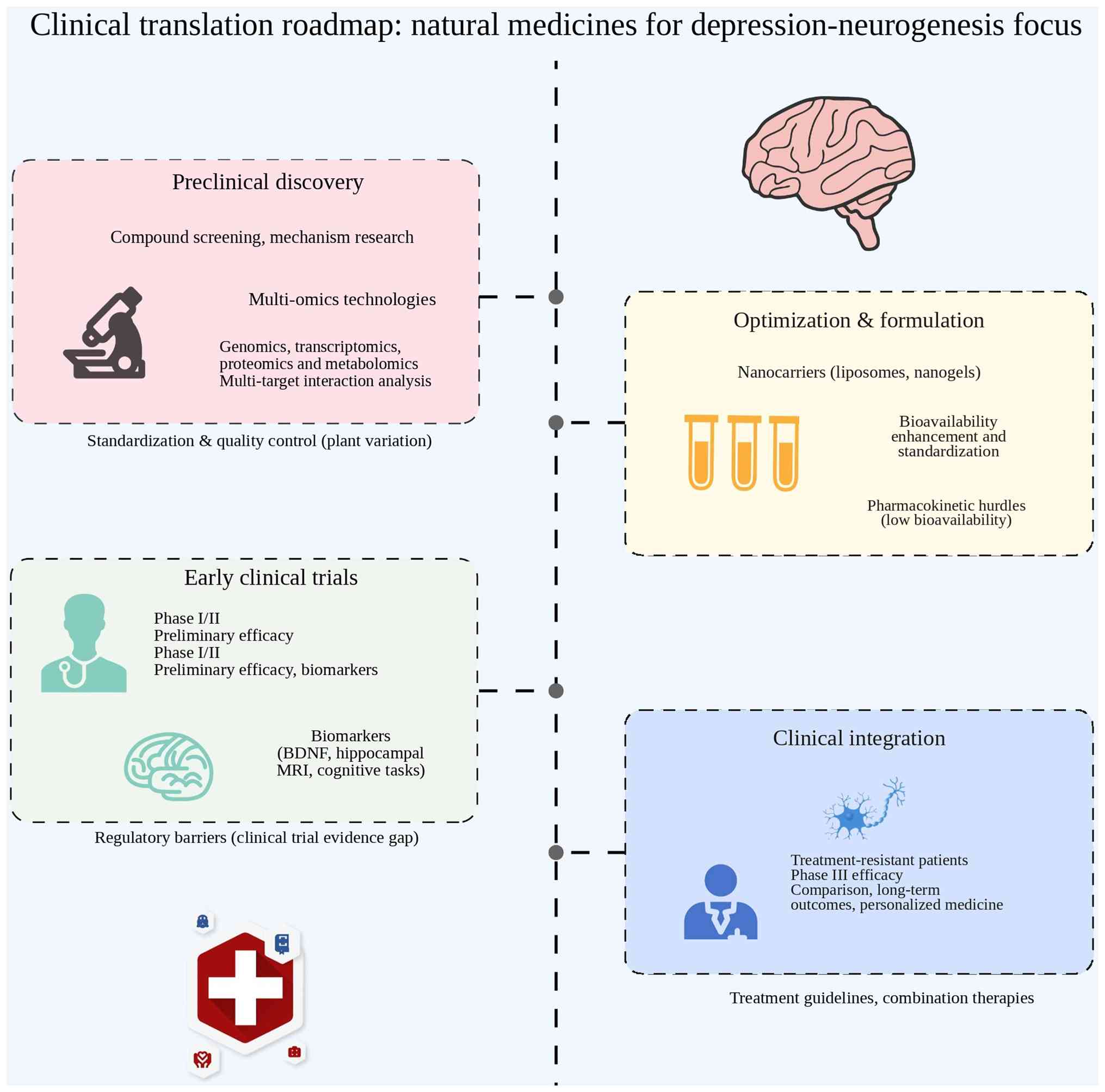
Standardization and quality control
A key obstacle in the clinical application of
natural medicines is the variability in standardization and quality
control. The chemical composition of plant-derived extracts can
differ substantially due to factors such as species variation,
geographical origin, cultivation practices, harvesting times,
processing methods and storage conditions (41,42).
This variability complicates the reproducibility of research
findings, the determination of optimal dosages, and the assurance
of consistent efficacy and safety in clinical use. For complex
traditional formulations such as NHQXW, identifying and quantifying
all active constituents and their synergistic interactions is
particularly difficult (67). Even
individual compounds may present challenges related to purity and
stability. Without rigorous standardization protocols, including
validated analytical methods for active ingredients, broader
clinical implementation of natural medicines will remain limited.
The development of robust analytical techniques, such as nanopore
analysis for the detection of salvianolic acids in herbal products,
is critical to ensure their authenticity and quality (114).
Complex pharmacokinetics and
bioavailability
Numerous natural compounds also suffer from poor
water solubility, low bioavailability and rapid metabolic
degradation, which reduce systemic absorption and limit brain
penetration. These limitations often necessitate high doses,
increasing the risk of off-target effects or toxicity, and may
contribute to inconsistent therapeutic outcomes. The complex
pharmacokinetic properties of natural products, especially in
multi-component formulations, complicate the prediction of
drug-drug interactions and individual patient responses. For
example, although quercetin has considerable therapeutic potential,
its low oral bioavailability requires advanced delivery systems,
such as nanogels, to enhance effectiveness (54). Similarly, in vivo evaluation
of natural medicines using advanced mass spectrometry data
processing is essential for understanding pharmacokinetics and
identifying bioactive constituents (56).
Regulatory hurdles and clinical
evidence gap
Regulatory frameworks for natural medicines
frequently differ from those applied to synthetic pharmaceuticals
and are often less standardized across regions. This inconsistency
contributes to a perception of reduced scientific credibility.
While a number of natural products are marketed as dietary
supplements subject to less rigorous regulatory oversight, claims
regarding their therapeutic efficacy frequently lack confirmation
from robust clinical trials. Therefore, there is a pressing need
for large-scale, carefully designed, placebo-controlled,
biomarker-stratified clinical trials to validate the efficacy,
safety and optimal dosing of natural medicines in the treatment of
depression. At present, much of the research is limited to
preclinical studies or small pilot trials, which, although valuable
for elucidating mechanisms, are insufficient for establishing broad
clinical recommendations. This challenge is further compounded by
the necessity of integrating traditional knowledge with modern
scientific approaches, requiring systematic evaluation of the
safety, efficacy and bioactivity of herbal medicines (38).
Opportunities and future
directions
Advanced delivery systems and nanotechnology
Nanotechnology offers innovative approaches to
overcoming the pharmacokinetic limitations of natural compounds.
The development of NDDS, including liposomes, polymeric
nanoparticles, micelles and exosome-like vesicles, has the
potential to substantially improve the solubility, stability,
bioavailability and targeted delivery of natural medicines to the
central nervous system (47–53).
For example, engineered RVG-BDNF-exosomes and BDNF-quercetin
alginate nanogels have demonstrated enhanced brain delivery and
therapeutic efficacy in preclinical models. Future research should
focus on: i) Developing novel, biocompatible and biodegradable
nanocarriers capable of crossing the BBB and delivering natural
compounds to specific neurogenic regions; ii) designing intelligent
nanocarriers that respond to pathological signals (such as
inflammation and oxidative stress) to achieve targeted and
controlled release; iii) investigating naturally occurring
nanostructures in CHMs, including nanoaggregates and exosome-like
vesicles, to exploit their inherent advantages (49,50);
and iv) exploring graphene-based nanocomposites in neurogenesis and
neuritogenesis, due to their superior electrical conductivity and
biocompatibility, to support nerve tissue engineering and promote
brain cell regeneration (115).
Biomarker-stratified clinical trials
and personalized medicine
To move beyond anecdotal evidence and establish
natural medicines as standard therapeutic options, future clinical
trials must adopt more rigorous and sophisticated designs. This
includes: i) Conducting larger, multicenter, randomized,
double-blind, placebo-controlled trials to definitively assess
efficacy and safety; ii) incorporating biomarkers of neurogenesis
(such as changes in hippocampal volume measured by MRI, blood BDNF
levels and performance on neurogenesis-dependent cognitive tasks)
to objectively evaluate treatment response and mechanistic
involvement in humans; iii) stratifying patients based on genetic
predisposition, inflammatory status, gut microbiome composition or
specific neurogenic deficits to support personalized medicine
approaches and identify subgroups most likely to benefit from
treatment; and iv) assessing the long-term efficacy and safety of
natural medicines, including their potential to prevent relapse and
their effects on overall brain health and cognitive function.
Integration of multi-omics and network
pharmacology
Natural medicines are chemically and biologically
complex and therefore require integrative analytical approaches to
elucidate their mechanisms (2).
Multi-omics technologies, including genomics, transcriptomics,
proteomics and metabolomics, can link compound exposure to gene
expression, protein networks and metabolic pathways (44,45).
These approaches may facilitate the identification of biomarkers
and treatment-responsive subgroups. In addition, network
pharmacology is particularly relevant for multi-component extracts
because it characterizes interactions among compounds, targets and
pathways (34,35,46).
Future studies should emphasize structurally defined analyses and
dynamic quantitative network models to improve the identification
of lead compounds.
Combination therapy and adjunctive
use
Because depression is a multifactorial disorder,
natural medicines are unlikely to serve as universal stand-alone
treatments. Instead, their multi-target properties may support
combination-based therapeutic strategies. Although some natural
compounds have demonstrated acceptable tolerability in available
studies, their safety profiles still require validation through
larger clinical datasets, standardized formulations and careful
monitoring for potential interactions. Potential combination
strategies include: i) Adjunctive use with conventional
antidepressants to enhance treatment response, accelerate onset or
reduce selected adverse effects; ii) integration with psychotherapy
when neuroplasticity-enhancing effects are hypothesized to
facilitate learning and behavioral change; and iii) combination
with lifestyle interventions, such as exercise, mindfulness and
dietary modification, which may converge on BDNF regulation and
neurogenesis (31).
Exploration of new sources and
mechanisms
The biodiversity of natural products remains
incompletely explored. Future investigations should examine marine
organisms, fungi and underutilized medicinal plants as sources of
compounds that modulate neurogenesis. Additional mechanistic
studies are also needed to identify novel therapeutic targets. For
example, ephrin receptors regulate NSC fate and circuit assembly
and may represent druggable targets for natural compounds (97). Similarly, hepcidin deficiency links
iron homeostasis to hippocampal neurogenesis and brain atrophy,
suggesting a potential avenue for the development of
iron-regulating natural products (98).
Conclusions
Over the past decade, research has substantially
advanced understanding of the relationship between hippocampal
neurogenesis and MDD, supporting neurogenesis as an important,
although not exclusive, framework for antidepressant development.
Studies of natural products have identified plant-derived
compounds, traditional formulations and dietary factors that
modulate neurogenesis-related pathways, including BDNF/TrkB
signaling, microglial activity, oxidative stress and the gut-brain
axis. TCM formulations such as NHQXW illustrate the multi-component
potential of natural products, although their clinical relevance
depends on standardization and controlled clinical trials. Emerging
areas, including psilocybin-related neuroplasticity research and
nanocarrier-based delivery systems, further expand the
translational landscape.
Comparative analyses suggest that natural compounds
may complement rather than replace established antidepressant
treatments. Their multi-target pharmacology may simultaneously
influence multiple biological processes associated with depression;
however, evidence regarding clinical efficacy, onset of action and
long-term safety remains less robust than that available for
established therapies. Although some preparations have demonstrated
acceptable tolerability in current studies, broader conclusions
regarding safety require larger and longer-term clinical trials.
Accordingly, standardized natural medicines should be regarded
primarily as adjunctive or investigational approaches until
stronger evidence becomes available.
Several challenges continue to limit broad clinical
translation. Major barriers include inconsistent product
standardization, low or variable bioavailability, complex
pharmacokinetic properties, uncertain drug-drug interactions and
the need for larger biomarker-stratified clinical trials. Future
studies should employ rigorous methodologies, predefined outcome
measures and transparent evidence grading while incorporating
multi-omics and network pharmacology approaches to clarify
mechanisms and identify reliable candidate interventions.
Future research should focus on four priorities: i)
Developing advanced delivery systems that enhance the
bioavailability and brain targeting of neurogenic natural
compounds; ii) conducting large-scale, biomarker-stratified
clinical trials to define efficacy, safety, dosing and responsive
patient subgroups; iii) integrating multi-omics and network
pharmacology approaches to characterize molecular interactions and
synergistic mechanisms; and iv) evaluating rational combination
strategies involving antidepressants, psychotherapy and lifestyle
interventions. Progress in these areas will determine whether
natural medicines can become evidence-based components of
depression treatment.
Acknowledgements
Not applicable.
Funding
Funding: No funding was received.
Availability of data and materials
Not applicable.
Authors' contributions
XZ was involved in conceptualization, investigation
and writing the original draft. JG was involved in
conceptualization and review and editing the manuscript. Data
authentication is not applicable. All authors read and approved the
final version of the manuscript.
Ethics approval and consent to
participate
Not applicable.
Patient consent for publication
Not applicable.
Competing interests
The authors declare that they have no competing
interests.
References
|
1
|
World Health Organization (WHO), .
Depressive disorder (depression) [Internet]. World Health
Organization Geneva; 2025, https://www.who.int/news-room/fact-sheets/detail/depression
|
|
2
|
Cuijpers P, Miguel C, Harrer M, Plessen
CY, Ciharova M, Ebert D and Karyotaki E: Cognitive behavior therapy
vs. control conditions, other psychotherapies, pharmacotherapies
and combined treatment for depression: A comprehensive
meta-analysis including 409 trials with 52,702 patients. World
Psychiatry. 22:105–115. 2023. View Article : Google Scholar : PubMed/NCBI
|
|
3
|
Leal GC, Souza-Marques B, Mello RP,
Bandeira ID, Caliman-Fontes AT, Carneiro BA, Faria-Guimarães D,
Guerreiro-Costa LNF, Jesus-Nunes AP, Silva SS, et al: Arketamine as
adjunctive therapy for treatment-resistant depression: A
placebo-controlled pilot study. J Affect Disord. 330:7–15. 2023.
View Article : Google Scholar : PubMed/NCBI
|
|
4
|
Reddy DS, Mbilinyi RH and Estes E:
Preclinical and clinical pharmacology of brexanolone
(allopregnanolone) for postpartum depression: A landmark journey
from concept to clinic in neurosteroid replacement therapy.
Psychopharmacology (Berl). 240:1841–1863. 2023. View Article : Google Scholar : PubMed/NCBI
|
|
5
|
Toda T, Parylak SL, Linker SB and Gage FH:
The role of adult hippocampal neurogenesis in brain health and
disease. Mol Psychiatry. 24:67–87. 2018. View Article : Google Scholar : PubMed/NCBI
|
|
6
|
Alonso M, Petit AC and Lledo PM: The
impact of adult neurogenesis on affective functions: Of mice and
men. Mol Psychiatry. 29:2527–2542. 2024. View Article : Google Scholar : PubMed/NCBI
|
|
7
|
Gage FH: Adult neurogenesis in the human
dentate Gyrus. Hippocampus. 35:e236552025. View Article : Google Scholar : PubMed/NCBI
|
|
8
|
Wu A and Zhang J: Neuroinflammation,
memory, and depression: New approaches to hippocampal neurogenesis.
J Neuroinflammation. 20:2832023. View Article : Google Scholar : PubMed/NCBI
|
|
9
|
Zhang K, Wang F, Zhai M, He M, Hu Y, Feng
L, Li Y, Yang J and Wu C: Hyperactive neuronal autophagy depletes
BDNF and impairs adult hippocampal neurogenesis in a
corticosterone-induced mouse model of depression. Theranostics.
13:1059–1075. 2023. View Article : Google Scholar : PubMed/NCBI
|
|
10
|
Correia AS, Cardoso A and Vale N:
Oxidative stress in depression: The link with the stress response,
neuroinflammation, serotonin, neurogenesis and synaptic plasticity.
Antioxidants (Basel). 12:4702023. View Article : Google Scholar : PubMed/NCBI
|
|
11
|
Wang Z, Yang K and Sun X: Effect of adult
hippocampal neurogenesis on pattern separation and its
applications. Cogn Neurodyn. 18:1–14. 2024. View Article : Google Scholar
|
|
12
|
Nicolas S, Dohm-Hansen S, Lavelle A,
Bastiaanssen TFS, English JA, Cryan JF and Nolan YM: Exercise
mitigates a gut microbiota-mediated reduction in adult hippocampal
neurogenesis and associated behaviours in rats. Transl Psychiatry.
14:1952024. View Article : Google Scholar : PubMed/NCBI
|
|
13
|
Jung S, Choe S, Woo H, Jeong H, An HK,
Moon H, Ryu HY, Yeo BK, Lee YW, Choi H, et al: Autophagic death of
neural stem cells mediates chronic stress-induced decline of adult
hippocampal neurogenesis and cognitive deficits. Autophagy.
16:512–530. 2020. View Article : Google Scholar : PubMed/NCBI
|
|
14
|
Shin HS, Lee SH, Moon HJ, So YH, Jang HJ,
Lee KH, Ahn C and Jung EM: Prolonged stress response induced by
chronic stress and corticosterone exposure causes adult
neurogenesis inhibition and astrocyte loss in mouse hippocampus.
Brain Res Bull. 208:1109032024. View Article : Google Scholar : PubMed/NCBI
|
|
15
|
Fang S, Wu Z, Guo Y, Zhu W, Wan C, Yuan N,
Chen J, Hao W, Mo X, Guo X, et al: Roles of microglia in adult
hippocampal neurogenesis in depression and their therapeutics.
Front Immunol. 14:11930532023. View Article : Google Scholar : PubMed/NCBI
|
|
16
|
Nikolopoulos D, Manolakou T, Polissidis A,
Filia A, Bertsias G, Koutmani Y and Boumpas DT: Microglia
activation in the presence of intact blood-brain barrier and
disruption of hippocampal neurogenesis via IL-6 and IL-18 mediate
early diffuse neuropsychiatric lupus. Ann Rheum Dis. 82:646–657.
2023. View Article : Google Scholar : PubMed/NCBI
|
|
17
|
Navabi SP, Badreh F, Khombi Shooshtari M,
Hajipour S, Moradi Vastegani S and Khoshnam SE: Microglia-induced
neuroinflammation in hippocampal neurogenesis following traumatic
brain injury. Heliyon. 10:e358692024. View Article : Google Scholar : PubMed/NCBI
|
|
18
|
Abarca-Merlin DM, Martínez-Durán JA,
Medina-Pérez JD, Rodríguez-Santos G and Alvarez-Arellano L: From
immunity to neurogenesis: Toll-like receptors as versatile
regulators in the nervous system. Int J Mol Sci. 25:57112024.
View Article : Google Scholar : PubMed/NCBI
|
|
19
|
Song Y, Jiang W, Afridi SK, Wang T, Zhu F,
Xu H, Nazir FH, Liu C, Wang Y, Long Y, et al: Astrocyte-derived
CHI3L1 signaling impairs neurogenesis and cognition in the
demyelinated hippocampus. Cell Rep. 43:1142262024. View Article : Google Scholar : PubMed/NCBI
|
|
20
|
Simard S, Matosin N and Mechawar N: Adult
hippocampal neurogenesis in the human brain: Updates, challenges,
and perspectives. Neuroscientist. 31:141–158. 2024. View Article : Google Scholar : PubMed/NCBI
|
|
21
|
Coquand L, Brunet Avalos C, Macé AS, Farcy
S, Di Cicco A, Lampic M, Wimmer R, Bessières B, Attie-Bitach T,
Fraisier V, et al: A cell fate decision map reveals abundant direct
neurogenesis bypassing intermediate progenitors in the human
developing neocortex. Nat Cell Biol. 26:698–709. 2024. View Article : Google Scholar : PubMed/NCBI
|
|
22
|
Thor S: Indirect neurogenesis in space and
time. Nat Rev Neurosci. 25:519–534. 2024. View Article : Google Scholar : PubMed/NCBI
|
|
23
|
Birtele M, Del Dosso A, Xu T, Nguyen T,
Wilkinson B, Hosseini N, Nguyen S, Urenda JP, Knight G, Rojas C, et
al: Non-synaptic function of the autism spectrum
disorder-associated gene SYNGAP1 in cortical neurogenesis. Nat
Neurosci. 26:2090–2103. 2023. View Article : Google Scholar : PubMed/NCBI
|
|
24
|
Huilgol D, Levine JM, Galbavy W, Wang BS,
He M, Suryanarayana SM and Huang ZJ: Direct and indirect
neurogenesis generate a mosaic of distinct glutamatergic projection
neuron types in cerebral cortex. Neuron. 111:2557–2569.e4. 2023.
View Article : Google Scholar : PubMed/NCBI
|
|
25
|
Tosoni G, Ayyildiz D, Bryois J, Macnair W,
Fitzsimons CP, Lucassen PJ and Salta E: Mapping human adult
hippocampal neurogenesis with single-cell transcriptomics:
Reconciling controversy or fueling the debate? Neuron.
111:1714–1731.e3. 2023. View Article : Google Scholar : PubMed/NCBI
|
|
26
|
Morizet D, Foucher I, Alunni A and
Bally-Cuif L: Reconstruction of macroglia and adult neurogenesis
evolution through cross-species single-cell transcriptomic
analyses. Nat Commun. 15:33062024. View Article : Google Scholar : PubMed/NCBI
|
|
27
|
Krontira AC, Cruceanu C, Dony L, Kyrousi
C, Link MH, Rek N, Pöhlchen D, Raimundo C, Penner-Goeke S, Schowe
A, et al: Human cortical neurogenesis is altered via
glucocorticoid-mediated regulation of ZBTB16 expression. Neuron.
112:1426–43.e11. 2024. View Article : Google Scholar : PubMed/NCBI
|
|
28
|
Colucci-D'Amato L, Speranza L and
Volpicelli F: Neurotrophic Factor BDNF, physiological functions and
therapeutic potential in depression, neurodegeneration and brain
cancer. Int J Mol Sci. 21:77772020. View Article : Google Scholar : PubMed/NCBI
|
|
29
|
Cavaleri D, Moretti F, Bartoccetti A,
Mauro S, Crocamo C, Carrà G and Bartoli F: The role of BDNF in
major depressive disorder, related clinical features, and
antidepressant treatment: Insight from meta-analyses. Neurosci
Biobehav Rev. 149:1051592023. View Article : Google Scholar : PubMed/NCBI
|
|
30
|
Liu S, Chen L, Guo M, Li Y, Liu Q and
Cheng Y: Targeted delivery of engineered RVG-BDNF-Exosomes: A novel
neurobiological approach for ameliorating depression and regulating
neurogenesis. Research (Wash D C). 7:04022024.PubMed/NCBI
|
|
31
|
Khalil MH: The BDNF-interactive model for
sustainable hippocampal neurogenesis in humans: Synergistic effects
of environmentally-mediated physical activity, cognitive
stimulation, and mindfulness. Int J Mol Sci. 25:129242024.
View Article : Google Scholar : PubMed/NCBI
|
|
32
|
Chaachouay N and Zidane L: Plant-derived
natural products: A source for drug discovery and development.
Drugs Drug Candidates. 3:184–207. 2024. View Article : Google Scholar
|
|
33
|
Gao TL, Guo HH and Jiang JD: Neg-entropy
mechanism as a target for natural medicines. Engineering. 38:11–12.
2024. View Article : Google Scholar
|
|
34
|
Li X, Liu Z, Liao J, Chen Q, Lu X and Fan
X: Network pharmacology approaches for research of traditional
Chinese medicines. Chin J Nat Med. 21:323–332. 2023.PubMed/NCBI
|
|
35
|
Ma S, Hou J, Liu S, Zhu F, Wei P, Feng C
and Chen N: Lead drug discover strategies from natural medicines
based on network pharmacology. Med Res Arch. 11:102023. View Article : Google Scholar : PubMed/NCBI
|
|
36
|
Jiang JD: Editorial for the special issue
on natural medicine. Engineering. 38:12024. View Article : Google Scholar
|
|
37
|
Luo Z, Yin F, Wang X and Kong L: Progress
in approved drugs from natural product resources. Chin J Nat Med.
22:195–211. 2024.PubMed/NCBI
|
|
38
|
Balkrishna A, Sharma N, Srivastava D,
Kukreti A, Srivastava S and Arya V: Exploring the safety, efficacy,
and bioactivity of herbal medicines: Bridging traditional wisdom
and modern science in healthcare. Future Integrative Med. 3:35–49.
2024. View Article : Google Scholar
|
|
39
|
Gaspar A, Garrido EMPJ, Borges F and
Garrido JMPJ: Biological and medicinal properties of natural
chromones and chromanones. ACS Omega. 9:21706–21726. 2024.
View Article : Google Scholar : PubMed/NCBI
|
|
40
|
Li Z, Zhao T, Shi M, Wei Y, Huang X, Shen
J, Zhang X, Xie Z, Huang P, Yuan K, et al: Polyphenols: Natural
food grade biomolecules for treating neurodegenerative diseases
from a multi-target perspective. Front Nutr. 10:11395582023.
View Article : Google Scholar : PubMed/NCBI
|
|
41
|
Tveden-Nyborg P, Yang B, Simonsen U and
Lykkesfeldt J: BCPT perspectives on studies involving natural
products, traditional Chinese medicine and systems pharmacology.
Basic Clin Pharmacol Toxicol. 135:782–785. 2024. View Article : Google Scholar : PubMed/NCBI
|
|
42
|
Salau AK, Shehu MS and Bakare-Odunola MT:
Navigating the challenges of integrating african herbal medicines:
A path to universal acceptance: Herbal medicines. Fount J Nat Appl
Sci. 13:1–14. 2024.
|
|
43
|
Singh S, Rai V, Kanojia A and Yadav A:
Natural products and traditional medicine: Investigating the role
of natural products and traditional medicine in modern
pharmacology. J Res Appl Sci Biotechnol. 3:40–53. 2024. View Article : Google Scholar
|
|
44
|
Zhang W, Zeng Y, Jiao M, Ye C, Li Y, Liu C
and Wang J: Integration of high-throughput omics technologies in
medicinal plant research: The new era of natural drug discovery.
Front Plant Sci. 14:10738482023. View Article : Google Scholar : PubMed/NCBI
|
|
45
|
Chen Z, Zhou J, Zheng X, Xie H and Hao H:
Metabolic insights into gut microbiota in the pharmacology of
natural medicines. Chin J Nat Med. 23:158–168. 2025.PubMed/NCBI
|
|
46
|
Xing X, Sun M, Guo Z, Zhao Y, Cai Y, Zhou
P, Wang H, Gao W, Li P and Yang H: Functional annotation map of
natural compounds in traditional Chinese medicines library: TCMs
with myocardial protection as a case. Acta Pharm Sin B.
13:3802–3816. 2023. View Article : Google Scholar : PubMed/NCBI
|
|
47
|
Herdiana Y: Nanoparticles of natural
product-derived medicines: Beyond the pandemic. Heliyon.
11:e427392025. View Article : Google Scholar : PubMed/NCBI
|
|
48
|
Marimuthu A, Seenivasan R, Pachiyappan JK,
Nizam I and Ganesh GNK: Synergy of science and tradition: A
nanotechnology-driven revolution in natural medicine. Int J Appl
Pharmaceutics. 10–20. 2024. View Article : Google Scholar
|
|
49
|
Zhang YL, Wang YL, Yan K, Deng QQ, Li FZ,
Liang XJ and Hua Q: Nanostructures in Chinese herbal medicines
(CHMs) for potential therapy. Nanoscale Horiz. 8:976–990. 2023.
View Article : Google Scholar : PubMed/NCBI
|
|
50
|
Wang YL, Mu Y, Zhang YL, Luo X, Peng T,
Tan Y, Wang X, Feng L, Chen J and Hua Q: Accessible and effective
nanomedicines: Self-assembly products from Chinese herbal medicines
(CHMs). Adv Funct Materials. 35:24161512024. View Article : Google Scholar
|
|
51
|
Qiu C, Zhang JZ, Wu B, Xu CC, Pang HH, Tu
QC, Lu YQ, Guo QY, Xia F and Wang JG: Advanced application of
nanotechnology in active constituents of Traditional Chinese
Medicines. J Nanobiotechnology. 21:4562023. View Article : Google Scholar : PubMed/NCBI
|
|
52
|
Hu Y, Song J, Feng A, Li J, Li M, Shi Y,
Sun W and Li L: Recent advances in Nanotechnology-Based targeted
delivery systems of active constituents in natural medicines for
cancer treatment. Molecules. 28:77672023. View Article : Google Scholar : PubMed/NCBI
|
|
53
|
Feng X, Jia P and Zhang D: Nanocarrier
drug delivery system: Promising platform for targeted depression
therapy. Front Pharmacol. 15:14351332024. View Article : Google Scholar : PubMed/NCBI
|
|
54
|
Xu D, Gao LN, Song XJ, Dong QW, Chen YB,
Cui YL and Wang Q: Enhanced antidepressant effects of
BDNF-quercetin alginate nanogels for depression therapy. J
Nanobiotechnology. 21:3792023. View Article : Google Scholar : PubMed/NCBI
|
|
55
|
Zhu TT, Wang H, Gu HW, Ju LS, Wu XM, Pan
WT, Zhao MM, Yang JJ and Liu PM: Melanin-like polydopamine
nanoparticles mediating anti-inflammatory and rescuing synaptic
loss for inflammatory depression therapy. J Nanobiotechnology.
21:522023. View Article : Google Scholar : PubMed/NCBI
|
|
56
|
Chen S, Dai B, Zhang D, Yang Y, Zhang H,
Zhang J, Lu D and Wu C: Advances in intelligent mass spectrometry
data processing technology for in vivo analysis of natural
medicines. Chin J Nat Med. 22:900–913. 2024.PubMed/NCBI
|
|
57
|
Chen H, Dong M, He H, Piao X, Han X, Li R,
Jiang H, Li X, Li B and Cui R: Ginsenoside re prevents
depression-like behaviors via inhibition of inflammation, oxidative
stress, and activating BDNF/TrkB/ERK/CREB signaling: An in vivo and
in vitro study. J Agric Food Chem. 72:19838–19851. 2024. View Article : Google Scholar : PubMed/NCBI
|
|
58
|
Lu R, Zhang L, Wang H, Li M, Feng W and
Zheng X: Echinacoside exerts antidepressant-like effects through
enhancing BDNF-CREB pathway and inhibiting neuroinflammation via
regulating microglia M1/M2 polarization and JAK1/STAT3 pathway.
Front Pharmacol. 13:9934832023. View Article : Google Scholar : PubMed/NCBI
|
|
59
|
Yang Z, Zhao Y, Wang Y, Liu X, Jiang Y,
Jiang Y, Liu T, Hu Y and Chang H: Echinacoside ameliorates
post-stroke depression by activating BDNF signaling through
modulation of Nrf2 acetylation. Phytomedicine. 128:1554332024.
View Article : Google Scholar : PubMed/NCBI
|
|
60
|
Lou S, Gong D, Yang M, Qiu Q, Luo J and
Chen T: Curcumin improves neurogenesis in Alzheimer's disease mice
via the upregulation of Wnt/β-catenin and BDNF. Int J Mol Sci.
25:51232024. View Article : Google Scholar : PubMed/NCBI
|
|
61
|
Li C, Liu B, Xu J, Jing B, Guo L, Wang L,
Wang M, Zhang H, He Q, Yu X, et al: Phloretin decreases
microglia-mediated synaptic engulfment to prevent chronic mild
stress-induced depression-like behaviors in the mPFC. Theranostics.
13:955–972. 2023. View Article : Google Scholar : PubMed/NCBI
|
|
62
|
Abdelkawy YS, Elharoun M, Sheta E,
Abdel-Raheem IT and Nematalla HA: Liraglutide and Naringenin
relieve depressive symptoms in mice by enhancing Neurogenesis and
reducing inflammation. Eur J Pharmacol. 971:1765252024. View Article : Google Scholar : PubMed/NCBI
|
|
63
|
Li RL, Wang LY, Duan HX, Qian D, Zhang Q,
He LS and Li XP: Natural flavonoids derived from herbal medicines
are potential anti-atherogenic agents by inhibiting oxidative
stress in endothelial cells. Front Pharmacol. 14:11411802023.
View Article : Google Scholar : PubMed/NCBI
|
|
64
|
Lai W, Luo R, Tang Y, Yu Z, Zhou B, Yang
Z, Brown J and Hong G: Salidroside directly activates HSC70,
revealing a new role for HSC70 in BDNF signalling and neurogenesis
after cerebral ischemia. Phytother Res. 38:2619–2640. 2024.
View Article : Google Scholar : PubMed/NCBI
|
|
65
|
Zhang MF, Wang JH, Sun S, Xu YT, Wan D,
Feng S, Tian Z and Zhu HF: Catalpol attenuates ischemic stroke by
promoting neurogenesis and angiogenesis via the SDF-1α/CXCR4
pathway. Phytomedicine. 128:1553622024. View Article : Google Scholar : PubMed/NCBI
|
|
66
|
Ding Y, He J, Kong F, Sun D, Chen W, Luo
B, Wu J, Zhang S, Zhan P and Peng C: Gallic acid alleviates
cognitive impairment by promoting neurogenesis via the GSK3β-Nrf2
signaling pathway in an APP/PS1 mouse model. J Alzheimers Dis Rep.
8:461–477. 2024. View Article : Google Scholar : PubMed/NCBI
|
|
67
|
Du Q, Gao C, Tsoi B, Wu M and Shen J:
Niuhuang Qingxin Wan ameliorates depressive-like behaviors and
improves hippocampal neurogenesis through modulating TrkB/ERK/CREB
signaling pathway in chronic restraint stress or corticosterone
challenge mice. Front Pharmacol. 14:12743432024. View Article : Google Scholar : PubMed/NCBI
|
|
68
|
Yao M, Oduro PK, Akintibu AM and Yan H:
Modulation of the vitamin D receptor by traditional Chinese
medicines and bioactive compounds: Potential therapeutic
applications in VDR-dependent diseases. Front Pharmacol.
15:12981812024. View Article : Google Scholar : PubMed/NCBI
|
|
69
|
Melgar-Locatelli S, Mañas-Padilla MC,
Castro-Zavala A, Rivera P, Carmen Razola-Díaz M, Monje FJ,
Rodríguez-Pérez C and Castilla-Ortega E: Diet enriched with
high-phenolic cocoa potentiates hippocampal brain-derived
neurotrophic factor expression and neurogenesis in healthy adult
mice with subtle effects on memory. Food Funct. 15:8310–8329. 2024.
View Article : Google Scholar : PubMed/NCBI
|
|
70
|
Medoro A, Davinelli S, Milella L, Willcox
B, Allsopp R, Scapagnini G and Willcox D: Dietary astaxanthin: A
promising antioxidant and anti-inflammatory agent for brain aging
and adult neurogenesis. Mar Drugs. 21:6432023. View Article : Google Scholar : PubMed/NCBI
|
|
71
|
Du Preez A, Lefèvre-Arbogast S,
González-Domínguez R, Houghton V, Lucia C, Lee H, Low DY, Helmer C,
Féart C, Delcourt C, et al: Association of dietary and nutritional
factors with cognitive decline, dementia, and depressive
symptomatology in older individuals according to a
neurogenesis-centred biological susceptibility to brain ageing. Age
Ageing. 53 (Suppl_2):ii47–ii59. 2024. View Article : Google Scholar : PubMed/NCBI
|
|
72
|
Korkmaz ND, Cikrikcili U, Akan M and
Yucesan E: Psychedelic therapy in depression and substance use
disorders. Eur J Neurosci. 60:4063–4077. 2024. View Article : Google Scholar : PubMed/NCBI
|
|
73
|
Agrawal M, Emanuel E, Richards B, Richards
W, Roddy K and Thambi P: Assessment of psilocybin therapy for
patients with cancer and major depression disorder. JAMA Oncol.
9:8642023. View Article : Google Scholar : PubMed/NCBI
|
|
74
|
Sloshower J, Zeifman RJ, Guss J, Krause R,
Safi-Aghdam H, Pathania S, Pittman B and D'Souza DC: Psychological
flexibility as a mechanism of change in psilocybin-assisted therapy
for major depression: Results from an exploratory
placebo-controlled trial. Sci Rep. 14:88332024. View Article : Google Scholar : PubMed/NCBI
|
|
75
|
Back AL, Freeman-Young TK, Morgan L, Sethi
T, Baker KK, Myers S, McGregor BA, Harvey K, Tai M, Kollefrath A,
et al: Psilocybin therapy for clinicians with symptoms of
depression from frontline care during the COVID-19 pandemic: A
randomized clinical trial. JAMA Network Open. 7:e24490262024.
View Article : Google Scholar : PubMed/NCBI
|
|
76
|
Erritzoe D, Barba T, Spriggs MJ, Rosas FE,
Nutt DJ and Carhart-Harris R: Effects of discontinuation of
serotonergic antidepressants prior to psilocybin therapy versus
escitalopram for major depression. J Psychopharmacol. 38:458–470.
2024. View Article : Google Scholar : PubMed/NCBI
|
|
77
|
Weiss B, Ginige I, Shannon L, Giribaldi B,
Murphy-Beiner A, Murphy R, Baker-Jones M, Martell J, Nutt DJ,
Carhart-Harris RL and Erritzoe D: Personality change in a trial of
psilocybin therapy v. escitalopram treatment for depression.
Psychol Med. 54:178–192. 2023. View Article : Google Scholar : PubMed/NCBI
|
|
78
|
Leiter O, Brici D, Fletcher SJ, Yong XLH,
Widagdo J, Matigian N, Schroer AB, Bieri G, Blackmore DG, Bartlett
PF, et al: Platelet-derived exerkine CXCL4/platelet factor 4
rejuvenates hippocampal neurogenesis and restores cognitive
function in aged mice. Nat Commun. 14:43752023. View Article : Google Scholar : PubMed/NCBI
|
|
79
|
Fallahi S, Zangbar HS, Farajdokht F,
Rahbarghazi R, Ghiasi F and Mohaddes G: Mesenchymal stem
cell-derived exosomes improve neurogenesis and cognitive function
of mice with methamphetamine addiction: A novel treatment approach.
CNS Neurosci Ther. 30:e147192024. View Article : Google Scholar : PubMed/NCBI
|
|
80
|
Zhang H, Xie XH, Xu SX, Wang C, Sun S,
Song X, Li R, Li N, Feng Y, Duan H, et al: Oligodendrocyte-derived
exosomes-containing SIRT2 ameliorates depressive-like behaviors and
restores hippocampal neurogenesis and synaptic plasticity via the
AKT/GSK-3β pathway in depressed mice. CNS Neurosci Ther.
30:e146612024. View Article : Google Scholar : PubMed/NCBI
|
|
81
|
Hu Y, Zhao M, Wang H, Guo Y, Cheng X, Zhao
T, Wang H, Zhang Y, Ma Y and Tao W: Exosome-sheathed ROS-responsive
nanogel to improve targeted therapy in perimenopausal depression. J
Nanobiotechnology. 21:2612023. View Article : Google Scholar : PubMed/NCBI
|
|
82
|
Zheng H, Yang Z, Zhou L, Zhang B, Cheng R
and Zhang Q: Bioactive Nb2C MXene-Functionalized hydrogel with
microenvironment remodeling and enhanced neurogenesis to promote
skeletal muscle regeneration and functional restoration. Small.
20:e23104832024. View Article : Google Scholar : PubMed/NCBI
|
|
83
|
Hong J, Zhu Z, Wang Z, Li J, Liu Z, Tan R,
Hao Y and Cheng G: Annular conductive Hydrogel-Mediated wireless
electrical stimulation for augmenting neurogenesis. Adv Healthc
Mater. 13:e24006242024. View Article : Google Scholar : PubMed/NCBI
|
|
84
|
Liu J, Yan R, Wang B, Chen S, Hong H, Liu
C and Chen X: Decellularized extracellular matrix enriched with
GDNF enhances neurogenesis and remyelination for improved motor
recovery after spinal cord injury. Acta Biomater. 180:308–322.
2024. View Article : Google Scholar : PubMed/NCBI
|
|
85
|
Liu C, Liu K, Zhang D, Liu Y, Yu Y, Kang
H, Dong X, Dai H and Yu A: Dual-layer microneedles with NO/O2
releasing for diabetic wound healing via neurogenesis,
angiogenesis, and immune modulation. Bioact Mater. 46:213–228.
2025.PubMed/NCBI
|
|
86
|
Li L, Wang L and Zhang L: Therapeutic
potential of natural compounds from herbs and nutraceuticals in
alleviating neurological disorders: Targeting the wnt signaling
pathway. J Agric Food Chem. 72:2411–2433. 2024. View Article : Google Scholar : PubMed/NCBI
|
|
87
|
El-Kadi RA, AbdelKader NF, Zaki HF and
Kamel AS: Vilazodone alleviates Neurogenesis-induced anxiety in the
chronic unpredictable mild stress female rat model: Role of
Wnt/β-catenin signaling. Mol Neurobiol. 61:9060–9077. 2024.
View Article : Google Scholar : PubMed/NCBI
|
|
88
|
Li ZY, Yang X, Wang JK, Yan XX, Liu F and
Zuo YC: MFGE8 promotes adult hippocampal neurogenesis in rats
following experimental subarachnoid hemorrhage via modifying the
integrin β3/Akt signaling pathway. Cell Death Discov. 10:3592024.
View Article : Google Scholar : PubMed/NCBI
|
|
89
|
Kong X, Lyu W, Lin X, Lin C, Feng H, Xu L,
Shan K, Wei P and Li J: Itaconate alleviates
anesthesia/surgery-induced cognitive impairment by activating a
Nrf2-dependent anti-neuroinflammation and neurogenesis via
gut-brain axis. J Neuroinflammation. 21:1042024. View Article : Google Scholar : PubMed/NCBI
|
|
90
|
Wu Z, Zhang T, Ma X, Guo S, Zhou Q, Zahoor
A and Deng G: Recent advances in anti-inflammatory active
components and action mechanisms of natural medicines.
Inflammopharmacology. 31:2901–2937. 2023. View Article : Google Scholar : PubMed/NCBI
|
|
91
|
Xu H, Tian X, Wang Y, Lin J, Zhu B, Zhao
C, Wang B, Zhang X, Sun Y, Li N, et al: Exercise promotes
hippocampal neurogenesis in T2DM Mice via
Irisin/TLR4/MyD88/NF-κB-Mediated neuroinflammation pathway. Biology
(Basel). 13:8092024.PubMed/NCBI
|
|
92
|
Wang G, Cao L, Li S, Zhang M, Li Y, Duan
J, Li Y, Hu Z, Wu J, Li T, et al: Corticosterone impairs
hippocampal neurogenesis and behaviors through p21-Mediated ROS
Accumulation. Biomolecules. 14:2682024. View Article : Google Scholar : PubMed/NCBI
|
|
93
|
Zhao A, Xu W, Han R, Wei J, Yu Q, Wang M,
Li H, Li M and Chi G: Role of histone modifications in neurogenesis
and neurodegenerative disease development. Ageing Res Rev.
98:1023242024. View Article : Google Scholar : PubMed/NCBI
|
|
94
|
He H, Zhao Z, Xiao C, Li L, Liu YE, Fu J,
Liao H, Zhou T and Zhang J: Gut microbiome promotes mice recovery
from stress-induced depression by rescuing hippocampal
neurogenesis. Neurobiol Dis. 191:1063962024. View Article : Google Scholar : PubMed/NCBI
|
|
95
|
Halvorson CS, Sánchez-Lafuente CL,
Johnston JN, Kalynchuk LE and Caruncho HJ: Molecular mechanisms of
reelin in the enteric nervous system and the Microbiota-gut-brain
axis: Implications for depression and antidepressant therapy. Int J
Mol Sci. 25:8142024. View Article : Google Scholar : PubMed/NCBI
|
|
96
|
Lampada A and Taylor V: Notch signaling as
a master regulator of adult neurogenesis. Front Neurosci.
17:11790112023. View Article : Google Scholar : PubMed/NCBI
|
|
97
|
Rasool D and Jahani-Asl A: Master
regulators of neurogenesis: The dynamic roles of Ephrin receptors
across diverse cellular niches. Transl Psychiatry. 14:462024.
View Article : Google Scholar : PubMed/NCBI
|
|
98
|
Bai X, Wang B, Cui Y, Tian S, Zhang Y, You
L, Chang YZ and Gao G: Hepcidin deficiency impairs hippocampal
neurogenesis and mediates brain atrophy and memory decline in mice.
J Neuroinflammation. 21:152024. View Article : Google Scholar : PubMed/NCBI
|
|
99
|
Deng ZD, Robins PL, Regenold W, Rohde P,
Dannhauer M and Lisanby SH: How electroconvulsive therapy works in
the treatment of depression: Is it the seizure, the electricity, or
both? Neuropsychopharmacology. 49:150–162. 2024. View Article : Google Scholar : PubMed/NCBI
|
|
100
|
Abe Y, Yokoyama K, Kato T, Yagishita S,
Tanaka KF and Takamiya A: Neurogenesis-independent mechanisms of
MRI-detectable hippocampal volume increase following
electroconvulsive stimulation. Neuropsychopharmacology.
49:1236–1245. 2024. View Article : Google Scholar : PubMed/NCBI
|
|
101
|
Xu SX, Xie XH, Yao L, Wang W, Zhang H,
Chen MM, Sun S, Nie ZW, Nagy C and Liu Z: Human in vivo evidence of
reduced astrocyte activation and neuroinflammation in patients with
treatment-resistant depression following electroconvulsive therapy.
Psychiatry Clin Neurosci. 77:653–664. 2023. View Article : Google Scholar : PubMed/NCBI
|
|
102
|
Kopf-Beck J, Müller CL, Tamm J, Fietz J,
Rek N, Just L, Spock ZI, Weweck K, Takano K, Rein M, et al:
Effectiveness of schema therapy versus cognitive behavioral therapy
versus supportive therapy for depression in inpatient and day
clinic settings: A randomized clinical trial. Psychother Psychosom.
93:24–35. 2024. View Article : Google Scholar : PubMed/NCBI
|
|
103
|
Krakau L, Ernst M, Hautzinger M, Beutel ME
and Leuzinger-Bohleber M: Childhood trauma and differential
response to long-term psychoanalytic versus cognitive-behavioural
therapy for chronic depression in adults. Br J Psychiatry.
225:446–453. 2024. View Article : Google Scholar : PubMed/NCBI
|
|
104
|
Hankin BL, Demers CH, Hennessey E-MP,
Perzow SED, Curran MC, Gallop RJ, Hoffman MC and Davis EP: Effect
of brief interpersonal therapy on depression during pregnancy: A
randomized clinical trial. JAMA Psychiatry. 80:5392023. View Article : Google Scholar : PubMed/NCBI
|
|
105
|
Verhoeven JE, Han LKM, Milligen BA, Hu MX,
Révész D, Hoogendoorn AW, Batelaan NM, Schaik DJF, Balkom AJLM, van
Oppen P and Penninx BWJH: Antidepressants or running therapy:
Comparing effects on mental and physical health in patients with
depression and anxiety disorders. J Affect Disord. 329:19–29. 2023.
View Article : Google Scholar : PubMed/NCBI
|
|
106
|
Alizadeh Pahlavani H: Possible role of
exercise therapy on depression: Effector neurotransmitters as key
players. Behav Brain Res. 459:1147912024. View Article : Google Scholar : PubMed/NCBI
|
|
107
|
Li T and Gal D: Consumers prefer natural
medicines more when treating psychological than physical
conditions. J Consumer Psychol. 34:425–444. 2023. View Article : Google Scholar
|
|
108
|
Kaurani L, Besse M, Methfessel I, Methi A,
Zhou J, Pradhan R, Burkhardt S, Kranaster L, Sartorius A, Habel U,
et al: Baseline levels of miR-223-3p correlate with the
effectiveness of electroconvulsive therapy in patients with major
depression. Transl Psychiatry. 13:2942023. View Article : Google Scholar : PubMed/NCBI
|
|
109
|
Benjet C, Zainal NH, Albor Y,
Alvis-Barranco L, Carrasco-Tapias N, Contreras-Ibáñez CC,
Cudris-Torres L, Peña FR, González N, Guerrero-López JB, et al: A
precision treatment model for Internet-delivered cognitive
behavioral therapy for anxiety and depression among university
students: A secondary analysis of a randomized clinical trial. JAMA
Psychiatry. 80:7682023. View Article : Google Scholar : PubMed/NCBI
|
|
110
|
Wilhelm S, Bernstein EE, Bentley KH,
Snorrason I, Hoeppner SS, Klare D, Greenberg JL, Weingarden H,
McCoy TH and Harrison O: Feasibility, acceptability, and
preliminary efficacy of a smartphone App-Led cognitive behavioral
therapy for depression under therapist supervision: Open trial.
JMIR Ment Health. 11:e539982024. View
Article : Google Scholar : PubMed/NCBI
|
|
111
|
Watkins E, Newbold A, Tester-Jones M,
Collins LM and Mostazir M: Investigation of active ingredients
within Internet-Delivered cognitive behavioral therapy for
depression: A randomized optimization trial. JAMA Psychiatry.
80:942–951. 2023. View Article : Google Scholar : PubMed/NCBI
|
|
112
|
Schramm E, Elsaesser M, Jenkner C,
Hautzinger M and Herpertz SC: Algorithm-based modular psychotherapy
vs. Cognitive-behavioral therapy for patients with depression,
psychiatric comorbidities and early trauma: A proof-of-concept
randomized controlled trial. World Psychiatry. 23:257–266. 2024.
View Article : Google Scholar : PubMed/NCBI
|
|
113
|
Chen G, Chen P, Yang Z, Ma W, Yan H, Su T,
Zhang Y, Qi Z, Fang W, Jiang L, et al: Increased functional
connectivity between the midbrain and frontal cortex following
bright light therapy in subthreshold depression: A randomized
clinical trial. Am Psychol. 79:437–450. 2024. View Article : Google Scholar : PubMed/NCBI
|
|
114
|
Fan P, Zhang S, Wang Y, Li T, Zhang H,
Zhang P and Huang S: Nanopore analysis of salvianolic acids in
herbal medicines. Nat Commun. 15:19702024. View Article : Google Scholar : PubMed/NCBI
|
|
115
|
Raghavan A and Ghosh S: Influence of
Graphene-based nanocomposites in neurogenesis and neuritogenesis: A
brief summary. ACS Appl Bio Mater. 7:711–726. 2024. View Article : Google Scholar : PubMed/NCBI
|