Introduction
Cancer remains a major global health challenge, with
conventional chemotherapy still limited by poor selectivity,
systemic toxicity and unpredictable therapeutic outcomes (1–4).
These limitations have driven the development of advanced drug
delivery systems (DDSs) that increase intratumoural drug
accumulation while reducing off-target toxicity (5,6).
Nanotechnology has played a key role in improving DDSs by enabling
controlled drug release and improved pharmacokinetics. Various
nanocarriers, including liposomes (7,8),
polymeric nanoparticles (9–11)
and inorganic nanomaterials (12,13),
have been explored for cancer therapy. However, these systems
frequently suffer from limited drug loading, instability in
biological environments or complex manufacturing processes. An
effective DDS should integrate favourable pharmacokinetic
properties, efficient tumour targeting and the capability to
achieve spatiotemporally controlled and site-specific drug release
within pathological microenvironments (14–18).
Such coordinated regulation is crucial for enhancing therapeutic
efficacy, minimising systemic side effects and supporting precision
cancer therapy (19).
Graphene, a representative two-dimensional
sp2-hybridised carbon nanomaterial, has attracted
extensive attention owing to its unique crystal structure and
exceptional physicochemical properties (20–24).
Besides its established applications in nanoelectronics, energy
storage and catalysis, graphene and its derivatives are being
increasingly investigated for biomedical applications (25–34),
including biosensing (27–29), bioimaging (30,31),
drug and gene delivery (32),
cancer therapy (33) and tissue
engineering (34). For drug
delivery applications, graphene-based nanomaterials exhibit
distinct advantages, making them promising nanocarrier candidates.
In particular, their ultrahigh specific surface area (up to ~2,630
m2/g) endows a high loading capacity for various
therapeutic agents, including small-molecule drugs, nucleic acids
and proteins. For instance, Qian et al (35) developed a hyaluronic acid
(HA)-functionalised graphene oxide (GO) nanocarrier via
nano-functionalisation and nucleic acid co-assembly, leading to
MDR1 gene silencing and microRNA (miRNA/miR)-489-mediated
epithelial-mesenchymal transition inhibition, which considerably
reduced the half-maximal inhibitory concentration of doxorubicin
(DOX) to 5.61 µg/ml and markedly increased its cytotoxicity against
drug-resistant MCF-7/ADM breast cancer cells. The extended
π-conjugated framework of graphene-based nanomaterials facilitates
efficient non-covalent loading of therapeutic compounds while
preserving their structural and functional integrity. Furthermore,
the abundant surface functional groups of these nanomaterials
enable precise chemical modification through the attachment of
targeting ligands and stimuli-responsive moieties, thereby
improving specificity and control in drug delivery. Beyond GO,
other graphene-derived nanostructures, such as graphene nanoribbons
(36,37) and graphene quantum dots (38,39),
exhibit size-dependent properties and greater functional
tunability, expanding the material basis for graphene-based
delivery systems.
Although graphene and its derivatives offer major
advantages in drug delivery, notable challenges hinder their
practical use in biomedical settings (40–42).
First, graphene-based nanomaterials tend to aggregate in
physiological microenvironments, reducing their dispersion
stability and thereby limiting their in vivo circulation and
tumour accumulation efficiency. Second, questions regarding their
biotoxicity and long-term biosafety persist. High doses or
prolonged exposure may result in oxidative stress, cell membrane
damage and adverse immune responses. Additionally, the poor
biodegradability of graphene-based nanomaterials raises concerns
about long-term accumulation in the body, which could limit their
clinical applicability (43–45).
To address the aforementioned challenges,
substantial efforts have recently been devoted to optimising
graphene--based delivery systems through surface functionalisation,
composite development, stimuli-responsive design and
biocompatibility improvement. Salimi and Mohammadi-Manesh (46) prepared
Fe3O4/TiO2/GO nanocomposites via
thermal treatment for curcumin delivery. Compared with the GO-free
nanocomposite, the GO-containing nanocomposite exhibited superior
pH-dependent drug adsorption and release, increased cancer cell
cytotoxicity and negligible haemolytic toxicity, demonstrating that
GO surface chemistry and composite architecture directly influence
drug release kinetics and biological performance. Dilpreet and
Mandavi (47) introduced hybrid
nanophotonic graphene systems as externally controllable
transdermal drug delivery platforms. In these systems, the
photothermal effects of graphene, combined with its electrical and
thermal conductivity, enhance skin permeability and enable
controlled drug transport. These advancements indicate that
graphene-based systems are shifting from passive drug reservoirs to
interface-driven, stimuli-responsive and spatiotemporally
controlled delivery platforms. However, this progress is also
associated with unresolved issues related to reproducible
fabrication, controlled release, long-term biocompatibility and
clinical applicability (48,49).
Furthermore, the aforementioned challenges become
more pronounced when graphene-based materials are incorporated into
complex biological systems. Grecca et al (50) reviewed GO-integrated
three-dimensional printed systems combined with mesenchymal stem
cells for drug delivery and tissue regeneration, showing that GO
can improve cell adhesion, proliferation and osteogenic
differentiation. However, substantial uncertainties remain
regarding the mechanisms and safety of GO-based therapies. These
findings indicate that current research is limited by an incomplete
understanding of the structure-surface chemistry-drug release
relationship, the behaviour of graphene-based nanomaterials in
complex in vivo microenvironments, and the connections among
physicochemical design, biological outcomes, biosafety and clinical
translation. Furthermore, the mechanisms through which various
surface functionalisation strategies influence drug loading
efficiency (51,52), spatiotemporally controlled release
and biocompatibility remain inadequately understood. Concurrently,
approaches that enable synergistic responses to multiple tumour
microenvironmental signals (such as pH gradients, intracellular
redox states and tumour-specific enzymatic activity) are still in
early development and require further research to realise their
full potential in cancer therapy.
For the present review, a literature search was
conducted to identify representative studies on graphene-based
nanocarriers for tumour drug delivery. Relevant publications were
retrieved from major scientific databases, including Web of Science
(https://www.webofscience.com/, Web of
Science Core Collection, continuously updated online. Literature
search was performed in September 2026.) and Scopus (URL:
https://www.scopus.com/, Scopus continuously
updated online. Literature search was performed in September
2026.), using combinations of key words such as ‘graphene oxide’,
‘functionalisation’, ‘nanocarrier’, ‘drug delivery’, ‘nanocarriers’
and ‘stimuli-responsive release’. Studies published between 2015
and 2026 were considered.
Building on this background, the present review
provides a mechanism-focused analysis of graphene-based
nanocarriers for tumour drug delivery. Unlike numerous reviews that
predominantly summarise material synthesis, surface
functionalisation or biomedical applications (53–55),
the present review emphasises how structural features and
interfacial chemistry influence drug-carrier interactions, loading
and release behaviour, biological responses and translational
performance. Graphene, GO and reduced GO (rGO) are discussed by
linking their physicochemical properties and functionalisation
abilities with tumour-targeting efficiency, stimuli-responsive
delivery, biosafety, biodegradation and in vivo fate.
Particular attention is devoted to unresolved translational
challenges, including long-term safety, limited biodegradability,
uncertain clearance pathways and the absence of standardised
evaluation frameworks. By integrating insights regarding material
design, delivery mechanisms, biological effects and clinical
constraints, the present review aims to establish a rational
framework for developing safer, more predictable and clinically
viable graphene-based nanomedicine platforms for precision cancer
therapy.
Synthesis of graphene and its
derivatives
Synthesis of graphene
Graphene can be synthesised using various
approaches, broadly categorised as top-down (56,57)
and bottom-up (58,59) strategies. These methods
considerably differ in terms of structural quality, defect density,
scalability and surface chemistry, all of which influence the
physicochemical properties and biomedical performance of
graphene-based nanomaterials.
Top-down approaches
Top-down approaches involve exfoliating graphite
into graphene layers by overcoming the weak van der Waals
interactions between stacked sheets. This is a key method for
synthesising graphene, offering advantages of simplicity and low
cost (56,60). It mainly includes liquid-phase
exfoliation, mechanical exfoliation, solid-phase exfoliation,
electrochemical exfoliation, chemical oxidation-reduction, the
arc-discharge method and unzipping of carbon nanotubes, which
produce thin-layer nanomaterials by exfoliating or etching bulk
layered precursors. Among these approaches, mechanical exfoliation
is the earliest and most fundamental technique for isolating
graphene; it uses physical forces to exfoliate graphite layers,
producing single- or few-layer graphene sheets from bulk graphite.
This method typically yields graphene with near-perfect
crystallinity, minimal defect density and well-preserved intrinsic
properties, making it highly suitable for fundamental
investigations of the physicochemical and electronic
characteristics of graphene. However, its practical application is
constrained by extremely low yield, limited scalability and poor
control over layer count (61).
Consequently, it is mainly used in laboratory research and is not
suitable for large-scale production or biomedical applications.
Liquid-phase exfoliation has become a more scalable
alternative. In this approach, graphite is dispersed in organic
solvents, surfactant solutions or ionic liquids and then exfoliated
through ultrasonication or shear mixing. The choice of solvent is
vital for stabilising exfoliated graphene sheets by matching their
surface energy. Although this technique allows for large-scale
production, the resulting graphene often shows a broad range in
lateral size and thickness and contains structural defects caused
by sonication (62). Another
effective top-down technique is electrochemical exfoliation,
wherein graphite electrodes are subjected to an applied voltage in
an electrolyte solution, leading to intercalation and exfoliation.
This method provides benefits such as higher yield, faster
processing and tuneable surface functionalisation. However, it can
also introduce defects and oxygen-containing groups that may modify
the intrinsic properties of graphene (63).
Bottom-up approaches
Bottom-up synthesis constructs graphene from
molecular precursors (64–66), with chemical vapour deposition
(CVD) being the most common technique used for high-quality
graphene film production (67–69).
In CVD, carbon-containing gases, including methane, are decomposed
at high temperatures on catalytic metal substrates, such as copper
or nickel, resulting in graphene layer formation. CVD-produced
graphene offers robust crystallinity, uniform thickness and low
defect levels, making it suitable for electronic and optical
applications. For example, Niu et al (70) fabricated transferred CVD-grown
graphene islands on copper foils using atmospheric-pressure CVD,
followed by polymethyl methacrylate-assisted wet transfer onto
SiO2/Si and post-annealing in H2/Ar,
resulting in more uniform strain and carrier density on copper
single crystals. However, the high temperatures, complex transfer
process and high production costs hinder its scalability for
biomedical purposes. Other bottom-up approaches include epitaxial
growth on silicon carbide (SiC) substrates and molecular
self-assembly, where high-temperature decomposition of SiC forms
graphene layers on its surface. Although this method yields
high-quality graphene, it requires stringent conditions and
expensive substrates (71).
Synthesis of graphene derivatives
GO and rGO are essential functionalised graphene
derivatives that have garnered intensive research interest in drug
delivery. Compared with pristine graphene, these nanomaterials
offer superior dispersibility and abundant surface functional
moieties. Their inherent structural and compositional advantages
support their use in efficient DDSs, allowing for adjustable
biocompatibility, controlled release and high drug payloads, all
aimed at targeted therapy in complex biological
microenvironments.
Synthesis of GO
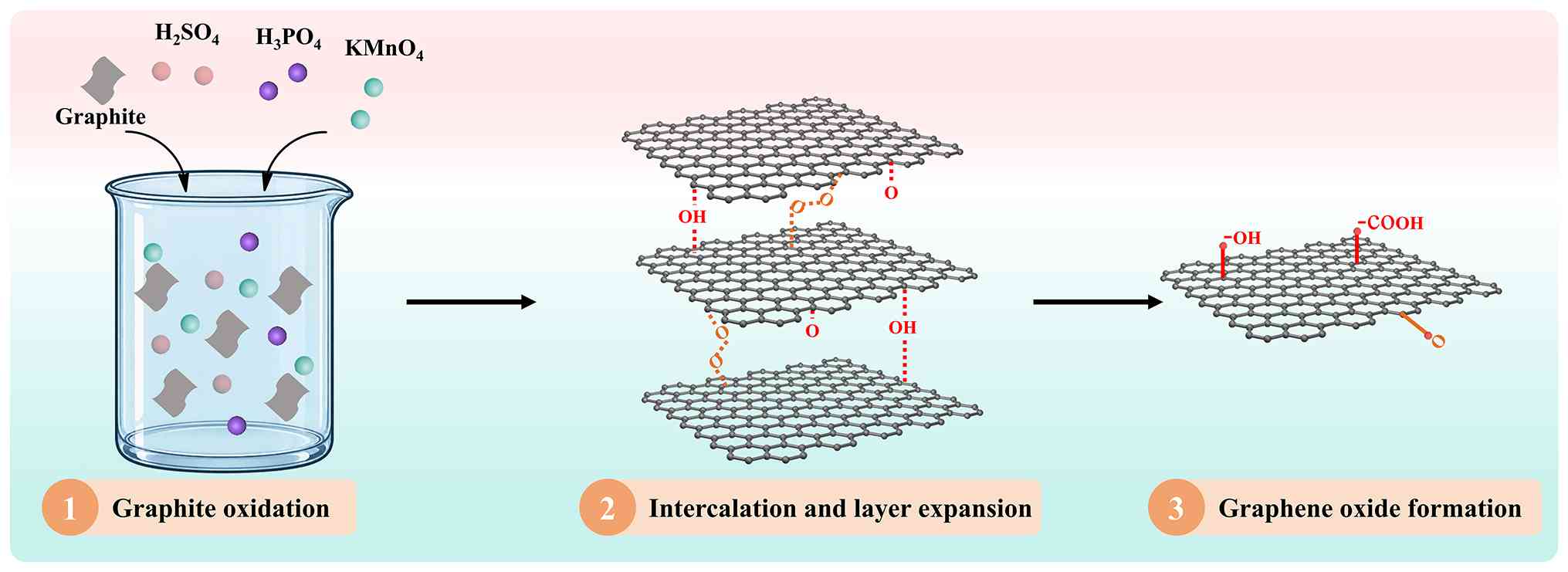
GO is mainly synthesised by oxidising graphite
chemically, most extensively via Hummers' method and its variants
(72), as shown in Fig. 1. Al-Gaashani et al (72) prepared high-quality GO and rGO via
modified Hummers' methods with mixed acids and low-temperature
control, achieving tuneable C/O ratios and abundant oxygen-rich
functional groups that enhance hydrophilicity. In this process,
strong oxidisers oxidise graphite, enabling intercalation of
oxygen-containing functional groups between the graphitic layers.
This weakens the interlayer interactions, allowing the material to
be exfoliated into single- or few-layer GO sheets. The oxidation
creates numerous oxygen-containing groups, including hydroxyl and
epoxy moieties on the basal plane, as well as carboxyl groups
predominantly at the sheet edges. These functionalities disrupt the
extended sp2-conjugated network, increasing the
hydrophilicity of GO and thereby improving its dispersibility in
aqueous media. Additionally, the negatively charged surface of GO
provides electrostatic stabilisation, important for maintaining
stability under physiological conditions.
Synthesis of rGO
The formation of rGO occurs when oxygen-containing
groups are partially removed from GO via chemical, thermal or
electrochemical reduction strategies (73–76).
Among these approaches, chemical reduction is the most extensively
employed method, typically using reductants, such as hydrazine,
sodium borohydride or ascorbic acid. For example, Zhuang et
al (76) produced
high-performance rGO-cellulose nanocrystal composite films through
mild oxidation, confined evaporation, and hydroiodic acid (HI)
reduction which improved their mechanical strength, electrical
conductivity and electromagnetic-interference shielding performance
in the X-band. During conventional evaporation, a large evaporation
height can generate a concentration gradient and promote the
formation of a skin layer, which may lead to disordered stacking
and wrinkles in the resulting film. Spatially confined evaporation
reduces the effective evaporation height and enables repeated
confined evaporation, thereby facilitating the gradual accumulation
and more orderly arrangement of graphene-based nanosheets (76). Thermal reduction can further
decrease oxygen levels and promote the reconstruction of graphitic
domains at higher temperatures. The extent of reduction markedly
affects the balance among electrical conductivity, hydrophilicity
and surface reactivity. Highly reduced graphene offers superior
electronic properties but reduced dispersibility in aqueous
environments, whereas partially reduced graphene maintains a
sufficient density of functional groups for subsequent chemical
functionalisation, which is beneficial for biomedical applications
(77).
Overall, different synthesis methods for graphene
and its derivatives produce materials with unique structural and
surface chemical properties. These features influence their
effectiveness in drug delivery applications. In such systems,
graphene derivatives with controlled defect structures and surface
functionalities are preferred since they show improved
dispersibility and modifiability. Therefore, defect-engineered or
partially oxidised graphene materials are more commonly used than
pristine graphene.
Graphene and its derivatives in drug
delivery
Characteristics of graphene-based
materials and their relevance in drug delivery
Graphene and its derivatives have become highly
versatile nanoplatforms for drug delivery owing to their unique
two-dimensional structure, extensive specific surface area,
tuneable surface chemistry and capacity for multimodal
functionalisation (78,79). Unlike conventional nanocarriers,
graphene-based materials offer multiple interaction sites for
therapeutic agents and can incorporate targeting, imaging and
stimuli-responsive features in a single delivery platform. These
characteristics make them attractive candidates for cancer
treatment, where efficient drug loading, prolonged circulation,
tumour-specific accumulation, controlled drug release and reduced
systemic toxicity are critical.
Drug loading strategies
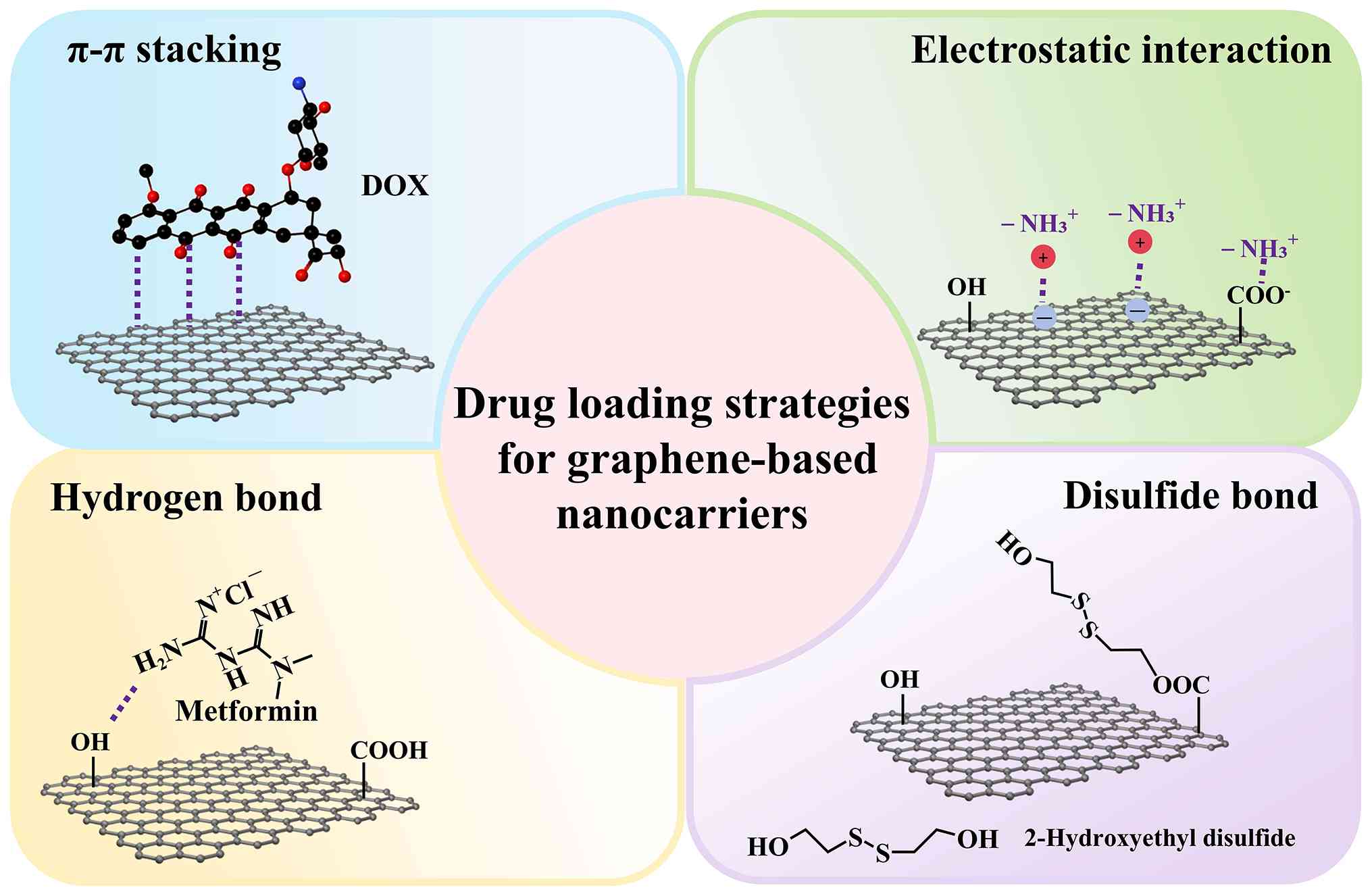
Drug loading onto graphene-based nanocarriers can be
achieved through non-covalent adsorption (80–83)
or covalent conjugation; these commonly used drug-loading
strategies are illustrated in Fig.
2. Non-covalent methods are the most common as they preserve
the structure of therapeutic molecules and enable reversible drug
release under specific physiological conditions. Among them, π-π
stacking and hydrogen bonding are among the most commonly exploited
mechanisms for loading drugs onto graphene-based nanocarriers
(35). In addition, electrostatic
interactions are also important, particularly for charged
therapeutics. The negatively charged GO surface interacts with
positively charged drugs, peptides or nucleic acids, and surface
modification with cationic polymers further enhances the loading of
anionic biomolecules, including small interfering RNA, miRNA and
plasmid DNA. For example, Garwal et al (80) fabricated polyvinyl alcohol
(PVA)-grafted magnetic GO (GO-PVA-Fe3O4)
nanocomposites via chemical co-precipitation and
carbodiimide-activated esterification, which enhanced
5-fluorouracil (5-FU) loading capacity, lowered systemic haemolysis
risk and enabled tumour acidic microenvironment-triggered
controlled drug release. GO-PVA-Fe3O4
possesses a 5-FU loading capacity of 14.17 weight percent (wt%) and
the cumulative 5-FU release of
GO-PVA-Fe3O4−5FU reaches 30.40% at pH 4.0,
which is ~2.5-fold higher than the release (15.4%) under
physiological conditions (pH 7.4). Afzal et al (81) developed ZnO-GO nanocomposites via
facile chemical deposition; hydrogen bonds between GO functional
groups and DOX considerably increased drug loading efficiency to
89% [higher than that of pure ZnO (82%)], and the composites showed
pH-responsive release behaviour.
Covalent conjugation enhances drug stability and
minimises leakage during systemic circulation using cleavable
linkers, such as hydrazone, disulphide, ester or peptide bonds.
These linkers remain stable under normal conditions but cleave
under tumour-associated stimuli, including acidic pH, elevated
glutathione (GSH) levels or specific enzymatic activity. For
instance, Rabchinskii et al (82) synthesised carboxylated rGO via
wet-chemical modification and covalently anchored an hepatitis B
virus (HBV)aptamer via amide bonds for stable bioconjugation,
supported by theoretical conformation analysis. Specifically, a
unit mass of carboxylated rGO carrier can bind 4.1×10⁻¹²
mmol/g of HBV aptamer. Although this rGO-based system was initially
designed for chemiresistive biosensing rather than drug delivery,
it serves as a valuable example of covalent biomolecule
immobilisation on functionalised graphene surfaces, which can be
adapted for ligand conjugation and molecular modification of
graphene-based nanocarriers.
Each loading strategy has advantages and
disadvantages. For instance, non-covalent methods, employing π-π
stacking, electrostatic interactions, hydrogen bonding or
hydrophobic interactions, are simple and versatile, enabling the
loading of diverse therapeutic cargos while preserving their
biological activity; however, these reversible interactions may
result in premature drug leakage under physiological conditions due
to competitive interactions with proteins and ions. In particular,
ionic-driven displacement has been experimentally demonstrated in
buffered media (83). By contrast,
covalent modification strategies can be exemplified by the work of
Matiyani et al (84), who
fabricated polyamidoamine (PAMAM)-functionalised GO via
EDC/NHS-mediated amide coupling and achieved enhanced quercetin
(QSR) loading with pH-responsive release behaviour and improved
anticancer activity against breast cancer cells. The covalent
conjugation methods provided improved stability, reducing premature
release through cleavable linkers. Compared with the QSR loading
capacity of 30.79±1.53% in pure GO, the QSR loading capacity in
GO-PAMAM reached as high as 37.42±1.72%. At the same time, under
physiological conditions (pH 7.4), the cumulative QSR release rate
from GO-PAMAM-QSR over 72 h is 20–21%. However, it involves more
complex synthesis and may affect drug accessibility. Therefore, the
choice of loading strategy depends on the chemical properties of
the therapeutic cargo and the target biological application.
Surface functionalisation for improved
stability and biocompatibility
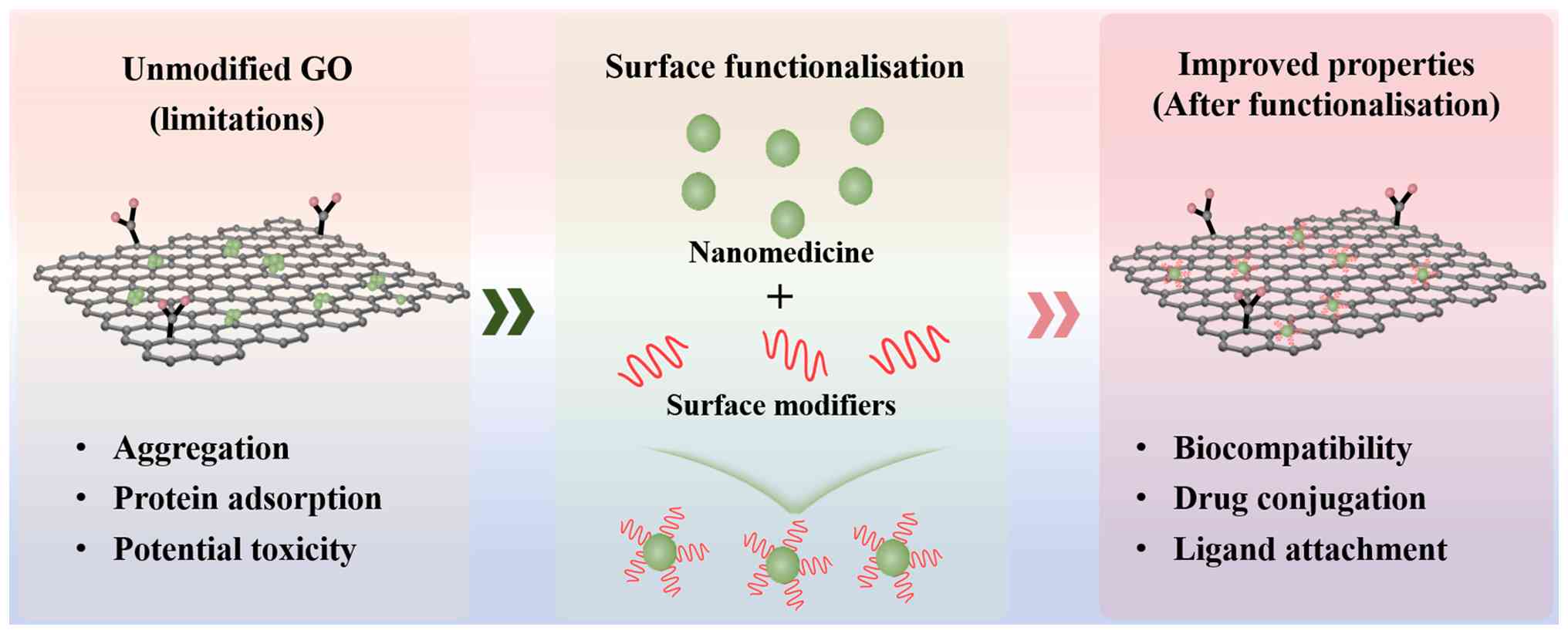
Graphene-based nanomaterials hold considerable
potential as drug carriers. However, their direct biomedical
application is limited by aggregation, non-specific protein
adsorption, rapid clearance and potential toxicity. To address
these issues, surface functionalisation is crucial for boosting
colloidal stability, biocompatibility and in vivo delivery
performance (85–87), as shown in Fig. 3. Polyethylene glycol (PEG)
functionalisation (PEGylation) is one of the most widely used
modification approaches. PEGylation enhances aqueous stability,
reduces opsonisation by serum proteins, prolongs blood circulation
time and decreases uptake by the mononuclear phagocyte system
(88). For example, Karimi and
Namazi (88) developed PEGylated
triazine dendrimer (TD)-grafted GO/Fe3O4
nanocomposites (GO-TD-Fe3O4@PEG), where
Fe3O4 nanoparticles were pre-coated with PEG.
With the PEG coating enhancing hydrophilicity and colloidal
stability to achieve high-efficiency pH-responsive DOX delivery.
The DOX loading capacity of GO-TD-Fe3O4@PEG
is 9.26 wt% and the encapsulation efficiency of
GO-TD-Fe3O4@PEG reaches 92.6%. At pH 7.4
(normal blood environment), the cumulative DOX release percentage
can be up to 66.1%. Besides PEG (89), polymers such as chitosan (90–92),
polyethyleneimine (93), HA
(94), dextran (95) and polydopamine (96) have been used to modify
graphene-based nanocarriers. These polymers improve dispersion
stability while providing additional functional groups for drug
conjugation or ligand attachment.
Tumour-targeted delivery
strategies
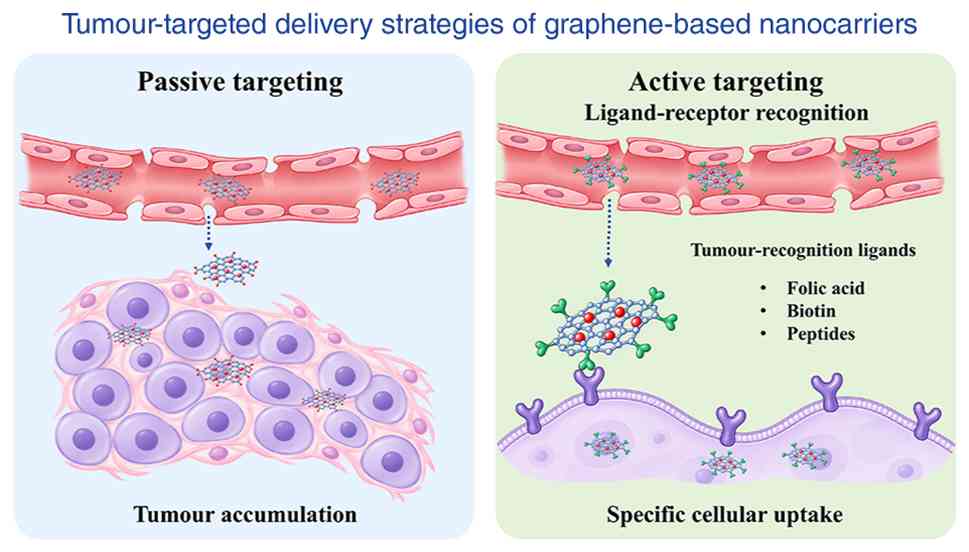
Efficient tumour targeting is key in DDS design.
Tumour-targeted delivery strategies are broadly classified into
passive and active targeting, as shown in Fig. 4. Passive targeting relies on the
enhanced permeability and retention effect, where nanoscale
carriers accumulate in tumour tissues due to leaky vasculature and
impaired lymphatic drainage. However, tumour vasculature
heterogeneity and variability among tumour types can reduce passive
targeting reliability. To improve specificity, active targeting is
often used and involves the conjugation of tumour-recognition
ligands (97–100). For example, Rostami et al
(97) prepared
ZnFe2O4@L-cysteine-N/RGO nanocarriers for
chemo-sonodynamic therapy, featuring pH/ultrasound dual-responsive
curcumin release. The curcumin loading efficiency of
ZnFe2O4@L-cysteine-N/RGO was 71.65%, which
was higher than the 63.17% of
ZnFe2O4@L-cysteine. For
ZnFe2O4@L-cysteine-N/RGO, only 33.03% of
curcumin leaked at pH 7.4 within 96 h. Liu et al (98) fabricated light-driven tubular
rGO/Cu2+1O nanomotors for active targeted DOX delivery
and combined melanoma therapy via π-π stacking interaction. The DOX
loading capacity of rGO/Cu2+1O nanomotors reached
11.7±1.2 wt% after a 120-min incubation. In addition, Sridharan
et al (92) fabricated
folic acid-modified rGO/Co3O4/chitosan (GCC)
ternary nanocomposites for folate-targeted pH-sensitive DOX
delivery against lung and breast cancer cells. The maximum DOX
loading percentage of GCC reached 95.25%. Only 10–11% of DOX leaked
at pH 7.4 within 10 h. Moreover, Gupta et al (99) constructed a biotin-adorned
poly-(ethylene oxide) bis-(amine) conjugate (BPBA) for targeted
gallic acid (GA) therapy using a rGO nanocarrier (rGONC), forming
BPBA@GA-rGONC, for treating A549
lung tumour cells. The GA loading capacity of BPBA@GA-rGONC was 12.8 wt% and the
corresponding entrapment efficiency was 25.6%. At physiological pH
7.4, 52.5% of GA was cumulatively released within 48 h, whereas the
total GA release percentage reached 67% at tumour-mimicking acidic
pH 5.0 with strengthened anticancer activity (99).
However, graphene tumour-targeted nanocarriers face
translational barriers: Passive targeting lacks consistency across
tumour subtypes, single-ligand active targeting is restrained by
variable tumour receptor expression and excessive ligand-induced
off-target interactions, while serum protein corona blocks ligand
recognition and poor intracellular transport weakens therapy
(100). Next-generation graphene
carriers should combine optimised ligand layout, biocompatible
anti-protein adsorption coating and stimulus-triggered release for
reliable tumour-specific delivery.
Stimuli-responsive drug release
mechanisms
Stimuli-responsive release is a key advantage of
graphene-based DDSs. Tumour tissues possess distinctive
microenvironmental features, including acidic extracellular pH,
elevated intracellular GSH concentrations, upregulated enzymes,
hypoxia and abnormal reactive oxygen species levels. Graphene-based
nanocarriers can be designed to respond to these endogenous
stimuli, enabling site-specific and controlled drug release.
Drug release responsive to pH
The release of drugs in response to pH has been
extensively studied in graphene-based nanocarriers (101–104), primarily owing to the acidic
tumour microenvironment (pH 6.5–6.8) and even lower pH in
endo/lysosomal compartments (pH 4.5–5.5). GO is enriched with
oxygen-containing functional groups, including carboxyl, hydroxyl
and epoxide moieties, enabling facile modification with
pH-sensitive linkers or polymers and allowing controlled drug
release under acidic conditions. Drugs are typically loaded onto GO
via π-π stacking and hydrophobic interactions, which are
destabilised in acidic environments, thereby accelerating drug
desorption. Sultana et al (101) developed gelatin-chitosan
composite films incorporating PEG-functionalised few-layer graphene
as pH-responsive mesna delivery systems, with the materials
exhibiting marked pH-dependent release kinetics and accelerated
drug release under acidic conditions (pH 4.5). Zainab et al
(102) reported tetraethyl
orthosilicate (TEOS)-crosslinked, GO-reinforced chitosan/sodium
alginate hydrogels as pH-responsive oral insulin carriers, which
suppressed premature release at gastric pH (pH 1.2) and achieved
near-complete sustained release at intestinal pH (pH 6.8), with 94%
encapsulation efficiency and Fickian diffusion kinetics.
Redox-responsive drug release
Redox-responsive drug release is a widely studied
approach in nanomedicine, leveraging the differences in redox
conditions between extracellular and intracellular environments to
achieve selective drug release (105,106). In graphene-based DDSs,
redox-responsive release is most commonly achieved through the
cleavage of disulphide bonds (−S-S-). For instance, Liu et
al (106) developed a
redox-responsive NGO-SS-HA-Gef nanocarrier for targeted gefitinib
delivery. HA was conjugated to nano-GO through a cystamine
disulphide linker, while gefitinib was loaded through π-π stacking
and hydrophobic interactions. The HA coating improved colloidal
stability and biocompatibility and promoted CD44 receptor-mediated
uptake by CD44-upregulated tumour cells. Intracellular GSH cleaved
the disulphide linkage, thereby removing the HA barrier and
accelerating gefitinib release. The system achieved a maximum
gefitinib loading of ~13.8%. At pH 5.5, cumulative gefitinib
release over 72 h increased from 30.8% without GSH to 60.1% in the
presence of 10 mM GSH, whereas 10 µM GSH caused little additional
release, indicating limited premature release under
circulation-like conditions (106). Overall, disulphide-based redox
response improves extracellular stability and enables rapid,
on-demand intracellular drug release, thereby improving therapeutic
selectivity and reducing off-target toxicity. This strategy is
highly suitable for graphene-based platforms as their large surface
area and facile functionalisation enable the integration of redox
triggering with other modalities (such as photothermal effects) for
synergistic therapy.
Externally triggered physical
stimuli-responsive release
Graphene-based nanocarriers can be engineered to
respond to external physical stimuli, including near-infrared (NIR)
light, temperature, magnetic fields and ultrasound. Compared with
endogenous stimuli, these externally triggered systems provide more
precise spatiotemporal control, as release can be achieved at
selected tumour sites and defined times. Among these strategies,
NIR-responsive drug release is particularly well-studied (107–109). GO, rGO and other graphene
derivatives absorb NIR light efficiently and convert it into heat
(110). When graphene-based
nanocarriers are irradiated with NIR light, the resulting
photothermal effect raises the temperature around the nanosheets,
weakening non-covalent interactions, such as π-π stacking, hydrogen
bonding and hydrophobic interactions, thereby accelerating drug
desorption. Local heating can also disrupt thermosensitive polymer
coatings or damage tumour cell membranes, further enhancing
intracellular drug release. Beyond light- and
temperature-responsive modalities, magnetic field-triggered systems
are gaining attention as exogenous platforms for spatiotemporally
precise cargo transport and on-demand release, featuring deep
tissue penetration, non-invasive remote manipulation and favourable
biocompatibility (111,112). These systems commonly incorporate
magnetic nanoparticles, such as Fe3O4, onto
GO or rGO surfaces, providing magnetic targeting and the ability to
generate heat under an alternating magnetic field. In such systems,
the external magnetic field directs the nanocarriers to the tumour,
while magnetothermal heating weakens drug-carrier bonds or alters
surface coatings, leading to controlled drug release. Overall, such
physical stimuli-responsive graphene-based systems achieve drug
release through externally controlled photothermal conversion
(113), polymer phase transitions
(114) or magnetic
heating-induced effect (115).
These mechanisms enable on-demand drug release, offering promising
strategies to enhance therapeutic accuracy and minimise systemic
toxicity.
Compared with passive release systems,
stimuli-responsive graphene-based nanocarriers provide improved
spatial and temporal control over therapeutic delivery. Notably,
pH-responsive systems exploit acidic tumour microenvironments,
whereas GSH-responsive systems use intracellular reduction
conditions for selective drug release. Enzyme-responsive approaches
add further specificity by responding to biological signals
associated with tumours. Externally triggered systems, such as
NIR-responsive platforms, enable on-demand release through
graphene-mediated photothermal conversion. Nonetheless, the
practical performance of these systems depends on tumour
heterogeneity, stimulus accessibility, release reproducibility and
clinical applicability. Moreover, despite the development of
numerous graphene-based loading and release strategies, direct
quantitative comparison of systems remains challenging as
performance is strongly influenced by graphene derivatives, cargo
properties, functionalisation methods, experimental conditions and
test protocols. Therefore, performance data should be interpreted
in the context of specific experimental setups, not generalised
across different systems.
Table I
systematically evaluates and compares various graphene-based DDSs;
it includes parameters such as loading performance,
stimulus-triggered release modes, in vitro and in
vivo verification results, therapeutic effectiveness and
biosafety profiles. The multi-stimulus responsive, covalently
modified graphene composite platforms show superior overall
therapeutic performance. By contrast, simple non-covalent GO
formulations face major challenges, including protein corona
interference, limited biodegradability and the lack of in
vivo validation, highlighting areas for future focus and
improvement.
 | Table I.Comparison of modified graphene oxide
nanocarriers for drug delivery. |
Table I.
Comparison of modified graphene oxide
nanocarriers for drug delivery.
| Samples | Surface
functionalisation strategies | Drug delivery | Release
mechanism | In vitro/in
vivo model | Therapeutic
effect | Toxicity
assessment | Major
limitations | (Refs.) |
|---|
| GO/zinc oxide | Hydrogen bonds | Doxorubicin | pH response | In vitro
tumour cell models | Increased apoptosis
rate | Low
cytotoxicity | Lack of animal
validation | (78) |
|
GO/chitosan/dextran | Electrostatic
attraction | Doxorubicin
hydrochloride | pH response | Multiple in
vitro tumour cell lines | Reducing
non-specific protein adsorption | No acute
cytotoxicity | Forming protein
capsids | (79) |
|
GO/Fe2O3 | PEG grafting | Doxorubicin | pH response | In vitro
tumour cell models | Improved colloidal
stability | Low haemolytic
toxicity | Reduced endocytosis
efficiency | (85) |
|
GO/Fe3O4 | Covalent
modification | Doxorubicin | pH/NIR
response | In vivo
breast cancer tumour-bearing mouse models | A three-fold
increase in drug accumulation | Low systemic
toxicity | Incomplete
biodegradability | (91) |
| GN quantum
dots | Peptide covalent
linkage | Doxorubicin | Tissue protease
response | In vitro
tumour cell fluorescence tracing model | Real-time
monitoring of drug release | Controllable
cytotoxicity | Short duration of
action | (98) |
|
GN/gelatin-chitosan | PEG grafting | Mesna | pH response | In vitro
mucosal biofilm models | Triples the
sustained-release period of the drug | Excellent local
biocompatibility | Topical mucosal
administration | (92) |
Toxicity and biosafety of
graphene-based nanomaterials for drug delivery
The toxicity of graphene-based nanomaterials depends
on physicochemical parameters such as size, lateral dimensions,
thickness, morphology, surface charge, oxidation and reduction
levels, functionalisation and aggregation (116,117). Smaller graphene derivatives
generally exhibit enhanced cellular uptake and tissue penetration
but may increase oxidative stress, whereas larger nanosheets show
reduced uptake but prolonged retention. Thickness, morphology and
aggregation affect membrane interactions and inflammation (118). Surface charge regulates cellular
internalisation and biological compatibility; positively charged
materials improve uptake but may increase protein adsorption,
haemolysis and immune response (119). GO is more dispersible and
susceptible to functionalisation owing to abundant
oxygen-containing groups, whereas rGO has enhanced photothermal
properties but shows increased aggregation. Surface
functionalisation improves colloidal stability and
biocompatibility, but excessive modification alters protein corona
formation and cellular responses.
The in vivo behaviour of graphene-based
nanomaterials remains a major translational challenge. Owing to
their stable carbon structure, graphene derivatives can persist in
organs of the mononuclear phagocyte system, including the liver,
spleen and lungs. Their biodegradation and clearance are heavily
influenced by size, oxidation level, surface chemistry, aggregation
and administration route (120).
Thus, understanding how their structure affects biodistribution,
degradation and clearance is crucial for designing safer
nanocarriers. Currently, a key limitation in graphene-based
nanomedicine is the absence of standardised biosafety protocols.
Variability in graphene types, sizes, oxidation states, surface
modifications, doses, administration routes, exposure durations and
biological models often produces inconsistent toxicity results. For
example, at comparable concentrations, extensively sonicated
small-flaked GO exhibits markedly higher genotoxic and
oxidative-stress effects compared with untreated larger GO sheets
under identical test systems (121). Future safety evaluations should
integrate systematic physicochemical characterisation with
biological assessments, covering hemocompatibility, immune
compatibility, cytotoxicity, genotoxicity, biodistribution,
pharmacokinetics and biodegradation, as well as acute and chronic
toxicity. Developing standardised and physiologically relevant
evaluation methods is vital for establishing reliable
structure-property-biological outcome relationships and advancing
the clinical use of graphene-based DDSs.
Biological and methodological
implications
Graphene-based nanomaterials are promising platforms
for drug delivery owing to their two-dimensional structure, large
surface area, π-conjugated network and adjustable surface
chemistry, which facilitate enhanced drug loading, versatile
functionalisation and stimuli-triggered release. Compared with
conventional nanocarriers such as soluble polymers, inorganic
nanoparticles and magnetic nanoparticles (122), graphene-based systems provide a
larger interface for drug adsorption and greater adaptability for
incorporating targeting, imaging and therapy functions. However,
these features can also cause issues such as non-specific protein
adsorption, aggregation in physiological environments, oxidative
stress, membrane damage, immune activation and long-term tissue
retention (123,124). Therefore, evaluating their
biological performance should include not only drug loading and
release efficiency but also how material structure, surface
chemistry, biological interactions and in vivo fate
interrelate. Prior research indicates that the effectiveness of
graphene-based drug delivery depends on material design and testing
conditions. GO and partially rGO tend to disperse more optimally
(125) and show higher
functionalisation potential relative to pristine graphene, making
them more suitable for biomedical uses. Non-covalent drug loading
maintains activity and enables reversible release, whereas covalent
conjugation enhances stability but complicates synthesis and
affects drug activity (126).
Surface modifications, including PEGylation, improve colloidal
stability and biocompatibility, but their impact on release,
cellular uptake and immune response varies with polymer density,
molecular weight, linkage chemistry and surface coverage (127). Responsive systems triggered by
pH, redox conditions, enzymes, NIR, temperature or magnetic fields
can improve spatiotemporal control over drug release, but their
performance depends on tumour heterogeneity and trigger condition
reproducibility (106). These
aspects may account for differences observed in drug loading,
release kinetics, cytotoxicity, targeting efficiency and treatment
outcomes across studies.
Clinical translation of graphene-based
DDSs
Despite the promising therapeutic potential of
graphene-based nanocarriers demonstrated in numerous in
vitro and animal studies (128,129), their clinical translation remains
limited. Graphene-based DDSs are still at the preclinical phase and
clinically validated platforms for cancer therapy remain scarce.
The major challenges include concerns over long-term biosafety,
uncertain in vivo fate, material heterogeneity and a lack of
standardised evaluation criteria (130,131). Beyond safety, reliable
manufacturing processes are essential for clinical application.
Good manufacturing practice-compatible, large-scale batches with
consistent properties are challenging since the features of
graphene, such as lateral size, thickness, oxidation level, surface
chemistry and aggregation, strongly influence biological
performance. Sterilisation, endotoxin removal, impurity control and
quality assurance must be developed carefully to ensure product
consistency and meet regulatory standards. Before clinical trials,
comprehensive preclinical testing is necessary, covering
pharmacokinetics, biodistribution, biodegradation, clearance
pathways, hemocompatibility, immune response and genotoxicity, as
well as acute and chronic toxicity. Establishing standardised
characterisation methods and physiologically relevant evaluation
models is crucial to ensure safety profiles and gain regulatory
approval.
Conclusion and prospects
Graphene-based nanomaterials have emerged as highly
adaptable platforms for tumour-targeted drug delivery owing to
their two-dimensional structure, large surface area and chemically
tuneable interfaces. These features enable high-capacity drug
loading, modular functionalisation, tumour-targeted delivery and
stimuli-responsive behaviour. Notably, graphene-based nanocarriers
hold practical value for precision cancer therapy as they enhance
local drug accumulation, reduce systemic toxicity, overcome
multidrug resistance and support combined therapies, such as
chemo-photothermal therapy, immunomodulation and image-guided
treatment. The field is evolving from passive carriers towards
stimuli-responsive and increasingly sophisticated cascade-activated
systems that utilise tumour-associated signals and external
physical triggers to improve selectivity and therapeutic efficacy.
However, clinical translation is limited by gaps in understanding
structure-property-biological outcome relationships, heterogeneity
in material fabrication, unclear long-term biodistribution and
clearance, potential immunotoxicity and the absence of standardised
evaluation frameworks. Future research should focus on
mechanism-based, clinically relevant designs, scalable preparation,
biodegradable or transformable graphene systems with predictable
in vivo fate, and integrated platforms for targeting,
imaging and therapy. Using physiologically relevant models for
evaluating graphene-based nanomedicines will be vital for improving
reproducibility, safety assessment and clinical translation. These
developments can lead to safer, more predictable and clinically
applicable graphene-based nanomedicines for precision cancer
therapy.
Acknowledgements
Not applicable.
Funding
The present review was supported by the Henan Provincial
Engineering Research Center for Biomedical Materials in Respiratory
Diseases Open Research Projects (grant no. SWCLGCJS KF02) and the
Henan Province Engineering Research Center for Advanced Materials
and Applications of 3D Printing in Personalized Respiratory
Diseases (Henan Provincial Development and Reform Commission,
September 2023; grant no. 3DDYXJCLKF02).
Availability of data and materials
Not applicable.
Authors' contributions
HL conceptualised the review framework and wrote the
original manuscript. HY was responsible for reviewing the
manuscript. SLiu performed literature searching and revised the
manuscript. YX was responsible for manuscript polishing. JH was
responsible for writing, reviewing and editing the manuscript and
supervision. SLi was responsible for writing, review and editing
the manuscript, supervision and funding acquisition. All authors
have read and approved the final version of the manuscript. Data
authentication is not applicable.
Ethics approval and consent to
participate
Not applicable.
Patient consent for publication
Not applicable.
Competing interests
The authors declare that they have no competing
interests.
References
|
1
|
Banushi B, Joseph SR, Lum B, Lee JJ and
Simpson F: Endocytosis in cancer and cancer therapy. Nat Rev
Cancer. 23:450–473. 2023. View Article : Google Scholar : PubMed/NCBI
|
|
2
|
Lu Z, Chen Y, Liu D, Jiao X, Liu C, Wang
Y, Zhang Z, Jia K, Gong J, Yang Z and Shen L: The landscape of
cancer research and cancer care in China. Nat Med. 29:3022–3032.
2023. View Article : Google Scholar : PubMed/NCBI
|
|
3
|
Jassim A, Rahrmann EP, Simons BD and
Gilbertson RJ: Cancers make their own luck: Theories of cancer
origins. Nat Rev Cancer. 23:710–724. 2023. View Article : Google Scholar : PubMed/NCBI
|
|
4
|
Jovito BL, Paterno LG, Sales MJA, Gross
MA, Silva LP, de Souza P and Báo SN: Graphene oxide/Zinc oxide
nanocomposite displaying selective toxicity to glioblastoma cell
lines. ACS Appl Bio Mater. 4:829–843. 2021. View Article : Google Scholar
|
|
5
|
Zhou C, Zhang Y, Tian B, Yu Y, Li D, Wu B,
Chang W, Shi T, Xu F, Bai J and Wang C: Bacteria-responsive
cytoderm drug delivery systems. Biomater Sci. 13:2744–2754. 2025.
View Article : Google Scholar : PubMed/NCBI
|
|
6
|
Sabbagh F, Zargarian SS, Kosik Kozioł A,
Nakielski P and Pierini F: Hydrogel-based ocular drug delivery
systems. J Mater Chem B. 13:14982–15006. 2025. View Article : Google Scholar : PubMed/NCBI
|
|
7
|
Attri N, Das S, Banerjee J, Shamsuddin SH,
Dash SK and Pramanik A: Liposomes to cubosomes: The evolution of
lipidic nanocarriers and their cutting-edge biomedical
applications. ACS Appl Bio Mater. 7:2677–2694. 2024. View Article : Google Scholar : PubMed/NCBI
|
|
8
|
Wróblewska AM, Łukawska E, Wakuła Z, Zajda
J, Keppler BK, Timerbaev AR and Matczuk M: Toward the boosted
loading of cisplatin drug into liposome nanocarriers. Eur J Pharm
Biopharm. 198:1142452024. View Article : Google Scholar : PubMed/NCBI
|
|
9
|
Nunziata G, Borroni A and Rossi F:
Advanced microfluidic strategies for core-shell nanoparticles: The
next-generation of polymeric and lipid-based drug nanocarriers.
Chem Eng J Adv. 22:1007592025. View Article : Google Scholar
|
|
10
|
Chudzińska Skorupinska J, Wawrzyńczak A
and Feliczak Guzik A: Carbohydrate-based polymer nanocarriers for
environmentally friendly applications. Adv Colloid Interface Sci.
338:1034152025. View Article : Google Scholar : PubMed/NCBI
|
|
11
|
Cheung TH and Shoichet MS: The Interplay
of endosomal escape and RNA release from polymeric nanoparticles.
Langmuir. 41:7174–7190. 2025. View Article : Google Scholar : PubMed/NCBI
|
|
12
|
Wang Y, Zhong D, Xie F, Chen S, Ma Z, Yang
X, Iqbal MZ, Zhang Q, Lu J, Wang S, et al: Manganese
phosphate-doxorubicin-based nanomedicines using mimetic
mineralization for cancer chemotherapy. ACS Biomater Sci Eng.
8:1930–1941. 2022. View Article : Google Scholar : PubMed/NCBI
|
|
13
|
Xu Q, Cai H, Li W, Wu M, Wu Y and Gong X:
Carbon dot/inorganic nanomaterial composites. J Mater Chem A.
10:14709–14731. 2022. View Article : Google Scholar
|
|
14
|
Makimoto A, Fang J and Maeda H:
Development of a selective tumor-targeted drug delivery system:
Hydroxypropyl-acrylamide polymer-conjugated pirarubicin (P-THP) for
pediatric solid tumors. Cancers (Basel). 13:36982021. View Article : Google Scholar : PubMed/NCBI
|
|
15
|
Wang Y, Zhang Z, Zheng C, Zhao X, Zheng Y,
Liu Q, Liu Y and Shi L: Multistage adaptive nanoparticle overcomes
biological barriers for effective chemotherapy. Small.
17:e21005782021. View Article : Google Scholar : PubMed/NCBI
|
|
16
|
Wang C, Huang J, Zhang Y, Jia H and Chen
B: Construction and evaluation of red blood cells-based drug
delivery system for chemo-photothermal therapy. Colloids Surf B
Biointerfaces. 204:1117892021. View Article : Google Scholar : PubMed/NCBI
|
|
17
|
Soni S and Andey T: Formulation
characteristics of solid-dispersible self-emulsifying drug delivery
systems for dual drug delivery. Pharmaceutics. 18:6372026.
View Article : Google Scholar : PubMed/NCBI
|
|
18
|
Peng X, Gao Y, Liu J, Shi X, Li W, Ma Y,
Li X and Li H: Mitochondria-derived vesicles: A promising and
potential target for tumour therapy. Clin Transl Med.
15:e703202025. View Article : Google Scholar : PubMed/NCBI
|
|
19
|
Cao D, Tian M, Liu Z, Guo K, Peng J,
Ravichandra A, Ferrell C and Dong Y: Unlock the sustained
therapeutic efficacy of mRNA. J Control Release. 383:1138372025.
View Article : Google Scholar : PubMed/NCBI
|
|
20
|
Jin C, Zheng H and Chen J: Advances in the
application of graphene and its derivatives in drug delivery
systems. Pharmaceuticals (Basel). 18:12452025. View Article : Google Scholar : PubMed/NCBI
|
|
21
|
Frigerio G, Motta S, Siani P, Donadoni E
and Di Valentin C: Unveiling the drug delivery mechanism of
graphene oxide dots at the atomic scale. J Control Release.
379:344–362. 2025. View Article : Google Scholar : PubMed/NCBI
|
|
22
|
Basavci E, Demirel E, Elhassan M and
Yuksel Durmaz Y: The effect of PEGylation components on drug
release behavior of targeted reduced graphene oxide based drug
delivery system. Eur Polym J. 215:1132112024. View Article : Google Scholar
|
|
23
|
Huang J, Zhang D, Zhu C, Chen S, Wang Y,
Han K, Ci S and Lv Y: Graphene-based nanomaterials: Mechanisms and
potentials in the fight against multidrug resistant bacterial
infections: A review. RSC Adv. 15:26728–26738. 2025. View Article : Google Scholar : PubMed/NCBI
|
|
24
|
Pratama BP, Khairullah AR, Kurniasih DAA,
Yulianti W, Wardhani BWK, Ma'ruf IF, Akintunde AO, Ahmad RZ, Ansori
ANM, Sukmanadi M, et al: Unveiling the potential of graphene oxide
as a multifunctional platform for active food packaging:
Properties, applications, and prospects. Trends Sci. 23:119052025.
View Article : Google Scholar
|
|
25
|
Papait A, Perini G, Palmieri V, Cargnoni
A, Vertua E, Pasotti A, Rosa E, De Spirito M, Silini AR, Papi M and
Parolini O: Defining the immunological compatibility of graphene
oxide-loaded PLGA scaffolds for biomedical applications. Biomater
Adv. 165:2140242024. View Article : Google Scholar : PubMed/NCBI
|
|
26
|
Sun M, Wang S, Liang Y, Wang C, Zhang Y,
Liu H, Zhang Y and Han L: Flexible graphene field-effect
transistors and their application in flexible biomedical sensing.
Nanomicro Lett. 17:342024.PubMed/NCBI
|
|
27
|
Wang CS, Jiang Y, Li Z, Kong FY, Wang W
and Zhao WW: Graphene photoelectrochemical transistor for
dual-directional signal-on biosensing. Adv Funct Mater.
35:25002352025. View Article : Google Scholar : PubMed/NCBI
|
|
28
|
Gao J, Huang Y, Bao L, Jiao A, Li Y, Ao S,
Xue H, Kang X, Jiang G, Gao W, et al: Quantum-capacitive activation
of diazonium-functionalized graphene edges for reversible
biosensing. Mater Today. 92:387–395. 2026. View Article : Google Scholar
|
|
29
|
Askari S, Salimifard H, Alavi R, Eskandari
M, Zarepour A, Khosravi A, Iravani S and Zarrabi A: Two-dimensional
nanomaterial-based aptasensors: Graphene and MXenes as emerging
biosensing platforms. ACS Appl Nano Mater. 8:17819–17862. 2025.
View Article : Google Scholar
|
|
30
|
Vashani D, Paul H, Nguyen S, Topkiran UC,
Valimukhametova AR, Dorsky A, Sottile O, Durmaz L, Gonzalez
Rodriguez R and Naumov AV: Precursor-dependent optical and
structural properties of eleven NIR-emissive graphene quantum dots
for bioimaging applications. 2d Mater. 13:0250172026. View Article : Google Scholar : PubMed/NCBI
|
|
31
|
Akmal MH, Kalashgrani MY, Mousavi SM,
Rahmanian V, Sharma N, Gholami A, Althomali RH, Rahman MM and
Chiang WH: Recent advances in synergistic use of GQD-based
hydrogels for bioimaging and drug delivery in cancer treatment. J
Mater Chem B. 12:5039–5060. 2024. View Article : Google Scholar : PubMed/NCBI
|
|
32
|
Zhao C, Song X, Liu Y, Fu Y, Ye L, Wang N,
Wang F, Li L, Mohammadniaei M, Zhang M, et al: Synthesis of
graphene quantum dots and their applications in drug delivery. J
Nanobiotechnol. 18:1422020. View Article : Google Scholar
|
|
33
|
Cai C, Zhang Q, Ye J, Yao S, Li Q, Fan Z,
Ge S, Wang Y, Xu D, Zhou J, et al: Tumor microenvironment
modulation innovates combinative cancer therapy via a versatile
graphene oxide nanosystem. Biomater Sci. 13:3123–3148. 2025.
View Article : Google Scholar : PubMed/NCBI
|
|
34
|
Pilato S, Moffa S, Siani G, Diomede F,
Trubiani O, Pizzicannella J, Capista D, Passacantando M, Samorì P
and Fontana A: 3D graphene oxide-polyethylenimine scaffolds for
cardiac tissue engineering. ACS Appl Mater Interfaces.
15:14077–14088. 2023.PubMed/NCBI
|
|
35
|
Qian Y, Wei Z, Liu Y, Cai Y and Yang Z:
Enhancement of doxorubicin efficacy in drug-resistant breast cancer
cells through nucleic acid modulation. Chem Select.
10:e017032025.
|
|
36
|
Khudhair AM and Ben Ahmed A: Pure and
stone-wales defect armchair boron nitride graphene nanoribbons as
anticancer drug delivery vehicles: A theoretical investigation. J
Cluster Sci. 35:451–460. 2024. View Article : Google Scholar
|
|
37
|
Johnson AP, Jyothi SL, Shahid M, Venkatesh
MP, Chidambaram SB, Osmani RA, Gangadharappa HV and Pramod K:
Graphene oxide nanoribbons conjugated with 1,
2-distearoyl-sn-glycero-3 phosphoethanolamine-poly (ethylene
glycol)-transferrin enhanced targeted delivery and cytotoxicity of
raloxifene against breast cancer. Int J Biol Macromol.
278:1347722024. View Article : Google Scholar : PubMed/NCBI
|
|
38
|
Ahmadi Z, Manoochehri M and Ahmad Panahi
H: Polyester dendrimer decorated magnetic graphene quantum dots as
a pH-sensitive nanocarrier for the delivery of silibinin as an
anticancer drug. J Mol Liq. 447:1293672026. View Article : Google Scholar
|
|
39
|
Gunawardhana GANK, Ching YC, Noothalapati
H and Sampath Udeni Gunathilake TM: pH-responsive onion-structured
hydrogel beads based on chitosan-spider silk-graphene quantum dots
for controlled drug delivery. Int J Biol Macromol. 342:1503842026.
View Article : Google Scholar : PubMed/NCBI
|
|
40
|
Xi Y, Kavadiya S, Kavanaugh P, Russo M,
Bilbao D and Biswas P: Crumpled graphene oxide loaded with
anticancer agents synthesized by a single-step aerosol method for
drug delivery. ACS Omega. 11:5765–5778. 2026. View Article : Google Scholar : PubMed/NCBI
|
|
41
|
Yang F, Deng J, Yu X, Fu W, Sun W, Xu Z,
Song X, Wang C, Du Q and Wang M: Lysosome-targeted ROS-responsive
graphene oxide-based drug delivery system to overcome tumor DOX
resistance. Colloids Surf B Biointerfaces. 261:1154342026.
View Article : Google Scholar : PubMed/NCBI
|
|
42
|
Khan SS, Vashitha A, Jiteshwaran T, Janani
B, Bahkali AH and Elgorban AM: Synthesis and characterization of
novel chitosan coated rGO nanocarrier for drug delivery
5-fluorouracil. Diam Relat Mater. 164:1133492026. View Article : Google Scholar
|
|
43
|
Martín C, Kostarelos K, Prato M and Bianco
A: Biocompatibility and biodegradability of 2D materials: Graphene
and beyond. Chem Commun (Camb). 55:5540–5546. 2019. View Article : Google Scholar : PubMed/NCBI
|
|
44
|
Hazarika D, Gupta K, Mandal M and Karak N:
High-performing biodegradable waterborne polyester/functionalized
graphene oxide nanocomposites as an eco-friendly material. ACS
Omega. 3:2292–2303. 2018. View Article : Google Scholar : PubMed/NCBI
|
|
45
|
Tayeb RA, Alsafrani AE, Khan A and Jawaid
M: Fabrication of biodegradable graphene functionalized amyloid
fibril-styrene-butadiene rubber (SBR) composite for automobile tyre
application. Ind Crops Prod. 224:1203702025. View Article : Google Scholar
|
|
46
|
Salimi N and Mohammadi-Manesh E: Effect of
graphene oxide on Fe3O4/TiO2
nanocomposite and their characterization for drug delivery
applications. Inorg Chem Commun. 177:1143872025. View Article : Google Scholar
|
|
47
|
Singh D and Pandey M: Hybrid nanophotonic
graphene systems: A transformative innovation for transdermal drug
delivery. Recent Patents Nanotechnol. 19:160–165. 2025. View Article : Google Scholar : PubMed/NCBI
|
|
48
|
Jiang J, Cui D, Yan T, Guo F and Gu W:
Holey graphene layers as promising drug delivery systems. Phys E.
124:1143032020. View Article : Google Scholar
|
|
49
|
Kesavan S, Rajesh D, Shanmugam J, Aruna S,
Gopal M and Vijayakumar S: Biocompatible polysaccharide fabricated
graphene oxide nanoparticles: A versatile nanodrug carrier to
deliver DD-carrageenan against cancer cells. Int J Biol Macromol.
244:1253222023. View Article : Google Scholar : PubMed/NCBI
|
|
50
|
Grecca ISG, Miola VFB, Ferreira JC,
Vinholo TR, da Silva LMD, Totti PGF, Gianini SHS, Souza MDSSD,
Souza JDSSD, Araújo AC, et al: Integrating graphene oxide and
mesenchymal stem cells in 3D-printed systems for drug delivery and
tissue regeneration. Pharmaceutics. 17:10882025. View Article : Google Scholar : PubMed/NCBI
|
|
51
|
Basha SS, Babunagappan KV, Kabir A, Raj T
and Sudhakar S: Microgravity as a platform to enhance drug loading
efficiency in nanomaterials. J Drug Deliv Sci Technol.
98:1058692024. View Article : Google Scholar
|
|
52
|
Qi J, Chang Z, Yin L, Li Y, Qi H, Zheng S,
Gao S and Huang D: Sawtooth-shaped microsaws for enhanced
transdermal drug delivery: Improved drug loading and piercing
efficiency. Mater Today Commun. 41:1105732024. View Article : Google Scholar
|
|
53
|
Zhang Q, Wu Z, Li N, Pu Y, Wang B, Zhang T
and Tao J: Advanced review of graphene-based nanomaterials in drug
delivery systems: Synthesis, modification, toxicity and
application. Mater Sci Eng C Mater Biol Appl. 77:1363–1375. 2017.
View Article : Google Scholar : PubMed/NCBI
|
|
54
|
Sontakke AD, Tiwari S and Purkait MK: A
comprehensive review on graphene oxide-based nanocarriers:
Synthesis, functionalisation and biomedical applications. FlatChem.
38:1004842023. View Article : Google Scholar
|
|
55
|
Joshi D, Koduru JR, Malek N, Hussain CM
and Kailasa SK: Surface modifications and analytical applications
of graphene oxide: A review. TrAC Trends Anal Chem. 144:1164482021.
View Article : Google Scholar
|
|
56
|
Kumar N, Salehiyan R, Chauke V, Joseph
Botlhoko O, Setshedi K, Scriba M, Masukume M and Sinha Ray S:
Top-down synthesis of graphene: A comprehensive review. FlatChem.
27:1002242021. View Article : Google Scholar
|
|
57
|
Khatun S and Pradhan A: Dual-porous holey
graphene for supercapacitor applications. ACS Appl Nano Mater.
8:14750–14758. 2025. View Article : Google Scholar
|
|
58
|
Khatun S, Samanta S, Sahoo S, Mukherjee I,
Maity S and Pradhan A: Bottom-up porous graphene synthesis and its
applications. Chemistry. 30:e2024033862024. View Article : Google Scholar : PubMed/NCBI
|
|
59
|
Fan Q, Ruan Z, Werner S, Naumann T, Bolat
R, Martinez Castro J, Koehler T, Vollgraff T, Hieringer W, Mandalia
R, et al: Bottom-up synthesis and characterization of porous
12-atom-wide armchair graphene nanoribbons. Nano Lett.
24:10718–10723. 2024. View Article : Google Scholar : PubMed/NCBI
|
|
60
|
Li G, Tao J, Chen X, Liu Y, Li C, Bao R
and Yi J: Realizing single-layer graphene by simultaneous
crystallization and top-down etching of amorphous graphene-like
carbon obtained via CVD. Chem Eng J. 500:1574752024. View Article : Google Scholar
|
|
61
|
Zhang Y, Lin H, Zhang L, Peng S, Weng Z,
Wang J, Wu L and Zheng L: Mechanical exfoliation assisted with
carbon nanospheres to prepare a few-layer graphene for flexible
strain sensor. Appl Surf Sci. 611:1556492023. View Article : Google Scholar
|
|
62
|
Saeed MA, Ismail AA, AlSaidi M and Ahmed
SA: Liquid-phase exfoliation of graphite using various surfactants
into few-layer graphene. Mater Chem Phys. 348:1316502026.
View Article : Google Scholar
|
|
63
|
Park SW, Jang B, Kim H, Lee J, Park JY,
Kang SO and Choa YH: Highly water-dispersible graphene nanosheets
from electrochemical exfoliation of graphite. Front Chem.
9:6992312021. View Article : Google Scholar : PubMed/NCBI
|
|
64
|
Luong DX, Bets KV, Algozeeb WA, Stanford
MG, Kittrell C, Chen W, Salvatierra RV, Ren M, McHugh EA, Advincula
PA, et al: Gram-scale bottom-up flash graphene synthesis. Nature.
577:647–651. 2020. View Article : Google Scholar : PubMed/NCBI
|
|
65
|
Tomai T, Nakayasu Y, Okamura Y, Ishiguro
S, Tamura N, Katahira S and Honma I: Bottom-up synthesis of
graphene via hydrothermal cathodic reduction. Carbon. 158:131–136.
2020. View Article : Google Scholar
|
|
66
|
Neumann C, Kaiser D, Mohn MJ, Füser M,
Weber NE, Reimer O, Gölzhäuser A, Weimann T, Terfort A, Kaiser U
and Turchanin A: Bottom-up synthesis of graphene monolayers with
tunable crystallinity and porosity. ACS Nano. 13:7310–7322. 2019.
View Article : Google Scholar : PubMed/NCBI
|
|
67
|
Wang H, Han Y, Luo P, Zhou Y, Chen Q, Zhu
H, Yang Y, Zhang B and Huang K: Advances in microwave-enhanced
chemical vapor deposition for graphene synthesis. Chem Select.
7:e2022001032022.
|
|
68
|
Liu B and Ma S: Precise synthesis of
graphene by chemical vapor deposition. Nanoscale. 16:4407–4433.
2024. View Article : Google Scholar : PubMed/NCBI
|
|
69
|
Khan MS, Jhankal D, Shakya P, Sharma AK,
Banerjee MK and Sachdev K: Ultraslim and highly flexible
supercapacitor based on chemical vapor deposited nitrogen-doped
bernal graphene for wearable electronics. Carbon. 208:227–237.
2023. View Article : Google Scholar
|
|
70
|
Niu Y, Qing FZ, Li XS and Peng B:
Inhomogeneous strain and doping of transferred CVD-grown graphene.
Rare Met. 41:1727–1734. 2022. View Article : Google Scholar
|
|
71
|
Khan A, Cong J, Kumar RR, Ahmed S, Yang D
and Yu X: Chemical vapor deposition of graphene on self-limited SiC
interfacial layers formed on silicon substrates for heterojunction
devices. ACS Appl Nano Mater. 5:17544–17555. 2022. View Article : Google Scholar
|
|
72
|
Al Gaashani R, Najjar A, Zakaria Y,
Mansour S and Atieh MA: XPS and structural studies of high quality
graphene oxide and reduced graphene oxide prepared by different
chemical oxidation methods. Ceram Int. 45:14439–14448. 2019.
View Article : Google Scholar
|
|
73
|
Huang HH, Joshi RK, De Silva KKH, Badam R
and Yoshimura M: Fabrication of reduced graphene oxide membranes
for water desalination. J Membr Sci. 572:12–19. 2019. View Article : Google Scholar
|
|
74
|
Luo N, Ma Y, Ni Z, Chen F and Fu Q:
Preparation of reduced graphene oxide aerogel microspheres with
excellent electromagnetic microwave absorption performance. Carbon.
243:1204662025. View Article : Google Scholar
|
|
75
|
Zhao R, Bulin C and Guo T: Green
fabrication of reduced graphene oxide for enhanced removal of ionic
dye. Mater Chem Phys. 340:1308502025. View Article : Google Scholar
|
|
76
|
Zhuang Z, Zhou Y, Feng J, Xiong H and Li
C: High-performance chemically modified graphene films via
spatially confined evaporation. Carbon. 248:1212122026. View Article : Google Scholar
|
|
77
|
Geetha Bai R, Muthoosamy K, Shipton FN and
Manickam S: Acoustic cavitation induced generation of
stabilizer-free, extremely stable reduced graphene oxide
nanodispersion for efficient delivery of paclitaxel in cancer
cells. Ultrason Sonochem. 36:129–138. 2017. View Article : Google Scholar : PubMed/NCBI
|
|
78
|
Ghawanmeh AA, Ali GAM, Algarni H, Sarkar
SM and Chong KF: Graphene oxide-based hydrogels as a nanocarrier
for anticancer drug delivery. Nano Res. 12:973–990. 2019.
View Article : Google Scholar
|
|
79
|
Wang J, Zhang L, Fan D, Yang Y, Wang M,
Zhang W and Liu Y: Graphene derivatives drug delivery systems: A
review on graphene materials. J Drug Deliv Sci Technol.
116:1078582026. View Article : Google Scholar : PubMed/NCBI
|
|
80
|
Garwal K, Rana A, Negi PB, Matiyani M,
Tewari D, Basak S, Pande V and Sahoo NG: Designing magnetic
graphene oxide-polymer nanocomposites for pH-responsive passive
targeting of hydrophobic anticancer drug 5-fluorouracil for breast
cancer therapy. Int J Pharm. 682:1259562025. View Article : Google Scholar : PubMed/NCBI
|
|
81
|
Afzal H, Ikram M and Ali S, Shahzadi A,
Aqeel M, Haider A, Imran M and Ali S: Enhanced drug efficiency of
doped ZnO-GO (graphene oxide) nanocomposites, a new gateway in drug
delivery systems (DDSs). Mater Res Express. 7:0154052020.
View Article : Google Scholar
|
|
82
|
Rabchinskii MK, Ryzhkov SA, Besedina NA,
Brzhezinskaya M, Malkov MN, Stolyarova DY, Arutyunyan AF, Struchkov
NS, Saveliev SD, Diankin ID, et al: Guiding graphene derivatization
for covalent immobilization of aptamers. Carbon. 196:264–279. 2022.
View Article : Google Scholar
|
|
83
|
Wu S, Zhao X, Li Y, Du Q, Sun J, Wang Y,
Wang X, Xia Y, Wang Z and Xia L: Adsorption properties of
doxorubicin hydrochloride onto graphene oxide: Equilibrium, kinetic
and thermodynamic studies. Materials (Basel). 6:2026–2042. 2013.
View Article : Google Scholar : PubMed/NCBI
|
|
84
|
Matiyani M, Rana A, Pal M, Dokwal S and
Sahoo NG: Polyamidoamine dendrimer decorated graphene oxide as a
pH-sensitive nanocarrier for the delivery of hydrophobic anticancer
drug quercetin: A remedy for breast cancer. J Pharm Pharmacol.
75:859–872. 2023. View Article : Google Scholar : PubMed/NCBI
|
|
85
|
Najafi Rad Z, Farzad F and Razavi L:
Surface functionalization of graphene nanosheet with poly
(L-histidine) and its application in drug delivery: Covalent vs
non-covalent approaches. Sci Rep. 12:190462022. View Article : Google Scholar : PubMed/NCBI
|
|
86
|
Omolo CA, Ismail EA, Amuhaya EK, Fasiku V,
Nwabuife JC, Mohamed M, Gafar MA, Kalhapure R and Govender T:
Revolutionizing drug delivery: The promise of surface
functionalized dendrimers in overcoming conventional limitations.
Eur Polym J. 235:1140792025. View Article : Google Scholar
|
|
87
|
Rezaeian Y and Morteza Naghib S:
Multifunctional chitosan-graphene composites for drug, gene, and
protein delivery: Promises, challenges, and outlook. Mater Des.
259:1147862025. View Article : Google Scholar
|
|
88
|
Karimi S and Namazi H:
Fe3O4@PEG-coated dendrimer modified graphene
oxide nanocomposite as a pH-sensitive drug carrier for targeted
delivery of doxorubicin. J Alloys Compd. 879:1604262021. View Article : Google Scholar
|
|
89
|
Jeshvaghani PA, Pourmadadi M, Yazdian F,
Rashedi H, Khoshmaram K and Nigjeh MN: Synthesis and
characterization of a novel, pH-responsive sustained release
nanocarrier using polyethylene glycol, graphene oxide, and natural
silk fibroin protein by a green nano emulsification method to
enhance cancer treatment. Int J Biol Macromol. 226:1100–1115. 2023.
View Article : Google Scholar : PubMed/NCBI
|
|
90
|
Anirudhan TS, Chithra Sekhar V and Athira
VS: Graphene oxide based functionalized chitosan polyelectrolyte
nanocomposite for targeted and pH responsive drug delivery. Int J
Biol Macromol. 150:468–479. 2020. View Article : Google Scholar : PubMed/NCBI
|
|
91
|
Rajput P and Khanchandani S: A review of
chitosan-functionalized graphene oxide nanocomposites: A
revolutionary drug delivery vehicle for cancer therapy. Int J Biol
Macromol. 311:1439992025. View Article : Google Scholar : PubMed/NCBI
|
|
92
|
Sridharan B, Viswanathan K, Park YS, Park
J, Cho WS, Arumugam A and Lim HG: Folic acid functionalization of
rGO/Co3O4/chitosan based biocompatible
nanocomposite enhances targeted delivery and cytotoxicity of
doxorubicin. Compos Commun. 56:1023622025. View Article : Google Scholar
|
|
93
|
Liu Y, Zhao C, Sabirsh A, Ye L, Wu X, Lu H
and Liu J: A novel graphene quantum dot-based mRNA delivery
platform. ChemistryOpen. 10:666–671. 2021. View Article : Google Scholar : PubMed/NCBI
|
|
94
|
Jia B, Zhong Y, Zhai D, Pang J, Sha B, Li
N, Li B, Liang W and Bian W: Fe3O4-graphene
oxide nanocomposites functionalized with hyaluronic acid and folic
acid as dual pH/NIR-responsive platforms for synergistic
chemophotothermal therapy of breast cancer. RSC Adv.
16:11580–11593. 2026. View Article : Google Scholar : PubMed/NCBI
|
|
95
|
Erceg T, Radosavljević M, Miljić M,
Cvetanović Kljakić A, Baloš S, Špoljarić KM, Ćorić I, Glavaš
Obrovac L and Torbica A: The influence of synthesis parameters on
the properties of dextran-based hydrogels for colon-targeted
antitumor drug delivery part I: Room temperature synthesis of
dextran/inulin hydrogels for colon-targeted antitumor drug
delivery. Gels. 11:10112025. View Article : Google Scholar : PubMed/NCBI
|
|
96
|
Zhao Z, Shi W, Wu Y, Kong L, Gao J and
Kong Y: A stimuli-responsive drug delivery system based on konjac
glucomannan, carboxymethyl chitosan and mesoporous polydopamine
nanoparticles. Int J Biol Macromol. 292:1391962025. View Article : Google Scholar : PubMed/NCBI
|
|
97
|
Rostami M, Rahimi-Nasrabadi M, Ghaderi A,
Hajiabdollah A, Banafshe HR and Nasab AS:
ZnFe2O4@L-cysteine-N/RGO as efficient
nano-sonosensitizers, pH-responsive drug carriers and surface
charge switchable drug delivery system for targete
chemo-sonodynamic therapy of cancer. Diam Relat Mater.
133:1097012023. View Article : Google Scholar
|
|
98
|
Liu W, Chen Y, Liu Y, Song Q, Lu X and Gu
Z: Light-driven rGO/Cu2+1O tubular nanomotor with active
targeted drug delivery for combination treatment of cancer cells.
Microchim Acta. 191:4042024. View Article : Google Scholar
|
|
99
|
Gupta N, Bhagat S, Singh M, Jangid AK,
Bansal V, Singh S, Pooja D and Kulhari H: Site-specific delivery of
a natural chemotherapeutic agent to human lung cancer cells using
biotinylated 2D rGO nanocarriers. Mater Sci Eng C Mater Biol Appl.
112:1108842020. View Article : Google Scholar : PubMed/NCBI
|
|
100
|
Sharma H and Mondal S: Functionalized
graphene oxide for chemotherapeutic drug delivery and cancer
treatment: A promising material in nanomedicine. Int J Mol Sci.
21:62802020. View Article : Google Scholar : PubMed/NCBI
|
|
101
|
Sultana N, Hasan M, Alim MDSU, Tahia F,
Komatsu N, Salem KS and Mustafizur Rahman AFM: A study on drug
delivery and release kinetics of polyethylene glycol-functionalized
few-layer graphene (FLG) incorporated into a gelatin-chitosan
bio-composite film. RSC Adv. 15:46048–46062. 2025. View Article : Google Scholar : PubMed/NCBI
|
|
102
|
Zainab F, Mir S, Khan SW, Awwad NS and
Ibrahium HA: Silane-crosslinked graphene oxide reinforced
chitosan/sodium alginate hydrogel for controlled release of
insulin. RSC Adv. 15:19983–20005. 2025. View Article : Google Scholar : PubMed/NCBI
|
|
103
|
Zhou T, Zhou X and Xing D: Controlled
release of doxorubicin from graphene oxide based charge-reversal
nanocarrier. Biomaterials. 35:4185–4194. 2014. View Article : Google Scholar : PubMed/NCBI
|
|
104
|
Wang G, Ma Y, Wei Z and Qi M: Development
of multifunctional cobalt ferrite/graphene oxide nanocomposites for
magnetic resonance imaging and controlled drug delivery. Chem Eng
J. 289:150–160. 2016. View Article : Google Scholar
|
|
105
|
Jeong Y, Shim YS, Jo YK and Cha HJ:
Redox-activatable inhalable mucoadhesive proteinic nanotherapeutics
for targeted treatment of lung cancer. Biomaterials.
316:1230042025. View Article : Google Scholar : PubMed/NCBI
|
|
106
|
Liu J, Zhang D, Lian S, Zheng J, Li B, Li
T and Jia L: Redox-responsive hyaluronic acid-functionalized
graphene oxide nanosheets for targeted delivery of water-insoluble
cancer drugs. Int J Nanomedicine. 13:7457–7472. 2018. View Article : Google Scholar : PubMed/NCBI
|
|
107
|
Taylor K, Tabish TA and Narayan RJ: Drug
release kinetics of DOX-loaded graphene-based nanocarriers for
ovarian and breast cancer therapeutics. Appl Sci. 11:111512021.
View Article : Google Scholar
|
|
108
|
Tang Y, Hu H, Zhang MG, Song J, Nie L,
Wang S, Niu G, Huang P, Lu G and Chen X: An aptamer-targeting
photoresponsive drug delivery system using ‘off-on’ graphene oxide
wrapped mesoporous silica nanoparticles. Nanoscale. 7:6304–6310.
2015. View Article : Google Scholar : PubMed/NCBI
|
|
109
|
Li S, Xiao L, Deng H, Shi X and Cao Q:
Remote controlled drug release from multi-functional
Fe3O4/GO/Chitosan microspheres fabricated by
an electrospray method. Colloids Surf B Biointerfaces. 151:354–362.
2017. View Article : Google Scholar : PubMed/NCBI
|
|
110
|
Fujisawa N, Chen L and Ebara M: Design of
remote-controllable diels-alder platform on magnetic nanoparticles
via layer-by-layer assembly for AC magnetic field-triggered drug
release. Langmuir. 40:23895–23901. 2024. View Article : Google Scholar : PubMed/NCBI
|
|
111
|
Vo QNQ, Zhao H, Kang K, Rezk AI, Shrestha
D, Hwang S, Kim B, Kim SM and Park CH: Magnetothermally regulated
interfacial gatekeeping in magnetic graphene oxide-capped hollow
silica nanocapsules for on-demand drug release and cancer therapy.
Mater Today Nano. 35:1009042026. View Article : Google Scholar : PubMed/NCBI
|
|
112
|
Li X, Liu Y, Chen X, Zhao C, Huang M, Shan
K, Zhou X and Liu X: Biodegradable magnetic vesicles for magnetic
hyperthermia stimulated drug release. Macromol Chem Phys.
225:24001362024. View Article : Google Scholar
|
|
113
|
Donoso González O, Riveros AL, Marco JF,
Venegas-Yazigi D, Paredes-García V, Olguín CF, Mayorga-Lobos C,
Lobos-González L, Franco-Campos F, Wang J, et al: Iron-reduced
graphene oxide core-shell micromotors designed for magnetic
guidance and photothermal therapy under second near-infrared light.
Pharmaceutics. 16:8562024. View Article : Google Scholar : PubMed/NCBI
|
|
114
|
Baipaywad P, Ryu N, Im SS, Lee U, Son HB,
Kim WJ and Park H: Facile preparation of
poly(N-isopropylacrylamide)/graphene oxide nanocomposites for
chemo-photothermal therapy. Des Monomers Polym. 25:245–253. 2022.
View Article : Google Scholar : PubMed/NCBI
|
|
115
|
Rodrigues RO, Baldi G, Doumett S,
Garcia-Hevia L, Gallo J, Bañobre-López M, Dražić G, Calhelha RC,
Ferreira ICFR, Lima R, et al: Multifunctional graphene-based
magnetic nanocarriers for combined hyperthermia and dual
stimuli-responsive drug delivery. Mater Sci Eng C Mater Biol Appl.
93:206–217. 2018. View Article : Google Scholar : PubMed/NCBI
|
|
116
|
de la Parra S, Fernández-Pampín N, Garroni
S, Poddighe M, de la Fuente-Vivas D, Barros R, Martel-Martín S,
Aparicio S, Rumbo C and Tamayo-Ramos JA: Comparative toxicological
analysis of two pristine carbon nanomaterials (graphene oxide and
aminated graphene oxide) and their corresponding degraded forms
using human in vitro models. Toxicology. 504:1537832024. View Article : Google Scholar : PubMed/NCBI
|
|
117
|
Bortolozzo LS, Côa F, Khan LU, Medeiros
AMZ, Da Silva GH, Delite FS, Strauss M and Martinez DST: Mitigation
of graphene oxide toxicity in C. elegans after chemical degradation
with sodium hypochlorite. Chemosphere. 278:1304212021. View Article : Google Scholar : PubMed/NCBI
|
|
118
|
Ou L, Song B, Liang H, Liu J, Feng X, Deng
B, Sun T and Shao L: Toxicity of graphene-family nanoparticles: A
general review of the origins and mechanisms. Part Fibre Toxicol.
13:572016. View Article : Google Scholar : PubMed/NCBI
|
|
119
|
Karki N, Tiwari H, Tewari C, Rana A,
Pandey N, Basak S and Sahoo NG: Functionalized graphene oxide as a
vehicle for targeted drug delivery and bioimaging applications. J
Mater Chem B. 8:8116–8148. 2020. View Article : Google Scholar : PubMed/NCBI
|
|
120
|
Lu N, Wang L, Lv M, Tang Z and Fan C:
Graphene-based nanomaterials in biosystems. Nano Res. 12:247–264.
2019. View Article : Google Scholar : PubMed/NCBI
|
|
121
|
Jiang T, Amadei CA, Lin Y, Gou N, Rahman
SM, Lan J, Vecitis CD and Gu AZ: Dependence of graphene oxide (GO)
toxicity on oxidation level, elemental composition, and size. Int J
Mol Sci. 19:105782021. View Article : Google Scholar
|
|
122
|
Dunuweera SP, Rajapa R, Rajapakshe R,
Wijekoon S, Thilakarathna M and Rajapakse RMG: Review on targeted
drug delivery carriers used in nanobiomedical applications. Curr
Nanosci. 15:382–397. 2019. View Article : Google Scholar
|
|
123
|
Li YT, Mei KC, Liam-Or R, Wang JTW, Faruqu
FN, Zhu S, Wang YL, Lu Y and Al Jamal KT: Graphene oxide nanosheets
toxicity in mice is dependent on protein corona composition and
host immunity. ACS Nano. 18:22572–22585. 2024. View Article : Google Scholar : PubMed/NCBI
|
|
124
|
Wen KP, Chen YC, Chuang CH, Chang HY, Lee
CY and Tai NH: Accumulation and toxicity of intravenously-injected
functionalized graphene oxide in mice. J Appl Toxicol.
35:1211–1218. 2015. View Article : Google Scholar : PubMed/NCBI
|
|
125
|
Qi X, Zhang S, Wang T, Guo S and Ren R:
Effect of high-dispersible graphene on the strength and durability
of cement mortars. Materials (Basel). 14:9152021. View Article : Google Scholar : PubMed/NCBI
|
|
126
|
Lima-Sousa R, Melo BL, Mendonça AG,
Correia IJ and de Melo Diogo D: Hyaluronic acid-functionalized
graphene-based nanohybrids for targeted breast cancer
chemo-photothermal therapy. Int J Pharm. 651:1237632024. View Article : Google Scholar : PubMed/NCBI
|
|
127
|
Dash BS, Lu YJ, Huang YS and Chen JP:
Chitosan-coated magnetic graphene oxide for targeted delivery of
doxorubicin as a nanomedicine approach to treat glioblastoma. Int J
Biol Macromol. 260:1294012024. View Article : Google Scholar : PubMed/NCBI
|
|
128
|
Li R, Liu C, Wan C, Liu T, Zhang R, Du J,
Wang X, Jiao X, Gao R and Li B: A targeted and pH-responsive
nano-graphene oxide nanoparticle loaded with doxorubicin for
synergetic chemo-photothermal therapy of oral squamous cell
carcinoma. Int J Nanomedicine. 18:3309–3324. 2023. View Article : Google Scholar : PubMed/NCBI
|
|
129
|
Tu Z, Donskyi IS, Qiao H, Zhu Z, Unger
WES, Hackenberger CPR, Chen W, Adeli M and Haag R: Graphene
oxide-cyclic R10 peptide nuclear translocation nanoplatforms for
the surmounting of multiple-drug resistance. Adva Funct Mater.
30:20009332020. View Article : Google Scholar
|
|
130
|
Syama S and Mohanan PV: Safety and
biocompatibility of graphene: A new generation nanomaterial for
biomedical application. Int J Biol Macromol. 86:546–555. 2016.
View Article : Google Scholar : PubMed/NCBI
|
|
131
|
Abdelhalim AOE, Ageev SV, Petrov AV,
Meshcheriakov AA, Luttsev MD, Vasina LV, Nashchekina IA, Murin IV,
Molchanov OE, Maistrenko DN, et al: Graphene oxide conjugated with
doxorubicin: Synthesis, bioactivity, and biosafety. J Mol Liquids.
359:1191562022. View Article : Google Scholar
|