Spandidos Publications Logo
  • About
    • About Spandidos
    • Aims and Scopes
    • Abstracting and Indexing
    • Editorial Policies
    • Reprints and Permissions
    • Job Opportunities
    • Terms and Conditions
    • Contact
  • Journals
    • All Journals
    • Oncology Letters
      • Oncology Letters
      • Information for Authors
      • Editorial Policies
      • Editorial Board
      • Aims and Scope
      • Abstracting and Indexing
      • Bibliographic Information
      • Archive
    • International Journal of Oncology
      • International Journal of Oncology
      • Information for Authors
      • Editorial Policies
      • Editorial Board
      • Aims and Scope
      • Abstracting and Indexing
      • Bibliographic Information
      • Archive
    • Molecular and Clinical Oncology
      • Molecular and Clinical Oncology
      • Information for Authors
      • Editorial Policies
      • Editorial Board
      • Aims and Scope
      • Abstracting and Indexing
      • Bibliographic Information
      • Archive
    • Experimental and Therapeutic Medicine
      • Experimental and Therapeutic Medicine
      • Information for Authors
      • Editorial Policies
      • Editorial Board
      • Aims and Scope
      • Abstracting and Indexing
      • Bibliographic Information
      • Archive
    • International Journal of Molecular Medicine
      • International Journal of Molecular Medicine
      • Information for Authors
      • Editorial Policies
      • Editorial Board
      • Aims and Scope
      • Abstracting and Indexing
      • Bibliographic Information
      • Archive
    • Biomedical Reports
      • Biomedical Reports
      • Information for Authors
      • Editorial Policies
      • Editorial Board
      • Aims and Scope
      • Abstracting and Indexing
      • Bibliographic Information
      • Archive
    • Oncology Reports
      • Oncology Reports
      • Information for Authors
      • Editorial Policies
      • Editorial Board
      • Aims and Scope
      • Abstracting and Indexing
      • Bibliographic Information
      • Archive
    • Molecular Medicine Reports
      • Molecular Medicine Reports
      • Information for Authors
      • Editorial Policies
      • Editorial Board
      • Aims and Scope
      • Abstracting and Indexing
      • Bibliographic Information
      • Archive
    • World Academy of Sciences Journal
      • World Academy of Sciences Journal
      • Information for Authors
      • Editorial Policies
      • Editorial Board
      • Aims and Scope
      • Abstracting and Indexing
      • Bibliographic Information
      • Archive
    • International Journal of Functional Nutrition
      • International Journal of Functional Nutrition
      • Information for Authors
      • Editorial Policies
      • Editorial Board
      • Aims and Scope
      • Abstracting and Indexing
      • Bibliographic Information
      • Archive
    • International Journal of Epigenetics
      • International Journal of Epigenetics
      • Information for Authors
      • Editorial Policies
      • Editorial Board
      • Aims and Scope
      • Abstracting and Indexing
      • Bibliographic Information
      • Archive
    • Medicine International
      • Medicine International
      • Information for Authors
      • Editorial Policies
      • Editorial Board
      • Aims and Scope
      • Abstracting and Indexing
      • Bibliographic Information
      • Archive
  • Articles
  • Information
    • Information for Authors
    • Information for Reviewers
    • Information for Librarians
    • Information for Advertisers
    • Conferences
  • Language Editing
Spandidos Publications Logo
  • About
    • About Spandidos
    • Aims and Scopes
    • Abstracting and Indexing
    • Editorial Policies
    • Reprints and Permissions
    • Job Opportunities
    • Terms and Conditions
    • Contact
  • Journals
    • All Journals
    • Biomedical Reports
      • Information for Authors
      • Editorial Policies
      • Editorial Board
      • Aims and Scope
      • Abstracting and Indexing
      • Bibliographic Information
      • Archive
    • Experimental and Therapeutic Medicine
      • Information for Authors
      • Editorial Policies
      • Editorial Board
      • Aims and Scope
      • Abstracting and Indexing
      • Bibliographic Information
      • Archive
    • International Journal of Epigenetics
      • Information for Authors
      • Editorial Policies
      • Editorial Board
      • Aims and Scope
      • Abstracting and Indexing
      • Bibliographic Information
      • Archive
    • International Journal of Functional Nutrition
      • Information for Authors
      • Editorial Policies
      • Editorial Board
      • Aims and Scope
      • Abstracting and Indexing
      • Bibliographic Information
      • Archive
    • International Journal of Molecular Medicine
      • Information for Authors
      • Editorial Policies
      • Editorial Board
      • Aims and Scope
      • Abstracting and Indexing
      • Bibliographic Information
      • Archive
    • International Journal of Oncology
      • Information for Authors
      • Editorial Policies
      • Editorial Board
      • Aims and Scope
      • Abstracting and Indexing
      • Bibliographic Information
      • Archive
    • Medicine International
      • Information for Authors
      • Editorial Policies
      • Editorial Board
      • Aims and Scope
      • Abstracting and Indexing
      • Bibliographic Information
      • Archive
    • Molecular and Clinical Oncology
      • Information for Authors
      • Editorial Policies
      • Editorial Board
      • Aims and Scope
      • Abstracting and Indexing
      • Bibliographic Information
      • Archive
    • Molecular Medicine Reports
      • Information for Authors
      • Editorial Policies
      • Editorial Board
      • Aims and Scope
      • Abstracting and Indexing
      • Bibliographic Information
      • Archive
    • Oncology Letters
      • Information for Authors
      • Editorial Policies
      • Editorial Board
      • Aims and Scope
      • Abstracting and Indexing
      • Bibliographic Information
      • Archive
    • Oncology Reports
      • Information for Authors
      • Editorial Policies
      • Editorial Board
      • Aims and Scope
      • Abstracting and Indexing
      • Bibliographic Information
      • Archive
    • World Academy of Sciences Journal
      • Information for Authors
      • Editorial Policies
      • Editorial Board
      • Aims and Scope
      • Abstracting and Indexing
      • Bibliographic Information
      • Archive
  • Articles
  • Information
    • For Authors
    • For Reviewers
    • For Librarians
    • For Advertisers
    • Conferences
  • Language Editing
Login Register Submit
  • This site uses cookies
  • You can change your cookie settings at any time by following the instructions in our Cookie Policy. To find out more, you may read our Privacy Policy.

    I agree
Search articles by DOI, keyword, author or affiliation
Search
Advanced Search
presentation
Oncology Letters
Join Editorial Board Propose a Special Issue
Print ISSN: 1792-1074 Online ISSN: 1792-1082
Journal Cover
July-August 2011 Volume 2 Issue 4

Full Size Image

Sign up for eToc alerts
Recommend to Library

Journals

International Journal of Molecular Medicine

International Journal of Molecular Medicine

International Journal of Molecular Medicine is an international journal devoted to molecular mechanisms of human disease.

International Journal of Oncology

International Journal of Oncology

International Journal of Oncology is an international journal devoted to oncology research and cancer treatment.

Molecular Medicine Reports

Molecular Medicine Reports

Covers molecular medicine topics such as pharmacology, pathology, genetics, neuroscience, infectious diseases, molecular cardiology, and molecular surgery.

Oncology Reports

Oncology Reports

Oncology Reports is an international journal devoted to fundamental and applied research in Oncology.

Experimental and Therapeutic Medicine

Experimental and Therapeutic Medicine

Experimental and Therapeutic Medicine is an international journal devoted to laboratory and clinical medicine.

Oncology Letters

Oncology Letters

Oncology Letters is an international journal devoted to Experimental and Clinical Oncology.

Biomedical Reports

Biomedical Reports

Explores a wide range of biological and medical fields, including pharmacology, genetics, microbiology, neuroscience, and molecular cardiology.

Molecular and Clinical Oncology

Molecular and Clinical Oncology

International journal addressing all aspects of oncology research, from tumorigenesis and oncogenes to chemotherapy and metastasis.

World Academy of Sciences Journal

World Academy of Sciences Journal

Multidisciplinary open-access journal spanning biochemistry, genetics, neuroscience, environmental health, and synthetic biology.

International Journal of Functional Nutrition

International Journal of Functional Nutrition

Open-access journal combining biochemistry, pharmacology, immunology, and genetics to advance health through functional nutrition.

International Journal of Epigenetics

International Journal of Epigenetics

Publishes open-access research on using epigenetics to advance understanding and treatment of human disease.

Medicine International

Medicine International

An International Open Access Journal Devoted to General Medicine.

Journal Cover
July-August 2011 Volume 2 Issue 4

Full Size Image

Sign up for eToc alerts
Recommend to Library

  • Article
  • Citations
    • Cite This Article
    • Download Citation
    • Create Citation Alert
    • Remove Citation Alert
    • Cited By
  • Similar Articles
    • Related Articles (in Spandidos Publications)
    • Similar Articles (Google Scholar)
    • Similar Articles (PubMed)
  • Download PDF
  • Download XML
  • View XML
Article

Survival of untreated advanced colorectal cancer patients

  • Authors:
    • G. P. Stathopoulos
  • View Affiliations / Copyright

    Affiliations: First Oncology Clinic, Errikos Dunant Hospital, Athens, Greece
  • Pages: 731-733
    |
    Published online on: May 13, 2011
       https://doi.org/10.3892/ol.2011.310
  • Expand metrics +
Metrics: Total Views: 0 (Spandidos Publications: | PMC Statistics: )
Metrics: Total PDF Downloads: 0 (Spandidos Publications: | PMC Statistics: )
Cited By (CrossRef): 0 citations Loading Articles...

This article is mentioned in:


Abstract

Colorectal cancer has specific biological characteristics that distinguish it from other malignancies. One such characteristic is its slow growth in patients in advanced stages. For the past 15 years, no effective systemic treatment has been available in clinical practice. The present study involved a retrospective evaluation of patients with advanced colorectal cancer in order to assess the median and overall survival of patients. Concurrently, the study aimed to describe the biological characteristics of this slow-growing disease and the quality of life of the patients. The key characteristic of this patient group was the lack of any systemic treatment. The study included 40 patients (25 male and 15 female, median age 67 years) who were evaluated between 1993 and 1996. Only supportive treatment was provided. One patient underwent 2 cycles of chemotherapy. Liver surgery was unsuccessfully performed on 3 patients. Two patients underwent radiofrequency once and 2 had intra-arterial treatment, also once. The results showed the median survival of patients to be 24 months (range 16-42). One-year survival was found to be 65% while the 2-year survival was found to be 25%. A satisfactory quality of life was also observed. In conclusion, colorectal cancer is a slow-going malignancy, as indicated by the long-term survival of patients and the biological characteristics of the tumor.

Introduction

Colorectal cancer is a common malignancy that is surgically treated. Radiotherapy has been successfully applied in rectal cancer as adjuvant therapy and in the treatment of residual disease. Chemotherapy based on 5-fluorouracil was previously administered, but without any noteworthy effects (1–3). Chemotherapy was rendered a viable treatment modality when leucovorin was introduced into clinical practice as a 5-fluorouracil modulator (4,5). Prior to this introduction, patients with advanced colorectal cancer remained untreated, since chemotherapy alone was ineffective. New drugs were only used in protocol trials. Irinotecan was regarded as a new drug that was reported to be effective in colorectal cancer when combined with leucovorin and 5-fluorouracil (6–9). During the last decade, the cisplatin analogue oxaliplatin was introduced into clinical practice, mainly for the treatment of advanced stages of the disease, and was combined with leucovorin and 5-fluorouracil or with irinotecan. The results were positive with respect to the response rate, median and overall survival. (10–16). Currently, no new cytotoxic agent has been produced for the treatment of colorectal cancer with the exception of oral capecitabine, which has been used as a substitute for leucovorin and 5-fluorouracil.

The present study involved a retrospective evaluation of 40 patients with advanced metastatic colorectal cancer in order to assess the median and overall survival of patients. Concurrently, a description was provided of the biological characteristics of this slow-growing disease as well as the quality of life of the patients as determined by their performance status (PS) .

Materials and methods

Patients

The untreated patients were randomly recruited between 1993 and 1996. Patients were untreated for the reasons that they refused to undergo cytotoxic therapy or the disease remained stable and the patients were asymptomatic. Certain patients required supportive treatment, such as antibiotics in case of infection, or blood transfusion for anemia.

Eligibility criteria

A patient histological diagnosis of colorectal cancer and advanced metastatic disease were confirmed by radiological examinations. None of the patients had under-gone prior chemotherapy, although 2 (5%) of the patients had received adjuvant treatment prior to the appearance of metastatic disease. Physical examination, X-rays, ultra-sound or computed tomography (CT) were performed prior to disease management. Eligibility criteria included stage IV disease, performance status of 0–2, (World Health Organization), an expected survival of ≥12 weeks and that patients be ≥18 years old. Laboratory examinations were performed to evaluate disease progression. Patients were required to have adequate bone marrow reserves (leukocyte count ≥3500/μl, platelet count ≥100,000/μl and hemoglobin ≥10 g/dl) and adequate renal function (serum creatinine ≤1.5 mg/dl and serum transaminases ≤3 times the upper limit of normal). Patients exhibiting central nervous system involvement or secondary malignancy were excluded from the study. This study was conducted with the approval of the institutional review board. Written informed consent was obtained from the patients included in this study.

Following the baseline tests, patients were followed up via a clinico-laboratory evaluation that included a physical examination, ECG, full blood count, liver and renal function tests, and urine analysis. Radiological tests were performed where disease progression was indicated by clinical signs, otherwise the tests were performed every six months.

Results

Patients

A total of 40 patients with histologically confirmed adenocarcinomas of moderate differentiation were included and evaluated. Table I shows the patient characteristics at baseline.

Table I

Patient characteristics.

Table I

Patient characteristics.

No.%
Patients evaluated40100.0
Median age (years) (range)67 (32–87)
Gender
 Male2562.5
 Female1537.5
Disease stage
 IV40100.0
PS
 0–13382.5
 2717.5
Histology adenocarcinoma
 Moderate differentiation40100.0
Site of metastasis
 Liver1845.0
 Lung37.5
 Abdomen1025.0
 Bone12.5
 Multiple820.0

Only two patients were administered with adjuvant chemotherapy (leucovorin and 5-fluorouracil). This treatment had been administered between 1993 and 1996 when adjuvant chemotherapy with irinotecan or oxaliplatin was not yet available. All 40 patients had metastatic disease when the evaluation and follow-up were commenced. Systemic treatment was not administered to the majority of patients (29 patients, 72.5%). Of the remaining 11, 1 patient underwent 2 courses of chemotherapy, and 2 patients underwent liver surgery due to liver metastases. The 2 patients undergoing liver resection showed residual disease within 3 months after surgery and 1 patient showed liver recurrence, also within 3 months. Intra-arterial chemotherapy was administered once to 2 patients and chemo-embolization was administered to 2 further patients, also once. Radiotherapy was administered to 2 patients with temporary liver deposit reduction (Table II).

Table II

Treatment.

Table II

Treatment.

TreatmentNo.%
Chemotherapy (2 cycles)12.5
Liver surgery37.5
Radiotherapy, skeleton12.5
Radiofrequency25.0
Intra-arterial25.0
Chemo-embolization25.0
Total1127.5
Survival

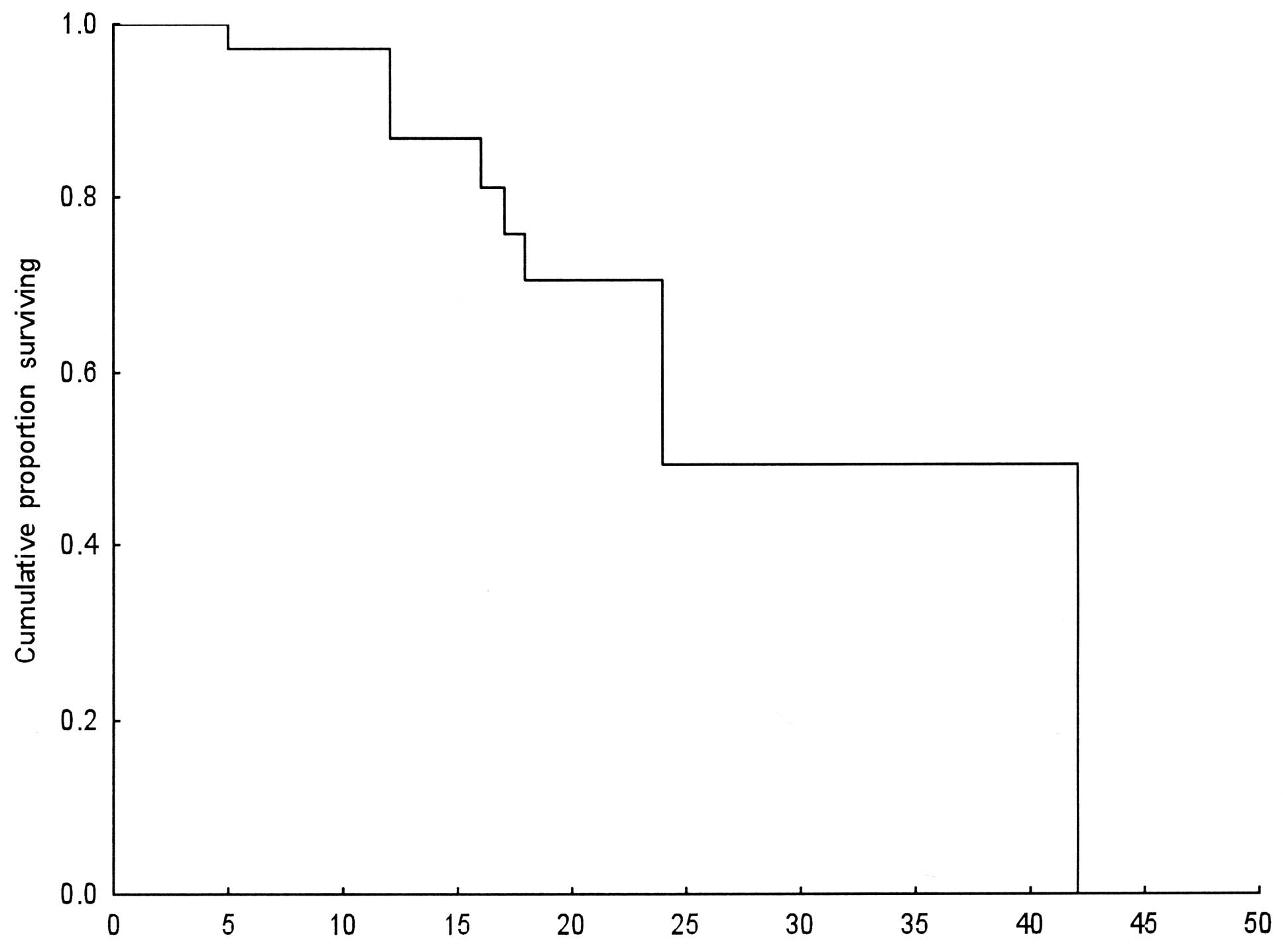
The median survival for the 40 patients was 24 months (range 5–42). A total of 26 patients (65%) survived for one year. After 2 years, 10 patients had survived (25%; Table III). The quality of life of these 10 patients was satisfactory based on the PS, which remained at 0–1.

Table III

Survival in months.

Table III

Survival in months.

Median survival24 (95% CI, 16–42)
Range5–42
One-year26 patients (65.0%)
2-year10 patients (25.0%)
Alive at the end of the study21 patients (52.5%)
Statistical analysis

The Kaplan-Meier method was used for survival distribution estimation (Fig. 1).

Figure 1

Kaplan-Meier survival curve in months.

Discussion

Colorectal cancer is a slow-growing malignancy. In the majority of patients, the result of chemotherapy in advanced metastatic disease is stabilization (17). According to the RECIST criteria, stable disease is defined as a tumor reduction of less than 30% and tumor progression of less than 20% (18). Where evaluation by CT after treatment showed stable disease, the result may be attributed to either: i) the effect of chemotherapy, which inhibited disease progression, or ii) the biological characteristics of the tumor, which define how rapidly it develops. It is difficult to verify which interpretation applies in routine clinical practice. Relevant data are required to determine whether chemotherapy plays a significant role in regulating disease progression. One example of how data may be gathered involves a comparison of treated versus non-treated patients in a randomized trial. A study by Cunningham et al, which compared chemotherapy with irinotecan plus supportive care versus supportive care alone, showed that overall survival was significantly higher in the irinotecan group (p=0.001) (18). Results by these authors showed that one-year survival for the irinotecan group was 36.2% compared with 13.8% for the supportive care group. These percentages of one-year survival for each group are lower than those obtained in our study. The reason for this discrepancy is that the previous study included the time period after the administration of second-line treatment (18). On the other hand, the results of the study by Cunningham et al (18) indicate the advantage of chemotherapy in colorectal cancer. The aim of our study was to contribute to a better understanding of the biology of colorectal cancer. Our findings indicate that this is a slow-growing disease with a 65% survival rate after 1 year, and a 25% survival rate after 2 years (10/40 patients). Local treatment administered to 11/40 patients (27.5%) contributed little to overall survival.

The long-term survival of patients with metastatic advanced colorectal cancer without systemic treatment may be due to the biological characteristics of this tumor, indicating that it is a slow-growing malignancy. These findings are useful in obviating long-term or unstoppable chemotherapy when patients are in stable disease.

References

1 

Gastrointestinal Tumor Study Group. Adjuvant therapy for colon cancer: results of a prospectively randomized trial. N Engl J Med. 310:737–740. 1984. View Article : Google Scholar : PubMed/NCBI

2 

Mulcahy HE, Toner M, Patchett SE, et al: Identifying stage B colorectal cancer patients at high risk of tumor recurrence and death. Dis Colon Rectum. 40:326–336. 1997. View Article : Google Scholar : PubMed/NCBI

3 

Moertel CG: Chemotherapy of gastrointestinal cancer. Recent Advances in Cancer Treatment. Tajnon HJ and Staquet MJ: New York: Raven Press; pp. 311–323. 1997

4 

Wolmark N, Rockette H, Fisher B, et al: The benefit of leucovorin-modulated fluorouracil as postoperative adjuvant therapy for primary colon cancer: results from National Surgical Adjuvant Breast and Bowel Project. Protocol C-03. J Clin Oncol. 11:1879–87. 1993.

5 

Francini GP and Lorenzini L: Folinic acid and 5-fluorouracil as adjuvant chemotherapy in colon cancer. Gastroenterology. 106:899–906. 1994.PubMed/NCBI

6 

De Gramont A, Vignoud J, Tournigand C, et al: Oxaliplatin with high-dose leucovorin and 5-fluorouracil 48-hour continuous infusion in pretreated metastatic colorectal cancer. Eur J Cancer. 33:214–219. 1997.

7 

Rougier P, Van Cutsem E, Bajetta E, et al: Randomised trial of irinotecan versus fluorouracil by continuous infusion after fluorouracil failure in patients with metastatic colorectal cancer. Lancet. 352:1407–1412. 1998. View Article : Google Scholar

8 

Sargent DJ, Niedzwiecki D, O’ Conell MJ, et al: Recommendation for caution with irinotecan, fluorouracil, and leucovorin for colorectal cancer. N Engl J Med. 345:144–145. 2001. View Article : Google Scholar : PubMed/NCBI

9 

De Gramont A, Figer A, Seymour M, et al: Leucovorin and fluorouracil with or without oxaliplatin as first-line treatment in advanced colorectal cancer. J Clin Oncol. 18:2938–2947. 2000.

10 

Scheithauer W, Kornek GV, Raderer M, et al: Combined irinotecan and oxaliplatin plus granulocyte colony-stimulating factor in patients with advanced fluoropyrimidine/leucovorin-pretreated colorectal cancer. J Clin Oncol. 17:902–906. 1999.

11 

Rothenberg ML: Efficiacy of oxaliplatin in the treatment of colorectal cancer. Oncology. 14:9–14. 2000.PubMed/NCBI

12 

Souglakos J, Mavroudis D, Kakolyris S, et al: Triplet combination with irinotecan plus oxaliplatin plus continuous-infusion fluorouracil and leucovorin as first-line treatment in metastatic colorectal cancer: a multicenter phase II trial. J Clin Oncol. 20:2651–2657. 2002. View Article : Google Scholar

13 

Scheithauer W, Kornek GV, Raderer M, et al: Randomized multicenter Phase II trial of two different schedules of capecitabine plus oxaliplatin as first-line treatment in advanced colorectal cancer. J Clin Oncol. 21:1307–1312. 2003. View Article : Google Scholar : PubMed/NCBI

14 

Goldberg RM, Sargent DJ, Morton RF, et al: A randomized controlled trial of fluorouracil plus leucovorin, irinotecan and oxaliplatin combinations in patients with previously untreated metastatic colorectal cancer. J Clin Oncol. 22:23–30. 2004. View Article : Google Scholar

15 

Stathopoulos GP, Rigatos SK, Stathopoulos JG, Xynotroulas JP and Dimou E: Efficacy and tolerability of oxaliplatin plus irinotecan 5-fluorouracil and leucovorin regimen in advanced stage colorectal cancer patients pretreated with irinotecan, 5-fluorouracil and leucovorin. AJ Clin Oncol. 28:565–569. 2005. View Article : Google Scholar : PubMed/NCBI

16 

Stathopoulos GP, Rigatos SK, Malamos N, et al: Long term survival of patients with advanced colorectal cancer may not be due to the response to chemotherapy. Oncology Rep. 12:1295–1300. 2004.PubMed/NCBI

17 

Therasse P, Arbuck SG, Eisenhower E, et al: New guidelines to evaluate the response to tumor in solid tumors. JNCI. 92:205–216. 2000. View Article : Google Scholar : PubMed/NCBI

18 

Cunningham D, Pyrhonen S, James RD, et al: Randomised trial of irinotecan plus supportive care versus supportive care alone after fluorouracil failure for patients with metastatic colorectal cancer. Lancet. 31(353): 1275–1276. 1999.PubMed/NCBI

Related Articles

  • Abstract
  • View
  • Download
  • Twitter
Copy and paste a formatted citation
Spandidos Publications style
Stathopoulos GP: Survival of untreated advanced colorectal cancer patients. Oncol Lett 2: 731-733, 2011.
APA
Stathopoulos, G.P. (2011). Survival of untreated advanced colorectal cancer patients. Oncology Letters, 2, 731-733. https://doi.org/10.3892/ol.2011.310
MLA
Stathopoulos, G. P."Survival of untreated advanced colorectal cancer patients". Oncology Letters 2.4 (2011): 731-733.
Chicago
Stathopoulos, G. P."Survival of untreated advanced colorectal cancer patients". Oncology Letters 2, no. 4 (2011): 731-733. https://doi.org/10.3892/ol.2011.310
Copy and paste a formatted citation
x
Spandidos Publications style
Stathopoulos GP: Survival of untreated advanced colorectal cancer patients. Oncol Lett 2: 731-733, 2011.
APA
Stathopoulos, G.P. (2011). Survival of untreated advanced colorectal cancer patients. Oncology Letters, 2, 731-733. https://doi.org/10.3892/ol.2011.310
MLA
Stathopoulos, G. P."Survival of untreated advanced colorectal cancer patients". Oncology Letters 2.4 (2011): 731-733.
Chicago
Stathopoulos, G. P."Survival of untreated advanced colorectal cancer patients". Oncology Letters 2, no. 4 (2011): 731-733. https://doi.org/10.3892/ol.2011.310
Follow us
  • Twitter
  • LinkedIn
  • Facebook
About
  • Spandidos Publications
  • Careers
  • Cookie Policy
  • Privacy Policy
How can we help?
  • Help
  • Live Chat
  • Contact
  • Email to our Support Team