Spandidos Publications Logo
  • About
    • About Spandidos
    • Aims and Scopes
    • Abstracting and Indexing
    • Editorial Policies
    • Reprints and Permissions
    • Job Opportunities
    • Terms and Conditions
    • Contact
  • Journals
    • All Journals
    • Oncology Letters
      • Oncology Letters
      • Information for Authors
      • Editorial Policies
      • Editorial Board
      • Aims and Scope
      • Abstracting and Indexing
      • Bibliographic Information
      • Archive
    • International Journal of Oncology
      • International Journal of Oncology
      • Information for Authors
      • Editorial Policies
      • Editorial Board
      • Aims and Scope
      • Abstracting and Indexing
      • Bibliographic Information
      • Archive
    • Molecular and Clinical Oncology
      • Molecular and Clinical Oncology
      • Information for Authors
      • Editorial Policies
      • Editorial Board
      • Aims and Scope
      • Abstracting and Indexing
      • Bibliographic Information
      • Archive
    • Experimental and Therapeutic Medicine
      • Experimental and Therapeutic Medicine
      • Information for Authors
      • Editorial Policies
      • Editorial Board
      • Aims and Scope
      • Abstracting and Indexing
      • Bibliographic Information
      • Archive
    • International Journal of Molecular Medicine
      • International Journal of Molecular Medicine
      • Information for Authors
      • Editorial Policies
      • Editorial Board
      • Aims and Scope
      • Abstracting and Indexing
      • Bibliographic Information
      • Archive
    • Biomedical Reports
      • Biomedical Reports
      • Information for Authors
      • Editorial Policies
      • Editorial Board
      • Aims and Scope
      • Abstracting and Indexing
      • Bibliographic Information
      • Archive
    • Oncology Reports
      • Oncology Reports
      • Information for Authors
      • Editorial Policies
      • Editorial Board
      • Aims and Scope
      • Abstracting and Indexing
      • Bibliographic Information
      • Archive
    • Molecular Medicine Reports
      • Molecular Medicine Reports
      • Information for Authors
      • Editorial Policies
      • Editorial Board
      • Aims and Scope
      • Abstracting and Indexing
      • Bibliographic Information
      • Archive
    • World Academy of Sciences Journal
      • World Academy of Sciences Journal
      • Information for Authors
      • Editorial Policies
      • Editorial Board
      • Aims and Scope
      • Abstracting and Indexing
      • Bibliographic Information
      • Archive
    • International Journal of Functional Nutrition
      • International Journal of Functional Nutrition
      • Information for Authors
      • Editorial Policies
      • Editorial Board
      • Aims and Scope
      • Abstracting and Indexing
      • Bibliographic Information
      • Archive
    • International Journal of Epigenetics
      • International Journal of Epigenetics
      • Information for Authors
      • Editorial Policies
      • Editorial Board
      • Aims and Scope
      • Abstracting and Indexing
      • Bibliographic Information
      • Archive
    • Medicine International
      • Medicine International
      • Information for Authors
      • Editorial Policies
      • Editorial Board
      • Aims and Scope
      • Abstracting and Indexing
      • Bibliographic Information
      • Archive
  • Articles
  • Information
    • Information for Authors
    • Information for Reviewers
    • Information for Librarians
    • Information for Advertisers
    • Conferences
  • Language Editing
Spandidos Publications Logo
  • About
    • About Spandidos
    • Aims and Scopes
    • Abstracting and Indexing
    • Editorial Policies
    • Reprints and Permissions
    • Job Opportunities
    • Terms and Conditions
    • Contact
  • Journals
    • All Journals
    • Biomedical Reports
      • Information for Authors
      • Editorial Policies
      • Editorial Board
      • Aims and Scope
      • Abstracting and Indexing
      • Bibliographic Information
      • Archive
    • Experimental and Therapeutic Medicine
      • Information for Authors
      • Editorial Policies
      • Editorial Board
      • Aims and Scope
      • Abstracting and Indexing
      • Bibliographic Information
      • Archive
    • International Journal of Epigenetics
      • Information for Authors
      • Editorial Policies
      • Editorial Board
      • Aims and Scope
      • Abstracting and Indexing
      • Bibliographic Information
      • Archive
    • International Journal of Functional Nutrition
      • Information for Authors
      • Editorial Policies
      • Editorial Board
      • Aims and Scope
      • Abstracting and Indexing
      • Bibliographic Information
      • Archive
    • International Journal of Molecular Medicine
      • Information for Authors
      • Editorial Policies
      • Editorial Board
      • Aims and Scope
      • Abstracting and Indexing
      • Bibliographic Information
      • Archive
    • International Journal of Oncology
      • Information for Authors
      • Editorial Policies
      • Editorial Board
      • Aims and Scope
      • Abstracting and Indexing
      • Bibliographic Information
      • Archive
    • Medicine International
      • Information for Authors
      • Editorial Policies
      • Editorial Board
      • Aims and Scope
      • Abstracting and Indexing
      • Bibliographic Information
      • Archive
    • Molecular and Clinical Oncology
      • Information for Authors
      • Editorial Policies
      • Editorial Board
      • Aims and Scope
      • Abstracting and Indexing
      • Bibliographic Information
      • Archive
    • Molecular Medicine Reports
      • Information for Authors
      • Editorial Policies
      • Editorial Board
      • Aims and Scope
      • Abstracting and Indexing
      • Bibliographic Information
      • Archive
    • Oncology Letters
      • Information for Authors
      • Editorial Policies
      • Editorial Board
      • Aims and Scope
      • Abstracting and Indexing
      • Bibliographic Information
      • Archive
    • Oncology Reports
      • Information for Authors
      • Editorial Policies
      • Editorial Board
      • Aims and Scope
      • Abstracting and Indexing
      • Bibliographic Information
      • Archive
    • World Academy of Sciences Journal
      • Information for Authors
      • Editorial Policies
      • Editorial Board
      • Aims and Scope
      • Abstracting and Indexing
      • Bibliographic Information
      • Archive
  • Articles
  • Information
    • For Authors
    • For Reviewers
    • For Librarians
    • For Advertisers
    • Conferences
  • Language Editing
Login Register Submit
  • This site uses cookies
  • You can change your cookie settings at any time by following the instructions in our Cookie Policy. To find out more, you may read our Privacy Policy.

    I agree
Search articles by DOI, keyword, author or affiliation
Search
Advanced Search
presentation
Oncology Letters
Join Editorial Board Propose a Special Issue
Print ISSN: 1792-1074 Online ISSN: 1792-1082
Journal Cover
July 2012 Volume 4 Issue 1

Full Size Image

Sign up for eToc alerts
Recommend to Library

Journals

International Journal of Molecular Medicine

International Journal of Molecular Medicine

International Journal of Molecular Medicine is an international journal devoted to molecular mechanisms of human disease.

International Journal of Oncology

International Journal of Oncology

International Journal of Oncology is an international journal devoted to oncology research and cancer treatment.

Molecular Medicine Reports

Molecular Medicine Reports

Covers molecular medicine topics such as pharmacology, pathology, genetics, neuroscience, infectious diseases, molecular cardiology, and molecular surgery.

Oncology Reports

Oncology Reports

Oncology Reports is an international journal devoted to fundamental and applied research in Oncology.

Experimental and Therapeutic Medicine

Experimental and Therapeutic Medicine

Experimental and Therapeutic Medicine is an international journal devoted to laboratory and clinical medicine.

Oncology Letters

Oncology Letters

Oncology Letters is an international journal devoted to Experimental and Clinical Oncology.

Biomedical Reports

Biomedical Reports

Explores a wide range of biological and medical fields, including pharmacology, genetics, microbiology, neuroscience, and molecular cardiology.

Molecular and Clinical Oncology

Molecular and Clinical Oncology

International journal addressing all aspects of oncology research, from tumorigenesis and oncogenes to chemotherapy and metastasis.

World Academy of Sciences Journal

World Academy of Sciences Journal

Multidisciplinary open-access journal spanning biochemistry, genetics, neuroscience, environmental health, and synthetic biology.

International Journal of Functional Nutrition

International Journal of Functional Nutrition

Open-access journal combining biochemistry, pharmacology, immunology, and genetics to advance health through functional nutrition.

International Journal of Epigenetics

International Journal of Epigenetics

Publishes open-access research on using epigenetics to advance understanding and treatment of human disease.

Medicine International

Medicine International

An International Open Access Journal Devoted to General Medicine.

Journal Cover
July 2012 Volume 4 Issue 1

Full Size Image

Sign up for eToc alerts
Recommend to Library

  • Article
  • Citations
    • Cite This Article
    • Download Citation
    • Create Citation Alert
    • Remove Citation Alert
    • Cited By
  • Similar Articles
    • Related Articles (in Spandidos Publications)
    • Similar Articles (Google Scholar)
    • Similar Articles (PubMed)
  • Download PDF
  • Download XML
  • View XML
Article

Surgical wound management made easier and more cost-effective

  • Authors:
    • Ichiro Akagi
    • Kiyonori Furukawa
    • Masao Miyashita
    • Teruo Kiyama
    • Akihisa Matsuda
    • Tsutomu Nomura
    • Hiroshi Makino
    • Nobutoshi Hagiwara
    • Ken Takahashi
    • Eiji Uchida
  • View Affiliations / Copyright

    Affiliations: Division of Surgery for Organ Function and Biological Regulation, Nippon Medical School, Tokyo, Japan
  • Pages: 97-100
    |
    Published online on: April 19, 2012
       https://doi.org/10.3892/ol.2012.687
  • Expand metrics +
Metrics: Total Views: 0 (Spandidos Publications: | PMC Statistics: )
Metrics: Total PDF Downloads: 0 (Spandidos Publications: | PMC Statistics: )
Cited By (CrossRef): 0 citations Loading Articles...

This article is mentioned in:


Abstract

Evidence-based guidelines for the prevention of surgical site infection (SSI) have been published by the U.S. Centers for Disease Control and Prevention (CDC). According to these guidelines, a wound should usually be covered with a sterile dressing for 24 to 48 h when a surgical incision is closed primarily. However, it is not recommended that an incision be covered by a dressing beyond 48 h. In this study, patients were stratified into two groups for analysis: patients whose surgical wound was sterilized and whose gauze was changed once daily until postoperative day 7 (7POD; group A); and patients whose surgical wound was sterilized and whose gauze was changed once daily until 2POD (group B). We evaluated the incidence of SSI, nursing hours and cost implications. The results showed that there was no significant difference in SSI occurrence between the two groups (group A, 10% vs. group B, 7.3%). By contrast, the average nursing time differed by 2.8 min (group A, 3.8 min vs. group B, 0.9 min). The material costs per patient were also reduced by $14.70 (group A, $61.80 vs. group B, $47.10). In conclusion, we applied our knowledge of the evidence‑based CDC guidelines to determine whether 48‑h wound management can be made easier, more uniform and more cost-effective compared to conventional wound management. The results of the present study showed that surgical wound management methods can be more convenient and inexpensive.

Introduction

Surgical wounds are given local care when healing; for example, by maintaining a moist wound environment to foster healing (1). There are numerous types of dressings (including gauze and bandages) and topical agents (including antiseptics and enzymes) available for surgical wound management. The ideal dressing for healing wounds has a number of features, including the ability to absorb and contain exudate without leakage, impermeability to water and bacteria, lack of particulate contaminants that may be left in the wound, and avoidance of wound trauma on dressing removal. However, dressings and topical agents are occasionally used inappropriately and uneconomically.

The scientific literature regarding the care of surgical wounds describes numerous advanced wound care modalities developed over the past 40 years. Among them, evidence-based guidelines for the prevention of surgical site infection (SSI) have been published by the U.S. Centers for Disease Control and Prevention (CDC) (2). This organization provides recommendations concerning the reduction of SSI risk. Each recommendation is classified on the basis of existing scientific data, theoretical rationale and applicability. According to these guidelines, the type of postoperative incision care is determined by whether the incision is closed primarily (i.e., the skin edges are re-approximated at the end of the operation), left open to be closed later, or left open to heal by second intention (2). When a surgical incision is closed primarily, as is usually the case, the incision is usually covered with a sterile dressing for 24 to 48 h. Beyond 48 h, it is unclear whether an incision should be covered by a dressing, or whether showering or bathing is detrimental to healing (2).

Most surgically sutured wounds are acute wounds that heal without complication in an expected time frame. When the incision is closed primarily, the wounds proceed through a specific cell and biochemical sequence of healing that comprises overlapping stages of hemostasis, inflammation, granulation and epithelialization within 48 h (2). Previously in our department, surgical wounds were sterilized and gauze was changed once daily until postoperative day 7 (7POD). This form of management for surgical wounds was inconsistent with the CDC guidelines, which raises the question of whether it is necessary to sterilize surgical wounds and change gauze once daily until 7POD.

In this study, patients were stratified into two groups for analysis: patients whose surgical wound was sterilized and whose gauze was changed once daily until 7POD; and patients whose surgical wound was sterilized and whose gauze was changed once daily until 2POD. We evaluated the incidence of SSI, nursing hours and cost implications.

Patients and methods

Patients

A prospective study of all patients who underwent operative treatment between May 1 and October 31, 2003, was performed. These patients were selected from all patients who were treated during that time period at the Nippon Medical School Main Hospital, Japan. Study patients were all treated by surgeons in the surgery department. This was an institutional review board-approved study, with patient consent obtained for all study patients. Study inclusion criteria included diagnosis of gastroenterological disease, breast cancer, inguinal hernia, clinical stability, and adequate postoperative follow-up documentation. Exclusion criteria included coexisting diseases, steroid use, complications (including diabetes mellitus, hypertension, hyperlipidemia and pneumonia), aged <15 years and failure to return for postoperative follow-up. Data were collected on age, gender, surgical procedure, hospital charges and follow-up. Patients were stratified into two groups for analysis: group A, patients whose surgical wound was sterilized and whose gauze was changed once daily until 7POD; and group B, patients whose surgical wound was sterilized and whose gauze was changed once daily until 2POD.

The surgical wounds of group B were not managed but were carefully observed beyond 48 h. The gauze surrounding the drainage tube was changed properly until the drainage tube was removed. Patient characteristics are shown in Table I. The two groups of patients were similar in terms of age, gender and diseases. The material cost per operation and nursing hours for changing the gauze were compared between the two groups. The prices of consumables, such as gauze, 10% isoGln liquid TM®, 0.2% Welpas® and sterilized gloves, were obtained from the national medical aids reimbursement price list. The sterilized gauze was changed an average of once daily in this study. If a wound infection was suspected based on the appearance or odor of the wound or systemic signs (such as fever or tachycardia), the gauze dressing was removed and the wound was inspected. Using a sterile technique, the wound was lavaged using saline.

Table I

Patient characteristics.

Table I

Patient characteristics.

Group A (n=40)Group B (n=41)
Male/female26/1428/13
Age (yrs.), mean ± SD61.3±20.163.2±14.9
Opened gastrointestinal tract
 Gastric cancer810
 Colon cancer57
 Cholangiocarcinoma11
 Hepatocellular carcionoma13
 Pancreatic cancer13
 Appendicitis43
 Gallstone44
Closed gastrointestinal tract
 Breast cancer43
 Inguinal hernia127

Results

Rates of surgical site infection

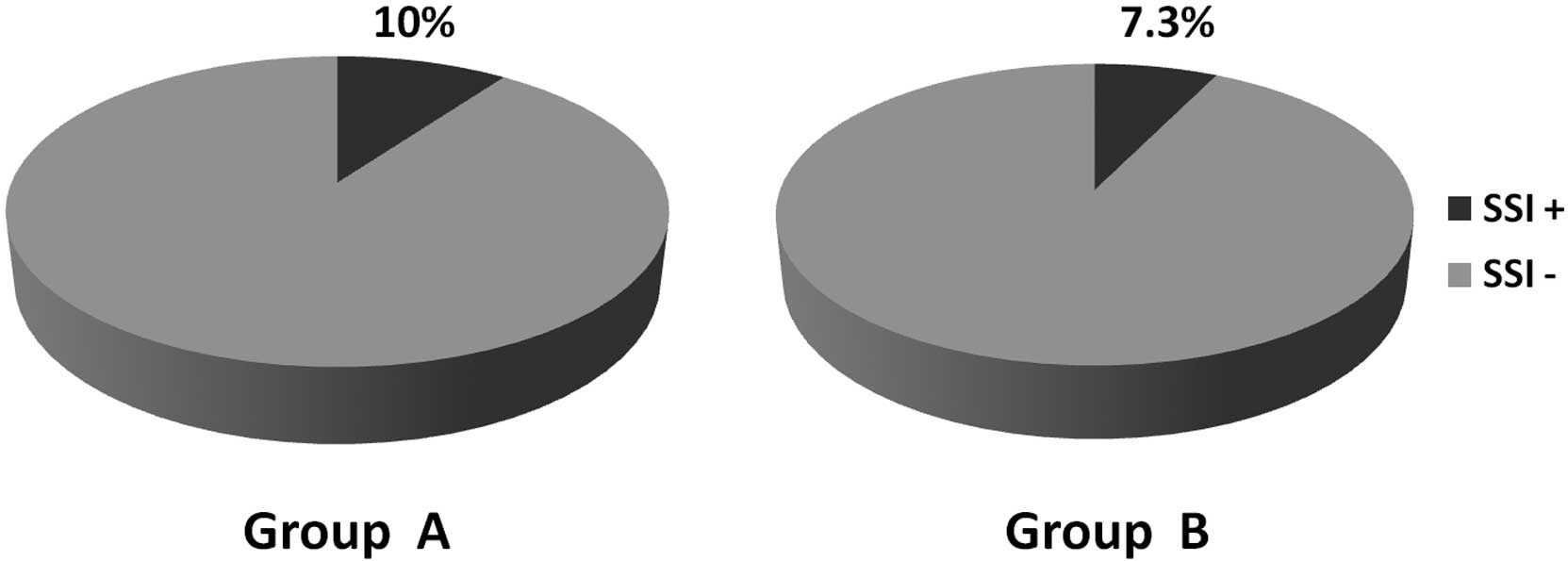
In group A, there were 4 wound infections (10%), all of which occurred in the midline wound with erythema and induration (Fig. 1). In group B, there were 3 wound infections (7.3%), all of which occurred in the midline wound (Fig. 1). These wounds were reopened and lavaged. There was no significant difference in SSI occurrence between the two groups.

Figure 1

The rates of surgical site infection (SSI). There was no significant difference in SSI occurrence (group A, 10%; group B, 7.3%).

Clinical outcomes and treatment costs

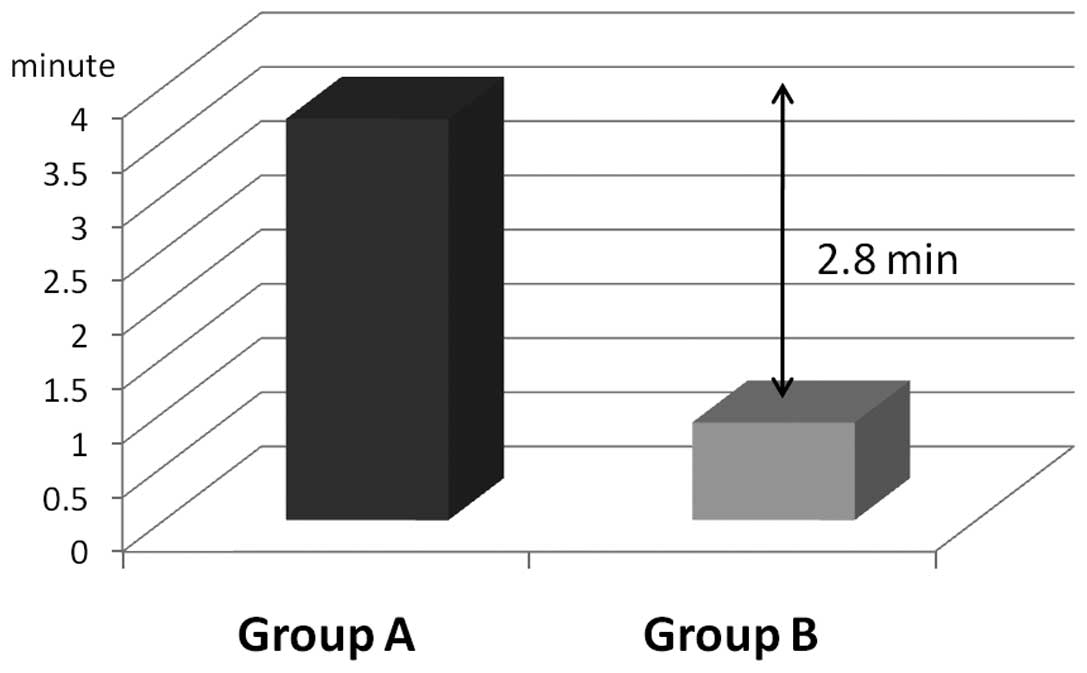
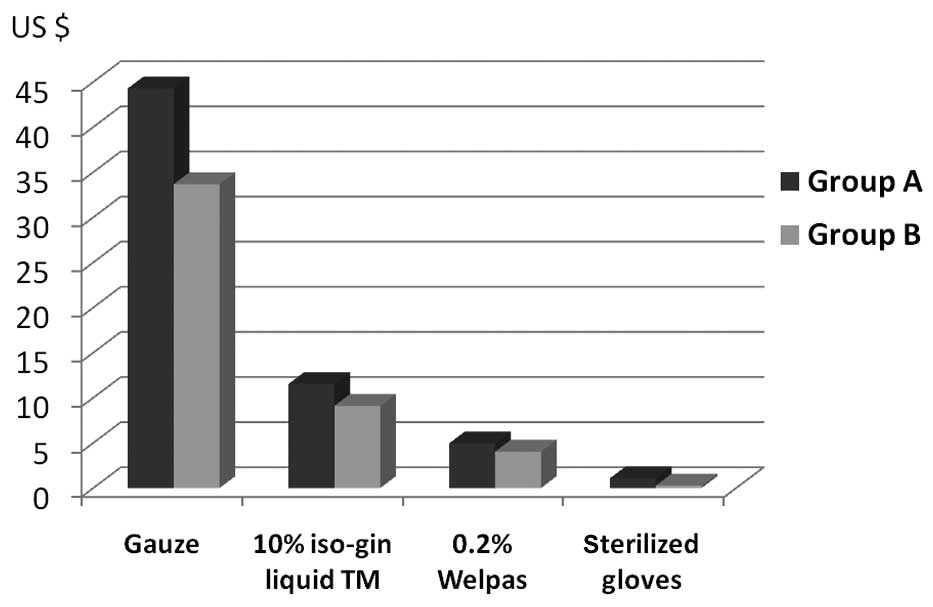
It was anticipated that the implementation of evidence-based guidelines for wound management would lead to improved clinical outcomes. The average nursing time was reduced by 2.8 min (71.1%)-3.7 min for group A patients compared with 0.9 min for group B patients (Fig. 2). Wound management for 48-h was also expected to reduce material costs. The material costs per patient were $61.80 (gauze, $44.3; 10% isoGln liquid TM, $11.50; 0.2% Welpas, $4.90; sterilized gloves, $1.10) in group A and $47.10 (gauze, $33.70; 10% isoGln liquid TM, $9.10; 0.2% Welpas, $4.00; sterilized gloves, $0.30) in group B (Fig. 3). The difference in material costs was $14.70 (a 23.8% reduction).

Figure 2

The average nursing time for changing the gauze differed by 2.8 min (71.1%)-3.7 min for group A patients compared with 0.9 min for group B patients.

Figure 3

Mean material costs of surgical wound management per operation.

Discussion

The increasing healthcare expenditure covered by the National Medical Insurance system has been a critical problem in Japan. Thus, the costs and consequences of surgical wound management should be considered a significant healthcare priority due to its prevalence and the amount of associated healthcare resource use. Surgical wounds are managed by clinicians, nurses and caregivers with essential systems of support, including specialized clinical training, links to allied health care professionals, established best practice guidelines, measuring and monitoring tools and focused commitment from health care organizations. The CDC guidelines do not recommend wound management using gauze-based dressings beyond 48 h. The development of such guidelines is occasionally complicated by the heterogeneous nature of SSIs, which makes it difficult to generalize findings from a study of a specific patient population to a wider setting, and by the fact that the impact of various routine practices (such as wearing surgical gloves) cannot be evaluated for ethical or logistical reasons (2). This is the reason for the recent development in wound management not being well-recognized among patients and health care institutions at present.

To the best of our knowledge, this is the first prospective study comparing two principles of surgical wound management, i.e., conventional 7-day vs. 48-h wound management, in surgical patients with primary wound closure. Patients were only recruited from the surgical wards of the hospital for a number of reasons. First, selecting surgical patients limited patient and wound heterogeneity. Second, the nursing staff of these wards were most familiar with the two regimens of surgical wound care. The evidence from our study shows that, in this clinical setting, 48-h wound management does not lead to greater SSI or patient discomfort than conventional 7-day wound management and is likely to be more cost-effective. In closed surgical wounds, the main function of the gauze-based dressing is to absorb blood or hemoserous fluid in the immediate postoperative phase. By contrast, gauze-based dressings potentially cause avoidable pain and trauma on removal and typically harden in the wound, requiring softening by bathing prior to extraction (3). Such pain may impact on the health-related quality of life of the patient involved. Early removal of the gauze causes less pain and improved comfort on removal. It also allows surgical patients to take a shower or bath since the material had served as a protection of the wound from environmental influences (4). Moreover, it enables not only the clinician but also nurses to assess wound healing, the condition of the surrounding skin, exudate handling and the presence of infection at any time. These factors also contribute to the quality of life of the patient.

Forty-eight hour wound management requires fewer nursing hours for the changing of the gauze, which may lead to nursing staff being re-assigned to more appropriate duties. In addition, it contributes to a reduction in the overall cost of wound management. However, our results showed that a wound can be healed at a cost of $47.10, assuming that the healing rate is constant throughout the process. This amount is low compared with the estimated cost using conventional management, which is at $61.80. Although there are certain differences in health insurance systems among countries, this low cost of treating primary closed surgical wounds is likely to be of considerable interest to medical insurers and hospitals alike.

To promote the prevalence of evidence-based guidelines, certain institutes have an identified physician champion and coordinator. Theoretically, these roles differ in the way they may exert influence to achieve desired changes, but function as change agents, using interpersonal contact and strong communication skills to build trust, promote the use of new practices, and thus affect behavior (5). The ability of opinion leaders to change practices is known to be somewhat limited, in part because studies evaluating this intervention have not described consistent methods for identifying or engaging opinion leaders (6). The cooperative structure between clinicians and nurses has resulted in the adoption of all recommended evidence-based guidelines.

There are a number of limitations to our study. One involved the difficulty in analyzing the use of antibiotics, since antibiotics were used not only for serious underlying intra-abdominal infections, where the duration and type of antibiotics in part depended on the clinical response in each patient, but also for a variety of concomitant indications (such as pneumonia or line sepsis). Therefore, it was not ethical to restrict the use of antibiotics in accordance with a specified protocol. Second, it is more likely that other factors played a more significant role in determining the hospital stay than surgical wound management. This is the reason for the length of stay not being taken into consideration in this study. Third, the investigators evaluating the wounds could not be masked, and this may have introduced a potential bias depending on each investigator’s preference for skin closure. Future studies may benefit from the use of independent assessors who are blinded to study treatment allocation.

In conclusion, we applied previous knowledge of the evidence-based CDC guidelines to determine whether 48-h wound management can be made easier, more uniform, and more cost-effective compared with conventional wound management. The results of the present study showed that surgical wound management methods can be more convenient and inexpensive. Guidelines also change over time as new methods are adopted. Adaptation and re-evaluation may therefore be required when new evidence regarding surgical wound management is published.

Acknowledgements

The authors thank the hospital committees for endorsing this study.

References

1 

Schultz GS, Sibbald RG, Falanga V, et al: Wound bed preparation: a systematic approach to wound management. Wound Repair Regen. 11(Suppl 1): 1–28. 2003. View Article : Google Scholar : PubMed/NCBI

2 

Mangram AJ, Horan TC, Pearson ML, Silver LC and Jarvis WR: Guideline for prevention of surgical site infection, 1999. Centers for Disease Control and Prevention (CDC) Hospital Infection Control Practices Advisory Committee. Am J Infect Control. 27:97–132, Quiz 133–134; Discussion 196. 1999.PubMed/NCBI

3 

Hollinworth H and Collier M: Nurses’ views about pain and trauma at dressing changes: results of a national survey. J Wound Care. 9:369–373. 2000.

4 

Hermans MH: Clinical benefit of a hydrocolloid dressing in closed surgical wounds. J ET Nurs. 20:68–72. 1993.PubMed/NCBI

5 

Thompson GN, Estabrooks CA and Degner LF: Clarifying the concepts in knowledge transfer: a literature review. J Adv Nurs. 53:691–701. 2006. View Article : Google Scholar : PubMed/NCBI

6 

Lansisalmi H, Kivimaki M, Aalto P and Ruoranen R: Innovation in healthcare: a systematic review of recent research. Nurs Sci Q. 19:65–72. 2006. View Article : Google Scholar

Related Articles

  • Abstract
  • View
  • Download
  • Twitter
Copy and paste a formatted citation
Spandidos Publications style
Akagi I, Furukawa K, Miyashita M, Kiyama T, Matsuda A, Nomura T, Makino H, Hagiwara N, Takahashi K, Uchida E, Uchida E, et al: Surgical wound management made easier and more cost-effective. Oncol Lett 4: 97-100, 2012.
APA
Akagi, I., Furukawa, K., Miyashita, M., Kiyama, T., Matsuda, A., Nomura, T. ... Uchida, E. (2012). Surgical wound management made easier and more cost-effective. Oncology Letters, 4, 97-100. https://doi.org/10.3892/ol.2012.687
MLA
Akagi, I., Furukawa, K., Miyashita, M., Kiyama, T., Matsuda, A., Nomura, T., Makino, H., Hagiwara, N., Takahashi, K., Uchida, E."Surgical wound management made easier and more cost-effective". Oncology Letters 4.1 (2012): 97-100.
Chicago
Akagi, I., Furukawa, K., Miyashita, M., Kiyama, T., Matsuda, A., Nomura, T., Makino, H., Hagiwara, N., Takahashi, K., Uchida, E."Surgical wound management made easier and more cost-effective". Oncology Letters 4, no. 1 (2012): 97-100. https://doi.org/10.3892/ol.2012.687
Copy and paste a formatted citation
x
Spandidos Publications style
Akagi I, Furukawa K, Miyashita M, Kiyama T, Matsuda A, Nomura T, Makino H, Hagiwara N, Takahashi K, Uchida E, Uchida E, et al: Surgical wound management made easier and more cost-effective. Oncol Lett 4: 97-100, 2012.
APA
Akagi, I., Furukawa, K., Miyashita, M., Kiyama, T., Matsuda, A., Nomura, T. ... Uchida, E. (2012). Surgical wound management made easier and more cost-effective. Oncology Letters, 4, 97-100. https://doi.org/10.3892/ol.2012.687
MLA
Akagi, I., Furukawa, K., Miyashita, M., Kiyama, T., Matsuda, A., Nomura, T., Makino, H., Hagiwara, N., Takahashi, K., Uchida, E."Surgical wound management made easier and more cost-effective". Oncology Letters 4.1 (2012): 97-100.
Chicago
Akagi, I., Furukawa, K., Miyashita, M., Kiyama, T., Matsuda, A., Nomura, T., Makino, H., Hagiwara, N., Takahashi, K., Uchida, E."Surgical wound management made easier and more cost-effective". Oncology Letters 4, no. 1 (2012): 97-100. https://doi.org/10.3892/ol.2012.687
Follow us
  • Twitter
  • LinkedIn
  • Facebook
About
  • Spandidos Publications
  • Careers
  • Cookie Policy
  • Privacy Policy
How can we help?
  • Help
  • Live Chat
  • Contact
  • Email to our Support Team