Spandidos Publications Logo
  • About
    • About Spandidos
    • Aims and Scopes
    • Abstracting and Indexing
    • Editorial Policies
    • Reprints and Permissions
    • Job Opportunities
    • Terms and Conditions
    • Contact
  • Journals
    • All Journals
    • Oncology Letters
      • Oncology Letters
      • Information for Authors
      • Editorial Policies
      • Editorial Board
      • Aims and Scope
      • Abstracting and Indexing
      • Bibliographic Information
      • Archive
    • International Journal of Oncology
      • International Journal of Oncology
      • Information for Authors
      • Editorial Policies
      • Editorial Board
      • Aims and Scope
      • Abstracting and Indexing
      • Bibliographic Information
      • Archive
    • Molecular and Clinical Oncology
      • Molecular and Clinical Oncology
      • Information for Authors
      • Editorial Policies
      • Editorial Board
      • Aims and Scope
      • Abstracting and Indexing
      • Bibliographic Information
      • Archive
    • Experimental and Therapeutic Medicine
      • Experimental and Therapeutic Medicine
      • Information for Authors
      • Editorial Policies
      • Editorial Board
      • Aims and Scope
      • Abstracting and Indexing
      • Bibliographic Information
      • Archive
    • International Journal of Molecular Medicine
      • International Journal of Molecular Medicine
      • Information for Authors
      • Editorial Policies
      • Editorial Board
      • Aims and Scope
      • Abstracting and Indexing
      • Bibliographic Information
      • Archive
    • Biomedical Reports
      • Biomedical Reports
      • Information for Authors
      • Editorial Policies
      • Editorial Board
      • Aims and Scope
      • Abstracting and Indexing
      • Bibliographic Information
      • Archive
    • Oncology Reports
      • Oncology Reports
      • Information for Authors
      • Editorial Policies
      • Editorial Board
      • Aims and Scope
      • Abstracting and Indexing
      • Bibliographic Information
      • Archive
    • Molecular Medicine Reports
      • Molecular Medicine Reports
      • Information for Authors
      • Editorial Policies
      • Editorial Board
      • Aims and Scope
      • Abstracting and Indexing
      • Bibliographic Information
      • Archive
    • World Academy of Sciences Journal
      • World Academy of Sciences Journal
      • Information for Authors
      • Editorial Policies
      • Editorial Board
      • Aims and Scope
      • Abstracting and Indexing
      • Bibliographic Information
      • Archive
    • International Journal of Functional Nutrition
      • International Journal of Functional Nutrition
      • Information for Authors
      • Editorial Policies
      • Editorial Board
      • Aims and Scope
      • Abstracting and Indexing
      • Bibliographic Information
      • Archive
    • International Journal of Epigenetics
      • International Journal of Epigenetics
      • Information for Authors
      • Editorial Policies
      • Editorial Board
      • Aims and Scope
      • Abstracting and Indexing
      • Bibliographic Information
      • Archive
    • Medicine International
      • Medicine International
      • Information for Authors
      • Editorial Policies
      • Editorial Board
      • Aims and Scope
      • Abstracting and Indexing
      • Bibliographic Information
      • Archive
  • Articles
  • Information
    • Information for Authors
    • Information for Reviewers
    • Information for Librarians
    • Information for Advertisers
    • Conferences
  • Language Editing
Spandidos Publications Logo
  • About
    • About Spandidos
    • Aims and Scopes
    • Abstracting and Indexing
    • Editorial Policies
    • Reprints and Permissions
    • Job Opportunities
    • Terms and Conditions
    • Contact
  • Journals
    • All Journals
    • Biomedical Reports
      • Information for Authors
      • Editorial Policies
      • Editorial Board
      • Aims and Scope
      • Abstracting and Indexing
      • Bibliographic Information
      • Archive
    • Experimental and Therapeutic Medicine
      • Information for Authors
      • Editorial Policies
      • Editorial Board
      • Aims and Scope
      • Abstracting and Indexing
      • Bibliographic Information
      • Archive
    • International Journal of Epigenetics
      • Information for Authors
      • Editorial Policies
      • Editorial Board
      • Aims and Scope
      • Abstracting and Indexing
      • Bibliographic Information
      • Archive
    • International Journal of Functional Nutrition
      • Information for Authors
      • Editorial Policies
      • Editorial Board
      • Aims and Scope
      • Abstracting and Indexing
      • Bibliographic Information
      • Archive
    • International Journal of Molecular Medicine
      • Information for Authors
      • Editorial Policies
      • Editorial Board
      • Aims and Scope
      • Abstracting and Indexing
      • Bibliographic Information
      • Archive
    • International Journal of Oncology
      • Information for Authors
      • Editorial Policies
      • Editorial Board
      • Aims and Scope
      • Abstracting and Indexing
      • Bibliographic Information
      • Archive
    • Medicine International
      • Information for Authors
      • Editorial Policies
      • Editorial Board
      • Aims and Scope
      • Abstracting and Indexing
      • Bibliographic Information
      • Archive
    • Molecular and Clinical Oncology
      • Information for Authors
      • Editorial Policies
      • Editorial Board
      • Aims and Scope
      • Abstracting and Indexing
      • Bibliographic Information
      • Archive
    • Molecular Medicine Reports
      • Information for Authors
      • Editorial Policies
      • Editorial Board
      • Aims and Scope
      • Abstracting and Indexing
      • Bibliographic Information
      • Archive
    • Oncology Letters
      • Information for Authors
      • Editorial Policies
      • Editorial Board
      • Aims and Scope
      • Abstracting and Indexing
      • Bibliographic Information
      • Archive
    • Oncology Reports
      • Information for Authors
      • Editorial Policies
      • Editorial Board
      • Aims and Scope
      • Abstracting and Indexing
      • Bibliographic Information
      • Archive
    • World Academy of Sciences Journal
      • Information for Authors
      • Editorial Policies
      • Editorial Board
      • Aims and Scope
      • Abstracting and Indexing
      • Bibliographic Information
      • Archive
  • Articles
  • Information
    • For Authors
    • For Reviewers
    • For Librarians
    • For Advertisers
    • Conferences
  • Language Editing
Login Register Submit
  • This site uses cookies
  • You can change your cookie settings at any time by following the instructions in our Cookie Policy. To find out more, you may read our Privacy Policy.

    I agree
Search articles by DOI, keyword, author or affiliation
Search
Advanced Search
presentation
Oncology Letters
Join Editorial Board Propose a Special Issue
Print ISSN: 1792-1074 Online ISSN: 1792-1082
Journal Cover
August 2012 Volume 4 Issue 2

Full Size Image

Sign up for eToc alerts
Recommend to Library

Journals

International Journal of Molecular Medicine

International Journal of Molecular Medicine

International Journal of Molecular Medicine is an international journal devoted to molecular mechanisms of human disease.

International Journal of Oncology

International Journal of Oncology

International Journal of Oncology is an international journal devoted to oncology research and cancer treatment.

Molecular Medicine Reports

Molecular Medicine Reports

Covers molecular medicine topics such as pharmacology, pathology, genetics, neuroscience, infectious diseases, molecular cardiology, and molecular surgery.

Oncology Reports

Oncology Reports

Oncology Reports is an international journal devoted to fundamental and applied research in Oncology.

Experimental and Therapeutic Medicine

Experimental and Therapeutic Medicine

Experimental and Therapeutic Medicine is an international journal devoted to laboratory and clinical medicine.

Oncology Letters

Oncology Letters

Oncology Letters is an international journal devoted to Experimental and Clinical Oncology.

Biomedical Reports

Biomedical Reports

Explores a wide range of biological and medical fields, including pharmacology, genetics, microbiology, neuroscience, and molecular cardiology.

Molecular and Clinical Oncology

Molecular and Clinical Oncology

International journal addressing all aspects of oncology research, from tumorigenesis and oncogenes to chemotherapy and metastasis.

World Academy of Sciences Journal

World Academy of Sciences Journal

Multidisciplinary open-access journal spanning biochemistry, genetics, neuroscience, environmental health, and synthetic biology.

International Journal of Functional Nutrition

International Journal of Functional Nutrition

Open-access journal combining biochemistry, pharmacology, immunology, and genetics to advance health through functional nutrition.

International Journal of Epigenetics

International Journal of Epigenetics

Publishes open-access research on using epigenetics to advance understanding and treatment of human disease.

Medicine International

Medicine International

An International Open Access Journal Devoted to General Medicine.

Journal Cover
August 2012 Volume 4 Issue 2

Full Size Image

Sign up for eToc alerts
Recommend to Library

  • Article
  • Citations
    • Cite This Article
    • Download Citation
    • Create Citation Alert
    • Remove Citation Alert
    • Cited By
  • Similar Articles
    • Related Articles (in Spandidos Publications)
    • Similar Articles (Google Scholar)
    • Similar Articles (PubMed)
  • Download PDF
  • Download XML
  • View XML
Article

The importance of molecular cytogenetic analysis prior to using cell lines in research: The case of the KG-1a leukemia cell line

  • Authors:
    • Franca Pelliccia
    • Valentina Ubertini
    • Nazario Bosco
  • View Affiliations / Copyright

    Affiliations: Department of Biology and Biotechnology, Sapienza University, I-00185 Rome, Italy, The Rockefeller University, New York, NY 10065, USA
  • Pages: 237-240
    |
    Published online on: May 9, 2012
       https://doi.org/10.3892/ol.2012.709
  • Expand metrics +
Metrics: Total Views: 0 (Spandidos Publications: | PMC Statistics: )
Metrics: Total PDF Downloads: 0 (Spandidos Publications: | PMC Statistics: )
Cited By (CrossRef): 0 citations Loading Articles...

This article is mentioned in:


Abstract

KG-1 and its less differentiated subline KG-1a are leukemia cell lines used in research in a number of laboratories. The karyotypes of the two lines were initially identical. In the following years, further analysis revealed that the cell lines had acquired additional karyotypical abnormalities and differed in the presence of certain typical chromosomal rearrangements. To obtain cytogenetic authentication prior to the use of the two cell lines, we analyzed their karyotype by combining DAPI- and CMA-chromosome bandings and a fluorescence in situ hybridization (FISH)-based approach by using BAC clones useful for the identification of chromosome regions of interest. Sequences of the MYC, PLZF, RARA and BCR genes, that are known to play a critical role in leukemogenesis, and certain BAC clones mapped to five known common fragile sites (CFS) were used for the FISH analysis. A telomeric probe (TTAGGG)n and a set of BAC clones were used to characterize the marker chromosome der(1) that was observed in the cell line KG-1a. The existence of notable differences between the karyotype of the KG-1a cell line previously described, and that described in this study, demonstrate that the use of established cancer cell lines should be preceded by cytogenetic and/or molecular characterization.

Introduction

KG-1 and KG-1a leukemia cell lines have been used in research in numerous laboratories. KG-1, a cell line established in 1978 by Koeffler and Golde (1), was derived from the bone marrow of a male individual with erythroleukemia that developed into acute myeloid leukemia (AML). The KG-1 cells are mostly at the myeloblast or promyelocyte stage of maturation.

KG-1a is a less differentiated subline of KG-1 developed after 35 passages. The karyotypes of the two lines were initially identical (2). The comparative karyotypic analysis of the two cell lines performed in subsequent years by other authors using various cytogenetic and molecular techniques (3,4) revealed that the cell lines had acquired additional karyotypical abnormalities and, although sharing several identical structural aberrations, differed in the presence of certain typical chromosomal rearrangements. Particularly, Mrózek et al (4) used G-banding, spectral karyotyping (SKY) and fluorescence in situ hybridization (FISH) analyses to produce a detailed description of chromosome aberrations in the KG-1 and KG-1a cell lines. Comparative analysis of the two karyotypes is extremely useful for authentication of the two cell lines.

To obtain a characterization and cytogenetic authentication of the two cell lines prior to use, their karyotype was analyzed by combining DAPI- and CMA-chromosome bandings and a FISH-based approach. For FISH analyses a number of BAC clones useful for the identification of chromosome regions of interest were employed, including the MYC, retinoic acid receptor (RARA), promyelocytic leukemia zinc finger (PLZF) and breakpoint cluster region (BCR) genes. Evidence suggests that the MYC copy number gain has a role in human myeloid leukemia (5 and refs. cited therein). The RARA, PLZF and BCR genes are known to be involved in translocations generating fusion proteins that play a critical role in leukemogenesis (6). A number of BAC clones mapped to five known common fragile sites (CFS) were also used. CFS are preferential loci for double strand DNA breaks under stressful growing cell conditions. In cancer cells, CFS are frequently involved in recurrent chromosome rearrangements (7). A number of BAC clones mapped on chromosome 1 were used to characterize the marker chromosome der(1) that we observed in the cell line KG-1a. This study reveals the results of our analysis.

Materials and methods

Cell lines

The analyzed KG-1 and KG-1a cell lines were obtained from the American Type Culture Collection (Manassas, VA, USA) approximately 20 years ago. The cells had not been maintained in culture for long periods of time but were refreshed a certain number of times. The cells were cultured in RPMI-1640 with 2 mM L-glutamine, 10% FCS at 37°C in 5% CO2.

Chromosome analysis

Cell harvesting, DAPI- and CMA-chromosome bandings were performed using standard methods. The BAC clones used for the FISH analysis were: RP11-440N18 mapped at 8q24.21 that contains the entire MYC gene; RP11-1006G20 (11q23.2), the majority of the PLZF gene; RP11-1152A10 (17q21.2), the entire RARA gene; and RP11-434O9 (22q11.23), the first part of the BCR gene. BAC clones mapped to five known CFS were also used: RP11-158L8 (FRA2G, 2q31), RP11-48E21 (FRA3B, 3p14.2), RP11-425P5 (FRA7B, 7p22.1), RP11-36B6 (FRA7H, 7q32.3) and RP11-264L1 (FRA16D, 16q23.2). We also used a telomeric probe (TTAGGG)n, generated by PCR (8) and a set of BAC clones mapped onto chromosome 1 to characterize the marker chromosome der(1) that was observed in the cell line KG-1a: RP11-319A11 (1p36.32), RP11-79E5 (1q12), RP11-434B7 (1q32.3), RP11-385F5 (1q43) and RP11-438F14 (1q44). The BAC stabs were obtained from CHORI (Oakland, CA, USA), and a number of them were supplied by the Cytogenetic Unit of the University of Bari (Italy). FISH experiments were performed as described in a previous study (9).

Results

KG-1 cell line karyotype

The karyotype of the KG-1 and KG-1a cell lines revealed a pseudodiploid modal number of chromosomes. The karyotype of the KG-1 cell line analyzed was the same as that described by Mrózek et al (4): 46,der(4)t(4;8)(q31;p21),−5,del(7)(q22q35), der(8)t(8;12)(p11;q13),+idic(8)(p11)x2,−12, der(17)(5pter→5p11::5q13→5q31::17p11.2→cen→17qter),der(20)t(12;20)(?;p13). Therefore the MYC gene was present in six copies: one on a normal chromosome 8, four on the two copies of the idic(8)(p11) and one on the der(8)t(8;12); the PLZF and BCR genes were present in the normal number and chromosomal location and the RARA gene was present in two copies: one localized on a normal chromosome 17, the other on the short arm of the der(17)t(5;17).

KG-1a cell line karyotype

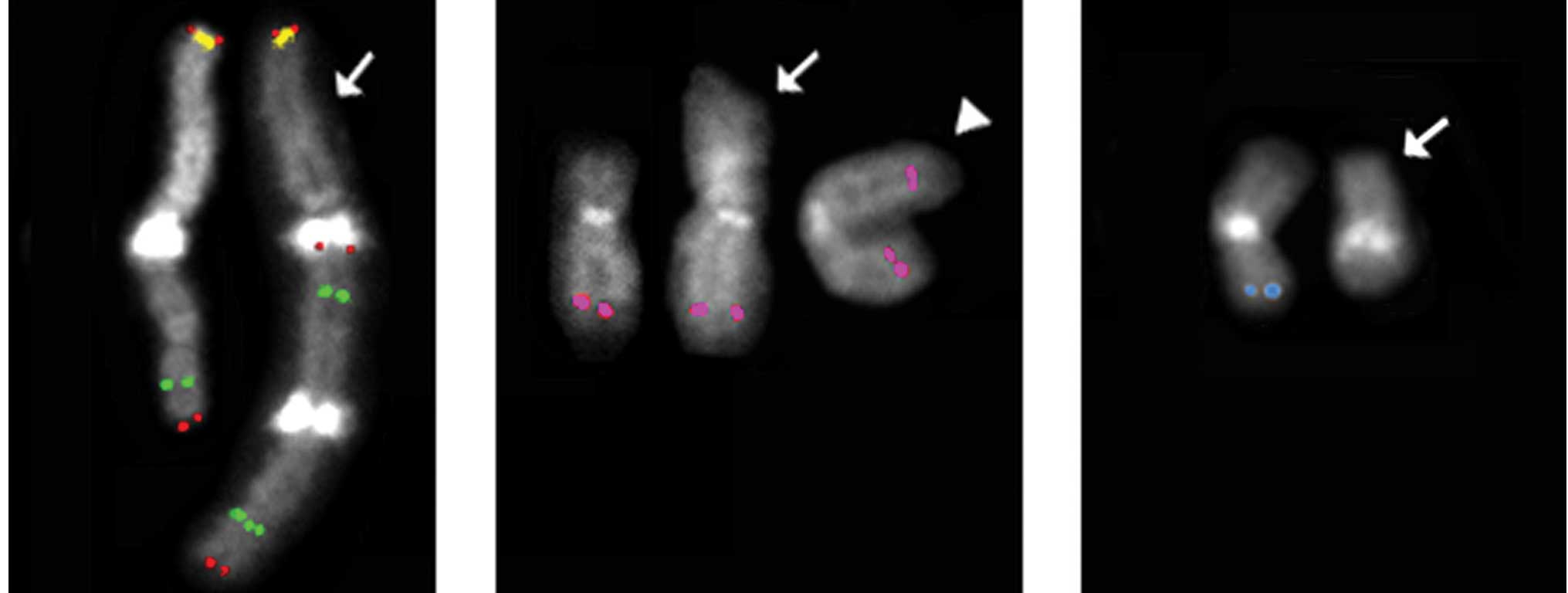
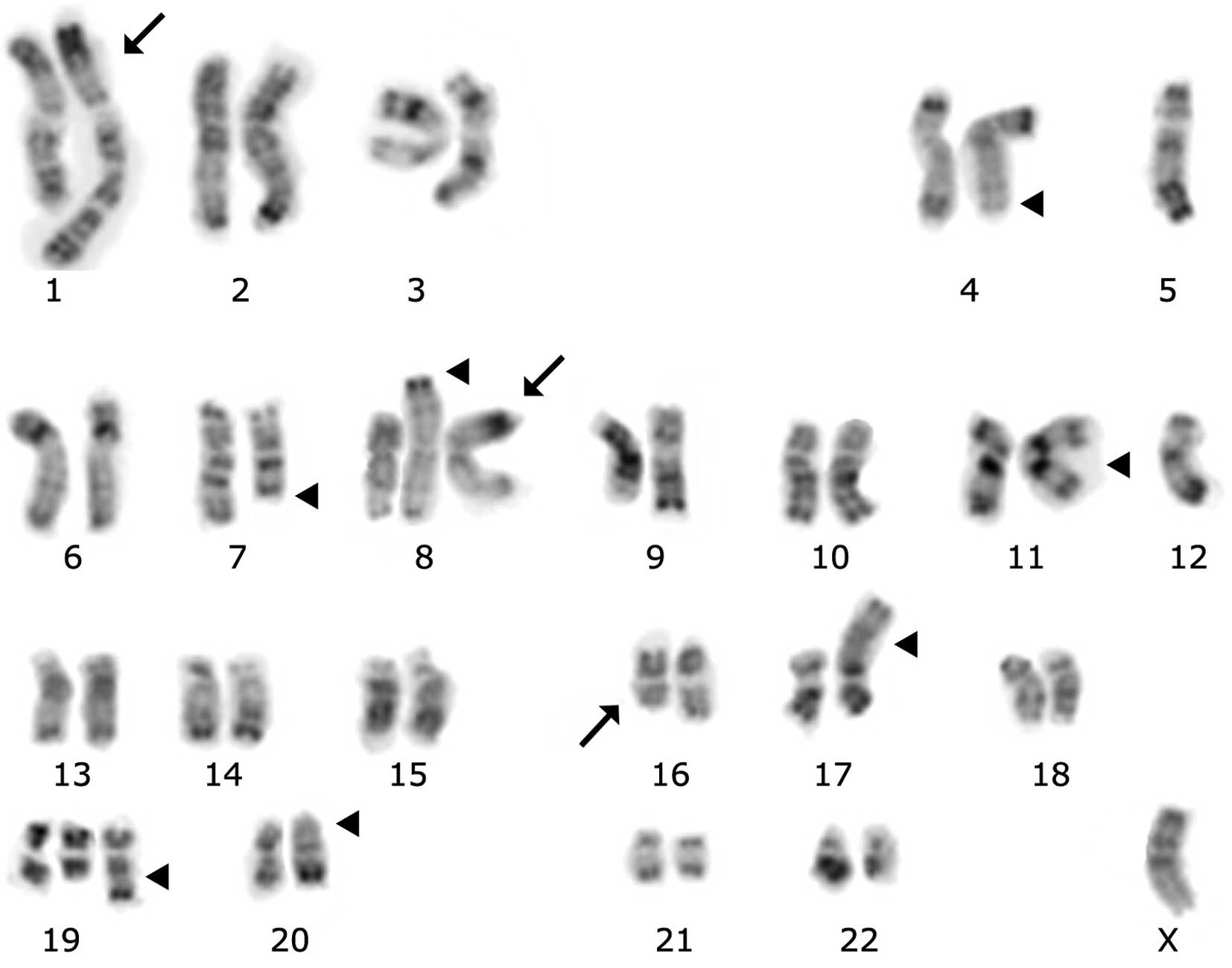
Differing from KG-1, the karyotype of the KG-1a cell line showed specific differences from that described by Mrózek et al (4): the presence, besides a normal chromosome 1, of a chromosome der(1) that has the duplication of the entire long arm (Fig. 1A); chromosome der(8;12) (Fig. 1B, arrow) instead of the der(8;22); only one normal copy of the chromosome 11 besides the i(11)(q10); a deleted chromosome 16q (Fig. 1C); two normal copies of chromosome 22 and lack of the chromosome Y. Accordingly, the description of the KG-1a karyotype observed (Fig. 2) is: 45-47,X,-Y,der(1)(pter→cen→q12::qter→q12::q12→qter), der(4)t(4;8)(q31;p21),−5,del(7)(q22q35),der(8)t(8;12)(p11;q13), +idic(8)(p11),i(11)(q10),−12,del(16)(q13~21), der(17)(5pter→5p11::5q13→5q31::17p11.2→cen→17qter), +der(19)t(14;19)(q13;q13.4),der(20)t(12;20)(?;p13).

Figure 1

FISH experiments on chromosomes from KG-1a cells. (A) Chromosomes 1 and der(1) (arrow) are hybridized by a telomeric probe (red), BAC clones RP11-319A11 (yellow) and RP11-434B7 (green). The palindromic arrangement of the last clone and the interchromosomal telomeric signal can be detected on the chromosome der(1). (B) Chromosomes 8, der(8)t(8;12) (arrow) and idic(8)(p11) (arrowhead) are hybridized by the BAC clone RP11-440N18 (MYC). (C) Chromosomes 16 and del(16) are hybridized by the BAC clone RP11-264L1 (FRA16D). FISH, fluorescence in situ hybridization.

Figure 2

R-banding karyotype of the KG-1a cell line as mentioned in Materials and methods. The arrowheads indicate the chromosome rearrangements previously described by Mrózek et al (4). The arrows indicate the rearrangements only present in the KG-1a cell line described in the present study.

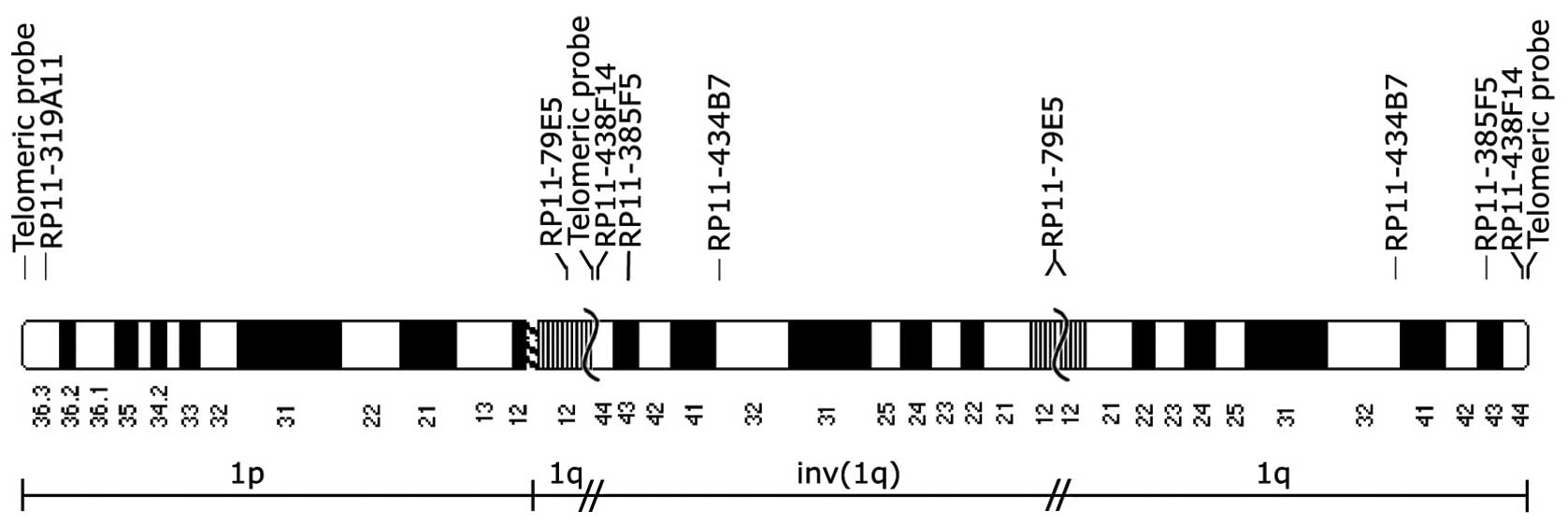
Therefore, in the KG-1a karyotype the MYC gene was present in four copies: one on a normal chromosome 8, two on the idic(8)(p11) and one on the der(8)t(8;12) (Fig. 1B). We also observed that the PLZF gene was present in three copies: one on a normal chromosome 11 and two on the i(11)(q10). The RARA gene was present in two copies: one localized on a normal chromosome 17, the other on the short arm of the der(17)t(5;17). The BCR gene was present in normal number and chromosomal location on two chromosomes 22. Of note is that due to the presence of the chromosome der(1) bearing two copies of the long arm of the chromosome 1, three copies of the 54 genes indicated as involved in cancer (10) localized on the long arm of this chromosome are present (Fig. 3).

Figure 3

Map of the chromosome der(1) showing the BAC clones used as probes in the present study. The two curved lines indicate the breakpoint at the origin of the rearranged chromosome.

Discussion

Koeffler et al (2) reported the presence of a large submetacentric chromosome (MAR-1) in the karyotype of the KG-1 and KG-1a cell lines, besides two normal copies of chromosome 1. Moreover, Furley et al (3) described the presence of a der(1) (mar 1) only partially identified and slightly different in the two cell lines, besides two normal copies of chromosome 1. Therefore, it is likely that the KG-1 cell line examined by Mrózek et al (4) and by the authors of this study has lost the chromosome MAR-1 observed by Koeffler et al (2) and by Furley et al (3) and has maintained two copies of chromosome 1. Conversely, the KG-1a cell line examined by Mrózek et al (4) lost the chromosome MAR-1 and maintained the two copies of chromosome 1, whereas the KG-1a cell line examined in the present study has lost one normal chromosome 1 and maintained the der(1) described in the present study.

The differences between the KG-1a karyotype described by Mrózek et al (4) and the one described in the present study demonstrate again that although the established cancer cell lines maintained in culture or refreshed numerous times in different laboratories derive from the same original cell lines, they may have different genotypic characteristics due either to the selection of subclones or to intervening mutations. Therefore, the use of established cancer cell lines for research purposes in cancer biology, and in any other field, should be preceded by a proper cytogenetic and molecular characterization (11).

References

1 

Koeffler HP and Golde DW: Acute myelogenous leukemia: a human cell line responsive to colony-stimulating activity. Science. 200:1153–1154. 1978. View Article : Google Scholar : PubMed/NCBI

2 

Koeffler HP, Billing R, Lusis AJ, et al: An undifferentiated variant derived from the human acute myelogenous leukemia cell line (KG-1). Blood. 56:265–273. 1980.PubMed/NCBI

3 

Furley AJ, Reeves BR, Mizutani S, et al: Divergent molecular phenotypes of KG1 and KG1a myeloid cell lines. Blood. 68:1101–1107. 1986.PubMed/NCBI

4 

Mrózek K, Tanner SM, Heinonen K and Bloomfield CD: Molecular cytogenetic characterization of the KG-1 and KG-1a acute myeloid leukemia cell lines by use of spectral karyotyping and fluorescence in situ hybridization. Genes Chromosomes Cancer. 38:249–252. 2003.PubMed/NCBI

5 

Jones L, Wei G, Sevcikova S, et al: Gain of MYC underlies recurrent trisomy of the MYC chromosome in acute promyelocytic leukemia. J Exp Med. 207:2581–2594. 2010. View Article : Google Scholar : PubMed/NCBI

6 

Guidez F, Parks S, Wong H, et al: RARalpha-PLZF overcomes PLZF-mediated repression of CRABPI, contributing to retinoid resistance in t(11;17) acute promyelocytic leukemia. Proc Natl Acad Sci USA. 104:18694–18699. 2007. View Article : Google Scholar : PubMed/NCBI

7 

Arlt MF, Casper AM and Glover TW: Common fragile sites. Cytogenet Genome Res. 100:92–100. 2003. View Article : Google Scholar

8 

Ijdo WJ, Wells RA, Baldini A and Reeders ST: Improved telomere detection using a telomere repeat probe (TTAGGG)n generated by PCR. Nucleic Acids Res. 19:47801991. View Article : Google Scholar : PubMed/NCBI

9 

Pelliccia F, Bosco N and Rocchi A: Breakages at common fragile sites set boundaries of amplified regions in two leukemia cell lines K562 - Molecular characterization of FRA2H and localization of a new CFS FRA2S. Cancer Lett. 299:37–44. 2010. View Article : Google Scholar : PubMed/NCBI

10 

Dessen P, Knuutila S and Huret JL: Chromosome. Atlas Cytogenet Oncol Haematol. Jul. 2004, Updated 2010. http://AtlasGeneticsOncology.org.

11 

Hughes P, Marshall D, Reid Y, et al: The costs of using unauthenticated, over-passaged cell lines: how much more data do we need? Biotechniques. 43:575–586. 2007. View Article : Google Scholar : PubMed/NCBI

Related Articles

  • Abstract
  • View
  • Download
  • Twitter
Copy and paste a formatted citation
Spandidos Publications style
Pelliccia F, Ubertini V and Bosco N: The importance of molecular cytogenetic analysis prior to using cell lines in research: The case of the KG-1a leukemia cell line. Oncol Lett 4: 237-240, 2012.
APA
Pelliccia, F., Ubertini, V., & Bosco, N. (2012). The importance of molecular cytogenetic analysis prior to using cell lines in research: The case of the KG-1a leukemia cell line. Oncology Letters, 4, 237-240. https://doi.org/10.3892/ol.2012.709
MLA
Pelliccia, F., Ubertini, V., Bosco, N."The importance of molecular cytogenetic analysis prior to using cell lines in research: The case of the KG-1a leukemia cell line". Oncology Letters 4.2 (2012): 237-240.
Chicago
Pelliccia, F., Ubertini, V., Bosco, N."The importance of molecular cytogenetic analysis prior to using cell lines in research: The case of the KG-1a leukemia cell line". Oncology Letters 4, no. 2 (2012): 237-240. https://doi.org/10.3892/ol.2012.709
Copy and paste a formatted citation
x
Spandidos Publications style
Pelliccia F, Ubertini V and Bosco N: The importance of molecular cytogenetic analysis prior to using cell lines in research: The case of the KG-1a leukemia cell line. Oncol Lett 4: 237-240, 2012.
APA
Pelliccia, F., Ubertini, V., & Bosco, N. (2012). The importance of molecular cytogenetic analysis prior to using cell lines in research: The case of the KG-1a leukemia cell line. Oncology Letters, 4, 237-240. https://doi.org/10.3892/ol.2012.709
MLA
Pelliccia, F., Ubertini, V., Bosco, N."The importance of molecular cytogenetic analysis prior to using cell lines in research: The case of the KG-1a leukemia cell line". Oncology Letters 4.2 (2012): 237-240.
Chicago
Pelliccia, F., Ubertini, V., Bosco, N."The importance of molecular cytogenetic analysis prior to using cell lines in research: The case of the KG-1a leukemia cell line". Oncology Letters 4, no. 2 (2012): 237-240. https://doi.org/10.3892/ol.2012.709
Follow us
  • Twitter
  • LinkedIn
  • Facebook
About
  • Spandidos Publications
  • Careers
  • Cookie Policy
  • Privacy Policy
How can we help?
  • Help
  • Live Chat
  • Contact
  • Email to our Support Team