Spandidos Publications Logo
  • About
    • About Spandidos
    • Aims and Scopes
    • Abstracting and Indexing
    • Editorial Policies
    • Reprints and Permissions
    • Job Opportunities
    • Terms and Conditions
    • Contact
  • Journals
    • All Journals
    • Oncology Letters
      • Oncology Letters
      • Information for Authors
      • Editorial Policies
      • Editorial Board
      • Aims and Scope
      • Abstracting and Indexing
      • Bibliographic Information
      • Archive
    • International Journal of Oncology
      • International Journal of Oncology
      • Information for Authors
      • Editorial Policies
      • Editorial Board
      • Aims and Scope
      • Abstracting and Indexing
      • Bibliographic Information
      • Archive
    • Molecular and Clinical Oncology
      • Molecular and Clinical Oncology
      • Information for Authors
      • Editorial Policies
      • Editorial Board
      • Aims and Scope
      • Abstracting and Indexing
      • Bibliographic Information
      • Archive
    • Experimental and Therapeutic Medicine
      • Experimental and Therapeutic Medicine
      • Information for Authors
      • Editorial Policies
      • Editorial Board
      • Aims and Scope
      • Abstracting and Indexing
      • Bibliographic Information
      • Archive
    • International Journal of Molecular Medicine
      • International Journal of Molecular Medicine
      • Information for Authors
      • Editorial Policies
      • Editorial Board
      • Aims and Scope
      • Abstracting and Indexing
      • Bibliographic Information
      • Archive
    • Biomedical Reports
      • Biomedical Reports
      • Information for Authors
      • Editorial Policies
      • Editorial Board
      • Aims and Scope
      • Abstracting and Indexing
      • Bibliographic Information
      • Archive
    • Oncology Reports
      • Oncology Reports
      • Information for Authors
      • Editorial Policies
      • Editorial Board
      • Aims and Scope
      • Abstracting and Indexing
      • Bibliographic Information
      • Archive
    • Molecular Medicine Reports
      • Molecular Medicine Reports
      • Information for Authors
      • Editorial Policies
      • Editorial Board
      • Aims and Scope
      • Abstracting and Indexing
      • Bibliographic Information
      • Archive
    • World Academy of Sciences Journal
      • World Academy of Sciences Journal
      • Information for Authors
      • Editorial Policies
      • Editorial Board
      • Aims and Scope
      • Abstracting and Indexing
      • Bibliographic Information
      • Archive
    • International Journal of Functional Nutrition
      • International Journal of Functional Nutrition
      • Information for Authors
      • Editorial Policies
      • Editorial Board
      • Aims and Scope
      • Abstracting and Indexing
      • Bibliographic Information
      • Archive
    • International Journal of Epigenetics
      • International Journal of Epigenetics
      • Information for Authors
      • Editorial Policies
      • Editorial Board
      • Aims and Scope
      • Abstracting and Indexing
      • Bibliographic Information
      • Archive
    • Medicine International
      • Medicine International
      • Information for Authors
      • Editorial Policies
      • Editorial Board
      • Aims and Scope
      • Abstracting and Indexing
      • Bibliographic Information
      • Archive
  • Articles
  • Information
    • Information for Authors
    • Information for Reviewers
    • Information for Librarians
    • Information for Advertisers
    • Conferences
  • Language Editing
Spandidos Publications Logo
  • About
    • About Spandidos
    • Aims and Scopes
    • Abstracting and Indexing
    • Editorial Policies
    • Reprints and Permissions
    • Job Opportunities
    • Terms and Conditions
    • Contact
  • Journals
    • All Journals
    • Biomedical Reports
      • Information for Authors
      • Editorial Policies
      • Editorial Board
      • Aims and Scope
      • Abstracting and Indexing
      • Bibliographic Information
      • Archive
    • Experimental and Therapeutic Medicine
      • Information for Authors
      • Editorial Policies
      • Editorial Board
      • Aims and Scope
      • Abstracting and Indexing
      • Bibliographic Information
      • Archive
    • International Journal of Epigenetics
      • Information for Authors
      • Editorial Policies
      • Editorial Board
      • Aims and Scope
      • Abstracting and Indexing
      • Bibliographic Information
      • Archive
    • International Journal of Functional Nutrition
      • Information for Authors
      • Editorial Policies
      • Editorial Board
      • Aims and Scope
      • Abstracting and Indexing
      • Bibliographic Information
      • Archive
    • International Journal of Molecular Medicine
      • Information for Authors
      • Editorial Policies
      • Editorial Board
      • Aims and Scope
      • Abstracting and Indexing
      • Bibliographic Information
      • Archive
    • International Journal of Oncology
      • Information for Authors
      • Editorial Policies
      • Editorial Board
      • Aims and Scope
      • Abstracting and Indexing
      • Bibliographic Information
      • Archive
    • Medicine International
      • Information for Authors
      • Editorial Policies
      • Editorial Board
      • Aims and Scope
      • Abstracting and Indexing
      • Bibliographic Information
      • Archive
    • Molecular and Clinical Oncology
      • Information for Authors
      • Editorial Policies
      • Editorial Board
      • Aims and Scope
      • Abstracting and Indexing
      • Bibliographic Information
      • Archive
    • Molecular Medicine Reports
      • Information for Authors
      • Editorial Policies
      • Editorial Board
      • Aims and Scope
      • Abstracting and Indexing
      • Bibliographic Information
      • Archive
    • Oncology Letters
      • Information for Authors
      • Editorial Policies
      • Editorial Board
      • Aims and Scope
      • Abstracting and Indexing
      • Bibliographic Information
      • Archive
    • Oncology Reports
      • Information for Authors
      • Editorial Policies
      • Editorial Board
      • Aims and Scope
      • Abstracting and Indexing
      • Bibliographic Information
      • Archive
    • World Academy of Sciences Journal
      • Information for Authors
      • Editorial Policies
      • Editorial Board
      • Aims and Scope
      • Abstracting and Indexing
      • Bibliographic Information
      • Archive
  • Articles
  • Information
    • For Authors
    • For Reviewers
    • For Librarians
    • For Advertisers
    • Conferences
  • Language Editing
Login Register Submit
  • This site uses cookies
  • You can change your cookie settings at any time by following the instructions in our Cookie Policy. To find out more, you may read our Privacy Policy.

    I agree
Search articles by DOI, keyword, author or affiliation
Search
Advanced Search
presentation
Oncology Letters
Join Editorial Board Propose a Special Issue
Print ISSN: 1792-1074 Online ISSN: 1792-1082
Journal Cover
January 2013 Volume 5 Issue 1

Full Size Image

Sign up for eToc alerts
Recommend to Library

Journals

International Journal of Molecular Medicine

International Journal of Molecular Medicine

International Journal of Molecular Medicine is an international journal devoted to molecular mechanisms of human disease.

International Journal of Oncology

International Journal of Oncology

International Journal of Oncology is an international journal devoted to oncology research and cancer treatment.

Molecular Medicine Reports

Molecular Medicine Reports

Covers molecular medicine topics such as pharmacology, pathology, genetics, neuroscience, infectious diseases, molecular cardiology, and molecular surgery.

Oncology Reports

Oncology Reports

Oncology Reports is an international journal devoted to fundamental and applied research in Oncology.

Experimental and Therapeutic Medicine

Experimental and Therapeutic Medicine

Experimental and Therapeutic Medicine is an international journal devoted to laboratory and clinical medicine.

Oncology Letters

Oncology Letters

Oncology Letters is an international journal devoted to Experimental and Clinical Oncology.

Biomedical Reports

Biomedical Reports

Explores a wide range of biological and medical fields, including pharmacology, genetics, microbiology, neuroscience, and molecular cardiology.

Molecular and Clinical Oncology

Molecular and Clinical Oncology

International journal addressing all aspects of oncology research, from tumorigenesis and oncogenes to chemotherapy and metastasis.

World Academy of Sciences Journal

World Academy of Sciences Journal

Multidisciplinary open-access journal spanning biochemistry, genetics, neuroscience, environmental health, and synthetic biology.

International Journal of Functional Nutrition

International Journal of Functional Nutrition

Open-access journal combining biochemistry, pharmacology, immunology, and genetics to advance health through functional nutrition.

International Journal of Epigenetics

International Journal of Epigenetics

Publishes open-access research on using epigenetics to advance understanding and treatment of human disease.

Medicine International

Medicine International

An International Open Access Journal Devoted to General Medicine.

Journal Cover
January 2013 Volume 5 Issue 1

Full Size Image

Sign up for eToc alerts
Recommend to Library

  • Article
  • Citations
    • Cite This Article
    • Download Citation
    • Create Citation Alert
    • Remove Citation Alert
    • Cited By
  • Similar Articles
    • Related Articles (in Spandidos Publications)
    • Similar Articles (Google Scholar)
    • Similar Articles (PubMed)
  • Download PDF
  • Download XML
  • View XML
Article

Superficial spreading squamous cell carcinoma of the uterine cervix involving the endometrium: Report of two cases with emphasis on the likely molecular mechanism

  • Authors:
    • Mitsuaki Ishida
    • Hidetoshi Okabe
  • View Affiliations / Copyright

    Affiliations: Department of Clinical Laboratory Medicine and Division of Diagnostic Pathology, Shiga University of Medical Science, Shiga, Japan
  • Pages: 31-34
    |
    Published online on: October 3, 2012
       https://doi.org/10.3892/ol.2012.953
  • Expand metrics +
Metrics: Total Views: 0 (Spandidos Publications: | PMC Statistics: )
Metrics: Total PDF Downloads: 0 (Spandidos Publications: | PMC Statistics: )
Cited By (CrossRef): 0 citations Loading Articles...

This article is mentioned in:


Abstract

Squamous cell carcinoma (SCC) of the cervix generally invades directly into the uterine wall, but in rare cases it spreads superficially to the inner surface of the uterus, thereby replacing the endometrium. This type is called superficial spreading SCC. In the present study we report two cases of this unusual form of cervical SCC and discuss the possible molecular mechanism involved. Two females, aged 64 (case 1) and 59 (case 2) years old, presented with post-menopausal vaginal bleeding. Histopathological studies of the resected specimens revealed non-keratinizing SCC of the cervix (pTIIA1 in case 1 and pTIIB in case 2). A notable finding in the two tumors was that atypical squamous cells were extending and replacing the endometrium directly from the cervix. Glandular involvement of atrophic endometrial glands was observed, however no invasive growth was observed in the endometrium in either case. Immunohistochemical studies revealed that CD138 was strongly expressed in the carcinoma cells superficially spreading in the endometrium in the two cases. It has been reported that the loss of expression of CD138, a cell-surface heparan sulfate proteoglycan participating in cell-cell and cell-extracellular matrix interactions, is correlated with tumor invasion and progression to cervical SCC. Our present findings suggest that CD138 expression in carcinoma cells may participate in superficial spread by regulating cell-cell interactions.

Introduction

Squamous cell carcinoma (SCC) is the most common malignant tumor of the cervix, comprising 70–80% of cervical malignancies. Cervical SCC generally invades directly into the uterine wall with or without parametrial involvement. Cervical SCC that spreads superficially to the inner surface of the uterus and replaces the endometrium with carcinoma cells is called superficial spreading SCC and has been extremely rarely reported (1–4). In the present study, we report two additional cases of superficial spreading SCC of the cervix involving the endometrium and discuss the possible molecular mechanism of this unusual spreading form of cervical SCC. This study was approved by the Ethics Committee of Shiga, University of Medical Science, Shiga, Japan. Consent was obtained from the patients.

Patients and methods

Case reports
Case 1

A 64-year-old Japanese female presented with persistent post-menopausal vaginal bleeding. Cervical biopsy at a gynecological clinic revealed invasive SCC and the patient was referred to Shiga University of Medical Science Hospital. The patient was pre-operatively classified as clinical stage IIA1 since vaginal examination revealed vaginal involvement of the cervical cancer and the tumor size was 1 cm. The patient underwent total hysterectomy and bilateral salpingo-oophorectomy.

The post-operative course has been uneventful, and the patient has been free from tumor recurrence or metastasis for 10 months.

Case 2

A 59-year-old Japanese female presented with persistent post-menopausal vaginal bleeding. Cervical smear at a gynecological clinic revealed presence of a high-grade squamous intraepithelial lesion and the patient was referred to Shiga University of Medical Science Hospital. Magnetic resonance imaging revealed a cervical tumor, measuring ∼4x4 cm, directly invading into the parametrium. Histopathological study of the cervical biopsy specimen showed invasive SCC. The patient was pre-operatively classified as clinical stage IIB and underwent total hysterectomy and bilateral salpingooophorectomy.

The post-operative course has been uneventful, and the patient has been free from tumor recurrence or metastasis for 6 months.

Materials and methods

The formalin-fixed, paraffin-embedded tissue blocks of the resected specimens were cut into 3-μm-thick sections, deparaffinized and rehydrated. Each section was stained with hematoxylin and eosin and then used for immunostaining. Immunohistochemical analyses were performed using an autostainer (XT system Benchmark, Ventana Medical System, Tucson, AZ, USA) according to the manufacturer’s instructions. A mouse monoclonal antibody against CD138 (syndecan-1; B-A38, Cell Marque, Rocklin, CA, USA) was used.

Results

Case 1

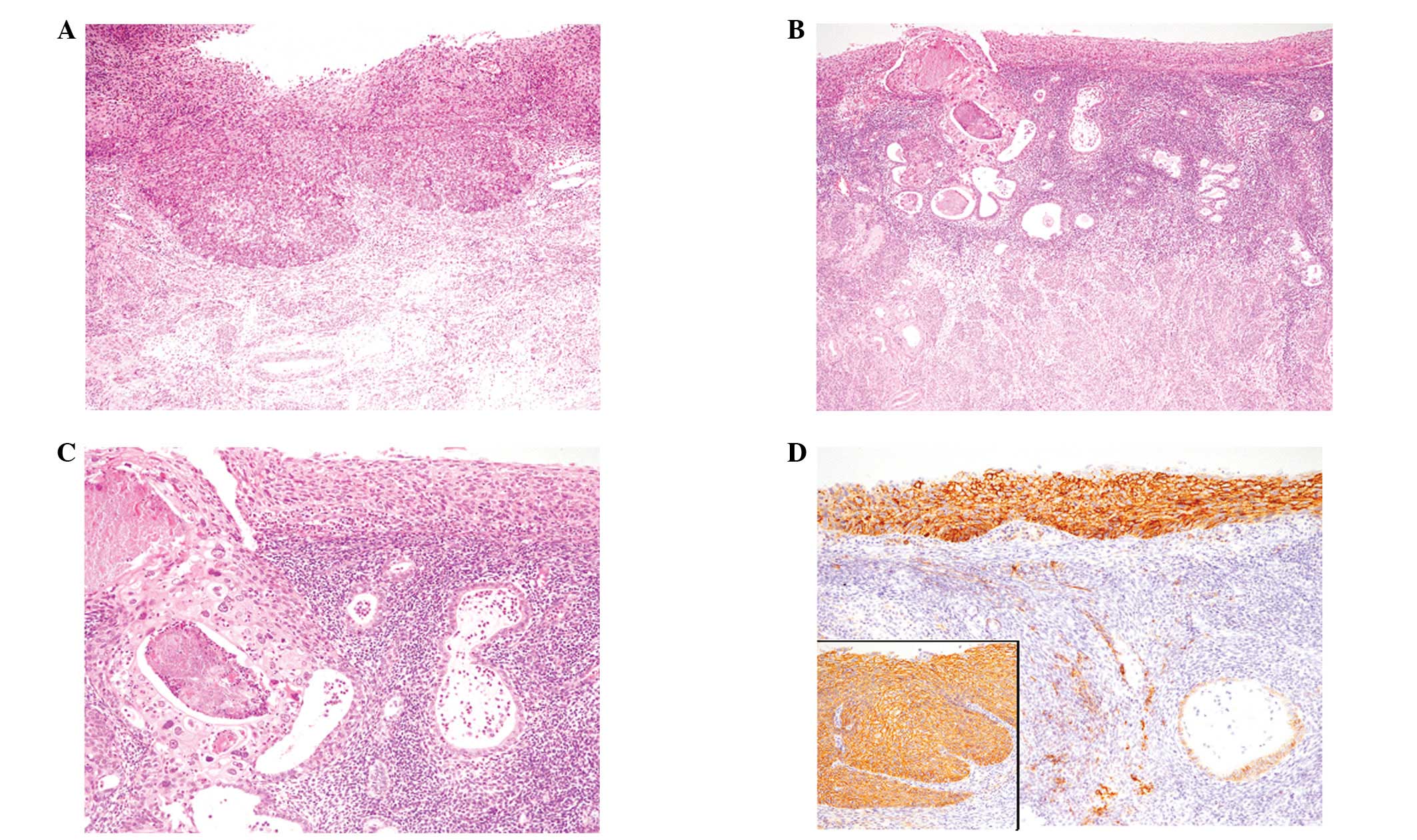
Proliferation of atypical squamous cells with large oval nuclei and a single nucleolus was observed in the entire squamous epithelium of the cervix and mitotic figures were noted in the upper portion of the squamous epithelium. Most of the cervical tumor was composed of this intraepithelial lesion with glandular involvement, however, focal superficial invasive growth was noted (Fig. 1A). Keratinization was not evident. Intraepithelial involvement and superficial invasive growth of carcinoma cells in the vagina were also observed. According to these findings, a diagnosis of non-keratinizing SCC of the cervix (pTIIA1) was made.

Figure 1

Histopathological and immunohistochemical features of case 1. (A) Mild invasive growth of atypical squamous cells in the cervix (hematoxylin and eosin, ×100). (B) Low-power view of superficial spreading atypical squamous cells in the endometrium (hematoxylin and eosin, ×100). (C) High-power view showing superficial spreading and glandular involvement of atypical squamous cells (hematoxylin and eosin, ×200). (D) CD138 was strongly expressed in the neoplastic squamous cells spreading in the endometrium (×200). Mildly invasive squamous cells in the cervix also expressed CD138 (inset, ×100).

The notable finding of the present case was that atypical squamous cells were extending and replacing the endometrium directly from the cervix (Fig. 1B). Glandular involvement of atrophic endometrial glands was observed (Fig. 1B and C), but no invasive growth was noted in the endometrium. Bilateral tubes and ovaries were free from carcinoma spread. In addition, no lymph node metastasis was detected.

Immunohistochemically, all the carcinoma cells that were spreading superficially in the endometrium (Fig. 1D), in the mildly invasive lesion of the cervix and vagina (Fig. 1D, inset) and in the intraepithelial lesions of the cervix and vagina were diffusely and strongly positive for CD138.

Case 2

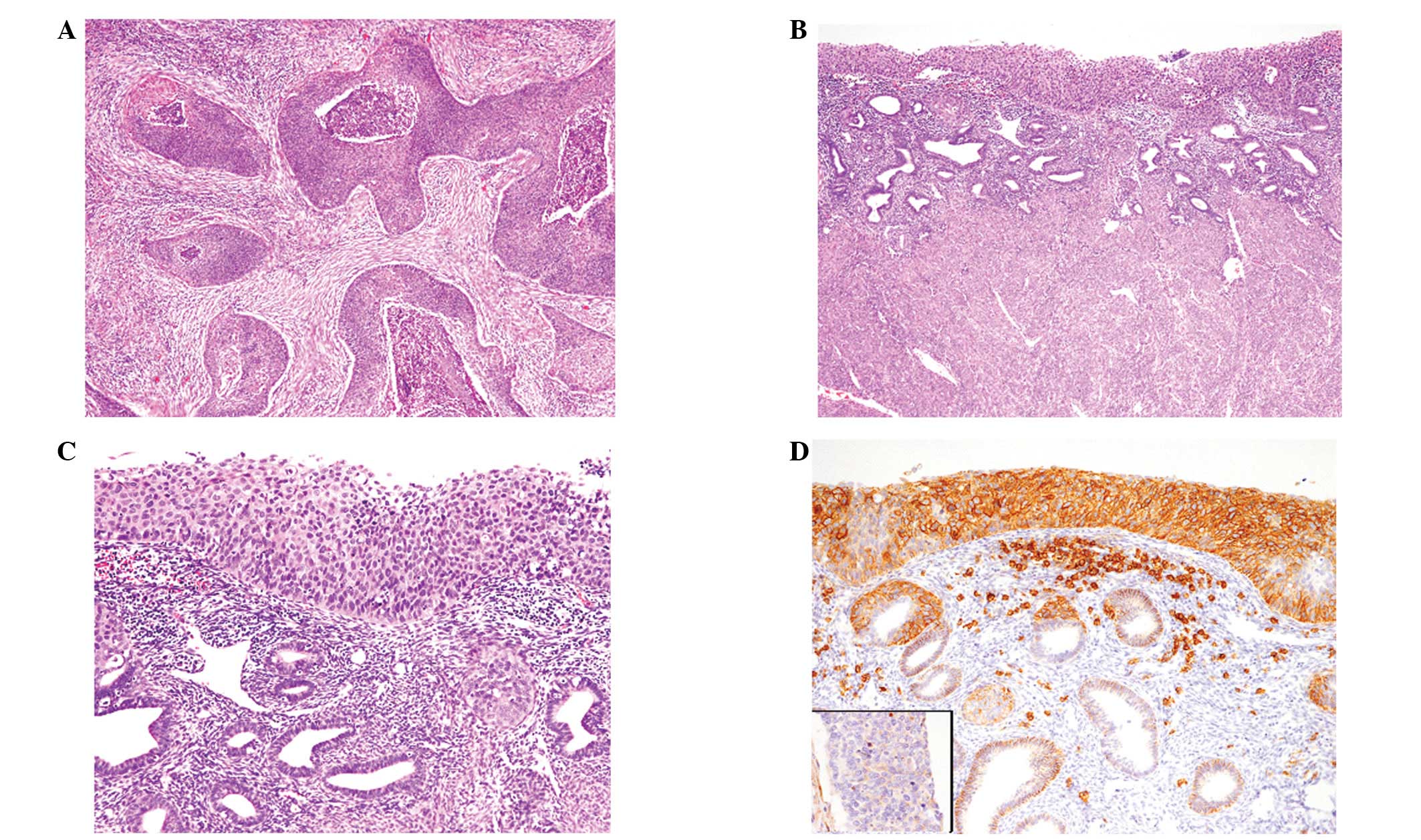
Invasive neoplastic growth composed of irregular islands or large nests was observed in the entire cervix (Fig. 2A). Neoplastic cells had large slightly eosinophilic cytoplasm and large oval nuclei with a conspicuous nucleolus. Intercellular bridges and individual cell keratinization were observed, however, keratinizaion was not evident and keratin pearls were not observed. The tumor had directly invaded into the parametrium, but not into the vagina. Therefore, a diagnosis of non-keratinizing SCC of the cervix (pTIIB) was made.

Figure 2

Histopathological and immunohistochemical features of case 2. (A) Invasive growth of squamous cell carcinoma with desmoplastic reaction in the cervix (hematoxylin and eosin, ×100). (B) Low-power view of superficial spreading atypical squamous cells in the endometrium (hematoxylin and eosin, ×100). (C) High-power view showing superficial spreading and glandular involvement of atypical squamous cells (hematoxylin and eosin, × 200). (D) CD138 was strongly expressed in the atypical squamous cells spreading in the endometrium. Plasma cells were also positive for CD138 in the endometrium (×200). No CD138 expression was observed in the invasive squamous cell carcinoma cells in the cervix (inset, ×200).

Neoplastic squamous cells were extending and replacing the endometrium directly from the cervix (Fig. 2B). Glandular involvement of the atrophic endometrial glands was observed (Fig. 2B and C), but no myometrial invasion was noted. The entire endometrium was replaced by carcinoma cells, however, bilateral tubes and ovaries were free from carcinoma spread. In addition, no lymph node metastasis was detected.

Immunohistochemical analyses revealed that CD138 was strongly and diffusely expressed in the neoplastic squamous cells superficially spreading in the endometrium (Fig. 2D) and the intraepithelial lesion of the cervix, however CD138 expression was hardly observed in the neoplastic squamous cells of the invasive lesion of the cervix (Fig. 2D, inset).

Discussion

In the present study, we described two additional cases of superficial spreading SCC of the cervix involving the endometrium. The clinicopathological features of the 26 previously reported cases of superficial spreading SCC of the cervix and the two present cases are as follows: i) the age of all patients was over 50 years (average, 61.9 years; range, 52–78 years; information on the patients’ age was available in 14 cases); ii) the most common clinical presentation was genital bleeding; and iii) Fallopian tube with or without ovarian involvement was present in 9 cases (1–4).

Kushima et al reported five cases of superficial spreading SCC of the cervix involving the endometrium and/or Fallopian tube and ovary (3). They concluded that most tumors of this type were monoclonal neoplasia originating from the cervical mucosa with subsequent superficial spreading to the upper genital mucosa according to loss of heterozygosity analyses (3). The two present cases were also thought to be of cervical mucosa origin that had spread superficially in the endometrium.

The molecular mechanism of the superficial spreading of carcinoma cells is not well understood. CD138, also known as syndecan-1, is a cell-surface heparan sulfate proteoglycan and participates in cell-cell and cell-extracellular matrix interactions (5). CD138 is expressed in normal epithelial cells, including stratified squamous epithelium, as well as plasma cells. A correlation between CD138 expression and carcinogenesis has been investigated in various organs. Increased expression of CD138 has been reported in endometrial and ovarian carcinomas (6,7). By contrast, decreased expression of CD138 has been reported to correlate with tumor invasion and progression of cervical cancer (8–10). Shinyo et al reported that the loss of CD138 expression is an early event in cervical carcinogenesis, as this molecule is strongly expressed in cervical intraepithelial neoplasia (CIN) I and II. However, its expression is reduced in CIN III, and CD138 expression in microinvasive and invasive SCC is lower compared with CIN III (9). In the two present cases, CD138 was strongly expressed in the intraepithelial lesions of the cervix as well as in the cells that were superficially spreading in the endometrium. Therefore, the findings of the present cases suggest that CD138 expression in carcinoma cells may participate in superficial spreading by regulating cell-cell interactions and, by contrast, carcinoma cells lacking CD138 expression show overt invasive growth.

References

1 

Gungor T, Altinkaya SO, Ozat M, Akbay S and Mollamahmutoglu L: Unusual form of superficial spreading squamous cell carcinoma of cervix involving the endometrium, bilateral tubes and ovaries: a case report with literature review. Arch Gynecol Obstet. 283:323–327. 2011. View Article : Google Scholar

2 

Tan GC, Isa MR, Ng SP and Jamil MA: Unusual form of superficial spreading microinvasive squamous cell carcinoma of uterine cervix involving the endometrium of uterus. J Obstet Gynaecol Res. 30:363–367. 2004. View Article : Google Scholar : PubMed/NCBI

3 

Kushima M, Fujii H, Murakami K, et al: Simultaneous squamous cell carcinomas of the uterine cervix and upper genital tract: loss of heterozygosity analysis demonstrates clonal neoplasms of cervical origin. Int J Gynecol Pathol. 20:353–358. 2001. View Article : Google Scholar

4 

Pins MR, Young RH, Crum CP, Leach IH and Scully RE: Cervical squamous cell carcinoma in situ with intraepithelial extension to the upper genital tract and invasion of tubes and ovaries: report of a case with human papilloma virus analysis. Int J Gynecol Pathol. 16:272–278. 1997. View Article : Google Scholar

5 

Bernfield M, Götte M, Park PW, et al: Functions of cell surface heparan sulfate proteoglycans. Ann Rev Biochem. 68:729–777. 1999. View Article : Google Scholar : PubMed/NCBI

6 

Oh JH, Kim JH, Ahn HJ, et al: Syndecan-1 enhances the endometrial cancer invasion by modulating matrix metalloproteinase-9 expression through nuclear factor kappa B. Gynecol Oncol. 114:509–515. 2009. View Article : Google Scholar : PubMed/NCBI

7 

Davies EJ, Blackhall FH, Shanks JH, et al: Distribution and clinical significance of heparan sulfate proteoglycans in ovarian cancer. Clin Cancer Res. 10:5178–5186. 2004. View Article : Google Scholar : PubMed/NCBI

8 

Numa F, Hirabayashi K, Kawasaki K, et al: Syndecan-1 expression in cancer of the uterine cervix: association with lymph node metastasis. Int J Oncol. 20:39–43. 2002.PubMed/NCBI

9 

Shinyo Y, Kodama J, Hasengaowa, Kusumoto T and Hiramatsu Y: Loss of cell-surface heparan sulfate expression in both cervical intraepithelial neoplasm and invasive cervical cancer. Gynecol Oncol. 96:776–783. 2005. View Article : Google Scholar : PubMed/NCBI

10 

Kim YI, Lee A, Lee BH and Kim SY: Prognostic significance of syndecan-1 expression in cervical cancers. J Gynecol Oncol. 22:161–167. 2001. View Article : Google Scholar : PubMed/NCBI

Related Articles

  • Abstract
  • View
  • Download
  • Twitter
Copy and paste a formatted citation
Spandidos Publications style
Ishida M and Okabe H: Superficial spreading squamous cell carcinoma of the uterine cervix involving the endometrium: Report of two cases with emphasis on the likely molecular mechanism. Oncol Lett 5: 31-34, 2013.
APA
Ishida, M., & Okabe, H. (2013). Superficial spreading squamous cell carcinoma of the uterine cervix involving the endometrium: Report of two cases with emphasis on the likely molecular mechanism. Oncology Letters, 5, 31-34. https://doi.org/10.3892/ol.2012.953
MLA
Ishida, M., Okabe, H."Superficial spreading squamous cell carcinoma of the uterine cervix involving the endometrium: Report of two cases with emphasis on the likely molecular mechanism". Oncology Letters 5.1 (2013): 31-34.
Chicago
Ishida, M., Okabe, H."Superficial spreading squamous cell carcinoma of the uterine cervix involving the endometrium: Report of two cases with emphasis on the likely molecular mechanism". Oncology Letters 5, no. 1 (2013): 31-34. https://doi.org/10.3892/ol.2012.953
Copy and paste a formatted citation
x
Spandidos Publications style
Ishida M and Okabe H: Superficial spreading squamous cell carcinoma of the uterine cervix involving the endometrium: Report of two cases with emphasis on the likely molecular mechanism. Oncol Lett 5: 31-34, 2013.
APA
Ishida, M., & Okabe, H. (2013). Superficial spreading squamous cell carcinoma of the uterine cervix involving the endometrium: Report of two cases with emphasis on the likely molecular mechanism. Oncology Letters, 5, 31-34. https://doi.org/10.3892/ol.2012.953
MLA
Ishida, M., Okabe, H."Superficial spreading squamous cell carcinoma of the uterine cervix involving the endometrium: Report of two cases with emphasis on the likely molecular mechanism". Oncology Letters 5.1 (2013): 31-34.
Chicago
Ishida, M., Okabe, H."Superficial spreading squamous cell carcinoma of the uterine cervix involving the endometrium: Report of two cases with emphasis on the likely molecular mechanism". Oncology Letters 5, no. 1 (2013): 31-34. https://doi.org/10.3892/ol.2012.953
Follow us
  • Twitter
  • LinkedIn
  • Facebook
About
  • Spandidos Publications
  • Careers
  • Cookie Policy
  • Privacy Policy
How can we help?
  • Help
  • Live Chat
  • Contact
  • Email to our Support Team