Spandidos Publications Logo
  • About
    • About Spandidos
    • Aims and Scopes
    • Abstracting and Indexing
    • Editorial Policies
    • Reprints and Permissions
    • Job Opportunities
    • Terms and Conditions
    • Contact
  • Journals
    • All Journals
    • Oncology Letters
      • Oncology Letters
      • Information for Authors
      • Editorial Policies
      • Editorial Board
      • Aims and Scope
      • Abstracting and Indexing
      • Bibliographic Information
      • Archive
    • International Journal of Oncology
      • International Journal of Oncology
      • Information for Authors
      • Editorial Policies
      • Editorial Board
      • Aims and Scope
      • Abstracting and Indexing
      • Bibliographic Information
      • Archive
    • Molecular and Clinical Oncology
      • Molecular and Clinical Oncology
      • Information for Authors
      • Editorial Policies
      • Editorial Board
      • Aims and Scope
      • Abstracting and Indexing
      • Bibliographic Information
      • Archive
    • Experimental and Therapeutic Medicine
      • Experimental and Therapeutic Medicine
      • Information for Authors
      • Editorial Policies
      • Editorial Board
      • Aims and Scope
      • Abstracting and Indexing
      • Bibliographic Information
      • Archive
    • International Journal of Molecular Medicine
      • International Journal of Molecular Medicine
      • Information for Authors
      • Editorial Policies
      • Editorial Board
      • Aims and Scope
      • Abstracting and Indexing
      • Bibliographic Information
      • Archive
    • Biomedical Reports
      • Biomedical Reports
      • Information for Authors
      • Editorial Policies
      • Editorial Board
      • Aims and Scope
      • Abstracting and Indexing
      • Bibliographic Information
      • Archive
    • Oncology Reports
      • Oncology Reports
      • Information for Authors
      • Editorial Policies
      • Editorial Board
      • Aims and Scope
      • Abstracting and Indexing
      • Bibliographic Information
      • Archive
    • Molecular Medicine Reports
      • Molecular Medicine Reports
      • Information for Authors
      • Editorial Policies
      • Editorial Board
      • Aims and Scope
      • Abstracting and Indexing
      • Bibliographic Information
      • Archive
    • World Academy of Sciences Journal
      • World Academy of Sciences Journal
      • Information for Authors
      • Editorial Policies
      • Editorial Board
      • Aims and Scope
      • Abstracting and Indexing
      • Bibliographic Information
      • Archive
    • International Journal of Functional Nutrition
      • International Journal of Functional Nutrition
      • Information for Authors
      • Editorial Policies
      • Editorial Board
      • Aims and Scope
      • Abstracting and Indexing
      • Bibliographic Information
      • Archive
    • International Journal of Epigenetics
      • International Journal of Epigenetics
      • Information for Authors
      • Editorial Policies
      • Editorial Board
      • Aims and Scope
      • Abstracting and Indexing
      • Bibliographic Information
      • Archive
    • Medicine International
      • Medicine International
      • Information for Authors
      • Editorial Policies
      • Editorial Board
      • Aims and Scope
      • Abstracting and Indexing
      • Bibliographic Information
      • Archive
  • Articles
  • Information
    • Information for Authors
    • Information for Reviewers
    • Information for Librarians
    • Information for Advertisers
    • Conferences
  • Language Editing
Spandidos Publications Logo
  • About
    • About Spandidos
    • Aims and Scopes
    • Abstracting and Indexing
    • Editorial Policies
    • Reprints and Permissions
    • Job Opportunities
    • Terms and Conditions
    • Contact
  • Journals
    • All Journals
    • Biomedical Reports
      • Information for Authors
      • Editorial Policies
      • Editorial Board
      • Aims and Scope
      • Abstracting and Indexing
      • Bibliographic Information
      • Archive
    • Experimental and Therapeutic Medicine
      • Information for Authors
      • Editorial Policies
      • Editorial Board
      • Aims and Scope
      • Abstracting and Indexing
      • Bibliographic Information
      • Archive
    • International Journal of Epigenetics
      • Information for Authors
      • Editorial Policies
      • Editorial Board
      • Aims and Scope
      • Abstracting and Indexing
      • Bibliographic Information
      • Archive
    • International Journal of Functional Nutrition
      • Information for Authors
      • Editorial Policies
      • Editorial Board
      • Aims and Scope
      • Abstracting and Indexing
      • Bibliographic Information
      • Archive
    • International Journal of Molecular Medicine
      • Information for Authors
      • Editorial Policies
      • Editorial Board
      • Aims and Scope
      • Abstracting and Indexing
      • Bibliographic Information
      • Archive
    • International Journal of Oncology
      • Information for Authors
      • Editorial Policies
      • Editorial Board
      • Aims and Scope
      • Abstracting and Indexing
      • Bibliographic Information
      • Archive
    • Medicine International
      • Information for Authors
      • Editorial Policies
      • Editorial Board
      • Aims and Scope
      • Abstracting and Indexing
      • Bibliographic Information
      • Archive
    • Molecular and Clinical Oncology
      • Information for Authors
      • Editorial Policies
      • Editorial Board
      • Aims and Scope
      • Abstracting and Indexing
      • Bibliographic Information
      • Archive
    • Molecular Medicine Reports
      • Information for Authors
      • Editorial Policies
      • Editorial Board
      • Aims and Scope
      • Abstracting and Indexing
      • Bibliographic Information
      • Archive
    • Oncology Letters
      • Information for Authors
      • Editorial Policies
      • Editorial Board
      • Aims and Scope
      • Abstracting and Indexing
      • Bibliographic Information
      • Archive
    • Oncology Reports
      • Information for Authors
      • Editorial Policies
      • Editorial Board
      • Aims and Scope
      • Abstracting and Indexing
      • Bibliographic Information
      • Archive
    • World Academy of Sciences Journal
      • Information for Authors
      • Editorial Policies
      • Editorial Board
      • Aims and Scope
      • Abstracting and Indexing
      • Bibliographic Information
      • Archive
  • Articles
  • Information
    • For Authors
    • For Reviewers
    • For Librarians
    • For Advertisers
    • Conferences
  • Language Editing
Login Register Submit
  • This site uses cookies
  • You can change your cookie settings at any time by following the instructions in our Cookie Policy. To find out more, you may read our Privacy Policy.

    I agree
Search articles by DOI, keyword, author or affiliation
Search
Advanced Search
presentation
Oncology Letters
Join Editorial Board Propose a Special Issue
Print ISSN: 1792-1074 Online ISSN: 1792-1082
Journal Cover
May 2013 Volume 5 Issue 5

Full Size Image

Sign up for eToc alerts
Recommend to Library

Journals

International Journal of Molecular Medicine

International Journal of Molecular Medicine

International Journal of Molecular Medicine is an international journal devoted to molecular mechanisms of human disease.

International Journal of Oncology

International Journal of Oncology

International Journal of Oncology is an international journal devoted to oncology research and cancer treatment.

Molecular Medicine Reports

Molecular Medicine Reports

Covers molecular medicine topics such as pharmacology, pathology, genetics, neuroscience, infectious diseases, molecular cardiology, and molecular surgery.

Oncology Reports

Oncology Reports

Oncology Reports is an international journal devoted to fundamental and applied research in Oncology.

Experimental and Therapeutic Medicine

Experimental and Therapeutic Medicine

Experimental and Therapeutic Medicine is an international journal devoted to laboratory and clinical medicine.

Oncology Letters

Oncology Letters

Oncology Letters is an international journal devoted to Experimental and Clinical Oncology.

Biomedical Reports

Biomedical Reports

Explores a wide range of biological and medical fields, including pharmacology, genetics, microbiology, neuroscience, and molecular cardiology.

Molecular and Clinical Oncology

Molecular and Clinical Oncology

International journal addressing all aspects of oncology research, from tumorigenesis and oncogenes to chemotherapy and metastasis.

World Academy of Sciences Journal

World Academy of Sciences Journal

Multidisciplinary open-access journal spanning biochemistry, genetics, neuroscience, environmental health, and synthetic biology.

International Journal of Functional Nutrition

International Journal of Functional Nutrition

Open-access journal combining biochemistry, pharmacology, immunology, and genetics to advance health through functional nutrition.

International Journal of Epigenetics

International Journal of Epigenetics

Publishes open-access research on using epigenetics to advance understanding and treatment of human disease.

Medicine International

Medicine International

An International Open Access Journal Devoted to General Medicine.

Journal Cover
May 2013 Volume 5 Issue 5

Full Size Image

Sign up for eToc alerts
Recommend to Library

  • Article
  • Citations
    • Cite This Article
    • Download Citation
    • Create Citation Alert
    • Remove Citation Alert
    • Cited By
  • Similar Articles
    • Related Articles (in Spandidos Publications)
    • Similar Articles (Google Scholar)
    • Similar Articles (PubMed)
  • Download PDF
  • Download XML
  • View XML
Article

Three‑way Philadelphia translocation t(9;10;22)(q34;p11.2;q11.2) as a secondary abnormality in an imatinib mesylate‑resistant chronic myeloid leukemia patient

  • Authors:
    • Walid Al‑Achkar
    • Abdulsamad Wafa
    • Adnan Ikhtiar
    • Thomas Liehr
  • View Affiliations / Copyright

    Affiliations: Department of Molecular Biology and Biotechnology, Human Genetics Division, Atomic Energy Commission, Damascus, Syria , Department of Molecular Biology and Biotechnology, Mammalian Biology Division, Flow‑cytometry Lab, Atomic Energy Commission, Damascus, Syria, Jena University Hospital, Institute of Human Genetics, Jena, Germany
  • Pages: 1656-1658
    |
    Published online on: March 5, 2013
       https://doi.org/10.3892/ol.2013.1228
  • Expand metrics +
Metrics: Total Views: 0 (Spandidos Publications: | PMC Statistics: )
Metrics: Total PDF Downloads: 0 (Spandidos Publications: | PMC Statistics: )
Cited By (CrossRef): 0 citations Loading Articles...

This article is mentioned in:


Abstract

Chronic myelogenous leukemia (CML) is characterized by the Philadelphia (Ph) chromosome created by the reciprocal translocation t(9:22)(q34;q11), resulting in the chimeric gene breakpoint cluster region (BCR)‑Abelson (ABL). Variant Ph chromosome translocations involving chromosomes other than 9 and 22 occur in 5‑10% of CML cases. In the present study, a novel case of a Ph chromosome‑positive CML in the chronic phase (CP) is reported, with a three‑way Ph translocation involving three chromosomal regions, 9q34, 10p11.2 and 22q11.2, in addition to the loss of the Y chromosome, where the latter was a secondary abnormality. Since the majority of CML cases are currently treated with imatinib, variant rearrangements generally have no specific prognostic significance, although the mechanisms involved in resistance to therapy have yet to be investigated. The underlying mechanisms and prognostic implications of these cytogenetic abnormalities are discussed in the present study.

Introduction

Chronic myeloid leukemia (CML) is a clonal disorder characterized by the Philadelphia chromosome (Ph). The Ph chromosome results from a reciprocal translocation between the long arms of chromosomes 9 and 22 and is demonstrable in all hematopoietic precursors (1). This translocation results in the transfer of the Abelson (ABL) proto-oncogene on chromosome 9 to an area of chromosome 22 named the breakpoint cluster region (BCR). This results in a fused BCR/ABL gene and the production of an abnormal tyrosine kinase protein that causes the disordered myelopoiesis observed in CML. Imatinib mesylate (IM; Glivec), formerly STI57 (1), was the first available BCR/ABL-targeted therapy and produced complete cytogenetic responses in 70–85% of patients with CML in the early chronic phase (CP) (2). However, despite the remarkable efficacy of this agent, resistance or intolerance to IM has also been observed. Moreover, IM does not completely eradicate residual leukemic stem cells and progenitors (3).

In 5–10% of CML cases, variant rearrangements involving 9q34, 22q11.2 and one or more additional genomic regions generate the previously mentioned chimeric gene (4). Occasionally, the chromosome changes are submicroscopic so the translocation may be masked and revealed only by fluorescence in situ hybridization (FISH) or molecular analysis (5). The present study reports a rare case of Ph chromosome-positive CML in CP with variant translocation involving chromosome 10 at sub-band region p11.2, as well as 9q34 and 22q11.2. The rearrangement was characterized by FISH, multicolor banding (MCB) and reverse transcription polymerase chain reaction (RT-PCR).

Materials and methods

Case report

A 42-year-old male patient was diagnosed with CML in CP in February 2006. Hepatosplenomegaly, fever and loss of weight were the indicative symptoms. The patient then received IM at 400 mg/day intermittently for two years overall. However, in January 2011 the patient exhibited less marked symptoms. The patient’s hematological parameters were white blood cells (WBC) at 306×109/l, consisting of 78% neutrophils, 18% lymphocytes, 1% monocytes and 1% basophiles. The platelet count was 500×109/l and the hemoglobin level was 9.3 g/dl. The serum lactate dehydrogenase (LDH) level was 658 U/l (normal level up to 240 U/l).

The study was approved by the Biosafety and Bioethics Commitee of Syrian Atomic Energy Commssion. Written informed consent was obtained from the patient.

Chromosome cytogenetics

Chromosome analysis was performed using the GTG-banding technique according to standard procedures (6). A total of 20 metaphase cells derived from unstimulated bone marrow culture were analyzed. Karyotypes were described according to the International System for Human Cytogenetic Nomenclature (7).

Molecular cytogenetics

FISH using an LSI BCR/ABL dual-color dual-fusion translocation probe (Abbott Molecular/Vysis, Des Plaines, IL, USA) was used according to the manufacturer’s instructions (6). MCB probe sets based on microdissection-derived region-specific libraries for chromosomes 9, 10 and 22 were used as described previously (8). A minimum of 20 metaphase spreads were analyzed, using a fluorescence microscope (AxioImager.Z1 mot; Zeiss, Jena, Germany) equipped with appropriate filter sets to discriminate between a maximum of five fluorochromes and the counter-stain 4’,6-diamino-2-phenylindole (DAPI). Image capturing and processing were performed using an Isis imaging system (MetaSystems, Altlussheim, Germany).

RT-PCR for BCR/ABL fusion transcripts

RT-PCR was performed as described previously (9).

Immunophenotyping

Immunophenotyping of leukemic blasts was performed as described previously (10).

Results

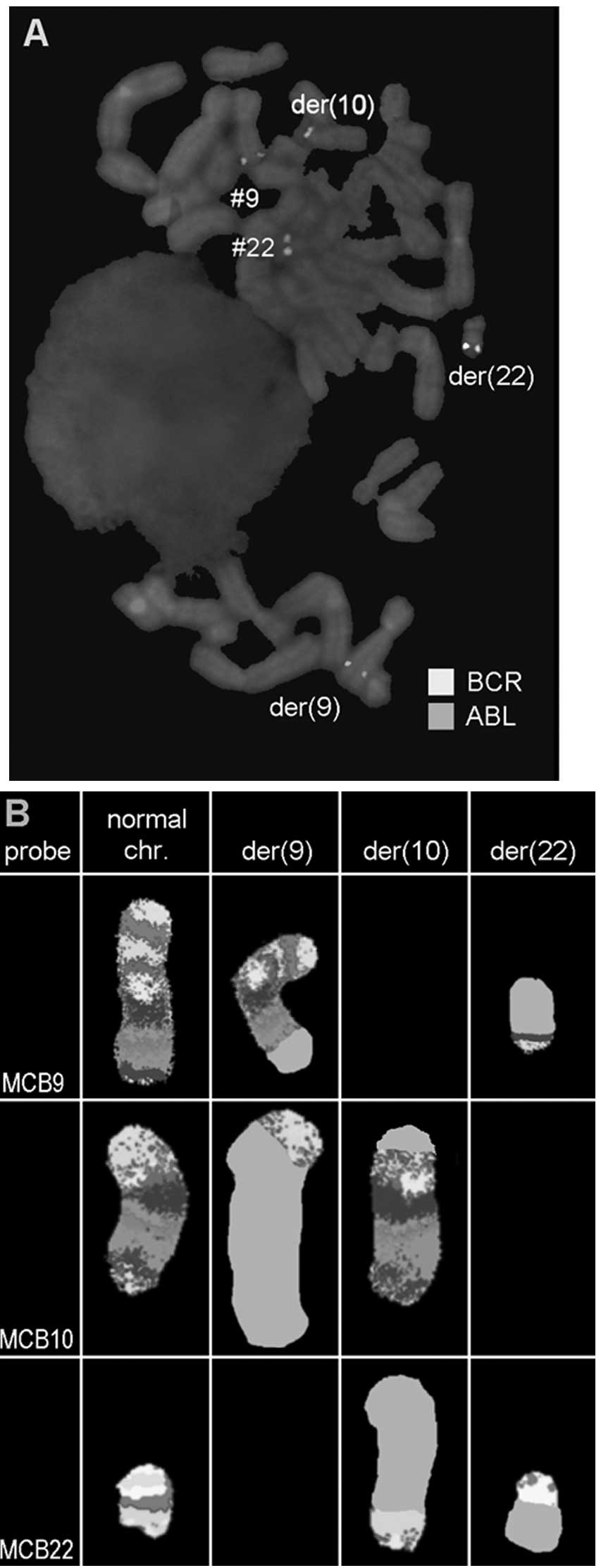
Karyotyping was performed prior to and following the chemotherapy treatment. Initially, GTG-banding revealed 46,XY,t(9;22)[20]. The result following chemotherapy was 46,XY,t(9;10;22)[12]/45,X,-Y,t(9;10;22)[8] (Fig. 1), which was further specified by molecular cytogenetic studies (Fig. 2). Dual-color FISH using a probe specific for BCR and ABL revealed a typical Ph chromosome with the BCR/ABL fusion gene. However, sections of chromosome 22 were present on the derivative chromosome 10 [der(10)] (Fig. 2A). RT-PCR demonstrated a p210, b2a2 fusion transcript, most often observed in CML (data not shown). After the application of MCB, a complex translocation among chromosomes 9, 10 and 22 was revealed (Fig. 2B): 46,XY,t(9;10;22)(q34;p11.2;q11) [12]/45,X,-Y,t(9;10;22)(q34;p11.2;q11)[8].

Figure 1

GTG-banding revealed a complex karyotype involving three chromosomes as well as the loss of the Y chromosome. All derivative chromosomes are highlighted by arrow heads.

Figure 2

Karyotype and chromosomal aberrations were confirmed using molecular cytogenetic approaches. (A) Metaphase FISH using probes for BCR (white) and ABL (gray) confirmed an involvement of chromosome 10 in the rearrangement, the presence of the BCR/ABL translocation and the Ph chromosome. (B) MCB was applied to determine which chromosomes were involved in the complex rearrangement. Each image shows the results of MCB analysis using probe sets for chromosomes 9, 10 and 22. The normal chromosomes are shown in the first column and the derivatives of the three chromosomes in the subsequent columns. The MCB-probe unstained regions on the derivative chromosomes are shown in gray. #, chromosome; der, derivative chromosome; Ph, Philadelphia chromosome; FISH, fluorescence in situ hybridization; BCR, breakpoint cluster region; ABL, Abelson; MCB, multicolor banding.

Immunophenotyping analysis of the peripheral blood showed abnormal antigen expression profiles for CD16 (66.8%), CD64 (66.8%), CD32 (66.8%), CD33 (35%) and CD13 (84%). A high percentage of these cells were CD123-positive (20%). These cells were CD15 (85%), CD38 (62.7), CD11c (53%), CD10 (31%) and CD34 (2.9%). This immunophenotype was consistent with CML according to the FAB classification.

Discussion

As reported previously, variant Ph translocations involving chromosome 10 are rare and only a few cases involving the short arm of chromosome 10 have been described. Furthermore, only one of these previously reported CML cases involved the breakpoint region 10p11 (11). To the best of our knowledge, the present study is the first to observe a case of Ph chromosome-positive CML in CP with t(9;10;22)(q34;p11.2;q11). Notably, there was another Ph-positive clone with a loss of chromosome Y secondary abnormality which most likely resulted in the resistance to IM chemotherapy (12).

Two possible mechanisms have been suggested for the formation of variant translocations (13). The first is a single event rearrangement via the simultaneous breakage of several chromosomes followed by mismatched joining. The other is a multi-step mechanism in which a classical Ph translocation is followed by further translocation events involving chromosomes 9 and 22, as well as other chromosomes. A WCP-FISH study demonstrated the insertion of chromosomal material from chromosome 22 into a variant chromosome. In this pattern, the BCR/ABL fusion gene was located on derivative chromosome 22. This suggests that three breaks have occurred on chromosomes 9, 22 and the variant chromosome and that 9q34∼qter was rejoined 22q11 at the same time as 22q11∼qter was inserted into the variant chromosome. This pattern is indicative of a one-step formation mechanism.

The progression of CML from the CP to blast crisis is frequently associated with non-random secondary chromosomal aberrations such as +8, i(17q), +19 and an extra Ph chromosome. Other less frequent abnormalities include -7, -17, -Y, +17 and +21 (14).

Resistance to chemotherapy may occur as a result of increased expression of the BCR-ABL kinase from genomic amplification, clonal chromosomal evolution or mutations in the ABL kinase of the BCR-ABL gene affecting drug interactions or kinase activity (15).

ABI-1 is located at 10p11.2 in humans and is a homolog to the mouse Abelson interactor 1 gene (Abi-1) It is one of the major regulators of actin cytoskeleton reorganization but its role in cancer progression and metastasis remains ill-defined (16). While Abi-1 (which has high homology to ABI-2) and ABI-2 are regulators of ABL function in transformation or signal transduction, the functional correlation between Abi-1, ABI-2 and BCR-ABL remains unknown (17).

Variant Ph translocation involving chromosome 10 may represent a more aggressive marker in CML and its presence may suggest an increased dose of IM as commonly administered in the accelerated phase (18).

In conclusion, the present study reported a Ph chromosome-positive CML case in the CP with a rare variant translocation involving chromosome 10p11.2 as well as 9q34 and 22q11.2 and the loss of a Y chromosome as a secondary abnormality which most likely resulted in the resistance to IM chemotherapy.

Acknowledgements

The authors would like to thank Professor I. Othman, the Director General of the Atomic Energy Commission of SYRIA (AECS), and Dr N. Mirali, Head of the Molecular Biology and Biotechnology Department, for their support. The present study was supported by the AECS and in part by the Stefan-Morsch-Stiftung, Monika-Kutzner-Stiftung and DAAD (D/07/09624).

References

1 

Rowley JD: Letter: A new consistent abnormality in chronic myelogenous leukaemia identified by quinacrine fluorescence and Giemsa staining. Nature. 243:290–293. 1973. View Article : Google Scholar : PubMed/NCBI

2 

Druker BJ, Guilhot F, O’Brien SG, Gathmann I, Kantarjian H, Gattermann N, Deininger MW, Silver RT, Goldman JM, Stone RM, Cervantes F, Hochhaus A, Powell BL, Gabrilove JL, Rousselot P, Reiffers J, Cornelissen JJ, Hughes T, Agis H, Fischer T, Verhoef G, Shepherd J, Saglio G, Gratwohl A, Nielsen JL, Radich JP, Simonsson B, Taylor K, Baccarani M, So C and Letvak L: Five-year follow-up of patients receiving imatinib for chronic myeloid leukaemia. N Engl J Med. 355:2408–2417. 2006.PubMed/NCBI

3 

Graham SM, Jørgensen HG, Allan E, Pearson C, Alcorn MJ, Richmond L and Holyoake TL: Primitive, quiescent, Philadelphia-positive stem cells from patients with chronic myeloid leukemia are insensitive to STI571 in vitro. Blood. 99:319–325. 2002. View Article : Google Scholar : PubMed/NCBI

4 

Johansson B, Fioretos T and Mitelman F: Cytogenetic and molecular genetic evolution of chronic myeloid leukemia. Acta Haematol. 107:76–94. 2002. View Article : Google Scholar : PubMed/NCBI

5 

Quintás-Cardama A and Cortes J: Molecular biology of bcr-abl1-positive chronic myeloid leukemia. Blood. 113:1619–1630. 2009.PubMed/NCBI

6 

Al-Achkar W, Wafa A and Nweder MS: A complex translocation t(5;9;22) in Philadelphia cells involving the short arm of chromosome 5 in a case of chronic myelogenous leukemia. J Exp Clin Cancer Res. 26:411–415. 2007.PubMed/NCBI

7 

Shaffer L, Slovak M and Cambell L; ISCN (2009): An International System for Human Cytogenetic Nomenclature. 2009, S. Karger,; Basel: 2009

8 

Liehr T, Heller A, Starke H, Rubtsov N, Trifonov V, Mrasek K, Weise A, Kuechler A and Claussen U: Microdissection based high resolution multicolor banding for all 24 human chromosomes. Int J Mol Med. 9:335–339. 2002.PubMed/NCBI

9 

Al-Achkar W, Wafa A, Ali BY, Manvelyan M and Liehr T: A rare chronic myeloid leukemia case with Philadelphia chromosome, BCR-ABL e13a3 transcript and complex translocation involving four different chromosomes. Oncol Lett. 1:797–800. 2010.PubMed/NCBI

10 

Al-Achkar W, Wafa A, Klein E and Aljapawe A: Biclonal myelodysplastic syndrome involving six chromosomes and monoallelic loss of RB1 - A rare case. Mol Cytogenet. 4:162011. View Article : Google Scholar : PubMed/NCBI

11 

Jacob A, Griffiths M, Larkins S and Holmes J: t(3;21) following peripheral blood stem cell transplantation in chronic phase chronic myeloid leukaemia. Bone Marrow Transplant. 19:1255–1258. 1997. View Article : Google Scholar : PubMed/NCBI

12 

Mitelman F, Johansson B and Mertens F: Mitelman Database of Chromosome. Aberrations in Cancer (2009). http://cgap.nci.nih.gov/Chromosomes/MitelmanAccessed June 18, 2012.

13 

Mkrtchyan H, Ghazaryan S, Avetisyan G, Hovhannisyan A, Muradyan L, Daghbashyan S, Karst C, Gross M, Hinreiner S, Aroutiounian R and Liehr T: Novel complex t(V;9;22) rearrangements in three cases with chronic myeloid leukemia and a rare translocation in a case with classical Philadelphia chromosome. Oncol Rep. 20:99–104. 2008.

14 

Faderl S, Talpaz M, Estrov Z, O’Brien S, Kurzrock R and Kantarjian HM: The biology of chronic myelogenous leukemia. New Eng J Med. 341:164–172. 1999. View Article : Google Scholar

15 

Hochhaus A, Kreil S, Corbin AS, La Rosée P, Müller MC, Lahaye T, Hanfstein B, Schoch C, Cross NC, Berger U, Gschaidmeier H, Druker BJ and Hehlmann R: Molecular and chromosomal mechanisms of resistance to imatinib (STI571) therapy. Leukemia. 16:2190–2196. 2002. View Article : Google Scholar : PubMed/NCBI

16 

Morerio C, Rosanda C, Rapella A, Micalizzi C and Panarello C: Is t(10;11)(p11.2;q23) involving MLL and ABI-1 genes associated with congenital acute monocytic leukemia? Cancer Genet Cytogenet. 139:57–59. 2002. View Article : Google Scholar : PubMed/NCBI

17 

Taki T, Shibuya N, Taniwaki M, Hanada R, Morishita K, Bessho F, Yanagisawa M and Hayashi Y: ABI-1, a human homolog to mouse Abl-interactor 1, fuses the MLL gene in acute myeloid leukemia with t(10;11)(p11.2;q23). Blood. 92:1125–1130. 1998.PubMed/NCBI

18 

Buda G, Orciuolo E, Cecconi N, Galimberti S, Cervetti G and Petrini M: Poor prognosis chronic myeloid leukemia with a complex variant Philadelphia translocation, t(9;10;22) (q34;q24;q11). Leuk Res. 31:1765–1766. 2007. View Article : Google Scholar : PubMed/NCBI

Related Articles

  • Abstract
  • View
  • Download
  • Twitter
Copy and paste a formatted citation
Spandidos Publications style
Al‑Achkar W, Wafa A, Ikhtiar A and Liehr T: Three‑way Philadelphia translocation t(9;10;22)(q34;p11.2;q11.2) as a secondary abnormality in an imatinib mesylate‑resistant chronic myeloid leukemia patient. Oncol Lett 5: 1656-1658, 2013.
APA
Al‑Achkar, W., Wafa, A., Ikhtiar, A., & Liehr, T. (2013). Three‑way Philadelphia translocation t(9;10;22)(q34;p11.2;q11.2) as a secondary abnormality in an imatinib mesylate‑resistant chronic myeloid leukemia patient. Oncology Letters, 5, 1656-1658. https://doi.org/10.3892/ol.2013.1228
MLA
Al‑Achkar, W., Wafa, A., Ikhtiar, A., Liehr, T."Three‑way Philadelphia translocation t(9;10;22)(q34;p11.2;q11.2) as a secondary abnormality in an imatinib mesylate‑resistant chronic myeloid leukemia patient". Oncology Letters 5.5 (2013): 1656-1658.
Chicago
Al‑Achkar, W., Wafa, A., Ikhtiar, A., Liehr, T."Three‑way Philadelphia translocation t(9;10;22)(q34;p11.2;q11.2) as a secondary abnormality in an imatinib mesylate‑resistant chronic myeloid leukemia patient". Oncology Letters 5, no. 5 (2013): 1656-1658. https://doi.org/10.3892/ol.2013.1228
Copy and paste a formatted citation
x
Spandidos Publications style
Al‑Achkar W, Wafa A, Ikhtiar A and Liehr T: Three‑way Philadelphia translocation t(9;10;22)(q34;p11.2;q11.2) as a secondary abnormality in an imatinib mesylate‑resistant chronic myeloid leukemia patient. Oncol Lett 5: 1656-1658, 2013.
APA
Al‑Achkar, W., Wafa, A., Ikhtiar, A., & Liehr, T. (2013). Three‑way Philadelphia translocation t(9;10;22)(q34;p11.2;q11.2) as a secondary abnormality in an imatinib mesylate‑resistant chronic myeloid leukemia patient. Oncology Letters, 5, 1656-1658. https://doi.org/10.3892/ol.2013.1228
MLA
Al‑Achkar, W., Wafa, A., Ikhtiar, A., Liehr, T."Three‑way Philadelphia translocation t(9;10;22)(q34;p11.2;q11.2) as a secondary abnormality in an imatinib mesylate‑resistant chronic myeloid leukemia patient". Oncology Letters 5.5 (2013): 1656-1658.
Chicago
Al‑Achkar, W., Wafa, A., Ikhtiar, A., Liehr, T."Three‑way Philadelphia translocation t(9;10;22)(q34;p11.2;q11.2) as a secondary abnormality in an imatinib mesylate‑resistant chronic myeloid leukemia patient". Oncology Letters 5, no. 5 (2013): 1656-1658. https://doi.org/10.3892/ol.2013.1228
Follow us
  • Twitter
  • LinkedIn
  • Facebook
About
  • Spandidos Publications
  • Careers
  • Cookie Policy
  • Privacy Policy
How can we help?
  • Help
  • Live Chat
  • Contact
  • Email to our Support Team