Spandidos Publications Logo
  • About
    • About Spandidos
    • Aims and Scopes
    • Abstracting and Indexing
    • Editorial Policies
    • Reprints and Permissions
    • Job Opportunities
    • Terms and Conditions
    • Contact
  • Journals
    • All Journals
    • Oncology Letters
      • Oncology Letters
      • Information for Authors
      • Editorial Policies
      • Editorial Board
      • Aims and Scope
      • Abstracting and Indexing
      • Bibliographic Information
      • Archive
    • International Journal of Oncology
      • International Journal of Oncology
      • Information for Authors
      • Editorial Policies
      • Editorial Board
      • Aims and Scope
      • Abstracting and Indexing
      • Bibliographic Information
      • Archive
    • Molecular and Clinical Oncology
      • Molecular and Clinical Oncology
      • Information for Authors
      • Editorial Policies
      • Editorial Board
      • Aims and Scope
      • Abstracting and Indexing
      • Bibliographic Information
      • Archive
    • Experimental and Therapeutic Medicine
      • Experimental and Therapeutic Medicine
      • Information for Authors
      • Editorial Policies
      • Editorial Board
      • Aims and Scope
      • Abstracting and Indexing
      • Bibliographic Information
      • Archive
    • International Journal of Molecular Medicine
      • International Journal of Molecular Medicine
      • Information for Authors
      • Editorial Policies
      • Editorial Board
      • Aims and Scope
      • Abstracting and Indexing
      • Bibliographic Information
      • Archive
    • Biomedical Reports
      • Biomedical Reports
      • Information for Authors
      • Editorial Policies
      • Editorial Board
      • Aims and Scope
      • Abstracting and Indexing
      • Bibliographic Information
      • Archive
    • Oncology Reports
      • Oncology Reports
      • Information for Authors
      • Editorial Policies
      • Editorial Board
      • Aims and Scope
      • Abstracting and Indexing
      • Bibliographic Information
      • Archive
    • Molecular Medicine Reports
      • Molecular Medicine Reports
      • Information for Authors
      • Editorial Policies
      • Editorial Board
      • Aims and Scope
      • Abstracting and Indexing
      • Bibliographic Information
      • Archive
    • World Academy of Sciences Journal
      • World Academy of Sciences Journal
      • Information for Authors
      • Editorial Policies
      • Editorial Board
      • Aims and Scope
      • Abstracting and Indexing
      • Bibliographic Information
      • Archive
    • International Journal of Functional Nutrition
      • International Journal of Functional Nutrition
      • Information for Authors
      • Editorial Policies
      • Editorial Board
      • Aims and Scope
      • Abstracting and Indexing
      • Bibliographic Information
      • Archive
    • International Journal of Epigenetics
      • International Journal of Epigenetics
      • Information for Authors
      • Editorial Policies
      • Editorial Board
      • Aims and Scope
      • Abstracting and Indexing
      • Bibliographic Information
      • Archive
    • Medicine International
      • Medicine International
      • Information for Authors
      • Editorial Policies
      • Editorial Board
      • Aims and Scope
      • Abstracting and Indexing
      • Bibliographic Information
      • Archive
  • Articles
  • Information
    • Information for Authors
    • Information for Reviewers
    • Information for Librarians
    • Information for Advertisers
    • Conferences
  • Language Editing
Spandidos Publications Logo
  • About
    • About Spandidos
    • Aims and Scopes
    • Abstracting and Indexing
    • Editorial Policies
    • Reprints and Permissions
    • Job Opportunities
    • Terms and Conditions
    • Contact
  • Journals
    • All Journals
    • Biomedical Reports
      • Information for Authors
      • Editorial Policies
      • Editorial Board
      • Aims and Scope
      • Abstracting and Indexing
      • Bibliographic Information
      • Archive
    • Experimental and Therapeutic Medicine
      • Information for Authors
      • Editorial Policies
      • Editorial Board
      • Aims and Scope
      • Abstracting and Indexing
      • Bibliographic Information
      • Archive
    • International Journal of Epigenetics
      • Information for Authors
      • Editorial Policies
      • Editorial Board
      • Aims and Scope
      • Abstracting and Indexing
      • Bibliographic Information
      • Archive
    • International Journal of Functional Nutrition
      • Information for Authors
      • Editorial Policies
      • Editorial Board
      • Aims and Scope
      • Abstracting and Indexing
      • Bibliographic Information
      • Archive
    • International Journal of Molecular Medicine
      • Information for Authors
      • Editorial Policies
      • Editorial Board
      • Aims and Scope
      • Abstracting and Indexing
      • Bibliographic Information
      • Archive
    • International Journal of Oncology
      • Information for Authors
      • Editorial Policies
      • Editorial Board
      • Aims and Scope
      • Abstracting and Indexing
      • Bibliographic Information
      • Archive
    • Medicine International
      • Information for Authors
      • Editorial Policies
      • Editorial Board
      • Aims and Scope
      • Abstracting and Indexing
      • Bibliographic Information
      • Archive
    • Molecular and Clinical Oncology
      • Information for Authors
      • Editorial Policies
      • Editorial Board
      • Aims and Scope
      • Abstracting and Indexing
      • Bibliographic Information
      • Archive
    • Molecular Medicine Reports
      • Information for Authors
      • Editorial Policies
      • Editorial Board
      • Aims and Scope
      • Abstracting and Indexing
      • Bibliographic Information
      • Archive
    • Oncology Letters
      • Information for Authors
      • Editorial Policies
      • Editorial Board
      • Aims and Scope
      • Abstracting and Indexing
      • Bibliographic Information
      • Archive
    • Oncology Reports
      • Information for Authors
      • Editorial Policies
      • Editorial Board
      • Aims and Scope
      • Abstracting and Indexing
      • Bibliographic Information
      • Archive
    • World Academy of Sciences Journal
      • Information for Authors
      • Editorial Policies
      • Editorial Board
      • Aims and Scope
      • Abstracting and Indexing
      • Bibliographic Information
      • Archive
  • Articles
  • Information
    • For Authors
    • For Reviewers
    • For Librarians
    • For Advertisers
    • Conferences
  • Language Editing
Login Register Submit
  • This site uses cookies
  • You can change your cookie settings at any time by following the instructions in our Cookie Policy. To find out more, you may read our Privacy Policy.

    I agree
Search articles by DOI, keyword, author or affiliation
Search
Advanced Search
presentation
Oncology Letters
Join Editorial Board Propose a Special Issue
Print ISSN: 1792-1074 Online ISSN: 1792-1082
Journal Cover
May 2013 Volume 5 Issue 5

Full Size Image

Sign up for eToc alerts
Recommend to Library

Journals

International Journal of Molecular Medicine

International Journal of Molecular Medicine

International Journal of Molecular Medicine is an international journal devoted to molecular mechanisms of human disease.

International Journal of Oncology

International Journal of Oncology

International Journal of Oncology is an international journal devoted to oncology research and cancer treatment.

Molecular Medicine Reports

Molecular Medicine Reports

Covers molecular medicine topics such as pharmacology, pathology, genetics, neuroscience, infectious diseases, molecular cardiology, and molecular surgery.

Oncology Reports

Oncology Reports

Oncology Reports is an international journal devoted to fundamental and applied research in Oncology.

Experimental and Therapeutic Medicine

Experimental and Therapeutic Medicine

Experimental and Therapeutic Medicine is an international journal devoted to laboratory and clinical medicine.

Oncology Letters

Oncology Letters

Oncology Letters is an international journal devoted to Experimental and Clinical Oncology.

Biomedical Reports

Biomedical Reports

Explores a wide range of biological and medical fields, including pharmacology, genetics, microbiology, neuroscience, and molecular cardiology.

Molecular and Clinical Oncology

Molecular and Clinical Oncology

International journal addressing all aspects of oncology research, from tumorigenesis and oncogenes to chemotherapy and metastasis.

World Academy of Sciences Journal

World Academy of Sciences Journal

Multidisciplinary open-access journal spanning biochemistry, genetics, neuroscience, environmental health, and synthetic biology.

International Journal of Functional Nutrition

International Journal of Functional Nutrition

Open-access journal combining biochemistry, pharmacology, immunology, and genetics to advance health through functional nutrition.

International Journal of Epigenetics

International Journal of Epigenetics

Publishes open-access research on using epigenetics to advance understanding and treatment of human disease.

Medicine International

Medicine International

An International Open Access Journal Devoted to General Medicine.

Journal Cover
May 2013 Volume 5 Issue 5

Full Size Image

Sign up for eToc alerts
Recommend to Library

  • Article
  • Citations
    • Cite This Article
    • Download Citation
    • Create Citation Alert
    • Remove Citation Alert
    • Cited By
  • Similar Articles
    • Related Articles (in Spandidos Publications)
    • Similar Articles (Google Scholar)
    • Similar Articles (PubMed)
  • Download PDF
  • Download XML
  • View XML
Article

Cytotoxic effect and tissue penetration of phenol for adjuvant treatment of giant cell tumours

  • Authors:
    • Falk Mittag
    • Carmen Leichtle
    • Ina Kieckbusch
    • Hartwig Wolburg
    • Maximilian Rudert
    • Torsten Kluba
    • Ulf Leichtle
  • View Affiliations / Copyright

    Affiliations: Department of Orthopaedic Surgery, University Hospital Tuebingen, Tuebingen 72076, Germany, Institute of Pathology and Neuropathology, Department of General Pathology, University Hospital Tuebingen, Tuebingen 72076, Germany, Department of Orthopaedic Surgery, University Hospital Wuerzburg, Wuerzburg 97074, Germany
  • Pages: 1595-1598
    |
    Published online on: March 11, 2013
       https://doi.org/10.3892/ol.2013.1244
  • Expand metrics +
Metrics: Total Views: 0 (Spandidos Publications: | PMC Statistics: )
Metrics: Total PDF Downloads: 0 (Spandidos Publications: | PMC Statistics: )
Cited By (CrossRef): 0 citations Loading Articles...

This article is mentioned in:


Abstract

Local adjuvant treatment of giant cell tumours (GCTs) of the bone with phenol has led to a significant reduction in recurrence rates. In the current study, the optimal phenol concentration and duration of intralesional exposure were evaluated. Specimens of GCTs were exposed to various concentrations of phenol solution (6, 60 and 80%) for either 1 or 3 min. Following embedding in glutaraldehyde, the tumour cell layers were examined by transmission electron microscopy. Destroyed cell organelles indicated the penetration depth as a sign of denaturation. Incubation of GCT specimens with 6% phenol solution for 3 min resulted in the most tissue damage and the deepest tissue penetration of ~200 µm. Incubation with 60 and 80% phenol solution reached a penetration depth of only ~100 µm. Phenol instillation may be used for the treatment of small scattered cellular debris following intralesional curettage; however, it is not suitable for treatment of remaining solid tumour tissue of GCT. The use of high phenol concentrations has no benefit and increases the risk of local or systemic intoxication.

Introduction

Giant cell tumours (GCTs) account for ∼8% of all bone tumours (1,2), commonly arising from the meta-epiphyseal region of the knee (condyles and tibial plateau), proximal humerus and distal radius (3,4). Wide resection of these tumours lowers the local recurrence rate but often results in a loss of function due to extensive joint resection (2,3). Therefore, extended intralesional curettage has become the recommended treatment (5,6). Combined with various adjuvant therapies, including phenolisation, ethanolisation, rinsing with H2O2, heat (electric cauterisation or cementation) cryosurgery, burring and argon beam coagulation, recurrence rates vary from 5–50% (7–12). Among the additional adjuvant therapies, phenolisation (chemical cauterisation) and cementation (thermic cauterisation and stabilisation of the bone defect) are common treatments (8,11,13–15). After curettage of the tumour a phenol solution is instilled and should cover the whole cavity. Phenol is highly toxic and supposed to eliminate the majority of the remaining tumour cells by denaturation (16). In this context, little is known concerning the necessary concentration, the duration of exposure and the depth of tissue penetration of the phenol solution. Commonly used phenol concentrations for the treatment of GCT are either low (5–6%) or very high (60–80%) (8,14,15). Therefore, we exposed GCT specimens to various concentrations of phenol. The time-dependent depth of tissue penetration and denaturation of cells were evaluated using transmission electron microscopy.

Materials and methods

Samples

Histologically determined GCTs of 3 patients (2 proximal tibia and 1 metatarsal bone) were surgically removed at the Department of Orthopaedic Surgery, Tuebingen, Germany. Additionally, 6% phenol instillation and cementation were performed. Viable solid tumour tissue specimens (∼0.5 cm in diameter) of the removed GCTs were obtained and tested in vitro. All patients provided informed consent to partake in the study. The study was approved by the local ethics committee (Nr. 605/2011BO2).

Preparation of specimens

Phenol solution (6, 60 or 80%) was added to the surface of the tumour specimens for either 1 or 3 min in vitro. Following washing with 0.9% NaCl solution, specimens were immediately embedded in paraffin, sliced and stained. In addition, following phenolisation, each specimen was examined by transmission electron microscopy. Briefly, tissues were fixed with 2.5% glutaraldehyde (Paesel and Lorei; Frankfurt, Germany) buffered in 0.1 mol/l cacodylate buffer (pH 7.4). Thereafter, the tissues were postfixed in the same fixative as used previously for an additional 4 h, then post-fixed in 1% OsO4 in 0.1 mol/l cacodylate buffer and dehydrated in an ethanol series (50, 70, 96 and 100%). The 70% ethanol solution was saturated with uranyl acetate for contrast enhancement. Dehydration was completed in propylene oxide. The specimens were embedded in Araldite (Serva; Heidelberg, Germany). Semi- and ultra-thin sections were produced on an FCR Reichert Ultracut ultramicrotome (Leica, Bensheim, Germany). The semi-thin sections were stained with toluidine blue for inspection, while the ultra-thin sections were mounted on pioloform-coated copper grids, contrasted with lead citrate, and analysed and documented with an EM10A electron microscope (Carl Zeiss; Oberkochen, Germany). The penetration depth of phenol was observed to be dependent on the destruction of cell organelles in the deeper cell layers.

Results

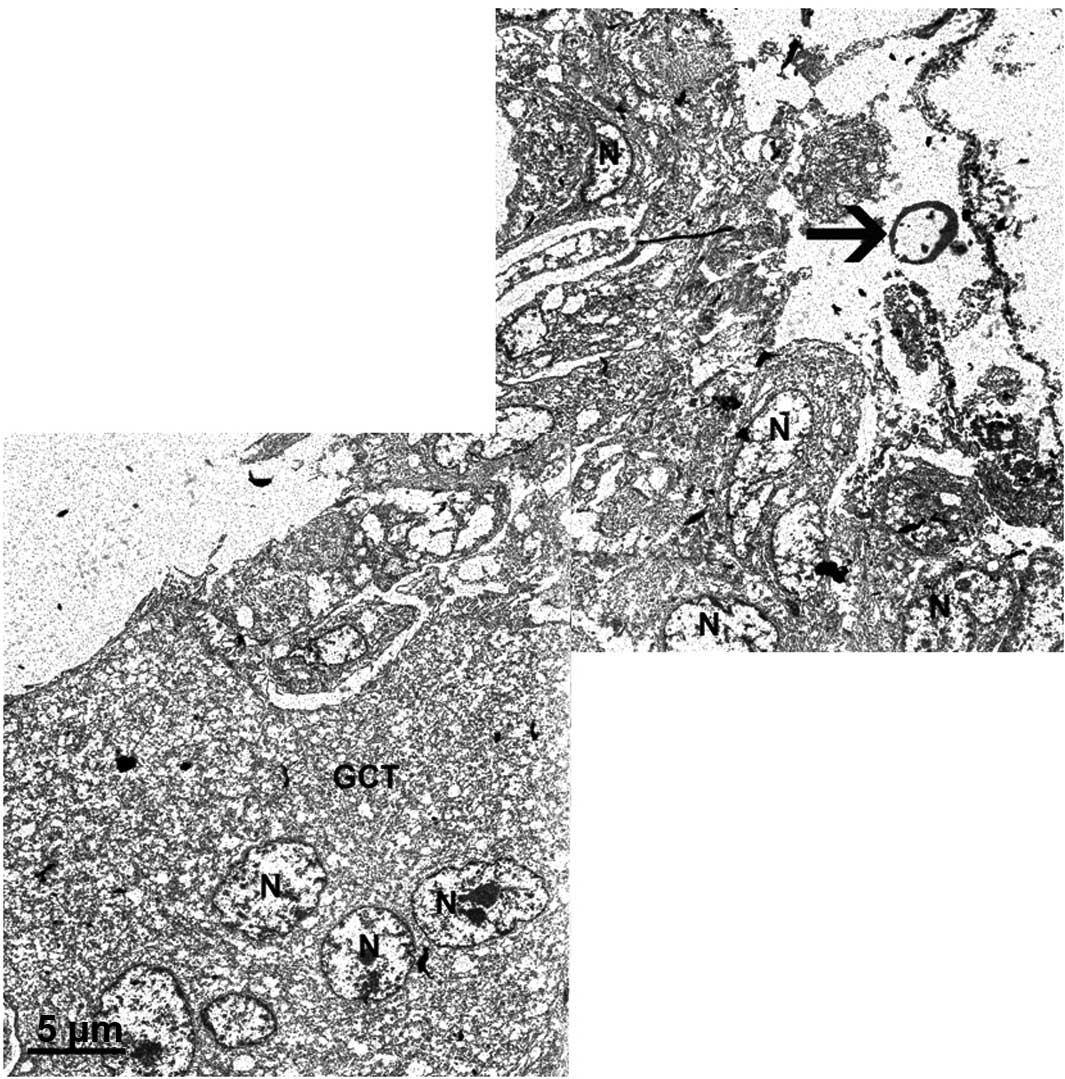
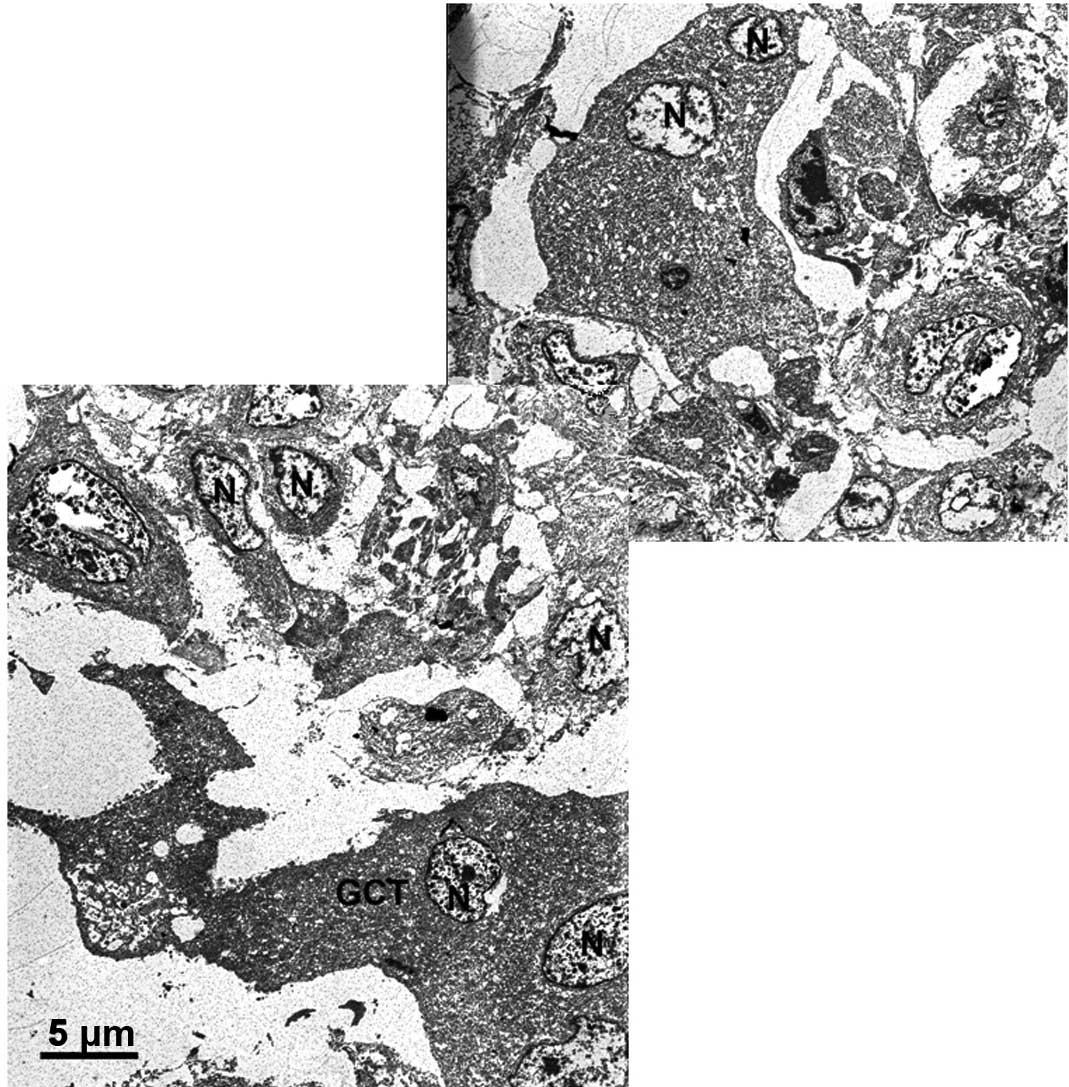
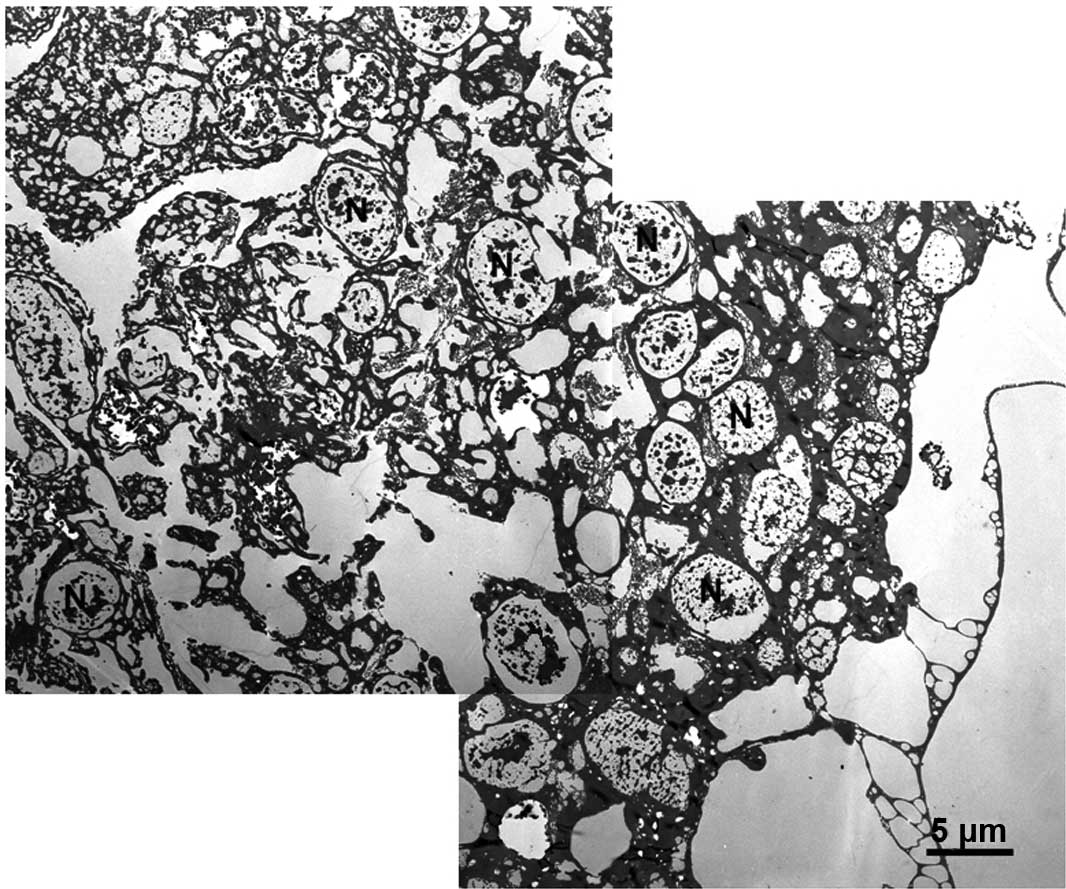
Incubation with 6% phenol solution for 1 min resulted in a damage to only the uppermost cell layers (10–20 μm; Figs. 1 and 2). Damage was represented as a complete coagulation of the cytoplasm and in particular the nucleoplasm. No complete loss of any of the cell substructures was observed. The outlines of the organelles were simply converted to black. After 3 min, the penetration depth increased to ∼200 μm. Incubation with the 60 and 80% phenol solution for 1 min resulted in the destruction of 10 cell layers and a penetration depth of ∼100 μm. After 3 min of 60 and 80% phenol exposure, neither additional tissue damage or an increase in the penetration depth were observed (Fig. 3 and Table I).

Figure 1

Electron microscopical analysis of the treatment of a giant cell tumour (GCT) with 6% phenol for 1 min, directly at the surface of the probe. The arrow indicates a cell that was completely coagulated; however, this zone of destruction remains rather small. Only 10–15 μm from the phenol diffusion front, the cellular structure is observed to be normal. A cell of the GCT with several nuclei (N) is shown.

Figure 2

Electron microscopical analysis of the treatment of a giant cell tumour (GCT) with 6% phenol for 1 min, ∼10 μm along from the zone shown in Fig. 1. As already evident in the left panel of Fig. 1, the cellular structure is relatively well maintained.

Figure 3

Electron microscopical analysis of the treatment of a giant cell tumour (GCT) with 80% phenol for 3 min, directly at the surface of the probe. In contrast to the lower phenol concentrations and lower treatment time, all cells are completely coagulated. The cells are visualised only as scaffolds of coagulated proteins, and no longer as complex structures of cyto- and nucleoplasms enclosed by cell membranes or nuclear envelopes, respectively. Therefore, this type of cell death cannot be categorised as necrosis or apoptosis, as these processes both precede reactive or even active mechanisms as a response to toxic agents of different types. In this case, an immediate passive coagulation of cells treated with phenol and not characterised by a specific biological reactivity is observed.

Table I

Penetration depth of phenol in GCT specimens incubated with different concentrations of phenol soution.

Table I

Penetration depth of phenol in GCT specimens incubated with different concentrations of phenol soution.

Penetration depth (μm)
Phenol concentration (%)Exposure time (min)Specimen 1Specimen 2Specimen 3
61151025
63180–200No data200
60116080100
60380100No data
8018080–9060
80380–100100100

[i] GCT, giant cell tumour; incubation with 6% phenol solution for 3 min resulted in the deepest tissue penetration.

Discussion

The greatest penetration depth and tissue destruction in GCT were observed when 6% phenol solution and a contact time of ≥3 min were employed. This type of destruction cannot be described as cell death in the sense of necrosis or apoptosis, as such types of cellular destruction imply a reaction (necrosis) or an active execution (apoptosis) as a consequence of toxic treatment. Higher concentrations of phenol led to extreme destruction of the uppermost cell layers, but not to a deeper infiltration of the tissue. Superficial denaturised tissues were considered to act as a barrier preventing further penetration of phenol.

Due to the complex investigation of each single cell layer with transmission electron microscopy and the achievement of consistent results in all three tumours, we did not extend the study. Nevertheless, it is possible that a deeper tissue penetration depth may be achieved by 6% (or a slightly higher concentrated) phenol solution with an incubation time >3 min. This requires further investigation.

The penetration depth of various concentrations of phenol in GCT has not yet been investigated. According to the literature, phenol concentrations used in the treatment of GCTs vary from 5–75% (8,14,15). The incubation time is often not mentioned. Quint et al investigated the cytotoxic effect of different phenol concentrations on single-layer sarcoma cell lines and recommend the use of a phenol concentration of 5% (17). Evaluation of the penetration depth was not possible with this setting. Lack et al investigated the denaturising effect of a 75% phenol solution on normal tissue, tumours and chondromatous tissue, using light microscopy (18). The penetration depth in soft tissue varied from 40–500 μm. In chondromatous tissue, no cytotoxic effect was evaluated. This suggests that phenol has no toxic effect on bone.

High concentrations of phenol are capable of causing local chemical burs; contact of the healthy surrounding tissue with the solution ought to be avoided. Phenol is locally absorbed and excreted in the urine. In this regard, Quint et al described a low risk for humans depending on the quantity of 5% phenol solution used (16).

The results of the present study suggest that an instillation of 6% phenol solution for ≥3 min is the most effective method for denaturising as many of the remaining tumour cells as possible. High phenol concentrations did not demonstrate a benefit, and they increased the risk of bone necrosis and systemic intoxication. The determined optimal phenol concentration and incubation time for GCT are not transferable to the treatment of other tumours.

Phenol instillation (6% for ≥3 min) may be used for the denaturation of small, scattered, cellular debris following intralesional curettage of GCT; however, due to the relatively low tissue penetration of 200 μm, it is not suitable for treatment of the remaining solid tumour tissue. Adequate surgical removal of the tumour remains to be the most important predictive factor in preventing recurrence of GCT of the bone.

Acknowledgements

The authors would like to thank Professor Aicher and Mrs. Kienzle, Center for Regenerative Biology and Medicine (ZRM, Eberhard-Karls-University Tuebingen), for their assistance and technical support in performing GCT fixation and staining.

References

1 

Schajowicz F: Tumors and tumorlike lesions of bone - pathology, radiology and treatment. 2nd edition. Springer-Verlag; Berlin, Heidelberg, New York: pp. 257–299. 1994, View Article : Google Scholar

2 

Szendröi M: Giant-cell tumour of bone. J Bone Joint Surg Br. 86:5–12. 2004.

3 

Campanacci M, Baldini N, Boriani S and Sudanese A: Giant-cell tumor of bone. J Bone Joint Surg Am. 69:106–114. 1987.PubMed/NCBI

4 

Lee MJ, Sallomi DF, Munk PL, Janzen DL, Connell DG, O’Conell JX, Logan PM and Masri BA: Pictorial review: giant cell tumours of bone. Clin Radiol. 53:481–489. 1998. View Article : Google Scholar : PubMed/NCBI

5 

Lackmann RD, Hosalkar HS, Ogilvie CM, Torbert JT and Fox EJ: Intralesional curettage for grades II and III giant cell tumors of bone. Clin Orthop Relat Res. 438:123–127. 2005. View Article : Google Scholar : PubMed/NCBI

6 

Turcotte RE, Wunder JS, Isler MH, Bell RS, Schachar N, Masri BA, Moreau G and Davis AM: Canadian Sarcoma Group: Giant cell tumor of long bone: a Canadian Sarcoma Group study. Clin Orthop Relat Res. 397:248–258. 2002. View Article : Google Scholar : PubMed/NCBI

7 

Balke M, Schremper L, Gebert C, Ahrens H, Streitburger A, Koehler G, Hardes J and Gosheger G: Giant cell tumor of bone: treatment and outcome of 214 cases. J Cancer Res Clin Oncol. 134:969–978. 2008. View Article : Google Scholar : PubMed/NCBI

8 

Dürr HR, Maier M, Jansson V, Baur A and Refior HJ: Phenol as an adjuvant for local control in the treatment of giant cell tumour of the bone. Eur J Surg Oncol. 25:610–618. 1999.PubMed/NCBI

9 

Lin WH, Lan TY, Chen CY, Wu K and Yang RS: Similar Local Control between Phenol- and Ethanol-treated Giant Cell Tumors of Bone. Clin Orthop Relat Res. 469:3200–3208. 2011. View Article : Google Scholar : PubMed/NCBI

10 

Malawer MM, Bickels J, Meller I, Buch RG, Henshaw R and Kollender Y: Cryosurgery in the treatment of giant cell tumor: a long-term followup study. Clin Orthop Relat Res. 359:176–188. 1999. View Article : Google Scholar : PubMed/NCBI

11 

Remedios D, Saifuddin A and Pringle J: Radiological and clinical recurrence of giant-cell tumour of bone after use of cement. J Bone Joint Surg Br. 79:26–30. 1997. View Article : Google Scholar : PubMed/NCBI

12 

Willert HG: Clinical results of the temporary acrylic bone cement plug in the treatment of bone tumors: a multicentric study. In: Limb-sparing Surgery in Musculoskeletal Oncology. Enneking WF: Churchill Livingstone; New York: pp. 445–458. 1987

13 

O’Donell RJ, Springfield DS, Motwani HK, Ready JE, Gebhardt MC and Mankin HJ: Recurrence of giant-cell tumors of the long bones after curettage and packing with cement. J Bone Joint Surg Am. 76:1827–1833. 1994.PubMed/NCBI

14 

Schiller C, Ritschl P, Windhager R, Kropej D and Kotz R: The incidence of recurrence in phenol treated and non-phenol treated bone cavities following intralesional resection of non-malignant bone tumors. Z Orthop Ihre Grenzgeb. 127:398–401. 1989.(In German).

15 

Szendröi M: Adjuvant therapy (phenol, bone cements) in giant cell tumors. Z Orthop Ihre Grenzgeb. 130:95–98. 1992.(In German).

16 

Quint U, Müller RT and Müller G: Characteristics of phenol. Arch Orthop Trauma Surg. 117:43–46. 1998. View Article : Google Scholar

17 

Quint U, Vanhöfer U, Harstrick A and Müller RT: Cytotoxicity of penol to musculoskeletal tumours. J Bone Joint Surg Br. 78:984–985. 1996. View Article : Google Scholar : PubMed/NCBI

18 

Lack W, Lang S and Brand G: Necrotising effect of phenol on normal tissues and on tumors. Acta Orthop Scand. 65:351–354. 1994. View Article : Google Scholar : PubMed/NCBI

Related Articles

  • Abstract
  • View
  • Download
  • Twitter
Copy and paste a formatted citation
Spandidos Publications style
Mittag F, Leichtle C, Kieckbusch I, Wolburg H, Rudert M, Kluba T and Leichtle U: Cytotoxic effect and tissue penetration of phenol for adjuvant treatment of giant cell tumours. Oncol Lett 5: 1595-1598, 2013.
APA
Mittag, F., Leichtle, C., Kieckbusch, I., Wolburg, H., Rudert, M., Kluba, T., & Leichtle, U. (2013). Cytotoxic effect and tissue penetration of phenol for adjuvant treatment of giant cell tumours. Oncology Letters, 5, 1595-1598. https://doi.org/10.3892/ol.2013.1244
MLA
Mittag, F., Leichtle, C., Kieckbusch, I., Wolburg, H., Rudert, M., Kluba, T., Leichtle, U."Cytotoxic effect and tissue penetration of phenol for adjuvant treatment of giant cell tumours". Oncology Letters 5.5 (2013): 1595-1598.
Chicago
Mittag, F., Leichtle, C., Kieckbusch, I., Wolburg, H., Rudert, M., Kluba, T., Leichtle, U."Cytotoxic effect and tissue penetration of phenol for adjuvant treatment of giant cell tumours". Oncology Letters 5, no. 5 (2013): 1595-1598. https://doi.org/10.3892/ol.2013.1244
Copy and paste a formatted citation
x
Spandidos Publications style
Mittag F, Leichtle C, Kieckbusch I, Wolburg H, Rudert M, Kluba T and Leichtle U: Cytotoxic effect and tissue penetration of phenol for adjuvant treatment of giant cell tumours. Oncol Lett 5: 1595-1598, 2013.
APA
Mittag, F., Leichtle, C., Kieckbusch, I., Wolburg, H., Rudert, M., Kluba, T., & Leichtle, U. (2013). Cytotoxic effect and tissue penetration of phenol for adjuvant treatment of giant cell tumours. Oncology Letters, 5, 1595-1598. https://doi.org/10.3892/ol.2013.1244
MLA
Mittag, F., Leichtle, C., Kieckbusch, I., Wolburg, H., Rudert, M., Kluba, T., Leichtle, U."Cytotoxic effect and tissue penetration of phenol for adjuvant treatment of giant cell tumours". Oncology Letters 5.5 (2013): 1595-1598.
Chicago
Mittag, F., Leichtle, C., Kieckbusch, I., Wolburg, H., Rudert, M., Kluba, T., Leichtle, U."Cytotoxic effect and tissue penetration of phenol for adjuvant treatment of giant cell tumours". Oncology Letters 5, no. 5 (2013): 1595-1598. https://doi.org/10.3892/ol.2013.1244
Follow us
  • Twitter
  • LinkedIn
  • Facebook
About
  • Spandidos Publications
  • Careers
  • Cookie Policy
  • Privacy Policy
How can we help?
  • Help
  • Live Chat
  • Contact
  • Email to our Support Team