Introduction
Photodynamic therapy (PDT) is a new technology for
the treatment of cancer that has gained interest within the past
two decades and has been used in the treatment of lung, esophageal,
cervical, bladder and skin cancer and other tumors (1). Clinically, PDT has been considered to
be more applicable to tumors with a wide range of superficial
locations, as it may be combined with fluorescence diagnostic
techniques to distinguish the range of lesions, selectively kill
tumors and reduce the damage to normal tissues. It is recognized
that the efficacy of PDT in tumors with a depth of 1.0 cm is
extremely high. Precancerous lesions of an oral or maxillofacial
location are more superficial, therefore, PDT has a measurable
effect on these types of lesions (2).
The present study used intravenous PDT to treat
precancerous lesions in order to explore the mechanism of the
treatment. Through the establishment of a golden hamster
leukoplakia model, which was similar to human leukoplakia, the
effect of the hematoporphyrin monomethyl ether (PsD-007)-mediated
krypton laser PDT on the oral dysplasia of hamster was observed and
the dose-effect correlation of PDT was also studied. This provides
a basis and reference for the treatment of human precancerous
lesions in the clinic.
Materials and methods
Experimental animals and establishment of
leukoplakia model
Materials
A total of 25, six to eight-week-old female Syrian
hamsters (n=25) were purchased from the BK company (Shanghai,
China). 9,10-Dimethyl-1,2-benzanthracene (DMBA) was purchased from
Sigma (St Louis, MO, USA) and the krypton ion laser was obtained
from Coherent (Santa Clara, CA, USA). The hematoporphyrin
monomethyl ether, PsD-007 (Shanghai Second Military Medical
University, Shanghai, China), was prepared prior to performing the
study.
Grouping
The 25 Syrian golden hamsters were randomly divided
into five groups (A, B, C, D and E; n=5). The concentration of the
photosensitizer used was 5, 10, 20, 40 and 60 mg/kg, respectively
in the five groups. In all the animals, the cheek pouch of the
right side was set as the PDT group and the left side was set as
the control group.
Preparation of leukoplakia model
According to the methods used by Salley (3), 0.5% DMBA (5 g/l) was dissolved in
acetone solution and stored in brown bottles. The cheek pouch was
everted using tweezers and a number one oil painting pen dipped
with 0.5% DMBA acetone solution was used to brush the tissues 10
times within a 1-cm range of the cheek pouch vein. The other side
of the cheek pouch mucosa was prepared using the same method. The
hamsters were made to fast for 2 h following the drug-smearing. All
the animals were treated with the surface drug on Monday, Wednesday
and Friday continuously for six weeks in the same manner. The study
was approved by the ethics committee of Shanghai Ninth People’s
Hospital Affiliated to Shanghai Jiao Tong University, School of
Medicine (Shanghai, China).
Krypton laser PDT
Femoral vein exposure
Six weeks after the drug-smearing, all the animals
were made to fast for 12 h, were weighed and their skin prepared.
Barbiturates (0.8–1 ml/kg; Changchun Medical Sciences, Changchun,
China) were intramuscularly injected as a general anesthetic. The
hamster was placed in a supine position and fixed to a special
operating table. Using bromogeramine iodine tincture cotton balls
to disinfect the skin of the groin, the hair was cut and the skin
was disinfected again. A skin incision was made between the pubis
and iliac crest to expose the femoral vein (>1 cm) and then the
fascia was carefully peeled off for the venipuncture.
Femoral venipuncture
The femoral vein was pierced with a number 4.5 scalp
needle. The photosensitizer, PsD-007, was injected slowly, and the
breathing and heartbeat of the hamster were observed closely during
the infusion process. Finally, the needle was removed and the
incision was sutured layer by layer. Chlortetracycline eye ointment
was coated on the wound.
Krypton laser irradiation
All the animals remained fixed to the operating
table. The upper and lower incisors were wound with fine wire to
keep the mouth open. The cheek pouch lesion was exposed and the
krypton laser vertically irradiated the lesion at a wavelength of
413 nm, a power density of 150 mW/cm2 and an irradiation
time of 20 min. The non-irradiated skin and mucous were shaded from
the radiation using black stickers. Dexamethasone was administered
to all the animals at three days post-surgery (0.1 ml, bid,
im).
Post-operative observation
Naked eye observation
The dynamic change in the experimental-side cheek
pouch was observed and recorded.
Pathological observation
Six weeks after the surgery, all the animals were
sacrificed and the cheek pouch mucosa specimens of the PDT and
control groups were collected and fixed with 10% formalin for 48 h.
The samples were conventionally dehydrated, embedded in paraffin
and sliced. The slides were stained using hematoxylin and eosin
(HE) and observed under a light microscope. The pathological
diagnosis was concluded by two pathologists.
Observation indices
The pathological criteria, according to the 12
diagnostic criteria of epithelial dysplasia proposed by the WHO
Oral Precancerous Lesions Collaborating Centre (4), were as follows: 2, mild dysplasia;
2–4, moderate dysplasia; and >5, severe dysplasia. The typical
pathological changes of the tumor cells were recorded as carcinoma
in situ.
The efficacy evaluation was based on the
post-operative cheek pouch mucosal pathology, which was graded as a
cure (normal mucosa) or as effective (mild dysplasia). The lesions
were alleviated compared with the control side.
Statistics
Values are shown as the mean ± SEM. The differences
between all the groups were evaluated using one-way ANOVA with a
post-hoc Student-Newman-Keuls multiple comparisons test. The
statistical analyses were performed using SPSS software (v13.0;
SPSS, Inc., Chicago, IL, USA) and P<0.05 was considered to
indicate a statistically significant difference.
Results
General observation
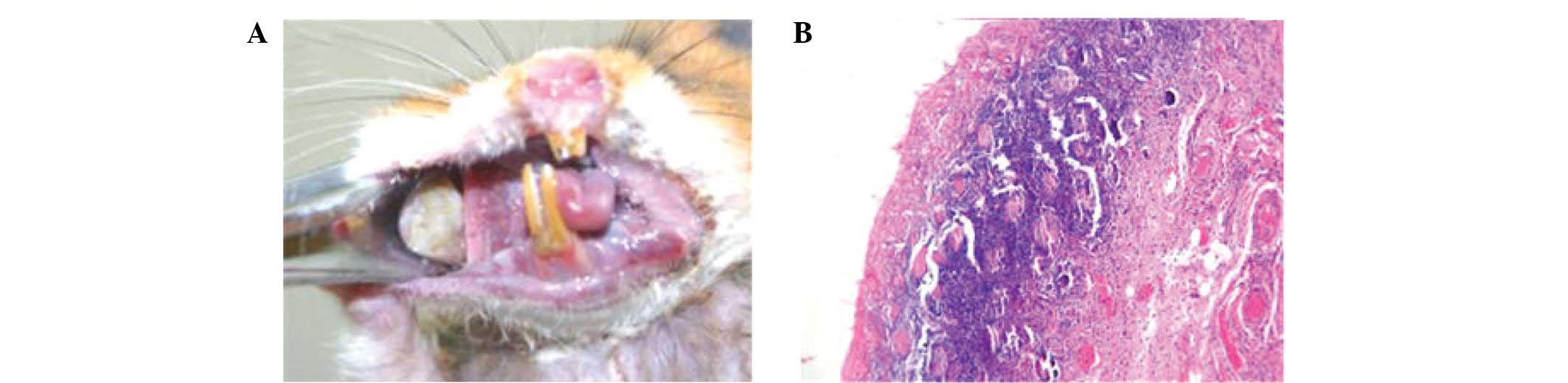
In groups A–E, the laser-irradiated cheek pouch
mucosa presented with mild edema immediately after the PDT and with
reactive edema involving the tongue and neck within 48–72 h. The
swelling subsided after five to seven days. One week after the
surgery, the cheek pouch mucosa became necrotic and grayish yellow.
The pouch formed an ulcer and the necrotic tissues formed a white
pseudomembrane to cover the mucosa within one to two weeks
(Fig. 1). Subsequent to
approximately four weeks, the wound healed. However, certain
hamsters demonstrated slight scarring.
Effect of PDT on dysplasia
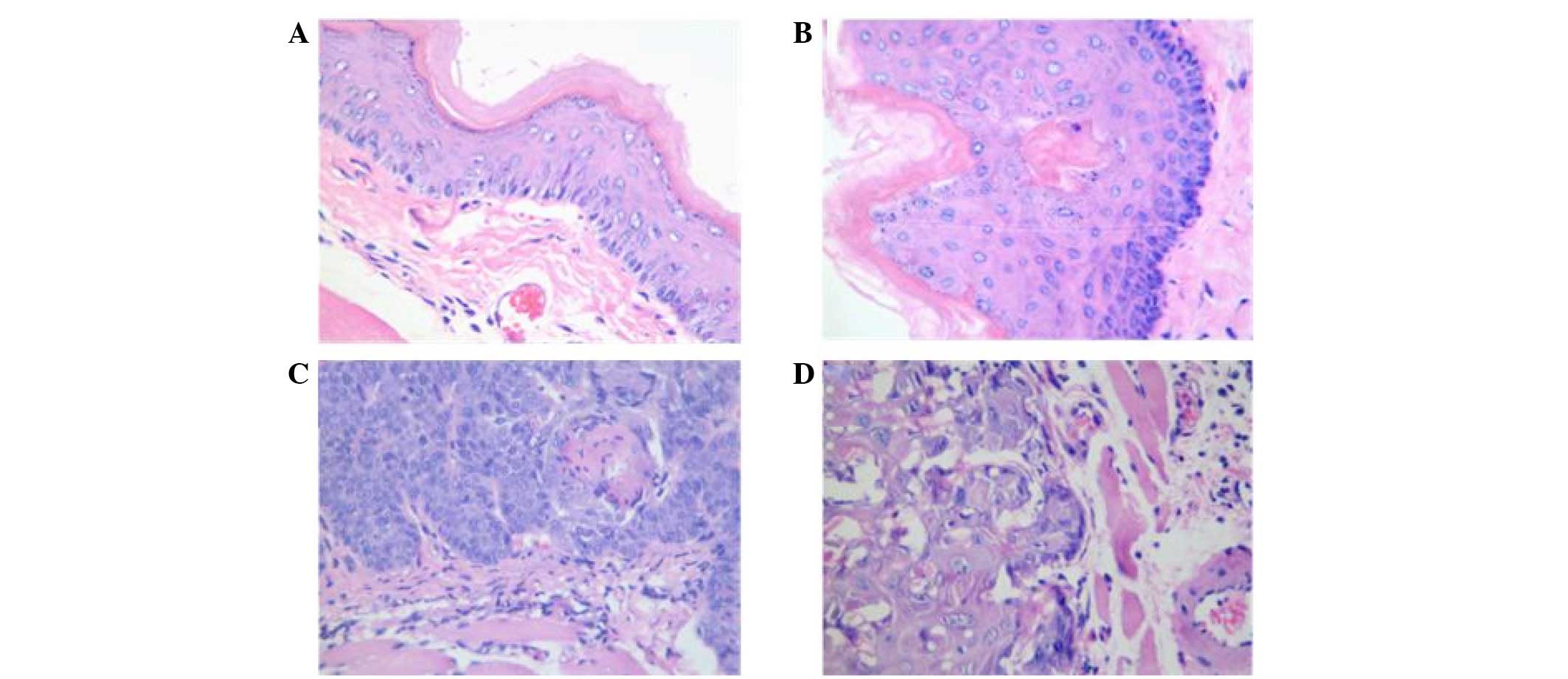
Of the total 25 hamsters, only one hamster from
group C died. Among the remaining 24 hamsters in the PDT group, 15
cases exhibited normal mucosa and nine displayed mild dysplasia. In
the control group, six cases presented with moderate dysplasia, six
with severe dysplasia and 13 with carcinoma in situ and SCC
(Table I; Fig. 2). There was a significant difference
between the PDT group and the control group, as shown by the
χ2 test (P<0.01).
 | Table IPathological results of the
PDT-treated and control sides of the buccal pouch mucosa in groups
A–E following six weeks of treatment. |
Table I
Pathological results of the
PDT-treated and control sides of the buccal pouch mucosa in groups
A–E following six weeks of treatment.
| | | Epithelium dysplasia,
n (%) | |
|---|
| | |
| |
|---|
| Group | n | Normal mucosa, n
(%) | Mild | Moderate | Severe | Carcinoma in
situ, n (%) |
|---|
| A |
| PDT-treated
side | 5 | 1 (20.0) | 4 (80.0) | 0 (0.0) | 0 (0.0) | 0 (0.0) |
| Control side | 5 | 0 (0.0) | 0 (0.0) | 1 (25.0) | 1 (25.0) | 3 (60.0) |
| B |
| PDT-treated
side | 5 | 4 (40.0) | 1 (60.0) | 0 (0.0) | 0 (0.0) | 0 (0.0) |
| Control side | 5 | 0 (0.0) | 0 (0.0) | 2 (40.0) | 1 (20.0) | 2 (40.0) |
| C |
| PDT-treated
side | 4 | 3 (75.0) | 1 (25.0) | 0 (0.0) | 0 (0.0) | 0 (0.0) |
| Control side | 4 | 0 (0.0) | 0 (0.0) | 0 (0.0) | 1 (25.0) | 3 (75.0) |
| D |
| PDT-treated
side | 5 | 3 (60.0) | 2 (40.0) | 0 (0.0) | 0 (0.0) | 0 (0.0) |
| Control side | 5 | 0 (0.0) | 0 (0.0) | 2 (40.0) | 1 (20.0) | 2 (40.0) |
| E |
| PDT-treated
side | 5 | 4 (80.0) | 1 (20.0) | 0 (0.0) | 0 (0.0) | 0 (0.0) |
| Control side | 5 | 0 (0.0) | 0 (0.0) | 1 (20.0) | 1 (20.0) | 3 (60.0) |
| Total |
| PDT-treated
side | 24 | 15 (62.5) | 9 (37.5) | 0 (0.0) | 0 (0.0) | 0 (0.0) |
| Control side | 24 | 0 (0.0) | 0 (0.0) | 6 (25.0) | 5 (20.8) | 13 (54.2) |
Correlation between dose and effect of
PsD-007
As shown in Table
II, the cure rate in group A was 20%. There was a significant
difference between group A and the other groups (P<0.05). The
cure rate in groups B, C, D and E was 80, 75, 80 and 60%,
respectively, indicating that the cure rate did not increase with
increasing concentration (P>0.05) after a concentration of 10
mg/kg. Therefore, 10 mg/kg was defined as the effective dose for
the treatment of dysplasia using krypton laser PDT.
| Table IICure and effective rates of groups
A–E. |
Table II
Cure and effective rates of groups
A–E.
| Group | Dose, mg/kg | Cure, n (%) | Effective, n(%) | n |
|---|
| A | 5 | 1 (20.0) | 4 (80.0) | 5 |
| B | 10 | 4 (80.0) | 1 (20.0) | 5 |
| C | 20 | 3 (75.0) | 1 (25.0) | 4 |
| D | 40 | 3 (60.0) | 2 (40.0) | 5 |
| E | 60 | 4 (80.0) | 1 (20.0) | 5 |
| Total | - | 15 (62.5) | 9 (37.5) | 24 |
Side-effects
A single hamster in group C (20 mg/kg) died of a
photosensitive reaction two weeks after the surgery. In the other
groups, the hamsters presented various degrees of photosensitive
reactions, particularly in groups D (40 mg/kg) and E (60 mg/kg).
There were three cases in group D and four cases in group E that
demonstrated photosensitive reactions, including a rash, alopecia
and scab formation.
Discussion
The precancerous lesions of the cheek pouch hamster
model are considered the best choice for observing the dynamic
process from precancerous lesions to cancer, which may be used to
observe and evaluate the effect of PDT and obtain reliable results.
The golden hamster used in the present study is a small mouse and
the tail is extremely short. Therefore, a subcutaneous superficial
vein or tail vein injection would be unsuccessful. Consequently,
the photodynamic methods of the present study were established
using a femoral vein injection, which has repeatability as a new
method.
The mechanism of the destruction of the tumor using
PDT may be summarized as follows: i) The hematoporphyrin derivative
photosensitizer is combined with a biofilm system, particularly the
cell plasma and nuclear membranes, to destroy the mitochondria,
lysosomes and liposomes of the tumor cells. Therefore, the
activities of the cells that are necessary for life, including
respiration, electron transport and ATP synthesis, are affected due
to the mitochondrial damage, thereby inducing cell apoptosis
(5–7); ii) PDT causes tumor microvascular
dysfunction and structural damage, including destruction of the
vascular endothelium, platelet adhesion, degranulation, siltation
of the blood cells and vascular occlusion, thereby leading to tumor
necrosis (8); iii) PDT may cause an
immune response of the tumor cells responding to tumor antigens
(9); and iv) PDT may affect the
gene expression of the tumor cells (10). However, due to the shorter
photosensitizer absorption lines, the penetration depth of the
corresponding laser is limited. Therefore, deep and large tumors
may not be able to be treated using this method. It has been
recognized that the method is only efficient on tumors with a depth
of ≤1.0 cm (11,12).
Precancerous lesions are extremely superficial and
only identified in the epithelium, which means that the desired
treatment results may be obtained with PDT. PDT has gradually been
focused on the treatment of superficial tumors and precancerous
lesions. The treatment of precancerous lesions with PDT and
5-AminoLevulinic Acid (ALA) has become a focus for research
(3). ALA is an exogenous
photosensitizer, which is able to indirectly synthesize
protoporphyrin IX at a 635 nm absorption peak in vivo
following absorption through the skin or mucous (14). ALA-PDT has been used to treat a
variety of superficial precancerous lesions, including skin,
bladder, lung and gastrointestinal cancer. Tsai et
al(15) revealed that a
combination of 20% ALA and a light-emitting diode (LED) laser (630
nm, 100 J/cm2) was able to effectively treat hamsters
with oral dysplasia induced by DMBA. Furthermore the same ALA-PDT
method was used to treat 32 patients with oral dysplasia. Following
a six-month follow-up period, the results revealed that a complete
response was evident in seven cases and a partial response was
evident in 13 cases. the treatment was ineffective in 12 cases.
Kübler et al(16) used 20%
ALA to treat 12 patients with leukoplakia. After 2 h, the patients
were irradiated using a 630 nm laser (100 J/cm2). The
results revealed that a complete response was evident in five cases
and a partial response was evident in four cases. The treatment was
ineffective in three cases. The lesions disappeared following
re-treatment in one case.
The systemic toxicity was observed to be low when
partially coated with ALA, and light did not have to be avoided
following the surgery due to a rapid metabolism (15,16).
However, the efficacy of ALA-PDT was dependent on the level of
protoporphyrin that was synthesized in the tumors. The capacity of
synthesizing protoporphyrin has yet to be elucidated in various
tumor cells and precancerous lesions. Therefore, the method lacks a
theoretical basis for the treatment of precancerous lesions. In the
present study, the intravenous PDT method was used, in which the
mechanism has been confirmed. PsD-007 was the purified product of
the hematoporphyrin derivatives and the maximum absorption peak was
408 nm, which was close to the wavelength of the krypton laser (413
nm). The results revealed that the overall cure rate of dysplasia
was 62.5% (15/24) in the PDT group, indicating that PDT had a
positive effect on the precancerous lesions.
The traditional view is that the porphyrin-based
photosensitizer has a selective storage role for tumor tissues.
However, there has not been sufficient experimental evidence for
this. The mechanism behind the treatment of tumors using PDT was
believed to function as the new tumor tissues were rich in blood
vessels. The hematoporphyrin derivative photosensitizer reached a
relatively high concentration in the tumor tissues through the
blood vessels, thereby selectively destroying the tumors. The
objective of the present study was to treat oral precancerous
lesions, in which the vascular distribution is not clear.
Therefore, a confirmation of the differences between
photosensitizer concentrations in the precancerous lesions and
normal tissues was required. In the present study, all the animals
demonstrated mucosal necrosis and shedding following the treatment
with PDT. The selectivity was also determined by the range of the
irradiation. However, the normal tissues were also damaged, which
may have been due to fact that the vascular distribution of the
precancerous lesions was not abnormal compared with the tumors.
Therefore, the difference in the concentration of the
photosensitizer was not great enough between the precancerous
lesions and the normal tissues in order to obtain selective damage
results.
The results of the present study revealed that 15
cases were cured in the PDT group at six weeks post-treatment, none
of which appeared carcinogenic. However, in the control group, 13
cases appeared carcinogenic, indicating that the efficacy was
significantly improved in the PDT group. Furthermore, although the
animals demonstrated mild dysplasia in the PDT group, the degree of
dysplasia was less than that of the control group. This provides
evidence for the efficiency of PDT using a krypton laser and
PsD-007 on the precancerous lesions of the golden hamsters. In
addition, there was a significant difference between group A (5
mg/kg) and the other four groups (>10 mg/kg). However, although
the cure rate did not increase with an increasing concentration,
the phototoxicity did. Therefore, 10 mg/kg was considered a
suitable photosensitizer concentration. A single hamster in group C
died of a severe swelling response and photosensitive reaction at
two weeks post-surgery. In groups D and E, the animals also
demonstrated photosensitive reactions, including a rash, alopecia
and skin ulceration. These reactions may have been due to the
larger dose of photosensitizer and the unintentional exposure to
light.
Although PDT exhibited a positive effect on the
precancerous lesions, the lesions had characteristics of regional
malignancy and multi-step carcinogenesis. Therefore, the efficiency
of the treatment may have been reduced and the lesions may have
recurred after an extended observation time. PDT requires further
study in order to evaluate the long-term effects of the method on
precancerous lesions.
Acknowledgements
This study was supported by the Research Fund of
Science and Technology Commission of Shanghai Municipality (grant
no. 08DZ2271100).
References
|
1
|
Dougherty TJ, Gomer CJ, Herderson BW, et
al: Photodynamic therapy. J Natl Cancer Inst. 90:889–905. 1998.
View Article : Google Scholar
|
|
2
|
Hopper C, Kubler A, Lewis H, et al:
mTHPC-mediated photodynamic therapy for early oral squamous cell
carcinoma. Int J Cancer. 111:138–146. 2004. View Article : Google Scholar : PubMed/NCBI
|
|
3
|
Salley JJ: Experimental carcinogenesis in
the cheek pouch of the Syrian hamster. J Dent Res. 33:253–262.
1954. View Article : Google Scholar : PubMed/NCBI
|
|
4
|
Eversole LR: Dysplasia of the upper
aerodigestive tract squamous epithelium. Head Neck Pathol. 3:63–68.
2009. View Article : Google Scholar : PubMed/NCBI
|
|
5
|
Chen HM, Chen CT, Yang H, et al:
Successful treatment of oral verrucous hyperplasia with topical
5-aminolevulinic acid-mediated photodynamic therapy. Oral Oncol.
40:630–637. 2004. View Article : Google Scholar : PubMed/NCBI
|
|
6
|
Gush RJ and King TA: Discrimination of
capillary and arterio-venular blood flow in skin by laser Doppler
flowmetry. Med Biol Eng Comput. 29:387–392. 1991. View Article : Google Scholar : PubMed/NCBI
|
|
7
|
Tsai JC, Chiang CP, Chen HM, et al:
Photodynamic Therapy of oral dysplasia with topical
5-aminolevulinic acid and light-emitting diode array. Lasers Surg
Med. 34:18–24. 2004. View Article : Google Scholar : PubMed/NCBI
|
|
8
|
Biel MA: Photodynamic therapy and the
treatment of neoplastic diseases of the larynx. Laryngoscope.
104:399–403. 1994.PubMed/NCBI
|
|
9
|
Kübler A, Haase T, Rheinwald M, et al:
Treatment of oral leukoplakia by topical application of
5-aminolevulinic acid. Int J Oral Maxillofac Surg. 27:466–469.
1998.PubMed/NCBI
|
|
10
|
Pariser DM, Lowe NJ, Stewart DM, et al:
Photodynamic therapy with topical methyl aminolevulinate for
actinic keratosis: results of a prospective randomized multicenter
trial. J Am Acad Dermatol. 48:227–232. 2003. View Article : Google Scholar
|
|
11
|
Date M, Sakata I, Fukuchi K, et al:
Photodynamic therapy for human oral squamous cell carcinoma and
xenografts using a new photosensitizer, PAD-S31. Lasers Surg Med.
33:57–63. 2003. View Article : Google Scholar : PubMed/NCBI
|
|
12
|
Nauta JM, van Leengoed HL, Witjes MJ, et
al: Photofrin-mediated photodynamic therapy of chemically-induced
premalignant lesions and squamous cell carcinoma of the palatal
mucosa in rats. Int J Oral Maxillofac Surg. 26:223–231. 1997.
View Article : Google Scholar : PubMed/NCBI
|
|
13
|
Collaud S, Juzeniene A, Moan J and Lange
N: On the selectivity of 5-aminolevulinic acid-induced
protoporphyrin IX formation. Curr Med Chem Anticancer Agents.
4:301–316. 2004. View Article : Google Scholar : PubMed/NCBI
|
|
14
|
Chang SC, Buonaccorsi G, MacRobert AJ and
Bown SG: 5-Aminolevulinic acid (ALA)-induced protoporphyrin IX
fluorescence and photodynamic effects in the rat bladder: an in
vivo study comparing oral and intravesical ALA administration.
Lasers Surg Med. 20:254–264. 1997. View Article : Google Scholar : PubMed/NCBI
|
|
15
|
Tsai JC, Chiang CP, Chen HM, et al:
Potodynamic therapy of oral dysplasia with topical 5-aminolebulinic
acid and light-emitting diode array. Lasers Surg Med. 34:18–24.
2004. View Article : Google Scholar : PubMed/NCBI
|
|
16
|
Kubler A, Haase T, Rheinwald M, et al:
Treatment of oral leukoplakia by topical application of
5-aminolevulinic acid. Int J Oral Maxillofac Surg. 27:466–469.
1998. View Article : Google Scholar : PubMed/NCBI
|