Spandidos Publications Logo
  • About
    • About Spandidos
    • Aims and Scopes
    • Abstracting and Indexing
    • Editorial Policies
    • Reprints and Permissions
    • Job Opportunities
    • Terms and Conditions
    • Contact
  • Journals
    • All Journals
    • Oncology Letters
      • Oncology Letters
      • Information for Authors
      • Editorial Policies
      • Editorial Board
      • Aims and Scope
      • Abstracting and Indexing
      • Bibliographic Information
      • Archive
    • International Journal of Oncology
      • International Journal of Oncology
      • Information for Authors
      • Editorial Policies
      • Editorial Board
      • Aims and Scope
      • Abstracting and Indexing
      • Bibliographic Information
      • Archive
    • Molecular and Clinical Oncology
      • Molecular and Clinical Oncology
      • Information for Authors
      • Editorial Policies
      • Editorial Board
      • Aims and Scope
      • Abstracting and Indexing
      • Bibliographic Information
      • Archive
    • Experimental and Therapeutic Medicine
      • Experimental and Therapeutic Medicine
      • Information for Authors
      • Editorial Policies
      • Editorial Board
      • Aims and Scope
      • Abstracting and Indexing
      • Bibliographic Information
      • Archive
    • International Journal of Molecular Medicine
      • International Journal of Molecular Medicine
      • Information for Authors
      • Editorial Policies
      • Editorial Board
      • Aims and Scope
      • Abstracting and Indexing
      • Bibliographic Information
      • Archive
    • Biomedical Reports
      • Biomedical Reports
      • Information for Authors
      • Editorial Policies
      • Editorial Board
      • Aims and Scope
      • Abstracting and Indexing
      • Bibliographic Information
      • Archive
    • Oncology Reports
      • Oncology Reports
      • Information for Authors
      • Editorial Policies
      • Editorial Board
      • Aims and Scope
      • Abstracting and Indexing
      • Bibliographic Information
      • Archive
    • Molecular Medicine Reports
      • Molecular Medicine Reports
      • Information for Authors
      • Editorial Policies
      • Editorial Board
      • Aims and Scope
      • Abstracting and Indexing
      • Bibliographic Information
      • Archive
    • World Academy of Sciences Journal
      • World Academy of Sciences Journal
      • Information for Authors
      • Editorial Policies
      • Editorial Board
      • Aims and Scope
      • Abstracting and Indexing
      • Bibliographic Information
      • Archive
    • International Journal of Functional Nutrition
      • International Journal of Functional Nutrition
      • Information for Authors
      • Editorial Policies
      • Editorial Board
      • Aims and Scope
      • Abstracting and Indexing
      • Bibliographic Information
      • Archive
    • International Journal of Epigenetics
      • International Journal of Epigenetics
      • Information for Authors
      • Editorial Policies
      • Editorial Board
      • Aims and Scope
      • Abstracting and Indexing
      • Bibliographic Information
      • Archive
    • Medicine International
      • Medicine International
      • Information for Authors
      • Editorial Policies
      • Editorial Board
      • Aims and Scope
      • Abstracting and Indexing
      • Bibliographic Information
      • Archive
  • Articles
  • Information
    • Information for Authors
    • Information for Reviewers
    • Information for Librarians
    • Information for Advertisers
    • Conferences
  • Language Editing
Spandidos Publications Logo
  • About
    • About Spandidos
    • Aims and Scopes
    • Abstracting and Indexing
    • Editorial Policies
    • Reprints and Permissions
    • Job Opportunities
    • Terms and Conditions
    • Contact
  • Journals
    • All Journals
    • Biomedical Reports
      • Information for Authors
      • Editorial Policies
      • Editorial Board
      • Aims and Scope
      • Abstracting and Indexing
      • Bibliographic Information
      • Archive
    • Experimental and Therapeutic Medicine
      • Information for Authors
      • Editorial Policies
      • Editorial Board
      • Aims and Scope
      • Abstracting and Indexing
      • Bibliographic Information
      • Archive
    • International Journal of Epigenetics
      • Information for Authors
      • Editorial Policies
      • Editorial Board
      • Aims and Scope
      • Abstracting and Indexing
      • Bibliographic Information
      • Archive
    • International Journal of Functional Nutrition
      • Information for Authors
      • Editorial Policies
      • Editorial Board
      • Aims and Scope
      • Abstracting and Indexing
      • Bibliographic Information
      • Archive
    • International Journal of Molecular Medicine
      • Information for Authors
      • Editorial Policies
      • Editorial Board
      • Aims and Scope
      • Abstracting and Indexing
      • Bibliographic Information
      • Archive
    • International Journal of Oncology
      • Information for Authors
      • Editorial Policies
      • Editorial Board
      • Aims and Scope
      • Abstracting and Indexing
      • Bibliographic Information
      • Archive
    • Medicine International
      • Information for Authors
      • Editorial Policies
      • Editorial Board
      • Aims and Scope
      • Abstracting and Indexing
      • Bibliographic Information
      • Archive
    • Molecular and Clinical Oncology
      • Information for Authors
      • Editorial Policies
      • Editorial Board
      • Aims and Scope
      • Abstracting and Indexing
      • Bibliographic Information
      • Archive
    • Molecular Medicine Reports
      • Information for Authors
      • Editorial Policies
      • Editorial Board
      • Aims and Scope
      • Abstracting and Indexing
      • Bibliographic Information
      • Archive
    • Oncology Letters
      • Information for Authors
      • Editorial Policies
      • Editorial Board
      • Aims and Scope
      • Abstracting and Indexing
      • Bibliographic Information
      • Archive
    • Oncology Reports
      • Information for Authors
      • Editorial Policies
      • Editorial Board
      • Aims and Scope
      • Abstracting and Indexing
      • Bibliographic Information
      • Archive
    • World Academy of Sciences Journal
      • Information for Authors
      • Editorial Policies
      • Editorial Board
      • Aims and Scope
      • Abstracting and Indexing
      • Bibliographic Information
      • Archive
  • Articles
  • Information
    • For Authors
    • For Reviewers
    • For Librarians
    • For Advertisers
    • Conferences
  • Language Editing
Login Register Submit
  • This site uses cookies
  • You can change your cookie settings at any time by following the instructions in our Cookie Policy. To find out more, you may read our Privacy Policy.

    I agree
Search articles by DOI, keyword, author or affiliation
Search
Advanced Search
presentation
Oncology Letters
Join Editorial Board Propose a Special Issue
Print ISSN: 1792-1074 Online ISSN: 1792-1082
Journal Cover
2014-February Volume 7 Issue 2

Full Size Image

Sign up for eToc alerts
Recommend to Library

Journals

International Journal of Molecular Medicine

International Journal of Molecular Medicine

International Journal of Molecular Medicine is an international journal devoted to molecular mechanisms of human disease.

International Journal of Oncology

International Journal of Oncology

International Journal of Oncology is an international journal devoted to oncology research and cancer treatment.

Molecular Medicine Reports

Molecular Medicine Reports

Covers molecular medicine topics such as pharmacology, pathology, genetics, neuroscience, infectious diseases, molecular cardiology, and molecular surgery.

Oncology Reports

Oncology Reports

Oncology Reports is an international journal devoted to fundamental and applied research in Oncology.

Experimental and Therapeutic Medicine

Experimental and Therapeutic Medicine

Experimental and Therapeutic Medicine is an international journal devoted to laboratory and clinical medicine.

Oncology Letters

Oncology Letters

Oncology Letters is an international journal devoted to Experimental and Clinical Oncology.

Biomedical Reports

Biomedical Reports

Explores a wide range of biological and medical fields, including pharmacology, genetics, microbiology, neuroscience, and molecular cardiology.

Molecular and Clinical Oncology

Molecular and Clinical Oncology

International journal addressing all aspects of oncology research, from tumorigenesis and oncogenes to chemotherapy and metastasis.

World Academy of Sciences Journal

World Academy of Sciences Journal

Multidisciplinary open-access journal spanning biochemistry, genetics, neuroscience, environmental health, and synthetic biology.

International Journal of Functional Nutrition

International Journal of Functional Nutrition

Open-access journal combining biochemistry, pharmacology, immunology, and genetics to advance health through functional nutrition.

International Journal of Epigenetics

International Journal of Epigenetics

Publishes open-access research on using epigenetics to advance understanding and treatment of human disease.

Medicine International

Medicine International

An International Open Access Journal Devoted to General Medicine.

Journal Cover
2014-February Volume 7 Issue 2

Full Size Image

Sign up for eToc alerts
Recommend to Library

  • Article
  • Citations
    • Cite This Article
    • Download Citation
    • Create Citation Alert
    • Remove Citation Alert
    • Cited By
  • Similar Articles
    • Related Articles (in Spandidos Publications)
    • Similar Articles (Google Scholar)
    • Similar Articles (PubMed)
  • Download PDF
  • Download XML
  • View XML
Article

Correlation between incidental FDG PET/CT colorectal observations and endoscopic and histopathological results

  • Authors:
    • Tova Rainis
    • Orit Kaidar‑Person
    • Dean Keren
    • Alexandra Lavy
    • Zohar Keidar
  • View Affiliations / Copyright

    Affiliations: Gastroenterology Unit, Bnai‑Zion Medical Center, Haifa 31048, Israel, Division of Oncology, Rambam Health Care Campus and Rappaport School of Medicine, Technion, Haifa 31096, Israel, Department of Nuclear Medicine, Rambam Health Care Campus and Rappaport School of Medicine, Technion, Haifa 31096, Israel
  • Pages: 479-482
    |
    Published online on: November 25, 2013
       https://doi.org/10.3892/ol.2013.1702
  • Expand metrics +
Metrics: Total Views: 0 (Spandidos Publications: | PMC Statistics: )
Metrics: Total PDF Downloads: 0 (Spandidos Publications: | PMC Statistics: )
Cited By (CrossRef): 0 citations Loading Articles...

This article is mentioned in:


Abstract

Fluorodeoxyglucose positron emission tomography/computed tomography (FDG PET/CT) is used in the imaging workup of various malignancies. Incidental gastrointestinal observations on FDG PET/CT may be of clinical significance. The aim of the present study was to evaluate endoscopic and histopathological observations in patients referred for colonoscopy due to incidental FDG colonic uptake on a PET/CT study. Fifty-six patients with incidental colonic findings on FDG PET/CT underwent colonoscopy. Normal colonoscopies were observed in 63% of the patients. In 37% of the colonoscopies, we identified an endoscopic observation, including 67% with benign adenomatous polyps, 3% with hyperplastic polyps, 20% with advanced histological lesions and 10% with a malignancy.

Introduction

Fluorodeoxyglucose positron emission tomography/computed tomography (FDG PET/CT) is used in the imaging workup of various malignancies for staging and surveillance (1). Incidental gastrointestinal observations are found in ~3% of patients undergoing evaluation for non-gastrointestinal diseases (2). These incidental observations in asymptomatic patients may be of clinical significance (2–4). The value of FDG PET or FDG PET/CT for identifying incidental pre-malignant and malignant colonic lesions has previously been reported (4–8). The early detection and treatment of colonic pre-malignant and malignant lesions may significantly improve survival, whereas further unnecessary studies may delay treatment of the primary disease. Studies that document the follow-up of these incidental observations to the point of histological confirmation are of great importance since they are the only means to evaluate the true positive rates of pre-malignant and malignant lesions identified by FDG PET/CT (8,9).

The aim of the present study was to evaluate endoscopic and histopathological observations in patients who were referred for colonoscopy due to incidental FDG colonic uptake on a PET/CT study.

Patients and methods

The FDG-PET/CT database was retrospectively searched for patients in whom colonic FDG uptake was incidentally found and who then underwent colonoscopy between January 2007 and June 2009. Following identification of the specific patient population, the following data were retrieved from their medical records: Demographics, medical history, indications for performing FDG PET/CT, results of PET/CT and endoscopic and histopathological observations. Patients with known colon cancer or previous colonic surgery were excluded from further evaluation. The Institutional Review Board of Rambam Health Care Campus (Technion, Israel) approved this retrospective study and the requirement to obtain informed consent was waived.

Results

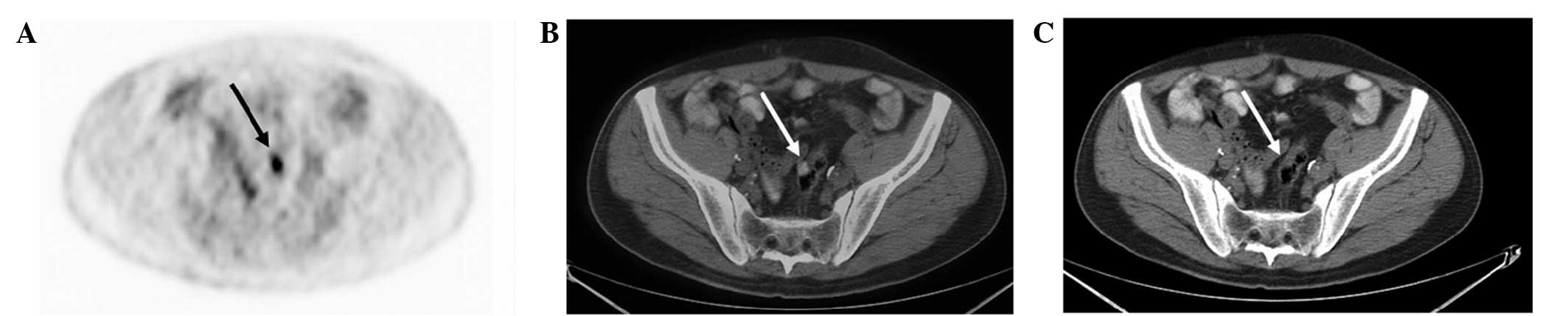
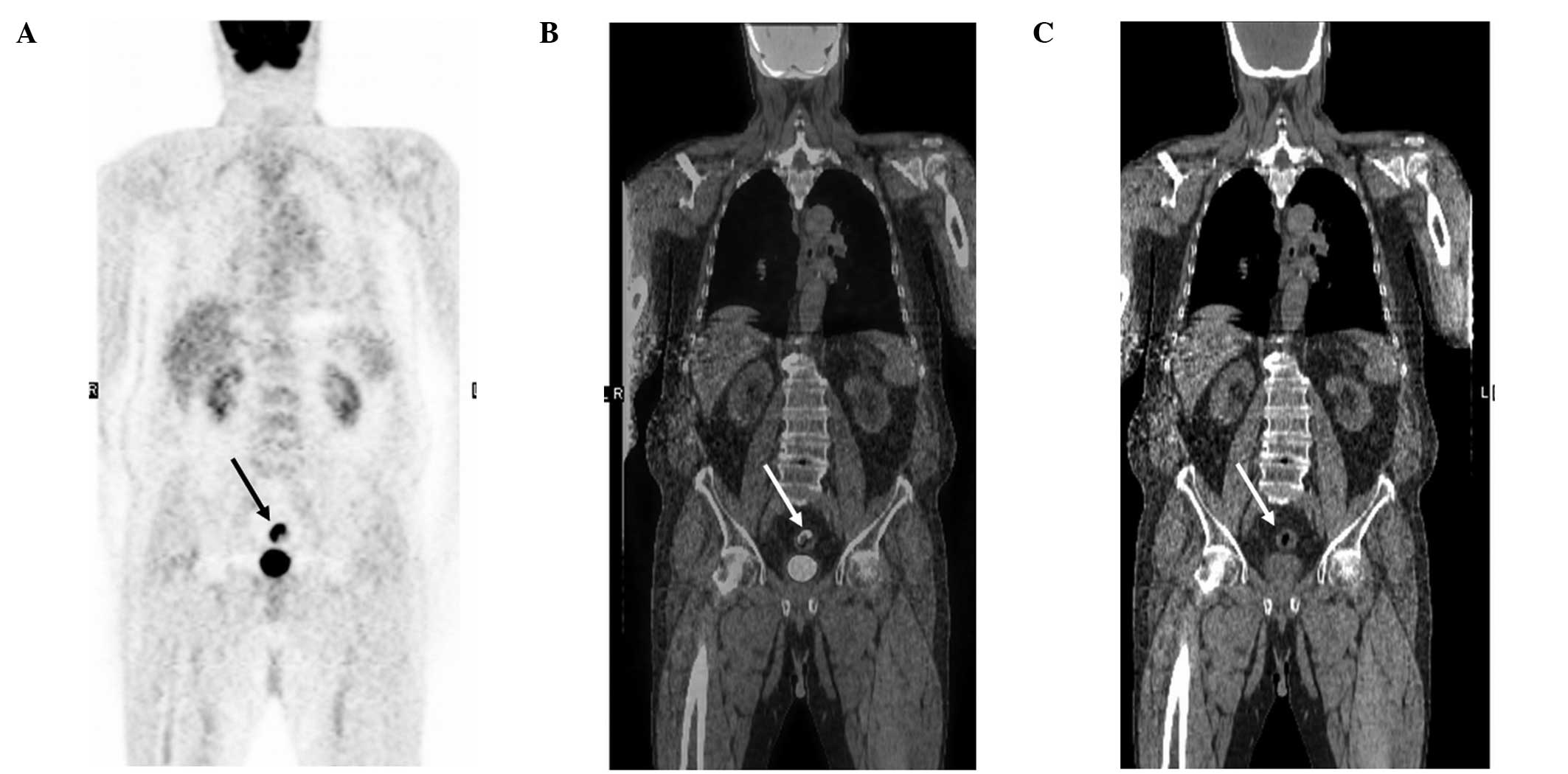
The present study consisted of 56 patients (25 males and 31 females) with a mean age of 72 years old (range, 43–89 years old). The patient characteristics and indications for FDG PET/CT are listed in Table I. Overall, 60 foci of FDG uptake were found in the 56 patients. Of the occurrences indicative of focal FDG uptake in the colon, 13 were in the ascending colon, 6 in the transverse colon, 14 in the descending colon, 25 in the rectosigmoid and 2 in the ileum. The colonoscopy was normal in 35 patients (63%), and endoscopic observations were found in 21 patients (37%). In these 21 patients, 30 lesions were found; 20/30 (67%) were benign adenomatous polyps, 6/30 (20%) were advanced histological lesions (with features of high-grade dysplasia or carcinoma in situ), a malignancy was detected in 3/30 lesions (10%) and 1/30 (3%) was a benign hyperplastic polyp (Table II; Figs 1 and 2). Diverticular disease, with no endoscopic signs of inflammation, was found in 7/56 patients (12.5%) with positive FDG PET/CT results.

Figure 1

A 61-year-old male with a history of gastric carcinoma referred for suspicious pulmonary and liver findings on CT. (A) Transaxial FDG-PET demonstrates a focus of increased tracer uptake in the mid pelvis (arrow) localized by (B) PET/CT image to the rectosigmoid wall, which appears to be thickened on (C) CT. Following colonoscopy, a large polyp was resected, and the histological examination showed tubulovillous adenoma with moderate dysplasia. CT, computed tomography; FDG-PET, fluorodeoxyglucose-positron emission tomography.

Figure 2

A 79-year-old male was referred for the assessment of a pulmonary nodule observed on CT. (A) Coronal FDG-PET, (B) PET/CT and (C) CT slices demonstrate intense FDG uptake in the proximal region of the colon (arrows). On colonoscopy, a large ulcer was found in 15 cm into the colon. The final diagnosis was of an adenocarcinoma of the colon. FDG PET/CT, fluorodeoxyglucose positron emission tomography/computed tomography.

Table I

Indication for FDG PET/CT (n=56).

Table I

Indication for FDG PET/CT (n=56).

Primary diseasePatients, nIndication for FDG PET/CT
Colorectal cancer16In 15 patients, imaging was performed as part of surveillance or due to increased levels of CEA. One patient had a known metastatic disease without bowel sites of disease
Non-Hodgkin lymphoma14Staging
Assessment of new suspicious lesions
Breast cancer5Suspected metastatic disease
Lung cancer7Staging
Melanoma3Staging
Response to systemic treatment
Hodgkin lymphoma2Surveillance
Bladder cancer2Assessment of new lung lesion
Assessment of response to systemic treatment
Malignant hystiocytoma1Suspected recurrence
Gastric cancer1Suspected lesions in the lung and liver
Cervix cancer1Surveillance
Pancreatic cancer1Staging
Tongue cancer1Staging
Skin squamous cell cancer1Staging
Fever of unknown origin1To determine to source of prolonged fever

[i] FDG PET/CT, fluorodeoxyglucose positron emission tomography/computed tomography; CEA, carcinoembryonic antigen.

Table II

Anatomical site of FDG foci and histological observations.

Table II

Anatomical site of FDG foci and histological observations.

ParameterMalignant, nAdvanced adenoma, nBenign, n
Foci3621
Anatomical site
 Ascending colon15
 Descending colon127
 Rectosigmoid239
Normal colonoscopy (including diverticular disease)35

[i] FDG, fluorodeoxyglucose.

Discussion

The potential of FDG PET or FDG PET/CT in colorectal screening has been studied in numerous trials (4–9). Focal colonic FDG uptake has up to a 70–80% probability of showing corresponding abnormal histopathological observations (4,6). Gutman et al(6) evaluated the positive predictive value of FDG PET/CT for the detection of colonic abnormalities. The study focused on the ability of FDG PET/CT to detect advanced adenomas (adenomas of >10 mm in diameter, adenomas with a villous component or moderate to severe dysplasia) and carcinomas. Among the 20 patients who underwent a colonoscopy, 5 had a normal colonoscopy (25%) and 15 (75%) patients had pathological lesions. In these 15 patients, a total of 18 lesions were found, including 2 benign hyperplastic polyps in the rectosigmoid and 16 advanced neoplasms. The advanced neoplasms consisted of 13 villous adenomas and 3 adenocarcinomas.

In an additional series of 3,210 PET scans performed for screening in asymptomatic patients, focal FDG avid uptakes were found in 20 patients, corresponding to 12 villous adenomas, 6 carcinomas and 2 tubular adenomas in the colonoscopy (4). These results are consistent with other studies showing that FDG PET ± CT is a sensitive tool to detect colonic premalignant lesions (4,6,7,9,10). However, caution must be applied, as the true negative rates are rarely evaluated in studies (9). It should be noted that FDG PET/CT is not a screening test for colon lesions; however, these were incidental observations detected during the evaluation of other diseases.

The majority of studies evaluating incidental colonic observations did not include patients with colorectal cancer. In the present study, the primary disease was colorectal cancer in 16 patients; however, all the patients had undergone surgical resection of their primary lesions and had no evidence of disease located in the bowel. Moreover, the medical files of patients who underwent a colonoscopy due to colonic observations on FDG PET/CT were reviewed, therefore, the rates of incidental colonic observations or the false negative rates were not evaluated. The true positive rates (36%) in the current study were lower than reported by others. Despite possible false-positive results, colonoscopy is recommended as the next diagnostic step for further evaluation of such observations. Since there are numerous confounding factors when evaluating the colorectal region, including fecal impaction, muscular peristaltic activity and inflammation, re-evaluation of the scan is advised. Gutman et al(6) indicated that in 3 patients, re-evaluation led to a different conclusion from that of the scan report regarding the nature of the FDG focal colonic uptake. The re-evaluation indicated that the colonic lesion was consistent with physiological activity, as the FDG uptake was located in the colonic lumen without bowel-wall involvement in an area of fecal stasis.

Although the present study found a lower incidence of lesions in the colon following colonoscopy, in 20 patients, colonic FDG observations matched the colonoscopic abnormalities, the majority of which required further surveillance and treatment. In the majority of cases of complete endoscopic resection, even in cases of carcinoma in situ or adenoma (tubular, tubulovillous or villous) with favorable histological features (T1 lesion, grade 1–2, no lymphovascular invasion, negative margins and no fragmentation of the specimen), no further treatment is required (11,12). However, appropriate endoscopic surveillance is mandatory (12).

In the present study, in one patient with a normal colonoscopy who exhibited a complete response to metastatic colon carcinoma, the colonic observation disappeared in a subsequent FDG PET/CT following chemotherapy. However, a later FDG PET/CT scan indicated diffuse metastatic disease involving the lung, liver and pelvis. A total of 35 FDG observations did not match any colonoscopic abnormality in the present study, thus, the PET/CT scan results were interpreted as false positive (62.5%). Of these false positive results, 7 revealed diverticular-disease with no endoscopic signs of inflammation. Peng et al(8) indicated that false-positive FDG uptake is more commonly observed in the right colon; this observation is not consistent with the present study. In the current study, the maximal standardized uptake (SUVmax) was not evaluated and the clinical significance of the SUVmax from previous studies was inconclusive (5,8). The SUVmax value was higher in cancer patients, however, a high SUVmax value does not necessarily result in the detection of malignancies (5,8).

A positive FDG uptake that was followed by a normal endoscopy was considered physiological FDG uptake in the bowel. As shown in Table I, in specific patients, the indication for FDG PET/CT was pre-treatment staging, whereas for others, it was performed to evaluate the response to treatment of metastatic disease. Therefore, the timing and relevance of colonoscopic investigation must be dictated by clinical judgment and the status of the primary tumor.

References

1 

Bar-Shalom R, Valdivia AY and Blaufox D: PET imaging in oncology. Semin Nucl Med. 30:150–185. 2000. View Article : Google Scholar : PubMed/NCBI

2 

Kamel EM, Thumshirn M, Truninger K, et al: Significance of incidental 18F-FDG accumulations in the gastrointestinal tract in PET/CT: correlation with endoscopic and histopathologic results. J Nucl Med. 45:1804–1810. 2004.PubMed/NCBI

3 

Agress H Jr and Cooper BZ: Detection of clinically unexpected malignant and premalignant tumors with whole-body FDG PET: histopathologic comparison. Radiology. 230:417–422. 2004. View Article : Google Scholar

4 

Chen YK, Kao CH, Liao AC, et al: Colorectal cancer screening in asymptomatic adults: the role of FDG PET scan. Anticancer Res. 23:4357–4361. 2003.PubMed/NCBI

5 

Israel O, Yefremov N, Bar-Shalom R, Kagana O, Frenkel A, Keidar Z and Fischer D: PET/CT detection of unexpected gastrointestinal foci of 18F-FDG uptake: incidence, localization patterns, and clinical significance. J Nucl Med. 46:758–762. 2005.

6 

Gutman F, Alberini JL, Wartski M, et al: Incidental colonic focal lesions detected by FDG PET/CT. AJR Am J Roentgenol. 185:495–500. 2005. View Article : Google Scholar : PubMed/NCBI

7 

Tatlidil R, Jadvar H, Bading JR and Conti PS: Incidental colonic fluorodeoxyglucose uptake: correlation with colonoscopic and histopathologic findings. Radiology. 224:783–787. 2002. View Article : Google Scholar : PubMed/NCBI

8 

Peng J, He Y, Xu J, et al: Detection of incidental colorectal tumours with 18F-labelled 2-fluoro-2-deoxyglucose positron emission tomography/computed tomography scans: results of a prospective study. Colorectal Dis. 13:e374–e378. 2011. View Article : Google Scholar

9 

Weston BR, Iyer RB, Qiao W, Lee JH, Bresalier RS and Ross WA: Ability of integrated positron emission and computed tomography to detect significant colonic pathology: the experience of a tertiary cancer center. Cancer. 116:1454–1461. 2010. View Article : Google Scholar

10 

Drenth JP, Nagengast FM and Oyen WJ: Evaluation of (pre-)malignant colonic abnormalities: endoscopic validation of FDG-PET findings. Eur J Nucl Med. 28:1766–1769. 2001. View Article : Google Scholar : PubMed/NCBI

11 

Markowitz AJ and Winawer SJ: Management of colorectal polyps. CA Cancer J Clin. 47:93–112. 1997. View Article : Google Scholar : PubMed/NCBI

12 

Winawer SJ, Zauber AG, Fletcher RH, et al: Guidelines for colonoscopy surveillance after polypectomy: a consensus update by the US Multi-Society Task Force on Colorectal Cancer and the American Cancer Society. CA Cancer J Clin. 56:143–159. 2006. View Article : Google Scholar

Related Articles

  • Abstract
  • View
  • Download
  • Twitter
Copy and paste a formatted citation
Spandidos Publications style
Rainis T, Kaidar‑Person O, Keren D, Lavy A and Keidar Z: Correlation between incidental FDG PET/CT colorectal observations and endoscopic and histopathological results. Oncol Lett 7: 479-482, 2014.
APA
Rainis, T., Kaidar‑Person, O., Keren, D., Lavy, A., & Keidar, Z. (2014). Correlation between incidental FDG PET/CT colorectal observations and endoscopic and histopathological results. Oncology Letters, 7, 479-482. https://doi.org/10.3892/ol.2013.1702
MLA
Rainis, T., Kaidar‑Person, O., Keren, D., Lavy, A., Keidar, Z."Correlation between incidental FDG PET/CT colorectal observations and endoscopic and histopathological results". Oncology Letters 7.2 (2014): 479-482.
Chicago
Rainis, T., Kaidar‑Person, O., Keren, D., Lavy, A., Keidar, Z."Correlation between incidental FDG PET/CT colorectal observations and endoscopic and histopathological results". Oncology Letters 7, no. 2 (2014): 479-482. https://doi.org/10.3892/ol.2013.1702
Copy and paste a formatted citation
x
Spandidos Publications style
Rainis T, Kaidar‑Person O, Keren D, Lavy A and Keidar Z: Correlation between incidental FDG PET/CT colorectal observations and endoscopic and histopathological results. Oncol Lett 7: 479-482, 2014.
APA
Rainis, T., Kaidar‑Person, O., Keren, D., Lavy, A., & Keidar, Z. (2014). Correlation between incidental FDG PET/CT colorectal observations and endoscopic and histopathological results. Oncology Letters, 7, 479-482. https://doi.org/10.3892/ol.2013.1702
MLA
Rainis, T., Kaidar‑Person, O., Keren, D., Lavy, A., Keidar, Z."Correlation between incidental FDG PET/CT colorectal observations and endoscopic and histopathological results". Oncology Letters 7.2 (2014): 479-482.
Chicago
Rainis, T., Kaidar‑Person, O., Keren, D., Lavy, A., Keidar, Z."Correlation between incidental FDG PET/CT colorectal observations and endoscopic and histopathological results". Oncology Letters 7, no. 2 (2014): 479-482. https://doi.org/10.3892/ol.2013.1702
Follow us
  • Twitter
  • LinkedIn
  • Facebook
About
  • Spandidos Publications
  • Careers
  • Cookie Policy
  • Privacy Policy
How can we help?
  • Help
  • Live Chat
  • Contact
  • Email to our Support Team