Spandidos Publications Logo
  • About
    • About Spandidos
    • Aims and Scopes
    • Abstracting and Indexing
    • Editorial Policies
    • Reprints and Permissions
    • Job Opportunities
    • Terms and Conditions
    • Contact
  • Journals
    • All Journals
    • Oncology Letters
      • Oncology Letters
      • Information for Authors
      • Editorial Policies
      • Editorial Board
      • Aims and Scope
      • Abstracting and Indexing
      • Bibliographic Information
      • Archive
    • International Journal of Oncology
      • International Journal of Oncology
      • Information for Authors
      • Editorial Policies
      • Editorial Board
      • Aims and Scope
      • Abstracting and Indexing
      • Bibliographic Information
      • Archive
    • Molecular and Clinical Oncology
      • Molecular and Clinical Oncology
      • Information for Authors
      • Editorial Policies
      • Editorial Board
      • Aims and Scope
      • Abstracting and Indexing
      • Bibliographic Information
      • Archive
    • Experimental and Therapeutic Medicine
      • Experimental and Therapeutic Medicine
      • Information for Authors
      • Editorial Policies
      • Editorial Board
      • Aims and Scope
      • Abstracting and Indexing
      • Bibliographic Information
      • Archive
    • International Journal of Molecular Medicine
      • International Journal of Molecular Medicine
      • Information for Authors
      • Editorial Policies
      • Editorial Board
      • Aims and Scope
      • Abstracting and Indexing
      • Bibliographic Information
      • Archive
    • Biomedical Reports
      • Biomedical Reports
      • Information for Authors
      • Editorial Policies
      • Editorial Board
      • Aims and Scope
      • Abstracting and Indexing
      • Bibliographic Information
      • Archive
    • Oncology Reports
      • Oncology Reports
      • Information for Authors
      • Editorial Policies
      • Editorial Board
      • Aims and Scope
      • Abstracting and Indexing
      • Bibliographic Information
      • Archive
    • Molecular Medicine Reports
      • Molecular Medicine Reports
      • Information for Authors
      • Editorial Policies
      • Editorial Board
      • Aims and Scope
      • Abstracting and Indexing
      • Bibliographic Information
      • Archive
    • World Academy of Sciences Journal
      • World Academy of Sciences Journal
      • Information for Authors
      • Editorial Policies
      • Editorial Board
      • Aims and Scope
      • Abstracting and Indexing
      • Bibliographic Information
      • Archive
    • International Journal of Functional Nutrition
      • International Journal of Functional Nutrition
      • Information for Authors
      • Editorial Policies
      • Editorial Board
      • Aims and Scope
      • Abstracting and Indexing
      • Bibliographic Information
      • Archive
    • International Journal of Epigenetics
      • International Journal of Epigenetics
      • Information for Authors
      • Editorial Policies
      • Editorial Board
      • Aims and Scope
      • Abstracting and Indexing
      • Bibliographic Information
      • Archive
    • Medicine International
      • Medicine International
      • Information for Authors
      • Editorial Policies
      • Editorial Board
      • Aims and Scope
      • Abstracting and Indexing
      • Bibliographic Information
      • Archive
  • Articles
  • Information
    • Information for Authors
    • Information for Reviewers
    • Information for Librarians
    • Information for Advertisers
    • Conferences
  • Language Editing
Spandidos Publications Logo
  • About
    • About Spandidos
    • Aims and Scopes
    • Abstracting and Indexing
    • Editorial Policies
    • Reprints and Permissions
    • Job Opportunities
    • Terms and Conditions
    • Contact
  • Journals
    • All Journals
    • Biomedical Reports
      • Information for Authors
      • Editorial Policies
      • Editorial Board
      • Aims and Scope
      • Abstracting and Indexing
      • Bibliographic Information
      • Archive
    • Experimental and Therapeutic Medicine
      • Information for Authors
      • Editorial Policies
      • Editorial Board
      • Aims and Scope
      • Abstracting and Indexing
      • Bibliographic Information
      • Archive
    • International Journal of Epigenetics
      • Information for Authors
      • Editorial Policies
      • Editorial Board
      • Aims and Scope
      • Abstracting and Indexing
      • Bibliographic Information
      • Archive
    • International Journal of Functional Nutrition
      • Information for Authors
      • Editorial Policies
      • Editorial Board
      • Aims and Scope
      • Abstracting and Indexing
      • Bibliographic Information
      • Archive
    • International Journal of Molecular Medicine
      • Information for Authors
      • Editorial Policies
      • Editorial Board
      • Aims and Scope
      • Abstracting and Indexing
      • Bibliographic Information
      • Archive
    • International Journal of Oncology
      • Information for Authors
      • Editorial Policies
      • Editorial Board
      • Aims and Scope
      • Abstracting and Indexing
      • Bibliographic Information
      • Archive
    • Medicine International
      • Information for Authors
      • Editorial Policies
      • Editorial Board
      • Aims and Scope
      • Abstracting and Indexing
      • Bibliographic Information
      • Archive
    • Molecular and Clinical Oncology
      • Information for Authors
      • Editorial Policies
      • Editorial Board
      • Aims and Scope
      • Abstracting and Indexing
      • Bibliographic Information
      • Archive
    • Molecular Medicine Reports
      • Information for Authors
      • Editorial Policies
      • Editorial Board
      • Aims and Scope
      • Abstracting and Indexing
      • Bibliographic Information
      • Archive
    • Oncology Letters
      • Information for Authors
      • Editorial Policies
      • Editorial Board
      • Aims and Scope
      • Abstracting and Indexing
      • Bibliographic Information
      • Archive
    • Oncology Reports
      • Information for Authors
      • Editorial Policies
      • Editorial Board
      • Aims and Scope
      • Abstracting and Indexing
      • Bibliographic Information
      • Archive
    • World Academy of Sciences Journal
      • Information for Authors
      • Editorial Policies
      • Editorial Board
      • Aims and Scope
      • Abstracting and Indexing
      • Bibliographic Information
      • Archive
  • Articles
  • Information
    • For Authors
    • For Reviewers
    • For Librarians
    • For Advertisers
    • Conferences
  • Language Editing
Login Register Submit
  • This site uses cookies
  • You can change your cookie settings at any time by following the instructions in our Cookie Policy. To find out more, you may read our Privacy Policy.

    I agree
Search articles by DOI, keyword, author or affiliation
Search
Advanced Search
presentation
Oncology Letters
Join Editorial Board Propose a Special Issue
Print ISSN: 1792-1074 Online ISSN: 1792-1082
Journal Cover
2014-February Volume 7 Issue 2

Full Size Image

Sign up for eToc alerts
Recommend to Library

Journals

International Journal of Molecular Medicine

International Journal of Molecular Medicine

International Journal of Molecular Medicine is an international journal devoted to molecular mechanisms of human disease.

International Journal of Oncology

International Journal of Oncology

International Journal of Oncology is an international journal devoted to oncology research and cancer treatment.

Molecular Medicine Reports

Molecular Medicine Reports

Covers molecular medicine topics such as pharmacology, pathology, genetics, neuroscience, infectious diseases, molecular cardiology, and molecular surgery.

Oncology Reports

Oncology Reports

Oncology Reports is an international journal devoted to fundamental and applied research in Oncology.

Experimental and Therapeutic Medicine

Experimental and Therapeutic Medicine

Experimental and Therapeutic Medicine is an international journal devoted to laboratory and clinical medicine.

Oncology Letters

Oncology Letters

Oncology Letters is an international journal devoted to Experimental and Clinical Oncology.

Biomedical Reports

Biomedical Reports

Explores a wide range of biological and medical fields, including pharmacology, genetics, microbiology, neuroscience, and molecular cardiology.

Molecular and Clinical Oncology

Molecular and Clinical Oncology

International journal addressing all aspects of oncology research, from tumorigenesis and oncogenes to chemotherapy and metastasis.

World Academy of Sciences Journal

World Academy of Sciences Journal

Multidisciplinary open-access journal spanning biochemistry, genetics, neuroscience, environmental health, and synthetic biology.

International Journal of Functional Nutrition

International Journal of Functional Nutrition

Open-access journal combining biochemistry, pharmacology, immunology, and genetics to advance health through functional nutrition.

International Journal of Epigenetics

International Journal of Epigenetics

Publishes open-access research on using epigenetics to advance understanding and treatment of human disease.

Medicine International

Medicine International

An International Open Access Journal Devoted to General Medicine.

Journal Cover
2014-February Volume 7 Issue 2

Full Size Image

Sign up for eToc alerts
Recommend to Library

  • Article
  • Citations
    • Cite This Article
    • Download Citation
    • Create Citation Alert
    • Remove Citation Alert
    • Cited By
  • Similar Articles
    • Related Articles (in Spandidos Publications)
    • Similar Articles (Google Scholar)
    • Similar Articles (PubMed)
  • Download PDF
  • Download XML
  • View XML
Article

α‑smooth muscle actin‑positive fibroblasts correlate with poor survival in hepatocellular carcinoma

  • Authors:
    • Jignesh G. Parikh
    • Anand Kulkarni
    • Cameila Johns
  • View Affiliations / Copyright

    Affiliations: Department of Pathology, University of Tennessee Health Science Center, Memphis, TN 38163, USA
  • Pages: 573-575
    |
    Published online on: November 29, 2013
       https://doi.org/10.3892/ol.2013.1720
  • Expand metrics +
Metrics: Total Views: 0 (Spandidos Publications: | PMC Statistics: )
Metrics: Total PDF Downloads: 0 (Spandidos Publications: | PMC Statistics: )
Cited By (CrossRef): 0 citations Loading Articles...

This article is mentioned in:


Abstract

The current case‑control study was conducted to assess the value of activated fibroblasts with high α‑smooth muscle actin (α‑SMA) expression as an indicator of survival in hepatocellular carcinoma (HCC) patients. In total, 47 patients diagnosed with HCC who underwent a liver biopsy at the Veterans Affairs Medical Center (Memphis, TN, USA) between January 2000 and December 2009, and 10 age‑ and gender‑matched controls with normal liver biopsy samples were included in the study. The immunohistochemical staining for α‑SMA was performed and classified qualitatively and quantitatively within tumor stroma and perisinusoidal spaces. HCC patients with high qualitative and quantitative expression of α‑SMA revealed a statistically significant negative correlation with 3‑year [odds ratio (OR), 0.021 and 0.111; P=0.001 and 0.0302, respectively] and 1.5‑year (OR, 0.040 and 0.051; P=0.0330 and 0.0492, respectively) survival rates in comparison with low expression. The results of the present study demonstrated a predictive role of high qualitative and quantitative expression in activated fibroblasts for poor survival in patients with HCC.

Introduction

Activated fibroblasts or myofibroblasts with α-smooth muscle actin (α-SMA) expression are considered to be the main cellular constituents of reactive stroma in a number of solid tumors (1). These activated fibroblasts have been proposed to be important in promoting tumor progression and metastasis by releasing growth factors, extracellular matrix proteins and angiogenic factors (2,3). The hepatic stellate cell (HSC), an important hepatic stromal cell, is known to be activated or transdifferentiated into a myofibroblast-like cell through intercellular communication between HSCs and damaged hepatocytes in various liver tumors, including hepatocellular carcinoma (HCC) (4). These activated HSCs demonstrate a high expression of α-SMA and are considered to be a vital stromal component in HCC (5). Increasing evidence has indicated that activated HSCs play a critical role in promoting HCC cell proliferation and invasiveness (6,7). In addition, HSCs are now being considered as a new potential therapeutic target in patients with HCC (3). To the best of our knowledge, no direct evidence has been identified documenting a correlation between fibroblast activation and survival in HCC patients. The aim of the present study was to assess the value of activated fibroblasts with high α-SMA expression as an indicator for survival in patients with HCC.

Patients and methods

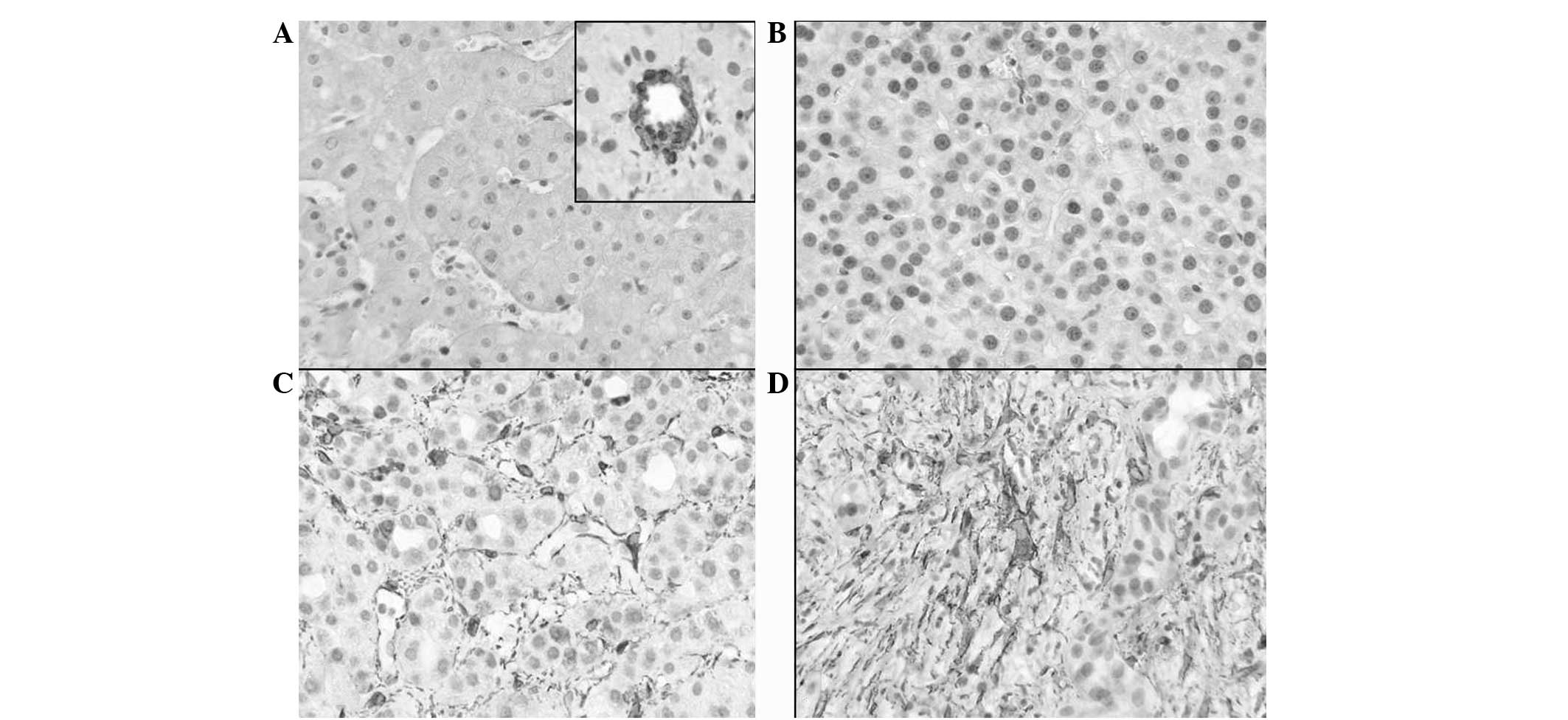
A case-control study was performed at the Veterans Affairs Medical Center (Memphis, TN, USA) following appropriate Institutional Review Board approval. A review of the computerized hospital records was conducted to identify the cases of patients diagnosed with HCC who had undergone a liver biopsy between January 2000 and December 2009. A total of 10 age- and gender-matched cases with no histopathological abnormality on liver biopsy were also identified and used as controls. The clinical information with regard to age and survival period were obtained for all study cases. The immunohistochemical staining for α-SMA was performed on the formalin-fixed, paraffin-embedded tissue sections of all study and control cases. The α-SMA staining in the HSCs within the tumor stroma and perisinusoidal spaces was qualitatively classified into the following 4 groups compared with vascular smooth muscle cells (VSMCs): 0, no staining; +1, staining intensity considerably lower than VSMCs (Fig. 1B); +2, staining intensity lower than VSMCs; and +3, staining intensity similar to that of VSMCs (Fig. 1C and D). In addition, the α-SMA staining was quantitatively classified into the following 4 groups: 0, ≤1 positive cell/high-power field (hpf); +1, <10 positive cells/hpf (Fig. 1B); +2, 10–20 positive cells/hpf; and +3, >20 positive cells/hpf (Fig. 1C and 1D). Qualitative and quantitative classification was performed by a fellowship-trained gastrointestinal pathologist without matching knowledge of the clinical data. For statistical analysis, grades 0 and +1 were categorized as low expression and grades +2 and +3 as high expression.

Figure 1

Expression of α-SMA in HCC. (A) Control tissues revealing positive staining for α-SMA mainly in the perisinusoidal spaces and VSMC (inset). (B) Grade +1 staining (qualitatively and quantitatively); staining intensity was considerably lower than in the VSMC, with <10 positive cells/hpf. (C and D) Grade +3 staining (qualitatively and quantitatively); staining intensity was similar to that of VSMC, with >20 positive cells/high power field (magnification, ×400). α-SMA, α-smooth muscle actin; HCC, hepatocellular carcinoma; hpf, high-power field; VSMC, vascular smooth muscle cells.

Results

A total of 47 patients (age range, 45–85 years; mean age, 64.45 years) were diagnosed with HCC between January 2000 and December 2009. All the study subjects subsequently succumbed to their condition. The survival period following diagnosis ranged between 1 and 94 months (mean survival, 19 months). All the study and control subjects were male. Positive staining for α-SMA in control tissue was mainly observed in VSMCs (Fig 1A; inset) and in extremely few cells in the perisinusoidal spaces (Fig. 1A). High qualitative (strong) and quantitative (extensive) expression of α-SMA was revealed in 41 and 42 of the 47 patients, respectively. Low qualitative (weak) and quantitative (sparse) expression of α-SMA was revealed in 6 and 5 of the 47 patients, respectively. Strong and extensive expression of α-SMA revealed a statistically significant negative correlation with the 3-year [OR, 0.021 and 0.111; 95% confidence interval (CI), 0.002–0.234 and 0.015–0.810; P=0.001 and 0.0302, respectively] and 1.5-year (OR, 0.040 and 0.051; 95% CI, 0.002–0.771 and 0.002–0.990; P=0.0330 and 0.0492, respectively) survival rates in comparison with weak and sparse expression (Table I). No significant correlation was identified between age and α-SMA expression.

Table I

Qualitative and quantitative expression of α-SMA in HCC.

Table I

Qualitative and quantitative expression of α-SMA in HCC.

α-SMA staining intensityα-SMA-positive HSC


Characteristicsn, (%)High, n (%)Low, n (%)OR (95% CI)P-valueHigh, n (%)Low, n (%)OR (95% CI)P-value
Age, years 1
 ≤6223 (49)18 (38)5 (11)0.1560.10319 (40)4 (9)0.2060.174
 >6224 (51)23 (49)1 (2)23 (49)1 (2)
3-year survival
 >39 (19)4 (8)5 (11)0.021 (0.002–0.234)0.00166 (13)3 (6)0.111 (0.015–0.810)0.0302
 ≤338 (81)37 (79)1 (2)36 (77)2 (4)
1.5-year survival
 >1.520 (43)14 (30)6 (13)0.040 (0.002–0.771)0.033015 (32)5 (11)0.051 (0.002–0.990)0.0492
 ≤1.527 (57)27 (57)0 (0)27 (57)0 (0)

[i] α-SMA, α-smooth muscle actin; HCC, hepatocellular carcinoma; OR, odds ratio; CI, confidence interval.

Discussion

The interaction of tumor cells with surrounding stromal cells has been recognized to promote tumor development by affecting cell proliferation, survival and invasiveness (7). As important hepatic stromal cells, HSCs have been considered to play a key role in liver fibrosis when excessively activated in various liver diseases, including HCC (8). HCC is one of the most common types of malignant cancer in humans, with an overall 5-year survival rate of only 3% in the United States (9). Surgical resection is the choice of treatment for HCC, however, this is not feasible when patients present in late stages of the disease (10). In addition, radiotherapy and chemotherapy are not effective in advanced disease (10). Activated HSCs that express extremely high levels of α-SMA have emerged as potent suppressors of hepatic immunity by affecting T-cell responses and thus, play a vital role in the progression of HCC (6,7,11,12). Previous studies have also indicated that activated HSCs are potential targets for HCC treatment (4).

The current study revealed that the detection of α-SMA-expressing fibroblasts in HCC provides valuable prognostic information. As α-SMA is a routinely used and relatively inexpensive immunohistochemical stain, the majority of pathology laboratories efficiently employ α-SMA to predict future survival in HCC patients. The present study also supports the role of α-SMA expressing activated HSCs in promoting carcinogenesis, which is considered to be a possible target for future antitumor therapy in HCC.

In the present study, due to lack of follow-up staging information for all the patients, the results were not corrected for stage, metastasis and other factors. Due to this same reason, it was not possible to determine whether α-SMA is predictive of metastasis-related survival or is an independent predictive factor. Multicenter-based large studies with detailed and frequent staging evaluation data, which enables multifactorial analysis, are recommended to improve the present understanding of the role of α-SMA-expressing fibroblasts for predicting poor survival in HCC.

In conclusion, the current study demonstrated a predictive role of strong and extensive α-SMA expression in activated fibroblasts for poor survival in HCC patients. Strong expression of α-SMA is an excellent marker to anticipate poor 3-year survival (OR, 0.021; 95% CI, 0.002–0.234; P=0.001). Qualitative α-SMA expression levels in activated fibroblasts appear to present an improved marker for predicting survival compared with quantitative expression.

References

1 

Micke P and Ostman A: Exploring the tumor environment: cancer-associated fibroblasts as targets in cancer therapy. Expert Opin Ther Targets. 9:1217–1233. 2005. View Article : Google Scholar : PubMed/NCBI

2 

Olumi AF, Grossfeld GD, Hayward SW, et al: Carcinoma-associated fibroblasts direct tumor progression of initiated human prostatic epithelium. Cancer Res. 59:5002–5011. 1999.

3 

Chuaysri C, Thuwajit P, Paupairoj A, et al: Alpha-smooth muscle actin-positive fibroblasts promote biliary cell proliferation and correlate with poor survival in cholangiocarcinoma. Oncol Rep. 21:957–969. 2009.

4 

Kuang P, Zhao W, Su W, et al: 18β-glycyrrhetinic acid inhibits hepatocellular carcinoma development by reversing hepatic stellate cell-mediated immunosuppression in mice. Int J Cancer. 132:1831–1841. 2013.

5 

Hautekeete ML and Geerts A: The hepatic stellate (Ito) cell: its role in human liver disease. Virchows Arch. 430:195–207. 1997. View Article : Google Scholar : PubMed/NCBI

6 

Carpino G, Morini S, Ginanni CS, et al: Alpha-SMA expression in hepatic stellate cells and quantitative analysis of hepatic fibrosis in cirrhosis and in recurrent chronic hepatitis after liver transplantation. Dig Liver Dis. 37:349–356. 2005. View Article : Google Scholar

7 

Desmoulière A, Guyot C and Gabbiani G: The stroma reaction myofibroblast: a key player in the control of tumor cell behavior. Int J Dev Biol. 48:509–517. 2004.PubMed/NCBI

8 

Friedman SL: Mechanism of hepatic fibrogenesis. Gastroenterology. 134:1655–1669. 2008. View Article : Google Scholar

9 

Desmet VJ and Rosai J: Liver: tumors and tumorlike conditions. Rosai and Akerman’s Surgical Pathology. Rosai J: 10th Edition. Mosby Elsevier; New York: pp. 944–953. 2011

10 

Bruix J and Sherman M; American Association for the Study of Liver Diseases. Management of hepatocellular carcinoma: an update. Hepatology. 53:1020–1022. 2011. View Article : Google Scholar : PubMed/NCBI

11 

Yu MC, Chen CH, Liang X, et al: Inhibition of T-cell responses by hepatic stellate cells via B7-H1-mediated T-cell apoptosis in mice. Hepatology. 40:1312–1321. 2004. View Article : Google Scholar : PubMed/NCBI

12 

Chen CH, Kuo LM, Chang Y, et al: In vivo immune modulatory activity of hepatic stellate cells in mice. Hepatology. 44:1171–1181. 2006. View Article : Google Scholar : PubMed/NCBI

Related Articles

  • Abstract
  • View
  • Download
  • Twitter
Copy and paste a formatted citation
Spandidos Publications style
Parikh JG, Kulkarni A and Johns C: α‑smooth muscle actin‑positive fibroblasts correlate with poor survival in hepatocellular carcinoma. Oncol Lett 7: 573-575, 2014.
APA
Parikh, J.G., Kulkarni, A., & Johns, C. (2014). α‑smooth muscle actin‑positive fibroblasts correlate with poor survival in hepatocellular carcinoma. Oncology Letters, 7, 573-575. https://doi.org/10.3892/ol.2013.1720
MLA
Parikh, J. G., Kulkarni, A., Johns, C."α‑smooth muscle actin‑positive fibroblasts correlate with poor survival in hepatocellular carcinoma". Oncology Letters 7.2 (2014): 573-575.
Chicago
Parikh, J. G., Kulkarni, A., Johns, C."α‑smooth muscle actin‑positive fibroblasts correlate with poor survival in hepatocellular carcinoma". Oncology Letters 7, no. 2 (2014): 573-575. https://doi.org/10.3892/ol.2013.1720
Copy and paste a formatted citation
x
Spandidos Publications style
Parikh JG, Kulkarni A and Johns C: α‑smooth muscle actin‑positive fibroblasts correlate with poor survival in hepatocellular carcinoma. Oncol Lett 7: 573-575, 2014.
APA
Parikh, J.G., Kulkarni, A., & Johns, C. (2014). α‑smooth muscle actin‑positive fibroblasts correlate with poor survival in hepatocellular carcinoma. Oncology Letters, 7, 573-575. https://doi.org/10.3892/ol.2013.1720
MLA
Parikh, J. G., Kulkarni, A., Johns, C."α‑smooth muscle actin‑positive fibroblasts correlate with poor survival in hepatocellular carcinoma". Oncology Letters 7.2 (2014): 573-575.
Chicago
Parikh, J. G., Kulkarni, A., Johns, C."α‑smooth muscle actin‑positive fibroblasts correlate with poor survival in hepatocellular carcinoma". Oncology Letters 7, no. 2 (2014): 573-575. https://doi.org/10.3892/ol.2013.1720
Follow us
  • Twitter
  • LinkedIn
  • Facebook
About
  • Spandidos Publications
  • Careers
  • Cookie Policy
  • Privacy Policy
How can we help?
  • Help
  • Live Chat
  • Contact
  • Email to our Support Team