Spandidos Publications Logo
  • About
    • About Spandidos
    • Aims and Scopes
    • Abstracting and Indexing
    • Editorial Policies
    • Reprints and Permissions
    • Job Opportunities
    • Terms and Conditions
    • Contact
  • Journals
    • All Journals
    • Oncology Letters
      • Oncology Letters
      • Information for Authors
      • Editorial Policies
      • Editorial Board
      • Aims and Scope
      • Abstracting and Indexing
      • Bibliographic Information
      • Archive
    • International Journal of Oncology
      • International Journal of Oncology
      • Information for Authors
      • Editorial Policies
      • Editorial Board
      • Aims and Scope
      • Abstracting and Indexing
      • Bibliographic Information
      • Archive
    • Molecular and Clinical Oncology
      • Molecular and Clinical Oncology
      • Information for Authors
      • Editorial Policies
      • Editorial Board
      • Aims and Scope
      • Abstracting and Indexing
      • Bibliographic Information
      • Archive
    • Experimental and Therapeutic Medicine
      • Experimental and Therapeutic Medicine
      • Information for Authors
      • Editorial Policies
      • Editorial Board
      • Aims and Scope
      • Abstracting and Indexing
      • Bibliographic Information
      • Archive
    • International Journal of Molecular Medicine
      • International Journal of Molecular Medicine
      • Information for Authors
      • Editorial Policies
      • Editorial Board
      • Aims and Scope
      • Abstracting and Indexing
      • Bibliographic Information
      • Archive
    • Biomedical Reports
      • Biomedical Reports
      • Information for Authors
      • Editorial Policies
      • Editorial Board
      • Aims and Scope
      • Abstracting and Indexing
      • Bibliographic Information
      • Archive
    • Oncology Reports
      • Oncology Reports
      • Information for Authors
      • Editorial Policies
      • Editorial Board
      • Aims and Scope
      • Abstracting and Indexing
      • Bibliographic Information
      • Archive
    • Molecular Medicine Reports
      • Molecular Medicine Reports
      • Information for Authors
      • Editorial Policies
      • Editorial Board
      • Aims and Scope
      • Abstracting and Indexing
      • Bibliographic Information
      • Archive
    • World Academy of Sciences Journal
      • World Academy of Sciences Journal
      • Information for Authors
      • Editorial Policies
      • Editorial Board
      • Aims and Scope
      • Abstracting and Indexing
      • Bibliographic Information
      • Archive
    • International Journal of Functional Nutrition
      • International Journal of Functional Nutrition
      • Information for Authors
      • Editorial Policies
      • Editorial Board
      • Aims and Scope
      • Abstracting and Indexing
      • Bibliographic Information
      • Archive
    • International Journal of Epigenetics
      • International Journal of Epigenetics
      • Information for Authors
      • Editorial Policies
      • Editorial Board
      • Aims and Scope
      • Abstracting and Indexing
      • Bibliographic Information
      • Archive
    • Medicine International
      • Medicine International
      • Information for Authors
      • Editorial Policies
      • Editorial Board
      • Aims and Scope
      • Abstracting and Indexing
      • Bibliographic Information
      • Archive
  • Articles
  • Information
    • Information for Authors
    • Information for Reviewers
    • Information for Librarians
    • Information for Advertisers
    • Conferences
  • Language Editing
Spandidos Publications Logo
  • About
    • About Spandidos
    • Aims and Scopes
    • Abstracting and Indexing
    • Editorial Policies
    • Reprints and Permissions
    • Job Opportunities
    • Terms and Conditions
    • Contact
  • Journals
    • All Journals
    • Biomedical Reports
      • Information for Authors
      • Editorial Policies
      • Editorial Board
      • Aims and Scope
      • Abstracting and Indexing
      • Bibliographic Information
      • Archive
    • Experimental and Therapeutic Medicine
      • Information for Authors
      • Editorial Policies
      • Editorial Board
      • Aims and Scope
      • Abstracting and Indexing
      • Bibliographic Information
      • Archive
    • International Journal of Epigenetics
      • Information for Authors
      • Editorial Policies
      • Editorial Board
      • Aims and Scope
      • Abstracting and Indexing
      • Bibliographic Information
      • Archive
    • International Journal of Functional Nutrition
      • Information for Authors
      • Editorial Policies
      • Editorial Board
      • Aims and Scope
      • Abstracting and Indexing
      • Bibliographic Information
      • Archive
    • International Journal of Molecular Medicine
      • Information for Authors
      • Editorial Policies
      • Editorial Board
      • Aims and Scope
      • Abstracting and Indexing
      • Bibliographic Information
      • Archive
    • International Journal of Oncology
      • Information for Authors
      • Editorial Policies
      • Editorial Board
      • Aims and Scope
      • Abstracting and Indexing
      • Bibliographic Information
      • Archive
    • Medicine International
      • Information for Authors
      • Editorial Policies
      • Editorial Board
      • Aims and Scope
      • Abstracting and Indexing
      • Bibliographic Information
      • Archive
    • Molecular and Clinical Oncology
      • Information for Authors
      • Editorial Policies
      • Editorial Board
      • Aims and Scope
      • Abstracting and Indexing
      • Bibliographic Information
      • Archive
    • Molecular Medicine Reports
      • Information for Authors
      • Editorial Policies
      • Editorial Board
      • Aims and Scope
      • Abstracting and Indexing
      • Bibliographic Information
      • Archive
    • Oncology Letters
      • Information for Authors
      • Editorial Policies
      • Editorial Board
      • Aims and Scope
      • Abstracting and Indexing
      • Bibliographic Information
      • Archive
    • Oncology Reports
      • Information for Authors
      • Editorial Policies
      • Editorial Board
      • Aims and Scope
      • Abstracting and Indexing
      • Bibliographic Information
      • Archive
    • World Academy of Sciences Journal
      • Information for Authors
      • Editorial Policies
      • Editorial Board
      • Aims and Scope
      • Abstracting and Indexing
      • Bibliographic Information
      • Archive
  • Articles
  • Information
    • For Authors
    • For Reviewers
    • For Librarians
    • For Advertisers
    • Conferences
  • Language Editing
Login Register Submit
  • This site uses cookies
  • You can change your cookie settings at any time by following the instructions in our Cookie Policy. To find out more, you may read our Privacy Policy.

    I agree
Search articles by DOI, keyword, author or affiliation
Search
Advanced Search
presentation
Oncology Letters
Join Editorial Board Propose a Special Issue
Print ISSN: 1792-1074 Online ISSN: 1792-1082
Journal Cover
September-2014 Volume 8 Issue 3

Full Size Image

Sign up for eToc alerts
Recommend to Library

Journals

International Journal of Molecular Medicine

International Journal of Molecular Medicine

International Journal of Molecular Medicine is an international journal devoted to molecular mechanisms of human disease.

International Journal of Oncology

International Journal of Oncology

International Journal of Oncology is an international journal devoted to oncology research and cancer treatment.

Molecular Medicine Reports

Molecular Medicine Reports

Covers molecular medicine topics such as pharmacology, pathology, genetics, neuroscience, infectious diseases, molecular cardiology, and molecular surgery.

Oncology Reports

Oncology Reports

Oncology Reports is an international journal devoted to fundamental and applied research in Oncology.

Experimental and Therapeutic Medicine

Experimental and Therapeutic Medicine

Experimental and Therapeutic Medicine is an international journal devoted to laboratory and clinical medicine.

Oncology Letters

Oncology Letters

Oncology Letters is an international journal devoted to Experimental and Clinical Oncology.

Biomedical Reports

Biomedical Reports

Explores a wide range of biological and medical fields, including pharmacology, genetics, microbiology, neuroscience, and molecular cardiology.

Molecular and Clinical Oncology

Molecular and Clinical Oncology

International journal addressing all aspects of oncology research, from tumorigenesis and oncogenes to chemotherapy and metastasis.

World Academy of Sciences Journal

World Academy of Sciences Journal

Multidisciplinary open-access journal spanning biochemistry, genetics, neuroscience, environmental health, and synthetic biology.

International Journal of Functional Nutrition

International Journal of Functional Nutrition

Open-access journal combining biochemistry, pharmacology, immunology, and genetics to advance health through functional nutrition.

International Journal of Epigenetics

International Journal of Epigenetics

Publishes open-access research on using epigenetics to advance understanding and treatment of human disease.

Medicine International

Medicine International

An International Open Access Journal Devoted to General Medicine.

Journal Cover
September-2014 Volume 8 Issue 3

Full Size Image

Sign up for eToc alerts
Recommend to Library

  • Article
  • Citations
    • Cite This Article
    • Download Citation
    • Create Citation Alert
    • Remove Citation Alert
    • Cited By
  • Similar Articles
    • Related Articles (in Spandidos Publications)
    • Similar Articles (Google Scholar)
    • Similar Articles (PubMed)
  • Download PDF
  • Download XML
  • View XML
Case Report

Progression of penile cutaneous horn to squamous cell carcinoma: A case report

  • Authors:
    • Yihong Zhou
    • Yuxin Tang
    • Jin Tang
    • Bing Xia
    • Yingbo Dai
  • View Affiliations / Copyright

    Affiliations: Department of Urology, The Third Xiangya Hospital of Central South University, Changsha, Hunan 410013, P.R. China
  • Pages: 1211-1213
    |
    Published online on: June 12, 2014
       https://doi.org/10.3892/ol.2014.2247
  • Expand metrics +
Metrics: Total Views: 0 (Spandidos Publications: | PMC Statistics: )
Metrics: Total PDF Downloads: 0 (Spandidos Publications: | PMC Statistics: )
Cited By (CrossRef): 0 citations Loading Articles...

This article is mentioned in:


Abstract

The current report presents the case of a 43‑year‑old male suffering from a penile cutaneous horn. A surgical excision of the lesion was performed and histopathology demonstrated hyperkeratosis, dyskeratosis and epithelial hyperplasia. The cutaneous horn progressed to squamous cell carcinoma <1.5 months following surgery and a partial penectomy was conducted. The International Index of Erectile Function 5 questionnaire was used to assess the patient and the score had decreased in the one‑month postoperative follow‑up compared with that of the preoperative period. These findings indicate that undergoing a partial penectomy on initial diagnosis of a penile cutaneous horn should be considered in order to conserve a greater quantity of the penile tissue and improve the postoperative quality of life.

Introduction

The incidence of penile cutaneous horn has been particularly low since the first case was reported (1). It is a lesion that exhibits hyperkeratotic features on the penile glans. These hyperkeratoses are superimposed on a wide variety of benign, premalignant or malignant lesions (2). In the current report, a case of a 43-year-old male is presented. The patient underwent surgical excision of the lesion that indicated a penile cutaneous horn, this subsequently progressed to squamous cell carcinoma in <1.5 months. Finally, a partial penectomy was performed. Patient provided written informed consent.

Case report

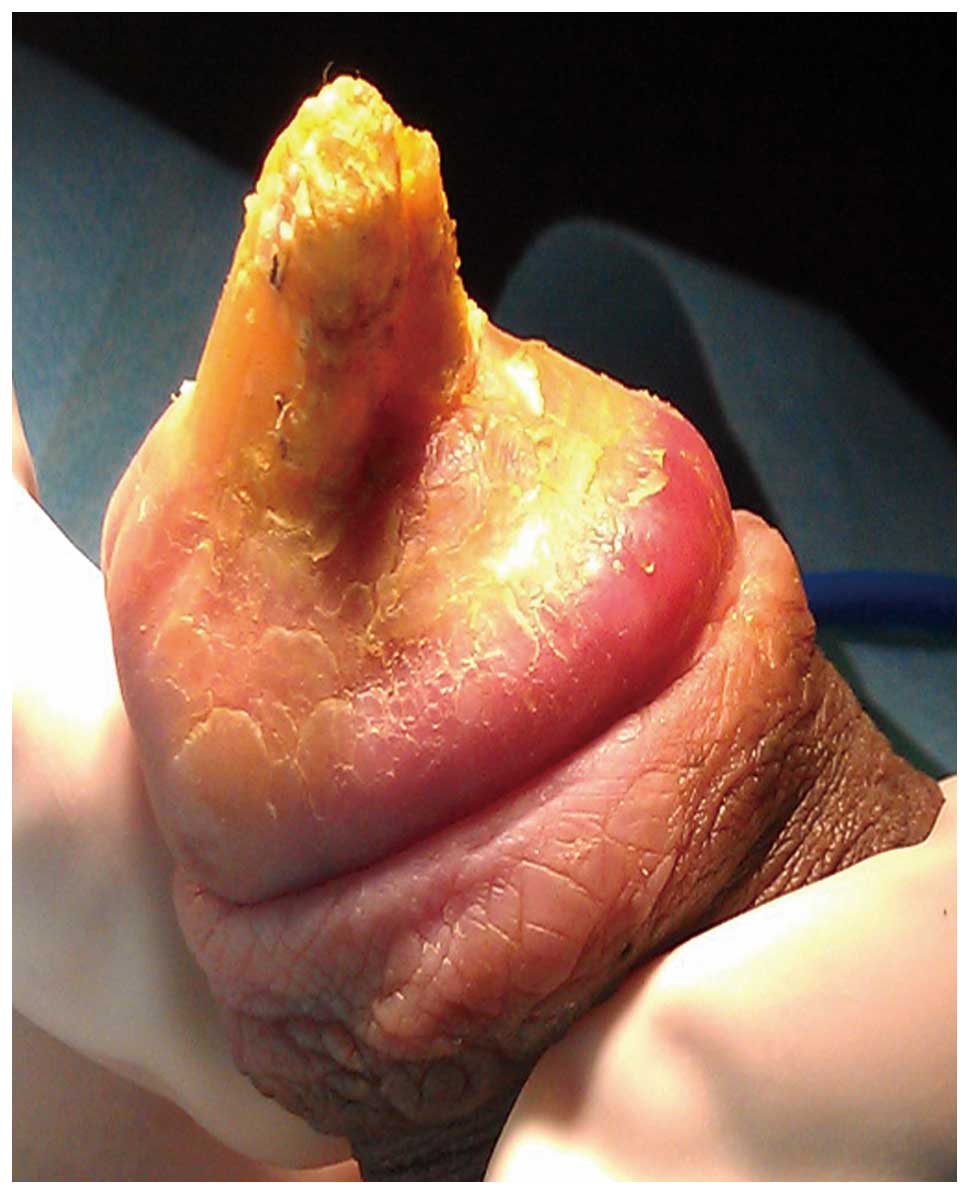
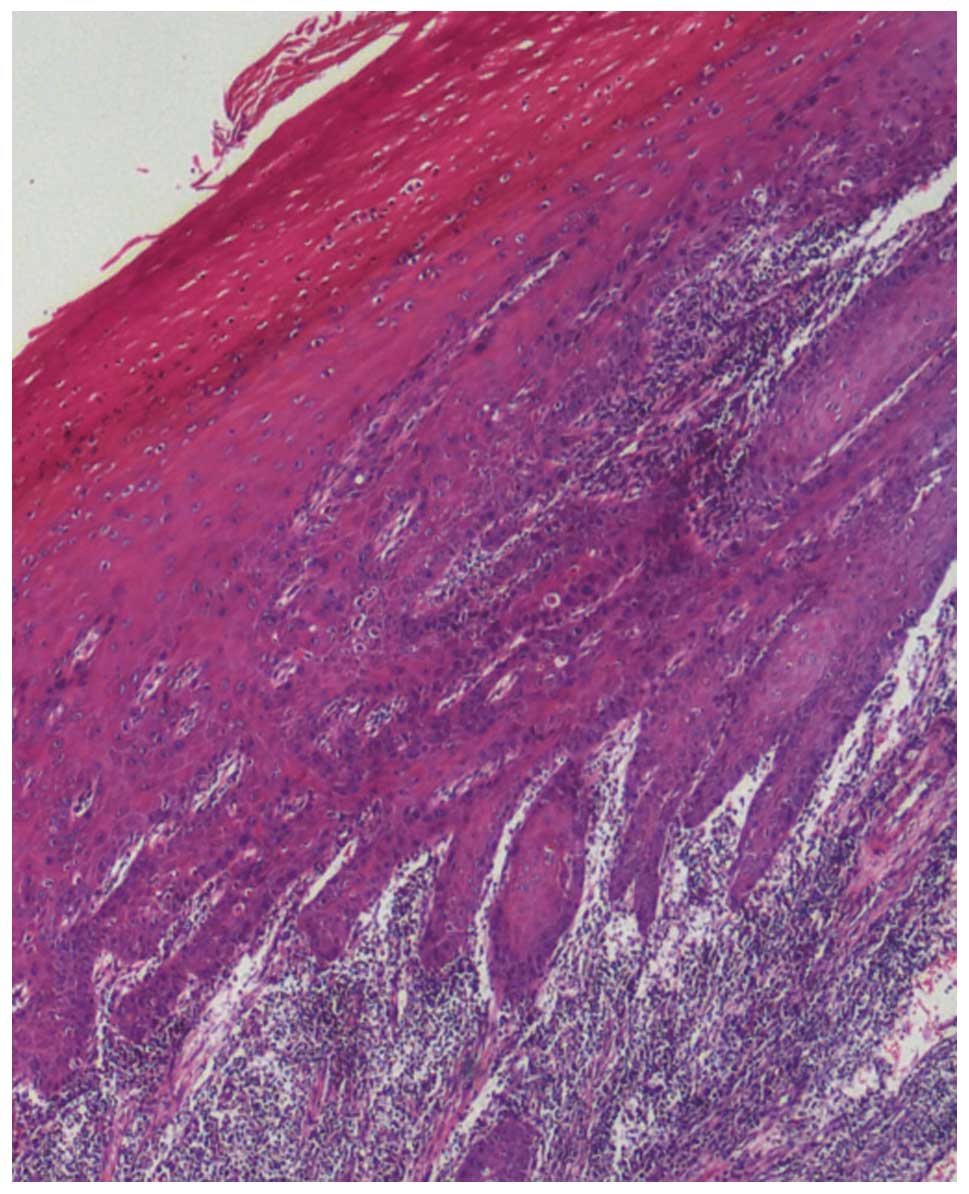
In February 2013, a 43-year-old male presented to the Department of Urology, The Third Xiangya Hospital of Central South University (Changsha, China) with a six-month history of a progressive growth in the glans penis. The patient had undergone a circumcision for phimosis six months previously and subsequently identified a yellow lesion projecting out from the left aspect of the glans penis. The patient experienced no pain and disregarded the lesion, which grew rapidly and prevented the patient from engaging in sexual intercourse. Examination of the patient revealed a horn-like keratinized lesion of ~2.0×1.0×0.6 cm in the glans penis with no inguinal lymphadenopathy (Fig. 1). The International Index of Erectile Function 5 (IIEF-5) questionnaire was used for assessment and the patient’s score was 18 (mild) (3). As the patient was initially reluctant to undergo a partial penectomy, a surgical excision of the lesion was performed. Histopathology the lesion demonstrated extreme hyperkeratosis, dyskeratosis and epithelial hyperplasia (Fig. 2). The patient’s postoperative recovery was uneventful.

Figure 1

Clinical appearance of the penile cutaneous horn; a horn-like keratotic neoplasm that is yellow in colour and projects from the glans penis.

Figure 2

Histopathological staining of the lesion, revealed hyperkeratosis, dyskeratosis and epithelial hyperplasia (haematoxylin and eosin stain; magnification, ×40).

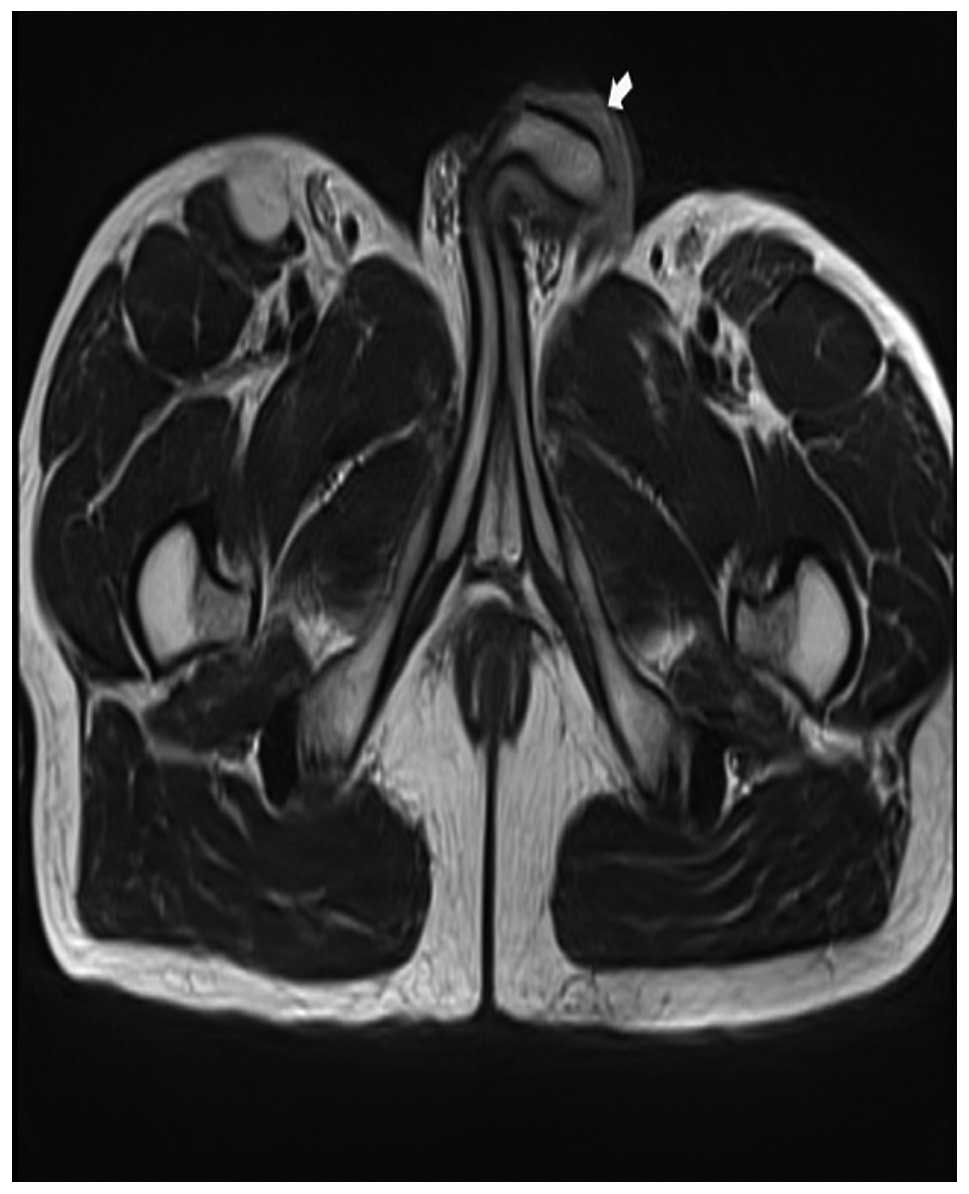
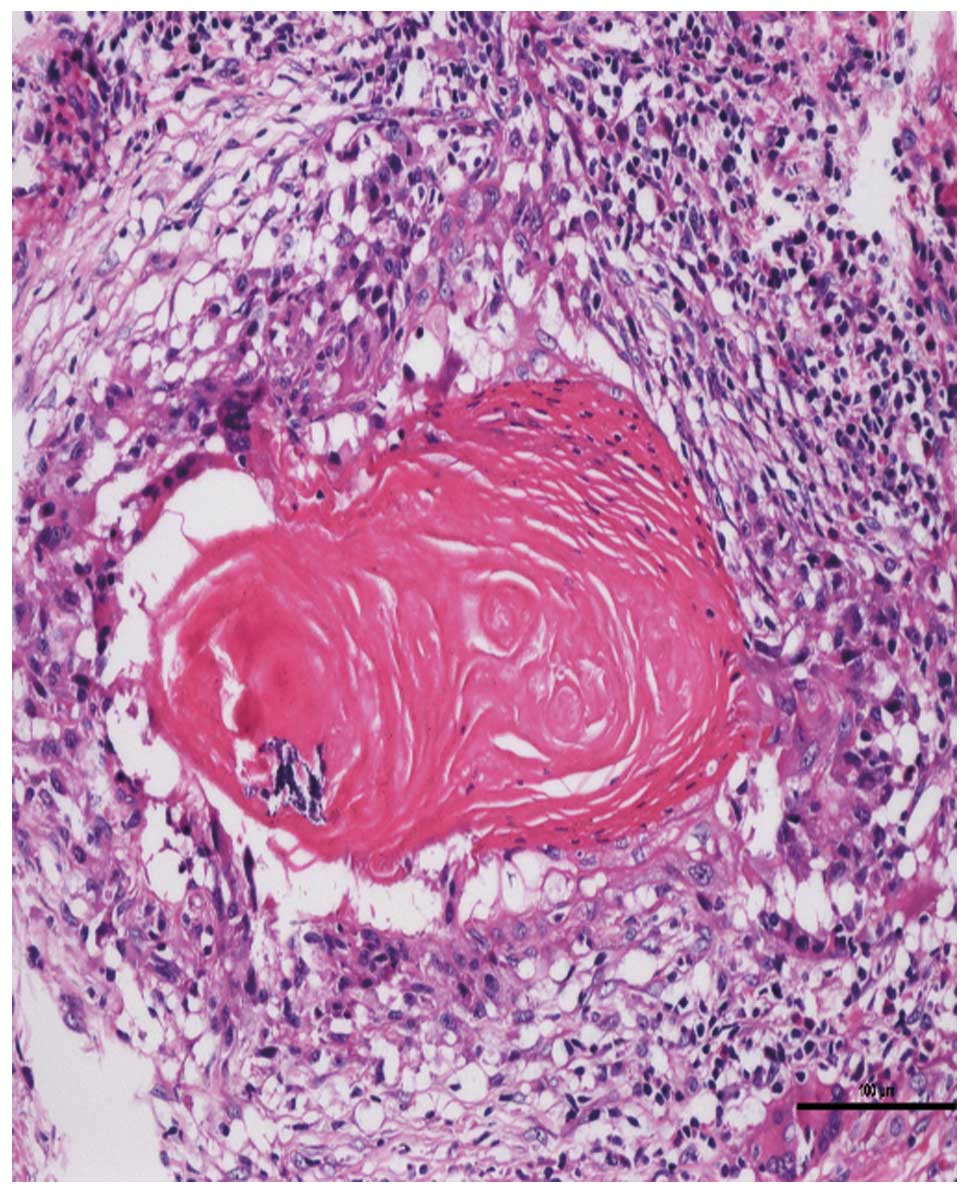
The first postoperative visit was conducted on day 39 following surgery, the patient presented with a painful swelling over the glans penis and purulent discharge of the urethra. On examination, the glans penis was stiff and there was a ~5-mm nodular lesion on the distal aspect of the penile shaft. Pelvic magnetic resonance imaging (MRI) revealed a lesion with an unclear boundary measuring 0.6 cm in diameter (Fig. 3). A biopsy was performed and histopathology indicated squamous atypia and suspected squamous cell carcinoma. Finally, the patient consented to a partial penectomy and histopathology revealed a well differentiated squamous cell carcinoma (Fig. 4). A six-month postoperative follow-up was conducted and the patient was able to urinate whilst standing and the IIEF-5 score was 15 (moderate). Follow-up of the patient is ongoing.

Figure 3

Magnetic resonance image of the pelvis. The white arrow indicates the abnormal lesion.

Figure 4

Histopathological staining identifying the lesion as a well differentiated squamous cell carcinoma (haematoxylin and eosin stain; magnification, ×200).

Discussion

The etiology of penile cutaneous horn remains uncertain since the first case was reported in 1854 (1). Viral and non-viral factors may be implicated in penile cutaneous horn formation. Solivan et al (4) identified a positive human papillomavirus (HPV) reaction for HPV 16 using in situ DNA hybridization; furthermore, Zhu et al (5) demonstrated that the HPV 16/18 infection was positive in a patient exhibiting a penile cutaneous horn. These findings indicate that the HPV infection may be one of the pathogens involved. In addition, the presentation of a penile cutaneous horn may be associated with phimosis, warts and trauma, amongst other conditions (6,7). To the best of our knowledge, penile cutaneous horn usually occurs following an adult circumcision (2). However in the present case, the formation of the penile cutaneous horn preceded the patient’s circumcision, as it was during the circumcision that the lesion was identified. It was hypothesized in the present study that continuous, chronic preputial inflammation aggravates the formation of a penile cutaneous horn and the trauma of circumcision accelerates its development.

The European Association of Urology guidelines on penile cancer classify penile cutaneous horn as a premalignant lesion (8) and approximately one-third of penile cutaneous horns are associated with an underlying malignancy (2). It has previously been reported that MRI is helpful when there is uncertainty regarding the depth of infiltration or proximal extension (9). When the patient in the present case was hospitalized for the second time, a physical examination presented a nodular lesion on the distal aspect of the penile shaft and the MRI result provided the basis of the nature of the lesion.

As instances of penile cutaneous horn are particularly rare and the majority of studies regarding them are case reports, various treatment methods have been adopted, including laser therapy, administration of keratolytic agents and surgical excision (10,11). In the present report, a malignant lesion did not exist when the patient was first diagnosed with a penile cutaneous horn. However, a malignancy was present less than 1.5 months following surgery, thus a partial penectomy was conducted. The IIEF-5 questionnaire, which has previously been used to evaluate sexual function and satisfaction following a partial penectomy (12), was used in the present case; the patient’s IIEF-5 score in the preoperative period was greater than the score six months postoperatively. Based on these findings, undergoing a partial penectomy when a penile cutaneous horn is initially diagnosed should be considered in order to conserve a greater quantity of penile tissue and improve the postoperative quality of life.

In conclusion, to the best of our knowledge, such a rapid progression of a penile cutaneous horn to squamous cell carcinoma has not previously been described. In addition, a decline in the patient’s quality of life was noted. Thus, performance of a partial penectomy should be considered as soon as a diagnosis of penile cutaneous horn is determined.

References

1 

Jewett PA: A case of horn on the glans penis. Med Times. 3:91854.

2 

Lowe FC and McCullough AR: Cutaneous horns of the penis: an approach to management. Case report and review of the literature. J Am Acad Dermatol. 13:369–373. 1985.

3 

Rosen RC, Cappelleri JC, Smith MD, Lipsky J and Peña BM: Development and evaluation of an abridged, 5-item version of the International Index of Erectile Function (IIEF-5) as a diagnostic tool for erectile dysfunction. Int J Impot Res. 11:319–326. 1999.

4 

Solivan GA, Smith KJ and James WD: Cutaneous horn of the penis: its association with squamous cell carcinoma and HPV-16 infection. J Am Acad Dermatol. 23:969–972. 1990.

5 

Zhu JW, Luo D, Li CR, Lu Y, Ji X, Zhu J, Ming YL and Shen CH: A case of penile verrucous carcinoma associated with cutaneous horn. Clin Exp Dermatol. 32:213–214. 2007.

6 

Karthikeyan, Thappa DM, Jaisankar TJ, Balamourougane, Ananthakrishnan N and Ratnakar C: Cutaneous horn of glans penis. Sex Transm Infect. 74:456–457. 1998.

7 

Agarwalla A, Agrawal CS, Thakur A, Garg VK, Joshi A, Agrawal S and Jacob M: Cutaneous horn on condyloma acuminatum. Acta Derm Venereol. 80:1592000.

8 

Pizzocaro G, Algaba F, Horenblas S, Solsona E, Tana S, Van Der Poel H and Watkin NA; European Association of Urology (EAU) Guidelines Group on Penile Cancer. EAU penile cancer guidelines 2009. Eur Urol. 57:1002–1012. 2010.

9 

Lynch DF and Pettaway CA: Tumors of the penis. Campbell’s Urology. Walsh PC, Retik AB, Vaughan ED, et al: 4. 8th edition. W.B. Saunders; Philadelphia, PA: pp. 2453–2485. 2002

10 

Mastrolorenzo A, Tiradritti L, Locunto U, Carini M, Massi D and Zuccati G: Incidental finding: a penile cutaneous horn. Acta Derm Venereol. 85:283–284. 2005.

11 

Schellhammer PF, Jordan GH, Robey EL and Spaulding JT: Premalignant lesions and nonsquamous malignancy of the penis and carcinoma of the scrotum. Urol Clin North Am. 19:131–142. 1992.

12 

Romero FR, Romero KR, Mattos MA, Garcia CR, de Fernandes RC and Perez MD: Sexual function after partial penectomy for penile cancer. Urology. 66:1292–1295. 2005.

Related Articles

  • Abstract
  • View
  • Download
  • Twitter
Copy and paste a formatted citation
Spandidos Publications style
Zhou Y, Tang Y, Tang J, Xia B and Dai Y: Progression of penile cutaneous horn to squamous cell carcinoma: A case report. Oncol Lett 8: 1211-1213, 2014.
APA
Zhou, Y., Tang, Y., Tang, J., Xia, B., & Dai, Y. (2014). Progression of penile cutaneous horn to squamous cell carcinoma: A case report. Oncology Letters, 8, 1211-1213. https://doi.org/10.3892/ol.2014.2247
MLA
Zhou, Y., Tang, Y., Tang, J., Xia, B., Dai, Y."Progression of penile cutaneous horn to squamous cell carcinoma: A case report". Oncology Letters 8.3 (2014): 1211-1213.
Chicago
Zhou, Y., Tang, Y., Tang, J., Xia, B., Dai, Y."Progression of penile cutaneous horn to squamous cell carcinoma: A case report". Oncology Letters 8, no. 3 (2014): 1211-1213. https://doi.org/10.3892/ol.2014.2247
Copy and paste a formatted citation
x
Spandidos Publications style
Zhou Y, Tang Y, Tang J, Xia B and Dai Y: Progression of penile cutaneous horn to squamous cell carcinoma: A case report. Oncol Lett 8: 1211-1213, 2014.
APA
Zhou, Y., Tang, Y., Tang, J., Xia, B., & Dai, Y. (2014). Progression of penile cutaneous horn to squamous cell carcinoma: A case report. Oncology Letters, 8, 1211-1213. https://doi.org/10.3892/ol.2014.2247
MLA
Zhou, Y., Tang, Y., Tang, J., Xia, B., Dai, Y."Progression of penile cutaneous horn to squamous cell carcinoma: A case report". Oncology Letters 8.3 (2014): 1211-1213.
Chicago
Zhou, Y., Tang, Y., Tang, J., Xia, B., Dai, Y."Progression of penile cutaneous horn to squamous cell carcinoma: A case report". Oncology Letters 8, no. 3 (2014): 1211-1213. https://doi.org/10.3892/ol.2014.2247
Follow us
  • Twitter
  • LinkedIn
  • Facebook
About
  • Spandidos Publications
  • Careers
  • Cookie Policy
  • Privacy Policy
How can we help?
  • Help
  • Live Chat
  • Contact
  • Email to our Support Team