Introduction
Due to the infiltrative nature of malignant tumors
and the resulting requirement for safety margins surrounding
macroscopic lesions, as well as tumor motion and set-up variations,
radiation treatment inevitably influences surrounding normal
tissues. Due to the potentially serious consequences of normal
tissue damage, significant investigations have been directed
towards improving the therapeutic index (1–4). As a
result of feedback from previous studies, clinical studies
regarding normal tissue (including those concerning long-term
cardiovascular disease or neurotoxicity) were considered to be
difficult to perform due to the requirement for long-term
follow-up, a rigorous methodology and large patient numbers, in
addition to being costly (5–7). The
aim of the present study was to quantify this assumption in a
systematic review of the literature by identifying the particularly
influential scientific publications as well as the areas that are
currently predominantly being investigated. For various reasons,
including (although not limited to) tenure track or probability of
future funding, study groups attempt to publish their results in a
way that ensures high visibility and allows for the broad adoption
of the progress achieved. The success of a publication may be
defined by various factors. The impact factor of journals is a
double-edged sword, for example in publication bias exists, where
negative or inconclusive studies are not reported (8–10).
Article download rates may provide an indication of visibility and
impact; however, this depends on the presence and the amount of
fees that are charged by the publisher. Another potential measure
of the quality and impact of studies is the citation rate (11,12).
Notable or practice-changing studies are likely to be cited by
follow-up trials, editorials and review articles. The citation
rates of articles published between 2006 and 2010 were evaluated
for the purpose of the present study. Information regarding highly
cited article types may facilitate strategic decision-making and
preparation of future research projects. Furthermore, identifying
underrepresented research areas may initiate the improvement of
resource allocation and increase the focus on these areas.
Materials and methods
Data source, search strategy and
inclusion criteria
On November 7, 2012, a systematic search of the
database, Scopus (Elsevier B.V.; www.scopus.com)
using the key words ‘normal tissue’ and ‘radiotherapy’ was
performed. The evolution of publication activity following the year
2000 was analyzed in order to provide a broader view of the
subject. Articles, including reviews, and clinical and experimental
studies, published between 2006 and 2010 were selected regardless
of language and article type. Pure dosimetric studies, for example
those comparing normal tissue doses with photons versus protons
(treatment planning without clinical follow-up data) were
excluded.
Analysis of patterns of citation
Finally, patterns of citation (using the field,
‘times cited’ in the Scopus citation database) were analyzed as
described in our previous study (13). The total number of accumulated
citations was evaluated (irrespective of their origin) and the
proportion of highly cited articles, arbitrarily defined as those
with ≥25 citations, was investigated. Due to the notably low number
of such articles, the cut-off was lowered to ≥15 citations. A
complete list of articles that have been cited ≥15 times may be
requested from the corresponding author.
Statistical analysis
To estimate the longitudinal trends, the estimated
annual percentage change was calculated by use of a linear
regression model (IBM SPSS Statistics 21, Armonk, NY, USA).
Statistical significance was assessed using the two-tailed test.
P<0.05 was considered to indicate a statistically significant
difference.
Results
Review of the literature
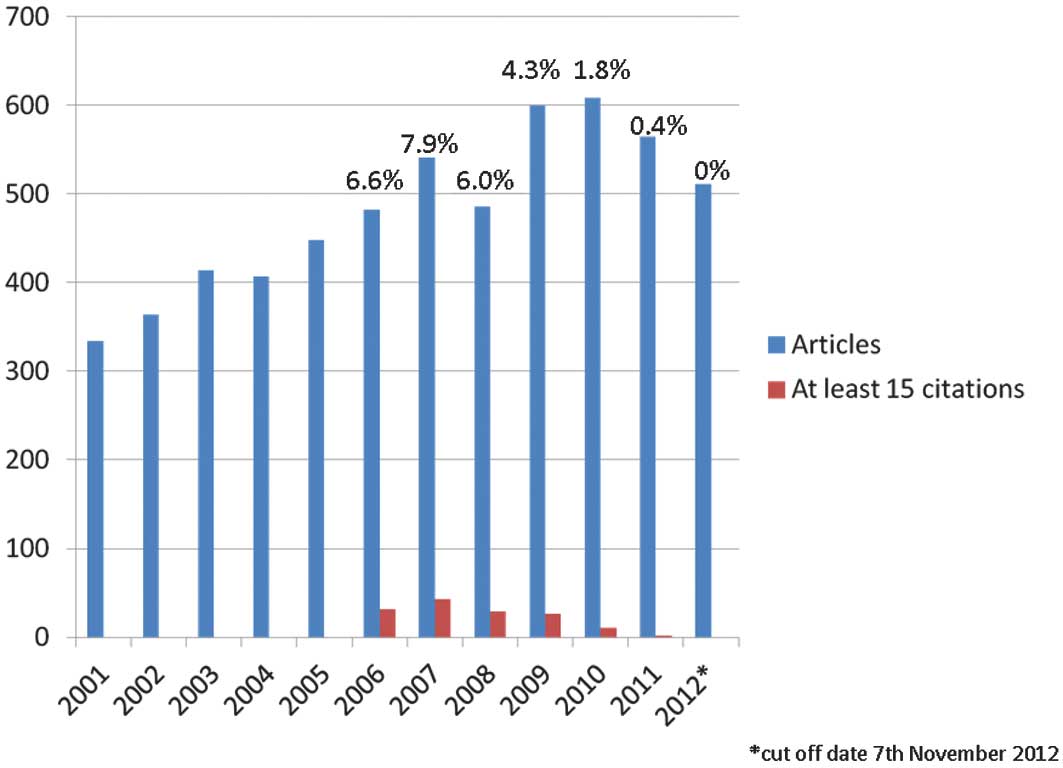
Between 482 and 608 articles per year were published
during the five-year period that was investigated. Fig. 1 presents the number of publications
per year, which significantly increased between 2006 and 2010 by
>50% (P>0.05). In each year <10% of publications
accumulated ≥15 citations. Fig. 1
also shows that accumulation of citations takes ≥3–4 years
subsequent to publication. Therefore, articles published in 2009
and 2010 were less likely to have accumulated ≥15 citations.
Most cited references
References (14–38)
represent the five most cited articles annually between 2006 and
2010. The most cited articles were published in 12 different
scientific journals. Ten articles (40%) were published in the
International Journal of Radiation Oncology Biology and Physics,
and two (8%) in each of the Journal of Clinical Oncology,
Radiotherapy and Oncology, Nature Reviews Cancer and Oncologist.
Table I shows the 10 most cited
articles overall. The majority of these were reviews or
radiobiological modeling studies and all but three were published
prior to 2009. Since articles that were published, for example, in
2006 are more likely to have accumulated a large number of
citations than articles that were published in 2010, the mean of
the annual numbers of citations was also calculated. For this
purpose, 2012 was defined as 0.85 years (January 1st-November 7th).
Table II displays the 10 articles
with the most citations per year and contains articles that were
published between 2006 and 2010. The majority of these were also
reviews or radiobiological modeling studies.
 | Table ITen articles with the highest number
of citations (absolute count). |
Table I
Ten articles with the highest number
of citations (absolute count).
| Author, year
(reference) | Short title | Absolute citation
count | Citations per
year |
|---|
| Bentzen 2006
(14) | Review of late
effects | 154 | 22 |
| François et al
2006 (15) | Human mesenchymal
stem cell engraftment | 123 | 18 |
| Kong et al
2006 (16) | Radiation pneumonitis
and fibrosis | 112 | 16 |
| Wazer et al
2006 (17) | Late toxicity after
breast radiotherapy | 90 | 13 |
| Fiorino et al
2009 (29) | Pelvic normal tissue
review | 67 | 17 |
| Bentzen and Trotti
2007 (19) | Toxicity of
chemoradiation review | 66 | 11 |
| Barnett et al
2009 (30) | Tailoring dose by
genotype | 65 | 17 |
| Kouvaris et al
2007 (20) | Amifostine
review | 60 | 10 |
| Kirkpatrick et
al 2008 (24) | LQ model in
radiosurgery | 60 | 12 |
| Michalski et
al 2010 (34) | Dose-volume effects
for rectum | 60 | 21 |
| Table IIArticles with the highest number of
annual citations. |
Table II
Articles with the highest number of
annual citations.
| Author, year
(reference) | Short title year
count | Citations per | Absolute
citation |
|---|
| Bentzen 2006
(114) | Review of late
effects | 22 | 154 |
| Michalski et
al 2010 (34) | Dose-volume effects
for rectum | 21 | 60 |
| François et al
2006 (15) | Human mesenchymal
stem cell engraftment | 18 | 123 |
| Fiorino et al
2009 (29) | Pelvic normal tissue
review | 17 | 67 |
| Barnett et al
2009 (30) | Tailoring dose by
genotype | 17 | 65 |
| Kong et al
2006 (16) | Radiation pneumonitis
and fibrosis | 16 | 112 |
| Bentzen et al
2010 (35) | QUANTEC review | 15 | 44 |
| Weiss and Landauer
2009 (31) | Review of
radioprotectors | 15 | 59 |
| Zhao and Robbins 2009
(32) | Inflammation and
chronic oxidative stress in late normal tissue injury | 14 | 53 |
| Wazer et al
2006 (17) | Late toxicity after
breast radiotherapy | 13 | 90 |
Discussion
The aim of the current study was to identify
influential and highly cited scientific publications (thereby
determining the trends in current research) concerning the
pathogenesis, epidemiology, prevention, diagnosis, and treatment of
normal tissue toxicity during the five-year period between 2006 and
2010. It was hypothesized that large, clinical toxicity prevention
or mitigation studies may complement the technical efforts towards
improved dose distribution and organ sparing, and improve quality
of life of irradiated cancer survivors. However, large, clinical
toxicity prevention or mitigation studies are difficult to conduct
due to cost issues and competition for funding, thus, are rare and
relatively underrepresented. Following arbitrary decisions
regarding which database to search and what keywords to use, a
systematic literature search was performed and a broad definition
of normal tissue-associated publications was applied (excluding
pure treatment planning studies without clinical follow-up data).
The citation rate of published articles was subsequently evaluated.
Articles that have accumulated a high number of citations are
likely to have impressed other clinicians/scientists and, thus, may
profoundly influence clinical practice or future developments in
the field.
The number of studies performed has increased in the
time period that was studied in the present study. In contrast to
general radiotherapy publications (39), none of the articles regarding normal
tissues achieved >40 citations per year. In our previous study,
15% of all articles accumulated ≥40 citations per year and 42% had
between 20 and 39. Most citations per year were recorded for
meta-analyses and randomized phase III trials. Notably, the lowest
figures were observed for review articles, non-phase III
prospective clinical trials and retrospective clinical studies
(39). In a recent review of
glioblastoma research, the ten articles with the highest number of
citations were cited ≥100 times annually (13). Only 1.5% of all glioblastoma
articles published between 2006 and 2010 accumulated ≥100
citations, however, ~10% had 25–99 citations. In a previous study
regarding radiosurgery for various conditions the same figure was
reported (40); this particular
study did not include articles with <100 citations. To the best
of our knowledge, no other published citation studies have focused
on normal tissue research. The results of the present study
indicate that considerable differences exist with regards to the
topics mentioned above.
In addition to the absolute number of citations, the
mean annual citation rate was also evaluated as the exact time
course or kinetics of citation are difficult to predict, and vary
with the topic and journal (41).
The accumulation of citations of recently published articles and
the reduced interest in older articles over time presents a
challenge if reliable quantitative analysis is to be attempted. The
current study did not account for the date of publication in terms
of whether an article was published earlier or later during a
specific year. For the purpose of this study, the selected methods
were considered to be sufficient. However, more detailed and
quantitative analyses may be performed with the internet-based
tools available. It must be noted that searches using different
databases or different key words may result in more or less
variable citation counts; therefore, the present results only
provide a snapshot. Furthermore, self-citation is likely to
influence the final citation count of sparsely cited articles,
whereas its impact on highly cited articles may be less pronounced.
It was recently estimated that 6.4% of all citations per article
(interquartile range, 2.8–11.3; mean, 8.4) were self-citations
(42). The studies most vulnerable
to this effect were those with a higher number of authors and small
sample sizes.
The results of the present study are consistent with
the theory that citation rate progressively increases several years
after publication. However, the aim of the present study was not to
investigate the dynamics of citation counts. As the majority of
scientific radiation oncology journals have steadily increased in
numbers of published issues and articles, and considering that each
article contains a certain number of references, the increase in
total publication numbers over time is expected to result in a
parallel increase in citation rates. Notably, the highly cited
studies were published in a large number of different scientific
journals with or without high impact factors and were always in
English.
Between 2006 and 2010, significant progress has been
achieved in the areas of genomic analyses, toxicity prediction and
implementation of highly conformal radiotherapy techniques, which
reduce normal tissue doses. Various articles regarding these
subjects were among those with the highest numbers of citations
(13,26,27,31,32).
Systematic reviews were also considered likely to achieve a high
number of citations. The large diversity of current research topics
covering all clinical, pre-clinical, biological and technical
aspects of the field is noteworthy. Prospective clinical research
in areas including prevention and mitigation, using radioprotectors
and response modifiers, was underrepresented. This is unusual
considering the major focus on radiation-induced long-term effects
in breast cancer, lymphoma and brain cancer survivors (43–45).
Efforts to support awareness, funding and publication of normal
tissue studies, in particular clinical strategies that aim to
reduce toxicity and improve quality of life, may be warranted.
In conclusion, publication numbers have increased in
recent years; however, the number of highly cited articles is
limited. In addition to the dose-volume relationship and
pathogenesis of normal tissue effects, the predominating research
areas were genomic analyses and toxicity prediction. For clinical
practice, the development of effective prevention and mitigation
strategies is required, as improvements in technology alone cannot
prevent all types of radiation-induced toxicity. Radiation fields
inevitably include certain amounts of normal tissue, however,
current clinical studies primarily focus on cancer cells and
efforts to increase their radiosensitivity. Thus, general support
and funding for clinical studies focusing on normal tissues are
required.
References
|
1
|
Moding EJ, Kastan MB and Kirsch DG:
Strategies for optimizing the response of cancer and normal tissues
to radiation. Nat Rev Drug Discov. 12:526–542. 2013.
|
|
2
|
Löfdahl E, Berg G, Johansson KA, et al:
Compromised quality of life in adult patients who have received a
radiation dose towards the basal part of the brain. A case-control
study in long-term survivors from cancer in the head and neck
region. Radiat Oncol. 7:1792012.
|
|
3
|
Raabe A, Derda K, Reuther S, et al:
Association of single nucleotide polymorphisms in the genes ATM,
GSTP1, SOD2, TGFB1, XPD and XRCC1 with risk of severe erythema
after breast conserving radiotherapy. Radiat Oncol. 7:652012.
|
|
4
|
Mangoni M, Vozenin MC, Biti G and Deutsch
E: Normal tissues toxicities triggered by combined anti-angiogenic
and radiation therapies: hurdles might be ahead. Br J Cancer.
107:308–314. 2012.
|
|
5
|
Nieder C, Jeremic B, Astner S and Molls M:
Radiotherapy-induced lung toxicity: risk factors and prevention
strategies. Anticancer Res. 23:4991–4998. 2003.
|
|
6
|
Nieder C, Andratschke N and Astner ST:
Experimental concepts for toxicity prevention and tissue
restoration after central nervous system irradiation. Radiat Oncol.
2:232007.
|
|
7
|
Nieder C, Astner ST, Grosu AL and Molls M:
Evaluation of late neurologic adverse events in patients with brain
metastases from non-small cell lung cancer. Anticancer Res.
27:1701–1704
|
|
8
|
Young NS, Ioannidis JPA and Al-Ubaydli O:
Why current publication practices may distort science. PLoS Med.
5:e2012008.
|
|
9
|
Kanaan Z, Galandiuk S, Abby M, et al: The
value of lesser-impact-factor surgical journals as a source of
negative and inconclusive outcomes reporting. Ann Surg.
253:619–623. 2011.
|
|
10
|
Durieux V and Gevenois PA: Bibliometric
indicators: quality measurements of scientific publication.
Radiology. 255:342–351. 2010.
|
|
11
|
Radicchi F, Fortunato S and Castellano C:
Universality of citation distributions: toward an objective measure
of scientific impact. Proc Natl Acad Sci USA. 105:17268–17272.
2008.
|
|
12
|
Vinkler P: Relations of relative
scientometric indicators. Scientometrics. 58:687–694. 2003.
|
|
13
|
Nieder C, Astner ST and Grosu AL:
Glioblastoma research 2006–2010: pattern of citation and systematic
review of highly cited articles. Clin Neurol Neurosurg.
114:1207–1210. 2012.
|
|
14
|
Bentzen SM: Preventing or reducing late
side effects of radiation therapy: Radiobiology meets molecular
pathology. Nat Rev Cancer. 6:702–713. 2006.
|
|
15
|
François S, Bensidhoum M, Mouiseddine M,
et al: Local irradiation not only induces homing of human
mesenchymal stem cells at exposed sites but promotes their
widespread engraftment to multiple organs: A study of their
quantitative distribution after irradiation damage. Stem Cells.
24:1020–1029. 2006.
|
|
16
|
Kong FM, Hayman JA, Griffith KA, et al:
Final toxicity results of a radiation-dose escalation study in
patients with non-small-cell lung cancer (NSCLC): predictors for
radiation pneumonitis and fibrosis. Int J Radiat Oncol Biol Phys.
65:1075–1086. 2006.
|
|
17
|
Wazer DE, Kaufman S, Cuttino L, DiPetrillo
T and Arthur DW: Accelerated partial breast irradiation: an
analysis of variables associated with late toxicity and long-term
cosmetic outcome after high-dose-rate interstitial brachytherapy.
Int J Radiat Oncol Biol Phys. 64:489–495. 2006.
|
|
18
|
Braam PM, Terhaard CH, Roesink JM and
Raaijmakers CP: Intensity-modulated radiotherapy significantly
reduces xerostomia compared with conventional radiotherapy. Int J
Radiat Oncol Biol Phys. 66:975–980. 2006.
|
|
19
|
Bentzen SM and Trotti A: Evaluation of
early and late toxicities in chemoradiation trials. J Clin Oncol.
25:4096–4103. 2007.
|
|
20
|
Kouvaris JR, Kouloulias VE and Vlahos LJ:
Amifostine: the first selective-target and broad-spectrum
radioprotector. Oncologist. 12:738–747. 2007.
|
|
21
|
Söhn M, Yan D, Liang J, et al: Incidence
of late rectal bleeding in high-dose conformal radiotherapy of
prostate cancer using equivalent uniform dose-based and
dose-volume-based normal tissue complication probability models.
Int J Radiat Oncol Biol Phys. 67:1066–1073. 2007.
|
|
22
|
Shirazi A, Ghobadi G and Ghazi-Khansari M:
A radiobiological review on melatonin: a novel radioprotector. J
Radiat Res. 48:263–272. 2007.
|
|
23
|
Giotopoulos G, Symonds RP, Foweraker K, et
al: The late radiotherapy normal tissue injury phenotypes of
telangiectasia, fibrosis and atrophy in breast cancer patients have
distinct genotype-dependent causes. Br J Cancer. 96:1001–1007.
2007.
|
|
24
|
Kirkpatrick JP, Meyer JJ and Marks LB: The
linear-quadratic model is inappropriate to model high dose per
fraction effects in radiosurgery. Semin Radiat Oncol. 18:240–243.
2008.
|
|
25
|
Fiorino C, Fellin G, Rancati T, et al:
Clinical and dosimetric predictors of late rectal syndrome after
3D-CRT for localized prostate cancer: preliminary results of a
multicenter prospective study. Int J Radiat Oncol Biol Phys.
70:1130–1137. 2008.
|
|
26
|
Mayer R and Sminia P: Reirradiation
tolerance of the human brain. Int J Radiat Oncol Biol Phys.
70:1350–1360. 2008.
|
|
27
|
Clarke RE, Tenorio LM, Hussey JR, et al:
Hyperbaric oxygen treatment of chronic refractory radiation
proctitis: a randomized and controlled double-blind crossover trial
with long-term follow-up. Int J Radiat Oncol Biol Phys. 72:134–143.
2008.
|
|
28
|
Burri RJ, Stock RG, Cesaretti JA, et al:
Association of single nucleotide polymorphisms in SOD2, XRCC1 and
XRCC3 with susceptibility for the development of adverse effects
resulting from radiotherapy for prostate cancer. Radiat Res.
170:49–59. 2008.
|
|
29
|
Fiorino C, Valdagni R, Rancati T and
Sanguineti G: Dose-volume effects for normal tissues in external
radiotherapy: pelvis. Radiother Oncol. 93:153–167. 2009.
|
|
30
|
Barnett GC, West CM, Dunning AM, et al:
Normal tissue reactions to radiotherapy: towards tailoring
treatment dose by genotype. Nat Rev Cancer. 9:134–142. 2009.
|
|
31
|
Weiss JF and Landauer MR: History and
development of radiation-protective agents. Int J Radiat Biol.
85:539–573. 2009.
|
|
32
|
Zhao W and Robbins ME: Inflammation and
chronic oxidative stress in radiation-induced late normal tissue
injury: therapeutic implications. Curr Med Chem. 16:130–143.
2009.
|
|
33
|
Yuan X, Liao Z, Liu Z, et al: Single
nucleotide polymorphism at rs1982073:T869C of the TGFbeta 1 gene is
associated with the risk of radiation pneumonitis in patients with
non-small-cell lung cancer treated with definitive radiotherapy. J
Clin Oncol. 27:3370–3378. 2009.
|
|
34
|
Michalski JM, Gay H, Jackson A, et al:
Radiation dose-volume effects in radiation-induced rectal injury.
Int J Radiat Oncol Biol Phys. 76(Suppl 3): S123–S129. 2010.
|
|
35
|
Bentzen SM, Constine LS, Deasy JO, et al:
Quantitative Analyses of Normal Tissue Effects in the Clinic
(QUANTEC): an introduction to the scientific issues. Int J Radiat
Oncol Biol Phys. 76(Suppl 3): S3–S9. 2010.
|
|
36
|
Citrin D, Cotrim AP, Hyodo F, et al:
Radioprotectors and mitigators of radiation-induced normal tissue
injury. Oncologist. 15:360–371. 2010.
|
|
37
|
Yarnold J and Brotons MC: Pathogenetic
mechanisms in radiation fibrosis. Radiother Oncol. 97:149–161.
2010.
|
|
38
|
Gulliford SL, Foo K, Morgan RC, et al:
Dose-volume constraints to reduce rectal side effects from prostate
radiotherapy: evidence from MRC RT01 Trial ISRCTN 47772397. Int J
Radiat Oncol Biol Phys. 76:747–754. 2010.
|
|
39
|
Nieder C: Highly cited German research
contributions to the fields of radiation oncology, biology, and
physics: focus on collaboration and diversity. Strahlenther Onkol.
188:865–872. 2012.
|
|
40
|
Kondziolka D: Citation measures in
stereotactic radiosurgery: publication across a discipline.
Stereotact Funct Neurosurg. 89:56–61. 2011.
|
|
41
|
Stringer MJ, Sales-Pardo M and Nunes
Amaral LA: Statistical validation of a global model for the
distribution of the ultimate number of citations accrued by papers
published in a scientific journal. J Am Soc Inf Sci Technol.
61:1377–1385. 2010.
|
|
42
|
Kulkarni AV, Aziz B, Shams I and Busse JW:
Author self-citation in the general medicine literature. PLoS One.
6:e208852011.
|
|
43
|
Maraldo MV, Brodin NP, Aznar MC, et al:
Estimated risk of cardiovascular disease and secondary cancers with
modern highly conformal radiotherapy for early-stage mediastinal
Hodgkin lymphoma. Ann Oncol. 24:2113–2118. 2013.
|
|
44
|
Darby SC, Ewertz M, McGale P, et al: Risk
of ischemic heart disease in women after radiotherapy for breast
cancer. N Engl J Med. 368:987–998. 2013.
|
|
45
|
Padovani L, André N, Constine LS and
Muracciole X: Neurocognitive function after radiotherapy for
paediatric brain tumours. Nat Rev Neurol. 8:578–588. 2012.
|