Spandidos Publications Logo
  • About
    • About Spandidos
    • Aims and Scopes
    • Abstracting and Indexing
    • Editorial Policies
    • Reprints and Permissions
    • Job Opportunities
    • Terms and Conditions
    • Contact
  • Journals
    • All Journals
    • Oncology Letters
      • Oncology Letters
      • Information for Authors
      • Editorial Policies
      • Editorial Board
      • Aims and Scope
      • Abstracting and Indexing
      • Bibliographic Information
      • Archive
    • International Journal of Oncology
      • International Journal of Oncology
      • Information for Authors
      • Editorial Policies
      • Editorial Board
      • Aims and Scope
      • Abstracting and Indexing
      • Bibliographic Information
      • Archive
    • Molecular and Clinical Oncology
      • Molecular and Clinical Oncology
      • Information for Authors
      • Editorial Policies
      • Editorial Board
      • Aims and Scope
      • Abstracting and Indexing
      • Bibliographic Information
      • Archive
    • Experimental and Therapeutic Medicine
      • Experimental and Therapeutic Medicine
      • Information for Authors
      • Editorial Policies
      • Editorial Board
      • Aims and Scope
      • Abstracting and Indexing
      • Bibliographic Information
      • Archive
    • International Journal of Molecular Medicine
      • International Journal of Molecular Medicine
      • Information for Authors
      • Editorial Policies
      • Editorial Board
      • Aims and Scope
      • Abstracting and Indexing
      • Bibliographic Information
      • Archive
    • Biomedical Reports
      • Biomedical Reports
      • Information for Authors
      • Editorial Policies
      • Editorial Board
      • Aims and Scope
      • Abstracting and Indexing
      • Bibliographic Information
      • Archive
    • Oncology Reports
      • Oncology Reports
      • Information for Authors
      • Editorial Policies
      • Editorial Board
      • Aims and Scope
      • Abstracting and Indexing
      • Bibliographic Information
      • Archive
    • Molecular Medicine Reports
      • Molecular Medicine Reports
      • Information for Authors
      • Editorial Policies
      • Editorial Board
      • Aims and Scope
      • Abstracting and Indexing
      • Bibliographic Information
      • Archive
    • World Academy of Sciences Journal
      • World Academy of Sciences Journal
      • Information for Authors
      • Editorial Policies
      • Editorial Board
      • Aims and Scope
      • Abstracting and Indexing
      • Bibliographic Information
      • Archive
    • International Journal of Functional Nutrition
      • International Journal of Functional Nutrition
      • Information for Authors
      • Editorial Policies
      • Editorial Board
      • Aims and Scope
      • Abstracting and Indexing
      • Bibliographic Information
      • Archive
    • International Journal of Epigenetics
      • International Journal of Epigenetics
      • Information for Authors
      • Editorial Policies
      • Editorial Board
      • Aims and Scope
      • Abstracting and Indexing
      • Bibliographic Information
      • Archive
    • Medicine International
      • Medicine International
      • Information for Authors
      • Editorial Policies
      • Editorial Board
      • Aims and Scope
      • Abstracting and Indexing
      • Bibliographic Information
      • Archive
  • Articles
  • Information
    • Information for Authors
    • Information for Reviewers
    • Information for Librarians
    • Information for Advertisers
    • Conferences
  • Language Editing
Spandidos Publications Logo
  • About
    • About Spandidos
    • Aims and Scopes
    • Abstracting and Indexing
    • Editorial Policies
    • Reprints and Permissions
    • Job Opportunities
    • Terms and Conditions
    • Contact
  • Journals
    • All Journals
    • Biomedical Reports
      • Information for Authors
      • Editorial Policies
      • Editorial Board
      • Aims and Scope
      • Abstracting and Indexing
      • Bibliographic Information
      • Archive
    • Experimental and Therapeutic Medicine
      • Information for Authors
      • Editorial Policies
      • Editorial Board
      • Aims and Scope
      • Abstracting and Indexing
      • Bibliographic Information
      • Archive
    • International Journal of Epigenetics
      • Information for Authors
      • Editorial Policies
      • Editorial Board
      • Aims and Scope
      • Abstracting and Indexing
      • Bibliographic Information
      • Archive
    • International Journal of Functional Nutrition
      • Information for Authors
      • Editorial Policies
      • Editorial Board
      • Aims and Scope
      • Abstracting and Indexing
      • Bibliographic Information
      • Archive
    • International Journal of Molecular Medicine
      • Information for Authors
      • Editorial Policies
      • Editorial Board
      • Aims and Scope
      • Abstracting and Indexing
      • Bibliographic Information
      • Archive
    • International Journal of Oncology
      • Information for Authors
      • Editorial Policies
      • Editorial Board
      • Aims and Scope
      • Abstracting and Indexing
      • Bibliographic Information
      • Archive
    • Medicine International
      • Information for Authors
      • Editorial Policies
      • Editorial Board
      • Aims and Scope
      • Abstracting and Indexing
      • Bibliographic Information
      • Archive
    • Molecular and Clinical Oncology
      • Information for Authors
      • Editorial Policies
      • Editorial Board
      • Aims and Scope
      • Abstracting and Indexing
      • Bibliographic Information
      • Archive
    • Molecular Medicine Reports
      • Information for Authors
      • Editorial Policies
      • Editorial Board
      • Aims and Scope
      • Abstracting and Indexing
      • Bibliographic Information
      • Archive
    • Oncology Letters
      • Information for Authors
      • Editorial Policies
      • Editorial Board
      • Aims and Scope
      • Abstracting and Indexing
      • Bibliographic Information
      • Archive
    • Oncology Reports
      • Information for Authors
      • Editorial Policies
      • Editorial Board
      • Aims and Scope
      • Abstracting and Indexing
      • Bibliographic Information
      • Archive
    • World Academy of Sciences Journal
      • Information for Authors
      • Editorial Policies
      • Editorial Board
      • Aims and Scope
      • Abstracting and Indexing
      • Bibliographic Information
      • Archive
  • Articles
  • Information
    • For Authors
    • For Reviewers
    • For Librarians
    • For Advertisers
    • Conferences
  • Language Editing
Login Register Submit
  • This site uses cookies
  • You can change your cookie settings at any time by following the instructions in our Cookie Policy. To find out more, you may read our Privacy Policy.

    I agree
Search articles by DOI, keyword, author or affiliation
Search
Advanced Search
presentation
Oncology Letters
Join Editorial Board Propose a Special Issue
Print ISSN: 1792-1074 Online ISSN: 1792-1082
Journal Cover
December-2014 Volume 8 Issue 6

Full Size Image

Sign up for eToc alerts
Recommend to Library

Journals

International Journal of Molecular Medicine

International Journal of Molecular Medicine

International Journal of Molecular Medicine is an international journal devoted to molecular mechanisms of human disease.

International Journal of Oncology

International Journal of Oncology

International Journal of Oncology is an international journal devoted to oncology research and cancer treatment.

Molecular Medicine Reports

Molecular Medicine Reports

Covers molecular medicine topics such as pharmacology, pathology, genetics, neuroscience, infectious diseases, molecular cardiology, and molecular surgery.

Oncology Reports

Oncology Reports

Oncology Reports is an international journal devoted to fundamental and applied research in Oncology.

Experimental and Therapeutic Medicine

Experimental and Therapeutic Medicine

Experimental and Therapeutic Medicine is an international journal devoted to laboratory and clinical medicine.

Oncology Letters

Oncology Letters

Oncology Letters is an international journal devoted to Experimental and Clinical Oncology.

Biomedical Reports

Biomedical Reports

Explores a wide range of biological and medical fields, including pharmacology, genetics, microbiology, neuroscience, and molecular cardiology.

Molecular and Clinical Oncology

Molecular and Clinical Oncology

International journal addressing all aspects of oncology research, from tumorigenesis and oncogenes to chemotherapy and metastasis.

World Academy of Sciences Journal

World Academy of Sciences Journal

Multidisciplinary open-access journal spanning biochemistry, genetics, neuroscience, environmental health, and synthetic biology.

International Journal of Functional Nutrition

International Journal of Functional Nutrition

Open-access journal combining biochemistry, pharmacology, immunology, and genetics to advance health through functional nutrition.

International Journal of Epigenetics

International Journal of Epigenetics

Publishes open-access research on using epigenetics to advance understanding and treatment of human disease.

Medicine International

Medicine International

An International Open Access Journal Devoted to General Medicine.

Journal Cover
December-2014 Volume 8 Issue 6

Full Size Image

Sign up for eToc alerts
Recommend to Library

  • Article
  • Citations
    • Cite This Article
    • Download Citation
    • Create Citation Alert
    • Remove Citation Alert
    • Cited By
  • Similar Articles
    • Related Articles (in Spandidos Publications)
    • Similar Articles (Google Scholar)
    • Similar Articles (PubMed)
  • Download PDF
  • Download XML
  • View XML
Case Report

Minimal deviation mucinous adenocarcinoma of the uterine cervix that proved difficult to differentiate from endometrial cancer: A case report

  • Authors:
    • Yuko Nishii
    • Takeshi Fukuda
    • Kenji Imai
    • Makoto Yamauchi
    • Yasunori Hashiguchi
    • Tomoyuki Ichimura
    • Tomoyo Yasui
    • Toshiyuki Sumi
  • View Affiliations / Copyright

    Affiliations: Department of Obstetrics and Gynecology, Osaka City University Graduate School of Medicine, Osaka 545‑8585, Japan
  • Pages: 2481-2484
    |
    Published online on: September 12, 2014
       https://doi.org/10.3892/ol.2014.2532
  • Expand metrics +
Metrics: Total Views: 0 (Spandidos Publications: | PMC Statistics: )
Metrics: Total PDF Downloads: 0 (Spandidos Publications: | PMC Statistics: )
Cited By (CrossRef): 0 citations Loading Articles...

This article is mentioned in:


Abstract

Minimal deviation adenocarcinoma (MDA), also known as adenoma malignum of the uterine cervix, accounts for only ~1% of uterine cervical adenocarcinomas. Adenoma malignum of the uterine cervix was initially described by Gusserow in 1870. Using magnetic resonance imaging (MRI), MDA appears as multilocular lesions with solid components that extend from the endocervical glands to the deep cervical stroma. Cytological evaluation and biopsies have low detection rates, therefore, it is difficult to diagnose MDA accurately prior to treatment. The current study describes a rare case of MDA that was difficult to differentiate from endometrial adenocarcinoma of the corpus uteri preoperatively, as the endometrial biopsy results suggested a well‑differentiated endometrioid adenocarcinoma and MRI did not show typical images for MDA. A total abdominal hysterectomy with bilateral salpingo‑oophorectomy was performed under the diagnosis of endometrial cancer, and the mass was subsequently diagnosed as MDA of the uterine cervix by pathological examination of the hysterectomy specimen. Postoperatively, although two types of adjuvant chemotherapy were performed, the remaining tumor continued to grow, causing obstruction of the bilateral ureters and leading to bilateral hydronephrosis. The patient is currently alive with the disease 10 months following the surgery.

Introduction

Minimal deviation adenocarcinoma (MDA), also known as adenoma malignum of the uterine cervix, accounts for only ~1% of adenocarcinomas of the uterine cervix. The main clinical manifestations are vaginal profuse, watery or mucoid discharge and irregular bleeding (1). In total, ~10% of MDA is accompanied by Peutz-Jeghers syndrome (2). Using magnetic resonance imaging (MRI), MDA appears as multilocular lesions with solid components that extend from the endocervical glands to the deep cervical stroma. Histopathologically, MDA is composed of mucinous, well-differentiated glands, deeply invading the cervical stroma, often surrounded by a desmoplastic reaction. Although MDA exhibits a benign histological appearance, it is typically characterized by aggressive clinical behavior. Cytological evaluation and biopsies have low detection rates, which delays the accurate diagnosis and leads to a poor prognosis.

The current study describes a rare case of MDA that was difficult to differentiate from endometrial adenocarcinoma of the corpus uteri preoperatively, as the endometrial biopsy results suggested well-differentiated endometrioid adenocarcinoma and MRI did not show typical images. Surgery was performed under the diagnosis of endometrial cancer, and the tumor was diagnosed as MDA of the uterine cervix following pathological examination of the hysterectomy specimen. Written informed consent was obtained from the patient.

Case report

A 65-year-old female (gravida 2, para 0) visited a local clinic due to abnormal vaginal bleeding. A previous history of surgery for acute appendicitis was recorded at 20 years of age, and the patient’s family history was unremarkable. Mild ascites and swelling of an ovary were observed during transvaginal ultrasonography; therefore, the patient was referred to the Department of Obstetrics and Gynecology, Osaka City University Graduate School of Medicine (Osaka, Japan).

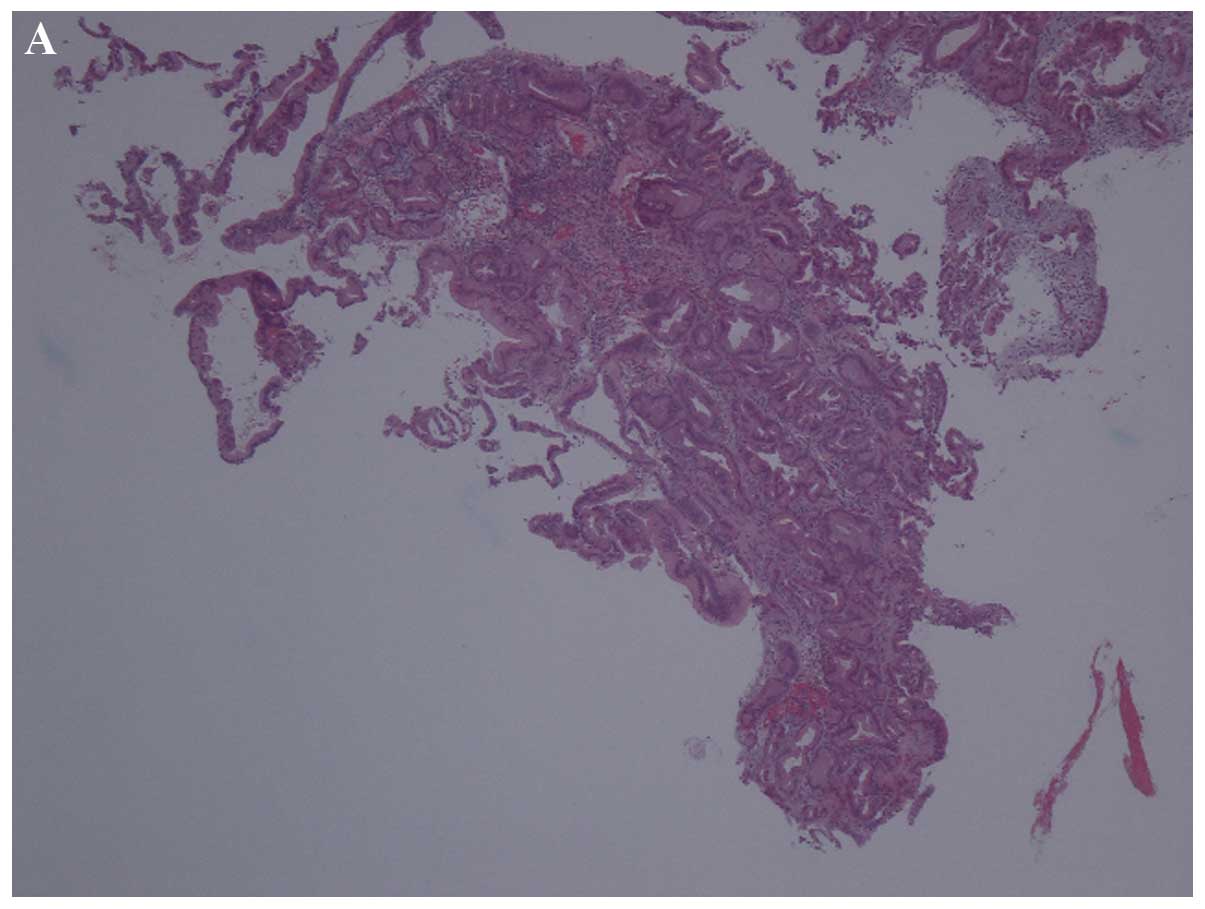
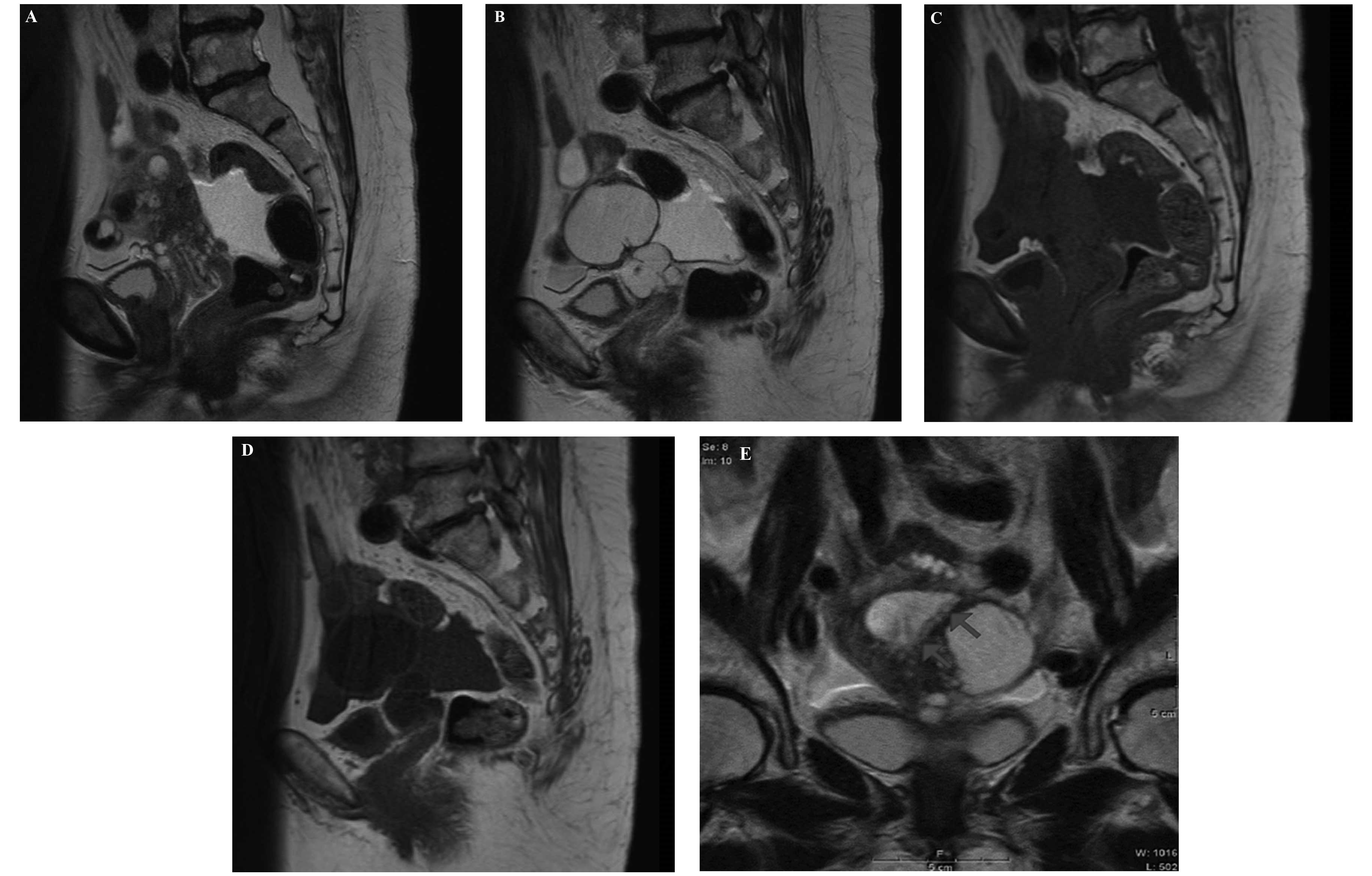
On presentation, the patient exhibited a small volume of bloody vaginal discharge. The uterine corpus was enlarged to 85 mm in size and the uterine cervix was not enlarged or abnormal. Transvaginal ultrasonography revealed a small amount of ascites and mildly thickened endometrium. The fallopian tubes and ovaries exhibited no abnormalities. A cervical smear was negative for intraepithelial lesions or malignancy and an endometrial biopsy revealed a well-differentiated suspected endometrioid adenocarcinoma (Fig. 1). magnetic resonance imaging (MRI) revealed mucus retention in the endometrial cavity and multiple cysts from the uterine corpus to the uterine cervix, with low intensity on T1-weighted images and high intensity on T2-weighted images. No enlargement of the uterine cervix was observed. T2-weighted images revealed a high-intensity area in the endometrium of the uterine corpus (Fig. 2). A chest CT revealed the enlargement of the supraclavicular lymph nodes. Serum carbohydrate antigen (CA)-125 levels were 153 U/ml (normal, <35 U/ml) and CA19-9 levels were 44 U/ml (normal, <37 U/ml), while carcinoembryonic antigen and sialyl-Tn antigen levels were within the normal ranges.

Figure 1

(A) Low-power and (B) high-power view of minimal deviation adenocarcinoma histopathology. The glands are well-differentiated and show minimal cytological atypia. The density of glands is increased and a number of glands are back to back [magnification, (A) ×20 and (B) ×200.]

Figure 2

(A) T2-weighted sagittal magnetic resonance imaging revealing (A) no evident enlargement of the uterine cervix and (B) several high intensity cystic lesions in the uterine corpus and uterine cervix. (C) T1-weighted sagittal magnetic resonance image corresponding to Fig 2A. (D) T1-weighted sagittal magnetic resonance image corresponding to Fig. 2B. (E) T2-weighted coronal magnetic resonance image showing thickening of the endometrium (arrow).

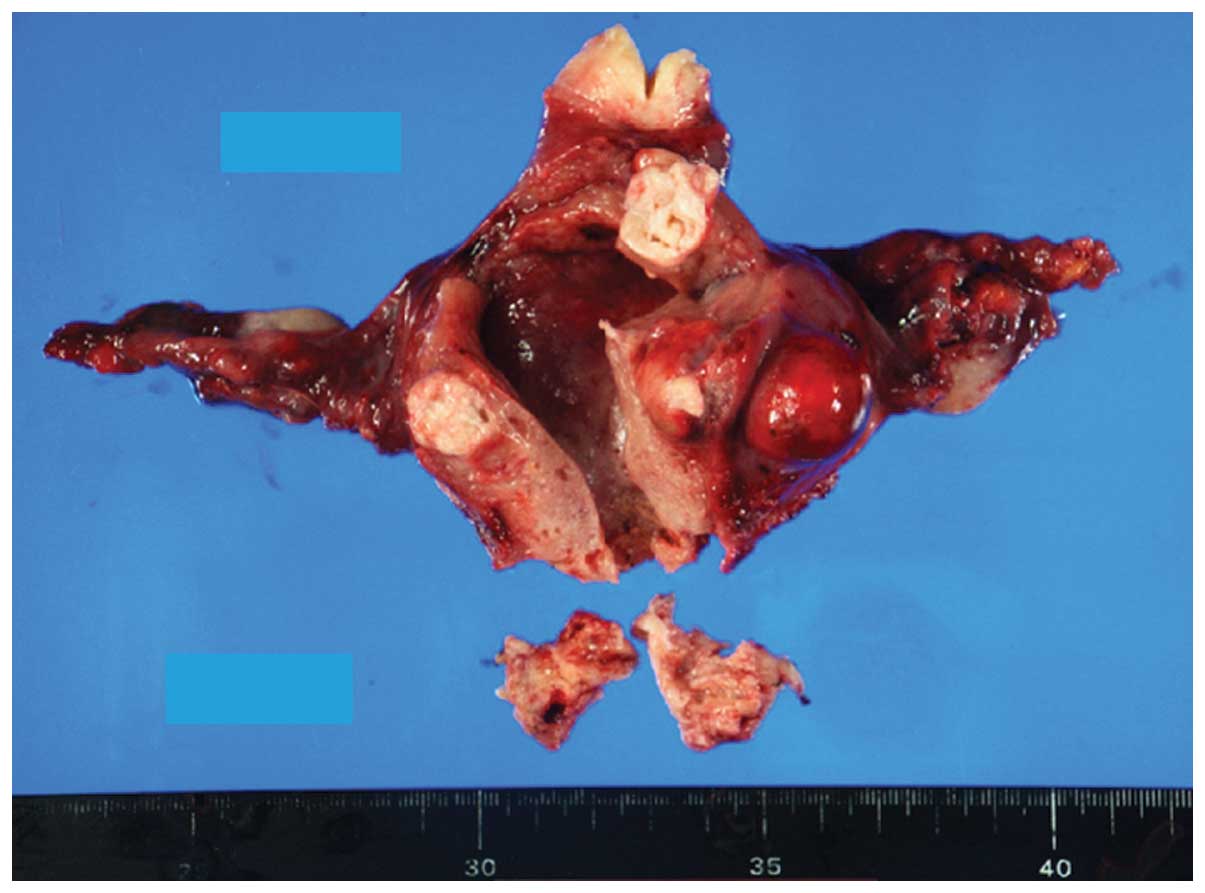
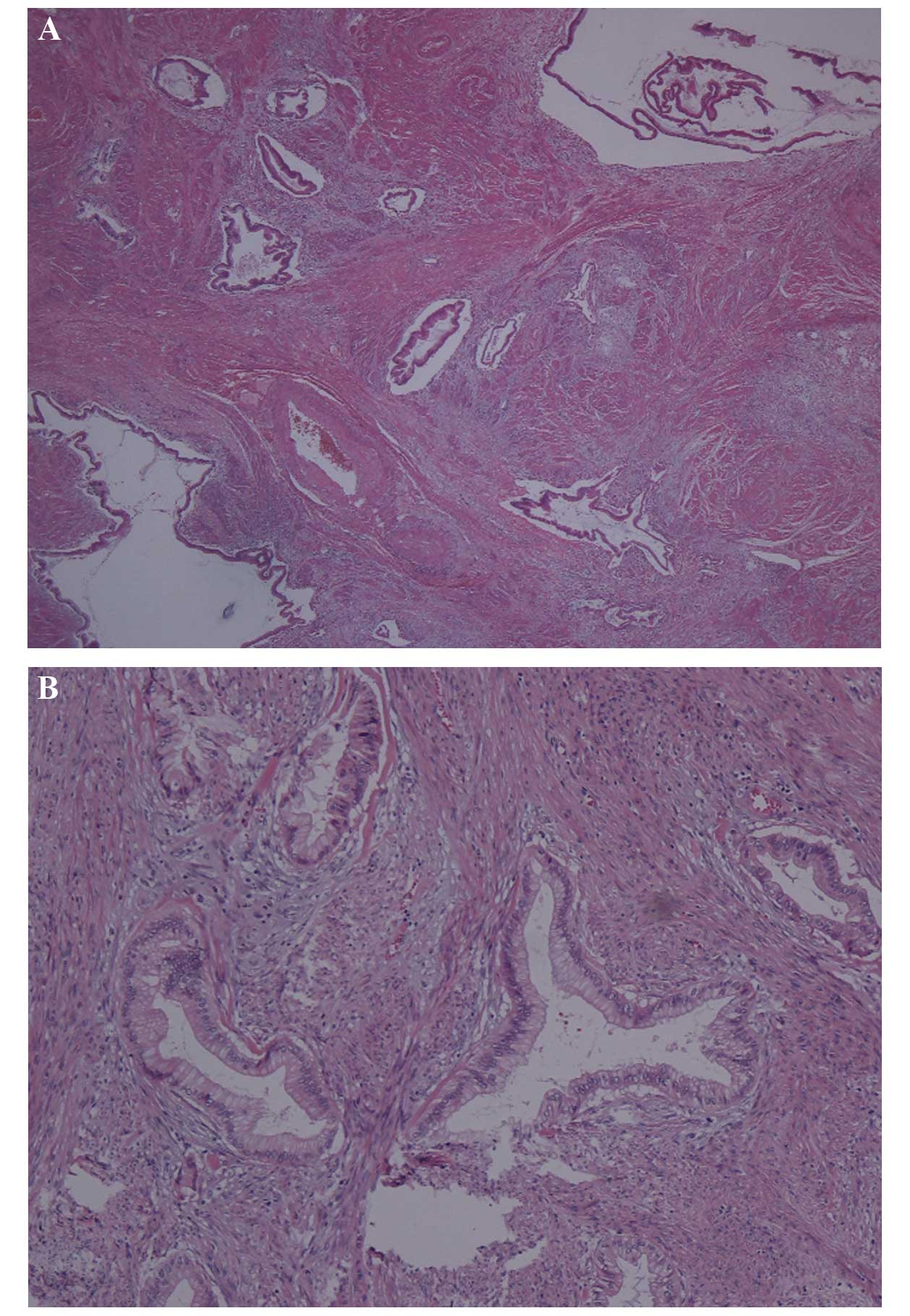
Based on the diagnosis of advanced endometrial adenocarcinoma of the corpus uteri, an abdominal total hysterectomy was performed with bilateral salpingo-oophorectomy and left supraclavicular lymph node biopsy. Intra-abdominal dissemination was observed and intraoperative peritoneal cytology was positive. The uterine cervix was extremely fragile and was damaged during the hysterectomy; therefore, the affected tissue was resected as much as possible. However, further tumors remained. Macroscopically, the uterine corpus was enlarged to goose-egg size and the tumor was located in the uterine cervix and uterine corpus. The tumor was predominantly present in the uterine cervix. The endometrial surface was moderately irregular (Fig. 3) and microscopically, deeply infiltrating mucinous adenocarcinoma, composed of well-formed glands arranged in an irregular fashion, was identified. The nuclear and architectural abnormalities were generally minimal; however, limited areas exhibited a desmoplastic stromal reaction, indicating a malignant nature (Fig. 4). A final diagnosis of MDA of the uterine cervix was determined. Extension of tumors to the uterine corpus, fallopian tubes and ovaries was identified and the left supraclavicular lymph node was positive for metastasis. The tumor was designated as pT4NXM1, according to the Union for International Cancer Control TNM classification (7th edition) (3).

Figure 3

Extracted uterus and adnexa. The uterine cervix was extremely fragile and was damaged during hysterectomy.

Figure 4

(A) Low-power and (B) high-power view of the multicystic lesions that resemble normal endocervical glands. The majority of glands had an irregular shape, cellular atypia and structural dysplasia. Branching-shaped endocervical glands infiltrated deep into the muscle [magnification, (A) ×100 and (B) ×200.

In total, six courses of chemotherapy containing irinotecan and cisplatin were administered postoperatively; however, the growth of the remaining tumor tissue continued despite the chemotherapy. The chemotherapy regimen was altered to paclitaxel and carboplatin. Following one course, the remaining tumor increased further, causing obstruction to the bilateral ureters and leading to bilateral hydronephrosis. A double-J catheter was inserted into the right ureter and this was followed by supportive care. The patient is currently alive with the disease at 10 months following the surgery.

Discussion

Adenoma malignum of the uterine cervix was initially described by Gusserow in 1870 (4) and, in 1963, McKelvey and Goodlin reported five cases of adenoma malignum (5). In 1975, the name MDA was proposed by Silverberg and Hurt (6) to more accurately reflect the resemblance of the glands to the normal endocervical glands and the lack of malignant cellular features. MDA is a rare subtype of mucinous adenocarcinoma of the uterine cervix, accounting for only 1–3% of uterine cervical adenocarcinoma and 0.15–0.45% of all cervical carcinomas of the uterus reported in the literature (1). The major clinical manifestations of MDA are profuse or mucoid discharge and irregular vaginal bleeding (7).

The diagnostic methods of MDA are cytological evaluations, biopsies, cross-sectional imaging and immunostaining. MDA appears in MRI as a multicystic mass, demonstrating extremely high-signal intensity on T2-weighted images and isointensity or moderate hyperintensity on T1-weighted images, which extends from the endocervical glands to the deep cervical stroma, with solid portions located deep in the endocervix (8,9). MDA is difficult to diagnose as few findings conclusively suggest malignancy on cytological or histological examination. MDA lesions are located deep in the endocervix and exhibit an endophytic growth pattern, which also makes it difficult to determine an accurate cytological and histological diagnosis (10). Li et al (7) reported that the detection rate of MDA by cytological evaluation was only 32.7%. Granter and Lee (11) reported that enlarged glandular cells in honeycombed sheets with abundant cytoplasm in exfoliative cytology were crucial in the detection of MDA; however, a preoperative histological diagnosis of MDA is also often difficult to determine. Preoperative punch biopsy occasionally fails to confirm the diagnosis of MDA as the tumor glands positioned in the deep cervical stroma require a deep biopsy (i.e. cervical conization) to confirm the presence of invasion. The monoclonal antibody HIK-1083, which detects mucin produced and secreted by the gastric mucous cells, has been indicated to be useful in the correct diagnosis of MDA (12). However, endocervical glandular hyperplasia with pyloric gland metaplasia has also been observed to be positive for HIK-1083 (13). Li et al (7) reported that the detection rate of MDA following a single biopsy was 28.7% and the rate of the total number of biopsies including cervical conization was 50.7%. Treatment and prognosis of MDA are controversial. Surgical treatment is the most successful option; however, no standard surgical treatment or adjuvant therapy have been established. The treatment of MDA frequently shadows that of endocervical adenocarcinoma and despite the presence of well-differentiated histopathological features, the prognosis of MDA is poor. This is due to the likelihood of the tumor to exhibit lymph node involvement and the early presence of peritoneal carcinomatosis, in contrast to the behavior of classical adenocarcinoma (5). However, a number of studies have reported a favorable prognosis (7,14) and stated that a poor prognosis of MDA is not always observed if it is identified at an early stage. The present case exhibited peritoneal carcinomatosis and distant metastasis to the left supraclavicular lymph node at diagnosis; therefore, optimal surgery could not be performed and the two types of adjuvant chemotherapy were ineffective.

McGowan et al (2) reported that Peutz-Jeghers syndrome may complicate MDA (2), and Gilks et al (15) reported that approximately half of all MDAs are complicated with ovarian mucinous tumors. The present case, however, was not complicated with these diseases.

The current study describes a rare case of MDA that was difficult to differentiate from endometrial adenocarcinoma of the corpus uteri preoperatively; following the diagnosis of endometrial cancer, surgery was performed. The tumor was diagnosed as MDA of the uterine cervix following pathological examination of the hysterectomy specimen. In cases where mild thickening of the endometrium is observed and the endometrial biopsy results indicate a well-differentiated adenocarcinoma, with cystic lesions in the uterine corpus and uterine cervix, the possibility of the invasion of MDA of the uterine cervix to the uterine corpus must be considered.

References

1 

Kaminski PF and Norris HJ: Minimal deviation carcinoma (adenoma malignum) of the cervix. Int J Gynecol Pathol. 2:141–152. 1983.

2 

McGowan L, Young RH and Scully RE: Peutz-Jeghers syndrome with ‘adenoma malignum’ of the cervix. A report of two cases. Gynecol Oncol. 10:125–133. 1980.

3 

Sobin LH, Gospodarowicz MK and Wittekind C: TNM Classification of Malignant Tumours. 7th edition. Wiley-Blackwell; Hoboken, NJ: 2009

4 

Gusserow ALS: Ueber sarcome des uterus. Arch Gynakol. 1:240–251. 1870.

5 

McKelvey JL and Goodlin RR: Adenoma malignum of the cervix. A cancer of deceptively innocent histological pattern. Cancer. 16:549–557. 1963.

6 

Silverberg SG and Hurt WG: Minimal deviation adenocarcinoma (‘adenoma malignum’) of the cervix: a reappraisal. Am J Obstet Gynecol. 121:971–975. 1975.

7 

Li G, Jiang W, Gui S and Xu C: Minimal deviation adenocarcinoma of the uterine cervix. Int J Gynaecol Obstet. 110:89–92. 2010.

8 

Doi T, Yamashita Y, Yasunaga T, et al: Adenoma malignum: MR imaging and pathologic study. Radiology. 204:39–42. 1997.

9 

Yamashita Y, Takahashi M, Katabuchi H, Fukumatsu Y, Miyazaki K and Okamura H: Adenoma malignum: MR appearances mimicking nabothian cysts. Am J Roentgenol. 162:649–650. 1994.

10 

Ishii K, Katsuyama T, Ota H, et al: Cytologic and cytochemical features of adenoma malignum of the uterine cervix. Cancer. 87:245–253. 1999.

11 

Granter SR and Lee KR: Cytologic findings in minimal deviation adenocarcinoma (adenoma malignum) of the cervix. A report of seven cases. Am J Clin Pathol. 105:327–333. 1996.

12 

Utsugi K, Hirai Y, Takeshima N, Akiyama F, Sakurai S and Hasumi K: Utility of the monoclonal antibody HIK1083 in the diagnosis of adenoma malignum of the uterine cervix. Gynecol Oncol. 75:345–348. 1999.

13 

Yoden E, Mikami Y, Fujiwara K, Kohno I and Imajo Y: Florid endocervical glandular hyperplasia with pyloric gland metaplasia: a radiologic pitfall. J Comput Assist Tomogr. 25:94–97. 2001.

14 

Hirai Y, Takeshima N, Haga A, Arai Y, Akiyama F and Hasumi K: A clinicocytopathologic study of adenoma malignum of the uterine cervix. Gynecol Oncol. 70:219–223. 1998.

15 

Gilks CB, Young RH, Aguirre P, DeLellis RA and Scully RE: Adenoma malignum (minimal deviation adenocarcinoma) of the uterine cervix. A clinicopathological and immunohistochemical analysis of 26 cases. Am J Surg Pathol. 13:717–729. 1989.

Related Articles

  • Abstract
  • View
  • Download
  • Twitter
Copy and paste a formatted citation
Spandidos Publications style
Nishii Y, Fukuda T, Imai K, Yamauchi M, Hashiguchi Y, Ichimura T, Yasui T and Sumi T: Minimal deviation mucinous adenocarcinoma of the uterine cervix that proved difficult to differentiate from endometrial cancer: A case report. Oncol Lett 8: 2481-2484, 2014.
APA
Nishii, Y., Fukuda, T., Imai, K., Yamauchi, M., Hashiguchi, Y., Ichimura, T. ... Sumi, T. (2014). Minimal deviation mucinous adenocarcinoma of the uterine cervix that proved difficult to differentiate from endometrial cancer: A case report. Oncology Letters, 8, 2481-2484. https://doi.org/10.3892/ol.2014.2532
MLA
Nishii, Y., Fukuda, T., Imai, K., Yamauchi, M., Hashiguchi, Y., Ichimura, T., Yasui, T., Sumi, T."Minimal deviation mucinous adenocarcinoma of the uterine cervix that proved difficult to differentiate from endometrial cancer: A case report". Oncology Letters 8.6 (2014): 2481-2484.
Chicago
Nishii, Y., Fukuda, T., Imai, K., Yamauchi, M., Hashiguchi, Y., Ichimura, T., Yasui, T., Sumi, T."Minimal deviation mucinous adenocarcinoma of the uterine cervix that proved difficult to differentiate from endometrial cancer: A case report". Oncology Letters 8, no. 6 (2014): 2481-2484. https://doi.org/10.3892/ol.2014.2532
Copy and paste a formatted citation
x
Spandidos Publications style
Nishii Y, Fukuda T, Imai K, Yamauchi M, Hashiguchi Y, Ichimura T, Yasui T and Sumi T: Minimal deviation mucinous adenocarcinoma of the uterine cervix that proved difficult to differentiate from endometrial cancer: A case report. Oncol Lett 8: 2481-2484, 2014.
APA
Nishii, Y., Fukuda, T., Imai, K., Yamauchi, M., Hashiguchi, Y., Ichimura, T. ... Sumi, T. (2014). Minimal deviation mucinous adenocarcinoma of the uterine cervix that proved difficult to differentiate from endometrial cancer: A case report. Oncology Letters, 8, 2481-2484. https://doi.org/10.3892/ol.2014.2532
MLA
Nishii, Y., Fukuda, T., Imai, K., Yamauchi, M., Hashiguchi, Y., Ichimura, T., Yasui, T., Sumi, T."Minimal deviation mucinous adenocarcinoma of the uterine cervix that proved difficult to differentiate from endometrial cancer: A case report". Oncology Letters 8.6 (2014): 2481-2484.
Chicago
Nishii, Y., Fukuda, T., Imai, K., Yamauchi, M., Hashiguchi, Y., Ichimura, T., Yasui, T., Sumi, T."Minimal deviation mucinous adenocarcinoma of the uterine cervix that proved difficult to differentiate from endometrial cancer: A case report". Oncology Letters 8, no. 6 (2014): 2481-2484. https://doi.org/10.3892/ol.2014.2532
Follow us
  • Twitter
  • LinkedIn
  • Facebook
About
  • Spandidos Publications
  • Careers
  • Cookie Policy
  • Privacy Policy
How can we help?
  • Help
  • Live Chat
  • Contact
  • Email to our Support Team