Article
Malignant transformation of sinonasal inverted papilloma: A retrospective analysis of 32 cases
- Authors:
-
View Affiliations / Copyright
Affiliations:
Department of Otorhinolaryngology Head and Neck Surgery, Tianjin Huanhu Hospital, Tianjin 300060, P.R. China
-
Pages:
2637-2641
|
Published online on:
September 16, 2014
https://doi.org/10.3892/ol.2014.2539
- Expand metrics +
Metrics:
Total
Views: 0
(Spandidos Publications: | PMC Statistics:
)
Metrics:
Total PDF Downloads: 0
(Spandidos Publications: | PMC Statistics:
)
This article is mentioned in:
Abstract
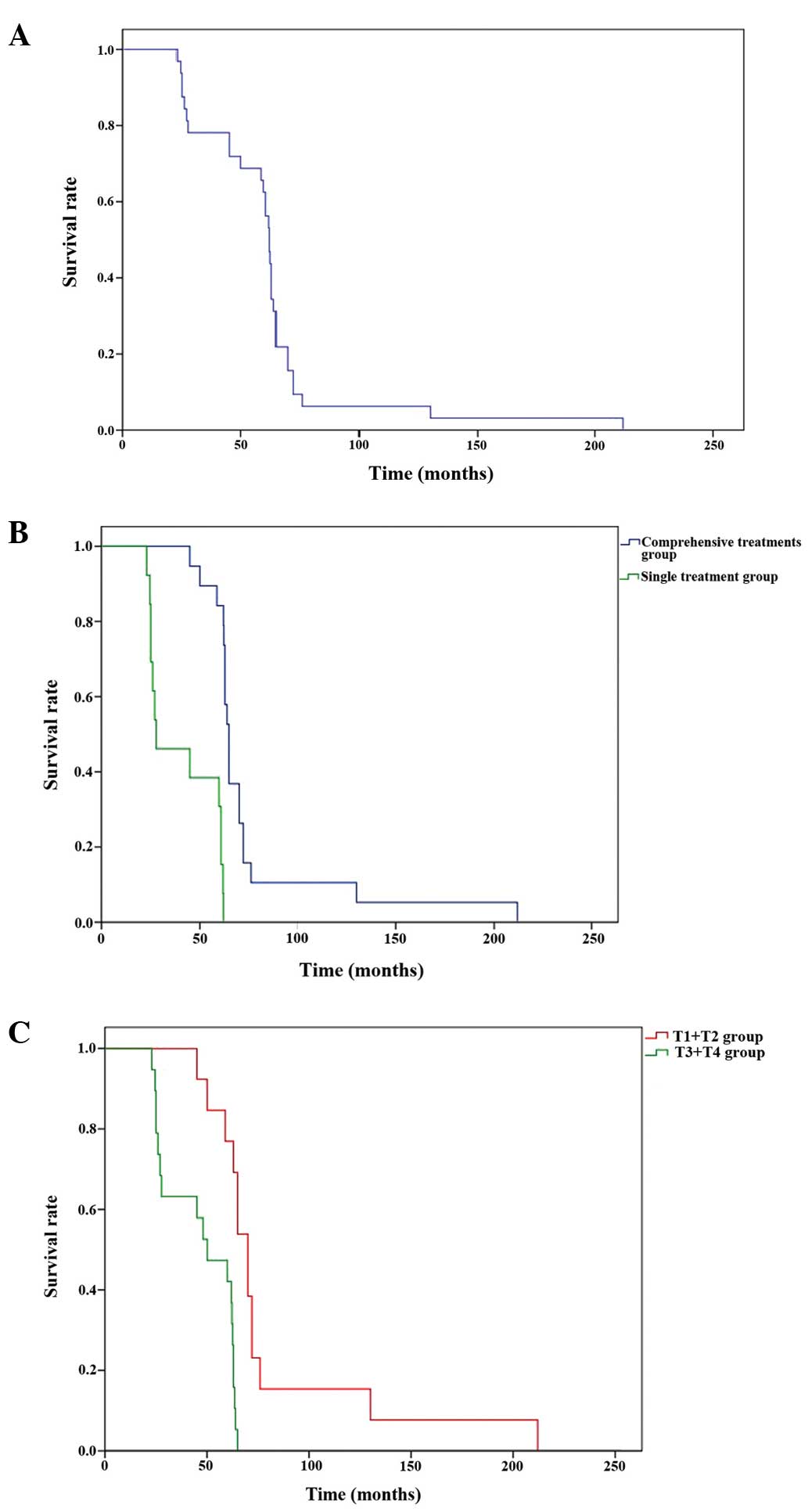
Sinonasal inverted papillomas (SNIPs) are derived from the benign tumors of the epithelial cells and have the potential to recur and exhibit malignant characteristics. The aim of the present study was to investigate the clinicopathological features and prognosis of patients with malignant transformation of SNIP. A total of 32 consecutive cases, who were patients at the Department of Otorhinolaryngology Head and Neck Surgery, Tianjin Huanhu Hospital from January 1991 to January 2008, were retrospectively reviewed. Survival rates and prognostic factors were calculated using the Kaplan‑Meier method and multivariate Cox model survival analysis. The malignancy accounted for 8.99% of all types of SNIP. There were 25 males and seven females, and the median age of onset was 56.5 years. The sites of tumor included 22 in the nasal cavity and ethmoid sinuses, and 10 in the maxillary sinus. The tumors included 21 high‑grade tumors, eight intermediate‑grade tumors and three low‑grade tumors. The number of patients with T1, T2, T3 and T4 stage disease was three, 10, 16 and three, respectively, according to the American Joint Committee on Cancer staging method. Based on the percentage of malignant cells in the entire tumor tissue, five patients had grade Ⅰ tumors, five had grade Ⅱ, eight had grade Ⅲ and14 had grade Ⅳ. Among the 32 patients, three cases exhibited distant metastasis, and 19 patients underwent surgery plus postoperative radiotherapy, 10 underwent surgery alone and three underwent radiotherapy alone. The 5‑year survival rate was 72.5% and the median overall survival time was 62.2 months. Kaplan‑Meier univariate survival analysis indicated that the clinical stage and treatment method were prognostic factors, and multivariate Cox model survival analysis confirmed that the clinical stage and treatment method were independent factors for overall survival (relative risk: 4.211 and 0.312, respectively; P<0.05 for both). T3 and T4 staging and mono-treatment were associated with poor patient survival. Overall, the present study identified that the morbidity of SNIP‑associated malignancy was low, the clinicopathological features were not specific, and the prognosis was improved compared with other types of sinonasal squamous cell carcinoma. The clinical stage and treatment method were found to affect the prognosis, and surgery plus postoperative radiotherapy was the predominant form of treatment. The present study may improve the understanding of the prognosis for patients with malignant SNIP in the future.
View References
|
1
|
Sauter A, Matharu R, Hörmann K, et al:
Current advances in the basic research and clinical management of
sinonasal inverted papilloma (review). Oncol Rep. 17:495–504.
2007.
|
|
2
|
Lawson W, Kaufman MR and Biller HF:
Treatment outcomes in the management of inverted papilloma: an
analysis of 160 cases. Laryngoscope. 113:1548–1556. 2003.
|
|
3
|
von Buchwald C and Bradley PJ: Risks of
malignancy in inverted papilloma of the nose and paranasal sinuses.
Curr Opin Otolaryngol Head Neck Surg. 15:95–98. 2007.
|
|
4
|
Yuan H and Wang RG: Management of
sinonasal inverting papilloma with recurrence and malignant
transformation. Zhong Hua Er Bi Yan Hou Ke Za Zhi. 3:45–48.
2002.(In Chinese).
|
|
5
|
Benninger MS, Roberts JK, Sebek BA, et al:
Inverted papillomas and associated squamous cell carcinomas.
Otolaryngol Head Neck Surg. 103:457–461. 1990.
|
|
6
|
Choi JW, Kim SG, Kim YM, et al: Clinical
and histologic features of inverted papilloma-associated
malignancy. Eur Arch Otorhinolaryngol. 269:2349–2354. 2012.
|
|
7
|
Edge SB and Compton CC: The American Joint
Committee on Cancer: the 7th edition of the AJCC cancer staging
manual and the future of TNM. Ann Surg Oncol. 17:1471–1474.
2010.
|
|
8
|
Katori H, Nozawa A and Tsukuda M:
Histopathological parameters of recurrence and malignant
transformation in sinonasal inverted papilloma. Acta Otolaryngol.
126:241–218. 2006.
|
|
9
|
Min Zhangzong, Pingzhang Tang, Gang
Xuzhen, et al: Nasal sinus treatment of 146 cases of squamous cell
carcinoma of the analysis. Chinese Journal of Otorhinolaryngology
Head and Neck Surgery. 45:555–559. 2010.
|
|
10
|
Mirza S, Bradley PJ, Acharya A, et al:
Sinonasal inverted papillomas: recurrence, and synchronous and
metachronous malignancy. J Larygol Otol. 121:857–864. 2007.
|
|
11
|
Tanvetyanon T, Qin D, Padhya T, et al:
Survival outcomes of squamous cell carcinoma arising from sinonasal
inverted papilloma: report of 6 cases with systematic review and
pooled analysis. Am J Otolaryngol. 30:38–43. 2009.
|
|
12
|
Hug EB, Wang CC, Montgomery WW and Goodman
ML: Management of inverted papilloma of the nasal cavity and
paranasal sinuses: importance of radiation therapy. Int J Radiat
Oncol Biol Phys. 26:67–72. 1993.
|
|
13
|
Sun WY, Zhao N, Zhai RH, et al: Endoscopic
surgery and endoscopy-assisted surgery for the malignant
transformation of sinonasal inverted papilloma. Zhonghua Er Bi Yan
Hou Tou Jing Wai Ke Za Zhi. 46:1036–1039. 2011.(In Chinese).
|