Spandidos Publications Logo
  • About
    • About Spandidos
    • Aims and Scopes
    • Abstracting and Indexing
    • Editorial Policies
    • Reprints and Permissions
    • Job Opportunities
    • Terms and Conditions
    • Contact
  • Journals
    • All Journals
    • Oncology Letters
      • Oncology Letters
      • Information for Authors
      • Editorial Policies
      • Editorial Board
      • Aims and Scope
      • Abstracting and Indexing
      • Bibliographic Information
      • Archive
    • International Journal of Oncology
      • International Journal of Oncology
      • Information for Authors
      • Editorial Policies
      • Editorial Board
      • Aims and Scope
      • Abstracting and Indexing
      • Bibliographic Information
      • Archive
    • Molecular and Clinical Oncology
      • Molecular and Clinical Oncology
      • Information for Authors
      • Editorial Policies
      • Editorial Board
      • Aims and Scope
      • Abstracting and Indexing
      • Bibliographic Information
      • Archive
    • Experimental and Therapeutic Medicine
      • Experimental and Therapeutic Medicine
      • Information for Authors
      • Editorial Policies
      • Editorial Board
      • Aims and Scope
      • Abstracting and Indexing
      • Bibliographic Information
      • Archive
    • International Journal of Molecular Medicine
      • International Journal of Molecular Medicine
      • Information for Authors
      • Editorial Policies
      • Editorial Board
      • Aims and Scope
      • Abstracting and Indexing
      • Bibliographic Information
      • Archive
    • Biomedical Reports
      • Biomedical Reports
      • Information for Authors
      • Editorial Policies
      • Editorial Board
      • Aims and Scope
      • Abstracting and Indexing
      • Bibliographic Information
      • Archive
    • Oncology Reports
      • Oncology Reports
      • Information for Authors
      • Editorial Policies
      • Editorial Board
      • Aims and Scope
      • Abstracting and Indexing
      • Bibliographic Information
      • Archive
    • Molecular Medicine Reports
      • Molecular Medicine Reports
      • Information for Authors
      • Editorial Policies
      • Editorial Board
      • Aims and Scope
      • Abstracting and Indexing
      • Bibliographic Information
      • Archive
    • World Academy of Sciences Journal
      • World Academy of Sciences Journal
      • Information for Authors
      • Editorial Policies
      • Editorial Board
      • Aims and Scope
      • Abstracting and Indexing
      • Bibliographic Information
      • Archive
    • International Journal of Functional Nutrition
      • International Journal of Functional Nutrition
      • Information for Authors
      • Editorial Policies
      • Editorial Board
      • Aims and Scope
      • Abstracting and Indexing
      • Bibliographic Information
      • Archive
    • International Journal of Epigenetics
      • International Journal of Epigenetics
      • Information for Authors
      • Editorial Policies
      • Editorial Board
      • Aims and Scope
      • Abstracting and Indexing
      • Bibliographic Information
      • Archive
    • Medicine International
      • Medicine International
      • Information for Authors
      • Editorial Policies
      • Editorial Board
      • Aims and Scope
      • Abstracting and Indexing
      • Bibliographic Information
      • Archive
  • Articles
  • Information
    • Information for Authors
    • Information for Reviewers
    • Information for Librarians
    • Information for Advertisers
    • Conferences
  • Language Editing
Spandidos Publications Logo
  • About
    • About Spandidos
    • Aims and Scopes
    • Abstracting and Indexing
    • Editorial Policies
    • Reprints and Permissions
    • Job Opportunities
    • Terms and Conditions
    • Contact
  • Journals
    • All Journals
    • Biomedical Reports
      • Information for Authors
      • Editorial Policies
      • Editorial Board
      • Aims and Scope
      • Abstracting and Indexing
      • Bibliographic Information
      • Archive
    • Experimental and Therapeutic Medicine
      • Information for Authors
      • Editorial Policies
      • Editorial Board
      • Aims and Scope
      • Abstracting and Indexing
      • Bibliographic Information
      • Archive
    • International Journal of Epigenetics
      • Information for Authors
      • Editorial Policies
      • Editorial Board
      • Aims and Scope
      • Abstracting and Indexing
      • Bibliographic Information
      • Archive
    • International Journal of Functional Nutrition
      • Information for Authors
      • Editorial Policies
      • Editorial Board
      • Aims and Scope
      • Abstracting and Indexing
      • Bibliographic Information
      • Archive
    • International Journal of Molecular Medicine
      • Information for Authors
      • Editorial Policies
      • Editorial Board
      • Aims and Scope
      • Abstracting and Indexing
      • Bibliographic Information
      • Archive
    • International Journal of Oncology
      • Information for Authors
      • Editorial Policies
      • Editorial Board
      • Aims and Scope
      • Abstracting and Indexing
      • Bibliographic Information
      • Archive
    • Medicine International
      • Information for Authors
      • Editorial Policies
      • Editorial Board
      • Aims and Scope
      • Abstracting and Indexing
      • Bibliographic Information
      • Archive
    • Molecular and Clinical Oncology
      • Information for Authors
      • Editorial Policies
      • Editorial Board
      • Aims and Scope
      • Abstracting and Indexing
      • Bibliographic Information
      • Archive
    • Molecular Medicine Reports
      • Information for Authors
      • Editorial Policies
      • Editorial Board
      • Aims and Scope
      • Abstracting and Indexing
      • Bibliographic Information
      • Archive
    • Oncology Letters
      • Information for Authors
      • Editorial Policies
      • Editorial Board
      • Aims and Scope
      • Abstracting and Indexing
      • Bibliographic Information
      • Archive
    • Oncology Reports
      • Information for Authors
      • Editorial Policies
      • Editorial Board
      • Aims and Scope
      • Abstracting and Indexing
      • Bibliographic Information
      • Archive
    • World Academy of Sciences Journal
      • Information for Authors
      • Editorial Policies
      • Editorial Board
      • Aims and Scope
      • Abstracting and Indexing
      • Bibliographic Information
      • Archive
  • Articles
  • Information
    • For Authors
    • For Reviewers
    • For Librarians
    • For Advertisers
    • Conferences
  • Language Editing
Login Register Submit
  • This site uses cookies
  • You can change your cookie settings at any time by following the instructions in our Cookie Policy. To find out more, you may read our Privacy Policy.

    I agree
Search articles by DOI, keyword, author or affiliation
Search
Advanced Search
presentation
Oncology Letters
Join Editorial Board Propose a Special Issue
Print ISSN: 1792-1074 Online ISSN: 1792-1082
Journal Cover
December-2014 Volume 8 Issue 6

Full Size Image

Sign up for eToc alerts
Recommend to Library

Journals

International Journal of Molecular Medicine

International Journal of Molecular Medicine

International Journal of Molecular Medicine is an international journal devoted to molecular mechanisms of human disease.

International Journal of Oncology

International Journal of Oncology

International Journal of Oncology is an international journal devoted to oncology research and cancer treatment.

Molecular Medicine Reports

Molecular Medicine Reports

Covers molecular medicine topics such as pharmacology, pathology, genetics, neuroscience, infectious diseases, molecular cardiology, and molecular surgery.

Oncology Reports

Oncology Reports

Oncology Reports is an international journal devoted to fundamental and applied research in Oncology.

Experimental and Therapeutic Medicine

Experimental and Therapeutic Medicine

Experimental and Therapeutic Medicine is an international journal devoted to laboratory and clinical medicine.

Oncology Letters

Oncology Letters

Oncology Letters is an international journal devoted to Experimental and Clinical Oncology.

Biomedical Reports

Biomedical Reports

Explores a wide range of biological and medical fields, including pharmacology, genetics, microbiology, neuroscience, and molecular cardiology.

Molecular and Clinical Oncology

Molecular and Clinical Oncology

International journal addressing all aspects of oncology research, from tumorigenesis and oncogenes to chemotherapy and metastasis.

World Academy of Sciences Journal

World Academy of Sciences Journal

Multidisciplinary open-access journal spanning biochemistry, genetics, neuroscience, environmental health, and synthetic biology.

International Journal of Functional Nutrition

International Journal of Functional Nutrition

Open-access journal combining biochemistry, pharmacology, immunology, and genetics to advance health through functional nutrition.

International Journal of Epigenetics

International Journal of Epigenetics

Publishes open-access research on using epigenetics to advance understanding and treatment of human disease.

Medicine International

Medicine International

An International Open Access Journal Devoted to General Medicine.

Journal Cover
December-2014 Volume 8 Issue 6

Full Size Image

Sign up for eToc alerts
Recommend to Library

  • Article
  • Citations
    • Cite This Article
    • Download Citation
    • Create Citation Alert
    • Remove Citation Alert
    • Cited By
  • Similar Articles
    • Related Articles (in Spandidos Publications)
    • Similar Articles (Google Scholar)
    • Similar Articles (PubMed)
  • Download PDF
  • Download XML
  • View XML
Case Report

Facial nerve schwannoma: A case report and review of the literature

  • Authors:
    • Mei‑Chien Chen
    • Te‑Ming Tseng
    • Shih‑Han Hung
    • Po‑Yueh Chen
  • View Affiliations / Copyright

    Affiliations: Department of Otolaryngology Head and Neck Surgery, Shuang Ho Hospital, Taipei Medical University, Taipei 235, Taiwan, R.O.C., Department of Otolaryngology, Taipei Medical University Hospital, Taipei 110, Taiwan, R.O.C.
  • Pages: 2787-2789
    |
    Published online on: September 18, 2014
       https://doi.org/10.3892/ol.2014.2550
  • Expand metrics +
Metrics: Total Views: 0 (Spandidos Publications: | PMC Statistics: )
Metrics: Total PDF Downloads: 0 (Spandidos Publications: | PMC Statistics: )
Cited By (CrossRef): 0 citations Loading Articles...

This article is mentioned in:


Abstract

A vestibular schwannoma, often termed an acoustic neuroma, is a type of benign primary intracranial tumor of the myelin‑forming cells of the vestibulocochlear nerve. The typical clinical presentation often includes ipsilateral sensorineural hearing loss/deafness, vertigo and tinnitus. In the present study, the case of a young male patient who presented with recurrent unilateral facial palsy without hearing impairment is presented. The patient was diagnosed with vestibular schwannoma and received steroidal treatment with prednisolone for two weeks. The patient's facial weakness recovered three weeks following treatment, however, the tumor subsequently grew. The patient then underwent Gamma Knife radiosurgery with a margin dose of 13 Gy. Six months after the radiosurgery, the tumor was stable without progression, and the patient's facial nerve function and hearing remained intact.

Introduction

Facial nerve schwannomas are rare benign tumors, which originate along the facial nerve. On imaging, those presenting as an enhancing cerebellopontine angle mass may be difficult to distinguish from vestibular schwannoma (also termed acoustic neuroma) and meningiomas. The geniculate ganglion is located in the temporal bone and contains cell bodies associated with facial nerve-specialized taste and general somatic sensory fibers. In the absence of pathological conditions, the geniculate ganglion is not usually observed under intravenous gadolinium-based enhancement.

Common clinical presentations of vestibular schwannoma include ipsilateral sensorineural hearing loss/deafness, disturbed sense of balance and altered gait, vertigo, nausea and vomiting, as well as a sensation of pressure in the ears (1). It is generally hypothesized that as the tumor increases in size, it compresses the brainstem and other cranial nerves. The facial nerves are rarely involved and, thus, facial paralysis is an uncommon symptom. However, Mackle et al (2) reported that 3.7% of vestibular schwannoma patients do not present with the typical audiovestibular symptoms that are associated with vestibular schwannoma. Written informed consent was obtained from the patient.

Case report

In December 2012, a 36-year-old male was referred to Shuang Ho Hospital (Taipei, Taiwan) presenting with the sudden onset of right facial palsy three days previously. The patient had experienced right facial palsy two years previously and recovered completely following treatment at another hospital (Far Eastern Memorial Hospital, Taipei, Taiwan). The patient also experienced the sudden onset of right-sided tinnitus without noticeable hearing impairment or dizziness. On physical examination, a House-Brackmann (HB) grade III facial palsy was observed (3). No spontaneous or provoked nystagmus were identified during a head shaking maneuver. Furthermore, the tympanic membranes and nasopharynx were unremarkable.

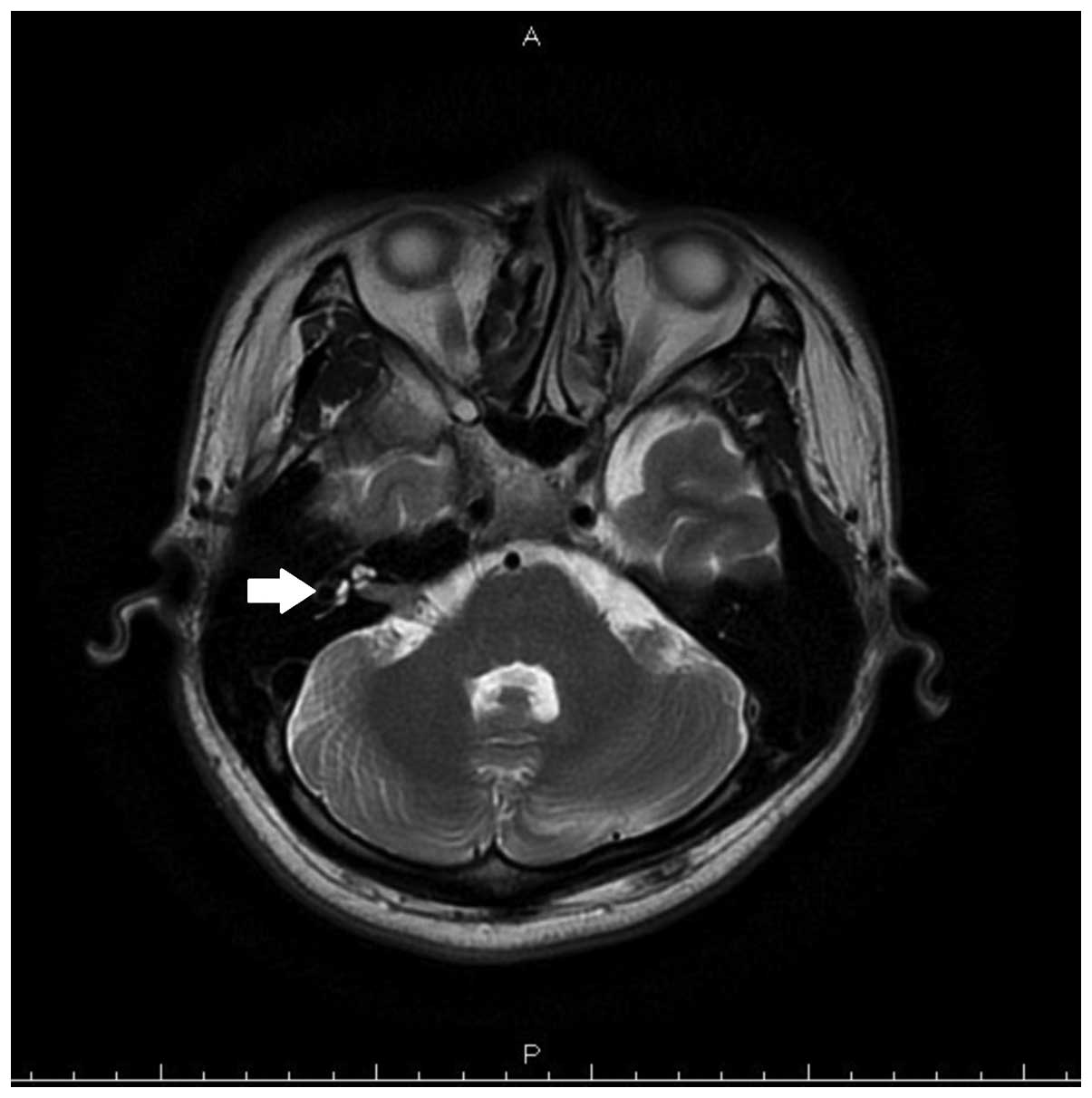
Pure tone audiometry did not reveal any hearing impairment and the patient’s speech recognition was 100% bilaterally. In addition, the auditory brainstem response appeared to be normal. Vestibular evoked myogenic potentials were symmetrical on either side. The caloric test revealed 38% right canal paresis, while facial electroneurography demonstrated 80% degeneration on the right side. The patient did not experience facial paresthesia or altered sensations of taste. Brain magnetic resonance imaging (MRI) demonstrated a mass (maximal diameter, 1.2 cm) in the right internal auditory canal (Fig. 1). No enhancement was observed at the labyrinthine portion of the facial nerve or at the geniculate ganglion.

Figure 1

Contrast-enhanced T2-weighted magnetic resonance imaging reveals an intracanalicular tumor in the region of the cerebellopontine angle (shown by the arrow).

Following steroidal therapy with prednisolone (1 mg/kg per day) for two weeks, the facial weakness improved to HB grade I. Considering the patient’s hearing status and that the tumor remained intracanalicular without any immediate risk of compressing other vital structures, conservative treatment (watchful waiting) with an MRI follow-up was performed.

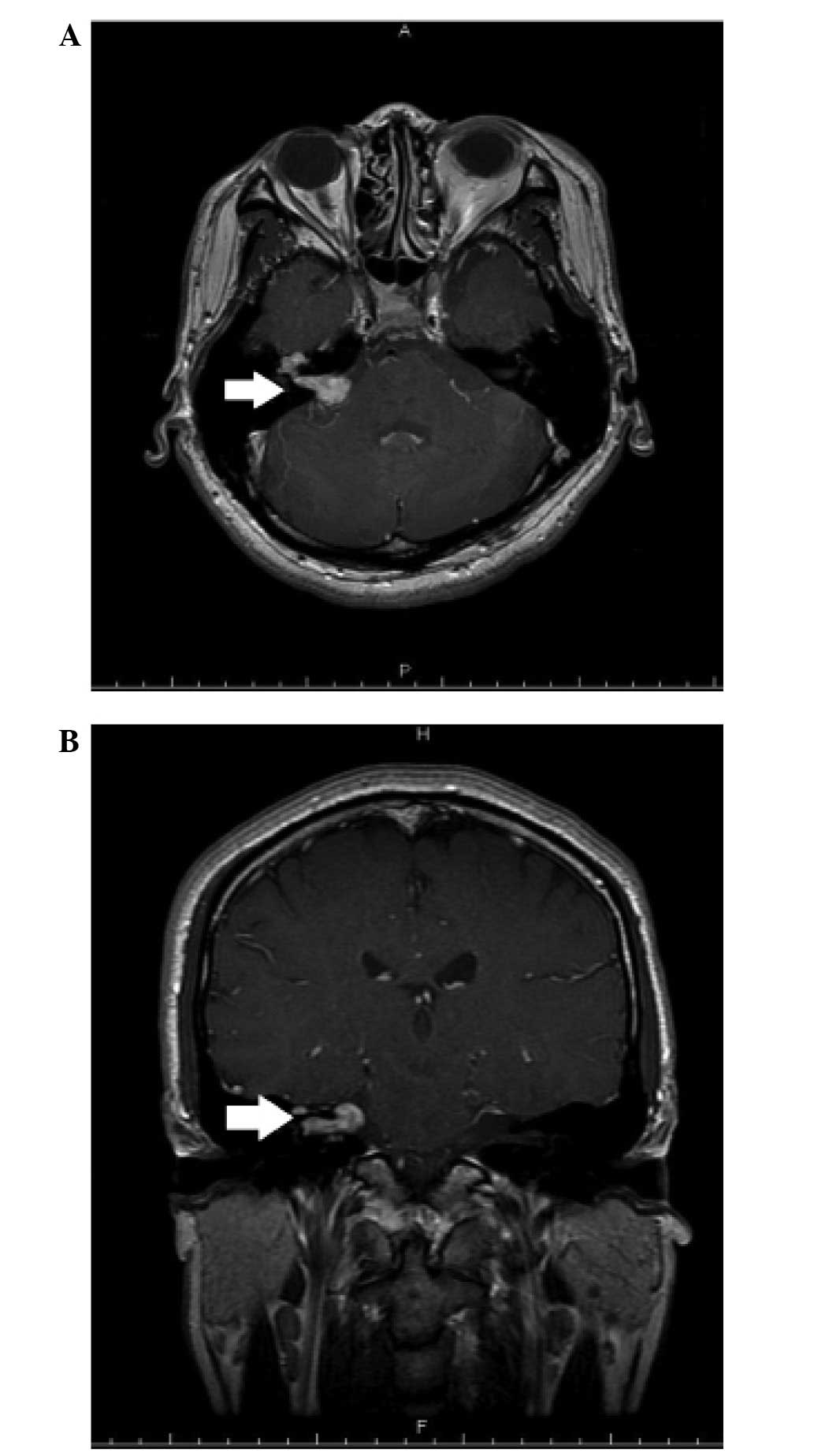
At the one-year follow-up the tumor had enlarged and extended along the facial nerve to the peri-geniculate area (Fig. 2). Right-sided tinnitus was observed, however, the patient’s hearing remained normal. Gamma Knife radiosurgery using a margin dose of 13 Gy was performed. Six months following radiosurgery, follow-up MRI imaging revealed that the tumor was stable without progression. In addition, the patient’s facial nerve function and hearing remained intact.

Figure 2

Contrast-enhanced T1-weighted magnetic resonance images. (A) Axial and (B) coronal views demonstrate an enhancing mass at the cerebellopontine angle and internal auditory canal, with involvement of the labyrinthine segment and geniculate ganglion (as shown by the arrows).

Discussion

Facial nerve tumors are rare tumors of the temporal bone, which may involve any aspect of the facial nerve. However, facial nerve tumors predominantly present in the peri-geniculate area and the tympanic segment. Skip lesions or multiple segments of involvement are occasionally identified. Typical symptoms include the slow progression of facial nerve paresis or paralysis, as well as hearing loss, tinnitus, pain and vestibular symptoms. Furthermore, an ear canal mass may be present (9). Facial twitching followed by progressive paresis is also a common symptom of this type of tumor. Facial nerve tumors account for 5% of all cases of facial paralysis, worldwide and, therefore, must be considered in all cases of facial palsy (11).

Facial nerve schwannoma are the most common type of tumor involving the facial nerve. In a series analyzing 600 temporal bones, the incidence of intratemporal facial schwannoma was 0.8% (12). Perez et al (13) observed growth in four out of 13 facial schwannomas that were managed via expectant treatment, with a mean growth rate of 1.4 mm/year among the tumors that grew (although if all 13 tumors were considered, the mean growth rate was 0.42 mm/year). Facial nerve tumors are rarely considered during the differential diagnoses of enhancing cerebellopontine angle lesions. In the present case, the diagnosis was based on MRI enhancement of the geniculate ganglion, a structure that is located along the facial nerve within the temporal bone.

The management of facial nerve tumors has evolved from the performance of microsurgical excision with facial nerve repair (MER) to an increased adoption of more conservative techniques, which are regarded as facial nerve preservation approaches (14). These include observation with the watchful waiting approach, fallopian canal decompression and stereotactic radiosurgery. All of which are considered to be important treatment options for the management of facial nerve tumors (15). There is controversy regarding the resection of facial nerve tumors of any size when the facial nerve function is normal or near normal (HB grade I–II). In cases where tumors are determined to have a high probability of being facial nerve schwannoma, via imaging or electrophysiological analysis, preservation of the best possible facial nerve function must be prioritized regardless of the tumor size. An exception to this principle includes cases where the tumor is causing compressive symptoms, such as brainstem compression or labyrinthine erosion.

Stereotactic radiosurgery is an emerging treatment modality. Although it has been widely used for treating acoustic neuroma, there are few reports regarding its use in facial nerve tumors, however, the number is increasing (2). For facial nerve tumors, the advantages of stereotactic radiation include the avoidance of surgery, potential growth arrest of the tumor and possible preservation of facial nerve function. The selection of treatment is based on the intent to preserve facial nerve functions at the best possible level for the longest duration. If patients exhibit a progressively worsening clinical and radiological condition (HB grade II–IV and radiological evidence of growth or impending complications) treatments including, fallopian canal decompression, radiation or MER are considered to be treatment options that are dependent on the patient’s situation. Irradiation is an alternative for patients with early facial dysfunction (HB grade II–III) and a documented worsening of the clinical and radiological condition. It has a relatively small, although notable risk of worsening the auditory and facial function, which must be considered and discussed with the patient prior to determining the treatment plans (10).

The changes in facial function and tumor sizes of patients with facial nerve tumors, following stereotactic radiosurgery from all published studies identified during the literature search are presented in Table I. Approximately 4% of patients experienced a decline in facial nerve function and 7% exhibited tumor enlargement. The current treatment modality relies on observations with serial MRI for cases with no or limited facial nerve dysfunction.

Table I

Summary of variations in patient HB grade and tumor size following stereotactic radiation treatment for facial nerve tumors, obtained from the literature.

Table I

Summary of variations in patient HB grade and tumor size following stereotactic radiation treatment for facial nerve tumors, obtained from the literature.

Study [year, (ref)]Patients, nVariation

HB gradeTumor size
Litre et al [2007, (4)]113 improved4 decreased
8 unchanged6 stable
1 increased
Kida et al [2007, (5)]145 improved8 decreased
8 unchanged6 stable
1 worsened
Nishioka et al [2009, (6)]44 unchanged2 decreased
2 stable
Madhok et al [2009, (7)]61 improved3 decreased
5 unchanged3 stable
Hillman et al [2008, (8)]21 improved2 stable
1 unchanged
Wilkinson et al [2011, (9)]61 improved3 decrease
5 unchanged1 stable
2 increased
Channer et al [2012, (10)]31 improved3 stable
1 unchanged, 1 worsened

[i] HB, House-Brackmann.

The deterioration of facial nerve function or hearing, rapid tumor growth, or impending labyrinthine erosion or other complications require the consideration of conducting more aggressive treatment strategies. Irradiation or fallopian canal decompression of tumors is often employed for facial nerve function with an HB grade between II and IV. Microsurgical excision and facial nerve repair is generally delayed until the facial nerve function deteriorates to HB grades IV–VI. This is due to the consideration that postoperative facial nerve paralysis is expected to last for six to 18 months, which may be followed by an improvement to an HB grade III at best. In conclusion, the present case identified that enhancement of the geniculate ganglion is an important characteristic to identify when evaluating the MRI appearance of cerebellopontine angle masses. In addition, a more conservative treatment modality may allow a greater number of patients to experience improved long-term facial nerve function in the management of facial nerve tumors.

References

1 

Kirazli T, Oner K, Bilgen C, Ovul I and Midilli R: Facial nerve neuroma: clinical, diagnostic, and surgical features. Skull Base. 14:115–120. 2004.

2 

Mackle T, Rawluk D and Walsh RM: Atypical clinical presentations of vestibular schwannomas. Otol Neurotol. 28:526–528. 2007.

3 

House JW and Brackmann DE: Facial nerve grading system. Otolaryngol Head Neck Surg. 93:146–147. 1985.

4 

Litre CF, Gourg GP, Tamura M, et al: Gamma knife surgery for facial nerve schwannomas. Neurosurgery. 60:853–859. 2007.

5 

Kida Y, Yoshimoto M and Hasegawa T: Radiosurgery for facial schwannoma. J Neurosurg. 106:24–29. 2007.

6 

Nishioka K, Abo D, Aoyama H, et al: Stereotactic radiotherapy for intracranial nonacoustic schwannomas including facial nerve schwannoma. Int J Radiat Oncol Biol Phys. 75:1415–1419. 2009.

7 

Madhok R, Kondziolka D, Flickinger JC and Lunsford LD: Gamma knife radiosurgery for facial schwannomas. Neurosurgery. 64:2009.

8 

Hillman TA, Chen DA and Fuhrer R: An alternative treatment for facial nerve tumors: short-term results of radiotherapy. Ear Nose Throat J. 87:574–577. 2008.

9 

Wilkinson EP, Hoa M, Slattery WH III, et al: Evolution in the management of facial nerve schwannoma. Laryngoscope. 121:2065–2074. 2011.

10 

Channer GA, Herman B, Telischi FF, Zeitler D and Angeli SI: Management outcomes of facial nerve tumors: comparative outcomes with observation, CyberKnife, and surgical management. Otolaryngol Head Neck Surg. 147:525–530. 2012.

11 

O’Donoghue GM, Brackmann DE, House JW and Jackler RK: Neuromas of the facial nerve. Am J Otol. 10:49–54. 1989.

12 

Saito H and Baxter A: Undiagnosed intratemporal facial nerve neurilemomas. Arch Otolaryngol. 95:415–419. 1972.

13 

Perez R, Chen JM and Nedzelski JM: Intratemporal facial nerve schwannoma: a management dilemma. Otol Neurotol. 26:121–126. 2005.

14 

Minovi A, Vosschulte R, Hofmann E, Draf W and Bockmuhl U: Facial nerve neuroma: surgical concept and functional results. Skull Base. 14:195–200; discussion 200–191, 2004.

15 

Shirazi MA, Leonetti JP, Marzo SJ and Anderson DE: Surgical management of facial neuromas: lessons learned. Otol Neurotol. 28:958–963. 2007.

Related Articles

  • Abstract
  • View
  • Download
  • Twitter
Copy and paste a formatted citation
Spandidos Publications style
Chen MC, Tseng TM, Hung SH and Chen PY: Facial nerve schwannoma: A case report and review of the literature. Oncol Lett 8: 2787-2789, 2014.
APA
Chen, M., Tseng, T., Hung, S., & Chen, P. (2014). Facial nerve schwannoma: A case report and review of the literature. Oncology Letters, 8, 2787-2789. https://doi.org/10.3892/ol.2014.2550
MLA
Chen, M., Tseng, T., Hung, S., Chen, P."Facial nerve schwannoma: A case report and review of the literature". Oncology Letters 8.6 (2014): 2787-2789.
Chicago
Chen, M., Tseng, T., Hung, S., Chen, P."Facial nerve schwannoma: A case report and review of the literature". Oncology Letters 8, no. 6 (2014): 2787-2789. https://doi.org/10.3892/ol.2014.2550
Copy and paste a formatted citation
x
Spandidos Publications style
Chen MC, Tseng TM, Hung SH and Chen PY: Facial nerve schwannoma: A case report and review of the literature. Oncol Lett 8: 2787-2789, 2014.
APA
Chen, M., Tseng, T., Hung, S., & Chen, P. (2014). Facial nerve schwannoma: A case report and review of the literature. Oncology Letters, 8, 2787-2789. https://doi.org/10.3892/ol.2014.2550
MLA
Chen, M., Tseng, T., Hung, S., Chen, P."Facial nerve schwannoma: A case report and review of the literature". Oncology Letters 8.6 (2014): 2787-2789.
Chicago
Chen, M., Tseng, T., Hung, S., Chen, P."Facial nerve schwannoma: A case report and review of the literature". Oncology Letters 8, no. 6 (2014): 2787-2789. https://doi.org/10.3892/ol.2014.2550
Follow us
  • Twitter
  • LinkedIn
  • Facebook
About
  • Spandidos Publications
  • Careers
  • Cookie Policy
  • Privacy Policy
How can we help?
  • Help
  • Live Chat
  • Contact
  • Email to our Support Team