Introduction
Insulin-like growth factor 2 (IGF2) is an
important mediator of cell growth and apoptosis that is paternally
expressed. IGF2 loss of imprinting (LOI) is predominantly
indicated by the activation of the usually silenced maternal
allele, with subsequent expression of the two gene copies (1). This is associated with a number of
hereditary overgrowth conditions, including Beckwith-Wiedemann
syndrome (2) and cancer that
exhibits cell overgrowth resulting from IGF2 overexpression
(3). LOI has been reported in a
variety of cancer types, in particular colorectal carcinoma
(4–6). However, to the best of our knowledge,
only one study examining LOI in lung carcinoma (7) has been published; LOI was detected in
47% adenocarcinomas, although the prevalence of LOI in squamous
cell carcinomas was not mentioned. However, other studies have
found the prevalence of LOI in squamous cell carcinomas and
urothelial carcinomas in other organs to be relatively low. For
example, the prevalence was found to be 21% in esophageal cancer
(8) and 22% in bladder cancer
(9). By contrast, the prevalence of
LOI was 44–54% (4,7) and 49% (10) in colorectal adenocarcinoma and
gastric carcinoma, respectively. However, considerable variation
has been reported.
Personalized cancer therapy has been applied to lung
adenocarcinoma patients through the development of
molecular-targeted therapeutic drugs against driver oncogenes. For
example, lung adenocarcinoma patients with an epidermal growth
factor receptor (EGFR) mutation or with an
ELM4-ALK fusion protein have been shown to respond
well to the corresponding drugs (11). Similarly, molecular-targeted therapy
for insulin growth factors (IGFs) has been developed for a variety
of cancer types, including non-small cell lung cancer (12,13).
Therapeutic methods that target the IGF1 receptor (IGF1R) have
achieved certain success, although a modified therapy that targets
and insulin receptor (IR) has proved more effective (13). IGF1 and IR are receptors for IGF2
that induce signal transduction resulting in cell growth; however,
the IGF2 receptor interrupts IGF2 signal induction (13). Silencing of the IGF2 gene was
recently reported to result in apoptosis only for IGF2 LOI
colorectal carcinomas (14). Thus,
IGF2 LOI lung carcinoma appears to be a good candidate for
molecular-targeted therapy.
To examine IGF2 LOI, polymerase chain
reaction-restriction fragment length polymorphism (PCR-RFLP) has
been previously employed, but precise analysis is hampered by a
number of problems, including lymphocyte contamination and
heteroduplex formation during PCR (15). In the present study, the precise
incidence of IGF2 LOI in lung carcinomas was examined using
PCR-RFLP in combination with DNA sequencing of samples obtained by
a laser capture microdissection (LCM) method, as reported
previously (16).
Materials and methods
Materials
Tissue samples were obtained from 32 patients with
lung cancer (19 with adenocarcinoma, 12 with squamous cell
carcinoma and one with large cell carcinoma). Sections of carcinoma
tissues and non-tumor lung tissue were removed and frozen
immediately following surgery at Kanazawa University Cancer
Research Hospital (Kanazawa, Japan). The tissues were stored at
−80°C until further analysis.
LCM
Frozen 10-μm tissue sections were fixed with 70%
ethanol for 10 min and stained with Kernechtrot (Merck, Darmstadt,
Germany). A total of ~1,000 carcinoma cells in the frozen sections
were punched out using a LCM system (LM100; Olympus Corporation,
Tokyo, Japan) and collected on a plastic cap (CapSureTM LCM Caps;
Arcturus, Mountain View, CA, USA). All specimens were assessed
histologically by a pathologist (Professor E. Kawahara).
PCR-RFLP and direct sequencing
Genomic DNA from the frozen sections of the normal
tissues was extracted using a Wizard® SV Genomic DNA
Purification system (Promega Corporation, Fitchburg, WI, USA). To
extract total RNA from the microdissected carcinoma cells, a
PicoPure™ RNA isolation kit (Arcturus) was used. The extracted RNA
was further purified using the acid guanidinium phenol chloroform
method, and possible contaminating DNAs were digested with DNase I
(Takara, Tokyo, Japan). Aliquots of 1 μl extracted total RNA in a
volume of 20 μl were converted to cDNA using AMV reverse
transcriptase (Promega Corporation). The reverse transcription
reaction was performed for 30 min at 42°C and then the sample was
heated for 5 min at 99°C to inactivate the enzyme. Genomic DNA from
normal whole tissues was amplified by PCR using the following
primer pair for exon 9 of human IGF2: Forward,
5′-CTTGGACTTGAGTCAAATTGG-3′ and reverse,
5′-GGTCGTGCCAATTACATTTCA-3′. The tumor cDNAs obtained from the
microdissection samples were amplified by nested PCR using the same
primer pair followed by the second primer pair: Forward,
5′-CTTGGACTTTGAGTCAAATTGG-3′ and reverse,
5′-GGTTTTCATGCTCTGTCCTC-3′. The amplified 292 and 257 base-pair
fragments were digested by ApaI (Toyobo, Osaka, Japan),
which recognizes the C/T single nucleotide polymorphism site in the
amplified area. Successful digestion of contaminating DNA was
confirmed by PCR designed to amplify the exon-intron spanning
region of the integrin β5 gene. Analysis of the polymorphism in the
IGF2 gene was then performed. The digested and undigested
DNAs were run on 2% agarose gels containing ethidium bromide. The
gel revealed three bands for heterozygotes, in which the
restriction enzyme recognition sequence was present in one allele
and absent in the other. The PCR products were also sequenced using
Dye Terminator 1.1 (Applied Biosystems, Carlsbad, CA, USA) and ABI
PRISM® 3130×l Genetic Analyzer (Applied Biosystems).
Determination of imprinting status
Digital images of the bands scanned into a computer
were analyzed using the Image J software (National Institutes of
Health, Bethesda, MD, USA). The band densities were measured and
the ratio of the two bands was calculated. Similarly, the ratio of
the two C and T peaks was calculated. The imprinting status was
determined according to the criterion described in our previous
study (10). In the case that two
clear bands were detected with PCR-RFLP (ratio = 10–90%) and the
sequence pattern revealed two clear peaks (ratio = 20–80%), the
status was considered to be LOI; otherwise, the status was
considered as imprinted.
Statistical analysis
Statistical analyses were performed using StatMate
software version 4.0 (ATMS, Co., Ltd., Tokyo, Japan) to perform the
χ2 test. P<0.05 was considered to indicate a
statistically significant difference.
Ethics
The study was approved by the Instititional Review
Board for Analytical Research for Human Genome and Gene at Kanazawa
University. All patients provided informed consent prior to sample
collection according to the institutional guidelines.
Results
LOI and imprinting status of lung
carcinoma samples
The genomic DNA of whole non-tumor mucosa was
employed to screen for whether the samples were informative or not,
using the PCR-based, IGF2 gene ApaI polymorphism. Of
the 32 lung cancer cases, 23 (72%) were informative. All
informative cases were examined for imprinting status in the
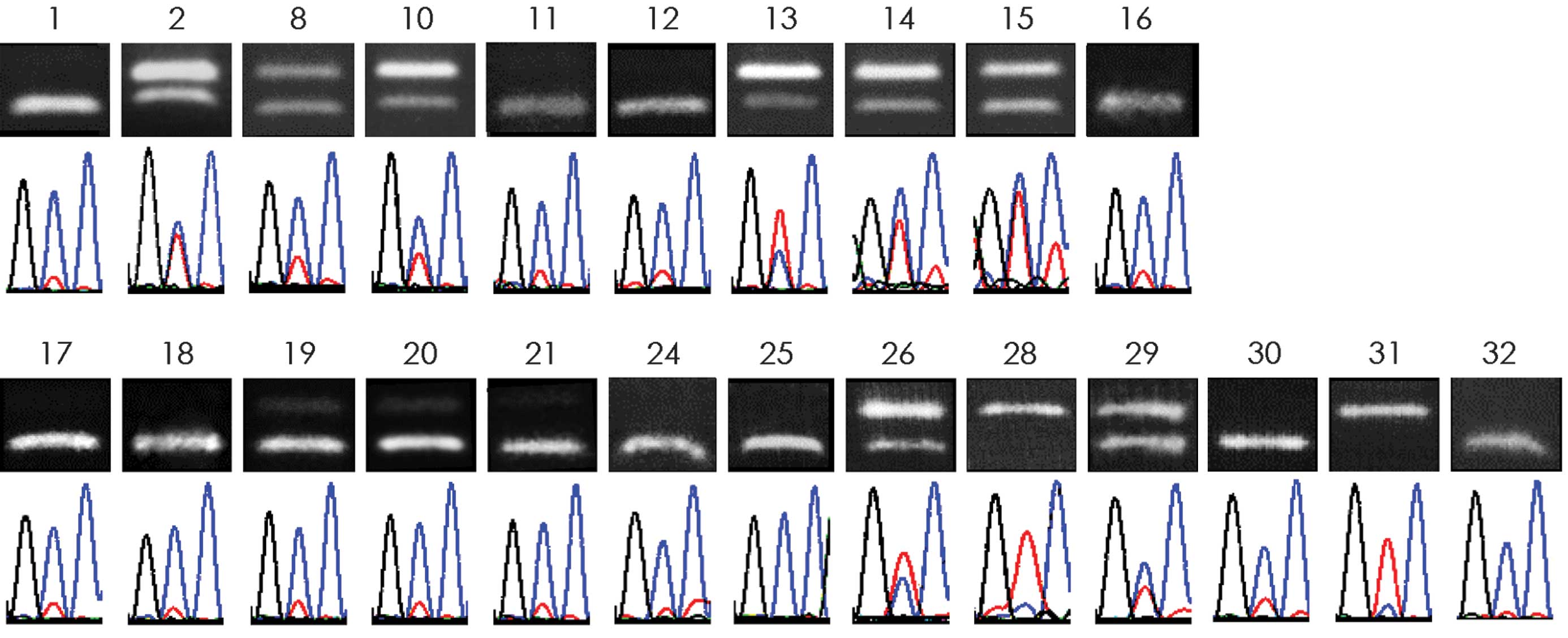
microdissected carcinoma cells. The PCR products from the cDNA of
the carcinoma cells revealed either two bands or a single band
following ApaI analysis, and either two C and T peaks or one
peak with a possible background peak subsequent to sequence
analysis (Fig. 1). Prior to
determining whether the status was imprinted or LOI, the density
ratio between the top and bottom bands, determined using PCR-RFLP,
and the height ratio of the C and T peaks, examined using sequence
analysis, were measured and calculated (Table I). Each case was identified as
either imprinted or LOI, according to the criteria described above
(Table I). LOI was detected in the
adenocarcinoma and large cell carcinoma specimens, but was not
detected in the squamous cell carcinoma samples. The percentage of
LOI was 39% in total lung carcinomas (9 out of 23 cases) and 62% (8
out of 13 cases) in adenocarcinomas.
 | Table IIGF2 status of
laser-capture-microdissected carcinoma cells, defined as imprinted
or LOI in informative cases, evaluated by PCR-RFLP in combination
with direct sequencing. |
Table I
IGF2 status of
laser-capture-microdissected carcinoma cells, defined as imprinted
or LOI in informative cases, evaluated by PCR-RFLP in combination
with direct sequencing.
| Case number | PCR (%T) | Sequence (%T) | Status | Histology | Differentiation of
adenocarcinoma |
|---|
| 1 | 0 | 12 | Imprinted | SCC | |
| 2 | 72 | 44 | LOI | Adenocarcinoma | Well |
| 8 | 54 | 25 | LOI | Adenocarcinoma | Well |
| 10 | 77 | 33 | LOI | Adenocarcinoma | Well |
| 11 | 0 | 17 | Imprinted | SCC | |
| 12 | 0 | 18 | Imprinted | SCC | |
| 13 | 62 | 69 | LOI | Adenocarcinoma | Moderate |
| 14 | 73 | 41 | LOI | Large cell
carcinoma | |
| 15 | 58 | 46 | LOI | Adenocarcinoma | Moderate |
| 16 | 0 | 16 | Imprinted | Adenocarcinoma | Moderate |
| 17 | 0 | 16 | Imprinted | SCC | |
| 18 | 0 | 11 | Imprinted | Adenocarcinoma | Moderate |
| 19 | 9 | 17 | Imprinted | Adenocarcinoma | Well |
| 20 | 7 | 16 | Imprinted | Adenocarcinoma | Moderate |
| 21 | 5 | 16 | Imprinted | SCC | |
| 24 | 0 | 13 | Imprinted | SCC | |
| 25 | 0 | 3 | Imprinted | Adenocarcinoma | Poor |
| 26 | 83 | 62 | LOI | Adenocarcinoma | Poor |
| 28 | 100 | 85 | Imprinted | SCC | |
| 29 | 60 | 35 | LOI | Adenocarcinoma | Moderate |
| 30 | 0 | 22 | Imprinted | Adenocarcinoma | Well |
| 31 | 100 | 86 | Imprinted | SCC | |
| 32 | 0 | 9 | Imprinted | SCC | |
Association between LOI and histological
grade
Since a previous study concerning IGF2 LOI in
lung adenocarcinoma refers to histological type (7), the association between the
histological grade of the adenocarcinoma sample and LOI was also
analyzed in the present study. Four cases of well-differentiated
adenocarcinoma were found to be LOI and one case of poorly
differentiated adenocarcinoma was imprinted (Table I). These results do not support the
previous suggestion that IGF2 LOI occurs more frequently in
poorly differentiated adenocarcinomas (7). Statistical analysis revealed no
significant association between the degree of differentiation and
LOI.
Discussion
In the present study, the status of genomic
imprinting of IGF2 in lung cancer was evaluated. IGF2 LOI was found
to increase IGF2 signaling by increasing the proliferation of
expression-related genes (17). We
hypothesize that IGF2 LOI leads to an increased the risk of
malignant transformation.
In this study, IGF2 LOI was detected in half
the cases of adenocarcinoma, but not in any cases of lung squamous
cell carcinoma, which suggests an association between IGF2
LOI and the histological type of the tumor. A number of
adenocarcinoma-specific gene alterations are known, including
EGFR, KRAS and BRAF, and these affect the gene
products of the MAP kinase and PI3/AKT signaling pathways (18,19).
IGF2 binds to IR or IGF1R, thereby activating the same pathways
(12). In this context, the effect
of IGF2 overexpression appears comparable with the effect of
other gene alterations specific to adenocarcinoma.
The incidence of IGF2 LOI in adenocarcinoma
(62%) appears high as compared with other adenocarcinoma-specific
gene alterations. However, the incidence of gene alteration may
reflect population differences. A previous study indicated that the
most frequent gene alteration in lung adenocarcinomas in Japanese
patients is the EGFR mutation, with an incidence of 38%,
while the most frequent gene alteration in Caucasians is
KRAS mutation, with an incidence of 30% (19). The high incidence of the IGF2
mutation in the present study, as compared with the incidences of
other genes detected in previous studies, suggests an important
role for the IGF2 mutation in lung carcinogenesis.
In the present study, IGF2 LOI was detected
in approximately half of adenocarcinomas but not in any of the
squamous cell carcinomas examined; thus, IGF2 LOI may be a
marker of lung adenocarcinoma. Distinguishing squamous cell
carcinoma from adenocarcinoma of the lung is important, since the
therapeutic methods employed are different and molecular analysis
is guided by the histology. Molecular-targeted therapeutic drugs
for activated EGFR have resulted in improvements in response
rates and progression-free survival times in lung adenocarcinoma
(20).
In conclusion, in the present study, IGF2 LOI
was observed to occur at a high frequency in lung adenocarcinoma,
but was not observed in squamous cell carcinoma. This result
suggests that distinct carcinogenic pathways may exist for lung
adenocarcinoma and squamous cell carcinoma, depending on the
IGF2 genomic imprinting status. Therefore, IGF2 may
have potential value as a diagnostic marker and therapeutic
target.
Acknowledgements
This study was supported by a grant from the
Ministry of Education, Culture, Sports, Science and Technology of
Japan.
References
|
1
|
Ferguson-Smith AC: Genetic imprinting:
silencing elements have their say. Curr Biol. 10:R872–R875.
2000.
|
|
2
|
Ohlsson R, Nystrom A, Pfeifer-Ohlsson S,
et al: IGF2 is parentally imprinted during human embryogenesis and
in the Beckwith-Wiedemann syndrome. Nat Genet. 4:94–97. 1993.
|
|
3
|
Rainier S, Johnson LA, Dobry CJ, et al:
Relaxation of imprinted genes in human cancer. Nature. 22:747–749.
1993.
|
|
4
|
Cui H, Horon IL, Ohlsson R, Hamilton SR
and Feinberg AP: Loss of imprinting in normal tissue of colorectal
cancer patients with microsatellite instability. Nat Med.
4:1276–1280. 1998.
|
|
5
|
Nakagawa H, Chadwick RB, Peltomaki P, et
al: Loss of imprinting of the insulin-like growth factor II gene
occurs by biallelic methylation in a core region of H19-associated
CTCF-binding sites in colorectal cancer. Proc Natl Acad Sci USA.
98:591–596. 2001.
|
|
6
|
Takano Y, Shiota G and Kawasaki H:
Analysis of genomic imprinting of insulin-like growth factor 2 in
colorectal cancer. Oncology. 59:210–216. 2000.
|
|
7
|
Kohda M, Hoshiya H, Katoh M, et al:
Frequent loss of imprinting of IGF2 and MEST in lung
adenocarcinoma. Mol Carcinog. 31:184–191. 2001.
|
|
8
|
Xu W, Fan H, He X, Zhang J and Xie W: LOI
of IGF2 is associated with esophageal cancer and linked to
methylation status of IGF2 DMR. J Exp Clin Cancer Res. 25:543–547.
2006.
|
|
9
|
Byun HM, Wong HL, Birnstein EA, et al:
Examination of IGF2 and H19 loss of imprinting in bladder cancer.
Cancer Res. 67:10753–10758. 2007.
|
|
10
|
Zuo QS, Yan R, Feng DX, et al: Loss of
imprinting and abnormal expression of the insulin-like growth
factor 2 gene in gastric cancer. Mol Carcinog. 50:390–396.
2011.
|
|
11
|
Cheng L, Alexander RE, Maclennan GT, et
al: Molecular pathology of lung cancer: key to personalized
medicine. Mod Pathol. 25:347–369. 2012.
|
|
12
|
Trajkovic-Arsic M, Kalideris E and Siveke
JT: The role of insulin and IGF system in pancreatic cancer. J Mol
Endocrinol. 50:R67–R74. 2013.
|
|
13
|
Vincent EE, Elder DJ, Curwen J, et al:
Targeting non-small cell lung cancer cells by dual inhibition of
the insulin receptor and the insulin-like growth factor-1 receptor.
PLoS One. 8:e669632013.
|
|
14
|
Nie ZL, Pan YQ, He BS, et al: Gene therapy
for colorectal cancer by an oncolytic adenovirus that targets loss
of the insulin-like growth factor 2 imprinting system. Mol Cancer.
11:862012.
|
|
15
|
Uejima H, Lee MP, Cui H and Feinberg AP:
Hot-stop PCR: a simple and general assay for linear quantitation of
allele ratios. Nat Genet. 25:375–376. 2000.
|
|
16
|
Maenaka S, Hikichi T, Imai MA, Minamoto T
and Kawahara E: Loss of imprinting in IGF2 in colorectal carcinoma
assessed by microdissection. Oncol Rep. 15:791–795. 2006.
|
|
17
|
Kaneda A, Wang CJ, Cheong R, et al:
Enhanced sensitivity to IGF-II signaling links loss of imprinting
of IGF2 to increased cell proliferation and tumor risk. Proc Natl
Acad Sci USA. 104:20926–20931. 2007.
|
|
18
|
Liu P, Morrison C, Wang L, et al:
Identification of somatic mutations in non-small cell lung
carcinomas using whole-exome sequencing. Carcinogenesis.
33:1270–1276. 2012.
|
|
19
|
Suzuki A, Mimaki S, Yamane Y, et al:
Identification and characterization of cancer mutations in Japanese
lung adenocarcinoma without sequencing of normal tissue
counterparts. PLoS One. 8:e734842013.
|
|
20
|
Douillard JY, Shepherd FA, Hirsh V, et al:
Molecular predictors of outcome with gefitinib and docetaxel in
previously treated non-small-cell lung cancer: data from the
randomized phase III INTEREST trial. J Clin Oncol. 28:744–752.
2010.
|