Spandidos Publications Logo
  • About
    • About Spandidos
    • Aims and Scopes
    • Abstracting and Indexing
    • Editorial Policies
    • Reprints and Permissions
    • Job Opportunities
    • Terms and Conditions
    • Contact
  • Journals
    • All Journals
    • Oncology Letters
      • Oncology Letters
      • Information for Authors
      • Editorial Policies
      • Editorial Board
      • Aims and Scope
      • Abstracting and Indexing
      • Bibliographic Information
      • Archive
    • International Journal of Oncology
      • International Journal of Oncology
      • Information for Authors
      • Editorial Policies
      • Editorial Board
      • Aims and Scope
      • Abstracting and Indexing
      • Bibliographic Information
      • Archive
    • Molecular and Clinical Oncology
      • Molecular and Clinical Oncology
      • Information for Authors
      • Editorial Policies
      • Editorial Board
      • Aims and Scope
      • Abstracting and Indexing
      • Bibliographic Information
      • Archive
    • Experimental and Therapeutic Medicine
      • Experimental and Therapeutic Medicine
      • Information for Authors
      • Editorial Policies
      • Editorial Board
      • Aims and Scope
      • Abstracting and Indexing
      • Bibliographic Information
      • Archive
    • International Journal of Molecular Medicine
      • International Journal of Molecular Medicine
      • Information for Authors
      • Editorial Policies
      • Editorial Board
      • Aims and Scope
      • Abstracting and Indexing
      • Bibliographic Information
      • Archive
    • Biomedical Reports
      • Biomedical Reports
      • Information for Authors
      • Editorial Policies
      • Editorial Board
      • Aims and Scope
      • Abstracting and Indexing
      • Bibliographic Information
      • Archive
    • Oncology Reports
      • Oncology Reports
      • Information for Authors
      • Editorial Policies
      • Editorial Board
      • Aims and Scope
      • Abstracting and Indexing
      • Bibliographic Information
      • Archive
    • Molecular Medicine Reports
      • Molecular Medicine Reports
      • Information for Authors
      • Editorial Policies
      • Editorial Board
      • Aims and Scope
      • Abstracting and Indexing
      • Bibliographic Information
      • Archive
    • World Academy of Sciences Journal
      • World Academy of Sciences Journal
      • Information for Authors
      • Editorial Policies
      • Editorial Board
      • Aims and Scope
      • Abstracting and Indexing
      • Bibliographic Information
      • Archive
    • International Journal of Functional Nutrition
      • International Journal of Functional Nutrition
      • Information for Authors
      • Editorial Policies
      • Editorial Board
      • Aims and Scope
      • Abstracting and Indexing
      • Bibliographic Information
      • Archive
    • International Journal of Epigenetics
      • International Journal of Epigenetics
      • Information for Authors
      • Editorial Policies
      • Editorial Board
      • Aims and Scope
      • Abstracting and Indexing
      • Bibliographic Information
      • Archive
    • Medicine International
      • Medicine International
      • Information for Authors
      • Editorial Policies
      • Editorial Board
      • Aims and Scope
      • Abstracting and Indexing
      • Bibliographic Information
      • Archive
  • Articles
  • Information
    • Information for Authors
    • Information for Reviewers
    • Information for Librarians
    • Information for Advertisers
    • Conferences
  • Language Editing
Spandidos Publications Logo
  • About
    • About Spandidos
    • Aims and Scopes
    • Abstracting and Indexing
    • Editorial Policies
    • Reprints and Permissions
    • Job Opportunities
    • Terms and Conditions
    • Contact
  • Journals
    • All Journals
    • Biomedical Reports
      • Information for Authors
      • Editorial Policies
      • Editorial Board
      • Aims and Scope
      • Abstracting and Indexing
      • Bibliographic Information
      • Archive
    • Experimental and Therapeutic Medicine
      • Information for Authors
      • Editorial Policies
      • Editorial Board
      • Aims and Scope
      • Abstracting and Indexing
      • Bibliographic Information
      • Archive
    • International Journal of Epigenetics
      • Information for Authors
      • Editorial Policies
      • Editorial Board
      • Aims and Scope
      • Abstracting and Indexing
      • Bibliographic Information
      • Archive
    • International Journal of Functional Nutrition
      • Information for Authors
      • Editorial Policies
      • Editorial Board
      • Aims and Scope
      • Abstracting and Indexing
      • Bibliographic Information
      • Archive
    • International Journal of Molecular Medicine
      • Information for Authors
      • Editorial Policies
      • Editorial Board
      • Aims and Scope
      • Abstracting and Indexing
      • Bibliographic Information
      • Archive
    • International Journal of Oncology
      • Information for Authors
      • Editorial Policies
      • Editorial Board
      • Aims and Scope
      • Abstracting and Indexing
      • Bibliographic Information
      • Archive
    • Medicine International
      • Information for Authors
      • Editorial Policies
      • Editorial Board
      • Aims and Scope
      • Abstracting and Indexing
      • Bibliographic Information
      • Archive
    • Molecular and Clinical Oncology
      • Information for Authors
      • Editorial Policies
      • Editorial Board
      • Aims and Scope
      • Abstracting and Indexing
      • Bibliographic Information
      • Archive
    • Molecular Medicine Reports
      • Information for Authors
      • Editorial Policies
      • Editorial Board
      • Aims and Scope
      • Abstracting and Indexing
      • Bibliographic Information
      • Archive
    • Oncology Letters
      • Information for Authors
      • Editorial Policies
      • Editorial Board
      • Aims and Scope
      • Abstracting and Indexing
      • Bibliographic Information
      • Archive
    • Oncology Reports
      • Information for Authors
      • Editorial Policies
      • Editorial Board
      • Aims and Scope
      • Abstracting and Indexing
      • Bibliographic Information
      • Archive
    • World Academy of Sciences Journal
      • Information for Authors
      • Editorial Policies
      • Editorial Board
      • Aims and Scope
      • Abstracting and Indexing
      • Bibliographic Information
      • Archive
  • Articles
  • Information
    • For Authors
    • For Reviewers
    • For Librarians
    • For Advertisers
    • Conferences
  • Language Editing
Login Register Submit
  • This site uses cookies
  • You can change your cookie settings at any time by following the instructions in our Cookie Policy. To find out more, you may read our Privacy Policy.

    I agree
Search articles by DOI, keyword, author or affiliation
Search
Advanced Search
presentation
Oncology Letters
Join Editorial Board Propose a Special Issue
Print ISSN: 1792-1074 Online ISSN: 1792-1082
Journal Cover
February-2015 Volume 9 Issue 2

Full Size Image

Sign up for eToc alerts
Recommend to Library

Journals

International Journal of Molecular Medicine

International Journal of Molecular Medicine

International Journal of Molecular Medicine is an international journal devoted to molecular mechanisms of human disease.

International Journal of Oncology

International Journal of Oncology

International Journal of Oncology is an international journal devoted to oncology research and cancer treatment.

Molecular Medicine Reports

Molecular Medicine Reports

Covers molecular medicine topics such as pharmacology, pathology, genetics, neuroscience, infectious diseases, molecular cardiology, and molecular surgery.

Oncology Reports

Oncology Reports

Oncology Reports is an international journal devoted to fundamental and applied research in Oncology.

Experimental and Therapeutic Medicine

Experimental and Therapeutic Medicine

Experimental and Therapeutic Medicine is an international journal devoted to laboratory and clinical medicine.

Oncology Letters

Oncology Letters

Oncology Letters is an international journal devoted to Experimental and Clinical Oncology.

Biomedical Reports

Biomedical Reports

Explores a wide range of biological and medical fields, including pharmacology, genetics, microbiology, neuroscience, and molecular cardiology.

Molecular and Clinical Oncology

Molecular and Clinical Oncology

International journal addressing all aspects of oncology research, from tumorigenesis and oncogenes to chemotherapy and metastasis.

World Academy of Sciences Journal

World Academy of Sciences Journal

Multidisciplinary open-access journal spanning biochemistry, genetics, neuroscience, environmental health, and synthetic biology.

International Journal of Functional Nutrition

International Journal of Functional Nutrition

Open-access journal combining biochemistry, pharmacology, immunology, and genetics to advance health through functional nutrition.

International Journal of Epigenetics

International Journal of Epigenetics

Publishes open-access research on using epigenetics to advance understanding and treatment of human disease.

Medicine International

Medicine International

An International Open Access Journal Devoted to General Medicine.

Journal Cover
February-2015 Volume 9 Issue 2

Full Size Image

Sign up for eToc alerts
Recommend to Library

  • Article
  • Citations
    • Cite This Article
    • Download Citation
    • Create Citation Alert
    • Remove Citation Alert
    • Cited By
  • Similar Articles
    • Related Articles (in Spandidos Publications)
    • Similar Articles (Google Scholar)
    • Similar Articles (PubMed)
  • Download PDF
  • Download XML
  • View XML
Article Open Access

TP53-induced glycolysis and apoptosis regulator promotes proliferation and invasiveness of nasopharyngeal carcinoma cells

  • Authors:
    • Elaine Yue Ling Wong
    • Sze‑Chuen Cesar Wong
    • Charles Ming Lok Chan
    • Emily Kai Yee Lam
    • Louisa Yeung Ho
    • Cecilia Pik Yuk Lau
    • Thomas Chi Chuen Au
    • Amanda Kit Ching Chan
    • Chi Man Tsang
    • Sai Wah Tsao
    • Vivian Wai Yan Lui
    • Anthony Tak Cheung Chan
  • View Affiliations / Copyright

    Affiliations: State Key Laboratory of Oncology in South China, Sir YK Pao Centre for Cancer, Department of Clinical Oncology, Hong Kong Cancer Institute and Prince of Wales Hospital, The Chinese University of Hong Kong, Hong Kong SAR, P.R. China, Department of Neuroscience, University of Minnesota, Minneapolis, MN 55455, USA, Department of Pathology, Queen Elizabeth Hospital, Hong Kong SAR, P.R. China, Department of Anatomy, University of Hong Kong, Hong Kong SAR, P.R. China, Department of Pharmacology and Pharmacy, University of Hong Kong, Hong Kong SAR, P.R. China
    Copyright: © Wong et al. This is an open access article distributed under the terms of Creative Commons Attribution License.
  • Pages: 569-574
    |
    Published online on: December 12, 2014
       https://doi.org/10.3892/ol.2014.2797
  • Expand metrics +
Metrics: Total Views: 0 (Spandidos Publications: | PMC Statistics: )
Metrics: Total PDF Downloads: 0 (Spandidos Publications: | PMC Statistics: )
Cited By (CrossRef): 0 citations Loading Articles...

This article is mentioned in:


Abstract

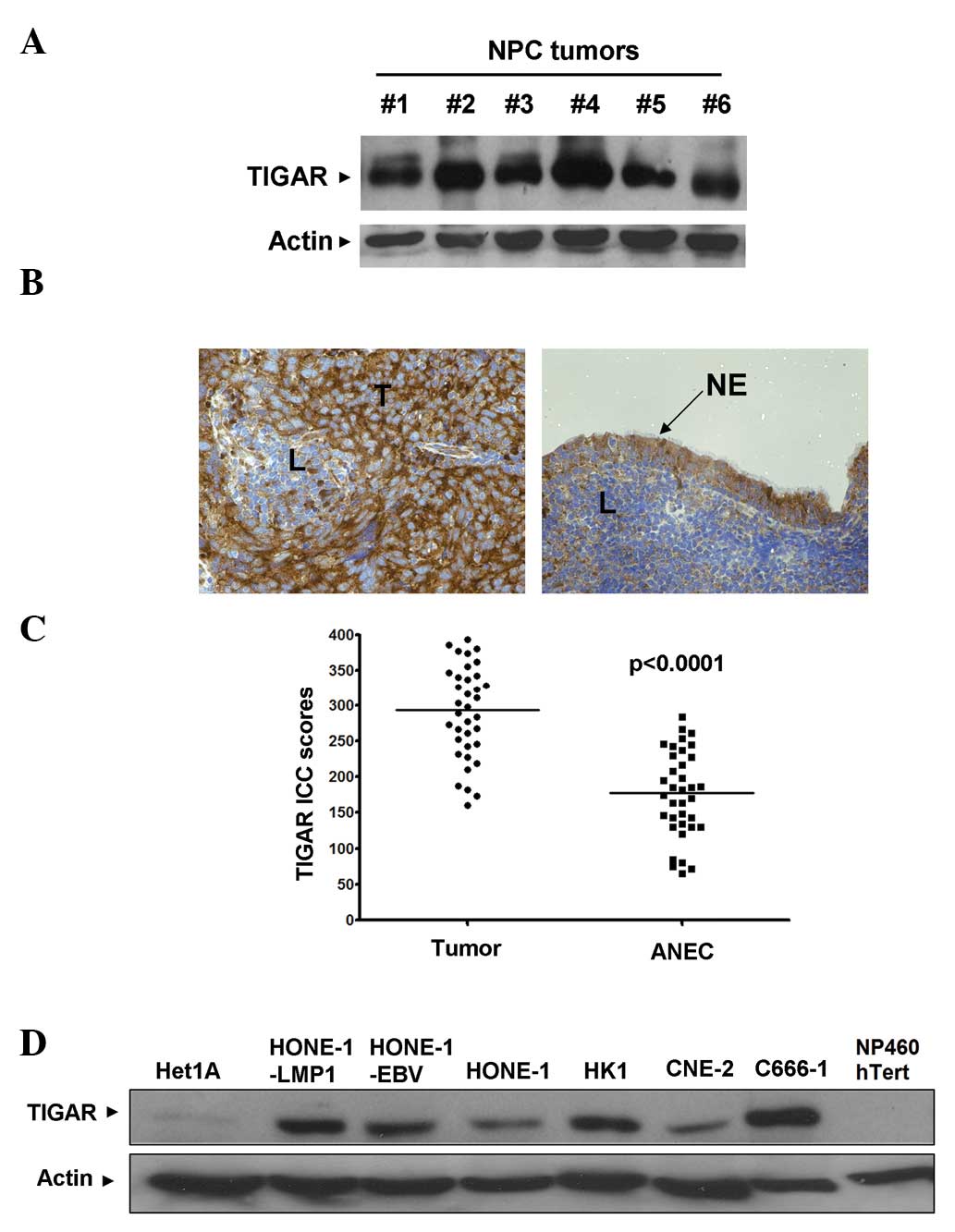
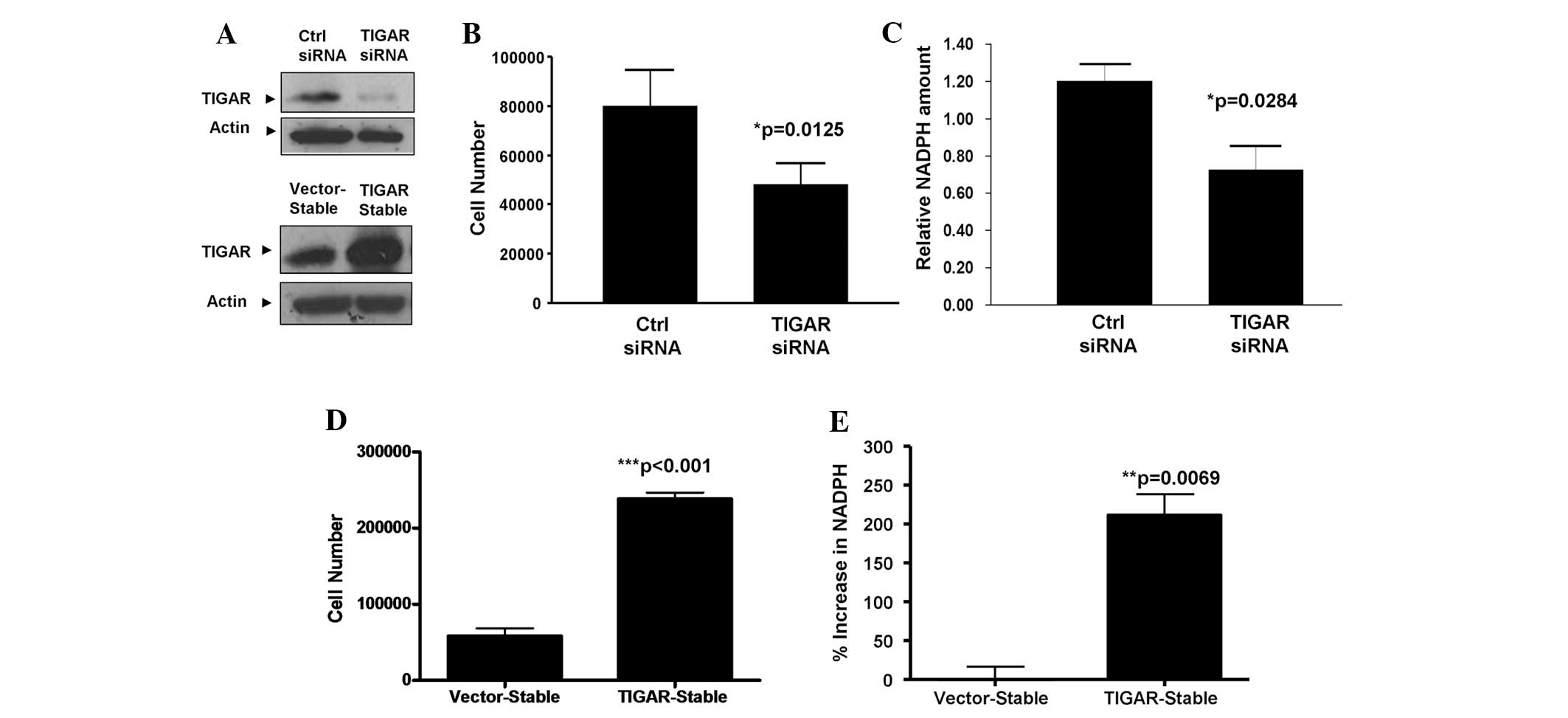
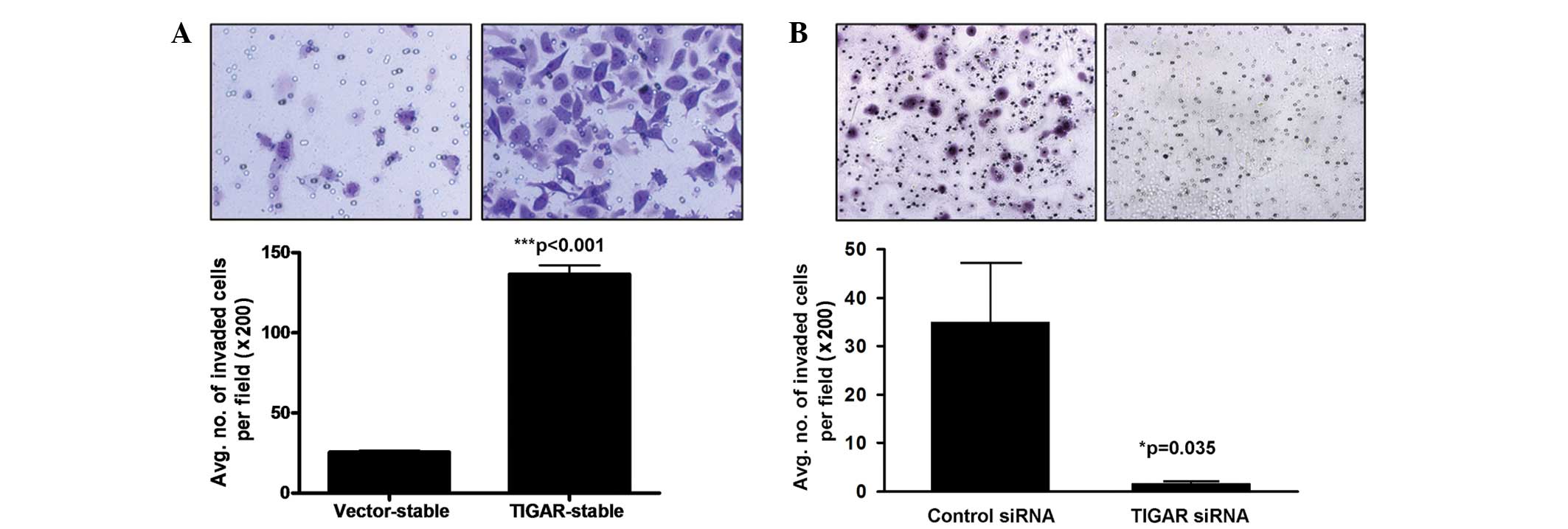
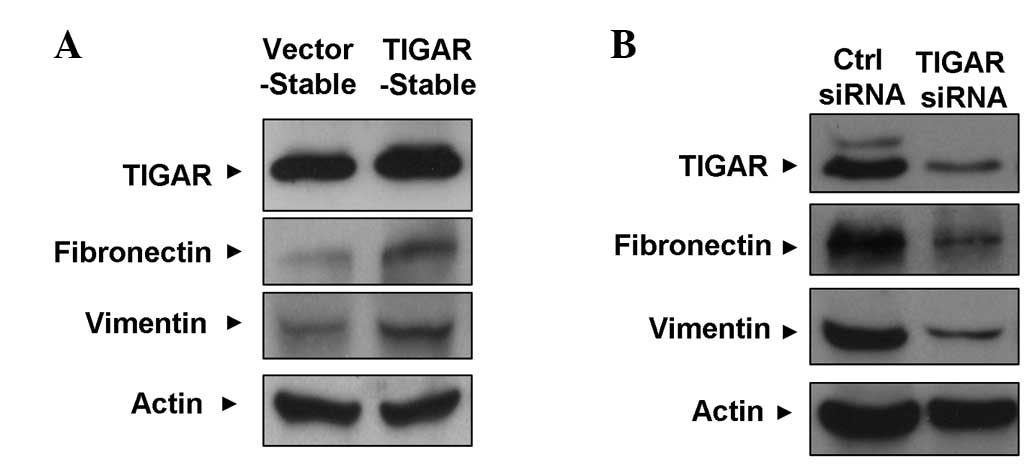
The TP53‑induced glycolysis and apoptosis regulator (TIGAR) is the protein product of the p53 target gene, C12orf5. TIGAR blocks glycolysis and promotes cellular metabolism via the pentose phosphate pathway; it promotes the production of cellular nicotinamide adenine dinucleotide phosphate (NADPH), which leads to enhanced scavenging of intracellular reactive oxygen species, and inhibition of oxidative stress‑induced apoptosis in normal cells. Our previous study identified a novel nucleoside analog that inhibited cellular growth and induced apoptosis in nasopharyngeal carcinoma (NPC) cell lines via downregulation of TIGAR expression. Furthermore, the growth inhibitory effects of c‑Met tyrosine kinase inhibitors were ameliorated by the overexpression of TIGAR in the NPC cell lines. These results indicate a significant role for TIGAR expression in the survival of NPCs. The present study aimed to further define the function of TIGAR expression in NPC cells. In total, 36 formalin‑fixed, paraffin‑embedded NPC tissue samples were obtained for the immunohistochemical determination of TIGAR expression. The effects of TIGAR expression on cell proliferation, NADPH production and cellular invasiveness were also assessed in NPC cell lines. Overall, TIGAR was overexpressed in 27/36 (75%) of the NPC tissues compared with the adjacent non‑cancer epithelial cells. Similarly, TIGAR overexpression was also observed in a panel of six NPC cell lines compared with normal NP460 hTert and Het1A cell lines. TIGAR overexpression led to increased cellular growth, NADPH production and invasiveness of the NPC cell lines, whereas a knockdown of TIGAR expression resulted in significant inhibition of cellular growth and invasiveness. The expression of the two mesenchymal markers, fibronectin and vimentin, was increased by TIGAR overexpression, but reduced following TIGAR‑knockdown. The present study revealed that TIGAR overexpression led to increased cellular growth, NADPH production and invasiveness, and the maintenance of a mesenchymal phenotype, in NPC tissues.
View Figures

Figure 1

Figure 2

Figure 3

Figure 4

View References

1 

Lee P, Vousden KH and Cheung EC: TIGAR, TIGAR, burning bright. Cancer Metab. 2:12014. View Article : Google Scholar : PubMed/NCBI

2 

Bensaad K, Tsuruta A, Selak MA, et al: TIGAR, a p53-inducible regulator of glycolysis and apoptosis. Cell. 126:107–120. 2006. View Article : Google Scholar : PubMed/NCBI

3 

Bensaad K, Cheung EC and Vousden KH: Modulation of intracellular ROS levels by TIGAR controls autophagy. EMBO J. 28:3015–3026. 2009. View Article : Google Scholar : PubMed/NCBI

4 

Cheung EC, Athineos D, Lee P, et al: TIGAR is required for efficient intestinal regeneration and tumorigenesis. Dev Cell. 25:463–477. 2013. View Article : Google Scholar : PubMed/NCBI

5 

Martinez-Outschoorn UE, Goldberg A, Lin Z, et al: Anti-estrogen resistance in breast cancer is induced by the tumor microenvironment and can be overcome by inhibiting mitochondrial function in epithelial cancer cells. Cancer Biol Ther. 12:924–938. 2011. View Article : Google Scholar : PubMed/NCBI

6 

Yin L, Kosugi M and Kufe D: Inhibition of the MUC1-C oncoprotein induces multiple myeloma cell death by down-regulating TIGAR expression and depleting NADPH. Blood. 119:810–816. 2012. View Article : Google Scholar :

7 

Ye L, Zhao X, Lu J, et al: Knockdown of TIGAR by RNA interference induces apoptosis and autophagy in HepG2 hepatocellular carcinoma cells. Biochem Biophys Res Commun. 437:300–306. 2013. View Article : Google Scholar : PubMed/NCBI

8 

Chan AT: Nasopharyngeal carcinoma. Ann Oncol. 21(suppl 7): vii308–vii312. 2010. View Article : Google Scholar : PubMed/NCBI

9 

Yu MC and Yuan JM: Epidemiology of nasopharyngeal carcinoma. Semin Cancer Biol. 12:421–429. 2002. View Article : Google Scholar : PubMed/NCBI

10 

Lui VW, Lau CP, Cheung CS, Ho K, Ng MH, et al: An RNA-directed nucleoside anti-metabolite, 1-(3-C-ethynyl-beta-d-ribo-pentofuranosyl)cytosine (ECyd), elicits antitumor effect via TP53-induced glycolysis and apoptosis regulator (TIGAR) downregulation. Biochem Pharmacol. 79:1772–1780. 2010. View Article : Google Scholar : PubMed/NCBI

11 

Lui VW, Wong EY, Ho K, et al: Inhibition of c-Met downregulates TIGAR expression and reduces NADPH production leading to cell death. Oncogene. 30:1127–1134. 2011. View Article : Google Scholar

12 

Wong SC, He CW, Chan CM, et al: Clinical significance of frizzled homolog 3 protein in colorectal cancer patients. PLoS One. 8:e794812013. View Article : Google Scholar : PubMed/NCBI

13 

Glaser R, Zhang HY, Yao KT, et al: Two epithelial tumor cell lines (HNE-1 and HONE-1) latently infected with Epstein-Barr virus that were derived from nasopharyngeal carcinomas. Proc Natl Acad Sci USA. 86:9524–9528. 1989. View Article : Google Scholar : PubMed/NCBI

14 

Sizhong Z, Xiukung G and Yi Z: Cytogenetic studies on an epithelial cell line derived from poorly differentiated nasopharyngeal carcinoma. Int J Cancer. 31:587–590. 1983. View Article : Google Scholar : PubMed/NCBI

15 

Lo AK, Lo KW, Tsao SW, et al: Epstein-Barr virus infection alters cellular signal cascades in human nasopharyngeal epithelial cells. Neoplasia. 8:173–180. 2006. View Article : Google Scholar : PubMed/NCBI

16 

Lui VW, He Y and Huang L: Specific down-regulation of HER-2/neu mediated by a chimeric U6 hammerhead ribozyme results in growth inhibition of human ovarian carcinoma. Mol Ther. 3:169–177. 2001. View Article : Google Scholar : PubMed/NCBI

17 

Lui VW, Boehm AL, Koppikar P, et al: Antiproliferative mechanisms of a transcription factor decoy targeting signal transducer and activator of transcription (STAT) 3: the role of STAT1. Mol Pharmacol. 71:1435–1443. 2007. View Article : Google Scholar : PubMed/NCBI

18 

Thiery JP: Epithelial-mesenchymal transitions in tumour progression. Nat Rev Cancer. 2:442–454. 2002. View Article : Google Scholar : PubMed/NCBI

19 

Wanka C, Steinbach JP and Rieger J: Tp53-induced glycolysis and apoptosis regulator (TIGAR) protects glioma cells from starvation-induced cell death by up-regulating respiration and improving cellular redox homeostasis. J Biol Chem. 287:33436–33446. 2012. View Article : Google Scholar : PubMed/NCBI

20 

Fico A, Paglialunga F, Cigliano L, et al: Glucose-6-phosphate dehydrogenase plays a crucial role in protection from redox-stress-induced apoptosis. Cell Death Differ. 11:823–831. 2004. View Article : Google Scholar : PubMed/NCBI

21 

Tian WN, Braunstein LD, Apse K, et al: Importance of glucose-6-phosphate dehydrogenase activity in cell death. Am J Physiol. 276:C1121–C1131. 1999.PubMed/NCBI

22 

Li XJ, Peng LX, Shao JY, et al: As an independent unfavorable prognostic factor, IL-8 promotes metastasis of nasopharyngeal carcinoma through induction of epithelial-mesenchymal transition and activation of AKT signaling. Carcinogenesis. 33:1302–1309. 2012. View Article : Google Scholar : PubMed/NCBI

23 

Luo W, Fang W, Li S and Yao K: Aberrant expression of nuclear vimentin and related epithelial-mesenchymal transition markers in nasopharyngeal carcinoma. Int J Cancer. 131:1863–1873. 2012. View Article : Google Scholar : PubMed/NCBI

24 

Lin CC, Cheng TL, Tsai WH, et al: Loss of the respiratory enzyme citrate synthase directly links the Warburg effect to tumor malignancy. Sci Rep. 2:7852012. View Article : Google Scholar : PubMed/NCBI

Related Articles

  • Abstract
  • View
  • Download
  • Twitter
Copy and paste a formatted citation
Spandidos Publications style
Wong EY, Wong SCC, Chan CM, Lam EK, Ho LY, Lau CP, Au TC, Chan AK, Tsang CM, Tsao SW, Tsao SW, et al: TP53-induced glycolysis and apoptosis regulator promotes proliferation and invasiveness of nasopharyngeal carcinoma cells. Oncol Lett 9: 569-574, 2015.
APA
Wong, E.Y., Wong, S.C., Chan, C.M., Lam, E.K., Ho, L.Y., Lau, C.P. ... Chan, A.T. (2015). TP53-induced glycolysis and apoptosis regulator promotes proliferation and invasiveness of nasopharyngeal carcinoma cells. Oncology Letters, 9, 569-574. https://doi.org/10.3892/ol.2014.2797
MLA
Wong, E. Y., Wong, S. C., Chan, C. M., Lam, E. K., Ho, L. Y., Lau, C. P., Au, T. C., Chan, A. K., Tsang, C. M., Tsao, S. W., Lui, V. W., Chan, A. T."TP53-induced glycolysis and apoptosis regulator promotes proliferation and invasiveness of nasopharyngeal carcinoma cells". Oncology Letters 9.2 (2015): 569-574.
Chicago
Wong, E. Y., Wong, S. C., Chan, C. M., Lam, E. K., Ho, L. Y., Lau, C. P., Au, T. C., Chan, A. K., Tsang, C. M., Tsao, S. W., Lui, V. W., Chan, A. T."TP53-induced glycolysis and apoptosis regulator promotes proliferation and invasiveness of nasopharyngeal carcinoma cells". Oncology Letters 9, no. 2 (2015): 569-574. https://doi.org/10.3892/ol.2014.2797
Copy and paste a formatted citation
x
Spandidos Publications style
Wong EY, Wong SCC, Chan CM, Lam EK, Ho LY, Lau CP, Au TC, Chan AK, Tsang CM, Tsao SW, Tsao SW, et al: TP53-induced glycolysis and apoptosis regulator promotes proliferation and invasiveness of nasopharyngeal carcinoma cells. Oncol Lett 9: 569-574, 2015.
APA
Wong, E.Y., Wong, S.C., Chan, C.M., Lam, E.K., Ho, L.Y., Lau, C.P. ... Chan, A.T. (2015). TP53-induced glycolysis and apoptosis regulator promotes proliferation and invasiveness of nasopharyngeal carcinoma cells. Oncology Letters, 9, 569-574. https://doi.org/10.3892/ol.2014.2797
MLA
Wong, E. Y., Wong, S. C., Chan, C. M., Lam, E. K., Ho, L. Y., Lau, C. P., Au, T. C., Chan, A. K., Tsang, C. M., Tsao, S. W., Lui, V. W., Chan, A. T."TP53-induced glycolysis and apoptosis regulator promotes proliferation and invasiveness of nasopharyngeal carcinoma cells". Oncology Letters 9.2 (2015): 569-574.
Chicago
Wong, E. Y., Wong, S. C., Chan, C. M., Lam, E. K., Ho, L. Y., Lau, C. P., Au, T. C., Chan, A. K., Tsang, C. M., Tsao, S. W., Lui, V. W., Chan, A. T."TP53-induced glycolysis and apoptosis regulator promotes proliferation and invasiveness of nasopharyngeal carcinoma cells". Oncology Letters 9, no. 2 (2015): 569-574. https://doi.org/10.3892/ol.2014.2797
Follow us
  • Twitter
  • LinkedIn
  • Facebook
About
  • Spandidos Publications
  • Careers
  • Cookie Policy
  • Privacy Policy
How can we help?
  • Help
  • Live Chat
  • Contact
  • Email to our Support Team