Spandidos Publications Logo
  • About
    • About Spandidos
    • Aims and Scopes
    • Abstracting and Indexing
    • Editorial Policies
    • Reprints and Permissions
    • Job Opportunities
    • Terms and Conditions
    • Contact
  • Journals
    • All Journals
    • Oncology Letters
      • Oncology Letters
      • Information for Authors
      • Editorial Policies
      • Editorial Board
      • Aims and Scope
      • Abstracting and Indexing
      • Bibliographic Information
      • Archive
    • International Journal of Oncology
      • International Journal of Oncology
      • Information for Authors
      • Editorial Policies
      • Editorial Board
      • Aims and Scope
      • Abstracting and Indexing
      • Bibliographic Information
      • Archive
    • Molecular and Clinical Oncology
      • Molecular and Clinical Oncology
      • Information for Authors
      • Editorial Policies
      • Editorial Board
      • Aims and Scope
      • Abstracting and Indexing
      • Bibliographic Information
      • Archive
    • Experimental and Therapeutic Medicine
      • Experimental and Therapeutic Medicine
      • Information for Authors
      • Editorial Policies
      • Editorial Board
      • Aims and Scope
      • Abstracting and Indexing
      • Bibliographic Information
      • Archive
    • International Journal of Molecular Medicine
      • International Journal of Molecular Medicine
      • Information for Authors
      • Editorial Policies
      • Editorial Board
      • Aims and Scope
      • Abstracting and Indexing
      • Bibliographic Information
      • Archive
    • Biomedical Reports
      • Biomedical Reports
      • Information for Authors
      • Editorial Policies
      • Editorial Board
      • Aims and Scope
      • Abstracting and Indexing
      • Bibliographic Information
      • Archive
    • Oncology Reports
      • Oncology Reports
      • Information for Authors
      • Editorial Policies
      • Editorial Board
      • Aims and Scope
      • Abstracting and Indexing
      • Bibliographic Information
      • Archive
    • Molecular Medicine Reports
      • Molecular Medicine Reports
      • Information for Authors
      • Editorial Policies
      • Editorial Board
      • Aims and Scope
      • Abstracting and Indexing
      • Bibliographic Information
      • Archive
    • World Academy of Sciences Journal
      • World Academy of Sciences Journal
      • Information for Authors
      • Editorial Policies
      • Editorial Board
      • Aims and Scope
      • Abstracting and Indexing
      • Bibliographic Information
      • Archive
    • International Journal of Functional Nutrition
      • International Journal of Functional Nutrition
      • Information for Authors
      • Editorial Policies
      • Editorial Board
      • Aims and Scope
      • Abstracting and Indexing
      • Bibliographic Information
      • Archive
    • International Journal of Epigenetics
      • International Journal of Epigenetics
      • Information for Authors
      • Editorial Policies
      • Editorial Board
      • Aims and Scope
      • Abstracting and Indexing
      • Bibliographic Information
      • Archive
    • Medicine International
      • Medicine International
      • Information for Authors
      • Editorial Policies
      • Editorial Board
      • Aims and Scope
      • Abstracting and Indexing
      • Bibliographic Information
      • Archive
  • Articles
  • Information
    • Information for Authors
    • Information for Reviewers
    • Information for Librarians
    • Information for Advertisers
    • Conferences
  • Language Editing
Spandidos Publications Logo
  • About
    • About Spandidos
    • Aims and Scopes
    • Abstracting and Indexing
    • Editorial Policies
    • Reprints and Permissions
    • Job Opportunities
    • Terms and Conditions
    • Contact
  • Journals
    • All Journals
    • Biomedical Reports
      • Information for Authors
      • Editorial Policies
      • Editorial Board
      • Aims and Scope
      • Abstracting and Indexing
      • Bibliographic Information
      • Archive
    • Experimental and Therapeutic Medicine
      • Information for Authors
      • Editorial Policies
      • Editorial Board
      • Aims and Scope
      • Abstracting and Indexing
      • Bibliographic Information
      • Archive
    • International Journal of Epigenetics
      • Information for Authors
      • Editorial Policies
      • Editorial Board
      • Aims and Scope
      • Abstracting and Indexing
      • Bibliographic Information
      • Archive
    • International Journal of Functional Nutrition
      • Information for Authors
      • Editorial Policies
      • Editorial Board
      • Aims and Scope
      • Abstracting and Indexing
      • Bibliographic Information
      • Archive
    • International Journal of Molecular Medicine
      • Information for Authors
      • Editorial Policies
      • Editorial Board
      • Aims and Scope
      • Abstracting and Indexing
      • Bibliographic Information
      • Archive
    • International Journal of Oncology
      • Information for Authors
      • Editorial Policies
      • Editorial Board
      • Aims and Scope
      • Abstracting and Indexing
      • Bibliographic Information
      • Archive
    • Medicine International
      • Information for Authors
      • Editorial Policies
      • Editorial Board
      • Aims and Scope
      • Abstracting and Indexing
      • Bibliographic Information
      • Archive
    • Molecular and Clinical Oncology
      • Information for Authors
      • Editorial Policies
      • Editorial Board
      • Aims and Scope
      • Abstracting and Indexing
      • Bibliographic Information
      • Archive
    • Molecular Medicine Reports
      • Information for Authors
      • Editorial Policies
      • Editorial Board
      • Aims and Scope
      • Abstracting and Indexing
      • Bibliographic Information
      • Archive
    • Oncology Letters
      • Information for Authors
      • Editorial Policies
      • Editorial Board
      • Aims and Scope
      • Abstracting and Indexing
      • Bibliographic Information
      • Archive
    • Oncology Reports
      • Information for Authors
      • Editorial Policies
      • Editorial Board
      • Aims and Scope
      • Abstracting and Indexing
      • Bibliographic Information
      • Archive
    • World Academy of Sciences Journal
      • Information for Authors
      • Editorial Policies
      • Editorial Board
      • Aims and Scope
      • Abstracting and Indexing
      • Bibliographic Information
      • Archive
  • Articles
  • Information
    • For Authors
    • For Reviewers
    • For Librarians
    • For Advertisers
    • Conferences
  • Language Editing
Login Register Submit
  • This site uses cookies
  • You can change your cookie settings at any time by following the instructions in our Cookie Policy. To find out more, you may read our Privacy Policy.

    I agree
Search articles by DOI, keyword, author or affiliation
Search
Advanced Search
presentation
Oncology Letters
Join Editorial Board Propose a Special Issue
Print ISSN: 1792-1074 Online ISSN: 1792-1082
Journal Cover
June-2015 Volume 9 Issue 6

Full Size Image

Sign up for eToc alerts
Recommend to Library

Journals

International Journal of Molecular Medicine

International Journal of Molecular Medicine

International Journal of Molecular Medicine is an international journal devoted to molecular mechanisms of human disease.

International Journal of Oncology

International Journal of Oncology

International Journal of Oncology is an international journal devoted to oncology research and cancer treatment.

Molecular Medicine Reports

Molecular Medicine Reports

Covers molecular medicine topics such as pharmacology, pathology, genetics, neuroscience, infectious diseases, molecular cardiology, and molecular surgery.

Oncology Reports

Oncology Reports

Oncology Reports is an international journal devoted to fundamental and applied research in Oncology.

Experimental and Therapeutic Medicine

Experimental and Therapeutic Medicine

Experimental and Therapeutic Medicine is an international journal devoted to laboratory and clinical medicine.

Oncology Letters

Oncology Letters

Oncology Letters is an international journal devoted to Experimental and Clinical Oncology.

Biomedical Reports

Biomedical Reports

Explores a wide range of biological and medical fields, including pharmacology, genetics, microbiology, neuroscience, and molecular cardiology.

Molecular and Clinical Oncology

Molecular and Clinical Oncology

International journal addressing all aspects of oncology research, from tumorigenesis and oncogenes to chemotherapy and metastasis.

World Academy of Sciences Journal

World Academy of Sciences Journal

Multidisciplinary open-access journal spanning biochemistry, genetics, neuroscience, environmental health, and synthetic biology.

International Journal of Functional Nutrition

International Journal of Functional Nutrition

Open-access journal combining biochemistry, pharmacology, immunology, and genetics to advance health through functional nutrition.

International Journal of Epigenetics

International Journal of Epigenetics

Publishes open-access research on using epigenetics to advance understanding and treatment of human disease.

Medicine International

Medicine International

An International Open Access Journal Devoted to General Medicine.

Journal Cover
June-2015 Volume 9 Issue 6

Full Size Image

Sign up for eToc alerts
Recommend to Library

  • Article
  • Citations
    • Cite This Article
    • Download Citation
    • Create Citation Alert
    • Remove Citation Alert
    • Cited By
  • Similar Articles
    • Related Articles (in Spandidos Publications)
    • Similar Articles (Google Scholar)
    • Similar Articles (PubMed)
  • Download PDF
  • Download XML
  • View XML
Case Report Open Access

Portal vein tumor thrombus in advanced hepatocellular carcinoma: A case report

  • Authors:
    • Xianli Chen
    • Liguan Liu
    • Xingnan Pan
  • View Affiliations / Copyright

    Affiliations: Institute for Infectious Diseases, The 180th Hospital of The People's Liberation Army, Quanzhou, Fujian 362000, P.R. China
    Copyright: © Chen et al. This is an open access article distributed under the terms of Creative Commons Attribution License.
  • Pages: 2495-2498
    |
    Published online on: April 14, 2015
       https://doi.org/10.3892/ol.2015.3115
  • Expand metrics +
Metrics: Total Views: 0 (Spandidos Publications: | PMC Statistics: )
Metrics: Total PDF Downloads: 0 (Spandidos Publications: | PMC Statistics: )
Cited By (CrossRef): 0 citations Loading Articles...

This article is mentioned in:


Abstract

Portal vein tumor thrombus (PVTT) in hepatocellular carcinoma (HCC) is a common entity. However, the prognosis of patients with hepatocellular carcinoma (HCC) with portal vein tumor thrombus (PVTT) is extremely poor. The current study reports a case of HCC with PVTT, including a description of the gross surgical pathology and discussion of the relevance of assessing the growth of the tumor thrombus to the outcome of this disease. This case suggests that destruction of the primary tumor and PVTT must be considered according to the growth characteristics and modality of PVTT. It also indicates that transcatheter arterial embolization may be a suitable strategy for palliative treatment of patients with advanced HCC with PVTT.

Introduction

Hepatocellular carcinoma (HCC) is the sixth most common type of cancer and the third highest cause of cancer-related mortality worldwide (1). It is particularly prevalent in China, where it is the most common cause of cancer-related mortalities among patients with chronic Hepatitis B infection and cirrhosis (2). Globally, >500,000 new cases are diagnosed every year and the annual incidence rate is 2.5–7% in patients with liver cirrhosis (1). HCC exhibits intense neo-angiogenic activity during its progression. In the early stages the tumor is not highly vascularised and its blood supply comes from the portal vein. However, as the tumor grows the blood supply becomes progressively arterialized (3).

HCC has a tendency to invade the portal venous system, which results in portal vein tumor thrombus (PVTT); this is typically observed in the branches and trunk of the portal vein in 40–90% of patients whose HCC is advanced at the time of initial diagnosis (4). PVTT is an independent predictor for poor overall survival rate (5). The survival time after diagnosis of PVTT has been reported to be <3 months without treatment (6). These patients have extremely poor prognoses and a high rate of mortality. Previous studies have reported the median survival period of patients with portal venous invasion to be 2.7–4.0 months if left untreated (7).

Although many advances have been made in the diagnosis and treatment of HCC with PVTT, the prognosis remains poor. The survival of patients with this condition is dependent upon the PVTT growth characteristics, including the location and extent of portal vein involvement. PVTT may cause the interruption or reduction of the portal vein blood flow, which results in worsening of acute liver failure. Concomitantly, PVTT may increase the portal vein blood pressure, leading to the aggravation of gastroesophageal varices. For this reason, understanding of PVTT must be improved.

This study reports a case of HCC with PVTT, and discusses the growth behavior of PVTT and how this affects the outcome of the disease.

Case report

A 43-year-old female with chronic hepatitis B was found to have advanced HCC with portal vein tumor thrombus (PVTT); this was detected in the right lobe using dynamic computed tomography (CT) on a routine check up at The 180th Hospital of The People's Liberation Army (Quanzhou, China). The patient had received prior treatment with interferon-α with HBeAg serological conversion.

Upon physical examination, the right subcostal liver could be palpated and no other significant findings were observed. The patient was hemodynamically stable. Laboratory data are shown in Table I. A marked increase in levels of tumor markers was observed (α-fetoprotein, 2,844.2 ng/ml; normal range, 0.0–10.0 ng/ml). The patient's Child-Pugh score was 6 points (Class A) (8) and the Model for End-Stage Liver Disease score was 25 (9).

Table I.

Laboratory data upon admission.

Table I.

Laboratory data upon admission.

TestResultNormal range
Hematology
  White blood cells per µl3,7704.0–10.0
  Red blood cells per µl 418×104 409×104-574×104
  Hemoglobin, g/dl11.313.1–17.2
  Platelets per µl 9.4×10⁴ 10×104-30×104
Coagulation
  Prothrombin time, %90.070.0–130.0
  APTT, s32.620.0–40.0
Virus markers
  HBs antigenPositiveNegative
  HCV antibodyNegativeNegative
Tumor markers
  AFP, ng/ml2,844.20.0–10.0
  CEA, µg/l2.00.0–5.0
Chemistry
  Total protein, g/dl7.86.0–8.0
  Albumin, g/dl4.03.5–5.2
  Total bilirubin, µmol/l18.41.7–20.0
  AST, IU/l46.05.0–40.0
  ALT, IU/l69.05.0–40.0
  ALP, IU/l92.030.0–150.0
  γGTP, IU/l163.07.0–50.0
  Choline esterase, IU/l11,390.04,300.0–13,200.0
  LDH, IU/l200.080.0–280.0
  Na, mmol/l137.3135.0–145.0
  K, mmol/l3.493.5–5.4
  Cl, mmol/l107.598.0–107.0
  BUN, mmol/l4.51.8–8.9
  Cr, µmol/l63.053.0–124.0

[i] APTT, activated partial thromboplastin time; HBs, hepatitis B surface; HCV, hepatitis C virus; AFP, α-fetoprotein; CEA, carcinoembryonic antigen; AST, aspartate aminotransferase; ALT, alanine aminotransferase; ALP, alkaline phosphatase; γGTP, γ-glutamyl transpeptidase; LDH, lactate dehydrogenase; Na, sodium; K, potassium; Cl, chlorine; BUN, blood urea nitrogen; Cr, creatinine.

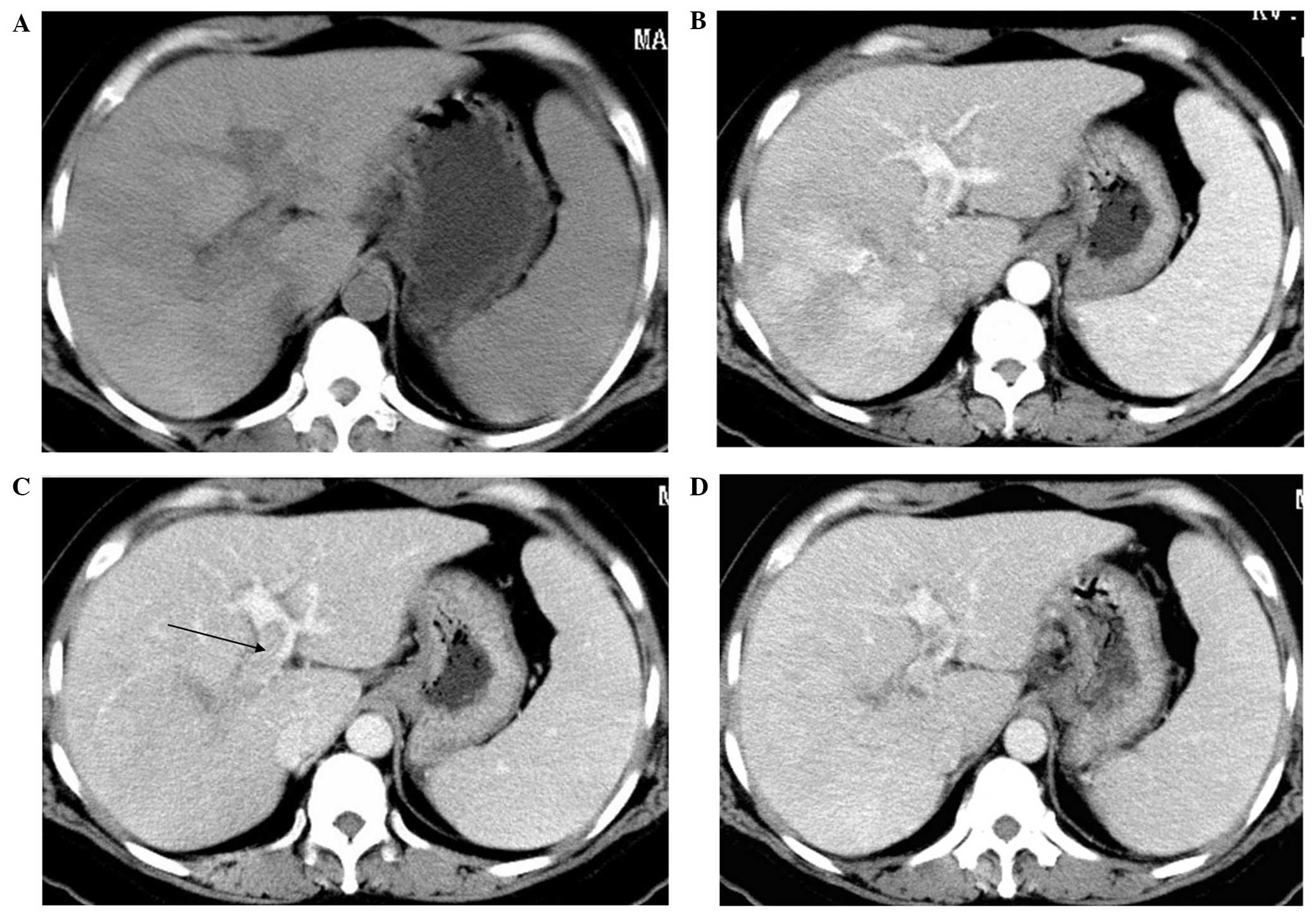
Dynamic CT imaging revealed an irregularly shaped tumor, 8.5×7.0 cm in size. It was increased in size on early phase CT in the right lobe of the liver. A region of deficiency was observed on delayed phase CT imaging, in liver segment 8/6. The tumor had invaded the left and right branches, and main trunk of the portal vein (Fig. 1C, arrow). The PVTT began at the primary tumor, and extended towards the main portal vein, supplied by a nutrient artery. The PVTT tissue was extremely friable.

Figure 1.

Dynamic computed tomography findings before treatment. (A) An irregularly shaped tumor of 8.5×7.0 cm in size was identified in the right lobe of the liver. (B) The tumor increased in size during the early phase. (C and D) A region of deficiency was observed during the delayed phase. (B, C and D) The tumor invaded the left branch, right branch, and main portal vein and (C) was excised in the area indicated by the arrow.

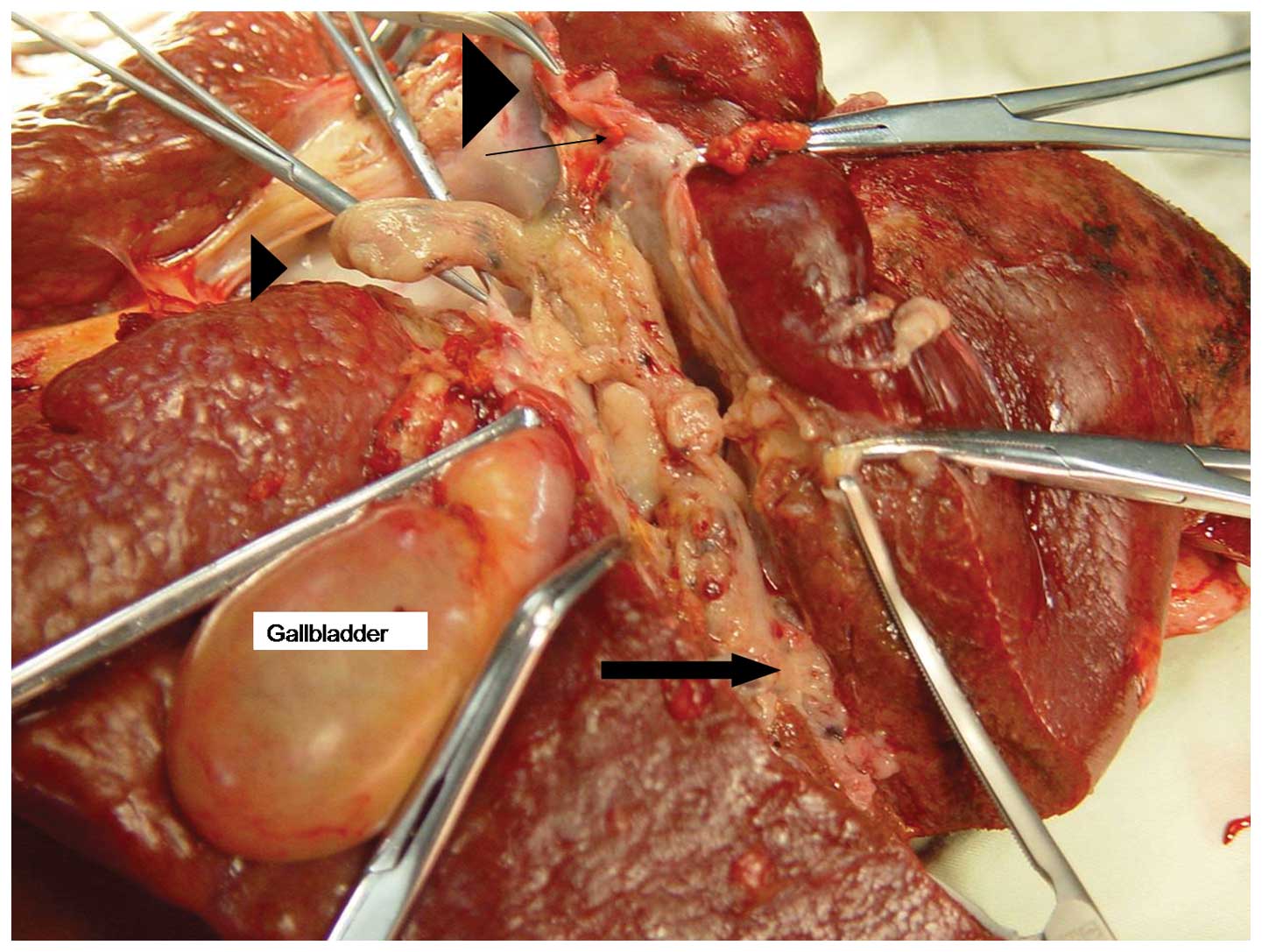
The patient subsequently underwent orthotopic liver transplantation. The gross surgical pathology of the isolated liver is shown in Fig. 2. Intraoperative histopathological examination also confirmed the diagnosis of HCC with PVTT. No complications were experienced, and the patient was discharged and subsequently treated with anti-viral and anti-rejection drugs in the outpatient clinic. The patient remained healthy during follow-up examinations. However, 8 years post-transplantation, metastatic lesions in the liver, lung and brain were detected by positron emission tomography-CT. The patient did not meet the recommended Milan Criteria for liver transplantation and therefore succumbed to intracranial hemorrhage at 51 years of age. This study was approved by the Institutional Review Board of The 180th Hospital of the People's Liberation Army. Written informed consent was obtained from the patient's family according to the principles expressed by the Declaration of Helsinki.

Figure 2.

Anatomical examination of isolated liver with hepatocellular carcinoma with PVTT. The PVTT began at the primary tumor and grew from the right branch portal vein (large arrow) towards the main portal vein (large arrowhead) and the left branch of the portal vein (small arrowhead). A nutrient artery (small arrow) supplied the tumor thrombus. PVTT, portal vein tumor thrombosis.

Discussion

HCC in combination with portal venous invasion is associated with poor outcome, and the extent of PVTT may affect the prognosis (10). In 2007, Shi et al (11) proposed a PVTT classification which was based on the extent of the tumor thrombus in the portal vein, as follows: Type I0, tumor thrombus formation found under microscopy; type I, tumor thrombi involving segmental branches of portal vein or above; type II, tumor thrombi involving right/left portal vein; type III, tumor thrombi involving the main portal vein trunk; and type IV, tumor thrombi involving the superior mesenteric vein (7). A number of studies have reported that patients with PVTT extending to the main trunk of the portal vein or beyond have poorer outcomes following surgery compared to those with PVTT confined to the first- or second-order portal branches (12). Therefore, the growth characteristics of PVTT may affect the outcomes in cases of advanced HCC. The presence of PVTT also limits the treatment options, as HCC treatment guidelines consider PVTT a contraindication for transplantation (13). Currently, treatment for HCC with PVTT includes surgery, radiotherapy, and transcatheter arterial embolization (TACE). Surgical resection is the optimal treatment modality for early-stage HCC patients, who account for only 5% of cases in Western countries and ~40% of cases in Asia. The five-year survival rate of HCC patients after resection is >50% (14). The five-year survival of early-stage HCC patients after liver transplantation is >70%, however, the lack of sufficient liver donation is the major limitation for liver transplantation (15). Kim et al (16) reported that radiotherapy for PVTT of HCC showed a complete response (CR) in 4 of 59 patients (6.8%), a partial response (PR) in 23 patients (39.0%), no response in 28 patients (47.5%) and progressive disease in four patients (6.8%). TACE is considered for patients with inoperable HCC, who are not eligible for liver transplantation. Previous studies have reported that TACE treatment induced a CR or PR in 35% of patients, with <2% of patients achieving a CR (17,18). Lo et al (19) showed that patients treated with TACE exhibited an increased two-year survival rate following treatment (41%) when compared with patients receiving symptomatic treatment (27%). TACE may improve survival in cases of intermediate-stage HCC with Child-Pugh class A in the absence of PVTT (19). Sorafenib has also been found to confer a survival benefit for patients with advanced HCC and PVTT, however, its safety and efficacy limit use (20).

In conclusion, in cases of HCC and PVTT where the growth characteristics and modality of PVTT include extension to the trunk of the portal vein or further, destruction of the primary tumor and PVTT must be considered. Patients with poor liver function or unresectable HCC who cannot receive surgery have a very poor prognosis, with a life expectancy of 2.7–4 months (6). In the present case, the PVTT was found to be supplied by a tumor vessel. This study supports use of the TAE methods and proposes that this approach may be a suitable for palliation of advanced HCC with PVTT in patients who cannot undergo a surgery.

Glossary

Abbreviations

Abbreviations:

HCC

hepatocellular carcinoma

PVTT

portal vein tumor thrombus

AFP

alpha-fetoprotein

OLT

orthotopic liver transplantation

TAE

transcatheter arterial embolization

References

1 

Montalto G, Cervello M, Giannitrapani L, Dantona F, Terranova A and Castagnetta LA: Epidemiology, risk factors, and natural history of hepatocellular carcinoma. Ann NY Acad Sci. 963:13–20. 2002. View Article : Google Scholar : PubMed/NCBI

2 

Yamanaka N, Okamoto E, Fujihara S, et al: Do the tumor cells for hepatocellular carcinomas dislodge into the portal venous stream during hepatic resection? Cancer. 70:2263–2267. 1992. View Article : Google Scholar : PubMed/NCBI

3 

Nakashima T and Kojiro M: Hepatocellular CarcinomaAn Atlas of Its Pathology. 7th. Springer Verlag; Tokyo: 1987

4 

Wu MC, Chen H and Shen F: Surgical treatment of primary liver cancer: a report of 5524 patients. Chin J Surg. 39:25–28. 2001.

5 

Zhang J, Gong F, Li L, et al: Diabetes mellitus and the neutrophil to lymphocyte ratio predict overall survival in non-viral hepatocellular carcinoma treated with transarterial chemoembolization. Oncol Lett. 7:1704–1710. 2014.PubMed/NCBI

6 

Llovet JM, Bustamante J, Castells A, et al: Natural history of untreated nonsurgical hepatocellular carcinoma: rationale for the design and evaluation of therapeutic trials. Hepatology. 29:62–67. 1999. View Article : Google Scholar : PubMed/NCBI

7 

Lau WY, Lai EC and Yu SCH: Management Of Portal Vein Tumor ThrombusHepatocellular Carcinoma. Lau WY: World Scientific Publishing; Singapore: pp. 739–760. 2008, View Article : Google Scholar

8 

Pugh RNH, Murray-Lyon IM, Dawson JL, et al: Transection of the oesophagus for bleeding oesophageal varices. Br J Surg. 60:646–649. 1973. View Article : Google Scholar : PubMed/NCBI

9 

Kamath PS, Wiesner RH, Malinchoc M, et al: A model to predict survival in patients with end-stage liver disease. Hepatology. 33:464–470. 2001. View Article : Google Scholar : PubMed/NCBI

10 

Shuqun C, Mengchao W, Han C, et al: Tumor thrombus types influence the prognosis of hepatocellular carcinoma with the tumor thrombi in the portal vein. Hepatogastroenterology. 54:499–502. 2007.PubMed/NCBI

11 

Shi J, Lai EC, Li N, et al: A new for classification hepatocellular carcinoma with portal vein tumor thrombus. J Hepatobiliary Pancreat Sci. 18:74–80. 2011. View Article : Google Scholar : PubMed/NCBI

12 

Chen XP, Qiu FZ, Wu ZD, et al: Effects of location and extension of portal vein tumor thrombus on long-term outcomes of surgical treatment for hepatocellular carcinoma. Ann Surg Oncol. 13:940–946. 2006. View Article : Google Scholar : PubMed/NCBI

13 

Bruix J and Sherman M: American Association for the Study of Liver Diseases: Management of hepatocellular carcinoma: an update. Hepatology. 53:1020–1022. 2011. View Article : Google Scholar : PubMed/NCBI

14 

Arii S, Yamaoka Y, Futagawa S, et al: Results of surgical and nonsurgical treatment for small-sized hepatocellular carcinomas: A retrospective and nationwide survey in Japan. The Liver Cancer Study Group of Japan. Hepatology. 32:1224–1229. 2000. View Article : Google Scholar : PubMed/NCBI

15 

Mazzaferro V, Regalia E, Doci R, et al: Liver transplantation for the treatment of small hepatocellular carcinomas in patients with cirrhosis. N Engl J Med. 334:693–699. 1996. View Article : Google Scholar : PubMed/NCBI

16 

Kim DY, Park W, Lim DH, et al: Three-dimensional conformal radiotherapy for portal vein thrombosis of hepatocellular carcinoma. Cancer. 103:2419–2426. 2005. View Article : Google Scholar : PubMed/NCBI

17 

Llovet JM and Bruix J: Systematic review of randomized trials for unresectable hepatocellular carcinoma: Chemoembolization improves survival. Hepatology. 37:429–442. 2003. View Article : Google Scholar : PubMed/NCBI

18 

Bruix J, Sala M and Llovet JM: Chemoembolization for hepatocellular carcinoma. Gastroenterology. 127 (5 Suppl 1):S179–S188. 2004. View Article : Google Scholar : PubMed/NCBI

19 

Lo CM, Ngan H, Tso WK, et al: Randomized controlled trial of transarterial lipiodol chemoembolization for unresectable hepatocellular carcinoma. Hepatology. 35:1164–1171. 2002. View Article : Google Scholar : PubMed/NCBI

20 

Federico A, Orditura M, Cotticelli G, et al: Safety and efficacy of sorafenib in patients with advanced hepatocellular carcinoma and Child-Pugh A or B cirrhosis. Oncol Lett. 9:1628–1632. 2015.PubMed/NCBI

Related Articles

  • Abstract
  • View
  • Download
  • Twitter
Copy and paste a formatted citation
Spandidos Publications style
Chen X, Liu L and Pan X: Portal vein tumor thrombus in advanced hepatocellular carcinoma: A case report. Oncol Lett 9: 2495-2498, 2015.
APA
Chen, X., Liu, L., & Pan, X. (2015). Portal vein tumor thrombus in advanced hepatocellular carcinoma: A case report. Oncology Letters, 9, 2495-2498. https://doi.org/10.3892/ol.2015.3115
MLA
Chen, X., Liu, L., Pan, X."Portal vein tumor thrombus in advanced hepatocellular carcinoma: A case report". Oncology Letters 9.6 (2015): 2495-2498.
Chicago
Chen, X., Liu, L., Pan, X."Portal vein tumor thrombus in advanced hepatocellular carcinoma: A case report". Oncology Letters 9, no. 6 (2015): 2495-2498. https://doi.org/10.3892/ol.2015.3115
Copy and paste a formatted citation
x
Spandidos Publications style
Chen X, Liu L and Pan X: Portal vein tumor thrombus in advanced hepatocellular carcinoma: A case report. Oncol Lett 9: 2495-2498, 2015.
APA
Chen, X., Liu, L., & Pan, X. (2015). Portal vein tumor thrombus in advanced hepatocellular carcinoma: A case report. Oncology Letters, 9, 2495-2498. https://doi.org/10.3892/ol.2015.3115
MLA
Chen, X., Liu, L., Pan, X."Portal vein tumor thrombus in advanced hepatocellular carcinoma: A case report". Oncology Letters 9.6 (2015): 2495-2498.
Chicago
Chen, X., Liu, L., Pan, X."Portal vein tumor thrombus in advanced hepatocellular carcinoma: A case report". Oncology Letters 9, no. 6 (2015): 2495-2498. https://doi.org/10.3892/ol.2015.3115
Follow us
  • Twitter
  • LinkedIn
  • Facebook
About
  • Spandidos Publications
  • Careers
  • Cookie Policy
  • Privacy Policy
How can we help?
  • Help
  • Live Chat
  • Contact
  • Email to our Support Team