Introduction
Hysteromyoma is a common disease and its incidence
in females >45 years old is >60% (1). Hysteromyomas are monoclonal tumors that
arise from the uterine myometrium smooth muscle cells. The tumors
are estrogen- and progesterone-dependent and occur in reproductive
females, usually prior to the menopause. It has been reported that
the incidence of hysteromyoma is 5.1% in Chinese females who are
25–30 years old (2). Although
hysteromyomas are benign, the tumors are able to trigger a number
of diseases and cause severe complications, including abnormal
uterine bleeding, abdominal pain and discomfort, pregnancy
complications and even infertility (3). The common consequence of a hysteromyoma
is a hysterectomy, which gives rise to social and economic problems
(4,5).
The protein coded by mediator complex subunit 12
(MED12) is a subunit of the mediator complex, which is a
transcription factor that regulates gene expression and consists of
26 subunits (6). Certain recent
studies have shown that MED12 presents with different mutations
frequencies in hysteromyoma patients of different racial
populations (7–9), which suggests that MED12 mutations have
an important role in causing hysteromyoma. At present, there is no
study with regard to MED12 gene mutations in hysteromyoma patients
of the Chinese Han population.
In the present study, the biopsy specimens of 171
patients with hysteromyoma were analyzed for SNP mutations of
MED12, and then the mutation frequency was compared with that of
other races. The association between the size of the hysteromyomas
and the MED12 mutation frequency was also analyzed.
Materials and methods
Eligibility and patient consent
All patients who met the inclusion criteria were
provided with detailed information about the present study and
their rights by the principal investigator/s. Han Chinese patients,
aged between 30 and 65 years, with pathologically confirmed
hysteromyoma were considered eligible for the study. The patients
who were willing to take part provided written informed consent and
were enrolled into the study. This study was approved by the ethics
committee of The Taizhou People's Hospital (Taizhou, China) and all
experiments were performed in accordance with the China Food and
Drug Adminstration Guidelines for Ethical Review Work of Drug
Clinical Trials (10).
Materials
In total, 171 hysteromyoma biopsy samples were
obtained from in-hospital patients undergoing surgery in the
Department of Obstetrics and Gynecology of The Taizhou People's
Hospital. Among these patients, 13 cases had samples taken from the
tissues surrounding the hysteromyoma. All samples were fresh
tissues and were frozen at −20°C for later analysis.
Amplification of the second exon in
MED12
Design and synthesis of primers
According to the references and sequence found in
the National Center for Biotechnology Information (NCBI) GenBank
(NCBI sequence, NG_012808.1), the following primers were designed:
MED12-F, 5′-GCCCTTTCACCTTGTTCCTTC-3′ and MED12-R,
5′-GTCCCTATAAGTCTTCCCAAC-3′.
Genome isolation
Hysteromyoma biopsy tissues or biopsy tissues from
the surrounding hysteromyoma were placed separately into mortars
precooled by ice, and were then ground quickly into homogenates in
liquid nitrogen using a pestle. Next, the genomes were isolated
using the Tissue Genome Isolation kit, containing 50 mM Tris-HCl
lysis buffer (150 mM NaCl, 1 mM EDTA, 1% Triton X100, 1% sodium
deoxycholate and 0.1% SDS; pH 7.4), 100 mg/ml RNaseI and 20 mg/ml
protein K [Tiangen Biotech (Beijing) Co., Ltd., Beijing, China],
according to the manufacturer's instructions. The homogenates were
lysed in Tris-HCl lysis buffer and RNA was digested using 4µl
RNaseI. The protein was then digested using 20 µl protein K. Next,
200 µl ethanol was added to the sample and centrifuged at 13,400 ×
g for 60 sec, using the TIANamp Spin Column CB3 (Tiangen Biotech
(Beijing) Co., Ltd.). TIANamp Spin Column CB3 was placed into the
1.5 ml microcentrifuge tube, 700 µl of was h buffer (75% ethanol)
was added, and centrifuged at 13,400 × g for 30s at room
temperature. Subsequently an additional 500 µl PW was h buffer (75%
ethanol) was added and centrifuged at 13,400 × g for a further 3
min at room temperature. Finally, the TIANamp Spin Column CB3 was
placed into a new clean collection tube and 100 µl distilled water
was added to elute the genomic DNA, was incubated at room
temperature (15–25°C) for 5 min and subsequently centrifuged at
13,400 × g for 2 min at room temperature. The eluent, which
included the genomic DNA, was then collected.
PCR amplification and sequencing of
the MED12 gene
The PCR reaction system consisted of the following:
5 µl genome template (30 ng), 5 µl 10X tag buffer, 2.5 mM dNTP mix
(Futaibio Technology Company, Taizhou, China) and Taq polymerase
(Futaibio Technology Company). PCR was performed using the GeneAmp
PCR system 9700 (Applied Biosystems Life Technologies, Foster City,
CA, USA). The PCR conditions were as follows: Pre-denaturation at
95°C for 5 min, followed by 35 cycles of 94°C for 30 sec, 55°C for
30 sec 72°C 30 sec and then 72°C for 5 min. The obtained PCR
amplification products were sequenced by Nanjing Jinsirui
Biotechnology Co., Ltd. (Nanjing, China).
Statistical analysis
SigmaPlot version 12.0 (Systat Software, Inc., San
Jose, CA, USA) was used for the statistical analysis, and the
comparison of mutation rate was analyzed by χ2 test.
P<0.05 was considered to indicate a statistically significant
difference.
Results
Sequence of the second exon in the
MED12 gene of the hysteromyoma and adjacent tissue samples
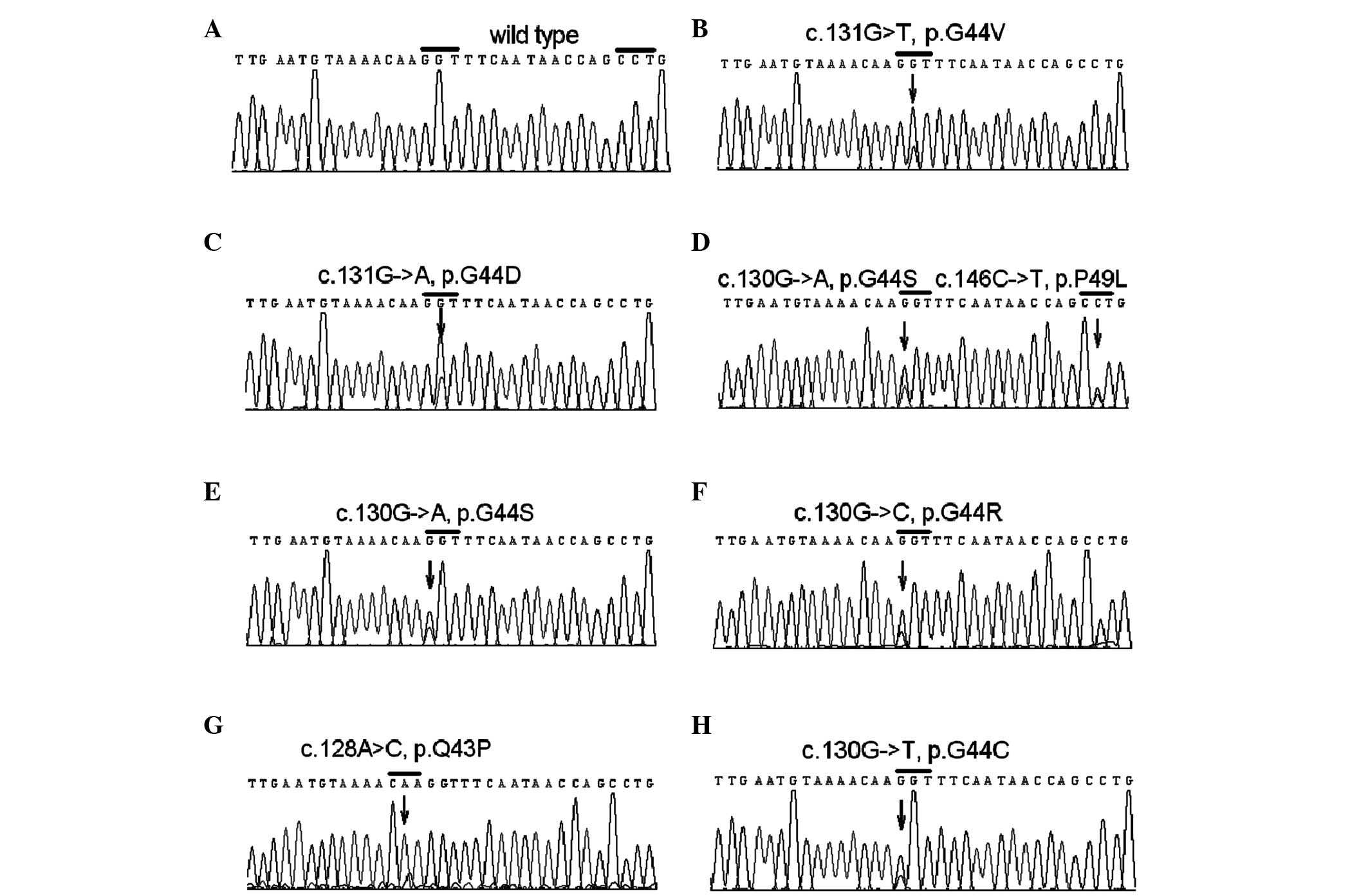
The sequencing results from the 171 hysteromyoma
tissue samples revealed 93 cases (54.39%) with mutations. The
tissues surrounding the hysteromyoma did not present with mutations
(Fig. 1A). Among the mutations in the
hysteromyoma tissues, 23 (13.45%) presented as 131G→T (Fig. 1B), 17 (9.94%) presented as 131G→A
(Fig. 1C), 5 (2.92%) presented as
130G→A and 146C→T (Fig. 1D), 6
(3.51%) presented as 130G→A (Fig.
1E), 7 (4.09%) presented as 130G→C (Fig. 1F), 6 (3.51%) presented as 128A→C
(Fig. 1G) and 11 (6.43%) presented as
130G→T (Fig. 1H). In addition to
these SNP mutations, there were 3 insertion mutations (1.75%;
127Ins27) and 15 deletion mutations (8.77%; two cases of
118_132Del15, three cases of 117_134Del18, three cases of
131_148Del18 and seven cases of 141_165Del15). Among these
mutations, 146C→T, 127Ins27, 135Del46, 118Del15, 141Del15 and
117Del18 have been reported for the first time by the present
study.
Comparison of the second exon in the
MED12 gene in the Chinese Han population versus populations of
other ethnicities
Certain studies have reported that the mutation
frequency of the second exon of MED12 in patients with hysteromyoma
was 70.67% (159/225) in the Finnish population (8), 50.0% (14/28) in individuals of African
descent or individuals of other non-Caucasian ethnicities (7), and 67% (100/147) in North American
populations (9). The present study
showed that the mutation frequency of the second exon of the MED12
gene in the hysteromyoma patients in the present Chinese Han
population was 54.39%, which was significantly different from
mutation frequencies in the Finnish or North American
(χ2=10.437, P=0.001; χ2=5.607, P=0.018)
populations, but not significantly different from that of the
individuals of African descent or individuals of other
non-Caucasian ethnicities (χ2=0.0516, P=0.820).
To detect the association between the size of the
hysteromyoma tissue sample and the mutation frequency, samples from
141 hysteromyoma patients whose tumor sizes were measured underwent
analysis. The results showed that 33 out of the 84 cases with a
hysteromyoma of ≥5 cm in diameter presented with MED12 mutations
(39.29%), and 34 out of the 57 cases with a hysteromyoma of <5
cm in diameter presented with MED12 mutations (59.65%). These two
rates were significantly different (χ2=4.859,
P=0.0027).
Discussion
Difference in ethnicity is an important risk factor
in epidemiology, particularly for hysteromyoma. Certain studies
have shown that the incidence of hysteromyoma varies among
populations of different ethnicities (11–16). For
example, the incidence of hysteromyoma in African females is three
times as high as that in Caucasian females (13). Also, compared with other ethnicities,
African females with hysteromyoma are younger and have larger
lesions, with hysteromyomas that grow faster (12,15). The
incidence of hysteromyoma in females of African descent is higher
than in individuals of other ethnicities, including Hispanic and
Asian individuals (11,15,16).
Certain studies have indicated that other risks, such as family
history, smoking, drinking, hypertension and weight increase, can
increase the risk of hysteromyoma, in addition to the risk
associated with ethnicity (12,14,16,17).
A study by Mäkinen et al (8) indicated that 70% of patients with
hysteromyoma in the Finnish population presented with a mutation in
the second exon of MED12, which affected the genetically-conserved
sequence of the MED12 protein. Also, small myomas were shown to
exhibit more mutations than large myomas. Another study by Mäkinen
et al (7) detected mutations
of the second exon in the MED12 genes from 28 pathological tissue
samples obtained from 18 patients with hysteromyoma and reported a
50% mutation frequency rate. A study by McGuire et al
(9) reported that the MED12 mutation
frequency in North American females with hysteromyoma was 67%
(100/148). In the present study, mutations of the second exon in
the MED12 gene were analyzed in 171 pathological tissue samples in
hysteromyoma patients, and the result showed that the mutation
frequency was 54.39%, which was significantly different from the
Finnish and North American populations, but not significantly
different from the population of individuals of African descent.
Additionally, none of the adjacent tissue samples presented with
MED12 mutations. The mutation frequency of 54.39% suggested that
mutation in the second exon of the MED12 gene is also a significant
risk factor for hysteromyoma in the Chinese Han population.
Furthermore, the present study was the first to find several novel
mutation types in the second exon of the MED12 gene of hysteromyoma
patients.
Previous studies have shown that the second exon of
the MED12 gene in hysteromyoma patients who were from Finland,
North America or South Africa presented with high mutation
frequencies (7–9). The reported mutation frequency in the
South African population appeared to be lower than that found in
Caucasian individuals, which may be a result of the size of the
hysteromyoma in these patients. The tumors of the individuals of
the South African population were usually large, and according the
study by Mäkinen et al, the size of the hysteromyoma may be
negatively correlated with the presence of mutations (7). In the present study, the mutation
frequency of MED12 in hysteromyoma was 54.39%, similar to that of
the individuals of African descent, and lower than that of the
Finnish or North American populations. Also, in the 141
hysteromyomas measured, the percentage of tumors with a diameter of
≥5 cm was 59.57% (84 cases), which was significantly higher than
the percentage of tumors with a diameter of <5 cm (40.43%; 57
cases). This result suggested that patients in the Chinese Han
population had larger hysteromyomas, which may be one of the
reasons why the mutation frequency of the MED12 gene in the
hysteromyoma patients of the Chinese Han population was lower than
that of the Finnish or North American populations. The original
Finnish study also reported that tumors lacking MED12 mutations
tended to be larger (P=0.015) (8).
However, it is not certain whether the myoma size in the Chinese
population is actually larger on average compared with that of the
Caucasian population, as the present study was only conducted on a
small number of samples. Further studies must be performed to
clarify this matter. In addition, the results of the present study
also showed that the MED12 mutation frequency in small
hysteromyomas was higher than that in large hysteromyomas, which
was consistent with the study by Mäkinen et al (7).
The pathways for focal adhesion, extracellular
matrix receptor interaction and Wnt signaling are altered in
hysteromyomas with mutations (8). The
association between the exact mutation of exon 2 in the MED12 gene
and its consequent function has not been reported. In the present
study, 13 mutations, namely 131G→T, 131G→A, 130G→A, 146 C→T,
130G→A, 130G→C, 128A→C, 130G→T, 127Ins27, 118_132Del15,
117_134Del18, 131_148Del18 and 141_165Del15, were found. All of
these mutations were located in exon 2 of the MED12 gene. The
association between each mutation and their consequent functions
requires further study.
Although the present study was a pilot study,
several novel mutation types were identified in the second exon of
the MED12 gene in the studied hysteromyoma patients, and the study
also suggested that mutations in the second exon of the MED12 gene
also play a significant role in the development of hysteromyomas in
the female Chinese Han population.
Acknowledgements
The authors would like to thank the staff of The
Taizhou Peoples's Hospital for providing their support.
References
|
1
|
Okolo S: Incidence, aetiology and
epidemiology of uterine fibroids. Best Pract Res Clin Obstet
Gynaecol. 22:571–588. 2008. View Article : Google Scholar : PubMed/NCBI
|
|
2
|
Shi YF: Incidence, aetiology of uterine
fibroids. Zhongguo Yi Kan. 37:11122002.(In Chinese).
|
|
3
|
Stewart EA: Uterine fibroids. Lancet.
357:293–298. 2001. View Article : Google Scholar : PubMed/NCBI
|
|
4
|
Flynn M, Jamison M, Datta S and Myers E:
Health care resource use for uterine fibroid tumors in the United
States. Am J Obstet Gynecol. 195:955–964. 2006. View Article : Google Scholar : PubMed/NCBI
|
|
5
|
Hartmann KE, Birnbaum H, Ben-Hamadi R, Wu
EQ, Farrell MH, Spalding J and Stang P: Annual costs associated
with diagnosis of uterine leiomyomata. Obstet Gynecol. 108:930–937.
2006. View Article : Google Scholar : PubMed/NCBI
|
|
6
|
Taatjes DJ: The human Mediator complex: a
versatile, genome-wide regulator of transcription. Trends Biochem
Sci. 35:315–322. 2010. View Article : Google Scholar : PubMed/NCBI
|
|
7
|
Makinen N, Heinonen HR, Moore S, Tomlinson
IP, van der Spuy ZM and Aaltonen LA: Med12 exon 2 mutations are
common in uterine leiomyomas from South African patients.
Oncotarget. 2:966–969. 2011.PubMed/NCBI
|
|
8
|
Makinen N, Mehine M, Tolvanen J, et al:
Med12, the mediator complex subunit 12 gene, is mutated at high
frequency in uterine leiomyomas. Science. 334:252–255. 2011.
View Article : Google Scholar : PubMed/NCBI
|
|
9
|
McGuire MM, Yatsenko A, Hoffner L, Jones
M, Surti U and Rajkovic A: Whole exome sequencing in a random
sample of North American women with leiomyomas identifies MED12
mutations in majority of uterine leiomyomas. PLoS One.
7:e332512012. View Article : Google Scholar : PubMed/NCBI
|
|
10
|
Guidelines for Ethical Review Work of Drug
Clinical Trials 2010. China Food and Drug Administration; Beijing:
pp. 1–15. 2010
|
|
11
|
Kjerulff KH, Langenberg P, Seidman JD,
Stolley PD and Guzinski GM: Uterine leiomyomas. Racial differences
in severity, symptoms and age at diagnosis. J Reprod Med.
41:483–490. 1996.PubMed/NCBI
|
|
12
|
Marshall LM, Spiegelman D, Barbieri RL, et
al: Variation in the incidence of uterine leiomyoma among
premenopausal women by age and race. Obstet Gynecol. 90:967–973.
1997. View Article : Google Scholar : PubMed/NCBI
|
|
13
|
Baird DD, Dunson DB, Hill MC, Cousins D
and Schectman JM: High cumulative incidence of uterine leiomyoma in
black and white women: ultrasound evidence. Am J Obstet Gynecol.
188:100–107. 2003. View Article : Google Scholar : PubMed/NCBI
|
|
14
|
Wise LA, Palmer JR, Harlow BL, et al: Risk
of uterine leiomyomata in relation to tobacco, alcohol and caffeine
consumption in the Black Women's Health Study. Hum Reprod.
19:1746–1754. 2004. View Article : Google Scholar : PubMed/NCBI
|
|
15
|
Huyck KL, Panhuysen CI, Cuenco KT, et al:
The impact of race as a risk factor for symptom severity and age at
diagnosis of uterine leiomyomata among affected sisters. Am J
Obstet Gynecol. 198:168.e1–168.e9. 2008. View Article : Google Scholar
|
|
16
|
Templeman C, Marshall SF, Clarke CA, et
al: Risk factors for surgically removed fibroids in a large cohort
of teachers. Fertil Steril. 92:1436–1446. 2009. View Article : Google Scholar : PubMed/NCBI
|
|
17
|
Wise LA, Palmer JR, Spiegelman D, Harlow
BL, Stewart EA, Adams-Campbell LL and Rosenberq L: Influence of
body size and body fat distribution on risk of uterine leiomyomata
in U.S. black women. Epidemiology. 16:346–354. 2005. View Article : Google Scholar : PubMed/NCBI
|