Spandidos Publications Logo
  • About
    • About Spandidos
    • Aims and Scopes
    • Abstracting and Indexing
    • Editorial Policies
    • Reprints and Permissions
    • Job Opportunities
    • Terms and Conditions
    • Contact
  • Journals
    • All Journals
    • Oncology Letters
      • Oncology Letters
      • Information for Authors
      • Editorial Policies
      • Editorial Board
      • Aims and Scope
      • Abstracting and Indexing
      • Bibliographic Information
      • Archive
    • International Journal of Oncology
      • International Journal of Oncology
      • Information for Authors
      • Editorial Policies
      • Editorial Board
      • Aims and Scope
      • Abstracting and Indexing
      • Bibliographic Information
      • Archive
    • Molecular and Clinical Oncology
      • Molecular and Clinical Oncology
      • Information for Authors
      • Editorial Policies
      • Editorial Board
      • Aims and Scope
      • Abstracting and Indexing
      • Bibliographic Information
      • Archive
    • Experimental and Therapeutic Medicine
      • Experimental and Therapeutic Medicine
      • Information for Authors
      • Editorial Policies
      • Editorial Board
      • Aims and Scope
      • Abstracting and Indexing
      • Bibliographic Information
      • Archive
    • International Journal of Molecular Medicine
      • International Journal of Molecular Medicine
      • Information for Authors
      • Editorial Policies
      • Editorial Board
      • Aims and Scope
      • Abstracting and Indexing
      • Bibliographic Information
      • Archive
    • Biomedical Reports
      • Biomedical Reports
      • Information for Authors
      • Editorial Policies
      • Editorial Board
      • Aims and Scope
      • Abstracting and Indexing
      • Bibliographic Information
      • Archive
    • Oncology Reports
      • Oncology Reports
      • Information for Authors
      • Editorial Policies
      • Editorial Board
      • Aims and Scope
      • Abstracting and Indexing
      • Bibliographic Information
      • Archive
    • Molecular Medicine Reports
      • Molecular Medicine Reports
      • Information for Authors
      • Editorial Policies
      • Editorial Board
      • Aims and Scope
      • Abstracting and Indexing
      • Bibliographic Information
      • Archive
    • World Academy of Sciences Journal
      • World Academy of Sciences Journal
      • Information for Authors
      • Editorial Policies
      • Editorial Board
      • Aims and Scope
      • Abstracting and Indexing
      • Bibliographic Information
      • Archive
    • International Journal of Functional Nutrition
      • International Journal of Functional Nutrition
      • Information for Authors
      • Editorial Policies
      • Editorial Board
      • Aims and Scope
      • Abstracting and Indexing
      • Bibliographic Information
      • Archive
    • International Journal of Epigenetics
      • International Journal of Epigenetics
      • Information for Authors
      • Editorial Policies
      • Editorial Board
      • Aims and Scope
      • Abstracting and Indexing
      • Bibliographic Information
      • Archive
    • Medicine International
      • Medicine International
      • Information for Authors
      • Editorial Policies
      • Editorial Board
      • Aims and Scope
      • Abstracting and Indexing
      • Bibliographic Information
      • Archive
  • Articles
  • Information
    • Information for Authors
    • Information for Reviewers
    • Information for Librarians
    • Information for Advertisers
    • Conferences
  • Language Editing
Spandidos Publications Logo
  • About
    • About Spandidos
    • Aims and Scopes
    • Abstracting and Indexing
    • Editorial Policies
    • Reprints and Permissions
    • Job Opportunities
    • Terms and Conditions
    • Contact
  • Journals
    • All Journals
    • Biomedical Reports
      • Information for Authors
      • Editorial Policies
      • Editorial Board
      • Aims and Scope
      • Abstracting and Indexing
      • Bibliographic Information
      • Archive
    • Experimental and Therapeutic Medicine
      • Information for Authors
      • Editorial Policies
      • Editorial Board
      • Aims and Scope
      • Abstracting and Indexing
      • Bibliographic Information
      • Archive
    • International Journal of Epigenetics
      • Information for Authors
      • Editorial Policies
      • Editorial Board
      • Aims and Scope
      • Abstracting and Indexing
      • Bibliographic Information
      • Archive
    • International Journal of Functional Nutrition
      • Information for Authors
      • Editorial Policies
      • Editorial Board
      • Aims and Scope
      • Abstracting and Indexing
      • Bibliographic Information
      • Archive
    • International Journal of Molecular Medicine
      • Information for Authors
      • Editorial Policies
      • Editorial Board
      • Aims and Scope
      • Abstracting and Indexing
      • Bibliographic Information
      • Archive
    • International Journal of Oncology
      • Information for Authors
      • Editorial Policies
      • Editorial Board
      • Aims and Scope
      • Abstracting and Indexing
      • Bibliographic Information
      • Archive
    • Medicine International
      • Information for Authors
      • Editorial Policies
      • Editorial Board
      • Aims and Scope
      • Abstracting and Indexing
      • Bibliographic Information
      • Archive
    • Molecular and Clinical Oncology
      • Information for Authors
      • Editorial Policies
      • Editorial Board
      • Aims and Scope
      • Abstracting and Indexing
      • Bibliographic Information
      • Archive
    • Molecular Medicine Reports
      • Information for Authors
      • Editorial Policies
      • Editorial Board
      • Aims and Scope
      • Abstracting and Indexing
      • Bibliographic Information
      • Archive
    • Oncology Letters
      • Information for Authors
      • Editorial Policies
      • Editorial Board
      • Aims and Scope
      • Abstracting and Indexing
      • Bibliographic Information
      • Archive
    • Oncology Reports
      • Information for Authors
      • Editorial Policies
      • Editorial Board
      • Aims and Scope
      • Abstracting and Indexing
      • Bibliographic Information
      • Archive
    • World Academy of Sciences Journal
      • Information for Authors
      • Editorial Policies
      • Editorial Board
      • Aims and Scope
      • Abstracting and Indexing
      • Bibliographic Information
      • Archive
  • Articles
  • Information
    • For Authors
    • For Reviewers
    • For Librarians
    • For Advertisers
    • Conferences
  • Language Editing
Login Register Submit
  • This site uses cookies
  • You can change your cookie settings at any time by following the instructions in our Cookie Policy. To find out more, you may read our Privacy Policy.

    I agree
Search articles by DOI, keyword, author or affiliation
Search
Advanced Search
presentation
Oncology Letters
Join Editorial Board Propose a Special Issue
Print ISSN: 1792-1074 Online ISSN: 1792-1082
Journal Cover
January-2016 Volume 11 Issue 1

Full Size Image

Sign up for eToc alerts
Recommend to Library

Journals

International Journal of Molecular Medicine

International Journal of Molecular Medicine

International Journal of Molecular Medicine is an international journal devoted to molecular mechanisms of human disease.

International Journal of Oncology

International Journal of Oncology

International Journal of Oncology is an international journal devoted to oncology research and cancer treatment.

Molecular Medicine Reports

Molecular Medicine Reports

Covers molecular medicine topics such as pharmacology, pathology, genetics, neuroscience, infectious diseases, molecular cardiology, and molecular surgery.

Oncology Reports

Oncology Reports

Oncology Reports is an international journal devoted to fundamental and applied research in Oncology.

Experimental and Therapeutic Medicine

Experimental and Therapeutic Medicine

Experimental and Therapeutic Medicine is an international journal devoted to laboratory and clinical medicine.

Oncology Letters

Oncology Letters

Oncology Letters is an international journal devoted to Experimental and Clinical Oncology.

Biomedical Reports

Biomedical Reports

Explores a wide range of biological and medical fields, including pharmacology, genetics, microbiology, neuroscience, and molecular cardiology.

Molecular and Clinical Oncology

Molecular and Clinical Oncology

International journal addressing all aspects of oncology research, from tumorigenesis and oncogenes to chemotherapy and metastasis.

World Academy of Sciences Journal

World Academy of Sciences Journal

Multidisciplinary open-access journal spanning biochemistry, genetics, neuroscience, environmental health, and synthetic biology.

International Journal of Functional Nutrition

International Journal of Functional Nutrition

Open-access journal combining biochemistry, pharmacology, immunology, and genetics to advance health through functional nutrition.

International Journal of Epigenetics

International Journal of Epigenetics

Publishes open-access research on using epigenetics to advance understanding and treatment of human disease.

Medicine International

Medicine International

An International Open Access Journal Devoted to General Medicine.

Journal Cover
January-2016 Volume 11 Issue 1

Full Size Image

Sign up for eToc alerts
Recommend to Library

  • Article
  • Citations
    • Cite This Article
    • Download Citation
    • Create Citation Alert
    • Remove Citation Alert
    • Cited By
  • Similar Articles
    • Related Articles (in Spandidos Publications)
    • Similar Articles (Google Scholar)
    • Similar Articles (PubMed)
  • Download PDF
  • Download XML
  • View XML
Article Open Access

Expression and clinical significance of Oct‑4 and E‑cad in non‑small‑cell lung cancer

  • Authors:
    • Li Li
    • Yanling Lv
    • Ying Zhang
    • Liya He
    • Hongzhen Zhang
  • View Affiliations / Copyright

    Affiliations: Department of Prevention and Health Care, Hebei People's Hospital, Shijiazhuang, Hebei 050051, P.R. China, Department of Personnel, Hebei People's Hospital, Shijiazhuang, Hebei 050051, P.R. China, Department of 5th Oncology, Hebei People's Hospital, Shijiazhuang, Hebei 050051, P.R. China
    Copyright: © Li et al. This is an open access article distributed under the terms of Creative Commons Attribution License.
  • Pages: 234-236
    |
    Published online on: November 4, 2015
       https://doi.org/10.3892/ol.2015.3856
  • Expand metrics +
Metrics: Total Views: 0 (Spandidos Publications: | PMC Statistics: )
Metrics: Total PDF Downloads: 0 (Spandidos Publications: | PMC Statistics: )
Cited By (CrossRef): 0 citations Loading Articles...

This article is mentioned in:


Abstract

Non‑small‑lung cancer (NSCLC) is a common malignant tumor and is a leading cause of cancer mortality. Tumor stem cells are associated with tumor pathogenesis and development as well as invastion and metastasis. In the present study, the expression and correlation of tumor stem cell markers, octamer‑binding transcription factor 4 (Oct‑4) and E‑cadherin (E‑cad) in NSCLC and normal lung tissue were investigated. Additionally, the molecular mechanisms of invasion and metastasis of NSCLC were assessed. The expression of Oct‑4 and E‑cad was examined in 65 pathologically diagnosed cases of NSCLC using immunohistochemistry. The correlation between Oct‑4 and E‑cad, as well as the association with pathological grade and clinical staging were also analyzed. Fifteen cases of normal lung tissues served as the control. The positive expression of Oct‑4 and abnormal expression of E‑cad was higher in the NSCLC tissue compared to the normal lung tissue, and increased as NSCLC malignancy increased. The differences in each grade each stage were statistically significant (P<0.05). A correlation was identified between the abnormal expression of Oct‑4 and E‑cad (P<0.05, coefficient of contingency C=0.439). In conclusion, the expression of Oct‑4 promoted the epithelial‑mesenchymal transition in lung cancer.

Introduction

Non-small-lung cancer (NSCLC) is a common malignant tumor, and a leading cause of mortality (1). Invasion and metastasis of NSCLC are the most dominant reasons for cancer mortality and treatment failure. Findings of previous studies have suggested that tumor pathogenesis was induced by tumor stem cells (2). Tumor stem cells were identified in many solid tumors, such as glioma, as well as breast, prostate, pancreatic and colon cancer (2). These stem cells have been associated with tumor pathogenesis and development, as well as invasion and metastasis of tumor cells (2). Octamer-binding transcription factor 4 (Oct-4) is a marker of tumor stem cells. Epithelial-mesenchymal transition (EMT) indicates the phenomenon that epithelial cells transit to fibroblast or mesenchymal cells and acquire migration ability (3). The most important marker of EMT is the downregulation or silencing of E-cadherin (E-cad) expression. The occurrence of EMT causes a loose cellular arrangement and increased cell mobility, leading to further invasion and metastasis of tumor cells (3).

The present study analyzed the expression of Oct-4 and E-cad in NSCLC and normal lung tissue, and examined the association between tumor stem cells in NSCLC and EMT.

Materials and methods

Specimen source

Specimens were obtained from 65 NSCLC patients at the Department of Thoracic Surgery, Hebei People's Hospital (Shijiazhuang, China) between January 2013 and June 2014. The patients included 38 males and 27 females, with an age range of 26–78 years and a median age of 53 years. The pathogenic grade of the patients was: high differentiation, 22 cases; medium differentiation, 30 cases; and low differentiation, 13 cases. The clinical stage of the patients was: stage 0-I, 9 cases; stage II–III, 31 cases; and stage IV, 25 cases. The control group included 15 cases of normal lung tissue following lobectomy for bronchiectasis and pulmonary bullae resection, which were confirmed pathologically. The age range for the control group was 18–48 years, with a median age of 35 years. These specimens were fixed in 10% formaldehyde, embedded with paraffin, and cut into serial tissue sections (5 µm).

Reagents

Mouse anti-human E-cad mAb (Beckman Coulter, Brea, CA, USA), and rabbit anti-Oct-4 polyclonal antibodies (Abcam, Cambridge, UK) were used. The dilutions for the antibodies was 1:500. Diaminobenzidine (DAB) chromogenic agent and ELISA kit were purchased from Beijing Zhongshan Jinqiao Biotechnology Co., Ltd. (Beijing, China). The protocols followed were as specified in the kit instructions.

Interpretation of results

Brown granules in the cell nucleus indicated a positive expression of Oct-4. The score was calculated by combining the staining intensity and the percentage of positive cells in the tumor cells. Values for the staining intensity were: colorless, 0; light yellow, 1; tan, 2; and brown, 3. The score for positive cell percentage was: <5%, 0; 5–25%, 1; 26–50%, 2; and >50%, 3. The final score was calculated using the score of staining intensity multiplied by the score of positive cell percentage, as follows: 0–1, negative (−); 2–6, weak positive (+); and 7–12, strongly positive (++). Both (+) and (++) were classified as a positive expression (4). Light-yellow to brown granules were observed in the cells with a positive expression of E-cad, and the staining was located on the cell membrane with a few granules in the cytoplasm. The scoring criteria used were as previously described by Mahler-Araujo et al (5): <10% positive cells, 0: 10–25% positive cells, 1; 25–50% positive cells, 2; 50–75% positive cells, 3; ≥75% positive cells, 4. Scores of 0–3 indicated a negative expression, i.e., abnormal expression; and ≥3 indicated a positive expression, i.e., normal expression.

Statistical analysis

SPSS 17.0 software (SPSS, Inc., Chicago, IL, USA) was used for statistical analysis. The χ2 test was used for enumeration data, with an inspection level of α=0.05. P<0.05 was considered to indicate a statistically significant difference.

Results

Relationship between grade, stage of Oct-4 and E-cad

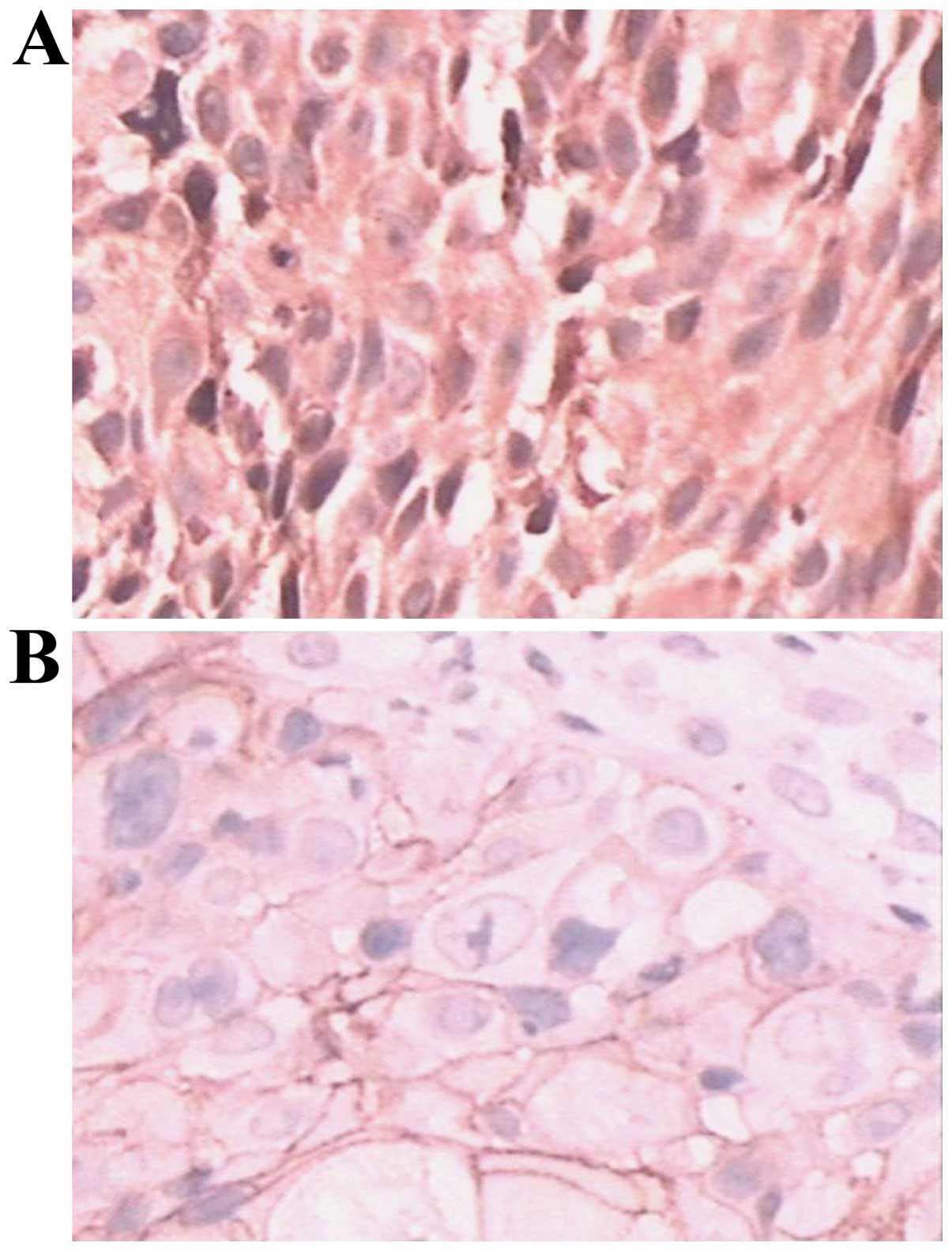
Abnormal expression of E-cad was observed in NSCLC tissue and the staining demonstrated light-yellow to brown granules. E-cad expression was located on the cell membrane, with a few granules in the cytoplasm (Fig. 1A). A positive expression of Oct-4 was observed in the NSCLC tissue, and the staining demonstrated brown granules. Oct-4 expression was located on the cell membrane (Fig. 1B). The abnormal expression of E-cad and positive expression of Oct-4 in the NSCLC specimens was higher than that of the normal lung tissue, and statistically significant (P<0.05). The expression of Oct-4 and E-cad were associated with the pathological grade and clinical stage of the patient, and were increased as the NSCLC malignancy increased. The differences in each grade and each stage were statistically significant (P<0.05) (Table I).

Figure 1.

(A) Expression of E-cadherin in non-small-cell lung cancer (NSCLC) tissue [hematoxylin and eosin (H&E); maginification, ×100]. (B) Expression of octamer-binding transcription factor 4 in NSCLC tissue (H&E; maginification, ×100).

Table I.

Correlation between the expression of Oct-4 and E-cad in NSCLC tissue and between pathological grade and clinical stage.

Table I.

Correlation between the expression of Oct-4 and E-cad in NSCLC tissue and between pathological grade and clinical stage.

Oct-4 E-cad


GroupNo. of casesNo. of positive cases (%)P-valueNo. of abnormal expression cases (%)P-value
Normal lung tissue15  0 (0.00)   2 (13.3)
Pathological grade
  High differentiation13     4 (30.77)     3 (23.08)
  Medium differentiation30  16 (53.33)0.009a  19 (63.33)0.002a
  Low differentiation22  18 (81.82)   18 (81.82)
Clinical stage
  0-I  9     2 (22.22)     1 (11.11)
  II–III31  18 (58.06)0.034a  18 (58.06)0.001a
  IV25  18 (72.00)   21 (84.00)

a P<0.05. Oct-4, octamer-binding transcription factor 4; E-cad, E-cadherin; NSCLC, non-small-cell lung cancer.

Correlation between Oct-4 and E-cad expression

Of the 65 NSCLC specimens, the abnormal expression rate of E-cad was 61.54% and the positive expression rate of Oct-4 was 58.46% (Table II). The difference between E-cad and Oct-4 was statistically significant (P=0.000, coefficient of contingency=0.439), and demonstrated that E-cad expression was correlated with Oct-4 expression.

Table II.

Correlation between Oct-4 and E-cad expression.

Table II.

Correlation between Oct-4 and E-cad expression.

E-cadOct-4


CharacteristicsNegativePositiveTotalP-value
Normal expression18725
Abnormal expression931400.000a
In total273865

a P<0.05. Oct-4, octamer-binding transcription factor 4; E-cad, E-cadherin.

Discussion

Invasion and metastasis are basic characteristics of malignant tumor. Tumor invasion and metastasis includes three key features: decreased adhesion, degraded matrix and enhanced migration, and EMT attributes to these features. E-cad is distributed in various epithelial cells and may mediate cell adhesion. The most important EMT tumor marker is the downregulation or silencing of E-cad, which is considered as the prerequisite for the ability of invasion and metastasis of epithelial cells (6). The findings of the present study have demonstrated that the increase in abnormal expression of E-cad in the NSCLC specimens was higher than that of the normal lung tissue, and the result was statistically significant. The decreased NSCLC differentiation level and increased clinical stage led to the abnormal expression of E-cad being increased, and the result was statistically significant.

Tumor stem cells are the cells that are characteristic of self-renewal with differentiation potential, and contribute to tumor relapse, metastasis and drug resistance (7). The expression of Oct-4 is a marker of tumor stem cells. Tumor cells with a positive Oct-4 expression have increased tumorigenic capacity in vitro and the characteristics of tumor stem cells. Akunuru et al (8) reported that although tumor stem cells have various phenotypes, they can express the genes of pluripotent stem cells, particularly Oct-4. The overexpression of Oct-4 protein may enhance tumor malignancy and promote tumor growth (9). The results of the present study have demonstrated that Oct-4 was not expressed in normal lung tissue. This indicates that the normal lung tissue achieved developmental maturation and lost the differentiation ability. The expression of Oct-4 was higher in NSCLC tissue compared to the normal lung tissue. This finding suggested that the expression of Oct-4 was associated with NSCLC pathogenesis, as well as pathological grade and clinical stage. Thus, the positive expression of Oct-4 is associated with NSCLC pathogenesis.

Tumor stem cells have the characteristics of mesenchymal cells. The tumor microenvironment theory suggests that the tumor epithelial cells may have the characteristics of mesenchymal cells after EMT. This finding indicates that the formation of tumor stem cells is associated with the EMT of tumor cells. It was previously reported that the EMT promoted mammary epithelial cells and breast cancer cells to acquire the properties of stem cells, leading to limitless proliferation and cell growth (3). The tumorigenicity of tumor cells was significantly increased after EMT, indicating that EMT is associated with the formation of tumor stem cells (10). Our results have demonstrated that the positive expression of Oct-4 was associated with the abnormal expression of E-cad, i.e., the expression of Oct-4 may be associated with the EMT of NSCLC.

In summary, Oct-4 is highly expressed in NSCLC tissue, and is a potential new biomarker of NSCLC pathogenesis, development and differentiation. Currently, E-cadherin is considered as a tumor suppressor. The downregulation or deficiency of E-cadherin can induce EMT, leading to invasion and metastasis of tumor cells. Specific therapy against tumor stem cells may block EMT, which is a promising target of NSCLC therapy, and can assist in the clinical treatment of NSCLC.

References

1 

Siegel R, DeSantis C, Virgo K, Stein K, Mariotto A, Smith T, Cooper D, Gansler T, Lerro C, Fedewa S, et al: Cancer treatment and survivorship statistics, 2012. CA Cancer J Clin. 62:220–241. 2012. View Article : Google Scholar : PubMed/NCBI

2 

Kellner S and Kikyo N: Transcriptional regulation of the Oct4 gene, a master gene for pluripotency. Histol Histopathol. 25:405–412. 2010.PubMed/NCBI

3 

Guarino M: Epithelial-mesenchymal transition and tumour invasion. Int J Biochem Cell Biol. 39:2153–2160. 2007. View Article : Google Scholar : PubMed/NCBI

4 

Dong C, Tu J, Tao L, et al: The expression of OCT4 and miRNA 155 in non-small lung cancer tissue and the relationship to clinical pathogenic features. Res Cancer Prev Treat. 40:776–780. 2013.

5 

Mahler-Araujo B, Savage K, Parry S and Reis-Filho JS: Reduction of E-cadherin expression is associated with non-lobular breast carcinomas of basal-like and triple negative phenotype. J Clin Pathol. 61:615–620. 2008. View Article : Google Scholar : PubMed/NCBI

6 

Berx G and van Roy F: Involvement of members of the cadherin superfamily in cancer. Cold Spring Harb Perspect Biol. 1:a0031292009. View Article : Google Scholar : PubMed/NCBI

7 

Millane RC, Kanska J, Duffy DJ, Seoighe C, Cunningham S, Plickert G and Frank U: Induced stem cell neoplasia in a cnidarian by ectopic expression of a POU domain transcription factor. Development. 138:2429–2439. 2011. View Article : Google Scholar : PubMed/NCBI

8 

Akunuru S, James Zhai Q and Zheng Y: Non-small cell lung cancer stem/progenitor cells are enriched in multiple distinct phenotypic subpopulations and exhibit plasticity. Cell Death Dis. 3:e3522012. View Article : Google Scholar : PubMed/NCBI

9 

Hu J, Qin K, Zhang Y, Gong J, Li N, Lv D, Xiang R and Tan X: Downregulation of transcription factor Oct4 induces an epithelial-to-mesenchymal transition via enhancement of Ca2+ influx in breast cancer cells. Biochem Biophys Res Commun. 411:786–791. 2011. View Article : Google Scholar : PubMed/NCBI

10 

Mani SA, Guo W, Liao MJ, Eaton EN, Ayyanan A, Zhou AY, Brooks M, Reinhard F, Zhang CC, Shipitsin M, et al: The epithelial-mesenchymal transition generates cells with properties of stem cells. Cell. 133:704–715. 2008. View Article : Google Scholar : PubMed/NCBI

Related Articles

  • Abstract
  • View
  • Download
  • Twitter
Copy and paste a formatted citation
Spandidos Publications style
Li L, Lv Y, Zhang Y, He L and Zhang H: Expression and clinical significance of Oct‑4 and E‑cad in non‑small‑cell lung cancer. Oncol Lett 11: 234-236, 2016.
APA
Li, L., Lv, Y., Zhang, Y., He, L., & Zhang, H. (2016). Expression and clinical significance of Oct‑4 and E‑cad in non‑small‑cell lung cancer. Oncology Letters, 11, 234-236. https://doi.org/10.3892/ol.2015.3856
MLA
Li, L., Lv, Y., Zhang, Y., He, L., Zhang, H."Expression and clinical significance of Oct‑4 and E‑cad in non‑small‑cell lung cancer". Oncology Letters 11.1 (2016): 234-236.
Chicago
Li, L., Lv, Y., Zhang, Y., He, L., Zhang, H."Expression and clinical significance of Oct‑4 and E‑cad in non‑small‑cell lung cancer". Oncology Letters 11, no. 1 (2016): 234-236. https://doi.org/10.3892/ol.2015.3856
Copy and paste a formatted citation
x
Spandidos Publications style
Li L, Lv Y, Zhang Y, He L and Zhang H: Expression and clinical significance of Oct‑4 and E‑cad in non‑small‑cell lung cancer. Oncol Lett 11: 234-236, 2016.
APA
Li, L., Lv, Y., Zhang, Y., He, L., & Zhang, H. (2016). Expression and clinical significance of Oct‑4 and E‑cad in non‑small‑cell lung cancer. Oncology Letters, 11, 234-236. https://doi.org/10.3892/ol.2015.3856
MLA
Li, L., Lv, Y., Zhang, Y., He, L., Zhang, H."Expression and clinical significance of Oct‑4 and E‑cad in non‑small‑cell lung cancer". Oncology Letters 11.1 (2016): 234-236.
Chicago
Li, L., Lv, Y., Zhang, Y., He, L., Zhang, H."Expression and clinical significance of Oct‑4 and E‑cad in non‑small‑cell lung cancer". Oncology Letters 11, no. 1 (2016): 234-236. https://doi.org/10.3892/ol.2015.3856
Follow us
  • Twitter
  • LinkedIn
  • Facebook
About
  • Spandidos Publications
  • Careers
  • Cookie Policy
  • Privacy Policy
How can we help?
  • Help
  • Live Chat
  • Contact
  • Email to our Support Team