Spandidos Publications Logo
  • About
    • About Spandidos
    • Aims and Scopes
    • Abstracting and Indexing
    • Editorial Policies
    • Reprints and Permissions
    • Job Opportunities
    • Terms and Conditions
    • Contact
  • Journals
    • All Journals
    • Oncology Letters
      • Oncology Letters
      • Information for Authors
      • Editorial Policies
      • Editorial Board
      • Aims and Scope
      • Abstracting and Indexing
      • Bibliographic Information
      • Archive
    • International Journal of Oncology
      • International Journal of Oncology
      • Information for Authors
      • Editorial Policies
      • Editorial Board
      • Aims and Scope
      • Abstracting and Indexing
      • Bibliographic Information
      • Archive
    • Molecular and Clinical Oncology
      • Molecular and Clinical Oncology
      • Information for Authors
      • Editorial Policies
      • Editorial Board
      • Aims and Scope
      • Abstracting and Indexing
      • Bibliographic Information
      • Archive
    • Experimental and Therapeutic Medicine
      • Experimental and Therapeutic Medicine
      • Information for Authors
      • Editorial Policies
      • Editorial Board
      • Aims and Scope
      • Abstracting and Indexing
      • Bibliographic Information
      • Archive
    • International Journal of Molecular Medicine
      • International Journal of Molecular Medicine
      • Information for Authors
      • Editorial Policies
      • Editorial Board
      • Aims and Scope
      • Abstracting and Indexing
      • Bibliographic Information
      • Archive
    • Biomedical Reports
      • Biomedical Reports
      • Information for Authors
      • Editorial Policies
      • Editorial Board
      • Aims and Scope
      • Abstracting and Indexing
      • Bibliographic Information
      • Archive
    • Oncology Reports
      • Oncology Reports
      • Information for Authors
      • Editorial Policies
      • Editorial Board
      • Aims and Scope
      • Abstracting and Indexing
      • Bibliographic Information
      • Archive
    • Molecular Medicine Reports
      • Molecular Medicine Reports
      • Information for Authors
      • Editorial Policies
      • Editorial Board
      • Aims and Scope
      • Abstracting and Indexing
      • Bibliographic Information
      • Archive
    • World Academy of Sciences Journal
      • World Academy of Sciences Journal
      • Information for Authors
      • Editorial Policies
      • Editorial Board
      • Aims and Scope
      • Abstracting and Indexing
      • Bibliographic Information
      • Archive
    • International Journal of Functional Nutrition
      • International Journal of Functional Nutrition
      • Information for Authors
      • Editorial Policies
      • Editorial Board
      • Aims and Scope
      • Abstracting and Indexing
      • Bibliographic Information
      • Archive
    • International Journal of Epigenetics
      • International Journal of Epigenetics
      • Information for Authors
      • Editorial Policies
      • Editorial Board
      • Aims and Scope
      • Abstracting and Indexing
      • Bibliographic Information
      • Archive
    • Medicine International
      • Medicine International
      • Information for Authors
      • Editorial Policies
      • Editorial Board
      • Aims and Scope
      • Abstracting and Indexing
      • Bibliographic Information
      • Archive
  • Articles
  • Information
    • Information for Authors
    • Information for Reviewers
    • Information for Librarians
    • Information for Advertisers
    • Conferences
  • Language Editing
Spandidos Publications Logo
  • About
    • About Spandidos
    • Aims and Scopes
    • Abstracting and Indexing
    • Editorial Policies
    • Reprints and Permissions
    • Job Opportunities
    • Terms and Conditions
    • Contact
  • Journals
    • All Journals
    • Biomedical Reports
      • Information for Authors
      • Editorial Policies
      • Editorial Board
      • Aims and Scope
      • Abstracting and Indexing
      • Bibliographic Information
      • Archive
    • Experimental and Therapeutic Medicine
      • Information for Authors
      • Editorial Policies
      • Editorial Board
      • Aims and Scope
      • Abstracting and Indexing
      • Bibliographic Information
      • Archive
    • International Journal of Epigenetics
      • Information for Authors
      • Editorial Policies
      • Editorial Board
      • Aims and Scope
      • Abstracting and Indexing
      • Bibliographic Information
      • Archive
    • International Journal of Functional Nutrition
      • Information for Authors
      • Editorial Policies
      • Editorial Board
      • Aims and Scope
      • Abstracting and Indexing
      • Bibliographic Information
      • Archive
    • International Journal of Molecular Medicine
      • Information for Authors
      • Editorial Policies
      • Editorial Board
      • Aims and Scope
      • Abstracting and Indexing
      • Bibliographic Information
      • Archive
    • International Journal of Oncology
      • Information for Authors
      • Editorial Policies
      • Editorial Board
      • Aims and Scope
      • Abstracting and Indexing
      • Bibliographic Information
      • Archive
    • Medicine International
      • Information for Authors
      • Editorial Policies
      • Editorial Board
      • Aims and Scope
      • Abstracting and Indexing
      • Bibliographic Information
      • Archive
    • Molecular and Clinical Oncology
      • Information for Authors
      • Editorial Policies
      • Editorial Board
      • Aims and Scope
      • Abstracting and Indexing
      • Bibliographic Information
      • Archive
    • Molecular Medicine Reports
      • Information for Authors
      • Editorial Policies
      • Editorial Board
      • Aims and Scope
      • Abstracting and Indexing
      • Bibliographic Information
      • Archive
    • Oncology Letters
      • Information for Authors
      • Editorial Policies
      • Editorial Board
      • Aims and Scope
      • Abstracting and Indexing
      • Bibliographic Information
      • Archive
    • Oncology Reports
      • Information for Authors
      • Editorial Policies
      • Editorial Board
      • Aims and Scope
      • Abstracting and Indexing
      • Bibliographic Information
      • Archive
    • World Academy of Sciences Journal
      • Information for Authors
      • Editorial Policies
      • Editorial Board
      • Aims and Scope
      • Abstracting and Indexing
      • Bibliographic Information
      • Archive
  • Articles
  • Information
    • For Authors
    • For Reviewers
    • For Librarians
    • For Advertisers
    • Conferences
  • Language Editing
Login Register Submit
  • This site uses cookies
  • You can change your cookie settings at any time by following the instructions in our Cookie Policy. To find out more, you may read our Privacy Policy.

    I agree
Search articles by DOI, keyword, author or affiliation
Search
Advanced Search
presentation
Oncology Letters
Join Editorial Board Propose a Special Issue
Print ISSN: 1792-1074 Online ISSN: 1792-1082
Journal Cover
January-2016 Volume 11 Issue 1

Full Size Image

Sign up for eToc alerts
Recommend to Library

Journals

International Journal of Molecular Medicine

International Journal of Molecular Medicine

International Journal of Molecular Medicine is an international journal devoted to molecular mechanisms of human disease.

International Journal of Oncology

International Journal of Oncology

International Journal of Oncology is an international journal devoted to oncology research and cancer treatment.

Molecular Medicine Reports

Molecular Medicine Reports

Covers molecular medicine topics such as pharmacology, pathology, genetics, neuroscience, infectious diseases, molecular cardiology, and molecular surgery.

Oncology Reports

Oncology Reports

Oncology Reports is an international journal devoted to fundamental and applied research in Oncology.

Experimental and Therapeutic Medicine

Experimental and Therapeutic Medicine

Experimental and Therapeutic Medicine is an international journal devoted to laboratory and clinical medicine.

Oncology Letters

Oncology Letters

Oncology Letters is an international journal devoted to Experimental and Clinical Oncology.

Biomedical Reports

Biomedical Reports

Explores a wide range of biological and medical fields, including pharmacology, genetics, microbiology, neuroscience, and molecular cardiology.

Molecular and Clinical Oncology

Molecular and Clinical Oncology

International journal addressing all aspects of oncology research, from tumorigenesis and oncogenes to chemotherapy and metastasis.

World Academy of Sciences Journal

World Academy of Sciences Journal

Multidisciplinary open-access journal spanning biochemistry, genetics, neuroscience, environmental health, and synthetic biology.

International Journal of Functional Nutrition

International Journal of Functional Nutrition

Open-access journal combining biochemistry, pharmacology, immunology, and genetics to advance health through functional nutrition.

International Journal of Epigenetics

International Journal of Epigenetics

Publishes open-access research on using epigenetics to advance understanding and treatment of human disease.

Medicine International

Medicine International

An International Open Access Journal Devoted to General Medicine.

Journal Cover
January-2016 Volume 11 Issue 1

Full Size Image

Sign up for eToc alerts
Recommend to Library

  • Article
  • Citations
    • Cite This Article
    • Download Citation
    • Create Citation Alert
    • Remove Citation Alert
    • Cited By
  • Similar Articles
    • Related Articles (in Spandidos Publications)
    • Similar Articles (Google Scholar)
    • Similar Articles (PubMed)
  • Download PDF
  • Download XML
  • View XML
Case Report

Paraganglioma of the urinary bladder with chromosome duplications detected by fluorescence in situ hybridization in urine exfoliated cells: A case report

  • Authors:
    • Chunguang Yang
    • Zheng Liu
    • Ruzhu Lan
    • Zhihua Wang
    • Zhiquan Hu
    • Zhiqiang Chen
    • Zhangqun Ye
  • View Affiliations / Copyright

    Affiliations: Department of Urology, Tongji Hospital, Tongji Medical College, Huazhong University of Science and Technology, Wuhan, Hubei 430030, P.R. China
  • Pages: 795-797
    |
    Published online on: November 18, 2015
       https://doi.org/10.3892/ol.2015.3941
  • Expand metrics +
Metrics: Total Views: 0 (Spandidos Publications: | PMC Statistics: )
Metrics: Total PDF Downloads: 0 (Spandidos Publications: | PMC Statistics: )
Cited By (CrossRef): 0 citations Loading Articles...

This article is mentioned in:


Abstract

Paragangliomas of the urinary bladder are rare neoplasms derived from chromaffin tissue with a chromosomal imbalance. Their preoperative diagnosis and assessment of malignant potential remain significant challenges for urologists. The current report presents the case of a 34‑year‑old male who presented with a history of paroxysmal gross hematuria lasting for 7 months. Chromosome duplications were detected by fluorescence in situ hybridization (FISH) in urine exfoliated cells, and the diagnosis was confirmed by histopathology following a transurethral resection. To the best of our knowledge, this is the first reported case of urinary bladder paraganglioma in which chromosomal duplications were detected by FISH in urine exfoliated cells. This may be helpful to its differential diagnosis and malignant potential determination.

Introduction

Derived from chromaffin tissue of the sympathetic nervous system, paragangliomas have the potential to secrete catecholamines, accounting for several of the predominant symptoms of functional paragangliomas. The common presentation of urinary bladder paraganglioma is painless haematura, paroxysmal hypertension, headache, palpitation and anxiety (1). Metastasis to the lymph nodes and invasion of adjacent organs indicate the malignant potential (2). Urinary bladder paragangliomas are rare neoplasms constituting only 0.06% of all bladder tumors (1). The preoperative diagnosis and assessment of malignant potential of paragangliomas, particularly non-functional paragangliomas, present significant challenges for urologists (3). Tumor-specific patterns of chromosomal imbalances characterize almost all forms of neoplasm, and have been used in the diagnosis and malignancy determination of many tumors (4). For example, multiprobe fluorescence in situ hybridization (FISH) analysis of exfoliated cells in the urine has been approved for use in the detection of recurrent urothelial carcinoma and the evaluation of hematuria, as FISH exhibits a higher sensitivity compared with conventional cytology in detecting urothelial carcinoma (81 vs. 58%) (5).

To the best of our knowledge, the current study is the first report of a case of a urinary bladder paraganglioma in which chromosome duplications were detected by fluorescence in situ hybridization (FISH) in exfoliated cells in the urine. This may be helpful to its preoperative diagnosis and malignant potential determination.

Case report

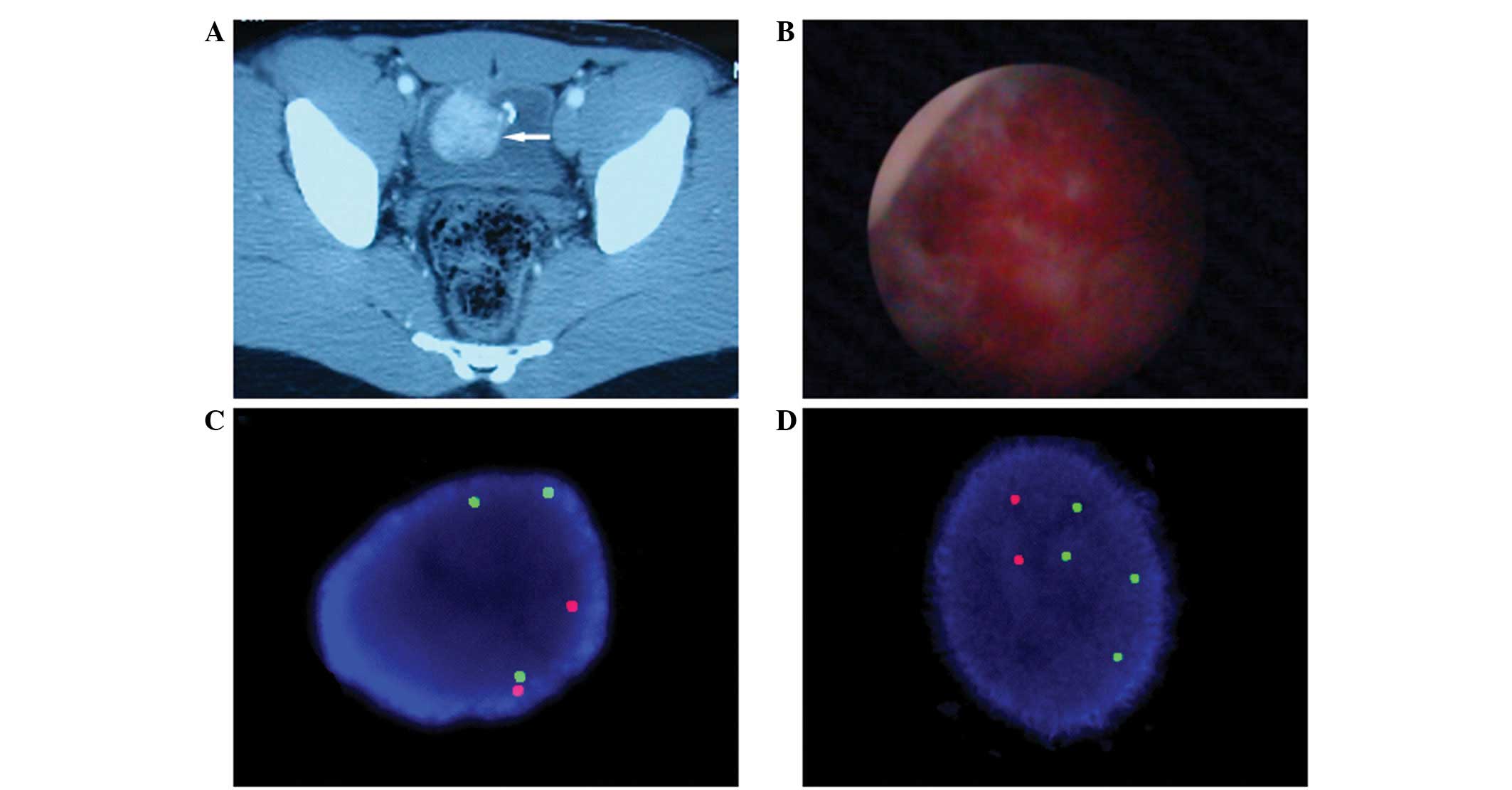
A 34-year-old male complaining of paroxysmal gross hematuria lasting for 7 months was admitted to Tongji Hospital (Wuhan, China). His medical and family history were unremarkable. General examination, including blood pressure and heart rate, yielded results within the normal range. Abdominal computed tomography (CT) imaging revealed a 3.6×3.9-cm mass on the dome of the bladder, which exhibited intense uniform enhancement on a contrast study (Fig. 1A). There was no indication of lymph node involvement or invasion to the surrounding structures. Cystoscopy revealed a 3×4-cm submucosal neoplasm on the dome of the bladder, partly covered by normal urothelium (Fig. 1B). A biopsy of the neoplasm was conducted, revealing a highly vascular tumor. FISH of exfoliated cells in the urine indicated the presence of duplications of chromosomes 3 and 17 (Fig. 1C and D).

Figure 1.

(A) Computed tomography of a 34-year-old male patient revealed a 3.6×3.9-cm mass on the dome of the bladder with intense uniform enhancement (arrow). (B) Cystoscopy revealed a 3×4-cm submucosal neoplasm on the dome of the bladder with ulceration and a rich blood supply. (C) Fluorescence in situ hybridization of chromosomes 17 (green) and 9p16 (red) in urine exfoliated cells revealed polysomy of chromosome 17. (D) Fluorescence in situ hybridization of chromosomes 3 (green) and 7 (red) in urine exfoliated cells revealed polysomy of chromosome 3.

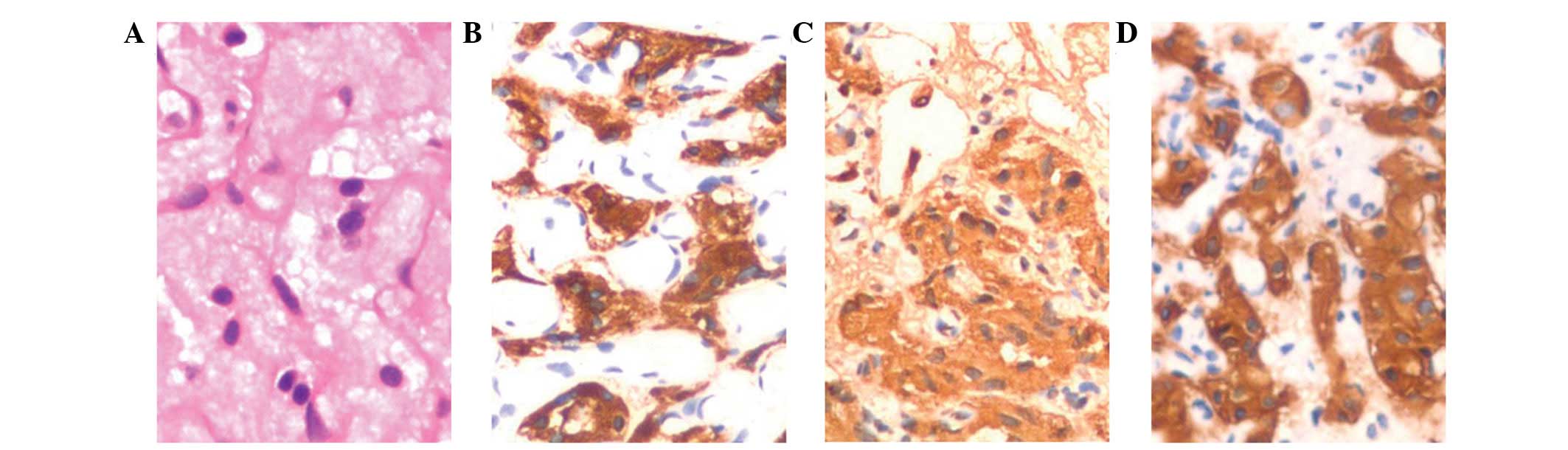
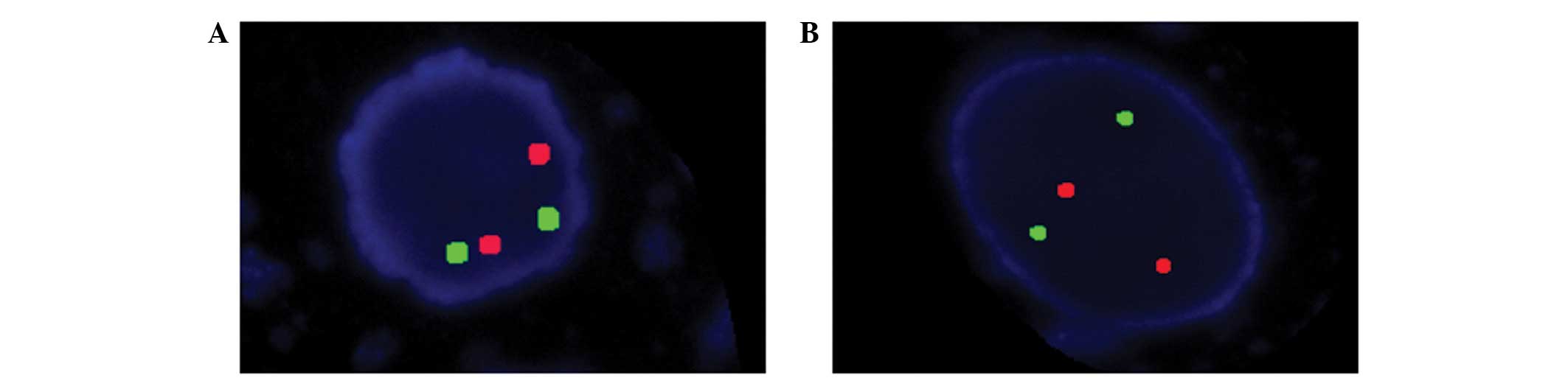
Upon diagnosis of the bladder tumor, a transurethral resection was performed. During the surgery, no hypertension occurred. On microscopic examination of the resected specimen, nested spindle cells were observed (Fig. 2A). Immunohistochemical staining revealed positive reactivity for chromogranin A, S-100 protein, CD56 and synaptophysin, as well as negative reactivity for cytokeratins 7, 8 and 18, confirming the diagnosis of paraganglioma (Fig. 2B, C and D). Following surgery, FISH of exfoliated cells in the urine showed no chromosomal duplications (Fig. 3). Further treatment was avoided as no tumor cells were observed in the deep muscle layer. At 2 years after the surgery, the patient remained disease-free. Written informed consent was obtained from the patient for inclusion in the present study.

Figure 2.

(A) Microscopic examination revealed nested spindle cells (hematoxylin and eosin staining; magnification, ×400). The tumor cells were positive for (B) synaptophysin, (C) chromogranin A and (D) CD56 (magnification, ×200).

Figure 3.

Fluorescence in situ hybridization of urine exfoliated cells following surgery did not reveal any duplications of (A) chromosomes 17 (green) and 9p16 (red) or (B) chromosomes 3 (green) and 7 (red).

Discussion

Histological and immunohistochemical staining is often used for the definitive diagnosis of paragangliomas; however, their determination of malignant potential remains a challenge for urologists and pathologists (6). Chromosomal imbalances have become a new parameter to predict the assessment of malignant potential of paraganglioma (7). As summarized by Schaefer et al (7), gains or losses of chromosomes 1, 3, 6, 7, 8, 9, 11, 16, 17, 19, 20, 21 and 22 in paragangliomas have been reported. Furthermore, a gain of 17p has been implicated in increased probability of progression to malignancy (8). A previous comparative genomic hybridization study was the first to identify that paraganglioma of the urinary bladder shares common chromosomal imbalances with other paragangliomas and related pheochromocytomas (7). Similarly, multiprobe FISH analysis of exfoliated cells in the urine may identify specific abnormalities in chromosomes 3 and 17, in addition to others (9). As a non-invasive method, it has been approved for use in the detection of recurrent urothelial carcinoma and the evaluation of hematuria (9). In the current patient, chromosome duplications in paraganglioma tissue were detected by FISH in exfoliated cells in the urine, which is helpful to determine the malignant potential of paraganglioma. However, the precise association between chromosome duplications and the malignant potential of paraganglioma requires further research.

In the present case, the submucosal neoplasm of the urinary bladder with intense uniform enhancement, and the results of the preoperative histological analysis, were indicative of hemangioma. However, duplications of chromosomes 3 or 17 have not been reported in cases of hemangioma of the urinary bladder, providing a clue for their differential diagnosis. Furthermore, bladder neoplasms with positive FISH results are commonly considered to be urothelial carcinomas (9). It is indicated that submucosal tumors, such as paraganglioma, with chromosome duplications and ulceration, may shed into the urine and be detected. Thus, if FISH of urine exfoliated cells from a patient with a neoplasm of the urinary system, such as a urothelial carcinoma and submucosal tumor, reveals positive results, then chromosome duplication and ulceration should be considered, as shown in the current case report.

In conclusion, the preoperative diagnosis and malignant potential predication of urinary bladder paraganglioma present significant challenges for urologists, and is currently limited to evaluation of specific symptoms, imaging investigations and histological analysis of tissue biopsies. As in the current case, chromosome duplications of urinary bladder paraganglioma detected by FISH in urine exfoliated cells have the potential to provide additional information. This may facilitate the differential diagnosis and malignant determination of patients with urinary bladder paraganglioma.

Acknowledgements

The authors would like to thank Professor Hua Xu (Department of Urology, Tongji Hospital, Tongji Medical College, Huazhong University of Science and Technology) for technical assistance in the analysis of the FISH studies.

References

1 

Leestma JE and Price EB Jr: Paraganglioma of the urinary bladder. Cancer. 28:1063–1073. 1971. View Article : Google Scholar : PubMed/NCBI

2 

Ansari MS, Goel A, Goel S, Durairajan LN and Seth A: Malignant paraganglioma of the urinary bladder. A case report. Int Urol Nephrol 2001. 33:343–345. 2001. View Article : Google Scholar

3 

Lai Y, Chen D, Yu Z, Ni L and Yang S: Non-functioning paraganglioma of the urinary bladder: A case report and review of the literature. Oncol Lett. 7:891–893. 2014.PubMed/NCBI

4 

Stallings RL: Are chromosomal imbalances important in cancer? Trends Genet. 23:278–283. 2007. View Article : Google Scholar : PubMed/NCBI

5 

Halling KC, King W, Sokolova IA, Meyer RG, Burkhardt HM, Halling AC, Cheville JC, Sebo TJ, Ramakumar S, Stewart CS, et al: A comparison of cytology and fluorescence in situ hybridization for the detection of urothelial carcinoma. J Urol. 164:1768–1775. 2000. View Article : Google Scholar : PubMed/NCBI

6 

Kang WY, Shen JT and Chai CY: Paraganglioma of the urinary bladder: A case report. Kaohsiung J Med Sci. 19:136–140. 2003. View Article : Google Scholar : PubMed/NCBI

7 

Schaefer IM, Gunawan B, Füzesi L, Blech M, Frasunek J and Loertzer H: Chromosomal imbalances in urinary bladder paraganglioma. Cancer Genet Cytogenet. 203:341–344. 2010. View Article : Google Scholar : PubMed/NCBI

8 

August C, August K, Schroeder S, Bahn H, Hinze R, Baba HA, Kersting C and Buerger H: CGH and CD 44/MIB-1 immunohistochemistry are helpful to distinguish metastasized from nonmetastasized sporadic pheochromocytomas. Mod Pathol. 17:1119–1128. 2004. View Article : Google Scholar : PubMed/NCBI

9 

Caraway NP and Katz RL: A review on the current state of urine cytology emphasizing the role of fluorescence in situ hybridization as an adjunct to diagnosis. Cancer Cytopathol. 118:175–183. 2010. View Article : Google Scholar : PubMed/NCBI

Related Articles

  • Abstract
  • View
  • Download
  • Twitter
Copy and paste a formatted citation
Spandidos Publications style
Yang C, Liu Z, Lan R, Wang Z, Hu Z, Chen Z and Ye Z: Paraganglioma of the urinary bladder with chromosome duplications detected by fluorescence in situ hybridization in urine exfoliated cells: A case report. Oncol Lett 11: 795-797, 2016.
APA
Yang, C., Liu, Z., Lan, R., Wang, Z., Hu, Z., Chen, Z., & Ye, Z. (2016). Paraganglioma of the urinary bladder with chromosome duplications detected by fluorescence in situ hybridization in urine exfoliated cells: A case report. Oncology Letters, 11, 795-797. https://doi.org/10.3892/ol.2015.3941
MLA
Yang, C., Liu, Z., Lan, R., Wang, Z., Hu, Z., Chen, Z., Ye, Z."Paraganglioma of the urinary bladder with chromosome duplications detected by fluorescence in situ hybridization in urine exfoliated cells: A case report". Oncology Letters 11.1 (2016): 795-797.
Chicago
Yang, C., Liu, Z., Lan, R., Wang, Z., Hu, Z., Chen, Z., Ye, Z."Paraganglioma of the urinary bladder with chromosome duplications detected by fluorescence in situ hybridization in urine exfoliated cells: A case report". Oncology Letters 11, no. 1 (2016): 795-797. https://doi.org/10.3892/ol.2015.3941
Copy and paste a formatted citation
x
Spandidos Publications style
Yang C, Liu Z, Lan R, Wang Z, Hu Z, Chen Z and Ye Z: Paraganglioma of the urinary bladder with chromosome duplications detected by fluorescence in situ hybridization in urine exfoliated cells: A case report. Oncol Lett 11: 795-797, 2016.
APA
Yang, C., Liu, Z., Lan, R., Wang, Z., Hu, Z., Chen, Z., & Ye, Z. (2016). Paraganglioma of the urinary bladder with chromosome duplications detected by fluorescence in situ hybridization in urine exfoliated cells: A case report. Oncology Letters, 11, 795-797. https://doi.org/10.3892/ol.2015.3941
MLA
Yang, C., Liu, Z., Lan, R., Wang, Z., Hu, Z., Chen, Z., Ye, Z."Paraganglioma of the urinary bladder with chromosome duplications detected by fluorescence in situ hybridization in urine exfoliated cells: A case report". Oncology Letters 11.1 (2016): 795-797.
Chicago
Yang, C., Liu, Z., Lan, R., Wang, Z., Hu, Z., Chen, Z., Ye, Z."Paraganglioma of the urinary bladder with chromosome duplications detected by fluorescence in situ hybridization in urine exfoliated cells: A case report". Oncology Letters 11, no. 1 (2016): 795-797. https://doi.org/10.3892/ol.2015.3941
Follow us
  • Twitter
  • LinkedIn
  • Facebook
About
  • Spandidos Publications
  • Careers
  • Cookie Policy
  • Privacy Policy
How can we help?
  • Help
  • Live Chat
  • Contact
  • Email to our Support Team