Introduction
Gastric cancer is the fifth most common cancer in
the world, and is the third leading cause of cancer-associated
mortality (1). The ability to
recognize patients with early gastric cancer has gradually improved
due to a novel endoscopic approach that uses narrow band imaging.
The prognosis of patients has also improved, with 5-year survival
rates of 95–100% and 85–95% for mucosal and submucosal gastric
cancer, respectively (2). However,
certain patients with early gastric cancer develop and succumb to
recurrent disease or cancer-associated complications. The key cause
of disease recurrence is challenging to predict during the clinical
management of patients with early gastric cancer. By contrast, the
development of novel chemotherapy has improved the prognosis of
patients with unresectable, advanced or recurrent gastric cancer
(3). Although the prognosis of
patients with advanced gastric cancer is poor, for patients that
are recurrence-free there is a positive prognosis (3). However, predicting the postoperative
prognosis of patients with advanced gastric cancer is challenging.
Carcinoembryonic antigen (CEA) and carbohydrate antigen 19-9 (CA
19-9) have been used in clinical settings as conventional blood
markers of gastric cancer. However, the sensitivity and specificity
of immunoassays to detect these tumor markers, in order to identify
subclinical patients at high risk of recurrence, is clinically
limited (4).
Hepatocytes mainly synthesize fibrinogen, which is
an acute-phase reactant glycoprotein (5). Activated thrombin transforms fibrinogen
to fibrin in the coagulation cascade; therefore, fibrinogen is
important in the regulation of clot formation, wound healing, and
the inflammatory response (6).
Furthermore, previous studies have demonstrated that elevated
fibrinogen activity enhances tumor aggressiveness in several
malignancies, including esophageal, stomach and colorectal
carcinomas (7–9). Consequently, hyperfibrinogenemia is
associated with tumor progression and a poor prognosis for patients
with malignant disease (7–9).
The host immunosurveillance system is important in
the prevention of tumor progression, and an imbalance facilitates
tumor proliferation and metastasis (10). Previous studies have investigated the
clinical significance of the systemic inflammatory response during
tumor progression in various malignancies (11). The neutrophil-lymphocyte ratio (NLR)
is a representative index that may be used to assess the systemic
inflammatory response (12). Several
studies have associated an elevated, preoperative NLR with tumor
development and poor prognosis of patients with esophageal,
hepatocellular and colorectal cancer, including gastric cancer
(13–16). However, fibrinogen activity and the
NLR have not been simultaneously assessed as markers of tumor
progression and prognosis in patients with gastric cancer.
The present study aimed to determine the
preoperative fibrinogen concentrations and NLRs in patients with
gastric cancer, and to evaluate the association between these
values and clinicopathological characteristics, including
prognosis. The present study also assessed the clinical
applicability of combining the fibrinogen concentration with the
NLR (CFS-NLR) as a prognostic marker of gastric cancer.
Materials and methods
Patients
The present study enrolled 275 patients (179 men and
96 women; age range, 31–89 years; average age, 66 years) with
gastric cancer, who underwent gastrectomy with lymphadenectomy at
Kagoshima University Hospital (Kagoshima, Kagoshima, Japan) between
January 2000 and December 2011. A total of 87 patients that had
received endoscopic treatment, palliative resection or preoperative
chemotherapy or radiotherapy were excluded. The patients were
categorized and their tumors were staged based on the criteria in
the tumor-node-metastasis (TNM) classification of gastric carcinoma
established by the Union for International Cancer Control (17). Table I
reveals the clinicopathological characteristics of the patients
enrolled in the present study. All patients were followed up every
3–6 months subsequent to discharge from the hospital, by regular
clinical examinations, including tumor marker studies (CEA and
CA19-9), radiography, ultrasonography and computed tomography (CT)
scans at Kagoshima University Hospital. The median follow-up period
following surgery was 40 months (range, 1–123 months).
 | Table I.Clinicopathological characteristics of
275 patients with gastric cancer. |
Table I.
Clinicopathological characteristics of
275 patients with gastric cancer.
| Characteristics | n |
|---|
| Gender |
|
| Male | 179 |
|
Female | 96 |
| Age, years |
|
| ≤70 | 159 |
|
>70 | 116 |
| Histological
type |
|
|
Differentiated | 109 |
|
Undifferentiated | 166 |
| Depth of tumor
invasion |
|
| pT1 | 138 |
| pT2 | 17 |
| pT3 | 63 |
| pT4 | 57 |
| Lymph node
metastasis |
|
|
Negative | 145 |
|
Positive | 130 |
| Lymphatic
invasion |
|
|
Negative | 133 |
|
Positive | 142 |
| Venous
invasion |
|
|
Negative | 152 |
|
Positive | 123 |
| Tumor stage |
|
| I | 139 |
| II | 44 |
|
III | 64 |
| IV | 28 |
The Institutional Review Board of Kagoshima
University Hospital approved the present study (approval no.
25–39). Prior to surgery, written informed consent was obtained
from all the patients regarding the use and publication of their
information.
Fibrinogen levels and NLR in blood
samples
Blood specimens were pre-operatively collected to
quantify the fibrinogen concentrations and NLR. Plasma fibrinogen
concentrations were measured using an STA-R Coagulation Analyzer
1999 (Roche Diagnostics K.K., Tokyo, Japan). Neutrophils and
lymphocytes were counted using an XE-2100™ Automated Hematology
Analyzer (Sysmex Corporation, Kobe, Hyogo, Japan). The NLR was
calculated by dividing the neutrophil count by the lymphocyte
count.
Scoring system of modified Glasgow
prognostic score (mGPS)
The patients were divided into three groups, using
cutoff values adjusted in a previous study (18), as follows: Hypoalbuminemia (<3.8
g/dl) and a high C-reactive protein (CRP) (>0.5 mg/dl), (mGPS 2
group); either hypoalbuminemia or a high CRP, (mGPS 1 group); or
neither abnormality (mGPS 0 group).
Statistical analysis
The differences in the association between
fibrinogen concentrations or the NLR and categorical
clinicopathological characteristics were assessed using the
Wilcoxon signed-rank test. Receiver operating characteristic (ROC)
curves and the area under the curve (AUC) were used to assess the
predictive value of fibrinogen concentrations and NLR to
discriminate between gastric cancer patients with advanced stages
II–IV and those with early stage I. The association between CFS-NLR
and the clinicopathological characteristics was analyzed using the
χ2 test. Kaplan-Meier survival curves were generated,
and the differences in survival rate were determined using the
log-rank test. Prognostic factors were assessed by univariate and
multivariate analyses (Cox's proportional hazards regression
model). The data was analyzed using SAS/STAT® software (SAS
Institute Inc., Cary, NC, USA). P<0.05 was considered to
indicate a statistically significant difference.
Results
Fibrinogen concentrations and
clinicopathological characteristics
The present study initially investigated the
association between clinicopathological characteristics and
fibrinogen concentrations and assessed the clinical significance of
the association during tumor progression in 275 patients with
gastric cancer.
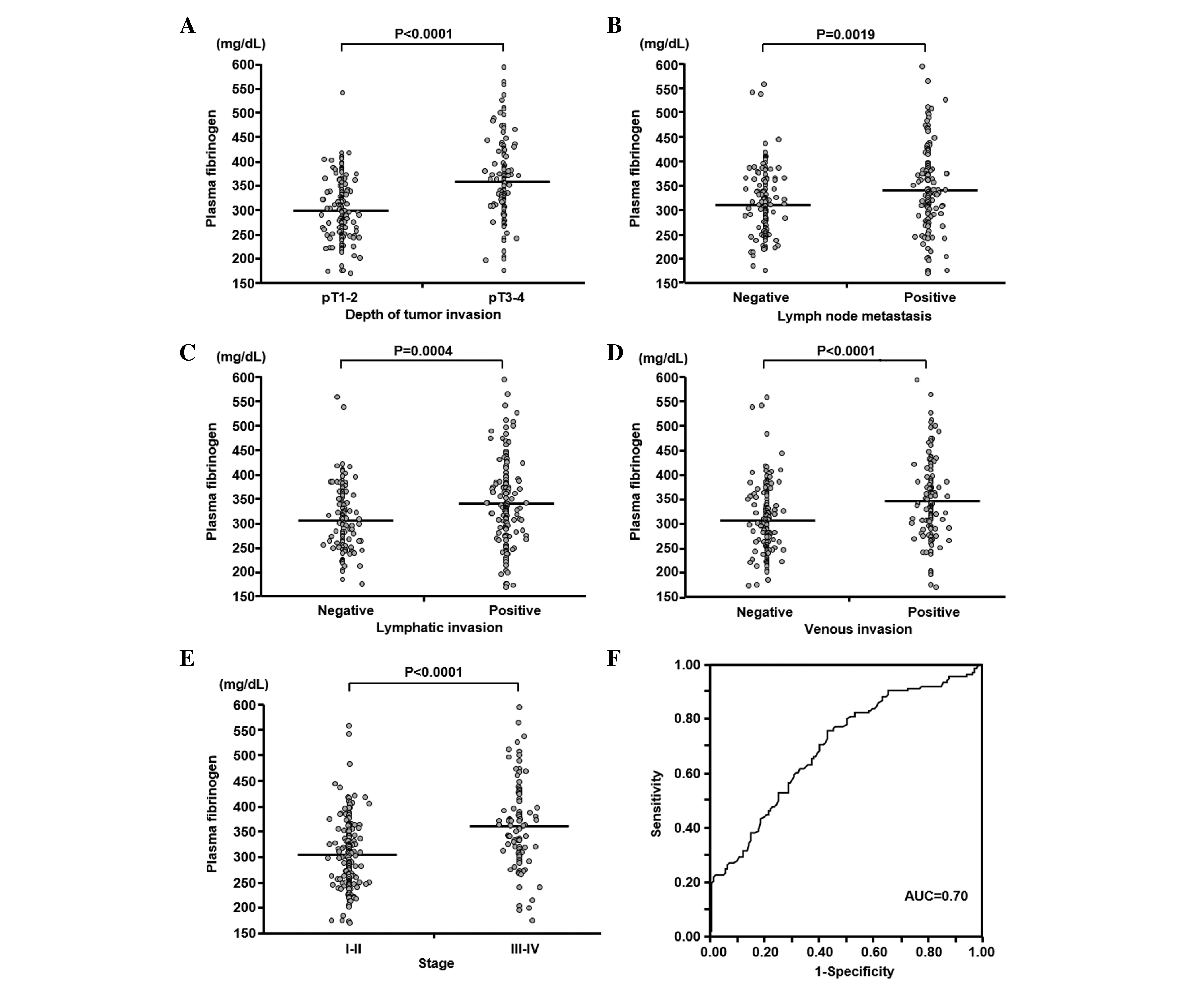
The mean concentration ± standard deviation (SD) and
the range of plasma fibrinogen concentrations were 326.5±76.7 mg/dl
and 171–595 mg/dl, respectively. The mean ± SD of the plasma
fibrinogen concentrations in patients with pT1-T2 (n=155) and pT3–4
(n=120) tumors were 300.6±61.5 and 360.0±81.5 mg/dl, respectively
(Fig. 1A). The plasma fibrinogen
concentration was significantly associated with the depth of tumor
invasion (P<0.0001). The mean ± SD of the plasma fibrinogen
concentrations were significantly higher in patients with lymph
node metastasis (n=130) than in patients without (n=145)
(341.9±84.1 and 312.8±66.8 mg/dl, respectively; P=0.0019; Fig. 1B). Furthermore, the plasma fibrinogen
concentrations were associated with lymphatic and venous invasion
(P=0.0004 and P<0.0001, respectively; Fig. 1C and D). The mean ± SD of the plasma
fibrinogen concentrations in stage I–II (n=183) and stage III–IV
(n=92) were 308.2±65.6 and 362.9±84.3 mg/dl, respectively (Fig. 1E). The tumor stage was also
significantly associated with plasma fibrinogen concentrations
(P<0.0001). The outcome of the ROC analysis demonstrated that
the sensitivity of the AUC value for discriminating between
patients with advanced and early gastric cancer based on plasma
fibrinogen concentrations was 0.70 (Fig.
1F). The cutoff plasma fibrinogen concentration was 305 mg/dl.
The sensitivity and specificity of the plasma fibrinogen
concentration was 0.76 and 0.57, respectively. The patients were
assigned to the high (n=163) or low (n=112) plasma fibrinogen
groups based on the cutoff value. This binary system in the plasma
fibrinogen level was used in subsequent analyses.
NLR and clinicopathological
characteristics
The present study also assessed the association
between the NLR and clinicopathological characteristics of patients
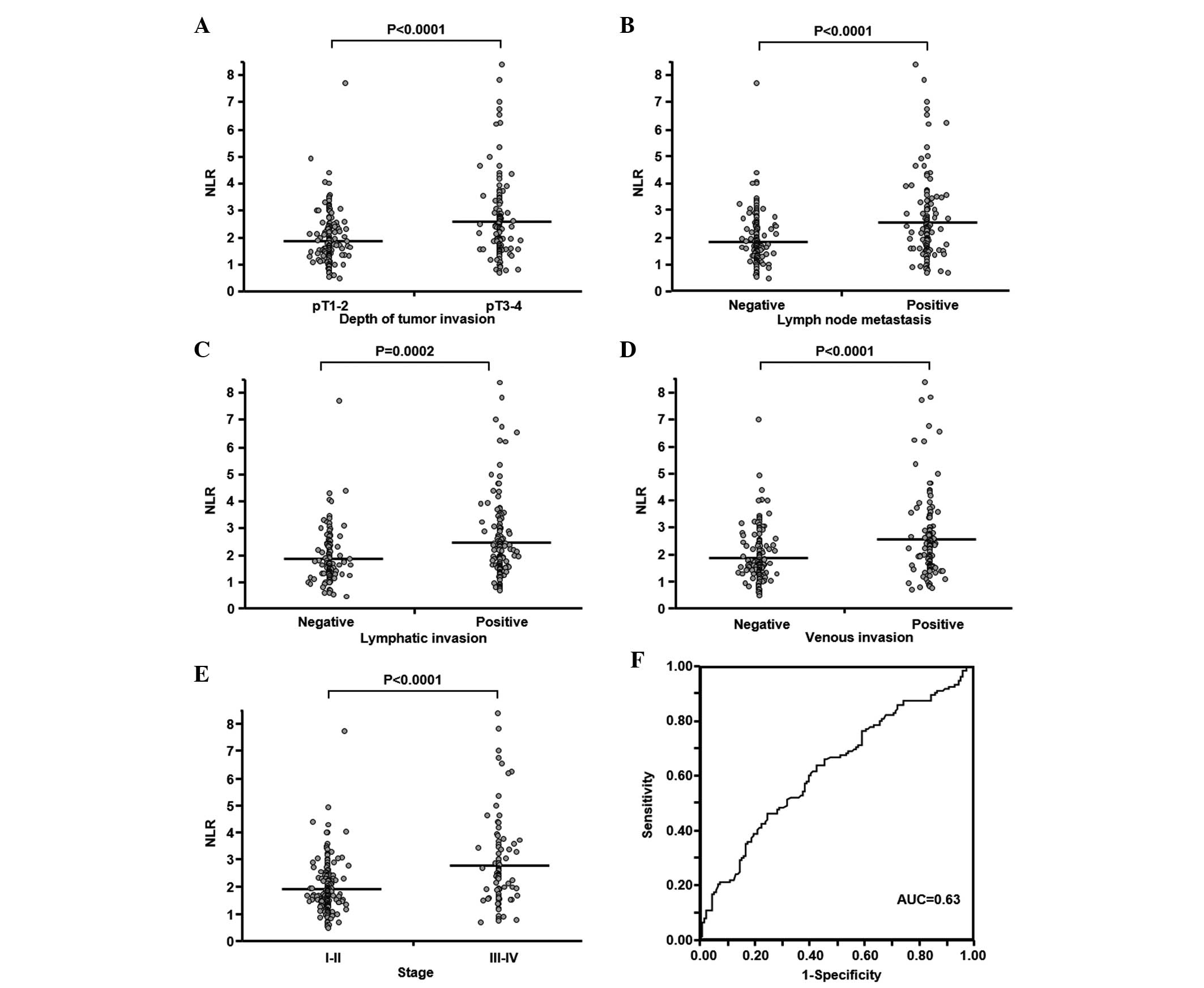
during gastric cancer progression. In the present 275 patients, the
mean ± SD and range of the NLR were 2.21±1.25 and 0.46–8.40 mg/dl,
respectively. The mean ± SD of the NLR in patients with pT1-T2
(n=155) and pT3–4 (n=120) tumors were 1.91±0.94 and 2.59±1.48
mg/dl, respectively (Fig. 2A). This
indicates a significant association between the NLR and the depth
of tumor invasion (P<0.0001). The mean ± SD of the NLR was
significantly higher in patients with lymph node metastasis (n=130)
compared with patients without lymph node metastasis (n=145)
(2.57±1.47 vs. 1.89±0.90 mg/dl; P<0.0001; Fig. 2B). Furthermore, the NLR was associated
with lymphatic and venous invasion (P=0.0002 and P<0.0001,
respectively; Fig. 2C and D). The
mean ± SD of the NLR was significantly higher in patients with
stage III–IV disease (n=92) compared to patients with stage I–II
(n=183) gastric cancer (2.77±1.60 vs. 1.93±0.91 mg/dl; P<0.0001;
Fig. 2E). The AUC for discriminating
between patients with advanced and early gastric cancer based on
the NLR was 0.63, according to ROC analysis (Fig. 2F). Therefore, the cutoff NLR was 2.34.
The sensitivity and specificity for NLR were 0.46 and 0.76,
respectively. All patients were classified into groups according to
the NLR ratios, ≥2.34 (n=97) or <2.34 (n=178). This binary
system for NLR, such as for the plasma fibrinogen concentration,
was used in subsequent analyses.
Fibrinogen concentration and NLR as
prognostic factors
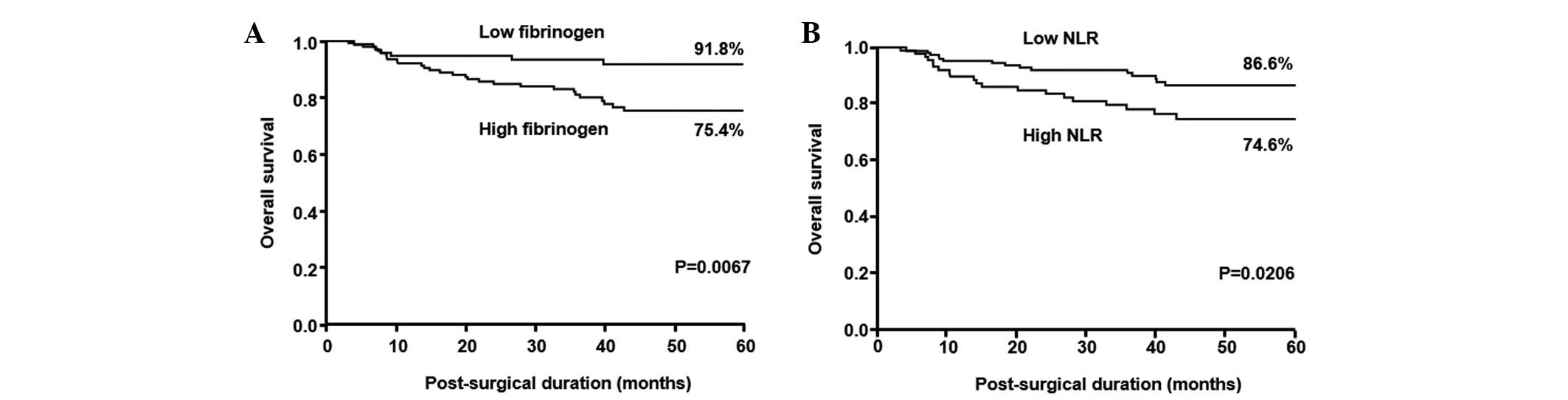
The 5-year survival rate was significantly decreased
among patients with high fibrinogen values compared with those with
low values (75.4 vs. 91.8%; P=0.0067; Fig. 3A) and the prognosis was significantly
poorer for patients with NLR ≥2.34 compared to those with NLR
<2.34 (74.6 vs. 86.6%; P=0.0206; Fig.
3B).
CFS-NLR and clinicopathological
characteristics
The present study simultaneously assessed the
fibrinogen concentration and NLR as CFS-NLR based on each cutoff
value established in previous prognostic analyses, to determine the
clinical value of CFS-NLR for patients with gastric cancer. The
patients were divided into three groups, based on the following
criteria: Hyperfibrinogenemia (≥305 mg/dl) and a high NLR (≥2.34);
(CFS-NLR 2 group; n=80; 29.1%); either hyperfibrinogenemia or a
high NLR (CFS-NLR 1 group; n=130; 47.3%); or neither abnormality
(CFS-NLR 0 group; n=65; 23.6%).
The CFS-NLR was significantly associated with the
depth of tumor invasion, lymph node metastasis, lymphovascular
invasion and tumor stage (P<0.0001; Table II).
| Table II.Association between CFS-NLR and the
clinicopathological characteristics of patients with gastric
cancer. |
Table II.
Association between CFS-NLR and the
clinicopathological characteristics of patients with gastric
cancer.
|
| CFS-NLR group, n
(%) |
|
|---|
|
|
|
|
|---|
|
Characteristics | Group 0 | Group 1 | Group 2 | P-value |
|---|
| Total | 80
(100.0) | 130 (100.0) | 65
(100.0) |
|
| Gender |
|
|
|
0.1960 |
|
Male | 52 (65.0) | 79 (60.8) | 48 (73.9) |
|
|
Female | 28 (35.0) | 51 (39.2) | 17 (26.1) |
|
| Age, years |
|
|
|
0.5540 |
|
≤70 | 50 (62.5) | 74 (56.9) | 35 (53.8) |
|
|
>70 | 30 (37.5) | 56 (43.1) | 30 (46.2) |
|
| Tumor location |
|
|
|
0.0720 |
|
Upper | 21 (26.2) | 26 (20.0) | 23 (35.4) |
|
|
Middle | 35 (43.8) | 61 (46.9) | 18 (27.7) |
|
|
Lower | 24 (30.0) | 43 (33.1) | 24 (36.9) |
|
| Histological
type |
|
|
|
0.0730 |
|
Differentiated | 36 (45.0) | 55 (42.3) | 18 (27.7) |
|
|
Undifferentiated | 44 (55.0) | 75 (57.7) | 47 (72.3) |
|
| Depth of tumor
invasion |
|
|
| <0.0001 |
|
pT1-T2 | 64 (80.0) | 75 (57.7) | 16 (24.6) |
|
|
pT3-T4 | 16 (20.0) | 55 (42.3) | 49 (75.4) |
|
| Lymph node
metastasis |
|
|
| <0.0001 |
|
Negative | 55 (68.8) | 71 (54.6) | 19 (29.2) |
|
|
Positive | 25 (31.2) | 59 (45.4) | 46 (70.8) |
|
| Lymphatic
invasion |
|
|
| <0.0001 |
|
Negative | 53 (66.3) | 60 (46.2) | 20 (30.8) |
|
|
Positive | 27 (33.7) | 70 (53.8) | 45 (69.2) |
|
| Venous
invasion |
|
|
| <0.0001 |
|
Negative | 59 (73.8) | 73 (56.2) | 20 (30.8) |
|
|
Positive | 21 (26.2) | 57 (43.8) | 45 (69.2) |
|
| Tumor stage |
|
|
| <0.0001 |
|
I–II | 69 (86.3) | 91 (70.0) | 23 (35.4) |
|
|
III–IV | 11 (13.7) | 39 (30.0) | 42 (64.6) |
|
CFS-NLR as a prognostic factor
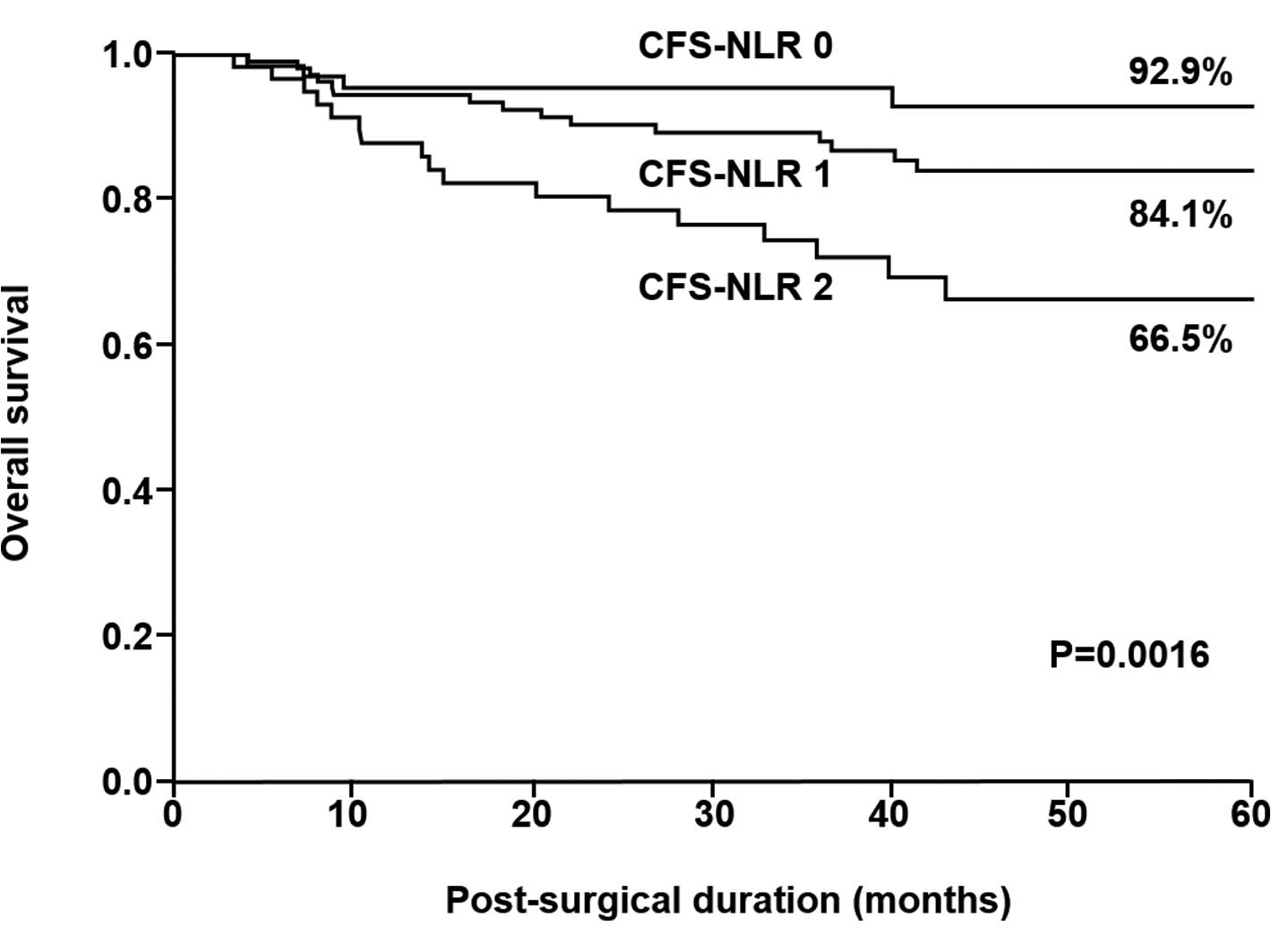
The 5-year survival rates of patients in CFS-NLR
groups 0, 1 and 2 differed significantly and were 92.9, 84.1 and
66.5%, respectively (P=0.0016; Fig.
4).
Univariate and multivariate analyses
of the survival rate
The depth of tumor invasion, lymph node metastasis
and CFS-NLR were significantly associated with prognosis in the
univariate analysis (P<0.0001, P<0.0001 and P=0.0018,
respectively; Table III).
Multivariate analysis demonstrated that the depth of tumor invasion
and lymph node metastasis were independent prognostic factors
(P=0.01 and P<0.0001, respectively; Table III).
| Table III.Univariate and multivariate analyses
of the survival rate of patients with gastric cancer. |
Table III.
Univariate and multivariate analyses
of the survival rate of patients with gastric cancer.
|
| Univariate
analysis | Multivariate
analysis |
|---|
|
|
|
|
|---|
| Independent
prognostic factor | Hazard ratio | 95% CI | P-value | Hazard ratio | 95% CI | P-value |
|---|
| Depth of tumor
invasion |
|
|
|
|
|
|
|
pT1-T3/pT4 |
4.59 | 2.37–8.87 | <0.0001 | 2.44 | 1.24–4.82 |
0.0100 |
| Lymph node
metastasis |
|
|
|
|
|
|
|
Negative/Positive | 12.77 |
4.58–53.10 | <0.0001 | 8.80 |
3.04–37.27 | <0.0001 |
| CFS-NLR |
|
|
|
|
|
|
| Group
0–1/2 |
2.94 | 1.51–5.67 |
0.0018 | 1.87 | 0.95–3.64 |
0.0695 |
mGPS as a prognostic factor
The 5 year survival rates of patients in mGPS groups
0 (n=183; 66.5%), 1 (n=64; 23.3%) and 2 (n=28; 10.2%) differed
significantly and were 87.1, 75.0 and 63.9%, respectively
(P=0.0055).
Discussion
The present study analyzed plasma fibrinogen
concentrations and the NLR in pre-operative blood specimens
obtained from 275 patients with gastric cancer. The fibrinogen
concentrations and NLR were assessed together as the CFS-NLR and
its association with clinicopathological characteristics, including
prognosis, was investigated. To the best of our knowledge, this is
the first study to determine the clinical value of CFS-NLR in
patients with gastric cancer.
Several studies have associated hyperfibrinogenemia
with tumor progression and the development of metastasis in
patients with various malignancies (7–9); however,
a reliable basis for elucidating this mechanism remains unknown.
Yamaguchi et al (19) reported
that interleukin-6, which is produced by cancer cells, stimulates
fibrinogen secretion in patients with lung cancer. Furthermore,
cancer cells synthesize fibrinogen (20). Fibrinogen eventually promotes tumor
cell growth and angiogenesis through the interaction with
fibroblast growth factor-2 and vascular endothelial growth factor
(20,21). The present study identified a
significant association between hyperfibrinogenemia and known
clinicopathological prognostic characteristics, including the depth
of tumor invasion, lymph node metastasis, lymphovascular invasion
and tumor stage. Furthermore, the findings that 5-year survival
rates were significantly decreased in patients with increased
fibrinogen concentrations indicated that evaluating plasma
fibrinogen may be useful for the preoperative prediction of
progressive gastric cancer and prognosis.
Inflammatory cells in primary and metastatic tumor
foci are important in the process of tumor cell growth, and tumor
cells create an advantageous microenvironment by suppressing
antitumor immunity, which enables their progression (22). A previous study identified an improved
prognosis when patients with gastric cancer had a high, rather than
a low, density of cluster of differentiation (CD) 3+
tumor-infiltrating lymphocytes (23).
Zhao et al (24) revealed that
gastric cancer patients with a higher density of CD15+
tumor-infiltrating neutrophils possessed a poorer prognosis. A
systemic inflammatory response causes variations in the balance of
circulating white blood cell constituents (25). These findings indicate that the
systemic inflammatory response mediates increases and decreases in
the numbers of neutrophils and lymphocytes, respectively, during
cancer progression. The NLR has been previously investigated as a
representative marker indicating a systemic inflammatory response,
in patients with various malignant neoplasms (13–16). The
present study demonstrated that the NLR is closely associated with
the depth of tumor invasion, lymph node metastasis, lymphovascular
invasion and tumor stage. Furthermore, the 5-year survival rate was
significantly decreased for patients with a higher NLR. These
findings suggest that the NLR is a potential blood marker for
predicting tumor aggressiveness, in connection with the host
microenvironment. Certain studies have previously revealed that the
NLR may be a useful predictor of chemosensitivity in patients with
advanced cancer (26,27).
The most salient feature of the present study was
the assessment of the plasma fibrinogen concentration and NLR as a
novel index, CFS-NLR. The present study identified a close
association between CFS-NLR and the depth of tumor invasion, lymph
node metastasis and lymphovascular invasion, which are prominent
clinicopathological prognostic characteristics in patients with
gastric cancer. However, to diagnose these characteristics in
practice using preoperative imaging modalities, including
endoscopy, endoscopic ultrasonography, CT and positron emission
tomography, may be challenging (28).
The evaluation of CFS-NLR in preoperative blood specimens would be
clinically useful for indicating the pathological status of tumor
progression in combination with diagnostic imaging. Furthermore,
this potential marker may aid the selection of patients with latent
gastric cancer that may be candidates for neoadjuvant systemic
chemotherapy. The CFS-NLR is easily calculated from fibrinogen
concentrations and the NLR, which are determined by conventional
blood analyses. Consequently, CFS-NLR may serve as a practical,
cost-effective blood marker that does not require dedicated
measuring devices.
The GPS, which is a combined index consisting of
C-reactive protein (CRP) and albumin, is a prominent marker that is
associated with the systemic inflammatory response during tumor
progression (29). Numerous studies
have demonstrated that GPS is a useful indicator of tumor
aggressive behavior and prognosis in patients with various
malignant neoplasms, including gastric cancer (29,30).
Furthermore, recent studies have proposed that the mGPS, which
consists of adjusted values of CRP and albumin, is clinically
useful (18,31). In total, 1 study of 295 patients with
gastric cancer identified a significantly poorer prognosis among
patients with a higher mGPS, in terms of survival rates (18). The present study assessed the
prognostic significance of mGPS in 275 patients with gastric
cancer, using cutoff values adjusted in the previous study
(18), to yield 3 groups. The
log-rank test revealed a significant prognostic difference between
the three groups with mGPS scores of 0, 1 or 2 (P=0.0055). The
prognostic difference between the same three groups classified by
the CFS-NLR also differed significantly (P=0.0016). Furthermore,
the CFS-NLR was significantly associated with the prognosis in a
univariate analysis (P=0.0018). These results suggest that CFS-NLR
is a more effective prognostic marker than mGPS for patients with
gastric cancer. However, multivariate analysis did not select
CFS-NLR as an independent prognostic factor (P=0.0695). Since this
result may have been affected by a short follow-up period and a
small sample size, larger validation studies of patients with
gastric cancer are required. Additional studies are being prepared
to survey blood specimens from patients with other gastrointestinal
tract cancers to assess the clinical significance of CFS-NLR.
In conclusion, the present study proposes a novel
prognostic factor, the CFS-NLR, which is a combination of the
fibrinogen concentration and NLR of blood specimens obtained from
patients with gastric cancer. The present study demonstrates that
the CFS-NLR is closely associated with tumor progression and
prognosis in gastric cancer patients; therefore, CFS-NLR may act as
a convenient marker to predict tumor properties.
Acknowledgements
This study was supported in part by a grant-in-aid
(grant no. 22791256) for scientific research from the Ministry of
Education, Science, Sports and Culture, Japan.
References
|
1
|
Fock KM: Review article: The epidemiology
and prevention of gastric cancer. Aliment Pharmacol Ther.
40:250–260. 2014. View Article : Google Scholar : PubMed/NCBI
|
|
2
|
Maehara Y, Orita H, Okuyama T, Moriguchi
S, Tsujitani S, Korenaga D and Sugimachi K: Predictors of lymph
node metastasis in early gastric cancer. Br J Surg. 79:245–247.
1992. View Article : Google Scholar : PubMed/NCBI
|
|
3
|
Ohtsu A: Current status and future
prospects of chemotherapy for metastatic gastric cancer: A review.
Gastric Cancer. 8:95–102. 2005. View Article : Google Scholar : PubMed/NCBI
|
|
4
|
Gaspar MJ, Arribas I, Coca MC and
Diez-Alonso M: Prognostic value of carcinoembryonic antigen, CA
19-9 and CA 72-4 in gastric carcinoma. Tumour Biol. 22:318–322.
2001. View Article : Google Scholar : PubMed/NCBI
|
|
5
|
Tennent GA, Brennan SO, Stangou AJ,
O'Grady J, Hawkins PN and Pepys MB: Human plasma fibrinogen is
synthesized in the liver. Blood. 109:1971–1974. 2007. View Article : Google Scholar : PubMed/NCBI
|
|
6
|
Weisel JW: Fibrinogen and fibrin. Adv
Protein Chem. 70:247–299. 2005. View Article : Google Scholar : PubMed/NCBI
|
|
7
|
Yamashita H, Kitayama J, Kanno N, Yatomi Y
and Nagawa H: Hyperfibrinogenemia is associated with lymphatic as
well as hematogenous metastasis and worse clinical outcome in T2
gastric cancer. BMC Cancer. 6:1472006. View Article : Google Scholar : PubMed/NCBI
|
|
8
|
Takeuchi H, Ikeuchi S, Kitagawa Y, Shimada
A, Oishi T, Isobe Y, Kubochi K, Kitajima M and Matsumoto S:
Pretreatment plasma fibrinogen level correlates with tumor
progression and metastasis in patients with squamous cell carcinoma
of the esophagus. J Gastroenterol Hepatol. 22:2222–2227. 2007.
View Article : Google Scholar : PubMed/NCBI
|
|
9
|
Son HJ, Park JW, Chang HJ, Kim DY, Kim BC,
Kim SY, Park SC, Choi HS and Oh JH: Preoperative plasma
hyperfibrinogenemia is predictive of poor prognosis in patients
with nonmetastatic colon cancer. Ann Surg Oncol. 20:2908–2913.
2013. View Article : Google Scholar : PubMed/NCBI
|
|
10
|
Vesely MD and Schreiber RD: Cancer
immunoediting: Antigens, mechanisms, and implications to cancer
immunotherapy. Ann NY Acad Sci. 1284:1–5. 2013. View Article : Google Scholar : PubMed/NCBI
|
|
11
|
Mantovani A, Allavena P, Sica A and
Balkwill F: Cancer-related inflammation. Nature. 454:436–444. 2008.
View Article : Google Scholar : PubMed/NCBI
|
|
12
|
Guthrie GJ, Charles KA, Roxburgh CS,
Horgan PG, McMillan DC and Clarke SJ: The systemic
inflammation-based neutrophil-lymphocyte ratio: Experience in
patients with cancer. Crit Rev Oncol Hematol. 88:218–230. 2013.
View Article : Google Scholar : PubMed/NCBI
|
|
13
|
Shimada H, Takiguchi N, Kainuma O, Soda H,
Ikeda A, Cho A, Miyazaki A, Gunji H, Yamamoto H and Nagata M: High
preoperative neutrophil-lymphocyte ratio predicts poor survival in
patients with gastric cancer. Gastric Cancer. 13:170–176. 2010.
View Article : Google Scholar : PubMed/NCBI
|
|
14
|
Sharaiha RZ, Halazun KJ, Mirza F, Port JL,
Lee PC, Neugut AI, Altorki NK and Abrams JA: Elevated preoperative
neutrophil:lymphocyte ratio as a predictor of postoperative disease
recurrence in esophageal cancer. Ann Surg Oncol. 18:3362–3369.
2011. View Article : Google Scholar : PubMed/NCBI
|
|
15
|
Mano Y, Shirabe K, Yamashita Y, Harimoto
N, Tsujita E, Takeishi K, Aishima S, Ikegami T, Yoshizumi T,
Yamanaka T and Maehara Y: Preoperative neutrophil-to-lymphocyte
ratio is a predictor of survival after hepatectomy for
hepatocellular carcinoma: A retrospective analysis. Ann Surg.
258:301–305. 2013. View Article : Google Scholar : PubMed/NCBI
|
|
16
|
Li MX, Liu XM, Zhang XF, Zhang JF, Wang
WL, Zhu Y, Dong J, Cheng JW, Liu ZW, Ma L and Lv Y: Prognostic role
of neutrophil-to-lymphocyte ratio in colorectal cancer: A
systematic review and meta-analysis. Int J Cancer. 134:2403–2413.
2014. View Article : Google Scholar : PubMed/NCBI
|
|
17
|
Edge S, Byrd DR, Compton CC, Fritz AG,
Greene FL and Trotti A: American Joint Committee on Cancer (AJCC)
Cancer Staging Manual (7th). New York, NY: Springer. 117–121.
2010.
|
|
18
|
Hirashima K, Watanabe M, Shigaki H,
Imamura Y, Ida S, Iwatsuki M, Ishimoto T, Iwagami S, Baba Y and
Baba H: Prognostic significance of the modified Glasgow prognostic
score in elderly patients with gastric cancer. J Gastroenterol.
49:1040–1046. 2014. View Article : Google Scholar : PubMed/NCBI
|
|
19
|
Yamaguchi T, Yamamoto Y, Yokota S,
Nakagawa M, Ito M and Ogura T: Involvement of interleukin-6 in the
elevation of plasma fibrinogen levels in lung cancer patients. Jpn
J Clin Oncol. 28:740–744. 1998. View Article : Google Scholar : PubMed/NCBI
|
|
20
|
Sahni A, Simpson-Haidaris PJ, Sahni SK,
Vaday GG and Francis CW: Fibrinogen synthesized by cancer cells
augments the proliferative effect of fibroblast growth factor-2
(FGF-2). J Thromb Haemost. 6:176–183. 2008. View Article : Google Scholar : PubMed/NCBI
|
|
21
|
Sahni A and Francis CW: Vascular
endothelial growth factor binds to fibrinogen and fibrin and
stimulates endothelial cell proliferation. Blood. 96:3772–3778.
2000.PubMed/NCBI
|
|
22
|
Fridman WH, Galon J, Dieu-Nosjean MC,
Cremer I, Fisson S, Damotte D, Pagès F, Tartour E and
Sautès-Fridman C: Immune infiltration in human cancer: prognostic
significance and disease control. Curr Top Microbiol Immunol.
344:1–24. 2011.PubMed/NCBI
|
|
23
|
Arigami T, Uenosono Y, Ishigami S,
Matsushita D, Hirahara T, Yanagita S, Okumura H, Uchikado Y, Nakajo
A, Kijima Y and Natsugoe S: Decreased density of CD3+
tumor-infiltrating lymphocytes during gastric cancer progression. J
Gastroenterol Hepatol. 29:1435–1441. 2014. View Article : Google Scholar : PubMed/NCBI
|
|
24
|
Zhao JJ, Pan K, Wang W, Chen JG, Wu YH, Lv
L, Li JJ, Chen YB, Wang DD, Pan QZ, et al: The prognostic value of
tumor-infiltrating neutrophils in gastric adenocarcinoma after
resection. PLoS One. 7:e336552012. View Article : Google Scholar : PubMed/NCBI
|
|
25
|
Satomi A, Murakami S, Ishida K, Mastuki M,
Hashimoto T and Sonoda M: Significance of increased neutrophils in
patients with advanced colorectal cancer. Acta Oncol. 34:69–73.
1995. View Article : Google Scholar : PubMed/NCBI
|
|
26
|
Sato H, Tsubosa Y and Kawano T:
Correlation between the pretherapeutic neutrophil to lymphocyte
ratio and the pathologic response to neoadjuvant chemotherapy in
patients with advanced esophageal cancer. World J Surg. 36:617–622.
2012. View Article : Google Scholar : PubMed/NCBI
|
|
27
|
Lorente D, Mateo J, Templeton AJ,
Zafeiriou Z, Bianchini D, Ferraldeschi R, Bahl A, Shen L, Su Z,
Sartor O and de Bono JS: Baseline neutrophil-lymphocyte ratio (NLR)
is associated with survival and response to treatment with
second-line chemotherapy for advanced prostate cancer independent
of baseline steroid use. Ann Oncol. 26:750–755. 2015. View Article : Google Scholar : PubMed/NCBI
|
|
28
|
Sim SH, Kim YJ, Oh DY, Lee SH, Kim DW,
Kang WJ, Im SA, Kim TY, Kim WH, Heo DS and Bang YJ: The role of
PET/CT in detection of gastric cancer recurrence. BMC Cancer.
9:732009. View Article : Google Scholar : PubMed/NCBI
|
|
29
|
McMillan DC: The systemic
inflammation-based Glasgow Prognostic Score: A decade of experience
in patients with cancer. Cancer Treat Rev. 39:534–540. 2013.
View Article : Google Scholar : PubMed/NCBI
|
|
30
|
Vashist YK, Loos J, Dedow J, Tachezy M,
Uzunoglu G, Kutup A, Yekebas EF and Izbicki JR: Glasgow Prognostic
Score is a predictor of perioperative and long-term outcome in
patients with only surgically treated esophageal cancer. Ann Surg
Oncol. 18:1130–1138. 2011. View Article : Google Scholar : PubMed/NCBI
|
|
31
|
Lamb GW, Aitchison M, Ramsey S, Housley SL
and McMillan DC: Clinical utility of the Glasgow Prognostic Score
in patients undergoing curative nephrectomy for renal clear cell
cancer: Basis of new prognostic scoring systems. Br J Cancer.
106:279–283. 2012. View Article : Google Scholar : PubMed/NCBI
|