Introduction
Ureteral cancer is rare malignant neoplasm of the
ureter, and is believed to be associated with environmental
stimuli, including tobacco use and exposure to benzidine and
β-naphthylamine. The most prevalent forms of ureteral cancer
include transitional cell carcinoma (>80%), squamous cell
carcinoma (<10%) and adenocarcinoma (<1%), all of which are
highly malignant and are associated with a poor prognosis (1). Ureteral lymphoma is extremely rare, most
likely due to the absence of lymphoid tissue in the ureteral wall
(2). There are limited descriptions
of non-Hodgkin's lymphoma of the ureter in the current literature,
with data primarily reported as single cases or small series.
The current study reports the case of a 31-year-old
man presenting with follicular non-Hodgkin's lymphoma, which was
subsequently treated with surgery; additionally, the diagnosis and
treatment of malignant lymphoma of the ureter is discussed with
reference to the present case and the relevant literature.
Case report
In September 2013, a 31-year-old man was referred to
the Second Affiliated Hospital of Dalian Medical University
(Dalian, China) in 2013 presenting with pain and discomfort in the
lower left back. A urinary ultrasound revealed left kidney
hydronephrosis and left ureteral expansion. The patient did not
present with any marked clinical symptoms, including gross
hematuria, frequent micturition or urinary urgency. The blood
routine and biochemical parameters were within the normal ranges,
with the exception of an elevated serum creatinine level of 143
mmol/l (normal range, 90–120 mmol/l). Voiding urethrocystography
was performed three times, however, the results were negative. A
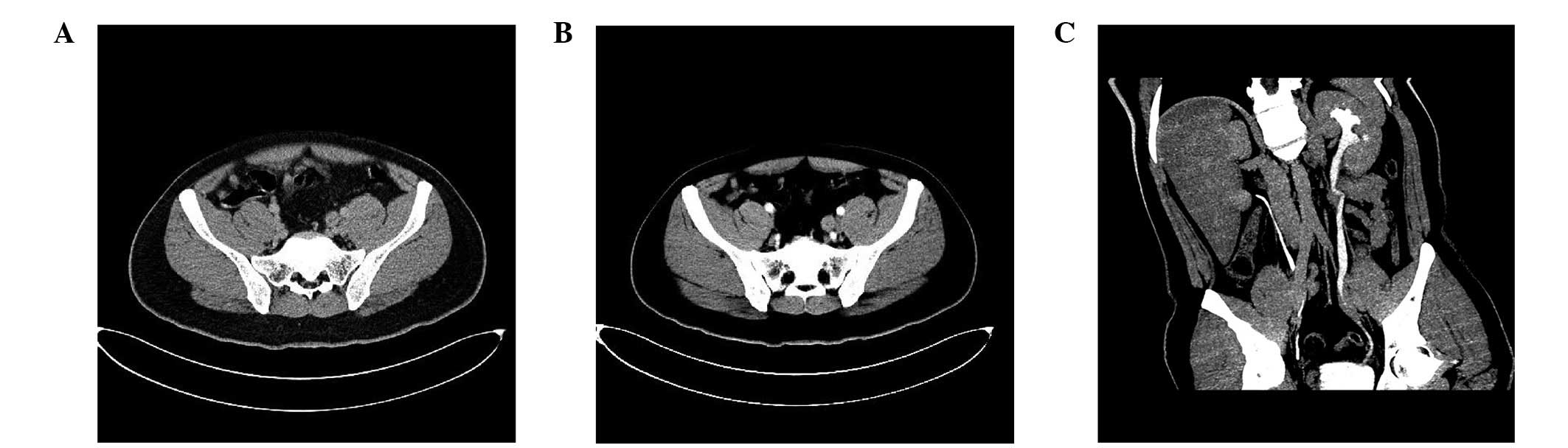
computed tomography (CT) urogram revealed a progressive,
space-occupying lesion (measuring 20×16 mm) located in the lower
left ureter; this was preliminarily considered to be a ureteral
tumor (Fig. 1). Emission CT of the
kidney indicated that renal function was impaired, as evidenced by
a marked decrease in the glomerular filtration rate of the left
kidney (29.7 ml/min; normal range, 40–60.0 ml/min) and a
compensatory increase in the glomerular filtration rate of the
right kidney (73.8 ml/min; normal range, 40–60.0 ml/min).
A flexible ureteroscopy was performed on the patient
for further examination, with the scope inserted 6 cm into the left
stoma; this identified luminal stenosis of the left ureter
presenting with a stiff ureteral wall. Pathological specimens were
not successfully acquired during this procedure, therefore,
exploratory surgery was performed to form a definitive diagnosis.
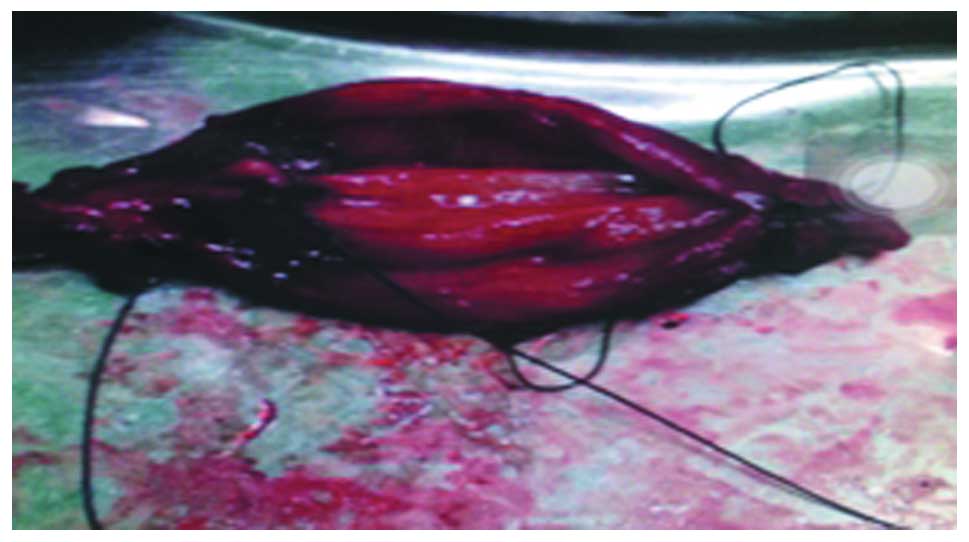
During surgery, the lesion (measuring ~3×1 cm) was observed to be
located in the ureter, ~4 cm from the bladder. The affected
ureteric segment presented with stiff walls and was severely
distended, whilst the ureteral mucosa was smooth with integrity.
The ureteric segment was excised 1 cm from the tumor. The lesion
was a spindle-shaped neoplasm, and appeared gray-white in color
under the blood pictured in Fig.
2.
Analysis of the intraoperative frozen sections
demonstrated lymphoid tissue hyperplasia in the left lower ureter.
The ureters were repaired by end-to-end anastomosis with insertion
of a double-J tube for internal drainage. Post-operative
pathological examination utilizing hematoxylin and eosin and
immunohistochemical staining suggested a diagnosis of non-Hodgkin's
follicular lymphoma (stage I–II; Fig.
3) (3), and the two cut edges of
the ureter were free of tumor tissue. The patient was subsequently
discharged with satisfactory clinical outcomes without any adjuvant
therapy subsequent to surgery; follow-up was conducted for 10
months and no signs of recurrence were noted.
Discussion
Lymphoma may occur in a single lymph node or within
a group. Extranodal lymphoma is used to describe the development of
lymphoma in organs or tissues outside the lymphatic system. Primary
extranodal lymphomas account for 25–40% of all non-Hodgkin's
lymphoma cases (4). In total, <5%
of lymphomas occur in the urinary system, with the majority located
in the kidneys and bladder (5).
Primary lymphoma of the ureter is extremely rare, with only 20
cases previously reported, including 4 cases of Hodgkin's lymphoma
and 16 cases of non-Hodgkin's lymphoma (Table I) (4–12).
Regarding non-Hodgkin's lymphoma, diffuse large B-cell lymphoma is
the most prevalent histological type, whilst follicular lymphoma is
particularly rare. Ureteral lymphoma is more frequent in men than
in women. The majority of reported cases of ureteral lymphoma were
unilateral, with only two cases discussing the occurrence of
bilateral ureters (7,8).
 | Table I.Summary of reported cases of malignant
lymphoma of the ureter. |
Table I.
Summary of reported cases of malignant
lymphoma of the ureter.
| Author, year | Age, years | Gender | Side | Pathology | Treatment | Outcome, follow-up
time | Refs. |
|---|
| Schniederjan and
Osunkoya, 2009 | 28 | M | R | NHL (DLBCL) | Unknown | SWD, 2.5 years | (5) |
| Ni, 2014 | 61 | M | L | NHL (DLBCL) | R-CHOP | NED, 6 months | (4) |
| Yoshii, 2010 | 41 | F | R | NHL (DLBCL) | Chemotherapy | SWD, 16 months | (6) |
| Kubota, 2007 | 58 | M | L | NHL (DLBCL) | PU +
chemotherapy | NED, 2 years | (7) |
|
| 74 | M | Unknown | NHL (DLBCL) | Unknown | Unknown | (7) |
| Bhattachary and
Gammall, 1995 | 26 | M | Bil | NHL (DLBCL) | PU +
chemotherapy | Unknown | (8) |
| Kerner, 2008 | 59 | M | R | NHL (DLBCL) | Unknown | Unknown | (9) |
|
| 42 | M | L | NHL (DLBCL) | R-CHOP | SWD, 2.5 years | (9) |
|
| 35 | M | L | NHL (MALT) | NU + R-CHOP | NED, 1 year | (9) |
| Numakura, 2011 | 72 | M | R | NHL (MALT) | PU | S, 5 months | (10) |
| Haitani, 2012 | 71 | M | R | NHL (follicular) | PU | SND, 3.5 years | (2) |
| Kubota, 2007 | 68 | M | Bil | NHL | NU +
chemotherapy | S, 3 years | (7) |
| Salem, 2014 | 69 | F | L | NHL | PU | SWD, 1 year | (11) |
| Jaegar, 2014 | 22 | F | L | NHL | PU | NED,6 months | (12) |
| Kubota, 2007 | 60 | M | R | NHL | Unknown | Unknown | (7) |
|
| 38 | M | L | NHL | NU +
chemotherapy | NED, 21 months | (7) |
|
| 52 | F | L | HL | NU + radiation | Unknown | (7) |
|
| 12 | M | L | HL | NU +
chemotherapy | NED, 18 months | (7) |
|
| 52 | M | L | HL | PU | Unknown | (7) |
|
| 54 | M | R | HL | NU +
chemotherapy | NED, 11 months | (7) |
Painless gross or microscopic hematuria is commonly
observed in patients presenting with ureteral carcinoma (13). However, individuals with follicular
lymphoma often have limited clinical symptoms. In the current
study, the patient exhibited soreness and pain in the left waist
area and hydronephrosis as a result of ureterostenosis, with little
or no hematuria.
Currently, there are no specific diagnostic methods
available to detect ureteral lymphoma, and forming a pre-operative
diagnosis is challenging. Routine surveillance imaging has a
limited role in diagnosis. Ultrasonography is only capable of
indicating possible ureteral expansion above the lesion and
ipsilateral hydronephrosis, whilst intravenous urography only
detects ureterostenosis in the lesion segment. CT may identify a
space-occupying lesion with ureteral wall thickening and
ureterostenosis, however, it cannot identify the nature of the
lesion. Therefore, it is difficult for CT to differentiate ureteral
lymphoma from other ureteral tumors, such as transitional cell and
squamous cell carcinoma.
It is believed that combining multiple imaging
modalities, including positron emission tomography/CT and CT
urography, may improve the diagnostic rate of ureteral lymphoma
(14). Since there are no definitive
imaging characteristics associated with the disease, ureteroscopic
biopsy or surgical exploration appear to be necessary to form a
definite diagnosis (15). It is
reported that laparoscopic ureteral needle biopsy, a minimally
invasive technique, typically leads to a pathological diagnosis
(16). In the present case, when the
ureteroscopy failed to successfully collect pathological specimens,
the patient underwent exploratory surgery. Thereafter, the
diagnosis was established based on intraoperative frozen sections
and post-operative pathological examination.
There are two types of lymphocytes: B and T
lymphocytes. The majority of non-Hodgkin's lymphomas, including
follicular lymphoma, are B-cell type. The etiology of follicular
non-Hodgkin's lymphoma is currently unknown, but it is believed to
be associated with viral infection (such as infection with the
Epstein-Barr virus or human herpes virus-8) or specific gene
alterations (including those in B-cell lymphoma 2) (17,18).
Follicular lymphoma is a form of low-grade lymphoma,
implying that the tumors are typically slow-growing and that it may
take a number of years for the disease to progress. Thus, treatment
is not always required upon diagnosis, but is dependent on the
individual requirements of the patient. A study by Brice et
al (19) compared the three
following therapeutic options regarding follicular lymphoma: i)
Delay of any treatment until clinically significant progression is
observed; ii) immediate treatment with an oral alkylating agent; or
iii) treatment with interferon-α for patients with follicular
lymphoma and a low tumor burden. Notably, it was determined that
delayed treatment is feasible and does not hamper the prognosis or
subsequent response to treatment (19). However, a lymphoma of the ureter
typically leads to ureteral obstruction, which may cause
progressive deterioration of kidney function if left untreated, as
in the present study. Therefore, lymphomas and affected ureteric
segments require resection as early as possible.
Even in the advanced stages of the disease, a
patient with follicular lymphoma often survives for a long period
of time (2). However, the disease is
difficult to cure completely, and active treatment is required when
a patient presents with clinical symptoms. Such treatments may
include various combinations of chemotherapy, radioimmunotherapy,
monoclonal antibodies or autologous or allogeneic hematopoietic
stem cell transplantation. In recent years, rituximab (anti-cluster
of differentiation 20 monoclonal antibody) has become the primary
first-line therapy for follicular lymphoma patients, with a high
rate of complete clinical and molecular remission (20,21).
However, in the present case, the patient did not require any
auxiliary treatment following surgery, possibly due to early
diagnosis and treatment. The patient was followed up for 10 months
without any signs of recurrence.
In conclusion, the current study affirms the
importance of pathological examination in the differential
diagnosis of ureteral neoplasms. Lymphoma of the ureter, in cases
of ureteral obstruction, typically requires prompt and appropriate
treatment to prevent progressive impairment of renal function.
References
|
1
|
Rouprêt M, Babjuk M, Compérat E, Zigeuner
R, Sylvester RJ, Burger M, Cowan NC, Böhle A, Van Rhijn BW,
Kaasinen E, et al: European Association of Urology Guidelines on
Upper Urinary Tract Urothelial Cell Carcinoma: 2015 Update. Eur
Urol. 68:868–879. 2015. View Article : Google Scholar : PubMed/NCBI
|
|
2
|
Haitani T, Shimizu Y, Inoue T, Okubo K,
Watanabe J, Kamba T, Yoshimura K, Kanematsu A, Nishiyama H, Ogawa
O, et al: A case of ureteral malignant lymphoma with concentric
thickening of the ureteral wall. Hinyokika Kiyo. 58:209–213.
2012.(In Japanese). PubMed/NCBI
|
|
3
|
Fauzi MF, Pennell M, Sahiner B, Chen W,
Shana'ah A, Hemminger J, Gru A, Kurt H, Losos M, Joehlin-Price A,
et al: Classification of follicular lymphoma: The effect of
computer aid on pathologists grading. BMC Med Inform Decis Mak.
15:1152015. View Article : Google Scholar : PubMed/NCBI
|
|
4
|
Ni BW, Zhong L, Wang T and Chen FY:
Malignant lymphoma of the ureter: A case report and literature
review. Exp Ther Med. 7:1521–1524. 2014.PubMed/NCBI
|
|
5
|
Schniederjan SD and Osunkoya AO: Lymphoid
neoplasms of the urinary tract and male genital organs: A
clinicopathological study of 40 cases. Mod Pathol. 22:1057–1065.
2009. View Article : Google Scholar : PubMed/NCBI
|
|
6
|
Yoshii T, Horiguchi A, Shirotake S, Tobe
M, Hayakawa M, Sumitomo M and Asano T: Spontaneous rupture of the
ureter as the primary symptom of malignant lymphoma. Hinyokika
Kiyo. 56:639–643. 2010.(In Japanese). PubMed/NCBI
|
|
7
|
Kubota Y, Kawai A, Tsuchiya T, Kozima K,
Yokoi S and Deguchi T: Bilateral primary malignant lymphoma of the
ureter. Int J Clin Oncol. 12:482–484. 2007. View Article : Google Scholar : PubMed/NCBI
|
|
8
|
Bhattachary V and Gammall MM: Bilateral
non-Hodgkin's intrinsic lymphoma of ureters. Br J Urol. 75:673–674.
1995. View Article : Google Scholar : PubMed/NCBI
|
|
9
|
Kerner A, Ott HW and Potthast S: Ureteral
metastases - rarely radiologically diagnosed: Case series of
carcinoid and non-Hodgkin lymphoma. Rofo. 180:153–155. 2008.(In
German). View Article : Google Scholar : PubMed/NCBI
|
|
10
|
Numakura K, Tsuchiya N, Obara T, Tsuruta
H, Saito M, Narita S, Inoue T, Horikawa Y, Satoh S and Habuchi T: A
case of ureteral malignant lymphoma diagnosed by laparoscopic
needle biopsy. Jpn J Clin Oncol. 41:440–442. 2011. View Article : Google Scholar : PubMed/NCBI
|
|
11
|
Salem AB, Nfoussi H and Kchir N: Ureteral
spread of a primary cutaneous diffuse large B-cell lymphoma, leg
type. Indian J Urol. 30:222–224. 2014. View Article : Google Scholar : PubMed/NCBI
|
|
12
|
Jaeger CD, McAlvany KL, Zingula SN, Kramer
SA and Granberg CF: Diffuse large B-cell lymphoma in an adolescent
male presenting as ureteral stricture. Case Rep Radiol.
2014:2393452014.PubMed/NCBI
|
|
13
|
Rouprêt M, Zigeuner R, Palou J, Boehle A,
Kaasinen E, Sylvester R, Babjuk M and Oosterlinck W: European
guidelines for the diagnosis and management of upper urinary tract
urothelial cell carcinomas: 2011 update. Eur Urol. 59:584–594.
2011. View Article : Google Scholar : PubMed/NCBI
|
|
14
|
Ghersin E, Keidar Z, Eldad DJ, Bar-Shalom
R, Fischer D and Halachmi S: Multimodality imaging of direct
ureteric involvement in non-Hodgkin's lymphoma using PET/CT, CT
urography and antegrade CT pyelography. Br J Radiol. 80:e283–e286.
2007. View Article : Google Scholar : PubMed/NCBI
|
|
15
|
Hashimoto H, Tsugawa M, Nasu Y, Tsushima T
and Kumon H: Primary non-Hodgkin lymphoma of the ureter. BJU Int.
83:148–149. 1999. View Article : Google Scholar : PubMed/NCBI
|
|
16
|
Numakura K, Tsuchiya N, Obara T, Tsuruta
H, Saito M, Narita S, Inoue T, Horikawa Y, Satoh S and Habuchi T: A
case of ureteral malignant lymphoma diagnosed by laparoscopic
needle biopsy. Jpn J Clin Oncol. 41:440–442. 2011. View Article : Google Scholar : PubMed/NCBI
|
|
17
|
Martini M, Capello D, Serraino D, Navarra
A, Pierconti F, Cenci T, Gaidano G and Larocca LM: Characterization
of variants in the promoter of EBV gene BZLF1 in normal donors,
HIV-positive patients and in AIDS-related lymphomas. J Infect.
54:298–306. 2007. View Article : Google Scholar : PubMed/NCBI
|
|
18
|
Bosga-Bouwer AG, van Imhoff GW, Boonstra
R, van der Veen A, Haralambieva E, van den Berg A, de Jong B,
Krause V, Palmer MC, Coupland R, et al: Follicular lymphoma grade
3B includes 3 cytogenetically defined subgroups with primary
t(14;18), 3q27, or other translocations: T(14;18) and 3q27 are
mutually exclusive. Blood. 101:1149–1154. 2003. View Article : Google Scholar : PubMed/NCBI
|
|
19
|
Brice P, Bastion Y, Lepage E, Brousse N,
Haïoun C, Moreau P, Straetmans N, Tilly H, Tabah I and
Solal-Céligny P: Comparison in low-tumor-burden follicular
lymphomas between an initial no-treatment policy, prednimustine, or
interferon alfa: A randomized study from the Groupe d'Etude des
Lymphomes Folliculaires. Groupe d'Etude des Lymphomes de l'Adulte.
J Clin Oncol. 15:1110–1117. 1997.PubMed/NCBI
|
|
20
|
Czuczman MS, Weaver R, Alkuzweny B,
Berlfein J and Grillo-López AJ: Prolonged clinical and molecular
remission in patients with low-grade or follicular non-Hodgkin's
lymphoma treated with rituximab plus CHOP chemotherapy: 9-year
follow-up. J Clin Oncol. 22:4711–4716. 2004. View Article : Google Scholar : PubMed/NCBI
|
|
21
|
Colombat P, Salles G, Brousse N, Eftekhari
P, Soubeyran P, Delwail V, Deconinck E, Haïoun C, Foussard C,
Sebban C, et al: Rituximab (anti-CD20 monoclonal antibody) as
single first-line therapy for patients with follicular lymphoma
with a low tumor burden: Clinical and molecular evaluation. Blood.
97:101–106. 2001. View Article : Google Scholar : PubMed/NCBI
|