Spandidos Publications Logo
  • About
    • About Spandidos
    • Aims and Scopes
    • Abstracting and Indexing
    • Editorial Policies
    • Reprints and Permissions
    • Job Opportunities
    • Terms and Conditions
    • Contact
  • Journals
    • All Journals
    • Oncology Letters
      • Oncology Letters
      • Information for Authors
      • Editorial Policies
      • Editorial Board
      • Aims and Scope
      • Abstracting and Indexing
      • Bibliographic Information
      • Archive
    • International Journal of Oncology
      • International Journal of Oncology
      • Information for Authors
      • Editorial Policies
      • Editorial Board
      • Aims and Scope
      • Abstracting and Indexing
      • Bibliographic Information
      • Archive
    • Molecular and Clinical Oncology
      • Molecular and Clinical Oncology
      • Information for Authors
      • Editorial Policies
      • Editorial Board
      • Aims and Scope
      • Abstracting and Indexing
      • Bibliographic Information
      • Archive
    • Experimental and Therapeutic Medicine
      • Experimental and Therapeutic Medicine
      • Information for Authors
      • Editorial Policies
      • Editorial Board
      • Aims and Scope
      • Abstracting and Indexing
      • Bibliographic Information
      • Archive
    • International Journal of Molecular Medicine
      • International Journal of Molecular Medicine
      • Information for Authors
      • Editorial Policies
      • Editorial Board
      • Aims and Scope
      • Abstracting and Indexing
      • Bibliographic Information
      • Archive
    • Biomedical Reports
      • Biomedical Reports
      • Information for Authors
      • Editorial Policies
      • Editorial Board
      • Aims and Scope
      • Abstracting and Indexing
      • Bibliographic Information
      • Archive
    • Oncology Reports
      • Oncology Reports
      • Information for Authors
      • Editorial Policies
      • Editorial Board
      • Aims and Scope
      • Abstracting and Indexing
      • Bibliographic Information
      • Archive
    • Molecular Medicine Reports
      • Molecular Medicine Reports
      • Information for Authors
      • Editorial Policies
      • Editorial Board
      • Aims and Scope
      • Abstracting and Indexing
      • Bibliographic Information
      • Archive
    • World Academy of Sciences Journal
      • World Academy of Sciences Journal
      • Information for Authors
      • Editorial Policies
      • Editorial Board
      • Aims and Scope
      • Abstracting and Indexing
      • Bibliographic Information
      • Archive
    • International Journal of Functional Nutrition
      • International Journal of Functional Nutrition
      • Information for Authors
      • Editorial Policies
      • Editorial Board
      • Aims and Scope
      • Abstracting and Indexing
      • Bibliographic Information
      • Archive
    • International Journal of Epigenetics
      • International Journal of Epigenetics
      • Information for Authors
      • Editorial Policies
      • Editorial Board
      • Aims and Scope
      • Abstracting and Indexing
      • Bibliographic Information
      • Archive
    • Medicine International
      • Medicine International
      • Information for Authors
      • Editorial Policies
      • Editorial Board
      • Aims and Scope
      • Abstracting and Indexing
      • Bibliographic Information
      • Archive
  • Articles
  • Information
    • Information for Authors
    • Information for Reviewers
    • Information for Librarians
    • Information for Advertisers
    • Conferences
  • Language Editing
Spandidos Publications Logo
  • About
    • About Spandidos
    • Aims and Scopes
    • Abstracting and Indexing
    • Editorial Policies
    • Reprints and Permissions
    • Job Opportunities
    • Terms and Conditions
    • Contact
  • Journals
    • All Journals
    • Biomedical Reports
      • Information for Authors
      • Editorial Policies
      • Editorial Board
      • Aims and Scope
      • Abstracting and Indexing
      • Bibliographic Information
      • Archive
    • Experimental and Therapeutic Medicine
      • Information for Authors
      • Editorial Policies
      • Editorial Board
      • Aims and Scope
      • Abstracting and Indexing
      • Bibliographic Information
      • Archive
    • International Journal of Epigenetics
      • Information for Authors
      • Editorial Policies
      • Editorial Board
      • Aims and Scope
      • Abstracting and Indexing
      • Bibliographic Information
      • Archive
    • International Journal of Functional Nutrition
      • Information for Authors
      • Editorial Policies
      • Editorial Board
      • Aims and Scope
      • Abstracting and Indexing
      • Bibliographic Information
      • Archive
    • International Journal of Molecular Medicine
      • Information for Authors
      • Editorial Policies
      • Editorial Board
      • Aims and Scope
      • Abstracting and Indexing
      • Bibliographic Information
      • Archive
    • International Journal of Oncology
      • Information for Authors
      • Editorial Policies
      • Editorial Board
      • Aims and Scope
      • Abstracting and Indexing
      • Bibliographic Information
      • Archive
    • Medicine International
      • Information for Authors
      • Editorial Policies
      • Editorial Board
      • Aims and Scope
      • Abstracting and Indexing
      • Bibliographic Information
      • Archive
    • Molecular and Clinical Oncology
      • Information for Authors
      • Editorial Policies
      • Editorial Board
      • Aims and Scope
      • Abstracting and Indexing
      • Bibliographic Information
      • Archive
    • Molecular Medicine Reports
      • Information for Authors
      • Editorial Policies
      • Editorial Board
      • Aims and Scope
      • Abstracting and Indexing
      • Bibliographic Information
      • Archive
    • Oncology Letters
      • Information for Authors
      • Editorial Policies
      • Editorial Board
      • Aims and Scope
      • Abstracting and Indexing
      • Bibliographic Information
      • Archive
    • Oncology Reports
      • Information for Authors
      • Editorial Policies
      • Editorial Board
      • Aims and Scope
      • Abstracting and Indexing
      • Bibliographic Information
      • Archive
    • World Academy of Sciences Journal
      • Information for Authors
      • Editorial Policies
      • Editorial Board
      • Aims and Scope
      • Abstracting and Indexing
      • Bibliographic Information
      • Archive
  • Articles
  • Information
    • For Authors
    • For Reviewers
    • For Librarians
    • For Advertisers
    • Conferences
  • Language Editing
Login Register Submit
  • This site uses cookies
  • You can change your cookie settings at any time by following the instructions in our Cookie Policy. To find out more, you may read our Privacy Policy.

    I agree
Search articles by DOI, keyword, author or affiliation
Search
Advanced Search
presentation
Oncology Letters
Join Editorial Board Propose a Special Issue
Print ISSN: 1792-1074 Online ISSN: 1792-1082
Journal Cover
September-2016 Volume 12 Issue 3

Full Size Image

Sign up for eToc alerts
Recommend to Library

Journals

International Journal of Molecular Medicine

International Journal of Molecular Medicine

International Journal of Molecular Medicine is an international journal devoted to molecular mechanisms of human disease.

International Journal of Oncology

International Journal of Oncology

International Journal of Oncology is an international journal devoted to oncology research and cancer treatment.

Molecular Medicine Reports

Molecular Medicine Reports

Covers molecular medicine topics such as pharmacology, pathology, genetics, neuroscience, infectious diseases, molecular cardiology, and molecular surgery.

Oncology Reports

Oncology Reports

Oncology Reports is an international journal devoted to fundamental and applied research in Oncology.

Experimental and Therapeutic Medicine

Experimental and Therapeutic Medicine

Experimental and Therapeutic Medicine is an international journal devoted to laboratory and clinical medicine.

Oncology Letters

Oncology Letters

Oncology Letters is an international journal devoted to Experimental and Clinical Oncology.

Biomedical Reports

Biomedical Reports

Explores a wide range of biological and medical fields, including pharmacology, genetics, microbiology, neuroscience, and molecular cardiology.

Molecular and Clinical Oncology

Molecular and Clinical Oncology

International journal addressing all aspects of oncology research, from tumorigenesis and oncogenes to chemotherapy and metastasis.

World Academy of Sciences Journal

World Academy of Sciences Journal

Multidisciplinary open-access journal spanning biochemistry, genetics, neuroscience, environmental health, and synthetic biology.

International Journal of Functional Nutrition

International Journal of Functional Nutrition

Open-access journal combining biochemistry, pharmacology, immunology, and genetics to advance health through functional nutrition.

International Journal of Epigenetics

International Journal of Epigenetics

Publishes open-access research on using epigenetics to advance understanding and treatment of human disease.

Medicine International

Medicine International

An International Open Access Journal Devoted to General Medicine.

Journal Cover
September-2016 Volume 12 Issue 3

Full Size Image

Sign up for eToc alerts
Recommend to Library

  • Article
  • Citations
    • Cite This Article
    • Download Citation
    • Create Citation Alert
    • Remove Citation Alert
    • Cited By
  • Similar Articles
    • Related Articles (in Spandidos Publications)
    • Similar Articles (Google Scholar)
    • Similar Articles (PubMed)
  • Download PDF
  • Download XML
  • View XML
Case Report

A rare case of a three way complex variant positive Philadelphia translocation involving chromosome (9;11;22 (q34;p15;q11) in chronic myeloid leukemia: A case report

  • Authors:
    • Muhammad Asif
    • Abrar Hussain
    • Mahmood Rasool
  • View Affiliations / Copyright

    Affiliations: Department of Biotechnology and Informatics, Balochistan University of Information Technology, Engineering and Management Sciences, Quetta, Balochistan 87300, Pakistan, Center of Excellence in Genomic Medicine Research, King Abdulaziz University, Jeddah, Makkah 21589, Saudi Arabia
  • Pages: 1986-1988
    |
    Published online on: July 7, 2016
       https://doi.org/10.3892/ol.2016.4821
  • Expand metrics +
Metrics: Total Views: 0 (Spandidos Publications: | PMC Statistics: )
Metrics: Total PDF Downloads: 0 (Spandidos Publications: | PMC Statistics: )
Cited By (CrossRef): 0 citations Loading Articles...

This article is mentioned in:


Abstract

The t(9;22)(q34;q11) translocation is present in 90‑95% of patients with chronic myeloid leukemia (CML). Variant complex translocations have been observed in 5‑8% of CML patients, in which a third chromosome other than (9;22) is involved. Imatinib mesylate is the first line breakpoint cluster region‑Abelson gene (BCR/ABL)‑targeted oral therapy for CML, and may produce a complete response in 70‑80% of CML patients in the chronic phase. In the present study, a bone marrow sample was used for conventional cytogenetic analysis, and the fluorescence in situ hybridization (FISH) test was used for BCR/ABL gene detection. A hematological analysis was also performed to determine the white blood cell (WBC) count, red blood cell count, hemoglobin levels, packed and mean cell volumes, mean corpuscular hemoglobin, mean corpuscular hemoglobin concentration and platelet values of the patient. The hematological analysis of the patient indicated the increased WBC of 186.5x10³ cells/µl, and decreased hemoglobin levels of 11.1 g/dl. The FISH test revealed that 67% cells demonstrated BCR/ABL gene translocation. The patient was treated with 400 mg imatinib mesylate daily, and was monitored at various intervals over a 6‑month period. The present study reports the rare case of a patient that demonstrates a three‑way Philadelphia chromosome‑positive translocation involving 46XY,t(9;11;22)(q34;p15;q11)[10], alongside CML in the chronic phase. The translocation was analyzed using cytogenetic and FISH tests.

Introduction

Chronic myeloid leukemia (CML) is a clonal myeloproliferative disorder of pluripotent stem cells. CML is caused by reciprocal translocation between the long arms of chromosomes 9 and 22, t(9;22)(q34;q11), termed the Philadelphia chromosome (Ph) (1,2). The translocation consists of the combination of the break-point cluster region (BCR) and Abelson (ABL) genes to form the fusion gene BCR/ABL, which produces a chimeric protein with deregulated tyrosine kinase activity. The tyrosine kinase activity is responsible for regulating the maintenance of adult tissues, aiding signaling pathways and regulating cell division (3–5). The fusion gene BCR/ABL is associated with increased levels of erythrocytes, monocytes, megakaryocytes, myelocytes and platelets in the peripheral blood and marked myeloid hyperplasia in the bone marrow (6).

The Ph-positive translocation that results from reciprocal translocation between chromosomes 9 and 22 (q34;q11) is present in 90–95% of CML cases. However variant or complex translocations involving one or more additional chromosomes compared with (9;22)(q34;q11) may be observed in 5–8% CML patients (1,7,8).

Gleevec imatinib mesylate (Novartis Pharmaceuticals, Basel, Switzerland) is an orally-designed selective BCR/ABL protein tyrosine kinase inhibitor, which may induce a complete cytogenetic response in 65–90% of CML patients (9,10). The therapy is the first line treatment for >90% of CML patients, and the key function of imatinib mesylate is to hinder proliferation and induce apoptosis in cells that express the BCR/ABL gene (7). There is evidence to suggest that imatinib mesylate may prolong survival and improve the quality of life for patients with CML (6,11,12).

The present study reports of the case of a 45-year-old male patient diagnosed with CML in the chronic phase of disease, who demonstrated a rare Ph-positive three-way complex variant translocation involving chromosome 46XY,t(9;11;22)(q34; p15; q11.2)[10]. Written informed consent was obtained from the patient.

Case report

A 45-year-old male patient was diagnosed with CML at the Sundayman Civil Hospital (Quetta, Balochistan, Pakistan) on August 5, 2008. The patient was referred to the hospital due to a 15 week history of weight loss, sleep disturbance, fever, anxiety, depression, dry skin, sweating, swelling on body and high cholesterol levels. The hematological parameters of the patient were as follows: White blood cell (WBC) count, 186.5×10³ cells/µl (normal range, 4–11×103 cells/µl); hemoglobin, 11.1 g/dl (normal range, 14–18 g/dl); platelet (PLT) count, 235×103 PLTs/µl (normal range, 150–400×103 PLTs/µl); neutrophils, 66% (normal range, 40–75%); lymphocytes, 2% (normal range, 20–45%); eosinophils, 1% (normal range, 1–6%); monocytes, 6% (normal range, 2–10%); myelocytes, 15% (normal range, 0%); metamyelocytes, 4% (normal range, 0%); promyelocytes, 6% (normal range, 0%); and basophils, 0% (normal range,0–1%). Due to the high WBC count and low hemoglobin levels identified, the patient was subsequently administered ongoing treatment with imatinib mesylate (400 mg/day).

For complete blood cell analysis, a hematological analyzer (Celltac F MEK-8222; Nihon Kohden Corporation, Tokyo, Japan) was used to assess the total leukocyte, WBC, neutrophil, lymphocyte, eosinophil, monocyte, myelocyte, promyelocyte, basophil and platelet counts. CML patients tend to exhibit high WBC and platelet counts. The aforementioned assessments were used to determine if the patient was suffering from leukemia. The patient was advised to undergo additional tests.

A cytogenetic analysis was performed using the GTG-banding technique. Bone marrow specimens were examined on direct or short-term (24 h) cultures and >10 metaphases were analyzed. The karyotypes were classified using the International System for Human Cytogenetic Nomenclature (13,14).

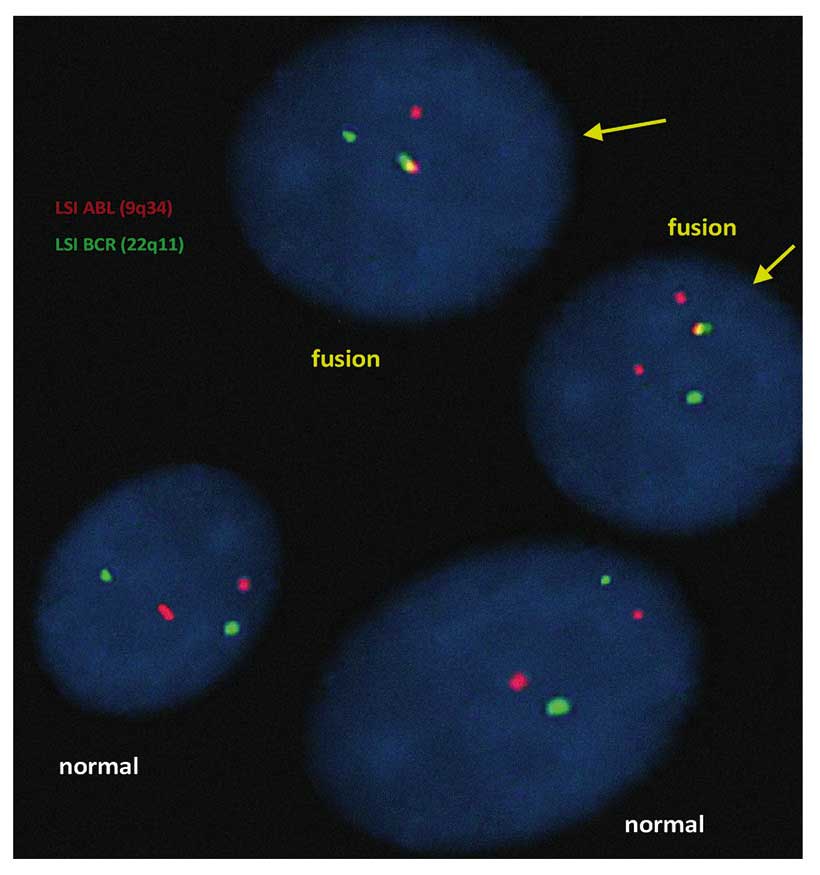
FISH was performed using directly labeled dual color locus-specific indicator/centromere enumeration probes, according to the manufacturer's protocol (Oncor; Ventana Medical Systems, Tucson, AZ, USA) in order to detect BCR/ABL translocation. In total, 500 metaphase or interphase cells were counted in order to calculate the percentage of BCR/ABL cells. The main steps in the methodology included the hypotonic treatment and fixation of direct demecolcine-treated cultures, dehydration, codenaturation, overnight hybridization, washing and the mounting of slides using 4′,6-diamidino-2-phenylindole (DAPI)-antifade (15,16). The slides were viewed using an Axioskop 2 microscope (Zeiss AG, Oberkochen, Germany) with a HBO 100 mercury lamp (Osram, Munich, Germany). The slides were analyzed through a fluorescent microscope (BMX60; Olympus, Tokyo, Japan) with DAPI, rhodamine, fluorescein isothiocyanate and triple band pass filters (Chromo Technology, Bellows Falls, VT, USA). The slides showed fluorescent red dots (rhodamine) that corresponded to the ABL (9q34.1) gene and green dots (fluorescein) that corresponded to the BCR (22q11) gene. Therefore, a cell exhibiting two isolated orange and green dots was counted as normal, or without translocation. A cell exhibiting one isolated orange dot, one isolated green dot and one fused orange and green signal was considered to be presenting the irregular translocation of CML. Morphological and hematological analyses were performed on the bone marrow of the CML patient every 6 months for a year. Follow-up revealed a reduction in fatigue, anxiety and swelling of the body on June 5th, 2009. In total the patient was followed-up for 84 months.

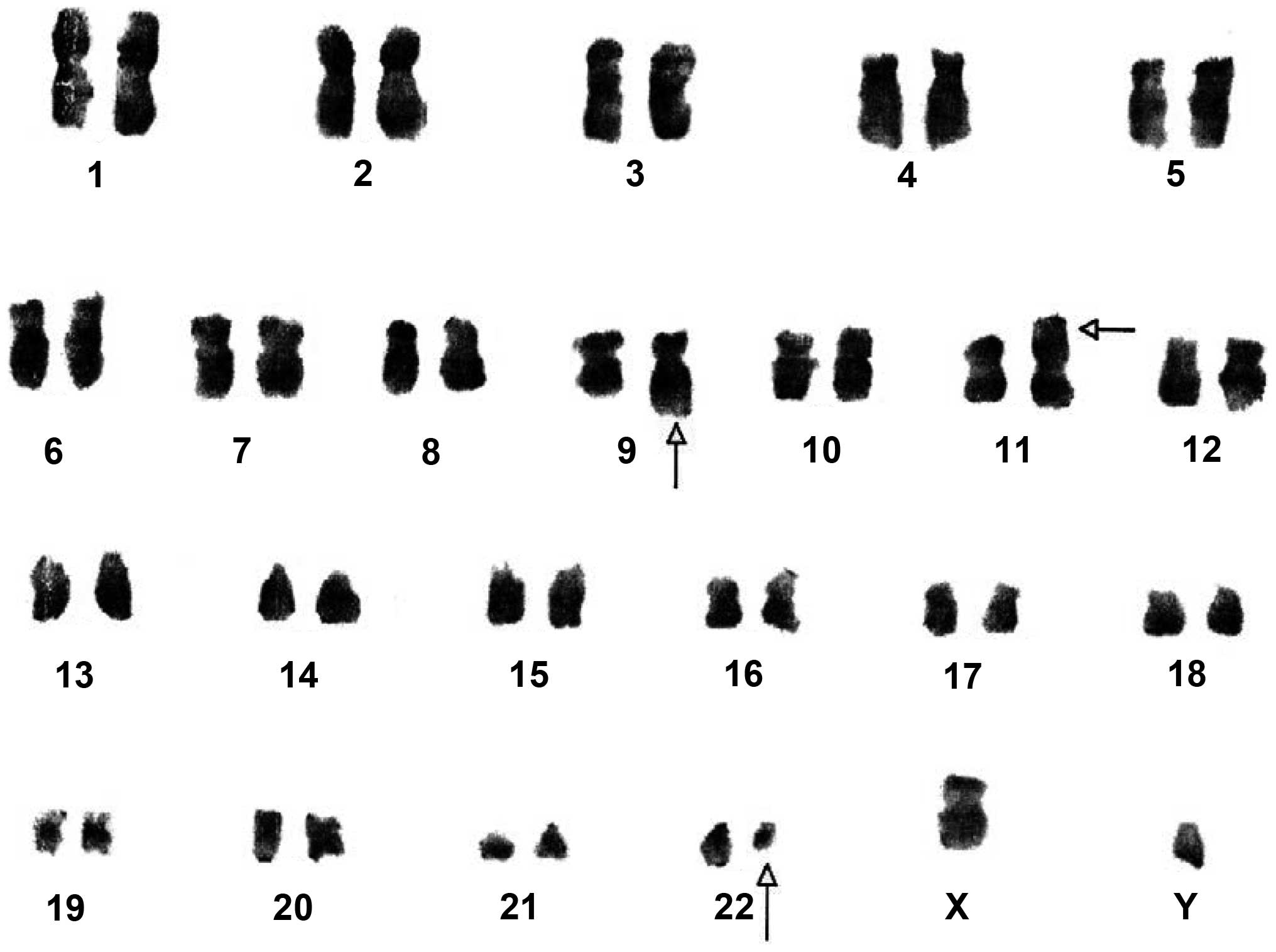
The cytogenetic analysis revealed that 10 of the cells that were examined expressed the Ph chromosome and demonstrated the 46XY,t(9;11;22)(p15;q34;q11.2)[10] translocation (Fig. 1). BCR/ABL translocations were detected in 67% of the 500 nuclei counted using the FISH test (Fig. 2). The hematological analyses revealed that the WBC count was 186.5×10³ cells/µl, the PLT count was 235×103 PLTs/µl and the hemoglobin level was 11.1 mg/dl, which indicated that the patient had anemia.

Figure 1.

Cytogenetic analysis showing the karyotype of a chronic myeloid leukemia patient with the 46XY,t(9;11;22)(q34;p15;q11.2)[10] translocation. Derivative chromosomes are highlighted by arrows.

Figure 2.

Fluorescence in situ hybridization was used for the detection of (9;22)(q34;q11)[10]. Breakpoint cluster region-Abelson murine leukemia viral oncogene homolog 1 translocation was detected in 67% of the 500 nuclei counted.

Discussion

CML is a cancer of the blood that occurs when two proteins on chromosomes 9 and 22 translocate to create the novel Ph chromosome. CML is responsible for the production of the BCR/ABL gene. BCR/ABL interferes with the function of white blood cells, making it challenging for the body to fight off infections. The Ph chromosome (9;22)(q34;q11) is found in 90–95% of CML patients; however, only 5–8% of CML patients demonstrate a variant that involves a third chromosome other than (9;22) in a three-way Ph chromosome complex (1,8,17).

To the best of our knowledge, the present study is the second case of a three-way complex variant involving chromosome 46XY,t(9;11;22)(q34;p15;q11.2) to be reported, with one case reported previously, which was identified by searching the Mitelman Database of Chromosome Aberrations and Gene Fusions in Cancer (http://cgap.nci.nih.gov/Chromosomes/Mitelman) using the terms ‘Chronic myeloid leukemia’ and ‘complex variant translocation (9;11;22)(q34;p15;q11)’ (18).

The formation of the variant Ph translocations is a controversial matter. The studies by Morel et al (2003) and Emberger et al (2001) on complex variant Ph translocations concluded that the variant may occur as a result of a single event, which involves the simultaneous breaking of the chromosomal regions involved, followed by a mismatched rejoining of the broken ends, termed concerted genomic rearrangement (18,19). The studies by Sessarego et al (1995) and Reddy and Sulcova (2001) stated that the mechanism behind variant translocation is a two-step process, which includes the initial formation of a standard t(9;22)(q34;q11) translocation, followed by a translocation that usually involves one derivative chromosome from the Ph translocation and a third chromosome (20,21).

In the present study the patient was successfully treated with 400 mg/day imatinib mesylate. Imatinib mesylate is an orally designed tyrosine kinase protein inhibitor that inhibits BCR/ABL gene translocation and the constitutive abnormal tyrosine kinase produced by the Ph chromosome. The drug also inhibits the platelet-derived growth factor and stem cell factor receptor tyrosine kinases. The treatment of CML with imatinib has demonstrated notable success, by prolonging the survival time and improving the quality of life for the patient (2,11,17).

In conclusion, the present study reports a rare case of a CML patient in the chronic phase of disease, who demonstrates the BCR/ABL translocation that involves the three-way translocation variant 46XY,t(9;11;22)(q34;p15;q11.2)[10].

Acknowledgements

This study was supported by the Faculty of Life Sciences BUITEMS, Quetta, Pakistan. (registration ID no. 27934).

References

1 

Kuru D, Tarkan-Argüden Y, Ar MC, Çırakoğlu A, Öngören Ş, Yılmaz Ş, Eşkazan AE, Deviren A, Soysal T, Hacıhanefioğlu S and Ülkü B: Variant Philadelphia translocations with different breakpoints in six chronic myeloid leukemia patients. Turk J Hematol. 28:186–192. 2001. View Article : Google Scholar

2 

Aliano S, Cirmena G, Fugazza G, Bruzzone R, Palermo C and Sessarego M: Standard and variant Philadelphia translocation in a CML patient with different sensitivity to imatinib therapy. Leuk Res Rep. 2:75–78. 2013.PubMed/NCBI

3 

Quintás-Cardama A and Cortes JE: Chronic myeloid leukemia: Diagnosis and treatment. Mayo Clin Proc. 81:973–988. 2006. View Article : Google Scholar : PubMed/NCBI

4 

Aguayo A, García-Álvarez E, Cázarez-Ordónez Y, Crespo-Solís E, Martínez-Baños D, Guadarrama-Beltrán E, Cervera-Ceballos EE and López-Karpovicth X: Chronic myeloid leukemia: A clinicoepidemiologic and therapeutic description of a single institution in México City. Clinical Leukemia. 2:261–266. 2008. View Article : Google Scholar

5 

Au WY, Caguioa PB, Chuah C, Hsu SC, Jootar S, Kim DW, Kweon IY, O'Neil WM, Saikia TK and Wang J: Chronic myeloid leukemia in Asia. Int J Hematol. 89:14–23. 2009. View Article : Google Scholar : PubMed/NCBI

6 

Sawyers CL: Chronic myeloid leukemia. N Engl J Med. 340:1330–1340. 1999. View Article : Google Scholar : PubMed/NCBI

7 

Al-Achkar W, Wafa A and Liehr T: A new t(9;11;20;22)(q34;p11.2;q11.21;q11) in a Philadelphia-positive chronic myeloid leukemia case. Oncol Lett. 5:605–608. 2013.PubMed/NCBI

8 

Sessarego M, Fugazza G, Bruzzone R, Ballestrero A, Miglino M and Bacigalupo A: Complex chromosome rearrangements may locate the bcr/abl fusion gene sites other than 22q11. Haematologica. 85:35–39. 2000.PubMed/NCBI

9 

O'Brien SG, Meinhardt P, Bond E, Beck J, Peng B, Dutreix C, Mehring G, Milosavljev S, Huber C, Capdeville R and Fischer T: Effects of imatinib mesylate (STI571, Glivec) on the pharmacokinetics of simvastatin, a cytochrome p450 3A4 substrate, in patients with chronic myeloid leukaemia. Br J Cancer. 89:1855–1859. 2003. View Article : Google Scholar : PubMed/NCBI

10 

Todaro J, Ferreira E, Hamerschlak N, Simon SD, Kutner JM, Pietrocola M and Borovik CL: Imatinib improves survival of CML patients in accelerated phase: A 48-month follow-up. Einstein. 4:16–21. 2006.

11 

Cohen MH, Williams G, Johnson JR, Duan J, Gobburu J, Rahman A, Benson K, Leighton J, Kim SK, Wood R, et al: Approval summary for imatinib mesylate capsules in the treatment of chronic myelogenous leukemia. Clin Cancer Res. 8:935–942. 2002.PubMed/NCBI

12 

Cohen MS, Hussain HB and Moley JF: Inhibition of medullary thyroid carcinoma cell proliferation and RET phosphorylation by tyrosine kinase inhibitors. Surgery. 132:960–966. 2002. View Article : Google Scholar : PubMed/NCBI

13 

Simons A, Shaffer LG and Hastings RJ: Cytogenetic nomenclature: Changes in the ISCN 2013 compared to the 2009 edition. Cytogenet Genome Res. 141:1–6. 2013. View Article : Google Scholar : PubMed/NCBI

14 

Claussen U, Michel S, Mühlig P, Westermann M, Grummt UW, Kromeyer-Hauschild K and Liehr T: Demystifying chromosome preparation and the implications for the concept of chromosome condensation during mitosis. Cytogenet Genome Res. 98:136–146. 2002. View Article : Google Scholar : PubMed/NCBI

15 

Froncillo MC, Maffei L, Cantonetti M, Del Poeta G, Lentini R, Bruno A, Masi M, Tribalto M and Amadori S: FISH analysis for CML monitoring? Ann Hematol. 73:113–119. 1996. View Article : Google Scholar : PubMed/NCBI

16 

Buño I, Wyatt WA, Zinsmeister AR, Dietz-Band J, Silver RT and Dewald GW: A special fluorescent in situ hybridization technique to study peripheral blood and assess the effectiveness of interferon therapy in chronic myeloid leukemia. Blood. 92:2315–2321. 1998.PubMed/NCBI

17 

La Starza R, Testoni N, Lafage-Pochitaloff M, Ruggeri D, Ottaviani E, Perla G, Martelli MF, Marynen P and Mecucci C: Complex variant Philadelphia translocations involving the short arm of chromosome 6 in chronic myeloid leukemia. Haematologica. 87:143–147. 2002.PubMed/NCBI

18 

Morel F, Herry A, Le Bris MJ, Morice P, Bouquard P, Abgrall JF, Berthou C and De Braekeleer M: Contribution of fluorescence in situ hybridization analyses to the characterization of masked and complex Philadelphia chromosome translocations in chronic myelocytic leukemia. Cancer Genet Cytogenet. 147:115–20. 2003. View Article : Google Scholar : PubMed/NCBI

19 

Emberger W, Behmel A, Tschernigg M, Seewann HL, Petek E, Kroisel PM and Wagner K: Chronic myeloid leukemia with a rare variant Philadelphia translocation: t(9;10;22)(q34;q22;q11). Cancer Genet Cytogenet. 129:76–79. 2001. View Article : Google Scholar : PubMed/NCBI

20 

Reddy KS and Sulcova V: A FISH study of variant Philadelphia rearrangements. Cancer Genet Cytogenet. 118:121–131. 2000. View Article : Google Scholar : PubMed/NCBI

21 

Sessarego M, Fugazza G, Canepa L, Bacigalupo A, Bruzzone R and Patrone F: Fluorescence in situ hybridization provides evidence for two step rearrangement in a masked Ph chromosome formation. Leuk Res. 19:921–925. 1995. View Article : Google Scholar : PubMed/NCBI

Related Articles

  • Abstract
  • View
  • Download
  • Twitter
Copy and paste a formatted citation
Spandidos Publications style
Asif M, Hussain A and Rasool M: A rare case of a three way complex variant positive Philadelphia translocation involving chromosome (9;11;22 (q34;p15;q11) in chronic myeloid leukemia: A case report. Oncol Lett 12: 1986-1988, 2016.
APA
Asif, M., Hussain, A., & Rasool, M. (2016). A rare case of a three way complex variant positive Philadelphia translocation involving chromosome (9;11;22 (q34;p15;q11) in chronic myeloid leukemia: A case report. Oncology Letters, 12, 1986-1988. https://doi.org/10.3892/ol.2016.4821
MLA
Asif, M., Hussain, A., Rasool, M."A rare case of a three way complex variant positive Philadelphia translocation involving chromosome (9;11;22 (q34;p15;q11) in chronic myeloid leukemia: A case report". Oncology Letters 12.3 (2016): 1986-1988.
Chicago
Asif, M., Hussain, A., Rasool, M."A rare case of a three way complex variant positive Philadelphia translocation involving chromosome (9;11;22 (q34;p15;q11) in chronic myeloid leukemia: A case report". Oncology Letters 12, no. 3 (2016): 1986-1988. https://doi.org/10.3892/ol.2016.4821
Copy and paste a formatted citation
x
Spandidos Publications style
Asif M, Hussain A and Rasool M: A rare case of a three way complex variant positive Philadelphia translocation involving chromosome (9;11;22 (q34;p15;q11) in chronic myeloid leukemia: A case report. Oncol Lett 12: 1986-1988, 2016.
APA
Asif, M., Hussain, A., & Rasool, M. (2016). A rare case of a three way complex variant positive Philadelphia translocation involving chromosome (9;11;22 (q34;p15;q11) in chronic myeloid leukemia: A case report. Oncology Letters, 12, 1986-1988. https://doi.org/10.3892/ol.2016.4821
MLA
Asif, M., Hussain, A., Rasool, M."A rare case of a three way complex variant positive Philadelphia translocation involving chromosome (9;11;22 (q34;p15;q11) in chronic myeloid leukemia: A case report". Oncology Letters 12.3 (2016): 1986-1988.
Chicago
Asif, M., Hussain, A., Rasool, M."A rare case of a three way complex variant positive Philadelphia translocation involving chromosome (9;11;22 (q34;p15;q11) in chronic myeloid leukemia: A case report". Oncology Letters 12, no. 3 (2016): 1986-1988. https://doi.org/10.3892/ol.2016.4821
Follow us
  • Twitter
  • LinkedIn
  • Facebook
About
  • Spandidos Publications
  • Careers
  • Cookie Policy
  • Privacy Policy
How can we help?
  • Help
  • Live Chat
  • Contact
  • Email to our Support Team