Introduction
Acute lymphoblastic leukemia (ALL) is the most
common malignancy in B cells, immature T lymphocytes or lymphoid
progenitors (1). T-cell acute
lymphoblastic leukemia (T-ALL) accounts for ~15 and 25% of ALL in
pediatric and adult patients, respectively (2). Patients with T-ALL usually have high
white blood cell (WBC) counts and may present with organomegaly,
particularly mediastinal enlargement and central nervous system
(CNS) involvement (3). The biological
knowledge of T-ALL is limited. Previously, T-ALL was classified
into five subgroups (pro-T, pre-T, cortical, mature T-ALL and ETP)
based on the results of fluorescent in situ hybridization
(FISH), molecular biology and gene expression profiling (4). With exome-sequencing and whole genome
sequencing, genetic mutations on genes including NOTCH1, F-box and
WD repeat domain containing 7 (FBXW7), Ras, PHD finger protein 6
(PHF6) and Janus kinase 1 (JAK1) have been found to be high-risk
markers in patients with T-ALL (3,5,6).
The GTPase dynamin 2 (DNM2) is essential for
intracellular vesicle formation and trafficking, cytokinesis and
receptor endocytosis. DNM2 contains five domains, as follows:
GTPase domain; intermediate domain (MD); pleckstrin homology domain
(PH); GTPase effector domain (GED); and proline-arginine-rich
domain (PRD). High DNM2 expression is observed in prostate cancer
and associated with cancer progression (7). DNM2 potentiates invasive migration of
pancreatic tumor cells (8).
Inhibition of DNM2 induced cell death in 11 cancer cell lines
(9). Previously, DNM2 genetic
mutations were identified in a subtype of T-ALL, termed early
T-cell precursor (ETP) ALL, which accounts for up to 15% of T-ALL
and is associated with a high risk of treatment failure (6,10).
However, to the best of our knowledge, no studies have investigated
DNM2 genetic mutations in adult ALL. The present study sequenced
the exons of DNM2 genes in 42 patients with T-ALL, and the clinical
features in the patients with DNM2 mutations were analyzed.
Materials and methods
Patients and samples
Bone marrow (BM) samples from 42 patients with newly
diagnosed T-ALL, consisting of 31 male patients with a median age
of 26 years (range, 16–62 years) and 11 female patients with a
median age of 29 years (range, 19–60 years), were collected between
July 2010 and December 2014 at the First Affiliated Hospital of
Nanjing Medical University (Nanjing, Jiangsu, China). The diagnosis
of ALL was made according to the morphological, immunophenotypical,
cytogenetic and molecular criteria of the 2008 World Health
Organization Diagnosis and Classification of ALL (11). All patients provided written informed
consent, in accordance with the Declaration of Helsinki, prior to
enrollment in the study. The present study was approved by the
Institutional Review Board of Nanjing Medical University.
Mutational analysis of DNM2
Mutational analysis of DNM2 exons 2–22 was
performed. Genomic DNA was isolated using a Wizard®
Genomic DNA Purification kit (Promega Corporation, Madison, WI,
USA) according to the manufacturer's protocol. DNA fragments
spanning the aforementioned DNM2 exons were amplified by PCR using
AmpliTaq Gold kit (Applied Biosystems; Thermo Fisher Scientific,
Inc., Waltham, MA, USA) and exon-specific primers. The primers for
PCR amplification of DNM2 exons were as follows: exon 2 forward,
TGCAAGACAGAGTTGCTCCAC and reverse, TGTGTAAGTGTTCACTGAGCCG; exon 3
forward, CCAGCCTGGGTCATTACTTTC and reverse, ACACAGGCTCACCCATAGCAC;
exon 4 forward, GTGGTTCAGGCAGAGTGTCAG and reverse,
GACTTGGAACCAAGGATGCTG; exon 5 forward, CTGTGAGATCAGGGCTGTGAC and
reverse, GGAGAAGCAATGACTTCCAGG; exon 6 forward,
TACTTGAATCTTGCCCATCCC and reverse, CTGAAACAAGTGCCAGTGAGG; exon 7
forward, ATAGTGGCACCCTGGTGTTG and reverse, GTGGACGAGTGATGAGTGGTG;
exon 8 forward, GTAAACCCTGGCTTGACTTGG and reverse,
CTTGAGACCTTATTGCCTGGG; exon 9 forward, GTGTGAGCCACTGTATCTGGC and
reverse, GGACTCAGAGGTGTGGGTGAC; exon 10 forward,
CAACCTTCATTCCTTGTTGGG and reverse, CTGGGAGCCTGATACCAAACC; exon 12
forward, TCTTCTGCTCTTAGCTCCCAG and reverse, TGTCAGCATGCACAGAACAGT;
exon 13 forward, TCTGTTGCCTATGAGGGTGTG and AATCCCAACTCAGTCACCTCC;
exon 14 forward, CTACCTGTGGCTGCTCACTTG and reverse,
TAGAGAGAGCAGATGGCCTGG; exon 16 forward, GGGCTGGAGGTGTCTCTATTG and
reverse, GCAGTGACTGAGTTCTGCCC; exon 17 forward,
TCATATACAGCAGCGACCAGC and reverse, GTGCTCAGTGCTCAGTGAAGG; exon 18
forward, CTAGAGCCCATTCCTCTCGG and reverse, CATGATTTCAGAGACTCCTGGC;
exon 19 forward, TAGGGCAGATGGTTTCCAGAG and reverse,
CTCCTTAGCTCGTGATCCGC; exon 20 forward, CCCGCCCTGTGAGAGATG and
reverse, AGGACCCTGCAGGACACAC; exon 21 forward, CACCTCAGGTTCTGGCAGC
and reverse, ACTGGGAGGAAGTGAGACAGG; and exon 22 forward,
GAGTTGATGCCTAGGTTTGGC and reverse GAGCCTGGTCCCAGCATAG. Exons in
NOTCH1, FBXW7, PHF6, phosphatase and tensin homolog (PTEN), JAK1
and interleukin (IL)-7R were also amplified as previously reported
(11–15).
The PCR products of the DNM2 gene exons 2–22, NOTCH1
gene exons 26–28 and 34, FBXW7 gene exons 5–12, PHF6 gene exons
2–10, PTEN gene exons 1–9, JAK1 gene exons 13, 14, 16, 18 and 19
and IL-7R exons 2–8 were purified in 2% agarose gel and cloned into
the vector by The Beijing Genomics Institute (BGI; Beijing, China)
and sequenced by BGI or Shanghai Bojin Medical Instrument Co., Ltd.
(Shanghai, China).
Cytogenetic and molecular
analyses
Conventional cytogenetic analysis was performed at
the time of diagnosis, using unstimulated short-term cultures,
according to the recommendations of the International System for
Human Cytogenetic Nomenclature (16).
For each sample, at least 20 BM metaphase cells were analyzed.
Immunophenotypical analyses were performed by flow
cytometry on fresh BM samples as described previously (17,18). The
following antibody conjugates were used: anti-cluster of
differentiation (CD)3-fluorescein isothiocyanate (FITC; catalog
no., 555339), anti-CD2-allophycocyanin (APC; catalog no., 560642),
anti-CD5-phycoerythrin (PE; catalog no., 555353),
anti-CD7-brilliant violet 421 (BV421; catalog no., 562635),
anti-CD19-FITC (catalog no., 555412), anti-CD20-APC (catalog no.,
559776), anti-CD10-BV421 (catalog no., 562902), anti-CD34-PE
(catalog no., 555822) and anti-CD33-BV605 (catalog no., 740400).
All the antibodies were mouse anti-human and purchased from BD
Biosciences (San Jose, CA, USA) and used for cell staining
according to the manufacturer's protocol. FITC, PE, BV605 and
BV421-conjugated antibodies were diluted 1:5; APC-conjugated
antibodies were diluted 1:20. The stained cells were analyzed on a
FACScalibur flow cytometer (BD Biosciences), which was equipped
with red and blue lasers. Routine machine calibration was performed
daily according to the standard operating procedures of our
laboratory. Fluorescence compensation calibration was run at least
once a week using standard fluorescence beads (Calibrite beads; BD
Biosciences). Data analysis was performed using BD CellQuest™ Pro
software version 6.0 (BD Biosciences), and lymphocytes were
delineated using forward scatter/side scatter dot plots.
Cell-surface antigens were defined as present when the fluorescence
intensity of ≥20% of cells exceeded the fluorescence of the
negative control.
Statistical analysis
For qualitative parameters, overall group
differences were analyzed using a χ2 test. All
statistical analyses were performed using SPSS version 17.0 (SPSS,
Inc., Chicago, IL, USA). P<0.05 was considered to indicate
statistical significance.
Results
Mutational analysis of DNM2
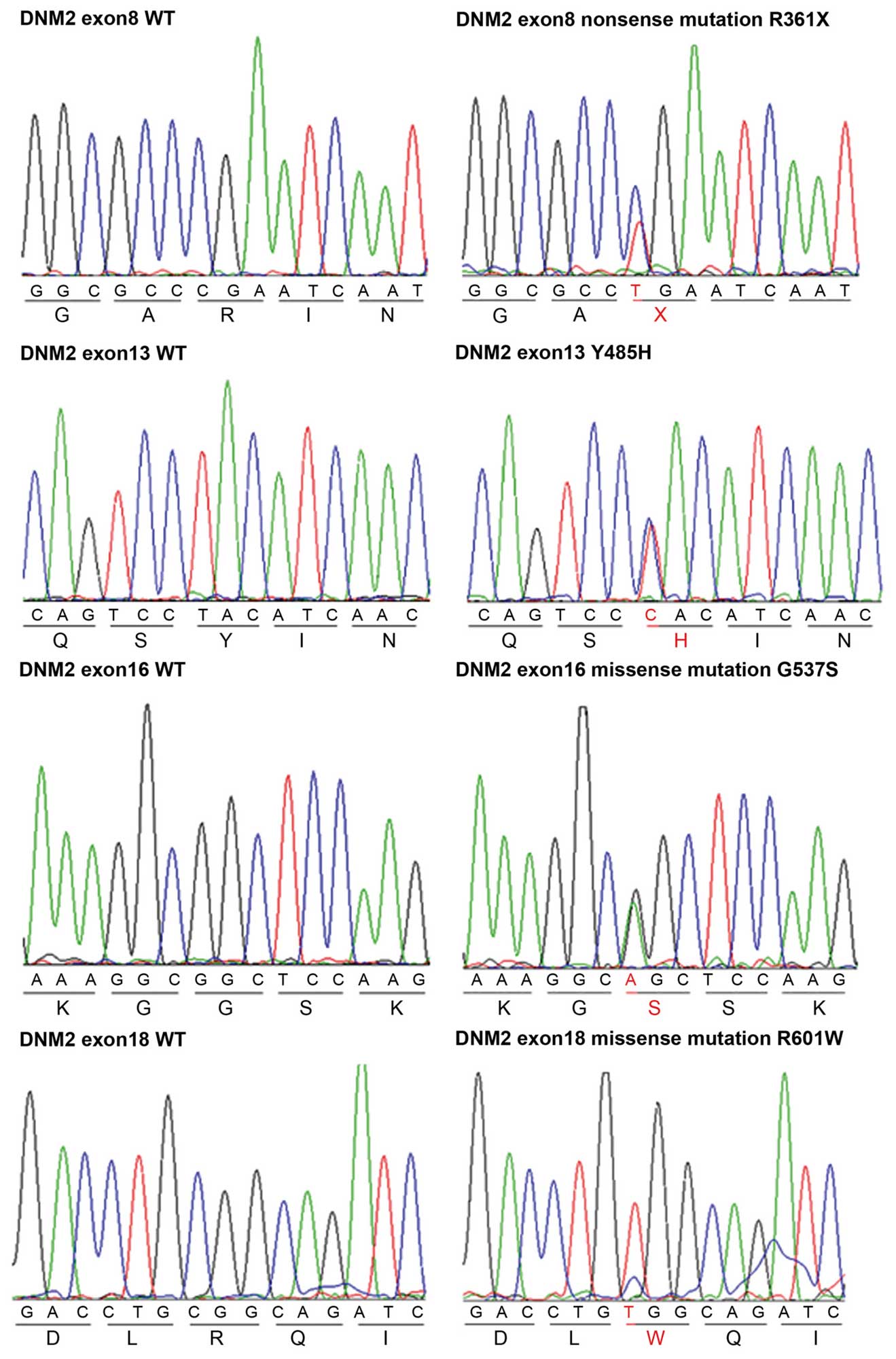
DNM2 mutations were identified in 4 out of 42 T-ALL
patients, resulting in a mutation incidence of 9.5%. The 4
mutations were the point mutations c.1081C>T, c.1453T>C,
c.1609G>A and c.1801C>T, which were located in exons 8, 13,
16 and 18, respectively. In the 4 mutations, 1 mutation was a
nonsense mutation and 3 mutations were missense mutations. All 4
mutations led to amino acid changes (R361X, Y485H, G537S and
R601W). The R361X and Y485H mutations are located within the DNM2
MD; G537S and R601W mutations are located within the DNM2 PH domain
(Fig. 1).
DNM2 mutation in combination with
NOTCH1 and PHF6 mutation
The present study found that in these 4 patients,
DNM2 mutations co-existed with NOTCH1 mutations. In 3 of the 4
patients, the DNM2 mutation co-existed with two NOTCH1 mutations
(point mutations and/or indel mutations) located in NOTCH1 exons
26, 27 and 34. In addition, 3 of the 4 patients with DNM2 mutations
had PHF6 mutations located in PHF6 exons 4, 5 and 8 (Table I).
 | Table I.Co-existence of DNM2, NOTCH1 and PHF6
mutations in adult patients with T-cell acute lymphoblastic
leukemia. |
Table I.
Co-existence of DNM2, NOTCH1 and PHF6
mutations in adult patients with T-cell acute lymphoblastic
leukemia.
|
| DNM2 | NOTCH1 | PHF6 |
|---|
|
|
|
|
|
|---|
| Patient ID | Mutation | Location | Mutation | Location | Mutation | Location |
|---|
| Mu1# | c.1081C>T, | exon 8 |
c.4732_4734delGTG, | exon 26 | c.820C>T, | exon 8 |
|
| p.R361X |
| p.V1578delV, |
| p.R274X |
|
|
|
|
| c.5094C>T,
p.D1698D | exon 27 |
|
|
| Mu2# | c.1453T>C, | exon 13 | c.5033T>C,
p.L1678P | exon 27 | c.346C>T, | exon 4 |
|
| p.Y485H |
| c.7400C>A,
p.S2467* | exon 34 | p.R116X |
|
| Mu3# | c.1609G>A, | exon 16 | c.4721T>C,
p.L1574P | exon 26 | c.385C>T, | exon 5 |
|
| p.G537S |
|
|
| p.R129X |
|
| Mu4# | c.1801C>T, | exon 18 | c.7427G>C,
p.V7427L | exon 34 |
|
|
|
| p.R601W |
|
c.7171delinsTTTT, |
|
|
|
|
|
|
| p.Q2391fs*3 |
|
|
|
Clinical characteristics of the
patients with DNM2 mutations
The clinical characteristics of the patients with
DNM2 mutations are listed on Table
II. No significant differences in clinical characteristics were
observed between the patients with DNM2 mutations and those without
mutations in terms of age (P=0.094), sex (P=1.000), T/B subtype
diagnosis (P=1.000), initial WBC (P=0.453), HGB (P=0.602),
platelets (P=0.950), lactate dehydrogenase (P=0.317), blasts in
bone marrow (P=0.939), blasts in peripheral blood (P=0.900), immune
phenotype CD34+ (P=0.098), CD10+ (P=0.866),
CD19+ (P=1.000), CD20+ (P=1.000),
CD33+ (P=1.000), CD2+ (P=0.525),
CD3+ (P=0.535), CD5+ (P=0.777) and
CD7+ (P=1.000), frequency of extramedullary infiltration
on liver (P=0.888), spleen (P=0.204) and lymph nodes (P=1.000), and
days for complete remission (P=0.234). However, it was found that 1
patient experienced relapse, 1 patient had a high WBC count, and 2
patients had complex karyotypes and lymph node infiltration.
Notably, the time taken to reach complete remission was >4 weeks
in all 4 patients. These data suggest that the patients with DNM2
mutation exhibit high-risk leukemia and possess a poor
prognosis.
| Table II.Clinical characteristics of T-ALL
patients with DNM2 mutations. |
Table II.
Clinical characteristics of T-ALL
patients with DNM2 mutations.
|
| Mutation |
|
|---|
|
|
|
|
|---|
| Characteristics | Mu1# | Mu2# | Mu3# | Mu4# | No mutation, median
(range) |
|---|
| Age, years | 27 | 26 | 26 | 14 | 30.0 (14.0–70.0) |
| Gender | F | M | M | M | F/M |
| Diagnosis | T-ALL | T-ALL | T-ALL | T-ALL | T-ALL |
| DNM2 mutations | R361X | Y485H | G537S | R601W | No |
| WBC,
nx109/l | 2.9 | 106.7 | 28.9 | 54.4 | 44.2
(1.0–546.0) |
| HGB, g/l | 117 | 124 | 92 | 114 | 115.5
(56.0–171.0) |
| PLT,
nx109/l | 85 | 76 | 46 | 56 | 58.5
(17.0–267.0) |
| LDH, U/l | 934 | 731 | 861 | 588 | 1,144.0
(131.0–8601.0) |
| Blasts in bone
marrow, % | 56.4 | 95.6 | 90.2 | 72.4 | 76.0
(20.0–100.0) |
| Blasts in
peripheral blood, % |
6.0 | 68.0 | 88.0 | 89.0 | 64.0
(0.0–100.0) |
| Immune
phenotypea |
|
CD34+ | Negative | Negative | Negative | Negative |
|
|
CD10+ | Negative | Negative | Positive | Negative |
|
|
CD19+ | Negative | Negative | Negative | Negative |
|
|
CD20+ | Negative | Negative | Negative | Negative |
|
|
CD33+ | Negative | Positive | Negative | Negative |
|
|
CD2+ | Negative | Positive | Negative | Positive |
|
|
CD3+ | Negative | Positive | Positive | Negative |
|
|
CD5+ | Positive | Positive | Negative | Positive |
|
|
CD7+ | Positive | Positive | Positive | Positive |
|
| Extramedullary
infiltration |
|
Liver | No | No | No | No |
|
|
Spleen | No | No | No | No |
|
| Lymph
node metastasis | No | No | No | Yes |
|
| Karyotype | 46, XX[20] | 46, XY, der
(1), 9p-, 14q+[3]/47, XY, t(6:11;)
(p10;p10), +?8,9p-[1]/46, XY[6] | 46, XY[20]
+[3][inc]/46, XY[1] 2013.1.7: 47–48, XY, −1,2q-, −4,4q-, −5,
+8,9p-, der (9), +11,11q-*2,12q+,
16q+, 17q-, +2mar[7cp]/46, XY[3] | 46, XY, 11q |
|
| Rearrangement | TCR/TCR | TCR/TCR | TCR/TCR | TCR/TCR |
|
| Time to complete
remission, days | 61 | 43 | 60 | 65 | 28 (9–169) |
DNM2 synonymous amino acid
mutations
DNM2 synonymous amino acid mutations were identified
in exon 4 (1/42 patients; 2.38%), exon 6 (1/42 patients; 2.38%),
exon 22 (1/42 patients; 2.38%), and exon 20 (34/42 patients;
80.95%) in the T-ALL patients. There were two synonymous amino acid
mutations, Ala713Ala and Asp720Asp, in exon 20, and the former
mutation was found in 31 patients (31/42 patients; 73.81%) and the
latter in 3 patients (3/42 patients; 7.14%). The coexistence of the
two mutations was identified in 1 case (1/42 patients; 2.38%)
(Table III). The clinical features
of the patients with DNM2 synonymous amino acid mutations were also
observed, but these synonymous amino acid mutations were not
significantly associated with any clinical features observed (data
not shown).
| Table III.Mutations of synonymous amino acids
in exons of DNM2. |
Table III.
Mutations of synonymous amino acids
in exons of DNM2.
| Mutation, Exon | Mutation, Cases,
n | nucleotide | amino acid |
|---|
| 4 | 1 | c.450A>G | p.P150P |
| 6 | 1 | c.789G>A | p.P263P |
| 20 | 31 | c.2139T>C | p.A713A |
| 20 | 3 | c.2160C>T | p.D720D |
| 20 | 1 |
c.2139T>C+ |
p.A713A+ |
|
|
| c.2160C>T | p.D720D |
| 22 | 1 | c.2571G>A | p.R857R |
Discussion
The DNM2 protein is involved in a wide range of
cellular functions, including phagocytosis, phagosome formation of
actin and microtubule interactions, cytokinesis, cell migration and
regulation of apoptosis (19). It has
been reported that DNM2 gene mutation is an important factor for
patients with autosomal dominant centronuclear myopathy (20) and Alzheimer's disease (21,22).
Recurrent DNM2 mutations have also been identified
in patients with ETP-ALL by whole-exome sequencing (6,10,23). These mutations include: E78fs in the
Ras-like GTPase domain; L3354P, R364C, K382E, T404N and E468* in
the dynamin MD domain; S528fs, E544fs and K557_K558>K in the PH
domain; S698L in the GTPase effector domain; and K770*, P791T,
L789fs and I805fs in the C-terminus. In addition, it has been shown
that certain mutations appear in patients that experience relapse
with induction failure. The present study identified 4 novel DNM2
mutations in 42 adult T-ALL patients, with a mutation rate of 9.5%.
These mutations also mainly appear in the dynamin central region
(MD domain), PH domain and GTPase effector domains. It was also
found that the patients with DNM2 mutations were more likely to
demonstrate high-risk factors, such as a high WBC count, complex
karyotype, lymph node infiltration and difficulty achieving
complete remission. These data indicated that patients with T-ALL
with DNM2 mutations have a poor outcome.
Patient Mu1# was diagnosed with a type of
hypoproliferative leukemia termed ‘hypocellular leukemia’, with
less tolerance to chemotherapy and poor clinical outcome compared
to individual's with normal/increased WBC counts. Hypocelluar
leukemia is most commonly observed in cases of acute myeloid
leukemia, and certain cases are secondary leukemia resulting from
myelodysplastic syndrome, indicating high-risk leukemia (24,25). The
mechanism of hypoproliferative leukemia is not fully understood.
The present study identified that 5 immunotypes were present in
patient Mu2#, but only 2–3 immunotypes were present in the other 3
patients with detected mutations. Only CD33 was observed in patient
Mu2#, suggesting this immunotype may lead to a poorer outcome
compared with those observed in the other 3 patients. In addition,
the association of the mutations with survival of the patients
requires clarification with more patients with the mutations in
future.
DNM2 can bind to membrane phospholipids through PH
domains and the endogenous GED can activate GTPase activity. In
addition, high DNM2 expression is associated with a poor prognosis
and high rate of metastasis in patients with solid cancer.
Inhibition of DNM2 induces the apoptosis of cancer cells (8–10).
Therefore, the present authors hypothesize that the DNM2 mutations
identified in the present study may be gain-of-function mutations.
The effects of these newly-identified DNM2 mutations on the
proliferation of leukemia cells in the current study may be
examined in future studies.
Notably, a high rate of DNM2 synonymous amino acid
mutations (also termed silent mutations) was identified in the
patients. Silent mutations are the evolutionary substitution of one
base for another in an exon of a gene coding for a protein, such
that the produced amino acid sequence is not modified. However,
mutations do not always result in silent mutations (26–28). The
point mutation may affect transcription, splicing, mRNA transport
and translation, any of which may alter the phenotype, rendering
the synonymous mutation non-silent (26–28).
In the present study, DNM2 expression was not
observed in the patients with DNM2 silent mutations, and no
significant changes in DNM2 expression were found in the patients
with silent mutations compared to patients without mutations. In
addition, no significant association between the DNM2 silent
mutations and any clinical features was observed. These data
indicated that the sites with silent mutations may only be the hot
spots and the nucleotides in these sites are easily changed, but
the nucleotide changes may also be quickly corrected. The clinical
relevance of DNM2 silent mutations requires additional
clarification. It was hypothesized in the present study that silent
mutations may affect DNM2 translation in patients (26–28).
In summary, the present study identified 4 novel
DNM2 mutations in T-ALL and their associations with high-risk
leukemia. The current findings suggest the DNM2 mutations may be
involved in the oncogenesis of T-ALL.
Acknowledgements
This study was supported by the following
organizations: The National Natural Science Foundation of China
(grant nos. 81270613 and 30973376); Jiangsu Province Key Medical
Talents (grant no. RC2011077); The Scientific Research Foundation
for the Returned Overseas Chinese Scholars, State Education
Ministry (39th); China Postdoctoral Science Foundation (grant no.
20090461134); Special Grade of the Financial Support from China
Postdoctoral Science Foundation (grant no. 201003598); The Six
Great Talent Peak Plan of Jiangsu (grant no. 2010-WS-024); The
Scientific Research Foundation for the Returned Overseas Chinese
Scholars, Nanjing Municipal Bureau of Personnel (2009); and Project
of National Key Clinical Specialty, and Project funded by Jiangsu
Provincial Special Program of Medical Science (grant no.
BL2014086). The study was also supported partially by the Four
Diamond Foundation of Pennsylvania State University.
References
|
1
|
Pui CH, Relling MV and Downing JR: Acute
lymphoblastic leukemia. N Engl J Med. 350:1535–1548. 2004.
View Article : Google Scholar : PubMed/NCBI
|
|
2
|
Mody R, Li S, Dover DC, Sallan S,
Leisenring W, Oeffinger KC, Yasui Y, Robison LL and Neglia JP:
Twenty-five-year follow-up among survivors of childhood acute
lymphoblastic leukemia: A report from the childhood cancer survivor
study. Blood. 111:5515–5523. 2008. View Article : Google Scholar : PubMed/NCBI
|
|
3
|
Chiaretti S and Foà R: T-cell acute
lymphoblastic leukemia. Haematologica. 94:160–162. 2009. View Article : Google Scholar : PubMed/NCBI
|
|
4
|
Ferrando AA, Neuberg DS, Staunton J, Loh
ML, Huard C, Raimondi SC, Behm FG, Pui CH, Downing JR, Gilliland
DG, et al: Gene expression signatures define novel oncogenic
pathways in T cell acute lymphoblastic leukemia. Cancer Cell.
1:75–87. 2002. View Article : Google Scholar : PubMed/NCBI
|
|
5
|
Roberts KG and Mullighan CG: Genomics in
acute lymphoblastic leukaemia: Insights and treatment implications.
Nat Rev Clin Oncol. 12:344–357. 2015. View Article : Google Scholar : PubMed/NCBI
|
|
6
|
Neumann M, Vosberg S, Schlee C, Heesch S,
Schwartz S, Gökbuget N, Hoelzer D, Graf A, Krebs S, Bartram I, et
al: Mutational spectrum of adult T-ALL. Oncotarget. 6:2754–2766.
2015. View Article : Google Scholar : PubMed/NCBI
|
|
7
|
Xu B, Teng LH, Silva SD, Bijian K, Al
Bashir S, Jie S, Dolph M, Alaoui-Jamali MA and Bismar TA: The
significance of dynamin 2 expression for prostate cancer
progression, prognostication, and therapeutic targeting. Cancer
Med. 3:14–24. 2014. View
Article : Google Scholar : PubMed/NCBI
|
|
8
|
Razidlo GL, Wang Y, Chen J, Krueger EW,
Billadeau DD and McNiven MA: Dynamin 2 potentiates invasive
migration of pancreatic tumor cells through stabilization of the
Rac1 GEF Vav1. Dev Cell. 24:573–585. 2013. View Article : Google Scholar : PubMed/NCBI
|
|
9
|
Chircop M, Perera S, Mariana A, Lau H, Ma
MP, Gilbert J, Jones NC, Gordon CP, Young KA, Morokoff A, et al:
Inhibition of dynamin by dynole 34-2 induces cell death following
cytokinesis failure in cancer cells. Mol Cancer Ther. 10:1553–1562.
2011. View Article : Google Scholar : PubMed/NCBI
|
|
10
|
Neumann M, Heesch S, Schlee C, Schwartz S,
Gökbuget N, Hoelzer D, Konstandin NP, Ksienzyk B, Vosberg S, Graf
A, et al: Whole-exome sequencing in adult ETP-ALL reveals a high
rate of DNMT3A mutations. Blood. 121:4749–4752. 2013. View Article : Google Scholar : PubMed/NCBI
|
|
11
|
Guo X, Zhang R, Liu J, Li M, Song C, Dovat
S, Li J and Ge Z: Characterization of LEF1 high expression and
novel mutations in adult acute lymphoblastic leukemia. PLoS One.
10:e01254292015. View Article : Google Scholar : PubMed/NCBI
|
|
12
|
Parsons DW, Li M, Zhang X, Jones S, Leary
RJ, Lin JC, Boca SM, Carter H, Samayoa J, Bettegowda C, et al: The
genetic landscape of the childhood cancer medulloblastoma. Science.
331:435–439. 2011. View Article : Google Scholar : PubMed/NCBI
|
|
13
|
Lin ZK, Zhang R, Ge Z, Liu J, Guo X, Qiao
C, Wu YJ, Qiu HR, Zhang JF and Li JY: Characteristics of NOTCH1
mutation in adult T-cell acute lymphoblastic leukemia. Zhongguo Shi
Yan Xue Ye Xue Za Zhi. 21:1403–1408. 2013.(In Chinese). PubMed/NCBI
|
|
14
|
Guo X, Zhang R, Ge Z, Xu JY, Li M, Qiao C,
Qiu HR and Li JY: Mutations of FBXW7 in adult T-cell acute
lymphocytic leukemia. Zhongguo Shi Yan Xue Ye Xue Za Zhi.
23:612–618. 2015.(In Chinese). PubMed/NCBI
|
|
15
|
Wang Q, Qiu H, Jiang H, Wu L, Dong S, Pan
J, Wang W, Ping N, Xia J, Sun A, et al: Mutations of PHF6 are
associated with mutations of NOTCH1, JAK1 and rearrangement of
SET-NUP214 in T-cell acute lymphoblastic leukemia. Haematologica.
96:1808–1814. 2011. View Article : Google Scholar : PubMed/NCBI
|
|
16
|
Shaffer LG, Slovak ML and Campbell LJ: An
International System for Human Cytogenetic
NomenclatureRecommendations of the International Standing Committee
on Human Cytogenetic Nomenclature. Karger; Basel, Switzerland:
2009
|
|
17
|
Chen HY, Ge Z, Wu YJ, Wu LY, Sun M, Tian
T, Qiou HR, Liu P and Li JY: Immunophenotypic analysis of
Philadelphia chromosome positive acute lymphoblastic leukaemia in
adults. Zhongguo Shi Yan Xue Ye Xue Za Zhi. 18:714–717. 2010.(In
Chinese). PubMed/NCBI
|
|
18
|
Miao Y, Fan L, Wu YJ, Xia Y, Qiao C, Wang
Y, Wang L, Hong M, Zhu HY, Xu W and Li JY: Low expression of CD200
predicts shorter time-to-treatment in chronic lymphocytic leukemia.
Oncotarget. 7:13551–13562. 2016.PubMed/NCBI
|
|
19
|
Van Vlierberghe P, Palomero T, Khiabanian
H, Van der Meulen J, Castillo M, Van Roy N, De Moerloose B,
Philippé J, González-García S, Toribio ML, et al: PHF6 mutations in
T-cell acute lymphoblastic leukemia. Nat Genet. 42:338–342. 2010.
View Article : Google Scholar : PubMed/NCBI
|
|
20
|
Ferguson SM and De Camilli P: Dynamin, a
membrane-remodelling GTPase. Nat Rev Mol Cell Biol. 13:75–88.
2012.PubMed/NCBI
|
|
21
|
Bitoun M, Maugenre S, Jeannet PY, Lacène
E, Ferrer X, Laforêt P, Martin JJ, Laporte J, Lochmüller H, Beggs
AH, et al: Mutations in dynamin 2 cause dominant centronuclear
myopathy. Nat Genet. 37:1207–1209. 2005. View Article : Google Scholar : PubMed/NCBI
|
|
22
|
Aidaralieva NJ, Kamino K, Kimura R,
Yamamoto M, Morihara T, Kazui H, Hashimoto R, Tanaka T, Kudo T,
Kida T, et al: Dynamin 2 gene is a novel susceptibility gene for
late-onset Alzheimer disease in non-APOE-epsilon4 carriers. J Hum
Genet. 53:296–302. 2008. View Article : Google Scholar : PubMed/NCBI
|
|
23
|
Koutsopoulos OS, Kretz C, Weller CM, Roux
A, Mojzisova H, Böhm J, Koch C, Toussaint A, Heckel E, Stemkens D,
et al: Dynamin 2 homozygous mutation in humans with a lethal
congenital syndrome. Eur J Hum Genet. 21:637–642. 2013. View Article : Google Scholar : PubMed/NCBI
|
|
24
|
Nagai K, Kohno T, Chen YX, Tsushima H,
Mori H, Nakamura H, Jinnai I, Matsuo T, Kuriyama K, Tomonaga M and
Bennett JM: Diagnostic criteria for hypocellular acute leukemia: A
clinical entity distinct from overt acute leukemia and
myelodysplastic syndrome. Leuk Res. 20:563–574. 1996. View Article : Google Scholar : PubMed/NCBI
|
|
25
|
Hu X, Fu W, Wang L, Gao L, Lü S, Xi H, Qiu
H, Chen L, Chen J, Ni X, et al: HAG regimen improves survival in
adult patients with hypocellular acute myeloid leukemia.
Oncotarget. 7:3623–3634. 2016.PubMed/NCBI
|
|
26
|
Chamary JV, Parmley JL and Hurst LD:
Hearing silence: Non-neutral evolution at synonymous sites in
mammals. Nat Rev Genet. 7:98–108. 2006. View Article : Google Scholar : PubMed/NCBI
|
|
27
|
Goymer P: Synonymous mutations break their
silence. Nat Rev Genet. 8:922007. View
Article : Google Scholar
|
|
28
|
Zhou T, Ko EA, Gu W, Lim I, Bang H and Ko
JH: Non-silent story on synonymous sites in voltage-gated ion
channel genes. PLoS One. 7:e485412012. View Article : Google Scholar : PubMed/NCBI
|