Spandidos Publications Logo
  • About
    • About Spandidos
    • Aims and Scopes
    • Abstracting and Indexing
    • Editorial Policies
    • Reprints and Permissions
    • Job Opportunities
    • Terms and Conditions
    • Contact
  • Journals
    • All Journals
    • Oncology Letters
      • Oncology Letters
      • Information for Authors
      • Editorial Policies
      • Editorial Board
      • Aims and Scope
      • Abstracting and Indexing
      • Bibliographic Information
      • Archive
    • International Journal of Oncology
      • International Journal of Oncology
      • Information for Authors
      • Editorial Policies
      • Editorial Board
      • Aims and Scope
      • Abstracting and Indexing
      • Bibliographic Information
      • Archive
    • Molecular and Clinical Oncology
      • Molecular and Clinical Oncology
      • Information for Authors
      • Editorial Policies
      • Editorial Board
      • Aims and Scope
      • Abstracting and Indexing
      • Bibliographic Information
      • Archive
    • Experimental and Therapeutic Medicine
      • Experimental and Therapeutic Medicine
      • Information for Authors
      • Editorial Policies
      • Editorial Board
      • Aims and Scope
      • Abstracting and Indexing
      • Bibliographic Information
      • Archive
    • International Journal of Molecular Medicine
      • International Journal of Molecular Medicine
      • Information for Authors
      • Editorial Policies
      • Editorial Board
      • Aims and Scope
      • Abstracting and Indexing
      • Bibliographic Information
      • Archive
    • Biomedical Reports
      • Biomedical Reports
      • Information for Authors
      • Editorial Policies
      • Editorial Board
      • Aims and Scope
      • Abstracting and Indexing
      • Bibliographic Information
      • Archive
    • Oncology Reports
      • Oncology Reports
      • Information for Authors
      • Editorial Policies
      • Editorial Board
      • Aims and Scope
      • Abstracting and Indexing
      • Bibliographic Information
      • Archive
    • Molecular Medicine Reports
      • Molecular Medicine Reports
      • Information for Authors
      • Editorial Policies
      • Editorial Board
      • Aims and Scope
      • Abstracting and Indexing
      • Bibliographic Information
      • Archive
    • World Academy of Sciences Journal
      • World Academy of Sciences Journal
      • Information for Authors
      • Editorial Policies
      • Editorial Board
      • Aims and Scope
      • Abstracting and Indexing
      • Bibliographic Information
      • Archive
    • International Journal of Functional Nutrition
      • International Journal of Functional Nutrition
      • Information for Authors
      • Editorial Policies
      • Editorial Board
      • Aims and Scope
      • Abstracting and Indexing
      • Bibliographic Information
      • Archive
    • International Journal of Epigenetics
      • International Journal of Epigenetics
      • Information for Authors
      • Editorial Policies
      • Editorial Board
      • Aims and Scope
      • Abstracting and Indexing
      • Bibliographic Information
      • Archive
    • Medicine International
      • Medicine International
      • Information for Authors
      • Editorial Policies
      • Editorial Board
      • Aims and Scope
      • Abstracting and Indexing
      • Bibliographic Information
      • Archive
  • Articles
  • Information
    • Information for Authors
    • Information for Reviewers
    • Information for Librarians
    • Information for Advertisers
    • Conferences
  • Language Editing
Spandidos Publications Logo
  • About
    • About Spandidos
    • Aims and Scopes
    • Abstracting and Indexing
    • Editorial Policies
    • Reprints and Permissions
    • Job Opportunities
    • Terms and Conditions
    • Contact
  • Journals
    • All Journals
    • Biomedical Reports
      • Information for Authors
      • Editorial Policies
      • Editorial Board
      • Aims and Scope
      • Abstracting and Indexing
      • Bibliographic Information
      • Archive
    • Experimental and Therapeutic Medicine
      • Information for Authors
      • Editorial Policies
      • Editorial Board
      • Aims and Scope
      • Abstracting and Indexing
      • Bibliographic Information
      • Archive
    • International Journal of Epigenetics
      • Information for Authors
      • Editorial Policies
      • Editorial Board
      • Aims and Scope
      • Abstracting and Indexing
      • Bibliographic Information
      • Archive
    • International Journal of Functional Nutrition
      • Information for Authors
      • Editorial Policies
      • Editorial Board
      • Aims and Scope
      • Abstracting and Indexing
      • Bibliographic Information
      • Archive
    • International Journal of Molecular Medicine
      • Information for Authors
      • Editorial Policies
      • Editorial Board
      • Aims and Scope
      • Abstracting and Indexing
      • Bibliographic Information
      • Archive
    • International Journal of Oncology
      • Information for Authors
      • Editorial Policies
      • Editorial Board
      • Aims and Scope
      • Abstracting and Indexing
      • Bibliographic Information
      • Archive
    • Medicine International
      • Information for Authors
      • Editorial Policies
      • Editorial Board
      • Aims and Scope
      • Abstracting and Indexing
      • Bibliographic Information
      • Archive
    • Molecular and Clinical Oncology
      • Information for Authors
      • Editorial Policies
      • Editorial Board
      • Aims and Scope
      • Abstracting and Indexing
      • Bibliographic Information
      • Archive
    • Molecular Medicine Reports
      • Information for Authors
      • Editorial Policies
      • Editorial Board
      • Aims and Scope
      • Abstracting and Indexing
      • Bibliographic Information
      • Archive
    • Oncology Letters
      • Information for Authors
      • Editorial Policies
      • Editorial Board
      • Aims and Scope
      • Abstracting and Indexing
      • Bibliographic Information
      • Archive
    • Oncology Reports
      • Information for Authors
      • Editorial Policies
      • Editorial Board
      • Aims and Scope
      • Abstracting and Indexing
      • Bibliographic Information
      • Archive
    • World Academy of Sciences Journal
      • Information for Authors
      • Editorial Policies
      • Editorial Board
      • Aims and Scope
      • Abstracting and Indexing
      • Bibliographic Information
      • Archive
  • Articles
  • Information
    • For Authors
    • For Reviewers
    • For Librarians
    • For Advertisers
    • Conferences
  • Language Editing
Login Register Submit
  • This site uses cookies
  • You can change your cookie settings at any time by following the instructions in our Cookie Policy. To find out more, you may read our Privacy Policy.

    I agree
Search articles by DOI, keyword, author or affiliation
Search
Advanced Search
presentation
Oncology Letters
Join Editorial Board Propose a Special Issue
Print ISSN: 1792-1074 Online ISSN: 1792-1082
Journal Cover
August-2017 Volume 14 Issue 2

Full Size Image

Sign up for eToc alerts
Recommend to Library

Journals

International Journal of Molecular Medicine

International Journal of Molecular Medicine

International Journal of Molecular Medicine is an international journal devoted to molecular mechanisms of human disease.

International Journal of Oncology

International Journal of Oncology

International Journal of Oncology is an international journal devoted to oncology research and cancer treatment.

Molecular Medicine Reports

Molecular Medicine Reports

Covers molecular medicine topics such as pharmacology, pathology, genetics, neuroscience, infectious diseases, molecular cardiology, and molecular surgery.

Oncology Reports

Oncology Reports

Oncology Reports is an international journal devoted to fundamental and applied research in Oncology.

Experimental and Therapeutic Medicine

Experimental and Therapeutic Medicine

Experimental and Therapeutic Medicine is an international journal devoted to laboratory and clinical medicine.

Oncology Letters

Oncology Letters

Oncology Letters is an international journal devoted to Experimental and Clinical Oncology.

Biomedical Reports

Biomedical Reports

Explores a wide range of biological and medical fields, including pharmacology, genetics, microbiology, neuroscience, and molecular cardiology.

Molecular and Clinical Oncology

Molecular and Clinical Oncology

International journal addressing all aspects of oncology research, from tumorigenesis and oncogenes to chemotherapy and metastasis.

World Academy of Sciences Journal

World Academy of Sciences Journal

Multidisciplinary open-access journal spanning biochemistry, genetics, neuroscience, environmental health, and synthetic biology.

International Journal of Functional Nutrition

International Journal of Functional Nutrition

Open-access journal combining biochemistry, pharmacology, immunology, and genetics to advance health through functional nutrition.

International Journal of Epigenetics

International Journal of Epigenetics

Publishes open-access research on using epigenetics to advance understanding and treatment of human disease.

Medicine International

Medicine International

An International Open Access Journal Devoted to General Medicine.

Journal Cover
August-2017 Volume 14 Issue 2

Full Size Image

Sign up for eToc alerts
Recommend to Library

  • Article
  • Citations
    • Cite This Article
    • Download Citation
    • Create Citation Alert
    • Remove Citation Alert
    • Cited By
  • Similar Articles
    • Related Articles (in Spandidos Publications)
    • Similar Articles (Google Scholar)
    • Similar Articles (PubMed)
  • Download PDF
  • Download XML
  • View XML
Review Open Access

Exploitation of necroptosis for treatment of caspase‑compromised cancers (Review)

  • Authors:
    • Young Sik Cho
    • Hey Li Park
  • View Affiliations / Copyright

    Affiliations: College of Pharmacy, Keimyung University, Daegu 704‑701, Republic of Korea
    Copyright: © Cho et al. This is an open access article distributed under the terms of Creative Commons Attribution License.
  • Pages: 1207-1214
    |
    Published online on: May 31, 2017
       https://doi.org/10.3892/ol.2017.6285
  • Expand metrics +
Metrics: Total Views: 0 (Spandidos Publications: | PMC Statistics: )
Metrics: Total PDF Downloads: 0 (Spandidos Publications: | PMC Statistics: )
Cited By (CrossRef): 0 citations Loading Articles...

This article is mentioned in:


Abstract

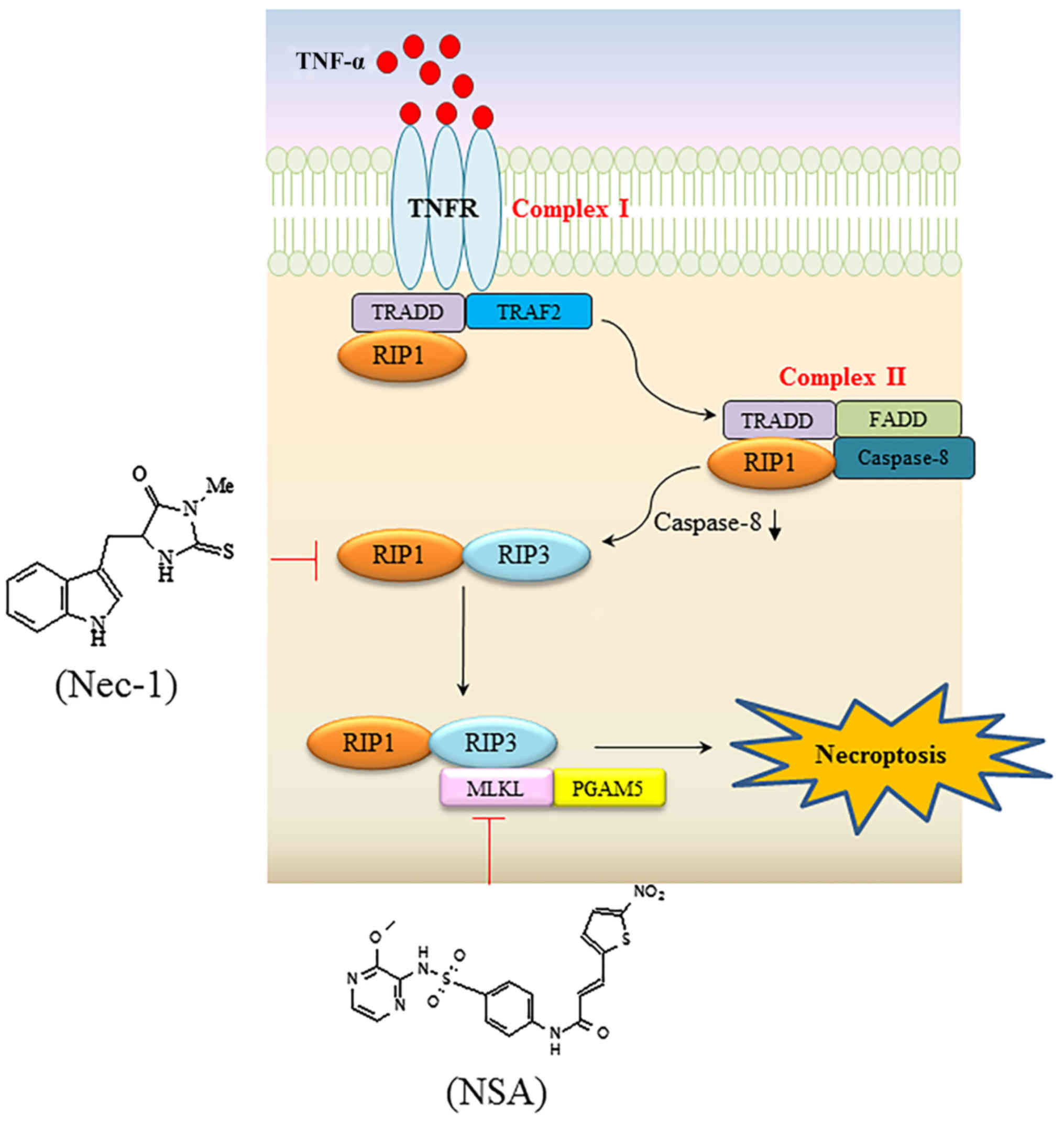
Programmed necrosis, or necroptosis, is a type of specialized cell death with necrotic characteristics, including the loss of membrane integrity and swollen organelles in dying cells. However, unlike simple necrosis, it may be induced as an alternative form of cell death when apoptosis is blocked and it is mediated in an orchestrated manner, similar to apoptosis, by a series of signaling molecules. Necroptosis‑associated proteins and their specific small molecules have been extensively identified in order to illuminate the underlying mechanisms by which necroptosis is activated through a novel signaling pathway. However, the biological significance of necroptosis, which is known as a secondary route of apoptosis, remains under debate. Concurrent with these concerns, the clinical application of necroptosis has been cautiously proposed to treat necroptosis‑associated diseases, and to overcome resistance to anticancer drugs. Accordingly, the present review will highlight the harnessing of necroptosis for anticancer therapy. To this end, the state‑of‑the art technique of necroptosis as a cancer therapy will be briefly described, and then its potential for clinical purposes will be delineated. For a further understanding of necroptosis, the present review begins with a basic introduction to necroptosis and its multifaceted physiological consequences.
View Figures

Figure 1

View References

1 

Fulda S, Gorman AM, Hori O and Samali A: Cellular stress responses: Cell survival and cell death. Int J Cell Biol. 2010:2140742010. View Article : Google Scholar : PubMed/NCBI

2 

Haanen C and Vermes I: Apoptosis: Programmed cell death in fetal development. Eur J Obstet Gynecol Reprod Biol. 64:129–133. 1996. View Article : Google Scholar : PubMed/NCBI

3 

Opferman JT: Apoptosis in the development of the immune system. Cell Death Differ. 15:234–242. 2008. View Article : Google Scholar : PubMed/NCBI

4 

Duval D, Trouillas M, Thibault C, Dembelé D, Diemunsch F, Reinhardt B, Mertz AL, Dierich A and Boeuf H: Apoptosis and differentiation commitment: Novel insights revealed by gene profiling studies in mouse embryonic stem cells. Cell Death Differ. 13:564–575. 2006. View Article : Google Scholar : PubMed/NCBI

5 

Elliott MR and Ravichandran KS: Clearance of apoptotic cells: Implications in health and disease. J Cell Biol. 189:1059–1070. 2010. View Article : Google Scholar : PubMed/NCBI

6 

Van den Berghe T, Linkermann A, Jouan-Lanhouet S, Walczak H and Vandenabeele P: Regulated necrosis: The expanding network of non-apoptotic cell death pathways. Nat Rev Mol Cell Biol. 15:135–147. 2014. View Article : Google Scholar : PubMed/NCBI

7 

Giampietri C, Starace D, Petrungaro S, Filippini A and Ziparo E: Necroptosis: Molecular signalling and translational implications. Int J Cell Biol. 2014:4902752014. View Article : Google Scholar : PubMed/NCBI

8 

Lu JV, Chen HC and Walsh CM: Necroptotic signaling in adaptive and innate immunity. Semin Cell Dev Biol. 35:33–39. 2014. View Article : Google Scholar : PubMed/NCBI

9 

Fulda S: The mechanism of necroptosis in normal and cancer cells. Cancer Biol Ther. 14:999–1004. 2013. View Article : Google Scholar : PubMed/NCBI

10 

Zhou W and Yuan J: Necroptosis in health and diseases. Semin Cell Dev Biol. 35:14–23. 2014. View Article : Google Scholar : PubMed/NCBI

11 

Kaczmarek A, Vandenabeele P and Krysko DV: Necroptosis: The release of damage-associated molecular patterns and its physiological relevance. Immunity. 38:209–223. 2013. View Article : Google Scholar : PubMed/NCBI

12 

Cho YS, Challa S, Moquin D, Genga R, Ray TD, Guildford M and Chan FK: Phosphorylation-driven assembly of the RIP1-RIP3 complex regulates programmed necrosis and virus-induced inflammation. Cell. 137:1112–1123. 2009. View Article : Google Scholar : PubMed/NCBI

13 

Hitomi J, Christofferson DE, Ng A, Yao J, Degterev A, Xavier RJ and Yuan J: Identification of a molecular signaling network that regulates a cellular necrotic cell death pathway. Cell. 135:1311–1323. 2008. View Article : Google Scholar : PubMed/NCBI

14 

Festjens N, Berghe T Vanden, Cornelis S and Vandenabeele P: RIP1, a kinase on the crossroads of a cell's decision to live or die. Cell Death Differ. 14:400–410. 2007. View Article : Google Scholar : PubMed/NCBI

15 

Micheau O and Tschopp J: Induction of TNF receptor I-mediated apoptosis via two sequential signaling complexes. Cell. 114:181–190. 2003. View Article : Google Scholar : PubMed/NCBI

16 

Han J, Zhong CQ and Zhang DW: Programmed necrosis: Backup to and competitor with apoptosis in the immune system. Nat Immunol. 12:1143–1149. 2011. View Article : Google Scholar : PubMed/NCBI

17 

Moquin DM, McQuade T and Chan FK: CYLD deubiquitinates RIP1 in the TNFα-induced necrosome to facilitate kinase activation and programmed necrosis. PLoS One. 8:e768412013. View Article : Google Scholar : PubMed/NCBI

18 

Moriwaki K and Chan FK: RIP3: A molecular switch for necrosis and inflammation. Genes Dev. 27:1640–1649. 2013. View Article : Google Scholar : PubMed/NCBI

19 

Sun L, Wang H, Wang Z, He S, Chen S, Liao D, Wang L, Yan J, Liu W, Lei X and Wang X: Mixed lineage kinase domain-like protein mediates necrosis signaling downstream of RIP3 kinase. Cell. 148:213–227. 2012. View Article : Google Scholar : PubMed/NCBI

20 

Zhao J, Jitkaew S, Cai Z, Choksi S, Li Q, Luo J and Liu ZG: Mixed lineage kinase domain-like is a key receptor interacting protein 3 downstream component of TNF-induced necrosis. Proc Natl Acad Sci USA. 109:pp. 5322–5327. 2012; View Article : Google Scholar : PubMed/NCBI

21 

Wang Z, Jiang H, Chen S, Du F and Wang X: The mitochondrial phosphatase PGAM5 functions at the convergence point of multiple necrotic death pathways. Cell. 148:228–243. 2012. View Article : Google Scholar : PubMed/NCBI

22 

Remijsen Q, Goossens V, Grootjans S, Van den Haute C, Vanlangenakker N, Dondelinger Y, Roelandt R, Bruggeman I, Goncalves A, Bertrand MJ, et al: Depletion of RIPK3 or MLKL blocks TNF-driven necroptosis and switches towards a delayed RIPK1 kinase-dependent apoptosis. Cell Death Dis. 5:e10042014. View Article : Google Scholar : PubMed/NCBI

23 

Degterev A, Hitomi J, Germscheid M, Ch'en IL, Korkina O, Teng X, Abbott D, Cuny GD, Yuan C, Wagner G, et al: Identification of RIP1 kinase as a specific cellular target of necrostatins. Nat Chem Biol. 4:313–321. 2008. View Article : Google Scholar : PubMed/NCBI

24 

Liao D, Sun L, Liu W, He S, Wang X and Lei X: Necrosulfonamide inhibits necroptosis by selectively targeting the mixed lineage kinase domain-like protein. Med Chem Comm. 5:333–337. 2014. View Article : Google Scholar

25 

Christofferson DE and Yuan J: Necroptosis as an alternative form of programmed cell death. Curr Opin Cell Biol. 22:263–268. 2010. View Article : Google Scholar : PubMed/NCBI

26 

Bohgaki T, Mozo J, Salmena L, Matysiak-Zablocki E, Bohgaki M, Sanchez O, Strasser A, Hakem A and Hakem R: Caspase-8 inactivation in T cells increases necroptosis and suppresses autoimmunity in Bim-/-mice. J Cell Biol. 195:277–291. 2011. View Article : Google Scholar : PubMed/NCBI

27 

Upton JW, Kaiser WJ and Mocarski ES: Virus inhibition of RIP3-dependent necrosis. Cell Host Microbe. 7:302–313. 2010. View Article : Google Scholar : PubMed/NCBI

28 

Desvignes L, Wolf AJ and Ernst JD: Dynamic roles of type I and type II IFNs in early infection with Mycobacterium tuberculosis. J Immunol. 188:6205–6215. 2012. View Article : Google Scholar : PubMed/NCBI

29 

Robinson N, McComb S, Mulligan R, Dudani R, Krishnan L and Sad S: Type I interferon induces necroptosis in macrophages during infection with Salmonella enterica serovar Typhimurium. Nat Immunol. 13:954–962. 2012. View Article : Google Scholar : PubMed/NCBI

30 

He S, Wang L, Miao L, Wang T, Du F, Zhao L and Wang X: Receptor interacting protein kinase-3 determines cellular necrotic response to TNF-alpha. Cell. 137:1100–1111. 2009. View Article : Google Scholar : PubMed/NCBI

31 

Gunther C, Martini E, Wittkopf N, Amann K, Weigmann B, Neumann H, Waldner MJ, Hedrick SM, Tenzer S, Neurath MF and Becker C: Caspase-8 regulates TNF-α-induced epithelial necroptosis and terminal ileitis. Nature. 477:335–339. 2011. View Article : Google Scholar : PubMed/NCBI

32 

Trichonas G, Murakami Y, Thanos A, Morizane Y, Kayama M, Debouck CM, Hisatomi T, Miller JW and Vavvas DG: Receptor interacting protein kinases mediate retinal detachment-induced photoreceptor necrosis and compensate for inhibition of apoptosis. Proc Natl Acad Sci USA. 107:pp. 21695–21700. 2010; View Article : Google Scholar : PubMed/NCBI

33 

Linkermann A, De Zen F, Weinberg J, Kunzendorf U and Krautwald S: Programmed necrosis in acute kidney injury. Nephrol Dial Transplant. 27:3412–3419. 2012. View Article : Google Scholar : PubMed/NCBI

34 

Ramachandran A, McGill MR, Xie Y, Ni HM, Ding WX and Jaeschke H: Receptor interacting protein kinase 3 is a critical early mediator of acetaminophen-induced hepatocyte necrosis in mice. Hepatology. 58:2099–2108. 2013. View Article : Google Scholar : PubMed/NCBI

35 

Ofengeim D, Ito Y, Najafov A, Zhang Y, Shan B, DeWitt JP, Ye J, Zhang X, Chang A, Vakifahmetoglu-Norberg H, et al: Activation of necroptosis in multiple sclerosis. Cell Rep. 10:1836–1849. 2015. View Article : Google Scholar : PubMed/NCBI

36 

Kitur K, Parker D, Nieto P, Ahn DS, Cohen TS, Chung S, Wachtel S, Bueno S and Prince A: Toxin-induced necroptosis is a major mechanism of Staphylococcus aureus lung damage. PLoS Pathog. 11:e10048202015. View Article : Google Scholar : PubMed/NCBI

37 

Su Z, Yang Z, Xie L, DeWitt JP and Chen Y: Cancer therapy in the necroptosis era. Cell Death Differ. 23:748–756. 2016. View Article : Google Scholar : PubMed/NCBI

38 

Meng MB, Wang HH, Cui YL, Wu ZQ, Shi YY, Zaorsky NG, Deng L, Yuan ZY, Lu Y and Wang P: Necroptosis in tumorigenesis, activation of anti-tumor immunity, and cancer therapy. Oncotarget. 7:57391–57413. 2016.PubMed/NCBI

39 

Liu P, Xu B, Shen W, Zhu H, Wu W, Fu Y, Chen H, Dong H, Zhu Y, Miao K, et al: Dysregulation of TNFα-induced necroptotic signaling in chronic lymphocytic leukemia: Suppression of CYLD gene by LEF1. Leukemia. 26:1293–1300. 2012. View Article : Google Scholar : PubMed/NCBI

40 

Wu W, Liu P and Li J: Necroptosis: An emerging form of programmed cell death. Crit Rev Oncol Hemato. 82:249–258. 2012. View Article : Google Scholar

41 

Housman G, Byler S, Heerboth S, Lapinska K, Longacre M, Snyder N and Sarkar S: Drug resistance in cancer: An overview. Cancers (Basel). 6:1769–1792. 2014. View Article : Google Scholar : PubMed/NCBI

42 

McCabe KE, Bacos K, Lu D, Delaney JR, Axelrod J, Potter MD, Vamos M, Wong V, Cosford ND, Xiang R and Stupack DG: Triggering necroptosis in cisplatin and IAP antagonist-resistant ovarian carcinoma. Cell Death Dis. 5:e14962014. View Article : Google Scholar : PubMed/NCBI

43 

Basit F, Cristofanon S and Fulda S: Obatoclax (GX15-070) triggers necroptosis by promoting the assembly of the necrosome on autophagosomal membranes. Cell Death Differ. 20:1161–1173. 2013. View Article : Google Scholar : PubMed/NCBI

44 

Dunai ZA, Imre G, Barna G, Korcsmaros T, Petak I, Bauer PI and Mihalik R: Staurosporine induces necroptotic cell death under caspase-compromised conditions in U937 cells. PLoS One. 7:e419452012. View Article : Google Scholar : PubMed/NCBI

45 

Deeraksa A, Pan J, Sha Y, Liu XD, Eissa NT, Lin SH and Yu-Lee LY: Plk1 is upregulated in androgen-insensitive prostate cancer cells and its inhibition leads to necroptosis. Oncogene. 32:2973–2983. 2013. View Article : Google Scholar : PubMed/NCBI

46 

Kaku Y, Tsuchiya A, Kanno T and Nishizaki T: HUHS1015 induces necroptosis and caspase-independent apoptosis of MKN28 human gastric cancer cells in association with AMID accumulation in the nucleus. Anticancer Agents Med Chem. 15:242–247. 2015. View Article : Google Scholar : PubMed/NCBI

47 

Pasupuleti N, Leon L, Carraway KL III and Gorin F: 5-Benzylglycinyl-amiloride kills proliferating and nonproliferating malignant glioma cells through caspase-independent necroptosis mediated by apoptosis-inducing factor. J Pharmacol Exp Ther. 344:600–615. 2013. View Article : Google Scholar : PubMed/NCBI

48 

Huang C, Luo Y, Zhao J, Yang F, Zhao H, Fan W and Ge P: Shikonin kills glioma cells through necroptosis mediated by RIP-1. PLoS One. 8:e663262013. View Article : Google Scholar : PubMed/NCBI

49 

Fu Z, Deng B, Liao Y, Shan L, Yin F, Wang Z, Zeng H, Zuo D, Hua Y and Cai Z: The anti-tumor effect of shikonin on osteosarcoma by inducing RIP1 and RIP3 dependent necroptosis. BMC Cancer. 13:5802013. View Article : Google Scholar : PubMed/NCBI

50 

Tian W, Deng Y, Li L, He H, Sun J and Xu D: Honokiol synergizes chemotherapy drugs in multidrug resistant breast cancer cells via enhanced apoptosis and additional programmed necrotic death. Int J Oncol. 42:721–732. 2013.PubMed/NCBI

51 

Miki Y, Akimoto J, Moritake K, Hironaka C and Fujiwara Y: Photodynamic therapy using talaporfin sodium induces concentration-dependent programmed necroptosis in human glioblastoma T98G cells. Lasers Med Sci. 30:1739–1745. 2015. View Article : Google Scholar : PubMed/NCBI

52 

Nehs MA, Lin CI, Kozono DE, Whang EE, Cho NL, Zhu K, Moalem J, Moore FD Jr and Ruan DT: Necroptosis is a novel mechanism of radiation-induced cell death in anaplastic thyroid and adrenocortical cancers. Surgery. 150:1032–1039. 2011. View Article : Google Scholar : PubMed/NCBI

53 

Liu T, Bao YH, Wang Y and Jiang JY: The role of necroptosis in neurosurgical diseases. Braz J Med Biol Res. 48:292–298. 2015. View Article : Google Scholar : PubMed/NCBI

54 

Yamanaka K, Saito Y, Yamamori T, Urano Y and Noguchi N: 24(S)-hydroxycholesterol induces neuronal cell death through necroptosis, a form of programmed necrosis. J Biol Chem. 286:24666–24673. 2011. View Article : Google Scholar : PubMed/NCBI

55 

Luedde M, Lutz M, Carter N, Sosna J, Jacoby C, Vucur M, Gautheron J, Roderburg C, Borg N, Reisinger F, et al: RIP3, a kinase promoting necroptotic cell death, mediates adverse remodelling after myocardial infarction. Cardiovasc Res. 103:206–216. 2014. View Article : Google Scholar : PubMed/NCBI

56 

King MD, Whitaker-Lea WA, Campbell JM, Alleyne CH Jr and Dhandapani KM: Necrostatin-1 reduces neurovascular injury after intracerebral hemorrhage. Int J Cell Biol. 2014:4958172014. View Article : Google Scholar : PubMed/NCBI

57 

Wang H, Sun L, Su L, Rizo J, Liu L, Wang LF, Wang FS and Wang X: Mixed lineage kinase domain-like protein MLKL causes necrotic membrane disruption upon phosphorylation by RIP3. Mol Cell. 54:133–146. 2014. View Article : Google Scholar : PubMed/NCBI

Related Articles

  • Abstract
  • View
  • Download
  • Twitter
Copy and paste a formatted citation
Spandidos Publications style
Cho Y and Park H: Exploitation of necroptosis for treatment of caspase‑compromised cancers (Review). Oncol Lett 14: 1207-1214, 2017.
APA
Cho, Y., & Park, H. (2017). Exploitation of necroptosis for treatment of caspase‑compromised cancers (Review). Oncology Letters, 14, 1207-1214. https://doi.org/10.3892/ol.2017.6285
MLA
Cho, Y., Park, H."Exploitation of necroptosis for treatment of caspase‑compromised cancers (Review)". Oncology Letters 14.2 (2017): 1207-1214.
Chicago
Cho, Y., Park, H."Exploitation of necroptosis for treatment of caspase‑compromised cancers (Review)". Oncology Letters 14, no. 2 (2017): 1207-1214. https://doi.org/10.3892/ol.2017.6285
Copy and paste a formatted citation
x
Spandidos Publications style
Cho Y and Park H: Exploitation of necroptosis for treatment of caspase‑compromised cancers (Review). Oncol Lett 14: 1207-1214, 2017.
APA
Cho, Y., & Park, H. (2017). Exploitation of necroptosis for treatment of caspase‑compromised cancers (Review). Oncology Letters, 14, 1207-1214. https://doi.org/10.3892/ol.2017.6285
MLA
Cho, Y., Park, H."Exploitation of necroptosis for treatment of caspase‑compromised cancers (Review)". Oncology Letters 14.2 (2017): 1207-1214.
Chicago
Cho, Y., Park, H."Exploitation of necroptosis for treatment of caspase‑compromised cancers (Review)". Oncology Letters 14, no. 2 (2017): 1207-1214. https://doi.org/10.3892/ol.2017.6285
Follow us
  • Twitter
  • LinkedIn
  • Facebook
About
  • Spandidos Publications
  • Careers
  • Cookie Policy
  • Privacy Policy
How can we help?
  • Help
  • Live Chat
  • Contact
  • Email to our Support Team