Spandidos Publications Logo
  • About
    • About Spandidos
    • Aims and Scopes
    • Abstracting and Indexing
    • Editorial Policies
    • Reprints and Permissions
    • Job Opportunities
    • Terms and Conditions
    • Contact
  • Journals
    • All Journals
    • Oncology Letters
      • Oncology Letters
      • Information for Authors
      • Editorial Policies
      • Editorial Board
      • Aims and Scope
      • Abstracting and Indexing
      • Bibliographic Information
      • Archive
    • International Journal of Oncology
      • International Journal of Oncology
      • Information for Authors
      • Editorial Policies
      • Editorial Board
      • Aims and Scope
      • Abstracting and Indexing
      • Bibliographic Information
      • Archive
    • Molecular and Clinical Oncology
      • Molecular and Clinical Oncology
      • Information for Authors
      • Editorial Policies
      • Editorial Board
      • Aims and Scope
      • Abstracting and Indexing
      • Bibliographic Information
      • Archive
    • Experimental and Therapeutic Medicine
      • Experimental and Therapeutic Medicine
      • Information for Authors
      • Editorial Policies
      • Editorial Board
      • Aims and Scope
      • Abstracting and Indexing
      • Bibliographic Information
      • Archive
    • International Journal of Molecular Medicine
      • International Journal of Molecular Medicine
      • Information for Authors
      • Editorial Policies
      • Editorial Board
      • Aims and Scope
      • Abstracting and Indexing
      • Bibliographic Information
      • Archive
    • Biomedical Reports
      • Biomedical Reports
      • Information for Authors
      • Editorial Policies
      • Editorial Board
      • Aims and Scope
      • Abstracting and Indexing
      • Bibliographic Information
      • Archive
    • Oncology Reports
      • Oncology Reports
      • Information for Authors
      • Editorial Policies
      • Editorial Board
      • Aims and Scope
      • Abstracting and Indexing
      • Bibliographic Information
      • Archive
    • Molecular Medicine Reports
      • Molecular Medicine Reports
      • Information for Authors
      • Editorial Policies
      • Editorial Board
      • Aims and Scope
      • Abstracting and Indexing
      • Bibliographic Information
      • Archive
    • World Academy of Sciences Journal
      • World Academy of Sciences Journal
      • Information for Authors
      • Editorial Policies
      • Editorial Board
      • Aims and Scope
      • Abstracting and Indexing
      • Bibliographic Information
      • Archive
    • International Journal of Functional Nutrition
      • International Journal of Functional Nutrition
      • Information for Authors
      • Editorial Policies
      • Editorial Board
      • Aims and Scope
      • Abstracting and Indexing
      • Bibliographic Information
      • Archive
    • International Journal of Epigenetics
      • International Journal of Epigenetics
      • Information for Authors
      • Editorial Policies
      • Editorial Board
      • Aims and Scope
      • Abstracting and Indexing
      • Bibliographic Information
      • Archive
    • Medicine International
      • Medicine International
      • Information for Authors
      • Editorial Policies
      • Editorial Board
      • Aims and Scope
      • Abstracting and Indexing
      • Bibliographic Information
      • Archive
  • Articles
  • Information
    • Information for Authors
    • Information for Reviewers
    • Information for Librarians
    • Information for Advertisers
    • Conferences
  • Language Editing
Spandidos Publications Logo
  • About
    • About Spandidos
    • Aims and Scopes
    • Abstracting and Indexing
    • Editorial Policies
    • Reprints and Permissions
    • Job Opportunities
    • Terms and Conditions
    • Contact
  • Journals
    • All Journals
    • Biomedical Reports
      • Information for Authors
      • Editorial Policies
      • Editorial Board
      • Aims and Scope
      • Abstracting and Indexing
      • Bibliographic Information
      • Archive
    • Experimental and Therapeutic Medicine
      • Information for Authors
      • Editorial Policies
      • Editorial Board
      • Aims and Scope
      • Abstracting and Indexing
      • Bibliographic Information
      • Archive
    • International Journal of Epigenetics
      • Information for Authors
      • Editorial Policies
      • Editorial Board
      • Aims and Scope
      • Abstracting and Indexing
      • Bibliographic Information
      • Archive
    • International Journal of Functional Nutrition
      • Information for Authors
      • Editorial Policies
      • Editorial Board
      • Aims and Scope
      • Abstracting and Indexing
      • Bibliographic Information
      • Archive
    • International Journal of Molecular Medicine
      • Information for Authors
      • Editorial Policies
      • Editorial Board
      • Aims and Scope
      • Abstracting and Indexing
      • Bibliographic Information
      • Archive
    • International Journal of Oncology
      • Information for Authors
      • Editorial Policies
      • Editorial Board
      • Aims and Scope
      • Abstracting and Indexing
      • Bibliographic Information
      • Archive
    • Medicine International
      • Information for Authors
      • Editorial Policies
      • Editorial Board
      • Aims and Scope
      • Abstracting and Indexing
      • Bibliographic Information
      • Archive
    • Molecular and Clinical Oncology
      • Information for Authors
      • Editorial Policies
      • Editorial Board
      • Aims and Scope
      • Abstracting and Indexing
      • Bibliographic Information
      • Archive
    • Molecular Medicine Reports
      • Information for Authors
      • Editorial Policies
      • Editorial Board
      • Aims and Scope
      • Abstracting and Indexing
      • Bibliographic Information
      • Archive
    • Oncology Letters
      • Information for Authors
      • Editorial Policies
      • Editorial Board
      • Aims and Scope
      • Abstracting and Indexing
      • Bibliographic Information
      • Archive
    • Oncology Reports
      • Information for Authors
      • Editorial Policies
      • Editorial Board
      • Aims and Scope
      • Abstracting and Indexing
      • Bibliographic Information
      • Archive
    • World Academy of Sciences Journal
      • Information for Authors
      • Editorial Policies
      • Editorial Board
      • Aims and Scope
      • Abstracting and Indexing
      • Bibliographic Information
      • Archive
  • Articles
  • Information
    • For Authors
    • For Reviewers
    • For Librarians
    • For Advertisers
    • Conferences
  • Language Editing
Login Register Submit
  • This site uses cookies
  • You can change your cookie settings at any time by following the instructions in our Cookie Policy. To find out more, you may read our Privacy Policy.

    I agree
Search articles by DOI, keyword, author or affiliation
Search
Advanced Search
presentation
Oncology Letters
Join Editorial Board Propose a Special Issue
Print ISSN: 1792-1074 Online ISSN: 1792-1082
Journal Cover
August-2017 Volume 14 Issue 2

Full Size Image

Sign up for eToc alerts
Recommend to Library

Journals

International Journal of Molecular Medicine

International Journal of Molecular Medicine

International Journal of Molecular Medicine is an international journal devoted to molecular mechanisms of human disease.

International Journal of Oncology

International Journal of Oncology

International Journal of Oncology is an international journal devoted to oncology research and cancer treatment.

Molecular Medicine Reports

Molecular Medicine Reports

Covers molecular medicine topics such as pharmacology, pathology, genetics, neuroscience, infectious diseases, molecular cardiology, and molecular surgery.

Oncology Reports

Oncology Reports

Oncology Reports is an international journal devoted to fundamental and applied research in Oncology.

Experimental and Therapeutic Medicine

Experimental and Therapeutic Medicine

Experimental and Therapeutic Medicine is an international journal devoted to laboratory and clinical medicine.

Oncology Letters

Oncology Letters

Oncology Letters is an international journal devoted to Experimental and Clinical Oncology.

Biomedical Reports

Biomedical Reports

Explores a wide range of biological and medical fields, including pharmacology, genetics, microbiology, neuroscience, and molecular cardiology.

Molecular and Clinical Oncology

Molecular and Clinical Oncology

International journal addressing all aspects of oncology research, from tumorigenesis and oncogenes to chemotherapy and metastasis.

World Academy of Sciences Journal

World Academy of Sciences Journal

Multidisciplinary open-access journal spanning biochemistry, genetics, neuroscience, environmental health, and synthetic biology.

International Journal of Functional Nutrition

International Journal of Functional Nutrition

Open-access journal combining biochemistry, pharmacology, immunology, and genetics to advance health through functional nutrition.

International Journal of Epigenetics

International Journal of Epigenetics

Publishes open-access research on using epigenetics to advance understanding and treatment of human disease.

Medicine International

Medicine International

An International Open Access Journal Devoted to General Medicine.

Journal Cover
August-2017 Volume 14 Issue 2

Full Size Image

Sign up for eToc alerts
Recommend to Library

  • Article
  • Citations
    • Cite This Article
    • Download Citation
    • Create Citation Alert
    • Remove Citation Alert
    • Cited By
  • Similar Articles
    • Related Articles (in Spandidos Publications)
    • Similar Articles (Google Scholar)
    • Similar Articles (PubMed)
  • Download PDF
  • Download XML
  • View XML
Article

Baicalein, unlike 4-hydroxytamoxifen but similar to G15, suppresses 17β-estradiol-induced cell invasion, and matrix metalloproteinase-9 expression and activation in MCF-7 human breast cancer cells

  • Authors:
    • Yan Chen
    • Duan‑Yang Hong
    • Jing Wang
    • Jun Ling‑Hu
    • Yan‑Yan Zhang
    • Di Pan
    • Yi‑Ni Xu
    • Ling Tao
    • Hong Luo
    • Xiang‑Chun Shen
  • View Affiliations / Copyright

    Affiliations: Key Laboratory of Optimal Utilization of Natural Medicine Resources, Guizhou Medical University, Guiyang, Guizhou 550004, P.R. China, Department of Pharmacology of Chinese Materia Medica, Guizhou Medical University, Guiyang, Guizhou 550004, P.R. China
  • Pages: 1823-1830
    |
    Published online on: June 2, 2017
       https://doi.org/10.3892/ol.2017.6298
  • Expand metrics +
Metrics: Total Views: 0 (Spandidos Publications: | PMC Statistics: )
Metrics: Total PDF Downloads: 0 (Spandidos Publications: | PMC Statistics: )
Cited By (CrossRef): 0 citations Loading Articles...

This article is mentioned in:


Abstract

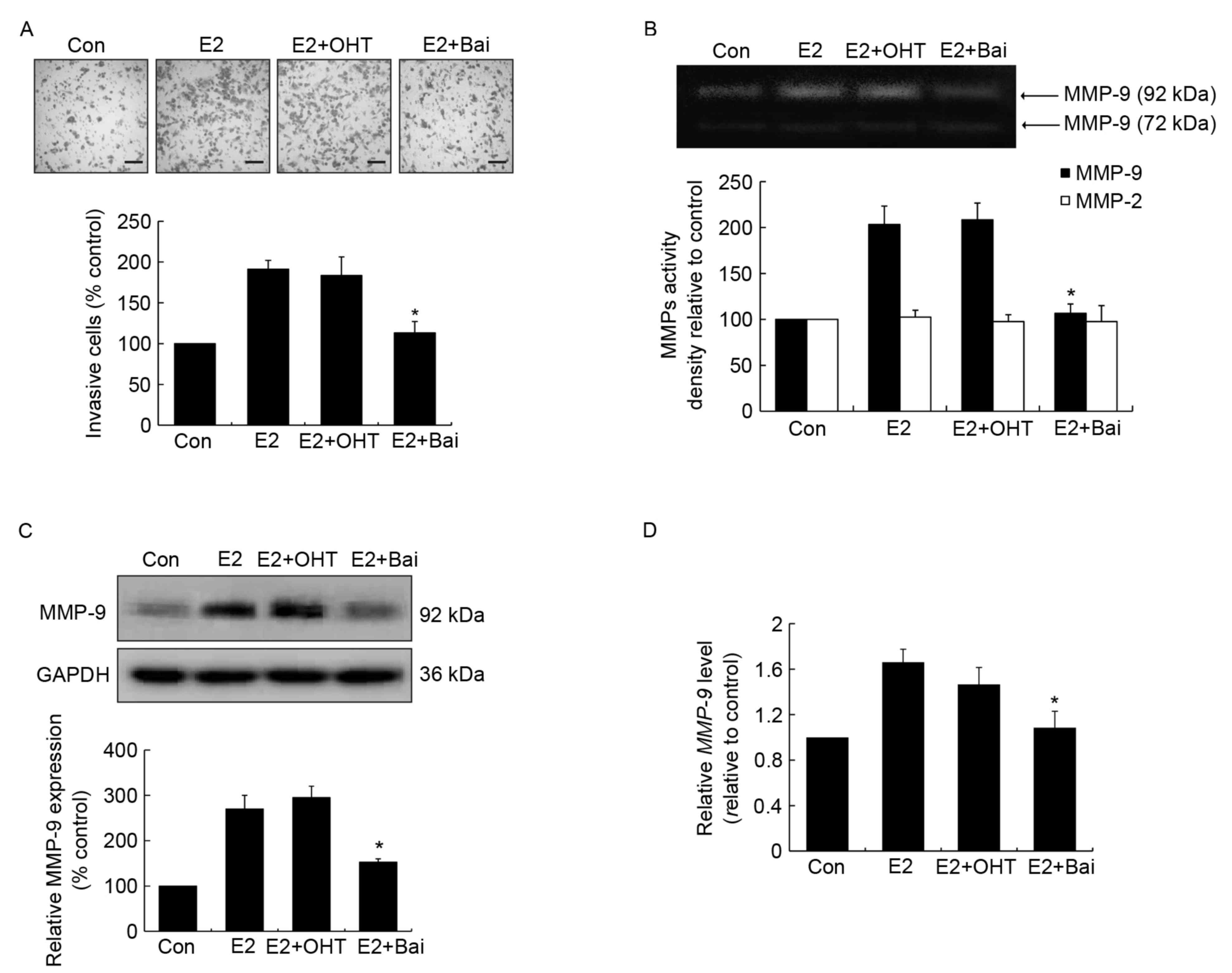
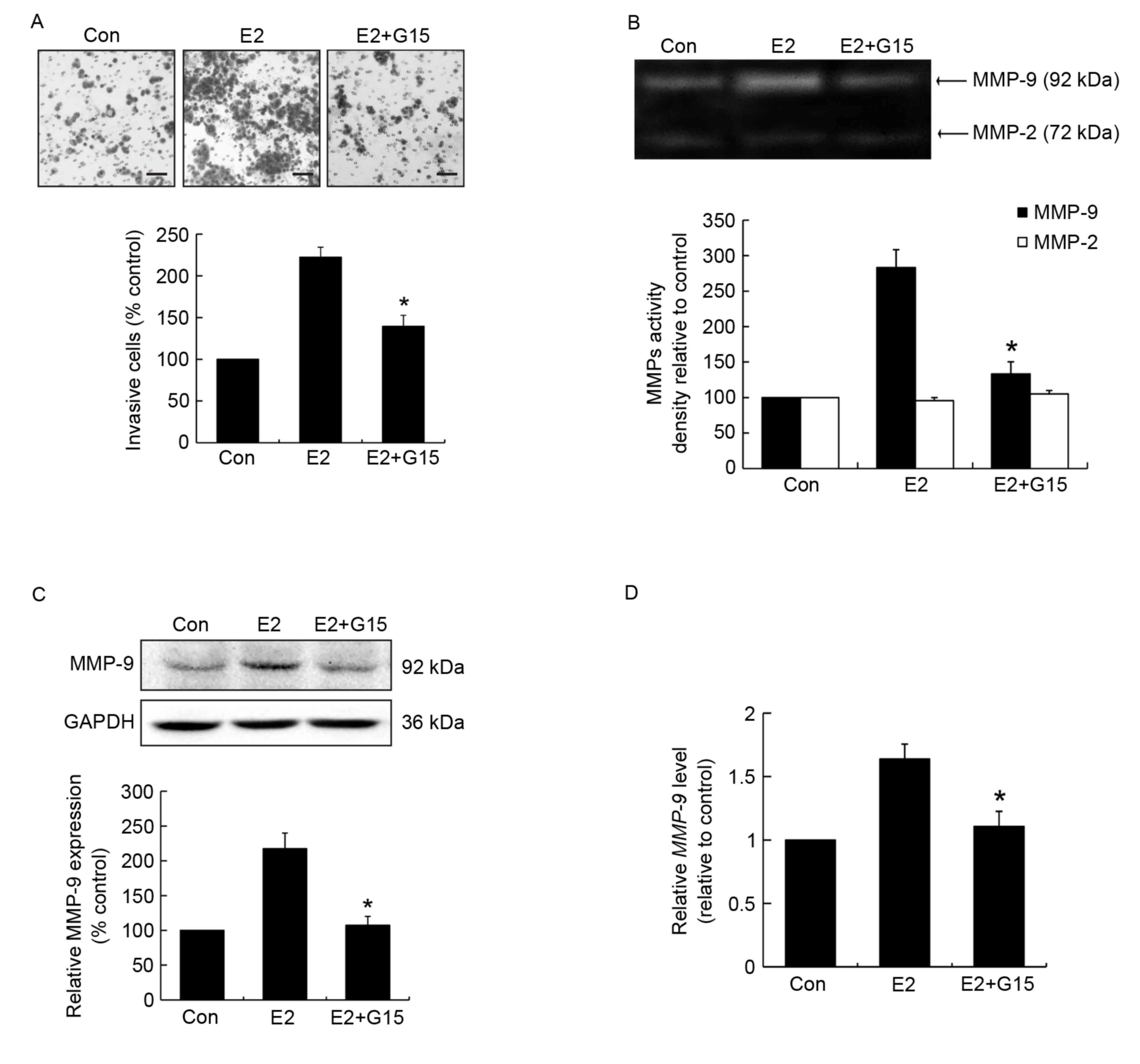
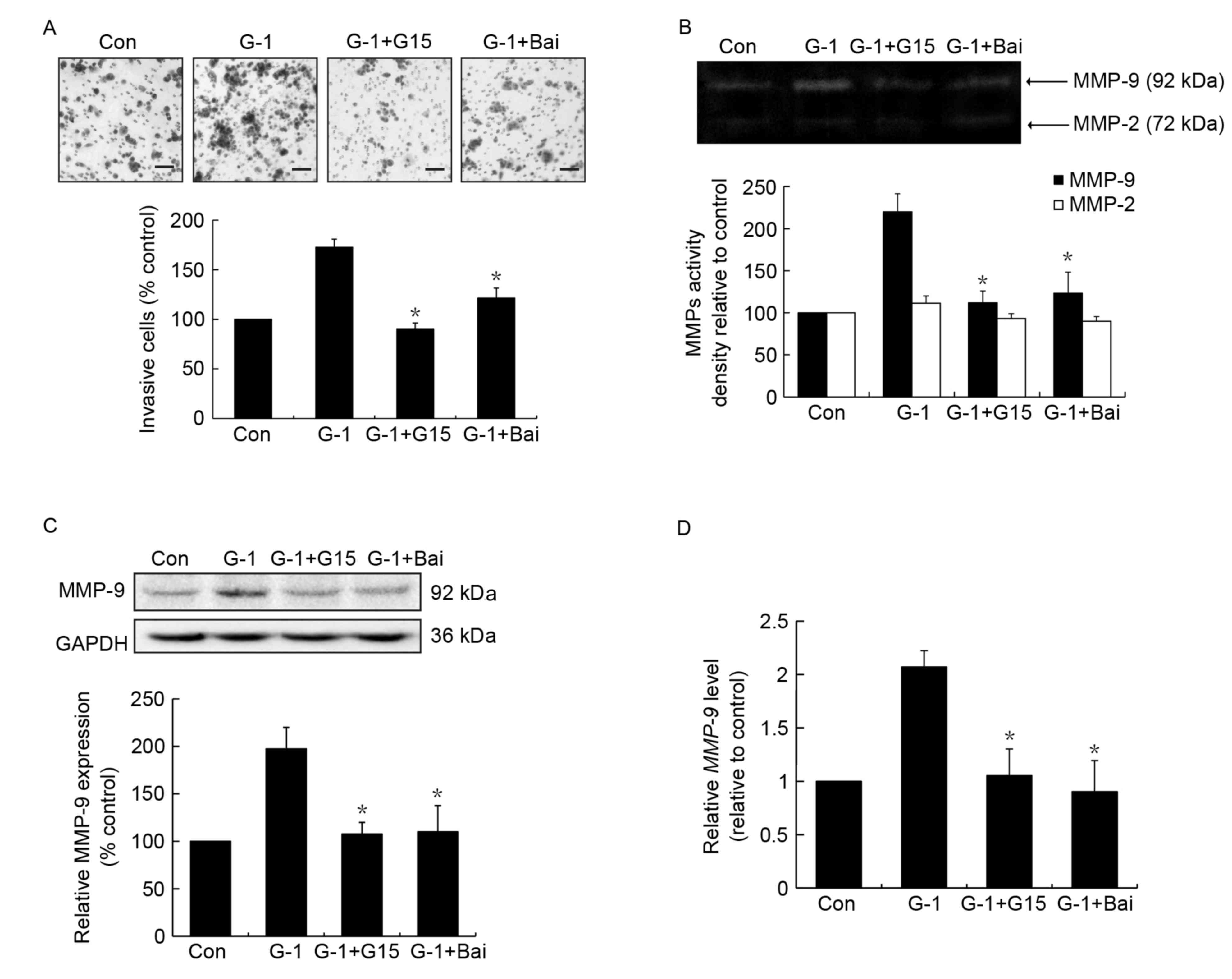
Estrogen performs an important role in the growth and development of breast cancer. There are at least three major receptors, including estrogen receptor (ER)α and β, and G protein‑coupled receptor 30 (GPR30), which mediate the actions of estrogen through using transcriptional and rapid non‑genomic signaling pathways. Flavonoids have been considered candidates for chemopreventive agents in breast cancer. Baicalein, the primary flavonoid derived from the root of Scutellaria baicalensis Georgi, has been reported to exert an anti‑estrogenic effect. In the present study, the effects of baicalein on 17β‑estradiol (E2)‑induced cell invasion, and matrix metalloproteinase‑9 (MMP‑9) expression and activation were investigated. Furthermore, its effects were compared with that of the active form of the ER modulator tamoxifen 4‑hydroxytamoxifen (OHT) and the GPR30 antagonist G15 in ERα‑ and GPR30‑positive MCF‑7 breast cancer cells. The results demonstrated that OHT failed to prevent E2‑induced cell invasion, upregulation and proteolytic activity of MMP‑9. However, baicalein was able to significantly suppress these E2‑induced effects. Furthermore, E2‑stimulated invasion, and MMP‑9 expression and activation were significantly attenuated following G15 treatment. In addition, baicalein significantly inhibited G‑1, a specific GPR30 agonist, induced invasion, and reduced G‑1 promoted expression and activity of MMP‑9, consistent with effects of G15. The results of the present study suggest that baicalein is a therapeutic candidate for GPR30‑positive breast cancer treatment, and besides ERα targeting the GPR30 receptor it may achieve additional therapeutic benefits in breast cancer.
View Figures

Figure 1

Figure 2

Figure 3

View References

1 

Cordera F and Jordan VC: Steroid receptors and their role in the biology and control of breast cancer growth. Semin Oncol. 33:631–641. 2006. View Article : Google Scholar : PubMed/NCBI

2 

Huang B, Warner M and Gustafsson JÅ: Estrogen receptors in breast carcinogenesis and endocrine therapy. Mol Cell Endocrinol. 418:240–244. 2015. View Article : Google Scholar : PubMed/NCBI

3 

Johnston SR: New strategies in estrogen receptor-positive breast cancer. Clin Cancer Res. 16:1979–1987. 2010. View Article : Google Scholar : PubMed/NCBI

4 

Jager NG, Linn SC, Schellens JH and Beijnen JH: Tailored tamoxifen treatment for breast cancer patients: A perspective. Clin Breast Cancer. 15:241–244. 2015. View Article : Google Scholar : PubMed/NCBI

5 

Prossnitz ER and Arterburn JB: International union of basic and clinical pharmacology. XCVII. G protein-coupled estrogen receptor and its pharmacologic modulators. Pharmacol Rev. 67:505–540. 2015. View Article : Google Scholar : PubMed/NCBI

6 

Filardo EJ, Graeber CT, Quinn JA, Resnick MB, Giri D, DeLellis RA, Steinhoff MM and Sabo E: Distribution of GPR30, a seven membrane-spanning estrogen receptor, in primary breast cancer and its association with clinicopathologic determinants of tumor progression. Clin Cancer Res. 12:6359–6366. 2006. View Article : Google Scholar : PubMed/NCBI

7 

Liu Q, Li JG, Zheng XY, Jin F and Dong HT: Expression of CD133, PAX2, ESA, and GPR30 in invasive ductal breast carcinomas. Chin Med J (Engl). 122:2763–2769. 2009.PubMed/NCBI

8 

Marjon NA, Hu C, Hathaway HJ and Prossnitz ER: G protein-coupled estrogen receptor regulates mammary tumorigenesis and metastasis. Mol Cancer Res. 12:1644–1654. 2014. View Article : Google Scholar : PubMed/NCBI

9 

Revankar CM, Cimino DF, Sklar LA, Arterburn JB and Prossnitz ER: A transmembrane intracellular estrogen receptor mediates rapid cell signaling. Science. 307:1625–1630. 2005. View Article : Google Scholar : PubMed/NCBI

10 

Yilmaz M, Christofori G and Lehembre F: Distinct mechanisms of tumor invasion and metastasis. Trends Mol Med. 13:535–541. 2007. View Article : Google Scholar : PubMed/NCBI

11 

Kessenbrock K, Plaks V and Werb Z: Matrix metalloproteinases: Regulators of the tumor microenvironment. Cell. 141:52–67. 2010. View Article : Google Scholar : PubMed/NCBI

12 

Li HC, Cao DC, Liu Y, Hou YF, Wu J, Lu JS, Di GH, Liu G, Li FM, Ou ZL, et al: Prognostic value of matrix metalloproteinases (MMP-2 and MMP-9) in patients with lymph node-negative breast carcinoma. Breast Cancer Res Treat. 88:75–85. 2004. View Article : Google Scholar : PubMed/NCBI

13 

Liu HD, Yan Y, Cao XF, Tan PZ, Wen HX, Lv CM, Li XM and Liu GY: The expression of a novel estrogen receptor, GPR30, in epithelial ovarian carcinoma and its correlation with MMP-9. Sheng Li Xue Bao. 62:524–528. 2010.(In Chinese). PubMed/NCBI

14 

Long L, Cao Y and Tang LD: Transmembrane estrogen receptor GPR30 is more frequently expressed in malignant than benign ovarian endometriotic cysts and correlates with MMP-9 expression. Int J Gynecol Cancer. 22:539–545. 2012. View Article : Google Scholar : PubMed/NCBI

15 

Yan Y, Liu H, Wen H, Jiang X, Cao X, Zhang G and Liu G: The novel estrogen receptor GPER regulates the migration and invasion of ovarian cancer cells. Mol Cell Biochem. 378:1–7. 2013. View Article : Google Scholar : PubMed/NCBI

16 

Rossi RE, Pericleous M, Mandair D, Whyand T and Caplin ME: The role of dietary factors in prevention and progression of breast cancer. Anticancer Res. 34:6861–6875. 2014.PubMed/NCBI

17 

Hui C, Qi X, Qianyong Z, Xiaoli P, Jundong Z and Mantian M: Flavonoids, flavonoid subclasses and breast cancer risk: A meta-analysis of epidemiologic studies. PLoS One. 8:e543182013. View Article : Google Scholar : PubMed/NCBI

18 

Cho YA, Kim J, Park KS, Lim SY, Shin A, Sung MK and Ro J: Effect of dietary soy intake on breast cancer risk according to menopause and hormone receptor status. Eur J Clin Nutr. 64:924–932. 2010. View Article : Google Scholar : PubMed/NCBI

19 

Takemura H, Sakakibara H, Yamazaki S and Shimoi K: Breast cancer and flavonoids - a role in prevention. Curr Pharm Des. 19:6125–6132. 2013. View Article : Google Scholar : PubMed/NCBI

20 

Moon YJ, Wang X and Morris ME: Dietary flavonoids: Effects on xenobiotic and carcinogen metabolism. Toxicol In Vitro. 20:187–210. 2006. View Article : Google Scholar : PubMed/NCBI

21 

Po LS, Chen ZY, Tsang DS and Leung LK: Baicalein and genistein display differential actions on estrogen receptor (ER) transactivation and apoptosis in MCF-7 cells. Cancer Lett. 187:33–40. 2002. View Article : Google Scholar : PubMed/NCBI

22 

Chang HT, Chou CT, Kuo DH, Shieh P, Jan CR and Liang WZ: The mechanism of Ca(2+) movement in the involvement of baicalein-induced cytotoxicity in ZR-75-1 human breast cancer cells. J Nat Prod. 78:1624–1634. 2015. View Article : Google Scholar : PubMed/NCBI

23 

Shang D, Li Z, Zhu Z, Chen H, Zhao L, Wang X and Chen Y: Baicalein suppresses 17-β-estradiol-induced migration, adhesion and invasion of breast cancer cells via the G protein-coupled receptor 30 signaling pathway. Oncol Rep. 33:2077–2085. 2015.PubMed/NCBI

24 

Wang L, Ling Y, Chen Y, Li CL, Feng F, You QD, Lu N and Guo QL: Flavonoid baicalein suppresses adhesion, migration and invasion of MDA-MB-231 human breast cancer cells. Cancer Lett. 297:42–48. 2010. View Article : Google Scholar : PubMed/NCBI

25 

Chen P, Lu N, Ling Y, Chen Y, Hui H, Lu Z, Song X, Li Z, You Q and Guo Q: Inhibitory effects of wogonin on the invasion of human breast carcinoma cells by downregulating the expression and activity of matrix metalloproteinase-9. Toxicology. 282:122–128. 2011. View Article : Google Scholar : PubMed/NCBI

26 

Pello OM, De Pizzol M, Mirolo M, Soucek L, Zammataro L, Amabile A, Doni A, Nebuloni M, Swigart LB, Evan GI, et al: Role of c-MYC in alternative activation of human macrophages and tumor-associated macrophage biology. Blood. 119:411–421. 2012. View Article : Google Scholar : PubMed/NCBI

27 

Ferreira E and Cronjé MJ: Selection of suitable reference genes for quantitative real-time PCR in apoptosis-induced MCF-7 breast cancer cells. Mol Biotechnol. 50:121–128. 2012. View Article : Google Scholar : PubMed/NCBI

28 

Livak KJ and Schmittgen TD: Analysis of relative gene expression data using real-time quantitative PCR and the 2(−Delta Delta C(T)) method. Methods. 25:402–408. 2001. View Article : Google Scholar : PubMed/NCBI

29 

Gialeli C, Theocharis AD and Karamanos NK: Roles of matrix metalloproteinases in cancer progression and their pharmacological targeting. FEBS J. 278:16–27. 2011. View Article : Google Scholar : PubMed/NCBI

30 

Jemal A, Bray F, Center MM, Ferlay J, Ward E and Forman D: Global cancer statistics. CA Cancer J Clin. 61:69–90. 2011. View Article : Google Scholar : PubMed/NCBI

31 

Dowsett M, Cuzick J, Ingle J, Coates A, Forbes J, Bliss J, Buyse M, Baum M, Buzdar A, Colleoni M, et al: Meta-analysis of breast cancer outcomes in adjuvant trials of aromatase inhibitors versus tamoxifen. J Clin Oncol. 28:509–518. 2010. View Article : Google Scholar : PubMed/NCBI

32 

Maggiolini M and Picard D: The unfolding stories of GPR30, a new membrane-bound estrogen receptor. J Endocrinol. 204:105–114. 2010. View Article : Google Scholar : PubMed/NCBI

33 

Wang D, Hu L, Zhang G, Zhang L and Chen C: G protein-coupled receptor 30 in tumor development. Endocrine. 38:29–37. 2010. View Article : Google Scholar : PubMed/NCBI

34 

Catalano S, Giordano C, Panza S, Chemi F, Bonofiglio D, Lanzino M, Rizza P, Romeo F, Fuqua SA, Maggiolini M, et al: Tamoxifen through GPER upregulates aromatase expression: A novel mechanism sustaining tamoxifen-resistant breast cancer cell growth. Breast Cancer Res Treat. 146:273–285. 2014. View Article : Google Scholar : PubMed/NCBI

35 

Ruan SQ, Wang ZH, Wang SW, Fu ZX, Xu KL, Li DB and Zhang SZ: Heregulin-β1-induced GPR30 upregulation promotes the migration and invasion potential of SkBr3 breast cancer cells via ErbB2/ErbB3-MAPK/ERK pathway. Biochem Biophys Res Commun. 420:385–390. 2012. View Article : Google Scholar : PubMed/NCBI

36 

Du GQ, Zhou L, Chen XY, Wan XP and He YY: The G protein-coupled receptor GPR30 mediates the proliferative and invasive effects induced by hydroxytamoxifen in endometrial cancer cells. Biochem Biophys Res Commun. 420:343–349. 2012. View Article : Google Scholar : PubMed/NCBI

37 

Thompson EW, Reich R, Shima TB, Albini A, Graf J, Martin GR, Dickson RB and Lippman ME: Differential regulation of growth and invasiveness of MCF-7 breast cancer cells by antiestrogens. Cancer Res. 48:6764–6768. 1988.PubMed/NCBI

38 

Nilsson UW, Garvin S and Dabrosin C: MMP-2 and MMP-9 activity is regulated by estradiol and tamoxifen in cultured human breast cancer cells. Breast Cancer Res Treat. 102:253–261. 2007. View Article : Google Scholar : PubMed/NCBI

39 

Fedele P, Calvani N, Marino A, Orlando L, Schiavone P, Quaranta A and Cinieri S: Targeted agents to reverse resistance to endocrine therapy in metastatic breast cancer: Where are we now and where are we going? Crit Rev Oncol Hematol. 84:243–251. 2012. View Article : Google Scholar : PubMed/NCBI

40 

Ignatov A, Ignatov T, Weissenborn C, Eggemann H, Bischoff J, Semczuk A, Roessner A, Costa SD and Kalinski T: G-protein-coupled estrogen receptor GPR30 and tamoxifen resistance in breast cancer. Breast Cancer Res Treat. 128:457–466. 2011. View Article : Google Scholar : PubMed/NCBI

41 

Mo Z, Liu M, Yang F, Luo H, Li Z, Tu G and Yang G: GPR30 as an initiator of tamoxifen resistance in hormone-dependent breast cancer. Breast Cancer Res. 15:R1142013. View Article : Google Scholar : PubMed/NCBI

42 

Lin CW, Yang LY, Shen SC and Chen YC: IGF-I plus E2 induces proliferation via activation of ROS-dependent ERKs and JNKs in human breast carcinoma cells. J Cell Physiol. 212:666–674. 2007. View Article : Google Scholar : PubMed/NCBI

43 

Branham WS, Dial SL, Moland CL, Hass BS, Blair RM, Fang H, Shi L, Tong W, Perkins RG and Sheehan DM: Phytoestrogens and mycoestrogens bind to the rat uterine estrogen receptor. J Nutr. 132:658–664. 2002.PubMed/NCBI

44 

Shenouda NS, Zhou C, Browning JD, Ansell PJ, Sakla MS, Lubahn DB and Macdonald RS: Phytoestrogens in common herbs regulate prostate cancer cell growth in vitro. Nutr Cancer. 49:200–208. 2004. View Article : Google Scholar : PubMed/NCBI

Related Articles

  • Abstract
  • View
  • Download
  • Twitter
Copy and paste a formatted citation
Spandidos Publications style
Chen Y, Hong DY, Wang J, Ling‑Hu J, Zhang YY, Pan D, Xu YN, Tao L, Luo H, Shen XC, Shen XC, et al: Baicalein, unlike 4-hydroxytamoxifen but similar to G15, suppresses 17β-estradiol-induced cell invasion, and matrix metalloproteinase-9 expression and activation in MCF-7 human breast cancer cells. Oncol Lett 14: 1823-1830, 2017.
APA
Chen, Y., Hong, D., Wang, J., Ling‑Hu, J., Zhang, Y., Pan, D. ... Shen, X. (2017). Baicalein, unlike 4-hydroxytamoxifen but similar to G15, suppresses 17β-estradiol-induced cell invasion, and matrix metalloproteinase-9 expression and activation in MCF-7 human breast cancer cells. Oncology Letters, 14, 1823-1830. https://doi.org/10.3892/ol.2017.6298
MLA
Chen, Y., Hong, D., Wang, J., Ling‑Hu, J., Zhang, Y., Pan, D., Xu, Y., Tao, L., Luo, H., Shen, X."Baicalein, unlike 4-hydroxytamoxifen but similar to G15, suppresses 17β-estradiol-induced cell invasion, and matrix metalloproteinase-9 expression and activation in MCF-7 human breast cancer cells". Oncology Letters 14.2 (2017): 1823-1830.
Chicago
Chen, Y., Hong, D., Wang, J., Ling‑Hu, J., Zhang, Y., Pan, D., Xu, Y., Tao, L., Luo, H., Shen, X."Baicalein, unlike 4-hydroxytamoxifen but similar to G15, suppresses 17β-estradiol-induced cell invasion, and matrix metalloproteinase-9 expression and activation in MCF-7 human breast cancer cells". Oncology Letters 14, no. 2 (2017): 1823-1830. https://doi.org/10.3892/ol.2017.6298
Copy and paste a formatted citation
x
Spandidos Publications style
Chen Y, Hong DY, Wang J, Ling‑Hu J, Zhang YY, Pan D, Xu YN, Tao L, Luo H, Shen XC, Shen XC, et al: Baicalein, unlike 4-hydroxytamoxifen but similar to G15, suppresses 17β-estradiol-induced cell invasion, and matrix metalloproteinase-9 expression and activation in MCF-7 human breast cancer cells. Oncol Lett 14: 1823-1830, 2017.
APA
Chen, Y., Hong, D., Wang, J., Ling‑Hu, J., Zhang, Y., Pan, D. ... Shen, X. (2017). Baicalein, unlike 4-hydroxytamoxifen but similar to G15, suppresses 17β-estradiol-induced cell invasion, and matrix metalloproteinase-9 expression and activation in MCF-7 human breast cancer cells. Oncology Letters, 14, 1823-1830. https://doi.org/10.3892/ol.2017.6298
MLA
Chen, Y., Hong, D., Wang, J., Ling‑Hu, J., Zhang, Y., Pan, D., Xu, Y., Tao, L., Luo, H., Shen, X."Baicalein, unlike 4-hydroxytamoxifen but similar to G15, suppresses 17β-estradiol-induced cell invasion, and matrix metalloproteinase-9 expression and activation in MCF-7 human breast cancer cells". Oncology Letters 14.2 (2017): 1823-1830.
Chicago
Chen, Y., Hong, D., Wang, J., Ling‑Hu, J., Zhang, Y., Pan, D., Xu, Y., Tao, L., Luo, H., Shen, X."Baicalein, unlike 4-hydroxytamoxifen but similar to G15, suppresses 17β-estradiol-induced cell invasion, and matrix metalloproteinase-9 expression and activation in MCF-7 human breast cancer cells". Oncology Letters 14, no. 2 (2017): 1823-1830. https://doi.org/10.3892/ol.2017.6298
Follow us
  • Twitter
  • LinkedIn
  • Facebook
About
  • Spandidos Publications
  • Careers
  • Cookie Policy
  • Privacy Policy
How can we help?
  • Help
  • Live Chat
  • Contact
  • Email to our Support Team