Spandidos Publications Logo
  • About
    • About Spandidos
    • Aims and Scopes
    • Abstracting and Indexing
    • Editorial Policies
    • Reprints and Permissions
    • Job Opportunities
    • Terms and Conditions
    • Contact
  • Journals
    • All Journals
    • Oncology Letters
      • Oncology Letters
      • Information for Authors
      • Editorial Policies
      • Editorial Board
      • Aims and Scope
      • Abstracting and Indexing
      • Bibliographic Information
      • Archive
    • International Journal of Oncology
      • International Journal of Oncology
      • Information for Authors
      • Editorial Policies
      • Editorial Board
      • Aims and Scope
      • Abstracting and Indexing
      • Bibliographic Information
      • Archive
    • Molecular and Clinical Oncology
      • Molecular and Clinical Oncology
      • Information for Authors
      • Editorial Policies
      • Editorial Board
      • Aims and Scope
      • Abstracting and Indexing
      • Bibliographic Information
      • Archive
    • Experimental and Therapeutic Medicine
      • Experimental and Therapeutic Medicine
      • Information for Authors
      • Editorial Policies
      • Editorial Board
      • Aims and Scope
      • Abstracting and Indexing
      • Bibliographic Information
      • Archive
    • International Journal of Molecular Medicine
      • International Journal of Molecular Medicine
      • Information for Authors
      • Editorial Policies
      • Editorial Board
      • Aims and Scope
      • Abstracting and Indexing
      • Bibliographic Information
      • Archive
    • Biomedical Reports
      • Biomedical Reports
      • Information for Authors
      • Editorial Policies
      • Editorial Board
      • Aims and Scope
      • Abstracting and Indexing
      • Bibliographic Information
      • Archive
    • Oncology Reports
      • Oncology Reports
      • Information for Authors
      • Editorial Policies
      • Editorial Board
      • Aims and Scope
      • Abstracting and Indexing
      • Bibliographic Information
      • Archive
    • Molecular Medicine Reports
      • Molecular Medicine Reports
      • Information for Authors
      • Editorial Policies
      • Editorial Board
      • Aims and Scope
      • Abstracting and Indexing
      • Bibliographic Information
      • Archive
    • World Academy of Sciences Journal
      • World Academy of Sciences Journal
      • Information for Authors
      • Editorial Policies
      • Editorial Board
      • Aims and Scope
      • Abstracting and Indexing
      • Bibliographic Information
      • Archive
    • International Journal of Functional Nutrition
      • International Journal of Functional Nutrition
      • Information for Authors
      • Editorial Policies
      • Editorial Board
      • Aims and Scope
      • Abstracting and Indexing
      • Bibliographic Information
      • Archive
    • International Journal of Epigenetics
      • International Journal of Epigenetics
      • Information for Authors
      • Editorial Policies
      • Editorial Board
      • Aims and Scope
      • Abstracting and Indexing
      • Bibliographic Information
      • Archive
    • Medicine International
      • Medicine International
      • Information for Authors
      • Editorial Policies
      • Editorial Board
      • Aims and Scope
      • Abstracting and Indexing
      • Bibliographic Information
      • Archive
  • Articles
  • Information
    • Information for Authors
    • Information for Reviewers
    • Information for Librarians
    • Information for Advertisers
    • Conferences
  • Language Editing
Spandidos Publications Logo
  • About
    • About Spandidos
    • Aims and Scopes
    • Abstracting and Indexing
    • Editorial Policies
    • Reprints and Permissions
    • Job Opportunities
    • Terms and Conditions
    • Contact
  • Journals
    • All Journals
    • Biomedical Reports
      • Information for Authors
      • Editorial Policies
      • Editorial Board
      • Aims and Scope
      • Abstracting and Indexing
      • Bibliographic Information
      • Archive
    • Experimental and Therapeutic Medicine
      • Information for Authors
      • Editorial Policies
      • Editorial Board
      • Aims and Scope
      • Abstracting and Indexing
      • Bibliographic Information
      • Archive
    • International Journal of Epigenetics
      • Information for Authors
      • Editorial Policies
      • Editorial Board
      • Aims and Scope
      • Abstracting and Indexing
      • Bibliographic Information
      • Archive
    • International Journal of Functional Nutrition
      • Information for Authors
      • Editorial Policies
      • Editorial Board
      • Aims and Scope
      • Abstracting and Indexing
      • Bibliographic Information
      • Archive
    • International Journal of Molecular Medicine
      • Information for Authors
      • Editorial Policies
      • Editorial Board
      • Aims and Scope
      • Abstracting and Indexing
      • Bibliographic Information
      • Archive
    • International Journal of Oncology
      • Information for Authors
      • Editorial Policies
      • Editorial Board
      • Aims and Scope
      • Abstracting and Indexing
      • Bibliographic Information
      • Archive
    • Medicine International
      • Information for Authors
      • Editorial Policies
      • Editorial Board
      • Aims and Scope
      • Abstracting and Indexing
      • Bibliographic Information
      • Archive
    • Molecular and Clinical Oncology
      • Information for Authors
      • Editorial Policies
      • Editorial Board
      • Aims and Scope
      • Abstracting and Indexing
      • Bibliographic Information
      • Archive
    • Molecular Medicine Reports
      • Information for Authors
      • Editorial Policies
      • Editorial Board
      • Aims and Scope
      • Abstracting and Indexing
      • Bibliographic Information
      • Archive
    • Oncology Letters
      • Information for Authors
      • Editorial Policies
      • Editorial Board
      • Aims and Scope
      • Abstracting and Indexing
      • Bibliographic Information
      • Archive
    • Oncology Reports
      • Information for Authors
      • Editorial Policies
      • Editorial Board
      • Aims and Scope
      • Abstracting and Indexing
      • Bibliographic Information
      • Archive
    • World Academy of Sciences Journal
      • Information for Authors
      • Editorial Policies
      • Editorial Board
      • Aims and Scope
      • Abstracting and Indexing
      • Bibliographic Information
      • Archive
  • Articles
  • Information
    • For Authors
    • For Reviewers
    • For Librarians
    • For Advertisers
    • Conferences
  • Language Editing
Login Register Submit
  • This site uses cookies
  • You can change your cookie settings at any time by following the instructions in our Cookie Policy. To find out more, you may read our Privacy Policy.

    I agree
Search articles by DOI, keyword, author or affiliation
Search
Advanced Search
presentation
Oncology Letters
Join Editorial Board Propose a Special Issue
Print ISSN: 1792-1074 Online ISSN: 1792-1082
Journal Cover
September-2017 Volume 14 Issue 3

Full Size Image

Sign up for eToc alerts
Recommend to Library

Journals

International Journal of Molecular Medicine

International Journal of Molecular Medicine

International Journal of Molecular Medicine is an international journal devoted to molecular mechanisms of human disease.

International Journal of Oncology

International Journal of Oncology

International Journal of Oncology is an international journal devoted to oncology research and cancer treatment.

Molecular Medicine Reports

Molecular Medicine Reports

Covers molecular medicine topics such as pharmacology, pathology, genetics, neuroscience, infectious diseases, molecular cardiology, and molecular surgery.

Oncology Reports

Oncology Reports

Oncology Reports is an international journal devoted to fundamental and applied research in Oncology.

Experimental and Therapeutic Medicine

Experimental and Therapeutic Medicine

Experimental and Therapeutic Medicine is an international journal devoted to laboratory and clinical medicine.

Oncology Letters

Oncology Letters

Oncology Letters is an international journal devoted to Experimental and Clinical Oncology.

Biomedical Reports

Biomedical Reports

Explores a wide range of biological and medical fields, including pharmacology, genetics, microbiology, neuroscience, and molecular cardiology.

Molecular and Clinical Oncology

Molecular and Clinical Oncology

International journal addressing all aspects of oncology research, from tumorigenesis and oncogenes to chemotherapy and metastasis.

World Academy of Sciences Journal

World Academy of Sciences Journal

Multidisciplinary open-access journal spanning biochemistry, genetics, neuroscience, environmental health, and synthetic biology.

International Journal of Functional Nutrition

International Journal of Functional Nutrition

Open-access journal combining biochemistry, pharmacology, immunology, and genetics to advance health through functional nutrition.

International Journal of Epigenetics

International Journal of Epigenetics

Publishes open-access research on using epigenetics to advance understanding and treatment of human disease.

Medicine International

Medicine International

An International Open Access Journal Devoted to General Medicine.

Journal Cover
September-2017 Volume 14 Issue 3

Full Size Image

Sign up for eToc alerts
Recommend to Library

  • Article
  • Citations
    • Cite This Article
    • Download Citation
    • Create Citation Alert
    • Remove Citation Alert
    • Cited By
  • Similar Articles
    • Related Articles (in Spandidos Publications)
    • Similar Articles (Google Scholar)
    • Similar Articles (PubMed)
  • Download PDF
  • Download XML
  • View XML
Review Open Access

Yes‑associated protein: A novel molecular target for the diagnosis, treatment and prognosis of hepatocellular carcinoma (Review)

  • Authors:
    • Liang Shan
    • Hongyuan Jiang
    • Lifang Ma
    • Yongchun Yu
  • View Affiliations / Copyright

    Affiliations: Department of Experiment Centre, Shanghai Municipal Hospital of Traditional Chinese Medicine, Shanghai University of Traditional Chinese Medicine, Shanghai 200071, P.R. China, Department of Clinical Laboratory Medicine, Shanghai Municipal Hospital of Traditional Chinese Medicine, Shanghai University of Traditional Chinese Medicine, Shanghai 200071, P.R. China
    Copyright: © Shan et al. This is an open access article distributed under the terms of Creative Commons Attribution License.
  • Pages: 3291-3296
    |
    Published online on: July 20, 2017
       https://doi.org/10.3892/ol.2017.6622
  • Expand metrics +
Metrics: Total Views: 0 (Spandidos Publications: | PMC Statistics: )
Metrics: Total PDF Downloads: 0 (Spandidos Publications: | PMC Statistics: )
Cited By (CrossRef): 0 citations Loading Articles...

This article is mentioned in:


Abstract

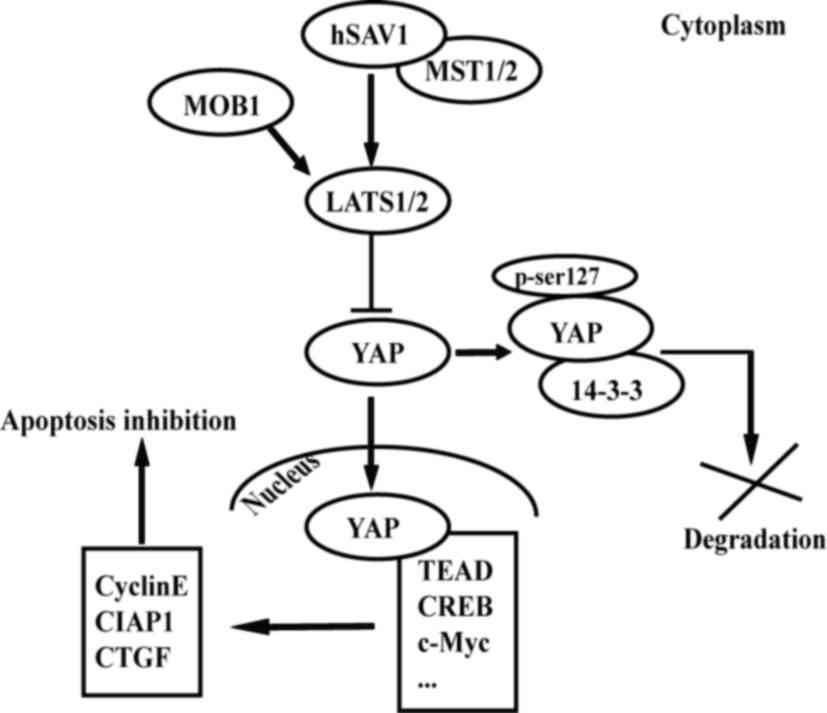
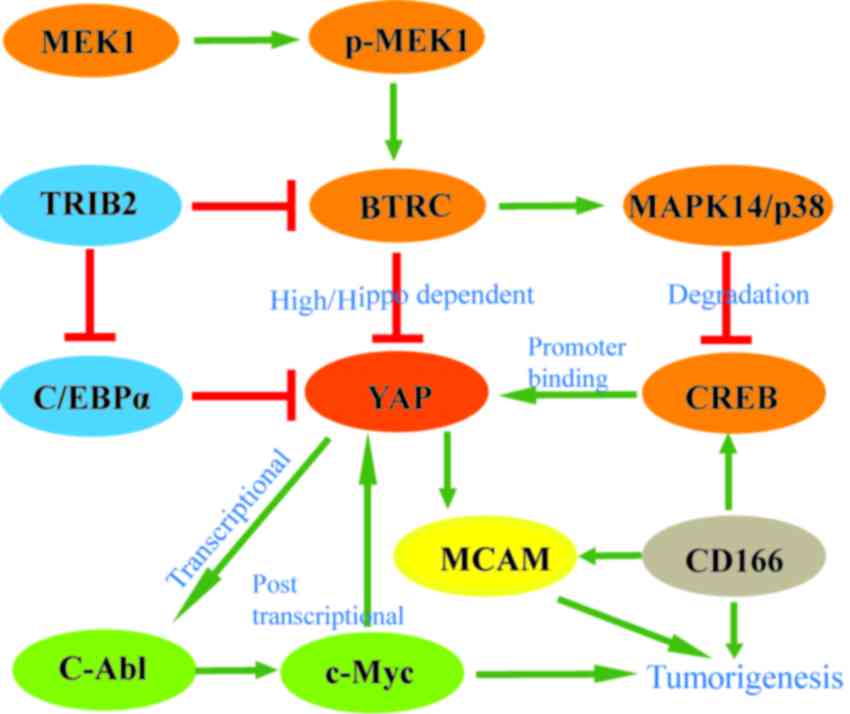
Hepatocellular carcinoma (HCC) is a common type of malignant tumor. The early‑diagnosis and treatment options for HCC are limited, which is primarily due to an incomplete understanding of the underlying molecular mechanisms of the disease. Yes‑associated protein (YAP) overexpression promotes proliferation and phenotypic transformation of HCC cells. Recently, elucidating the molecular mechanisms of the Hippo/YAP signaling pathway and investigating the interactions between the signaling molecules, as a potential strategy for the treatment of HCC, has become an area of interest. The present review will discuss the role of YAP in HCC pathogenesis, and the significance of YAP in diagnosis, treatment and determining the prognosis.
View Figures

Figure 1

Figure 2

View References

1 

Huang J, Wu S, Barrera J, Matthews K and Pan D: The Hippo signaling pathway coordinately regulates cell proliferation and apoptosis by inactivating Yorkie, the Drosophila homolog of YAP. Cell. 122:421–434. 2005. View Article : Google Scholar : PubMed/NCBI

2 

Hilman D and Gat U: The evolutionary history of YAP and the Hippo/YAP pathway. Mol Biol Evol. 28:2403–2417. 2011. View Article : Google Scholar : PubMed/NCBI

3 

Yu FX and Guan KL: The Hippo pathway: Regulators and regulations. Genes Dev. 27:355–371. 2013. View Article : Google Scholar : PubMed/NCBI

4 

Zeng Q and Hong W: The emerging role of the Hippo pathway in cell contact inhibition, organ size control and cancer development in mammals. Cancer Cell. 13:188–192. 2008. View Article : Google Scholar : PubMed/NCBI

5 

Halder G and Johnson RL: Hippo signaling: Growth control and beyond. Development. 138:9–22. 2011. View Article : Google Scholar : PubMed/NCBI

6 

Oh H and Irvine KD: Yorkie: The final destination of Hippo signaling. Trends Cell Biol. 20:410–417. 2010. View Article : Google Scholar : PubMed/NCBI

7 

Schlegelmilch K, Mohseni M, Kirak O, Pruszak J, Rodriguez JR, Zhou D, Kreger BT, Vasioukhin V, Avruch J, Brummelkamp TR and Camargo FD: YAP1 acts downstream of α-catenin to control epidermal proliferation. Cell. 144:782–795. 2011. View Article : Google Scholar : PubMed/NCBI

8 

Zhang J, Ji JY, Yu M, Overholtzer M, Smolen GA, Wang R, Brugge JS, Dyson NJ and Haber DA: YAP-dependent induction of amphiregulin identifies a non-cell-autonomous component of the Hippo pathway. Nat Cell Biol. 11:1444–1450. 2009. View Article : Google Scholar : PubMed/NCBI

9 

Strano S and Blandino G: YAP1 meets tumor suppression. Mol Cell. 27:863–864. 2007. View Article : Google Scholar : PubMed/NCBI

10 

Farazi PA and Depinho RA: Hepatocellular carcinoma pathogenesis: From genes to environment. Nat Rev Cancer. 6:674–687. 2006. View Article : Google Scholar : PubMed/NCBI

11 

Dong J, Feldmann G, Huang J, Wu S, Zhang N, Comerford SA, Gayyed MF, Anders RA, Maitra A and Pan D: Elucidation of a universal size-control mechanism in drosophila and mammals. Cell. 130:1120–1133. 2007. View Article : Google Scholar : PubMed/NCBI

12 

Wang J, Ma L, Weng W, Qiao Y, Zhang Y, He J, Wang H, Xiao W, Li L, Chu Q, et al: Mutual interaction between YAP and CREB promotes tumorigenesis in liver cancer. Hepatology. 58:1011–1020. 2013. View Article : Google Scholar : PubMed/NCBI

13 

Tang X, Chen X, Xu Y, Qiao Y, Zhang X, Wang Y, Guan Y, Sun F and Wang J: CD166 positively regulates MCAM via inhibition to ubiquitin E3 ligases Smurf1 and βTrCP through PI3K/AKT and c-Raf/MEK/ERK signaling in Bel-7402 hepatocellular carcinoma cells. Cell Signal. 27:1694–1702. 2015. View Article : Google Scholar : PubMed/NCBI

14 

Wang Y, Fang R, Cui M, Zhang W, Bai X, Wang H, Liu B, Zhang X and Ye L: The oncoprotein HBXIP up-regulates YAP through activation of transcription factor c-Myb to promote growth of liver cancer. Cancer Lett. 385:234–242. 2017. View Article : Google Scholar : PubMed/NCBI

15 

Xu G, Wang J, Wu F, Wang N, Zhou W, Wang Q, Pan W, Ao G and Yang J: YAP and 14–3-3γ are involved in HS-OA-induced growth inhibition of hepatocellular carcinoma cells: A novel mechanism for hydrogen sulfide releasing oleanolic acid. Oncotarget. 7:52150–52165. 2016. View Article : Google Scholar : PubMed/NCBI

16 

Perra A, Kowalik MA, Ghiso E, Ledda-Columbano GM, Di Tommaso L, Angioni MM, Raschioni C, Testore E, Roncalli M, Giordano S and Columbano A: YAP activation is an early event and a potential therapeutic target in liver cancer development. J Hepatol. 61:1088–1096. 2014. View Article : Google Scholar : PubMed/NCBI

17 

Loforese G, Malinka T, Keogh A, Baier F, Simillion C, Montani M, Halazonetis TD, Candinas D and Stroka D: Impaired liver regeneration in aged mice can be rescued by silencing Hippo core kinases MST1 and MST2. EMBO Mol Med. 9:46–60. 2017. View Article : Google Scholar : PubMed/NCBI

18 

Yi J, Lu L, Yanger K, Wang W, Sohn BH, Stanger BZ, Zhang M, Martin JF, Ajani JA, Chen J, et al: Large tumor suppressor homologs 1 and 2 regulate mouse liver progenitor cell proliferation and maturation through antagonism of the coactivators YAP and TAZ. Hepatology. 64:1757–1772. 2016. View Article : Google Scholar : PubMed/NCBI

19 

Perumal N, Perumal M, Kannan A, Subramani K, Halagowder D and Sivasithamparam N: Morin impedes Yap nuclear translocation and fosters apoptosis through suppression of Wnt/β-catenin and NF-κB signaling in Mst1 overexpressed HepG2 cells. Exp Cell Res. 355:124–141. 2017. View Article : Google Scholar : PubMed/NCBI

20 

Wang J, Park J, Wei Y, Rajurkar M, Cotton JL, Fan Q, Lewis BC, Ji H and Mao J: TRIB2 acts downstream of Wnt/TCF in liver cancer cells to regulate YAP and C/EBPα function. Mol Cell. 51:211–225. 2013. View Article : Google Scholar : PubMed/NCBI

21 

Wang YP and Tang DX: Expression of Yes-associated protein in liver cancer and its correlation with clinicopathological features and prognosis of liver cancer patients. Int J Clin Exp Med. 8:1080–1086. 2015.PubMed/NCBI

22 

Tordjmann T: Hippo signaling: Liver size regulation and beyond. Clin Res Hepatol Gastroenterol. 35:344–346. 2011. View Article : Google Scholar : PubMed/NCBI

23 

Xu MZ, Yao TJ, Lee NP, Ng IO, Chan YT, Zender L, Lowe SW, Poon RT and Luk JM: Yes-associated protein is an independent prognostic marker in hepatocellular carcinoma. Cancer. 115:4576–4585. 2009. View Article : Google Scholar : PubMed/NCBI

24 

Zender L, Spector MS, Xue W, Flemming P, Cordon-Cardo C, Silke J, Fan ST, Luk JM, Wigler M, Hannon GJ, et al: Idetification and validation of oncogenes in liver cancer using an integrative oncogenomic approach. Cell. 125:1253–1267. 2006. View Article : Google Scholar : PubMed/NCBI

25 

Zhao B, Ye X, Yu J, Li L, Li W, Li S, Yu J, Lin JD, Wang CY, Chinnaiyan AM, et al: TEAD mediates YAP-dependent gene induction and growth control. Genes Dev. 22:1962–1971. 2008. View Article : Google Scholar : PubMed/NCBI

26 

Cai WY, Lin LY, Hao H, Zhang SM, Ma F, Hong XX, Zhang H, Liu QF, Ye GD, Sun GB, et al: Yes-associated protein/TEA domain family member and hepatocyte nuclear factor 4-alpha (HNF4α) repress reciprocally to regulate hepatocarcinogenesis in rats and mice. Hepatology. 65:1206–1221. 2017. View Article : Google Scholar : PubMed/NCBI

27 

Lin C, Hu Z, Lei B, Tang B, Yu H, Qiu X and He S: Overexpression of Yes-associated protein and its association with clinicopathological features of hepatocellular carcinoma: A meta-analysis. Liver Int. Mar 26–2017.(Epub ahead of print). View Article : Google Scholar

28 

Song Y, Kim SH, Kim KM, Choi EK, Kim J and Seo HR: Activated hepatic stellate cells play pivotal roles in hepatocellular carcinoma cell chemoresistance and migration in multicellular tumor spheroids. Sci Rep. 6:367502016. View Article : Google Scholar : PubMed/NCBI

29 

Mannaerts I, Leite SB, Verhulst S, Claerhout S, Eysackers N, Thoen LF, Hoorens A, Reynaert H, Halder G and van Grunsven LA: The Hippo pathway effector YAP controls mouse hepatic stellate cell activation. J Hepatol. 63:679–688. 2015. View Article : Google Scholar : PubMed/NCBI

30 

Paget S: The distribution of secondary growths in cancer of the breast. 1989. Cancer Metastasis Rev. 8:98–101. 1989.PubMed/NCBI

31 

Okabe H, Beppu T, Hayashi H, Horino K, Masuda T, Komori H, Ishikawa S, Watanabe M, Takamori H, Iyama K and Baba H: Hepatic stellate cells may relate to progression of intrahepatic cholangiocarcinoma. Ann Surg Oncol. 16:2555–2564. 2009. View Article : Google Scholar : PubMed/NCBI

32 

Lian I, Kim J, Okazawa H, Zhao J, Zhao B, Yu J, Chinnaiyan A, Israel MA, Goldstein LS, Abujarour R, et al: The role of YAP transcription coactivator in regulating stem cell self-renewal and differentiation. Genes Dev. 24:1106–1118. 2010. View Article : Google Scholar : PubMed/NCBI

33 

Ma L, Lin J, Qiao Y, Weng W, Liu W, Wang J and Sun F: Serum CD166: A novel hepatocellular carcinoma tumor marker. Clin Chim Acta. 441:156–162. 2015. View Article : Google Scholar : PubMed/NCBI

34 

Wang J, Tang X, Weng W, Qiao Y, Lin J, Liu W, Liu R, Ma L, Yu W, Yu Y, et al: The membrane protein melanoma cell adhesion molecule (MCAM) is a novel tumor marker that stimulates tumorigenesis in hepatocellular carcinoma. Oncogene. 36:5781–5795. 2015. View Article : Google Scholar

35 

Camargo FD, Gokhale S, Johnnidis JB, Fu D, Bell GW, Jaenisch R and Brummelkamp TR: YAP1 increases organ size and expands undifferentiated progenitor cells. Curr Bio1. 17:2054–2060. 2007. View Article : Google Scholar

36 

Harvey KF, Zhang X and Thomas DM: The Hippo pathway and human cancer. Nat Rev Cancer. 13:246–257. 2013. View Article : Google Scholar : PubMed/NCBI

37 

Liu AM, Xu MZ, Chen J, Poon RT and Luk JM: Targeting YAP and Hippo signaling pathway in liver cancer. Expert Opin Ther Targets. 14:855–868. 2010. View Article : Google Scholar : PubMed/NCBI

38 

Zhou D, Conrad C, Xia F, Park JS, Payer B, Yin Y, Lauwers GY, Thasler W, Lee JT, Avruch J and Bardeesy N: Mst1 and Mst2 maintain hepatocyte quiescence and sup-press hepatocellular carcinoma development through inac-tivation of the Yap1 oncogene. Cancer Cell. 16:425–438. 2009. View Article : Google Scholar : PubMed/NCBI

39 

Liu AM, Poon RT and Luk JM: MicroRNA-375 targets Hippo-signaling effector YAP in liver cancer and inhibits tumor properties. Biochem Biophys Res Commun. 394:623–627. 2010. View Article : Google Scholar : PubMed/NCBI

40 

Wang Y, Cui M, Sun BD, Liu FB, Zhang XD and Ye LH: miR-506 suppresses proliferation of hepatoma cells through targeting YAP mRNA 3′UTR. Acta Pharmacol Sin. 35:1207–1214. 2014. View Article : Google Scholar : PubMed/NCBI

41 

Bai N, Zhang C, Liang N, Zhang Z, Chang A, Yin J, Li Z, Luo N, Tan X, Luo N, et al: Yes-associated protein (YAP) increases chemosensitivity of hepatocellular carcinoma cells by modulation of p53. Cancer Biol Ther. 14:511–520. 2013. View Article : Google Scholar : PubMed/NCBI

42 

Zhang W and Cohen SM: The Hippo pathway acts via p53 and microRNAs to control proliferation and proapoptotic gene expression during tissue growth. Biol Open. 2:822–828. 2013. View Article : Google Scholar : PubMed/NCBI

43 

Shimizu D, Inokawa Y, Sonohara F, Inaoka K and Nomoto S: Search for useful biomarkers in hepatocellular carcinoma, tumor factors and background liver factors (Review). Oncol Rep. 37:2527–2542. 2017.PubMed/NCBI

44 

Noubissi FK, Elcheva I, Bhatia N, Shakoori A, Ougolkov A, Liu J, Minamoto T, Ross J, Fuchs SY and Spiegelman VS: CRD-BP mediates stabilization of betaTrCP1 and c-myc mRNA in response to beta-catenin signalling. Nature. 441:898–901. 2006. View Article : Google Scholar : PubMed/NCBI

45 

Thompson MD and Monga SP: Wnt/beta-catenin signaling in liver health and disease. Hepatology. 45:1298–1305. 2007. View Article : Google Scholar : PubMed/NCBI

46 

Qiao Y, Zhang Y and Wang J: Ubiquitin E3 ligase SCF(β-TRCP) regulates TRIB2 stability in liver cancer cells. Biochem Biophys Res Commun. 441:555–559. 2013. View Article : Google Scholar : PubMed/NCBI

47 

Xiao W, Wang J, Ou C, Zhang Y, Ma L, Weng W, Pan Q and Sun F: Mutual interaction between YAP and c-Myc is critical for carcinogenesis in liver cancer. Biochem Biophys Res Commun. 439:167–172. 2013. View Article : Google Scholar : PubMed/NCBI

48 

Xu Y, Stamenkovic I and Yu Q: CD44 attenuates activation of the Hippo signaling pathway and is a prime therapeutic target for glioblastoma. Cancer Res. 70:2455–2464. 2010. View Article : Google Scholar : PubMed/NCBI

49 

Fernandez LA, Northcott PA, Dalton J, Fraga C, Ellison D, Angers S, Taylor MD and Kenney AM: YAP1 is amplified and upregulated in hedgehog-associated medulloblastomas and mediates Sonic hedgehog-driven neural precursor proliferation. Genes Dev. 23:2729–2741. 2009. View Article : Google Scholar : PubMed/NCBI

50 

Yu JZ, Poulton J, Huang YC and Deng WM: The hippo pathway promotes Notch signaling in regulation of cell differentiation, proliferation, and oocyte polarity. PLoS One. 3:e17612008. View Article : Google Scholar : PubMed/NCBI

51 

Kim D, Shu S, Coppola MD, Kaneko S, Yuan ZQ and Cheng JQ: Regulation of proapoptotic mammalian ste20-like kinase MST2 by the IGF1-Akt pathway. PLoS One. 5:e96162010. View Article : Google Scholar : PubMed/NCBI

52 

Yuan Z, Kim D, Shu S, Wu J, Guo J, Xiao L, Kaneko S, Coppola D and Cheng JQ: Phosphoinositide 3-kinase/Akt inhibits MST1-mediated pro-apoptotic signaling through phosphorylation of threonine 120. J Biol Chem. 285:3815–3824. 2010. View Article : Google Scholar : PubMed/NCBI

53 

Joliat GR, Allemann P, Labgaa I, Demartines N and Halkic N: Treatment and outcomes of recurrent hepatocellular carcinomas. Langenbecks Arch Surg. May 11–2017.(Epub ahead of print). View Article : Google Scholar : PubMed/NCBI

54 

Tu K, Yang W, Li C, Zheng X, Lu Z, Guo C, Yao Y and Liu Q: Fbxw7 is an independent prognostic marker and induces apoptosis and growth arrest by regulating YAP abundance in hepatocellular carcinoma. Mol Cancer. 13:1102014. View Article : Google Scholar : PubMed/NCBI

Related Articles

  • Abstract
  • View
  • Download
  • Twitter
Copy and paste a formatted citation
Spandidos Publications style
Shan L, Jiang H, Ma L and Yu Y: Yes‑associated protein: A novel molecular target for the diagnosis, treatment and prognosis of hepatocellular carcinoma (Review). Oncol Lett 14: 3291-3296, 2017.
APA
Shan, L., Jiang, H., Ma, L., & Yu, Y. (2017). Yes‑associated protein: A novel molecular target for the diagnosis, treatment and prognosis of hepatocellular carcinoma (Review). Oncology Letters, 14, 3291-3296. https://doi.org/10.3892/ol.2017.6622
MLA
Shan, L., Jiang, H., Ma, L., Yu, Y."Yes‑associated protein: A novel molecular target for the diagnosis, treatment and prognosis of hepatocellular carcinoma (Review)". Oncology Letters 14.3 (2017): 3291-3296.
Chicago
Shan, L., Jiang, H., Ma, L., Yu, Y."Yes‑associated protein: A novel molecular target for the diagnosis, treatment and prognosis of hepatocellular carcinoma (Review)". Oncology Letters 14, no. 3 (2017): 3291-3296. https://doi.org/10.3892/ol.2017.6622
Copy and paste a formatted citation
x
Spandidos Publications style
Shan L, Jiang H, Ma L and Yu Y: Yes‑associated protein: A novel molecular target for the diagnosis, treatment and prognosis of hepatocellular carcinoma (Review). Oncol Lett 14: 3291-3296, 2017.
APA
Shan, L., Jiang, H., Ma, L., & Yu, Y. (2017). Yes‑associated protein: A novel molecular target for the diagnosis, treatment and prognosis of hepatocellular carcinoma (Review). Oncology Letters, 14, 3291-3296. https://doi.org/10.3892/ol.2017.6622
MLA
Shan, L., Jiang, H., Ma, L., Yu, Y."Yes‑associated protein: A novel molecular target for the diagnosis, treatment and prognosis of hepatocellular carcinoma (Review)". Oncology Letters 14.3 (2017): 3291-3296.
Chicago
Shan, L., Jiang, H., Ma, L., Yu, Y."Yes‑associated protein: A novel molecular target for the diagnosis, treatment and prognosis of hepatocellular carcinoma (Review)". Oncology Letters 14, no. 3 (2017): 3291-3296. https://doi.org/10.3892/ol.2017.6622
Follow us
  • Twitter
  • LinkedIn
  • Facebook
About
  • Spandidos Publications
  • Careers
  • Cookie Policy
  • Privacy Policy
How can we help?
  • Help
  • Live Chat
  • Contact
  • Email to our Support Team